

ISO 14649-111:2010
(Main)Industrial automation systems and integration — Physical device control — Data model for computerized numerical controllers — Part 111: Tools for milling machines
General Information
- Abstract
ISO 14649-111:2010 specifies the data elements describing cutting tool data for milling machine tools and machining centres, which work together with the process data for milling machine tools and machining centres specified in ISO 14649-11. They can be used as criteria for selecting one of several operations; they do not describe complete information on a particular tool. Therefore, leaving out optional attributes gives the controller more freedom to select from a larger set of tools. ISO 14649-111:2010 also specifies the information to be provided in the tool set-up sheet: tool identifier; tool type; tool geometry; application-dependent expected tool life. The following data types are outside its scope: normative tool life; tool location in the tool changer; adaptive items also know as tool holders or tool clamping devices; tools for other technologies, such as turning, grinding and electrical discharge machining (EDM). ISO 14649-111:2010 uses the EXPRESS language as specified in ISO 10303-11.
- Status
- Published
- Publication Date
- 05-Sep-2010
- Technical Committee
- ISO/TC 184/SC 1 - Industrial cyber and physical device control
- Drafting Committee
- ISO/TC 184/SC 1 - Industrial cyber and physical device control
- Current Stage
- 9092 - International Standard to be revised
- Start Date
- 19-Aug-2024
- Completion Date
- 29-Aug-2026
Overview
ISO 14649-111:2010 - part of the ISO 14649 series - defines a standardized data model for cutting tools used on milling machines and machining centres. It specifies the data elements (using the EXPRESS language of ISO 10303-11) that describe tool types, basic geometry and selection criteria so CNC controllers and CAD/CAM systems can exchange tool-related information consistently. The standard also defines what information belongs on the tool set-up sheet (tool identifier, tool type, tool geometry and application-dependent expected tool life).
Key topics and requirements
- Data elements for milling tools: A schema (milling_machine_tool_schema) lists entities and attributes that describe cutting components and tool geometries (e.g., endmills, facemills, drills, reamers, taps, thread mills).
- Tool selection criteria: Attributes are intended to be used as selection criteria for controllers and tool management systems rather than as a full physical specification of a specific tool.
- Tool set-up sheet content: Mandatory/typical items include tool identifier, tool type, geometry and expected tool life (application-dependent).
- Use of EXPRESS: The standard uses the EXPRESS modelling language (ISO 10303-11) for formal schema definition and data exchange.
- Scope boundaries: Explicitly excludes normative tool life values, tool location in the tool changer, adaptive items (holders/clamping devices) and tools for technologies such as turning, grinding and EDM.
Practical applications
- CNC controller vendors can implement the schema to enable controllers to select appropriate tools from a tool magazine or database based on process requirements rather than simple tool ID codes.
- CAD/CAM developers can export tool data in a standard format for use by compliant CNCs or tool management systems, reducing reliance on machine-specific G/M-code-only workflows.
- Manufacturing engineers and process planners use the model to ensure tool descriptions in NC programs are rich enough for automated selection while remaining flexible (optional attributes allow broader selection).
- Tool management and MES integrations benefit from consistent tool metadata to support inventory, setup sheets and lifecycle management.
- Machine tool integrators and postprocessor developers find the standard helpful when migrating from legacy ISO 6983 (G-code) to feature- and process-oriented programming.
Related standards
- ISO 14649-11: Process data for milling - complementary process model used together with Part 111.
- ISO 14649-10: General process data (application reference model).
- ISO 10303-11: EXPRESS language (used for schema definitions).
- ISO 10303 parts (e.g., Part 41/42) for product data representation and geometry.
Keywords: ISO 14649-111:2010, milling tools data model, CNC tool data, tool set-up sheet, EXPRESS, ISO 10303-11, tool selection, machining centres, CAD/CAM to CNC interoperability.
Relations
- Effective Date
- 15-Apr-2008
Get Certified
Connect with accredited certification bodies for this standard

DVS-ZERT GmbH
German welding certification society.
CARES (UK Certification Authority for Reinforcing Steels)
UK certification for reinforcing steels and construction.
EWF/IIW (European/International Welding Federation)
International welding personnel certification.
Sponsored listings
Frequently Asked Questions
ISO 14649-111:2010 is a standard published by the International Organization for Standardization (ISO). Its full title is "Industrial automation systems and integration — Physical device control — Data model for computerized numerical controllers — Part 111: Tools for milling machines". This standard covers: ISO 14649-111:2010 specifies the data elements describing cutting tool data for milling machine tools and machining centres, which work together with the process data for milling machine tools and machining centres specified in ISO 14649-11. They can be used as criteria for selecting one of several operations; they do not describe complete information on a particular tool. Therefore, leaving out optional attributes gives the controller more freedom to select from a larger set of tools. ISO 14649-111:2010 also specifies the information to be provided in the tool set-up sheet: tool identifier; tool type; tool geometry; application-dependent expected tool life. The following data types are outside its scope: normative tool life; tool location in the tool changer; adaptive items also know as tool holders or tool clamping devices; tools for other technologies, such as turning, grinding and electrical discharge machining (EDM). ISO 14649-111:2010 uses the EXPRESS language as specified in ISO 10303-11.
ISO 14649-111:2010 specifies the data elements describing cutting tool data for milling machine tools and machining centres, which work together with the process data for milling machine tools and machining centres specified in ISO 14649-11. They can be used as criteria for selecting one of several operations; they do not describe complete information on a particular tool. Therefore, leaving out optional attributes gives the controller more freedom to select from a larger set of tools. ISO 14649-111:2010 also specifies the information to be provided in the tool set-up sheet: tool identifier; tool type; tool geometry; application-dependent expected tool life. The following data types are outside its scope: normative tool life; tool location in the tool changer; adaptive items also know as tool holders or tool clamping devices; tools for other technologies, such as turning, grinding and electrical discharge machining (EDM). ISO 14649-111:2010 uses the EXPRESS language as specified in ISO 10303-11.
ISO 14649-111:2010 is classified under the following ICS (International Classification for Standards) categories: 25.040.20 - Numerically controlled machines. The ICS classification helps identify the subject area and facilitates finding related standards.
ISO 14649-111:2010 has the following relationships with other standards: It is inter standard links to ISO 6983-1:1982. Understanding these relationships helps ensure you are using the most current and applicable version of the standard.
ISO 14649-111:2010 is available in PDF format for immediate download after purchase. The document can be added to your cart and obtained through the secure checkout process. Digital delivery ensures instant access to the complete standard document.
Standards Content (Sample)
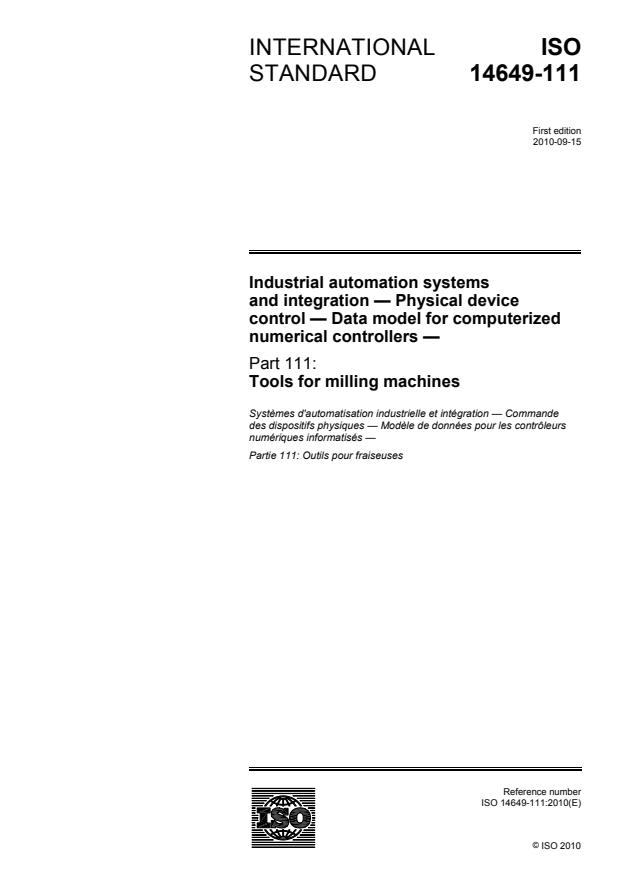
INTERNATIONAL ISO
STANDARD 14649-111
First edition
2010-09-15
Industrial automation systems
and integration — Physical device
control — Data model for computerized
numerical controllers —
Part 111:
Tools for milling machines
Systèmes d'automatisation industrielle et intégration — Commande
des dispositifs physiques — Modèle de données pour les contrôleurs
numériques informatisés —
Partie 111: Outils pour fraiseuses
Reference number
©
ISO 2010
PDF disclaimer
This PDF file may contain embedded typefaces. In accordance with Adobe's licensing policy, this file may be printed or viewed but
shall not be edited unless the typefaces which are embedded are licensed to and installed on the computer performing the editing. In
downloading this file, parties accept therein the responsibility of not infringing Adobe's licensing policy. The ISO Central Secretariat
accepts no liability in this area.
Adobe is a trademark of Adobe Systems Incorporated.
Details of the software products used to create this PDF file can be found in the General Info relative to the file; the PDF-creation
parameters were optimized for printing. Every care has been taken to ensure that the file is suitable for use by ISO member bodies. In
the unlikely event that a problem relating to it is found, please inform the Central Secretariat at the address given below.
© ISO 2010
All rights reserved. Unless otherwise specified, no part of this publication may be reproduced or utilized in any form or by any means,
electronic or mechanical, including photocopying and microfilm, without permission in writing from either ISO at the address below or
ISO's member body in the country of the requester.
ISO copyright office
Case postale 56 • CH-1211 Geneva 20
Tel. + 41 22 749 01 11
Fax + 41 22 749 09 47
E-mail copyright@iso.org
Web www.iso.org
Published in Switzerland
ii © ISO 2010 – All rights reserved
Contents Page
Foreword .iv
Introduction.v
1 Scope.1
2 Normative references.2
3 Terms and definitions .2
4 Cutting tools for milling machine tools and machining centres .2
4.1 Header and references.2
4.2 Syntax of milling machine cutting tools .3
4.2.1 Milling machine cutting tools.3
4.2.2 Cutting component.3
4.2.3 Hand of cut type .4
4.3 Catalogue of milling machine cutting tools.4
4.3.1 Drilling cutting tool.4
4.3.2 NC spot drill (centredrill) .4
4.3.3 Counterbore .5
4.3.4 Countersink.5
4.3.5 Twist drill.5
4.3.6 Tapered drill .5
4.3.7 Spade drill .6
4.3.8 Step drill .6
4.3.9 Milling cutting tool.6
4.3.10 Facemill .7
4.3.11 Shouldermill.7
4.3.12 Endmill.7
4.3.13 Ballnose endmill .7
4.3.14 Bullnose endmill.8
4.3.15 Profiled endmill.8
4.3.16 T-slot mill.8
4.3.17 Dovetail mill .8
4.3.18 Side mill.9
4.3.19 Thread mill .9
4.3.20 Reaming cutting tool.9
4.3.21 Combined drill and reamer.10
4.3.22 Tapered reamer.10
4.3.23 Rotating boring cutting tool .10
4.3.24 Tapping cutting tool.11
4.3.25 Combined drill and tap.11
4.4 End of schema .11
Annex A (normative) EXPRESS listing .12
Annex B (informative) Tool body illustrations .16
Annex C (informative) EXPRESS-G diagram.19
Bibliography.22
Foreword
ISO (the International Organization for Standardization) is a worldwide federation of national standards bodies
(ISO member bodies). The work of preparing International Standards is normally carried out through ISO
technical committees. Each member body interested in a subject for which a technical committee has been
established has the right to be represented on that committee. International organizations, governmental and
non-governmental, in liaison with ISO, also take part in the work. ISO collaborates closely with the
International Electrotechnical Commission (IEC) on all matters of electrotechnical standardization.
International Standards are drafted in accordance with the rules given in the ISO/IEC Directives, Part 2.
The main task of technical committees is to prepare International Standards. Draft International Standards
adopted by the technical committees are circulated to the member bodies for voting. Publication as an
International Standard requires approval by at least 75 % of the member bodies casting a vote.
Attention is drawn to the possibility that some of the elements of this document may be the subject of patent
rights. ISO shall not be held responsible for identifying any or all such patent rights.
ISO 14649-111 was prepared by Technical Committee ISO/TC 184, Automation systems and integration,
Subcommittee SC 1, Physical device control.
ISO 14649 consists of the following parts, under the general title Industrial automation systems and
integration — Physical device control — Data model for computerized numerical controllers:
⎯ Part 1: Overview and fundamental principles
⎯ Part 10: General process data
⎯ Part 11: Process data for milling
⎯ Part 12: Process data for turning
⎯ Part 111: Tools for milling machines
⎯ Part 121: Tools for turning machines
The following parts are under preparation:
⎯ Part 13: Process data for wire-EDM
⎯ Part 14: Process data for sink-EDM
Machine tool data model for general manufacturing processes is to form the subject of a future Part 110.
Gaps in the numbering were left to allow further additions. ISO 14649-10 is the ISO 10303 application
reference model (ARM) for process-independent data. ISO 10303 ARMs for specific technologies are added
after Part 10.
ISO 14649 is harmonized with ISO 10303 in the common field of product data over the whole life cycle.
ISO 14649-1:2003, Figure 1, shows the different fields of standardization between ISO 14649, ISO 10303 and
CNC manufacturers with respect to implementation and software development.
iv © ISO 2010 – All rights reserved
Introduction
Modern manufacturing enterprises are built from facilities spread around the globe, which contain equipment
from hundreds of different manufacturers. Immense volumes of product information will be transferred
between the various facilities and machines. Today's digital communications standards have solved the
problem of reliably transferring information across global networks. For mechanical parts, the description of
product data has been standardized by ISO 10303. This leads to the possibility of using standard data
throughout the entire process chain in the manufacturing enterprise. Impediments to realizing this principle are
the data formats used at the machine level. Most computer numerical control (CNC) machines are
programmed in the ISO 6983 “G and M code” language. Programs are typically generated by computer-aided
manufacturing (CAM) systems that use computer-aided design (CAD) information. However, ISO 6983 limits
program portability for three reasons. First, the language focuses on programming the tool centre path with
respect to machine axes, rather than the machining process with respect to the part. Second, ISO 6983
defines the syntax of program statements, but in most cases leaves the semantics ambiguous. Third, vendors
usually supplement the language with extensions that are not covered in the limited scope of ISO 6983.
ISO 14649 is a new model of data transfer between CAD/CAM systems and CNC machines, which replaces
ISO 6983. It remedies the shortcomings of ISO 6983 by specifying machining processes rather than machine
tool motion, using the object-oriented concept of Workingsteps. Workingsteps correspond to high-level
machining features and associated process parameters. CNCs are responsible for translating Workingsteps to
axis motion and tool operation. A major benefit of ISO 14649 is its use of existing data models from
ISO 10303. As ISO 14649 provides a comprehensive model of the manufacturing process, it can also be used
as the basis for a bi- and multi-directional data exchange between all other information technology systems.
ISO 14649 represents an object-oriented, information- and context-preserving approach for NC (numerical
control) programming that supersedes data reduction to simple switching instructions or linear and circular
movements. As it is object- and feature-oriented and describes the machining operations executed on the
workpiece, and not machine-dependent axis motions, it will be run on different machine tools or controllers.
This compatibility will spare all data adaptations by postprocessors, if the new data model is correctly
implemented on the NC controllers. If old NC programs in ISO 6983 are to be used on such controllers, it is
necessary that the corresponding interpreters be able to process the different NC program types in parallel.
ISO TC 184/SC 1/WG 7 envisions a gradual evolution from ISO 6983 programming to portable feature-based
programming. Early adopters of ISO 14649 will certainly support data input of legacy “G and M codes”
manually or through programs, just as modern controllers support both command-line interfaces and graphical
user interfaces. This will likely be made easier as open-architecture controllers become more prevalent.
Therefore, ISO 14649 does not include legacy program statements, which would otherwise dilute the
effectiveness of ISO 14649.
INTERNATIONAL STANDARD ISO 14649-111:2010(E)
Industrial automation systems and integration — Physical
device control — Data model for computerized numerical
controllers —
Part 111:
Tools for milling machines
1 Scope
This part of ISO 14649 specifies the data elements describing cutting tool data for milling machine tools and
machining centres, which work together with the process data for milling machine tools and machining centres
specified in ISO 14649-11. They can be used as criteria for selecting one of several operations; they do not
describe complete information on a particular tool. Therefore, leaving out optional attributes gives the
controller more freedom to select from a larger set of tools.
NOTE 1 The numerical control (NC) is assumed to have access to complete description of specific tools in a database.
The milling_machine_tool_schema defined in this part of ISO 14649 serves as a basic tool schema, including the
information required by the CNC to select a tool from the machine tool's tool magazine.
NOTE 2 In ISO 6983, the tool is defined by its identifier (e.g. “T8”). No further information concerning the tool type or
geometry is given. This information is part of the tool set-up sheet, which is supplied with the NC program to the machine.
The tool set-up sheet gives the relationship between the tool location (e.g. “slot 8 of the tool magazine”) and the type of
tool (e.g. “drill 4 mm”).
This part of ISO 14649 also specifies the information to be provided in the tool set-up sheet:
⎯ tool identifier;
⎯ tool type;
⎯ tool geometry;
⎯ application-dependent expected tool life.
The milling_machine_tool_schema does not include information which is part of the tool database. The tool
database is related to the machine tool and the tool itself, but is independent of the NC program. The following
data types are outside the scope of this part of ISO 14649:
⎯ normative tool life;
⎯ tool location in the tool changer;
⎯ adaptive items also know as tool holders or tool clamping devices;
1)
⎯ tools for other technologies, such as turning, grinding and electrical discharge machining (EDM) .
1) These technologies are described in other parts of ISO 14649.
NOTE 3 It is important to understand that all length measure types used in this part of ISO 14649 are not toleranced
length measure types because they are used to describe the tools required for the manufacturing of a workpiece, not the
actual dimensions of the tools available at the machine. A real tool will be selected by the tool management based on the
actual tool dimensions and the tolerances of features.
This part of ISO 14649 uses the EXPRESS language as specified in ISO 10303-11.
2 Normative references
The following referenced documents are indispensable for the application of this document. For dated
references, only the edition cited applies. For undated references, the latest edition of the referenced
document (including any amendments) applies.
ISO 3002-1, Basic quantities in cutting and grinding — Part 1: Geometry of the active part of cutting tools —
General terms, reference systems, tool and working angles, chip breakers
ISO 10303-41, Industrial automation systems and integration — Product data representation and exchange —
Part 41: Integrated generic resource: Fundamentals of product description and support
ISO 10303-42, Industrial automation systems and integration — Product data representation and exchange —
Part 42: Integrated generic resource: Geometric and topological representation
ISO 14649-10, Industrial automation systems and integration — Physical device control — Data model for
computerized numerical controllers — Part 10: General process data
ISO 14649-11, Industrial automation systems and integration — Physical device control — Data model for
computerized numerical controllers — Part 11: Process data for milling
3 Terms and definitions
For the purposes of this document, the terms and definitions given in ISO 14649-10, ISO 14649-11 and the
following apply.
3.1
overall assembly length
protruding length
dimension from the gauge plane to the frontmost point of the cutting tool, measured along the cutting tool axis
3.2
tool offset length
distance from the gauge plane to the specified point determined by the main function of the cutting component
4 Cutting tools for milling machine tools and machining centres
4.1 Header and references
The following listing gives the header and the list of entities referenced within this schema.
SCHEMA milling_machine_tool_schema;
(* Version 14.1 of April 30, 2004
Author: ISO TC184/SC1/WG7 *)
REFERENCE FROM measure_schema (*ISO10303-41e2*)
(plane_angle_measure,
length_measure);
2 © ISO 2010 – All rights reserved
REFERENCE FROM geometry_schema (*ISO10303-42e3*)
(direction);
REFERENCE FROM machining_schema (*ISO14649-10*)
(machining_tool,
technology);
4.2 Syntax of milling machine cutting tools
4.2.1 Milling machine cutting tools
Entity describing the technology specific information needed for description of a cutting tool for milling
machine tools (e.g. milling cutter, reamer, drill, tap, rotating boring tools): it is a subtype of entity
machining_tool, as defined in ISO 14649-10.
ENTITY milling_machine_cutting_tool
ABSTRACT SUPERTYPE OF ( ONEOF(milling_cutting_tool, drilling_cutting_tool,
tapping_cutting_tool, rotating_boring_cutting_tool, reaming_cutting_tool))
SUBTYPE OF (machining_tool);
its_cutting_edges: SET [1:?] OF cutting_component;
overall_assembly_length: length_measure;
effective_cutting_diameter: length_measure;
maximum_depth_of_cut: length_measure;
hand_of_cut: OPTIONAL hand_of_cut_type;
coolant_through_tool: OPTIONAL BOOLEAN;
END_ENTITY;
its_cutting_edges: information describing the cutting edge(s) of the cutting tool.
overall_assembly_length:
entire length of the assembled tooling measured from the
gauge plane to the tool's end along the tooling axis; used for
tool collision check.
effective_cutting_diameter: largest or greatest cutting outer diameter of the cutting tool.
maximum_depth_of_cut:
length of the maximum penetration of the tool capable of
removing chips in one cut.
hand_of_cut:
direction of cutter rotation as defined by type hand of cut.
coolant_through_tool: Boolean value which indicates whether the tool body has
through-the-tool coolant capabilities or not; the default value
is False.
4.2.2 Cutting component
Entity describing the name of the material composing the cutting edge of a solid tool or the insert and its
technological data.
ENTITY cutting_component;
tool_functional_length: length_measure;
its_material: OPTIONAL material;
expected_tool_life: OPTIONAL time_measure;
its_technology: OPTIONAL technology;
END_ENTITY;
tool_functional_length: measured maximum distance from the gauge plane to the
cutting tip of the cutting component.
its_material: identification of the material composing the cutting edge of a
solid tool or the insert.
EXAMPLE The attribute material_identifier of the entity
material can be high speed steel (HSS), carbide or polycrystalline
diamond (PCD).
expected_tool_life:
ex
...