


ISO 29400:2020
(Main)Ships and marine technology — Offshore wind energy — Port and marine operations
Ships and marine technology — Offshore wind energy — Port and marine operations
This document provides comprehensive requirements and guidance for the planning and engineering of port and marine operations of offshore wind farms, encompassing all documents and works related to such operations, e.g. the design and analysis of the components, systems, equipment and procedures required to perform port and marine operations, as well as the methods or procedures developed to carry them out safely. This document is intended to be comprehensive, covering all relevant information related to port and marine operations necessary for loadout, offshore transport, installation, offshore commissioning works, operation and maintenance, component exchange, repair operations and decommissioning or redeployment of offshore wind farms. This document is applicable to port and marine operations for offshore structures including: — lattice structure foundations made from steel; — concrete gravity base structures (GBS); — piled steel foundation or mixed steel and concrete foundation structures; — subsea templates and similar temporary structures or installation aids; — steel or mixed material towers, nacelles and blades forming part of the wind turbine generators (WTG); — floating turbines moored to the seabed; — self-elevating offshore units for offshore substations or offshore accommodations platforms; — launching systems at sea from quay side or onshore; — array cables within the wind farms as well as export cables connecting the wind farm to the grid. This document is also applicable to modifications of existing structures, e.g. installation of additional modules, exchange of components or decommissioning, and to marine operations during the service life of the windfarm related to the technical maintenance works. It is not applicable to the following operations: — construction activities, e.g. in a fabrication yard onshore, where there is no exposure to the marine environment; — road transport onshore; — diving.
Navires et technologie maritime — Énergie éolienne offshore — Opérations portuaires et maritimes
General Information
Relations
Standards Content (Sample)
INTERNATIONAL ISO
STANDARD 29400
Second edition
2020-05
Ships and marine technology —
Offshore wind energy — Port and
marine operations
Navires et technologie maritime — Énergie éolienne offshore —
Opérations portuaires et maritimes
Reference number
©
ISO 2020
© ISO 2020
All rights reserved. Unless otherwise specified, or required in the context of its implementation, no part of this publication may
be reproduced or utilized otherwise in any form or by any means, electronic or mechanical, including photocopying, or posting
on the internet or an intranet, without prior written permission. Permission can be requested from either ISO at the address
below or ISO’s member body in the country of the requester.
ISO copyright office
CP 401 • Ch. de Blandonnet 8
CH-1214 Vernier, Geneva
Phone: +41 22 749 01 11
Fax: +41 22 749 09 47
Email: copyright@iso.org
Website: www.iso.org
Published in Switzerland
ii © ISO 2020 – All rights reserved
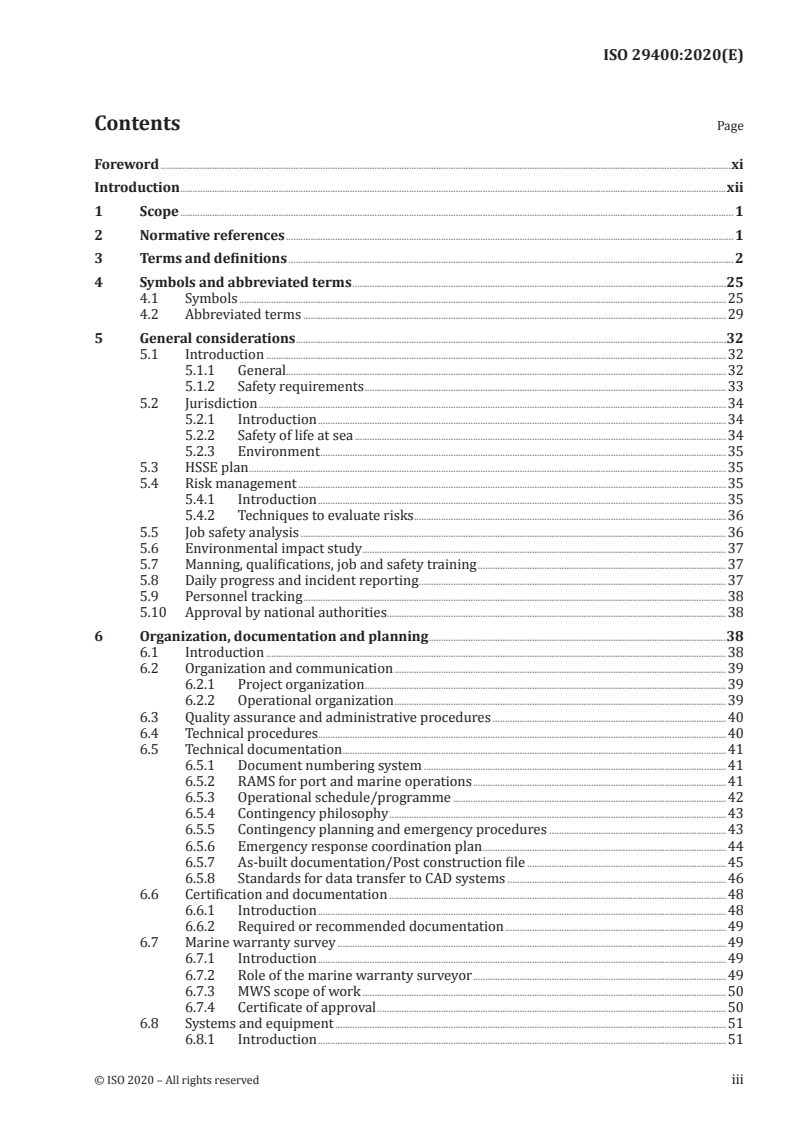
Contents Page
Foreword .xi
Introduction .xii
1 Scope . 1
2 Normative references . 1
3 Terms and definitions . 2
4 Symbols and abbreviated terms .25
4.1 Symbols .25
4.2 Abbreviated terms .29
5 General considerations .32
5.1 Introduction .32
5.1.1 General.32
5.1.2 Safety requirements .33
5.2 Jurisdiction .34
5.2.1 Introduction .34
5.2.2 Safety of life at sea .34
5.2.3 Environment .35
5.3 HSSE plan .35
5.4 Risk management .35
5.4.1 Introduction .35
5.4.2 Techniques to evaluate risks .36
5.5 Job safety analysis .36
5.6 Environmental impact study .37
5.7 Manning, qualifications, job and safety training .37
5.8 Daily progress and incident reporting .37
5.9 Personnel tracking .38
5.10 Approval by national authorities.38
6 Organization, documentation and planning .38
6.1 Introduction .38
6.2 Organization and communication .39
6.2.1 Project organization .39
6.2.2 Operational organization .39
6.3 Quality assurance and administrative procedures .40
6.4 Technical procedures.40
6.5 Technical documentation .41
6.5.1 Document numbering system .41
6.5.2 RAMS for port and marine operations .41
6.5.3 Operational schedule/programme .42
6.5.4 Contingency philosophy .43
6.5.5 Contingency planning and emergency procedures .43
6.5.6 Emergency response coordination plan .44
6.5.7 As-built documentation/Post construction file .45
6.5.8 Standards for data transfer to CAD systems .46
6.6 Certification and documentation .48
6.6.1 Introduction .48
6.6.2 Required or recommended documentation .49
6.7 Marine warranty survey .49
6.7.1 Introduction .49
6.7.2 Role of the marine warranty surveyor .49
6.7.3 MWS scope of work .50
6.7.4 Certificate of approval .50
6.8 Systems and equipment .51
6.8.1 Introduction .51
6.8.2 Marine vessels .51
6.8.3 Major equipment .51
7 Metocean requirements .51
7.1 Introduction .51
7.2 Weather-restricted/weather-unrestricted operations .52
7.2.1 Weather-restricted operations .52
7.2.2 Weather-unrestricted operations .52
7.3 Metocean conditions .52
7.3.1 Wind .52
7.3.2 Wave, wave period and swell conditions .53
7.3.3 Current.53
7.3.4 Other metocean factors .53
7.3.5 Temperature .54
7.3.6 Marine growth .54
7.4 Metocean criteria .54
7.4.1 Design criteria and operational limits .54
7.4.2 Return periods .55
7.4.3 Vessel response-based analysis .55
7.4.4 Probability distributions of sea state parameters .55
7.5 Operational duration, contingency and weather window .55
7.5.1 Planned operational duration .55
7.5.2 Weather window and contingency.56
7.5.3 Point of no return .56
7.5.4 Forecasted and monitored operational limits, metocean reduction factor .57
7.6 Weather forecasts .58
7.6.1 Introduction .58
7.6.2 Forecast parameters .58
7.7 On-site monitoring .58
8 Onshore transport and nearshore transport .59
8.1 Introduction .59
8.2 Structural integrity calculations .59
8.3 Transport by road .59
8.4 Transport via inland waterways .59
8.5 Transport via nearshore waterways .60
8.6 Transport via railways .60
8.7 Transport frames and equipment .60
9 Intermediate storage areas .60
9.1 Introduction .60
9.2 Infrastructure requirements .61
9.2.1 Load bearing .61
9.2.2 Surface .61
9.3 Storage frames and equipment .61
9.4 Requirements of components for storage .62
9.5 Protection of components against environmental conditions .62
9.6 Structural integrity calculations .62
9.6.1 Introduction .62
9.6.2 Vortex shedding .62
9.7 Security measures .63
10 Pre-assembly .63
10.1 Introduction .63
10.2 Pre-assembly area requirements .63
10.3 Pre-assembly activities .63
10.4 Pre-assembly equipment .64
10.5 Structural integrity calculations .64
10.6 Vortex shedding .64
10.7 Security measures .64
iv © ISO 2020 – All rights reserved
11 Port activities .64
11.1 Introduction .64
11.2 Accessibility of harbour areas .64
11.2.1 Water access .64
11.2.2 Inland access .65
11.3 Storage areas of quayside .65
11.4 Security measures .65
11.5 Quayside requirements .65
11.6 Port subsea soil requirements for jacking activities .65
12 Weight control .66
12.1 Introduction .66
12.2 Weight control classes .67
12.3 Weight and CoG constraints .67
12.4 Weight control monitoring .67
12.5 Dimensional control .68
12.6 Serial items .68
12.7 Weight determinations .68
13 Stability .68
13.1 Introduction .68
13.2 General requirements .69
13.3 Stability calculations .69
13.4 Intact stability .70
13.4.1 Introduction .70
13.4.2 Intact stability criteria .71
13.5 Damage stability .72
13.5.1 Introduction .72
13.5.2 Damage stability criteria .74
13.6 Single-barge transports .75
13.7 Multi-barge transports .75
13.8 Classed vessels .76
13.9 Self-floating structures .76
13.9.1 Introduction .76
13.9.2 Intact and damage stability .76
13.9.3 Upending and installation of self-floating and launched structures .77
13.10 Loadout operations .78
13.11 Watertight integrity and temporary closures .79
13.12 Inclining tests .79
14 Ballasting operations .80
14.1 Introduction .80
14.2 Ballast calculations for different stages.81
14.3 In ballast system .81
14.3.1 Operational aspects .81
14.3.2 Other operational considerations .82
14.4 Protection against damage and deterioration .82
14.4.1 Introduction .82
14.4.2 Freezing .83
14.5 Prevention of progressive flooding in damage condition .83
14.6 Control and indicating systems .83
14.7 Pumps .84
14.7.1 Introduction .84
14.7.2 Specification and layout .84
14.7.3 Pump performance curves and functional limitations .84
14.8 Valve arrangements .84
14.9 Vent systems.85
14.10 Air cushion system capacity .85
14.11 System testing .85
15 Loadout .85
15.1 Introduction .85
15.2 Categories of loadout .86
15.2.1 Introduction .86
15.2.2 Design: structural analysis during all loadout phases .87
15.2.3 Loadout planning .87
15.2.4 Cargo weight details and CoG information .87
15.2.5 Deck loading plan .88
15.3 Structure being loaded .88
15.4 Site and quay .88
15.5 Barge .89
15.6 Link beams, skidways and skidshoes .89
15.7 Moorings . .89
15.7.1 Weather-restricted operation .89
15.7.2 Temporary mooring system .90
15.8 Grounded loadouts .90
15.9 Pumping and ballasting .91
15.9.1 Pump capacity .91
15.9.2 Recommended pump capacity .91
15.10 Loadouts by trailers, SPMTs or hydraulic skidshoes .92
15.10.1 Introduction .92
15.10.2 Structural capacity .92
15.10.3 Load equalization and stability .93
15.10.4 Vertical alignment .93
15.10.5 Skidshoes .93
15.11 Propulsion system design, redundancy and back-up .93
15.11.1 Propulsion system .93
15.11.2 Redundancy and recommendations .94
15.12 Float-on onto submersible barges or vessels .95
15.13 Lifted loadouts.96
15.14 Horizontal loadouts .97
15.15 Barge reinstatement and sea fastenings .97
15.16 Tugs.98
15.17 Management and organization .98
15.18 Loadout manual .98
15.19 Operating manual .98
16 Transportation .100
16.1 Introduction .100
16.2 General considerations .100
16.2.1 Manned tows .100
16.2.2 Unmanned tows .101
16.2.3 Navigation lights, signals and day shapes .101
16.2.4 Contingency.101
16.2.5 Motion responses .101
16.2.6 Verification of the transported object.101
16.2.7 Structural analysis during all transport phases .101
16.2.8 Transport planning .102
16.3 Weather routeing and forecasting .102
16.4 Ports of shelter, shelter areas, holding areas .102
16.5 Inspections during the towage or voyage .103
16.6 Responsibility .103
16.7 Hazardous materials .103
16.8 Ballast water .104
16.9 Restricted depths, heights and manoeuvrability .104
16.10 Under-keel clearances .104
16.11 Air draught .105
16.12 Channel width .105
16.13 Survey requirements .105
vi © ISO 2020 – All rights reserved
16.14 Towline pull required, fleet composition and towing arrangement .106
16.14.1 Towline pull required .106
16.14.2 Towing fleet .107
16.14.3 Towing arrangement .107
16.14.4 Towline length.108
16.15 Tow out from dry dock .108
16.15.1 Introduction .108
16.15.2 Under-keel clearance .108
16.15.3 Side clearances .108
16.15.4 Air cushion/air pressure .108
16.15.5 Capacity of winching and towing arrangements .109
16.15.6 Positioning systems .109
16.15.7 Survey requirements .109
16.16 Inshore tow .109
16.16.1 Tow route and towing clearances.109
16.16.2 Positioning systems .
...
Questions, Comments and Discussion
Ask us and Technical Secretary will try to provide an answer. You can facilitate discussion about the standard in here.