

ISO 22157:2019
(Main)Bamboo structures — Determination of physical and mechanical properties of bamboo culms — Test methods
General Information
- Abstract
This document specifies test procedures for specimens obtained from round bamboo culms. The data obtained from the test methods can be used to establish characteristic physical or mechanical properties to be used in structural engineering design or for other scientific purposes. This document provides methods for evaluating the following physical and strength properties: moisture content, density, mass per unit length; strength properties parallel to the fibre direction, compression, tension and bending, and strength properties perpendicular to the fibre direction, tension and bending. It also provides methods to estimate moduli of elasticity in bending, compression and tension parallel to fibres, and bending perpendicular to fibres. The test methods reported in this document are intended for commercial testing applications. The test methods reported in this document are intended for commercial testing applications and can also be adopted as benchmark methods for scientific research. This document is organized to provide requirements for standard tests to be carried out to determine the material properties of full-culm bamboo as a structural material.
- Status
- Published
- Publication Date
- 17-Jan-2019
- Technical Committee
- ISO/TC 165 - Timber structures
- Drafting Committee
- ISO/TC 165/WG 12 - Structural use of bamboo
- Current Stage
- 9092 - International Standard to be revised
- Start Date
- 23-Jun-2025
- Completion Date
- 29-Aug-2026
Buy Documents
ISO 22157:2019 - Bamboo structures -- Determination of physical and mechanical properties of bamboo culms -- Test methods
ISO 22157:2019 - Bamboo structures — Determination of physical and mechanical properties of bamboo culms — Test methods/18/2019
Overview
ISO 22157:2019 - "Bamboo structures - Determination of physical and mechanical properties of bamboo culms - Test methods" defines standardized test methods for specimens taken from round bamboo culms. The standard provides procedures to obtain reliable material properties (physical and mechanical) that support structural engineering design, commercial testing, and scientific research. ISO 22157:2019 supersedes the earlier ISO 22157‑1:2004 and was prepared by ISO/TC 165 (Timber structures).
Key topics and requirements
ISO 22157:2019 organizes test methods and general requirements to ensure consistent, reproducible results. Major technical topics include:
- Sampling and specimen preparation
- Requirements for felling, marking, selection, storage and conversion of full‑culm bamboo to test specimens.
- Environmental and calibration controls
- Conditions for temperature, humidity, load rate and calibration of test equipment.
- Physical property tests
- Moisture content (oven‑dry method; electrical moisture meter method).
- Density and mass per unit length procedures.
- Mechanical property tests parallel to fibres
- Compression, tension, bending, and shear strength tests; methods to estimate modulus of elasticity in compression, tension and bending.
- Mechanical property tests perpendicular to fibres
- Tension and bending tests perpendicular to fibre direction, with stiffness estimation.
- Test reporting
- Standardized requirements for reporting test conditions, calculations and results to support use in design or research.
The document is oriented to commercial testing applications while serving as benchmark methods for scientific studies.
Practical applications
ISO 22157:2019 is essential for anyone who needs validated bamboo material data for structural use:
- Producing characteristic strength values and stiffnesses for design of bamboo buildings, bridges, or load‑bearing elements.
- Quality control and certification labs performing commercial bamboo testing.
- Researchers comparing mechanical behavior of different bamboo species, treatments, or manufacturing methods.
- Engineers developing design codes, structural models, or finite element analyses that require reliable bamboo material properties.
Who should use this standard
- Structural engineers and architects working with bamboo structures.
- Material testing laboratories and certification bodies.
- Academic and industrial researchers in bamboo material science.
- Manufacturers of engineered bamboo products seeking standardized property data.
Related information
- This is the first edition of ISO 22157:2019 and replaces ISO 22157‑1:2004.
- Prepared by ISO/TC 165 (Timber structures). Use the standard as a benchmark to harmonize bamboo testing and support consistent, code‑ready material data for bamboo structures.
Keywords: ISO 22157:2019, bamboo structures, bamboo culms, test methods, mechanical properties, moisture content, density, modulus of elasticity, structural engineering.
Relations
- Effective Date
- 12-Feb-2014
Buy Documents
ISO 22157:2019 - Bamboo structures -- Determination of physical and mechanical properties of bamboo culms -- Test methods
ISO 22157:2019 - Bamboo structures — Determination of physical and mechanical properties of bamboo culms — Test methods/18/2019
Get Certified
Connect with accredited certification bodies for this standard

Gozdarski inštitut Slovenije
Slovenian Forestry Institute. Forest management certification support, timber testing.
Sponsored listings
Frequently Asked Questions
ISO 22157:2019 is a standard published by the International Organization for Standardization (ISO). Its full title is "Bamboo structures — Determination of physical and mechanical properties of bamboo culms — Test methods". This standard covers: This document specifies test procedures for specimens obtained from round bamboo culms. The data obtained from the test methods can be used to establish characteristic physical or mechanical properties to be used in structural engineering design or for other scientific purposes. This document provides methods for evaluating the following physical and strength properties: moisture content, density, mass per unit length; strength properties parallel to the fibre direction, compression, tension and bending, and strength properties perpendicular to the fibre direction, tension and bending. It also provides methods to estimate moduli of elasticity in bending, compression and tension parallel to fibres, and bending perpendicular to fibres. The test methods reported in this document are intended for commercial testing applications. The test methods reported in this document are intended for commercial testing applications and can also be adopted as benchmark methods for scientific research. This document is organized to provide requirements for standard tests to be carried out to determine the material properties of full-culm bamboo as a structural material.
This document specifies test procedures for specimens obtained from round bamboo culms. The data obtained from the test methods can be used to establish characteristic physical or mechanical properties to be used in structural engineering design or for other scientific purposes. This document provides methods for evaluating the following physical and strength properties: moisture content, density, mass per unit length; strength properties parallel to the fibre direction, compression, tension and bending, and strength properties perpendicular to the fibre direction, tension and bending. It also provides methods to estimate moduli of elasticity in bending, compression and tension parallel to fibres, and bending perpendicular to fibres. The test methods reported in this document are intended for commercial testing applications. The test methods reported in this document are intended for commercial testing applications and can also be adopted as benchmark methods for scientific research. This document is organized to provide requirements for standard tests to be carried out to determine the material properties of full-culm bamboo as a structural material.
ISO 22157:2019 is classified under the following ICS (International Classification for Standards) categories: 79.040 - Wood, sawlogs and sawn timber. The ICS classification helps identify the subject area and facilitates finding related standards.
ISO 22157:2019 has the following relationships with other standards: It is inter standard links to ISO 22157-1:2004. Understanding these relationships helps ensure you are using the most current and applicable version of the standard.
ISO 22157:2019 is available in PDF format for immediate download after purchase. The document can be added to your cart and obtained through the secure checkout process. Digital delivery ensures instant access to the complete standard document.
Standards Content (Sample)
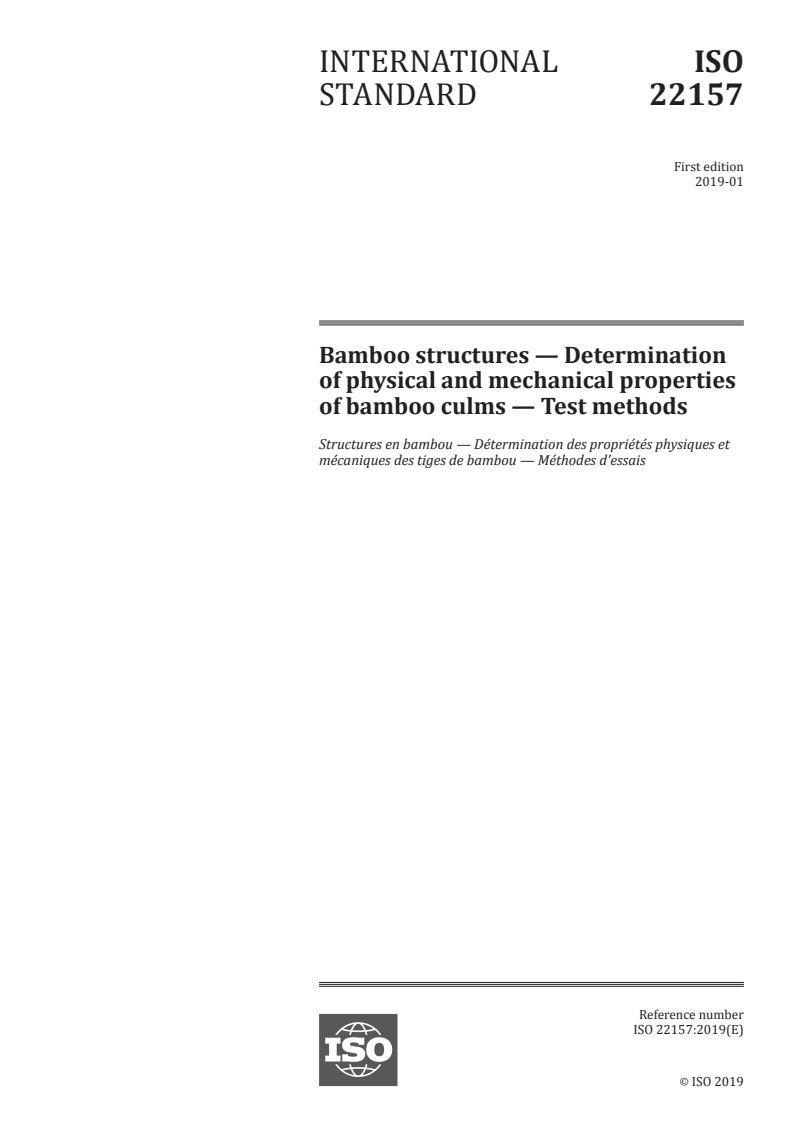
INTERNATIONAL ISO
STANDARD 22157
First edition
2019-01
Bamboo structures — Determination
of physical and mechanical properties
of bamboo culms — Test methods
Structures en bambou — Détermination des propriétés physiques et
mécaniques des tiges de bambou — Méthodes d'essais
Reference number
©
ISO 2019
© ISO 2019
All rights reserved. Unless otherwise specified, or required in the context of its implementation, no part of this publication may
be reproduced or utilized otherwise in any form or by any means, electronic or mechanical, including photocopying, or posting
on the internet or an intranet, without prior written permission. Permission can be requested from either ISO at the address
below or ISO’s member body in the country of the requester.
ISO copyright office
CP 401 • Ch. de Blandonnet 8
CH-1214 Vernier, Geneva
Phone: +41 22 749 01 11
Fax: +41 22 749 09 47
Email: copyright@iso.org
Website: www.iso.org
Published in Switzerland
ii © ISO 2019 – All rights reserved
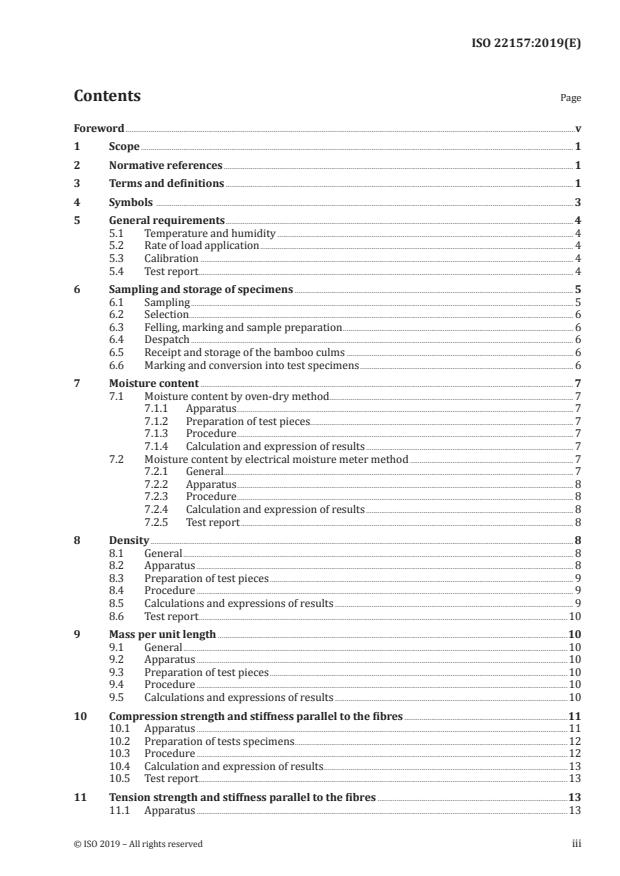
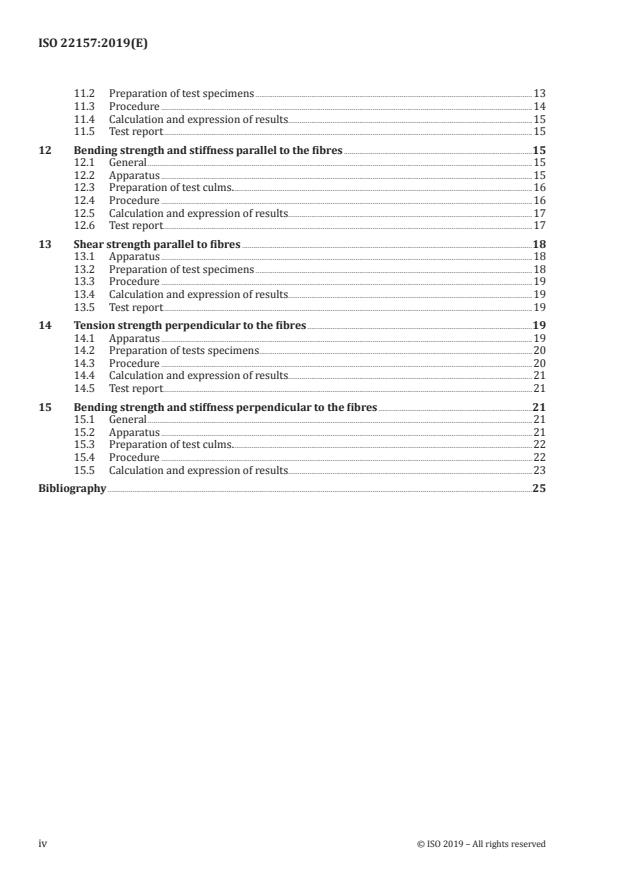
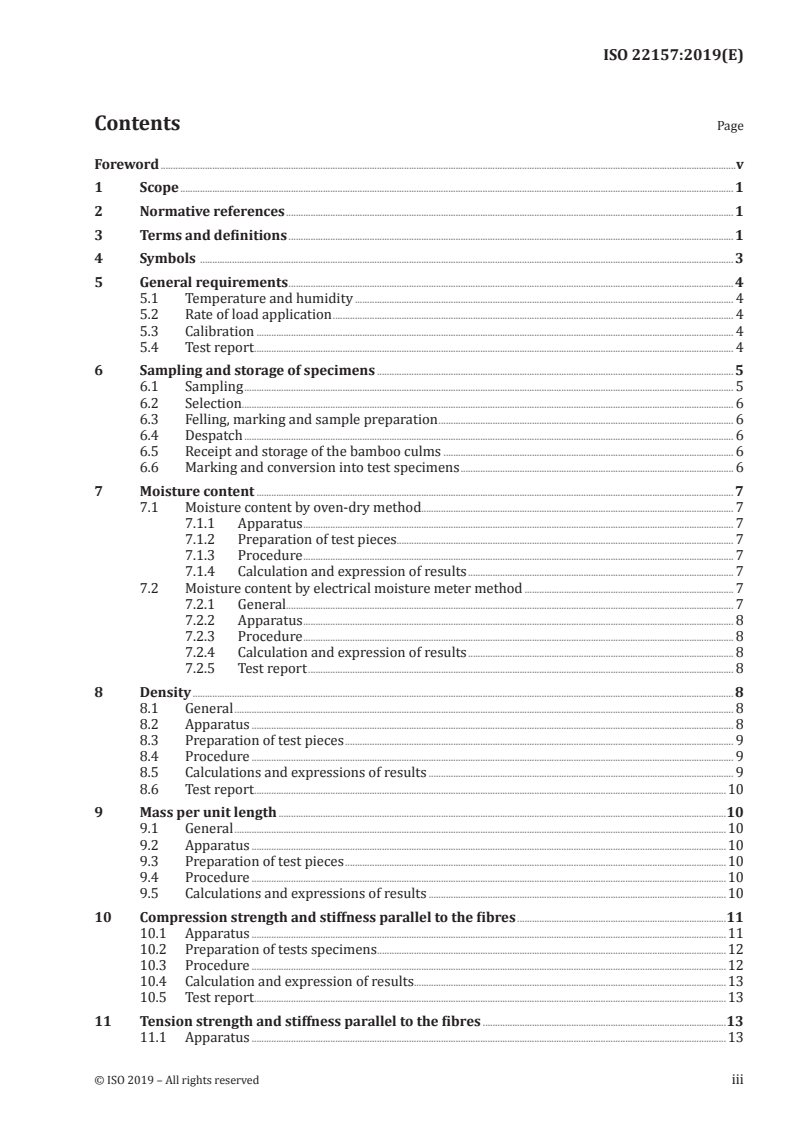
Contents Page
Foreword .v
1 Scope . 1
2 Normative references . 1
3 Terms and definitions . 1
4 Symbols . 3
5 General requirements . 4
5.1 Temperature and humidity . 4
5.2 Rate of load application . 4
5.3 Calibration . 4
5.4 Test report . 4
6 Sampling and storage of specimens . 5
6.1 Sampling . 5
6.2 Selection. 6
6.3 Felling, marking and sample preparation . 6
6.4 Despatch . 6
6.5 Receipt and storage of the bamboo culms . 6
6.6 Marking and conversion into test specimens . 6
7 Moisture content . 7
7.1 Moisture content by oven-dry method. 7
7.1.1 Apparatus . 7
7.1.2 Preparation of test pieces. 7
7.1.3 Procedure . 7
7.1.4 Calculation and expression of results . 7
7.2 Moisture content by electrical moisture meter method . 7
7.2.1 General. 7
7.2.2 Apparatus . 8
7.2.3 Procedure . 8
7.2.4 Calculation and expression of results . 8
7.2.5 Test report . 8
8 Density . 8
8.1 General . 8
8.2 Apparatus . 8
8.3 Preparation of test pieces . 9
8.4 Procedure . 9
8.5 Calculations and expressions of results . 9
8.6 Test report .10
9 Mass per unit length .10
9.1 General .10
9.2 Apparatus .10
9.3 Preparation of test pieces .10
9.4 Procedure .10
9.5 Calculations and expressions of results .10
10 Compression strength and stiffness parallel to the fibres .11
10.1 Apparatus .11
10.2 Preparation of tests specimens .12
10.3 Procedure .12
10.4 Calculation and expression of results.13
10.5 Test report .13
11 Tension strength and stiffness parallel to the fibres .13
11.1 Apparatus .13
11.2 Preparation of test specimens .13
11.3 Procedure .14
11.4 Calculation and expression of results.15
11.5 Test report .15
12 Bending strength and stiffness parallel to the fibres .15
12.1 General .15
12.2 Apparatus .15
12.3 Preparation of test culms. .16
12.4 Procedure .16
12.5 Calculation and expression of results.17
12.6 Test report .17
13 Shear strength parallel to fibres .18
13.1 Apparatus .18
13.2 Preparation of test specimens .18
13.3 Procedure .19
13.4 Calculation and expression of results.19
13.5 Test report .19
14 Tension strength perpendicular to the fibres .19
14.1 Apparatus .19
14.2 Preparation of tests specimens .20
14.3 Procedure .20
14.4 Calculation and expression of results.21
14.5 Test report .21
15 Bending strength and stiffness perpendicular to the fibres .21
15.1 General .21
15.2 Apparatus .21
15.3 Preparation of test culms. .22
15.4 Procedure .22
15.5 Calculation and expression of results.23
Bibliography .25
iv © ISO 2019 – All rights reserved
Foreword
ISO (the International Organization for Standardization) is a worldwide federation of national standards
bodies (ISO member bodies). The work of preparing International Standards is normally carried out
through ISO technical committees. Each member body interested in a subject for which a technical
committee has been established has the right to be represented on that committee. International
organizations, governmental and non-governmental, in liaison with ISO, also take part in the work.
ISO collaborates closely with the International Electrotechnical Commission (IEC) on all matters of
electrotechnical standardization.
The procedures used to develop this document and those intended for its further maintenance are
described in the ISO/IEC Directives, Part 1. In particular, the different approval criteria needed for the
different types of ISO documents should be noted. This document was drafted in accordance with the
editorial rules of the ISO/IEC Directives, Part 2 (see www .iso .org/directives).
Attention is drawn to the possibility that some of the elements of this document may be the subject of
patent rights. ISO shall not be held responsible for identifying any or all such patent rights. Details of
any patent rights identified during the development of the document will be in the Introduction and/or
on the ISO list of patent declarations received (see www .iso .org/patents).
Any trade name used in this document is information given for the convenience of users and does not
constitute an endorsement.
For an explanation of the voluntary nature of standards, the meaning of ISO specific terms and
expressions related to conformity assessment, as well as information about ISO's adherence to the
World Trade Organization (WTO) principles in the Technical Barriers to Trade (TBT) see www .iso
.org/iso/foreword .html.
This document was prepared by Technical Committee ISO/TC 165, Timber structures.
Any feedback or questions on this document should be directed to the user’s national standards body. A
complete listing of these bodies can be found at www .iso .org/members .html.
This first edition cancels and replaces ISO 22157-1:2004.
INTERNATIONAL STANDARD ISO 22157:2019(E)
Bamboo structures — Determination of physical and
mechanical properties of bamboo culms — Test methods
1 Scope
This document specifies test procedures for specimens obtained from round bamboo culms. The
data obtained from the test methods can be used to establish characteristic physical or mechanical
properties to be used in structural engineering design or for other scientific purposes. This document
provides methods for evaluating the following physical and strength properties: moisture content,
density, mass per unit length; strength properties parallel to the fibre direction, compression, tension
and bending, and strength properties perpendicular to the fibre direction, tension and bending. It also
provides methods to estimate moduli of elasticity in bending, compression and tension parallel to
fibres, and bending perpendicular to fibres.
The test methods reported in this document are intended for commercial testing applications. The test
methods reported in this document are intended for commercial testing applications and can also be
adopted as benchmark methods for scientific research.
This document is organized to provide requirements for standard tests to be carried out to determine
the material properties of full-culm bamboo as a structural material.
2 Normative references
There are no normative references in this document.
3 Terms and definitions
For the purposes of this document, the following terms and definitions apply.
ISO and IEC maintain terminological databases for use in standardization at the following addresses:
— ISO Online browsing platform: available at https: //www .iso .org/obp
— IEC Electropedia: available at http: //www .electropedia .org/
3.1
bamboo culm
single shoot of bamboo comprised of the entire unaltered bamboo cross-section, which is usually a
hollow cylinder except at nodes (3.11)
3.2
bamboo clump
clump
cluster of bamboo shoots emanating from two or more rhizomes at the same location
3.3
cross-sectional area
A
area of the net section perpendicular to the direction of the longitudinal axis of the culm
3.4
equilibrium moisture content
moisture content (3.10) at which bamboo is neither gaining moisture from, nor losing moisture to, the
environment
3.5
fibre
set of cellulosic fibres in bundles aligned parallel primarily in the longitudinal direction of the culm in
the internodes
Note 1 to entry: At nodes, the fibres radiate into the node plate, where they become entangled and their
orientation varies greatly.
3.6
fibre saturation point
FSP
moisture level in the bamboo solid material whereby no free liquid water remains in the cell cavities
but the cell wall structure is fully saturated by chemically bound water molecules
Note 1 to entry: The maximum content of bound water in bamboo tissue is approximately 30 % by weight of the
fully dried tissue.
3.7
green
condition of recently harvested bamboo that has not been dried and has a moisture content (3.10)
greater than the fibre saturation point (3.6)
3.8
internode
hollow region of bamboo culm between two nodes (3.11)
3.9
outer diameter
D
diameter of the cross-section of a piece of bamboo taken as the average of two perpendicular
measurements made across opposite points on the outer surface
Note 1 to entry: Measurement is usually made at the centre of an internode region.
3.10
moisture content
w
portion of culm weight consisting of water expressed as percentage of oven-dry weight
3.11
node
intermittent transverse diaphragm region located along length of culm separating adjacent internodes
(3.8), which, when alive, is a location of leaf growth
3.12
traveller specimen
specimen identical to, and stored and conditioned identically to specimens to be tested used to obtain
properties whose testing method affects the specimen
Note 1 to entry: Traveller specimens are usually used for determination of moisture content and density.
3.13
wall thickness
δ
thickness of wall of bamboo culm taken as the average of four measurements taken around the
circumference of the culm at angular spacings of 90°
Note 1 to entry: Measurement is usually made at the centre of an internode region.
2 © ISO 2019 – All rights reserved
4 Symbols
Symbol Description Unit
A cross-sectional area of the culm defined in 3.3 calculated as: mm
2 2
(π / 4) × [D − (D − 2δ) ]
where
D is the outer diameter;
δ is the wall thickness
A mean cross-sectional area of the gauge portion of the tension test parallel to the mm
g
fibres specimen described in Clause 11
a shear span (distance from support to nearest application of load) in a four-point mm
bending test described in Clause 12
b width of tension test specimen gauge region described in Clause 11 mm
D outer diameter of the bamboo culm defined in 3.9 mm
d diameter of transverse hole in the tension perpendicular to the fibres specimen mm
described in Clause 14
E compressive modulus of elasticity parallel to direction of fibres N/mm
c,0
E tensile modulus of elasticity parallel to direction of fibres N/mm
t,0
E apparent flexural modulus of elasticity parallel to direction of fibres N/mm
m,0
E circumferential modulus of elasticity N/mm
m,90
F load applied in test N
F maximum (ultimate) load applied in test N
ult
f compressive strength parallel to direction of fibres N/mm
c,0
f flexural strength parallel to direction of fibres N/mm
m,0
f flexural strength perpendicular to direction of fibres N/mm
m,90
f tension strength parallel to direction of fibres N/mm
t,0
f tension strength perpendicular to direction of fibres N/mm
t,90
f shear strength N/mm
v
h estimate of neutral axis location for a curved rectangular beam mm
I second moment of area, or moment of inertia, of the culm section calculated as: mm
B
4 4
(π / 64) × [D − (D 2δ) ]
where
D is the outer diameter;
δ is the wall thickness
L length of test piece or clear span in bending between centres of supports mm
(Clause 12)
M maximum moment N·mm
ult
m mass of test specimen g
e
m initial mass of test specimen G
i
m oven-dry mass of test specimen g
q mass per unit length g/mm
kg/m
q mass per unit length normalized for 12 % moisture content g/mm
kg/m
R characteristic radius of the centreline of the culm wall, calculated as 0,5(D – δ) mm
V volume of test piece mm
V volume of green test piece mm
w ratio of mass of embodied water to mass of oven-dry specimen, equivalent to —
moisture content defined in 3.10.
Δ deflection mm
δ culm wall thickness, defined in 3.13 mm
ε strain mm/mm
ρ density, when converted as indicated in 8.4 g/mm
kg/m
ρ density normalized for 12 % moisture content, when converted as indicated in g/mm
8.4 kg/m
ρ density under conditions of test, when converted as indicated in 8.4 g/mm
test
kg/m
5 General requirements
5.1 Temperature and humidity
Unless required by specific conditioning protocols, test specimens shall be stored, conditioned and
tested in an environment having a temperature range of (23 ± 3) °C, and relative humidity range of
(65 ± 5) %.
However, if tests results are to be used in the same environmental conditions in which testing took
place, or if the laboratory is unable to follow the standard, storage, conditioning and testing under
ambient temperature and relative humidity is permitted. The values of the temperature (±3 °C) and the
relative humidity (±5 %) for the laboratory shall be recorded in the test report, alongside the moisture
content determined for individual specimens.
5.2 Rate of load application
The rate of load application of the testing machine shall be selected such that failure is reached
within (300 ± 120) s. Tests that fail in less than 30 s shall be removed from analysis. The load shall
be applied continuously without interruption at the required rate throughout the test. For tests run
in displacement control, the rate of traverse of the movable head of the testing machine shall be the
free running or no-load speed of the head for mechanical drive type machines, and the loaded head
speed for hydraulic or servo-hydraulic driven testing machines. The time to failure for each individual
specimen shall be recorded in the test report.
5.3 Calibration
All apparatus and testing equipment used in obtaining data shall be calibrated at sufficiently frequent
intervals to ensure accuracy. A record of errors observed before calibration, the date and time of
calibration and observations following calibration shall be maintained.
5.4 Test report
The test report shall include the following information:
a) a reference to this document, i.e. ISO 22157;
b) the name of laboratory, authority or organization which performed the test;
c) the details of the test specimens, as noted in 6.3;
4 © ISO 2019 – All rights reserved
d) a description of the sampling including:
1) the method of grading and grade, if applicable;
2) the size of the sample; and
3) the moisture content at the time of sampling.
e) variations from the reference test conditions specified in Clause 5;
f) the equipment used, and any other information which may influence the use of the test results;
g) raw test data, including:
1) the dimensions of the specimen including measured values of at least D, δ and L;
2) the location of specimen along culm (B, M or T);
3) the measured values of moisture content from specimen or companion traveller specimens
obtained at the time of testing;
4) the measured values of density and density adjusted to 12 % moisture content from specimen
or traveller specimens obtained at the time of testing;
5) the load-displacement diagram up to failure for each specimen;
6) the observed location and mode of failure for each specimen;
7) the calculated moduli and/or strength values;
8) the range of data used to calculate the modulus of elasticity;
9) the time to failure for each specimen;
10) any other information which may influence the use of the test results;
h) the mean and coefficients of variation (and/or standard deviation) of the obtained test data; and
i) any additional information deemed to be important to interpretation of test data.
6 Sampling and storage of specimens
6.1 Sampling
Sampling should be representative of the population which test results are intended to represent and
be appropriate for the objective of the testing program. Sampling methodology shall be included in the
test report.
Bamboo material for any particular species shall be taken:
— in the case of tests on properties for commercial purposes: from a number of different localities,
representative of different growth conditions throughout the geographical range of the species;
— in the case of quality control as required in a strength grading protocol or standard: from a randomly
selected sample from a batch as required by the protocol or standard.
From each locality, the selection, marking, etc., of the different consignments, as well as all the details
of the various clumps and culms, shall be reported.
Culms are to be cut to length taking care to record the provenance of a specimen along the culm in
accordance to 6.3. For specimens that are to be used to determine bending strength, refer to Clause 12
for minimum lengths.
6.2 Selection
The culms selected shall fairly represent the total population that is to be used for construction
purposes, even if the entire population is characterized by poor quality stock. Broken, damaged and
discoloured culms shall be discarded. If a grading standard or protocol is being implemented, culms
selected for testing should be subjected to the grading process prior to testing.
The required number of culms shall be randomly selected from different clumps.
6.3 Felling, marking and sample preparation
Before felling, the following data shall be marked and recorded:
— the name of the species (botanical and local);
— the name of the locality;
— the number of clumps and culms selected;
— the age of the culm(s);
— details about the marks on the culms; and
— date(s) of felling and despatch.
Prior to cutting a felled culm into shorter lengths, it shall be marked “bottom”, “middle” and “top” (B, M
and T, respectively) in approximately equal thirds. For felled culms shorter than 5 m in length, the culm
may be cut in half, marking the halves “bottom” and “top” (B and T, respectively). The heights of each
third, or half, (in millimetres) shall be recorded from the level at which the culm was felled.
6.4 Despatch
Material should be despatched as early as possible, preferably within two weeks of felling. In case it is
not possible to despatch the material immediately, the material shall be stored in a manner consistent
with 6.5.
6.5 Receipt and storage of the bamboo culms
Bamboo culms shall be stored in such a way as to minimize possibility of deterioration. Proper storage
practices include:
a) no direct exposure to sunlight or rain;
b) no direct contact with soil or standing water; and
c) adequate air circulation to permit the equilibrium moisture content to be achieved for all
stored culms.
6.6 Marking and conversion into test specimens
Specimens shall be cut for the various tests, and suitable markings (project number, consignment
number, culm number, etc.) shall be made for complete identification of each specimen.
The sequence of tests shall be such as to eliminate, to the extent possible, changes due to storage and
environment conditions, which can affect comparison of results.
Specimens shall be tested in air dry condition (12 ± 3) % moisture content or the equilibrium moisture
content at the locality where the bamboo is to be used and subjected to the same preservation treatment
that would be considered standard.
6 © ISO 2019 – All rights reserved
The number of specimens prepared for each test shall be sufficient to establish the desired characteristic
data with 75 % confidence interval or as indicated in the grading standard. No fewer than 30 specimens
is recommended.
7 Moisture content
7.1 Moisture content by oven-dry method
7.1.1 Apparatus
7.1.1.1 Balance, suitable to weigh a specimen with a precision of at least 0,5 % of the specimen mass.
7.1.1.2 Oven, capable of drying bamboo to the absolute dry condition.
7.1.2 Preparation of test pieces
Specimens for determination of moisture content shall be prepared immediately after each mechanical
test. They shall be taken near the place of failure, weighed and placed in the drying oven. The number of
specimens shall be equal to the number of test pieces for the physical or mechanical test.
If traveller specimens are used, these shall be prepared immediately after each mechanical test, and
placed in the drying oven.
7.1.3 Procedure
The test pieces shall be weighed with a precision of at least 0,5 % of the dry specimen mass prior to
being placed in an oven at a temperature of (103 ± 2) °C. The initial mass is m .
i
After 24 hours, the mass shall be recorded at regular intervals of not less than 2 hours. The drying shall
be considered to be complete when the difference between successive determinations of mass do not
exceed 0,5 % of the measured mass. The final oven-dry mass is m .
7.1.4 Calculation and expression of results
The moisture content, w, of each test piece shall be calculated with Formula (1)as the loss in mass,
expressed as a percentage of the oven-dry mass:
mm−
i0
w = ×100 (1)
m
0
where
m is the initial mass of the test piece before drying;
i
m is the mass of the test piece after drying.
Both m and m are measured with a precision of at least 0,5 % of the dry specimen mass.
i 0
The calculated value of w shall be taken as representative of the tested specimen as a whole.
7.2 Moisture content by electrical moisture meter method
7.2.1 General
Alternatively, it can be sufficiently accurate to measure moisture content by means of a moisture meter,
provided that the meter is calibrated against moisture content measurements determined using the
oven-dry method described in 7.1. Commercial electrical conductivity moisture meters are generally
only reliable for wood moisture content between about 5 % and 25 %.
7.2.2 Apparatus
7.2.2.1 Moisture meter, of any design, calibrated for the species of bamboo concerned (using
comparison with oven-dry method described in 7.1), and capable of making an individual measurement
with an error of not more than 2 % at moisture contents from 7 % to 28 %.
7.2.3 Procedure
Measure the moisture content of the test piece or traveller specimen at a location within the culm wall
thickness. Measurements should not be made on the surface of the culm wall. Measurements should be
taken either at freshly cut cross-sections, or by driving deep, sharp probes into the wall from the side.
The area at which measurements are made shall not contain any dirt or visible defects. Drive the
electrodes into the culm wall cross-section so that the line between the tips of the needles intersects
only bamboo material.
Make at least three measurements in each measuring area, 10 mm to 15 mm apart, to avoid any error
due to the electrodes piercing an invisible defect.
7.2.4 Calculation and expression of results
Calculate the mean of the three individual measurements closest in their values, and express the
average moisture content, w, as a percentage by mass, to the nearest 1 %.
7.2.5 Test report
The moisture content shall be reported in the test report according to 5.4.
8 Density
8.1 General
This clause specifies three methods for determining the density, as mass by volume, of bamboo. For most
scientific and commercial applications, determining the density at the time of test, ρ , is adequate,
test
and shall be calculated from the mass and volume at the time of the test. To enable comparison between
reported values, the density at time of test should be adjusted to the density at 12 % moisture content, ρ .
For some scientific purposes and accurate comparison between reported values, basic density, ρ, is most
appropriate. It is determined from the oven-dry mass and green volume, since these remain unchanged
irrespective of environmental conditions.
8.2 Apparatus
8.2.1 Measuring instrument, capable of determining the dimensions of the test pieces with a
precision of 0,1 mm.
8.2.2 Balance, suitable to weigh a specimen with a precision of at least 0,5 % of the specimen mass.
8.2.3 Equipment for the determination of the moisture content in accordance with 7.1.
8 © ISO 2019 – All rights reserved
8.3 Preparation of test pieces
The density of bamboo varies in the cross-section and along the culm length. Therefore, specimen
sampling shall be carefully selected to reflect the density values desired. Full culm section specimens
are preferred, in which an immersion test is used to obtain specimen volume, though estimation of
volume from geometric measurements is acceptable, provided the shape of the specimens enables
accurate measurements to be obtained. An immersion test (Archimedes’ principle) is permitted to
obtain specimen volume provided the specimen moisture content exceeds the fibre saturation point
at the time of obtaining the volume or consideration is made for water absorbed during the immersion
process (e.g. measuring the mass before and after immersion).
Specimens for determination of the density at the time of test, ρ , shall be prepared immediately after
test
each mechanical test. They shall be taken near the place of failure. The number of specimens shall be
equal to the number of test pieces for the physical or mechanical test. If traveller specimens are used,
these shall be prepared immediately after each mechanical test.
8.4 Procedure
Measure the dimensions of the test pieces with a precision of at least 0,1 mm, and calculate the volume,
or determine the volume by another suitable method (e.g. immersion) to a precision of at least 0,5 % of
the specimen volume. Determine the basic density, ρ, in the green condition. To determine the density
at the time of test, ρ , measure the volume immediately after the mechanical test. In the latter case,
test
determine the moisture content, w, as described in Clause 7.
For the density at time of test, ρ , determine the mass of the test piece, m , to a precision of 0,5 % of
test e
the specimen mass.
For the basic density, ρ, dry the test pieces to constant oven-dry mass (see 7.1.3). Carry out the weighing
operations immediately after drying. Determine the mass of the oven-dry test pieces, m , to a precision
of 0,5 % of the specimen mass.
8.5 Calculations and expressions of results
The density at the time of test, ρ , shall be calculated from Formula (2):
test
ρ = m / V (2)
test e
where
m is the mass of the test piece in grams (g);
e
V is the volume of the test piece in cubic millimetres (mm ).
The density at 12 % moisture content, ρ , shall be calculated from Formula (3):
11, 2
ρρ= (3)
12 test
1+ w
where w is the moisture content at the time of test as determined in Clause 7, expressed as a decimal.
The basic density, ρ, shall be calculated from Formula (4):
ρ = m / V (4)
0 0
where
m is the oven-dry mass of the test piece in grams (g);
V is the volume of the green test piece in cubic millimetres (mm ).
Results are expressed in grams per cubic millimetre (g/mm ). This can be converted to kilograms per
3 6
cubic metre (kg/m ) by multiplying the calculated values by 10 .
8.6 Test report
The test report shall be in accordance with 5.4.
9 Mass per unit length
9.1 General
This clause specifies two methods for determining mass per unit length of bamboo culms. This method
is only appropriate for specimens comprised of full culm cross-sections. For most scientific and
commercial applications, determination of the mass per unit length at the time of the test, or in the
green condition, q, is adequate, and shall be calculated from the test culm mass and length. To enable
comparison between reported values, mass per unit length at the time of the test should be adjusted to
mass per unit length at 12 % moisture content, q .
9.2 Apparatus
9.2.1 Measuring instrument (tape measure), capable of determining the length of the culm with a
precision of 0,5 %;
9.2.2 Balance, capable of weighing specimen with precision of 0,5 %;
9.2.3 Equipment for the determination of the moisture content in accordance with 7.1.
9.3 Preparation of test pieces
Full culm cross-section specimens shall be prepared having a length over which the average mass per
unit length is desired. Culms should be cut square at their ends. Test culms shall be selected according
to Clause 6.
9.4 Procedure
Measure the length of the specimen with a precision of at least 0,5 %. To determine the mass per unit
length at time of test, measure the length immediately before the mechanical test and determine the
moisture content, w, as in Clause 7.
Determine the mass of the test pieces to a precision of 0,5 % of the specimen mass.
9.5 Calculations and expressions of results
The mass per unit length at time of test or in the green condition, q, shall be calculated from Formula (5):
q = m / L (5)
e
where
10 © ISO 2019 – All rights reserved
m is the mass of the test piece in grams (g);
e
L is the length of the test piece in millimetres (mm).
The mass per unit length at 12 % moisture content, q , shall be calculated from Formula (6):
11, 2
qq= (6)
1+w
where w is the moisture content at the time of test as determined in Clause 7 expressed as a decimal.
Results are expressed in grams per millimetre (g/mm). Alternatively, results may be expressed as
kilograms per metre (kg/m).
10 Compression strength and stiffness parallel to the fibres
10.1 Apparatus
10.1.1 Test machine. Tests shall be carried out on a suitable testing machine capable of measuring
compression load with a precision of at least 1 %. At least one platen of the testing machine shall be
equipped with a spherical bearing surface to ensure that the load is concentrically applied, as in Figure 1.
10.1.2 Intermediate layer. In between both steel platens of the machine and both ends of the
specimen, an intermediate layer shall be applied in order to minimize friction at, and radial restraint
of, the specimen ends. Successfully used intermediate layer media include radially oriented steel shims,
polytetrafluoroethylene (PTFE), sheets and sulphur “capping compound”.
Key
D outer diameter
δ wall thickness
F load
L length of specimen (L is the lesser of D or 10δ. If D < 20 mm, L = 2D)
1 upper loading platen with spherical bearing
2 interm
...
INTERNATIONAL ISO
STANDARD 22157
First edition
2019-01
Bamboo structures — Determination
of physical and mechanical properties
of bamboo culms — Test methods
Structures en bambou — Détermination des propriétés physiques et
mécaniques des tiges de bambou — Méthodes d'essais
Reference number
©
ISO 2019
© ISO 2019
All rights reserved. Unless otherwise specified, or required in the context of its implementation, no part of this publication may
be reproduced or utilized otherwise in any form or by any means, electronic or mechanical, including photocopying, or posting
on the internet or an intranet, without prior written permission. Permission can be requested from either ISO at the address
below or ISO’s member body in the country of the requester.
ISO copyright office
CP 401 • Ch. de Blandonnet 8
CH-1214 Vernier, Geneva
Phone: +41 22 749 01 11
Fax: +41 22 749 09 47
Email: copyright@iso.org
Website: www.iso.org
Published in Switzerland
ii © ISO 2019 – All rights reserved
Contents Page
Foreword .v
1 Scope . 1
2 Normative references . 1
3 Terms and definitions . 1
4 Symbols . 3
5 General requirements . 4
5.1 Temperature and humidity . 4
5.2 Rate of load application . 4
5.3 Calibration . 4
5.4 Test report . 4
6 Sampling and storage of specimens . 5
6.1 Sampling . 5
6.2 Selection. 6
6.3 Felling, marking and sample preparation . 6
6.4 Despatch . 6
6.5 Receipt and storage of the bamboo culms . 6
6.6 Marking and conversion into test specimens . 6
7 Moisture content . 7
7.1 Moisture content by oven-dry method. 7
7.1.1 Apparatus . 7
7.1.2 Preparation of test pieces. 7
7.1.3 Procedure . 7
7.1.4 Calculation and expression of results . 7
7.2 Moisture content by electrical moisture meter method . 7
7.2.1 General. 7
7.2.2 Apparatus . 8
7.2.3 Procedure . 8
7.2.4 Calculation and expression of results . 8
7.2.5 Test report . 8
8 Density . 8
8.1 General . 8
8.2 Apparatus . 8
8.3 Preparation of test pieces . 9
8.4 Procedure . 9
8.5 Calculations and expressions of results . 9
8.6 Test report .10
9 Mass per unit length .10
9.1 General .10
9.2 Apparatus .10
9.3 Preparation of test pieces .10
9.4 Procedure .10
9.5 Calculations and expressions of results .10
10 Compression strength and stiffness parallel to the fibres .11
10.1 Apparatus .11
10.2 Preparation of tests specimens .12
10.3 Procedure .12
10.4 Calculation and expression of results.13
10.5 Test report .13
11 Tension strength and stiffness parallel to the fibres .13
11.1 Apparatus .13
11.2 Preparation of test specimens .13
11.3 Procedure .14
11.4 Calculation and expression of results.15
11.5 Test report .15
12 Bending strength and stiffness parallel to the fibres .15
12.1 General .15
12.2 Apparatus .15
12.3 Preparation of test culms. .16
12.4 Procedure .16
12.5 Calculation and expression of results.17
12.6 Test report .17
13 Shear strength parallel to fibres .18
13.1 Apparatus .18
13.2 Preparation of test specimens .18
13.3 Procedure .19
13.4 Calculation and expression of results.19
13.5 Test report .19
14 Tension strength perpendicular to the fibres .19
14.1 Apparatus .19
14.2 Preparation of tests specimens .20
14.3 Procedure .20
14.4 Calculation and expression of results.21
14.5 Test report .21
15 Bending strength and stiffness perpendicular to the fibres .21
15.1 General .21
15.2 Apparatus .21
15.3 Preparation of test culms. .22
15.4 Procedure .22
15.5 Calculation and expression of results.23
Bibliography .25
iv © ISO 2019 – All rights reserved
Foreword
ISO (the International Organization for Standardization) is a worldwide federation of national standards
bodies (ISO member bodies). The work of preparing International Standards is normally carried out
through ISO technical committees. Each member body interested in a subject for which a technical
committee has been established has the right to be represented on that committee. International
organizations, governmental and non-governmental, in liaison with ISO, also take part in the work.
ISO collaborates closely with the International Electrotechnical Commission (IEC) on all matters of
electrotechnical standardization.
The procedures used to develop this document and those intended for its further maintenance are
described in the ISO/IEC Directives, Part 1. In particular, the different approval criteria needed for the
different types of ISO documents should be noted. This document was drafted in accordance with the
editorial rules of the ISO/IEC Directives, Part 2 (see www .iso .org/directives).
Attention is drawn to the possibility that some of the elements of this document may be the subject of
patent rights. ISO shall not be held responsible for identifying any or all such patent rights. Details of
any patent rights identified during the development of the document will be in the Introduction and/or
on the ISO list of patent declarations received (see www .iso .org/patents).
Any trade name used in this document is information given for the convenience of users and does not
constitute an endorsement.
For an explanation of the voluntary nature of standards, the meaning of ISO specific terms and
expressions related to conformity assessment, as well as information about ISO's adherence to the
World Trade Organization (WTO) principles in the Technical Barriers to Trade (TBT) see www .iso
.org/iso/foreword .html.
This document was prepared by Technical Committee ISO/TC 165, Timber structures.
Any feedback or questions on this document should be directed to the user’s national standards body. A
complete listing of these bodies can be found at www .iso .org/members .html.
This first edition cancels and replaces ISO 22157-1:2004.
INTERNATIONAL STANDARD ISO 22157:2019(E)
Bamboo structures — Determination of physical and
mechanical properties of bamboo culms — Test methods
1 Scope
This document specifies test procedures for specimens obtained from round bamboo culms. The
data obtained from the test methods can be used to establish characteristic physical or mechanical
properties to be used in structural engineering design or for other scientific purposes. This document
provides methods for evaluating the following physical and strength properties: moisture content,
density, mass per unit length; strength properties parallel to the fibre direction, compression, tension
and bending, and strength properties perpendicular to the fibre direction, tension and bending. It also
provides methods to estimate moduli of elasticity in bending, compression and tension parallel to
fibres, and bending perpendicular to fibres.
The test methods reported in this document are intended for commercial testing applications. The test
methods reported in this document are intended for commercial testing applications and can also be
adopted as benchmark methods for scientific research.
This document is organized to provide requirements for standard tests to be carried out to determine
the material properties of full-culm bamboo as a structural material.
2 Normative references
There are no normative references in this document.
3 Terms and definitions
For the purposes of this document, the following terms and definitions apply.
ISO and IEC maintain terminological databases for use in standardization at the following addresses:
— ISO Online browsing platform: available at https: //www .iso .org/obp
— IEC Electropedia: available at http: //www .electropedia .org/
3.1
bamboo culm
single shoot of bamboo comprised of the entire unaltered bamboo cross-section, which is usually a
hollow cylinder except at nodes (3.11)
3.2
bamboo clump
clump
cluster of bamboo shoots emanating from two or more rhizomes at the same location
3.3
cross-sectional area
A
area of the net section perpendicular to the direction of the longitudinal axis of the culm
3.4
equilibrium moisture content
moisture content (3.10) at which bamboo is neither gaining moisture from, nor losing moisture to, the
environment
3.5
fibre
set of cellulosic fibres in bundles aligned parallel primarily in the longitudinal direction of the culm in
the internodes
Note 1 to entry: At nodes, the fibres radiate into the node plate, where they become entangled and their
orientation varies greatly.
3.6
fibre saturation point
FSP
moisture level in the bamboo solid material whereby no free liquid water remains in the cell cavities
but the cell wall structure is fully saturated by chemically bound water molecules
Note 1 to entry: The maximum content of bound water in bamboo tissue is approximately 30 % by weight of the
fully dried tissue.
3.7
green
condition of recently harvested bamboo that has not been dried and has a moisture content (3.10)
greater than the fibre saturation point (3.6)
3.8
internode
hollow region of bamboo culm between two nodes (3.11)
3.9
outer diameter
D
diameter of the cross-section of a piece of bamboo taken as the average of two perpendicular
measurements made across opposite points on the outer surface
Note 1 to entry: Measurement is usually made at the centre of an internode region.
3.10
moisture content
w
portion of culm weight consisting of water expressed as percentage of oven-dry weight
3.11
node
intermittent transverse diaphragm region located along length of culm separating adjacent internodes
(3.8), which, when alive, is a location of leaf growth
3.12
traveller specimen
specimen identical to, and stored and conditioned identically to specimens to be tested used to obtain
properties whose testing method affects the specimen
Note 1 to entry: Traveller specimens are usually used for determination of moisture content and density.
3.13
wall thickness
δ
thickness of wall of bamboo culm taken as the average of four measurements taken around the
circumference of the culm at angular spacings of 90°
Note 1 to entry: Measurement is usually made at the centre of an internode region.
2 © ISO 2019 – All rights reserved
4 Symbols
Symbol Description Unit
A cross-sectional area of the culm defined in 3.3 calculated as: mm
2 2
(π / 4) × [D − (D − 2δ) ]
where
D is the outer diameter;
δ is the wall thickness
A mean cross-sectional area of the gauge portion of the tension test parallel to the mm
g
fibres specimen described in Clause 11
a shear span (distance from support to nearest application of load) in a four-point mm
bending test described in Clause 12
b width of tension test specimen gauge region described in Clause 11 mm
D outer diameter of the bamboo culm defined in 3.9 mm
d diameter of transverse hole in the tension perpendicular to the fibres specimen mm
described in Clause 14
E compressive modulus of elasticity parallel to direction of fibres N/mm
c,0
E tensile modulus of elasticity parallel to direction of fibres N/mm
t,0
E apparent flexural modulus of elasticity parallel to direction of fibres N/mm
m,0
E circumferential modulus of elasticity N/mm
m,90
F load applied in test N
F maximum (ultimate) load applied in test N
ult
f compressive strength parallel to direction of fibres N/mm
c,0
f flexural strength parallel to direction of fibres N/mm
m,0
f flexural strength perpendicular to direction of fibres N/mm
m,90
f tension strength parallel to direction of fibres N/mm
t,0
f tension strength perpendicular to direction of fibres N/mm
t,90
f shear strength N/mm
v
h estimate of neutral axis location for a curved rectangular beam mm
I second moment of area, or moment of inertia, of the culm section calculated as: mm
B
4 4
(π / 64) × [D − (D 2δ) ]
where
D is the outer diameter;
δ is the wall thickness
L length of test piece or clear span in bending between centres of supports mm
(Clause 12)
M maximum moment N·mm
ult
m mass of test specimen g
e
m initial mass of test specimen G
i
m oven-dry mass of test specimen g
q mass per unit length g/mm
kg/m
q mass per unit length normalized for 12 % moisture content g/mm
kg/m
R characteristic radius of the centreline of the culm wall, calculated as 0,5(D – δ) mm
V volume of test piece mm
V volume of green test piece mm
w ratio of mass of embodied water to mass of oven-dry specimen, equivalent to —
moisture content defined in 3.10.
Δ deflection mm
δ culm wall thickness, defined in 3.13 mm
ε strain mm/mm
ρ density, when converted as indicated in 8.4 g/mm
kg/m
ρ density normalized for 12 % moisture content, when converted as indicated in g/mm
8.4 kg/m
ρ density under conditions of test, when converted as indicated in 8.4 g/mm
test
kg/m
5 General requirements
5.1 Temperature and humidity
Unless required by specific conditioning protocols, test specimens shall be stored, conditioned and
tested in an environment having a temperature range of (23 ± 3) °C, and relative humidity range of
(65 ± 5) %.
However, if tests results are to be used in the same environmental conditions in which testing took
place, or if the laboratory is unable to follow the standard, storage, conditioning and testing under
ambient temperature and relative humidity is permitted. The values of the temperature (±3 °C) and the
relative humidity (±5 %) for the laboratory shall be recorded in the test report, alongside the moisture
content determined for individual specimens.
5.2 Rate of load application
The rate of load application of the testing machine shall be selected such that failure is reached
within (300 ± 120) s. Tests that fail in less than 30 s shall be removed from analysis. The load shall
be applied continuously without interruption at the required rate throughout the test. For tests run
in displacement control, the rate of traverse of the movable head of the testing machine shall be the
free running or no-load speed of the head for mechanical drive type machines, and the loaded head
speed for hydraulic or servo-hydraulic driven testing machines. The time to failure for each individual
specimen shall be recorded in the test report.
5.3 Calibration
All apparatus and testing equipment used in obtaining data shall be calibrated at sufficiently frequent
intervals to ensure accuracy. A record of errors observed before calibration, the date and time of
calibration and observations following calibration shall be maintained.
5.4 Test report
The test report shall include the following information:
a) a reference to this document, i.e. ISO 22157;
b) the name of laboratory, authority or organization which performed the test;
c) the details of the test specimens, as noted in 6.3;
4 © ISO 2019 – All rights reserved
d) a description of the sampling including:
1) the method of grading and grade, if applicable;
2) the size of the sample; and
3) the moisture content at the time of sampling.
e) variations from the reference test conditions specified in Clause 5;
f) the equipment used, and any other information which may influence the use of the test results;
g) raw test data, including:
1) the dimensions of the specimen including measured values of at least D, δ and L;
2) the location of specimen along culm (B, M or T);
3) the measured values of moisture content from specimen or companion traveller specimens
obtained at the time of testing;
4) the measured values of density and density adjusted to 12 % moisture content from specimen
or traveller specimens obtained at the time of testing;
5) the load-displacement diagram up to failure for each specimen;
6) the observed location and mode of failure for each specimen;
7) the calculated moduli and/or strength values;
8) the range of data used to calculate the modulus of elasticity;
9) the time to failure for each specimen;
10) any other information which may influence the use of the test results;
h) the mean and coefficients of variation (and/or standard deviation) of the obtained test data; and
i) any additional information deemed to be important to interpretation of test data.
6 Sampling and storage of specimens
6.1 Sampling
Sampling should be representative of the population which test results are intended to represent and
be appropriate for the objective of the testing program. Sampling methodology shall be included in the
test report.
Bamboo material for any particular species shall be taken:
— in the case of tests on properties for commercial purposes: from a number of different localities,
representative of different growth conditions throughout the geographical range of the species;
— in the case of quality control as required in a strength grading protocol or standard: from a randomly
selected sample from a batch as required by the protocol or standard.
From each locality, the selection, marking, etc., of the different consignments, as well as all the details
of the various clumps and culms, shall be reported.
Culms are to be cut to length taking care to record the provenance of a specimen along the culm in
accordance to 6.3. For specimens that are to be used to determine bending strength, refer to Clause 12
for minimum lengths.
6.2 Selection
The culms selected shall fairly represent the total population that is to be used for construction
purposes, even if the entire population is characterized by poor quality stock. Broken, damaged and
discoloured culms shall be discarded. If a grading standard or protocol is being implemented, culms
selected for testing should be subjected to the grading process prior to testing.
The required number of culms shall be randomly selected from different clumps.
6.3 Felling, marking and sample preparation
Before felling, the following data shall be marked and recorded:
— the name of the species (botanical and local);
— the name of the locality;
— the number of clumps and culms selected;
— the age of the culm(s);
— details about the marks on the culms; and
— date(s) of felling and despatch.
Prior to cutting a felled culm into shorter lengths, it shall be marked “bottom”, “middle” and “top” (B, M
and T, respectively) in approximately equal thirds. For felled culms shorter than 5 m in length, the culm
may be cut in half, marking the halves “bottom” and “top” (B and T, respectively). The heights of each
third, or half, (in millimetres) shall be recorded from the level at which the culm was felled.
6.4 Despatch
Material should be despatched as early as possible, preferably within two weeks of felling. In case it is
not possible to despatch the material immediately, the material shall be stored in a manner consistent
with 6.5.
6.5 Receipt and storage of the bamboo culms
Bamboo culms shall be stored in such a way as to minimize possibility of deterioration. Proper storage
practices include:
a) no direct exposure to sunlight or rain;
b) no direct contact with soil or standing water; and
c) adequate air circulation to permit the equilibrium moisture content to be achieved for all
stored culms.
6.6 Marking and conversion into test specimens
Specimens shall be cut for the various tests, and suitable markings (project number, consignment
number, culm number, etc.) shall be made for complete identification of each specimen.
The sequence of tests shall be such as to eliminate, to the extent possible, changes due to storage and
environment conditions, which can affect comparison of results.
Specimens shall be tested in air dry condition (12 ± 3) % moisture content or the equilibrium moisture
content at the locality where the bamboo is to be used and subjected to the same preservation treatment
that would be considered standard.
6 © ISO 2019 – All rights reserved
The number of specimens prepared for each test shall be sufficient to establish the desired characteristic
data with 75 % confidence interval or as indicated in the grading standard. No fewer than 30 specimens
is recommended.
7 Moisture content
7.1 Moisture content by oven-dry method
7.1.1 Apparatus
7.1.1.1 Balance, suitable to weigh a specimen with a precision of at least 0,5 % of the specimen mass.
7.1.1.2 Oven, capable of drying bamboo to the absolute dry condition.
7.1.2 Preparation of test pieces
Specimens for determination of moisture content shall be prepared immediately after each mechanical
test. They shall be taken near the place of failure, weighed and placed in the drying oven. The number of
specimens shall be equal to the number of test pieces for the physical or mechanical test.
If traveller specimens are used, these shall be prepared immediately after each mechanical test, and
placed in the drying oven.
7.1.3 Procedure
The test pieces shall be weighed with a precision of at least 0,5 % of the dry specimen mass prior to
being placed in an oven at a temperature of (103 ± 2) °C. The initial mass is m .
i
After 24 hours, the mass shall be recorded at regular intervals of not less than 2 hours. The drying shall
be considered to be complete when the difference between successive determinations of mass do not
exceed 0,5 % of the measured mass. The final oven-dry mass is m .
7.1.4 Calculation and expression of results
The moisture content, w, of each test piece shall be calculated with Formula (1)as the loss in mass,
expressed as a percentage of the oven-dry mass:
mm−
i0
w = ×100 (1)
m
0
where
m is the initial mass of the test piece before drying;
i
m is the mass of the test piece after drying.
Both m and m are measured with a precision of at least 0,5 % of the dry specimen mass.
i 0
The calculated value of w shall be taken as representative of the tested specimen as a whole.
7.2 Moisture content by electrical moisture meter method
7.2.1 General
Alternatively, it can be sufficiently accurate to measure moisture content by means of a moisture meter,
provided that the meter is calibrated against moisture content measurements determined using the
oven-dry method described in 7.1. Commercial electrical conductivity moisture meters are generally
only reliable for wood moisture content between about 5 % and 25 %.
7.2.2 Apparatus
7.2.2.1 Moisture meter, of any design, calibrated for the species of bamboo concerned (using
comparison with oven-dry method described in 7.1), and capable of making an individual measurement
with an error of not more than 2 % at moisture contents from 7 % to 28 %.
7.2.3 Procedure
Measure the moisture content of the test piece or traveller specimen at a location within the culm wall
thickness. Measurements should not be made on the surface of the culm wall. Measurements should be
taken either at freshly cut cross-sections, or by driving deep, sharp probes into the wall from the side.
The area at which measurements are made shall not contain any dirt or visible defects. Drive the
electrodes into the culm wall cross-section so that the line between the tips of the needles intersects
only bamboo material.
Make at least three measurements in each measuring area, 10 mm to 15 mm apart, to avoid any error
due to the electrodes piercing an invisible defect.
7.2.4 Calculation and expression of results
Calculate the mean of the three individual measurements closest in their values, and express the
average moisture content, w, as a percentage by mass, to the nearest 1 %.
7.2.5 Test report
The moisture content shall be reported in the test report according to 5.4.
8 Density
8.1 General
This clause specifies three methods for determining the density, as mass by volume, of bamboo. For most
scientific and commercial applications, determining the density at the time of test, ρ , is adequate,
test
and shall be calculated from the mass and volume at the time of the test. To enable comparison between
reported values, the density at time of test should be adjusted to the density at 12 % moisture content, ρ .
For some scientific purposes and accurate comparison between reported values, basic density, ρ, is most
appropriate. It is determined from the oven-dry mass and green volume, since these remain unchanged
irrespective of environmental conditions.
8.2 Apparatus
8.2.1 Measuring instrument, capable of determining the dimensions of the test pieces with a
precision of 0,1 mm.
8.2.2 Balance, suitable to weigh a specimen with a precision of at least 0,5 % of the specimen mass.
8.2.3 Equipment for the determination of the moisture content in accordance with 7.1.
8 © ISO 2019 – All rights reserved
8.3 Preparation of test pieces
The density of bamboo varies in the cross-section and along the culm length. Therefore, specimen
sampling shall be carefully selected to reflect the density values desired. Full culm section specimens
are preferred, in which an immersion test is used to obtain specimen volume, though estimation of
volume from geometric measurements is acceptable, provided the shape of the specimens enables
accurate measurements to be obtained. An immersion test (Archimedes’ principle) is permitted to
obtain specimen volume provided the specimen moisture content exceeds the fibre saturation point
at the time of obtaining the volume or consideration is made for water absorbed during the immersion
process (e.g. measuring the mass before and after immersion).
Specimens for determination of the density at the time of test, ρ , shall be prepared immediately after
test
each mechanical test. They shall be taken near the place of failure. The number of specimens shall be
equal to the number of test pieces for the physical or mechanical test. If traveller specimens are used,
these shall be prepared immediately after each mechanical test.
8.4 Procedure
Measure the dimensions of the test pieces with a precision of at least 0,1 mm, and calculate the volume,
or determine the volume by another suitable method (e.g. immersion) to a precision of at least 0,5 % of
the specimen volume. Determine the basic density, ρ, in the green condition. To determine the density
at the time of test, ρ , measure the volume immediately after the mechanical test. In the latter case,
test
determine the moisture content, w, as described in Clause 7.
For the density at time of test, ρ , determine the mass of the test piece, m , to a precision of 0,5 % of
test e
the specimen mass.
For the basic density, ρ, dry the test pieces to constant oven-dry mass (see 7.1.3). Carry out the weighing
operations immediately after drying. Determine the mass of the oven-dry test pieces, m , to a precision
of 0,5 % of the specimen mass.
8.5 Calculations and expressions of results
The density at the time of test, ρ , shall be calculated from Formula (2):
test
ρ = m / V (2)
test e
where
m is the mass of the test piece in grams (g);
e
V is the volume of the test piece in cubic millimetres (mm ).
The density at 12 % moisture content, ρ , shall be calculated from Formula (3):
11, 2
ρρ= (3)
12 test
1+ w
where w is the moisture content at the time of test as determined in Clause 7, expressed as a decimal.
The basic density, ρ, shall be calculated from Formula (4):
ρ = m / V (4)
0 0
where
m is the oven-dry mass of the test piece in grams (g);
V is the volume of the green test piece in cubic millimetres (mm ).
Results are expressed in grams per cubic millimetre (g/mm ). This can be converted to kilograms per
3 6
cubic metre (kg/m ) by multiplying the calculated values by 10 .
8.6 Test report
The test report shall be in accordance with 5.4.
9 Mass per unit length
9.1 General
This clause specifies two methods for determining mass per unit length of bamboo culms. This method
is only appropriate for specimens comprised of full culm cross-sections. For most scientific and
commercial applications, determination of the mass per unit length at the time of the test, or in the
green condition, q, is adequate, and shall be calculated from the test culm mass and length. To enable
comparison between reported values, mass per unit length at the time of the test should be adjusted to
mass per unit length at 12 % moisture content, q .
9.2 Apparatus
9.2.1 Measuring instrument (tape measure), capable of determining the length of the culm with a
precision of 0,5 %;
9.2.2 Balance, capable of weighing specimen with precision of 0,5 %;
9.2.3 Equipment for the determination of the moisture content in accordance with 7.1.
9.3 Preparation of test pieces
Full culm cross-section specimens shall be prepared having a length over which the average mass per
unit length is desired. Culms should be cut square at their ends. Test culms shall be selected according
to Clause 6.
9.4 Procedure
Measure the length of the specimen with a precision of at least 0,5 %. To determine the mass per unit
length at time of test, measure the length immediately before the mechanical test and determine the
moisture content, w, as in Clause 7.
Determine the mass of the test pieces to a precision of 0,5 % of the specimen mass.
9.5 Calculations and expressions of results
The mass per unit length at time of test or in the green condition, q, shall be calculated from Formula (5):
q = m / L (5)
e
where
10 © ISO 2019 – All rights reserved
m is the mass of the test piece in grams (g);
e
L is the length of the test piece in millimetres (mm).
The mass per unit length at 12 % moisture content, q , shall be calculated from Formula (6):
11, 2
qq= (6)
1+w
where w is the moisture content at the time of test as determined in Clause 7 expressed as a decimal.
Results are expressed in grams per millimetre (g/mm). Alternatively, results may be expressed as
kilograms per metre (kg/m).
10 Compression strength and stiffness parallel to the fibres
10.1 Apparatus
10.1.1 Test machine. Tests shall be carried out on a suitable testing machine capable of measuring
compression load with a precision of at least 1 %. At least one platen of the testing machine shall be
equipped with a spherical bearing surface to ensure that the load is concentrically applied, as in Figure 1.
10.1.2 Intermediate layer. In between both steel platens of the machine and both ends of the
specimen, an intermediate layer shall be applied in order to minimize friction at, and radial restraint
of, the specimen ends. Successfully used intermediate layer media include radially oriented steel shims,
polytetrafluoroethylene (PTFE), sheets and sulphur “capping compound”.
Key
D outer diameter
δ wall thickness
F load
L length of specimen (L is the lesser of D or 10δ. If D < 20 mm, L = 2D)
1 upper loading platen with spherical bearing
2 interm
...