

ISO 17419:2018
(Main)Intelligent transport systems — Cooperative systems — Globally unique identification
General Information
- Abstract
This document — describes and specifies globally unique addresses and identifiers (ITS-S object identifiers) which are both internal and external to ITS stations and are used for ITS station management, — describes how ITS-S object identifiers and related technical parameters are used for classification, registration and management of ITS applications and ITS application classes, — describes how ITS-S object identifiers are used in the ITS communication protocol stack, — introduces an organizational framework for registration and management of ITS-S objects, — defines and specifies management procedures at a high functional level, — is based on the architecture of an ITS station specified in ISO 21217:2014 as a Bounded Secured Managed Domain (BSMD), — specifies an ASN.1 module for the identifiers, addresses, and registry records identified in this document, and — specifies an ASN.1 module for a C-ITS Data Dictionary containing ASN.1 type definitions of general interest.
- Status
- Withdrawn
- Publication Date
- 10-May-2018
- Technical Committee
- ISO/TC 204 - Intelligent transport systems
- Drafting Committee
- ISO/TC 204/WG 18 - Cooperative systems
- Current Stage
- 9599 - Withdrawal of International Standard
- Start Date
- 29-May-2025
- Completion Date
- 29-Aug-2026
Buy Documents
ISO 17419:2018 - Intelligent transport systems — Cooperative systems — Globally unique identification/11/2018

ISO 17419:2018 - Intelligent transport systems -- Cooperative systems -- Globally unique identification
ISO 17419:2018 - Systèmes intelligents de transport — Systèmes coopératifs — Identification unique au niveau global/25/2019
ISO 17419:2018 - Systemes intelligents de transport -- Systemes coopératifs -- Identification unique au niveau global
Overview
ISO 17419:2018 - Intelligent transport systems - Cooperative systems - Globally unique identification defines how cooperative Intelligent Transport Systems (C-ITS) assign, register and manage globally unique addresses and identifiers (ITS‑S object identifiers). The standard specifies how these identifiers are used inside ITS stations and across the ITS communication protocol stack, provides ASN.1 modules for identifiers and a C‑ITS Data Dictionary, and introduces an organizational and management framework (GCMA) and high‑level management procedures. It is aligned with the ITS station architecture in ISO 21217:2014 (Bounded Secured Managed Domain - BSMD) and supersedes ISO/TS 17419:2014.
Key topics and technical requirements
- Globally unique ITS identifiers and addresses for ITS stations, applications, message sets and protocol elements.
- ASN.1 modules: normative ASN.1 definitions for identifiers, addresses, registry records and a C‑ITS Data Dictionary.
- GCMA organizational framework: registration, certification and management roles, registries and procedures for ITS‑S objects.
- Integration with ITS communication stack: using identifiers for addressing, classification and management across protocol layers.
- Security and PKI considerations: linkage to PKI architecture, certificate issuance/management for real‑time operation, and secure installation/maintenance.
- Management procedures: registration workflows, online management, configuration and exception reporting at a high functional level.
- Registry scope: application objects, message sets, port numbers, flow types, logical channels, equipment manufacturers, and related governance elements.
Examples of identifier types (documented in clause 7.1) include ITS‑AID, ITS‑MsgSetID, ITS‑SCUID, ITS‑S‑APPID and ITS‑ProtID (ASN.1 type definitions are provided).
Practical applications and who uses this standard
ISO 17419:2018 is intended for organizations designing, deploying or operating C‑ITS services where unambiguous global identification, registration and secure operation are required:
- Vehicle OEMs and suppliers - to uniquely identify in‑vehicle ITS components and applications.
- Road operators and infrastructure vendors - for RSU identification, message set registration and secure commissioning.
- C‑ITS application developers - to register application classes, message sets and ensure interoperable addressing.
- Security and PKI teams - for certificate issuance workflows and secure real‑time communication.
- Registry operators and standards bodies - to operate ITS registries and manage governance/policy regions.
Related standards
- ISO 21217:2014 - ITS station architecture (BSMD) - referenced as the architectural basis.
- ISO/TS 17419:2014 - previous technical specification replaced by ISO 17419:2018.
For implementers, ISO 17419:2018 is a central reference when building interoperable, secure and manageable cooperative transport systems using globally unique ITS identifiers.
Relations
- Effective Date
- 09-Feb-2026
- Effective Date
- 09-Feb-2026
- Effective Date
- 09-Feb-2026
- Effective Date
- 09-Feb-2026
- Effective Date
- 12-Feb-2026
- Effective Date
- 06-Jun-2022
- Effective Date
- 29-Oct-2022
- Effective Date
- 04-Nov-2023
- Effective Date
- 05-Nov-2015
Buy Documents
ISO 17419:2018 - Intelligent transport systems — Cooperative systems — Globally unique identification/11/2018
ISO 17419:2018 - Intelligent transport systems -- Cooperative systems -- Globally unique identification
ISO 17419:2018 - Systèmes intelligents de transport — Systèmes coopératifs — Identification unique au niveau global/25/2019
ISO 17419:2018 - Systemes intelligents de transport -- Systemes coopératifs -- Identification unique au niveau global
Get Certified
Connect with accredited certification bodies for this standard

BSI Group
BSI (British Standards Institution) is the business standards company that helps organizations make excellence a habit.

Great Wall Tianjin Quality Assurance Center
Established 1993, first batch to receive national accreditation with IAF recognition.
Hong Kong Quality Assurance Agency (HKQAA)
Hong Kong's leading certification body.
Sponsored listings
Frequently Asked Questions
ISO 17419:2018 is a standard published by the International Organization for Standardization (ISO). Its full title is "Intelligent transport systems — Cooperative systems — Globally unique identification". This standard covers: This document — describes and specifies globally unique addresses and identifiers (ITS-S object identifiers) which are both internal and external to ITS stations and are used for ITS station management, — describes how ITS-S object identifiers and related technical parameters are used for classification, registration and management of ITS applications and ITS application classes, — describes how ITS-S object identifiers are used in the ITS communication protocol stack, — introduces an organizational framework for registration and management of ITS-S objects, — defines and specifies management procedures at a high functional level, — is based on the architecture of an ITS station specified in ISO 21217:2014 as a Bounded Secured Managed Domain (BSMD), — specifies an ASN.1 module for the identifiers, addresses, and registry records identified in this document, and — specifies an ASN.1 module for a C-ITS Data Dictionary containing ASN.1 type definitions of general interest.
This document — describes and specifies globally unique addresses and identifiers (ITS-S object identifiers) which are both internal and external to ITS stations and are used for ITS station management, — describes how ITS-S object identifiers and related technical parameters are used for classification, registration and management of ITS applications and ITS application classes, — describes how ITS-S object identifiers are used in the ITS communication protocol stack, — introduces an organizational framework for registration and management of ITS-S objects, — defines and specifies management procedures at a high functional level, — is based on the architecture of an ITS station specified in ISO 21217:2014 as a Bounded Secured Managed Domain (BSMD), — specifies an ASN.1 module for the identifiers, addresses, and registry records identified in this document, and — specifies an ASN.1 module for a C-ITS Data Dictionary containing ASN.1 type definitions of general interest.
ISO 17419:2018 is classified under the following ICS (International Classification for Standards) categories: 03.220.20 - Road transport; 35.240.60 - IT applications in transport. The ICS classification helps identify the subject area and facilitates finding related standards.
ISO 17419:2018 has the following relationships with other standards: It is inter standard links to EN ISO 17423:2025, EN ISO 22418:2020, CEN ISO/TS 21177:2019, EN ISO 17423:2018, EN ISO 17419:2018, ISO/IEC 14496-10:2012/Amd 1:2013, ISO 17419:2018/Amd 1:2024, ISO 17419:2025, ISO/TS 17419:2014. Understanding these relationships helps ensure you are using the most current and applicable version of the standard.
ISO 17419:2018 is available in PDF format for immediate download after purchase. The document can be added to your cart and obtained through the secure checkout process. Digital delivery ensures instant access to the complete standard document.
Standards Content (Sample)
INTERNATIONAL ISO
STANDARD 17419
First edition
2018-05
Intelligent transport systems —
Cooperative systems — Globally
unique identification
Systèmes intelligents de transport — Systèmes coopératifs —
Identification unique au niveau global
Reference number
©
ISO 2018
© ISO 2018
All rights reserved. Unless otherwise specified, or required in the context of its implementation, no part of this publication may
be reproduced or utilized otherwise in any form or by any means, electronic or mechanical, including photocopying, or posting
on the internet or an intranet, without prior written permission. Permission can be requested from either ISO at the address
below or ISO’s member body in the country of the requester.
ISO copyright office
CP 401 • Ch. de Blandonnet 8
CH-1214 Vernier, Geneva
Phone: +41 22 749 01 11
Fax: +41 22 749 09 47
Email: copyright@iso.org
Website: www.iso.org
Published in Switzerland
ii © ISO 2018 – All rights reserved
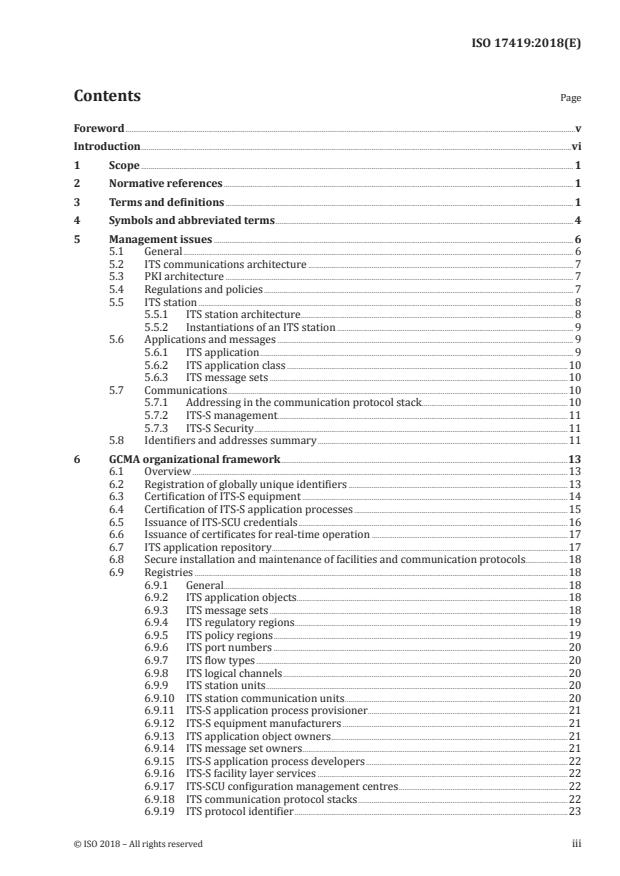
Contents Page
Foreword .v
Introduction .vi
1 Scope . 1
2 Normative references . 1
3 Terms and definitions . 1
4 Symbols and abbreviated terms . 4
5 Management issues . 6
5.1 General . 6
5.2 ITS communications architecture . 7
5.3 PKI architecture . 7
5.4 Regulations and policies . 7
5.5 ITS station . 8
5.5.1 ITS station architecture. 8
5.5.2 Instantiations of an ITS station . 9
5.6 Applications and messages . 9
5.6.1 ITS application . 9
5.6.2 ITS application class .10
5.6.3 ITS message sets .10
5.7 Communications .10
5.7.1 Addressing in the communication protocol stack.10
5.7.2 ITS-S management.11
5.7.3 ITS-S Security .11
5.8 Identifiers and addresses summary .11
6 GCMA organizational framework .13
6.1 Overview .13
6.2 Registration of globally unique identifiers .13
6.3 Certification of ITS-S equipment .14
6.4 Certification of ITS-S application processes .15
6.5 Issuance of ITS-SCU credentials .16
6.6 Issuance of certificates for real-time operation .17
6.7 ITS application repository . .17
6.8 Secure installation and maintenance of facilities and communication protocols.18
6.9 Registries .18
6.9.1 General.18
6.9.2 ITS application objects.18
6.9.3 ITS message sets .18
6.9.4 ITS regulatory regions . . .19
6.9.5 ITS policy regions .19
6.9.6 ITS port numbers .20
6.9.7 ITS flow types .20
6.9.8 ITS logical channels .20
6.9.9 ITS station units .20
6.9.10 ITS station communication units .20
6.9.11 ITS-S application process provisioner.21
6.9.12 ITS-S equipment manufacturers .21
6.9.13 ITS application object owners .21
6.9.14 ITS message set owners .21
6.9.15 ITS-S application process developers .22
6.9.16 ITS-S facility layer services .22
6.9.17 ITS-SCU configuration management centres .22
6.9.18 ITS communication protocol stacks .22
6.9.19 ITS protocol identifier .23
6.9.20 IANA registries.23
6.9.21 IEEE registries .23
6.10 Wrong behaviour reporting .24
7 GCMA technical framework .24
7.1 Addresses and identifiers .24
7.1.1 Overview .24
7.1.2 ITS-AID .24
7.1.3 ITS-SAPID .25
7.1.4 ITS-MsgSetID .25
7.1.5 ITS-PN .25
7.1.6 ITS-FlowTypeID .26
7.1.7 ITS-LCHID .26
7.1.8 ITS-SUID .27
7.1.9 ITS-SCUID .27
7.1.10 ITS-S-APPID .27
7.1.11 ITS-RRID.27
7.1.12 ITS-PRID .27
7.1.13 ITS-SEMID .28
7.1.14 ITS-AOOID .28
7.1.15 ITS-ATT .28
7.1.16 ITS-MSOID .28
7.1.17 ITS-SAPIID .29
7.1.18 ITS-S-APDID .29
7.1.19 ITS-SAPSSID .29
7.1.20 ITS-SecAlgID .30
7.1.21 ITS-S-FSID .30
7.1.22 ITS-SCU-CMCID .30
7.1.23 ITS-ProtStckID .30
7.1.24 ITS-ProtID .30
7.2 Online management .30
7.2.1 Secure installation and maintenance of ITS-S application processes .30
7.2.2 Secure installation of ITS-S protocols and control functions .30
7.2.3 Registration of ITS-S application processes with the ITS-S management entity .31
7.2.4 Data flow management .31
7.2.5 Management of certificates for real-time communications . .31
7.2.6 Exception reporting.31
Annex A (normative) ASN.1 modules .32
Annex B (informative) ITS-AID allocation request template .43
Bibliography .45
iv © ISO 2018 – All rights reserved
Foreword
ISO (the International Organization for Standardization) is a worldwide federation of national standards
bodies (ISO member bodies). The work of preparing International Standards is normally carried out
through ISO technical committees. Each member body interested in a subject for which a technical
committee has been established has the right to be represented on that committee. International
organizations, governmental and non-governmental, in liaison with ISO, also take part in the work.
ISO collaborates closely with the International Electrotechnical Commission (IEC) on all matters of
electrotechnical standardization.
The procedures used to develop this document and those intended for its further maintenance are
described in the ISO/IEC Directives, Part 1. In particular the different approval criteria needed for the
different types of ISO documents should be noted. This document was drafted in accordance with the
editorial rules of the ISO/IEC Directives, Part 2 (see www .iso .org/directives).
Attention is drawn to the possibility that some of the elements of this document may be the subject of
patent rights. ISO shall not be held responsible for identifying any or all such patent rights. Details of
any patent rights identified during the development of the document will be in the Introduction and/or
on the ISO list of patent declarations received (see www .iso .org/patents).
Any trade name used in this document is information given for the convenience of users and does not
constitute an endorsement.
For an explanation on the voluntary nature of standards, the meaning of ISO specific terms and
expressions related to conformity assessment, as well as information about ISO's adherence to the
World Trade Organization (WTO) principles in the Technical Barriers to Trade (TBT) see the following
URL: www .iso .org/iso/foreword .html.
This document was prepared by ISO/TC 204, Intelligent transport systems.
This first edition cancels and replaces ISO/TS 17419:2014, which has been technically revised to become
an International Standard.
Introduction
Classification and management of ITS applications in a global context covers more than just the ITS
applications themselves. It also covers elements of the environment in which ITS applications are
instantiated.
Intelligent Transport Systems (ITS) provide ITS services to users by execution of ITS applications which
typically requires communications between ITS station application processes residing in ITS station
units (ITS-SU). Communications includes messages dedicated to ITS applications, and messages from
ITS message sets.
[20]
Following the definition in TS 102 860 , ITS applications and ITS application classes are referred
to as ITS application objects. ITS application objects are uniquely identified by the registered “ITS
Application Identifier” (ITS-AID) specified in this document.
NOTE 1 An ITS application class groups ITS applications together that provide the same type of service, e.g.
“Electronic Fee Collection” (EFC), but operate in different contexts. Prior to start of service provisioning the
applicable context is negotiated. The definition of ITS application classes is based on the concept of the DSRC
[7]
Application entity as introduced in ISO 15628 , which is identified by a DSRCApplicationEntityID; negotiation of
the applicable context is performed by BST/VST exchange.
[20]
In ETSI TS 102 860 , ITS message sets were referred to as ITS application objects. This definition is
not adopted in this document due to the very different nature of ITS message sets and ITS application
objects. ITS message sets are uniquely identified by the registered “ITS Message Set Identifier” (ITS-
MsgSetID) specified in this document.
[20]
This document is an extension towards more general and global applicability of ETSI TS 102 860 .
This document introduces the term “ITS-S object” as a general reference to ITS application objects, ITS
message sets and other objects which may require globally unique identification and registration.
NOTE 2 Examples of other ITS-S objects are ITS-S communication protocols and ITS-S security protocols.
[9]–[12][14] [2]
Management of ITS-S objects is specified in the ISO 24102 series (all parts) and in ISO 17423 .
This document focuses on some management aspects related to authorized and controlled operation of
ITS-S objects, which requires considerations of ITS-S object identifiers, e.g. ITS-AID, ITS-MsgSetID, ITS-
SUID, ITS-SCUID, addresses and protocol identifiers used in the communication protocol stack of an
ITS-S, and others.
This document replaces ISO/TS 17419 without change of scope.
vi © ISO 2018 – All rights reserved
INTERNATIONAL STANDARD ISO 17419:2018(E)
Intelligent transport systems — Cooperative systems —
Globally unique identification
1 Scope
This document
— describes and specifies globally unique addresses and identifiers (ITS-S object identifiers) which
are both internal and external to ITS stations and are used for ITS station management,
— describes how ITS-S object identifiers and related technical parameters are used for classification,
registration and management of ITS applications and ITS application classes,
— describes how ITS-S object identifiers are used in the ITS communication protocol stack,
— introduces an organizational framework for registration and management of ITS-S objects,
— defines and specifies management procedures at a high functional level,
— is based on the architecture of an ITS station specified in ISO 21217:2014 as a Bounded Secured
Managed Domain (BSMD),
— specifies an ASN.1 module for the identifiers, addresses, and registry records identified in this
document, and
— specifies an ASN.1 module for a C-ITS Data Dictionary containing ASN.1 type definitions of general
interest.
2 Normative references
The following documents are referred to in the text in such a way that some or all of their content
constitutes requirements of this document. For dated references, only the edition cited applies. For
undated references, the latest edition of the referenced document (including any amendments) applies.
ISO/IEC 8824-1:2015, Information technology — Abstract Syntax Notation One (ASN.1): Specification of
basic notation — Part 1
ISO 21217:2014, Intelligent transport systems — Communications access for land mobiles (CALM) —
Architecture
3 Terms and definitions
For the purposes of this document, the terms and definitions given in ISO 21217:2014 and the
following apply.
ISO and IEC maintain terminological databases for use in standardization at the following addresses:
— IEC Electropedia: available at https: //www .electropedia .org/
— ISO Online browsing platform: available at https: //www .iso .org/obp
3.1
authorization
prescription that a particular behaviour shall not be prevented
Note 1 to entry: Unlike a permission, an authorization is an empowerment.
Note 2 to entry: From Reference [21].
3.2
ITS application
instantiation of an ITS service that involves an association of two or more complementary ITS-S
application processes
[SOURCE: ISO 21217:2014, 3.9, modified — the Note 1 to entry is deleted]
3.3
ITS application class
ITS application designed for operation in different contexts involving real-time negotiation of the
appropriate context
Note 1 to entry: The functional concepts of “application class” and “application context” were introduced in
ISO 15628. ITS application class is used, e.g. in ISO 22418. An example of an application class can be found in
ISO 14906.
3.4
ITS application identifier
globally unique, registered number identifying an ITS application object
3.5
ITS application object
ITS application or ITS application class
3.6
ITS message
message designed for an ITS-related purpose
3.7
ITS message set
collection of one or more uniquely identified ITS messages
3.8
ITS message set identifier
globally unique, registered identifier of an ITS message set
3.9
ITS protocol stack identifier
globally unique, registered identifier of a non-parameterized communications protocol stack
3.10
ITS registration authority
entity authorized to register ITS-S object identifiers
3.11
ITS service
functionality provided to users of intelligent transport systems designed, e.g. to increase safety,
sustainability, efficiency, and comfort
[SOURCE: ISO 21217:2014, 3.11.]
3.12
ITS trusted authority
entity authorized to issue ITS-S object security credentials
3.13
ITS-S application process
element in an ITS station that performs information processing for a particular application, and may
use ITS-S services to transmit and receive information[SOURCE: ISO 21217:2014, 3.19, modified —
“uses” replaced by “may use”].
2 © ISO 2018 – All rights reserved
3.14
ITS-S application process provisioner
functionality in an ITS-SU offering ITS-S application processes for download and installation to
other ITS-SUs
3.15
ITS-S communication protocol
protocol used in a communication protocol stack of an ITS-S
3.16
ITS-S communication protocol stack
consistent set of ITS-S communication protocols enabling communications between an ITS-SCU and
other nodes which may be identified by a registered globally unique reference number
[2]
Note 1 to entry: See ISO 17423 .
3.17
ITS-SCU configuration management centre
entity that retains information about capabilities of ITS-SCUs, status of objects in ITS-SCUs, and
supports management and update of this information
3.18
ITS-S object
entity used in ITS related to ITS-S management that may require a globally unique identifier
Note 1 to entry: Examples of ITS-S objects include ITS-SU, ITS-SCU, ITS application object, ITS message set, ITS-S
communication protocol, ITS flow type.
3.19
ITS-S object identifier
identifier of an ITS-S object
3.20
ITS-S object owner
entity responsible for the specification (design), maintenance and registration of an ITS-S object
3.21
ITS-S service
communication functionality of an ITS-S that provides the capability to connect to other nodes
[SOURCE: ISO 21217:2014,3.37.]
3.22
ITS-S unit
implementation of an ITS station
[SOURCE: ISO 21217:2014, 3.38.]
3.23
permission
rule that a particular behaviour is allowed to occur
[21]
Note 1 to entry: From ITU-T X.911 .
3.24
policy
set of rules related to a particular purpose, expressed as an obligation, an authorization, a permission
or a prohibition
[21]
Note 1 to entry: From ITU-T X.911 .
3.25
prohibition
prescription that a particular behaviour shall not occur
[21]
Note 1 to entry: From ITU-T X.911 .
3.26
registration
assignment of an unambiguous name to an object in a way which makes the assignment available to
interested parties
[22]
Note 1 to entry: From ITU-T X.911 .
3.27
registration authority
entity such as an organization, a standard or an automated facility that performs registration of one or
more types of objects
[22]
Note 1 to entry: From ITU-T X.911 .
3.28
regulation
written instrument containing rules having the force of law
3.29
regulation
process of the promulgation, monitoring, and enforcement of rules defined in 'regulation
(document)', established by primary and/or delegated legislation
3.30
regulator
agency responsible for exercising autonomous authority over some area of human activity
3.31
violation
behaviour contrary to a rule
[21]
Note 1 to entry: From ITU-T X.911 .
4 Symbols and abbreviated terms
ARCP Application Requirements for selection of Communication Profiles
BSMD Bounded Secured Managed Domain
BST Beacon Service Table
CEN Commission Européenne de Normalization
C-ITS Co-operative Intelligent Transport Systems
ETSI European Telecommunications Standards Institute
GCMA Global Classification and Management of ITS Applications
IANA Internet Assigned Numbers Authority
IEEE Institute of Electrical and Electronics Engineers
IETF Internet Engineering Task Force
4 © ISO 2018 – All rights reserved
ISO International Standards Organization
ITS Intelligent Transport Systems
ITS-ACID ITS Application Context Identifier
ITS-AID ITS Application Identifier
ITS-AOOID Application Object Owner (designer) Identifier
ITS-ATT ITS Access Technology Type
ITS-FlowTypeID ITS Flow Type Identifier
ITS-LCH ITS Logical Channel
ITS-LCHID ITS Logical Channel Identifier
ITS-MsgSetID ITS Message Set Identifier
ITS-MSOID ITS Message Set Owner Identifier
ITS-NTSDU ITS Station Networking and Transport layer Service Data Unit
ITS-PN ITS Port Number
ITS-PR ITS policy region
ITS-PRID ITS-PR Identifier
ITS-ProtID ITS Protocol Identifier
ITS-ProtStckID ITS Protocol Stack Identifier
ITS-RR ITS Regulatory Region
ITS-RRID ITS Regulatory Region Identifier
ITS-S ITS Station
ITS-SAPID ITS-S Application Process Identifier
ITS-SAPIID ITS-S Application Process Instance Identifier
ITS-S-APDID ITS-S Application Process Developer Identifier
ITS-S-APP ITS-S application Process Provisioner
ITS-S-APPID ITS-S Application Process Provider Identifier
ITS-SAPSSID ITS-S Application Process Sink Source Identifier
ITS-SCU ITS Station Communication Unit
ITS-SCU-CMC ITS-SCU Configuration Management Centre
ITS-SCU-CMCID ITS-SCU-CMD Identifier
ITS-SCUID ITS-SCU Identifier
ITS-SecAlgID ITS Security Algorithm Identifier
ITS-SEMID ITS Station Equipment Manufacturer Identifier
ITS-S-FSID ITS-S Facilities layer Service Identifier
ITS-SU ITS Station Unit
ITS-SUID ITS-SU Identifier
ITS-SU-UID ITS-SU User Identifier
LDM Local dynamic map
VST Vehicle Service Table
5 Management issues
NOTE This is an informative clause.
5.1 General
In this document, application management refers to objects and procedures, both internal and external to
the platforms on which the applications are installed, which are used to ensure the efficacy and authenticity
1)
of these applications and these platforms. Platforms in this context are ITS station communication units
(ITS-SCUs) and applications are ITS-S application processes as specified in ISO 21217:2014. Application
management procedures involve protocols for exchanging information between the various entities
involved in application management, and these procedures are described at a functional level in this
document. These procedures are to be used for authorizing and authenticating the use of ITS-S application
entities over communication networks as described in ISO 21217:2014 and in 5.2.
Entities related to ITS application management in the global context and their roles identified and / or
specified in this document are listed in Table 1.
Table 1 — Entities and their roles
Entity Role
ITS-S object Entity used in ITS related to ITS-S management that may be identified by a glob-
ally unique identifier.
EXAMPLE ITS application objects, ITS message sets, ITS-S communication pro-
tocols, ITS-S units, ITS-S communication units.
ITS-S object owner Entity which is responsible for the specification (design), maintenance and regis-
tration of ITS-S objects.
EXAMPLE Standards development organizations, industry special interest
groups such as the “Society of Automotive Engineers” (SAE).
ITS application object Entity that provides an ITS service to the user as specified in ISO 21217:2014.
EXAMPLE ITS applications and ITS application classes.
ITS message set Set of ITS messages designed for an ITS-related purpose as specified in
ISO 21217:2014.
ITS-S communication pro- Protocol used in a communication protocol stack of an ITS-S
tocol
ITS-S unit (ITS-SU) Physical instantiation of an ITS station specified in ISO 21217:2014. An ITS-SU
may consist of one single ITS-SCU, or several ITS-SCUs interconnected via an
ITS station internal network. An ITS-SU is also referred to as “Bounded Secured
Managed Entity” as specified in ISO 21217:2014.
1) An ITS-SU may consist of several physical units called ITS-SCUs as specified in ISO 21217:2014.
6 © ISO 2018 – All rights reserved
Table 1 (continued)
Entity Role
ITS-S communication unit Physical unit in an ITS-SU containing a part or all of the functionality of an ITS-S
(ITS-SCU) as specified in ISO 21217:2014.
ITS-S equipment manufac- Manufacturer of ITS-SUs or ITS-SCUs.
turer
ITS-S application process Developer (manufacturer) of ITS-S application processes for usage in ITS-SUs.
developer
ITS-S application process Entity that offers ITS-S application processes for download to an ITS-SCU.
provisioner
ITS-SCU configuration man- Entity that retains information about the capabilities of ITS-SUs, status of ob-
agement centre jects in ITS-SUs, and supports management and update of this information.
Certification authority (Cer- Entity in charge of checking ITS-SCUs, implementations of ITS-S communication
tification laboratory) protocols, and ITS-S application processes for compliance to standards or speci-
fications defined in an ITS release.
ITS registration authority Entity in charge of registering ITS-S objects referenced by globally unique iden-
tifiers.
ITS trusted authority Entity in charge of providing ITS-S object security credentials such as keys and
certificates for hardware and software.
5.2 ITS communications architecture
As illustrated in Figure 1, regardless of the complexity of the networks employed, communication
between “ITS station units” (ITS-SUs), and between ITS-SUs and other types of ITS communication
nodes, is on a peer-to-peer basis. The distinguishing feature of ITS-SUs is that of trust and authentication
as discussed in 5.5.1. The need for trust and authentication arises from the deployment of critical
safety-of-life and property applications. This leads to the definition of an ITS station as a “Bounded
Secured Managed Domain” (BSMD) as specified in ISO 21217:2014, and the requirement for a “Public
Key Infrastructure” (PKI) for trust assertion and certificate management.
Figure 1 — Simplified ITS peer-to-peer communication architecture
5.3 PKI architecture
A public-key infrastructure (PKI) is a system for the creation, storage, distribution, and revocation of
digital certificates which are used to verify that a particular public key and associated rights belong to
a certain entity. The PKI creates digital certificates which map public keys to entities and their rights,
securely stores these certificates in a central repository, and revokes them if needed.
5.4 Regulations and policies
Application management procedures shall comply with applicable regulation and use applicable policies.
A policy is a set of rules related to a particular purpose. Such a rule can be expressed as an obligation,
an authorization, a permission, or a prohibition. A regulation is an enforceable policy. Regulations apply
for a specific regulatory domain and are produced and maintained by regulators. Policies apply for a
specific policy domain.
The need and applicability for regulations and policies in ITS is identified in this document for the
following purposes:
— radio frequency allocation and usage;
— privacy issues;
— traffic operations and management.
A regulatory region is uniquely identified by an ITS Regulatory Region Identifier ITS-RRID.
A policy region is uniquely identified by an ITS Policy Region Identifier ITS-PRID.
5.5 ITS station
5.5.1 ITS station architecture
The architecture of the ITS station (ITS-S) specified in ISO 21217:2014 is illustrated in Figure 2.
Figure 2 — ITS station architecture [ISO 21217:2014]
The term ITS-S refers to functionalities rather than a physical unit. Six functional blocks of an ITS-S are
distinguished in Figure 2:
— “Applications”:
— ITS-S applications
— “Communications”:
— Data plane
— “Access”: ITS-S access layer, i.e. OSI layers one and two.
— “Networking & Transport”: ITS-S networking and transport layer, i.e. OSI layers three and four.
— “Facilities”: ITS-S facilities layer, i.e. OSI layers five, six and seven.
— Management plane
8 © ISO 2018 – All rights reserved
— “Management”: ITS-S management entity
— “Security”: ITS-S security entity
These functional blocks are assumed to interact with each other within a BSMD. Implementation and
maintenance of these functional blocks in a standards conformant manner creates ITS-SUs and ITS-
SCUs that can be trusted to operate according to the policies and procedures assigned to them by
trusted authorities. It is precisely the attribute of trust within the ITS domain that distinguishes ITS-
SUs Bounded Secured Managed Entities (BSMEs) from all other communication nodes. As a managed
domain, elements of the ITS-S need to be aware of and interact with the ITS-S management entity. As a
secured domain, installation (e.g. “plug-and-play”) of an element of an ITS-S such as an ITS-S application,
communication interface, or a communication protocol shall be performed in a controlled and secure
manner, applying the procedures for registration of identifiers of ITS-S objects and the authentication
of registered elements at time of installation.
ITS-S applications interact with the “Communications” block via an “Application Programming
Interface” (API). This interaction may address either protocols in the ITS-S facilities layer of the data
plane, or protocols in the ITS-S management entity or ITS-S security entity.
ITS-S access and ITS-S networking and transport layers are used by ITS-S facilities layer services and
ITS-S applications to transmit and receive ITS-NTSDUs as described in ISO 21217:2014.
A specific combination of an ITS-S networking and transport layer protocol (residing in an
instantiation of the ITS-S networking and transport layer), a “Communication Interface” (CI) (residing
in an instantiation of the ITS-S access layer), an ITS-S facilities layer protocols (optional) and related
necessary management and security protocols (optional) is referred to as an ITS-S communication
[2]
protocol stack specified in ISO 17423 . An ITS-S communication profile, which is a parameterized
[2]
ITS-S communication protocol stack specified in ISO 17423 is associated with a communication path
[14]
specified in ISO 24102-6 . An ITS-S application process may use more than one ITS-S communication
profile, e.g. one ITS-S communication profile for each of its distinct communication sources (flows).
[2]
Further details on the automatic selection of ITS-S communication profiles are found in ISO 17423 .
5.5.2 Instantiations of an ITS station
The functionality of an ITS-S may be implemented in one or several “ITS-S Communication Units” (ITS-
SCU) as explained in ISO 21217:2014. For example, an ITS-S can be implemented by connecting units
containing ITS-S router functionality and ITS-S host functionality using a local network (called an ITS
station-internal network). An implementation of an ITS station is referred to as an “ITS-S unit” (ITS-SU).
An ITS-SU may be uniquely identified by an ITS-SUID.
An ITS-SCU is assigned to one “ITS-SCU Configuration Management Centre” (ITS-SCU-CMC). The
purpose of the ITS-SCU-CMC is to manage the configuration of ITS-SCUs. Related ITS-S remote
[10]
management procedures are specified in ISO 24102-2 .
5.6 Applications and messages
5.6.1 ITS application
An ITS application is an instantiation of an ITS service that involves at least one ITS-S application
process, and may involve an association of two or more complementary ITS-S application processes as
described in ISO 21217:2014. ITS-S application processes may perform information dissemination by
implementing groupcast (broadcast or multicast) services, or by exchange of packets with peer ITS-S
application processes as part of a communication session, or may use data being available inside an ITS-
[5]
SU, e.g. provided by a Local Dynamic Map (LDM) specified in ISO 18750 , or provided by a publish-
[4]
subscribe mechanism specified in ISO/TS 17429 .
An ITS application is identified by an “ITS Application Identifier” (ITS-AID) specified in 7.1.2. ITS-
AIDs are assigned by a Registration authority. ITS-S application processes belonging to the same ITS
application are distinguished by an ITS-S application process identifier (ITS-SAPID) specified in 7.1.3,
i.e. a sub-identifier unique for a given ITS-AID.
One essential feature of the ITS-S reference architecture is that ITS-S application processes need not
necessarily concern themselves with the underlying communication protocols. They only need to be
able to inform the ITS-S management of their functional requirements for communications as described
[2]
in ISO 17423 .
An instance of an ITS-S application process installed in an ITS-SU is uniquely identified by an ITS-S
Application Process Instance Identifier (ITS-SAPIID) specified in 7.1.17.
5.6.2 ITS application class
[7]
The concept of an ITS application class as introduced in ISO 15628 (cf. DSRCApplicationEntity) is
based on identifying a set of different protocols that serve the same functional purpose, e.g. Electronic
Fee Collection (EFC).
An ITS application class is identified by an ITS-AID, see 5.6.1. The mutually exclusive characteristics
provided by an ITS application class for different contexts of usage are distinguished by an ITS
Application Context Identifier (ITS-ACID). Negotiation of the applicable context is part of the application
behaviour, and may also be performed in a general standardized way, e.g. in service advertisement
[1] [13]
specified in ISO/TS 16460 , ISO 24102-5 .
NOTE The term “ITS application class” is introduced in this document primarily for compatibility with legacy
[7]
systems ISO 15628 . The most popular ITS application class is the “Electronic Fee Collection” (EFC) application
(ITS-AID=1) based on the European DSRC, where the mutually exclusive characteristics are given by the different
EFC protocols used by road operators. The applicable EFC protocol is negotiated by BST/VST exchange prior to
service provisioning.
5.6.3 ITS message sets
An ITS message set is a collection of ITS messages associated with an entity that is responsible for
maintenance of the set. The messages of a given set are uniquely distinguishable, e.g. by a message
identifier being unique for the given message set
...
INTERNATIONAL ISO
STANDARD 17419
First edition
2018-05
Intelligent transport systems —
Cooperative systems — Globally
unique identification
Systèmes intelligents de transport — Systèmes coopératifs —
Identification unique au niveau global
Reference number
©
ISO 2018
© ISO 2018
All rights reserved. Unless otherwise specified, or required in the context of its implementation, no part of this publication may
be reproduced or utilized otherwise in any form or by any means, electronic or mechanical, including photocopying, or posting
on the internet or an intranet, without prior written permission. Permission can be requested from either ISO at the address
below or ISO’s member body in the country of the requester.
ISO copyright office
CP 401 • Ch. de Blandonnet 8
CH-1214 Vernier, Geneva
Phone: +41 22 749 01 11
Fax: +41 22 749 09 47
Email: copyright@iso.org
Website: www.iso.org
Published in Switzerland
ii © ISO 2018 – All rights reserved
Contents Page
Foreword .v
Introduction .vi
1 Scope . 1
2 Normative references . 1
3 Terms and definitions . 1
4 Symbols and abbreviated terms . 4
5 Management issues . 6
5.1 General . 6
5.2 ITS communications architecture . 7
5.3 PKI architecture . 7
5.4 Regulations and policies . 7
5.5 ITS station . 8
5.5.1 ITS station architecture. 8
5.5.2 Instantiations of an ITS station . 9
5.6 Applications and messages . 9
5.6.1 ITS application . 9
5.6.2 ITS application class .10
5.6.3 ITS message sets .10
5.7 Communications .10
5.7.1 Addressing in the communication protocol stack.10
5.7.2 ITS-S management.11
5.7.3 ITS-S Security .11
5.8 Identifiers and addresses summary .11
6 GCMA organizational framework .13
6.1 Overview .13
6.2 Registration of globally unique identifiers .13
6.3 Certification of ITS-S equipment .14
6.4 Certification of ITS-S application processes .15
6.5 Issuance of ITS-SCU credentials .16
6.6 Issuance of certificates for real-time operation .17
6.7 ITS application repository . .17
6.8 Secure installation and maintenance of facilities and communication protocols.18
6.9 Registries .18
6.9.1 General.18
6.9.2 ITS application objects.18
6.9.3 ITS message sets .18
6.9.4 ITS regulatory regions . . .19
6.9.5 ITS policy regions .19
6.9.6 ITS port numbers .20
6.9.7 ITS flow types .20
6.9.8 ITS logical channels .20
6.9.9 ITS station units .20
6.9.10 ITS station communication units .20
6.9.11 ITS-S application process provisioner.21
6.9.12 ITS-S equipment manufacturers .21
6.9.13 ITS application object owners .21
6.9.14 ITS message set owners .21
6.9.15 ITS-S application process developers .22
6.9.16 ITS-S facility layer services .22
6.9.17 ITS-SCU configuration management centres .22
6.9.18 ITS communication protocol stacks .22
6.9.19 ITS protocol identifier .23
6.9.20 IANA registries.23
6.9.21 IEEE registries .23
6.10 Wrong behaviour reporting .24
7 GCMA technical framework .24
7.1 Addresses and identifiers .24
7.1.1 Overview .24
7.1.2 ITS-AID .24
7.1.3 ITS-SAPID .25
7.1.4 ITS-MsgSetID .25
7.1.5 ITS-PN .25
7.1.6 ITS-FlowTypeID .26
7.1.7 ITS-LCHID .26
7.1.8 ITS-SUID .27
7.1.9 ITS-SCUID .27
7.1.10 ITS-S-APPID .27
7.1.11 ITS-RRID.27
7.1.12 ITS-PRID .27
7.1.13 ITS-SEMID .28
7.1.14 ITS-AOOID .28
7.1.15 ITS-ATT .28
7.1.16 ITS-MSOID .28
7.1.17 ITS-SAPIID .29
7.1.18 ITS-S-APDID .29
7.1.19 ITS-SAPSSID .29
7.1.20 ITS-SecAlgID .30
7.1.21 ITS-S-FSID .30
7.1.22 ITS-SCU-CMCID .30
7.1.23 ITS-ProtStckID .30
7.1.24 ITS-ProtID .30
7.2 Online management .30
7.2.1 Secure installation and maintenance of ITS-S application processes .30
7.2.2 Secure installation of ITS-S protocols and control functions .30
7.2.3 Registration of ITS-S application processes with the ITS-S management entity .31
7.2.4 Data flow management .31
7.2.5 Management of certificates for real-time communications . .31
7.2.6 Exception reporting.31
Annex A (normative) ASN.1 modules .32
Annex B (informative) ITS-AID allocation request template .43
Bibliography .45
iv © ISO 2018 – All rights reserved
Foreword
ISO (the International Organization for Standardization) is a worldwide federation of national standards
bodies (ISO member bodies). The work of preparing International Standards is normally carried out
through ISO technical committees. Each member body interested in a subject for which a technical
committee has been established has the right to be represented on that committee. International
organizations, governmental and non-governmental, in liaison with ISO, also take part in the work.
ISO collaborates closely with the International Electrotechnical Commission (IEC) on all matters of
electrotechnical standardization.
The procedures used to develop this document and those intended for its further maintenance are
described in the ISO/IEC Directives, Part 1. In particular the different approval criteria needed for the
different types of ISO documents should be noted. This document was drafted in accordance with the
editorial rules of the ISO/IEC Directives, Part 2 (see www .iso .org/directives).
Attention is drawn to the possibility that some of the elements of this document may be the subject of
patent rights. ISO shall not be held responsible for identifying any or all such patent rights. Details of
any patent rights identified during the development of the document will be in the Introduction and/or
on the ISO list of patent declarations received (see www .iso .org/patents).
Any trade name used in this document is information given for the convenience of users and does not
constitute an endorsement.
For an explanation on the voluntary nature of standards, the meaning of ISO specific terms and
expressions related to conformity assessment, as well as information about ISO's adherence to the
World Trade Organization (WTO) principles in the Technical Barriers to Trade (TBT) see the following
URL: www .iso .org/iso/foreword .html.
This document was prepared by ISO/TC 204, Intelligent transport systems.
This first edition cancels and replaces ISO/TS 17419:2014, which has been technically revised to become
an International Standard.
Introduction
Classification and management of ITS applications in a global context covers more than just the ITS
applications themselves. It also covers elements of the environment in which ITS applications are
instantiated.
Intelligent Transport Systems (ITS) provide ITS services to users by execution of ITS applications which
typically requires communications between ITS station application processes residing in ITS station
units (ITS-SU). Communications includes messages dedicated to ITS applications, and messages from
ITS message sets.
[20]
Following the definition in TS 102 860 , ITS applications and ITS application classes are referred
to as ITS application objects. ITS application objects are uniquely identified by the registered “ITS
Application Identifier” (ITS-AID) specified in this document.
NOTE 1 An ITS application class groups ITS applications together that provide the same type of service, e.g.
“Electronic Fee Collection” (EFC), but operate in different contexts. Prior to start of service provisioning the
applicable context is negotiated. The definition of ITS application classes is based on the concept of the DSRC
[7]
Application entity as introduced in ISO 15628 , which is identified by a DSRCApplicationEntityID; negotiation of
the applicable context is performed by BST/VST exchange.
[20]
In ETSI TS 102 860 , ITS message sets were referred to as ITS application objects. This definition is
not adopted in this document due to the very different nature of ITS message sets and ITS application
objects. ITS message sets are uniquely identified by the registered “ITS Message Set Identifier” (ITS-
MsgSetID) specified in this document.
[20]
This document is an extension towards more general and global applicability of ETSI TS 102 860 .
This document introduces the term “ITS-S object” as a general reference to ITS application objects, ITS
message sets and other objects which may require globally unique identification and registration.
NOTE 2 Examples of other ITS-S objects are ITS-S communication protocols and ITS-S security protocols.
[9]–[12][14] [2]
Management of ITS-S objects is specified in the ISO 24102 series (all parts) and in ISO 17423 .
This document focuses on some management aspects related to authorized and controlled operation of
ITS-S objects, which requires considerations of ITS-S object identifiers, e.g. ITS-AID, ITS-MsgSetID, ITS-
SUID, ITS-SCUID, addresses and protocol identifiers used in the communication protocol stack of an
ITS-S, and others.
This document replaces ISO/TS 17419 without change of scope.
vi © ISO 2018 – All rights reserved
INTERNATIONAL STANDARD ISO 17419:2018(E)
Intelligent transport systems — Cooperative systems —
Globally unique identification
1 Scope
This document
— describes and specifies globally unique addresses and identifiers (ITS-S object identifiers) which
are both internal and external to ITS stations and are used for ITS station management,
— describes how ITS-S object identifiers and related technical parameters are used for classification,
registration and management of ITS applications and ITS application classes,
— describes how ITS-S object identifiers are used in the ITS communication protocol stack,
— introduces an organizational framework for registration and management of ITS-S objects,
— defines and specifies management procedures at a high functional level,
— is based on the architecture of an ITS station specified in ISO 21217:2014 as a Bounded Secured
Managed Domain (BSMD),
— specifies an ASN.1 module for the identifiers, addresses, and registry records identified in this
document, and
— specifies an ASN.1 module for a C-ITS Data Dictionary containing ASN.1 type definitions of general
interest.
2 Normative references
The following documents are referred to in the text in such a way that some or all of their content
constitutes requirements of this document. For dated references, only the edition cited applies. For
undated references, the latest edition of the referenced document (including any amendments) applies.
ISO/IEC 8824-1:2015, Information technology — Abstract Syntax Notation One (ASN.1): Specification of
basic notation — Part 1
ISO 21217:2014, Intelligent transport systems — Communications access for land mobiles (CALM) —
Architecture
3 Terms and definitions
For the purposes of this document, the terms and definitions given in ISO 21217:2014 and the
following apply.
ISO and IEC maintain terminological databases for use in standardization at the following addresses:
— IEC Electropedia: available at https: //www .electropedia .org/
— ISO Online browsing platform: available at https: //www .iso .org/obp
3.1
authorization
prescription that a particular behaviour shall not be prevented
Note 1 to entry: Unlike a permission, an authorization is an empowerment.
Note 2 to entry: From Reference [21].
3.2
ITS application
instantiation of an ITS service that involves an association of two or more complementary ITS-S
application processes
[SOURCE: ISO 21217:2014, 3.9, modified — the Note 1 to entry is deleted]
3.3
ITS application class
ITS application designed for operation in different contexts involving real-time negotiation of the
appropriate context
Note 1 to entry: The functional concepts of “application class” and “application context” were introduced in
ISO 15628. ITS application class is used, e.g. in ISO 22418. An example of an application class can be found in
ISO 14906.
3.4
ITS application identifier
globally unique, registered number identifying an ITS application object
3.5
ITS application object
ITS application or ITS application class
3.6
ITS message
message designed for an ITS-related purpose
3.7
ITS message set
collection of one or more uniquely identified ITS messages
3.8
ITS message set identifier
globally unique, registered identifier of an ITS message set
3.9
ITS protocol stack identifier
globally unique, registered identifier of a non-parameterized communications protocol stack
3.10
ITS registration authority
entity authorized to register ITS-S object identifiers
3.11
ITS service
functionality provided to users of intelligent transport systems designed, e.g. to increase safety,
sustainability, efficiency, and comfort
[SOURCE: ISO 21217:2014, 3.11.]
3.12
ITS trusted authority
entity authorized to issue ITS-S object security credentials
3.13
ITS-S application process
element in an ITS station that performs information processing for a particular application, and may
use ITS-S services to transmit and receive information[SOURCE: ISO 21217:2014, 3.19, modified —
“uses” replaced by “may use”].
2 © ISO 2018 – All rights reserved
3.14
ITS-S application process provisioner
functionality in an ITS-SU offering ITS-S application processes for download and installation to
other ITS-SUs
3.15
ITS-S communication protocol
protocol used in a communication protocol stack of an ITS-S
3.16
ITS-S communication protocol stack
consistent set of ITS-S communication protocols enabling communications between an ITS-SCU and
other nodes which may be identified by a registered globally unique reference number
[2]
Note 1 to entry: See ISO 17423 .
3.17
ITS-SCU configuration management centre
entity that retains information about capabilities of ITS-SCUs, status of objects in ITS-SCUs, and
supports management and update of this information
3.18
ITS-S object
entity used in ITS related to ITS-S management that may require a globally unique identifier
Note 1 to entry: Examples of ITS-S objects include ITS-SU, ITS-SCU, ITS application object, ITS message set, ITS-S
communication protocol, ITS flow type.
3.19
ITS-S object identifier
identifier of an ITS-S object
3.20
ITS-S object owner
entity responsible for the specification (design), maintenance and registration of an ITS-S object
3.21
ITS-S service
communication functionality of an ITS-S that provides the capability to connect to other nodes
[SOURCE: ISO 21217:2014,3.37.]
3.22
ITS-S unit
implementation of an ITS station
[SOURCE: ISO 21217:2014, 3.38.]
3.23
permission
rule that a particular behaviour is allowed to occur
[21]
Note 1 to entry: From ITU-T X.911 .
3.24
policy
set of rules related to a particular purpose, expressed as an obligation, an authorization, a permission
or a prohibition
[21]
Note 1 to entry: From ITU-T X.911 .
3.25
prohibition
prescription that a particular behaviour shall not occur
[21]
Note 1 to entry: From ITU-T X.911 .
3.26
registration
assignment of an unambiguous name to an object in a way which makes the assignment available to
interested parties
[22]
Note 1 to entry: From ITU-T X.911 .
3.27
registration authority
entity such as an organization, a standard or an automated facility that performs registration of one or
more types of objects
[22]
Note 1 to entry: From ITU-T X.911 .
3.28
regulation
written instrument containing rules having the force of law
3.29
regulation
process of the promulgation, monitoring, and enforcement of rules defined in 'regulation
(document)', established by primary and/or delegated legislation
3.30
regulator
agency responsible for exercising autonomous authority over some area of human activity
3.31
violation
behaviour contrary to a rule
[21]
Note 1 to entry: From ITU-T X.911 .
4 Symbols and abbreviated terms
ARCP Application Requirements for selection of Communication Profiles
BSMD Bounded Secured Managed Domain
BST Beacon Service Table
CEN Commission Européenne de Normalization
C-ITS Co-operative Intelligent Transport Systems
ETSI European Telecommunications Standards Institute
GCMA Global Classification and Management of ITS Applications
IANA Internet Assigned Numbers Authority
IEEE Institute of Electrical and Electronics Engineers
IETF Internet Engineering Task Force
4 © ISO 2018 – All rights reserved
ISO International Standards Organization
ITS Intelligent Transport Systems
ITS-ACID ITS Application Context Identifier
ITS-AID ITS Application Identifier
ITS-AOOID Application Object Owner (designer) Identifier
ITS-ATT ITS Access Technology Type
ITS-FlowTypeID ITS Flow Type Identifier
ITS-LCH ITS Logical Channel
ITS-LCHID ITS Logical Channel Identifier
ITS-MsgSetID ITS Message Set Identifier
ITS-MSOID ITS Message Set Owner Identifier
ITS-NTSDU ITS Station Networking and Transport layer Service Data Unit
ITS-PN ITS Port Number
ITS-PR ITS policy region
ITS-PRID ITS-PR Identifier
ITS-ProtID ITS Protocol Identifier
ITS-ProtStckID ITS Protocol Stack Identifier
ITS-RR ITS Regulatory Region
ITS-RRID ITS Regulatory Region Identifier
ITS-S ITS Station
ITS-SAPID ITS-S Application Process Identifier
ITS-SAPIID ITS-S Application Process Instance Identifier
ITS-S-APDID ITS-S Application Process Developer Identifier
ITS-S-APP ITS-S application Process Provisioner
ITS-S-APPID ITS-S Application Process Provider Identifier
ITS-SAPSSID ITS-S Application Process Sink Source Identifier
ITS-SCU ITS Station Communication Unit
ITS-SCU-CMC ITS-SCU Configuration Management Centre
ITS-SCU-CMCID ITS-SCU-CMD Identifier
ITS-SCUID ITS-SCU Identifier
ITS-SecAlgID ITS Security Algorithm Identifier
ITS-SEMID ITS Station Equipment Manufacturer Identifier
ITS-S-FSID ITS-S Facilities layer Service Identifier
ITS-SU ITS Station Unit
ITS-SUID ITS-SU Identifier
ITS-SU-UID ITS-SU User Identifier
LDM Local dynamic map
VST Vehicle Service Table
5 Management issues
NOTE This is an informative clause.
5.1 General
In this document, application management refers to objects and procedures, both internal and external to
the platforms on which the applications are installed, which are used to ensure the efficacy and authenticity
1)
of these applications and these platforms. Platforms in this context are ITS station communication units
(ITS-SCUs) and applications are ITS-S application processes as specified in ISO 21217:2014. Application
management procedures involve protocols for exchanging information between the various entities
involved in application management, and these procedures are described at a functional level in this
document. These procedures are to be used for authorizing and authenticating the use of ITS-S application
entities over communication networks as described in ISO 21217:2014 and in 5.2.
Entities related to ITS application management in the global context and their roles identified and / or
specified in this document are listed in Table 1.
Table 1 — Entities and their roles
Entity Role
ITS-S object Entity used in ITS related to ITS-S management that may be identified by a glob-
ally unique identifier.
EXAMPLE ITS application objects, ITS message sets, ITS-S communication pro-
tocols, ITS-S units, ITS-S communication units.
ITS-S object owner Entity which is responsible for the specification (design), maintenance and regis-
tration of ITS-S objects.
EXAMPLE Standards development organizations, industry special interest
groups such as the “Society of Automotive Engineers” (SAE).
ITS application object Entity that provides an ITS service to the user as specified in ISO 21217:2014.
EXAMPLE ITS applications and ITS application classes.
ITS message set Set of ITS messages designed for an ITS-related purpose as specified in
ISO 21217:2014.
ITS-S communication pro- Protocol used in a communication protocol stack of an ITS-S
tocol
ITS-S unit (ITS-SU) Physical instantiation of an ITS station specified in ISO 21217:2014. An ITS-SU
may consist of one single ITS-SCU, or several ITS-SCUs interconnected via an
ITS station internal network. An ITS-SU is also referred to as “Bounded Secured
Managed Entity” as specified in ISO 21217:2014.
1) An ITS-SU may consist of several physical units called ITS-SCUs as specified in ISO 21217:2014.
6 © ISO 2018 – All rights reserved
Table 1 (continued)
Entity Role
ITS-S communication unit Physical unit in an ITS-SU containing a part or all of the functionality of an ITS-S
(ITS-SCU) as specified in ISO 21217:2014.
ITS-S equipment manufac- Manufacturer of ITS-SUs or ITS-SCUs.
turer
ITS-S application process Developer (manufacturer) of ITS-S application processes for usage in ITS-SUs.
developer
ITS-S application process Entity that offers ITS-S application processes for download to an ITS-SCU.
provisioner
ITS-SCU configuration man- Entity that retains information about the capabilities of ITS-SUs, status of ob-
agement centre jects in ITS-SUs, and supports management and update of this information.
Certification authority (Cer- Entity in charge of checking ITS-SCUs, implementations of ITS-S communication
tification laboratory) protocols, and ITS-S application processes for compliance to standards or speci-
fications defined in an ITS release.
ITS registration authority Entity in charge of registering ITS-S objects referenced by globally unique iden-
tifiers.
ITS trusted authority Entity in charge of providing ITS-S object security credentials such as keys and
certificates for hardware and software.
5.2 ITS communications architecture
As illustrated in Figure 1, regardless of the complexity of the networks employed, communication
between “ITS station units” (ITS-SUs), and between ITS-SUs and other types of ITS communication
nodes, is on a peer-to-peer basis. The distinguishing feature of ITS-SUs is that of trust and authentication
as discussed in 5.5.1. The need for trust and authentication arises from the deployment of critical
safety-of-life and property applications. This leads to the definition of an ITS station as a “Bounded
Secured Managed Domain” (BSMD) as specified in ISO 21217:2014, and the requirement for a “Public
Key Infrastructure” (PKI) for trust assertion and certificate management.
Figure 1 — Simplified ITS peer-to-peer communication architecture
5.3 PKI architecture
A public-key infrastructure (PKI) is a system for the creation, storage, distribution, and revocation of
digital certificates which are used to verify that a particular public key and associated rights belong to
a certain entity. The PKI creates digital certificates which map public keys to entities and their rights,
securely stores these certificates in a central repository, and revokes them if needed.
5.4 Regulations and policies
Application management procedures shall comply with applicable regulation and use applicable policies.
A policy is a set of rules related to a particular purpose. Such a rule can be expressed as an obligation,
an authorization, a permission, or a prohibition. A regulation is an enforceable policy. Regulations apply
for a specific regulatory domain and are produced and maintained by regulators. Policies apply for a
specific policy domain.
The need and applicability for regulations and policies in ITS is identified in this document for the
following purposes:
— radio frequency allocation and usage;
— privacy issues;
— traffic operations and management.
A regulatory region is uniquely identified by an ITS Regulatory Region Identifier ITS-RRID.
A policy region is uniquely identified by an ITS Policy Region Identifier ITS-PRID.
5.5 ITS station
5.5.1 ITS station architecture
The architecture of the ITS station (ITS-S) specified in ISO 21217:2014 is illustrated in Figure 2.
Figure 2 — ITS station architecture [ISO 21217:2014]
The term ITS-S refers to functionalities rather than a physical unit. Six functional blocks of an ITS-S are
distinguished in Figure 2:
— “Applications”:
— ITS-S applications
— “Communications”:
— Data plane
— “Access”: ITS-S access layer, i.e. OSI layers one and two.
— “Networking & Transport”: ITS-S networking and transport layer, i.e. OSI layers three and four.
— “Facilities”: ITS-S facilities layer, i.e. OSI layers five, six and seven.
— Management plane
8 © ISO 2018 – All rights reserved
— “Management”: ITS-S management entity
— “Security”: ITS-S security entity
These functional blocks are assumed to interact with each other within a BSMD. Implementation and
maintenance of these functional blocks in a standards conformant manner creates ITS-SUs and ITS-
SCUs that can be trusted to operate according to the policies and procedures assigned to them by
trusted authorities. It is precisely the attribute of trust within the ITS domain that distinguishes ITS-
SUs Bounded Secured Managed Entities (BSMEs) from all other communication nodes. As a managed
domain, elements of the ITS-S need to be aware of and interact with the ITS-S management entity. As a
secured domain, installation (e.g. “plug-and-play”) of an element of an ITS-S such as an ITS-S application,
communication interface, or a communication protocol shall be performed in a controlled and secure
manner, applying the procedures for registration of identifiers of ITS-S objects and the authentication
of registered elements at time of installation.
ITS-S applications interact with the “Communications” block via an “Application Programming
Interface” (API). This interaction may address either protocols in the ITS-S facilities layer of the data
plane, or protocols in the ITS-S management entity or ITS-S security entity.
ITS-S access and ITS-S networking and transport layers are used by ITS-S facilities layer services and
ITS-S applications to transmit and receive ITS-NTSDUs as described in ISO 21217:2014.
A specific combination of an ITS-S networking and transport layer protocol (residing in an
instantiation of the ITS-S networking and transport layer), a “Communication Interface” (CI) (residing
in an instantiation of the ITS-S access layer), an ITS-S facilities layer protocols (optional) and related
necessary management and security protocols (optional) is referred to as an ITS-S communication
[2]
protocol stack specified in ISO 17423 . An ITS-S communication profile, which is a parameterized
[2]
ITS-S communication protocol stack specified in ISO 17423 is associated with a communication path
[14]
specified in ISO 24102-6 . An ITS-S application process may use more than one ITS-S communication
profile, e.g. one ITS-S communication profile for each of its distinct communication sources (flows).
[2]
Further details on the automatic selection of ITS-S communication profiles are found in ISO 17423 .
5.5.2 Instantiations of an ITS station
The functionality of an ITS-S may be implemented in one or several “ITS-S Communication Units” (ITS-
SCU) as explained in ISO 21217:2014. For example, an ITS-S can be implemented by connecting units
containing ITS-S router functionality and ITS-S host functionality using a local network (called an ITS
station-internal network). An implementation of an ITS station is referred to as an “ITS-S unit” (ITS-SU).
An ITS-SU may be uniquely identified by an ITS-SUID.
An ITS-SCU is assigned to one “ITS-SCU Configuration Management Centre” (ITS-SCU-CMC). The
purpose of the ITS-SCU-CMC is to manage the configuration of ITS-SCUs. Related ITS-S remote
[10]
management procedures are specified in ISO 24102-2 .
5.6 Applications and messages
5.6.1 ITS application
An ITS application is an instantiation of an ITS service that involves at least one ITS-S application
process, and may involve an association of two or more complementary ITS-S application processes as
described in ISO 21217:2014. ITS-S application processes may perform information dissemination by
implementing groupcast (broadcast or multicast) services, or by exchange of packets with peer ITS-S
application processes as part of a communication session, or may use data being available inside an ITS-
[5]
SU, e.g. provided by a Local Dynamic Map (LDM) specified in ISO 18750 , or provided by a publish-
[4]
subscribe mechanism specified in ISO/TS 17429 .
An ITS application is identified by an “ITS Application Identifier” (ITS-AID) specified in 7.1.2. ITS-
AIDs are assigned by a Registration authority. ITS-S application processes belonging to the same ITS
application are distinguished by an ITS-S application process identifier (ITS-SAPID) specified in 7.1.3,
i.e. a sub-identifier unique for a given ITS-AID.
One essential feature of the ITS-S reference architecture is that ITS-S application processes need not
necessarily concern themselves with the underlying communication protocols. They only need to be
able to inform the ITS-S management of their functional requirements for communications as described
[2]
in ISO 17423 .
An instance of an ITS-S application process installed in an ITS-SU is uniquely identified by an ITS-S
Application Process Instance Identifier (ITS-SAPIID) specified in 7.1.17.
5.6.2 ITS application class
[7]
The concept of an ITS application class as introduced in ISO 15628 (cf. DSRCApplicationEntity) is
based on identifying a set of different protocols that serve the same functional purpose, e.g. Electronic
Fee Collection (EFC).
An ITS application class is identified by an ITS-AID, see 5.6.1. The mutually exclusive characteristics
provided by an ITS application class for different contexts of usage are distinguished by an ITS
Application Context Identifier (ITS-ACID). Negotiation of the applicable context is part of the application
behaviour, and may also be performed in a general standardized way, e.g. in service advertisement
[1] [13]
specified in ISO/TS 16460 , ISO 24102-5 .
NOTE The term “ITS application class” is introduced in this document primarily for compatibility with legacy
[7]
systems ISO 15628 . The most popular ITS application class is the “Electronic Fee Collection” (EFC) application
(ITS-AID=1) based on the European DSRC, where the mutually exclusive characteristics are given by the different
EFC protocols used by road operators. The applicable EFC protocol is negotiated by BST/VST exchange prior to
service provisioning.
5.6.3 ITS message sets
An ITS message set is a collection of ITS messages associated with an entity that is responsible for
maintenance of the set. The messages of a given set are uniquely distinguishable, e.g. by a message
identifier being unique for the given message set
...
NORME ISO
INTERNATIONALE 17419
Première édition
2018-05
Systèmes intelligents de transport —
Systèmes coopératifs — Identification
unique au niveau global
Intelligent transport systems — Cooperative systems — Globally
unique identification
Numéro de référence
©
ISO 2018
DOCUMENT PROTÉGÉ PAR COPYRIGHT
© ISO 2018
Tous droits réservés. Sauf prescription différente ou nécessité dans le contexte de sa mise en œuvre, aucune partie de cette
publication ne peut être reproduite ni utilisée sous quelque forme que ce soit et par aucun procédé, électronique ou mécanique,
y compris la photocopie, ou la diffusion sur l’internet ou sur un intranet, sans autorisation écrite préalable. Une autorisation peut
être demandée à l’ISO à l’adresse ci-après ou au comité membre de l’ISO dans le pays du demandeur.
ISO copyright office
Case postale 401 • Ch. de Blandonnet 8
CH-1214 Vernier, Genève
Tél.: +41 22 749 01 11
Fax: +41 22 749 09 47
E-mail: copyright@iso.org
Web: www.iso.org
Publié en Suisse
ii © ISO 2018 – Tous droits réservés
Sommaire Page
Avant-propos .v
Introduction .vi
1 Domaine d’application . 1
2 Références normatives . 1
3 Termes et définitions . 1
4 Symboles et abréviations . 4
5 Problématiques de gestion . 6
5.1 Généralités . 6
5.2 Architecture de communication ITS . 7
5.3 Architecture PKI . . 8
5.4 Réglementations et politiques . 8
5.5 Station ITS . 9
5.5.1 Architecture de station ITS . 9
5.5.2 Instanciations d’une station ITS .10
5.6 Applications et messages .10
5.6.1 Application ITS .10
5.6.2 Classe d’applications ITS.11
5.6.3 Ensembles de messages ITS .11
5.7 Communications .11
5.7.1 Adressage dans la pile de protocoles de communication .11
5.7.2 Gestion ITS-S .12
5.7.3 Sécurité ITS-S .12
5.8 Récapitulatif des identificateurs et des adresses .13
6 Cadre organisationnel GCMA .14
6.1 Vue d’ensemble .14
6.2 Enregistrement d’identificateurs uniques au niveau global .15
6.3 Certification de l’équipement ITS-S .16
6.4 Certification des processus d’application ITS-S .17
6.5 Émission de justificatifs ITS-SCU .18
6.6 Émission de certificats pour une exploitation en temps réel .19
6.7 Référentiel d’applications ITS .20
6.8 Installation et maintenance sécurisées des installations et des protocoles de
communication .21
6.9 Registres .21
6.9.1 Généralités .21
6.9.2 Objets d’application ITS .21
6.9.3 Ensembles de messages ITS .22
6.9.4 Régions de réglementation ITS .22
6.9.5 Régions de politique ITS .23
6.9.6 Numéros de ports ITS .23
6.9.7 Types de flux ITS .24
6.9.8 Canaux logiques ITS .24
6.9.9 Unités de station ITS .24
6.9.10 Unités de communication de station ITS .24
6.9.11 Fournisseur de processus d’application ITS .25
6.9.12 Fabricants d’équipements ITS-S .25
6.9.13 Responsables d’objets d’application ITS .25
6.9.14 Responsables d’ensembles de messages ITS .26
6.9.15 Développeurs de processus d’application ITS-S .26
6.9.16 Services de la couche d’installation ITS-S .26
6.9.17 Centres de gestion de la configuration des ITS-SCU .27
6.9.18 Piles de protocoles de communication ITS .27
6.9.19 Identificateur de protocole ITS.27
6.9.20 Registres IANA .28
6.9.21 Registres IEEE .28
6.10 Signalement d’un comportement inapproprié .28
7 Cadre technique GCMA .29
7.1 Adresses et identificateurs .29
7.1.1 Vue d’ensemble .29
7.1.2 ITS-AID .29
7.1.3 ITS-SAPID .30
7.1.4 ITS-MsgSetID .30
7.1.5 ITS-PN .30
7.1.6 ITS-FlowTypeID .31
7.1.7 ITS-LCHID .31
7.1.8 ITS-SUID .32
7.1.9 ITS-SCUID .32
7.1.10 ITS-S-APPID .32
7.1.11 ITS-RRID.32
7.1.12 ITS-PRID .33
7.1.13 ITS-SEMID .33
7.1.14 ITS-AOOID .33
7.1.15 ITS-ATT .33
7.1.16 ITS-MSOID .34
7.1.17 ITS-SAPIID .34
7.1.18 ITS-S-APDID .35
7.1.19 ITS-SAPSSID .35
7.1.20 ITS-SecAlgID .35
7.1.21 ITS-S-FSID .35
7.1.22 ITS-SCU-CMCID .35
7.1.23 ITS-ProtStckID .35
7.1.24 ITS-ProtID .36
7.2 Gestion en ligne .36
7.2.1 Installation et maintenance sécurisées des processus d’application ITS-S .36
7.2.2 Installation sécurisée des protocoles ITS-S et des fonctions de contrôle .36
7.2.3 Enregistrement des processus d’application ITS-S auprès de la gestion de
l’ITS-S .36
7.2.4 Gestion des flux de données .36
7.2.5 Gestion de certificats pour les communications en temps réel .37
7.2.6 Signalement des exceptions .37
Annexe A (normative) Modules ASN.1 .38
Annexe B (informative) Modèle de demande d’attribution d’un ITS-AID .49
Bibliographie .51
iv © ISO 2018 – Tous droits réservés
Avant-propos
L’ISO (Organisation internationale de normalisation) est une fédération mondiale d’organismes
nationaux de normalisation (comités membres de l’ISO). L’élaboration des Normes internationales est
en général confiée aux comités techniques de l’ISO. Chaque comité membre intéressé par une étude
a le droit de faire partie du comité technique créé à cet effet. Les organisations internationales,
gouvernementales et non gouvernementales, en liaison avec l’ISO, participent également aux travaux.
L’ISO collabore étroitement avec la Commission électrotechnique internationale (IEC) en ce qui
concerne la normalisation électrotechnique.
Les procédures utilisées pour élaborer le présent document et celles destinées à sa mise à jour sont
décrites dans les Directives ISO/IEC, Partie 1. Il convient en particulier de prendre note des différents
critères d’approbation requis pour les différents types de documents ISO. Le présent document a été
rédigé conformément aux règles de rédaction définies dans les Directives ISO/IEC, Partie 2 (voir www
.iso .org/directives).
L’attention est attirée sur le fait que certains des éléments du présent document peuvent faire l’objet de
droits de propriété intellectuelle ou de droits analogues. L’ISO ne saurait être tenue pour responsable
de ne pas avoir identifié de tels droits de propriété et averti de leur existence. Les détails concernant
les références aux droits de propriété intellectuelle ou autres droits analogues identifiés lors de
l’élaboration du document sont indiqués dans l’Introduction et/ou dans la liste des déclarations de
brevets reçues par l’ISO (voir www .iso .org/patents).
Les appellations commerciales éventuellement mentionnées dans le présent document sont données
pour information, par souci de commodité, à l’intention des utilisateurs et ne sauraient constituer un
engagement.
Pour une explication de la signification des termes et expressions spécifiques de l’ISO liés à l’évaluation
de la conformité, ou pour toute information au sujet de l’adhésion de l’ISO aux principes de l’organisation
mondiale du commerce (OMC) concernant les obstacles techniques au commerce (OTC), voir le lien
suivant: www .iso .org/iso/foreword .html.
Le présent document a été élaboré par le comité technique ISO/TC 204, Systèmes de transport intelligent.
Cette première édition annule et remplace ISO/TS 17419:2014 qui a fait l’objet d’une revision technique.
Introduction
Le périmètre de la classification et de la gestion des applications des systèmes intelligents de transport
(ITS) dans un contexte global s’étend au-delà des applications ITS proprement dites, pour couvrir
également les éléments de l’environnement dans lequel les applications ITS sont instanciées.
Les systèmes intelligents de transport fournissent des services ITS aux utilisateurs grace à l’exécution
d’applications ITS nécessitant généralement la mise en place de communications entre les processus
d’application des stations ITS résidant dans les unités de station ITS (ITS-SU). Les communications
englobent les messages destinés aux applications ITS ainsi que les messages issus des ensembles de
messages ITS.
[20]
Selon la définition présentée par le document TS 102 860 , les applications ITS et les classes
d’applications ITS sont désignées sous l’appellation « objets d’application ITS ». Les objets d’application
ITS sont identifiés de manière unique par l’« identificateur d’application ITS » (ITS-AID) enregistré,
spécifié dans le présent document.
NOTE Une classe d’applications ITS regroupe les applications ITS fournissant le même type de service,
par exemple « Télépéage » (EFC), mais fonctionnant dans des contextes différents. Le contexte applicable fait
l’objet d’une négociation avant la prestation du service. La définition des classes d’applications ITS est basée
[7]
sur le concept d’entité d’application DSRC selon l’ISO 15628 , identifiée par un DSRCApplicationEntityID. La
négociation du contexte applicable s’effectue au moyen de l’échange BST/VST.
[20]
Dans le document ETSI TS 102 860 , les ensembles de messages ITS étaient désignés sous l’appellation
« objets d’application ITS ». Cette définition n’est pas adoptée par le présent document, en raison de la
nature très différente des ensembles de messages ITS et des objets d’application ITS. Les ensembles
de messages ITS sont identifiés de manière unique par l’« identificateur d’ensemble de messages ITS »
(ITS-MsgSetID) enregistré, spécifié dans le présent document.
Le présent document constitue une extension vers une applicabilité plus générale et plus globale du
[20]
document ETSI TS 102 860 . Il présente le terme « Objet ITS-S » en tant que référence générale aux
objets d’application ITS, aux ensembles de messages ITS et aux autres objets pouvant nécessiter une
identification et un enregistrement unique au niveau global.
NOTE Les protocoles de communication ITS-S et les protocoles de sécurité ITS-S sont autant d’exemples
d’autres objets ITS-S.
[9-12][14]
La gestion des objets ITS-S est spécifiée dans le corpus documentaire ISO 24102 Parties 1 à 6 ,
[2]
et dans la norme EN/ISO 17423 . Le présent document est axé sur certains aspects de gestion liés
à l’exploitation autorisée et contrôlée d’objets ITS-S, nécessitant la prise en compte d’identificateurs
d’objets ITS-S, notamment les ITS-AID, les ITS-MsgSetID, les ITS-SUID, les ITS-SCUID, ainsi que les
adresses et les identificateurs de protocoles utilisés dans la pile de protocoles de communication d’une
ITS-S, entre autres.
Le présent document remplace la Spécification technique ISO/TS 17419 sans en modifier le domaine
d’application.
vi © ISO 2018 – Tous droits réservés
NORME INTERNATIONALE ISO 17419:2018(F)
Systèmes intelligents de transport — Systèmes coopératifs
— Identification unique au niveau global
1 Domaine d’application
Ce document
— décrit et spécifie des adresses et des identificateurs uniques au niveau global (identificateurs
d’objets ITS-S) internes et externes aux stations ITS et exploités dans le cadre de la gestion de la
station ITS,
— décrit les modalités d’exploitation des identificateurs d’objets ITS-S et des paramètres techniques
liés pour la classification, l’enregistrement et la gestion des applications ITS et des classes
d’applications ITS,
— décrit les modalités d’exploitation des identificateurs d’objets ITS-S dans la pile de protocoles de
communication ITS,
— présente un cadre organisationnel pour l’enregistrement et la gestion des objets ITS-S,
— définit et spécifie les procédures de gestion à un niveau fonctionnel élevé,
— s’appuie sur l’architecture d’une station ITS spécifiée dans l’ISO 21217:2014 en tant que domaine
délimité géré de manière sécurisée (BSMD),
— spécifie un module ASN.1 pour les identificateurs, les adresses et les articles de registre identifiés
dans cette Norme internationale,
— spécifie un module ASN.1 pour un dictionnaire de données C-ITS contenant des définitions de
type ASN.1 présentant un intérêt général.
2 Références normatives
Les documents suivants sont cités dans le texte de sorte qu’ils constituent, pour tout ou partie de leur
contenu, des exigences du présent document. Pour les références datées, seule l’édition citée s’applique.
Pour les références non datées, la dernière édition du document de référence s'applique (y compris les
éventuels amendements).
ISO/IEC 8824-1:2015, Technologies de l'information — Notation de syntaxe abstraite numéro un (ASN.1):
Spécification de la notation de base — Partie 1
ISO 21217:2014, Systèmes intelligents de transport — Accès aux communications des services mobiles
terrestres (CALM) — Architecture
3 Termes et définitions
Pour les besoins du présent document, les termes et les définitions de l’ISO 21217:2014 ainsi que les
suivants, s’appliquent.
L’ISO et l’IEC tiennent à jour des bases de données terminologiques destinées à être utilisées en
normalisation, consultables aux adresses suivantes:
— IEC Electropedia: disponible à l’adresse http: //www .electropedia .org/
— ISO Online browsing platform: disponible à l’adresse https: //www .iso .org/obp
3.1
autorisation
prescription selon laquelle un comportement particulier ne doit pas être empêché
Note 1 à l'article: Contrairement à une permission, une autorisation revêt un caractère d’habilitation.
Note 2 à l'article: D'après la référence [21].
3.2
application ITS
instanciation d’un service ITS qui implique une association de deux ou plusieurs processus d’application
ITS-S complémentaires
[SOURCE: ISO 21217:2014, 3.9, modifié - Note 1 à l'article supprimée.]
3.3
classe d’applications ITS
application ITS conçue pour une exploitation dans des contextes différents
Note 1 à l'article: Les concepts fonctionnels de "classe d'application" et "contexte d'application" ont été introduits
dans la norme ISO 15628. La classe d'application ITS est utilisée, par exemple dans la norme ISO 22418. Un
exemple de classe d'application se trouve dans la norme ISO 14906.
3.4
identificateur d’application ITS
numéro enregistré unique au niveau global identifiant un objet d’application ITS
3.5
objet d’application ITS
application ITS ou classe d’applications ITS
3.6
message ITS
message dont l’objet est lié aux ITS
3.7
ensemble de messages ITS
la collecte d'un ou de plusieurs messages ITS identifiés de manière unique
3.8
identificateur d’ensemble de messages ITS
numéro enregistré unique au niveau global identifiant un ensemble de messages ITS
3.9
identificateur de pile de protocoles ITS
numéro enregistré unique au niveau global identifiant une pile de protocoles de communication non
paramétrée
3.10
autorité d’enregistrement ITS
entité habilitée à enregistrer des identificateurs d’objets ITS-S
3.11
service ITS
fonctionnalité fournie aux utilisateurs de systèmes intelligents de transport et conçue, par exemple,
pour améliorer la sécurité, la durabilité, l’efficacité ou le confort
[SOURCE: ISO 21217:2014,3.11.]
3.12
autorité ITS de confiance
entité habilitée à émettre des justificatifs de sécurité pour les objets ITS-S
2 © ISO 2018 – Tous droits réservés
3.13
processus d’application ITS-S
élément d’une station ITS assurant le traitement des informations pour une application particulière et
pouvant utiliser les services ITS-S pour échanger des informations
[SOURCE: ISO 21217:2014, 3.19, modifié - "utilisations" remplacé par "peut être utilisé".]
3.14
fournisseur de processus d’application ITS-S
fonctionnalité d’une ITS-SU proposant des processus d’application ITS-S au téléchargement et à
l’installation à d’autres ITS-SU
3.15
protocole de communication ITS-S
protocole exploité dans la pile de protocoles de communication d’une ITS-S
3.16
pile de protocoles de communication ITS-S
ensemble cohérent de protocoles de communication ITS-S permettant la réalisation de communications
entre une ITS-SCU et d’autres nœuds pouvant être identifiés par un numéro de référence enregistré
unique au niveau global
Note 1 à l'article: Extrait de l’ISO 17423.
3.17
centre de gestion de la configuration des ITS-SCU
entité conservant les informations sur les capacités des ITS-SCU et le statut des objets dans les ITS-SCU,
et supportant la gestion et la mise à jour de ces informations
3.18
objet ITS-S
entité exploitée dans les ITS liée à la gestion des ITS-S pouvant exiger un identificateur unique au
niveau global
Note 1 à l'article: Les exemples d'objets ITS-S comprennent ITS-SU, ITS-SCU, ITS-SU, ITS-SU, ITS-SCU, objet
d'application ITS, ensemble de messages ITS, protocole de communication ITS-S, type de flux ITS.
3.19
identificateur d’objet ITS-S
identificateur d’un objet ITS-S
3.20
responsable d’objet ITS-S
entité responsable de la spécification (conception), de la maintenance et de l’enregistrement d’un
objet ITS-S
3.21
service ITS-S
fonctionnalité de communication d’une ITS-S offrant la possibilité de se connecter à d’autres nœuds
[SOURCE: ISO 21217:2014,3.37.]
3.22
unité ITS-S
mise en œuvre d’une station ITS
[SOURCE: ISO 21217:2014,3.38.]
3.23
permission
règle rendant possible l’adoption d’un comportement particulier
[21]
Note 1 à l'article: à l'article de l’ITU-T X.911 .
3.24
politique
ensemble de règles liées à un but particulier, exprimé en tant qu’obligation, autorisation, permission ou
interdiction
[21]
Note 1 à l'article: à l'article de l’ITU-T X.911 .
3.25
interdiction
prescription selon laquelle un comportement particulier doit être empêché
[21]
Note 1 à l'article: à l'article de l’ITU-T X.911 .
3.26
enregistrement
attribution d’un nom sans ambiguïté à un objet de sorte à rendre cette attribution disponible aux
parties intéressées
[22]
Note 1 à l'article: à l'article de l’ITU-T X.911 .
3.27
autorité d’enregistrement
entité telle qu’une organisation, une norme ou une installation automatisée réalisant l’enregistrement
d’un ou plusieurs types d’objets
[22]
Note 1 à l'article: à l'article de l’ITU-T X.911 .
3.28
réglementation (document)
écrit contenant des règles ayant force de loi
3.29
réglementation (processus)
processus de promulgation, surveillance et mise en application des règles définies dans la
« réglementation (document) » établie par une législation principale et/ou déléguée
3.30
régulateur
agence chargée d’exercer une autorité autonome sur un domaine particulier de l’activité humaine
3.31
violation
comportement contraire à une règle
[21]
Note 1 à l'article: à l'article de l’ITU-T X.911 .
4 Symboles et abréviations
ARCP Application Requirements for selection of Communication Profiles (exigences applica-
tives pour la sélection de profils de communication)
BSMD Bounded Secured Managed Domain (domaine délimité géré de manière sécurisée)
BST Beacon Service Table (tableau de service de balises)
4 © ISO 2018 – Tous droits réservés
CEN Commission Européenne de Normalisation
C-ITS Co-operative Intelligent Transport Systems (systèmes intelligents de transport coo-
pératifs)
ETSI European Telecommunications Standards Institute (institut européen des normes de
télécommunications)
GCMA Global Classification and Management of ITS Applications (gestion et classification
globales des applications ITS)
IANA Internet Assigned Numbers Authority (autorité américaine chargée de l’attribution
des numéros d’adresse)
IEEE Institute of Electrical and Electronics Engineers (Institut des ingénieurs électriciens
et électroniciens)
IETF Internet Engineering Task Force (groupe de travail d’ingénierie d’Internet)
ISO International Standards Organisation (Organisation internationale de normalisation)
ITS Intelligent Transport Systems (Systèmes intelligents de transport)
ITS-ACID ITS Application Context Identifier (identificateur de contexte d’application ITS)
ITS-AID ITS Application Identifier (identificateur d’application ITS)
ITS-AOOID ITS Application Object Owner (designer) Identifier (identificateur de responsable
(concepteur) d’objet d’application ITS)
ITS-ATT ITS Access Technology Type (type de technologie d’accès ITS)
ITS-FlowTypeID ITS Flow Type Identifier (identificateur de type de flux ITS)
ITS-LCH ITS Logical Channel (canal logique ITS)
ITS-LCHID ITS Logical Channel Identifier (identificateur de canal logique ITS)
ITS-MsgSetID ITS Message Set Identifier (identificateur d’ensemble de messages ITS)
ITS-MSOID ITS Message Set Owner Identifier (identificateur de responsable d’ensemble de mes-
sages ITS)
ITS-NTSDU ITS Station Networking and Transport layer Service Data Unit (unité de données de
service de la couche réseau et de transport de la station ITS)
ITS-PN ITS Port Number (numéro de port ITS)
ITS-PR ITS Policy Region (région de politique ITS)
ITS-PRID ITS-PR Identifier (identificateur de région de politique ITS)
ITS-ProtID ITS Protocol Identifier (identificateur de protocole ITS)
ITS-ProtStckID ITS Protocol Stack Identifier (identificateur de pile de protocoles ITS)
ITS-RR ITS Regulatory Region (région de réglementation ITS)
ITS-RRID ITS Regulatory Region Identifier (identificateur de région de réglementation ITS)
ITS-S ITS Station (station ITS)
ITS-SAPID ITS-S Application Process Identifier (identificateur de processus d’application ITS-S)
ITS-SAPIID ITS-S Application Process Instance Identifier (identificateur d’instance de processus
d’application ITS-S)
ITS-S-APDID ITS-S Application Process Developer Identifier (identificateur de développeur de pro-
cessus d’application ITS-S)
ITS-S-APP ITS-S Application Process Provisioner (fournisseur de processus d’application ITS-S)
ITS-S-APPID ITS-S Application Process Provider Identifier (identificateur de fournisseur de pro-
cessus d’application ITS-S)
ITS-SAPSSID ITS-S Application Process Sink Source Identifier (identificateur de source/destina-
taire de processus d’application ITS-S)
ITS-SCU ITS Station Communication Unit (unité de communication de station ITS)
ITS-SCU-CMC ITS-SCU Configuration Management Centre (centre de gestion de la configuration des
unités de communication de station ITS)
ITS-SCU-CMCID ITS-SCU-CMC Identifier (identificateur du centre de gestion de la configuration des
unités de communication de station ITS)
ITS-SCUID ITS-SCU Identifier (identificateur d’unité de communication de station ITS)
ITS-SecAlgID ITS Security Algorithm Identifier (identificateur d’algorithme de sécurité ITS)
ITS-SEMID ITS Station Equipment Manufacturer Identifier (identificateur de fabricant d’équipe-
ment de la station ITS)
ITS-S-FSID ITS-S Facilities layer Service Identifier (identificateur du service de la couche d’ins-
tallation de la station ITS)
ITS-SU ITS Station Unit (unité de station ITS)
ITS-SUID ITS-SU Identifier (identificateur d’unité de station ITS)
ITS-SU-UID ITS-SU User Identifier (identificateur d’utilisateur d’unité de station ITS)
LDM Local Dynamic Map (carte dynamique locale)
VST Vehicle Service Table (tableau de service de véhicules)
5 Problématiques de gestion
NOTE Cet article revêt un caractère informatif.
5.1 Généralités
Dans ce document, la gestion des applications s’applique aux objets et aux procédures internes et
externes aux plateformes sur lesquelles les applications sont installées, ces objets et procédures
étant exploités afin de s’assurer de l’efficacité et de l’authenticité de ces applications et plateformes.
1)
Dans ce contexte, les plateformes sont les unités de communication des stations ITS (ITS-SCU) et les
applications sont les processus d’application ITS-S spécifiés par l’ISO 21217:2014. Les procédures de
gestion des applications s’appuient sur des protocoles d’échange des informations entre les différentes
1) Une ITS-SU peut comporter plusieurs unités physiques nommées ITS-SCU conformément à l’ISO 21217:2014.
6 © ISO 2018 – Tous droits réservés
entités participant à la gestion des applications, et ces procédures sont décrites à un niveau fonctionnel
dans le présent document. Ces procédures doivent être suivies pour l’autorisation et l’authentification
de l’exploitation des entités d’applications ITS-S via les réseaux de communication comme le décrivent
l’ISO 21217:2014 et le paragraphe 5.2.
Les entités liées à la gestion des applications ITS dans le contexte global et leurs rôles identifiés et/ou
spécifiés dans le présent document sont énoncés dans le Tableau 1.
Tableau 1 — Entités et leurs rôles
Entité Rôle
Objet ITS-S Entité exploitée dans les ITS, liée à la gestion des ITS-S et pouvant être identifiée
par un identificateur unique au niveau global.
EXEMPLE Objets d’application ITS, ensembles de messages ITS, protocoles de
communication ITS-S, unités ITS-S, unités de communication ITS-S.
Responsable d’objet ITS-S Entité responsable de la spécification (conception), de la maintenance et de
l’enregistrement d’objets ITS-S.
EXEMPLE Organisation de normalisation, groupes d’intérêts particuliers
du secteur tels que l’association d’ingénieurs du domaine automobile « Society of
Automotive Engineers » (SAE).
Objet d’application ITS Entité fournissant un service ITS à l’utilisateur conformément à
l’ISO 21217:2014.
EXEMPLE Applications ITS et classes d’applications ITS.
Ensemble de messages ITS Jeu de messages ITS dont l’objet est lié aux ITS, conformément à
l’ISO 21217:2014.
Protocole de communica- Protocole exploité dans la pile de protocoles de communication d’une ITS-S
tion ITS-S
Unité ITS-S (ITS-SU) Instanciation physique d’une station ITS conformément à l’ISO 21217:2014.
Une ITS-SU peut comprendre une seule ITS-SCU, ou plusieurs ITS-SCU inter-
connectées via un réseau interne à la station ITS. Une ITS-SU est également
désignée « Entité délimitée gérée de manière sécurisée » conformément à
l’ISO 21217:2014.
Unité de communication Unité physique d’une ITS-SU contenant tout ou partie des fonctionnalités d’une
ITS-S (ITS-SCU) ITS-S, conformément à l’ISO 21217:2014.
Fabricant d’équipements Fabricant d’ITS-SU ou d’ITS-SCU.
ITS-S
Développeur de processus Développeur (fabricant) de processus d’application ITS-S exploitables dans
d’application ITS-S les ITS-SU.
Fournisseur de processus Entité proposant à une ITS-SCU des processus d’application ITS-S au télécharge-
d’application ITS-S ment.
Centre de gestion de la confi- Entité conservant les informations sur les capacités des ITS-SU, le statut des ob-
guration des ITS-SCU jets dans les ITS-SU et supportant la gestion et la mise à jour de ces informations.
Autorité de certification Entité chargée de contrôler la conformité des ITS-SCU, des mises en œuvre des
(laboratoire de certification) protocoles de communication ITS-S et des processus d’application ITS-S vis-à-vis
des normes ou des spécifications définies dans une mise à disposition d’ITS.
Autorité d’enregistrement ITS Entité chargée d’enregistrer les objets ITS-S référencés par des identificateurs
uniques au niveau global.
Autorité ITS de confiance Entité chargée de fournir des justificatifs de sécurité applicables aux objets ITS-
S, tels que des clés et des certificats pour les éléments matériels et logiciels.
5.2 Architecture de communication ITS
Comme le montre la Figure 1, quelle que soit la complexité des réseaux exploités, la communication
entre les « unités de station ITS » (ITS-SU) et entre les ITS-SU et d’autres types de nœuds de
communication ITS, se fait de pair à pair. La confiance et l’authentification constituent la caractéristique
distinctive des ITS-SU, comme l’indique le paragraphe 5.5.1. Le déploiement d’applications critiques
pour la sécurité des personnes et des biens implique un besoin de confiance et d’authentification. C’est
ce qui conduit à définir une station ITS en tant que « Domaine délimité géré de manière sécurisée »
(BSMD) conformément à l’ISO 21217:2014, et à exiger une « Infrastructure à clés publiques » (PKI) pour
l’instauration de la confiance et la gestion des certificats.
Figure 1 — Architecture de communication ITS de pair à pair simplifiée
5.3 Architecture PKI
Une infrastructure à clés publiques (PKI) est un système permettant la création, le stockage, la
distribution et la révocation de certificats numériques utilisés pour vérifier qu’une clé publique
particulière et ses droits associés appartiennent à une certaine entité. La PKI crée des certificats
numériques associant des clés publiques aux entités et à leurs droits, stocke ces certificats de manière
sécurisée dans un référentiel central, et procède à leur révocation si nécessaire.
5.4 Réglementations et politiques
Les procédures de gestion des applications doivent être conformes à la réglementation applicable et
exploiter les politiques applicables. Une politique est un ensemble de règles liées à un but particulier.
Une telle règle peut être exprimée en tant qu’obligation, autorisation, permission ou interdiction Une
réglementation est une politique ayant caractère exécutoire. Les réglementations s’appliquent à un
domaine réglementaire spécifique et sont rédigées et actualisées par les régulateurs. Les politiques
s’appliquent à un domaine de politique spécifique.
Le présent document identifie la nécessité et l’applicabilité des réglementations et politiques dans les
ITS pour les buts suivants:
— attribution et exploitation des fréquences radio;
— problématiques de confidentialité;
— l'exploitation et la gestion du trafic. routière;
Une région de réglementation est identifiée de manière unique par un identificateur de région de
réglementation ITS (ITS-RRID).
Une région de politique est identifiée de manière unique par un identificateur de région de politique ITS
(ITS-PRID).
8 © ISO 2018 – Tous droits réservés
5.5 Station ITS
5.5.1 Architecture de station ITS
La Figure 2 présente l’architecture d’une station ITS (ITS-S) selon l’ISO 21217:2014.
Figure 2 — Architecture d’une station ITS [ISO 21217:2014]
Le terme ITS-S désigne plus les fonctionnalités que l’unité physique elle-même. La Figure 2 distingue les
six blocs fonctionnels d’une ITS-S:
— «Applications»:
— Applications ITS-S
— «Communications»:
— Plan de données
— «Accès»: Couche d’accès ITS-S, c’est-à-dire les couches une et deux du modèle OSI.
— «Réseau et transport» Couche réseau et de transport ITS-S, c’est-à-dire les couches trois et
quatre du modèle OSI.
— «Installation» Couche d’installation ITS-S, c’est-à-dire les couches cinq, six et sept du
modèle OSI.
— Entité de gestion
— «Gestion»Plan de gestion ITS-S
— «Sécurité» Entité de sécurité ITS-S
Ces blocs fonctionnels sont supposées interagir entre elles au sein d’un BSMD. La mise en œuvre et la
maintenance de ces blocs fonctionnels de manière conforme à la norme crée des objets ITS-S, des ITS-
SU et des ITS-SCU dignes de confiance et pouvant de ce fait être exploités conformément aux politiques
et aux procédures qui leur ont été attribuées par les autorités de confiance. C’est précisément l’attribut
de confiance au sein du domaine ITS qui distingue les ITS-SU (entités délimitées gérées de manière
sécurisée, BSME) de tous les autres nœuds de communication. En tant que domaine géré, les éléments
de l’ITS-S doivent être conscients de l’existence de l’entité de gestion ITS-S et interagir avec elle. En tant
que domaine sécurisé, l’installation (par ex. « plug-and-play
...
NORME ISO
INTERNATIONALE 17419
Première édition
2018-05
Systèmes intelligents de transport —
Systèmes coopératifs — Identification
unique au niveau global
Intelligent transport systems — Cooperative systems — Globally
unique identification
Numéro de référence
©
ISO 2018
DOCUMENT PROTÉGÉ PAR COPYRIGHT
© ISO 2018
Tous droits réservés. Sauf prescription différente ou nécessité dans le contexte de sa mise en œuvre, aucune partie de cette
publication ne peut être reproduite ni utilisée sous quelque forme que ce soit et par aucun procédé, électronique ou mécanique,
y compris la photocopie, ou la diffusion sur l’internet ou sur un intranet, sans autorisation écrite préalable. Une autorisation peut
être demandée à l’ISO à l’adresse ci-après ou au comité membre de l’ISO dans le pays du demandeur.
ISO copyright office
Case postale 401 • Ch. de Blandonnet 8
CH-1214 Vernier, Genève
Tél.: +41 22 749 01 11
Fax: +41 22 749 09 47
E-mail: copyright@iso.org
Web: www.iso.org
Publié en Suisse
ii © ISO 2018 – Tous droits réservés
Sommaire Page
Avant-propos .v
Introduction .vi
1 Domaine d’application . 1
2 Références normatives . 1
3 Termes et définitions . 1
4 Symboles et abréviations . 4
5 Problématiques de gestion . 6
5.1 Généralités . 6
5.2 Architecture de communication ITS . 7
5.3 Architecture PKI . . 8
5.4 Réglementations et politiques . 8
5.5 Station ITS . 9
5.5.1 Architecture de station ITS . 9
5.5.2 Instanciations d’une station ITS .10
5.6 Applications et messages .10
5.6.1 Application ITS .10
5.6.2 Classe d’applications ITS.11
5.6.3 Ensembles de messages ITS .11
5.7 Communications .11
5.7.1 Adressage dans la pile de protocoles de communication .11
5.7.2 Gestion ITS-S .12
5.7.3 Sécurité ITS-S .12
5.8 Récapitulatif des identificateurs et des adresses .13
6 Cadre organisationnel GCMA .14
6.1 Vue d’ensemble .14
6.2 Enregistrement d’identificateurs uniques au niveau global .15
6.3 Certification de l’équipement ITS-S .16
6.4 Certification des processus d’application ITS-S .17
6.5 Émission de justificatifs ITS-SCU .18
6.6 Émission de certificats pour une exploitation en temps réel .19
6.7 Référentiel d’applications ITS .20
6.8 Installation et maintenance sécurisées des installations et des protocoles de
communication .21
6.9 Registres .21
6.9.1 Généralités .21
6.9.2 Objets d’application ITS .21
6.9.3 Ensembles de messages ITS .22
6.9.4 Régions de réglementation ITS .22
6.9.5 Régions de politique ITS .23
6.9.6 Numéros de ports ITS .23
6.9.7 Types de flux ITS .24
6.9.8 Canaux logiques ITS .24
6.9.9 Unités de station ITS .24
6.9.10 Unités de communication de station ITS .24
6.9.11 Fournisseur de processus d’application ITS .25
6.9.12 Fabricants d’équipements ITS-S .25
6.9.13 Responsables d’objets d’application ITS .25
6.9.14 Responsables d’ensembles de messages ITS .26
6.9.15 Développeurs de processus d’application ITS-S .26
6.9.16 Services de la couche d’installation ITS-S .26
6.9.17 Centres de gestion de la configuration des ITS-SCU .27
6.9.18 Piles de protocoles de communication ITS .27
6.9.19 Identificateur de protocole ITS.27
6.9.20 Registres IANA .28
6.9.21 Registres IEEE .28
6.10 Signalement d’un comportement inapproprié .28
7 Cadre technique GCMA .29
7.1 Adresses et identificateurs .29
7.1.1 Vue d’ensemble .29
7.1.2 ITS-AID .29
7.1.3 ITS-SAPID .30
7.1.4 ITS-MsgSetID .30
7.1.5 ITS-PN .30
7.1.6 ITS-FlowTypeID .31
7.1.7 ITS-LCHID .31
7.1.8 ITS-SUID .32
7.1.9 ITS-SCUID .32
7.1.10 ITS-S-APPID .32
7.1.11 ITS-RRID.32
7.1.12 ITS-PRID .33
7.1.13 ITS-SEMID .33
7.1.14 ITS-AOOID .33
7.1.15 ITS-ATT .33
7.1.16 ITS-MSOID .34
7.1.17 ITS-SAPIID .34
7.1.18 ITS-S-APDID .35
7.1.19 ITS-SAPSSID .35
7.1.20 ITS-SecAlgID .35
7.1.21 ITS-S-FSID .35
7.1.22 ITS-SCU-CMCID .35
7.1.23 ITS-ProtStckID .35
7.1.24 ITS-ProtID .36
7.2 Gestion en ligne .36
7.2.1 Installation et maintenance sécurisées des processus d’application ITS-S .36
7.2.2 Installation sécurisée des protocoles ITS-S et des fonctions de contrôle .36
7.2.3 Enregistrement des processus d’application ITS-S auprès de la gestion de
l’ITS-S .36
7.2.4 Gestion des flux de données .36
7.2.5 Gestion de certificats pour les communications en temps réel .37
7.2.6 Signalement des exceptions .37
Annexe A (normative) Modules ASN.1 .38
Annexe B (informative) Modèle de demande d’attribution d’un ITS-AID .49
Bibliographie .51
iv © ISO 2018 – Tous droits réservés
Avant-propos
L’ISO (Organisation internationale de normalisation) est une fédération mondiale d’organismes
nationaux de normalisation (comités membres de l’ISO). L’élaboration des Normes internationales est
en général confiée aux comités techniques de l’ISO. Chaque comité membre intéressé par une étude
a le droit de faire partie du comité technique créé à cet effet. Les organisations internationales,
gouvernementales et non gouvernementales, en liaison avec l’ISO, participent également aux travaux.
L’ISO collabore étroitement avec la Commission électrotechnique internationale (IEC) en ce qui
concerne la normalisation électrotechnique.
Les procédures utilisées pour élaborer le présent document et celles destinées à sa mise à jour sont
décrites dans les Directives ISO/IEC, Partie 1. Il convient en particulier de prendre note des différents
critères d’approbation requis pour les différents types de documents ISO. Le présent document a été
rédigé conformément aux règles de rédaction définies dans les Directives ISO/IEC, Partie 2 (voir www
.iso .org/directives).
L’attention est attirée sur le fait que certains des éléments du présent document peuvent faire l’objet de
droits de propriété intellectuelle ou de droits analogues. L’ISO ne saurait être tenue pour responsable
de ne pas avoir identifié de tels droits de propriété et averti de leur existence. Les détails concernant
les références aux droits de propriété intellectuelle ou autres droits analogues identifiés lors de
l’élaboration du document sont indiqués dans l’Introduction et/ou dans la liste des déclarations de
brevets reçues par l’ISO (voir www .iso .org/patents).
Les appellations commerciales éventuellement mentionnées dans le présent document sont données
pour information, par souci de commodité, à l’intention des utilisateurs et ne sauraient constituer un
engagement.
Pour une explication de la signification des termes et expressions spécifiques de l’ISO liés à l’évaluation
de la conformité, ou pour toute information au sujet de l’adhésion de l’ISO aux principes de l’organisation
mondiale du commerce (OMC) concernant les obstacles techniques au commerce (OTC), voir le lien
suivant: www .iso .org/iso/foreword .html.
Le présent document a été élaboré par le comité technique ISO/TC 204, Systèmes de transport intelligent.
Cette première édition annule et remplace ISO/TS 17419:2014 qui a fait l’objet d’une revision technique.
Introduction
Le périmètre de la classification et de la gestion des applications des systèmes intelligents de transport
(ITS) dans un contexte global s’étend au-delà des applications ITS proprement dites, pour couvrir
également les éléments de l’environnement dans lequel les applications ITS sont instanciées.
Les systèmes intelligents de transport fournissent des services ITS aux utilisateurs grace à l’exécution
d’applications ITS nécessitant généralement la mise en place de communications entre les processus
d’application des stations ITS résidant dans les unités de station ITS (ITS-SU). Les communications
englobent les messages destinés aux applications ITS ainsi que les messages issus des ensembles de
messages ITS.
[20]
Selon la définition présentée par le document TS 102 860 , les applications ITS et les classes
d’applications ITS sont désignées sous l’appellation « objets d’application ITS ». Les objets d’application
ITS sont identifiés de manière unique par l’« identificateur d’application ITS » (ITS-AID) enregistré,
spécifié dans le présent document.
NOTE Une classe d’applications ITS regroupe les applications ITS fournissant le même type de service,
par exemple « Télépéage » (EFC), mais fonctionnant dans des contextes différents. Le contexte applicable fait
l’objet d’une négociation avant la prestation du service. La définition des classes d’applications ITS est basée
[7]
sur le concept d’entité d’application DSRC selon l’ISO 15628 , identifiée par un DSRCApplicationEntityID. La
négociation du contexte applicable s’effectue au moyen de l’échange BST/VST.
[20]
Dans le document ETSI TS 102 860 , les ensembles de messages ITS étaient désignés sous l’appellation
« objets d’application ITS ». Cette définition n’est pas adoptée par le présent document, en raison de la
nature très différente des ensembles de messages ITS et des objets d’application ITS. Les ensembles
de messages ITS sont identifiés de manière unique par l’« identificateur d’ensemble de messages ITS »
(ITS-MsgSetID) enregistré, spécifié dans le présent document.
Le présent document constitue une extension vers une applicabilité plus générale et plus globale du
[20]
document ETSI TS 102 860 . Il présente le terme « Objet ITS-S » en tant que référence générale aux
objets d’application ITS, aux ensembles de messages ITS et aux autres objets pouvant nécessiter une
identification et un enregistrement unique au niveau global.
NOTE Les protocoles de communication ITS-S et les protocoles de sécurité ITS-S sont autant d’exemples
d’autres objets ITS-S.
[9-12][14]
La gestion des objets ITS-S est spécifiée dans le corpus documentaire ISO 24102 Parties 1 à 6 ,
[2]
et dans la norme EN/ISO 17423 . Le présent document est axé sur certains aspects de gestion liés
à l’exploitation autorisée et contrôlée d’objets ITS-S, nécessitant la prise en compte d’identificateurs
d’objets ITS-S, notamment les ITS-AID, les ITS-MsgSetID, les ITS-SUID, les ITS-SCUID, ainsi que les
adresses et les identificateurs de protocoles utilisés dans la pile de protocoles de communication d’une
ITS-S, entre autres.
Le présent document remplace la Spécification technique ISO/TS 17419 sans en modifier le domaine
d’application.
vi © ISO 2018 – Tous droits réservés
NORME INTERNATIONALE ISO 17419:2018(F)
Systèmes intelligents de transport — Systèmes coopératifs
— Identification unique au niveau global
1 Domaine d’application
Ce document
— décrit et spécifie des adresses et des identificateurs uniques au niveau global (identificateurs
d’objets ITS-S) internes et externes aux stations ITS et exploités dans le cadre de la gestion de la
station ITS,
— décrit les modalités d’exploitation des identificateurs d’objets ITS-S et des paramètres techniques
liés pour la classification, l’enregistrement et la gestion des applications ITS et des classes
d’applications ITS,
— décrit les modalités d’exploitation des identificateurs d’objets ITS-S dans la pile de protocoles de
communication ITS,
— présente un cadre organisationnel pour l’enregistrement et la gestion des objets ITS-S,
— définit et spécifie les procédures de gestion à un niveau fonctionnel élevé,
— s’appuie sur l’architecture d’une station ITS spécifiée dans l’ISO 21217:2014 en tant que domaine
délimité géré de manière sécurisée (BSMD),
— spécifie un module ASN.1 pour les identificateurs, les adresses et les articles de registre identifiés
dans cette Norme internationale,
— spécifie un module ASN.1 pour un dictionnaire de données C-ITS contenant des définitions de
type ASN.1 présentant un intérêt général.
2 Références normatives
Les documents suivants sont cités dans le texte de sorte qu’ils constituent, pour tout ou partie de leur
contenu, des exigences du présent document. Pour les références datées, seule l’édition citée s’applique.
Pour les références non datées, la dernière édition du document de référence s'applique (y compris les
éventuels amendements).
ISO/IEC 8824-1:2015, Technologies de l'information — Notation de syntaxe abstraite numéro un (ASN.1):
Spécification de la notation de base — Partie 1
ISO 21217:2014, Systèmes intelligents de transport — Accès aux communications des services mobiles
terrestres (CALM) — Architecture
3 Termes et définitions
Pour les besoins du présent document, les termes et les définitions de l’ISO 21217:2014 ainsi que les
suivants, s’appliquent.
L’ISO et l’IEC tiennent à jour des bases de données terminologiques destinées à être utilisées en
normalisation, consultables aux adresses suivantes:
— IEC Electropedia: disponible à l’adresse http: //www .electropedia .org/
— ISO Online browsing platform: disponible à l’adresse https: //www .iso .org/obp
3.1
autorisation
prescription selon laquelle un comportement particulier ne doit pas être empêché
Note 1 à l'article: Contrairement à une permission, une autorisation revêt un caractère d’habilitation.
Note 2 à l'article: D'après la référence [21].
3.2
application ITS
instanciation d’un service ITS qui implique une association de deux ou plusieurs processus d’application
ITS-S complémentaires
[SOURCE: ISO 21217:2014, 3.9, modifié - Note 1 à l'article supprimée.]
3.3
classe d’applications ITS
application ITS conçue pour une exploitation dans des contextes différents
Note 1 à l'article: Les concepts fonctionnels de "classe d'application" et "contexte d'application" ont été introduits
dans la norme ISO 15628. La classe d'application ITS est utilisée, par exemple dans la norme ISO 22418. Un
exemple de classe d'application se trouve dans la norme ISO 14906.
3.4
identificateur d’application ITS
numéro enregistré unique au niveau global identifiant un objet d’application ITS
3.5
objet d’application ITS
application ITS ou classe d’applications ITS
3.6
message ITS
message dont l’objet est lié aux ITS
3.7
ensemble de messages ITS
la collecte d'un ou de plusieurs messages ITS identifiés de manière unique
3.8
identificateur d’ensemble de messages ITS
numéro enregistré unique au niveau global identifiant un ensemble de messages ITS
3.9
identificateur de pile de protocoles ITS
numéro enregistré unique au niveau global identifiant une pile de protocoles de communication non
paramétrée
3.10
autorité d’enregistrement ITS
entité habilitée à enregistrer des identificateurs d’objets ITS-S
3.11
service ITS
fonctionnalité fournie aux utilisateurs de systèmes intelligents de transport et conçue, par exemple,
pour améliorer la sécurité, la durabilité, l’efficacité ou le confort
[SOURCE: ISO 21217:2014,3.11.]
3.12
autorité ITS de confiance
entité habilitée à émettre des justificatifs de sécurité pour les objets ITS-S
2 © ISO 2018 – Tous droits réservés
3.13
processus d’application ITS-S
élément d’une station ITS assurant le traitement des informations pour une application particulière et
pouvant utiliser les services ITS-S pour échanger des informations
[SOURCE: ISO 21217:2014, 3.19, modifié - "utilisations" remplacé par "peut être utilisé".]
3.14
fournisseur de processus d’application ITS-S
fonctionnalité d’une ITS-SU proposant des processus d’application ITS-S au téléchargement et à
l’installation à d’autres ITS-SU
3.15
protocole de communication ITS-S
protocole exploité dans la pile de protocoles de communication d’une ITS-S
3.16
pile de protocoles de communication ITS-S
ensemble cohérent de protocoles de communication ITS-S permettant la réalisation de communications
entre une ITS-SCU et d’autres nœuds pouvant être identifiés par un numéro de référence enregistré
unique au niveau global
Note 1 à l'article: Extrait de l’ISO 17423.
3.17
centre de gestion de la configuration des ITS-SCU
entité conservant les informations sur les capacités des ITS-SCU et le statut des objets dans les ITS-SCU,
et supportant la gestion et la mise à jour de ces informations
3.18
objet ITS-S
entité exploitée dans les ITS liée à la gestion des ITS-S pouvant exiger un identificateur unique au
niveau global
Note 1 à l'article: Les exemples d'objets ITS-S comprennent ITS-SU, ITS-SCU, ITS-SU, ITS-SU, ITS-SCU, objet
d'application ITS, ensemble de messages ITS, protocole de communication ITS-S, type de flux ITS.
3.19
identificateur d’objet ITS-S
identificateur d’un objet ITS-S
3.20
responsable d’objet ITS-S
entité responsable de la spécification (conception), de la maintenance et de l’enregistrement d’un
objet ITS-S
3.21
service ITS-S
fonctionnalité de communication d’une ITS-S offrant la possibilité de se connecter à d’autres nœuds
[SOURCE: ISO 21217:2014,3.37.]
3.22
unité ITS-S
mise en œuvre d’une station ITS
[SOURCE: ISO 21217:2014,3.38.]
3.23
permission
règle rendant possible l’adoption d’un comportement particulier
[21]
Note 1 à l'article: à l'article de l’ITU-T X.911 .
3.24
politique
ensemble de règles liées à un but particulier, exprimé en tant qu’obligation, autorisation, permission ou
interdiction
[21]
Note 1 à l'article: à l'article de l’ITU-T X.911 .
3.25
interdiction
prescription selon laquelle un comportement particulier doit être empêché
[21]
Note 1 à l'article: à l'article de l’ITU-T X.911 .
3.26
enregistrement
attribution d’un nom sans ambiguïté à un objet de sorte à rendre cette attribution disponible aux
parties intéressées
[22]
Note 1 à l'article: à l'article de l’ITU-T X.911 .
3.27
autorité d’enregistrement
entité telle qu’une organisation, une norme ou une installation automatisée réalisant l’enregistrement
d’un ou plusieurs types d’objets
[22]
Note 1 à l'article: à l'article de l’ITU-T X.911 .
3.28
réglementation (document)
écrit contenant des règles ayant force de loi
3.29
réglementation (processus)
processus de promulgation, surveillance et mise en application des règles définies dans la
« réglementation (document) » établie par une législation principale et/ou déléguée
3.30
régulateur
agence chargée d’exercer une autorité autonome sur un domaine particulier de l’activité humaine
3.31
violation
comportement contraire à une règle
[21]
Note 1 à l'article: à l'article de l’ITU-T X.911 .
4 Symboles et abréviations
ARCP Application Requirements for selection of Communication Profiles (exigences applica-
tives pour la sélection de profils de communication)
BSMD Bounded Secured Managed Domain (domaine délimité géré de manière sécurisée)
BST Beacon Service Table (tableau de service de balises)
4 © ISO 2018 – Tous droits réservés
CEN Commission Européenne de Normalisation
C-ITS Co-operative Intelligent Transport Systems (systèmes intelligents de transport coo-
pératifs)
ETSI European Telecommunications Standards Institute (institut européen des normes de
télécommunications)
GCMA Global Classification and Management of ITS Applications (gestion et classification
globales des applications ITS)
IANA Internet Assigned Numbers Authority (autorité américaine chargée de l’attribution
des numéros d’adresse)
IEEE Institute of Electrical and Electronics Engineers (Institut des ingénieurs électriciens
et électroniciens)
IETF Internet Engineering Task Force (groupe de travail d’ingénierie d’Internet)
ISO International Standards Organisation (Organisation internationale de normalisation)
ITS Intelligent Transport Systems (Systèmes intelligents de transport)
ITS-ACID ITS Application Context Identifier (identificateur de contexte d’application ITS)
ITS-AID ITS Application Identifier (identificateur d’application ITS)
ITS-AOOID ITS Application Object Owner (designer) Identifier (identificateur de responsable
(concepteur) d’objet d’application ITS)
ITS-ATT ITS Access Technology Type (type de technologie d’accès ITS)
ITS-FlowTypeID ITS Flow Type Identifier (identificateur de type de flux ITS)
ITS-LCH ITS Logical Channel (canal logique ITS)
ITS-LCHID ITS Logical Channel Identifier (identificateur de canal logique ITS)
ITS-MsgSetID ITS Message Set Identifier (identificateur d’ensemble de messages ITS)
ITS-MSOID ITS Message Set Owner Identifier (identificateur de responsable d’ensemble de mes-
sages ITS)
ITS-NTSDU ITS Station Networking and Transport layer Service Data Unit (unité de données de
service de la couche réseau et de transport de la station ITS)
ITS-PN ITS Port Number (numéro de port ITS)
ITS-PR ITS Policy Region (région de politique ITS)
ITS-PRID ITS-PR Identifier (identificateur de région de politique ITS)
ITS-ProtID ITS Protocol Identifier (identificateur de protocole ITS)
ITS-ProtStckID ITS Protocol Stack Identifier (identificateur de pile de protocoles ITS)
ITS-RR ITS Regulatory Region (région de réglementation ITS)
ITS-RRID ITS Regulatory Region Identifier (identificateur de région de réglementation ITS)
ITS-S ITS Station (station ITS)
ITS-SAPID ITS-S Application Process Identifier (identificateur de processus d’application ITS-S)
ITS-SAPIID ITS-S Application Process Instance Identifier (identificateur d’instance de processus
d’application ITS-S)
ITS-S-APDID ITS-S Application Process Developer Identifier (identificateur de développeur de pro-
cessus d’application ITS-S)
ITS-S-APP ITS-S Application Process Provisioner (fournisseur de processus d’application ITS-S)
ITS-S-APPID ITS-S Application Process Provider Identifier (identificateur de fournisseur de pro-
cessus d’application ITS-S)
ITS-SAPSSID ITS-S Application Process Sink Source Identifier (identificateur de source/destina-
taire de processus d’application ITS-S)
ITS-SCU ITS Station Communication Unit (unité de communication de station ITS)
ITS-SCU-CMC ITS-SCU Configuration Management Centre (centre de gestion de la configuration des
unités de communication de station ITS)
ITS-SCU-CMCID ITS-SCU-CMC Identifier (identificateur du centre de gestion de la configuration des
unités de communication de station ITS)
ITS-SCUID ITS-SCU Identifier (identificateur d’unité de communication de station ITS)
ITS-SecAlgID ITS Security Algorithm Identifier (identificateur d’algorithme de sécurité ITS)
ITS-SEMID ITS Station Equipment Manufacturer Identifier (identificateur de fabricant d’équipe-
ment de la station ITS)
ITS-S-FSID ITS-S Facilities layer Service Identifier (identificateur du service de la couche d’ins-
tallation de la station ITS)
ITS-SU ITS Station Unit (unité de station ITS)
ITS-SUID ITS-SU Identifier (identificateur d’unité de station ITS)
ITS-SU-UID ITS-SU User Identifier (identificateur d’utilisateur d’unité de station ITS)
LDM Local Dynamic Map (carte dynamique locale)
VST Vehicle Service Table (tableau de service de véhicules)
5 Problématiques de gestion
NOTE Cet article revêt un caractère informatif.
5.1 Généralités
Dans ce document, la gestion des applications s’applique aux objets et aux procédures internes et
externes aux plateformes sur lesquelles les applications sont installées, ces objets et procédures
étant exploités afin de s’assurer de l’efficacité et de l’authenticité de ces applications et plateformes.
1)
Dans ce contexte, les plateformes sont les unités de communication des stations ITS (ITS-SCU) et les
applications sont les processus d’application ITS-S spécifiés par l’ISO 21217:2014. Les procédures de
gestion des applications s’appuient sur des protocoles d’échange des informations entre les différentes
1) Une ITS-SU peut comporter plusieurs unités physiques nommées ITS-SCU conformément à l’ISO 21217:2014.
6 © ISO 2018 – Tous droits réservés
entités participant à la gestion des applications, et ces procédures sont décrites à un niveau fonctionnel
dans le présent document. Ces procédures doivent être suivies pour l’autorisation et l’authentification
de l’exploitation des entités d’applications ITS-S via les réseaux de communication comme le décrivent
l’ISO 21217:2014 et le paragraphe 5.2.
Les entités liées à la gestion des applications ITS dans le contexte global et leurs rôles identifiés et/ou
spécifiés dans le présent document sont énoncés dans le Tableau 1.
Tableau 1 — Entités et leurs rôles
Entité Rôle
Objet ITS-S Entité exploitée dans les ITS, liée à la gestion des ITS-S et pouvant être identifiée
par un identificateur unique au niveau global.
EXEMPLE Objets d’application ITS, ensembles de messages ITS, protocoles de
communication ITS-S, unités ITS-S, unités de communication ITS-S.
Responsable d’objet ITS-S Entité responsable de la spécification (conception), de la maintenance et de
l’enregistrement d’objets ITS-S.
EXEMPLE Organisation de normalisation, groupes d’intérêts particuliers
du secteur tels que l’association d’ingénieurs du domaine automobile « Society of
Automotive Engineers » (SAE).
Objet d’application ITS Entité fournissant un service ITS à l’utilisateur conformément à
l’ISO 21217:2014.
EXEMPLE Applications ITS et classes d’applications ITS.
Ensemble de messages ITS Jeu de messages ITS dont l’objet est lié aux ITS, conformément à
l’ISO 21217:2014.
Protocole de communica- Protocole exploité dans la pile de protocoles de communication d’une ITS-S
tion ITS-S
Unité ITS-S (ITS-SU) Instanciation physique d’une station ITS conformément à l’ISO 21217:2014.
Une ITS-SU peut comprendre une seule ITS-SCU, ou plusieurs ITS-SCU inter-
connectées via un réseau interne à la station ITS. Une ITS-SU est également
désignée « Entité délimitée gérée de manière sécurisée » conformément à
l’ISO 21217:2014.
Unité de communication Unité physique d’une ITS-SU contenant tout ou partie des fonctionnalités d’une
ITS-S (ITS-SCU) ITS-S, conformément à l’ISO 21217:2014.
Fabricant d’équipements Fabricant d’ITS-SU ou d’ITS-SCU.
ITS-S
Développeur de processus Développeur (fabricant) de processus d’application ITS-S exploitables dans
d’application ITS-S les ITS-SU.
Fournisseur de processus Entité proposant à une ITS-SCU des processus d’application ITS-S au télécharge-
d’application ITS-S ment.
Centre de gestion de la confi- Entité conservant les informations sur les capacités des ITS-SU, le statut des ob-
guration des ITS-SCU jets dans les ITS-SU et supportant la gestion et la mise à jour de ces informations.
Autorité de certification Entité chargée de contrôler la conformité des ITS-SCU, des mises en œuvre des
(laboratoire de certification) protocoles de communication ITS-S et des processus d’application ITS-S vis-à-vis
des normes ou des spécifications définies dans une mise à disposition d’ITS.
Autorité d’enregistrement ITS Entité chargée d’enregistrer les objets ITS-S référencés par des identificateurs
uniques au niveau global.
Autorité ITS de confiance Entité chargée de fournir des justificatifs de sécurité applicables aux objets ITS-
S, tels que des clés et des certificats pour les éléments matériels et logiciels.
5.2 Architecture de communication ITS
Comme le montre la Figure 1, quelle que soit la complexité des réseaux exploités, la communication
entre les « unités de station ITS » (ITS-SU) et entre les ITS-SU et d’autres types de nœuds de
communication ITS, se fait de pair à pair. La confiance et l’authentification constituent la caractéristique
distinctive des ITS-SU, comme l’indique le paragraphe 5.5.1. Le déploiement d’applications critiques
pour la sécurité des personnes et des biens implique un besoin de confiance et d’authentification. C’est
ce qui conduit à définir une station ITS en tant que « Domaine délimité géré de manière sécurisée »
(BSMD) conformément à l’ISO 21217:2014, et à exiger une « Infrastructure à clés publiques » (PKI) pour
l’instauration de la confiance et la gestion des certificats.
Figure 1 — Architecture de communication ITS de pair à pair simplifiée
5.3 Architecture PKI
Une infrastructure à clés publiques (PKI) est un système permettant la création, le stockage, la
distribution et la révocation de certificats numériques utilisés pour vérifier qu’une clé publique
particulière et ses droits associés appartiennent à une certaine entité. La PKI crée des certificats
numériques associant des clés publiques aux entités et à leurs droits, stocke ces certificats de manière
sécurisée dans un référentiel central, et procède à leur révocation si nécessaire.
5.4 Réglementations et politiques
Les procédures de gestion des applications doivent être conformes à la réglementation applicable et
exploiter les politiques applicables. Une politique est un ensemble de règles liées à un but particulier.
Une telle règle peut être exprimée en tant qu’obligation, autorisation, permission ou interdiction Une
réglementation est une politique ayant caractère exécutoire. Les réglementations s’appliquent à un
domaine réglementaire spécifique et sont rédigées et actualisées par les régulateurs. Les politiques
s’appliquent à un domaine de politique spécifique.
Le présent document identifie la nécessité et l’applicabilité des réglementations et politiques dans les
ITS pour les buts suivants:
— attribution et exploitation des fréquences radio;
— problématiques de confidentialité;
— l'exploitation et la gestion du trafic. routière;
Une région de réglementation est identifiée de manière unique par un identificateur de région de
réglementation ITS (ITS-RRID).
Une région de politique est identifiée de manière unique par un identificateur de région de politique ITS
(ITS-PRID).
8 © ISO 2018 – Tous droits réservés
5.5 Station ITS
5.5.1 Architecture de station ITS
La Figure 2 présente l’architecture d’une station ITS (ITS-S) selon l’ISO 21217:2014.
Figure 2 — Architecture d’une station ITS [ISO 21217:2014]
Le terme ITS-S désigne plus les fonctionnalités que l’unité physique elle-même. La Figure 2 distingue les
six blocs fonctionnels d’une ITS-S:
— «Applications»:
— Applications ITS-S
— «Communications»:
— Plan de données
— «Accès»: Couche d’accès ITS-S, c’est-à-dire les couches une et deux du modèle OSI.
— «Réseau et transport» Couche réseau et de transport ITS-S, c’est-à-dire les couches trois et
quatre du modèle OSI.
— «Installation» Couche d’installation ITS-S, c’est-à-dire les couches cinq, six et sept du
modèle OSI.
— Entité de gestion
— «Gestion»Plan de gestion ITS-S
— «Sécurité» Entité de sécurité ITS-S
Ces blocs fonctionnels sont supposées interagir entre elles au sein d’un BSMD. La mise en œuvre et la
maintenance de ces blocs fonctionnels de manière conforme à la norme crée des objets ITS-S, des ITS-
SU et des ITS-SCU dignes de confiance et pouvant de ce fait être exploités conformément aux politiques
et aux procédures qui leur ont été attribuées par les autorités de confiance. C’est précisément l’attribut
de confiance au sein du domaine ITS qui distingue les ITS-SU (entités délimitées gérées de manière
sécurisée, BSME) de tous les autres nœuds de communication. En tant que domaine géré, les éléments
de l’ITS-S doivent être conscients de l’existence de l’entité de gestion ITS-S et interagir avec elle. En tant
que domaine sécurisé, l’installation (par ex. « plug-and-play
...