

ISO 12480-5:2026
(Main)Cranes — Safe use — Part 5: Bridge and gantry cranes
General Information
- Abstract
This document establishes required practices for the safe use of bridge and gantry cranes. It is intended to be used in conjunction with ISO 12480-1. This document applies to the bridge and gantry cranes as defined in ISO 4306-1 and ISO 4306-5.
- Status
- Published
- Publication Date
- 11-Jun-2026
- Technical Committee
- ISO/TC 96/SC 9 - Bridge and gantry cranes
- Drafting Committee
- ISO/TC 96/SC 9 - Bridge and gantry cranes
- Current Stage
- 6060 - International Standard published
- Start Date
- 12-Jun-2026
- Due Date
- 23-Nov-2027
- Completion Date
- 12-Jun-2026
Overview
ISO 12480-5:2026, part of the ISO 12480 series, sets out best practices for the safe use of bridge and gantry cranes. Developed by the International Organization for Standardization (ISO), this standard aims to minimize risks and ensure efficient crane operations in accordance with internationally recognized guidelines. It supplements the general requirements detailed in ISO 12480-1 and aligns with key crane definitions from ISO 4306-1 and ISO 4306-5. The document addresses installation, relocation, operation, maintenance, inspection, and the use of load-lifting attachments specific to bridge and gantry cranes.
Key Topics
Safe Installation & Relocation
- Procedures must ensure safety and prevent structural deformation
- Only competent personnel should handle installation and relocation
- Working areas must be secured throughout all activities
Crane Operation
- Operators must verify container spreader twistlocks are fully engaged before lifting
- If multiple control stations are present, only one can be active at a time
Environmental Safety
- Outdoor crane operations must halt during thunderstorms
- Crew should not walk on cranes in adverse conditions, and operators should remain in the cabin for safety
Maintenance & Inspection
- Routine maintenance, inspection, and condition monitoring are required in line with ISO 9927-5 and ISO 12482
- Preventative measures should be taken against accidental crane start-up during inspections
- Use of warning signs is mandatory during maintenance activities
Unattended Crane Safety
- When not in use, cranes and trolleys should be parked in designated positions
- Load-lifting attachments must be secured and positioned safely
- For remote control systems, control transmitters must be placed in specified locations
Load-Lifting Attachments
- Safe working load markings must be clearly visible
- Operational procedures must avoid slack ropes to prevent disengagement from pulley grooves
Applications
ISO 12480-5:2026 is a crucial document for industries where bridge and gantry cranes are used, such as manufacturing, logistics, shipping, and construction. It supports:
- Health and Safety Compliance: Helps organizations meet global safety regulations and reduce accident risks
- Operational Efficiency: Ensures standardized procedures for crane operation, maintenance, and inspection
- Risk Management: Minimizes damage to equipment, property, and personnel through clear guidelines
- Training and Competency: Supports the development of training programs for crane operators and maintenance staff
- Incident Response: Provides a framework for crisis situations, such as severe weather, enhancing emergency preparedness
By following ISO 12480-5:2026, businesses can demonstrate their commitment to safety, uphold best practices, and safeguard their workforce and assets.
Related Standards
Organizations using bridge and gantry cranes may also reference these related International Standards to ensure comprehensive safety and operational excellence:
- ISO 12480-1: Cranes - Safe use - Part 1: General
- ISO 4306-1: Cranes - Vocabulary - Part 1: General
- ISO 4306-5: Cranes - Vocabulary - Part 5: Bridge and gantry cranes
- ISO 9927-5: Cranes - Inspections - Part 5: Bridge and gantry cranes, including portal and semi-portal cranes and their supporting structures
- ISO 12482: Cranes - Monitoring for crane design working period
For more information about standards and compliance, visit the ISO website.
ISO 12480-5:2026 is essential for maintaining high safety and performance standards in bridge and gantry crane operations worldwide.
Frequently Asked Questions
ISO 12480-5:2026 is a standard published by the International Organization for Standardization (ISO). Its full title is "Cranes — Safe use — Part 5: Bridge and gantry cranes". This standard covers: This document establishes required practices for the safe use of bridge and gantry cranes. It is intended to be used in conjunction with ISO 12480-1. This document applies to the bridge and gantry cranes as defined in ISO 4306-1 and ISO 4306-5.
This document establishes required practices for the safe use of bridge and gantry cranes. It is intended to be used in conjunction with ISO 12480-1. This document applies to the bridge and gantry cranes as defined in ISO 4306-1 and ISO 4306-5.
ISO 12480-5:2026 is classified under the following ICS (International Classification for Standards) categories: 53.020.20 - Cranes. The ICS classification helps identify the subject area and facilitates finding related standards.
ISO 12480-5:2026 is available in PDF format for immediate download after purchase. The document can be added to your cart and obtained through the secure checkout process. Digital delivery ensures instant access to the complete standard document.
Standards Content (Sample)
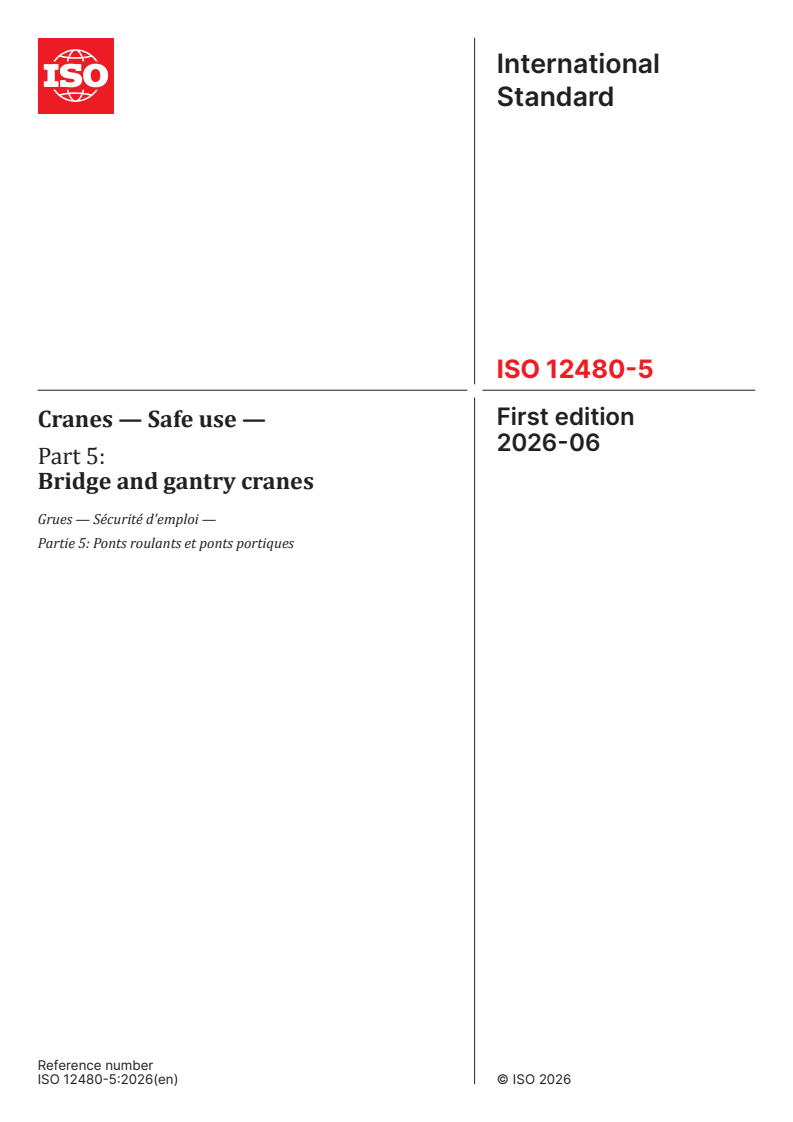
International
Standard
ISO 12480-5
First edition
Cranes — Safe use —
2026-06
Part 5:
Bridge and gantry cranes
Grues — Sécurité d'emploi —
Partie 5: Ponts roulants et ponts portiques
Reference number
© ISO 2026
All rights reserved. Unless otherwise specified, or required in the context of its implementation, no part of this publication may
be reproduced or utilized otherwise in any form or by any means, electronic or mechanical, including photocopying, or posting on
the internet or an intranet, without prior written permission. Permission can be requested from either ISO at the address below
or ISO’s member body in the country of the requester.
ISO copyright office
CP 401 • Ch. de Blandonnet 8
CH-1214 Vernier, Geneva
Phone: +41 22 749 01 11
Email: copyright@iso.org
Website: www.iso.org
Published in Switzerland
ii
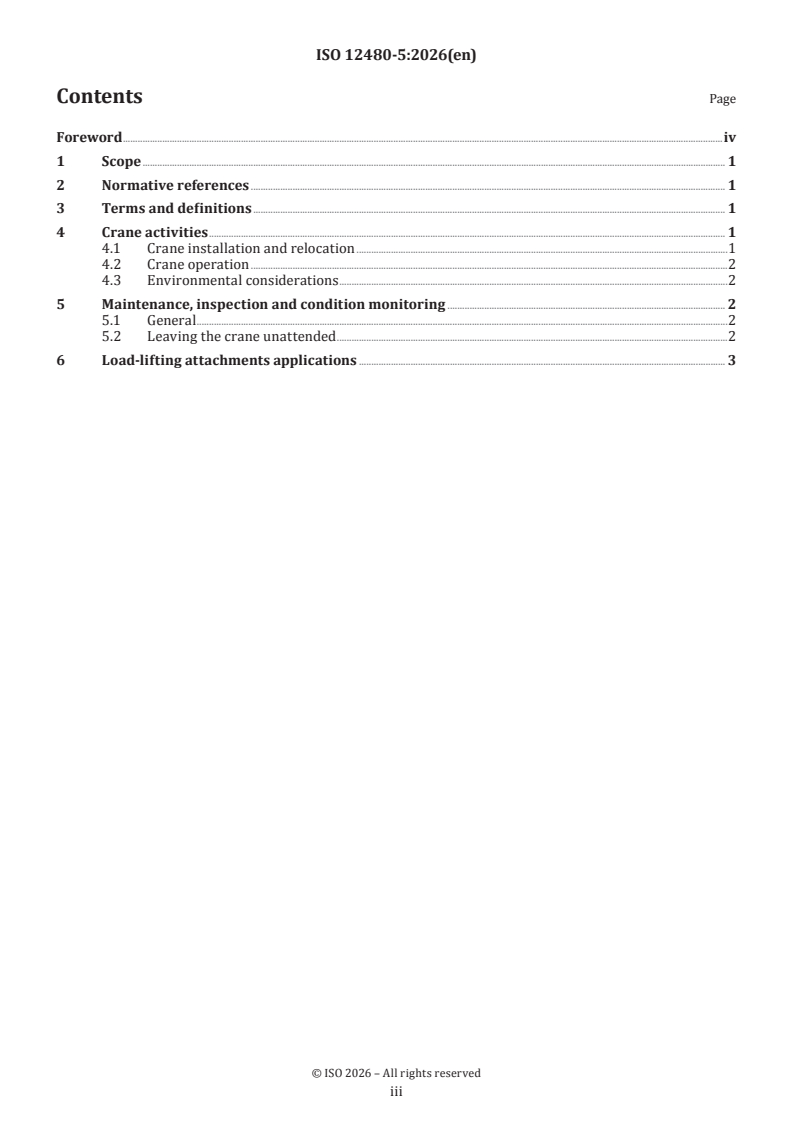
Contents Page
Foreword .iv
1 Scope . 1
2 Normative references . 1
3 Terms and definitions . 1
4 Crane activities . 1
4.1 Crane installation and relocation .1
4.2 Crane operation .2
4.3 Environmental considerations .2
5 Maintenance, inspection and condition monitoring . 2
5.1 General .2
5.2 Leaving the crane unattended .2
6 Load-lifting attachments applications . 3
iii
Foreword
ISO (the International Organization for Standardization) is a worldwide federation of national standards
bodies (ISO member bodies). The work of preparing International Standards is normally carried out through
ISO technical committees. Each member body interested in a subject for which a technical committee
has been established has the right to be represented on that committee. International organizations,
governmental and non-governmental, in liaison with ISO, also take part in the work. ISO collaborates closely
with the International Electrotechnical Commission (IEC) on all matters of electrotechnical standardization.
The procedures used to develop this document and those intended for its further maintenance are described
in the ISO/IEC Directives, Part 1. In particular, the different approval criteria needed for the different types
of ISO document should be noted. This document was drafted in accordance with the editorial rules of the
ISO/IEC Directives, Part 2 (see www.iso.org/directives).
ISO draws attention to the possibility that the implementation of this document may involve the use of (a)
patent(s). ISO takes no position concerning the evidence, validity or applicability of any claimed patent
rights in respect thereof. As of the date of publication of this document, ISO had not received notice of (a)
patent(s) which may be required to implement this document. However, implementers are cautioned that
this may not represent the latest information, which may be obtained from the patent database available at
www.iso.org/patents. ISO shall not be held responsible for identifying any or all such patent rights.
Any trade name used in this document is information given for the convenience of users and does not
constitute an endorsement.
For an explanation of the voluntary nature of standards, the meaning of ISO specific terms and expressions
relate
...