


ISO/FDIS 8983
(Main)Solid mineral fuels — Determination of nine trace elements — Acid digestion and flame atomic absorption method
Solid mineral fuels — Determination of nine trace elements — Acid digestion and flame atomic absorption method
ISO 8983:2007 covers the determination of beryllium, chromium, copper, manganese, nickel, lead, strontium, vanadium and zinc by atomic absorption spectrometry, following acid digestion of a laboratory-prepared ash.
Combustibles minéraux solides — Dosage de neuf éléments à l'état de trace — Digestion par l'acide et spectrométrie d'absorption atomique dans la flamme
General Information
- Status
- Withdrawn
- Technical Committee
- ISO/TC 27/SC 5 - Methods of analysis
- Current Stage
- 5098 - Project deleted
- Start Date
- 25-Jun-2007
- Completion Date
- 14-Feb-2026


Get Certified
Connect with accredited certification bodies for this standard

ABS Quality Evaluations Inc.
American Bureau of Shipping quality certification.

Element Materials Technology
Materials testing and product certification.

ABS Group Brazil
ABS Group certification services in Brazil.
Sponsored listings
Frequently Asked Questions
ISO/FDIS 8983 is a draft published by the International Organization for Standardization (ISO). Its full title is "Solid mineral fuels — Determination of nine trace elements — Acid digestion and flame atomic absorption method". This standard covers: ISO 8983:2007 covers the determination of beryllium, chromium, copper, manganese, nickel, lead, strontium, vanadium and zinc by atomic absorption spectrometry, following acid digestion of a laboratory-prepared ash.
ISO 8983:2007 covers the determination of beryllium, chromium, copper, manganese, nickel, lead, strontium, vanadium and zinc by atomic absorption spectrometry, following acid digestion of a laboratory-prepared ash.
ISO/FDIS 8983 is classified under the following ICS (International Classification for Standards) categories: 75.160.10 - Solid fuels. The ICS classification helps identify the subject area and facilitates finding related standards.
ISO/FDIS 8983 is available in PDF format for immediate download after purchase. The document can be added to your cart and obtained through the secure checkout process. Digital delivery ensures instant access to the complete standard document.
Standards Content (Sample)
FINAL
INTERNATIONAL ISO/FDIS
DRAFT
STANDARD 8983
ISO/TC 27/SC 5
Solid mineral fuels — Determination of
Secretariat: SA
nine trace elements — Acid digestion and
Voting begins on:
flame atomic absorption method
2007-03-07
Voting terminates on:
Combustibles minéraux solides — Dosage de neuf éléments à l'état de
2007-05-07
trace — Digestion par l'acide et spectrométrie d'absorption atomique
dans la flamme
Please see the administrative notes on page iii
RECIPIENTS OF THIS DRAFT ARE INVITED TO
SUBMIT, WITH THEIR COMMENTS, NOTIFICATION
OF ANY RELEVANT PATENT RIGHTS OF WHICH
THEY ARE AWARE AND TO PROVIDE SUPPORT-
ING DOCUMENTATION.
IN ADDITION TO THEIR EVALUATION AS
Reference number
BEING ACCEPTABLE FOR INDUSTRIAL, TECHNO-
LOGICAL, COMMERCIAL AND USER PURPOSES,
DRAFT INTERNATIONAL STANDARDS MAY ON
OCCASION HAVE TO BE CONSIDERED IN THE
LIGHT OF THEIR POTENTIAL TO BECOME STAN-
DARDS TO WHICH REFERENCE MAY BE MADE IN
©
NATIONAL REGULATIONS. ISO 2007
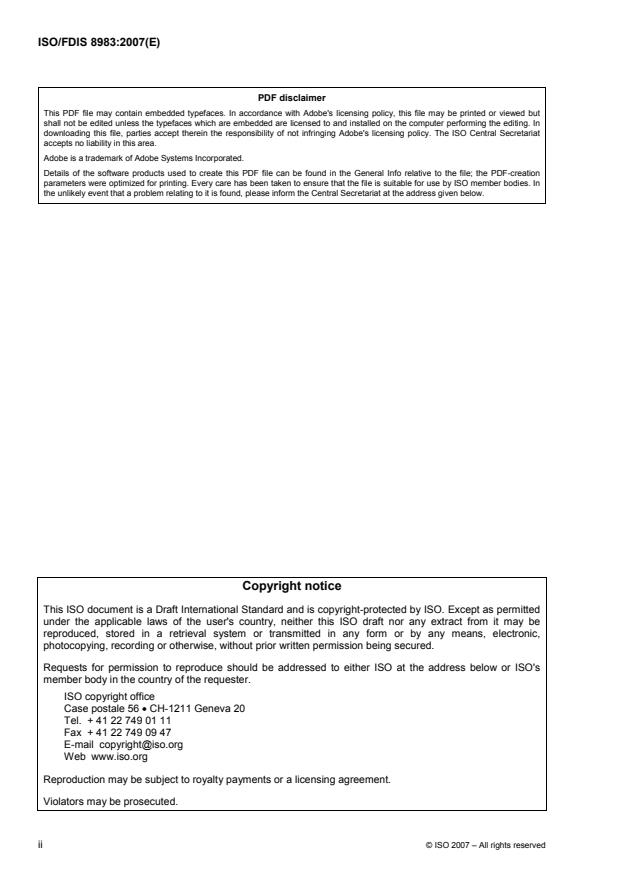
PDF disclaimer
This PDF file may contain embedded typefaces. In accordance with Adobe's licensing policy, this file may be printed or viewed but
shall not be edited unless the typefaces which are embedded are licensed to and installed on the computer performing the editing. In
downloading this file, parties accept therein the responsibility of not infringing Adobe's licensing policy. The ISO Central Secretariat
accepts no liability in this area.
Adobe is a trademark of Adobe Systems Incorporated.
Details of the software products used to create this PDF file can be found in the General Info relative to the file; the PDF-creation
parameters were optimized for printing. Every care has been taken to ensure that the file is suitable for use by ISO member bodies. In
the unlikely event that a problem relating to it is found, please inform the Central Secretariat at the address given below.
Copyright notice
This ISO document is a Draft International Standard and is copyright-protected by ISO. Except as permitted
under the applicable laws of the user's country, neither this ISO draft nor any extract from it may be
reproduced, stored in a retrieval system or transmitted in any form or by any means, electronic,
photocopying, recording or otherwise, without prior written permission being secured.
Requests for permission to reproduce should be addressed to either ISO at the address below or ISO's
member body in the country of the requester.
ISO copyright office
Case postale 56 • CH-1211 Geneva 20
Tel. + 41 22 749 01 11
Fax + 41 22 749 09 47
E-mail copyright@iso.org
Web www.iso.org
Reproduction may be subject to royalty payments or a licensing agreement.
Violators may be prosecuted.
ii © ISO 2007 – All rights reserved
In accordance with the provisions of Council Resolution 15/1993, this document is circulated in the
English language only.
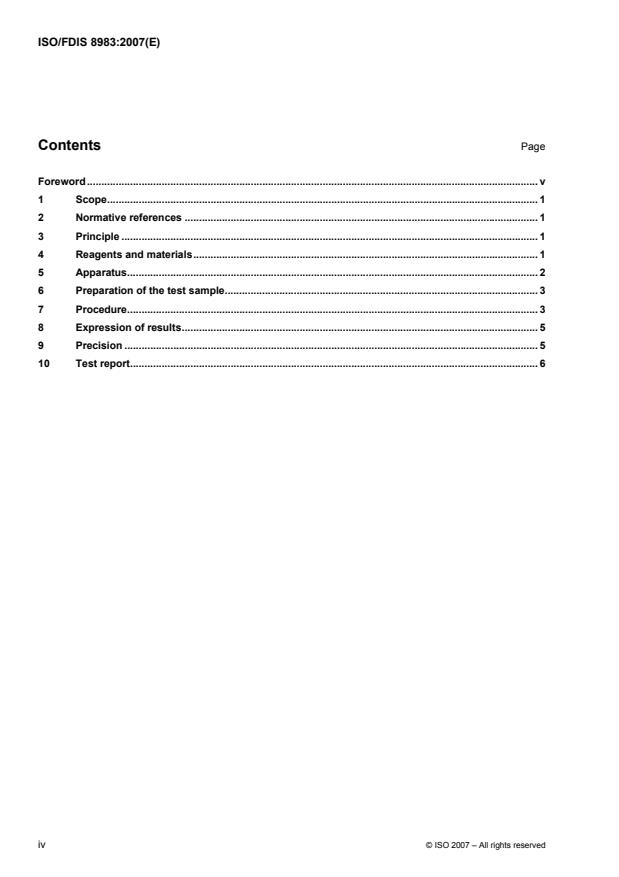
Contents Page
Foreword. v
1 Scope. 1
2 Normative references . 1
3 Principle . 1
4 Reagents and materials. 1
5 Apparatus. 2
6 Preparation of the test sample. 3
7 Procedure. 3
8 Expression of results. 5
9 Precision . 5
10 Test report. 6
iv © ISO 2007 – All rights reserved
Foreword
ISO (the International Organization for Standardization) is a worldwide federation of national standards bodies
(ISO member bodies). The work of preparing International Standards is normally carried out through ISO
technical committees. Each member body interested in a subject for which a technical committee has been
established has the right to be represented on that committee. International organizations, governmental and
non-governmental, in liaison with ISO, also take part in the work. ISO collaborates closely with the
International Electrotechnical Commission (IEC) on all matters of electrotechnical standardization.
International Standards are drafted in accordance with the rules given in the ISO/IEC Directives, Part 2.
The main task of technical committees is to prepare International Standards. Draft International Standards
adopted by the technical committees are circulated to the member bodies for voting. Publication as an
International Standard requires approval by at least 75 % of the member bodies casting a vote.
Attention is drawn to the possibility that some of the elements of this document may be the subject of patent
rights. ISO shall not be held responsible for identifying any or all such patent rights.
ISO 8983 was prepared by Technical Committee ISO/TC 27, Solid mineral fuels, Subcommittee SC 5,
Methods of analysis.
FINAL DRAFT INTERNATIONAL STANDARD ISO/FDIS 8983:2007(E)
Solid mineral fuels — Determination of nine trace elements —
Acid digestion and flame atomic absorption method
1 Scope
This International Standard covers the determination of beryllium, chromium, copper, manganese, nickel, lead,
strontium, vanadium and zinc by atomic absorption spectrometry, following acid digestion of a laboratory-
prepared ash.
2 Normative references
The following referenced documents are indispensable for the application of this document. For dated
references, only the edition cited applies. For undated references, the latest edition of the referenced
document (including any amendments) applies.
ISO 687, Solid mineral fuels — Coke — Determination of moisture in the general analysis test sample
ISO 1171, Solid mineral fuels — Determination of ash
ISO 13909-4, Hard coal and coke — Mechanical sampling — Part 4: Coal — Preparation of test samples
ISO 13909-6, Hard coal and coke — Mechanical sampling — Part 6: Coke — Preparation of test samples
ISO 3696, Water for analytical laboratory use — Specification and test methods
ISO 5068-2, Brown coals and lignites — Determination of moisture content — Part 2: Indirect gravimetric
method for moisture in the analysis sample
ISO 5725-6, Accuracy (trueness and precision) of measurement methods and results — Part 6: Use in
practice of accuracy values
ISO 11722, Solid mineral fuels — Hard coal — Determination of moisture in the general analysis test sample
by drying in nitrogen
ISO 18283, Hard coal and coke — Manual sampling
3 Principle
Coal and carbonized products are ashed under controlled laboratory conditions. Mineral acids dissolve the
ash. The individual elements are determined by atomic absorption spectrometry.
4 Reagents and materials
4.1 Purity of reagents
Use analytical reagent grade chemicals. Other grades can be used, provided it is documented that the
reagent is of sufficiently high purity to permit its use without adversely affecting the accuracy of the
determination.
4.2 Water, high purity, deionized (Type II water) as defined in ISO 3696, or equivalent purity.
4.3 Aqua regia.
Mix 1 part concentrated nitric acid (HNO , sp. gr. 1,42), 3 parts concentrated hydrochloric acid (HCI, sp. gr.
1,19) and 1 part water.
SAFETY PRECAUTIONS — Polypropylene bottles are unsuitable for storage of this aqua regia
solution because they have been found to become embrittled by it after a few months. Polyethylene
bottles, on the other hand, have been found to take four years to become embrittled by this solution.
4.4 Boric acid solution, saturated.
Dissolve by heating 60 g of boric acid (H BO ) in 1 l of de-ionized (Type II) water. Allow to cool.
3 3
4.5 Stock solutions, standard.
Prepare standard stock solutions from metals, oxides, or salts. Do not use sulfates or sulphuric acid (H SO ).
2 4
They have adverse effects on the flame, and some sulfates have low solubility. Prepare stock solutions of at
least 100 µg/ml.
NOTE Commercially available standard stock solutions (traceable to a national certifying authority) can be used.
4.6 Hydrofluoric acid, concentrated (HF, sp. gr. 1,15).
WARNING — All acids should be handled with care but extra precautions are required with
hydrofluoric acid. Even when diluted, this is an extremely dangerous acid, harmful to the eyes and
skin: rubber gloves and goggles should be worn when using this acid. Any acid that touches the skin
should be washed off immediately with copious quantities of water. Calcium gluconate gel should
also be stored on the workbench for immediate application if hydrofluoric acid contacts skin. A
physician should be consulted immediately if any acid is sprayed into the eyes or if prolonged contact
with the skin occurs.
4.7 Caesium chloride buffer solution, 20 000 mg/l Cs.
Prepare solution by dissolving 25 g caesium chloride in water and adjust volume to 1 l.
5 Apparatus
5.1 Atomic absorption spectrometer, single or dual-beam instrument using a deuterium (D ) arc
background corrector, or other comparable background correction system.
5.2 Muffle furnace, as specified in ISO 1171.
5.3 Bottles, polypropylene or polycarbonate, at least 125 ml capacity, capable of withstanding 130 °C.
5.4 Volumetric flasks, polypropylene or pol
...
Questions, Comments and Discussion
Ask us and Technical Secretary will try to provide an answer. You can facilitate discussion about the standard in here.
Loading comments...