


ISO/TR 18986:2024
(Main)Traditional Chinese medicine — Report on the global industry and standardization development of Panax ginseng
Traditional Chinese medicine — Report on the global industry and standardization development of Panax ginseng
This document reports on the global industry and standardization development of Panax ginseng. It includes its origin and application history, medicinal value, geographical distribution, cultivation and processing methods, industry development, international trade, current status and development demands for standardization.
Médecine traditionnelle chinoise — Rapport sur le développement de l'industrie mondiale et de la normalisation du Panax ginseng
General Information
- Status
- Published
- Publication Date
- 14-Feb-2024
- Technical Committee
- ISO/TC 249 - Traditional Chinese medicine
- Drafting Committee
- ISO/TC 249 - Traditional Chinese medicine
- Current Stage
- 6060 - International Standard published
- Start Date
- 15-Feb-2024
- Due Date
- 12-Dec-2024
- Completion Date
- 15-Feb-2024
Overview
ISO/TR 18986:2024 is an ISO Technical Report from ISO/TC 249 (Traditional Chinese medicine) that surveys the global industry and standardization development of Panax ginseng (the dried root and rhizome of Panax ginseng C. A. Meyer). The report documents origin and application history, medicinal value, geographical distribution, cultivation and processing methods, industry development, international trade, and the current status and demands for international standardization. As a Technical Report, it compiles information and analysis rather than prescribing binding requirements.
Key topics
The report organizes practical, technical information useful across the Panax ginseng value chain:
- Origin and historical use - classical use in China, Korea and other regions; historical periods and evolution of applications.
- Medicinal value - traditional indications, phytochemistry, pharmacological effects and modern TCM preparations.
- Geographical distribution - principal producing countries (China, Republic of Korea, DPRK, Japan, Russian Federation) and global market presence.
- Cultivation methods - general practices, wild-simulated and field cultivation approaches.
- Processing methods - cleansing, drying, steaming, sugaring, scalding, freeze‑drying and extraction techniques described in the report.
- Industry and trade analysis - production volumes, value, import/export trends and market analysis.
- Standardization status and needs - review of national pharmacopoeias, laws, national and regional standards and the gaps requiring international harmonization.
- Informative annexes - compilations of quality standards recorded in different pharmacopoeias and national/regional regulations (Annex A–C).
Practical applications
ISO/TR 18986:2024 is primarily an informational foundation to support development of harmonized standards and is useful for:
- Standards bodies and policy makers - to identify gaps and priorities for international standard development.
- Regulators and pharmacopoeia committees - to benchmark national requirements and align terminology, quality and safety criteria.
- Producers and processors - to compare cultivation and processing practices (wild-simulated vs field cultivation; steaming, drying, extraction) and anticipate international market expectations.
- Exporters and trade organizations - to understand trade flows and compliance pressures across major markets.
- Researchers and healthcare product developers - to locate pharmacological summaries and documented uses that inform product formulation and claims.
Related standards and next steps
- The report summarizes existing entries in national pharmacopoeias and regional standards and stresses the need for unified quality, safety, terminology and processing standards for Panax ginseng.
- ISO/TR 18986:2024 is intended to inform subsequent international standardization work (e.g., development of ISO standards covering the Panax ginseng industry chain).
Keywords: ISO/TR 18986:2024, Panax ginseng, Traditional Chinese medicine, ginseng cultivation, ginseng processing, ginseng standards, pharmacopoeia, international trade.
Get Certified
Connect with accredited certification bodies for this standard

BSI Group
BSI (British Standards Institution) is the business standards company that helps organizations make excellence a habit.

TÜV Rheinland
TÜV Rheinland is a leading international provider of technical services.

TÜV SÜD
TÜV SÜD is a trusted partner of choice for safety, security and sustainability solutions.
Sponsored listings
Frequently Asked Questions
ISO/TR 18986:2024 is a technical report published by the International Organization for Standardization (ISO). Its full title is "Traditional Chinese medicine — Report on the global industry and standardization development of Panax ginseng". This standard covers: This document reports on the global industry and standardization development of Panax ginseng. It includes its origin and application history, medicinal value, geographical distribution, cultivation and processing methods, industry development, international trade, current status and development demands for standardization.
This document reports on the global industry and standardization development of Panax ginseng. It includes its origin and application history, medicinal value, geographical distribution, cultivation and processing methods, industry development, international trade, current status and development demands for standardization.
ISO/TR 18986:2024 is classified under the following ICS (International Classification for Standards) categories: 11.120.10 - Medicaments. The ICS classification helps identify the subject area and facilitates finding related standards.
ISO/TR 18986:2024 is available in PDF format for immediate download after purchase. The document can be added to your cart and obtained through the secure checkout process. Digital delivery ensures instant access to the complete standard document.
Standards Content (Sample)
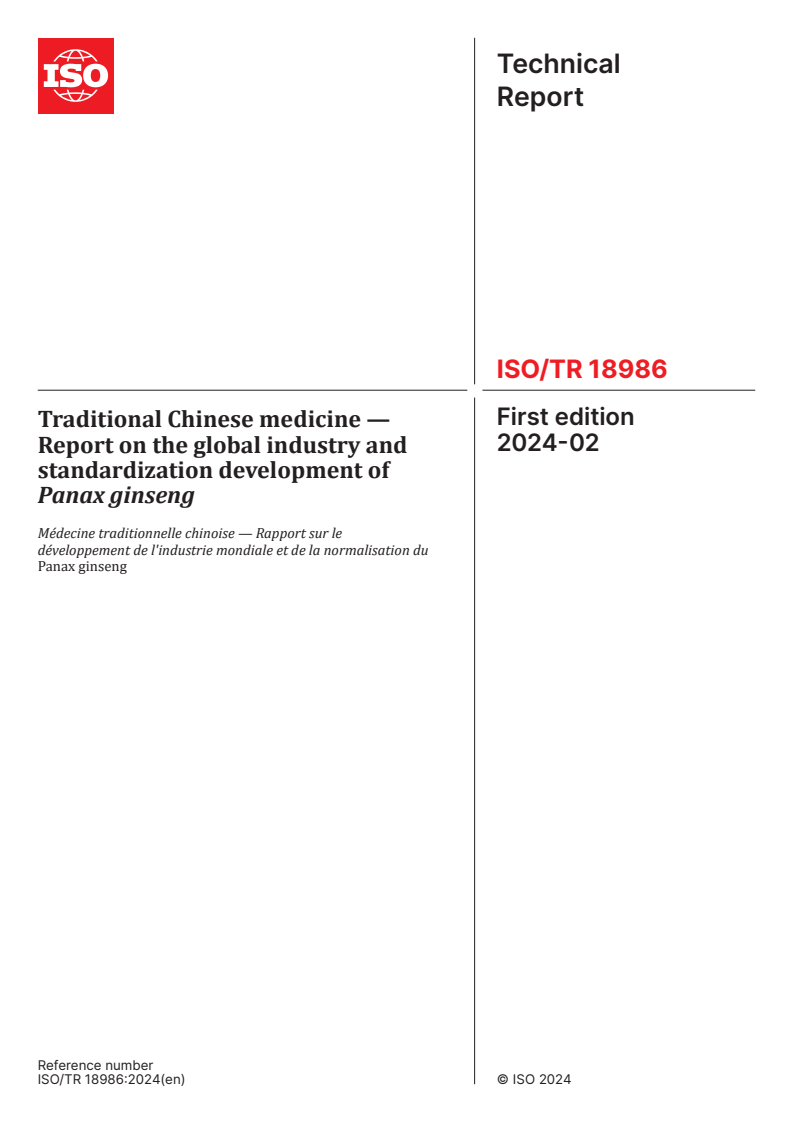
Technical
Report
ISO/TR 18986
First edition
Traditional Chinese medicine —
2024-02
Report on the global industry and
standardization development of
Panax ginseng
Médecine traditionnelle chinoise — Rapport sur le
développement de l'industrie mondiale et de la normalisation du
Panax ginseng
Reference number
© ISO 2024
All rights reserved. Unless otherwise specified, or required in the context of its implementation, no part of this publication may
be reproduced or utilized otherwise in any form or by any means, electronic or mechanical, including photocopying, or posting on
the internet or an intranet, without prior written permission. Permission can be requested from either ISO at the address below
or ISO’s member body in the country of the requester.
ISO copyright office
CP 401 • Ch. de Blandonnet 8
CH-1214 Vernier, Geneva
Phone: +41 22 749 01 11
Email: copyright@iso.org
Website: www.iso.org
Published in Switzerland
ii
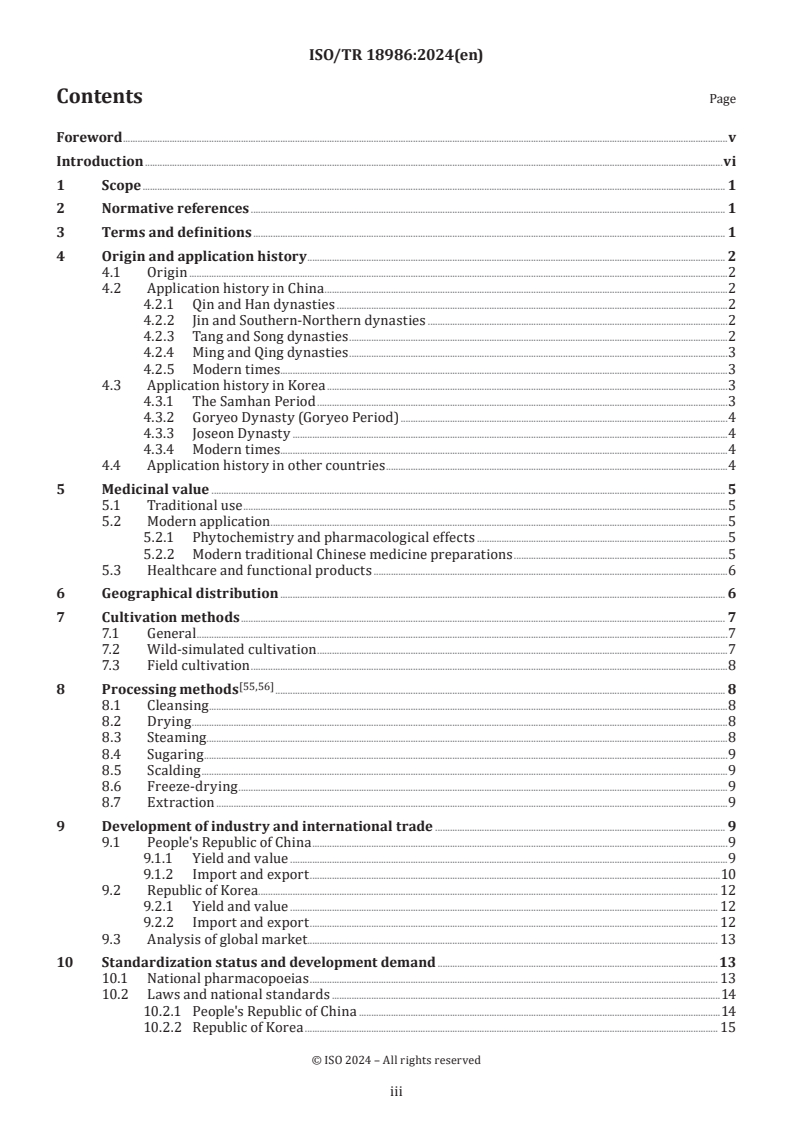
Contents Page
Foreword .v
Introduction .vi
1 Scope . 1
2 Normative references . 1
3 Terms and definitions . 1
4 Origin and application history . 2
4.1 Origin .2
4.2 Application history in China .2
4.2.1 Qin and Han dynasties .2
4.2.2 Jin and Southern-Northern dynasties .2
4.2.3 Tang and Song dynasties .2
4.2.4 Ming and Qing dynasties .3
4.2.5 Modern times.3
4.3 Application history in Korea .3
4.3.1 The Samhan Period .3
4.3.2 Goryeo Dynasty (Goryeo Period) .4
4.3.3 Joseon Dynasty .4
4.3.4 Modern times.4
4.4 Application history in other countries .4
5 Medicinal value . 5
5.1 Traditional use .5
5.2 Modern application .5
5.2.1 Phytochemistry and pharmacological effects .5
5.2.2 Modern traditional Chinese medicine preparations .5
5.3 Healthcare and functional products .6
6 Geographical distribution . 6
7 Cultivation methods . 7
7.1 General .7
7.2 Wild-simulated cultivation .7
7.3 Field cultivation .8
[55,56]
8 Processing methods . 8
8.1 Cleansing .8
8.2 Drying .8
8.3 Steaming .8
8.4 Sugaring .9
8.5 Scalding .9
8.6 Freeze-drying .9
8.7 Extraction .9
9 Development of industry and international trade . 9
9.1 People's Republic of China .9
9.1.1 Yield and value .9
9.1.2 Import and export .10
9.2 Republic of Korea . . 12
9.2.1 Yield and value . 12
9.2.2 Import and export . 12
9.3 Analysis of global market . 13
10 Standardization status and development demand .13
10.1 National pharmacopoeias . 13
10.2 Laws and national standards .14
10.2.1 People's Republic of China .14
10.2.2 Republic of Korea . 15
iii
10.2.3 Other countries .16
10.3 Regional standards .16
10.4 International Standards .17
10.5 Development demands for international standardization of Panax ginseng .17
Annex A (informative) Information on quality standards of Panax ginseng and its processed
products recorded in different national pharmacopoeias and regional standards .18
Annex B (informative) Industrial and provincial standards of Panax ginseng developed by China .23
Annex C (informative) The regualtions of Panax ginseng developed by the Republic of Korea .27
Bibliography .29
iv
Foreword
ISO (the International Organization for Standardization) is a worldwide federation of national standards
bodies (ISO member bodies). The work of preparing International Standards is normally carried out through
ISO technical committees. Each member body interested in a subject for which a technical committee
has been established has the right to be represented on that committee. International organizations,
governmental and non-governmental, in liaison with ISO, also take part in the work. ISO collaborates closely
with the International Electrotechnical Commission (IEC) on all matters of electrotechnical standardization.
The procedures used to develop this document and those intended for its further maintenance are described
in the ISO/IEC Directives, Part 1. In particular, the different approval criteria needed for the different types
of ISO document should be noted. This document was drafted in accordance with the editorial rules of the
ISO/IEC Directives, Part 2 (see www.iso.org/directives).
ISO draws attention to the possibility that the implementation of this document may involve the use of (a)
patent(s). ISO takes no position concerning the evidence, validity or applicability of any claimed patent
rights in respect thereof. As of the date of publication of this document, ISO had not received notice of (a)
patent(s) which may be required to implement this document. However, implementers are cautioned that
this may not represent the latest information, which may be obtained from the patent database available at
www.iso.org/patents. ISO shall not be held responsible for identifying any or all such patent rights.
Any trade name used in this document is information given for the convenience of users and does not
constitute an endorsement.
For an explanation of the voluntary nature of standards, the meaning of ISO specific terms and expressions
related to conformity assessment, as well as information about ISO's adherence to the World Trade
Organization (WTO) principles in the Technical Barriers to Trade (TBT), see www.iso.org/iso/foreword.html.
This document was prepared by Technical Committee ISO/TC 249, Traditional Chinese medicine.
Any feedback or questions on this document should be directed to the user’s national standards body. A
complete listing of these bodies can be found at www.iso.org/members.html.
v
Introduction
Panax ginseng is the dried root and rhizome of Panax ginseng C. A. Meyer. It has the effects of greatly tonifying
the original qi, restoring the pulse and relieving collapse, invigorating the spleen and benefiting the lungs.
It is used primarily for symptoms such as weakness, cold extremities with faint pulse and spleen deficiency
[2]
with reduced appetite. As a kind of rare and valuable Chinese materia medica, Panax ginseng has a long
history of medicinal use. Its single and compound formulas, as well as a variety of modern preparations,
play an important role in clinical practice. Furthermore, Panax ginseng is widely applied in many other fields
such as food, healthcare and daily chemical products.
As one of the Chinese materia medica with the largest global trade volume, Panax ginseng occupies a large
market scale. It is mainly cultivated in China, the Republic of Korea, the Democratic People's Republic
of Korea, Japan and the Russian Federation, among which China and the Republic of Korea are the main
countries for its production and consumption, accounting for over 80 % of the total yield in the world. In
addition, Panax ginseng is also widely used in Europe and the United States, as well as some other countries
in Asia.
Panax ginseng has been recorded in many national pharmacopoeias and regional standards. However, due
to the restrictions on different national regulations and different purposes for standard development,
the requirements specified by such pharmacopoeias and regional standards differ in their scope, items,
[3]
indicators and other aspects. The lack of unified quality and safety standards gives rise to some negative
phenomena, such as unqualified and fake products available on the market, substandard products sold at
high prices and confusion with specification and grades of Panax ginseng products. In addition, the lack of
unified standards in terms of the terminology and processing technology leads to confusion with products’
names and brings lots of difficulties not only to supervision authorities but also to consumers. Therefore, it
is urgent to develop unified International Standards for the whole industry chain of Panax ginseng, including
the production, processing, marketing and other links.
Standards for the whole industry chain of Panax ginseng would guarantee the sustainable development of
the industry and international trade in the aspects of promoting the manufacturing, improving the quality,
regulating the market and protecting the consumers’ interests. This document conducts a comprehensive
survey on the industry of Panax ginseng in terms of its origin and application history, medicinal value,
geographical distribution, cultivation methods, processing methods, the development of industry,
international trade and standardization status. It will be beneficial to provide reference and information
support for the follow-up formulation of the International Standards for Panax ginseng.
vi
Technical Report ISO/TR 18986:2024(en)
Traditional Chinese medicine — Report on the global
industry and standardization development of Panax ginseng
1 Scope
This document reports on the global industry and standardization development of Panax ginseng. It includes
its origin and application history, medicinal value, geographical distribution, cultivation and processing
methods, industry development, international trade, current status and development demands for
standardization.
2 Normative references
There are no normative references in this document.
3 Terms and definitions
For the purposes of this document, the following terms and definitions apply.
ISO and IEC maintain terminology databases for use in standardization at the following addresses:
— ISO Online browsing platform: available at https:// www .iso .org/ obp
— IEC Electropedia: available at https:// www .electropedia .org/
3.1
fresh ginseng
ginseng root harvested from the field, before being washed
[SOURCE: ISO 19610:2017, 3.1]
3.2
washed ginseng
raw ginseng root washed with drinking water to remove any foreign matter and then used as the starting
material for manufacturing red ginseng
[SOURCE: ISO 19610:2017, 3.2]
3.3
steamed ginseng
ginseng produced through a process of steaming the washed ginseng to gelatinize the starch content
[SOURCE: ISO 19610:2017, 3.3]
3.4
red ginseng
ginseng root from Panax ginseng C.A. Meyer, treated with steam and then dried and packaged as whole or
cut roots
[SOURCE: ISO 19610:2017, 3.4]
4 Origin and application history
4.1 Origin
Panax ginseng is one of the oldest relict plants on earth. The character “參” was first discovered in the oracle
bone inscriptions of the Shang Dynasty of China, dating back 3 500 years. The character “參” on the oracle
bone was pictographic, showing the typical characteristics of the aboveground and underground parts
[4] [5]
of Panax ginseng. Fan Zi Ji Ran (《范子計然》), written in the Warring States Period (465 BC), clearly
recorded the origin and properties of Panax ginseng, which is the earliest available document of Panax
ginseng.
4.2 Application history in China
4.2.1 Qin and Han dynasties
The Qin and Han dynasties were the initial medicinal and clinical application stages of Panax ginseng. As
[6]
recorded in Sheng Nong's Herbal Classics (《神農本草經》), Panax ginseng has rich therapeutic effects, such
as calming the spirit, improving vision, enhancing intelligence and prolonging life.
[7]
Medicine Inscribed Wooden Slips of the Han Dynasty in Wuwei (《武威漢代醫簡》), the earliest literature
on the clinical application of Panax ginseng, summarized the medication rules of Panax ginseng in treating
various diseases. In the Eastern Han Dynasty, the clinical application of Panax ginseng was expanded and
[8]
it was widely used in various formulas. In the Treatise on Febrile Diseases (《傷寒論》), 23 of a total of 113
formulas contained Panax ginseng.
4.2.2 Jin and Southern-Northern dynasties
The clinical application of Panax ginseng was further explored in the Jin and Southern-Northern dynasties.
The single prescription of Panax ginseng “Ginseng Powder” was first recorded in the Handbook of Prescription
[9]
for Emergency (《肘後備急方》) in the Eastern Jin Dynasty. It is mainly used for the treatment of sudden
[10]
reversed flow of qi and life-threatening diseases. Annotation of Materia Medica (《本草經集注》), written
during the Liang Dynasty, elaborated the therapeutic effects of Panax ginseng on diseases occurring in
specific Zang-fu organs, which extended the scope of functions and indications of Panax ginseng. The
cultivation of Panax ginseng in gardens was first recorded in the Individual Biography of Shi Le from The Book
[11]
of Jin (《晉書·石勒別傳》).
4.2.3 Tang and Song dynasties
The Tang and Song dynasties witnessed the rapid development of application and dissemination of Panax
[12]
ginseng. Tang Materia Medica (《新修本草》), the first official pharmacopoeia of China, recorded in detail
about the functions, indications, usage, properties and main production areas of Panax ginseng. In addition, a
large number of prescriptions containing Panax ginseng is included in Prescriptions Worth Thousand Gold for
[13]
Emergencies (《備急千金要方》) and Supplement to Invaluable Prescriptions for Ready Reference [14] (《千金
翼方》), with 445 and 310 prescriptions, respectively. With frequent foreign trade and exchange activities,
Panax ginseng spread more widely overseas in the Tang Dynasty. Panax ginseng produced in the Bohai State
(an ancient kingdom existing from 698 AD to 926 AD) was continuously paid to the central plains as tributes.
Master Jianzhen, an eminent Chinese monk in Tang Dynasty, propagated the herb of Panax ginseng and its
[15]
application to Japan. This herb is still preserved in Shosoin of Japan today.
Traditional Chinese medicine writings flourished in the Song Dynasty. Illustrated Classics of Materia
[16]
Medica (《本草圖經》) first systematically described the morphological characteristics of the original plant
[17]
of Panax ginseng in the form of illustrations. Classified Materia Medica (《證類本草》) further explained
the medicinal theory of Panax ginseng. In the Song Dynasty, the resources of Panax ginseng increased with
the eastward expansion of its main production areas. Meanwhile, a quantity of Panax ginseng was imported
[15]
through border trade to ensure domestic demand for medicinal use.
4.2.4 Ming and Qing dynasties
The Ming Dynasty was the peak period of clinical theory and practical application of Panax ginseng.
Biography of Panax ginseng (《人參傳》), the first monograph of Panax ginseng, comprehensively summarized
[18]
its pharmacology and medicinal properties. On this basis, Compendium of Materia Medica (《本草綱目》)
made a detailed collation of the prescriptions and indications of Panax ginseng, including 67 prescriptions
applied to 15 kinds of diseases. However, due to the severe destruction of resources, the production areas of
Panax ginseng moved northward. Thus, the supply of Panax ginseng in the Ming Dynasty fell into a difficult
period. Under such circumstances, the government opened cross-border markets to import large quantities
of Panax ginseng from the Liao Dynasty and the Joseon Dynasty of Korea in order to ease domestic demand
for supply. At the same time, large-scale artificial cultivation of Panax ginseng was realized through seed
[19]
propagation among the people.
In the Qing Dynasty, the theories and management of Panax ginseng were well developed. Essential of Materia
[20] [21]
Medica (《本草備要》) divided Panax ginseng into “raw” and “cooked” ginseng. Ginseng spectrum (《參
譜》) discussed ginseng production, purchase and sales, identification of quality, processing methods and
value in detail. At the same time, the authorities tightened the control over Panax ginseng by establishing
monopoly institutions and implementing various policies and systems for the management of Panax ginseng.
[22]
In addition, the grades and specifications of Panax ginseng were clearly specified. In the late Qing Dynasty,
the garden cultivation of Panax ginseng was rapidly developed to make up for the shortage of its natural
[15]
resources.
4.2.5 Modern times
Panax ginseng has been greatly developed covering such aspects as modern basic research, industrial scale
and regulation supervision. With the development of modern medicine, biology and chemistry, people
have a growing understanding of the pharmacological effects of Panax ginseng. Meanwhile, remarkable
achievements have been made in the research of the material basis of Panax ginseng. Supported by modern
science and technology, the industry of Panax ginseng continues to expand. The manufactured products
of Panax ginseng, such as general food, health functional food, cosmetics and drugs have become the main
components of the international industry of Panax ginseng. In order to promote the rapid and healthy
development of this industry, relevant regulations and standards have been successively issued by various
countries.
Panax ginseng was one of the first Chinese materia medica included in Chinese Pharmacopoeia 1963, with
[2]
a detailed description of its source, processing, usage and dosage. The industry development of Panax
ginseng in the People's Republic of China can be roughly divided into four periods:
— Expansion period (1970 to 1990): A production model of high quality and high yield was achieved in
[23]
terms of the planting of Panax ginseng.
— Turbulent period (1990 to 2002): The conflict between the lands and forests on Panax ginseng cultivation
led to a drop in price and a slowdown in the industry.
— Recovery period (2003 to 2012): The government paid more attention to the industry of Panax ginseng
and facilitated with modern technology to promote its industry development.
— Growth period (2012 to present): The industry of Panax ginseng developed rapidly after its approval as
“new resource food”.
4.3 Application history in Korea
4.3.1 The Samhan Period
[24,25]
According to literature, Panax ginseng has been cultivated and used to make medicine since the Samhan
Period. It is recorded that Panax ginseng grown on the Korean peninsula was traded to the Tang Dynasty,
China, during the periods of Kings Jinpyeong (A.D. 627) and Sungdeok (A.D. 723) of the Silla Dynasty.
4.3.2 Goryeo Dynasty (Goryeo Period)
The Goryeo period was characterized by active trade with neighbouring nations. Naturally, Panax
ginseng was one of the major commodities actively traded with the outside world, including the Khitans,
[26]
the Song Dynasty, the Yuan Dynasty and the Ming Dynasty. During the period of King Injong (1123),
[25]
GoryeoDogyeong (《高麗圖經》) contains information regarding ginseng steamed (red ginseng of today)
due to distribution issues, showing that people of the time steamed and dried ginseng for long-distance
transport.
Panax ginseng was actively traded not only with China but also with Japan. In the reigning period of King
Wu, Goryeo delivered ginseng as a gift when sending envoys to Japan to effectively handle trouble caused
[26]
by Japanese pirates. Panax ginseng, which was used as medicine and tributes during the Samhan period,
was regarded as a commodity that royal families trade for profit and was subject to taxation in the Goryeo
Dynasty. In particular, it was one of the nation’s representative items considered significant in terms of
diplomatic relations with China and Japan.
4.3.3 Joseon Dynasty
The clinical application and processing and cultivation method of Panax ginseng were greatly developed in
[27]
the Joseon Dynasty. Principles and Practice of Eastern Medicine published during the reign of King Seonjo
contains more than 170 prescriptions based on Panax ginseng. Moreover, steamed ginseng in the Goryeo
Dynasty was converted into pasam (steamed, compressed and threaded ginseng) and pansam (steamed,
[28]
compressed and pasted ginseng) that are the ancestors of red ginseng. During the periods of Kings
Sukjong and Jeongjo, the red ginseng production method was fully developed to enable the stable and long-
distance transport.
In the Joseon Dynasty, trading ginseng privately was thoroughly controlled, so that ginseng was used as
[28]
medicine or tributes by the royal families or those in authority for profit. However, the prices of Panax
ginseng were sharply raised due to lack of wild ginseng, which requires the development of ginseng
cultivation methods. Imwongyeongjeji shows that ginseng cultivation methods were fully established in the
[29]
mid-Joseon Dynasty. Against this backdrop, the development of Panax ginseng and red ginseng cultivation
methods greatly contributed to the financial health of the nation and the royal families.
4.3.4 Modern times
[30]
Throughout the history of Korea, Panax ginseng has been traded as one of Korea’s major commodities. In
1899, the Ginseng Policy Team (Samjeonggwa) initiated producing red ginseng under the leadership of the
central government. In 1908, the Red Ginseng Monopoly Act and the Ginseng Tax Act were promulgated to
lead the government to monopolize the red ginseng market. The Ginseng Policy Handbook (Samjeongyoram)
[30]
published by the Ginseng Policy Team shows that research on ginseng cultivation methods, pest control,
red ginseng manufacturing processes and the age of Panax ginseng optimized for red ginseng manufacturing
was systematically conducted.
In 1996, the Red Ginseng Monopoly Act and the Ginseng Industry Act were abolished and established,
respectively, thereby transferring the authority to control Panax ginseng and red ginseng to the private
sector for the first time in 600 years. The Ginseng Industry Act specifies matters required for the cultivation,
manufacturing and testing of Panax ginseng and ginseng products, leading Panax ginseng to be protected and
promoted as a speciality and significantly increasing the number of related firms and red ginseng products.
[30]
After diverse animal and clinical tests, the functionality of Panax ginseng has been officially recognized
[31]
in several areas by the Ministry of Food and Drug Safety.
4.4 Application history in other countries
Panax ginseng is mainly used for Kampo medicines and health food in Japan. In ancient Japan, Panax ginseng
[32]
was frequently used by Kampo practitioners. With the prosperity of Kampo medicine, prescriptions
containing Panax ginseng were more widely used in the treatment of several diseases. Japan attaches great
importance to the quality standards of Kampo medicine preparations and Panax ginseng varieties with high
[33]
extract content and short leaching time are often used as raw materials.
Wild Panax ginseng is listed in the Red Book of Primorsky Krai as an endangered species in the Russian
Federation. Cultivated Panax ginseng has been planted in Siberia since the 19th century. In 1968, it was
included in the State Pharmacopoeia of the Soviet Union. Panax ginseng is popular in the Russian Federation
[34]
as medicine, health products and food.
5 Medicinal value
5.1 Traditional use
Panax ginseng has the effects of greatly tonifying the original qi, restoring the pulse and relieving collapse,
invigorating spleen and benefiting lung, engendering fluid and nourishing blood, quieting the spirit and
sharpening the wits. It is used primarily for symptoms such as weakness, cold extremities with faint pulse
[2]
and spleen deficiency with reduced appetite.
Both single and formulas of Panax ginseng can be used in traditional clinical application. Nevertheless, there
are some incompatibilities. For example, Panax ginseng is antagonized by Veratrum nigrum root and rhizome,
[18]
restrained by Trogopterori faeces and inhibited by Raphanus sativus seed.
5.2 Modern application
5.2.1 Phytochemistry and pharmacological effects
Panax ginseng is mainly composed of saponins, polysaccharides, volatile oils, organic acids and esters,
[35]
sterols, flavonoids, lignans, inorganic elements and vitamins. A variety of pharmacological actions also
have been proven in Panax ginseng, including anti-fatigue, anti-stress, anti-mutagenesis, anti-oxidation, anti-
[36]
cancer, as well as protection of the cardiovascular system.
Ginsenosides are well believed as the primary bio-active ingredients in Panax ginseng. More than 170
[37]
kinds of ginsenosides have been reported, which can be mainly divided into protopanaxadiol type
(PPD), protopanaxatriol type (PPT) and oleanolic acid type (OA) according to their structure properties.
Ginsenosides of different types possess varied of pharmacological characteristics. For example, PPT is
recognized for the effects of stimulating central nervous system, improving memory, nourishing and
promoting protein synthesis, whereas OA exerts the effects of anti-inflammation and anti-platelet release.
Besides, polysaccharides and volatile oils are also important ingredients of Panax ginseng. Up to now,
[38] [39]
there have been reports of 64 polysaccharides and 160 volatile oils from Panax ginseng. Ginseng
polysaccharides are mainly composed of neutral and pectin-like acidic polysaccharides, which play critical
roles in enhancing immunity, anti-aging, anti-tumour and reducing liver injury. Ginseng volatile oils with
special fragrance are primarily made up of sesquiterpenes, long-chain saturated acids and aromatic
hydrocarbons. Among them, sesquiterpenes are the mostly constituents, while polyacetylenols such as
[40]
panaxynol and panaxyloxynol are regarded as the principalcharacteristic compounds. Ginseng volatile
oil has significant effects on antifungal, anti-inflammatory, central nervous system depression and bi-
directional regulation of blood pressure.
In addition, the traditional processing methods of Panax ginseng could alter its chemical composition and
pharmacological effects to achieve the purpose of efficiency enhancing. Various processed Panax ginseng
products have been exploited to better the therapeutic demands (see Clause 8).
5.2.2 Modern traditional Chinese medicine preparations
Ginsenoside monomer compounds, extract and preparations of Panax ginseng have been widely developed
into drugs for the treatment of different diseases. Ginsenoside Rg3, 20 (S) -ginsenoside Rg3 and Ginsenoside
[41,42]
Rd have been developed into new anticancer and antiviral drugs. Capsules developed from the fruits
and total saponins of Panax ginseng leaves have been used as adjuvant medicine for the treatment of coronary
[43,44]
heart disease, climacteric syndrome, diabetes and tumours. Ginseng polysaccharide injection has been
[45]
also mainly used for fighting various chronic infections, diabetes and various immune diseases.
5.3 Healthcare and functional products
Except for medicinal value, Panax ginseng has been widely developed into healthcare and functional
products because of its rich nutrients. These products are mainly helpful for immunity enhancement, anti-
aging, blood sugar control and auxiliary protective effects against liver injury, sleep improvement and anti-
[46]
oxidation.
Functional foods with Panax ginseng include capsules, sticks, ampoules, pills, drinks, baked food, prepared
[47]
food and condiments For example, ginseng polysaccharide fermented milk beverage is used for improving
immunity, preventing and treating hypertension, and fermented ginseng rice wine is used for anti-oxidation,
[48]
with rare saponin CK produced and the content of ginsenoside increased significantly after fermentation.
The use of natural and non-toxic botanical sources has become the trend of cosmetics industrial development.
Ginseng extracts and ginsenoside have been used in the field of cosmetics since the 1980s and nowadays
[49]
have become the most widely used starting materials in plant cosmetics. For example, moisturizing
cream, whitening cream, facial mask, eye cream and shampoo made with Panax ginseng are mainly used to
improve the antioxidant activity of skin cells, inhibit melanin transfer, improve skin colour and reduce hair
[50,51]
loss.
In addition, as a non-edible product, it is used in various ways such as cosmetics and toothpaste, and
[52]
premium pet food and products using ginseng fruit, not the root, are being released.
6 Geographical distribution
The production areas of Panax ginseng are mainly distributed in northeast Asia between latitude 33° N and
48° N. Information on the main production areas and climatic features is listed in Table 1.
Panax ginseng grows in special and strict conditions, mostly in deciduous broad-leaved forests or mixed
coniferous broad-leaved forests hundreds of metres above sea level. It prefers sandy loam with loose
texture, good ventilation, good drainage and high nutrient availability. As shade-tolerant plants, it is well
adapted to a cool and moist climate. In addition, Panax ginseng is resistant to low temperature and prefers
weakly scattered light rather than strong direct light. The relative moisture of the soil is usually maintained
[53]
at 35,0 % to 50,0 % during the growth of Panax ginseng. High soil moisture can restrain its root growth
and result in root rot, while low soil moisture can lead to its poor growth.
Table 1 — Main production areas and climatic features of Panax ginseng
Country Main production areas Latitude Climatic features
From Kuandian, Liaoning province
in the south, to Yichun, Heilongjiang
Affected by multiple
province in the north.
continental and mon-
People's Repub-
35° N to 48° N soon climates, with
Main production areas: Fusong,
lic of China
annual rainfall of about
Changbai, Jingyu, Ji'an, Dunhua, Antu
1 000 mm
and other counties or cities of Jilin
province
Gyeonggi province, Gangwon province,
north Chungcheong province, south
Chungcheong province, south Jeolla
Temperate monsoon cli-
Republic of
province, north Jeolla province, north
33° N to 42° N mate with annual rain-
Korea
Gyeongsang province, etc.
fall of around 1 500 mm
Main production area: Geumsan coun-
ty
Kaesong, Kumchon, Pyongsan, Sohung,
Democratic Ocean climate with
etc.
People's Repub- 35° N to 42° N annual rainfall of
lic of Korea 1 000 mm to 1 500 mm
Main production area: Kaesong
Temperate oceanic mon-
From Shimane Prefecture at 35° N to
soon climate and mixed
Hokkaido Kitami at 44° N
coniferous and broad-
Japan 35° N to 44° N
leaved forest climate
Main production area: Nagano and
with annual rainfall of
Fukushima Prefectures
1 000 mm to 1 500 mm
Khabarovsk, Vladivostok, the Sik-
Temperate monsoon
hot Mountains, Anochinsk and other
The Russian climate with annual
places
42° N to 48° N
Federation rainfall of 500 mm to
Main production area of wild Panax
1 000 mm
ginseng: Anozink
7 Cultivation methods
7.1 General
Panax ginseng on the market is mainly divided into wild ginseng and cultivated ginseng. Wild ginseng
usually refers to that grown in the natural environment without artificial intervention. It stands in a rather
important position on the market due to its long growth period and high medicinal value. With the scarcity
of wild ginseng resources, cultivated ginseng has become the mainstream variety. The exsiting cultivation
methods of Panax ginseng are wild-simulated cultivation and field cultivation.
7.2 Wild-simulated cultivation
Wild-simulated cultivation is the method that Panax ginseng is artificially grown in the forest to simulate the
growing environment of wild ginseng. Wild-simulated cultivation of Panax ginseng can be divided into two
ways as direct seeds sowing and seedlings transplanting. Panax ginseng grown by wild-simulated method
is called “woods-grown ginseng” on the market. Panax ginseng grown by seedling transplantation is also
called “transplanted ginseng” on the market.
The growth period of woods-grown ginseng is usually more than 10 years. During its growth, the rate of
seedling dropping and the growth period can be affected by artificial intervention. Those with frequent
artificial intervention are usually of lower growth age. Studies have shown that the weight of Panax ginseng,
increasing with its growth period, is positively correlated with ginsenosides Rg1, Rc and Rb1 and can
[54]
significantly affect its medicinal value. Thus, woods-grown ginseng of higher growth age is usually more
expensive than the others due to its higher quality.
7.3 Field cultivation
For the advantages of shorter growth period and higher yield, the field cultivation method has gradually
become a main cultivation mode of Panax ginseng. Panax ginseng cultivated in this way is usually called
field-cultivated Panax ginseng.
“1/5 method” (more popularly used in the Republic of Korea), “2/4 Method” and “3/3 Method”are usually
adopted for field-cultivated Panax ginseng. “1/5 method” means transplanting seedlings after 1-year
seeds-growing and harvesting after 5-year planting. “2/4 method” means transplanting seedlings after
2-year seeds-growing and harvesting after 4-year planting. “3/3 method” is in a similar way. The quality
of field-cultivated Panax ginseng is affected by many factors, such as land selection, soil improvement,
seed treatment, cover-seeding, field management and the type of sheds. With the development of modern
agricultural technology, a complete set of techniques of cultivation and rotation has been maturely applied.
Field-cultivated Panax ginseng can be harvested in 4 to 6 years. However, field-cultivated Panax ginseng with
different years differs in the active ingredients. Its content of total ginsenoside is positively correlated with
its growing years. Due to its advantages of short growth period, low input cost and relatively stable quality,
field-cultivated Panax ginseng can be easily standardized in quality to better meet the market demand.
[55,56]
8 Processing methods
8.1 Cleansing
Cleansing refers to removing the foreign matter on the surface of Panax ginseng root and rhizome by hand
or machine washing. After cleansing, Panax ginseng root and rhizome without any other processing is called
washed ginseng.
EXAMPLE When fresh ginseng is put into ginseng-washing machine, the feeding speed is adjusted to ensure that
fresh ginseng is thoroughly washed. The water must be kept clear and free of
...
Questions, Comments and Discussion
Ask us and Technical Secretary will try to provide an answer. You can facilitate discussion about the standard in here.
Loading comments...