

ISO/IEC 14496-26:2010/Amd 5:2018
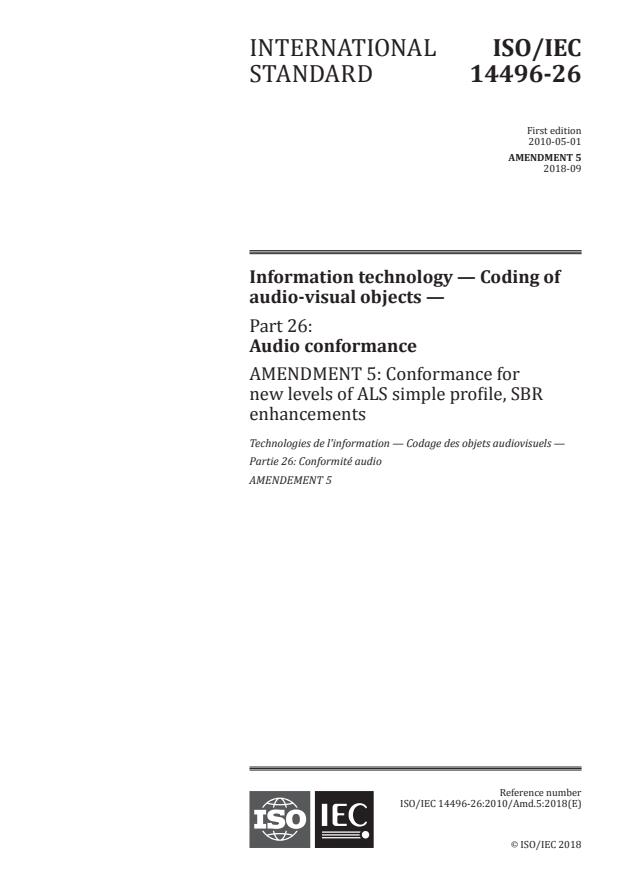
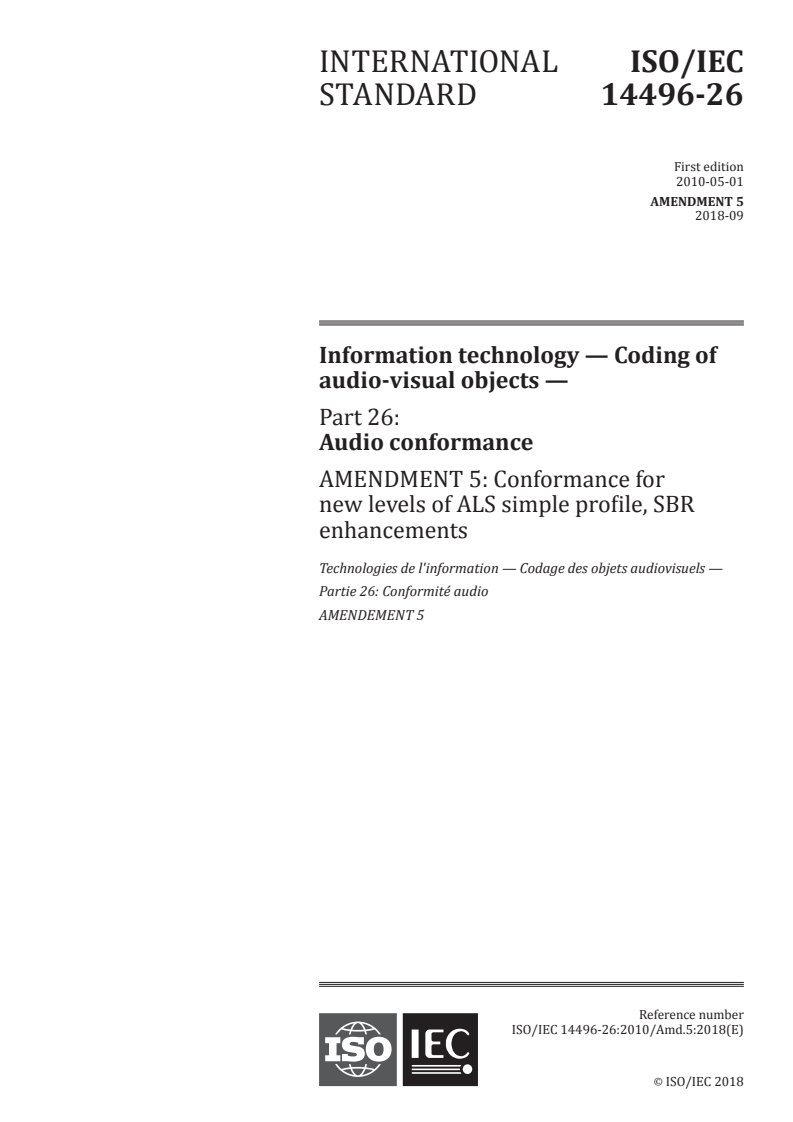
(Amendment)Information technology — Coding of audio-visual objects — Part 26: Audio conformance — Amendment 5: Conformance for new levels of ALS simple profile, SBR enhancements
General Information
- Abstract
- Status
- Withdrawn
- Publication Date
- 28-Aug-2018
- Current Stage
- 9599 - Withdrawal of International Standard
- Start Date
- 08-Nov-2024
- Completion Date
- 29-Aug-2026
Buy Documents

ISO/IEC 14496-26:2010/Amd 5:2018 - Conformance for new levels of ALS simple profile, SBR enhancements

ISO/IEC 14496-26:2010/Amd 5:2018 - Information technology — Coding of audio-visual objects — Part 26: Audio conformance — Amendment 5: Conformance for new levels of ALS simple profile, SBR enhancements/29/2018
Overview
ISO/IEC 14496-26:2010/Amd 5:2018 is an international standard amendment issued by ISO and IEC that enhances the Part 26 audio conformance testing for the coding of audio-visual objects. This amendment focuses on conformance to new levels of Audio Lossless Coding (ALS) simple profile and introduces improvements for Spectral Band Replication (SBR) technology, including SBR enhancements (eSBR). It supports reliable audio codec implementations ensuring interoperability and quality assurance in multimedia applications.
The standard is developed by the joint technical committee ISO/IEC JTC 1, Subcommittee SC 29, specializing in coding multimedia information. It covers technical specifications relevant for developers, testers, and implementers of audio coding solutions.
Key Topics
Audio Conformance for ALS Simple Profile
Amendment 5 extends conformance testing protocols for the ALS simple profile, validating bitstreams and decoded waveform files to guarantee bit-exact decoding and consistent audio quality.SBR and eSBR Enhancements
The standard defines updated testing for spectral band replication modules, focusing on:- Envelope adjuster
- Sine addition
- Time-grid transitions with header changes
- Inverse filtering
- Quadrature Mirror Filter (QMF) implementation
- Channel modes and SBR signaling
- SBR enhancements (eSBR), which improve audio compression efficiency and spectral quality.
Conformance Bitstreams and Testing Tools
The amendment provides a collection of conformance bitstreams and associated WAV outputs downloadable from the ISO website. These test sequences include various sampling rates, channel configurations, and synthetic as well as real music signals to cover a wide range of audio scenarios.Metadata and Bitstream Elements
Enhancements specify storage and syntactic elements for SBR and eSBR data, aligning with ISO/IEC 14496-3 standards. The amendment also addresses combined use of parametric stereo with SBR enhancements.
Applications
ISO/IEC 14496-26:2010/Amd 5:2018 serves critical roles in:
Audio Codec Development and Certification
Manufacturers and software developers use this standard as a benchmark for testing ALS and SBR component compliance within audio coding systems.Broadcasting and Streaming Services
Ensures high-fidelity audio transmission conforming to international interoperability standards, improving listener experience across devices and platforms.Multimedia Content Production
Facilitates consistent audio conformance in production tools and post-processing suites that encode or decode audio-visual content using ALS and SBR techniques.Consumer Electronics
Assists in verifying compatibility and performance of audio playback devices such as digital audio players, smartphones, and home entertainment systems.Research and Innovation
Provides a framework for ongoing enhancements and expansions in audio compression technologies and testing methodologies.
Related Standards
ISO/IEC 14496-3 (Audio Coding)
Defines audio coding and file structure; Amendment 5 references this for SBR and eSBR data storage and syntax.Other Parts of ISO/IEC 14496 Series
The MPEG-4 standard suite covers broader aspects of audiovisual coding, including video, graphics, and synchronization.ISO/IEC JTC 1/SC 29 Standards
Related multimedia coding standards under the technical subcommittee’s scope, including AAC and MPEG-H audio.
For more detailed conformance bitstreams, tools, and documentation, visit the official ISO standards website at iso.org. The amendment supports developers and implementers aiming to ensure compliance with international audio coding requirements, fostering innovation and compatibility in audio-visual technology markets.
Relations
- Effective Date
- 06-Jun-2022
- Effective Date
- 26-Nov-2021
- Effective Date
- 28-Jan-2023
Buy Documents
ISO/IEC 14496-26:2010/Amd 5:2018 - Conformance for new levels of ALS simple profile, SBR enhancements
ISO/IEC 14496-26:2010/Amd 5:2018 - Information technology — Coding of audio-visual objects — Part 26: Audio conformance — Amendment 5: Conformance for new levels of ALS simple profile, SBR enhancements/29/2018
Get Certified
Connect with accredited certification bodies for this standard

BSI Group
BSI (British Standards Institution) is the business standards company that helps organizations make excellence a habit.

NYCE
Mexican standards and certification body.
Sponsored listings
Frequently Asked Questions
ISO/IEC 14496-26:2010/Amd 5:2018 is a standard published by the International Organization for Standardization (ISO). Its full title is "Information technology — Coding of audio-visual objects — Part 26: Audio conformance — Amendment 5: Conformance for new levels of ALS simple profile, SBR enhancements". This standard covers: Information technology — Coding of audio-visual objects — Part 26: Audio conformance — Amendment 5: Conformance for new levels of ALS simple profile, SBR enhancements
Information technology — Coding of audio-visual objects — Part 26: Audio conformance — Amendment 5: Conformance for new levels of ALS simple profile, SBR enhancements
ISO/IEC 14496-26:2010/Amd 5:2018 is classified under the following ICS (International Classification for Standards) categories: 35.040.40 - Coding of audio, video, multimedia and hypermedia information. The ICS classification helps identify the subject area and facilitates finding related standards.
ISO/IEC 14496-26:2010/Amd 5:2018 has the following relationships with other standards: It is inter standard links to ISO 10882-1:2024, ISO/IEC 14496-26:2010, ISO/IEC 14496-26:2024. Understanding these relationships helps ensure you are using the most current and applicable version of the standard.
ISO/IEC 14496-26:2010/Amd 5:2018 is available in PDF format for immediate download after purchase. The document can be added to your cart and obtained through the secure checkout process. Digital delivery ensures instant access to the complete standard document.
Standards Content (Sample)
INTERNATIONAL ISO/IEC
STANDARD 14496-26
First edition
2010-05-01
AMENDMENT 5
2018-09
Information technology — Coding of
audio-visual objects —
Part 26:
Audio conformance
AMENDMENT 5: Conformance for
new levels of ALS simple profile, SBR
enhancements
Technologies de l'information — Codage des objets audiovisuels —
Partie 26: Conformité audio
AMENDEMENT 5
Reference number
ISO/IEC 14496-26:2010/Amd.5:2018(E)
©
ISO/IEC 2018
ISO/IEC 14496-26:2010/Amd.5:2018(E)
© ISO/IEC 2018
All rights reserved. Unless otherwise specified, or required in the context of its implementation, no part of this publication may
be reproduced or utilized otherwise in any form or by any means, electronic or mechanical, including photocopying, or posting
on the internet or an intranet, without prior written permission. Permission can be requested from either ISO at the address
below or ISO’s member body in the country of the requester.
ISO copyright office
CP 401 • Ch. de Blandonnet 8
CH-1214 Vernier, Geneva
Phone: +41 22 749 01 11
Fax: +41 22 749 09 47
Email: copyright@iso.org
Website: www.iso.org
Published in Switzerland
ii © ISO/IEC 2018 – All rights reserved
ISO/IEC 14496-26:2010/Amd.5:2018(E)
Foreword
ISO (the International Organization for Standardization) and IEC (the International Electrotechnical
Commission) form the specialized system for worldwide standardization. National bodies that are
members of ISO or IEC participate in the development of International Standards through technical
committees established by the respective organization to deal with particular fields of technical
activity. ISO and IEC technical committees collaborate in fields of mutual interest. Other international
organizations, governmental and non-governmental, in liaison with ISO and IEC, also take part in the
work. In the field of information technology, ISO and IEC have established a joint technical committee,
ISO/IEC JTC 1.
The procedures used to develop this document and those intended for its further maintenance are
described in the ISO/IEC Directives, Part 1. In particular, the different approval criteria needed for
the different types of document should be noted. This document was drafted in accordance with the
editorial rules of the ISO/IEC Directives, Part 2 (see www .iso .org/directives).
Attention is drawn to the possibility that some of the elements of this document may be the subject
of patent rights. ISO and IEC shall not be held responsible for identifying any or all such patent
rights. Details of any patent rights identified during the development of the document will be in the
Introduction and/or on the ISO list of patent declarations received (see www .iso .org/patents).
Any trade name used in this document is information given for the convenience of users and does not
constitute an endorsement.
For an explanation of the voluntary nature of standards, the meaning of ISO specific terms and
expressions related to conformity assessment, as well as information about ISO's adherence to the
World Trade Organization (WTO) principles in the Technical Barriers to Trade (TBT) see www .iso
.org/iso/foreword .html.
This document was prepared by Technical Committee ISO/IEC JTC 1, Information technology,
Subcommittee SC 29, Coding of audio, picture, multimedia and hypermedia information.
A list of all parts in the ISO/IEC 14496 series can be found on the ISO website.
Any feedback or questions on this document should be directed to the user’s national standards body. A
complete listing of these bodies can be found at www .iso .org/members .html.
© ISO/IEC 2018 – All rights reserved iii
ISO/IEC 14496-26:2010/Amd.5:2018(E)
Information technology — Coding of audio-visual
objects —
Part 26:
Audio conformance
AMENDMENT 5: Conformance for new levels of ALS simple
profile, SBR enhancements
Add a new paragraph as third paragraph of this subclause:
The conformance bitstreams and decoded wav-files package can be found at: http: //standards .iso
.org/iso -iec/14496/ -26/ed -1/en/amd/5
6.1
Replace the paragraph for with:
indicates the SBR module mainly targeted by the test sequence. Possible values are “e” for
testing the envelope adjuster “s” for testing sine addition, “gh” for testing time-grid transitions in
combination with changes of SBR header data, “i” for testing inverse filtering, “qmf” for testing
the QMF implementation, “cm” and "gen" for testing various channel modes, “sig” for testing SBR
signalling, “twi” for QMF identification, “sr” for testing various combinations of sampling rates, and
"esbr" for testing SBR enhancements.
7.17.1.1
Add a new paragraph at the end of this subclause:
If SBR enhancements (eSBR) are used, eSBR data shall be stored as outlined in ISO/IEC 14496-3:2009,
Annex 8.A.
7.17.1.2.1.6
Add a new subclause at the end of this sublclause:
7.17.1.2.1.7 esbr_data()
The top level syntactic element for conveying SBR enhancement data to the decoder is defined in ISO/
IEC 14496-3:2009/Amd.7:2018. No restrictions apply to bitstream elements within esbr_data().
If SBR enhancements are used in combination with parametric stereo, ps_data() shall precede esbr_
data() in the compressed data.
© ISO/IEC 2018 – All rights reserved 1
ISO/IEC 14496-26:2010/Amd.5:2018(E)
7.17.2.1
Add a new paragraph at the end of this subclause:
If no esbr_data() is present in the current frame the decoder shall resort to legacy SBR processing
(i.e. bs_sbr_preprocessing = 0; sbrPatchingMode = 1).
7.17.2.3
Update Table 69 with the grey-shaded columns/rows.
file base content bit QMF Iden- QMF enve- grid head- in- addi- SBR har- C Di RMS test proce-
name rate tification Accu- lope con- er verse tional pre-pro- monic R ff max dure
(kbit racy Ad- trol cha filter- sines cessing trans- C ma (lin
/s) juster tests nge ing tests tests poser x ear
Accu- tes tests tests val
racy ts ue)
al_sbr_twi none 24 y y — — — — y — — — — — —
al_sbr_qmf Sine 24 — y — — — — — — — — 5 1.4 maxDiff/
Sweep RMS
a
al_sbr_e rec- 24/ — — y — — — — — — y 90 2.0 maxDiff/
tangle 48 RMS
* 10Hz
sine
al_sbr_gh rec- 24/ — — — y y — — — — — 51 1.5 maxDiff/
tangle 48
...
INTERNATIONAL ISO/IEC
STANDARD 14496-26
First edition
2010-05-01
AMENDMENT 5
2018-09
Information technology — Coding of
audio-visual objects —
Part 26:
Audio conformance
AMENDMENT 5: Conformance for
new levels of ALS simple profile, SBR
enhancements
Technologies de l'information — Codage des objets audiovisuels —
Partie 26: Conformité audio
AMENDEMENT 5
Reference number
ISO/IEC 14496-26:2010/Amd.5:2018(E)
©
ISO/IEC 2018
ISO/IEC 14496-26:2010/Amd.5:2018(E)
© ISO/IEC 2018
All rights reserved. Unless otherwise specified, or required in the context of its implementation, no part of this publication may
be reproduced or utilized otherwise in any form or by any means, electronic or mechanical, including photocopying, or posting
on the internet or an intranet, without prior written permission. Permission can be requested from either ISO at the address
below or ISO’s member body in the country of the requester.
ISO copyright office
CP 401 • Ch. de Blandonnet 8
CH-1214 Vernier, Geneva
Phone: +41 22 749 01 11
Fax: +41 22 749 09 47
Email: copyright@iso.org
Website: www.iso.org
Published in Switzerland
ii © ISO/IEC 2018 – All rights reserved
ISO/IEC 14496-26:2010/Amd.5:2018(E)
Foreword
ISO (the International Organization for Standardization) and IEC (the International Electrotechnical
Commission) form the specialized system for worldwide standardization. National bodies that are
members of ISO or IEC participate in the development of International Standards through technical
committees established by the respective organization to deal with particular fields of technical
activity. ISO and IEC technical committees collaborate in fields of mutual interest. Other international
organizations, governmental and non-governmental, in liaison with ISO and IEC, also take part in the
work. In the field of information technology, ISO and IEC have established a joint technical committee,
ISO/IEC JTC 1.
The procedures used to develop this document and those intended for its further maintenance are
described in the ISO/IEC Directives, Part 1. In particular, the different approval criteria needed for
the different types of document should be noted. This document was drafted in accordance with the
editorial rules of the ISO/IEC Directives, Part 2 (see www .iso .org/directives).
Attention is drawn to the possibility that some of the elements of this document may be the subject
of patent rights. ISO and IEC shall not be held responsible for identifying any or all such patent
rights. Details of any patent rights identified during the development of the document will be in the
Introduction and/or on the ISO list of patent declarations received (see www .iso .org/patents).
Any trade name used in this document is information given for the convenience of users and does not
constitute an endorsement.
For an explanation of the voluntary nature of standards, the meaning of ISO specific terms and
expressions related to conformity assessment, as well as information about ISO's adherence to the
World Trade Organization (WTO) principles in the Technical Barriers to Trade (TBT) see www .iso
.org/iso/foreword .html.
This document was prepared by Technical Committee ISO/IEC JTC 1, Information technology,
Subcommittee SC 29, Coding of audio, picture, multimedia and hypermedia information.
A list of all parts in the ISO/IEC 14496 series can be found on the ISO website.
Any feedback or questions on this document should be directed to the user’s national standards body. A
complete listing of these bodies can be found at www .iso .org/members .html.
© ISO/IEC 2018 – All rights reserved iii
ISO/IEC 14496-26:2010/Amd.5:2018(E)
Information technology — Coding of audio-visual
objects —
Part 26:
Audio conformance
AMENDMENT 5: Conformance for new levels of ALS simple
profile, SBR enhancements
Add a new paragraph as third paragraph of this subclause:
The conformance bitstreams and decoded wav-files package can be found at: http: //standards .iso
.org/iso -iec/14496/ -26/ed -1/en/amd/5
6.1
Replace the paragraph for with:
indicates the SBR module mainly targeted by the test sequence. Possible values are “e” for
testing the envelope adjuster “s” for testing sine addition, “gh” for testing time-grid transitions in
combination with changes of SBR header data, “i” for testing inverse filtering, “qmf” for testing
the QMF implementation, “cm” and "gen" for testing various channel modes, “sig” for testing SBR
signalling, “twi” for QMF identification, “sr” for testing various combinations of sampling rates, and
"esbr" for testing SBR enhancements.
7.17.1.1
Add a new paragraph at the end of this subclause:
If SBR enhancements (eSBR) are used, eSBR data shall be stored as outlined in ISO/IEC 14496-3:2009,
Annex 8.A.
7.17.1.2.1.6
Add a new subclause at the end of this sublclause:
7.17.1.2.1.7 esbr_data()
The top level syntactic element for conveying SBR enhancement data to the decoder is defined in ISO/
IEC 14496-3:2009/Amd.7:2018. No restrictions apply to bitstream elements within esbr_data().
If SBR enhancements are used in combination with parametric stereo, ps_data() shall precede esbr_
data() in the compressed data.
© ISO/IEC 2018 – All rights reserved 1
ISO/IEC 14496-26:2010/Amd.5:2018(E)
7.17.2.1
Add a new paragraph at the end of this subclause:
If no esbr_data() is present in the current frame the decoder shall resort to legacy SBR processing
(i.e. bs_sbr_preprocessing = 0; sbrPatchingMode = 1).
7.17.2.3
Update Table 69 with the grey-shaded columns/rows.
file base content bit QMF Iden- QMF enve- grid head- in- addi- SBR har- C Di RMS test proce-
name rate tification Accu- lope con- er verse tional pre-pro- monic R ff max dure
(kbit racy Ad- trol cha filter- sines cessing trans- C ma (lin
/s) juster tests nge ing tests tests poser x ear
Accu- tes tests tests val
racy ts ue)
al_sbr_twi none 24 y y — — — — y — — — — — —
al_sbr_qmf Sine 24 — y — — — — — — — — 5 1.4 maxDiff/
Sweep RMS
a
al_sbr_e rec- 24/ — — y — — — — — — y 90 2.0 maxDiff/
tangle 48 RMS
* 10Hz
sine
al_sbr_gh rec- 24/ — — — y y — — — — — 51 1.5 maxDiff/
tangle 48
...