


ISO/TS 15923-2:2017
(Main)Water quality — Determination of selected parameters by discrete analysis systems — Part 2: Chromium(VI), fluoride, total alkalinity, total hardness, calcium, magnesium, iron, iron(II), manganese and aluminium with photometric detection
Water quality — Determination of selected parameters by discrete analysis systems — Part 2: Chromium(VI), fluoride, total alkalinity, total hardness, calcium, magnesium, iron, iron(II), manganese and aluminium with photometric detection
ISO/TS 15923-2:2017 specifies methods for the automatic determination of chromium(VI), fluoride, total alkalinity, total hardness, calcium, magnesium, iron, iron(II), manganese and aluminium with photometric determination using a discrete analysis system. The field of application is water (ground, potable, surface, waste, eluates and boiler water). The method can also be applied to marine waters with matrix matching of standard and control solutions. Note that some parameters, notably iron, manganese and aluminium and possibly chromium(VI), calcium and magnesium may not be completely quantified if the sample contains particulates. Samples can be digested in acid, as long as the buffering capacity of the reaction mixture is not exceeded. Such procedures are beyond the scope of ISO/TS 15923-2:2017, which is best suited to the determination of dissolved metals following on-site filtration.
Qualité de l'eau — Détermination de paramètres sélectionnés par des systèmes d'analyse discrète — Partie 2: Chrom(VI), fluorure, alcalinité totale, dureté totale, calcium, magnésium, fer, (fer(II), manganèse et aluminium avec détection photométrique
General Information
- Status
- Published
- Publication Date
- 28-Sep-2017
- Technical Committee
- ISO/TC 147/SC 2 - Physical, chemical and biochemical methods
- Drafting Committee
- ISO/TC 147/SC 2 - Physical, chemical and biochemical methods
- Current Stage
- 9093 - International Standard confirmed
- Start Date
- 07-Apr-2026
- Completion Date
- 11-Apr-2026
Overview
ISO/TS 15923-2:2017 specifies automated photometric methods for the determination of selected water-quality parameters using a discrete analysis system. Covered analytes include chromium(VI), fluoride, total alkalinity, total hardness, calcium, magnesium, iron (total and Fe(II)), manganese and aluminium. The techniques are applicable to a broad range of water matrices - ground, potable, surface, waste, eluates and boiler water - and can be extended to marine waters with matrix-matched standards.
Key topics and technical requirements
- Measurement principle: colour-forming reagent chemistry in individual reaction cells (cuvettes) with incubation and photometric absorbance reading.
- Discrete analysis system: automated sample/reagent pipetting, incubator, visible-wavelength detector (approx. 400–880 nm), control/data unit and recording software.
- Sample preparation: filtration (recommended 0.45 µm) to remove particulates; settlement, centrifugation or dialysis also acceptable. Note that particulate-associated metals may not be quantified after filtration.
- Interferences & corrections: inherent sample colour and turbidity can affect photometry; Annex A provides colour-correction procedures. Specific interference discussions are given in annexes for each analyte (B–J).
- Reagents and standards: use analytical-grade reagents; primary calibration and control standards are described in the annexes. Commercial preparations may be used if stability/storage instructions followed.
- Calibration & quality control: establish calibration functions per ISO 8466-1/2; perform calibration verification regularly (recommend control standard at least every 20 samples) and use water-for-analytical-grade (ISO 3696) as blank.
- Limitations & scope: best suited for dissolved metals following on-site filtration; acid digestion procedures can be used only if they do not exceed the reaction mixture buffering capacity (digestion procedures themselves are beyond the scope).
Applications and users
- Environmental and public-health laboratories performing routine water-monitoring and compliance testing.
- Drinking-water utilities, wastewater treatment plants and industrial boiler/wastewater monitoring programs.
- Field laboratories and contract testing services that use automated discrete photometric analyzers.
- Manufacturers and integrators of discrete analysis systems developing methods or instrument-specific protocols.
- Researchers needing standardized, inter-comparable analytical procedures for water quality studies.
Related standards
- ISO 3696 - Water for analytical laboratory use
- ISO 8466-1 / ISO 8466-2 - Calibration and evaluation of analytical methods
- ISO 5667-3 - Sampling and sample handling guidance
- ISO 18412, ISO 23913 - Guidance referenced for chromium(VI) sample storage
- Other parts of the ISO 15923 series covering discrete photometric determinations
Keywords: ISO/TS 15923-2:2017, water quality, discrete analysis system, photometric detection, chromium(VI), fluoride, alkalinity, hardness, calcium, magnesium, iron, manganese, aluminium, calibration, sample filtration.
Buy Documents
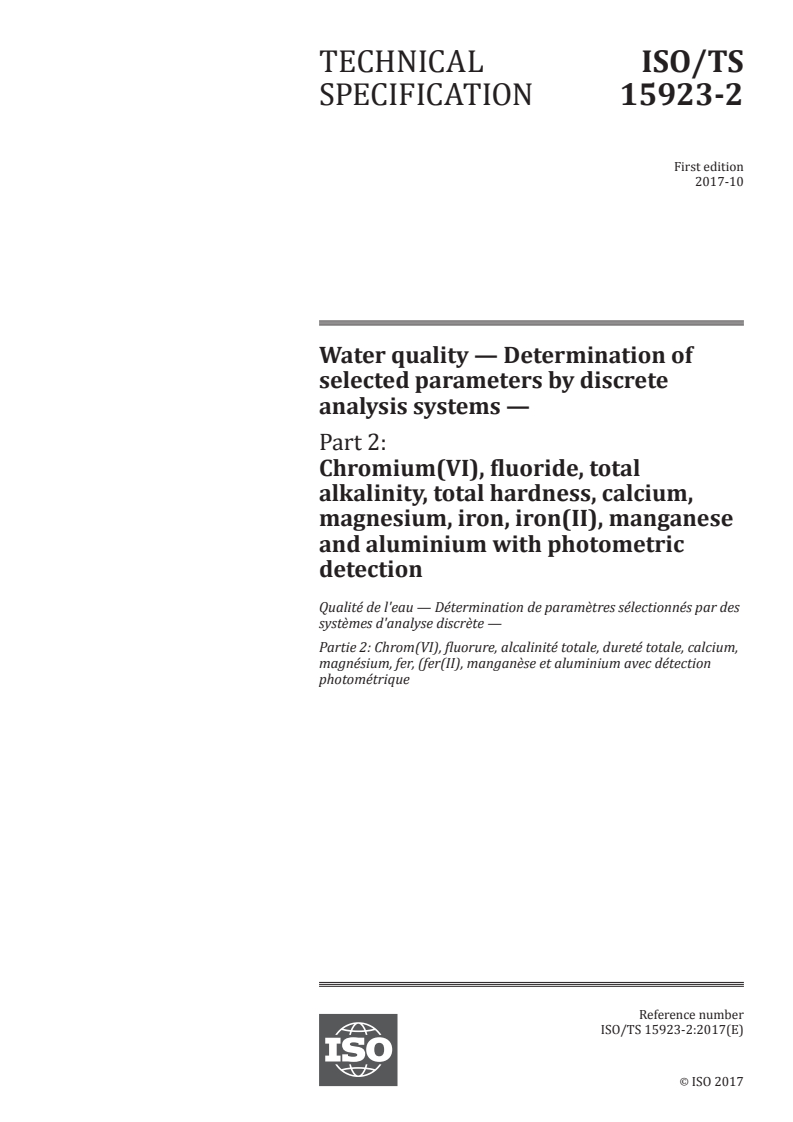

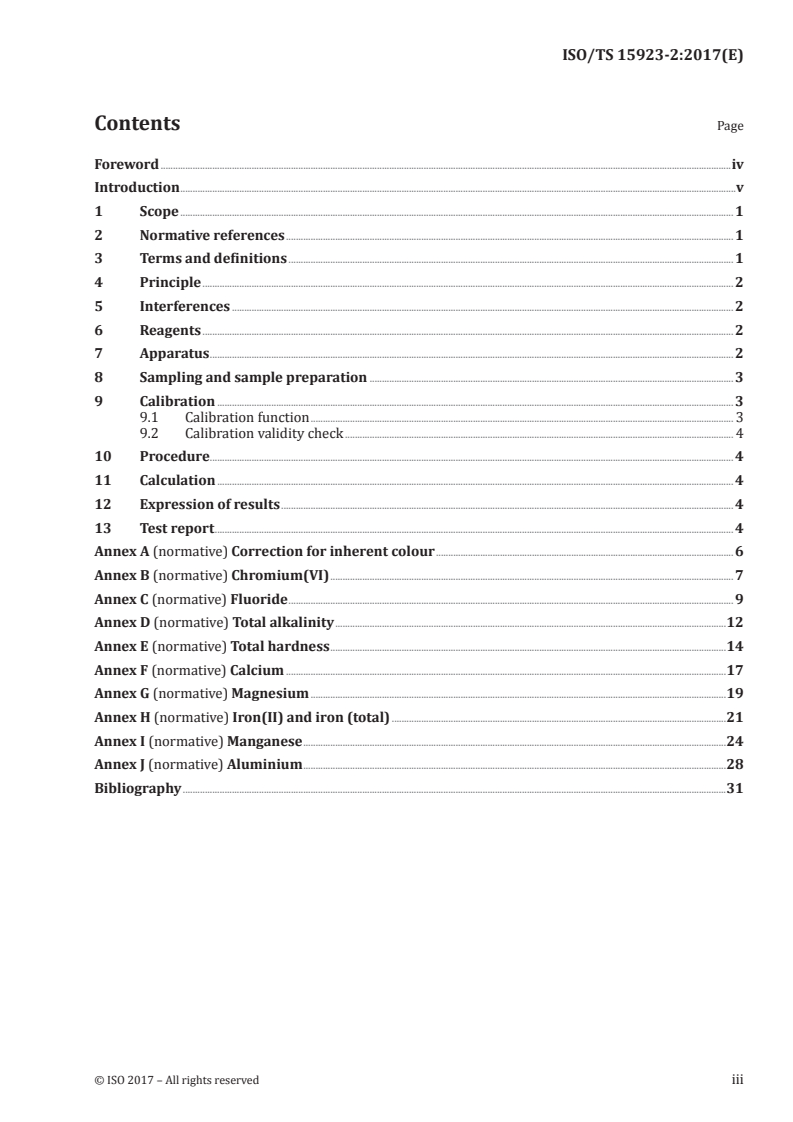

ISO/TS 15923-2:2017 - Water quality — Determination of selected parameters by discrete analysis systems — Part 2: Chromium(VI), fluoride, total alkalinity, total hardness, calcium, magnesium, iron, iron(II), manganese and aluminium with photometric detection Released:9/29/2017
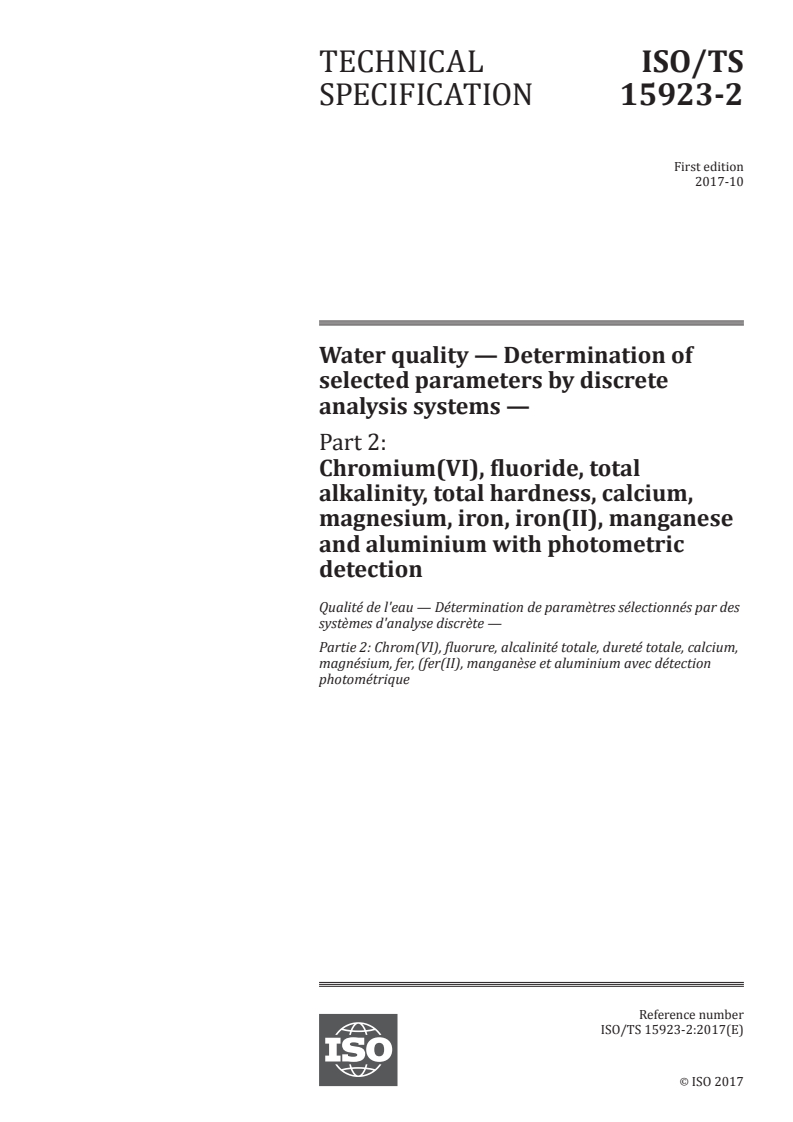

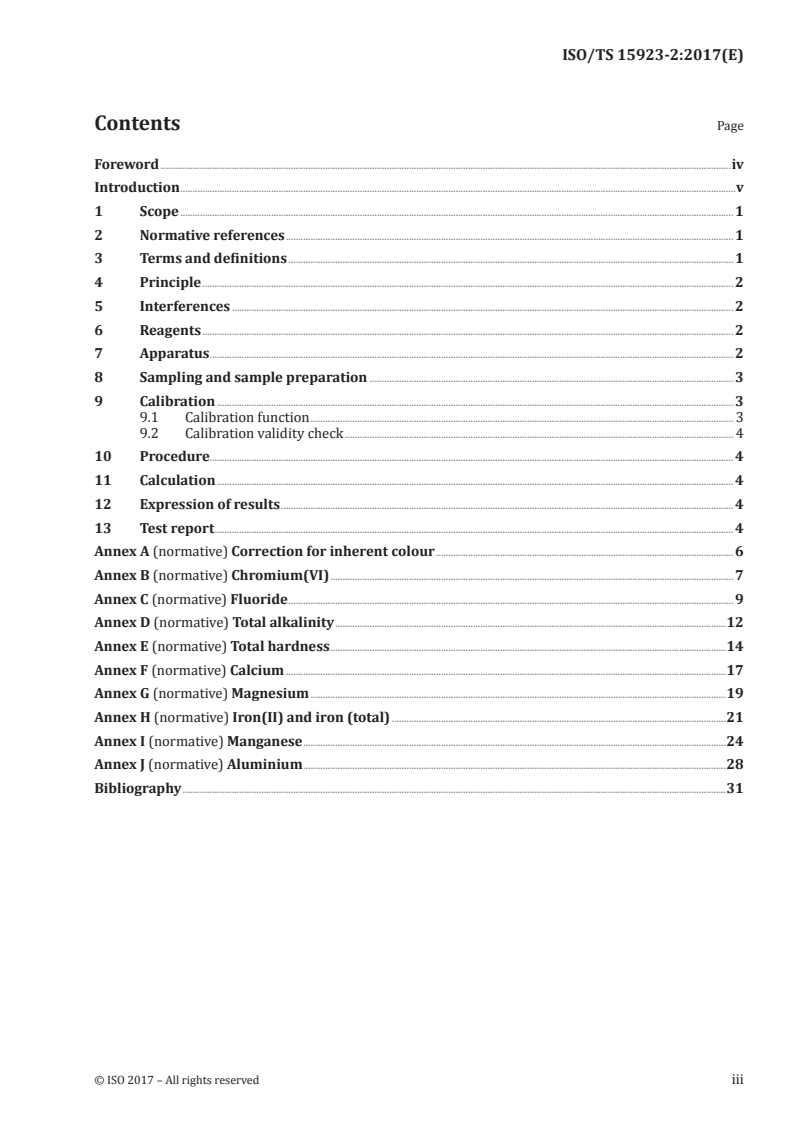

ISO/TS 15923-2:2017 - Water quality — Determination of selected parameters by discrete analysis systems — Part 2: Chromium(VI), fluoride, total alkalinity, total hardness, calcium, magnesium, iron, iron(II), manganese and aluminium with photometric detection/29/2017
Get Certified
Connect with accredited certification bodies for this standard

NSF International
Global independent organization facilitating standards development and certification.

CIS Institut d.o.o.
Personal Protective Equipment (PPE) certification body. Notified Body NB-2890 for EU Regulation 2016/425 PPE.

Kiwa BDA Testing
Building and construction product certification.
Sponsored listings
Frequently Asked Questions
ISO/TS 15923-2:2017 is a technical specification published by the International Organization for Standardization (ISO). Its full title is "Water quality — Determination of selected parameters by discrete analysis systems — Part 2: Chromium(VI), fluoride, total alkalinity, total hardness, calcium, magnesium, iron, iron(II), manganese and aluminium with photometric detection". This standard covers: ISO/TS 15923-2:2017 specifies methods for the automatic determination of chromium(VI), fluoride, total alkalinity, total hardness, calcium, magnesium, iron, iron(II), manganese and aluminium with photometric determination using a discrete analysis system. The field of application is water (ground, potable, surface, waste, eluates and boiler water). The method can also be applied to marine waters with matrix matching of standard and control solutions. Note that some parameters, notably iron, manganese and aluminium and possibly chromium(VI), calcium and magnesium may not be completely quantified if the sample contains particulates. Samples can be digested in acid, as long as the buffering capacity of the reaction mixture is not exceeded. Such procedures are beyond the scope of ISO/TS 15923-2:2017, which is best suited to the determination of dissolved metals following on-site filtration.
ISO/TS 15923-2:2017 specifies methods for the automatic determination of chromium(VI), fluoride, total alkalinity, total hardness, calcium, magnesium, iron, iron(II), manganese and aluminium with photometric determination using a discrete analysis system. The field of application is water (ground, potable, surface, waste, eluates and boiler water). The method can also be applied to marine waters with matrix matching of standard and control solutions. Note that some parameters, notably iron, manganese and aluminium and possibly chromium(VI), calcium and magnesium may not be completely quantified if the sample contains particulates. Samples can be digested in acid, as long as the buffering capacity of the reaction mixture is not exceeded. Such procedures are beyond the scope of ISO/TS 15923-2:2017, which is best suited to the determination of dissolved metals following on-site filtration.
ISO/TS 15923-2:2017 is classified under the following ICS (International Classification for Standards) categories: 13.060.50 - Examination of water for chemical substances. The ICS classification helps identify the subject area and facilitates finding related standards.
ISO/TS 15923-2:2017 is available in PDF format for immediate download after purchase. The document can be added to your cart and obtained through the secure checkout process. Digital delivery ensures instant access to the complete standard document.
Standards Content (Sample)
TECHNICAL ISO/TS
SPECIFICATION 15923-2
First edition
2017-10
Water quality — Determination of
selected parameters by discrete
analysis systems —
Part 2:
Chromium(VI), fluoride, total
alkalinity, total hardness, calcium,
magnesium, iron, iron(II), manganese
and aluminium with photometric
detection
Qualité de l'eau — Détermination de paramètres sélectionnés par des
systèmes d'analyse discrète —
Partie 2: Chrom(VI), fluorure, alcalinité totale, dureté totale, calcium,
magnésium, fer, (fer(II), manganèse et aluminium avec détection
photométrique
Reference number
©
ISO 2017
© ISO 2017, Published in Switzerland
All rights reserved. Unless otherwise specified, no part of this publication may be reproduced or utilized otherwise in any form
or by any means, electronic or mechanical, including photocopying, or posting on the internet or an intranet, without prior
written permission. Permission can be requested from either ISO at the address below or ISO’s member body in the country of
the requester.
ISO copyright office
Ch. de Blandonnet 8 • CP 401
CH-1214 Vernier, Geneva, Switzerland
Tel. +41 22 749 01 11
Fax +41 22 749 09 47
copyright@iso.org
www.iso.org
ii © ISO 2017 – All rights reserved
Contents Page
Foreword .iv
Introduction .v
1 Scope . 1
2 Normative references . 1
3 Terms and definitions . 1
4 Principle . 2
5 Interferences . 2
6 Reagents . 2
7 Apparatus . 2
8 Sampling and sample preparation . 3
9 Calibration . 3
9.1 Calibration function . 3
9.2 Calibration validity check . 4
10 Procedure. 4
11 Calculation . 4
12 Expression of results . 4
13 Test report . 4
Annex A (normative) Correction for inherent colour . 6
Annex B (normative) Chromium(VI) . 7
Annex C (normative) Fluoride . 9
Annex D (normative) Total alkalinity .12
Annex E (normative) Total hardness .14
Annex F (normative) Calcium .17
Annex G (normative) Magnesium .19
Annex H (normative) Iron(II) and iron (total) .21
Annex I (normative) Manganese .24
Annex J (normative) Aluminium .28
Bibliography .31
Foreword
ISO (the International Organization for Standardization) is a worldwide federation of national standards
bodies (ISO member bodies). The work of preparing International Standards is normally carried out
through ISO technical committees. Each member body interested in a subject for which a technical
committee has been established has the right to be represented on that committee. International
organizations, governmental and non-governmental, in liaison with ISO, also take part in the work.
ISO collaborates closely with the International Electrotechnical Commission (IEC) on all matters of
electrotechnical standardization.
The procedures used to develop this document and those intended for its further maintenance are
described in the ISO/IEC Directives, Part 1. In particular the different approval criteria needed for the
different types of ISO documents should be noted. This document was drafted in accordance with the
editorial rules of the ISO/IEC Directives, Part 2 (see www.iso.org/directives).
Attention is drawn to the possibility that some of the elements of this document may be the subject of
patent rights. ISO shall not be held responsible for identifying any or all such patent rights. Details of
any patent rights identified during the development of the document will be in the Introduction and/or
on the ISO list of patent declarations received (see www.iso.org/patents).
Any trade name used in this document is information given for the convenience of users and does not
constitute an endorsement.
For an explanation on the voluntary nature of standards, the meaning of ISO specific terms and
expressions related to conformity assessment, as well as information about ISO's adherence to the
World Trade Organization (WTO) principles in the Technical Barriers to Trade (TBT) see the following
URL: www.iso.org/iso/foreword.html.
This document was prepared by Technical Committee ISO/TC 147, Water quality, Subcommittee SC 2,
Physical, chemical and biochemical methods.
A list of all parts in the ISO 15923 series can be found on the ISO website.
iv © ISO 2017 – All rights reserved
Introduction
Many photometric determinations can be automated with a discrete analysis system. With a single
instrument, a large number of different parameters can be determined, and a different combination can
be specified for each sample. Working with small volumes requires less sample material and reagent.
Samples that fall outside the normal range of measurement can either be automatically diluted or
analysed using a different measuring range.
TECHNICAL SPECIFICATION ISO/TS 15923-2:2017(E)
Water quality — Determination of selected parameters by
discrete analysis systems —
Part 2:
Chromium(VI), fluoride, total alkalinity, total hardness,
calcium, magnesium, iron, iron(II), manganese and
aluminium with photometric detection
WARNING — Persons using this document should be familiar with normal laboratory practice.
This document does not purport to address all of the safety problems, if any, associated with its
use. It is the responsibility of the user to establish appropriate safety and health practices.
IMPORTANT — It is absolutely essential that tests conducted in accordance with this document
be carried out by suitably qualified staff.
1 Scope
This document specifies methods for the automatic determination of chromium(VI), fluoride, total
alkalinity, total hardness, calcium, magnesium, iron, iron(II), manganese and aluminium with
photometric determination using a discrete analysis system. The field of application is water (ground,
potable, surface, waste, eluates and boiler water). The method can also be applied to marine waters with
matrix matching of standard and control solutions. Note that some parameters, notably iron, manganese
and aluminium and possibly chromium(VI), calcium and magnesium may not be completely quantified
if the sample contains particulates. Samples can be digested in acid, as long as the buffering capacity of
the reaction mixture is not exceeded. Such procedures are beyond the scope of this document, which is
best suited to the determination of dissolved metals following on-site filtration.
2 Normative references
The following documents are referred to in the text in such a way that some or all of their content
constitutes requirements of this document. For dated references, only the edition cited applies. For
undated references, the latest edition of the referenced document (including any amendments) applies.
ISO 3696, Water for analytical laboratory use — Specification and test methods
ISO 8466-1, Water quality — Calibration and evaluation of analytical methods and estimation of
performance characteristics — Part 1: Statistical evaluation of the linear calibration function
ISO 8466-2, Water quality — Calibration and evaluation of analytical methods and estimation of
performance characteristics — Part 2: Calibration strategy for non-linear second-order calibration
functions
3 Terms and definitions
No terms and definitions are listed in this document.
ISO and IEC maintain terminological databases for use in standardization at the following addresses:
— ISO Online browsing platform: available at https://www.iso.org./obp
— IEC Electropedia: available at http://www.electropedia.org/
4 Principle
A discrete analysis system is an automated system for spectrophotometric and turbidimetric
determinations.
The colour reactions take place in reaction cells, which may be cuvettes, in an incubator. For each
determination, a separate reaction cell is used. Pre-set volumes of the sample and the reagents are
pipetted into the cells and mixed.
Following the incubation period, the absorbance of the solution is measured at the wavelength applicable
to the determination. Depending on which instrument is used, measurement is achieved by passing the
cuvettes through the photometer or by transferring the measuring solution from the reaction cells to a
photometer with a flow-through cell.
The specific chemistry for each parameter is given in the relevant annex.
5 Interferences
Particles present in the sample can lead to blockages and will interfere with the photometric
measurement. Filtration of samples containing particles through a 0,45 μm membrane filter is
recommended. Particles can also be removed by settlement, centrifugation or dialysis.
If the sample is filtered prior to analysis, the fraction of any of the parameters that is adsorbed onto the
surface of particles will not be measured.
Inherent colour or turbidity of the sample can interfere with the analysis. Two possible procedures to
correct for any inherent colour are described in Annex A.
A reliable procedure for the correction of turbidity cannot really be given. The Beer-Lambert law does
not apply to turbid solutions. Furthermore, many chromogenic reagents and coloured complexes are
adsorbed on particles.
Interferences specific to each parameter are discussed in the relevant annex.
6 Reagents
Reagents for each parameter are specified in Annexes B to J. Use only reagents of recognized analytical
grade, unless otherwise specified in the relevant annex. Dry all solid reagents to constant weight at
(105 ± 5) °C, provided that they are thermally stable. Store the dried solid in an exsiccator before
weighing. Reagent volumes specified in Annexes B to J may be adjusted to suit local requirements or
different instrument specifications.
For many of the reagents, calibration and control standards specified in this document, commercial
preparations are available and it is quite acceptable to use them provided that manufacturer’s
instructions relating to storage and stability are followed.
6.1 Water, complying with the specification for grade 1 as defined in ISO 3696.
7 Apparatus
7.1 Discrete analysis system, generally consisting of the following components.
7.1.1 Sample injection device, for automated or manual operation.
7.1.2 Sample container.
7.1.3 Reagent container, refrigerated or not.
2 © ISO 2017 – All rights reserved
7.1.4 Incubator with temperature control, capable of maintaining a constant temperature.
7.1.5 Visible wavelength detector, e.g. spectrophotometer, suitable for a wavelength range usually
between 400 nm and 880 nm.
7.1.6 Control and data processing unit.
7.1.7 Recording device, e.g. PC with software for data acquisition and evaluation.
7.2 Routine laboratory apparatus, including
7.2.1 Balance, capable of measuring to 0,000 1 g.
7.2.2 Oven.
7.2.3 Exsiccator.
7.2.4 Glassware, including volumetric flasks and beakers.
7.2.5 Autopipettes, capable of dispensing volumes from 50 µl to 500 µl.
8 Sampling and sample preparation
Use clean vessels for sampling.
Turbidity or particulates interfere with spectrophotometric detection. Using an appropriate filtration
apparatus, clarify any samples containing particles by filtering through a 0,45 μm membrane
(settlement, centrifugation or dialysis may also be used). To avoid contamination by the filter
membrane, discard the first few millilitres of filtrate.
ISO 5667-3 offers guidance on the preparation and storage of samples. However, the stability of some of
the parameters covered by this document may vary according to conditions such as the pH and other
constituents present in the sample. Stability trials should be carried out locally for each matrix type.
The guidance in ISO 5667-3 for preservation of samples for iron, manganese, aluminium, calcium and
magnesium recommends acidifying the sample to between pH 1 and 2, but this may not be appropriate
for discrete analysis methods where pH is critical, e.g. calcium and manganese. In such cases, it is
important to ensure that the buffering capacity of the reaction mixture is not exceeded. Fluoride is
stable for at least one month with no pre-treatment. For chromium(VI), best practice is to analyse the
[2]
sample as soon as possible after sampling. ISO 18412 recommends a maximum of 4 d refrigerated
[3]
storage, but ISO 23913 specifies storage for no more than 24 h at 2 °C to 5 °C.
Prepare a sample of water (6.1) in the same way as the sample, to be used as a blank.
Prepare a control standard solution from the primary control standard containing a level of analyte
similar to the samples. Run it as a sample at appropriate intervals in the batch, according to local
requirements. A minimum interval of once every 20 samples is recommended. Instructions for
preparing a primary control standard are given in Annexes B to J.
9 Calibration
9.1 Calibration function
When the analytical system is first evaluated and at intervals afterwards, establish a calibration
function for each parameter (see ISO 8466-1 or ISO 8466-2) as follows.
Using the primary calibration standard, prepare an appropriate series of calibration solutions
(Annexes B to J). Use water (6.1) as a zero concentration calibration solution.
Analyse the calibration solutions according to Clause 9 and the instrument manufacturer’s instructions.
Confirm the validity of the data obtained, and use to calculate the regression line as specified in
ISO 8466-1 or ISO 8466-2.
During the analysis, verify the continuing validity of the established calibration function by analysing an
appropriate calibration standard solution, at regular intervals according to local accuracy requirements,
or at least at the end of the batch. Recalibrate, if necessary. It is recommended that calibration verification
is carried out using a calibration solution in the upper third of the calibration range.
9.2 Calibration validity check
If the full calibration function is not established daily, carry out an initial calibration validity check by
analysing two calibration standard solutions in the lower and upper third of the calibrated working
range (see Clause 10).
Verify the continuing validity of the established calibration function as described in 9.1.
10 Procedure
Set up the discrete analysis system according to the instrument manufacturer’s instructions.
Calibrate the system according to Clause 9 and the instrument manufacturer’s instructions.
Prepare the samples according to Clause 8 and Annexes B to J. A consistent incubation temperature and
time are essential for the stability of the absorbance measurements. Measure the absorbance of the
samples using the instrument manufacturer’s recommended instructions. Measure the blank according
to Annex A and the instrument manufacturer’s instructions.
If the absorbance of a sample exceeds that of the top calibration solution, dilute the sample using
water (6.1), or reduce the sample intake by an appropriate factor to bring it into the upper half of the
calibration range, and reanalyse. If necessary, subtract the absorbance of the blank from that of the
samples (see Annex A).
The analytical procedure may be modified for different instruments, or to change the range or
sensitivity of the method for different parameter concentrations or sample types.
11 Calculation
Calculate the mass concentration, ρ, of the parameter in question in micrograms per litre (µg/l) or
milligrams per litre (mg/l) from the calibration line (see Clause 9), using the corrected absorbance
values obtained (see Clause 10), as specified in ISO 8466-1 or ISO 8466-2. Take account of any dilution
factors. This calculation can usually be carried out automatically using the instrument software.
12 Expression of results
Results shall be expressed as µg/l or mg/l to a maximum of three significant figures.
EXAMPLES A reading of 11,12 µg/l, rounding to: 11,1 µg/l (3 sig fig), 11 µg/l (2 sig fig), 10 µg/l (1 sig fig).
13 Test report
This test report shall contain at least the following information:
a) the test method used, together with a reference to this document, i.e. ISO/TS 15923-2:2017;
4 © ISO 2017 – All rights reserved
b) the details required for identification of the sample;
c) the date of the analysis;
d) the analytical results (see Clause 12);
e) any deviation from this method and a report of circumstances that may have affected the results.
Annex A
(normative)
Correction for inherent colour
A.1 General
Correction for any inherent colour in the sample is necessary. Two possible procedures are described
in A.2 and A.3. Accurate correction for turbidity is not possible using these methods because the
Beer-Lambert law does not apply. Discrete analysis systems can be programmed to carry out colour
correction automatically.
A.2 Sample blanking
The blank absorption measurement is done after dispensing the sample and, if applicable, one or more
reagents that could produce a colour change in the sample (for example because of the influence of the
pH), but before dispensing the chromogenic reagent. This blank value is adjusted to take account of the
ratio between the sample volumes with and without the chromogenic reagent, and subtracted from the
final absorption measurement. The standards are measured in the same way.
A.3 Use of a compensating solution
When using a compensating solution, a second measuring solution is prepared using the same volumes
of sample and reagent, in which the compound responsible for forming the colour is omitted. This can
be achieved either by adding an equal volume of water (6.1) instead of the chromogenic reagent, or by
preparing a separate reagent from which the chromogenic compound is omitted. The absorption of the
compensating solution is deducted from the absorption of the sample solution.
6 © ISO 2017 – All rights reserved
Annex B
(normative)
Chromium(VI)
B.1 Principle
The two most common naturally occurring oxidation states of chromium are Cr(III) and Cr(VI). Cr(III)
is the most stable state energetically. Cr(VI) is known to be highly toxic and mutagenic in solution, and
a potent carcinogen when inhaled as a chromate dust, whereas Cr(III) has a relatively low toxicity. It is
thus important to be able to routinely determine both total chromium and chromium(VI) in aqueous
samples.
Chromium(VI) reacts with diphenylcarbazide in acidic solution (pH 2) to produce a red-violet colour,
the absorbance of which is measured at (540 ± 10) nm.
B.2 Interferences
Vanadium produces an interference, but this is only significant at concentrations more than 10 times
that of chromium. Molybdenum(VI) and mercury salts also react to form a red colour with the reagent.
The red intensities are lower than those for chromium at the specified pH and concentrations of up to
200 mg/l of molybdenum and mercury can be tolerated, which are extremely unlikely to be found in the
aqueous matrices covered by this document. Iron concentrations > 1 mg/l may produce a yellow colour,
but this does not produce a significant interference at the specified wavelength of (540 ± 10) nm.
B.3 Reagents
B.3.1 Sulfuric acid, 95 % to 97 %.
B.3.2 Orthophosphoric acid, 1,71 g/ml.
B.3.3 1,5-Diphenylcarbazide, C H N O.
13 14 4
B.3.4 Ethanol, 95 %.
Alternatively, a mixture of acetone and 1-propanol dissolves possible precipitations of
1,5-diphenylcarbazide. The following solvents can be used: acetone, 1-propanol, 2-propanol, ethanol in
combination with water.
B.3.5 Potassium chromate, K CrO .
2 4
B.3.6 Sodium chromate, Na CrO .
2 4
B.3.7 Acid reagent.
Carefully add 27 ml of sulfuric acid (B.3.1) and 33 ml of orthophosphoric acid (B.3.2) into 200 ml
water (6.1) in a 500 ml volumetric flask and make up to the mark with water.
This solution is stable for at least 12 months at room temperature.
B.3.8 Chromogenic reagent.
Dissolve 0,50 g 1,5-diphenylcarbazide (B.3.3) in 100 ml ethanol (B.3.4) and make up to 500 ml with acid
reagent (B.3.7). Mix and store in an amber bottle.
This solution is stable for three weeks when stored at 2 °C to 8 °C.
B.3.9 Primary calibration standard, chromium(VI), ρ(Cr) = 100 mg/l.
Dissolve 0,373 5 g potassium chromate (B.3.5) in a 1 000 ml volumetric flask containing approximately
750 ml of water (6.1). Make up to the mark with water.
This solution is stable for at least one month at room temperature.
B.3.10 Primary control standard, chromium(VI), ρ(Cr) = 50 mg/l.
Dissolve 0,155 8 g sodium chromate (B.3.6) in a 1 000 ml volumetric flask containing approximately
750 ml of water (6.1). Make up to the mark with water.
This solution is stable for at least one week at room temperature.
B.3.11 Working calibration solutions, e.g. working range 0,05 mg/l to 0,5 mg/l Cr.
Into a series of 100 ml volumetric flasks, pipette 50 µl, 100 µl, 200 µl, 300 µl, 400 µl and 500 µl of
primary calibration standard (B.3.9) and make up to the mark with water (6.1), to give calibration
solutions containing 0,05 mg/l, 0,1 mg/l, 0,2 mg/l, 0,3 mg/l, 0,4 mg/l and 0,5 mg/l Cr.
Prepare freshly on the day of use.
B.3.12 Control solution.
Pipette a specific volume of primary control standard (B.3.10) into a volumetric flask and make up to
the mark with water (6.1). Select a volume to give a final concentration of Cr(VI) in the same range as
real samples.
B.4 Procedure
B.4.1 Calibration
The calibration curve is polynomial/second order.
B.4.2 Analysis
The incubation temperature lies between 20 °C and 40 °C. Prepare a measuring solution typically made
up of the following:
— 9 parts of sample;
— 1 part of chromogenic reagent (B.3.8).
Mix the solution after each addition.
The recommended maximum incubation time is 600 s. A lower incubation time may be used if the
incubation temperature is in the upper half of the quoted range.
Measure the absorbance at (540 ± 10) nm.
NOTE A typical calibration range for the method is 0,05 mg/l to 0,5 mg/l Cr.
8 © ISO 2017 – All rights reserved
Annex C
(normative)
Fluoride
C.1 Principle
3+
Fluoride reacts with Ce and alizarin-3-methyliminodiacetic acid in acidic solution to produce a violet
colour, the absorbance of which is measured at (630 ± 10) nm.
C.2 Interferences
Chlorine interferes. It can be removed by heating the water sample or stripping with nitrogen. Phosphate
concentrations above 1 mg/l P interfere and high levels of other phosphorus containing anions may
−3
also interfere. Aluminium forms an extremely stable fluoro compound, AlF . This is overcome by
treatment with 8-hydroxyquinoline to complex the aluminium and by subsequent extraction with
chloroform. At aluminium levels below 0,2 mg/l, the extraction procedure is not required. Fluoride
forms stable complexes with other high valency cations, but these are not normally found in typical
water samples. To obtain the total concentration of fluoride in samples containing a high concentration
of dissolved or suspended solids, or organic matter, a preliminary acid distillation step is necessary, but
the procedure is beyond the scope of this document.
C.3 Reagents
C.3.1 Ammonia solution, 25 %.
C.3.2 Alizarin-3-methyliminodiacetic acid, C H NO .
19 15 8
C.3.3 Acetic acid, glacial.
C.3.4 Sodium acetate trihydrate, C H NaO .
2 9 5
C.3.5 Cerium nitrate, Ce(NO ) .
3 3
C.3.6 Sodium fluoride, NaF.
C.3.7 Potassium fluoride, KF.
C.3.8 Nitric acid, 65 %.
C.3.9 Chromogenic reagent.
Suspend (0,192 ± 0,1) g alizarin-3-methyliminodiacetic acid (C.3.2) in 50 ml water (6.1) and dissolve by
adding 0,5 ml ammonia (C.3.1). Dilute the mixture with approximately 350 ml water (6.1)) and adjust
the pH to between 4,0 and 5,0 by adding acetic acid (C.3.3). Pour this solution into a 500 ml volumetric
flask and make up to the mark with water (6.1). Store in an amber bottle.
This solution is stable for one month at room temperature.
C.3.10 Acetate buffer solution.
Dissolve (30,0 ± 0,1) g sodium acetate-trihydrate (C.3.4) in approximately 300 ml water in a 500 ml
volumetric flask, add 57,5 ml acetic acid (C.3.3) and make up to the mark with water (6.1).
The solution is stable for six months at room temperature.
C.3.11 Cerium nitrate solution.
Dissolve (0,217 ± 0,1) g cerium nitrate (C.3.5) in approximately 400 ml water (6.1) in a 500 ml volumetric
flask, add 0,1 ml nitric acid (C.3.8) and make up to the mark with water (6.1).
This solution is stable for one month at room temperature.
C.3.12 Primary calibration standard fluoride, ρ(F) = 100 mg/l.
Dissolve (0,221 ± 0,001) g sodium fluoride (C.3.6) in a 1 000 ml volumetric flask in approximately
750 ml of water (6.1). Make up to the mark with water (6.1).
This solution is stable for three months at room temperature.
C.3.13 Primary control standard fluoride, ρ(F) = 100 mg/l.
Prepare the control standard solution using a different starting material to that for the primary
calibration standard, for example:
Dissolve (0,306 ± 0,001) g potassium fluoride (C.3.7) in a 1 000 ml volumetric flask in approximately
750 ml of water (6.1). Make up to the mark with water (6.1).
The solution is stable for three months at room temperature.
C.3.14 Working calibration solutions, e.g. working range 0,2 mg/l to 2,0 mg/l F.
Into a series of 100 ml volumetric flasks, pipette 200 µl, 400 µl, 800 µl, 1 200 µl, 1 600 µl and 2 000 µl
of primary calibration standard (C.3.12) and make up to the mark with water (6.1), to give calibration
solutions containing 0,20 mg/l, 0,40 mg/l, 0,80 mg/l, 1,2 mg/l, 1,6 mg/l and 2,0 mg/l F.
C.3.15 Control solution.
Pipette a specific volume of primary control standard (C.3.13) into a volumetric flask and make up to
the mark with water (6.1). Select a volume to give a final concentration of fluoride in the same range as
real samples.
C.4 Procedure
C.4.1 Calibration
The calibration curve is usually of first order.
C.4.2 Analysis
The incubation temperature lies between 20 °C and 40 °C. Prepare a measuring solution typically made
up of the following:
— 26 parts of sample;
— 7 parts water (6.1);
— 12 parts of chromogenic reagent (C.3.9) and 18 parts of water (6.1).
10 © ISO 2017 – All rights reserved
Mix the solution after each addition.
Incubate for a recommended time of 120 s.
— Add 2,2 parts of actetate buffer solution (C.3.10) and 7 parts of water (6.1).
Incubate for a recommended time of 240 s.
— Add 9 parts of cerium nitrate (C.3.11) and 18 parts of water (6.1).
Incubate for a recommended time of 600 s.
Measure the absorbance at (630 ± 10) nm.
NOTE A typical calibration range for the method is 0,2 mg/l to 2 mg/l F.
Annex D
(normative)
Total alkalinity
D.1 Principle
The sample is reacted with weak buffer and methyl orange indicator. The pH shift caused by the sample
affects the methyl orange colour. The colour changes from red at pH 3 to yellow at pH 4,5. The decrease
in colour of the indicator is measured spectrophotometrically at (550 ± 10) nm and is proportional to
the alkalinity of the sample.
D.2 Interferences
Oxidizing agents may bleach the methyl orange indicator causing falsely high results, but it is unlikely
tha
...
TECHNICAL ISO/TS
SPECIFICATION 15923-2
First edition
2017-10
Water quality — Determination of
selected parameters by discrete
analysis systems —
Part 2:
Chromium(VI), fluoride, total
alkalinity, total hardness, calcium,
magnesium, iron, iron(II), manganese
and aluminium with photometric
detection
Qualité de l'eau — Détermination de paramètres sélectionnés par des
systèmes d'analyse discrète —
Partie 2: Chrom(VI), fluorure, alcalinité totale, dureté totale, calcium,
magnésium, fer, (fer(II), manganèse et aluminium avec détection
photométrique
Reference number
©
ISO 2017
© ISO 2017, Published in Switzerland
All rights reserved. Unless otherwise specified, no part of this publication may be reproduced or utilized otherwise in any form
or by any means, electronic or mechanical, including photocopying, or posting on the internet or an intranet, without prior
written permission. Permission can be requested from either ISO at the address below or ISO’s member body in the country of
the requester.
ISO copyright office
Ch. de Blandonnet 8 • CP 401
CH-1214 Vernier, Geneva, Switzerland
Tel. +41 22 749 01 11
Fax +41 22 749 09 47
copyright@iso.org
www.iso.org
ii © ISO 2017 – All rights reserved
Contents Page
Foreword .iv
Introduction .v
1 Scope . 1
2 Normative references . 1
3 Terms and definitions . 1
4 Principle . 2
5 Interferences . 2
6 Reagents . 2
7 Apparatus . 2
8 Sampling and sample preparation . 3
9 Calibration . 3
9.1 Calibration function . 3
9.2 Calibration validity check . 4
10 Procedure. 4
11 Calculation . 4
12 Expression of results . 4
13 Test report . 4
Annex A (normative) Correction for inherent colour . 6
Annex B (normative) Chromium(VI) . 7
Annex C (normative) Fluoride . 9
Annex D (normative) Total alkalinity .12
Annex E (normative) Total hardness .14
Annex F (normative) Calcium .17
Annex G (normative) Magnesium .19
Annex H (normative) Iron(II) and iron (total) .21
Annex I (normative) Manganese .24
Annex J (normative) Aluminium .28
Bibliography .31
Foreword
ISO (the International Organization for Standardization) is a worldwide federation of national standards
bodies (ISO member bodies). The work of preparing International Standards is normally carried out
through ISO technical committees. Each member body interested in a subject for which a technical
committee has been established has the right to be represented on that committee. International
organizations, governmental and non-governmental, in liaison with ISO, also take part in the work.
ISO collaborates closely with the International Electrotechnical Commission (IEC) on all matters of
electrotechnical standardization.
The procedures used to develop this document and those intended for its further maintenance are
described in the ISO/IEC Directives, Part 1. In particular the different approval criteria needed for the
different types of ISO documents should be noted. This document was drafted in accordance with the
editorial rules of the ISO/IEC Directives, Part 2 (see www.iso.org/directives).
Attention is drawn to the possibility that some of the elements of this document may be the subject of
patent rights. ISO shall not be held responsible for identifying any or all such patent rights. Details of
any patent rights identified during the development of the document will be in the Introduction and/or
on the ISO list of patent declarations received (see www.iso.org/patents).
Any trade name used in this document is information given for the convenience of users and does not
constitute an endorsement.
For an explanation on the voluntary nature of standards, the meaning of ISO specific terms and
expressions related to conformity assessment, as well as information about ISO's adherence to the
World Trade Organization (WTO) principles in the Technical Barriers to Trade (TBT) see the following
URL: www.iso.org/iso/foreword.html.
This document was prepared by Technical Committee ISO/TC 147, Water quality, Subcommittee SC 2,
Physical, chemical and biochemical methods.
A list of all parts in the ISO 15923 series can be found on the ISO website.
iv © ISO 2017 – All rights reserved
Introduction
Many photometric determinations can be automated with a discrete analysis system. With a single
instrument, a large number of different parameters can be determined, and a different combination can
be specified for each sample. Working with small volumes requires less sample material and reagent.
Samples that fall outside the normal range of measurement can either be automatically diluted or
analysed using a different measuring range.
TECHNICAL SPECIFICATION ISO/TS 15923-2:2017(E)
Water quality — Determination of selected parameters by
discrete analysis systems —
Part 2:
Chromium(VI), fluoride, total alkalinity, total hardness,
calcium, magnesium, iron, iron(II), manganese and
aluminium with photometric detection
WARNING — Persons using this document should be familiar with normal laboratory practice.
This document does not purport to address all of the safety problems, if any, associated with its
use. It is the responsibility of the user to establish appropriate safety and health practices.
IMPORTANT — It is absolutely essential that tests conducted in accordance with this document
be carried out by suitably qualified staff.
1 Scope
This document specifies methods for the automatic determination of chromium(VI), fluoride, total
alkalinity, total hardness, calcium, magnesium, iron, iron(II), manganese and aluminium with
photometric determination using a discrete analysis system. The field of application is water (ground,
potable, surface, waste, eluates and boiler water). The method can also be applied to marine waters with
matrix matching of standard and control solutions. Note that some parameters, notably iron, manganese
and aluminium and possibly chromium(VI), calcium and magnesium may not be completely quantified
if the sample contains particulates. Samples can be digested in acid, as long as the buffering capacity of
the reaction mixture is not exceeded. Such procedures are beyond the scope of this document, which is
best suited to the determination of dissolved metals following on-site filtration.
2 Normative references
The following documents are referred to in the text in such a way that some or all of their content
constitutes requirements of this document. For dated references, only the edition cited applies. For
undated references, the latest edition of the referenced document (including any amendments) applies.
ISO 3696, Water for analytical laboratory use — Specification and test methods
ISO 8466-1, Water quality — Calibration and evaluation of analytical methods and estimation of
performance characteristics — Part 1: Statistical evaluation of the linear calibration function
ISO 8466-2, Water quality — Calibration and evaluation of analytical methods and estimation of
performance characteristics — Part 2: Calibration strategy for non-linear second-order calibration
functions
3 Terms and definitions
No terms and definitions are listed in this document.
ISO and IEC maintain terminological databases for use in standardization at the following addresses:
— ISO Online browsing platform: available at https://www.iso.org./obp
— IEC Electropedia: available at http://www.electropedia.org/
4 Principle
A discrete analysis system is an automated system for spectrophotometric and turbidimetric
determinations.
The colour reactions take place in reaction cells, which may be cuvettes, in an incubator. For each
determination, a separate reaction cell is used. Pre-set volumes of the sample and the reagents are
pipetted into the cells and mixed.
Following the incubation period, the absorbance of the solution is measured at the wavelength applicable
to the determination. Depending on which instrument is used, measurement is achieved by passing the
cuvettes through the photometer or by transferring the measuring solution from the reaction cells to a
photometer with a flow-through cell.
The specific chemistry for each parameter is given in the relevant annex.
5 Interferences
Particles present in the sample can lead to blockages and will interfere with the photometric
measurement. Filtration of samples containing particles through a 0,45 μm membrane filter is
recommended. Particles can also be removed by settlement, centrifugation or dialysis.
If the sample is filtered prior to analysis, the fraction of any of the parameters that is adsorbed onto the
surface of particles will not be measured.
Inherent colour or turbidity of the sample can interfere with the analysis. Two possible procedures to
correct for any inherent colour are described in Annex A.
A reliable procedure for the correction of turbidity cannot really be given. The Beer-Lambert law does
not apply to turbid solutions. Furthermore, many chromogenic reagents and coloured complexes are
adsorbed on particles.
Interferences specific to each parameter are discussed in the relevant annex.
6 Reagents
Reagents for each parameter are specified in Annexes B to J. Use only reagents of recognized analytical
grade, unless otherwise specified in the relevant annex. Dry all solid reagents to constant weight at
(105 ± 5) °C, provided that they are thermally stable. Store the dried solid in an exsiccator before
weighing. Reagent volumes specified in Annexes B to J may be adjusted to suit local requirements or
different instrument specifications.
For many of the reagents, calibration and control standards specified in this document, commercial
preparations are available and it is quite acceptable to use them provided that manufacturer’s
instructions relating to storage and stability are followed.
6.1 Water, complying with the specification for grade 1 as defined in ISO 3696.
7 Apparatus
7.1 Discrete analysis system, generally consisting of the following components.
7.1.1 Sample injection device, for automated or manual operation.
7.1.2 Sample container.
7.1.3 Reagent container, refrigerated or not.
2 © ISO 2017 – All rights reserved
7.1.4 Incubator with temperature control, capable of maintaining a constant temperature.
7.1.5 Visible wavelength detector, e.g. spectrophotometer, suitable for a wavelength range usually
between 400 nm and 880 nm.
7.1.6 Control and data processing unit.
7.1.7 Recording device, e.g. PC with software for data acquisition and evaluation.
7.2 Routine laboratory apparatus, including
7.2.1 Balance, capable of measuring to 0,000 1 g.
7.2.2 Oven.
7.2.3 Exsiccator.
7.2.4 Glassware, including volumetric flasks and beakers.
7.2.5 Autopipettes, capable of dispensing volumes from 50 µl to 500 µl.
8 Sampling and sample preparation
Use clean vessels for sampling.
Turbidity or particulates interfere with spectrophotometric detection. Using an appropriate filtration
apparatus, clarify any samples containing particles by filtering through a 0,45 μm membrane
(settlement, centrifugation or dialysis may also be used). To avoid contamination by the filter
membrane, discard the first few millilitres of filtrate.
ISO 5667-3 offers guidance on the preparation and storage of samples. However, the stability of some of
the parameters covered by this document may vary according to conditions such as the pH and other
constituents present in the sample. Stability trials should be carried out locally for each matrix type.
The guidance in ISO 5667-3 for preservation of samples for iron, manganese, aluminium, calcium and
magnesium recommends acidifying the sample to between pH 1 and 2, but this may not be appropriate
for discrete analysis methods where pH is critical, e.g. calcium and manganese. In such cases, it is
important to ensure that the buffering capacity of the reaction mixture is not exceeded. Fluoride is
stable for at least one month with no pre-treatment. For chromium(VI), best practice is to analyse the
[2]
sample as soon as possible after sampling. ISO 18412 recommends a maximum of 4 d refrigerated
[3]
storage, but ISO 23913 specifies storage for no more than 24 h at 2 °C to 5 °C.
Prepare a sample of water (6.1) in the same way as the sample, to be used as a blank.
Prepare a control standard solution from the primary control standard containing a level of analyte
similar to the samples. Run it as a sample at appropriate intervals in the batch, according to local
requirements. A minimum interval of once every 20 samples is recommended. Instructions for
preparing a primary control standard are given in Annexes B to J.
9 Calibration
9.1 Calibration function
When the analytical system is first evaluated and at intervals afterwards, establish a calibration
function for each parameter (see ISO 8466-1 or ISO 8466-2) as follows.
Using the primary calibration standard, prepare an appropriate series of calibration solutions
(Annexes B to J). Use water (6.1) as a zero concentration calibration solution.
Analyse the calibration solutions according to Clause 9 and the instrument manufacturer’s instructions.
Confirm the validity of the data obtained, and use to calculate the regression line as specified in
ISO 8466-1 or ISO 8466-2.
During the analysis, verify the continuing validity of the established calibration function by analysing an
appropriate calibration standard solution, at regular intervals according to local accuracy requirements,
or at least at the end of the batch. Recalibrate, if necessary. It is recommended that calibration verification
is carried out using a calibration solution in the upper third of the calibration range.
9.2 Calibration validity check
If the full calibration function is not established daily, carry out an initial calibration validity check by
analysing two calibration standard solutions in the lower and upper third of the calibrated working
range (see Clause 10).
Verify the continuing validity of the established calibration function as described in 9.1.
10 Procedure
Set up the discrete analysis system according to the instrument manufacturer’s instructions.
Calibrate the system according to Clause 9 and the instrument manufacturer’s instructions.
Prepare the samples according to Clause 8 and Annexes B to J. A consistent incubation temperature and
time are essential for the stability of the absorbance measurements. Measure the absorbance of the
samples using the instrument manufacturer’s recommended instructions. Measure the blank according
to Annex A and the instrument manufacturer’s instructions.
If the absorbance of a sample exceeds that of the top calibration solution, dilute the sample using
water (6.1), or reduce the sample intake by an appropriate factor to bring it into the upper half of the
calibration range, and reanalyse. If necessary, subtract the absorbance of the blank from that of the
samples (see Annex A).
The analytical procedure may be modified for different instruments, or to change the range or
sensitivity of the method for different parameter concentrations or sample types.
11 Calculation
Calculate the mass concentration, ρ, of the parameter in question in micrograms per litre (µg/l) or
milligrams per litre (mg/l) from the calibration line (see Clause 9), using the corrected absorbance
values obtained (see Clause 10), as specified in ISO 8466-1 or ISO 8466-2. Take account of any dilution
factors. This calculation can usually be carried out automatically using the instrument software.
12 Expression of results
Results shall be expressed as µg/l or mg/l to a maximum of three significant figures.
EXAMPLES A reading of 11,12 µg/l, rounding to: 11,1 µg/l (3 sig fig), 11 µg/l (2 sig fig), 10 µg/l (1 sig fig).
13 Test report
This test report shall contain at least the following information:
a) the test method used, together with a reference to this document, i.e. ISO/TS 15923-2:2017;
4 © ISO 2017 – All rights reserved
b) the details required for identification of the sample;
c) the date of the analysis;
d) the analytical results (see Clause 12);
e) any deviation from this method and a report of circumstances that may have affected the results.
Annex A
(normative)
Correction for inherent colour
A.1 General
Correction for any inherent colour in the sample is necessary. Two possible procedures are described
in A.2 and A.3. Accurate correction for turbidity is not possible using these methods because the
Beer-Lambert law does not apply. Discrete analysis systems can be programmed to carry out colour
correction automatically.
A.2 Sample blanking
The blank absorption measurement is done after dispensing the sample and, if applicable, one or more
reagents that could produce a colour change in the sample (for example because of the influence of the
pH), but before dispensing the chromogenic reagent. This blank value is adjusted to take account of the
ratio between the sample volumes with and without the chromogenic reagent, and subtracted from the
final absorption measurement. The standards are measured in the same way.
A.3 Use of a compensating solution
When using a compensating solution, a second measuring solution is prepared using the same volumes
of sample and reagent, in which the compound responsible for forming the colour is omitted. This can
be achieved either by adding an equal volume of water (6.1) instead of the chromogenic reagent, or by
preparing a separate reagent from which the chromogenic compound is omitted. The absorption of the
compensating solution is deducted from the absorption of the sample solution.
6 © ISO 2017 – All rights reserved
Annex B
(normative)
Chromium(VI)
B.1 Principle
The two most common naturally occurring oxidation states of chromium are Cr(III) and Cr(VI). Cr(III)
is the most stable state energetically. Cr(VI) is known to be highly toxic and mutagenic in solution, and
a potent carcinogen when inhaled as a chromate dust, whereas Cr(III) has a relatively low toxicity. It is
thus important to be able to routinely determine both total chromium and chromium(VI) in aqueous
samples.
Chromium(VI) reacts with diphenylcarbazide in acidic solution (pH 2) to produce a red-violet colour,
the absorbance of which is measured at (540 ± 10) nm.
B.2 Interferences
Vanadium produces an interference, but this is only significant at concentrations more than 10 times
that of chromium. Molybdenum(VI) and mercury salts also react to form a red colour with the reagent.
The red intensities are lower than those for chromium at the specified pH and concentrations of up to
200 mg/l of molybdenum and mercury can be tolerated, which are extremely unlikely to be found in the
aqueous matrices covered by this document. Iron concentrations > 1 mg/l may produce a yellow colour,
but this does not produce a significant interference at the specified wavelength of (540 ± 10) nm.
B.3 Reagents
B.3.1 Sulfuric acid, 95 % to 97 %.
B.3.2 Orthophosphoric acid, 1,71 g/ml.
B.3.3 1,5-Diphenylcarbazide, C H N O.
13 14 4
B.3.4 Ethanol, 95 %.
Alternatively, a mixture of acetone and 1-propanol dissolves possible precipitations of
1,5-diphenylcarbazide. The following solvents can be used: acetone, 1-propanol, 2-propanol, ethanol in
combination with water.
B.3.5 Potassium chromate, K CrO .
2 4
B.3.6 Sodium chromate, Na CrO .
2 4
B.3.7 Acid reagent.
Carefully add 27 ml of sulfuric acid (B.3.1) and 33 ml of orthophosphoric acid (B.3.2) into 200 ml
water (6.1) in a 500 ml volumetric flask and make up to the mark with water.
This solution is stable for at least 12 months at room temperature.
B.3.8 Chromogenic reagent.
Dissolve 0,50 g 1,5-diphenylcarbazide (B.3.3) in 100 ml ethanol (B.3.4) and make up to 500 ml with acid
reagent (B.3.7). Mix and store in an amber bottle.
This solution is stable for three weeks when stored at 2 °C to 8 °C.
B.3.9 Primary calibration standard, chromium(VI), ρ(Cr) = 100 mg/l.
Dissolve 0,373 5 g potassium chromate (B.3.5) in a 1 000 ml volumetric flask containing approximately
750 ml of water (6.1). Make up to the mark with water.
This solution is stable for at least one month at room temperature.
B.3.10 Primary control standard, chromium(VI), ρ(Cr) = 50 mg/l.
Dissolve 0,155 8 g sodium chromate (B.3.6) in a 1 000 ml volumetric flask containing approximately
750 ml of water (6.1). Make up to the mark with water.
This solution is stable for at least one week at room temperature.
B.3.11 Working calibration solutions, e.g. working range 0,05 mg/l to 0,5 mg/l Cr.
Into a series of 100 ml volumetric flasks, pipette 50 µl, 100 µl, 200 µl, 300 µl, 400 µl and 500 µl of
primary calibration standard (B.3.9) and make up to the mark with water (6.1), to give calibration
solutions containing 0,05 mg/l, 0,1 mg/l, 0,2 mg/l, 0,3 mg/l, 0,4 mg/l and 0,5 mg/l Cr.
Prepare freshly on the day of use.
B.3.12 Control solution.
Pipette a specific volume of primary control standard (B.3.10) into a volumetric flask and make up to
the mark with water (6.1). Select a volume to give a final concentration of Cr(VI) in the same range as
real samples.
B.4 Procedure
B.4.1 Calibration
The calibration curve is polynomial/second order.
B.4.2 Analysis
The incubation temperature lies between 20 °C and 40 °C. Prepare a measuring solution typically made
up of the following:
— 9 parts of sample;
— 1 part of chromogenic reagent (B.3.8).
Mix the solution after each addition.
The recommended maximum incubation time is 600 s. A lower incubation time may be used if the
incubation temperature is in the upper half of the quoted range.
Measure the absorbance at (540 ± 10) nm.
NOTE A typical calibration range for the method is 0,05 mg/l to 0,5 mg/l Cr.
8 © ISO 2017 – All rights reserved
Annex C
(normative)
Fluoride
C.1 Principle
3+
Fluoride reacts with Ce and alizarin-3-methyliminodiacetic acid in acidic solution to produce a violet
colour, the absorbance of which is measured at (630 ± 10) nm.
C.2 Interferences
Chlorine interferes. It can be removed by heating the water sample or stripping with nitrogen. Phosphate
concentrations above 1 mg/l P interfere and high levels of other phosphorus containing anions may
−3
also interfere. Aluminium forms an extremely stable fluoro compound, AlF . This is overcome by
treatment with 8-hydroxyquinoline to complex the aluminium and by subsequent extraction with
chloroform. At aluminium levels below 0,2 mg/l, the extraction procedure is not required. Fluoride
forms stable complexes with other high valency cations, but these are not normally found in typical
water samples. To obtain the total concentration of fluoride in samples containing a high concentration
of dissolved or suspended solids, or organic matter, a preliminary acid distillation step is necessary, but
the procedure is beyond the scope of this document.
C.3 Reagents
C.3.1 Ammonia solution, 25 %.
C.3.2 Alizarin-3-methyliminodiacetic acid, C H NO .
19 15 8
C.3.3 Acetic acid, glacial.
C.3.4 Sodium acetate trihydrate, C H NaO .
2 9 5
C.3.5 Cerium nitrate, Ce(NO ) .
3 3
C.3.6 Sodium fluoride, NaF.
C.3.7 Potassium fluoride, KF.
C.3.8 Nitric acid, 65 %.
C.3.9 Chromogenic reagent.
Suspend (0,192 ± 0,1) g alizarin-3-methyliminodiacetic acid (C.3.2) in 50 ml water (6.1) and dissolve by
adding 0,5 ml ammonia (C.3.1). Dilute the mixture with approximately 350 ml water (6.1)) and adjust
the pH to between 4,0 and 5,0 by adding acetic acid (C.3.3). Pour this solution into a 500 ml volumetric
flask and make up to the mark with water (6.1). Store in an amber bottle.
This solution is stable for one month at room temperature.
C.3.10 Acetate buffer solution.
Dissolve (30,0 ± 0,1) g sodium acetate-trihydrate (C.3.4) in approximately 300 ml water in a 500 ml
volumetric flask, add 57,5 ml acetic acid (C.3.3) and make up to the mark with water (6.1).
The solution is stable for six months at room temperature.
C.3.11 Cerium nitrate solution.
Dissolve (0,217 ± 0,1) g cerium nitrate (C.3.5) in approximately 400 ml water (6.1) in a 500 ml volumetric
flask, add 0,1 ml nitric acid (C.3.8) and make up to the mark with water (6.1).
This solution is stable for one month at room temperature.
C.3.12 Primary calibration standard fluoride, ρ(F) = 100 mg/l.
Dissolve (0,221 ± 0,001) g sodium fluoride (C.3.6) in a 1 000 ml volumetric flask in approximately
750 ml of water (6.1). Make up to the mark with water (6.1).
This solution is stable for three months at room temperature.
C.3.13 Primary control standard fluoride, ρ(F) = 100 mg/l.
Prepare the control standard solution using a different starting material to that for the primary
calibration standard, for example:
Dissolve (0,306 ± 0,001) g potassium fluoride (C.3.7) in a 1 000 ml volumetric flask in approximately
750 ml of water (6.1). Make up to the mark with water (6.1).
The solution is stable for three months at room temperature.
C.3.14 Working calibration solutions, e.g. working range 0,2 mg/l to 2,0 mg/l F.
Into a series of 100 ml volumetric flasks, pipette 200 µl, 400 µl, 800 µl, 1 200 µl, 1 600 µl and 2 000 µl
of primary calibration standard (C.3.12) and make up to the mark with water (6.1), to give calibration
solutions containing 0,20 mg/l, 0,40 mg/l, 0,80 mg/l, 1,2 mg/l, 1,6 mg/l and 2,0 mg/l F.
C.3.15 Control solution.
Pipette a specific volume of primary control standard (C.3.13) into a volumetric flask and make up to
the mark with water (6.1). Select a volume to give a final concentration of fluoride in the same range as
real samples.
C.4 Procedure
C.4.1 Calibration
The calibration curve is usually of first order.
C.4.2 Analysis
The incubation temperature lies between 20 °C and 40 °C. Prepare a measuring solution typically made
up of the following:
— 26 parts of sample;
— 7 parts water (6.1);
— 12 parts of chromogenic reagent (C.3.9) and 18 parts of water (6.1).
10 © ISO 2017 – All rights reserved
Mix the solution after each addition.
Incubate for a recommended time of 120 s.
— Add 2,2 parts of actetate buffer solution (C.3.10) and 7 parts of water (6.1).
Incubate for a recommended time of 240 s.
— Add 9 parts of cerium nitrate (C.3.11) and 18 parts of water (6.1).
Incubate for a recommended time of 600 s.
Measure the absorbance at (630 ± 10) nm.
NOTE A typical calibration range for the method is 0,2 mg/l to 2 mg/l F.
Annex D
(normative)
Total alkalinity
D.1 Principle
The sample is reacted with weak buffer and methyl orange indicator. The pH shift caused by the sample
affects the methyl orange colour. The colour changes from red at pH 3 to yellow at pH 4,5. The decrease
in colour of the indicator is measured spectrophotometrically at (550 ± 10) nm and is proportional to
the alkalinity of the sample.
D.2 Interferences
Oxidizing agents may bleach the methyl orange indicator causing falsely high results, but it is unlikely
tha
...
Questions, Comments and Discussion
Ask us and Technical Secretary will try to provide an answer. You can facilitate discussion about the standard in here.
Loading comments...