

ISO 15638-21:2018
(Main)Intelligent transport systems — Framework for cooperative telematics applications for regulated commercial freight vehicles (TARV) — Part 21: Monitoring of regulated vehicles using roadside sensors and data collected from the vehicle for enforcement and other purposes
General Information
- Abstract
The ISO 15638 series of standards defines the framework (3.21) for online fleet management of regulated commercial freight vehicles utilizing data communication between in-vehicle systems and an application service provider (3.39) via on-board communication unit interfacing with road monitoring infrastructure. This document defines an extension to the existing role model conceptual architecture (3.7) by adding roadside sensors (3.37) to the model for additional data collection path for enhancement of the system. The objective of this document is to reinforce vehicle monitoring for enforcement and other management purposes of regulated commercial freight vehicle movements. The scope of this document is to a) Reinforce vehicle monitoring for enforcement and other purposes, b) Provide additional data security by using roadside sensor data links, c) Detect/avoid tampering/incorrect setting of onboard sensor equipment, d) Provide means of using roadside sensors to validate the accuracy of on-board equipment, and e) Enable the combined use of data obtained from the regulated commercial freight vehicle and roadside/in-road sensors to monitor, manage and control the movement of regulated commercial freight vehicles. In this extended role model architecture (3.7), roadside sensor (including buried in-road sensors) functionality is added to the existing TARV role model. In this extended role model, jurisdictions (3.28) and other entities can reinforce monitoring or other management purpose applications by using a combination of information from both in-vehicle systems and roadside/in-road sensors. In this document, the framework (3.21) for this modified and improved reinforcement of vehicle monitoring for enforcement and other management purpose applications is defined. This document is complementary to, and does not replace, any other parts of the ISO 15638 series of standards. This document is beneficial to jurisdiction enforcement and other vehicle monitoring management purpose entities and it provides a means for using roadside sensors to validate the accuracy of on-board equipment and provides additional use cases for TARV service applications.
- Status
- Published
- Publication Date
- 14-Jun-2018
- Technical Committee
- ISO/TC 204 - Intelligent transport systems
- Drafting Committee
- ISO/TC 204/WG 7 - General fleet management and commercial/freight
- Current Stage
- 9060 - Close of review
- Completion Date
- 02-Dec-2028
Buy Documents

ISO 15638-21:2018 - Intelligent transport systems -- Framework for cooperative telematics applications for regulated commercial freight vehicles (TARV)
REDLINE ISO 15638-21:2018 - Intelligent transport systems — Framework for cooperative telematics applications for regulated commercial freight vehicles (TARV) — Part 21: Monitoring of regulated vehicles using roadside sensors and data collected from the vehicle for enforcement and other purposes Released:6/15/2018
ISO 15638-21:2018 - Intelligent transport systems — Framework for cooperative telematics applications for regulated commercial freight vehicles (TARV) — Part 21: Monitoring of regulated vehicles using roadside sensors and data collected from the vehicle for enforcement and other purposes/15/2018
Overview
ISO 15638-21:2018 specifies a framework extension for intelligent transport systems (ITS) focused on cooperative telematics applications for regulated commercial freight vehicles (TARV). It adds roadside and in‑road sensors to the existing TARV role‑model and defines how data from onboard vehicle systems and roadside monitoring infrastructure can be combined to support enforcement, monitoring and fleet management. The standard is part of the broader ISO 15638 series and is complementary to other parts of that series.
Key technical topics and requirements
- Extended role model and architecture: Incorporates roadside sensors (including buried in‑road sensors) into the TARV conceptual architecture to create an additional data collection path.
- Data integration and validation: Defines the framework for using roadside sensor data to validate onboard sensor outputs and to detect tampering or incorrect settings of in‑vehicle equipment.
- Security and data integrity: Requires measures to improve data security by leveraging independent roadside data links as corroborating evidence for vehicle‑originated data.
- Service and operational requirements: Covers service definitions, sequences of operations, quality of service (QoS) expectations, and test requirements for regulated TARV application services.
- Governance and roles: Clarifies responsibilities for users, application service providers (ASPs), jurisdictions and other stakeholders, including approval and auditing processes for IVSs (in‑vehicle systems) and roadside sensors.
- Data quality, access and auditing: Addresses data naming, content quality, access control policies, audit requirements and software engineering quality systems.
- Annex material: Includes informative annexes with application examples and details on roadside sensors.
Practical applications and users
Who benefits:
- Jurisdictions and enforcement agencies: Strengthened monitoring for compliance (weight, hours, routes, emissions, etc.) by cross‑verifying onboard data with roadside sensors.
- Fleet operators and logistics managers: Enhanced fleet management, route control and fraud/tamper detection through combined sensor data.
- Application service providers (ASPs): Framework for developing TARV services that use multi‑source telemetry and roadside corroboration.
- ITS integrators and sensor manufacturers: Guidance for integrating roadside/in‑road sensors with TARV systems and meeting approval/test requirements.
- Certification bodies and auditors: Criteria for approving IVSs, roadside sensors and service providers.
Use cases:
- Tamper detection and prevention of spoofed vehicle telemetry
- Validation of in‑vehicle sensor accuracy using independent roadside measurements
- Enforcement workflows where jurisdictional decisions rely on corroborated data streams
Related standards
- ISO 15638 (all parts) - TARV series (this document is complementary to other parts)
- ISO/TR 12859:2009 - Privacy aspects in ITS standards and systems
- ISO 15638‑9 (referenced) - noted consistency with EC165/2014 for certain provisions
Keywords: ISO 15638-21:2018, intelligent transport systems, TARV, roadside sensors, regulated commercial freight vehicles, enforcement, vehicle monitoring, in‑vehicle systems, application service provider, tamper detection, data validation.
Buy Documents
ISO 15638-21:2018 - Intelligent transport systems -- Framework for cooperative telematics applications for regulated commercial freight vehicles (TARV)
REDLINE ISO 15638-21:2018 - Intelligent transport systems — Framework for cooperative telematics applications for regulated commercial freight vehicles (TARV) — Part 21: Monitoring of regulated vehicles using roadside sensors and data collected from the vehicle for enforcement and other purposes Released:6/15/2018
ISO 15638-21:2018 - Intelligent transport systems — Framework for cooperative telematics applications for regulated commercial freight vehicles (TARV) — Part 21: Monitoring of regulated vehicles using roadside sensors and data collected from the vehicle for enforcement and other purposes/15/2018
Get Certified
Connect with accredited certification bodies for this standard

BSI Group
BSI (British Standards Institution) is the business standards company that helps organizations make excellence a habit.

Great Wall Tianjin Quality Assurance Center
Established 1993, first batch to receive national accreditation with IAF recognition.
Hong Kong Quality Assurance Agency (HKQAA)
Hong Kong's leading certification body.
Sponsored listings
Frequently Asked Questions
ISO 15638-21:2018 is a standard published by the International Organization for Standardization (ISO). Its full title is "Intelligent transport systems — Framework for cooperative telematics applications for regulated commercial freight vehicles (TARV) — Part 21: Monitoring of regulated vehicles using roadside sensors and data collected from the vehicle for enforcement and other purposes". This standard covers: The ISO 15638 series of standards defines the framework (3.21) for online fleet management of regulated commercial freight vehicles utilizing data communication between in-vehicle systems and an application service provider (3.39) via on-board communication unit interfacing with road monitoring infrastructure. This document defines an extension to the existing role model conceptual architecture (3.7) by adding roadside sensors (3.37) to the model for additional data collection path for enhancement of the system. The objective of this document is to reinforce vehicle monitoring for enforcement and other management purposes of regulated commercial freight vehicle movements. The scope of this document is to a) Reinforce vehicle monitoring for enforcement and other purposes, b) Provide additional data security by using roadside sensor data links, c) Detect/avoid tampering/incorrect setting of onboard sensor equipment, d) Provide means of using roadside sensors to validate the accuracy of on-board equipment, and e) Enable the combined use of data obtained from the regulated commercial freight vehicle and roadside/in-road sensors to monitor, manage and control the movement of regulated commercial freight vehicles. In this extended role model architecture (3.7), roadside sensor (including buried in-road sensors) functionality is added to the existing TARV role model. In this extended role model, jurisdictions (3.28) and other entities can reinforce monitoring or other management purpose applications by using a combination of information from both in-vehicle systems and roadside/in-road sensors. In this document, the framework (3.21) for this modified and improved reinforcement of vehicle monitoring for enforcement and other management purpose applications is defined. This document is complementary to, and does not replace, any other parts of the ISO 15638 series of standards. This document is beneficial to jurisdiction enforcement and other vehicle monitoring management purpose entities and it provides a means for using roadside sensors to validate the accuracy of on-board equipment and provides additional use cases for TARV service applications.
The ISO 15638 series of standards defines the framework (3.21) for online fleet management of regulated commercial freight vehicles utilizing data communication between in-vehicle systems and an application service provider (3.39) via on-board communication unit interfacing with road monitoring infrastructure. This document defines an extension to the existing role model conceptual architecture (3.7) by adding roadside sensors (3.37) to the model for additional data collection path for enhancement of the system. The objective of this document is to reinforce vehicle monitoring for enforcement and other management purposes of regulated commercial freight vehicle movements. The scope of this document is to a) Reinforce vehicle monitoring for enforcement and other purposes, b) Provide additional data security by using roadside sensor data links, c) Detect/avoid tampering/incorrect setting of onboard sensor equipment, d) Provide means of using roadside sensors to validate the accuracy of on-board equipment, and e) Enable the combined use of data obtained from the regulated commercial freight vehicle and roadside/in-road sensors to monitor, manage and control the movement of regulated commercial freight vehicles. In this extended role model architecture (3.7), roadside sensor (including buried in-road sensors) functionality is added to the existing TARV role model. In this extended role model, jurisdictions (3.28) and other entities can reinforce monitoring or other management purpose applications by using a combination of information from both in-vehicle systems and roadside/in-road sensors. In this document, the framework (3.21) for this modified and improved reinforcement of vehicle monitoring for enforcement and other management purpose applications is defined. This document is complementary to, and does not replace, any other parts of the ISO 15638 series of standards. This document is beneficial to jurisdiction enforcement and other vehicle monitoring management purpose entities and it provides a means for using roadside sensors to validate the accuracy of on-board equipment and provides additional use cases for TARV service applications.
ISO 15638-21:2018 is classified under the following ICS (International Classification for Standards) categories: 03.220.20 - Road transport; 35.240.60 - IT applications in transport. The ICS classification helps identify the subject area and facilitates finding related standards.
ISO 15638-21:2018 is available in PDF format for immediate download after purchase. The document can be added to your cart and obtained through the secure checkout process. Digital delivery ensures instant access to the complete standard document.
Standards Content (Sample)
INTERNATIONAL ISO
STANDARD 15638-21
First edition
2018-06
Intelligent transport systems —
Framework for cooperative telematics
applications for regulated commercial
freight vehicles (TARV) —
Part 21:
Monitoring of regulated vehicles using
roadside sensors and data collected
from the vehicle for enforcement and
other purposes
Systèmes intelligents de transport — Cadre pour applications
télématiques collaboratives pour véhicules de fret commercial
réglementé (TARV) —
Partie 21: Surveillance des véhicules réglementés à l'aide de capteurs
routiers et de données collectées dans les véhicules pour l'application
des lois et à d'autres fins
Reference number
©
ISO 2018
© ISO 2018
All rights reserved. Unless otherwise specified, or required in the context of its implementation, no part of this publication may
be reproduced or utilized otherwise in any form or by any means, electronic or mechanical, including photocopying, or posting
on the internet or an intranet, without prior written permission. Permission can be requested from either ISO at the address
below or ISO’s member body in the country of the requester.
ISO copyright office
CP 401 • Ch. de Blandonnet 8
CH-1214 Vernier, Geneva
Phone: +41 22 749 01 11
Fax: +41 22 749 09 47
Email: copyright@iso.org
Website: www.iso.org
Published in Switzerland
ii © ISO 2018 – All rights reserved
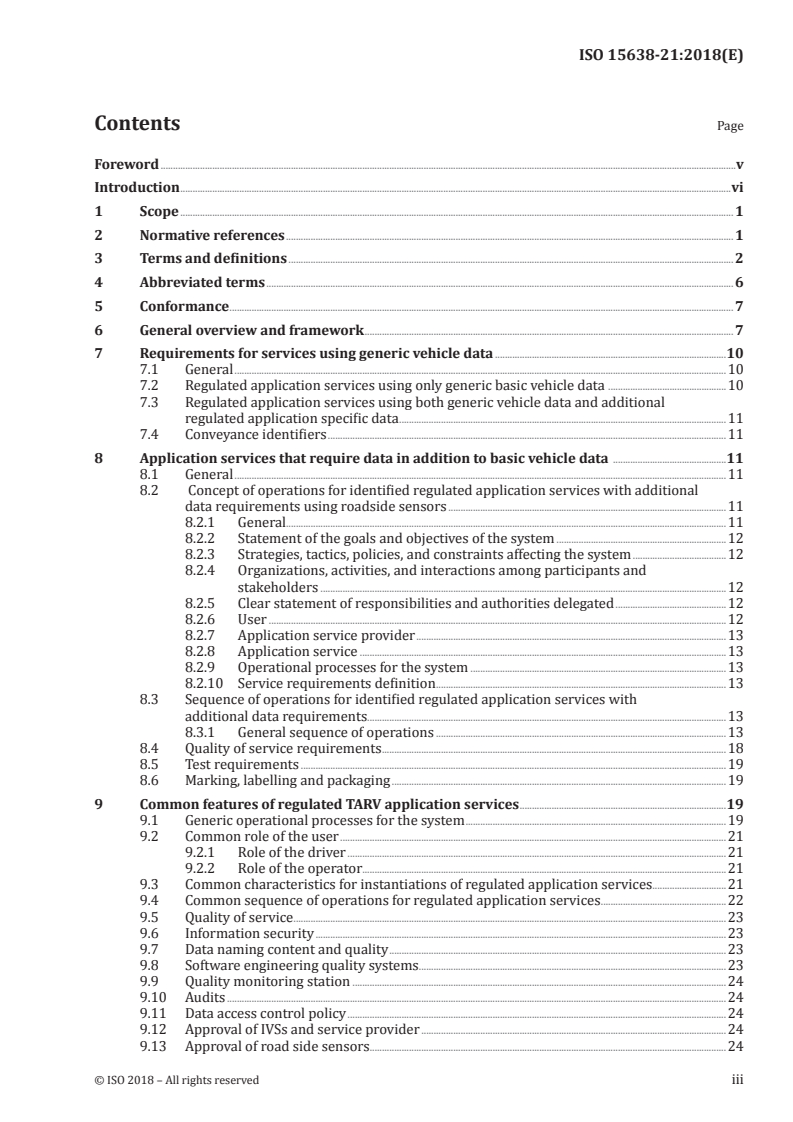
Contents Page
Foreword .v
Introduction .vi
1 Scope . 1
2 Normative references . 1
3 Terms and definitions . 2
4 Abbreviated terms . 6
5 Conformance . 7
6 General overview and framework . 7
7 Requirements for services using generic vehicle data .10
7.1 General .10
7.2 Regulated application services using only generic basic vehicle data .10
7.3 Regulated application services using both generic vehicle data and additional
regulated application specific data .11
7.4 Conveyance identifiers .11
8 Application services that require data in addition to basic vehicle data .11
8.1 General .11
8.2 Concept of operations for identified regulated application services with additional
data requirements using roadside sensors .11
8.2.1 General.11
8.2.2 Statement of the goals and objectives of the system .12
8.2.3 Strategies, tactics, policies, and constraints affecting the system .12
8.2.4 Organizations, activities, and interactions among participants and
stakeholders .12
8.2.5 Clear statement of responsibilities and authorities delegated .12
8.2.6 User .12
8.2.7 Application service provider .13
8.2.8 Application service .13
8.2.9 Operational processes for the system .13
8.2.10 Service requirements definition .13
8.3 Sequence of operations for identified regulated application services with
additional data requirements.13
8.3.1 General sequence of operations .13
8.4 Quality of service requirements .18
8.5 Test requirements .19
8.6 Marking, labelling and packaging .19
9 Common features of regulated TARV application services .19
9.1 Generic operational processes for the system .19
9.2 Common role of the user .21
9.2.1 Role of the driver .21
9.2.2 Role of the operator.21
9.3 Common characteristics for instantiations of regulated application services .21
9.4 Common sequence of operations for regulated application services .22
9.5 Quality of service .23
9.6 Information security .23
9.7 Data naming content and quality .23
9.8 Software engineering quality systems .23
9.9 Quality monitoring station .24
9.10 Audits .24
9.11 Data access control policy .24
9.12 Approval of IVSs and service provider .24
9.13 Approval of road side sensors.24
Annex A (informative) Application examples .25
Annex B (informative) Roadside sensors .30
Bibliography .32
iv © ISO 2018 – All rights reserved
Foreword
ISO (the International Organization for Standardization) is a worldwide federation of national standards
bodies (ISO member bodies). The work of preparing International Standards is normally carried out
through ISO technical committees. Each member body interested in a subject for which a technical
committee has been established has the right to be represented on that committee. International
organizations, governmental and non-governmental, in liaison with ISO, also take part in the work.
ISO collaborates closely with the International Electrotechnical Commission (IEC) on all matters of
electrotechnical standardization.
The procedures used to develop this document and those intended for its further maintenance are
described in the ISO/IEC Directives, Part 1. In particular the different approval criteria needed for the
different types of ISO documents should be noted. This document was drafted in accordance with the
editorial rules of the ISO/IEC Directives, Part 2 (see www .iso .org/directives).
Attention is drawn to the possibility that some of the elements of this document may be the subject of
patent rights. ISO shall not be held responsible for identifying any or all such patent rights. Details of
any patent rights identified during the development of the document will be in the Introduction and/or
on the ISO list of patent declarations received (see www .iso .org/patents).
Any trade name used in this document is information given for the convenience of users and does not
constitute an endorsement.
For an explanation on the voluntary nature of standards, the meaning of ISO specific terms and
expressions related to conformity assessment, as well as information about ISO's adherence to the
World Trade Organization (WTO) principles in the Technical Barriers to Trade (TBT) see the following
URL: www .iso .org/iso/foreword .html.
This document was prepared by Technical Committee ISO/TC 204, Intelligence transport systems.
A list of all parts in the ISO 15638 series can be found on the ISO website.
Introduction
The ISO 15638 seriesTARV application standards are based on a triumvirate of vehicle operators with
in-vehicle systems, on-board application service providers (3.39) and jurisdictions (3.28). The basic
TARV standards focus on the transactions between these parties via ITS-stations (3.25), and do not
have measures to detect/avoid tampering/incorrect setting of on-board equipment, and are limited to
using data collected from the vehicle for purposes such as control, management and enforcement. In
many countries road side sensors (3.37) are already widely used for jurisdiction enforcement and other
enhancement purposes. These road side sensors can be used in combination with the TARV framework
(3.21) to enhance functionality by eliminating/reducing problems of incorrect setting/tampering etc.
and/or complementing/corroborating data obtained from on-board systems. This provides increased
capability for jurisdictions and other entities to use existing parts of the ISO 15638 series of standards
(which are focussed only on the transaction of data collected from on-board systems), thus potentially
providing validation of, or removing weakness in, the accuracy of the data transmitted from the vehicle
to an application service provider (3.39), or to provide new management and control measures for
regulated commercial freight vehicles. In some cases, new means of management and enforcement may
be enabled by using this document.
It, therefore, seems appropriate to include this part of ISO 15638 to the 15638 series of standards to
provide the means to use roadside/in-road sensors to validate the accuracy of on-board equipment,
and/or complement the data available to application service providers (3.39) and jurisdictions and
other entities.
1)
NOTE ISO 15638-9 already covers provisions consistent with EC165/2014. This document is
complementary to and not competitive to ISO 15638-9, and therefore consistent with EC 165/2014.
1) To be published. Stage at publication: ISO/DIS 15638-9.
vi © ISO 2018 – All rights reserved
INTERNATIONAL STANDARD ISO 15638-21:2018(E)
Intelligent transport systems — Framework for
cooperative telematics applications for regulated
commercial freight vehicles (TARV) —
Part 21:
Monitoring of regulated vehicles using roadside sensors
and data collected from the vehicle for enforcement and
other purposes
1 Scope
The ISO 15638 series of standards defines the framework (3.21) for online fleet management of
regulated commercial freight vehicles utilizing data communication between in-vehicle systems and an
application service provider (3.39) via on-board communication unit interfacing with road monitoring
infrastructure. This document defines an extension to the existing role model conceptual architecture
(3.7) by adding roadside sensors (3.37) to the model for additional data collection path for enhancement
of the system.
The objective of this document is to reinforce vehicle monitoring for enforcement and other management
purposes of regulated commercial freight vehicle movements. The scope of this document is to
a) Reinforce vehicle monitoring for enforcement and other purposes,
b) Provide additional data security by using roadside sensor data links,
c) Detect/avoid tampering/incorrect setting of onboard sensor equipment,
d) Provide means of using roadside sensors to validate the accuracy of on-board equipment, and
e) Enable the combined use of data obtained from the regulated commercial freight vehicle and
roadside/in-road sensors to monitor, manage and control the movement of regulated commercial
freight vehicles.
In this extended role model architecture (3.7), roadside sensor (including buried in-road sensors)
functionality is added to the existing TARV role model. In this extended role model, jurisdictions (3.28)
and other entities can reinforce monitoring or other management purpose applications by using a
combination of information from both in-vehicle systems and roadside/in-road sensors.
In this document, the framework (3.21) for this modified and improved reinforcement of vehicle
monitoring for enforcement and other management purpose applications is defined.
This document is complementary to, and does not replace, any other parts of the ISO 15638 series
of standards. This document is beneficial to jurisdiction enforcement and other vehicle monitoring
management purpose entities and it provides a means for using roadside sensors to validate the
accuracy of on-board equipment and provides additional use cases for TARV service applications.
2 Normative references
The following documents are referred to in the text in such a way that some or all of their content
constitutes requirements of this document. For dated references, only the edition cited applies. For
undated references, the latest edition of the referenced document (including any amendments) applies.
ISO 15638 (all parts), Intelligent transport systems — Framework (3.21) for cooperative telematics (3.43)
applications for regulated commercial freight vehicles (TARV)
ISO/TR 12859:2009, System architecture — Privacy aspects in ITS standards and systems
3 Terms and definitions
For the purposes of this document, the following terms and definitions apply.
ISO and IEC maintain terminological databases for use in standardization at the following addresses:
— ISO Online browsing platform: available at https: //www .iso .org/obp
— IEC Electropedia: available at https: //www .electropedia .org
3.1
access methods
procedures and protocols to provision and retrieve data
3.2
app
small (usually) applets, organised as software bundles, that support application services (3.3) by
keeping the data pantry provisioned with up to date data
3.3
application service
service provided by a service provider (3.39) enabled by accessing data from the IVS (3.23) of a regulated
vehicle (3.35) via a wireless communications network
3.4
application service provider
ASP
party that provides an application service (3.3)
3.5
app library
separately secure area of memory in IVS (3.23) where apps are stored (with different access controls to
data pantry)
3.6
application service data file
ASD file
file held in the data pantry of the IVS (3.23) containing data specific to an application service (3.3)
3.7
architecture
formalised description of the design of the structure of TARV and its framework (3.21)
3.8
audit
auditing
review of a party’s capacity to meet, or continue to meet, the initial and ongoing certification agreements
as a service provider (3.39)
3.9
authentication
function intended to establish and verify a claimed identity
3.10
basic vehicle data
data that shall be maintained/provided by all IVS (3.23) (regardless of jurisdiction)
2 © ISO 2018 – All rights reserved
3.11
certification
formal affirmation that an applicant has satisfied all the requirements for appointment as an application
service provider (3.39)or that an application service (3.3) delivers the required service levels.
3.12
certification authority
organization which issues digital certificates for use by other parties (specifically in the
context of communications security)
3.13
certification authority
organisation (usually independent) which conducts certification (3.11) and ongoing audit
(3.8) for service providers (3.39) on behalf of a jurisdiction
3.14
commercial application(s)
ITS applications in regulated vehicles (3.35) for commercial (non-regulated) purposes
EXAMPLE Asset tracking, vehicle and engine monitoring, cargo security, driver management etc.
3.15
consignment
shipment of goods/cargo to a destination
3.16
conveyance
vehicle or trailer used to transport from one place to another
3.17
cooperative ITS
C-ITS
ITS applications for both regulatory and commercial purposes that require the exchange of data
between uncontracted parties using multiple ITS-stations (3.25) communicating with each other and
sharing data with other parties with whom they have no direct contractual relationship to provide one
or more ITS services (3.24)
3.18
data pantry
secure area of memory in IVS (3.23) where data values are stored [with different access controls to app
library (3.5)]
3.19
driver
person driving the regulated vehicle (3.35) at any specific point in time
3.20
facilities
layer that sits on top of the communication stack and helps to provide data interoperability and reuse,
and to manage applications and enable dynamic real time loading of new applications
3.21
framework
particular set of beliefs and ideas referred to in order to describe a scenario or solve a problem
3.22
global navigation satellite system
GNSS
system that comprises several networks of satellites that transmit radio signals containing time and
distance data that can be picked up by a receiver, allowing the user (3.45) to identify the location of its
receiver anywhere around the globe
3.23
in-vehicle system
IVS
ITS-station (3.25) and connected equipment on board a vehicle
3.24
ITS service
communication functionality offered by an ITS-station (3.25) to an ITS-station (3.25) application
3.25
ITS-station
ITS-s
entity in a communication network, comprised of application, facilities (3.20), networking and access
layer components specified in ISO 21217 that operate within a bounded secure management domain
3.26
IVS installer
actor who installs IVS (3.23) on behalf of the vehicle manufacturer or the initial prime service
provider (3.32)
3.27
IVS maintainer
actor who maintains IVS (3.23) on behalf of the prime service provider (3.32)
3.28
jurisdiction
government, road or traffic authority which owns the regulatory applications (3.33)
EXAMPLE Country, state, city council, road authority, government department (customs, treasury,
transport), etc.
3.29
jurisdiction regulator
regulator
agent of the jurisdiction (3.28) appointed to regulate and manage TARV within the domain of the
jurisdiction (3.28); may or may not be the certification authority (regulatory) (3.13)
3.30
local data tree
LDT
frequently updated data concept stored in the on-board data pantry containing a collection of data
values deemed essential for either a) TARV regulated application service (3.34), or b) cooperative
intelligent transport systems
3.31
operator
fleet manager of a regulated vehicle (3.35)
3.32
prime service provider
service provider (3.39) who is the first contractor to provide regulated application (3.33) services (3.3) to
the regulated vehicle (3.35), or a nominated successor on termination of that initial contract
Note 1 to entry: The prime service provider (3.32) is also responsible to maintain the installed IVS (3.23), if the
IVS (3.23) was not installed during the manufacture of the vehicle the prime service provider is also responsible
to install and commission the IVS (3.23)
4 © ISO 2018 – All rights reserved
3.33
regulated application
regulatory application
application arrangement using TARV utilised by jurisdictions (3.28) for granting certain categories of
commercial vehicles rights to operate in regulated circumstances subject to certain conditions, or to
permit a vehicle to operate within the jurisdiction (3.28)
Note 1 to entry: It may be mandatory or voluntary at the discretion of the jurisdiction (3.28).
3.34
regulated application service
TARV application service (3.3) that meets the requirements of a regulated application (3.33) that is
mandated by a regulation imposed by a jurisdiction (3.28), or is an option supported by a jurisdiction (3.28)
3.35
regulated vehicle
vehicle that is subject to regulations determined by the jurisdiction (3.28) as to its use on the road
system of the jurisdiction in regulated circumstances, subject to certain conditions, and in compliance
with specific regulations for that class of regulated vehicle
3.36
regime for open application management
ROAM
facilities layer for TARV, within the ISO 15638 series of standards, providing an open access, yet secure
runtime environment for TARV and other applications, including cooperative vehicle applications, on
top of the CALM communications environment
3.37
roadside sensor
device installed at or near the roadside or above the road or embedded into the road that either:
a) collects data concerning the vehicle (e.g. licence plate, vehicle speed, vehicle emission data, etc.)
and passes that data to the vehicle IVS (3.23),
b) provides other dynamic data to the vehicle IVS (3.23) (e.g. temporary or permanent speed limits or
other restrictions or informative data), and
c) Requests the IVS (3.23) to take some action as a result of sensed information
for use in support or execution of a TARV application
3.38
sensor
device that receives a signal or stimulus and responds to it
3.39
service provider
party which is certified by a certification authority (regulatory) (3.13) as suitable to provide regulated
or commercial ITS application services (3.3)
3.40
session
wireless communication exchange between the ITS-station (3.25) of an IVS (3.23) and the ITS-station
(3.25) of its application service provider (3.39) to achieve data update, data provision, upload apps
(3.2), or otherwise manage the provision of the application service (3.3), or a wireless communication
provision of data to the ITS-station (3.25) of an IVS (3.23) from any other ITS-station (3.25)
3.41
specification
explicit and detailed description of the nature and functional requirements and minimum performance
of equipment, service or a combination of both
3.42
tampering action
action conducted towards IVS (3.23) or a service provider’s system which is intended to prevent the IVS
(3.23) or the service provider’s (3.39) system from functioning correctly
3.43
telematics
use of wireless media to obtain and transmit (data) from a distant source
3.44
Unified Modeling Language
UML
graphical language for visualizing, specifying, constructing, and documenting the artifacts of a
software-intensive system which offers a standard way to write a system's blueprints, including
conceptual things such as business processes and system functions as well as concrete things such as
programming language statements, database schemas, and reusable software components
Note 1 to entry: UML is standardised as ISO/IEC 19501 [Unified Modeling Language (UML)].
3.45
user
individual or party that enrols in and operates within a regulated or commercial application (3.14)
service (3.3)
EXAMPLE Driver (3.19), transport operator (3.31), freight owner, etc.
4 Abbreviated terms
TM
app applet (JAVA application or similar)
ASD file application service data file (3.6)
ASP application service provider (3.39)
CALM communications access for land mobiles
C-ITS cooperative intelligent transport system
CONOPS concept of operations
DSRC dedicated short range communication
GNSS global navigation satellite system (3.22)
HGV heavy goods vehicle
HV heavy vehicle
Hz Hertz
ID identity
ITS-S ITS station (3.25)
IVS In-vehicle system (3.23)
LDM local dynamic map
LDT local data tree (3.30)
6 © ISO 2018 – All rights reserved
RAS regulated application (3.33) service (3.3)
RHV regulated heavy vehicle
ROAM regime for open application management (3.36)
RTM remote tachograph monitoring
SPaT-MAP Signal Phase and Timing — Intersection geometry
TARV telematics (3.43) applications for regulated vehicles (3.35)
UML Unified Modeling Language (ISO/IEC 19501)
VMS variable message sign (ISO 14823)
WIM weigh in motion
5 Conformance
Requirements to demonstrate conformance to any of the general provisions or specific application
services (3.3) described in this document shall be within the regulations imposed by the jurisdiction
(3.28) where they are instantiated. Conformance requirements to meet the provisions of this document
are therefore deemed to be under the control of, and to the specification (3.41) of, the jurisdiction where
the application service(s) (3.3) is/are instantiated.
6 General overview and framework
This document provides a framework (3.21) and architecture (3.7) for “extended TARV” which extends
the capabilities of TARV to include interaction with/data collection from roadside sensors (3.37). It
provides a general description of the roles of the actors in extended TARV and their relationships.
ISO 15638-1 and ISO 15638-6 shall be consulted to understand clearly the extended TARV framework
(3.21), architecture (3.7) and detailed specification (3.41) of the roles of the actors involved.
In summary, Figure 1 shows the extended role model conceptual architecture (3.7) showing the key
actors and their relationships.
Figure 1 — Extended Role model conceptual architecture (3.7)
The ISO 15638 series of standards provides a suite of standards deliverables addresses and defines
the framework (3.21) for a range of cooperative telematics (3.43) applications for regulated vehicles
(3.35) [such as electronic tachograph monitoring, Driver (3.19) work records, emergency messaging/
eCall,mass monitoring, 'Mass' information for jurisdictional control and enforcement, speed
monitoring, access control, access methods (3.1), location monitoring, weigh in motion, etc.]. The overall
scope includes the concept of operation, legal and regulatory issues, and the generic cooperative ITS
service (3.24) platform. The framework (3.21) is based on a (multiple) service provider (3.39) oriented
approach including provisions for the certification (3.11) and auditing (3.8) of service providers. This
document is an extension to ISO 15638-1 to ISO 15638-7 which provide a standardised approach for
telematics (3.43) aspects for regulated vehicles (3.35):
— ISO 15638-1, TARV — Framework and architecture;
— ISO 15638-2, TARV — Common platform parameters using CALM;
— ISO 15638-3, TARV — Operating requirements, certification procedures, and enforcement provisions
for the providers of regulated services,
— ISO 15638-4, TARV — System security requirements,
8 © ISO 2018 – All rights reserved
— ISO 15638-5, TARV — Generic vehicle information,
— ISO 15638-6, TARV — Regulated applications, and
— ISO 15638-7, TARV — Other applications.
This document provides basic requirement use cases for the roadside sensor (3.37) added version of
the generic telematics (3.43) and data requirements for candidate regulated applications (3.33) for
TARV, and defines the generic modus of operations.
A regulated application (3.33) service (3.3) shall be a TARV application service (3.3) that is mandated
by a regulation imposed by a jurisdiction (3.28) (government, road or traffic authority) which owns
the regulatory applications (3.33) in which case all vehicles of a class defined by the jurisdiction shall
support and provide this service, or is an option supported by a jurisdiction, in which case it provides
a voluntary electronic means of satisfying a requirement of a jurisdiction. The regulated application
service (3.34) can be deployed for other vehicle monitoring services provided by the service provider
(3.39). In such case, the expression of jurisdictions shall be read as part of the service provider.
The roadside sensors (3.37) are usually a property of jurisdictions. The data collected at roadside
sensors (3.38) may be available to the service provider. It may sometimes be provided through the
roadside sensor owner so that the service provider can provide reinforcement role for jurisdiction
enforcement by using the roadside sensor data. It can detect/avoid tampering/incorrectly setting of on-
board equipment. It can provide means of using roadside sensors to validate the accuracy of on-board
equipment. Jurisdictions can use the combination of data obtained from the regulated commercial
freight vehicle and roadside/in-road sensors. It provides management /enforcement and control of
regulated commercial freight vehicles for jurisdictions.
The roadside sensors are typically assumed to collect vehicle location data (present and accumulated),
vehicle ID (privacy information such as VIN/license plate), vehicle history (privacy information such as
time/location/type of road/motion sensor data/), vehicle on board unit holding data (engine running
data, digital tachograph recoreded data, on board weigh in motion data and etc.), vehicle engine
emission data and etc. By enrolling the enforcement by Jurisdiction, the user (3.45) is assumed to have
agreed with the reuse of user's (3.45) privacy information. ISO/TR 12859:2009 [System architecture
(3.7) — Privacy aspects in ITS standards and systems] shall be applied to secure privacy management
of the data collected from vehicles and roadside sensors.
The jurisdiction may use this link through roadside sensors to vehicles to pass data from the roadside
to the vehicle on board unit. The possible examples of notification of warning are temporary speed
restrictions, diversion advice for HGVs, reminder to take some action etc., even import VMS data into
the vehicle.
A regulated application (3.33) service (3.3) is provided by a service provider, also called an application
service provider (ASP)(3.4) who is a party which is certified by a certification authority (regulatory)
(3.13) as suitable to provide certified regulated or commercial ITS application services (3.3).
NOTE A certification authority (regulatory) (3.13) is an agency of or function within a jurisdiction regulator
(3.29) who certifies that the requirements and level of service of the jurisdiction have been met, and should not be
confused with a certification authority (digital) (3.12) which is an organization which issues digital certificates
for use by other parties (specifically in the context of communications security).
The service provider provides the application service (3.3) to/for a user (3.45) who is an individual
or party that enrols in and operates within a regulated application (3.33) service (3.3) or commercial
application (3.14) service (3.3) in order to meet specific aspects of the requirements of a jurisdiction for
the operation of the regulated vehicle (3.35) within that jurisdiction.
Examples of users (3.45) are a transport operator (3.31), driver (3.19), freight owner, etc. Most
commonly the user (3.45) is the transport operator (3.31).
Road side sensors are added to the basic TARV architecture (3.7) to enhance monitoring for
enforcement and other purpose management for the regulated application (3.33) services (3.3). These
roadside sensors provide jurisdictions and service providers a means for enhancing enforcement and/
or management by using/comparing roadside sensed vehicle data with data sensed by vehicle on board
unit. Roadside sensor sensed vehicle data can also include vehicle licence plate data, VIN data, vehicle
sensed WIM data, engine status data, emission gas data and on-board unit containg data such as of
digital tachograph, vehicle laden mass measuring device, and these data can be used for additional
regulated application (3.33) enforcement and other purpose application services (3.3).
For basic TARV information, refer to ISO 15638-1.
For reasons of efficiency, interoperability, ability to operate within multiple jurisdictions (3.28), ability
to deploy rapidly, and maintenance, the jurisdiction may elect to use one of the regulated application
(3.33) services (3.3) defined in this document to meet defined communications and data aspects of its
requirement(s).
Regulated application (3.33) services (3.3) require clear definition in terms of the requirements made
on the service provider (3.39).
The responsibility to make such requirements clearly defined and make such requirements available to
the application service providers (3.39) shall rest with the jurisdiction.
The service definition for each application service (3.3) supported by ISO 15638-6 comprises
— A clear description of the generic high level service provided and its inputs, outputs and results,
including a given service level,
— Generic data, naming content and quality that an IVS (3.23) has to deliver,
— Specific data, naming content and quality for the provision of that particular service,
— Generic service elements definition,
— Access methods (3.1) to provision and retrieve data,
— Provisions for quality of service,
— Provisions for test requirements, and
— Provisions for (but not the detailed requirements and arrangements for) the certification (3.11) of
IVSs (3.23) and service providers (3.39).
This document defines the basic requirements for application service (3.3) enhancements using
roadside sensors (3.37).
7 Requirements for services using generic vehicle data
7.1 General
Even though the roadside sensors (3.37) are added, this is in supplement to and makes no modification
to ISO 15638-6.
The means by which the access commands for generic vehicle information specified in ISO 15638-5 can
be used to provide all or part of the data required in order to support a regulated application (3.33)
service (3.3) shall be as defined in ISO 15638-6.
This Clause provides a means by which the access commands for generic vehicle information specified
in ISO 15638-5 can be used to provide all or part of the data required in order to support a regulated
application (3.33) service (3.3), and defines general requirements to assure data interoperability.
7.2 Regulated application services using only generic basic vehicle data
Where all of the required data can be obtained via the access commands for generic basic vehicle
data (3.10) specified in ISO 15638-5, the access methods (3.1) defined in ISO 15638-5 shall be used
10 © ISO 2018 – All rights reserved
consistently to obtain the values for the TARV LDT (and C-ITS LDT data concepts where required).
No further international standardization is required, and jurisdictions (3.28), subject to the privacy
regulations pertaining within the jurisdiction, may develop, operate, and update their regulated, or
supported regulated voluntary services according to local design; International interoperability being
maintained through the provisions of ISO 15638-5 (TARV Generic vehicle information). All vehicles that
are equipped to support ISO 15638 shall be able to support such service provisions.
ISO 15638-5:2013, Clause 7 defines the following relevant commands:
— GET TARV LDT (local data tree) data (3.30);
— GET C-ITS (co-operative vehicle systems) LDT data.
See ISO 15638-5 for details of these commands.
7.3 Regulated application services using both generic vehicle data and additional
regulated application specific data
See ISO 15638-5:2013, Clause 8 for the generic sequence of operations for regulated application (3.33)
services (3.3) using both generic vehicle data and additional regulated application (3.33) specific data.
7.4 Conveyance identifiers
The regulated vehicle (3.35) conveyance type shall be identified in accordance with ISO 26683-2 ,
ISO 14816,/ ISO 17262 , ISO 24534-3.
8 Application services that require data in addition to basic vehicle data
8.1 General
7.2 above provides a means by which two of the access commands specified in ISO 15638-5 can be used
to provide all of the data required in order to support a regulated application (3.33) service (3.3).
It shall be conducted as defined in ISO 15638-6.
Subsequent versions/issues of this document may include additional regulated application (3.33)
services (3.3) where these have been subsequently identified and specified.
8.2 Concept of operations for identified regulated application services with additional
data requirements using roadside sensors
8.2.1 General
This Clause describes the characteristics of a proposed system from the viewpoint of a user (3.45)
who will employ that system. Its objective is to communicate the quantitative and qualitative system
characteristics to all stakeholders.
This Clause defines the general concept of operations for ‘standardised’ regulated application (3.33)
services (3.3) for TARVs that require data in addition to that available from the basic vehicle data (3.10),
and provides the generic modus operation for the provision of the application services (3.3) defined
in the subsequent Clauses of this document that relate to provisions for specific regulated application
(3.33) services (3.3).
A ‘concept of operations’ (CONOPS) generally evolves from a concept and is a description of how a set
of capabilities may be employed to achieve desired objectives. In ISO 15638, the CONOPS concerns
the standardisation of data concepts to be exchanged and the wireless means to exchange that data.
ISO 15638 does not specify the capabilities or form of any product/system offering on the market, or the
form of the instantiation of the application service (3.3). Those aspects are defined by the jurisdiction
(3.28) and the application service provider (3.39).
This document enables data from roadside sensors (3.37) to supplement data collected from within the
vehicle.
8.2.2 Statement of the goals and objectives of the system
The overall objective of TARV regulated application (3.33) services (3.3) with additional data
requirements shall be as defined in ISO 15638-1 to ISO 15638-6 with the addition of the collection of
data from roadside sensors (3.37).
TARV does not specify the application service (3.3) itself [enabling the differing requirements of
different jurisdictions (3.28) to be met within the Standard, and for different commercial offerings
to provide market differentiation], but specifies the key generic data concepts required to enable the
service provision and their transfer via a wireless communication to the application service provider
(3.39), and the provision of key data to the IVS (3.23) of the regulated vehicle (3.35) from the application
service provider (3.39) or another ITS-station (3.25), such as that of a jurisdiction.
It is an underlying assumption that the regulated vehicle (3.35) is equipped with the means to acquire
and provide the data (additional to the ‘basic vehicle data), required by the specific application service
(3.3). The generic requirements for additional data for the specified service is defined below for the
particular application service (3.3) , as is the functional source of the means of such data provision.
This document determines the nature of the data and how it is to be received/sent by the IVS (3.23), but
does not standardise the equipment used to obtain the data.
8.2.3 Strategies, tactics, policies, and constraints affecting the system
Strategies, tactics, policies and constraints, and, t
...
Error! Reference source not found.
ISO TC 204/SC
Date: 2018-03-01
ISO 15638-21
ISO TC 204/SC /WG 7
Secretariat: ANSI
Intelligent Transport Systems — Framework for collaborative telematics applications
for regulated commercial freight vehicles (TARV) — Part 21: Monitoring of regulated
vehicles using roadside sensors and data collected from the vehicle for enforcement and
other purposes
Systèmes intelligents de transport -- Cadre pour applications télématiques collaboratives pour
véhicules de fret commercial réglementé (TARV) -- Partie 21: Titre manqueSurveillance des
véhicules réglementés à l'aide de capteurs routiers et de données collectées dans les véhicules
pour l'application des lois et à d'autres fins
Document type: Error! Reference source not found.
Document subtype: Error! Reference source not found.
Document stage: FDIS
Document language: Error! Reference source not found.
Copyright notice
This ISO document is a Draft International Standard and is copyright-protected by ISO. Except as
permitted under the applicable laws of the user's country, neither this ISO draft nor any extract
from it may be reproduced, stored in a retrieval system or transmitted in any form or by any
means, electronic, photocopying, recording or otherwise, without prior written permission being
secured.
Requests for permission to reproduce should be addressed to either ISO at the address below or
ISO's member body in the country of the requester.
ISO copyright office
Case postale 56 • CH-1211 Geneva 20
Tel. + 41 22 749 01 11
Fax + 41 22 749 09 47
E-mail copyright@iso.org
Web www.iso.org
Reproduction may be subject to royalty payments or a licensing agreement.
Violators may be prosecuted.
ii Error! Reference source not found.
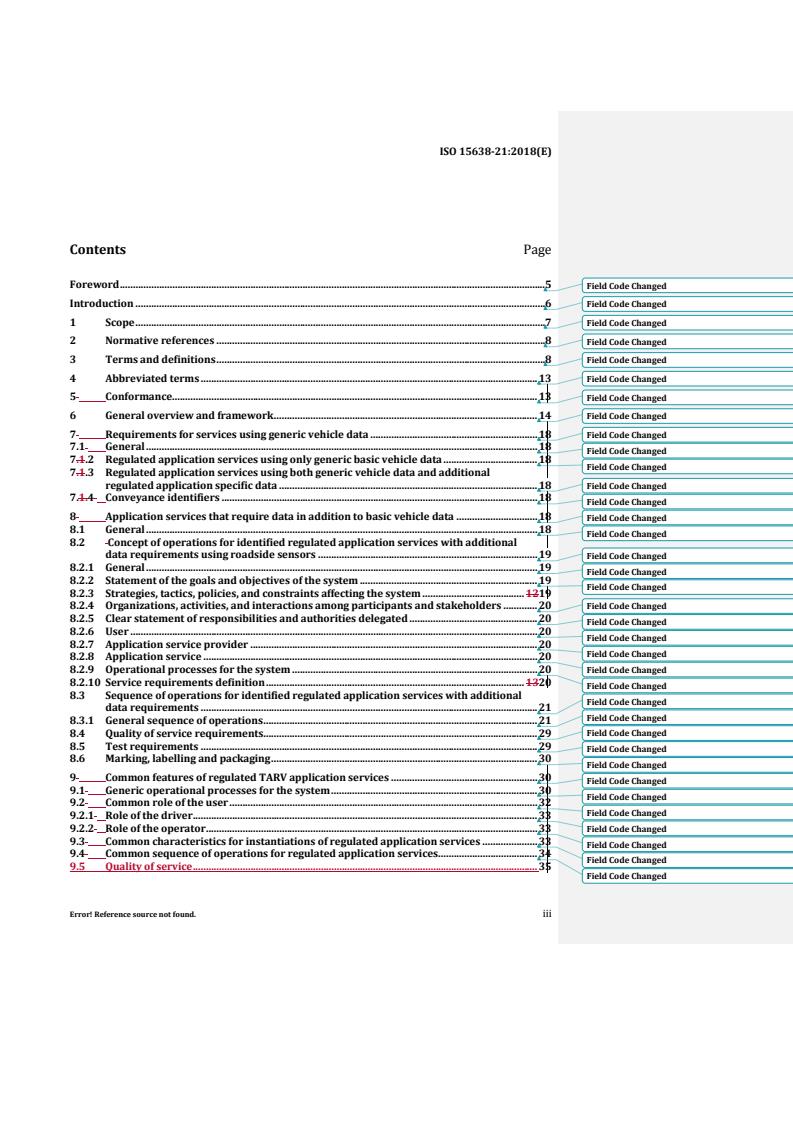
Contents Page
Foreword . 5 Field Code Changed
Introduction . 6 Field Code Changed
1 Scope . 7 Field Code Changed
2 Normative references . 8 Field Code Changed
3 Terms and definitions . 8 Field Code Changed
4 Abbreviated terms . 13 Field Code Changed
5 Conformance. 13 Field Code Changed
6 General overview and framework . 14 Field Code Changed
7 Requirements for services using generic vehicle data . 18 Field Code Changed
7.1 General . 18
Field Code Changed
7.1.2 Regulated application services using only generic basic vehicle data . 18
Field Code Changed
7.1.3 Regulated application services using both generic vehicle data and additional
regulated application specific data . 18
Field Code Changed
7.1.4 Conveyance identifiers . 18
Field Code Changed
8 Application services that require data in addition to basic vehicle data . 18 Field Code Changed
8.1 General . 18
Field Code Changed
8.2 Concept of operations for identified regulated application services with additional
data requirements using roadside sensors . 19 Field Code Changed
8.2.1 General . 19
Field Code Changed
8.2.2 Statement of the goals and objectives of the system . 19
Field Code Changed
8.2.3 Strategies, tactics, policies, and constraints affecting the system . 1219
8.2.4 Organizations, activities, and interactions among participants and stakeholders . 20 Field Code Changed
8.2.5 Clear statement of responsibilities and authorities delegated . 20
Field Code Changed
8.2.6 User . 20
Field Code Changed
8.2.7 Application service provider . 20
Field Code Changed
8.2.8 Application service . 20
8.2.9 Operational processes for the system . 20 Field Code Changed
8.2.10 Service requirements definition . 1320
Field Code Changed
8.3 Sequence of operations for identified regulated application services with additional
Field Code Changed
data requirements . 21
Field Code Changed
8.3.1 General sequence of operations . 21
8.4 Quality of service requirements. 29 Field Code Changed
8.5 Test requirements . 29
Field Code Changed
8.6 Marking, labelling and packaging . 30
Field Code Changed
9 Common features of regulated TARV application services . 30
Field Code Changed
9.1 Generic operational processes for the system . 30
Field Code Changed
9.2 Common role of the user . 32
Field Code Changed
9.2.1 Role of the driver . 33
9.2.2 Role of the operator . 33 Field Code Changed
9.3 Common characteristics for instantiations of regulated application services . 33
Field Code Changed
9.4 Common sequence of operations for regulated application services. 34
Field Code Changed
9.5 Quality of service . 35
Field Code Changed
Error! Reference source not found. iii
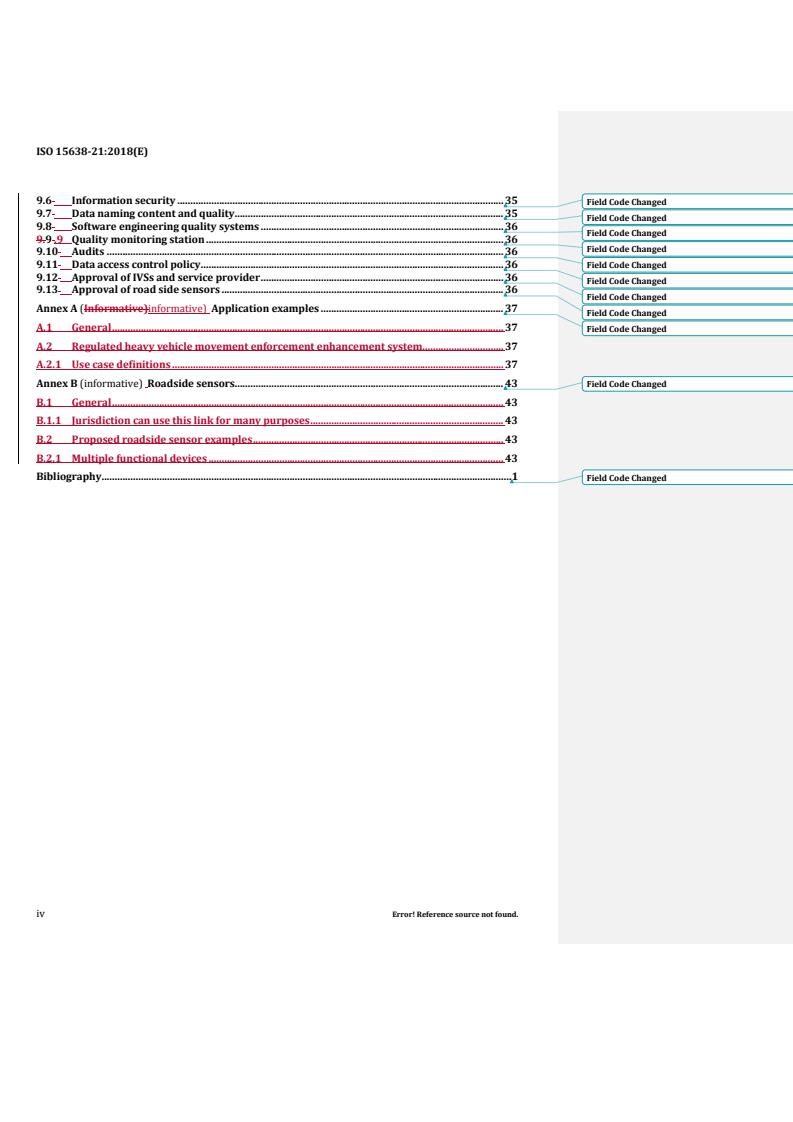
9.6 Information security . 35 Field Code Changed
9.7 Data naming content and quality . 35
Field Code Changed
9.8 Software engineering quality systems . 36
Field Code Changed
9.9 .9 Quality monitoring station . 36
Field Code Changed
9.10 Audits . 36
9.11 Data access control policy. 36 Field Code Changed
9.12 Approval of IVSs and service provider . 36
Field Code Changed
9.13 Approval of road side sensors . 36
Field Code Changed
Annex A (Informative)informative) Application examples . 37
Field Code Changed
A.1 General . 37 Field Code Changed
A.2 Regulated heavy vehicle movement enforcement enhancement system. 37
A.2.1 Use case definitions . 37
Annex B (informative) Roadside sensors. 43 Field Code Changed
B.1 General . 43
B.1.1 Jurisdiction can use this link for many purposes . 43
B.2 Proposed roadside sensor examples . 43
B.2.1 Multiple functional devices . 43
Bibliography . 1 Field Code Changed
iv Error! Reference source not found.
Foreword
ISO (the International Organization for Standardization) is a worldwide federation of national
standards bodies (ISO member bodies). The work of preparing International Standards is normally
carried out through ISO technical committees. Each member body interested in a subject for which a
technical committee has been established has the right to be represented on that committee.
International organizations, governmental and non-governmental, in liaison with ISO, also take part in
the work. ISO collaborates closely with the International Electrotechnical Commission (IEC) on all
matters of electrotechnical standardization.
The procedures used to develop this document and those intended for its further maintenance are
described in the ISO/IEC Directives, Part 1. In particular the different approval criteria needed for the
different types of ISO documents should be noted. This document was drafted in accordance with the
editorial rules of the ISO/IEC Directives, Part 2 (see www.iso.org/directiveswww.iso.org/directives).
Attention is drawn to the possibility that some of the elements of this document may be the subject of
patent rights. ISO shall not be held responsible for identifying any or all such patent rights. Details of
any patent rights identified during the development of the document will be in the Introduction and/or
on the ISO list of patent declarations received (see www.iso.org/patentswww.iso.org/patents).
Any trade name used in this document is information given for the convenience of users and does not
constitute an endorsement.
For an explanation on the voluntary nature of standards, the meaning of ISO specific terms and
expressions related to conformity assessment, as well as information about ISO's adherence to the
World Trade Organization (WTO) principles in the Technical Barriers to Trade (TBT) see the following
URL: www.iso.org/iso/foreword.html.
This document was prepared by Technical Committee ISO/TC 204, Intelligence transport systems.
A list of all parts in the ISO 15638 series can be found on the ISO website.
Error! Reference source not found. v
Introduction
The ISO 15638 seriesTARV application standards are based on a triumvirate of vehicle operators with
in-vehicle systems, on-board application service providers (3.39) and jurisdictions (3.28). The basic
TARV standards focus on the transactions between these parties via ITS-stations (3.25), and do not
have measures to detect/avoid tampering/incorrect setting of on-board equipment, and are limited to
using data collected from the vehicle for purposes such as control, management and enforcement. In
many countries road side sensors (3.37) are already widely used for jurisdiction enforcement and other
enhancement purposes. These road side sensors can be used in combination with the TARV
framework (3.21) to enhance functionality by eliminating/reducing problems of incorrect
setting/tampering etc. and/or complementing/corroborating data obtained from on-board systems.
This provides increased capability for jurisdictions and other entities to use existing parts of the
ISO 15638 series of standards (which are focussed only on the transaction of data collected from on-
board systems), thus potentially providing validation of, or removing weakness in, the accuracy of the
data transmitted from the vehicle to an application service provider (3.39), or to provide new
management and control measures for regulated commercial freight vehicles. In some cases, new
means of management and enforcement may be enabled by using this document.
It, therefore, seems appropriate to include this part of ISO 15638 to the 15638 series of standards to
provide the means to use roadside/in-road sensors to validate the accuracy of on-board equipment,
and/or complement the data available to application service providers (3.39) and jurisdictions and
other entities.
NOTE ISO 15638-9 already covers provisions consistent with EC165/2014. This document is
complementary to and not competitive to ISO 15638-9, and therefore consistent with EC 165/2014.
To be published. Stage at publication: XXXISO/DIS 15638-9.
vi Error! Reference source not found.
FINAL DRAFT INTERNATIONAL STANDARD ISO 15638-21:2018(E)
Intelligent Transport Systems — Framework for collaborative
telematics applications for regulated commercial freight vehicles
(TARV) — Part 21: Monitoring of regulated vehicles using
roadside sensors and data collecetd from the vehicle for
enforcement and other purposes
1 Scope
The ISO 15638 series of standards defines the framework (3.21) for online fleet management of
regulated commercial freight vehicles utilizing data communication between in-vehicle systems and an
application service provider (3.39) via on-board communication unit interfacing with road monitoring
infrastructure. This document defines an extension to the existing role model conceptual architecture
(3.7) by adding roadside sensors (3.37) to the model for additional data collection path for
enhancement of the system.
The objective of this document is to reinforce vehicle monitoring for enforcement and other
management purposes of regulated commercial freight vehicle movements. The scope of this document
is to
a) Reinforce vehicle monitoring for enforcement and other purposes,
b) Provide additional data security by using roadside sensor data links,
c) Detect/avoid tampering/incorrect setting of onboard sensor equipment,
d) Provide means of using roadside sensors to validate the accuracy of on-board equipment, and
e) Enable the combined use of data obtained from the regulated commercial freight vehicle and
roadside/in-road sensors to monitor, manage and control the movement of regulated commercial
freight vehicles.
In this extended role model architecture (3.7), roadside sensor (including buried in-road sensors)
functionality is added to the existing TARV role model. In this extended role model, jurisdictions (3.28)
and other entities can reinforce monitoring or other management purpose applications by using a
combination of information from both in-vehicle systems and roadside/in-road sensors.
In this document, the framework (3.21) for this modified and improved reinforcement of vehicle
monitoring for enforcement and other management purpose applications is defined.
This document is complementary to, and does not replace, any other parts of the ISO 15638 series of
standards. This document is beneficial to jurisdiction enforcement and other vehicle monitoring
management purpose entities and it provides a means for using roadside sensors to validate the
accuracy of on-board equipment and provides additional use cases for TARV service applications.
2 Normative references
The following documents are referred to in the text in such a way that some or all of their content
constitutes requirements of this document. For dated references, only the edition cited applies. For
undated references, the latest edition of the referenced document (including any amendments) applies.
ISO 15638 (all parts), Intelligent transport systems — Framework (3.21) for cooperative telematics (3.43)
applications for regulated commercial freight vehicles (TARV)
ISO/TR 12859:2009, System architecture — Privacy aspects in ITS standards and systems
3 Terms and definitions
For the purposes of this document, the following terms and definitions apply.
ISO and IEC maintain terminological databases for use in standardization at the following addresses:
— ISO Online browsing platform: available at https://www.iso.org/obp
— IEC Electropedia: available at https://www.electropedia.org
3.1
access methods
procedures and protocols to provision and retrieve data
3.2
app
small (usually) applets, organised as software bundles, that support application services (3.3) by
keeping the data pantry provisioned with up to date data
3.3
application service
service provided by a service provider (3.39) enabled by accessing data from the IVS (3.23) of a
regulated vehicle (3.35) via a wireless communications network
3.4
application service provider
ASP
party that provides an application service (3.3)
3.5
app library
separately secure area of memory in IVS (3.23) where apps are stored (with different access controls to
data pantry)
3.6
application service data file
ASD file
file held in the data pantry of the IVS (3.23) containing data specific to an application service (3.3)
3.7
architecture
formalised description of the design of the structure of TARV and its framework (3.21)
3.8
8 Error! Reference source not found.
audit
auditing
review of a party’s capacity to meet, or continue to meet, the initial and ongoing certification agreements
as a service provider (3.39)
3.9
authentication
function intended to establish and verify a claimed identity
3.10
basic vehicle data
data that shall be maintained/provided by all IVS (3.23) (regardless of jurisdiction)
3.11
certification
formal affirmation that an applicant has satisfied all the requirements for appointment as an application
service provider (3.39)or that an application service (3.3) delivers the required service levels.
3.12
certification authority
organization which issues digital certificates for use by other parties (specifically in the
context of communications security)
3.13
certification authority
organisation (usually independent) which conducts certification (3.11) and ongoing audit
(3.8) for service providers (3.39) on behalf of a jurisdiction
3.14
commercial application(s)
ITS applications in regulated vehicles (3.35) for commercial (non-regulated) purposes
EXAMPLE Asset tracking, vehicle and engine monitoring, cargo security, driver management etc.
3.15
consignment
shipment of goods/cargo to a destination
3.16
conveyance
vehicle or trailer used to transport from one place to another
3.17
cooperative ITS
C-ITS
ITS applications for both regulatory and commercial purposes that require the exchange of data
between uncontracted parties using multiple ITS-stations (3.25) communicating with each other and
sharing data with other parties with whom they have no direct contractual relationship to provide one
or more ITS services (3.24)
3.18
data pantry
secure area of memory in IVS (3.23) where data values are stored ([with different access controls to app
(3.2) library) (3.5)]
Error! Reference source not found. 9
3.19
driver
person driving the regulated vehicle (3.35) at any specific point in time
3.20
facilities
layer that sits on top of the communication stack and helps to provide data interoperability and reuse,
and to manage applications and enable dynamic real time loading of new applications
3.21
framework
particular set of beliefs and ideas referred to in order to describe a scenario or solve a problem
3.22
global navigation satellite system
GNSS
system that comprises several networks of satellites that transmit radio signals containing time and
distance data that can be picked up by a receiver, allowing the user (3.45) to identify the location of its
receiver anywhere around the globe
3.23
in-vehicle system
IVS
ITS-station (3.25) and connected equipment on board a vehicle
3.24
ITS service
communication functionality offered by an ITS-station (3.25) to an ITS-station (3.25) application
3.25
ITS-station
ITS-s
entity in a communication network, comprised of application, facilities (3.20), networking and access
layer components specified in ISO 21217 that operate within a bounded secure management domain
3.26
IVS installer
actor who installs IVS (3.23) on behalf of the vehicle manufacturer or the initial prime service provider
(3.32)
3.27
IVS maintainer
actor who maintains IVS (3.23) on behalf of the prime service provider (3.32)
3.28
jurisdiction
government, road or traffic authority which owns the regulatory applications (3.33)
EXAMPLE Country, state, city council, road authority, government department (customs, treasury,
transport), etc.
3.29
jurisdiction regulator
regulator
10 Error! Reference source not found.
agent of the jurisdiction (3.28) appointed to regulate and manage TARV within the domain of the
jurisdiction (3.28); may or may not be the certification authority (regulatory) (3.13)
3.30
local data tree
LDT
frequently updated data concept stored in the on-board data pantry containing a collection of data
values deemed essential for either a) TARV regulated application service (3.34), or b) cooperative
intelligent transport systems
3.31
operator
fleet manager of a regulated vehicle (3.35)
3.32
prime service provider
service provider (3.39) who is the first contractor to provide regulated application (3.33) services (3.3)
to the regulated vehicle (3.35), or a nominated successor on termination of that initial contract
Note 1 to entry: The prime service provider (3.32) is also responsible to maintain the installed IVS (3.23), if the IVS
(3.23) was not installed during the manufacture of the vehicle the prime service provider is also responsible to
install and commission the IVS (3.23)
3.33
regulated application
regulatory application
application arrangement using TARV utilised by jurisdictions (3.28) for granting certain categories of
commercial vehicles rights to operate in regulated circumstances subject to certain conditions, or to
permit a vehicle to operate within the jurisdiction (3.28)
Note 1 to entry: It may be mandatory or voluntary at the discretion of the jurisdiction (3.28).
3.34
regulated application service
TARV application service (3.3) that meets the requirements of a regulated application (3.33) that is
mandated by a regulation imposed by a jurisdiction (3.28), or is an option supported by a jurisdiction
(3.28)
3.35
regulated vehicle
vehicle that is subject to regulations determined by the jurisdiction (3.28) as to its use on the road
system of the jurisdiction in regulated circumstances, subject to certain conditions, and in compliance
with specific regulations for that class of regulated vehicle
3.36
regime for open application management
ROAM
facilities layer for TARV, within the ISO 15638 series of standards, providing an open access, yet secure
runtime environment for TARV and other applications, including cooperative vehicle applications, on
top of the CALM communications environment
3.37
roadside sensor
device installed at or near the roadside or above the road or embedded into the road that either:
Error! Reference source not found. 11
a) collects data concerning the vehicle (e.g. licence plate, vehicle speed, vehicle emission data, etc.)
and passes that data to the vehicle IVS (3.23),
b) provides other dynamic data to the vehicle IVS (3.23) (e.g. temporary or permanent speed limits or
other restrictions or informative data), and
c) Requests the IVS (3.23) to take some action as a result of sensed information
for use in support or execution of a TARV application
3.38
sensor
device that receives a signal or stimulus and responds to it
3.39
service provider
party which is certified by a certification authority (regulatory) (3.13) as suitable to provide regulated
or commercial ITS application services (3.3)
3.40
session
wireless communication exchange between the ITS-station (3.25) of an IVS (3.23) and the ITS-station
(3.25) of its application service provider (3.39) to achieve data update, data provision, upload apps (3.2),
or otherwise manage the provision of the application service (3.3), or a wireless communication
provision of data to the ITS-station (3.25) of an IVS (3.23) from any other ITS-station (3.25)
3.41
specification
explicit and detailed description of the nature and functional requirements and minimum performance
of equipment, service or a combination of both
3.42
tampering action
action conducted towards IVS (3.23) or a service provider’s system which is intended to prevent the IVS
(3.23) or the service provider’s (3.39) system from functioning correctly
3.43
telematics
use of wireless media to obtain and transmit (data) from a distant source
3.44
Unified Modeling Language
UML
graphical language for visualizing, specifying, constructing, and documenting the artifacts of a software-
intensive system which offers a standard way to write a system's blueprints, including conceptual
things such as business processes and system functions as well as concrete things such as programming
language statements, database schemas, and reusable software components
Note 1 to entry: UML is standardised as ISO/IEC 19501 ([Unified Modeling Language (UML)).)].
3.45
user
individual or party that enrols in and operates within a regulated or commercial application (3.14)
service (3.3)
12 Error! Reference source not found.
EXAMPLE Driver (3.19), transport operator (3.31), freight owner, etc.
4 Abbreviated terms
TM
app applet (JAVA application or similar)
ASD file application service data file (3.6)
ASP application service provider (3.39)
CALM communications access for land mobiles
C-ITS cooperative intelligent transport system
CONOPS concept of operations
DSRC dedicated short range communication
GNSS global navigation satellite system (3.22)
HGV heavy goods vehicle
HV heavy vehicle
Hz Hertz
ID identity
ITS-S ITS station (3.25)
IVS In-vehicle system (3.23)
LDM local dynamic map
LDT local data tree (3.30)
RAS regulated application (3.33) service (3.3)
RHV regulated heavy vehicle
ROAM regime for open application management (3.36)
RTM remote tachograph monitoring
SPaT-MAP Signal Phase and Timing — Intersection geometry
TARV telematics (3.43) applications for regulated vehicles (3.35)
UML Unified Modeling Language (ISO/IEC 19501)
VMS variable message sign (ISO 14823)
WIM weigh in motion
5 Conformance
Requirements to demonstrate conformance to any of the general provisions or specific application
services (3.3) described in this document shall be within the regulations imposed by the jurisdiction
(3.28) where they are instantiated. Conformance requirements to meet the provisions of this document
are therefore deemed to be under the control of, and to the specification (3.41) of, the jurisdiction
where the application service(s) (3.3) is/are instantiated.
Error! Reference source not found. 13
6 General overview and framework
This document provides a framework (3.21) and architecture (3.7) for “extended TARV” which extends
the capabilities of TARV to include interaction with/data collection from roadside sensors (3.37). It
provides a general description of the roles of the actors in extended TARV and their relationships.
ISO 15638-1 and ISO 15638-6 shall be consulted to understand clearly the extended TARV framework
(3.21), architecture (3.7) and detailed specification (3.41) of the roles of the actors involved.
In summary, Figure 1 shows the extended role model conceptual architecture (3.7) showing the key
actors and their relationships.
14 Error! Reference source not found.
Figure 1 — Extended Role model conceptual architecture (3.7)
The ISO 15638 series of standards provides a suite of standards deliverables addresses and defines the
framework (3.21) for a range of cooperative telematics (3.43) applications for regulated vehicles (3.35)
([such as electronic tachograph monitoring, Driver (3.19) work records, emergency
messaging/eCall,mass monitoring, 'Mass' information for jurisdictional control and enforcement, speed
monitoring, access control, access methods (3.1), location monitoring, weigh in motion, etc.).]. The
overall scope includes the concept of operation, legal and regulatory issues, and the generic cooperative
ITS service (3.24) platform. The framework (3.21) is based on a (multiple) service provider (3.39)
oriented approach including provisions for the certification (3.11) and auditing (3.8) of service
providers. This document is an extension to ISO 15638-1 to ISO 15638-7 which provide a standardised
approach for telematics (3.43) aspects for regulated vehicles (3.35):
— ISO 15638-1, TARV — Framework and architecture;
— ISO 15638-2, TARV — Common platform parameters using CALM;
— ISO 15638-3, TARV — Operating requirements, certification procedures, and enforcement provisions
for the providers of regulated services,
Error! Reference source not found. 15
— ISO 15638-4, TARV — System security requirements,
— ISO 15638-5, TARV — Generic vehicle information,
— ISO 15638-6, TARV — Regulated applications, and
— ISO 15638-7, TARV — Other applications.
This document provides basic requirement use cases for the roadside sensor (3.37) added version of
the generic telematics (3.43) and data requirements for candidate regulated applications (3.33) for
TARV, and defines the generic modus of operations.
A regulated application (3.33) service (3.3) shall be a TARV application service (3.3) that is mandated
by a regulation imposed by a jurisdiction (3.28) (government, road or traffic authority) which owns the
regulatory applications (3.33) in which case all vehicles of a class defined by the jurisdiction shall
support and provide this service, or is an option supported by a jurisdiction, in which case it provides a
voluntary electronic means of satisfying a requirement of a jurisdiction. The regulated application
service (3.34) can be deployed for other vehicle monitoring services provided by the service
provider (3.39). In such case, the expression of jurisdictions shall be read as part of the service
provider.
The roadside sensors (3.37) are usually a property of jurisdictions. The data collected at roadside
sensors (3.38) may be available to the service provider. It may sometimes be provided through the
roadside sensor owner so that the service provider can provide reinforcement role for jurisdiction
enforcement by using the roadside sensor data. It can detect/avoid tampering/incorrectly setting of on-
board equipment. It can provide means of using roadside sensors to validate the accuracy of on-board
equipment. Jurisdictions can use the combination of data obtained from the regulated commercial
freight vehicle and roadside/in-road sensors. It provides management /enforcement and control of
regulated commercial freight vehicles for jurisdictions.
The roadside sensors are typically assumed to collect vehicle location data (present and accumulated),
vehicle ID (privacy information such as VIN/license plate), vehicle history (privacy information such as
time/location/type of road/motion sensor data/), vehicle on board unit holding data (engine running
data, digital tachograph recoreded data, on board weigh in motion data and etc.), vehicle engine
emission data and etc. By enrolling the enforcement by Jurisdiction, the user (3.45) is assumed to have
agreed with the reuse of user's (3.45) privacy information. ISO/TR 12859:2009 ([System
architecture (3.7) — Privacy aspects in ITS standards and systems)] shall be applied to secure privacy
management of the data collected from vehicles and roadside sensors.
The jurisdiction may use this link through roadside sensors to vehicles to pass data from the roadside to
the vehicle on board unit. The possible examples of notification of warning are temporary speed
restrictions, diversion advice for HGVs, reminder to take some action etc., even import VMS data into
the vehicle.
A regulated application (3.33) service (3.3) is provided by a service provider, also called an application
service provider (ASP)(3.4) who is a party which is certified by a certification authority
(regulatory) (3.13) as suitable to provide certified regulated or commercial ITS application services
(3.3).
NOTE A certification authority (regulatory) (3.13) is an agency of or function within a jurisdiction
regulator (3.29) who certifies that the requirements and level of service of the jurisdiction have been met, and
should not be confused with a certification authority (digital) (3.12) which is an organization which issues digital
certificates for use by other parties (specifically in the context of communications security).
The service provider provides the application service (3.3) to/for a user (3.45) who is an individual or
party that enrols in and operates within a regulated application (3.33) service (3.3) or commercial
16 Error! Reference source not found.
application (3.14) service (3.3) in order to meet specific aspects of the requirements of a jurisdiction for
the operation of the regulated vehicle (3.35) within that jurisdiction.
Examples of users (3.45) are a transport operator (3.31), driver (3.19), freight owner, etc. Most
commonly the user (3.45) is the transport operator (3.31).
Road side sensors are added to the basic TARV architecture (3.7) to enhance monitoring for
enforcement and other purpose management for the regulated application (3.33) services (3.3). These
roadside sensors provide jurisdictions and service providers a means for enhancing enforcement
and/or management by using/comparing roadside sensed vehicle data with data sensed by vehicle on
board unit. Roadside sensor sensed vehicle data can also include vehicle licence plate data, VIN data,
vehicle sensed WIM data, engine status data, emission gas data and on-board unit containg data such as
of digital tachograph, vehicle laden mass measuring device, and these data can be used for additional
regulated application (3.33) enforcement and other purpose application services (3.3).
For basic TARV information, refer to ISO 15638-1.
For reasons of efficiency, interoperability, ability to operate within multiple jurisdictions (3.28), ability
to deploy rapidly, and maintenance, the jurisdiction may elect to use one of the regulated
application (3.33) services (3.3) defined in this document to meet defined communications and data
aspects of its requirement(s).
Regulated application (3.33) services (3.3) require clear definition in terms of the requirements made
on the service provider (3.39).
The responsibility to make such requirements clearly defined and make such requirements available to
the application service providers (3.39) shall rest with the jurisdiction.
The service definition for each application service (3.3) supported by ISO 15638-6 comprises
— A clear description of the generic high level service provided and its inputs, outputs and results,
including a given service level,
— Generic data, naming content and quality that an IVS (3.23) has to deliver,
— Specific data, naming content and quality for the provision of that particular service,
— Generic service elements definition,
— Access methods (3.1) to provision and retrieve data,
— Provisions for quality of service,
— Provisions for test requirements, and
— Provisions for (but not the detailed requirements and arrangements for) the certification (3.11) of
IVSs (3.23) and service providers (3.39).
This document defines the basic requirements for application service (3.3) enhancements using
roadside sensors (3.37).
7 Requirements for services using generic vehicle data
7.1 General
Even though the roadside sensors (3.37) are added, this is in supplement to and makes no modification
to ISO 15638-6.
Error! Reference source not found. 17
The means by which the access commands for generic vehicle information specified in ISO 15638-5 can
be used to provide all or part of the data required in order to support a regulated application (3.33)
service (3.3) shall be as defined in ISO 15638-6.
This Clause provides a means by which the access commands for generic vehicle information specified
in ISO 15638-5 can be used to provide all or part of the data required in order to support a regulated
application (3.33) service (3.3), and defines general requirements to assure data interoperability.
7.2 Regulated application services using only generic basic vehicle data
Where all of the required data can be obtained via the access commands for generic basic vehicle data
(3.10) specified in ISO 15638-5, the access methods (3.1) defined in ISO 15638-5 shall be used
consistently to obtain the values for the TARV LDT (and C-ITS LDT data concepts where required). No
further international standardization is required, and jurisdictions (3.28), subject to the privacy
regulations pertaining within the jurisdiction, may develop, operate, and update their regulated, or
supported regulated voluntary services according to local design; International interoperability being
maintained through the provisions of ISO 15638-5 (TARV Generic vehicle information). All vehicles that
are equipped to support ISO 15638 shall be able to support such service provisions.
ISO 15638-5:2013, Clause 7 defines the following relevant commands:
— GET TARV LDT (local data tree) data (3.30);
— GET C-ITS (co-operative vehicle systems) LDT data.
See ISO 15638-5 for details of these commands.
7.3 Regulated application services using both generic vehicle data and additional
regulated application specific data
See ISO 15638-5:2013, Clause 8 for the generic sequence of operations for regulated application (3.33)
services (3.3) using both generic vehicle data and additional regulated application (3.33) specific data.
7.4 Conveyance identifiers
The regulated vehicle (3.35) conveyance type shall be identified in accordance with ISO 26683-2 ,
ISO 14816,/ ISO 17262 , ISO 24534-3.
8 Application services that require data in addition to basic vehicle data
8.1 General
7.2 above provides a means by which two of the access commands specified in ISO 15638-5 can be used
to provide all of the data required in order to support a regulated application (3.33) service (3.3).
It shall be conducted as defined in ISO 15638-6.
Subsequent versions/issues of this document may include additional regulated application (3.33)
services (3.3) where these have been subsequently identified and specified.
18 Error! Reference source not found.
8.2 Concept of operations for identified regulated application services with additional
data requirements using roadside sensors
8.2.1 General
This Clause describes the characteristics of a proposed system from the viewpoint of a user (3.45) who
will employ that system. Its objective is to communicate the quantitative and qualitative system
characteristics to all stakeholders.
This Clause defines the general concept of operations for ‘standardised’ regulated application (3.33)
services (3.3) for TARVs that require data in addition to that available from the basic vehicle data
(3.10), and provides the generic modus operation for the provision of the application services (3.3)
defined in the subsequent Clauses of this document that relate to provisions for specific regulated
application (3.33) services (3.3).
A ‘concept of operations’ (CONOPS) generally evolves from a concept and is a description of how a set of
capabilities may be employed to achieve desired objectives. In ISO 15638, the CONOPS concerns the
standardisation of data concepts to be exchanged and the wireless means to exchange that data.
ISO 15638 does not specify the capabilities or form of any product/system offering on the market, or
the form of the instantiation of the application service (3.3). Those aspects are defined by the
jurisdiction (3.28) and the application service provider (3.39).
This document enables data from roadside sensors (3.37) to supplement data collected from within the
vehicle.
8.2.2 Statement of the goals and objectives of the system
The overall objective of TARV regulated application (3.33) services (3.3) with additional data
requirements shall be as defined in ISO 15638-1 to ISO 15638-6 with the addition of the collection of
data from roadside sensors (3.37).
TARV does not specify the application service (3.3) itself ([enabling the differing requirements of
different jurisdictions (3.28) to be met within the Standard, and for different commercial offerings to
provide ma
...
INTERNATIONAL ISO
STANDARD 15638-21
First edition
2018-06
Intelligent transport systems —
Framework for cooperative telematics
applications for regulated commercial
freight vehicles (TARV) —
Part 21:
Monitoring of regulated vehicles using
roadside sensors and data collected
from the vehicle for enforcement and
other purposes
Systèmes intelligents de transport — Cadre pour applications
télématiques collaboratives pour véhicules de fret commercial
réglementé (TARV) —
Partie 21: Surveillance des véhicules réglementés à l'aide de capteurs
routiers et de données collectées dans les véhicules pour l'application
des lois et à d'autres fins
Reference number
©
ISO 2018
© ISO 2018
All rights reserved. Unless otherwise specified, or required in the context of its implementation, no part of this publication may
be reproduced or utilized otherwise in any form or by any means, electronic or mechanical, including photocopying, or posting
on the internet or an intranet, without prior written permission. Permission can be requested from either ISO at the address
below or ISO’s member body in the country of the requester.
ISO copyright office
CP 401 • Ch. de Blandonnet 8
CH-1214 Vernier, Geneva
Phone: +41 22 749 01 11
Fax: +41 22 749 09 47
Email: copyright@iso.org
Website: www.iso.org
Published in Switzerland
ii © ISO 2018 – All rights reserved
Contents Page
Foreword .v
Introduction .vi
1 Scope . 1
2 Normative references . 1
3 Terms and definitions . 2
4 Abbreviated terms . 6
5 Conformance . 7
6 General overview and framework . 7
7 Requirements for services using generic vehicle data .10
7.1 General .10
7.2 Regulated application services using only generic basic vehicle data .10
7.3 Regulated application services using both generic vehicle data and additional
regulated application specific data .11
7.4 Conveyance identifiers .11
8 Application services that require data in addition to basic vehicle data .11
8.1 General .11
8.2 Concept of operations for identified regulated application services with additional
data requirements using roadside sensors .11
8.2.1 General.11
8.2.2 Statement of the goals and objectives of the system .12
8.2.3 Strategies, tactics, policies, and constraints affecting the system .12
8.2.4 Organizations, activities, and interactions among participants and
stakeholders .12
8.2.5 Clear statement of responsibilities and authorities delegated .12
8.2.6 User .12
8.2.7 Application service provider .13
8.2.8 Application service .13
8.2.9 Operational processes for the system .13
8.2.10 Service requirements definition .13
8.3 Sequence of operations for identified regulated application services with
additional data requirements.13
8.3.1 General sequence of operations .13
8.4 Quality of service requirements .18
8.5 Test requirements .19
8.6 Marking, labelling and packaging .19
9 Common features of regulated TARV application services .19
9.1 Generic operational processes for the system .19
9.2 Common role of the user .21
9.2.1 Role of the driver .21
9.2.2 Role of the operator.21
9.3 Common characteristics for instantiations of regulated application services .21
9.4 Common sequence of operations for regulated application services .22
9.5 Quality of service .23
9.6 Information security .23
9.7 Data naming content and quality .23
9.8 Software engineering quality systems .23
9.9 Quality monitoring station .24
9.10 Audits .24
9.11 Data access control policy .24
9.12 Approval of IVSs and service provider .24
9.13 Approval of road side sensors.24
Annex A (informative) Application examples .25
Annex B (informative) Roadside sensors .30
Bibliography .32
iv © ISO 2018 – All rights reserved
Foreword
ISO (the International Organization for Standardization) is a worldwide federation of national standards
bodies (ISO member bodies). The work of preparing International Standards is normally carried out
through ISO technical committees. Each member body interested in a subject for which a technical
committee has been established has the right to be represented on that committee. International
organizations, governmental and non-governmental, in liaison with ISO, also take part in the work.
ISO collaborates closely with the International Electrotechnical Commission (IEC) on all matters of
electrotechnical standardization.
The procedures used to develop this document and those intended for its further maintenance are
described in the ISO/IEC Directives, Part 1. In particular the different approval criteria needed for the
different types of ISO documents should be noted. This document was drafted in accordance with the
editorial rules of the ISO/IEC Directives, Part 2 (see www .iso .org/directives).
Attention is drawn to the possibility that some of the elements of this document may be the subject of
patent rights. ISO shall not be held responsible for identifying any or all such patent rights. Details of
any patent rights identified during the development of the document will be in the Introduction and/or
on the ISO list of patent declarations received (see www .iso .org/patents).
Any trade name used in this document is information given for the convenience of users and does not
constitute an endorsement.
For an explanation on the voluntary nature of standards, the meaning of ISO specific terms and
expressions related to conformity assessment, as well as information about ISO's adherence to the
World Trade Organization (WTO) principles in the Technical Barriers to Trade (TBT) see the following
URL: www .iso .org/iso/foreword .html.
This document was prepared by Technical Committee ISO/TC 204, Intelligence transport systems.
A list of all parts in the ISO 15638 series can be found on the ISO website.
Introduction
The ISO 15638 seriesTARV application standards are based on a triumvirate of vehicle operators with
in-vehicle systems, on-board application service providers (3.39) and jurisdictions (3.28). The basic
TARV standards focus on the transactions between these parties via ITS-stations (3.25), and do not
have measures to detect/avoid tampering/incorrect setting of on-board equipment, and are limited to
using data collected from the vehicle for purposes such as control, management and enforcement. In
many countries road side sensors (3.37) are already widely used for jurisdiction enforcement and other
enhancement purposes. These road side sensors can be used in combination with the TARV framework
(3.21) to enhance functionality by eliminating/reducing problems of incorrect setting/tampering etc.
and/or complementing/corroborating data obtained from on-board systems. This provides increased
capability for jurisdictions and other entities to use existing parts of the ISO 15638 series of standards
(which are focussed only on the transaction of data collected from on-board systems), thus potentially
providing validation of, or removing weakness in, the accuracy of the data transmitted from the vehicle
to an application service provider (3.39), or to provide new management and control measures for
regulated commercial freight vehicles. In some cases, new means of management and enforcement may
be enabled by using this document.
It, therefore, seems appropriate to include this part of ISO 15638 to the 15638 series of standards to
provide the means to use roadside/in-road sensors to validate the accuracy of on-board equipment,
and/or complement the data available to application service providers (3.39) and jurisdictions and
other entities.
1)
NOTE ISO 15638-9 already covers provisions consistent with EC165/2014. This document is
complementary to and not competitive to ISO 15638-9, and therefore consistent with EC 165/2014.
1) To be published. Stage at publication: ISO/DIS 15638-9.
vi © ISO 2018 – All rights reserved
INTERNATIONAL STANDARD ISO 15638-21:2018(E)
Intelligent transport systems — Framework for
cooperative telematics applications for regulated
commercial freight vehicles (TARV) —
Part 21:
Monitoring of regulated vehicles using roadside sensors
and data collected from the vehicle for enforcement and
other purposes
1 Scope
The ISO 15638 series of standards defines the framework (3.21) for online fleet management of
regulated commercial freight vehicles utilizing data communication between in-vehicle systems and an
application service provider (3.39) via on-board communication unit interfacing with road monitoring
infrastructure. This document defines an extension to the existing role model conceptual architecture
(3.7) by adding roadside sensors (3.37) to the model for additional data collection path for enhancement
of the system.
The objective of this document is to reinforce vehicle monitoring for enforcement and other management
purposes of regulated commercial freight vehicle movements. The scope of this document is to
a) Reinforce vehicle monitoring for enforcement and other purposes,
b) Provide additional data security by using roadside sensor data links,
c) Detect/avoid tampering/incorrect setting of onboard sensor equipment,
d) Provide means of using roadside sensors to validate the accuracy of on-board equipment, and
e) Enable the combined use of data obtained from the regulated commercial freight vehicle and
roadside/in-road sensors to monitor, manage and control the movement of regulated commercial
freight vehicles.
In this extended role model architecture (3.7), roadside sensor (including buried in-road sensors)
functionality is added to the existing TARV role model. In this extended role model, jurisdictions (3.28)
and other entities can reinforce monitoring or other management purpose applications by using a
combination of information from both in-vehicle systems and roadside/in-road sensors.
In this document, the framework (3.21) for this modified and improved reinforcement of vehicle
monitoring for enforcement and other management purpose applications is defined.
This document is complementary to, and does not replace, any other parts of the ISO 15638 series
of standards. This document is beneficial to jurisdiction enforcement and other vehicle monitoring
management purpose entities and it provides a means for using roadside sensors to validate the
accuracy of on-board equipment and provides additional use cases for TARV service applications.
2 Normative references
The following documents are referred to in the text in such a way that some or all of their content
constitutes requirements of this document. For dated references, only the edition cited applies. For
undated references, the latest edition of the referenced document (including any amendments) applies.
ISO 15638 (all parts), Intelligent transport systems — Framework (3.21) for cooperative telematics (3.43)
applications for regulated commercial freight vehicles (TARV)
ISO/TR 12859:2009, System architecture — Privacy aspects in ITS standards and systems
3 Terms and definitions
For the purposes of this document, the following terms and definitions apply.
ISO and IEC maintain terminological databases for use in standardization at the following addresses:
— ISO Online browsing platform: available at https: //www .iso .org/obp
— IEC Electropedia: available at https: //www .electropedia .org
3.1
access methods
procedures and protocols to provision and retrieve data
3.2
app
small (usually) applets, organised as software bundles, that support application services (3.3) by
keeping the data pantry provisioned with up to date data
3.3
application service
service provided by a service provider (3.39) enabled by accessing data from the IVS (3.23) of a regulated
vehicle (3.35) via a wireless communications network
3.4
application service provider
ASP
party that provides an application service (3.3)
3.5
app library
separately secure area of memory in IVS (3.23) where apps are stored (with different access controls to
data pantry)
3.6
application service data file
ASD file
file held in the data pantry of the IVS (3.23) containing data specific to an application service (3.3)
3.7
architecture
formalised description of the design of the structure of TARV and its framework (3.21)
3.8
audit
auditing
review of a party’s capacity to meet, or continue to meet, the initial and ongoing certification agreements
as a service provider (3.39)
3.9
authentication
function intended to establish and verify a claimed identity
3.10
basic vehicle data
data that shall be maintained/provided by all IVS (3.23) (regardless of jurisdiction)
2 © ISO 2018 – All rights reserved
3.11
certification
formal affirmation that an applicant has satisfied all the requirements for appointment as an application
service provider (3.39)or that an application service (3.3) delivers the required service levels.
3.12
certification authority
organization which issues digital certificates for use by other parties (specifically in the
context of communications security)
3.13
certification authority
organisation (usually independent) which conducts certification (3.11) and ongoing audit
(3.8) for service providers (3.39) on behalf of a jurisdiction
3.14
commercial application(s)
ITS applications in regulated vehicles (3.35) for commercial (non-regulated) purposes
EXAMPLE Asset tracking, vehicle and engine monitoring, cargo security, driver management etc.
3.15
consignment
shipment of goods/cargo to a destination
3.16
conveyance
vehicle or trailer used to transport from one place to another
3.17
cooperative ITS
C-ITS
ITS applications for both regulatory and commercial purposes that require the exchange of data
between uncontracted parties using multiple ITS-stations (3.25) communicating with each other and
sharing data with other parties with whom they have no direct contractual relationship to provide one
or more ITS services (3.24)
3.18
data pantry
secure area of memory in IVS (3.23) where data values are stored [with different access controls to app
library (3.5)]
3.19
driver
person driving the regulated vehicle (3.35) at any specific point in time
3.20
facilities
layer that sits on top of the communication stack and helps to provide data interoperability and reuse,
and to manage applications and enable dynamic real time loading of new applications
3.21
framework
particular set of beliefs and ideas referred to in order to describe a scenario or solve a problem
3.22
global navigation satellite system
GNSS
system that comprises several networks of satellites that transmit radio signals containing time and
distance data that can be picked up by a receiver, allowing the user (3.45) to identify the location of its
receiver anywhere around the globe
3.23
in-vehicle system
IVS
ITS-station (3.25) and connected equipment on board a vehicle
3.24
ITS service
communication functionality offered by an ITS-station (3.25) to an ITS-station (3.25) application
3.25
ITS-station
ITS-s
entity in a communication network, comprised of application, facilities (3.20), networking and access
layer components specified in ISO 21217 that operate within a bounded secure management domain
3.26
IVS installer
actor who installs IVS (3.23) on behalf of the vehicle manufacturer or the initial prime service
provider (3.32)
3.27
IVS maintainer
actor who maintains IVS (3.23) on behalf of the prime service provider (3.32)
3.28
jurisdiction
government, road or traffic authority which owns the regulatory applications (3.33)
EXAMPLE Country, state, city council, road authority, government department (customs, treasury,
transport), etc.
3.29
jurisdiction regulator
regulator
agent of the jurisdiction (3.28) appointed to regulate and manage TARV within the domain of the
jurisdiction (3.28); may or may not be the certification authority (regulatory) (3.13)
3.30
local data tree
LDT
frequently updated data concept stored in the on-board data pantry containing a collection of data
values deemed essential for either a) TARV regulated application service (3.34), or b) cooperative
intelligent transport systems
3.31
operator
fleet manager of a regulated vehicle (3.35)
3.32
prime service provider
service provider (3.39) who is the first contractor to provide regulated application (3.33) services (3.3) to
the regulated vehicle (3.35), or a nominated successor on termination of that initial contract
Note 1 to entry: The prime service provider (3.32) is also responsible to maintain the installed IVS (3.23), if the
IVS (3.23) was not installed during the manufacture of the vehicle the prime service provider is also responsible
to install and commission the IVS (3.23)
4 © ISO 2018 – All rights reserved
3.33
regulated application
regulatory application
application arrangement using TARV utilised by jurisdictions (3.28) for granting certain categories of
commercial vehicles rights to operate in regulated circumstances subject to certain conditions, or to
permit a vehicle to operate within the jurisdiction (3.28)
Note 1 to entry: It may be mandatory or voluntary at the discretion of the jurisdiction (3.28).
3.34
regulated application service
TARV application service (3.3) that meets the requirements of a regulated application (3.33) that is
mandated by a regulation imposed by a jurisdiction (3.28), or is an option supported by a jurisdiction (3.28)
3.35
regulated vehicle
vehicle that is subject to regulations determined by the jurisdiction (3.28) as to its use on the road
system of the jurisdiction in regulated circumstances, subject to certain conditions, and in compliance
with specific regulations for that class of regulated vehicle
3.36
regime for open application management
ROAM
facilities layer for TARV, within the ISO 15638 series of standards, providing an open access, yet secure
runtime environment for TARV and other applications, including cooperative vehicle applications, on
top of the CALM communications environment
3.37
roadside sensor
device installed at or near the roadside or above the road or embedded into the road that either:
a) collects data concerning the vehicle (e.g. licence plate, vehicle speed, vehicle emission data, etc.)
and passes that data to the vehicle IVS (3.23),
b) provides other dynamic data to the vehicle IVS (3.23) (e.g. temporary or permanent speed limits or
other restrictions or informative data), and
c) Requests the IVS (3.23) to take some action as a result of sensed information
for use in support or execution of a TARV application
3.38
sensor
device that receives a signal or stimulus and responds to it
3.39
service provider
party which is certified by a certification authority (regulatory) (3.13) as suitable to provide regulated
or commercial ITS application services (3.3)
3.40
session
wireless communication exchange between the ITS-station (3.25) of an IVS (3.23) and the ITS-station
(3.25) of its application service provider (3.39) to achieve data update, data provision, upload apps
(3.2), or otherwise manage the provision of the application service (3.3), or a wireless communication
provision of data to the ITS-station (3.25) of an IVS (3.23) from any other ITS-station (3.25)
3.41
specification
explicit and detailed description of the nature and functional requirements and minimum performance
of equipment, service or a combination of both
3.42
tampering action
action conducted towards IVS (3.23) or a service provider’s system which is intended to prevent the IVS
(3.23) or the service provider’s (3.39) system from functioning correctly
3.43
telematics
use of wireless media to obtain and transmit (data) from a distant source
3.44
Unified Modeling Language
UML
graphical language for visualizing, specifying, constructing, and documenting the artifacts of a
software-intensive system which offers a standard way to write a system's blueprints, including
conceptual things such as business processes and system functions as well as concrete things such as
programming language statements, database schemas, and reusable software components
Note 1 to entry: UML is standardised as ISO/IEC 19501 [Unified Modeling Language (UML)].
3.45
user
individual or party that enrols in and operates within a regulated or commercial application (3.14)
service (3.3)
EXAMPLE Driver (3.19), transport operator (3.31), freight owner, etc.
4 Abbreviated terms
TM
app applet (JAVA application or similar)
ASD file application service data file (3.6)
ASP application service provider (3.39)
CALM communications access for land mobiles
C-ITS cooperative intelligent transport system
CONOPS concept of operations
DSRC dedicated short range communication
GNSS global navigation satellite system (3.22)
HGV heavy goods vehicle
HV heavy vehicle
Hz Hertz
ID identity
ITS-S ITS station (3.25)
IVS In-vehicle system (3.23)
LDM local dynamic map
LDT local data tree (3.30)
6 © ISO 2018 – All rights reserved
RAS regulated application (3.33) service (3.3)
RHV regulated heavy vehicle
ROAM regime for open application management (3.36)
RTM remote tachograph monitoring
SPaT-MAP Signal Phase and Timing — Intersection geometry
TARV telematics (3.43) applications for regulated vehicles (3.35)
UML Unified Modeling Language (ISO/IEC 19501)
VMS variable message sign (ISO 14823)
WIM weigh in motion
5 Conformance
Requirements to demonstrate conformance to any of the general provisions or specific application
services (3.3) described in this document shall be within the regulations imposed by the jurisdiction
(3.28) where they are instantiated. Conformance requirements to meet the provisions of this document
are therefore deemed to be under the control of, and to the specification (3.41) of, the jurisdiction where
the application service(s) (3.3) is/are instantiated.
6 General overview and framework
This document provides a framework (3.21) and architecture (3.7) for “extended TARV” which extends
the capabilities of TARV to include interaction with/data collection from roadside sensors (3.37). It
provides a general description of the roles of the actors in extended TARV and their relationships.
ISO 15638-1 and ISO 15638-6 shall be consulted to understand clearly the extended TARV framework
(3.21), architecture (3.7) and detailed specification (3.41) of the roles of the actors involved.
In summary, Figure 1 shows the extended role model conceptual architecture (3.7) showing the key
actors and their relationships.
Figure 1 — Extended Role model conceptual architecture (3.7)
The ISO 15638 series of standards provides a suite of standards deliverables addresses and defines
the framework (3.21) for a range of cooperative telematics (3.43) applications for regulated vehicles
(3.35) [such as electronic tachograph monitoring, Driver (3.19) work records, emergency messaging/
eCall,mass monitoring, 'Mass' information for jurisdictional control and enforcement, speed
monitoring, access control, access methods (3.1), location monitoring, weigh in motion, etc.]. The overall
scope includes the concept of operation, legal and regulatory issues, and the generic cooperative ITS
service (3.24) platform. The framework (3.21) is based on a (multiple) service provider (3.39) oriented
approach including provisions for the certification (3.11) and auditing (3.8) of service providers. This
document is an extension to ISO 15638-1 to ISO 15638-7 which provide a standardised approach for
telematics (3.43) aspects for regulated vehicles (3.35):
— ISO 15638-1, TARV — Framework and architecture;
— ISO 15638-2, TARV — Common platform parameters using CALM;
— ISO 15638-3, TARV — Operating requirements, certification procedures, and enforcement provisions
for the providers of regulated services,
— ISO 15638-4, TARV — System security requirements,
8 © ISO 2018 – All rights reserved
— ISO 15638-5, TARV — Generic vehicle information,
— ISO 15638-6, TARV — Regulated applications, and
— ISO 15638-7, TARV — Other applications.
This document provides basic requirement use cases for the roadside sensor (3.37) added version of
the generic telematics (3.43) and data requirements for candidate regulated applications (3.33) for
TARV, and defines the generic modus of operations.
A regulated application (3.33) service (3.3) shall be a TARV application service (3.3) that is mandated
by a regulation imposed by a jurisdiction (3.28) (government, road or traffic authority) which owns
the regulatory applications (3.33) in which case all vehicles of a class defined by the jurisdiction shall
support and provide this service, or is an option supported by a jurisdiction, in which case it provides
a voluntary electronic means of satisfying a requirement of a jurisdiction. The regulated application
service (3.34) can be deployed for other vehicle monitoring services provided by the service provider
(3.39). In such case, the expression of jurisdictions shall be read as part of the service provider.
The roadside sensors (3.37) are usually a property of jurisdictions. The data collected at roadside
sensors (3.38) may be available to the service provider. It may sometimes be provided through the
roadside sensor owner so that the service provider can provide reinforcement role for jurisdiction
enforcement by using the roadside sensor data. It can detect/avoid tampering/incorrectly setting of on-
board equipment. It can provide means of using roadside sensors to validate the accuracy of on-board
equipment. Jurisdictions can use the combination of data obtained from the regulated commercial
freight vehicle and roadside/in-road sensors. It provides management /enforcement and control of
regulated commercial freight vehicles for jurisdictions.
The roadside sensors are typically assumed to collect vehicle location data (present and accumulated),
vehicle ID (privacy information such as VIN/license plate), vehicle history (privacy information such as
time/location/type of road/motion sensor data/), vehicle on board unit holding data (engine running
data, digital tachograph recoreded data, on board weigh in motion data and etc.), vehicle engine
emission data and etc. By enrolling the enforcement by Jurisdiction, the user (3.45) is assumed to have
agreed with the reuse of user's (3.45) privacy information. ISO/TR 12859:2009 [System architecture
(3.7) — Privacy aspects in ITS standards and systems] shall be applied to secure privacy management
of the data collected from vehicles and roadside sensors.
The jurisdiction may use this link through roadside sensors to vehicles to pass data from the roadside
to the vehicle on board unit. The possible examples of notification of warning are temporary speed
restrictions, diversion advice for HGVs, reminder to take some action etc., even import VMS data into
the vehicle.
A regulated application (3.33) service (3.3) is provided by a service provider, also called an application
service provider (ASP)(3.4) who is a party which is certified by a certification authority (regulatory)
(3.13) as suitable to provide certified regulated or commercial ITS application services (3.3).
NOTE A certification authority (regulatory) (3.13) is an agency of or function within a jurisdiction regulator
(3.29) who certifies that the requirements and level of service of the jurisdiction have been met, and should not be
confused with a certification authority (digital) (3.12) which is an organization which issues digital certificates
for use by other parties (specifically in the context of communications security).
The service provider provides the application service (3.3) to/for a user (3.45) who is an individual
or party that enrols in and operates within a regulated application (3.33) service (3.3) or commercial
application (3.14) service (3.3) in order to meet specific aspects of the requirements of a jurisdiction for
the operation of the regulated vehicle (3.35) within that jurisdiction.
Examples of users (3.45) are a transport operator (3.31), driver (3.19), freight owner, etc. Most
commonly the user (3.45) is the transport operator (3.31).
Road side sensors are added to the basic TARV architecture (3.7) to enhance monitoring for
enforcement and other purpose management for the regulated application (3.33) services (3.3). These
roadside sensors provide jurisdictions and service providers a means for enhancing enforcement and/
or management by using/comparing roadside sensed vehicle data with data sensed by vehicle on board
unit. Roadside sensor sensed vehicle data can also include vehicle licence plate data, VIN data, vehicle
sensed WIM data, engine status data, emission gas data and on-board unit containg data such as of
digital tachograph, vehicle laden mass measuring device, and these data can be used for additional
regulated application (3.33) enforcement and other purpose application services (3.3).
For basic TARV information, refer to ISO 15638-1.
For reasons of efficiency, interoperability, ability to operate within multiple jurisdictions (3.28), ability
to deploy rapidly, and maintenance, the jurisdiction may elect to use one of the regulated application
(3.33) services (3.3) defined in this document to meet defined communications and data aspects of its
requirement(s).
Regulated application (3.33) services (3.3) require clear definition in terms of the requirements made
on the service provider (3.39).
The responsibility to make such requirements clearly defined and make such requirements available to
the application service providers (3.39) shall rest with the jurisdiction.
The service definition for each application service (3.3) supported by ISO 15638-6 comprises
— A clear description of the generic high level service provided and its inputs, outputs and results,
including a given service level,
— Generic data, naming content and quality that an IVS (3.23) has to deliver,
— Specific data, naming content and quality for the provision of that particular service,
— Generic service elements definition,
— Access methods (3.1) to provision and retrieve data,
— Provisions for quality of service,
— Provisions for test requirements, and
— Provisions for (but not the detailed requirements and arrangements for) the certification (3.11) of
IVSs (3.23) and service providers (3.39).
This document defines the basic requirements for application service (3.3) enhancements using
roadside sensors (3.37).
7 Requirements for services using generic vehicle data
7.1 General
Even though the roadside sensors (3.37) are added, this is in supplement to and makes no modification
to ISO 15638-6.
The means by which the access commands for generic vehicle information specified in ISO 15638-5 can
be used to provide all or part of the data required in order to support a regulated application (3.33)
service (3.3) shall be as defined in ISO 15638-6.
This Clause provides a means by which the access commands for generic vehicle information specified
in ISO 15638-5 can be used to provide all or part of the data required in order to support a regulated
application (3.33) service (3.3), and defines general requirements to assure data interoperability.
7.2 Regulated application services using only generic basic vehicle data
Where all of the required data can be obtained via the access commands for generic basic vehicle
data (3.10) specified in ISO 15638-5, the access methods (3.1) defined in ISO 15638-5 shall be used
10 © ISO 2018 – All rights reserved
consistently to obtain the values for the TARV LDT (and C-ITS LDT data concepts where required).
No further international standardization is required, and jurisdictions (3.28), subject to the privacy
regulations pertaining within the jurisdiction, may develop, operate, and update their regulated, or
supported regulated voluntary services according to local design; International interoperability being
maintained through the provisions of ISO 15638-5 (TARV Generic vehicle information). All vehicles that
are equipped to support ISO 15638 shall be able to support such service provisions.
ISO 15638-5:2013, Clause 7 defines the following relevant commands:
— GET TARV LDT (local data tree) data (3.30);
— GET C-ITS (co-operative vehicle systems) LDT data.
See ISO 15638-5 for details of these commands.
7.3 Regulated application services using both generic vehicle data and additional
regulated application specific data
See ISO 15638-5:2013, Clause 8 for the generic sequence of operations for regulated application (3.33)
services (3.3) using both generic vehicle data and additional regulated application (3.33) specific data.
7.4 Conveyance identifiers
The regulated vehicle (3.35) conveyance type shall be identified in accordance with ISO 26683-2 ,
ISO 14816,/ ISO 17262 , ISO 24534-3.
8 Application services that require data in addition to basic vehicle data
8.1 General
7.2 above provides a means by which two of the access commands specified in ISO 15638-5 can be used
to provide all of the data required in order to support a regulated application (3.33) service (3.3).
It shall be conducted as defined in ISO 15638-6.
Subsequent versions/issues of this document may include additional regulated application (3.33)
services (3.3) where these have been subsequently identified and specified.
8.2 Concept of operations for identified regulated application services with additional
data requirements using roadside sensors
8.2.1 General
This Clause describes the characteristics of a proposed system from the viewpoint of a user (3.45)
who will employ that system. Its objective is to communicate the quantitative and qualitative system
characteristics to all stakeholders.
This Clause defines the general concept of operations for ‘standardised’ regulated application (3.33)
services (3.3) for TARVs that require data in addition to that available from the basic vehicle data (3.10),
and provides the generic modus operation for the provision of the application services (3.3) defined
in the subsequent Clauses of this document that relate to provisions for specific regulated application
(3.33) services (3.3).
A ‘concept of operations’ (CONOPS) generally evolves from a concept and is a description of how a set
of capabilities may be employed to achieve desired objectives. In ISO 15638, the CONOPS concerns
the standardisation of data concepts to be exchanged and the wireless means to exchange that data.
ISO 15638 does not specify the capabilities or form of any product/system offering on the market, or the
form of the instantiation of the application service (3.3). Those aspects are defined by the jurisdiction
(3.28) and the application service provider (3.39).
This document enables data from roadside sensors (3.37) to supplement data collected from within the
vehicle.
8.2.2 Statement of the goals and objectives of the system
The overall objective of TARV regulated application (3.33) services (3.3) with additional data
requirements shall be as defined in ISO 15638-1 to ISO 15638-6 with the addition of the collection of
data from roadside sensors (3.37).
TARV does not specify the application service (3.3) itself [enabling the differing requirements of
different jurisdictions (3.28) to be met within the Standard, and for different commercial offerings
to provide market differentiation], but specifies the key generic data concepts required to enable the
service provision and their transfer via a wireless communication to the application service provider
(3.39), and the provision of key data to the IVS (3.23) of the regulated vehicle (3.35) from the application
service provider (3.39) or another ITS-station (3.25), such as that of a jurisdiction.
It is an underlying assumption that the regulated vehicle (3.35) is equipped with the means to acquire
and provide the data (additional to the ‘basic vehicle data), required by the specific application service
(3.3). The generic requirements for additional data for the specified service is defined below for the
particular application service (3.3) , as is the functional source of the means of such data provision.
This document determines the nature of the data and how it is to be received/sent by the IVS (3.23), but
does not standardise the equipment used to obtain the data.
8.2.3 Strategies, tactics, policies, and constraints affecting the system
Strategies, tactics, policies and constraints, and, t
...