


ISO/IEC 13818-1:1996
(Main)Information technology — Generic coding of moving pictures and associated audio information: Systems
Information technology — Generic coding of moving pictures and associated audio information: Systems
Technologies de l'information — Codage générique des images animées et du son associé: Systèmes
General Information
- Status
- Withdrawn
- Publication Date
- 17-Apr-1996
- Withdrawal Date
- 17-Apr-1996
- Current Stage
- 9599 - Withdrawal of International Standard
- Start Date
- 14-Dec-2000
- Completion Date
- 14-Feb-2026
Relations
- Effective Date
- 06-Jun-2022
- Effective Date
- 06-Jun-2022
- Effective Date
- 06-Jun-2022
- Effective Date
- 06-Jun-2022
- Effective Date
- 06-Jun-2022
- Effective Date
- 06-Jun-2022
- Effective Date
- 06-Jun-2022
- Effective Date
- 06-Jun-2022
- Effective Date
- 15-Apr-2008
- Effective Date
- 15-Apr-2008
- Effective Date
- 15-Apr-2008
- Effective Date
- 15-Apr-2008
- Effective Date
- 15-Apr-2008
- Effective Date
- 15-Apr-2008
- Effective Date
- 15-Apr-2008
Buy Documents
ISO/IEC 13818-1:1996 - Information technology -- Generic coding of moving pictures and associated audio information: Systems
ISO/IEC 13818-1:1996 - Technologies de l'information -- Codage générique des images animées et du son associé: Systemes
Get Certified
Connect with accredited certification bodies for this standard

BSI Group
BSI (British Standards Institution) is the business standards company that helps organizations make excellence a habit.

NYCE
Mexican standards and certification body.
Sponsored listings
Frequently Asked Questions
ISO/IEC 13818-1:1996 is a standard published by the International Organization for Standardization (ISO). Its full title is "Information technology — Generic coding of moving pictures and associated audio information: Systems". This standard covers: Information technology — Generic coding of moving pictures and associated audio information: Systems
Information technology — Generic coding of moving pictures and associated audio information: Systems
ISO/IEC 13818-1:1996 is classified under the following ICS (International Classification for Standards) categories: 35.040 - Information coding; 35.040.40 - Coding of audio, video, multimedia and hypermedia information. The ICS classification helps identify the subject area and facilitates finding related standards.
ISO/IEC 13818-1:1996 has the following relationships with other standards: It is inter standard links to ISO 14673-2:2004, ISO/IEC 13818-1:1996/Amd 5:2000, ISO/IEC 13818-1:1996/Amd 3:1998, ISO/IEC 13818-1:1996/Amd 1:1997, ISO/IEC 13818-1:1996/Amd 6:2000, ISO/IEC 13818-1:1996/Amd 2:1997, ISO/IEC 13818-1:1996/Amd 4:1998, ISO/IEC 13818-1:1996/Cor 1:1999, ISO/IEC 13818-1:2000; is excused to ISO/IEC 13818-1:1996/Amd 3:1998, ISO/IEC 13818-1:1996/Amd 4:1998, ISO/IEC 13818-1:1996/Amd 6:2000, ISO/IEC 13818-1:1996/Amd 1:1997, ISO/IEC 13818-1:1996/Cor 1:1999, ISO/IEC 13818-1:1996/Amd 2:1997. Understanding these relationships helps ensure you are using the most current and applicable version of the standard.
ISO/IEC 13818-1:1996 is available in PDF format for immediate download after purchase. The document can be added to your cart and obtained through the secure checkout process. Digital delivery ensures instant access to the complete standard document.
Standards Content (Sample)
INTERNATIONAL lSO/IEC
STANDARD 13818-l
First edition
1996-04-I 5
Information technology - Generic coding
of moving pictures and associated audio
information: Systems
Technologies de /‘information - Codage des images animkes et du son
assock Sys t&mes
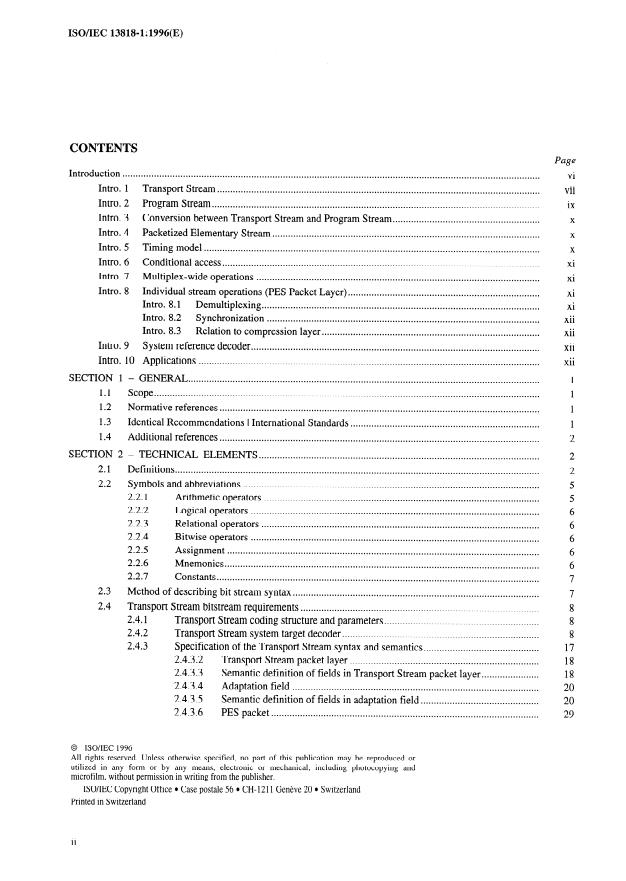
CONTENTS
Page
Vi
Introduction .
vii
Intro. 1 Transport Stream .
ix
Intro. 2 Program Stream .
........................................................ X
Intro. 3 Conversion between Transport Stream and Program Stream
X
Intro. 4 Packetized Elementary Stream .
X
Intro. 5 Timing model .
xi
.........................................................................................................................
Intro. 6 Conditional access
xi
Multiplex-wide operations .
Intro. 7
Xi
.........................................................................
Intro. 8 Individual stream operations (PES Packet Layer)
xi
Intro. 8.1 Demultiplexing .
xii
Intro. 8.2 Synchronization .
xii
Relation to compression layer .
Intro. 8.3
xii
System reference decoder .
Intro. 9
xii
Intro. 10 Applications .
SECTION 1 - GENERAL . . . . . . . . . . . . . . . . . . . . . . . . . . . . . . . . . . . . . . . . . .~.~.*.
1.1 Scope . . . . . . . . . . . . . . . . . . . . . . . . . . . . . . . . . . . . . . . . . . . . . . . . . . . . . . .~.
1.2 Normative references . . . . . . . . . . . . . . . . . . . . . . . . . . . . . . . . . . . . . . . . . . . . . . . . . . . . . . . . . . . . . . . . . . . . . . . . . . . . . . . . . . . . . . . . . . . . . . . . . . . . . . . . . . . . . . . . . . . . . . . . .
1.3 Identical Recommendations I International Standards . . . . . . . . . . . . . . . . . . . . . . . . . . . . . . . . . . . . . . . . . . . . . . . . . . . . . . . . . . . . . . . . . . . . . . . .
1.4 Additional references . . . . . . . . . . . . . . . . . . . . . . . . . . . . . . . . . . . . . . . . . . . . . . . . . . . . . . . . . . . . . . . . . . . . . . . . . . . . . . . . . . . . . . . . . . . . . . . . . . . . . . . . . . . . . . . . . . . . . . . . .
SECTION 2 - TECHNICAL ELEMENTS . . . . . . . . . . . . . . . . . . . . . . . . . . . . . . . . . . . . . . . . . . . . . . . . . . . . . . . . . . . . . . . . . . . . . . . . . . . . . . . . . . . . . . . . . . . . . . . . . . . . . . . . . . .
2.1 Definitions . . . . . . . . . . . . . . . . . . . . . . . . . . . . . . . . . . . . . . . . . . . . . . . . . . . . . . . . . . . . . . . . . . . . . . . . . . . . . . . . . . . . . . . . . . . . . . . . . . . . . . . . . . . . . . . . . . . . . . . . .
2.2 Symbols and abbreviations .
2.2.1 Arithmetic operators .
..............................................................................................................
2.2.2 Logical operators
..........................................................................................................
2.2.3 Relational operators
2.2.4 Bitwise operators .
2.2.5 Assignment .
2.2.6 Mnemonics .
2.2.7 Constants .
.............................................................................................. 7
2.3 Method of describing bit stream syntax
2.4 Transport Stream bitstream requirements .
2.4.1 Transport Stream coding structure and parameters . 8
2.4.2 Transport Stream system target decoder .
............................................ 17
2.4.3 Specification of the Transport Stream syntax and semantics
........................................................................ 18
2.4.3.2 Transport Stream packet layer
2.4.3.3 Semantic definition of fields in Transport Stream packet layer . 18
2.4.3.4 Adaptation field .
2.4.3.5 Semantic definition of fields in adaptation field .
2.4.3.6 PES packet .
0 ISO/IEC 1996
All rights reserved. Unless otherwise specified, no part of this publication may be reproduced or
utilized in any form or by any means, electronic or mechanical, including photocopying and
microfilm, without permission in writing from the publisher.
ISO/IEC Copyright Office l Case postale 56 l CH- 1211 Geneve 20 l Switzerland
Printed in Switzerland
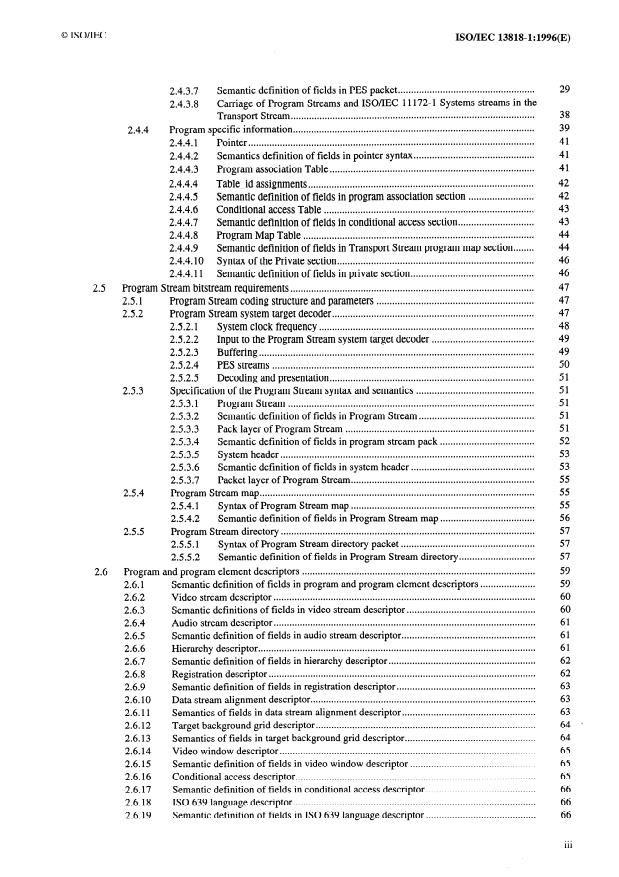
0 ISO/IEC
ISO/IEC 13818=1:1996(E)
....................................................
Semantic definition of fields in PES packet
2.4.3.7
Carriage of Program Streams and ISO/IEC 11172-l Systems streams in the
2.4.3.8
Transport Stream .
............................................................................................ 39
Program specific information
2.4.4
2.4.4.1 Pointer .
..............................................
2.4.4.2 Semantics definition of fields in pointer syntax
.............................................................................. 41
2.4.4.3 Program association Table
2.4.4.4 Table id assignments .
......................... 42
2.4.4.5 Semantic - . definition of fields in program association section
2.4.4.6 Conditional access Table .
2.4.4.7 .
Semantic definition of fields in conditional access section
........................................................................................ 44
2.4.4.8 Program Map Table
........ 44
2.4.4.9 Semantic definition of fields in Transport Stream program map section
...........................................................................
2.4.4.10 Syntax of the Private section
............................................... 46
2.4.4.11 Semantic definition of fields in private section
Program Stream bitstream requirements .
2.5
............................................................ 47
2.5.1 Program Stream coding structure and parameters
............................................................................. 47
2.5.2 Program Stream system target decoder
2.5.2.1 System clock frequency .
....................................... 49
2.5.2.2 Input to the Program Stream system target decoder
2.5.2.3 Buffering .
2.5.2.4 PES streams .
.............................................................................. 5%
2.5.2.5 Decoding and presentation
............................................. 51
2.5.3 Specification of the Program Stream syntax and semantics
2.5.3.1 Program Stream .
Semantic definition of fields in Program Stream .
2.5.3.2
2.5.3.3 Pack layer of Program Stream .
.................................... 52
2.5.3.4 Semantic definition of fields in program stream pack
System header .
2.5.3.5
............................................... 53
2.5.3.6 Semantic definition of fields in system header
2.5.3.7 Packet layer of Program Stream .
2.5.4 Program Stream map .
...................................................................... 55
2.5.4.1 Syntax of Program Stream map
.................................... 56
2.5.4.2 Semantic definition of fields in Program Stream map
Program Stream directory .
2.5.5
Syntax of Program Stream directory packet . 57
2.5.5.1
............................. 57
2.5.5.2 Semantic definition of fields in Program Stream directory
......................................................................................... 59
2.6 Program and program element descriptors
..................... 59
2.6.1 Semantic definition of fields in program and program element descriptors
....................................................................................................
2.6.2 Video stream descriptor
................................................. 60
2.6.3 Semantic definitions of fields in video stream descriptor
2.6.4 Audio stream descriptor .
Semantic definition of fields in audio stream descriptor .
2.6.5
.......................................................................................................... 61
2.6.6 Hierarchy descriptor
........................................................ 62
2.6.7 Semantic definition of fields in hierarchy descriptor
2.6.8 Registration descriptor .
Semantic definition of fields in registration descriptor . 63
2.6.9
...................................................................................... 63
2.6.10 Data stream alignment descriptor
2.6.11 Semantics of fields in data stream alignment descriptor .
64 *
....................................................................................
2.6.12 Target background grid descriptor
.................................................. 64
2.6.13 Semantics of fields in target background grid descriptor
2.6.14 Video window descriptor .
................................................
2.6.15 Semantic definition of fields in video window descriptor
2.6.16 Conditional access descriptor .
.......................................... 66
2.6.17 Semantic definition of fields in conditional access descriptor
IS0 639 language descriptor .
2.6.18
.......................................... 66
2.6.19 Semantic definition of fields in IS0 639 language descriptor
. . .
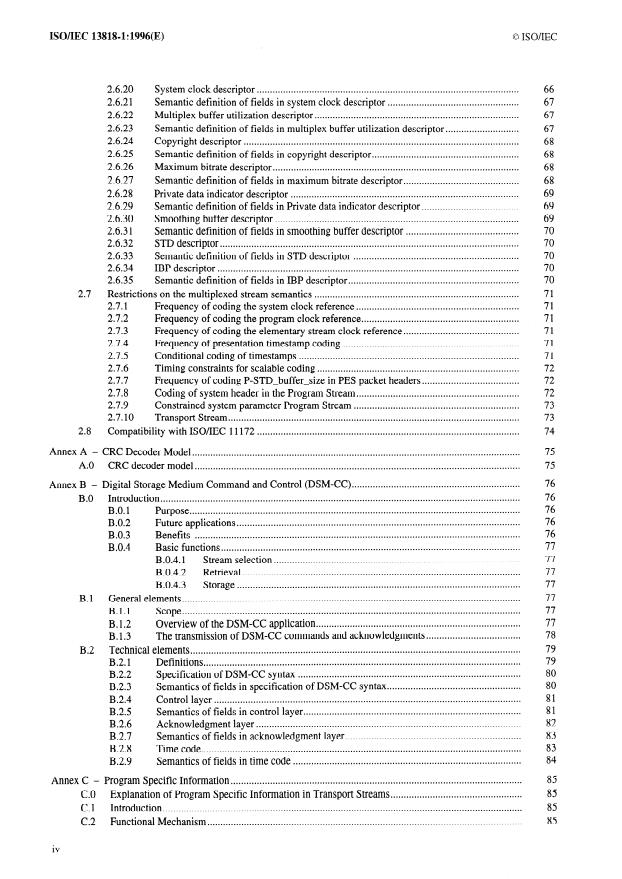
0 ISO/IEC
ISO/IEC 13818=1:1996(E)
2.6.20 System clock descriptor .
.................................................. 67
2.6.2 1 Semantic definition of fields in system clock descriptor
Multiplex buffer utilization descriptor .
2.6.22
............................ 67
2.6.23
Semantic definition of fields in multiplex buffer utilization descriptor
2.6.24 Copyright descriptor .
........................................................ 68
2.6.25 Semantic definition of fields in copyright descriptor
2.6.26 .
Maximum bitrate descriptor
............................................
2.6.27 Semantic definition of fields in maximum bitrate descriptor
2.6.28 Private data indicator descriptor .
..................................... 69
2.6.29 Semantic definition of fields in Private data indicator descriptor
2.6.30 Smoothing buffer descriptor .
...........................................
2.6.3 1 Semantic definition of fields in smoothing buffer descriptor
2.6.32 STD descriptor .
Semantic definition of fields in STD descriptor .
2.6.33
2.6.34 IBP descriptor .
.................................................................
2.6.35 Semantic definition of fields in IBP descriptor
..............................................................................
2.7 Restrictions on the multiplexed stream semantics
..............................................................
2.7.1 Frequency of coding the system clock reference
............................................................
2.7.2 Frequency of coding the program clock reference
............................................ 71
2.7.3 Frequency of coding the elementary stream clock reference
...................................................................
2.7.4 Frequency of presentation timestamp coding
....................................................................................
2.7.5 Conditional coding of timestamps
.............................................................................
2.7.6 Timing constraints for scalable coding
..................................... 72
2.7.7 Frequency of coding P-STD - buffer - size in PES packet headers
2.7.8 Coding of system header in the Program Stream .
...............................................................
2.7.9 Constrained system parameter Program Stream
...............................................................................................................
2.7.10 Transport Stream
2.8 Compatibility with ISO/IEC 11172 .
Annex A
- CRC Decoder Model .
A.0 CRC decoder model .
................................................................
Annex B - Digital Storage Medium Command and Control (DSM-CC)
.........................................................................................................................................
B.0 Introduction
Purpose .
B.O.l
............................................................................................................
B.0.2 Future applications
............................................................................................................................
B.0.3 Benefits
..................................................................................................................
B.0.4 Basic functions
Stream selection .
B.0.4.1
..........................................................................................................
B.0.4.2 Retrieval
............................................................................................................
B.0.4.3 Storage
.................................................................................................................................
B. 1 General elements
Scope .
B.l.l
..............................................................................
B.1.2 Overview of the DSM-CC application
....................................
B.1.3 The transmission of DSM-CC commands and acknowledgments
Technical elements .
B .2
.........................................................................................................................
B.2.1 Definitions
.....................................................................................
B.2.2 Specification of DSM-CC syntax
...................................................
Semantics of fields in specification of DSM-CC syntax
B.2.3
Control layer .
B.2.4
...................................................................................
B.2.5 Semantics of fields in control layer
.....................................................................................................
B.2.6 Acknowledgment layer
...................................................................
B.2.7 Semantics of fields in acknowledgment layer
..........................................................................................................................
B.2.8 Time code
.......................................................................................
Semantics of fields in time code
B.2.9
...............................................................................................................
Annex C - Program Specific Information
.................................................. 85
C.0 Explanation of Program Specific Information in Transport Streams
C. 1 Introduction .
........................................................................................................................
C.2 Functional Mechanism
iv
0 ISO/IEC
ISO/IEC 13818=1:1996(E)
C.3 The Mapping of Sections into Transport Stream Packets
................................................................... 86
C.4 Repetition Rates and Random Access . 86
C.5 What is a Program? . 86
C.6 Allocation of program number .
-
C.7 Usage of PSI in a Typical System . 87
C.8 The Relationships of PSI Structures . 88
C.8.1 Program Association Table . 88
C.8.2 Program Map Table . 88
C.8.3 Conditional Access Table . 88
C.8.4 Network Information Table . 90
C.8.5 Private-section0 . 90
........................................................................................................................ 90
C.8.6 Descriptors
C.9 Bandwidth Utilization and Signal Acquisition Time . 90
Annex D - Systems Timing Model and Application Implications of this Recommendation 1 International
Standard . 93
D.0 Introduction . 93
D.O. 1 Timing Model . 93
D.0.2 Audio and Video Presentation Synchronization . 94
D.0.3 System Time Clock recovery in the decoder . 96
D.0.4 SCR and PCR Jitter . 98
D.0.5 Clock Recovery in the Presence of Network Jitter . 99
D.0.6 System clock used for chroma sub-carrier generation . 100
D.0.7 Component video and audio reconstruction . BOB
D.0.8 Frame Slipping . 101
D.0.9 Smoothing of network jitter . 101
Annex E - Data Transmission Applications . 103
E.0 General considerations . 103
E.l Suggestion
........................................................................................................................................... 103
Annex F - Graphics of Syntax for this Recommendation I International Standard
................................................ 104
F.0 Introduction . 104
F.O. 1
Transport Stream syntax . 104
F.0.2 .
PES packet 105
F.0.3 Program Association Section . 106
F.0.4 CA section . 106
F.0.5 TS program map section . 107
F.0.6 Private section . 107
F.0.7
Program Stream . 108
F.0.8 Program Stream map .
Annex G - General Information .
G.0 General Information . 110
G.O. 1 Sync Byte Emulation . 110
G.0.2 .
Skipped picture status and decoding process 110
G.0.3 .
Selection of PID Values 110
G.0.4 PES start code emulation . 110
-
Annex H - Private Data
........................................................................................................................................... 111
H.0 Private Data . 111
Annex I - Systems conformance and real-time interface . 112
1.0 Systems conformance and real-time interface . 112
Annex J - Interfacing Jitter-Inducing Networks to MPEG-2 Decoders
................................................................. 113
J.0 Introduction
......................................................................................................................................... 113
J.l Network compliance models . 113
5.2 Network specification for jitter smoothing
......................................................................................... 114
5.3 Example decoder implementations . 115
5.3.1 Network adapter followed by an MPEG-2 decoder . 115
5.3.2 .
Integrated decoder 115
V
ISO/IEC 13818=1:1996(E) 0 ISOIIEC
Annex K - Splicing Transport Streams .
K.0 Introduction . 117
K. 1 The different types of splicing point . 117
K.l.1 Ordinary splicing points . 117
K.1.2 Seamless splicing points .
K.2 Decoder behaviour on splices . 118
K.2.1 On non-seamless splices . 118
K.2.2 On seamless splices . 118
Buffer Overflow . . . . . . . . . . . . . . . . . . . . . . . . . . . . . . . . . . . . . . . . . . . . . . . . . . . . . . . . . . . . . . . . . . . . . . . . . . . . . . . . . . . . . . . . . . . . . . . . . . . . . . . . . . . . . . . .
K.2.3 118
vi
@ ISO/IEC ISO/IEC 13818=1:1996(E)
Foreword
IS0 (the International Organization for Standardization) and IEC (the
International Electrotechnical Commission) form the specialized system for
worldwide standardization. National bodies that are members of IS0 or IEC par-
ticipate in the development of International Standards through technical
committees established by the respective organization to deal with particular fields
of technical activity. IS0 and IEC technical committees collaborate in fields of
mutual interest. Other international organizations, governmental and non-
governmental, in liaison with IS0 and IEC, also take part in the work.
In the field of information technology, IS0 and IEC have established a joint
technical committee, ISO/IEC JTC 1. Draft International Standards adopted by the
joint technical committee are circulated to national bodies for voting. Publication
as an International Standard requires approval by at least 75 % of the national
bodies casting a vote.
International Standard ISO/IEC 138 18- 1 was prepared by Joint Technical
Committee ISO/IEC JTC 1, Information technology, in collaboration with ITU-T.
The identical text is published as ITU-T Recommendation H.222.0.
ISOIIEC 138 18 consists of the following parts, under the general title Information
technology - Generic coding of moving pictures and associated audio
information:
- Part I: Systems
- Part 2: Video
- Part 3: Audio
Part 4: Compliance testing
- Part 6: Extensions for DSM-CC
- Part 9: Extension for real time inter$ace for systems decoders
Annex A forms an integral part of this part of ISO/IEC 138 18. Annexes B to K are
for information only.
ISO/IEC 138184:1996(E) 0 ISO/IEC
Introduction
The systems part of this Recommendation I International Standard addresses the combining of one or more elementary
streams of video and audio, as well as other data, into single or multiple streams which are suitable for storage or
transmission. Systems coding follows the syntactical and semantic rules imposed by this Specification and provides
information to enable synchronized decoding of decoder buffers over a wide range of retrieval or receipt conditions.
System coding shall be specified in two forms: the Transport Stream and the Program Stream. Each is optimized for
a different set of applications. Both the Transport Stream and Program Stream defined in this Recommendation I
International Standard provide coding syntax which is necessary and sufficient to synchronize the decoding and
presentation of the video and audio information, while ensuring that data buffers in the decoders do not overflow or
underflow. Information is coded in the syntax using time stamps concerning the decoding and presentation of coded
audio and visual data and time stamps concerning the delivery of the data stream itself. Both stream definitions are
packet-oriented multiplexes.
The basic multiplexing approach for single video and audio elementary streams is illustrated in Figure Intro. 1. The
video and audio data is encoded as described in ITU-T Rec. H.262 1 ISO/IEC 13818-2 and ISO/IEC 13818-3. The
resulting compressed elementary streams are packetized to produce PES packets. Information needed to use PES
packets independently of either Transport Streams or Program Streams may be added when PES packets are formed.
This information is not needed and need not be added when PES packets are further combined with system level
information to form Transport Streams or Program Streams. This systems standard covers those processes to the
A
right of the vertical dashed line.
:
:
:
:
:
:
.
Video PES
:
Video Video
Packetizer b
data encoder
:
:
PS
:
:
Program
:
:
:
Stream ’
I
’ : ’
.
: mux
: Audio PES
Audio Audio
Packetizer b
data encoder
:
:
:
:
TS
Transport
Stream ’
Extent of systems specification
Figure Intro. 1 - Simplified overview the scope of this Recommendation I International Standard
The Program Stream is analogous and similar to ISOLIEC 11172 Systems layer. It results from combining one or more
streams of PES packets, which have a common time base, into a single stream.
For applications that require the elementary streams which comprise a single program to be in separate streams which
are not multiplexed, the elementary streams can also be encoded as separate Program Streams, one per elementary
stream, with a common time base. In this case the values encoded in the SCR fields of the various streams shall be
consistent.
. . .
Vlll
0 ISO/IEC
ISO/IEC 13818=1:1996(E)
Like the single Program Stream, all elementary streams can be decoded with synchronization.
The Program Stream is designed for use in relatively error-free environments and is suitable for applications which may
involve software processing of system information such as interactive multi-media applications. Program Stream packets
may be of variable and relatively great length.
The Transport Stream combines one or more’programs with one or more independent time bases into a single stream.
PES packets made up of elementary streams that form a program share a common timebase. The Transport Stream is
designed for use in environments where errors are likely, such as storage or transmission in lossy or noisy media.
Transport Stream packets are 188 bytes in length.
Program and Transport Streams are designed for different applications and their definitions do not strictly follow a
layered model. It is possible and reasonable to convert from one to the other; however, one is not a subset or superset of
the other. In particular, extracting the contents of a program from a Transport Stream and creating a valid Program
Stream is possible and is accomplished through the common interchange format of PES packets, but not all of the fields
needed in a Program Stream are contained within the Transport Stream; some must be derived. The Transport Stream
may be used to span a range of layers in a layered model, and is designed for efficiency and ease of implementation in
high bandwidth applications.
The scope of syntactical and semantic rules set forth in the systems specification differ: the syntactical rules apply to
systems layer coding only, and do not extend to the compression layer coding of the video and audio specifications; by
contrast, the semantic rules apply to the combined stream in its entirety.
The systems specification does not specify the architecture or implementation of encoders or decoders, nor those of
multiplexors or demultiplexors. However, bit stream properties do impose functional and performance requirements on
encoders, decoders, multiplexors and demultiplexors. For instance, encoders must meet minimum clock tolerance
requirements. Notwithstanding this and other requirements, a considerable degree of freedom exists in the design and
implementation of encoders, decoders, multiplexors, and demultiplexors.
Intro. 1 Transport Stream
The Transport Stream is a stream definition which is tailored for communicating or storing one or more programs of
coded data according to ITU-T Rec. H.262 I ISO/IEC 138 18-2 and ISO/IEC 138 18-3 and other data in environments in
which significant errors may occur. Such errors may be manifested as bit value errors or loss of packets.
Transport Streams may be either fixed or variable rate. In either case the constituent elementary streams may either be
fixed or variable rate. The syntax and semantic constraints on the stream are identical in each of these cases. The
Transport Stream rate is defined by the values and locations of Program Clock Reference (PCR) fields, which in general
are separate PCR fields for each program.
There are some difficulties with constructing and delivering a Transport Stream containing multiple programs with
independent time bases such that the overall bit rate is variable. Refer to 2.4.2.2.
The Transport Stream may be constructed by any method that results in a valid stream. It is possible to construct
Transport Streams containing one or more programs from elementary coded data streams, from Program Streams, or
from other Transport Streams which may themselves contain one or more programs.
The Transport Stream is designed in such a way that several operations on a Transport Stream are possible with
minimum effort. Among these are:
1) Retrieve the coded data from one program within the Transport Stream, decode it and present the decoded
results as shown in Figure Intro. 2.
2) Extract the Transport Stream packets from one program within the Transport Stream and produce as
output a different Transport Stream with only that one program as shown in Figure Intro. 3.
Extract the Transport Stream packets of one or more programs from one or more Transport Streams and
3)
produce as output a di fferent Transport Stream (not ill ustrated).
4) Extract the contents of one program from the Transport Stream and produce as output a Program Stream
containing that one program as shown in Figure Intro. 4.
Take a Program Stream, convert it into a Transport Stream to and then
carry it over a lossy environment,
5)
recover a valid, and in certain cases, identical Program Stream
ISO/IEC 13818=1:1996(E) 0 ISO/IEC
Figure Intro. 2 and Figure Intro. 3 illustrate prototypical demultiplexing and decoding systems which take as input a
Transport Stream. Figure Intro. 2 illustrates the first case, where a Transport Stream is directly demultiplexed and
decoded. Transport Streams are constructed in two layers:
-
a system layer; and
-
a compression layer.
The input stream to the Transport Stream decoder has a system layer wrapped about a compression layer. Input streams
to the Video and Audio decoders have only the compression layer
Operations performed by the prototypical decoder which accepts Transport Streams either apply to the entire Transport
Stream (“multiplex-wide operations”), or to individual elementary streams (“stream-specific operations”). The Transport
Stream system layer is divided into two sub-layers, one for multiplex-wide operations (the Transport Stream packet
layer), and one for stream-specific operations (the PES packet layer),
A prototypical decoder for Transport Streams, including audio and video, is also depicted in Figure Intro. 2 to illustrate
the function of a decoder. The architecture is not unique - some system decoder functions, such as decoder timing
control, might equally well be distributed among elementary stream decoders and the channel specific decoder - but this
figure is useful for discussion. Likewise, indication of errors detected by the channel specific decoder to the individual
audio and video decoders may be performed in various ways and such communication paths are not shown in the
diagram. The prototypical decoder design does not imply any normative requirement for the design of a Transport
Stream decoder. Indeed non-audio/video data is also allowed, but not shown.
Video Decoded
b
decoder video
Transport Stream
Channel
Channel specific Clock
b
demultiplex
decoder cant rol
4L b
and decoder
I
t
\i
Transport Stream ’ Audio Decoded
L
containing one or multiple programs decoder audio
TlSO5770-95’dO2
Figure Intro. 2 - Prototypical transport demultiplexing and decoding example
Figure Intro. 3 illustrates the second case, where a Transport Stream containing multiple programs is converted into a
Transport Stream containing a single program. In this case the re-multiplexing operation may necessitate the correction
of Program Clock Reference (PCR) values to account for changes in the PCR locations in the bit stream.
Transport Stream
Channel
Channel specific
I
b b
demultiplex
decoder
and decode
! :
TISO5780-95/dO3
i
’ i
Transport SW&n Transport Stream
with single program
containing multiple programs
Figure Intro. 3 - Prototypical transport multiplexing example
0 ISO/IEC
ISO/IEC 13818-l: 1996(E)
Figure Intro. 4 illustrates a case in which an multi-program Transport Stream is first demultiplexed and then converted
into a Program Stream.
Figures Intro. 3 and Intro. 4 indicate that it is possible and reasonable to convert between different types and
configurations of Transport Streams. There are specific fields defined in the Transport Stream and Program Stream
syntax which facilitate the conversions illustrated. There is no requirement that specific implementations of
demultiplexors or decoders include all of these functions.
Transport Stream
Channel
Channel specific dernultiplex and
b
b c
Program Stream
decoder
multiplexor
TISO57904WdO4
I
I
Program Stream
Transport Stream
containing multiple programs
Figure Intro. 4 - Prototypical Transport Stream to Program Stream conversion
Intro. 2 Program Stream
The Program Stream is a stream definition which is tailored for communicating or storing one program of coded data
and other data in environments where errors are very unlikely, and where processing of system coding, e.g. by software,
is a major consideration.
Program Streams may be either fixed or variable rate. In either case, the constituent elementary streams may be either
fixed or variable rate. The syntax and semantics constraints on the stream are identical in each case. The Program Stream
rate is defined by the values and locations of the System Clock Reference (SCR) and mux-rate fields.
A prototypical audio/video Program Stream decoder system is depicted in Figure Intro. 5. The architecture is not unique
-
system decoder functions including decoder timing control might equally well be distributed among elementary stream
but this figure is useful for discussion. The prototypical decoder design does
decoders and the channel specific decoder -
not imply any normative requirement for the design of an Program Stream decoder. Indeed non-a
...
lSO/CEI
NORME
13818-I
INTERNATIONALE
Première édition
1996-04-15
Technologies de l’information - Codage
générique des images animées et du son
associé: Systèmes
Generic coding of moving pictures and
Information technology -
associated audio information.= Systems
Numéro de référence
ISO/CEI 13818-I :1996(F)
ISOKEI 138184:1996(F)
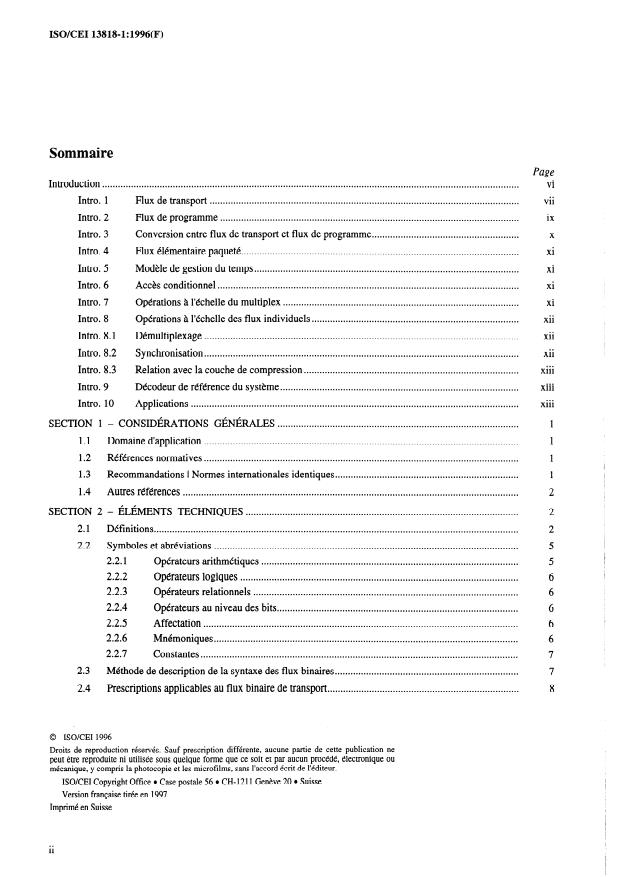
Sommaire
Page
. . . . . . . . . . . . . . . . . . . . . . . . . . . . . . . . . . . . . . . . . . . . . . . . . . . . . . . . . . . . . . . . . . . . . . . . . . . . .*. vi
Introduction
Flux de transport . vii
Intro. 1
.................................................................................................................. ix
Intro. 2 Flux de programme
........................................................ X
Intro. 3 Conversion entre flux de transport et flux de programme
xi
Intro. 4 Flux élémentaire paquet6 .
xi
Intro. 5 Modèle de gestion du temps .
Accès conditionnel . xi
Intro. 6
Opérations à l’échelle du multiplex . xi
Intro. 7
Opérations à l’échelle des flux individuels . xii
Intro. 8
xii
Intro. 8.1 Démultiplexage .
xii
Intro. 8.2 Synchronisation .
. . .
x111
Intro. 8.3 Relation avec la couche de compression .
. . .
x111
Decodeur de référence du système .
Intro. 9
. . .
............................................................................................................................. x111
Intro. 10 Applications
, I ,
............................................................................................ 1
SECTION 1 - CONSIDERATIONS GENERALES
1.1 Domaine d’application .
1.2 Références normatives .
1.3 Recommandations I Normes internationales identiques .
1.4 . 2
Autres references
........................................................................................................ 2
SECTION 2 - ÉLÉMENTS TECHNIQUES
2.1 Définitions .
2.2 Symboles et abréviations .
2.2.1 Opérateurs arithmétiques .
2.2.2 . 6
Opérateurs logiques
2.2.3 Opérateurs relationnels . 6
2.2.4 Opérateurs au niveau des bits . 6
2.2.5 Affectation .
2.2.6 Mnémoniques .
2.2.7 Constantes . 7
...................................................................... 7
2.3 Méthode de description de la syntaxe des flux binaires
Prescriptions applicables au flux binaire de transport .
2.4
0 NO/CE1 1996
Droits de reproduction réservés. Sauf prescription différente, aucune partie de cette publication ne
peut être reproduite ni utilisée sous quelque forme que ce soit et par aucun procédé, électronique ou
mécanique, y compris la photocopie et les microfilms, sans l’accord écrit de l’éditeur.
ISOKEI Copyright Office l Case postale 56 l CH-121 1 Genève 20 l Suisse
Version française tirée en 1997
Imprimé en Suisse
ii
0 ISOKEI ISOKEI 13818-1:1996(F)
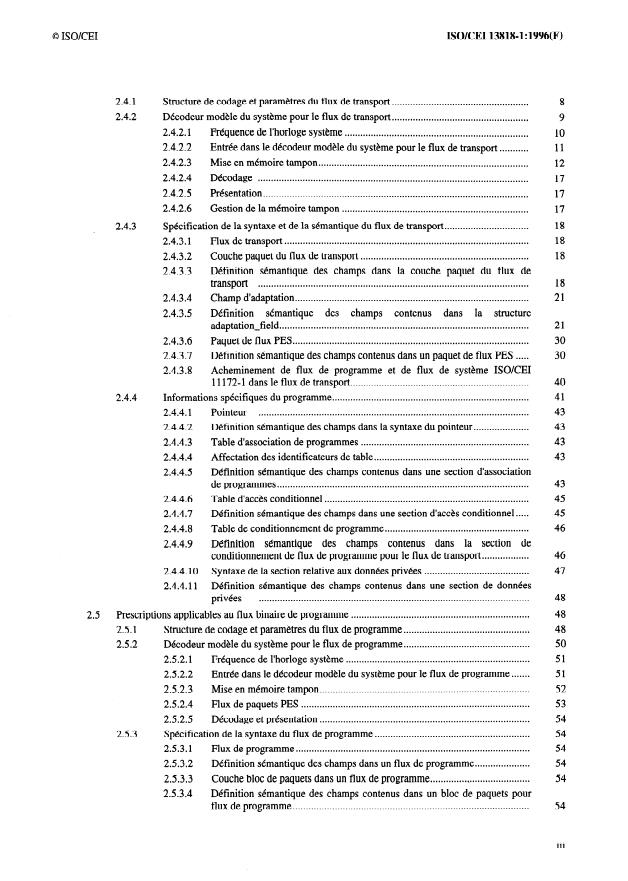
2.4.1 Structure de codage et paramètres du flux de transport .
Décodeur modèle du système pour le flux de transport
2.4.2 .
Fréquence de l’horloge système
2.4.2.1 . 10
2.4.2.2 Entrée dans le décodeur modèle du système pour le flux de transport .
Mise en mémoire tampon
2.4.2.3 . 12
2.4.2.4 Décodage .
2.4.2.5 Présentation .
2.4.2.6 Gestion de la mémoire tampon
. . . . . . . . . . . . . . . . . . . . . . . . . . . . . . . . . . . . . . . . . . . . . . . . . . . . . . . . . . . . . . . . . . . . . . . 17
Spécification de la syntaxe et de la sémantique du flux de transport . . . . . . . . . . . . . . . . . . . . . . . . . . . . . . . . 18
2.4.3
Flux de transport . . . . . . . . . . . .*. 18
2.4.3.1
2.4.3.2 Couche paquet du flux de transport . . . . . . . . . . . . . . . . . . . . . . . . . . . . . . . . . . . . . . . . . . . . . . . . . . . . . . . . . . . . . . . .
2.4.3.3 Définition sémantique des champs dans la couche paquet du flux de
transport . . . . . . . . . . . . . . . . . . . . . . . . . . . . . . . . . . . . . . . . . . . . . . . . . . . . . . . . . . . . . . . . . . . . . . . . . . . . . . . . . . . . . . . . . . . . . . . . . . . . . . . 18
2.4.3.4 Champ d’adaptation . . . . . . . . . . . . . .*.*. 21
Définition sémantique des champs contenus dans la structure
2.4.3.5
adaptation field . . . . . . . . . . . . . . . . . . . . . . . . . . . . . . . . . . . . . . . . . . . . . . . . . . . . . . . . . . . . . . . . . . . . . . . . . . . . . . . . . . . . . . . . . . . . . . . 21
-
2.4.3.6 Paquet de flux PES . . . . . . . . . . . . . . . . . . . . . . . . . . . . . . . . . . . . . . . . . . . . . . . . . . . . . . . . . . . . . . . . . . . . . . . . . . . . . . . . . . . . . . . . . . 30
2.4.3.7 Définition sémantique des champs contenus dans un paquet de flux PES . . . . . 30
Acheminement de flux de programme et de flux de système ISOKEI
2.4.3.8
11172-l dans le flux de transport . . . . . . . . . . . . . . . . . . . . . . . . . . . . . . . . . . . . . . . . . . . . . . . . . . . . . . . . . . . . . . . . . . . . 40
2.4.4 Informations spécifiques du programme . . . . . . . . . . . . . . . . . . . . . . . . . . . . . . . . . . . . . . . . . . . . . . . . . . . . . . . . . . . . . . . . . . . . . . . . . . . 41
2.4.4.1 Pointeur . . . . . . . . . . . . . . . . . . . . . . . . . . . . . . . . . . . . . . . . . . . . . . . . . . . . . . . . . . . . . . . . . . . . . . . . . . . . . . . . . . . . . . . . . . . . . . . . . . . . . . . 43
................... 43
2.4.4.2 Définition sémantique des champs dans la syntaxe du pointeur.
2.4.4.3 Table d’association de programmes . 43
2.4.4.4 Affectation des identificateurs de table . 43
2.4.4.5 Définition sémantique des champs contenus dans une section d’association
de programmes . . . . . . . . . . . . . . . . . . . . . . . . . . . . . . . . . . . . . . . . . . . . . . . . . . . . . . . . . . . . . . . . . . . . . . . . . . . . . . . . . . . . . . . . . . . . . . . . 43
2.4.4.6 Table d’accès conditionnel . . . . . . . . . . . . . . . . . . . . . . . . . . . . . . . . . . . . . . . . . . . . . . . . . . . . . . . . . . . . . . . . . . . . . . . . . . . . . . 45
Définition sémantique des champs dans une section d’accés conditionnel. . 45
2.4.4.7
....................................................... 46
2.4.4.8 Table de conditionnement de programme
2.4.4.9 Définition semantique des champs contenus dans la section de
................ 46
conditionnement de flux de programme pour le flux de transport.
2.4.4.10 Syntaxe de la section relative aux données privées . 47
2.4.4.11 Définition sémantique des champs contenus dans une section de données
privées . 48
.................................................................... 48
Prescriptions applicables au flux binaire de programme
2.5.1 Structure de codage et paramètres du flux de programme . 48
2.5.2 Décodeur modèle du système pour le flux de programme . 50
...................................................................... 51
2.5.2.1 Fréquence de l’horloge système
..... 51
2.5.2.2 Entrée dans le décodeur modéle du système pour le flux de programme.
2.5.2.3 Mise en mémoire tampon . 52
2.5.2.4 Flux de paquets PES . 53
Décodage et présentation . 54
2.5.2.5
2.5.3 Spécification de la syntaxe du flux de programme . 54
2.5.3.1 Flux de programme . 54
2.5.3.2 Définition sémantique des champs dans un flux de programme. . 54
...................................... 54
2.5.3.3 Couche bloc de paquets dans un flux de programme
2.5.3.4 Définition sémantique ‘des champs contenus dans un bloc de paquets pour
flux de programme . 54
. . .
ISOKEI 13818-1:1996(F)
@ ISOKEI
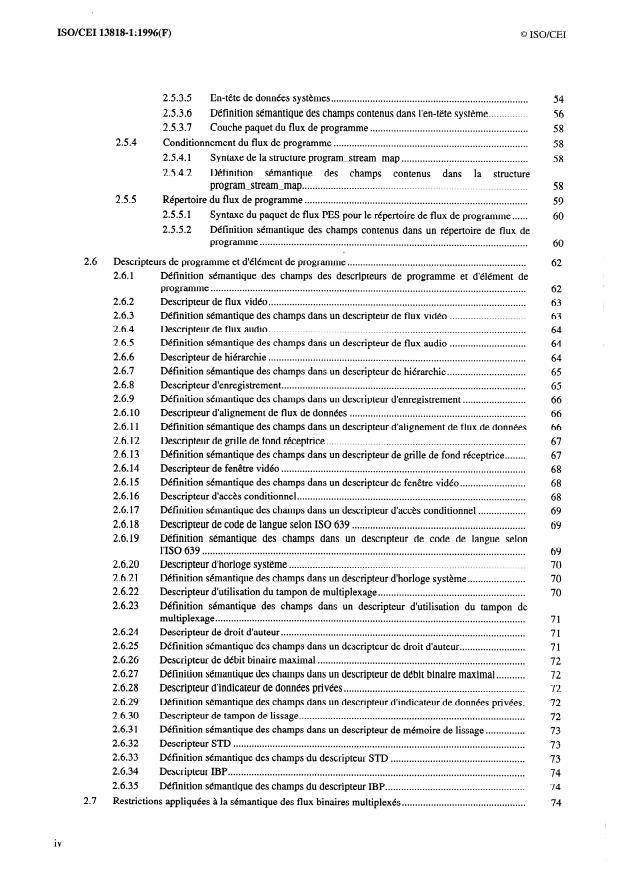
2.5.3.5 En-tête de données systèmes .
Définition sémantique des champs contenus dans l’en-tête système. .
2.5.3.6 56
2.5.3.7 Couche paquet du flux de programme . 58
2.5.4 Conditionnement du flux de programme . 58
2.5.4.1 Syntaxe de la structure program-stream-map
................................................ 58
2.5.4.2 Définition sémantique des champs contenus dans la structure
program-stream-map .
Répertoire du flux de programme
2.5.5 . 59
2.5.5.1 Syntaxe du paquet de flux PES pour le répertoire de flux de programme. . 60
2.5.5.2 Définition sémantique des champs contenus dans un répertoire de flux de
programme . 60
.
....................................................................
2.6 Descripteurs de programme et d’élément de programme 62
2.6.1 1 Définition sémantique des champs des descripteurs de programme et d’élément de
........................................................................................................................ 62
programme
2.6.2 Descripteur de flux vidéo . 63
2.6.3 Définition sémantique des champs dans un descripteur de flux vidéo . 63
.................................................................................................. 64
2.6.4 Descripteur de flux audio
2.6.5 Définition sémantique des champs dans un descripteur de flux audio . 64
2.6.6 Descripteur de hiérarchie . 64
2.6.7 Définition sémantique des champs dans un descripteur de hiérarchie . 65
2.6.8 Descripteur d’enregistrement . 65
2.6.9 Définition sémantique des champs dans un descripteur d’enregistrement . 66
2.6.10 Descripteur d’alignement de flux de données . 66
2.6.11 Définition sémantique des champs dans un descripteur d’alignement de flux de données 66
2.6.12 Descripteur de grille de fond réceptrice .
........
2.6.13 Définition sémantique des champs dans un descripteur de grille de fond réceptrice 67
2.6.14 Descripteur de fenêtre video . 68
2.6.15 Définition sémantique des champs dans un descripteur de fenêtre vidéo . 68
2.6.16 Descripteur d’accès conditionnel . 68
2.6.17 Définition sémantique des champs dans un descripteur d’accès conditionnel . 69
2.6.18 Descripteur de code de langue selon ISO 639 . 69
2.6.19 Définition sémantique des champs dans un descripteur de code de langue selon
........................................................................................................................... 69
I’ISO 639
.......................................................................................... 70
2.6.20 Descripteur d’horloge système
2.6.21 Définition sémantique des champs dans un descripteur d’horloge système. . 70
2.6.22 Descripteur d’utilisation du tampon de multiplexage . 70
2.6.23 Définition sémantique des champs dans un descripteur d’utilisation du tampon de
multiplexage . 71
2.6.24 Descripteur de droit d’auteur .
.......................
2.6.25 Définition sémantique des champs dans un descripteur de droit d’auteur. 71
2.6.26 Descripteur de débit binaire maximal . 72
2.6.27 Définition sémantique des champs dans un descripteur de débit binaire maximal. . 72
2.6.28 Descripteur d’indicateur de données privées . 72
2.6.29 Définition sémantique des champs dans un descripteur d’indicateur de données privées. 72
2.6.30 Descripteur de tampon de lissage . 72
...............
2.6.3 1 Définition sémantique des champs dans un descripteur de mémoire de lissage 73
2.6.32 Descripteur STD . 73
2.6.33 Définition sémantique des champs du descripteur STD .
2.6.34 Descripteur IBP . 74
2.6.35 Définition sémantique des champs du descripteur IBP . 74
2.7 Restrictions appliquées a la sémantique des flux binaires multiplexés . . . . . . . . . . . . . . . . . . . . . . . . . . . . . . . . . . . . . . . . . . . . . . . 74
iv
0 ISOKEI ISOKEI 13818-1:1996(F)
Fréquence de codage de la référence temporelle du système
2.7.1 .
2.7.2 Fréquence de codage de la référence temporelle de programme
......................................
Fréquence de codage de la référence temporelle d’un flux elémentaire
2.7.3 .
Fréquence de codage de l’élément presentation timestamp
2.7.4 .
2.7.5 Codage conditionnel des éléments horodateurs
................................................................ 75
2.7.6 Contraintes de synchronisation applicables au décodage echelonnable
........................... 75
2.7.7 Fréquence de codage de l’elément P-STD-buffer-size dans les en-têtes de paquet d’un
flux PES .
Codage d’en-tête système dans le flux de programme
2.7.8 .
2.7.9 Flux de programme de type flux paramétrique contraint du système
............................... 76
2.7.10 Verrouillage de la fréquence des échantillons dans les flux de transport . . . . . . . . . . . . . . . . . . . . . . . . .
Compatibilité avec ISOKEI 11172
2.8 . . . . . . . . . . . . . . . . . . . . . . . . . . . . . . . . . . . . . . . . . . . . . . . . . . . . . . . . . . . . . . . . . . . . . . . . . . . . . . . . . . . . . . . . . . . . . . . . . . . .
Annexe A - Modèle de décodeur pour le contrôle CRC
. . . .*.*.*.
A.0 Decodeur modèle de contrôle CRC . . . . . . . . . . . . . . . .*.
Annexe B - Commande et contrôle des supports d’enregistrement numérique (DSM-CC) . . . . . . . . . . . . . . . . . . . . . . . . . . . . . . . . . . . . . 80
B .O Introduction . . . . . . . . . . . . . . . . . . . . . . . . . . . . . . . . . . . . . . . . . . . . . . . . . . . . . . . . . . . . . . . . . . . . . . . . . . . . . . . . . . . . . . . . . . . . . . . . . . . . . . . . . . . . . . . . . . . . . . . . .
B.O.1 Objet . . . . . . . . . . . . . . . . . . . . . . . . . . . . . . . . . . . . . . . . . . . . . . . . . . . . . . . . . . . . . . . . . . . . . . . . . . . . . . . . . . . . . . . . . . . . . . . . . . . . . . . . . . . . . . . . . . . . . . . . .
B.O.2 Futures applications . . . . . . . . . . . . . . . . . . . . . . . . . . . . . . . . . . . . . . . . . . . . . . . . . . . . . . . . . . . . . . . . . . . . . . . . . . . . . . . . . . . . . . . . . . . . . . . . . . . . . . . . . .
B.O.3 Avantages . . . . . . . . . . . . . . . . . . . . . . . . . . . . . . . . . . . . . . . . . . . . . . . . . . . . . . . . . . . . . . . . . . . . . . . . . . . . . . . . . . . . . . . . . . . . . . . . . . . . . . . . . . . . . . . . . . . . . . . . .
B.O.4 Fonctions fondamentales . . . . . . . . . . . . . . . . . . . . . . . . . . . . . . . . . . . . . . . . . . . . . . . . . . . . . . . . . . . . . . . . . . . . . . . . . . . . . . . . . . . . . . . . . . . . . . . . . . .
B.0.4.1 Sélection du flux . . . . . . . . . . . . . . . . . . . . . . . . . . . . . . . . . . . . . . . . . . . . . . . . . . . . . . . . . . . . . . . . . . . . . . . . . . . . . . . . . . . . . . . . . . . . .
Extraction 81
B.0.4.2 . . . . . . . . . . . . . . . . . . . . . . . . . . . . . . . . . . . . . . . . . . . . . . . . . . . . . . . . . . . . . . . . . . . . . . . . . . . . . . . . . . . . . . . . . . . . . . . . . . . . . . .
Enregistrement . . . . . . . . . . . . . . . . . . . . . . . . . . . . . . . . . . . . . . . . . . . . . . . . . . . . . . . . . . . . . . . . . . . . . . . . . . . . . . . . . . . . . . . . . . . . . . . . 81
B.0.4.3
B. 1 Eléments géneraux . 81
B.l.l Domaine d’application . 81
B.1.2 Vue d’ensemble du mode d’application du protocole DSM-CC . 81
B.1.3 Transmission des commandes et acquittements du protocole DSM-CC . 82
............................................................................................................................ 83
B .2 Elements techniques
......................................................................................................................... 83
B.2.1 Définitions
.......................................................... 84
B.2.2 Spécification de la syntaxe du protocole DSM-CC
Sémantique des champs contenus dans la spécification syntaxique du
B.2.3
protocole DSM-CC . 84
B.2.4 Couche de commande . 85
Sémantique des champs contenus dans la couche de commande . 85
B.2.5
B.2.6 Couche d’acquittement . 87
B.2.7 Sémantique des champs contenus dans la couche d’acquittement . 87
B.2.8 Code temporel . 88
..............................
B .2.9 Sémantique des champs contenus dans la structure de code temporel 88
.............................................................................................. 89
Annexe C - Informations spécifiques du programme
C.0 Explications relatives aux informations spécifiques du programme (PSI) contenues dans un flux de
transport . . . . . . . . . . . . . . . . . . . . . . . . . . . . . . . . . . . . . . . . . . . . . . . . . . . . . . . . . . . . . . . . . . . . . . . . . . . . . . . . . . . . . . . . . . . . . . . . . . . . . . . . . . . . . . . . . . . . . . . . .
C. 1 Introduction . . . . . . . . . . . . . . . . . . . . . . . . . . . . . . . . . . . . . . . . . . . . . . . . . . . . . . . . . . . . . . . . . . . . . . . . . . . . . . . . . . . . . . . . . . . . . . . . . . . . . . . . . . . . . . . . . . . . . . . . .
. . . . . . . . . . . . . . . . . . . . . . . . . . . . . . . . . . . . . . . . . . . . . . . . . . . . . . . . . . . . . . . . . . . . . . . . . . . . . . . . . . . . . . . . . . . . . . . . . . . . . . . . . . . . . . . . . . . . . . . 89
C.2 Mécanisme fonctionnel
C.3 Insertion de sections dans des paquets du flux de transport .
C.4 Fréquences de répétition et accès aleatoire .
C.5 En quoi consiste un programme7 . .
C.6 Affectation du numéro de programme .
...................................................................... 92
C.7 Utilisation des informations PS1 dans un système type
C.8 Relations entre structures d’informations PS1 .
C.8.1 Table d’association de programmes (PAT) .
............................................................. 93
C.8.2 Table de conditionnement de programme (PMT)
C.8.3 Table d’accès conditionnel (CAT) .
C.8.4 Table d’informations sur le réseau (NIT) . 93
V
ISOKEI 13818-1:1996(F)
0 ISO/CEI
C.8.5 Sections privees .
C.8.6 Descripteurs .
C.9 Affectation spectrale et temps d’acquisition du signal .
Annexe D - Implications de la présente Recommandation I Norme internationale (systèmes) quant au modèle de
synchronisation et à ses applications .
D.0 Introduction .
D.O. 1 Modèle de gestion du temps
..............................................................................................
D.0.2 Synchronisation de la présentation des données audio et vidéo
.......................................
Recalage sur l’horloge de base du système dans le décodeur
D.0.3 .
D.0.4 Gigue des références SCR et PCR
....................................................................................
D.0.5 Récupération d’horloge en présence d’une gigue de réseau
..............................................
D.0.6 Horloge système utilisée pour construire une sous-porteuse de chrominance.
................
D.0.7 Reconstruction des données vidéo et audio en composantes
............................................
D.0.8 Glissement des trames
.......................................................................................................
D.0.9 Lissage de la gigue due au réseau
.....................................................................................
Annexe E - Applications de transmission de données
.............................................................................................
E.0 Considérations générales .
E.l Suggestion .
Annexe F - Presentation graphique de la syntaxe pour la présente Recommandation I Norme internationale
........
F.0 Introduction .
F.O. 1 Syntaxe d’un flux de transport
...........................................................................................
F.0.2 Paquet de flux PES
............................................................................................................
F.0.3 Section de table d’association de programmes
..................................................................
F.0.4 Section de table d’accès conditionnel
................................................................................
F.0.5
Section de table de conditionnement de programme pour flux de transport
.....................
F.0.6 Section de table de données privées .
F.0.7
Flux de programme .
F.0.8 Conditionnement de flux de programme
...........................................................................
Annexe G - Informations générales .
G.0 Informations générales .
G.O. 1 Emulation d’octets de synchronisation
..............................................................................
G.0.2 Etat d’image sautée et processus de décodage
...................................................................
G.0.3 Sélection de valeurs d’identificateur PID
..........................................................................
G.0.4 Emulation d’un code de debut de paquet PES
...................................................................
Annexe H - Données privées .
H.0 Données privées .
Annexe 1 - Conformité des systèmes et interface en temps réel
..............................................................................
1.0 Conformité des systèmes et interface en temps réel
...........................................................................
Annexe J - Interfaçage entre réseaux générateurs de gigue et décodeurs MPEG-2
.................................................
J.0 Introduction .
J.l Modèle de conformité de réseau
.........................................................................................................
5.2 Spécifkation de réseau pour le lissage de gigue
.................................................................................
5.3 Exemples de mises en oeuvre de décodeur
.........................................................................................
5.3.1 Adaptateur de réseau suivi d’un décodeur MPEG-2
.........................................................
5.3.2 Décodeur intégré .
Annexe K 2 Combinaison des flux de transport
.......................................................................................................
KO Introduction
.........................................................................................................................................
K. 1 Les différents types de points de combinaison
...................................................................................
K.l.l Points de combinaison ordinaire
.......................................................................................
K.1.2
Points de combinaison transparente .
K.2 Comportement des décodeurs en présence de combinaisons
..............................................................
K.2.1 Combinaisons non transparentes
.......................................................................................
K.2.2 Combinaisons transparentes
..............................................................................................
K.2.3 Surremplissage de la mémoire tampon
.............................................................................
0 ISO/CEI
ISOKEI 13818-l: 1996(F)
Avant-propos
L’ISO (Organisation internationale de normalisation) et la CE1 (Commission
électrotechnique internationale) forment ensemble un système consacré à la
normalisation internationale considérée comme un tout. Les organismes nationaux
membres de 1’ISO ou de la CE1 participent au développement de Normes inter-
nationales par l’intermédiaire des comités techniques créés par l’organisation
concernée afin de s’occuper des différents domaines particuliers de l’activité
technique. Les comités techniques de 1’ISO et de la CE1 collaborent dans des
domaines d’intérêt commun. D’autres organisations internationales, gouverne-
mentales ou non gouvernementales, en liaison avec 1’ISO et la CE1 participent
également aux travaux.
Dans le domaine des technologies de l’information, I’ISO et la CE1 ont créé un
comité technique mixte, l’ISO/CEI JTC 1. Les projets de Normes internationales
adoptés par le comité technique mixte sont soumis aux organismes nationaux pour
approbation, avant leur acceptation comme Normes internationales. Les Normes
internationales sont approuvées conformément aux procédures qui requièrent
l’approbation de 75 % au moins des organismes nationaux votants.
La Norme internationale ISO/CEI 138 18- 1 a été élaborée par le comité technique
mixte ISO/CEI JTC 1, Technologies de Z’information, en collaboration avec
I’UIT-T. Le texte identique est publié en tant que Recommandation UIT-T
H.222.0.
L’ISO/CEI 138 18 comprend les parties suivantes, présentées sous le titre général
Technologies de l’information - Codage générique des images animées et du son
associé:
- Partie 1: Systèmes
- Partie 2: Vidéo
- Partie 3: Son
- Partie 4: Essais de conformité
- Partie 6: Extensions pour DSM-CC
Partie 9: Extension pour inter$iace temps réel pour systèmes décodeurs
L’annexe A fait partie intégrante de la présente partie de l’ISO/CEI 138 18. Les
annexes B à K sont données uniquement à titre d’information.
VI1
ISOKEI 138184:1996(F)
0 ISOKEI
Introduction
La partie relative aux systèmes de la présente Recommandation I Norme internationale traite de la combinaison d’un ou
de plusieurs flux élémentaires de données video et audio, ainsi que d’autres types, pour former des flux isolés ou
multiples se prêtant à l’enregistrement ou à la transmission. Le codage de ces systèmes suit les règles syntaxiques et
sémantiques qui sont imposées par la présente Spécifïcation. Ce codage contient des informations qui permettent un
décodage synchronisé du contenu des memoires des décodeurs, dans une large gamme de conditions d’extraction ou de
réception.
Le codage d’un système doit être spécifié sous deux formes: le flux de transport et le flux de programme. Chacun
d’eux est optimisé pour un ensemble d’applications différentes. Ces deux flux, définis dans la présente Recommandation I
Norme internationale, acheminent les élements syntaxiques qui sont nécessaires et suffisants pour synchroniser le
décodage et la présentation des informations video et audio, tout en garantissant que les mémoires tampons contenues
dans les décodeurs ne subiront ni surremplissage ni sous-remplissage de données. Les informations sont codées sous
forme d’éléments syntaxiques faisant appel à des pointeurs temporels (horodateurs) régissant, d’une part, le décodage et
la présentation des données codées pour signaux audio et vidéo, d’autre part, l’acheminement du flux de données
proprement dit. Les definitions relatives à ces deux flux s’assimilent à des multiplex en mode paquet.
La Figure Intro. 1 illustre la démarche fondamentale - celle du multiplexage - pour les flux élémentaires de données
vidéo et audio. Celles-ci sont codées conformément à la Rec. UIT-T H.262 I ISOKEI 138 18-2 et a l’ISO/CEI 138 18-3.
Les flux élémentaires resultants sont, après compression, mis en paquets de flux PES. Les informations nécessaires
pour utiliser les paquets de flux PES peuvent être ajoutées au moment de la formation des paquets de flux PES, qu’il
s’agisse de flux de transport ou de flux de programme. Ces informations ne sont pas requises et n’ont pas besoin d’être
ajoutées si les paquets de flux PES sont recombinés avec des informations de niveau système pour former des flux de
transport ou des flux de programme. La présente norme relative aux systèmes traite des processus situes a droite du
trait pointillé vertical de la figure ci-après.
PES vidbo
b
Empaqueteur
MUX
flux de
PS
PES audio
Donnbs
codeur
Empaqueteur b
audio audio
.
PES: flux Aknentaire empaquetb
Domaine
d’application de la spbcification systèmes
PS: flux de programme
Figure Intro. 1 - Synoptique simplifié du domaine d’application de la présente
Recommandation I Norme internationale
. . .
Vlll
@ ISOKEI
ISOKEI 13818-1:1996(F)
Le flux de programme est analogue à la couche système de I’ISOKEI 11172. Il est le résultat de la combinaison, en un
seul flux d’un ou de plusieurs flux élémentaires de paquets PES ayant la même base de temps.
Pour les applications qui exigent des flux élémentaires sépares et non multiplexés pour un même programme, on peut
également coder ces flux élémentaires sous forme de flux de programme distincts (un par flux élémentaire), possédant la
même base de temps. Dans ce cas, les valeurs codées dans les champs de reference temporelle système des divers flux
doivent être cohérentes.
De même que le flux de programme isole, tous les flux élémentaires peuvent être décodés en synchronisme.
Le flux de programme est conçu pour être utilisé dans des environnements relativement exempts d’erreurs. Il convient à
des applications pouvant comporter un traitement informatique d’informations du système, comme les applications
multimédias interactives. Les paquets contenus dans le flux de programme peuvent avoir une longueur variable et
relativement grande.
Le flux de transport, en revanche, combine un ou plusieurs programmes possédant une ou plusieurs bases de temps
indépendantes, pour former un flux unique. Les paquets de flux PES contenus dans des flux élémentaires qui forment un
programme partagent une base de temps commune. Le flux de transport est conçu pour être utilisé dans des
environnements exposés aux erreurs, comme l’enregistrement ou la transmission sur des supports exposés aux erreurs ou
aux bruits. Les paquets d’un flux de transport ont une longueur de 188 octets.
Les flux de programme et de transport sont conçus pour différentes applications et leurs définitions ne suivent pas
strictement un modèle stratifié. Il est possible et logique de les convertir les uns les autres sans toutefois que l’un soit un
sous-ensemble ou un surensemble de l’autre. En particulier, l’extraction du contenu d’un programme dans un flux de
transport et la creation d’un flux de programme valide sont possibles, grâce au format intermédiaire commun (CIF) des
paquets de flux PES. Mais le flux de transport ne contient pas tous les champs necessaires dans un flux de programme et
certains doivent être calcules. On peut utiliser le flux de transport pour rassembler une série de couches dans un modèle
stratifie. Ce flux est conçu pour être efficace et de mise en œuvre aisée dans les applications à large bande.
Le domaine d’application des règles exposées dans la présente spécification des systèmes est différent selon qu’elles sont
syntaxiques ou semantiques: les règles syntaxiques ne s’appliquent qu’au codage de la couche système; elles ne
s’étendent pas au codage de la couche de compression des données vidéo et audio. En revanche, les règles sémantiques
s’appliquent aux combinaisons de flux dans leur ensemble.
La présente spécification des systèmes ne précise pas l’architecture ni la mise en œuvre des codeurs ou décodeurs, ni
celles des multiplexeurs ou démultiplexeurs. Les caractéristiques des flux binaires imposent cependant des exigences
relatives au fonctionnement et à la qualité des codeurs, des décodeurs, des multiplexeurs et des démultiplexeurs. Par
exemple, les codeurs doivent toujours satisfaire a des exigences minimales en termes de tolérance sur la référence
temporelle. Cela, ainsi que d’autres prescriptions, etant mis à part, il existe un degré de liberté considérable pour la
conception et la mise en œuvre des codeurs, décodeurs, multiplexeurs et démultiplexeurs.
Intro. 1 Flux de transport
Le flux de transport est défini de manière à convenir pour la communication ou l’enregistrement d’un ou de plusieurs
programmes de données codées, conformément à la Rec. UIT-T H.262 I ISOKEI 13818-2 et à I’ISOKEI 13818-3, ainsi
que d’autres données dans des environnements exposés à des erreurs notables. De telles erreurs peuvent se manifester
sous forme d’erreur sur la valeur d’un bit ou de perte de paquets.
Les flux de transport peuvent être à débit constant ou à débit variable. Dans un cas comme dans l’autre, les flux
élémentaires qui les constituent peuvent être a débit constant ou variable. Les contraintes syntaxiques et semantiques sur
le flux sont identiques dans l’un et l’autre cas. Le débit du flux de transport est defini par les valeurs et par les
emplacements des champs de la référence temporelle du programme (PCR). En géneral, ces champs sont distincts pour
chaque programme.
La construction et l’acheminement d’un flux de transport contenant plusieurs programmes caractérisés par des bases de
temps indépendantes, et comportant donc un débit binaire global variable, présentent certaines difficultés. Voir 2.4.2.2.
Le flux de transport peut être construit selon toute méthode qui produit un flux conforme. A partir de flux élémentaires
de données codées, de flux de programme ou de flux de transport pouvant eux-mêmes contenir un ou plusieurs
programmes, il est possible de construire des flux de transport contenant un ou plusieurs programmes.
ix
ISOKEI 138184:1996(F)
0 ISO/CEI
Le flux de transport est conçu de telle manière que l’on puisse effectuer sur lui plusieurs opérations avec le moins d’effort
nossible. Il peut s’agir, par exemple:
A A
d’extraire les données codées d’un programme contenu dans le flux de transport, de les décoder et de
1)
présenter les résultats comme indiqué sur la Figure Intro. 2;
d’extraire, du flux de transport, les paquets de type flux de transport contenus dans un programme donné
2)
et de produire, en sortie, un flux de transport différent, ne contenant que ce programme, comme indiqué
sur la Figure Intro. 3;
d’extraire, d’un ou de plusieurs flux de transport, les paquets de type flux de transport contenus dans un ou
3)
plusieurs programmes et de produire, en sortie, un flux de transport différent (non illustré);
d’extraire, du flux de transport, le contenu d’un programme isolé et de produire, en sortie, un flux de
4)
programme contenant ce programme isolé, comme indique sur la Figure Intro. 4;
de prendre un flux de programme, de le convertir en un flux de transport pour lui faire traverser un
5)
environnement exposé aux pertes puis de récupérer un flux de programme valide et, dans certains cas,
identique.
La Figure Intro. 2 et la Figure Intro. 3 montrent des prototypes de systèmes de démultiplexage et de décodage dont
l’entrée est un flux de transport. La Figure Intro.
...
Questions, Comments and Discussion
Ask us and Technical Secretary will try to provide an answer. You can facilitate discussion about the standard in here.
Loading comments...