

ISO/IEC 14496-5:2001/Amd 25:2009
(Amendment)Information technology — Coding of audio-visual objects — Part 5: Reference software — Amendment 25: Reference software for scene partitioning
General Information
- Abstract
- Status
- Published
- Publication Date
- 06-Dec-2009
- Current Stage
- 6060 - International Standard published
- Start Date
- 07-Dec-2009
- Due Date
- 13-Oct-2011
- Completion Date
- 13-Oct-2011
Buy Documents

ISO/IEC 14496-5:2001/Amd 25:2009 - Information technology — Coding of audio-visual objects — Part 5: Reference software — Amendment 25: Reference software for scene partitioning Released:12/7/2009

ISO/IEC 14496-5:2001/Amd 25:2009 - Information technology — Coding of audio-visual objects — Part 5: Reference software — Amendment 25: Reference software for scene partitioning Released:12/7/2009
Overview
ISO/IEC 14496-5:2001/Amd 25:2009 is an amendment to the international standard for information technology focused on the coding of audio-visual objects. This amendment introduces reference software for scene partitioning, an essential component for efficient rendering and management of 3D audio-visual content. Developed under the joint ISO/IEC technical committee JTC 1, this update enhances Part 5 of the MPEG-4 standard, which concerns reference software implementations used for decoding and rendering.
The addition of scene partitioning reference software supports improvements in the organization, decoding, and real-time rendering of complex 3D scenes in multimedia applications. This software includes both a decoder and rendering proxies to optimize data handling and visualization strategies for spatially partitioned scenes.
Key Topics
- Scene Partitioning Reference Software: Provides a modular add-on to existing IM1-Player3D software systems, enabling efficient partitioning of complex scenes into manageable spatial subsets.
- Decoder and Rendering Proxy: The amendment defines reference software components such as the Space Partitioning Decoder and the Space Partitioning Rendering Proxy. These tools aid in the interpretation and visualization of partitioned scene data.
- Class Structure and File Organization: The software reference implementation includes several classes focused on subdividing scenes using different partitioning techniques such as BSP (Binary Space Partitioning), Cell/Portal systems, PVS (Potentially Visible Set), Footprint partitioning, and Wavelet Subdivision Surfaces (WSS). The organization of source directories and header files facilitates modular development and integration.
- Key classes include SpacePartitionProxy, SPart, SpacePartDecoderLib, BSPTree, CPPartition, PvsPartition, HDescTree, and WssPartition.
- Scene Partitioning Techniques: Integrates spatial data structures to optimize rendering pipelines by dividing 3D scenes into cells, portals, and partitions. This method enhances rendering efficiency, scene complexity management, and visibility determination.
Applications
The capabilities defined in ISO/IEC 14496-5:2001/Amd 25:2009 offer practical advantages for a range of multimedia and information technology domains, including:
- 3D Multimedia Playback: Enhancing the performance and quality of 3D players by optimizing scene rendering through partitioning.
- Virtual Reality (VR) and Augmented Reality (AR): Efficient scene partitioning allows for better management of large-scale virtual environments, reducing rendering load and improving frame rates.
- Game Development: The reference software framework facilitates the implementation of advanced spatial partitioning, which is crucial in high-performance gaming engines.
- Visualization Systems: Scientific visualization and simulation platforms benefit from structured scene partitioning to handle complex models and datasets efficiently.
- Streaming and Broadcasting: Improved scene partitioning supports scalable streaming of 3D content, reducing bitrate requirements and enabling adaptive streaming strategies.
Related Standards
ISO/IEC 14496-5:2001/Amd 25:2009 is part of the broader MPEG-4 framework for audio-visual object coding. Related standards that complement this amendment include:
- ISO/IEC 14496-1: Systems - Specifies the framework for multimedia object composition and delivery.
- ISO/IEC 14496-2: Video Coding - Defines video codecs used in MPEG-4 systems.
- ISO/IEC 14496-3: Audio Coding - Specifies audio codecs supporting multi-channel and spatial audio representations.
- ISO/IEC 14496-5 (Original Part 5): Reference Software - Core reference software infrastructure prior to Amendment 25.
- ISO/IEC JTC 1/SC 29: Subcommittee responsible for multimedia coding standards including the MPEG series.
By conforming to this amendment, developers and organizations align with international best practices for 3D scene management and audio-visual object coding, ensuring interoperability, scalability, and performance in multimedia applications.
Keywords: ISO/IEC 14496-5, MPEG-4, scene partitioning, reference software, 3D audio-visual coding, spatial partitioning, BSP, Cell Portal partitioning, PVS, Wavelet Subdivision Surfaces, multimedia decoding, virtual reality, 3D rendering, multimedia standards.
Relations
- Effective Date
- 06-Jun-2022
- Effective Date
- 18-Dec-2008
Buy Documents
ISO/IEC 14496-5:2001/Amd 25:2009 - Information technology — Coding of audio-visual objects — Part 5: Reference software — Amendment 25: Reference software for scene partitioning Released:12/7/2009
ISO/IEC 14496-5:2001/Amd 25:2009 - Information technology — Coding of audio-visual objects — Part 5: Reference software — Amendment 25: Reference software for scene partitioning Released:12/7/2009
Get Certified
Connect with accredited certification bodies for this standard

BSI Group
BSI (British Standards Institution) is the business standards company that helps organizations make excellence a habit.

NYCE
Mexican standards and certification body.
Sponsored listings
Frequently Asked Questions
ISO/IEC 14496-5:2001/Amd 25:2009 is a standard published by the International Organization for Standardization (ISO). Its full title is "Information technology — Coding of audio-visual objects — Part 5: Reference software — Amendment 25: Reference software for scene partitioning". This standard covers: Information technology — Coding of audio-visual objects — Part 5: Reference software — Amendment 25: Reference software for scene partitioning
Information technology — Coding of audio-visual objects — Part 5: Reference software — Amendment 25: Reference software for scene partitioning
ISO/IEC 14496-5:2001/Amd 25:2009 is classified under the following ICS (International Classification for Standards) categories: 35.040 - Information coding; 35.040.40 - Coding of audio, video, multimedia and hypermedia information. The ICS classification helps identify the subject area and facilitates finding related standards.
ISO/IEC 14496-5:2001/Amd 25:2009 has the following relationships with other standards: It is inter standard links to ISO/IEC 14496-5:2001; is excused to ISO/IEC 14496-5:2001. Understanding these relationships helps ensure you are using the most current and applicable version of the standard.
ISO/IEC 14496-5:2001/Amd 25:2009 is available in PDF format for immediate download after purchase. The document can be added to your cart and obtained through the secure checkout process. Digital delivery ensures instant access to the complete standard document.
Standards Content (Sample)
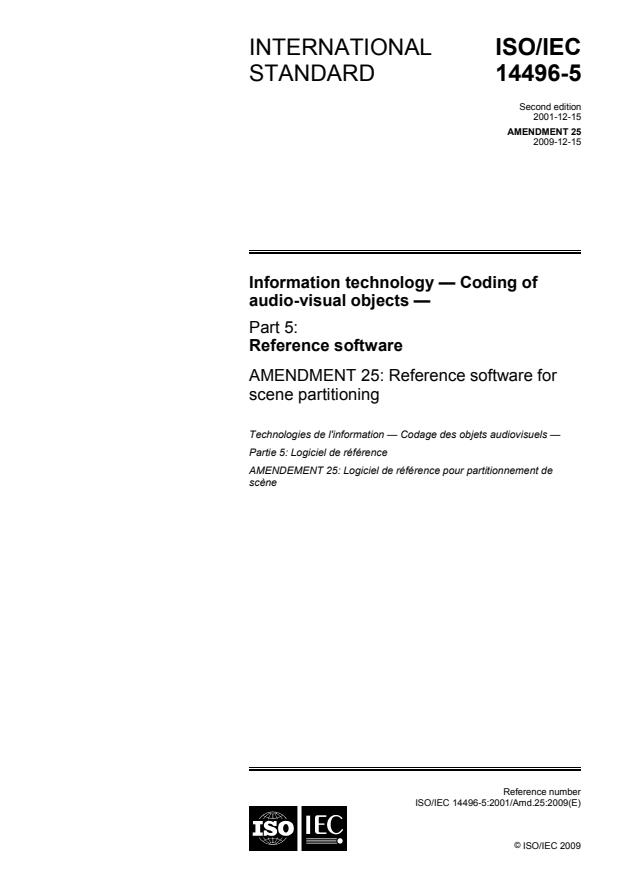
INTERNATIONAL ISO/IEC
STANDARD 14496-5
Second edition
2001-12-15
AMENDMENT 25
2009-12-15
Information technology — Coding of
audio-visual objects —
Part 5:
Reference software
AMENDMENT 25: Reference software for
scene partitioning
Technologies de l'information — Codage des objets audiovisuels —
Partie 5: Logiciel de référence
AMENDEMENT 25: Logiciel de référence pour partitionnement de
scène
Reference number
ISO/IEC 14496-5:2001/Amd.25:2009(E)
©
ISO/IEC 2009
ISO/IEC 14496-5:2001/Amd.25:2009(E)
PDF disclaimer
This PDF file may contain embedded typefaces. In accordance with Adobe's licensing policy, this file may be printed or viewed but
shall not be edited unless the typefaces which are embedded are licensed to and installed on the computer performing the editing. In
downloading this file, parties accept therein the responsibility of not infringing Adobe's licensing policy. The ISO Central Secretariat
accepts no liability in this area.
Adobe is a trademark of Adobe Systems Incorporated.
Details of the software products used to create this PDF file can be found in the General Info relative to the file; the PDF-creation
parameters were optimized for printing. Every care has been taken to ensure that the file is suitable for use by ISO member bodies. In
the unlikely event that a problem relating to it is found, please inform the Central Secretariat at the address given below.
© ISO/IEC 2009
All rights reserved. Unless otherwise specified, no part of this publication may be reproduced or utilized in any form or by any means,
electronic or mechanical, including photocopying and microfilm, without permission in writing from either ISO at the address below or
ISO's member body in the country of the requester.
ISO copyright office
Case postale 56 • CH-1211 Geneva 20
Tel. + 41 22 749 01 11
Fax + 41 22 749 09 47
E-mail copyright@iso.org
Web www.iso.org
Published in Switzerland
ii © ISO/IEC 2009 – All rights reserved
ISO/IEC 14496-5:2001/Amd.25:2009(E)
Foreword
ISO (the International Organization for Standardization) and IEC (the International Electrotechnical
Commission) form the specialized system for worldwide standardization. National bodies that are members of
ISO or IEC participate in the development of International Standards through technical committees
established by the respective organization to deal with particular fields of technical activity. ISO and IEC
technical committees collaborate in fields of mutual interest. Other international organizations, governmental
and non-governmental, in liaison with ISO and IEC, also ta
...
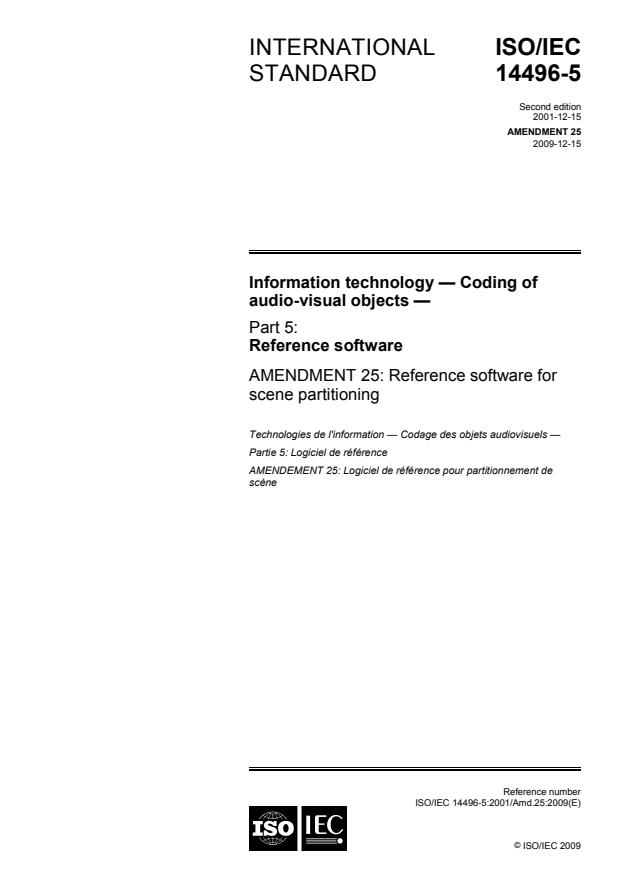
INTERNATIONAL ISO/IEC
STANDARD 14496-5
Second edition
2001-12-15
AMENDMENT 25
2009-12-15
Information technology — Coding of
audio-visual objects —
Part 5:
Reference software
AMENDMENT 25: Reference software for
scene partitioning
Technologies de l'information — Codage des objets audiovisuels —
Partie 5: Logiciel de référence
AMENDEMENT 25: Logiciel de référence pour partitionnement de
scène
Reference number
ISO/IEC 14496-5:2001/Amd.25:2009(E)
©
ISO/IEC 2009
ISO/IEC 14496-5:2001/Amd.25:2009(E)
PDF disclaimer
PDF files may contain embedded typefaces. In accordance with Adobe's licensing policy, such files may be printed or viewed but shall
not be edited unless the typefaces which are embedded are licensed to and installed on the computer performing the editing. In
downloading a PDF file, parties accept therein the responsibility of not infringing Adobe's licensing policy. The ISO Central Secretariat
accepts no liability in this area.
Adobe is a trademark of Adobe Systems Incorporated.
Details of the software products used to create the PDF file(s) constituting this document can be found in the General Info relative to
the file(s); the PDF-creation parameters were optimized for printing. Every care has been taken to ensure that the files are suitable for
use by ISO member bodies. In the unlikely event that a problem relating to them is found, please inform the Central Secretariat at the
address given below.
This CD-ROM contains:
1) the publication ISO/IEC 14496-5:2001/Amd.25:2009 in portable document format (PDF), which can
be viewed using Adobe® Acrobat® Reader;
2) reference software for scene partitioning.
Adobe and Acrobat are trademarks of Adobe Systems Incorporated.
© ISO/IEC 2009
All rights reserved. Unless required for installation or otherwise specified, no part of this CD-ROM may be reproduced, stored in a retrieval
system or transmitted in any form or by any means without prior permission from ISO. Requests for permission to reproduce this product
should be addressed to
ISO
...