

ISO 11218:2017
(Main)Aerospace — Cleanliness classification for hydraulic fluids
General Information
- Abstract
ISO 11218:2017 specifies a cleanliness classification for hydraulic fluids in aeroplanes, helicopters and space vehicles.
- Status
- Published
- Publication Date
- 15-Feb-2017
- Technical Committee
- ISO/TC 20/SC 10 - Aerospace fluid systems and components
- Drafting Committee
- ISO/TC 20/SC 10/WG 8 - Hydraulic fluids and fluid contamination control
- Current Stage
- 9093 - International Standard confirmed
- Start Date
- 14-Jun-2022
- Completion Date
- 29-Aug-2026
Buy Documents

ISO 11218:2017 - Aerospace -- Cleanliness classification for hydraulic fluids
ISO 11218:2017 - Aerospace — Cleanliness classification for hydraulic fluids/16/2017
Overview
ISO 11218:2017, Aerospace - Cleanliness classification for hydraulic fluids, specifies a cleanliness classification for hydraulic fluids used in aeroplanes, helicopters and space vehicles. Rather than creating a standalone new test method, ISO 11218:2017 adopts the contamination classification contained in SAE AS4059F as the de facto ISO classification and applies a specific modification: adding ISO 5884 as a referenced method for system sampling and particle measurement. The document provides the formal identification statement to show compliance and establishes consultation arrangements with SAE for future revisions.
Key Topics
- Scope: Cleanliness classification for hydraulic fluids across aerospace platforms (airborne and space).
- Adoption of AS4059F: Requirements and classification criteria are specified by SAE AS4059F; ISO 11218:2017 references AS4059F as the normative basis.
- Reference addition: ISO 5884 is added as a normative reference for methods of system sampling and measuring solid particle contamination.
- Compliance statement: The standard provides the required identification text: “Hydraulic fluid cleanliness classifications in accordance with ISO 11218.”
- Governance: ISO/TC 20/SC 10 is responsible for the standard and will be consulted on any AS4059F revisions.
Applications
ISO 11218:2017 is practical for organizations and activities that require controlled hydraulic-fluid cleanliness to ensure reliability and safety in aerospace systems:
- Aerospace manufacturers and integrators: specify cleanliness levels in procurement documents, supplier contracts and system design requirements.
- Maintenance, repair and overhaul (MRO) providers: establish acceptable cleanliness for replacement fluids, system flushing, and post-service verification.
- Quality and reliability engineers: implement contamination control programs, process audits and acceptance criteria for hydraulic systems.
- Test laboratories: apply ISO 5884 sampling and particle measurement methods alongside AS4059F classification for reporting cleanliness levels.
- Regulatory and certification bodies: reference ISO 11218:2017 to harmonize contamination control expectations across programmes.
Related Standards
- SAE AS4059F - Aerospace fluid power - Contamination classification for hydraulic fluids (normative basis adopted by ISO 11218:2017).
- ISO 5884 - Methods for system sampling and measuring the solid particle contamination of hydraulic fluids (added reference in ISO 11218:2017).
ISO 11218:2017 is essential when you need an internationally recognized cleanliness classification for hydraulic fluids in aerospace contexts, ensuring consistent contamination control, procurement clarity, and interoperability between manufacturers, suppliers and maintenance organizations. Keywords: ISO 11218:2017, hydraulic fluid cleanliness, aerospace hydraulic fluids, contamination classification, AS4059F, ISO 5884.
Relations
- Referred By
EN 6141:2020 - Aerospace series - Plug, protective, non-metallic, for EN 6123 fitting ends - Effective Date
- 09-Feb-2026
- Referred By
EN 6139:2020 - Aerospace series - Cap, protective, non-metallic, for EN 6123 fitting ends - Effective Date
- 09-Feb-2026
- Effective Date
- 09-Feb-2026
- Effective Date
- 04-Nov-2015
Buy Documents
ISO 11218:2017 - Aerospace -- Cleanliness classification for hydraulic fluids
ISO 11218:2017 - Aerospace — Cleanliness classification for hydraulic fluids/16/2017
Get Certified
Connect with accredited certification bodies for this standard

BUREAU VERITAS Certification Germany
Bureau Veritas certification in Germany.

Element Materials Technology
Materials testing and product certification.

AQMS Ltd.
AQMS provides ISO certification to SMEs across the UK.
Sponsored listings
Frequently Asked Questions
ISO 11218:2017 is a standard published by the International Organization for Standardization (ISO). Its full title is "Aerospace — Cleanliness classification for hydraulic fluids". This standard covers: ISO 11218:2017 specifies a cleanliness classification for hydraulic fluids in aeroplanes, helicopters and space vehicles.
ISO 11218:2017 specifies a cleanliness classification for hydraulic fluids in aeroplanes, helicopters and space vehicles.
ISO 11218:2017 is classified under the following ICS (International Classification for Standards) categories: 49.080 - Aerospace fluid systems and components. The ICS classification helps identify the subject area and facilitates finding related standards.
ISO 11218:2017 has the following relationships with other standards: It is inter standard links to EN 6141:2020, EN 6139:2020, EN 6140:2020, ISO 11218:1993. Understanding these relationships helps ensure you are using the most current and applicable version of the standard.
ISO 11218:2017 is available in PDF format for immediate download after purchase. The document can be added to your cart and obtained through the secure checkout process. Digital delivery ensures instant access to the complete standard document.
Standards Content (Sample)
INTERNATIONAL ISO
STANDARD 11218
Second edition
2017-02
Aerospace — Cleanliness classification
for hydraulic fluids
Aéronautique et espace — Classes de propreté des fluides
hydrauliques
Reference number
©
ISO 2017
© ISO 2017, Published in Switzerland
All rights reserved. Unless otherwise specified, no part of this publication may be reproduced or utilized otherwise in any form
or by any means, electronic or mechanical, including photocopying, or posting on the internet or an intranet, without prior
written permission. Permission can be requested from either ISO at the address below or ISO’s member body in the country of
the requester.
ISO copyright office
Ch. de Blandonnet 8 • CP 401
CH-1214 Vernier, Geneva, Switzerland
Tel. +41 22 749 01 11
Fax +41 22 749 09 47
copyright@iso.org
www.iso.org
ii © ISO 2017 – All rights reserved
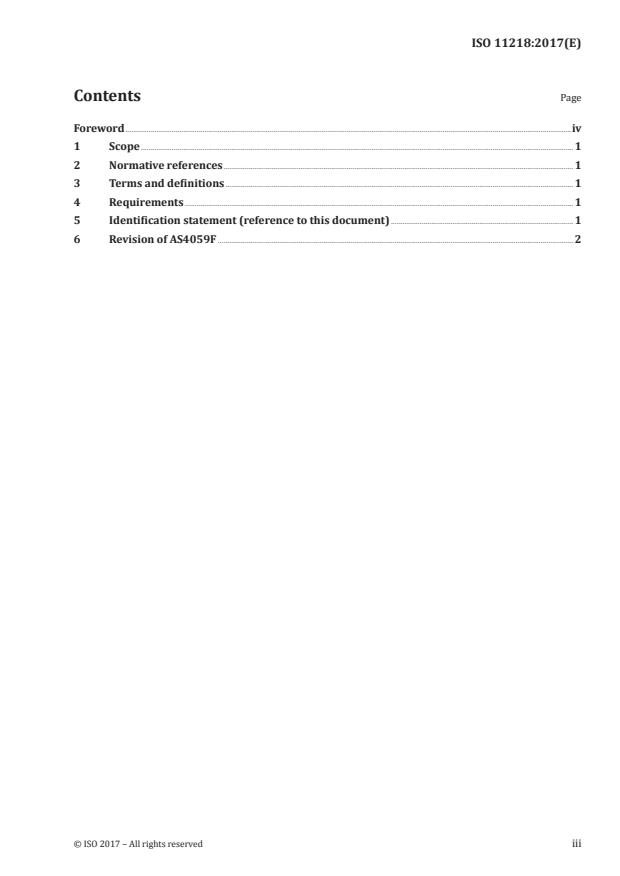
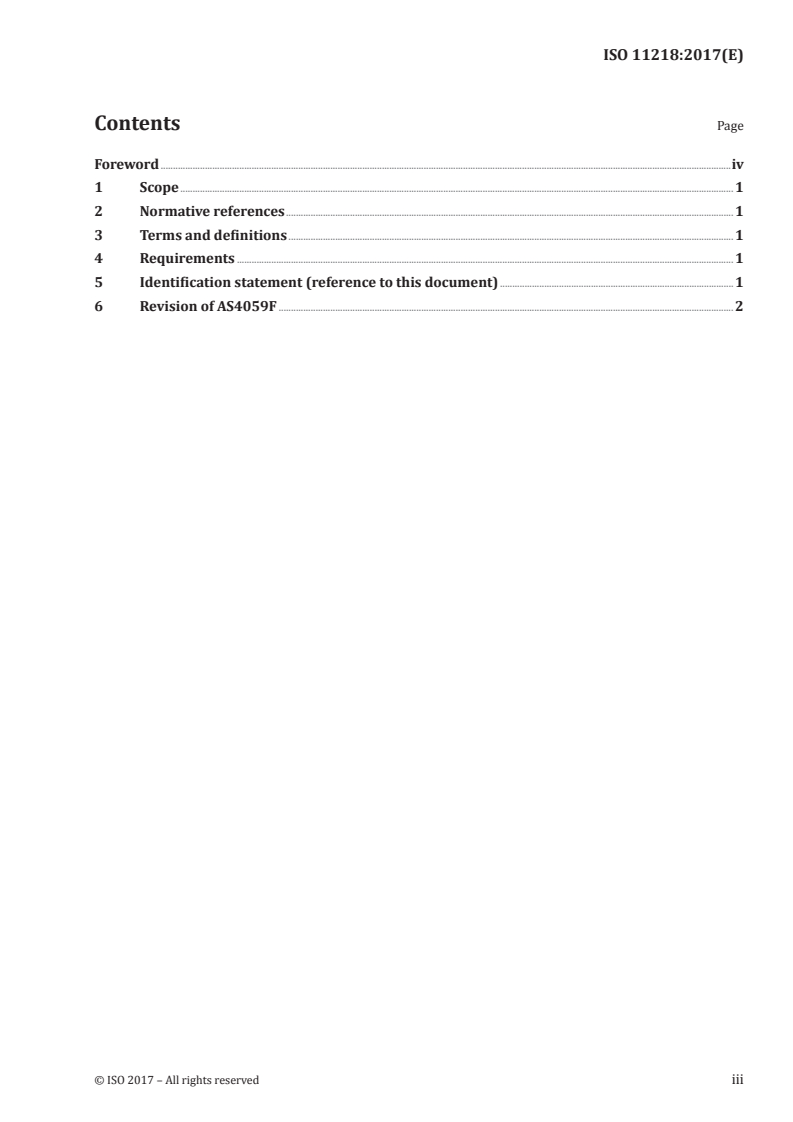
Contents Page
Foreword .iv
1 Scope . 1
2 Normative references . 1
3 Terms and definitions . 1
4 Requirements . 1
5 Identification statement (reference to this document) . 1
6 Revision of AS4059F . 2
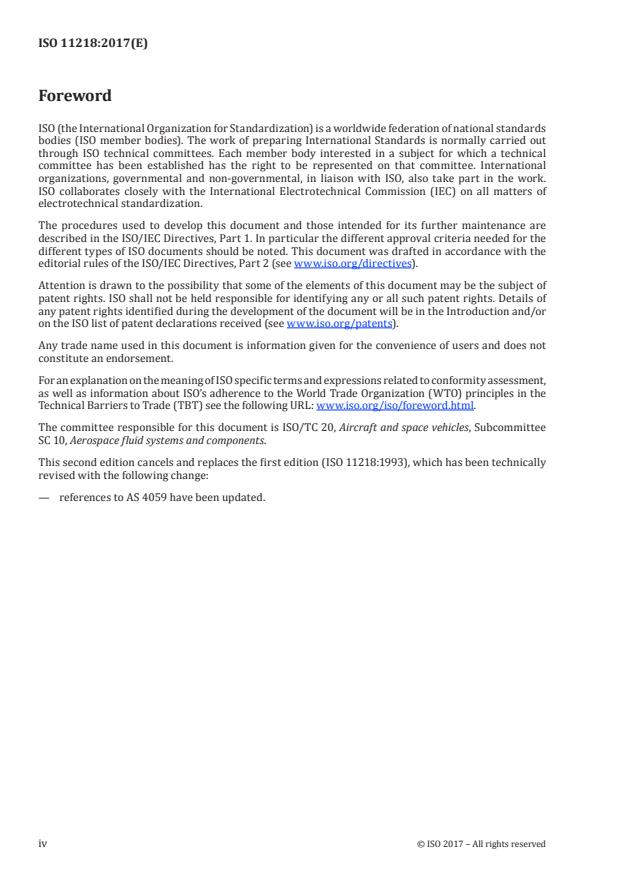
Foreword
ISO (the International Organization for Standardization) is a worldwide federation of national standards
bodies (ISO member bodies). The work of preparing International Standards is normally carried out
through ISO technical committees. Each member body interested in a subject for which a technical
committee has been established has the right to be represented on that committee. International
organizations, governmental and non-governmental, in liaison with ISO, also take part in the work.
ISO collaborates closely with the International Electrotechnical Commission (IEC) on all matters of
electrotechnical standardization.
The procedures used to develop this document and those intended for its further maintenance are
described in the ISO/IEC Directives, Part 1. In particular the different approval criteria needed for the
different types of ISO documents should be noted. This document was drafted in accordance with the
editorial rules of the ISO/IEC Directives, Pa
...
INTERNATIONAL ISO
STANDARD 11218
Second edition
2017-02
Aerospace — Cleanliness classification
for hydraulic fluids
Aéronautique et espace — Classes de propreté des fluides
hydrauliques
Reference number
©
ISO 2017
© ISO 2017, Published in Switzerland
All rights reserved. Unless otherwise specified, no part of this publication may be reproduced or utilized otherwise in any form
or by any means, electronic or mechanical, including photocopying, or posting on the internet or an intranet, without prior
written permission. Permission can be requested from either ISO at the address below or ISO’s member body in the country of
the requester.
ISO copyright office
Ch. de Blandonnet 8 • CP 401
CH-1214 Vernier, Geneva, Switzerland
Tel. +41 22 749 01 11
Fax +41 22 749 09 47
copyright@iso.org
www.iso.org
ii © ISO 2017 – All rights reserved
Contents Page
Foreword .iv
1 Scope . 1
2 Normative references . 1
3 Terms and definitions . 1
4 Requirements . 1
5 Identification statement (reference to this document) . 1
6 Revision of AS4059F . 2
Foreword
ISO (the International Organization for Standardization) is a worldwide federation of national standards
bodies (ISO member bodies). The work of preparing International Standards is normally carried out
through ISO technical committees. Each member body interested in a subject for which a technical
committee has been established has the right to be represented on that committee. International
organizations, governmental and non-governmental, in liaison with ISO, also take part in the work.
ISO collaborates closely with the International Electrotechnical Commission (IEC) on all matters of
electrotechnical standardization.
The procedures used to develop this document and those intended for its further maintenance are
described in the ISO/IEC Directives, Part 1. In particular the different approval criteria needed for the
different types of ISO documents should be noted. This document was drafted in accordance with the
editorial rules of the ISO/IEC Directives, Pa
...