

ISO 18566-6:2019
(Main)Building environment design — Design, test methods and control of hydronic radiant heating and cooling panel systems — Part 6: Input parameters for the energy calculation
General Information
- Abstract
This document establishes guidelines for the determination of input parameters for ceiling mounted radiant heating and cooling panels in relation to ISO 52031. The requirements specified by this document are applicable only to the components of the heating/cooling systems and the elements which are part of the heating/cooling panels and which are installed to provide heating and/or cooling. This document is applicable to water-based ceiling mounted radiant heating and cooling panels in residential, commercial and industrial buildings. The methods apply to systems mounted under the ceiling with an open air gap between the panels and the ceiling. This document also applies, as appropriate, to the use of fluids other than water as a heating or cooling medium. This document is also applicable for testing of systems. The methods do not apply to heated or chilled ceiling beams.
- Status
- Published
- Publication Date
- 21-Aug-2019
- Technical Committee
- ISO/TC 205 - Building environment design
- Drafting Committee
- ISO/TC 205/WG 8 - Radiant heating and cooling systems
- Current Stage
- 9093 - International Standard confirmed
- Start Date
- 06-Dec-2024
- Completion Date
- 29-Aug-2026
Buy Documents
ISO 18566-6:2019 - Building environment design -- Design, test methods and control of hydronic radiant heating and cooling panel systems
ISO 18566-6:2019 - Building environment design — Design, test methods and control of hydronic radiant heating and cooling panel systems — Part 6: Input parameters for the energy calculation/22/2019
Overview
ISO 18566-6:2019 is part of the ISO 18566 series and defines input parameters for energy calculations of ceiling-mounted hydronic radiant heating and cooling panel systems. It provides guidelines to determine product-specific data used in energy performance calculations in relation to ISO 52031. The standard applies to water-based, ceiling-mounted radiant panels with an open air gap (not embedded systems or chilled/heated ceiling beams) and is suitable for residential, commercial and industrial buildings. It is also applicable for laboratory testing of these systems.
Key topics and technical requirements
- Scope and applicability: Ceilings with an open air gap; water-based hydronic panels; also applicable to other heat-transfer fluids where appropriate. Excludes embedded systems and ceiling beams.
- Classification: Defines two product types used in calculation:
- Type 1: Systems with more than one covering layer above pipes.
- Type 2: Ceiling-mounted water-based radiator systems.
- Input parameter methods: Presents procedures to derive parameters required by ISO 52031, including:
- Determination of specific heat capacity of the emission system (used to correct default ISO 52031 values).
- Calculation of a correction coefficient (C) and a related Δθ correction for intermittent or dynamic behavior.
- Use of tabulated coefficients A and B (given per installation/orientation) to compute dynamic temperature variation corrections for heating and cooling cases. Example values in the standard include A ≈ 0.037 and B ≈ −1.45 for ceiling heating (with mirrored signs for cooling); a separate set (A ≈ 0.0034, B ≈ −0.11) is given for ceiling-mounted radiator systems.
- Formulas and worked example: Includes formulae (referenced as Formulae 6–9) and an informative calculation example (Annex A) demonstrating the method.
Practical applications and users
- HVAC and building services engineers: to supply accurate product input data for system energy modelling and compliance with ISO 52031.
- Manufacturers of radiant panels: to define and document product characteristic values and to support energy labels or datasheets.
- Test laboratories: to perform and report tests for energy calculation inputs and to verify dynamic behavior.
- Energy modelers and compliance assessors: to integrate corrected emission product parameters into building performance simulations and EPB assessments.
Related standards
- ISO 52031 - Method for calculation of system energy requirements and system efficiencies (space emission systems)
- ISO 18566 (all parts) - series for hydronic radiant panel systems
- ISO 11855 - embedded radiant heating and cooling systems
- EN 14037, EN 14240, ANSI/ASHRAE 138 - related product test and rating standards
Keywords: ISO 18566-6:2019, radiant heating and cooling panels, hydronic, ceiling mounted, input parameters, energy calculation, ISO 52031, water-based panels, specific heat capacity, testing, coefficients A and B.
Buy Documents
ISO 18566-6:2019 - Building environment design -- Design, test methods and control of hydronic radiant heating and cooling panel systems
ISO 18566-6:2019 - Building environment design — Design, test methods and control of hydronic radiant heating and cooling panel systems — Part 6: Input parameters for the energy calculation/22/2019
Get Certified
Connect with accredited certification bodies for this standard

DIBt (Deutsches Institut für Bautechnik)
German Institute for Building Technology.
DIN CERTCO
DIN Group product certification.

Aboma Certification B.V.
Specialized in construction, metal, and transport sectors.
Sponsored listings
Frequently Asked Questions
ISO 18566-6:2019 is a standard published by the International Organization for Standardization (ISO). Its full title is "Building environment design — Design, test methods and control of hydronic radiant heating and cooling panel systems — Part 6: Input parameters for the energy calculation". This standard covers: This document establishes guidelines for the determination of input parameters for ceiling mounted radiant heating and cooling panels in relation to ISO 52031. The requirements specified by this document are applicable only to the components of the heating/cooling systems and the elements which are part of the heating/cooling panels and which are installed to provide heating and/or cooling. This document is applicable to water-based ceiling mounted radiant heating and cooling panels in residential, commercial and industrial buildings. The methods apply to systems mounted under the ceiling with an open air gap between the panels and the ceiling. This document also applies, as appropriate, to the use of fluids other than water as a heating or cooling medium. This document is also applicable for testing of systems. The methods do not apply to heated or chilled ceiling beams.
This document establishes guidelines for the determination of input parameters for ceiling mounted radiant heating and cooling panels in relation to ISO 52031. The requirements specified by this document are applicable only to the components of the heating/cooling systems and the elements which are part of the heating/cooling panels and which are installed to provide heating and/or cooling. This document is applicable to water-based ceiling mounted radiant heating and cooling panels in residential, commercial and industrial buildings. The methods apply to systems mounted under the ceiling with an open air gap between the panels and the ceiling. This document also applies, as appropriate, to the use of fluids other than water as a heating or cooling medium. This document is also applicable for testing of systems. The methods do not apply to heated or chilled ceiling beams.
ISO 18566-6:2019 is classified under the following ICS (International Classification for Standards) categories: 91.040.01 - Buildings in general. The ICS classification helps identify the subject area and facilitates finding related standards.
ISO 18566-6:2019 is available in PDF format for immediate download after purchase. The document can be added to your cart and obtained through the secure checkout process. Digital delivery ensures instant access to the complete standard document.
Standards Content (Sample)
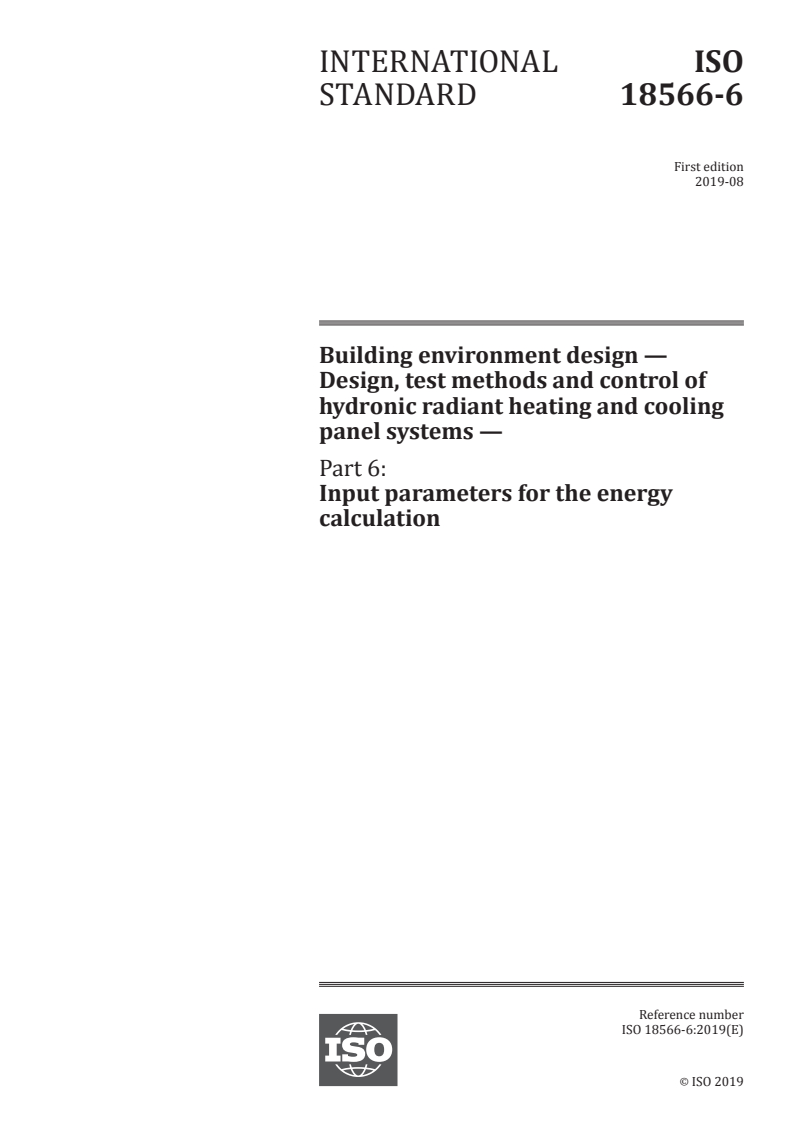
INTERNATIONAL ISO
STANDARD 18566-6
First edition
2019-08
Building environment design —
Design, test methods and control of
hydronic radiant heating and cooling
panel systems —
Part 6:
Input parameters for the energy
calculation
Reference number
©
ISO 2019
© ISO 2019
All rights reserved. Unless otherwise specified, or required in the context of its implementation, no part of this publication may
be reproduced or utilized otherwise in any form or by any means, electronic or mechanical, including photocopying, or posting
on the internet or an intranet, without prior written permission. Permission can be requested from either ISO at the address
below or ISO’s member body in the country of the requester.
ISO copyright office
CP 401 • Ch. de Blandonnet 8
CH-1214 Vernier, Geneva
Phone: +41 22 749 01 11
Fax: +41 22 749 09 47
Email: copyright@iso.org
Website: www.iso.org
Published in Switzerland
ii © ISO 2019 – All rights reserved
Contents Page
Foreword .iv
Introduction .v
1 Scope . 1
2 Normative references . 1
3 Terms and definitions . 1
4 Symbols and subscripts . 1
4.1 Symbols . 1
4.2 Subscripts . 2
5 Basic formula . 2
6 Determination of input parameters for the energy efficiency of heating and cooling
emission products . 3
6.1 Heating and cooling systems with more than one covering layer above the pipes
(Type 1) . 3
6.2 Ceiling mounted water-based radiator system (Type 2) . 4
Annex A (informative) Calculation example (Type 1) . 5
Bibliography . 6
Foreword
ISO (the International Organization for Standardization) is a worldwide federation of national standards
bodies (ISO member bodies). The work of preparing International Standards is normally carried out
through ISO technical committees. Each member body interested in a subject for which a technical
committee has been established has the right to be represented on that committee. International
organizations, governmental and non-governmental, in liaison with ISO, also take part in the work.
ISO collaborates closely with the International Electrotechnical Commission (IEC) on all matters of
electrotechnical standardization.
The procedures used to develop this document and those intended for its further maintenance are
described in the ISO/IEC Directives, Part 1. In particular, the different approval criteria needed for the
different types of ISO documents should be noted. This document was drafted in accordance with the
editorial rules of the ISO/IEC Directives, Part 2 (see www .iso .org/directives).
Attention is drawn to the possibility that some of the elements of this document may be the subject of
patent rights. ISO shall not be held responsible for identifying any or all such patent rights. Details of
any patent rights identified during the development of the document will be in the Introduction and/or
on the ISO list of patent declarations received (see www .iso .org/patents).
Any trade name used in this document is information given for the convenience of users and does not
constitute an endorsement.
For an explanation of the voluntary nature of standards, the meaning of ISO specific terms and
expressions related to conformity assessment, as well as information about ISO's adherence to the
World Trade Organization (WTO) principles in the Technical Barriers to Trade (TBT) see www .iso
.org/iso/foreword .html.
This document was prepared by Technical Committee ISO/TC 205, Building environment design.
A list of all parts in the ISO 18566 series can be found on the ISO website.
Any feedback or questions on this document should be directed to the user’s national standards body. A
complete listing of these bodies can be found at www .iso .org/members .html.
iv © ISO 2019 – All rights reserved
Introduction
The radiant heating and cooling system consists of heat emitting/absorbing, heat supply, distribution
and control systems. Typical applications are low temperature radiant heating and high temperature
radiant cooling. They are classified as embedded radiant heating and cooling systems and prefabricated
radiant heating and cooling panel systems.
While the ISO 11855 series is for embedded radiant heating and cooling systems without an open-
air gap, the ISO 18566 series is for radiant heating and cooling panel systems with an open air gap.
Because the system specifications for ISO 18566 are different from those of ISO 11855, it was necessary
to develop separate ISO standards regarding the design and test methods of the cooling and heating
capacity and control.
ISO 18566-1 specifies the comfort criteria, technical specifications and requirements which should be
considered in the manufacturing and installation of radiant heating and cooling systems. ISO 18566-2
provides the test facility and test method for heating and cooling capacity of ceiling mounted radiant
panels. ISO 18566-3 specifies the design considerations and design processes of ceiling mounted radiant
panels. ISO 18566-4 addresses the control of ceiling mounted radiant heating and cooling panels to
ensure the maximum performance which was intended in the design stage when the system is actually
being operated in a building. This document presents a determination method of input parameters for
1)
the energy efficiency of heating and cooling products in relation to ISO 52031.
ISO 18566 does not cover the panels that are embedded into the ceiling, wall or floor structure. This
document is partly based on EN 14240, EN 14037 and ASNI/ASHRAE Standard 138.
1) Under preparation. Stage at the time of publication: ISO/DIS 52031:—.
INTERNATIONAL STANDARD ISO 18566-6:2019(E)
Building environment design — Design, test methods and
control of hydronic radiant heating and cooling panel
systems —
Part 6:
Input parameters for the energy calculation
1 Scope
This document establishes guidelines for the determination of input parameters for ceiling mounted
radiant heating and cooling panels in relation to ISO 52031. The requirements specified by this
document are applicable only to the components of the heating/cooling systems and the elements
which are part of the heating/cooling panels and which are installed to provide heating and/or cooling.
This document is applicable to water-based ceiling mounted radiant heating and cooling panels in
residential, commercial and industrial buildings. The methods apply to systems mounted under the
ceiling with an open air gap between the panels and the ceiling.
This document also applies, as appropriate, to the use of fluids other than water as a heating or cooling
medium. This document is also applicable for testing of systems. The methods do not apply to heated or
chilled ceiling beams.
2 Normative references
The following documents are referred to in the text in such a way that some or all of their content
constitutes requirements of this document. For dated references, only the edition cited applies. For
undated references, the latest edition of the referenced document (including any amendme
...
INTERNATIONAL ISO
STANDARD 18566-6
First edition
2019-08
Building environment design —
Design, test methods and control of
hydronic radiant heating and cooling
panel systems —
Part 6:
Input parameters for the energy
calculation
Reference number
©
ISO 2019
© ISO 2019
All rights reserved. Unless otherwise specified, or required in the context of its implementation, no part of this publication may
be reproduced or utilized otherwise in any form or by any means, electronic or mechanical, including photocopying, or posting
on the internet or an intranet, without prior written permission. Permission can be requested from either ISO at the address
below or ISO’s member body in the country of the requester.
ISO copyright office
CP 401 • Ch. de Blandonnet 8
CH-1214 Vernier, Geneva
Phone: +41 22 749 01 11
Fax: +41 22 749 09 47
Email: copyright@iso.org
Website: www.iso.org
Published in Switzerland
ii © ISO 2019 – All rights reserved
Contents Page
Foreword .iv
Introduction .v
1 Scope . 1
2 Normative references . 1
3 Terms and definitions . 1
4 Symbols and subscripts . 1
4.1 Symbols . 1
4.2 Subscripts . 2
5 Basic formula . 2
6 Determination of input parameters for the energy efficiency of heating and cooling
emission products . 3
6.1 Heating and cooling systems with more than one covering layer above the pipes
(Type 1) . 3
6.2 Ceiling mounted water-based radiator system (Type 2) . 4
Annex A (informative) Calculation example (Type 1) . 5
Bibliography . 6
Foreword
ISO (the International Organization for Standardization) is a worldwide federation of national standards
bodies (ISO member bodies). The work of preparing International Standards is normally carried out
through ISO technical committees. Each member body interested in a subject for which a technical
committee has been established has the right to be represented on that committee. International
organizations, governmental and non-governmental, in liaison with ISO, also take part in the work.
ISO collaborates closely with the International Electrotechnical Commission (IEC) on all matters of
electrotechnical standardization.
The procedures used to develop this document and those intended for its further maintenance are
described in the ISO/IEC Directives, Part 1. In particular, the different approval criteria needed for the
different types of ISO documents should be noted. This document was drafted in accordance with the
editorial rules of the ISO/IEC Directives, Part 2 (see www .iso .org/directives).
Attention is drawn to the possibility that some of the elements of this document may be the subject of
patent rights. ISO shall not be held responsible for identifying any or all such patent rights. Details of
any patent rights identified during the development of the document will be in the Introduction and/or
on the ISO list of patent declarations received (see www .iso .org/patents).
Any trade name used in this document is information given for the convenience of users and does not
constitute an endorsement.
For an explanation of the voluntary nature of standards, the meaning of ISO specific terms and
expressions related to conformity assessment, as well as information about ISO's adherence to the
World Trade Organization (WTO) principles in the Technical Barriers to Trade (TBT) see www .iso
.org/iso/foreword .html.
This document was prepared by Technical Committee ISO/TC 205, Building environment design.
A list of all parts in the ISO 18566 series can be found on the ISO website.
Any feedback or questions on this document should be directed to the user’s national standards body. A
complete listing of these bodies can be found at www .iso .org/members .html.
iv © ISO 2019 – All rights reserved
Introduction
The radiant heating and cooling system consists of heat emitting/absorbing, heat supply, distribution
and control systems. Typical applications are low temperature radiant heating and high temperature
radiant cooling. They are classified as embedded radiant heating and cooling systems and prefabricated
radiant heating and cooling panel systems.
While the ISO 11855 series is for embedded radiant heating and cooling systems without an open-
air gap, the ISO 18566 series is for radiant heating and cooling panel systems with an open air gap.
Because the system specifications for ISO 18566 are different from those of ISO 11855, it was necessary
to develop separate ISO standards regarding the design and test methods of the cooling and heating
capacity and control.
ISO 18566-1 specifies the comfort criteria, technical specifications and requirements which should be
considered in the manufacturing and installation of radiant heating and cooling systems. ISO 18566-2
provides the test facility and test method for heating and cooling capacity of ceiling mounted radiant
panels. ISO 18566-3 specifies the design considerations and design processes of ceiling mounted radiant
panels. ISO 18566-4 addresses the control of ceiling mounted radiant heating and cooling panels to
ensure the maximum performance which was intended in the design stage when the system is actually
being operated in a building. This document presents a determination method of input parameters for
1)
the energy efficiency of heating and cooling products in relation to ISO 52031.
ISO 18566 does not cover the panels that are embedded into the ceiling, wall or floor structure. This
document is partly based on EN 14240, EN 14037 and ASNI/ASHRAE Standard 138.
1) Under preparation. Stage at the time of publication: ISO/DIS 52031:—.
INTERNATIONAL STANDARD ISO 18566-6:2019(E)
Building environment design — Design, test methods and
control of hydronic radiant heating and cooling panel
systems —
Part 6:
Input parameters for the energy calculation
1 Scope
This document establishes guidelines for the determination of input parameters for ceiling mounted
radiant heating and cooling panels in relation to ISO 52031. The requirements specified by this
document are applicable only to the components of the heating/cooling systems and the elements
which are part of the heating/cooling panels and which are installed to provide heating and/or cooling.
This document is applicable to water-based ceiling mounted radiant heating and cooling panels in
residential, commercial and industrial buildings. The methods apply to systems mounted under the
ceiling with an open air gap between the panels and the ceiling.
This document also applies, as appropriate, to the use of fluids other than water as a heating or cooling
medium. This document is also applicable for testing of systems. The methods do not apply to heated or
chilled ceiling beams.
2 Normative references
The following documents are referred to in the text in such a way that some or all of their content
constitutes requirements of this document. For dated references, only the edition cited applies. For
undated references, the latest edition of the referenced document (including any amendme
...