

ISO 6559:2024
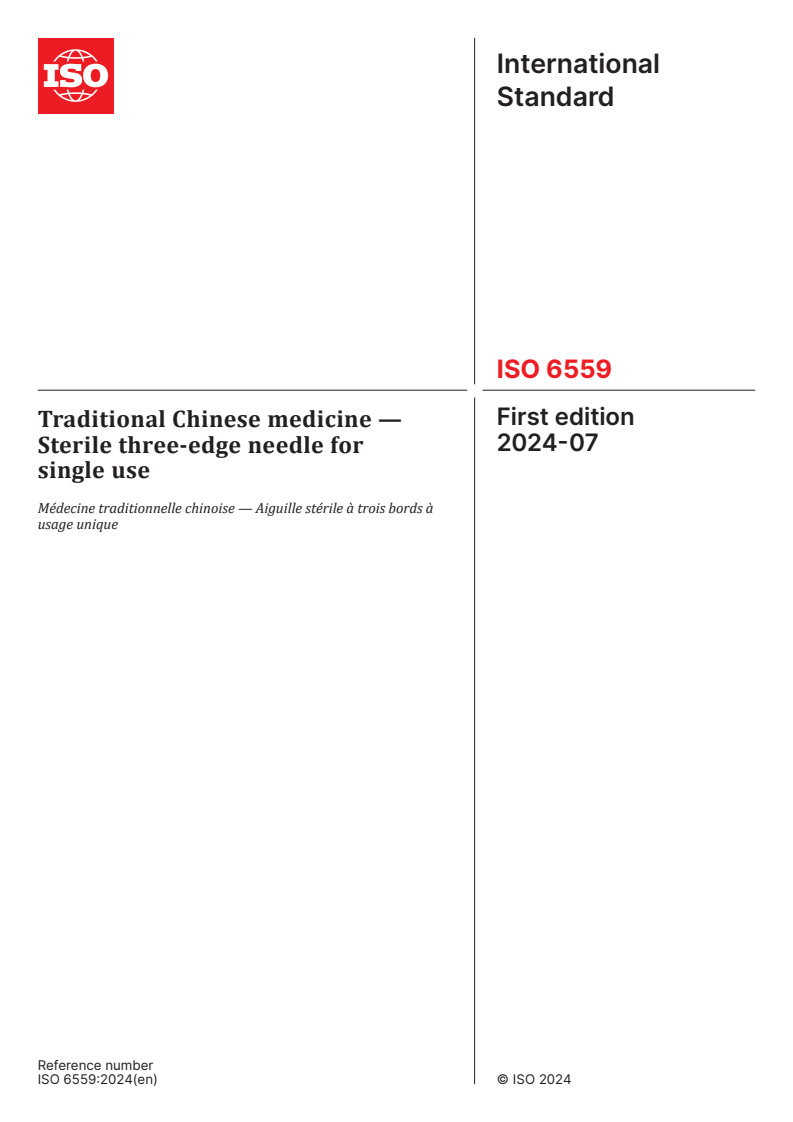
(Main)Traditional Chinese medicine — Sterile three-edge needle for single use
General Information
- Abstract
This document specifies the configuration, dimensions, parameters, requirements and test methods of a sterile three-edge needle for single use. It also specifies requirements for packaging, labelling, transit and storage. This document excludes requirements for the handle of a three-edge needle, which is structurally different from the body of a three-edge needle.
- Status
- Published
- Publication Date
- 30-Jun-2024
- Technical Committee
- ISO/TC 249 - Traditional Chinese medicine
- Drafting Committee
- ISO/TC 249 - Traditional Chinese medicine
- Current Stage
- 6060 - International Standard published
- Start Date
- 01-Jul-2024
- Due Date
- 07-May-2024
- Completion Date
- 01-Jul-2024
Overview
ISO 6559:2024 specifies requirements for the sterile three-edge needle for single use, a traditional Chinese medicine (TCM) acupuncture instrument. The standard covers the needle’s configuration, dimensions, material, mechanical and surface properties, sterility and biocompatibility requirements, test methods (including puncture force), and requirements for packaging, labelling, transit and storage. It explicitly excludes requirements for the handle, which differs structurally from the needle body.
Key topics and technical requirements
- Geometry & dimensions
- Whole length (L): 50–80 mm (±2.0 mm)
- Head length (L2): 1.5–20 mm
- Head widest diameter (d): 1–4.5 mm
- Body diameter (D): 1–3.5 mm (±0.30 mm)
- Material
- Must be stainless steel conforming to ISO 15510.
- Mechanical & surface properties
- Head hardness: ≥ 200 HV0.2 (test per ISO 6507‑1).
- Surface roughness (head): Ra ≤ 0.8 μm (test per ISO 21920‑3).
- Tip sharpness evaluated by puncture force (test method in Annex A).
- Corrosion resistance: no corrosion before expiry if storage conditions met (see ISO 17218:2014 Annex C).
- Sterility & biocompatibility
- Sterilization validation and process control per ISO 11135, ISO 11137‑1, ISO 17665 as applicable.
- Biological evaluation per the ISO 10993 series (Parts 1, 4, 10, 18) and ISO/TS 10993‑19.
- Appearance & quality
- Tip must be sharp, burr-free; head faces smooth and triangular in section; body straight and defect-free.
- Packaging & labelling
- Sterile primary packaging sealed with no foreign matter; packaging materials must maintain sterility and integrity.
- Requirements for primary and secondary labelling and transit/storage conditions are specified.
Applications and users
ISO 6559:2024 is intended for:
- Manufacturers of acupuncture and TCM devices - to design, produce and certify single‑use three-edge needles.
- Quality assurance and R&D teams - to set material, dimensional, mechanical and surface control plans.
- Regulatory and compliance professionals - to support technical files and conformity assessments.
- Testing laboratories - to perform hardness, roughness, puncture force and corrosion resistance tests.
- Healthcare procurement and clinical practitioners - to specify safe, single‑use sterile needles for three-edge needle therapy.
Related standards
Key referenced standards include ISO 15510, ISO 6507‑1, ISO 21920‑3, ISO 10993 series, ISO 11135, ISO 11137‑1, ISO 17665, ISO 17218, and ISO 15223‑1 (labelling symbols). These provide the testing and validation framework linked to ISO 6559.
Get Certified
Connect with accredited certification bodies for this standard

BSI Group
BSI (British Standards Institution) is the business standards company that helps organizations make excellence a habit.

TÜV Rheinland
TÜV Rheinland is a leading international provider of technical services.

TÜV SÜD
TÜV SÜD is a trusted partner of choice for safety, security and sustainability solutions.
Sponsored listings
Frequently Asked Questions
ISO 6559:2024 is a standard published by the International Organization for Standardization (ISO). Its full title is "Traditional Chinese medicine — Sterile three-edge needle for single use". This standard covers: This document specifies the configuration, dimensions, parameters, requirements and test methods of a sterile three-edge needle for single use. It also specifies requirements for packaging, labelling, transit and storage. This document excludes requirements for the handle of a three-edge needle, which is structurally different from the body of a three-edge needle.
This document specifies the configuration, dimensions, parameters, requirements and test methods of a sterile three-edge needle for single use. It also specifies requirements for packaging, labelling, transit and storage. This document excludes requirements for the handle of a three-edge needle, which is structurally different from the body of a three-edge needle.
ISO 6559:2024 is classified under the following ICS (International Classification for Standards) categories: 11.040.25 - Syringes, needles an catheters. The ICS classification helps identify the subject area and facilitates finding related standards.
ISO 6559:2024 is available in PDF format for immediate download after purchase. The document can be added to your cart and obtained through the secure checkout process. Digital delivery ensures instant access to the complete standard document.
Standards Content (Sample)
International
Standard
ISO 6559
First edition
Traditional Chinese medicine —
2024-07
Sterile three-edge needle for
single use
Médecine traditionnelle chinoise — Aiguille stérile à trois bords à
usage unique
Reference number
© ISO 2024
All rights reserved. Unless otherwise specified, or required in the context of its implementation, no part of this publication may
be reproduced or utilized otherwise in any form or by any means, electronic or mechanical, including photocopying, or posting on
the internet or an intranet, without prior written permission. Permission can be requested from either ISO at the address below
or ISO’s member body in the country of the requester.
ISO copyright office
CP 401 • Ch. de Blandonnet 8
CH-1214 Vernier, Geneva
Phone: +41 22 749 01 11
Email: copyright@iso.org
Website: www.iso.org
Published in Switzerland
ii
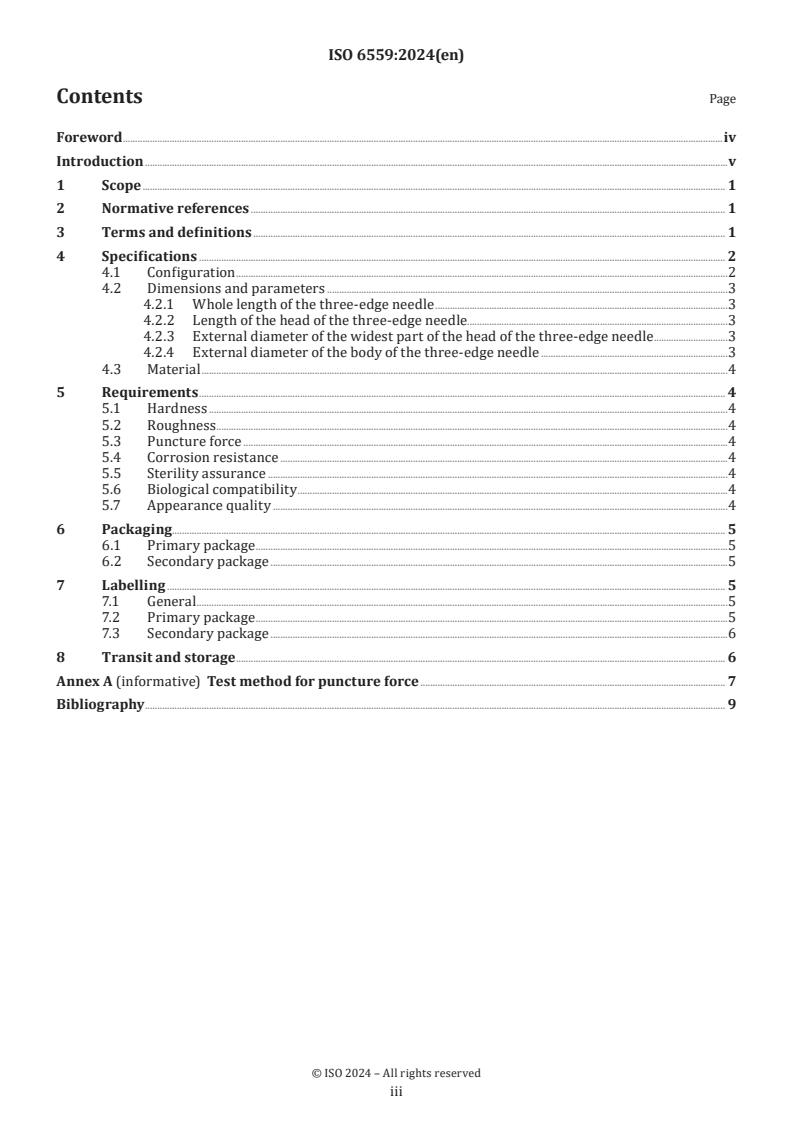
Contents Page
Foreword .iv
Introduction .v
1 Scope . 1
2 Normative references . 1
3 Terms and definitions . 1
4 Specifications . 2
4.1 Configuration .2
4.2 Dimensions and parameters .3
4.2.1 Whole length of the three-edge needle .3
4.2.2 Length of the head of the three-edge needle.3
4.2.3 External diameter of the widest part of the head of the three-edge needle .3
4.2.4 External diameter of the body of the three-edge needle .3
4.3 Material .4
5 Requirements . 4
5.1 Hardness .4
5.2 Roughness .4
5.3 Puncture force .4
5.4 Corrosion resistance .4
5.5 Sterility assurance .4
5.6 Biological compatibility .4
5.7 Appearance quality .4
6 Packaging. 5
6.1 Primary package .5
6.2 Secondary package .5
7 Labelling . 5
7.1 General .5
7.2 Primary package .5
7.3 Secondary package .6
8 Transit and storage . 6
Annex A (informative) Test method for puncture force . 7
Bibliography . 9
iii
Foreword
ISO (the International Organization for Standardization) is a worldwide federation of national standards
bodies (ISO member bodies). The work of preparing International Standards is normally carried out through
ISO technical committees. Each member body interested in a subject for which a technical committee
has been established has the right to be represented on that committee. International organizations,
governmental and non-governmental, in liaison with ISO, also take part in the work. ISO collaborates closely
with the International Electrotechnical Commission (IEC) on all matters of electrotechnical standardization.
The procedures used to develop this document and those intended for its further maintenance are described
in the ISO/IEC Directives, Part 1. In particular, the different approval criteria needed for the different types
of ISO document should be noted. This document was drafted in accordance with the editorial rules of the
ISO/IEC Directives, Part 2 (see www.iso.org/directives).
ISO draws attention to the possibility that the implementation of this document may involve the use of (a)
patent(s). ISO takes no position concerning the evidence, validity or applicability of any claimed patent
rights in respect thereof. As of the date of publication of this document, ISO had not received notice of (a)
patent(s) which may be required to implement this document. However, implementers are cautioned that
this may not represent the latest information, which may be obtained from the patent database available at
www.iso.org/patents. ISO shall not be held responsible for identifying any or all such patent rights.
Any trade name used in this document is information given for the convenience of users and does not
constitute an endorsement.
For an explanation of the voluntary nature of standards, the meaning of ISO specific terms and expressions
related to conformity assessment, as well as information about ISO's adherence to the World Trade
Organization (WTO) principles in the Technical Barriers to Trade (TBT), see www.iso.org/iso/foreword.html.
This document was prepared by Technical Committee ISO/TC 249, Traditional Chinese medicine.
Any feedback or questions on this document should be directed to the user’s national standards body. A
complete listing of these bodies can be found at www.iso.org/members.html.
iv
Introduction
Originating in ancient China, the three-edge needle is one of major types of acupuncture needles. The
three-edge needle was originally called "Feng Zhen", which literally means “sharp-edge needle”. Its clinical
application for the specific indications was earliest recorded in Huangdi’s Canon of Medicine, which is the
earliest writing about traditional Chinese medicine. The therapy which applies the three-edge needle is
called three-edge needle therapy.
The three-edge needle has a special needle body structure like an arrow head with three sharp edges. This
structure was designed in order to meet specific clinical requirements, such as bloodletting and draining
abscesses mainly by the manipulation methods including shallow pricking, deep pricking, multi-point shallow
pricking, pricking in and edge cutting out, and needle scratching. Of the manipulation methods, pricking in
and edge cutting out (mainly for breaking the fibrous tissue) and needle scratching (leaving marks on skin)
can only be practiced by the three-edge needle, which cannot be replaced by other bloodletting medical
instruments such as the blood point lancet and the syringe.
It is due to the special structure of the three-edge needle that the practitioner can bleed the clinically
required blood amount by controlling the depth instead of repeated pricking which induces pain in patients.
This structural advantage of the three-edge needle outweighs the blood point lancet and the syringe both in
clinical function, such as draining an abscess, and in obtaining a clinically required amount of blood.
Since the three-edge needle is an invasive medical instrument, it is important to use the sterile needle only
once. The quality of the three-edge needle has a direct impact on the safety of patients and the quality of the
therapy. Therefore, this document specifies the technical parameters of the sterile three-edge needle for
single use to ensure its quality and safety.
v
International Standard ISO 6559:2024(en)
Traditional Chinese medicine — Sterile three-edge needle for
single use
1 Scope
This document specifies the configuration, dimensions, parameters, requirements and test methods of a
sterile three-edge needle for single use. It also specifies requirements for packaging, labelling, transit and
storage.
This document excludes requirements for the handle of a three-edge needle, which is structurally different
from the body of a three-edge needle.
2 Normative references
The following documents are referred to in the text in such a way that some or all of their content constitutes
requirements of this document. For dated references, only the edition cited applies. For undated references,
the latest edition of the referenced document (including any amendments) applies.
ISO 6507-1, Metallic materials — Vickers hardness test — Part 1: Test method
ISO 10993-1, Biological evaluation of medical devices — Part 1: Evaluation and testing within a risk
management proc
...