


ISO 12232:2019/Amd 1:2020
(Amendment)Photography - Digital still cameras - Determination of exposure index, ISO speed ratings, standard output sensitivity, and recommended exposure index - Amendment 1: Determination of encoding-relative sensitivity (ERS)
Photography - Digital still cameras - Determination of exposure index, ISO speed ratings, standard output sensitivity, and recommended exposure index - Amendment 1: Determination of encoding-relative sensitivity (ERS)
Photographie — Appareils de prises de vue numériques — Détermination de l'indice d'exposition, des régimes de vitesse ISO, de la sensibilité normale de sortie et de l'indice d'exposition recommandé — Amendement 1: Détermination de la sensibilité relative au codage (ERS)
General Information
- Status
- Published
- Publication Date
- 25-Jun-2020
- Technical Committee
- ISO/TC 42 - Photography
- Drafting Committee
- ISO/TC 42/WG 18 - Electronic still picture imaging
- Current Stage
- 6060 - International Standard published
- Start Date
- 26-Jun-2020
- Due Date
- 02-Aug-2022
- Completion Date
- 26-Jun-2020
Relations
- Consolidated By
ISO/FDIS 15236-3 - Steel cord conveyor belts - Part 3: Special safety requirements for belts for use in underground installations - Effective Date
- 16-Dec-2023
- Effective Date
- 27-Nov-2021
Overview
ISO 12232:2019/Amd 1:2020 is an important international standard focused on digital still cameras and the precise determination of exposure index, ISO speed ratings, standard output sensitivity, and recommended exposure index. This amendment introduces the determination of encoding-relative sensitivity (ERS)-a novel parameter critical for accurately calibrating and interpreting camera exposures in digital imaging workflows.
Developed by ISO Technical Committee ISO/TC 42 on Photography, this standard facilitates uniformity and reliability in measuring camera sensitivity and image quality. The ERS value enhances the ability to correlate sensor exposure to processed image encoding, providing enhanced control and reproducibility in photography, scientific imaging, and archiving.
Key Topics
- Encoding-Relative Sensitivity (ERS): ERS represents the camera’s focal plane exposure that corresponds to processed image values with CIELAB Lab* coordinates of {50, 0, 0} (L* = 50). It links exposure levels to the actual encoded image data, enabling accurate calibration of processed files.
- Exposure Index and ISO Speed Ratings: Defines relationships between exposure and signal level, signal-to-noise ratios, and clipping thresholds, which correlate to expected image quality depending on camera sensitivity settings.
- Standard Output Sensitivity: Establishes parameters for how images are processed from sensor data to output-referred images, differentiating scene-referred and output-referred processing states.
- Application to Raw and Processed Files: ERS determination is applicable when cameras record processed images or when raw files are processed, allowing metadata integration and user control at the raw processing stage.
- Calculation Method: ERS is calculated as the ratio of a constant (10 lux·seconds) to the exposure required to reach the L* = 50 encoding level. This formalized method improves consistency across different cameras and processing pipelines.
- Metadata Reporting: ERS values should be embedded in image metadata alongside white balance and exposure compensation information to ensure traceability and reproducibility.
Applications
- Professional Photography: Enables photographers and manufacturers to standardize and optimize camera exposure settings ensuring consistent image quality and accurate tone reproduction.
- Scientific and Technical Imaging: Provides precise exposure calibration for analyses requiring absolute scene luminance and colorimetry, crucial in scientific research, quality control, and engineering.
- Digital Archiving and Cultural Heritage: Assists archiving professionals by improving the fidelity and consistency of digital captures of reflective originals and other heritage materials, aligning with ISO/TR 19263-1 and ISO/TS 19264-1 best practices.
- Raw Image Processing Software: Enhances software ability to display and adjust ERS values during raw file development, providing users greater control over exposure interpretation and adjustments.
- Camera Manufacturers: Supports integration of ERS determination in camera firmware to better align ISO sensitivity settings with actual camera output and processing states.
Related Standards
- ISO/TR 17321-3: Graphic technology and photography - Colour characterization of digital still cameras with a focus on scene-referred imaging modes.
- ISO/TR 19263-1: Photography archiving systems - Best practices for digital image capture of cultural heritage material.
- ISO/TS 19264-1: Archiving systems - Image quality analysis for reflective originals ensuring archival quality and standards compliance.
Summary
ISO 12232:2019/Amd 1:2020 introduces encoding-relative sensitivity (ERS) as a critical advancement in digital camera exposure measurement, linking sensor exposure directly to processed image encoding values. This allows for more precise, reproducible, and standardized assessments of camera sensitivity and image quality. It is a valuable tool for photographers, imaging professionals, archivers, and manufacturers who demand high fidelity and consistency in digital image capture and processing.
By adopting this amendment, stakeholders enhance their ability to achieve accurate exposure calibration, support scientific imaging needs, and ensure archival integrity in digital photography workflows. This standard acts as a cornerstone for modern photography and imaging quality control in a digital era.

ISO 12232:2019/Amd 1:2020 - Photography — Digital still cameras — Determination of exposure index, ISO speed ratings, standard output sensitivity, and recommended exposure index — Amendment 1: Determination of encoding-relative sensitivity (ERS) Released:6/26/2020
Frequently Asked Questions
ISO 12232:2019/Amd 1:2020 is a standard published by the International Organization for Standardization (ISO). Its full title is "Photography - Digital still cameras - Determination of exposure index, ISO speed ratings, standard output sensitivity, and recommended exposure index - Amendment 1: Determination of encoding-relative sensitivity (ERS)". This standard covers: Photography - Digital still cameras - Determination of exposure index, ISO speed ratings, standard output sensitivity, and recommended exposure index - Amendment 1: Determination of encoding-relative sensitivity (ERS)
Photography - Digital still cameras - Determination of exposure index, ISO speed ratings, standard output sensitivity, and recommended exposure index - Amendment 1: Determination of encoding-relative sensitivity (ERS)
ISO 12232:2019/Amd 1:2020 is classified under the following ICS (International Classification for Standards) categories: 37.040.10 - Photographic equipment. Projectors. The ICS classification helps identify the subject area and facilitates finding related standards.
ISO 12232:2019/Amd 1:2020 has the following relationships with other standards: It is inter standard links to ISO/FDIS 15236-3, ISO 12232:2019. Understanding these relationships helps ensure you are using the most current and applicable version of the standard.
ISO 12232:2019/Amd 1:2020 is available in PDF format for immediate download after purchase. The document can be added to your cart and obtained through the secure checkout process. Digital delivery ensures instant access to the complete standard document.
Standards Content (Sample)
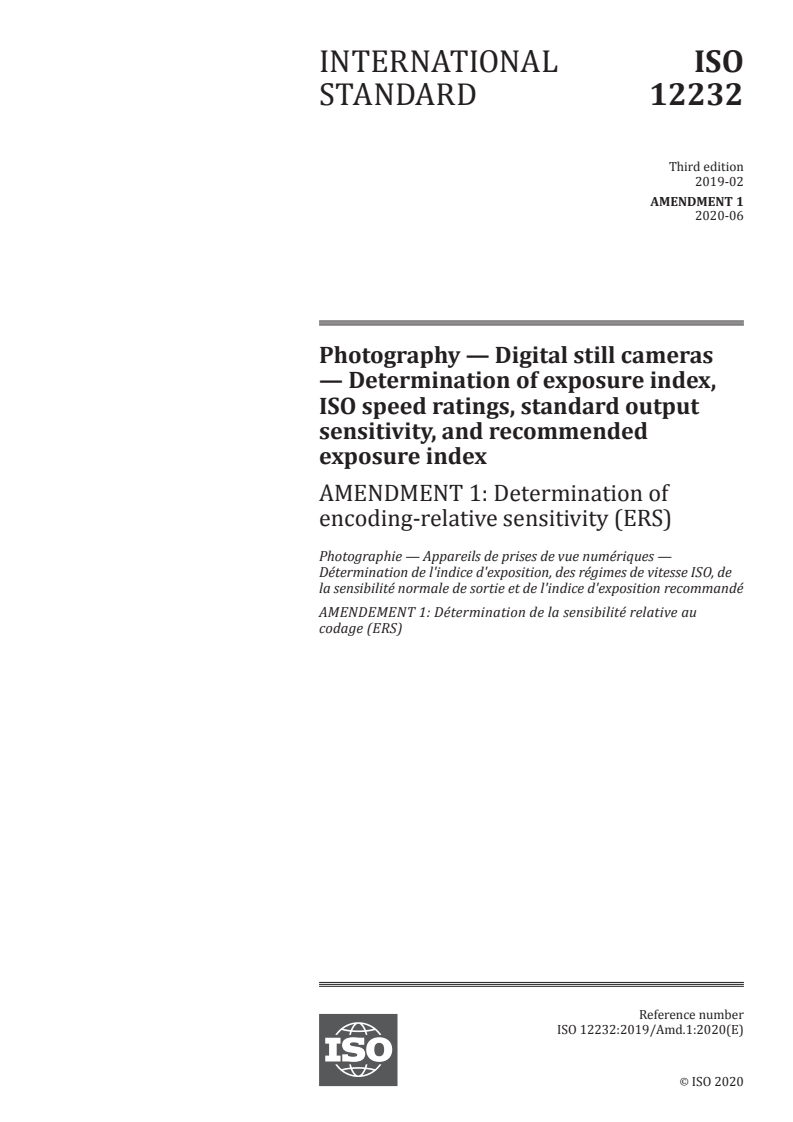
INTERNATIONAL ISO
STANDARD 12232
Third edition
2019-02
AMENDMENT 1
2020-06
Photography — Digital still cameras
— Determination of exposure index,
ISO speed ratings, standard output
sensitivity, and recommended
exposure index
AMENDMENT 1: Determination of
encoding-relative sensitivity (ERS)
Photographie — Appareils de prises de vue numériques —
Détermination de l'indice d'exposition, des régimes de vitesse ISO, de
la sensibilité normale de sortie et de l'indice d'exposition recommandé
AMENDEMENT 1: Détermination de la sensibilité relative au
codage (ERS)
Reference number
ISO 12232:2019/Amd.1:2020(E)
©
ISO 2020
ISO 12232:2019/Amd.1:2020(E)
© ISO 2020
All rights reserved. Unless otherwise specified, or required in the context of its implementation, no part of this publication may
be reproduced or utilized otherwise in any form or by any means, electronic or mechanical, including photocopying, or posting
on the internet or an intranet, without prior written permission. Permission can be requested from either ISO at the address
below or ISO’s member body in the country of the requester.
ISO copyright office
CP 401 • Ch. de Blandonnet 8
CH-1214 Vernier, Geneva
Phone: +41 22 749 01 11
Email: copyright@iso.org
Website: www.iso.org
Published in Switzerland
ii © ISO 2020 – All rights reserved
ISO 12232:2019/Amd.1:2020(E)
Foreword
ISO (the International Organization for Standardization) is a worldwide federation of national standards
bodies (ISO member bodies). The work of preparing International Standards is normally carried out
through ISO technical committees. Each member body interested in a subject for which a technical
committee has been established has the right to be represented on that committee. International
organizations, governmental and non-governmental, in liaison with ISO, also take part in the work.
ISO collaborates closely with the International Electrotechnical Commission (IEC) on all matters of
electrotechnical standardization.
The procedures used to develop this document and those intended for its further maintenance are
described in the ISO/IEC Directives, Part 1. In particular, the different approval criteria needed for the
different types of ISO documents should be noted. This document was drafted in accordance with the
editorial rules of the ISO/IEC Directives, Part 2 (see www .iso .org/ directives).
Attention is drawn to the possibility that some of the elements of this document may be the subject of
patent rights. ISO shall not be held responsible for identifying any or all such patent rights. Details of
any patent rights identified during the development of the document will be in the Introduction and/or
on the ISO list of patent declarations received (see www .iso .org/ patents).
Any trade name used in this document is information given for the convenience of users and does not
constitute an endorsement.
For an explanation of the voluntary nature of standards, the meaning of ISO specific terms and
expressions related to conformity assessment, as well as information about ISO's adherence to the
World Trade Organization (WTO) principles in the Technical Barriers to Trade (TBT), see www .iso .org/
is o/ f or ewor d . ht m l .
This document was prepared by Technical Committee ISO/TC 42, Photography.
Any feedback or questions on this document should be directed to the user’s national standards body. A
complete listing of these bodies can be found at www .iso .org/ members .html.
ISO 12232:2019/Amd.1:2020(E)
Photography — Digital still cameras — Determination
of exposure index, ISO speed ratings, standard output
sensitivity, and recommended exposure index
AMENDMENT 1: Determination of encoding-relative
sensitivity (ERS)
Clause 7, after the 2nd paragraph
Add the following NOTE:
"NOTE For information related to the determination of encoding-relative sensitivity (ERS), see
Annex E."
Annex E
Add the following Annex E:
ISO 12232:2019/Amd.1:2020(E)
Annex E
(informative)
Determination of encoding‐relative sensitivity (ERS)
E.1 General
E.1.1 Purpose and use cases of the ERS
The ERS recorded in an image file can be used for calibrating exposures, to provide information about
the exposures used to capture an image and to determine absolute scene luminance and colorimetry
estimates for scientific, technical, and archi
...
Questions, Comments and Discussion
Ask us and Technical Secretary will try to provide an answer. You can facilitate discussion about the standard in here.
Loading comments...