


ISO/FDIS 15236-3
(Main)Steel cord conveyor belts — Part 3: Special safety requirements for belts for use in underground installations
Steel cord conveyor belts — Part 3: Special safety requirements for belts for use in underground installations
ISO 15236-3:2017 specifies the performance and constructional requirements applicable to conveyor belts for underground mining having steel cords in the longitudinal direction as reinforcement. The requirements for design and construction apply to the design of single belts, as well as the design of complete type series such as those covered in ISO 15236‑2. Steel cord belts in accordance with this document are intended for use underground in coal mines and in other applications where the highest demands for safety against fire and explosion hazards have to be complied with. NOTE At present, the requirements can only be met by the use of compounds based on chloroprene rubber for the covers, as well as for the bonding rubber.
Courroies transporteuses à câbles d'acier — Partie 3: Exigences de sécurité particulières aux courroies utilisées dans des installations souterraines
ISO 15236-3:2017 spécifie les exigences relatives aux performances et à la construction applicables aux courroies transporteuses à câbles d'acier, placés dans le sens longitudinal en tant qu'armature, pour utilisation dans les mines souterraines. Les exigences de conception et de construction s'appliquent à la conception des courroies simples ainsi qu'à la conception des séries de courroies de type complet, telles que couvertes par l'ISO 15236‑2. Les courroies à câbles d'acier conformes au présent document sont prévues pour des usages souterrains dans les houillères et autres applications où des demandes plus exigeantes de sécurité contre les risques d'incendie et d'explosion sont à respecter. NOTE Actuellement, seule l'utilisation de mélanges à base de caoutchouc chloroprène pour les revêtements et pour la gomme de liaison permet de satisfaire aux exigences.
General Information
- Status
- Not Published
- Technical Committee
- ISO/TC 41/SC 3 - Conveyor belts
- Drafting Committee
- ISO/TC 41/SC 3 - Conveyor belts
- Current Stage
- 5060 - Close of voting Proof returned by Secretariat
- Start Date
- 04-Nov-2025
- Completion Date
- 03-Nov-2025
Relations
- Effective Date
- 12-Feb-2026
- Effective Date
- 16-Dec-2023
- Effective Date
- 09-Dec-2023
Overview
ISO/FDIS 15236-3:2025 is an international standard focused on steel cord conveyor belts designed specifically for underground installations, including coal mines and other hazardous environments. This part of the ISO 15236 series emphasizes special safety requirements tailored to conveyor belts reinforced with steel cords running longitudinally. The standard sets stringent performance and construction criteria to address fire and explosion risks common in underground mining operations.
Conveyor belts complying with this document are engineered to meet the highest safety demands through the use of chloroprene rubber compounds for both covers and bonding rubber, ensuring durability and resistance to hazardous conditions. ISO/FDIS 15236-3 is essential for manufacturers and end-users seeking to deploy safe, reliable conveyor systems in underground environments.
Key Topics
- Belt Design and Construction: Specifies design parameters for steel cord conveyor belts including belt width, edge width, steel cord pitch, and belt thickness. The document also details the design of single belts and complete type series as referenced in ISO 15236-2.
- Mechanical Requirements: Establishes criteria for breaking strength, cord pull-out force, adhesion quality, and safety performance. Emphasizes mechanical integrity under underground operational stresses.
- Material Compounds: Mandates the use of chloroprene rubber compounds for covers and bonding rubber to ensure compliance with fire resistance and explosion hazard safety.
- Safety Criteria: Introduces additional safety requirements critical for underground installations where high fire and explosion hazards exist.
- Testing and Sampling: Provides guidelines on sampling methods and tests such as tensile strength, abrasion resistance, adhesion strength, and troughability to validate belt performance.
- Marking and Ordering: Details belt designation, marking, and ordering data essential for traceability and quality assurance.
- Transverse Reinforcements: Discusses the use of breakers and wefts to protect longitudinal cords and improve belt durability and flexibility.
Applications
ISO/FDIS 15236-3 applies primarily to underground mining environments where conveyor belts transport coal or other materials through potentially hazardous atmospheres. Its robust safety requirements make it ideal for:
- Coal mining conveyor systems requiring enhanced fire and explosion resistance.
- Hazardous underground installations where conveyor belts face strict regulatory safety standards.
- Mining and mineral industries aiming to improve safety and reliability in their conveyor belt operations.
- Manufacturers of steel cord conveyor belts tasked with producing belts meeting comprehensive fire and mechanical safety criteria.
- Safety inspectors and regulatory bodies verifying compliance of conveyor belts used in underground mining infrastructure.
Related Standards
- ISO 15236-2: Specifies preferred belt types and general design guidelines for steel cord conveyor belts.
- ISO 7590:2018: Provides methods for determining total thickness and cover thickness of steel cord conveyor belts.
- ISO 7622-2: Specifies longitudinal traction testing for tensile strength measurement of belts.
- ISO 7623: Details tests for cord-to-coating bond strength initially and after thermal treatment.
- ISO 8094: Defines adhesion strength tests for the cover to carcass bonding.
- EN 13827:2003: Standard for determining lateral and vertical displacement of steel cords within conveyor belts.
- EN 14973:2006: Covers electrical and flammability safety requirements for conveyor belts in underground installations.
Practical Value
Implementing ISO/FDIS 15236-3 ensures conveyor belts used underground meet rigorous fire safety, mechanical performance, and durability standards, reducing the risk of operational failures and hazards in mining environments. This standard supports industry best practices for:
- Enhancing worker safety by mitigating fire and explosion risks.
- Improving belt longevity and resistance to underground environmental challenges.
- Facilitating compliance with national and international mining safety regulations.
- Enabling consistent quality control and performance verification through standardized testing.
- Supporting sustainable mining operations with safer material handling systems.
By adhering to this standard, stakeholders benefit from safer, more reliable conveyor belt installation and maintenance practices tailored to the unique challenges of underground mining operations.
Buy Documents


ISO/FDIS 15236-3 - Steel cord conveyor belts — Part 3: Special safety requirements for belts for use in underground installations Released:25. 08. 2025



REDLINE ISO/FDIS 15236-3 - Steel cord conveyor belts — Part 3: Special safety requirements for belts for use in underground installations Released:25. 08. 2025

ISO/FDIS 15236-3 - Courroies transporteuses à câbles d'acier — Partie 3: Exigences de sécurité particulières aux courroies utilisées dans des installations souterraines Released:5. 09. 2025
Frequently Asked Questions
ISO/FDIS 15236-3 is a draft published by the International Organization for Standardization (ISO). Its full title is "Steel cord conveyor belts — Part 3: Special safety requirements for belts for use in underground installations". This standard covers: ISO 15236-3:2017 specifies the performance and constructional requirements applicable to conveyor belts for underground mining having steel cords in the longitudinal direction as reinforcement. The requirements for design and construction apply to the design of single belts, as well as the design of complete type series such as those covered in ISO 15236‑2. Steel cord belts in accordance with this document are intended for use underground in coal mines and in other applications where the highest demands for safety against fire and explosion hazards have to be complied with. NOTE At present, the requirements can only be met by the use of compounds based on chloroprene rubber for the covers, as well as for the bonding rubber.
ISO 15236-3:2017 specifies the performance and constructional requirements applicable to conveyor belts for underground mining having steel cords in the longitudinal direction as reinforcement. The requirements for design and construction apply to the design of single belts, as well as the design of complete type series such as those covered in ISO 15236‑2. Steel cord belts in accordance with this document are intended for use underground in coal mines and in other applications where the highest demands for safety against fire and explosion hazards have to be complied with. NOTE At present, the requirements can only be met by the use of compounds based on chloroprene rubber for the covers, as well as for the bonding rubber.
ISO/FDIS 15236-3 is classified under the following ICS (International Classification for Standards) categories: 53.040.20 - Components for conveyors. The ICS classification helps identify the subject area and facilitates finding related standards.
ISO/FDIS 15236-3 has the following relationships with other standards: It is inter standard links to FprEN ISO 15236-3, ISO 12232:2019/Amd 1:2020, ISO 15236-3:2017. Understanding these relationships helps ensure you are using the most current and applicable version of the standard.
ISO/FDIS 15236-3 is available in PDF format for immediate download after purchase. The document can be added to your cart and obtained through the secure checkout process. Digital delivery ensures instant access to the complete standard document.
Standards Content (Sample)
FINAL DRAFT
International
Standard
ISO/TC 41/SC 3
Steel cord conveyor belts —
Secretariat: SAC
Part 3:
Voting begins on:
2025-09-08
Special safety requirements for
belts for use in underground
Voting terminates on:
2025-11-03
installations
Courroies transporteuses à câbles d'acier —
Partie 3: Exigences de sécurité particulières aux courroies
utilisées dans des installations souterraines
RECIPIENTS OF THIS DRAFT ARE INVITED TO SUBMIT,
WITH THEIR COMMENTS, NOTIFICATION OF ANY
RELEVANT PATENT RIGHTS OF WHICH THEY ARE AWARE
AND TO PROVIDE SUPPOR TING DOCUMENTATION.
IN ADDITION TO THEIR EVALUATION AS
BEING ACCEPTABLE FOR INDUSTRIAL, TECHNO-
ISO/CEN PARALLEL PROCESSING LOGICAL, COMMERCIAL AND USER PURPOSES, DRAFT
INTERNATIONAL STANDARDS MAY ON OCCASION HAVE
TO BE CONSIDERED IN THE LIGHT OF THEIR POTENTIAL
TO BECOME STAN DARDS TO WHICH REFERENCE MAY BE
MADE IN NATIONAL REGULATIONS.
Reference number
FINAL DRAFT
International
Standard
ISO/TC 41/SC 3
Steel cord conveyor belts —
Secretariat: SAC
Part 3:
Voting begins on:
Special safety requirements for
belts for use in underground
Voting terminates on:
installations
Courroies transporteuses à câbles d'acier —
Partie 3: Exigences de sécurité particulières aux courroies
utilisées dans des installations souterraines
RECIPIENTS OF THIS DRAFT ARE INVITED TO SUBMIT,
WITH THEIR COMMENTS, NOTIFICATION OF ANY
RELEVANT PATENT RIGHTS OF WHICH THEY ARE AWARE
AND TO PROVIDE SUPPOR TING DOCUMENTATION.
© ISO 2025
IN ADDITION TO THEIR EVALUATION AS
All rights reserved. Unless otherwise specified, or required in the context of its implementation, no part of this publication may
BEING ACCEPTABLE FOR INDUSTRIAL, TECHNO-
ISO/CEN PARALLEL PROCESSING
LOGICAL, COMMERCIAL AND USER PURPOSES, DRAFT
be reproduced or utilized otherwise in any form or by any means, electronic or mechanical, including photocopying, or posting on
INTERNATIONAL STANDARDS MAY ON OCCASION HAVE
the internet or an intranet, without prior written permission. Permission can be requested from either ISO at the address below
TO BE CONSIDERED IN THE LIGHT OF THEIR POTENTIAL
or ISO’s member body in the country of the requester.
TO BECOME STAN DARDS TO WHICH REFERENCE MAY BE
MADE IN NATIONAL REGULATIONS.
ISO copyright office
CP 401 • Ch. de Blandonnet 8
CH-1214 Vernier, Geneva
Phone: +41 22 749 01 11
Email: copyright@iso.org
Website: www.iso.org
Published in Switzerland Reference number
ii
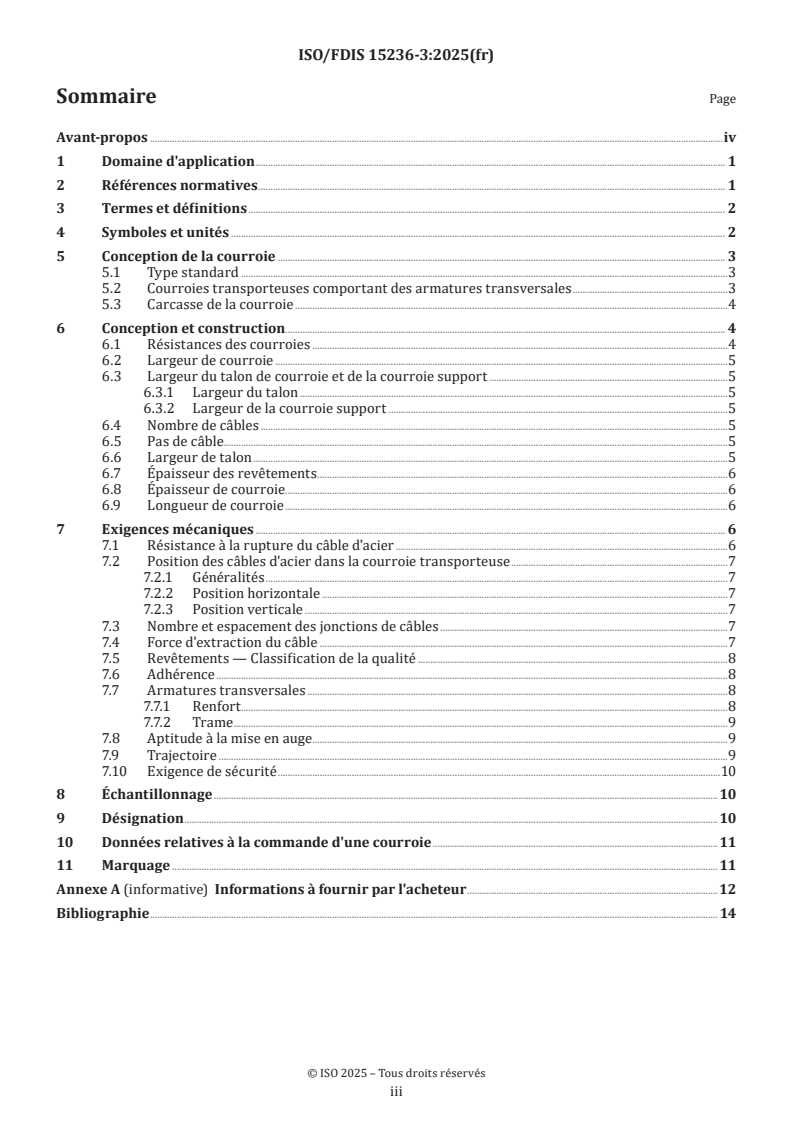
Contents Page
Foreword .iv
1 Scope . 1
2 Normative references . 1
3 Terms and definitions . 1
4 Symbols and units. 2
5 Belt design . 3
5.1 Standard type .3
5.2 Conveyor belting having transverse reinforcements.3
5.3 Belt core .4
6 Design and construction . 4
6.1 Belt strengths .4
6.2 Belt width .5
6.3 Belt edge and supporting belt width . .5
6.3.1 Edge width .5
6.3.2 Supporting belt width .5
6.4 Number of cords .5
6.5 Cord pitch .5
6.6 Edge width.6
6.7 Thickness of covers .6
6.8 Belt thickness .6
6.9 Belt length .6
7 Mechanical requirements . 6
7.1 Breaking strength of the steel cord .6
7.2 Position of the steel cords in the conveyor belt .7
7.2.1 General .7
7.2.2 Horizontal position .7
7.2.3 Vertical position .7
7.3 Number and spacing of cord joints .7
7.4 Cord pull-out force .7
7.5 Covers — Quality classification .8
7.6 Adhesion .8
7.7 Transverse reinforcements .8
7.7.1 Breaker . . .8
7.7.2 Weft .9
7.8 Troughability . .9
7.9 Tracking .10
7.10 Safety requirements .10
8 Sampling . 10
9 Designation .10
10 Ordering data .11
11 Marking . .11
Annex A (informative) Information to be supplied by the purchaser .12
Bibliography . 14
iii
Foreword
ISO (the International Organization for Standardization) is a worldwide federation of national standards
bodies (ISO member bodies). The work of preparing International Standards is normally carried out through
ISO technical committees. Each member body interested in a subject for which a technical committee
has been established has the right to be represented on that committee. International organizations,
governmental and non-governmental, in liaison with ISO, also take part in the work. ISO collaborates closely
with the International Electrotechnical Commission (IEC) on all matters of electrotechnical standardization.
The procedures used to develop this document and those intended for its further maintenance are described
in the ISO/IEC Directives, Part 1. In particular, the different approval criteria needed for the different types
of ISO documents should be noted. This document was drafted in accordance with the editorial rules of the
ISO/IEC Directives, Part 2 (see www.iso.org/directives).
ISO draws attention to the possibility that the implementation of this document may involve the use of (a)
patent(s). ISO takes no position concerning the evidence, validity or applicability of any claimed patent
rights in respect thereof. As of the date of publication of this document, ISO had not received notice of (a)
patent(s) which may be required to implement this document. However, implementers are cautioned that
this may not represent the latest information, which may be obtained from the patent database available at
www.iso.org/patents. ISO shall not be held responsible for identifying any or all such patent rights.
Any trade name used in this document is information given for the convenience of users and does not
constitute an endorsement.
For an explanation of the voluntary nature of standards, the meaning of ISO specific terms and expressions
related to conformity assessment, as well as information about ISO's adherence to the World Trade
Organization (WTO) principles in the Technical Barriers to Trade (TBT), see www.iso.org/iso/foreword.html.
This document was prepared by Technical Committee ISO/TC 41 Pulleys and belts (including veebelts),
Subcommittee SC 3, Conveyor belts, in collaboration with the European Committee for Standardization
(CEN) Technical Committee CEN/TC 188, Conveyor Belts, in accordance with the Agreement on technical
cooperation between ISO and CEN (Vienna Agreement).
This third edition cancels and replaces the second edition (ISO 15236-3:2017), which has been technically
revised.
The main changes are as follows:
— 6.1 Remove Table 2 “Belt types” , renumber all following tables;
— Grade Q is added to what is now Table 5 (previously Table 6);
A list of all parts in the ISO 15236 series can be found on the ISO website.
Any feedback or questions on this document should be directed to the user’s national standards body. A
complete listing of these bodies can be found at www.iso.org/members.html.
iv
FINAL DRAFT International Standard ISO/FDIS 15236-3:2025(en)
Steel cord conveyor belts —
Part 3:
Special safety requirements for belts for use in underground
installations
1 Scope
This document specifies the performance and constructional requirements applicable to conveyor belts for
underground mining having steel cords in the longitudinal direction as reinforcement. The requirements
for design and construction apply to all belts, including those covered in ISO 15236-2. Steel cord belts in
accordance with this document are intended for use underground, in coal mines and in other applications
where fire and explosion hazards exist.
NOTE At present, the requirements can only be met by the use of compounds based on chloroprene rubber for the
covers, as well as for the bonding rubber.
2 Normative references
The following documents are referred to in the text in such a way that some or all of their content constitutes
requirements of this document. For dated references, only the edition indicated applies. For undated
references, the latest edition of the referenced document (including any amendments) applies.
ISO 37, Rubber, vulcanized or thermoplastic — Determination of tensile stress-strain properties
ISO 703, Conveyor belts — Transverse flexibility (troughability) — Test method
ISO 4649, Rubber, vulcanized or thermoplastic — Determination of abrasion resistance using a rotating
cylindrical drum device
ISO 7590:2018, Steel cord conveyor belts — Methods for the determination of total thickness and cover thickness
ISO 7622-2, Steel cord conveyor belts — Longitudinal traction test — Part 2: Measurement of tensile strength
ISO 7623, Steel cord conveyor belts — Cord-to-coating bond test — Initial test and after thermal treatment
ISO 8094, Steel cord conveyor belts — Adhesion strength test of the cover to the core layer
ISO 15236-2, Steel cord conveyor belts — Part 2: Preferred belt types
EN 13827:2003, Steel cord conveyor belts — Determination of the lateral and vertical displacement of steel cords
EN 14973:2006, Conveyor belts for use in underground installations — Electrical and flammability safety
requirements
3 Terms and definitions
For the purposes of this document, the following terms and definitions apply.
ISO and IEC maintain terminological databases for use in standardization at the following addresses:
— ISO Online browsing platform: available at https:// www .iso .org/ obp
— IEC Electropedia: available at https:// www .electropedia .org/
3.1
edge width
b
k
width of rubber between the outer cord and the belt edge
Note 1 to entry: See Figure 1.
3.2
breaker
transverse reinforcement in the conveyor belt, typically of a textile material, inserted both above and below
or either above or below the steel cords at a distance of at least 1 mm and considered to be part of the cover
Note 1 to entry: See Figure 2, it is used to protect the longitudinal cords from impact or trapped material damage.
[SOURCE: ISO 7590:2018, 3.1, modified —"See Figure 2" added in Note 1.]
3.3
weft
transverse component of a protective reinforcement of either steel or textile cords, typically inserted both
above and below, or either above or below, the steel cords at a distance of less than 1 mm and considered to
be part of the belt carcass
Note 1 to entry: See Figure 3.
[SOURCE: ISO 7590:2018, 3.2, modified —"Note 1 to entry" added.]
4 Symbols and units
See Table 1.
Table 1 — Symbols and units
Symbol Explanation Unit
B belt width mm
F pull-out force of cord per cord length N/mm
a
F breaking strength of cord taken from cured belt kN
bs
F pull-out force of cord per cord length, after thermal treatment N/mm
v
K minimum (nominal) breaking strength per width of belt N/mm
N
b calculated edge width mm
k
b supporting belt width (see figure 1) mm
t
d cord diameter mm
e long diameter of threads in breaker (see figure 4) mm
F deflection (troughability) mm
h me
...
ISO/TC 41/SC 3
Date: 2025-07-15
Secretariat: SAC
Date: 2025-08-25
Steel cord conveyor belts —
Part 3:
Special safety requirements for belts for use in underground
installations
Courroies transporteuses à câbles d’acier — Partie 3: Exigences de sécurité particulières aux
courroies utilisées dans des installations souterrainesd'acier —
Partie 3: Exigences de sécurité particulières aux courroies utilisées dans des installations souterraines
FDIS stage
Warning for WDs and CDs
This document is not an ISO International Standard. It is distributed for review and comment. It is subject to change
without notice and may not be referred to as an International Standard.
Recipients of this draft are invited to submit, with their comments, notification of any relevant patent rights of which
they are aware and to provide supporting documentation.
All rights reserved. Unless otherwise specified, or required in the context of its implementation, no part of this publication
may be reproduced or utilized otherwise in any form or by any means, electronic or mechanical, including photocopying,
or posting on the internet or an intranet, without prior written permission. Permission can be requested from either ISO
at the address below or ISO’s member body in the country of the requester.
ISO copyright office
CP 401 • Ch. de Blandonnet 8
CH-1214 Vernier, Geneva
Phone: + 41 22 749 01 11
EmailE-mail: copyright@iso.org
Website: www.iso.orgwww.iso.org
Published in Switzerland
ISO/DISFDIS 15236-3XXXX(X) 3:2025(en)
Contents
Foreword . vi
1 Scope . 1
2 Normative references . 1
3 Terms and definitions . 1
4 Symbols and units . 2
5 Belt design . 3
5.1 Standard type . 3
5.2 Conveyor belting having transverse reinforcements . 4
5.3 Belt core . 5
6 Design and construction . 6
6.1 Belt strengths . 6
6.2 Belt width . 6
6.3 Belt edge and supporting belt width . 6
6.4 Number of cords . 6
6.5 Cord pitch . 6
6.6 Edge width . 7
6.7 Thickness of covers . 7
6.8 Belt thickness . 7
6.9 Belt length. 7
7 Mechanical requirements . 8
7.1 Breaking strength of the steel cord . 8
7.2 Position of the steel cords in the conveyor belt . 8
7.3 Number and spacing of cord joints . 8
7.4 Cord pull-out force . 8
7.5 Covers — Quality classification . 9
7.6 Adhesion . 9
7.7 Transverse reinforcements . 9
7.8 Troughability . 10
7.9 Tracking . 11
7.10 Safety requirements. 12
8 Sampling . 12
9 Designation . 12
10 Ordering data . 13
11 Marking . 13
Annex A (informative) Information to be supplied by the purchaser . 14
Bibliography . 17
v
ISO/DISFDIS 15236-3:2025(en)
Foreword
ISO (the International Organization for Standardization) is a worldwide federation of national standards
bodies (ISO member bodies). The work of preparing International Standards is normally carried out through
ISO technical committees. Each member body interested in a subject for which a technical committee has been
established has the right to be represented on that committee. International organizations, governmental and
non-governmental, in liaison with ISO, also take part in the work. ISO collaborates closely with the
International Electrotechnical Commission (IEC) on all matters of electrotechnical standardization.
The procedures used to develop this document and those intended for its further maintenance are described
in the ISO/IEC Directives, Part 1. In particular, the different approval criteria needed for the different types of
ISO documents should be noted. This document was drafted in accordance with the editorial rules of the
ISO/IEC Directives, Part 2 (see www.iso.org/directives).
ISO draws attention to the possibility that the implementation of this document may involve the use of (a)
patent(s). ISO takes no position concerning the evidence, validity or applicability of any claimed patent rights
in respect thereof. As of the date of publication of this document, ISO had not received notice of (a) patent(s)
which may be required to implement this document. However, implementers are cautioned that this may not
represent the latest information, which may be obtained from the patent database available at
www.iso.org/patents. ISO shall not be held responsible for identifying any or all such patent rights.
Any trade name used in this document is information given for the convenience of users and does not
constitute an endorsement.
For an explanation of the voluntary nature of standards, the meaning of ISO specific terms and expressions
related to conformity assessment, as well as information about ISO's adherence to the World Trade
Organization (WTO) principles in the Technical Barriers to Trade (TBT), see www.iso.org/iso/foreword.html.
This document was prepared by Technical Committee ISO/TC 41 Pulleys and belts (including veebelts),
Subcommittee SC 3, Conveyor belts, in collaboration with the European Committee for Standardization (CEN)
Technical Committee CEN/TC 188, Conveyor Belts, in accordance with the Agreement on technical
cooperation between ISO and CEN (Vienna Agreement).
This third edition cancels and replaces the second edition (ISO 15236--3:2017), which has been technically
revised.
The main changes are as follows:
— 6.1— 6.1 Remove Table 2Table 2 “Belt types” , renumber all following tables;
— — Grade Q is added to what is now Table 5Table 5 (previously Table 6Table 6););
A list of all parts in the ISO 15236 series can be found on the ISO website.
Any feedback or questions on this document should be directed to the user’s national standards body. A
complete listing of these bodies can be found at www.iso.org/members.html.
vi
ISO/DISFDIS 15236-3:XXXX(X) 2025(en)
Steel cord conveyor belts —
Part 3:
Special safety requirements for belts for use in underground
installations
1 Scope
This document specifies the performance and constructional requirements applicable to conveyor belts for
underground mining having steel cords in the longitudinal direction as reinforcement. The requirements for
design and construction apply to all belts, including those covered in ISO 15236--2. Steel cord belts in
accordance with this document are intended for use underground, in coal mines and in other applications
where fire and explosion hazards exist.
NOTE At present, the requirements can only be met by the use of compounds based on chloroprene rubber for the
covers, as well as for the bonding rubber.
2 Normative references
The following documents are referred to in the text in such a way that some or all of their content constitutes
requirements of this document. For dated references, only the edition indicated applies. For undated
references, the latest edition of the referenced document (including any amendments) applies.
ISO 37, Rubber, vulcanized or thermoplastic — Determination of tensile stress-strain properties
ISO 703, Conveyor belts — Transverse flexibility (troughability) — Test method
ISO 2062, Textiles — Yarns from packages — Determination of single-end breaking force and elongation at
break
ISO 4649, Rubber, vulcanized or thermoplastic — Determination of abrasion resistance using a rotating
cylindrical drum device
ISO 7590:2018, Steel cord conveyor belts — Methods for the determination of total thickness and cover thickness
ISO 7622--2, Steel cord conveyor belts — Longitudinal traction test — Part 2: Measurement of tensile strength
ISO 7623, Steel cord conveyor belts — Cord-to-coating bond test — Initial test and after thermal treatment
ISO 8094, Steel cord conveyor belts — Adhesion strength test of the cover to the core layer
ISO 15236-2, Steel cord conveyor belts — Part 2: Preferred belt types
EN 13827:2003, Steel cord conveyor belts — Determination of the lateral and vertical displacement of steel cords
EN 14973:2006, Conveyor belts for use in underground installations — Electrical and flammability safety
requirements
3 Terms and definitions
For the purposes of this document, the following terms and definitions apply.
ISO and IEC maintain terminological databases for use in standardization at the following addresses:
— — ISO Online browsing platform: available at https://www.iso.org/obp
— — IEC Electropedia: available at https://www.electropedia.org/
—
3.1 3.1
edge width
b
k
width of rubber between the outer cord and the belt edge
Note 1 to entry: See Figure 1Figure 1.
3.2 3.2
breaker
transverse reinforcement in the conveyor belt, typically of a textile material, inserted both above and below
or either above or below the steel cords at a distance of at least 1 mm and considered to be part of the cover.
Note 1 to entry: See Figure 2Figure 2,, it is used to protect the longitudinal cords from impact or trapped material
damage.
[SOURCE: ISO 7590:2018, 3.1, with the addition of modified —"See Figuer Figure 2" added in Note 1].]
3.3 3.3
weft
transverse component of a protective reinforcement of either steel or textile cords, typically inserted both
above and below, or either above or below, the steel cords at a distance of less than 1 mm and considered to
be part of the belt carcass
Note 1 to entry: See Figure 3Figure 3.
[SOURCE: ISO 7590:2018, 3.2, with the addition of modified —"Note 1 to entry]" added.]
4 Symbols and units
See Table 1Table 1.
Table 1 — Symbols and units
Symbol Explanation Unit
B Beltbelt width mm
F Pullpull-out force of cord per cord length N/mm
a
F Breakingbreaking strength of cord taken from cured belt kN
bs
Fv Pullpull-out force of cord per cord length, after thermal treatment N/mm
KN Minimumminimum (nominal) breaking strength per width of belt N/mm
b Calculatedcalculated edge width mm
k
b Supportingsupporting belt width (see figure 1Figure 1)) mm
t
d Cordcord diameter mm
e Longlong diameter of threads in breaker (see figure 4 (See Figure 4)) mm
F Deflectiondeflection (troughability) mm
h Meanmean cord height according to EN 13827:2003 (4.3.1) mm
m
ISO/DISFDIS 15236-3:XXXX(X) 2025(en)
Symbol Explanation Unit
n Numbernumber of cords —
s1 Totaltotal belt thickness (see ISO 7590) mm
s2 Covercover thickness carrying side mm
s Covercover thickness pulley side mm
s Thicknessthickness of layer between breaker and layer of longitudinal cords mm
s5 Thicknessthickness of layer between weft and layer of longitudinal cords mm
s6 Thicknessthickness of belt core (carcass) mm
t Cordcord spacing/pitch mm
Δh Numbernumber of cords positioned within a range of h ≤ 1 mm as a
1 m
%
percentage of the total number of cords
Δh Numbernumber of cords positioned within a range of h of from >1,0 mm to
2 m
%
1,5 mm and expressed as a percentage of the total number of cords
Δh Percentagepercentage of cords with h > 1,5 mm %
3 m
5 Belt design
5.1 Standard type
Conveyor belts conforming to this document contain steel cords surrounded by a layer of core rubber, this
belt core is protected on top and bottom by cover layers (see Figure 1Figure 1).).
Key
a
s = d
a
s = d.
Figure 1 — Cross section of standard belt
5.2 Conveyor belting having transverse reinforcements
Requirements for steel cord conveyor belts having breakers are illustrated in Figure 2Figure 2,, and
requirements relating to weft are illustrated in Figure 3Figure 3.
Key
1 Breaker
a
Including the breaker
b
≥1mm
c
s6 = d
1 breaker
a
Including the breaker.
b
≥1 mm.
c
s6 = d.
Figure 2 — Belt cross section with breaker
ISO/DISFDIS 15236-3:XXXX(X) 2025(en)
Key
1 Weft
a
Above weft.
b
Below weft.
c
<1 mm
1 weft
a
Above weft.
b
Below weft.
c
<1 mm.
Figure 3 — Belt cross section with weft
5.3 Belt core
The thickness of the belt core (carcass), s , for all belt types is defined as shown in Error! Reference source
not found. Formula 1 ::
s = s − s − s ( 1 )
6 1 2 3
s = s − s − s
6 1 2 3
(1)
6 Design and construction
6.1 Belt strengths
Steel cord belts shall be manufactured in strengths of between 500 N/mm and 10 000 N/mm belt width.
6.2 Belt width
The belt widths and tolerances according to Table 2Table 2 shall apply only to belts when manufactured and
not to belts when tensioned on site.
Table 2 — Belt widths, B
Dimensions in millimetres
B
1 00 1 20 1 40 1 60 1 80 2 00 2 20 2 40 2 60 2
...
PROJET FINAL
Norme
internationale
ISO/TC 41/SC 3
Courroies transporteuses à câbles
Secrétariat: SAC
d'acier —
Début de vote:
2025-09-08
Partie 3:
Exigences de sécurité particulières
Vote clos le:
2025-11-03
aux courroies utilisées dans des
installations souterraines
Steel cord conveyor belts —
Part 3: Special safety requirements for belts for use in
underground installations
LES DESTINATAIRES DU PRÉSENT PROJET SONT
INVITÉS À PRÉSENTER, AVEC LEURS OBSERVATIONS,
NOTIFICATION DES DROITS DE PROPRIÉTÉ DONT ILS
AURAIENT ÉVENTUELLEMENT CONNAISSANCE ET À
FOURNIR UNE DOCUMENTATION EXPLICATIVE.
OUTRE LE FAIT D’ÊTRE EXAMINÉS POUR
ÉTABLIR S’ILS SONT ACCEPTABLES À DES FINS
INDUSTRIELLES, TECHNOLOGIQUES ET COM-MERCIALES,
AINSI QUE DU POINT DE VUE DES UTILISATEURS, LES
PROJETS DE NORMES
TRAITEMENT PARALLÈLE ISO/CEN
INTERNATIONALES DOIVENT PARFOIS ÊTRE CONSIDÉRÉS
DU POINT DE VUE DE LEUR POSSI BILITÉ DE DEVENIR DES
NORMES POUVANT
SERVIR DE RÉFÉRENCE DANS LA RÉGLEMENTATION
NATIONALE.
Numéro de référence
PROJET FINAL
Norme
internationale
ISO/TC 41/SC 3
Courroies transporteuses à câbles
Secrétariat: SAC
d'acier —
Début de vote:
Partie 3: 2025-09-08
Exigences de sécurité particulières
Vote clos le:
2025-11-03
aux courroies utilisées dans des
installations souterraines
Steel cord conveyor belts —
Part 3: Special safety requirements for belts for use in
underground installations
LES DESTINATAIRES DU PRÉSENT PROJET SONT
INVITÉS À PRÉSENTER, AVEC LEURS OBSERVATIONS,
NOTIFICATION DES DROITS DE PROPRIÉTÉ DONT ILS
AURAIENT ÉVENTUELLEMENT CONNAISSANCE ET À
FOURNIR UNE DOCUMENTATION EXPLICATIVE.
DOCUMENT PROTÉGÉ PAR COPYRIGHT
OUTRE LE FAIT D’ÊTRE EXAMINÉS POUR
ÉTABLIR S’ILS SONT ACCEPTABLES À DES FINS
© ISO 2025 INDUSTRIELLES, TECHNOLOGIQUES ET COM-MERCIALES,
AINSI QUE DU POINT DE VUE DES UTILISATEURS, LES
Tous droits réservés. Sauf prescription différente ou nécessité dans le contexte de sa mise en œuvre, aucune partie de cette
PROJETS DE NORMES
TRAITEMENT PARALLÈLE ISO/CEN
INTERNATIONALES DOIVENT PARFOIS ÊTRE CONSIDÉRÉS
publication ne peut être reproduite ni utilisée sous quelque forme que ce soit et par aucun procédé, électronique ou mécanique,
DU POINT DE VUE DE LEUR POSSI BILITÉ DE DEVENIR DES
y compris la photocopie, ou la diffusion sur l’internet ou sur un intranet, sans autorisation écrite préalable. Une autorisation peut
NORMES POUVANT
être demandée à l’ISO à l’adresse ci-après ou au comité membre de l’ISO dans le pays du demandeur.
SERVIR DE RÉFÉRENCE DANS LA RÉGLEMENTATION
NATIONALE.
ISO copyright office
Case postale 401 • Ch. de Blandonnet 8
CH-1214 Vernier, Genève
Tél.: +41 22 749 01 11
E-mail: copyright@iso.org
Web: www.iso.org
Publié en Suisse Numéro de référence
ii
Sommaire Page
Avant-propos .iv
1 Domaine d'application . 1
2 Références normatives . 1
3 Termes et définitions . 2
4 Symboles et unités . 2
5 Conception de la courroie . 3
5.1 Type standard .3
5.2 Courroies transporteuses comportant des armatures transversales .3
5.3 Carcasse de la courroie .4
6 Conception et construction . . 4
6.1 Résistances des courroies .4
6.2 Largeur de courroie .5
6.3 Largeur du talon de courroie et de la courroie support .5
6.3.1 Largeur du talon .5
6.3.2 Largeur de la courroie support .5
6.4 Nombre de câbles .5
6.5 Pas de câble.5
6.6 Largeur de talon .5
6.7 Épaisseur des revêtements .6
6.8 Épaisseur de courroie . .6
6.9 Longueur de courroie .6
7 Exigences mécaniques . 6
7.1 Résistance à la rupture du câble d'acier .6
7.2 Position des câbles d'acier dans la courroie transporteuse .7
7.2.1 Généralités .7
7.2.2 Position horizontale .7
7.2.3 Position verticale .7
7.3 Nombre et espacement des jonctions de câbles .7
7.4 Force d'extraction du câble .7
7.5 Revêtements — Classification de la qualité .8
7.6 Adhérence .8
7.7 Armatures transversales .8
7.7.1 Renfort . .8
7.7.2 Trame .9
7.8 Aptitude à la mise en auge .9
7.9 Trajectoire .9
7.10 Exigence de sécurité .10
8 Échantillonnage .10
9 Désignation .10
10 Données relatives à la commande d'une courroie .11
11 Marquage .11
Annexe A (informative) Informations à fournir par l'acheteur .12
Bibliographie . 14
iii
Avant-propos
L'ISO (Organisation internationale de normalisation) est une fédération mondiale d'organismes nationaux
de normalisation (comités membres de l'ISO). L'élaboration des Normes internationales est en général
confiée aux comités techniques de l'ISO. Chaque comité membre intéressé par une étude a le droit de faire
partie du comité technique créé à cet effet. Les organisations internationales, gouvernementales et non
gouvernementales, en liaison avec l'ISO participent également aux travaux. L'ISO collabore étroitement avec
la Commission électrotechnique internationale (IEC) en ce qui concerne la normalisation électrotechnique.
Les procédures utilisées pour élaborer le présent document et celles destinées à sa mise à jour sont
décrites dans les Directives ISO/IEC, Partie 1. Il convient, en particulier, de prendre note des différents
critères d'approbation requis pour les différents types de documents ISO. Le présent document a
été rédigé conformément aux règles de rédaction données dans les Directives ISO/IEC, Partie 2 (voir
www.iso.org/directives"https://www.iso.org/directives-and-policies.html").
L’ISO attire l’attention sur le fait que la mise en application du présent document peut entraîner l’utilisation
d’un ou de plusieurs brevets. L’ISO ne prend pas position quant à la preuve, à la validité et à l’applicabilité de
tout droit de propriété revendiqué à cet égard. À la date de publication du présent document, l’ISO n'avait pas
reçu notification qu’un ou plusieurs brevets pouvaient être nécessaires à sa mise en application. Toutefois,
il y a lieu d’avertir les responsables de la mise en application du présent document que des informations
plus récentes sont susceptibles de figurer dans la base de données de brevets, disponible à l'adresse
www.iso.org/brevets. L’ISO ne saurait être tenue pour responsable de ne pas avoir identifié tout ou partie de
tels droits de propriété (voir www.iso.org/brevets).
Les appellations commerciales éventuellement mentionnées dans le présent document sont données pour
information, par souci de commodité, à l’intention des utilisateurs et ne sauraient constituer un engagement.
Pour une explication de la nature volontaire des normes, la signification des termes et expressions
spécifiques de l'ISO liés à l'évaluation de la conformité, ou pour toute information au sujet de l'adhésion de
l'ISO aux principes de l’Organisation mondiale du commerce (OMC) concernant les obstacles techniques au
commerce (OTC), voir le lien suivant: www.iso.org/iso/fr/avant-propos.html.
Le présent document a été préparé par le comité technique ISO/TC 41, Poulies et courroies (y compris les
courroies trapézoïdales), sous-comité SC 3, Courroies transporteuses, en collaboration avec le Comité
technique CEN/TC 188, Courroies transporteuses, du Comité européen de normalisation (CEN), en conformité
avec l'Accord de coopération technique entre l'ISO et le CEN (Accord de Vienne).
Cette troisième édition annule et remplace la deuxième édition (ISO 15236-3:2017), qui a fait l’objet d’une
révision technique.
Les principales modifications par rapport à l’édition précédente sont les suivantes:
— Dans 6.1, suppression du Tableau 2 «Types de courroies», renuméroter tous les tableaux ultérieurs;
— Ajout de la Classe Q à ce qui est maintenant le Tableau 5 (précédemment Tableau 6).
Une liste de toutes les parties de l’ISO 15236 peut être trouvée sur le site internet de l’ISO.
Il convient que l’utilisateur adresse tout retour d’information ou toute question concernant le présent
document à l’organisme national de normalisation de son pays. Une liste exhaustive desdits organismes se
trouve à l’adresse www.iso.org/fr/members.html.
iv
PROJET FINAL Norme internationale ISO/FDIS 15236-3:2025(fr)
Courroies transporteuses à câbles d'acier —
Partie 3:
Exigences de sécurité particulières aux courroies utilisées
dans des installations souterraines
1 Domaine d'application
Le présent document spécifie les exigences relatives aux performances et à la construction applicables
aux courroies transporteuses à câbles d'acier, placés dans le sens longitudinal en tant qu'armature, pour
utilisation dans les mines souterraines. Les exigences de conception et de construction s'appliquent à toutes
les courroies, y compris celles couvertes par l'ISO 15236-2. Les courroies à câbles d'acier conformes au
présent document sont prévues pour des usages souterrains dans les houillères et autres applications où
existent des risques d'incendie et d'explosion.
NOTE Actuellement, seule l'utilisation de mélanges à base de caoutchouc chloroprène pour les revêtements et
pour la gomme de liaison permet de satisfaire aux exigences.
2 Références normatives
Les documents suivants sont cités dans le texte de sorte qu’ils constituent, pour tout ou partie de leur
contenu, des exigences du présent document. Pour les références datées, seule l’édition citée s’applique. Pour
les références non datées, la dernière édition du document de référence s'applique (y compris les éventuels
amendements.
ISO 37, Caoutchouc vulcanisé ou thermoplastique — Détermination des caractéristiques de contrainte-
déformation en traction
ISO 703, Courroies transporteuses — Flexibilité transversale (aptitude à la mise en auge) — Méthode d'essai
ISO 4649, Caoutchouc vulcanisé ou thermoplastique — Détermination de la résistance à l'abrasion à l'aide d'un
dispositif à tambour tournant
ISO 7590:2018, Courroies transporteuses à câbles d'acier — Méthodes de détermination de l'épaisseur totale et
de l'épaisseur des revêtements
ISO 7622-2, Courroies transporteuses à câbles d'acier — Essai de traction dans le sens longitudinal — Partie 2:
Mesurage de la résistance à la rupture
ISO 7623, Courroies transporteuses à câbles d'acier — Essai d'adhérence des câbles dans l'enrobage — Essai
initial et après traitement thermique
ISO 8094, Courroies transporteuses à câbles d'acier — Essai d'adhérence du revêtement à la couche de câbles
ISO 15236-2, Courroies transporteuses à câbles d'acier — Partie 2: Types de courroies recommandées
EN 13827:2003, Courroies transporteuses à carcasse métallique — Détermination du déplacement latéral et
vertical des câbles d’acier
EN 14973:2006, Courroies transporteuses pour usage dans les installations souterraines — Prescriptions de
sécurité électrique et protection contre l’inflammation
3 Termes et définitions
Pour les besoins du présent document, les termes et définitions suivants s’appliquent.
L’ISO et l’IEC maintiennent des bases de données terminologiques pour utilisation dans le domaine de la
normalisation aux adresses suivantes:
— ISO Online browsing platform: disponible à https:// www .iso .org/ obp
— IEC Electropedia: disponible à https:// www .electropedia .org/
3.1
largeur du talon
b
k
largeur de caoutchouc entre le câble extérieur et le bord de la courroie
Note 1 à l'article: Voir Figure 1.
3.2
renfort
armature transversale de la courroie transporteuse, généralement constituée d'une matière textile,
positionnée soit à la fois au-dessus et au-dessous, soit au-dessus ou au-dessous des câbles d'acier, à une
distance minimale de 1 mm, et considérée comme faisant partie intégrante du revêtement
Note 1 à l'article: Voir Figure 2, il est utilisé pour protéger les câbles longitudinaux des impacts ou des dommages
consécutifs à des matériaux emprisonnés.
[SOURCE: ISO 7590:2018, 3.1, modifié — ajout de «Voir Figure 2» à la Note 1]
3.3
trame
composant transversal d’un renforcement de protection composé de câbles d'acier ou textile, inséré
généralement soit au-dessus et en-dessous, soit au-dessus ou en-dessous, des câbles d’acier à une distance
inférieure à 1 mm et considéré comme faisant partie de la carcasse de la courroie
Note 1 à l'article: Voir Figure 3.
[SOURCE: ISO 7590:2018, 3.2, modifié — ajout de «Note 1 à l'article»]
4 Symboles et unités
Voir Tableau 1.
Tableau 1 — Symboles et unités
Symbole Explication Unité
B largeur de la courroie mm
F force d'extraction du câble par longueur de câble N/mm
a
F résistance à la rupture du câble dans la courroie vulcanisée kN
bs
F force d'extraction du câble par longueur de câble, après traitement thermique N/mm
v
K résistance minimale (nominale) à la rupture par largeur de courroie N/mm
N
b largeur calculée du talon mm
k
b largeur câble à câble de la courroie de support (voir Figure 1) mm
t
d diamètre du câble mm
e diamètre longitudinal des fils dans le renfort (voir Figure 4) mm
F flèche (aptitude à la mise en auge) mm
h épaisseur moyenne du câble selon l'EN 13827:2003 (4.3.1) mm
m
TTabableleaauu 1 1 ((ssuuiitte)e)
Symbole Explication Unité
n nombre de câbles —
s épaisseur totale de la courroie (voir ISO 7590) mm
s épaisseur du revêtement porteur mm
s épaisseur du revêtement rouleur mm
s épaisseur de la couche entre le renfort et la couche de câbles longitudinaux mm
s épaisseur de la couche entre la trame et la couche de câbles longitudinaux mm
s épaisseur de la carcasse de la courroie (âme) mm
t espacement des câbles/pas mm
Δh nombre de câbles positionnés avec une variation de h ≤ 1 mm en pourcentage
1 m
%
du nombre total de câbles
Δh nombre de câbles positionnés avec une variation de h comprise entre > 1,0 mm
2 m
%
et 1,5 mm et exprimé en pourcentage du nombre total de câbles
Δh pourcentage de câbles avec h > 1,5 mm %
3 m
5 Conception de la courroie
5.1 Type standard
Les courroies transporteuses conformes au présent document com
...
Questions, Comments and Discussion
Ask us and Technical Secretary will try to provide an answer. You can facilitate discussion about the standard in here.
Loading comments...