

ISO 37164:2021
(Main)Smart community infrastructures — Smart transportation using fuel cell light rail transit (FC-LRT)
General Information
- Abstract
This document specifies a procedure to introduce smart transportation into cities by means of fuel cell light rail transit (FC-LRT). This service contributes to a cleaner atmosphere, with zero emission of greenhouse gases (GHGs) and small particles, an urban view free of catenaries and easy installation of LRT transportation operations, providing safe and comfortable rides for citizens.
- Status
- Published
- Publication Date
- 23-May-2021
- Current Stage
- 9093 - International Standard confirmed
- Start Date
- 03-Sep-2026
- Completion Date
- 12-Sep-2026
Buy Documents


ISO 37164:2021 - Smart community infrastructures -- Smart transportation using fuel cell light rail transit (FC-LRT)
ISO 37164:2021 - Smart community infrastructures — Smart transportation using fuel cell light rail transit (FC-LRT)/24/2021
Overview
ISO 37164:2021 - Smart community infrastructures: Smart transportation using fuel cell light rail transit (FC‑LRT) specifies a procedure for introducing fuel cell light rail transit into urban transport networks. The standard describes the concept, operation and quality maintenance of FC‑LRT systems that use hydrogen fuel cells for traction. Benefits highlighted include zero tailpipe greenhouse gas (GHG) and particulate emissions, elimination of overhead catenaries, faster refuelling versus battery charging, improved resilience to grid outages and reduced infrastructure footprint - all supporting smart transportation and cleaner urban environments.
Key topics and technical requirements
- Concept and objectives: Defines FC‑LRT and explains advantages over conventional catenary‑powered LRT, including energy storage/recovery and use of hydrogen produced from surplus renewable electricity.
- Operation: Minimum requirements and recommendations for organizing services, covering:
- Hydrogen refuelling and recharging: Siting and sizing of refuelling stations, on‑site vs off‑site hydrogen supply, and the role of renewable hydrogen for zero‑emission operation.
- Scheduling and dispatching: Optimizing timetables and vehicle rotation to accommodate refuelling cycles.
- Maintenance and passenger services: Ensuring maintenance does not disrupt refuelling; maintaining passenger comfort, access and fares comparable to conventional LRT.
- Driving conditions and skills: Operating parameters are consistent with conventional LRT; no special driver skills required beyond existing standards.
- Hydrogen delivery and storage: Guidance on storage on vehicles and at stations, and references to hydrogen quality and handling standards (for example ISO 14687, ISO 19880‑1, ISO 13985 family).
- Emergency response and safety: Station siting, risk reduction for leaks, fires and blast effects, and emergency procedures (references include NFPA 2, SAE J2578/J2579).
- Quality maintenance: Parameters to monitor, and procedures for modifying systems while preserving service quality.
Applications and who should use it
ISO 37164 is intended for:
- City planners and transport authorities planning sustainable urban transit
- Transit operators and LRT system designers evaluating fuel cell options
- Infrastructure and hydrogen refuelling station engineers
- Hydrogen suppliers, emergency planners and safety officers
- Policy makers and sustainability officers aligning transit with SDGs
Practical applications include feasibility studies for electrification alternatives, designing refuelling networks, operational planning to integrate hydrogen logistics, and aligning LRT deployment with zero‑emission and smart city goals.
Related standards
ISO 37164 references hydrogen and rail‑safety documents such as ISO 14687, ISO 19880‑1, ISO 13985, SAE J2578/J2579, and NFPA 2 for specifics on hydrogen quality, storage, refuelling and emergency response. These are essential complements when implementing FC‑LRT systems.
Relations
- Effective Date
- 04-Feb-2023
Buy Documents
ISO 37164:2021 - Smart community infrastructures -- Smart transportation using fuel cell light rail transit (FC-LRT)
ISO 37164:2021 - Smart community infrastructures — Smart transportation using fuel cell light rail transit (FC-LRT)/24/2021
Get Certified
Connect with accredited certification bodies for this standard

BSI Group
BSI (British Standards Institution) is the business standards company that helps organizations make excellence a habit.

Bureau Veritas
Bureau Veritas is a world leader in laboratory testing, inspection and certification services.

DNV
DNV is an independent assurance and risk management provider.
Sponsored listings
Frequently Asked Questions
ISO 37164:2021 is a standard published by the International Organization for Standardization (ISO). Its full title is "Smart community infrastructures — Smart transportation using fuel cell light rail transit (FC-LRT)". This standard covers: This document specifies a procedure to introduce smart transportation into cities by means of fuel cell light rail transit (FC-LRT). This service contributes to a cleaner atmosphere, with zero emission of greenhouse gases (GHGs) and small particles, an urban view free of catenaries and easy installation of LRT transportation operations, providing safe and comfortable rides for citizens.
This document specifies a procedure to introduce smart transportation into cities by means of fuel cell light rail transit (FC-LRT). This service contributes to a cleaner atmosphere, with zero emission of greenhouse gases (GHGs) and small particles, an urban view free of catenaries and easy installation of LRT transportation operations, providing safe and comfortable rides for citizens.
ISO 37164:2021 is classified under the following ICS (International Classification for Standards) categories: 13.020.20 - Environmental economics. Sustainability. The ICS classification helps identify the subject area and facilitates finding related standards.
ISO 37164:2021 has the following relationships with other standards: It is inter standard links to ISO 1628-1:2024. Understanding these relationships helps ensure you are using the most current and applicable version of the standard.
ISO 37164:2021 is available in PDF format for immediate download after purchase. The document can be added to your cart and obtained through the secure checkout process. Digital delivery ensures instant access to the complete standard document.
Standards Content (Sample)
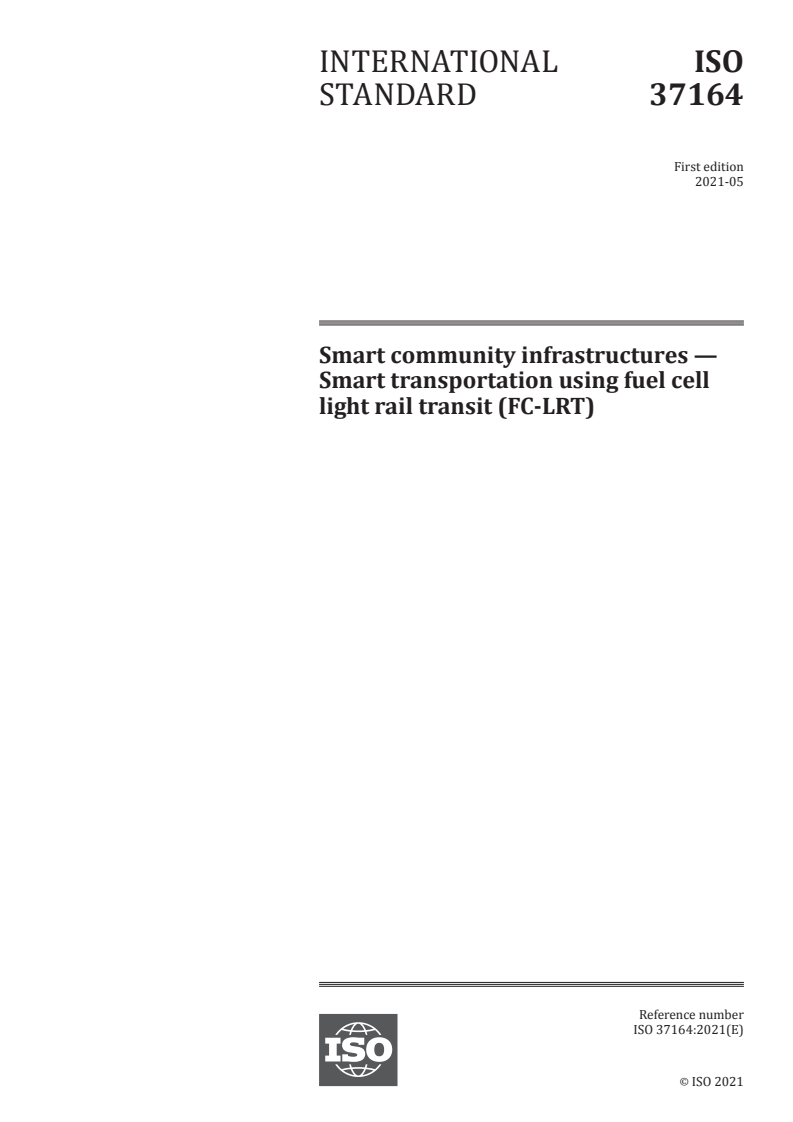
INTERNATIONAL ISO
STANDARD 37164
First edition
2021-05
Smart community infrastructures —
Smart transportation using fuel cell
light rail transit (FC-LRT)
Reference number
©
ISO 2021
© ISO 2021
All rights reserved. Unless otherwise specified, or required in the context of its implementation, no part of this publication may
be reproduced or utilized otherwise in any form or by any means, electronic or mechanical, including photocopying, or posting
on the internet or an intranet, without prior written permission. Permission can be requested from either ISO at the address
below or ISO’s member body in the country of the requester.
ISO copyright office
CP 401 • Ch. de Blandonnet 8
CH-1214 Vernier, Geneva
Phone: +41 22 749 01 11
Email: copyright@iso.org
Website: www.iso.org
Published in Switzerland
ii © ISO 2021 – All rights reserved
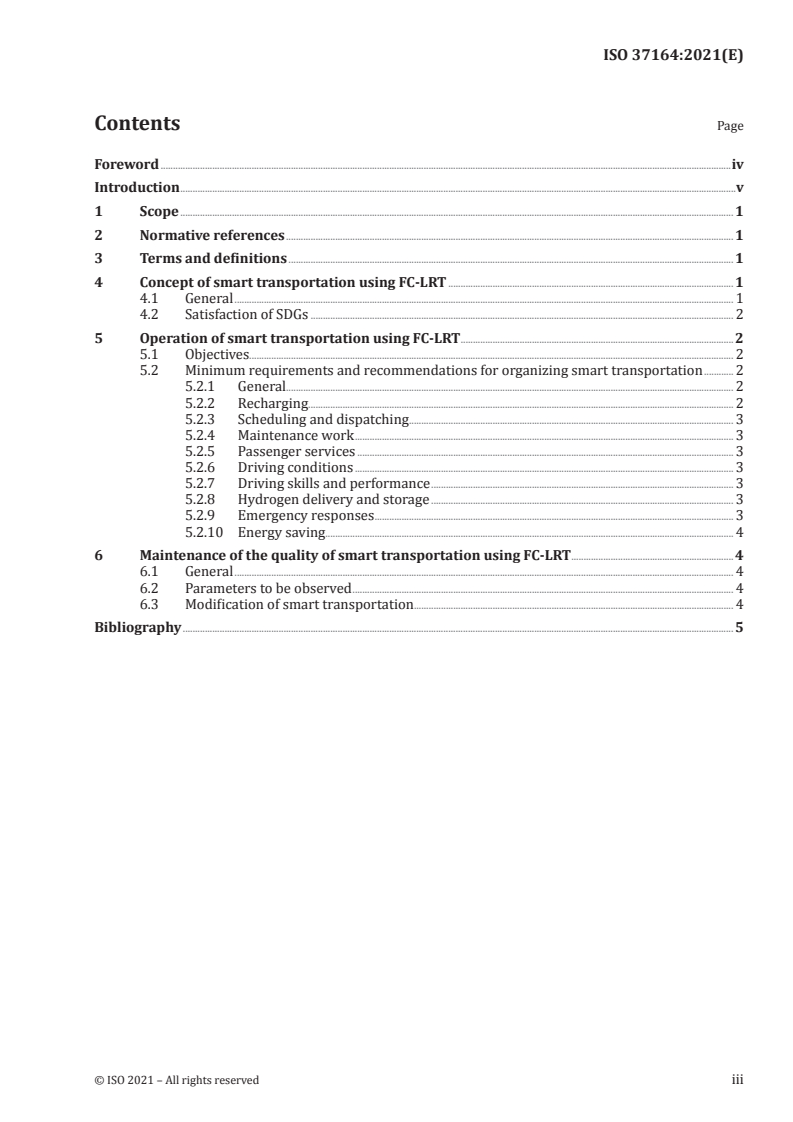
Contents Page
Foreword .iv
Introduction .v
1 Scope . 1
2 Normative references . 1
3 Terms and definitions . 1
4 Concept of smart transportation using FC-LRT . 1
4.1 General . 1
4.2 Satisfaction of SDGs . 2
5 Operation of smart transportation using FC-LRT . 2
5.1 Objectives. 2
5.2 Minimum requirements and recommendations for organizing smart transportation . 2
5.2.1 General. 2
5.2.2 Recharging . . 2
5.2.3 Scheduling and dispatching. 3
5.2.4 Maintenance work . 3
5.2.5 Passenger services . 3
5.2.6 Driving conditions . 3
5.2.7 Driving skills and performance . 3
5.2.8 Hydrogen delivery and storage . 3
5.2.9 Emergency responses . 3
5.2.10 Energy saving . . . 4
6 Maintenance of the quality of smart transportation using FC-LRT .4
6.1 General . 4
6.2 Parameters to be observed . 4
6.3 Modification of smart transportation. 4
Bibliography . 5
Foreword
ISO (the International Organization for Standardization) is a worldwide federation of national standards
bodies (ISO member bodies). The work of preparing International Standards is normally carried out
through ISO technical committees. Each member body interested in a subject for which a technical
committee has been established has the right to be represented on that committee. International
organizations, governmental and non-governmental, in liaison with ISO, also take part in the work.
ISO collaborates closely with the International Electrotechnical Commission (IEC) on all matters of
electrotechnical standardization.
The procedures used to develop this document and those intended for its further maintenance are
described in the ISO/IEC Directives, Part 1. In particular, the different approval criteria needed for the
different types of ISO documents should be noted. This document was drafted in accordance with the
editorial rules of the ISO/IEC Directives, Part 2 (see www .iso .org/ directives).
Attention is drawn to the possibility that some of the elements of this document may be the subject of
patent rights. ISO shall not be held responsible for identifying any or all such patent rights. Details of
any patent rights identified during the development of the document will be in the Introduction and/or
on the ISO list of patent declarations received (see www .iso .org/ patents).
Any trade name used in this document is information given for the convenience of users and does not
constitute an endorsement.
For an explanation of the voluntary nature of standards, the meaning of ISO specific terms and
expressions related to conformity assessment, as well as information about ISO's adherence to the
World Trade Organization (WTO) principles in the Technical Barriers to Trade (TBT), see www .iso .org/
iso/ foreword .html.
This document was prepared by Technical Committee ISO/TC 268, Sustainable cities and communities,
Subcommittee SC 1, Smart community infrastructures.
Any feedback or questions on this document should be directed to the user’s national standards body. A
complete listing of these bodies can be found at www .iso .org/ members .html.
iv © ISO 2021 – All rights reserved
Introduction
Light rail transit (LRT) has been used as convenient urban public transportation in cities for over
100 years, due to its smooth acceleration and deceleration performance, good ride comfort and larger
passenger capacity than bus vehicles. Although LRT has high energy efficiency and operation stability,
as well as producing zero emissions, it has shortcomings. Conventional LRT is powered with electricity
supplied from the outside of vehicles through catenaries and pantographs. Setting up catenaries and
substations calls for considerably high capital cost and long construction times, and spoils urban views.
The voltage of electricity depends on power grids and service lines, resulting in poor interconnection
in rail service networks by LRT. If the grid power fails, services are suspended on all LRT lines. LRT
equipped with energy storage using batteries and super capacitors is available, but the working
distance in relation to charging time is not long enough for commercial services.
Fuel cell light rail transit (FC-LRT) solves such problems with conventional LRT. Normally, hydrogen
fuel cells are adopted as power sources for FC-LRT. It is not necessary to equip rolling stock with
pantographs, hang catenaries or install substations, resulting in preservation of the urban view and
open skies. The elimination of the facilities leads to reduction in construction and maintenance costs
and time, and also safety improvements, especially on the risk with high-voltage grids exposed in
cities. Fuel-cell-powered vehicles emit no GHGs or small particles, only water. LRT vehicles with energy
storage, which do not rely on grids for power supply, can run on tracks independently of voltage,
whether electrified or not, wherever the track gauges are the same. The on-board power source makes
LRT highly resilient, especially when the power grid fails. Fuel cells enable LRT vehicles to run for
longer distances than possible with other on-board energy storage.
INTERNATIONAL STANDARD ISO 37164:2021(E)
Smart community infrastructures — Smart transportation
using fuel cell light rail transit (FC-LRT)
1 Scope
This document specifies a procedure to introduce smart transportation into cities by means of fuel
cell light rail transit (FC-LRT). This service contributes to a cleaner atmosphere, with zero emission of
greenhouse gases (GHGs) and small particles, an urban view free of catenaries and easy installation of
LRT transportation operations, providing safe and comfortable rides for citizens.
2 Normative references
There are no normative references in this document.
3 Terms and definitions
For the purposes of this document, the following terms and definitions apply.
ISO and IEC maintain terminological databases for use in standardization at the following addresses:
— ISO Online browsing platform: available at https:// www .iso .org/ obp
— IEC Electropedia: available at http:// www .electropedia .org/
3.1
fuel cell light rail transit
FC-LRT
LRT using hydrogen fuel cells for traction
Note 1 to entry: LRT means transportation systems using light rolling stock with steel tires on segregated tracks
(e.g. elevated, at ground level or underground).
3.2
conventional LRT
LRT using catenaries or third rails to collect power
4 Conc
...
INTERNATIONAL ISO
STANDARD 37164
First edition
2021-05
Smart community infrastructures —
Smart transportation using fuel cell
light rail transit (FC-LRT)
Reference number
©
ISO 2021
© ISO 2021
All rights reserved. Unless otherwise specified, or required in the context of its implementation, no part of this publication may
be reproduced or utilized otherwise in any form or by any means, electronic or mechanical, including photocopying, or posting
on the internet or an intranet, without prior written permission. Permission can be requested from either ISO at the address
below or ISO’s member body in the country of the requester.
ISO copyright office
CP 401 • Ch. de Blandonnet 8
CH-1214 Vernier, Geneva
Phone: +41 22 749 01 11
Email: copyright@iso.org
Website: www.iso.org
Published in Switzerland
ii © ISO 2021 – All rights reserved
Contents Page
Foreword .iv
Introduction .v
1 Scope . 1
2 Normative references . 1
3 Terms and definitions . 1
4 Concept of smart transportation using FC-LRT . 1
4.1 General . 1
4.2 Satisfaction of SDGs . 2
5 Operation of smart transportation using FC-LRT . 2
5.1 Objectives. 2
5.2 Minimum requirements and recommendations for organizing smart transportation . 2
5.2.1 General. 2
5.2.2 Recharging . . 2
5.2.3 Scheduling and dispatching. 3
5.2.4 Maintenance work . 3
5.2.5 Passenger services . 3
5.2.6 Driving conditions . 3
5.2.7 Driving skills and performance . 3
5.2.8 Hydrogen delivery and storage . 3
5.2.9 Emergency responses . 3
5.2.10 Energy saving . . . 4
6 Maintenance of the quality of smart transportation using FC-LRT .4
6.1 General . 4
6.2 Parameters to be observed . 4
6.3 Modification of smart transportation. 4
Bibliography . 5
Foreword
ISO (the International Organization for Standardization) is a worldwide federation of national standards
bodies (ISO member bodies). The work of preparing International Standards is normally carried out
through ISO technical committees. Each member body interested in a subject for which a technical
committee has been established has the right to be represented on that committee. International
organizations, governmental and non-governmental, in liaison with ISO, also take part in the work.
ISO collaborates closely with the International Electrotechnical Commission (IEC) on all matters of
electrotechnical standardization.
The procedures used to develop this document and those intended for its further maintenance are
described in the ISO/IEC Directives, Part 1. In particular, the different approval criteria needed for the
different types of ISO documents should be noted. This document was drafted in accordance with the
editorial rules of the ISO/IEC Directives, Part 2 (see www .iso .org/ directives).
Attention is drawn to the possibility that some of the elements of this document may be the subject of
patent rights. ISO shall not be held responsible for identifying any or all such patent rights. Details of
any patent rights identified during the development of the document will be in the Introduction and/or
on the ISO list of patent declarations received (see www .iso .org/ patents).
Any trade name used in this document is information given for the convenience of users and does not
constitute an endorsement.
For an explanation of the voluntary nature of standards, the meaning of ISO specific terms and
expressions related to conformity assessment, as well as information about ISO's adherence to the
World Trade Organization (WTO) principles in the Technical Barriers to Trade (TBT), see www .iso .org/
iso/ foreword .html.
This document was prepared by Technical Committee ISO/TC 268, Sustainable cities and communities,
Subcommittee SC 1, Smart community infrastructures.
Any feedback or questions on this document should be directed to the user’s national standards body. A
complete listing of these bodies can be found at www .iso .org/ members .html.
iv © ISO 2021 – All rights reserved
Introduction
Light rail transit (LRT) has been used as convenient urban public transportation in cities for over
100 years, due to its smooth acceleration and deceleration performance, good ride comfort and larger
passenger capacity than bus vehicles. Although LRT has high energy efficiency and operation stability,
as well as producing zero emissions, it has shortcomings. Conventional LRT is powered with electricity
supplied from the outside of vehicles through catenaries and pantographs. Setting up catenaries and
substations calls for considerably high capital cost and long construction times, and spoils urban views.
The voltage of electricity depends on power grids and service lines, resulting in poor interconnection
in rail service networks by LRT. If the grid power fails, services are suspended on all LRT lines. LRT
equipped with energy storage using batteries and super capacitors is available, but the working
distance in relation to charging time is not long enough for commercial services.
Fuel cell light rail transit (FC-LRT) solves such problems with conventional LRT. Normally, hydrogen
fuel cells are adopted as power sources for FC-LRT. It is not necessary to equip rolling stock with
pantographs, hang catenaries or install substations, resulting in preservation of the urban view and
open skies. The elimination of the facilities leads to reduction in construction and maintenance costs
and time, and also safety improvements, especially on the risk with high-voltage grids exposed in
cities. Fuel-cell-powered vehicles emit no GHGs or small particles, only water. LRT vehicles with energy
storage, which do not rely on grids for power supply, can run on tracks independently of voltage,
whether electrified or not, wherever the track gauges are the same. The on-board power source makes
LRT highly resilient, especially when the power grid fails. Fuel cells enable LRT vehicles to run for
longer distances than possible with other on-board energy storage.
INTERNATIONAL STANDARD ISO 37164:2021(E)
Smart community infrastructures — Smart transportation
using fuel cell light rail transit (FC-LRT)
1 Scope
This document specifies a procedure to introduce smart transportation into cities by means of fuel
cell light rail transit (FC-LRT). This service contributes to a cleaner atmosphere, with zero emission of
greenhouse gases (GHGs) and small particles, an urban view free of catenaries and easy installation of
LRT transportation operations, providing safe and comfortable rides for citizens.
2 Normative references
There are no normative references in this document.
3 Terms and definitions
For the purposes of this document, the following terms and definitions apply.
ISO and IEC maintain terminological databases for use in standardization at the following addresses:
— ISO Online browsing platform: available at https:// www .iso .org/ obp
— IEC Electropedia: available at http:// www .electropedia .org/
3.1
fuel cell light rail transit
FC-LRT
LRT using hydrogen fuel cells for traction
Note 1 to entry: LRT means transportation systems using light rolling stock with steel tires on segregated tracks
(e.g. elevated, at ground level or underground).
3.2
conventional LRT
LRT using catenaries or third rails to collect power
4 Conc
...