

ISO 9468:2025
(Main)Tourism and related services — Online travel agency (OTA) — Guidelines for online accommodation booking platform services
General Information
- Abstract
This document provides guidance on the operation of an effective online accommodation booking platform to meet the needs of accommodation service providers and users. This document is applicable to online accommodation booking platform operators, accommodation service providers and users.
- Status
- Published
- Publication Date
- 19-Feb-2025
- Technical Committee
- ISO/TC 228 - Tourism and related services
- Drafting Committee
- ISO/TC 228 - Tourism and related services
- Current Stage
- 6060 - International Standard published
- Start Date
- 20-Feb-2025
- Due Date
- 15-Oct-2024
- Completion Date
- 20-Feb-2025

Overview
ISO 9468:2025 - Tourism and related services - Online travel agency (OTA) - Guidelines for online accommodation booking platform services provides best-practice guidance for designing, operating and governing online accommodation booking platforms. Published as the first edition in 2025, this ISO standard targets online accommodation booking platform operators, accommodation service providers (hotels, short‑term rentals, hostels, campsites) and end users. It aims to increase trust, protect rights, reduce disputes and promote sustainable growth in the online accommodation booking industry.
Key topics and technical requirements
The standard covers platform design, operational controls and stakeholder responsibilities. Major topics include:
- General principles: integrity, transparency, authenticity, accountability, accessibility, privacy and continual improvement.
- Platform operator responsibilities:
- Legal entity status, licences and adequate resources (staff, facilities, secure IT systems).
- Clear published terms of use, visible updates and fair allocation of liabilities.
- Accessibility and inclusion for diverse users (referenced accessibility checklist in Annex A).
- Data, payment and transaction security; contingency and emergency plans.
- Fair ranking criteria and prohibition of unfair trading practices based on behavioral profiling.
- Final booking confirmation: the checkout must show a clear prompt labelled “Book with a duty to pay”.
- Accommodation provider obligations:
- Accurate, up‑to‑date information and meaningful descriptions (including photos and accessibility features) aligned with ISO 18513 vocabulary.
- Service modules: information/display, search & browse, order, payment, amendment/cancellation, reviews, customer service, dispute resolution, promotions, member services, emergency and ancillary services.
- Service guarantees and quality controls: information verification, financial security, privacy protection, review management and continuous improvement processes.
Practical applications - who uses this standard
ISO 9468 is practical for:
- OTA and booking platform operators - to design compliant, user‑centric booking flows, legal terms, ranking algorithms and incident response plans.
- Accommodation providers (hotels, hosts, campsites) - to meet listing accuracy and accessibility expectations and reduce booking disputes.
- Software developers & UX teams - to implement secure payment, clear checkout wording and accessible interfaces.
- Regulators, auditors and consumer protection bodies - to assess marketplace fairness, data protection and dispute resolution practices.
- Consultants and quality managers - for service quality frameworks, continuous improvement and audit checklists.
Related standards
- ISO 18513 (vocabulary for tourism accommodation)
- ISO/TS 42501, ISO 42500, ISO/TS 42502, ISO 32111 (platform governance and consumer protection)
- ISO 21902 (accessible tourism) - referenced for accessibility guidance
Keywords: ISO 9468, online travel agency, OTA guidelines, online accommodation booking, booking platform standards, platform operator responsibilities, accessibility, data privacy, payment security.
Get Certified
Connect with accredited certification bodies for this standard

Great Wall Tianjin Quality Assurance Center
Established 1993, first batch to receive national accreditation with IAF recognition.
Hong Kong Quality Assurance Agency (HKQAA)
Hong Kong's leading certification body.

Innovative Quality Certifications Pvt. Ltd. (IQCPL)
Known for integrity, providing ethical & impartial Assessment & Certification. CMMI Institute Partner.
Sponsored listings
Frequently Asked Questions
ISO 9468:2025 is a standard published by the International Organization for Standardization (ISO). Its full title is "Tourism and related services — Online travel agency (OTA) — Guidelines for online accommodation booking platform services". This standard covers: This document provides guidance on the operation of an effective online accommodation booking platform to meet the needs of accommodation service providers and users. This document is applicable to online accommodation booking platform operators, accommodation service providers and users.
This document provides guidance on the operation of an effective online accommodation booking platform to meet the needs of accommodation service providers and users. This document is applicable to online accommodation booking platform operators, accommodation service providers and users.
ISO 9468:2025 is classified under the following ICS (International Classification for Standards) categories: 03.200.01 - Leisure and tourism in general. The ICS classification helps identify the subject area and facilitates finding related standards.
ISO 9468:2025 is available in PDF format for immediate download after purchase. The document can be added to your cart and obtained through the secure checkout process. Digital delivery ensures instant access to the complete standard document.
Standards Content (Sample)
International
Standard
ISO 9468
First edition
Tourism and related services —
2025-02
Online travel agency (OTA)
— Guidelines for online
accommodation booking platform
services
Tourisme et services connexes — Agences de voyages en ligne
— Lignes directrices pour les services de plates-formes de
réservation d'hébergement en ligne
Reference number
© ISO 2025
All rights reserved. Unless otherwise specified, or required in the context of its implementation, no part of this publication may
be reproduced or utilized otherwise in any form or by any means, electronic or mechanical, including photocopying, or posting on
the internet or an intranet, without prior written permission. Permission can be requested from either ISO at the address below
or ISO’s member body in the country of the requester.
ISO copyright office
CP 401 • Ch. de Blandonnet 8
CH-1214 Vernier, Geneva
Phone: +41 22 749 01 11
Email: copyright@iso.org
Website: www.iso.org
Published in Switzerland
ii
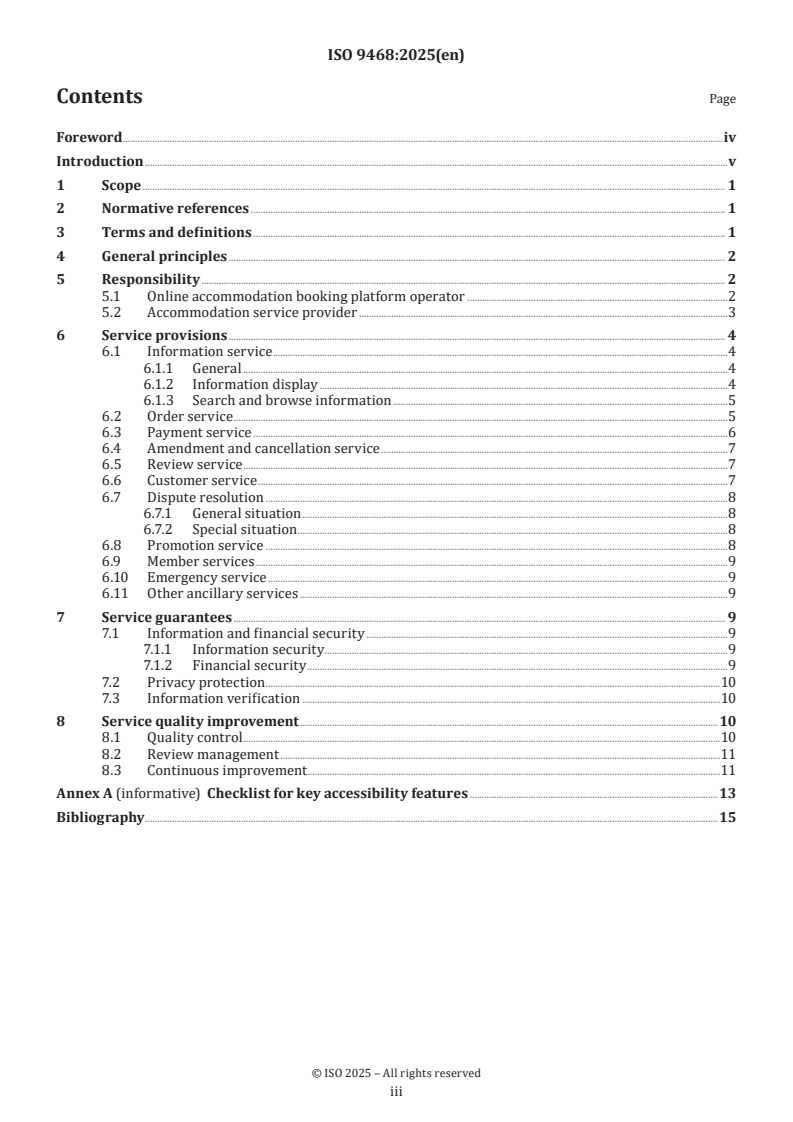
Contents Page
Foreword .iv
Introduction .v
1 Scope . 1
2 Normative references . 1
3 Terms and definitions . 1
4 General principles . 2
5 Responsibility . 2
5.1 Online accommodation booking platform operator .2
5.2 Accommodation service provider .3
6 Service provisions . 4
6.1 Information service .4
6.1.1 General .4
6.1.2 Information display .4
6.1.3 Search and browse information .5
6.2 Order service .5
6.3 Payment service .6
6.4 Amendment and cancellation service .7
6.5 Review service .7
6.6 Customer service .7
6.7 Dispute resolution .8
6.7.1 General situation .8
6.7.2 Special situation .8
6.8 Promotion service .8
6.9 Member services .9
6.10 Emergency service .9
6.11 Other ancillary services .9
7 Service guarantees . 9
7.1 Information and financial security .9
7.1.1 Information security . .9
7.1.2 Financial security .9
7.2 Privacy protection .10
7.3 Information verification .10
8 Service quality improvement .10
8.1 Quality control .10
8.2 Review management .11
8.3 Continuous improvement . .11
Annex A (informative) Checklist for key accessibility features .13
Bibliography .15
iii
Foreword
ISO (the International Organization for Standardization) is a worldwide federation of national standards
bodies (ISO member bodies). The work of preparing International Standards is normally carried out through
ISO technical committees. Each member body interested in a subject for which a technical committee
has been established has the right to be represented on that committee. International organizations,
governmental and non-governmental, in liaison with ISO, also take part in the work. ISO collaborates closely
with the International Electrotechnical Commission (IEC) on all matters of electrotechnical standardization.
The procedures used to develop this document and those intended for its further maintenance are described
in the ISO/IEC Directives, Part 1. In particular, the different approval criteria needed for the different types
of ISO document should be noted. This document was drafted in accordance with the editorial rules of the
ISO/IEC Directives, Part 2 (see http://www.iso.org/directives).
ISO draws attention to the possibility that the implementation of this document may involve the use of (a)
patent(s). ISO takes no position concerning the evidence, validity or applicability of any claimed patent
rights in respect thereof. As of the date of publication of this document, ISO had not received notice of (a)
patent(s) which may be required to implement this document. However, implementers are cautioned that
this may not represent the latest information, which may be obtained from the patent database available at
www.iso.org/patents. ISO shall not be held responsible for identifying any or all such patent rights.
Any trade name used in this document is information given for the convenience of users and does not
constitute an endorsement. For an explanation of the voluntary nature of standards, the meaning of ISO
specific terms and expressions related to conformity assessment, as well as information about ISO's
adherence to the World Trade Organization (WTO) principles in the Technical Barriers to Trade (TBT), see
http://www.iso.org/iso/foreword.html.
This document was prepared by Technical Committee ISO/TC 228, Tourism and related services.
Any feedback or questions on this document should be directed to the user’s national standards body. A
complete listing of these bodies can be found at www.iso.org/members.html.
iv
Introduction
With the increasing penetration of the internet and growth in the number of smart handheld device users, as
well as the growing demand for convenient tourism, the global online accommodation booking market has
continually expanded and the number of the online accommodation booking platforms has grown during
the past decade. Based on statistics, it is predicted that the compound annual growth rate (CAGR) from 2021
to 2026 will exceed 10 %.
While the online accommodation booking service industry continues to grow at an increasing rate, it is also
facing many problems, resulting in failure to provide the promised services, which causes a large number of
consumer disputes. Common problems include, for example, no room on arrival, impossibility to change or
cancel a reservation, serious inconsistencies between the service description and the actual service, and the
leaking of sensitive, private and financial data of the users.
It is necessary to create a global standard providing guidance on the online accommodation booking
industry to promote the development of this industry around the world.
This document aims to:
— provide advice and guidance on online accommodation booking platform services;
— protect the rights and interests of users, providers and platform operators, by establishing a mutual
trust mechanism among these stakeholders;
— promote the orderly and sustainable development of the online accommodation booking service industry;
— enrich existing standards and promote further standardized activities in the field of online travel agency.
v
International Standard ISO 9468:2025(en)
Tourism and related services — Online travel agency (OTA)
— Guidelines for online accommodation booking platform
services
1 Scope
This document provides guidance on the operation of an effective online accommodation booking platform
to meet the needs of accommodation service providers and users.
This document is applicable to online accommodation booking platform operators, accommodation service
providers and users.
2 Normative references
The following documents are referred to in the text in such a way that some or all of their content constitutes
requirements of this document. For dated references, only the edition cited applies. For undated references,
the latest edition of the referenced document (including any amendments) applies.
ISO 18513, Tourism services — Hotels and other types of tourism accommodation — Vocabulary
3 Terms and definitions
For the purposes of this document, the terms and definitions given in ISO 18513 and the following apply.
ISO and IEC maintain terminology databases for use in standardization at the following addresses:
— ISO Online browsing platform: available at https:// www .iso .org/ obp
— IEC Electropedia: available at https:// www .electropedia .org/
3.1
online travel agency
OTA
person or legal entity that operates a platform that offers online intermediary service between travel service
providers and users (3.6), providing search, comparison and transaction services
3.2
online accommodation booking platform
platform
type of online travel agency (OTA) (3.1) that offers online intermediary service between the accommodation
service provider (3.4) and the user (3.6)
Note 1 to entry: For further information, see Reference [2].
3.3
online accommodation booking platform operator
platform operator
person or legal entity that operates an online accommodation booking platform (3.2)
3.4
accommodation service provider
provider
person or legal entity that offers accommodation services to the user (3.6)
Note 1 to entry: This includes all kinds of tourism accommodation services such as hotels, short-term rental
accommodation services, campsites, hostels and holiday homes.
3.5
online accommodation booking
transaction by which accommodation is booked using an online accommodation booking platform (3.2)
3.6
user
consumer who accesses accommodation booking and related services through the online accommodation
booking platform (3.2)
Note 1 to entry: Accommodation service providers (3.4) usually use the term "guests" instead of "users".
4 General principles
Platform operators should follow the principles in ISO/TS 42501, ISO 42500, ISO/TS 42502 and ISO 32111
with regard to:
a) integrity;
b) transparency;
c) authenticity;
d) accountability and authorization;
e) accessibility and inclusion;
f) respect for the interest of others;
g) competence;
h) protection of intellectual property;
i) protection of security and privacy;
j) efficiency;
k) continual improvement.
5 Responsibility
5.1 Online accommodation booking platform operator
In addition to the provisions concerning competence set out in ISO/TS 42501:2022, 4.7, the platform
operator should:
a) be a legal entity holding the relevant valid business-related licences;
b) have service locations, facilities and equipment commensurate with the business and scale it engages in;
c) have sufficient management, technical and service personnel for the platform to function;
d) have a stable information system and security environment to ensure the provision of services;
EXAMPLE Platform operators ensure that providers can promote and sell their accommodation and users
can search for, compare and book them on the platforms.
e) establish and improve relevant mechanisms to standardize online accommodation booking services.
These mechanisms should be used to guide providers to fulfil their service commitments and protect
the rights and interests of users. There should also be a security mechanism for electronic transactions
to maintain the operation of platform transactions;
f) in addition to the provisions set out in ISO/TS 42501:2022, 4.2, 6.3.3 and 6.4.4, develop and publish
the terms of use and guide users to read the terms in their entirety. The terms of use should include
information reminding users of transaction risks, limitations of liability and exclusions of liability.
When amending the terms of use, the platform operator should publish the changes on the platform.
These terms should not unreasonably limit the platform's responsibilities, increase users' obligations
and exclude users' legal rights;
g) in addition to the provisions set out in ISO/TS 42501:2022, 4.3, 4.5, 6.3.2 and 6.3.4, ensure that online
accommodation booking services are as accessible, understandable and usable as possible for all users,
regardless of their age, size, ability or disability;
NOTE ISO 21902 provides further information about accessible tourism.
h) keep providers’ information up to date at all times;
i) not set unfair trading conditions based on extensive data analysis such as browsing records,
consumption habits and travel preferences;
j) fulfil any proposed service guarantees, such as best price, change and/or cancellation guarantees;
k) in addition to the provisions set out in ISO/TS 42501:2022, 6.4.6, develop and implement contingency
plans for emergencies regarding platform operation, services and security management;
l) display the categories representing the different types of accommodation according to ISO 18513;
m) ensure that the final step to conclude the booking contains a prompt with only the wording “Book with
a duty to pay”;
n) ensure the provisions on ranking criteria set out in ISO/TS 42501:2022, 4.3, are followed;
o) be responsible, to the extent possible under the circumstances, for the employees and personnel of
providers to which they have outsourced parts of their activities.
5.2 Accommodation service provider
Providers should:
a) be categorized according to ISO 18513;
b) present true, accurate, complete and up-to-date information, including photographs and other marketing
information, and ensure correct and meaningful information descriptions, including key accessibility
features (see Annex A for guidance);
c) not cancel an existing booking or a held booking without a justified reason or be unable to provide the
rooms at all upon arrival; if any of these situations occur, the platform operator should communicate
and coordinate with the users and providers to satisfy the needs of both parties involved at the earliest
possible time and not leave it until the point of arrival at the accommodation;
d) refrain from demanding parity clauses in their contracts for antitrust and fair competition reasons.
6 Service provisions
6.1 Information service
6.1.1 General
Information provided by platform operators should be:
a) clear and concise (i.e. ideas expressed in a straightforward and easy-to-understand manner, without
unnecessary words or complexity);
b) up to date and reliable;
c) available in different formats including alternative formats.
EXAMPLE Not only available in the form of text but also in audio, Braille or other formats.
The platform should also indicate the availability of additional information.
Providers should ensure:
— the availability of information about the accessibility of accommodation and services offered on their
platforms;
— users can book an accessible room through their platform via an ordinary booking procedure;
— that once an accessible room has been reserved and confirmed, it is not given away.
Electronic content supplied by the OTA service provider, including web pages, billing information and emails,
[7]
in applications such as marketing, bookings and reservations, should be designed according to EN 301 549.
6.1.2 Information display
The accommodation information supplied by providers should be displayed accurately and completely in the
relevant categories, for users to browse online conveniently (see 7.3).
In addition to the provisions set out in ISO/TS 42501:2022, 5.3, the list of information may include, for
example:
— overview and photos;
— price;
— room types and size;
— availability;
— accessibility;
— facilities;
— house rules;
— payment option;
— reviews;
— location;
— surroundings;
— indication of additional fees such as tourist taxes, if applicable;
— refund policy;
— sustainability initiatives.
The house rules should include, but not be limited to, rules concerning:
— check- in and check-out rules;
— cancellation policies;
— child policies;
— cot and extra bed policies;
— pets;
— assistance dogs;
— payment methods;
— age requirements.
Property highlights and frequently asked questions (FAQs) can also be displayed to show the features and
benefits of the provider, as well as to provide solutions to users' common questions.
Annex A provides guidance on the information the provider should supply on key accessibility features.
In addition to the provisions set out in ISO/TS 42501:2022, 6.5.1, the price policy should be displayed on
the platform in a transparent manner. The displayed booking price should indicate whether it includes
or excludes taxes and fees and whether there is a preferential rate for "new users". The price of the same
product or service under the same trading conditions should be consistent.
If the platform operator classifies the accommodation products on its own, it should clarify the classification
and matching principles and publish them. Relevant infor
...