

ISO 15153:2003
(Main)Tobacco — Determination of the content of reducing substances — Continuous-flow analysis method
General Information
- Abstract
ISO 15153:2003 specifies a method for the determination of the content of reducing substances in tobacco by continuous-flow analysis. This method is applicable to manufactured and unmanufactured tobacco.
- Status
- Published
- Publication Date
- 08-May-2003
- Technical Committee
- ISO/TC 126/SC 2 - Leaf tobacco
- Drafting Committee
- ISO/TC 126/SC 2 - Leaf tobacco
- Current Stage
- 9093 - International Standard confirmed
- Start Date
- 21-Jan-2026
- Completion Date
- 29-Aug-2026
Buy Documents
ISO 15153:2003 - Tobacco -- Determination of the content of reducing substances -- Continuous-flow analysis method
ISO 15153:2003 - Tobacco — Determination of the content of reducing substances — Continuous-flow analysis method/9/2003
ISO 15153:2003 - Tabac -- Détermination de la teneur en substances réductrices -- Méthode par analyse en flux continu
ISO 15153:2003 - Tabac — Détermination de la teneur en substances réductrices — Méthode par analyse en flux continu/9/2003
Overview
ISO 15153:2003 specifies a laboratory method for determining the content of reducing substances in tobacco using a continuous-flow analysis technique. Applicable to both manufactured and unmanufactured tobacco, the method measures reducing substances expressed as glucose equivalents after extraction in 5% acetic acid and colorimetric detection at 420 nm. ISO 15153 is intended for routine tobacco analysis, quality control and comparative studies.
Key topics and technical requirements
- Scope: Applicable to all tobacco types (manufactured and unmanufactured).
- Analytical principle: Reduction of yellow hexacyanoiron(III) to colourless hexacyanoiron(II); decrease in color measured at 420 nm using a continuous-flow analyser.
- Sample preparation:
- Grind sample to pass a 1 mm sieve; determine moisture content.
- Typical test portion: ~250 mg tobacco extracted with 25 ml of 5% acetic acid, shaken 30 minutes and filtered.
- Reagents: Includes Brij 35 (polyoxyethylene lauryl ether), NaCl solution, 1 mol/L NaOH, alkaline potassium ferricyanide solution, and D-glucose for standards.
- Standards and calibration:
- Stock glucose solution (~10 mg/ml) and a series of working standards (typical range e.g. 0.2–2.5 mg/ml) for calibration.
- Plot peak height vs. glucose concentration to obtain sample concentration (c, mg/ml).
- Calculation: Convert measured concentration to percentage of reducing substances (expressed as glucose) on a dry-weight basis using the sample mass, extract volume and measured moisture content. Results are reported to one decimal place.
- Equipment: Continuous-flow analyser components (sampler, proportioning pump, dialyser, heating bath, delay coils, 420 nm colorimeter and recorder). Annex A provides an example layout.
- Performance: International collaborative data (12 labs) provide repeatability and reproducibility examples (e.g., Burley mean 2.3%: r = 0.7, R = 1.7; Oriental mean 15.1%: r = 1.2, R = 2.5).
Applications and users
- Who uses it: Tobacco manufacturers, analytical and QA laboratories, regulatory agencies, research institutions and standardization bodies.
- Practical uses:
- Routine quality control and batch verification of tobacco leaf and products.
- Product characterization and comparative analysis of tobacco types (Burley, Oriental, flue-cured).
- Research into tobacco composition, processing effects, and formulation decisions where reducing substances (sugars and other reducing compounds) are critical.
- Support for regulatory reporting and inter-laboratory studies.
Related standards
- ISO 15152 - Determination of total alkaloids (nicotine) by continuous-flow analysis
- ISO 15154 - Reducing carbohydrates - continuous-flow analysis method
- ISO 15517 - Determination of nitrate content - continuous-flow analysis method
Keywords: ISO 15153, reducing substances, tobacco analysis, continuous-flow analysis, continuous flow analyser, reducing sugars, glucose equivalents, tobacco quality control.
Relations
- Effective Date
- 11-Dec-2021
Buy Documents
ISO 15153:2003 - Tobacco -- Determination of the content of reducing substances -- Continuous-flow analysis method
ISO 15153:2003 - Tobacco — Determination of the content of reducing substances — Continuous-flow analysis method/9/2003
ISO 15153:2003 - Tabac -- Détermination de la teneur en substances réductrices -- Méthode par analyse en flux continu
ISO 15153:2003 - Tabac — Détermination de la teneur en substances réductrices — Méthode par analyse en flux continu/9/2003
Get Certified
Connect with accredited certification bodies for this standard

Control Union Certifications
Global certification for agriculture and sustainability.

ECOCERT
Organic and sustainability certification.

FSC International
Forest Stewardship Council certification.
Sponsored listings
Frequently Asked Questions
ISO 15153:2003 is a standard published by the International Organization for Standardization (ISO). Its full title is "Tobacco — Determination of the content of reducing substances — Continuous-flow analysis method". This standard covers: ISO 15153:2003 specifies a method for the determination of the content of reducing substances in tobacco by continuous-flow analysis. This method is applicable to manufactured and unmanufactured tobacco.
ISO 15153:2003 specifies a method for the determination of the content of reducing substances in tobacco by continuous-flow analysis. This method is applicable to manufactured and unmanufactured tobacco.
ISO 15153:2003 is classified under the following ICS (International Classification for Standards) categories: 65.160 - Tobacco, tobacco products and related equipment. The ICS classification helps identify the subject area and facilitates finding related standards.
ISO 15153:2003 has the following relationships with other standards: It is inter standard links to ISO 15153:2003/Amd 1:2012. Understanding these relationships helps ensure you are using the most current and applicable version of the standard.
ISO 15153:2003 is available in PDF format for immediate download after purchase. The document can be added to your cart and obtained through the secure checkout process. Digital delivery ensures instant access to the complete standard document.
Standards Content (Sample)
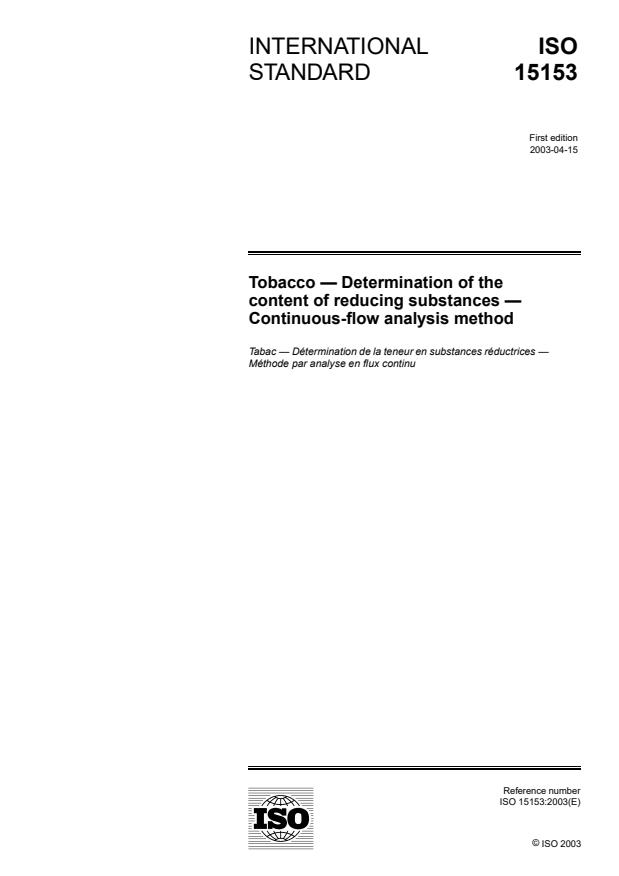
INTERNATIONAL ISO
STANDARD 15153
First edition
2003-04-15
Tobacco — Determination of the
content of reducing substances —
Continuous-flow analysis method
Tabac — Détermination de la teneur en substances réductrices —
Méthode par analyse en flux continu
Reference number
©
ISO 2003
PDF disclaimer
This PDF file may contain embedded typefaces. In accordance with Adobe's licensing policy, this file may be printed or viewed but shall
not be edited unless the typefaces which are embedded are licensed to and installed on the computer performing the editing. In
downloading this file, parties accept therein the responsibility of not infringing Adobe's licensing policy. The ISO Central Secretariat
accepts no liability in this area.
Adobe is a trademark of Adobe Systems Incorporated.
Details of the software products used to create this PDF file can be found in the General Info relative to the file; the PDF-creation
parameters were optimized for printing. Every care has been taken to ensure that the file is suitable for use by ISO member bodies. In the
unlikely event that a problem relating to it is found, please inform the Central Secretariat at the address given below.
All rights reserved. Unless otherwise specified, no part of this publication may be reproduced or utilized in any form or by any means,
electronic or mechanical, including photocopying and microfilm, without permission in writing from either ISO at the address below or
ISO's member body in the country of the requester.
ISO copyright office
Case postale 56 CH-1211 Geneva 20
Tel. + 41 22 749 01 11
Fax + 41 22 749 09 47
E-mail copyright@iso.org
Web www.iso.org
Published in Switzerland
©
ii ISO 2003 – All rights reserved
Contents Page
1 Scope . 1
2 Principle . 1
3 Reagents . 1
4 Apparatus . 2
5 Procedure . 2
6 Calculation . 3
7 Repeatability and reproducibility . 3
8 Test report . 3
Annex A (informative) Example of a continuous-flow analyser . 5
Bibliography . 6
©
ISO 2003 – All rights reserved iii
Foreword
ISO (the International Organization for Standardization) is a worldwide federation of national standards bodies
(ISO member bodies). The work of preparing International Standards is normally carried out through ISO
technical committees. Each member body interested in a subject for which a technical committee has been
established has the right to be represented on that committee. International organizations, governmental and
non-governmental, in liaison with ISO, also take part in the work. ISO collaborates closely with the International
Electrotechnical Commission (IEC) on all matters of electrotechnical standardization.
International Standards are drafted in accordance with the rules given in the ISO/IEC Directives, Part 2.
The main task of technical committees is to prepare International Standards. Draft International Standards
adopted by the technical committees are circulated to the member bodies for voting. Publication as an
International Standard requires approval by at least 75 % of the member bodies casting a vote.
Attention is drawn to the possibility that some of the elements of this document may be the subject of patent
rights. ISO shall not be held responsible for identifying any or all such patent rights.
ISO 15153 was prepared by Technical Committee ISO/TC 126, Tobacco and tobacco products, Subcommittee
SC 2, Leaf tobacco.
©
iv ISO 2003 – All rights reserved
Introduction
1)
A CORESTA Task Force studied the various widely used procedures for the determination of reducing sugars
in tobacco in order to adopt one of them as the CORESTA Recommended Method. Two procedures were
adopted as ISO 15154 and this International Standard. Studies carried out by the CORESTA Task Force
between 1989 and 1993 have shown that the two methods may not produce identical results. For some
tobaccos the results obtained with the method given in this International Standard are higher than those of the
method given in ISO 15154, because the former is sensitive to interferences from reducing substances, other
than sugars, present in tobacco. Collaborative studies have shown that when extracting with distilled water,
hydrolysis of sucrose occurs with some tobaccos.
1) CORESTA: Cooperation Centre for Scientific Research Relative to Tobacco.
©
ISO 2003 – All rights reserved v
.
vi
INTERNATIONAL STANDARD ISO 15153:2003(E)
Tobacco — Determination of the content of reducing
substances — Continuous-flow analysis method
1Scope
This International Standard specifies a method for the determination of the content of reducing substances in
tobacco by continuous-flow analysis.
This method is applicable to manufactured and unmanufactured tobacco.
2 Principle
A tobacco extract in 5% acetic acid solution is prepared and the content of the reducing substances in the
extract is determined by reduction of yellow hexacyanoiron(III) ions to colourless hexacyanoiron(II) ions. The
decrease in colour is measured at 420 nm.
3Reagents
All reagents shall be used according to good laboratory practice and existing national regulations. Use distilled
water or water of at least equivalent purity.
3.1 Polyoxyethylene lauryl ether (Brij 35 solution).
Add 1 litre of water to 250 g of Brij 35. Warm and stir until dissolved.
3.2 Sodium chloride solution (NaCl).
Dissolve 9,0 g sodium chloride in water, add 1 ml Brij 35 solution (3.1) and dilute to 1 litre.
3.3 Sodium hydroxide solution, .c(NaOH)= 1 mol/l
Prepare 1 litre of 1 mol/l sodium hydroxide from ampoules o
...
INTERNATIONAL ISO
STANDARD 15153
First edition
2003-04-15
Tobacco — Determination of the
content of reducing substances —
Continuous-flow analysis method
Tabac — Détermination de la teneur en substances réductrices —
Méthode par analyse en flux continu
Reference number
©
ISO 2003
PDF disclaimer
This PDF file may contain embedded typefaces. In accordance with Adobe's licensing policy, this file may be printed or viewed but shall
not be edited unless the typefaces which are embedded are licensed to and installed on the computer performing the editing. In
downloading this file, parties accept therein the responsibility of not infringing Adobe's licensing policy. The ISO Central Secretariat
accepts no liability in this area.
Adobe is a trademark of Adobe Systems Incorporated.
Details of the software products used to create this PDF file can be found in the General Info relative to the file; the PDF-creation
parameters were optimized for printing. Every care has been taken to ensure that the file is suitable for use by ISO member bodies. In the
unlikely event that a problem relating to it is found, please inform the Central Secretariat at the address given below.
All rights reserved. Unless otherwise specified, no part of this publication may be reproduced or utilized in any form or by any means,
electronic or mechanical, including photocopying and microfilm, without permission in writing from either ISO at the address below or
ISO's member body in the country of the requester.
ISO copyright office
Case postale 56 CH-1211 Geneva 20
Tel. + 41 22 749 01 11
Fax + 41 22 749 09 47
E-mail copyright@iso.org
Web www.iso.org
Published in Switzerland
©
ii ISO 2003 – All rights reserved
Contents Page
1 Scope . 1
2 Principle . 1
3 Reagents . 1
4 Apparatus . 2
5 Procedure . 2
6 Calculation . 3
7 Repeatability and reproducibility . 3
8 Test report . 3
Annex A (informative) Example of a continuous-flow analyser . 5
Bibliography . 6
©
ISO 2003 – All rights reserved iii
Foreword
ISO (the International Organization for Standardization) is a worldwide federation of national standards bodies
(ISO member bodies). The work of preparing International Standards is normally carried out through ISO
technical committees. Each member body interested in a subject for which a technical committee has been
established has the right to be represented on that committee. International organizations, governmental and
non-governmental, in liaison with ISO, also take part in the work. ISO collaborates closely with the International
Electrotechnical Commission (IEC) on all matters of electrotechnical standardization.
International Standards are drafted in accordance with the rules given in the ISO/IEC Directives, Part 2.
The main task of technical committees is to prepare International Standards. Draft International Standards
adopted by the technical committees are circulated to the member bodies for voting. Publication as an
International Standard requires approval by at least 75 % of the member bodies casting a vote.
Attention is drawn to the possibility that some of the elements of this document may be the subject of patent
rights. ISO shall not be held responsible for identifying any or all such patent rights.
ISO 15153 was prepared by Technical Committee ISO/TC 126, Tobacco and tobacco products, Subcommittee
SC 2, Leaf tobacco.
©
iv ISO 2003 – All rights reserved
Introduction
1)
A CORESTA Task Force studied the various widely used procedures for the determination of reducing sugars
in tobacco in order to adopt one of them as the CORESTA Recommended Method. Two procedures were
adopted as ISO 15154 and this International Standard. Studies carried out by the CORESTA Task Force
between 1989 and 1993 have shown that the two methods may not produce identical results. For some
tobaccos the results obtained with the method given in this International Standard are higher than those of the
method given in ISO 15154, because the former is sensitive to interferences from reducing substances, other
than sugars, present in tobacco. Collaborative studies have shown that when extracting with distilled water,
hydrolysis of sucrose occurs with some tobaccos.
1) CORESTA: Cooperation Centre for Scientific Research Relative to Tobacco.
©
ISO 2003 – All rights reserved v
.
vi
INTERNATIONAL STANDARD ISO 15153:2003(E)
Tobacco — Determination of the content of reducing
substances — Continuous-flow analysis method
1Scope
This International Standard specifies a method for the determination of the content of reducing substances in
tobacco by continuous-flow analysis.
This method is applicable to manufactured and unmanufactured tobacco.
2 Principle
A tobacco extract in 5% acetic acid solution is prepared and the content of the reducing substances in the
extract is determined by reduction of yellow hexacyanoiron(III) ions to colourless hexacyanoiron(II) ions. The
decrease in colour is measured at 420 nm.
3Reagents
All reagents shall be used according to good laboratory practice and existing national regulations. Use distilled
water or water of at least equivalent purity.
3.1 Polyoxyethylene lauryl ether (Brij 35 solution).
Add 1 litre of water to 250 g of Brij 35. Warm and stir until dissolved.
3.2 Sodium chloride solution (NaCl).
Dissolve 9,0 g sodium chloride in water, add 1 ml Brij 35 solution (3.1) and dilute to 1 litre.
3.3 Sodium hydroxide solution, .c(NaOH)= 1 mol/l
Prepare 1 litre of 1 mol/l sodium hydroxide from ampoules o
...
NORME ISO
INTERNATIONALE 15153
Première édition
2003-04-15
Tabac — Détermination de la teneur en
substances réductrices — Méthode par
analyse en flux continu
Tobacco — Determination of the content of reducing substances —
Continuous-flow analysis method
Numéro de référence
©
ISO 2003
PDF — Exonération de responsabilité
Le présent fichier PDF peut contenir des polices de caractères intégrées. Conformément aux conditions de licence d'Adobe, ce fichier
peut être imprimé ou visualisé, mais ne doit pas être modifié à moins que l'ordinateur employé à cet effet ne bénéficie d'une licence
autorisant l'utilisation de ces polices et que celles-ci y soient installées. Lors du téléchargement de ce fichier, les parties concernées
acceptent de fait la responsabilité de ne pas enfreindre les conditions de licence d'Adobe. Le Secrétariat central de l'ISO décline toute
responsabilité en la matière.
Adobe est une marque déposée d'Adobe Systems Incorporated.
Les détails relatifs aux produits logiciels utilisés pour la création du présent fichier PDF sont disponibles dans la rubrique General Info du
fichier; les paramètres de création PDF ont été optimisés pour l'impression. Toutes les mesures ont été prises pour garantir l'exploitation
de ce fichier par les comités membres de l'ISO. Dans le cas peu probable où surviendrait un problème d'utilisation, veuillez en informer
le Secrétariat central à l'adresse donnée ci-dessous.
Droits de reproduction réservés. Sauf prescription différente, aucune partie de cette publication ne peut être reproduite ni utilisée sous
quelque forme que ce soit et par aucun procédé, électronique ou mécanique, y compris la photocopie et les microfilms, sans l'accord écrit
de l'ISO à l'adresse ci-après ou du comité membre de l'ISO dans le pays du demandeur.
ISO copyright office
Case postale 56 CH-1211 Geneva 20
Tel. + 41 22 749 01 11
Fax + 41 22 749 09 47
E-mail copyright@iso.org
Web www.iso.org
Publié en Suisse
©
ii ISO 2003 – Tous droits réservés
Sommaire Page
1 Domaine d'application . 1
2 Principe . 1
3Réactifs . 1
4 Appareillage . 2
5 Mode opératoire . 2
6 Calculs . 3
7Répétabilité et reproductibilité . 3
8 Rapport d'essai . 4
Annexe A (informative) Exemple d'analyseur à flux continu . 5
Bibliographie . 6
©
ISO 2003 – Tous droits réservés iii
Avant-propos
L'ISO (Organisation internationale de normalisation) est une fédération mondiale d'organismes nationaux de
normalisation (comités membres de l'ISO). L'élaboration des Normes internationales est en général confiée
aux comités techniques de l'ISO. Chaque comité membre intéressé par une étude a le droit de faire partie du
comité technique créé à cet effet. Les organisations internationales, gouvernementales et non
gouvernementales, en liaison avec l'ISO participent également aux travaux. L'ISO collabore étroitement avec la
Commission électrotechnique internationale (CEI) en ce qui concerne la normalisation électrotechnique.
Les Normes internationales sont rédigées conformément aux règles données dans les Directives ISO/CEI,
Partie 2.
La tâche principale des comités techniques est d'élaborer les Normes internationales. Les projets de Normes
internationales adoptés par les comités techniques sont soumis aux comités membres pour vote. Leur
publication comme Normes internationales requiert l'approbation de 75 % au moins des comités membres
votants.
L'attention est appelée sur le fait que certains des éléments du présent document peuvent faire l'objet de droits
de propriété intellectuelle ou de droits analogues. L'ISO ne saurait être tenue pour responsable de ne pas avoir
identifié de tels droits de propriété et averti de leur existence.
L'ISO 15153 a été élaborée par le comité technique ISO/TC 126, Tabac et produits du tabac, sous-comité SC 2,
Tabacs en feuilles.
©
iv ISO 2003 – Tous droits réservés
Introduction
1)
Un groupe de travail du CORESTA a étudié les différents modes opératoires utilisés pour la détermination des
sucres réducteurs dans le tabac afin d'en retenir un qui deviendra la méthode recommandée par le CORESTA.
Deux modes opératoires ont été adoptés: l'ISO 15154 et la présente Norme internationale. Des études menées
par le groupe de travail du CORESTA entre 1989 et 1993 ont montré que ces deux méthodes peuvent ne pas
donner les mêmes résultats. Pour certains tabacs, les résultats obtenus avec la méthode donnée dans la
présente Norme internationale sont plus élevés que ceux obtenus avec la méthode donnée dans l'ISO 15154
car la méthode de la présente Norme internationale est sensible aux interférences dues aux substances
réductrices, autres que les sucres, et présentes dans le tabac. Des études interlaboratoires ont montré que
l'extraction à l'eau distillée s'accompagne d'une hydrolyse du saccharose, dans le cas de certains tabacs.
1) CORESTA: Centre de coopération pour les recherches scientifiques relatives au tabac.
©
ISO 2003 – Tous droits réservés v
.
vi
NORME INTERNATIONALE ISO 15153:2003(F)
Tabac — Détermination de la teneur en substances
réductrices — Méthode par analyse en flux continu
1 Domaine d'application
La présente Norme internationale spécifie une méthode pour la détermination de la teneur en substances
réductrices dans le tabac, par analyse en flux continu.
La présente méthode est applicable aux tabacs bruts et aux tabacs manufacturés.
2Principe
Un extrait de tabac en solution dans l'acide acétique à 5% est préparé et la teneur en substances réductrices
de l'extrait est déterminée par réduction des ions de ferricyanure(lll) de potassium jaune en ferrocyanure(II) de
potassium incolore. La décoloration est mesurée à .420 nm
3Réactifs
Tous les réactifs doivent être utilisés selon les bonnes pratiques de laboratoire et les réglementations
nationales en vigueur. Utiliser de l'eau distillée ou de pureté au moins équivalente.
3.1 Éther laurique de polyoxyéthylène (solution de Brij 35).
Ajouter 1 litre d'eau à 250 g de solution de Brij 35. Chauffer et agiter jusqu'à dissolution.
3.2 Solution de chlorure de sodium (NaCl).
Dissoudre 9,0 g de chlorure de sodium dans de l'eau, ajouter 1 ml de solution de Brij 35 (3.1) et compléter à
1litre.
3.3 Solution d'hydroxyde de sodium, .c(NaOH)= 1 mol/l
Préparer 1litre de solution d'hydroxyde de sodium à 1 mol/l à partir d'ampoules ou dissoudre 40,0 g
d'hydroxyde de sodium dans 800 ml d'eau. Mélanger
...
NORME ISO
INTERNATIONALE 15153
Première édition
2003-04-15
Tabac — Détermination de la teneur en
substances réductrices — Méthode par
analyse en flux continu
Tobacco — Determination of the content of reducing substances —
Continuous-flow analysis method
Numéro de référence
©
ISO 2003
PDF — Exonération de responsabilité
Le présent fichier PDF peut contenir des polices de caractères intégrées. Conformément aux conditions de licence d'Adobe, ce fichier
peut être imprimé ou visualisé, mais ne doit pas être modifié à moins que l'ordinateur employé à cet effet ne bénéficie d'une licence
autorisant l'utilisation de ces polices et que celles-ci y soient installées. Lors du téléchargement de ce fichier, les parties concernées
acceptent de fait la responsabilité de ne pas enfreindre les conditions de licence d'Adobe. Le Secrétariat central de l'ISO décline toute
responsabilité en la matière.
Adobe est une marque déposée d'Adobe Systems Incorporated.
Les détails relatifs aux produits logiciels utilisés pour la création du présent fichier PDF sont disponibles dans la rubrique General Info du
fichier; les paramètres de création PDF ont été optimisés pour l'impression. Toutes les mesures ont été prises pour garantir l'exploitation
de ce fichier par les comités membres de l'ISO. Dans le cas peu probable où surviendrait un problème d'utilisation, veuillez en informer
le Secrétariat central à l'adresse donnée ci-dessous.
Droits de reproduction réservés. Sauf prescription différente, aucune partie de cette publication ne peut être reproduite ni utilisée sous
quelque forme que ce soit et par aucun procédé, électronique ou mécanique, y compris la photocopie et les microfilms, sans l'accord écrit
de l'ISO à l'adresse ci-après ou du comité membre de l'ISO dans le pays du demandeur.
ISO copyright office
Case postale 56 CH-1211 Geneva 20
Tel. + 41 22 749 01 11
Fax + 41 22 749 09 47
E-mail copyright@iso.org
Web www.iso.org
Publié en Suisse
©
ii ISO 2003 – Tous droits réservés
Sommaire Page
1 Domaine d'application . 1
2 Principe . 1
3Réactifs . 1
4 Appareillage . 2
5 Mode opératoire . 2
6 Calculs . 3
7Répétabilité et reproductibilité . 3
8 Rapport d'essai . 4
Annexe A (informative) Exemple d'analyseur à flux continu . 5
Bibliographie . 6
©
ISO 2003 – Tous droits réservés iii
Avant-propos
L'ISO (Organisation internationale de normalisation) est une fédération mondiale d'organismes nationaux de
normalisation (comités membres de l'ISO). L'élaboration des Normes internationales est en général confiée
aux comités techniques de l'ISO. Chaque comité membre intéressé par une étude a le droit de faire partie du
comité technique créé à cet effet. Les organisations internationales, gouvernementales et non
gouvernementales, en liaison avec l'ISO participent également aux travaux. L'ISO collabore étroitement avec la
Commission électrotechnique internationale (CEI) en ce qui concerne la normalisation électrotechnique.
Les Normes internationales sont rédigées conformément aux règles données dans les Directives ISO/CEI,
Partie 2.
La tâche principale des comités techniques est d'élaborer les Normes internationales. Les projets de Normes
internationales adoptés par les comités techniques sont soumis aux comités membres pour vote. Leur
publication comme Normes internationales requiert l'approbation de 75 % au moins des comités membres
votants.
L'attention est appelée sur le fait que certains des éléments du présent document peuvent faire l'objet de droits
de propriété intellectuelle ou de droits analogues. L'ISO ne saurait être tenue pour responsable de ne pas avoir
identifié de tels droits de propriété et averti de leur existence.
L'ISO 15153 a été élaborée par le comité technique ISO/TC 126, Tabac et produits du tabac, sous-comité SC 2,
Tabacs en feuilles.
©
iv ISO 2003 – Tous droits réservés
Introduction
1)
Un groupe de travail du CORESTA a étudié les différents modes opératoires utilisés pour la détermination des
sucres réducteurs dans le tabac afin d'en retenir un qui deviendra la méthode recommandée par le CORESTA.
Deux modes opératoires ont été adoptés: l'ISO 15154 et la présente Norme internationale. Des études menées
par le groupe de travail du CORESTA entre 1989 et 1993 ont montré que ces deux méthodes peuvent ne pas
donner les mêmes résultats. Pour certains tabacs, les résultats obtenus avec la méthode donnée dans la
présente Norme internationale sont plus élevés que ceux obtenus avec la méthode donnée dans l'ISO 15154
car la méthode de la présente Norme internationale est sensible aux interférences dues aux substances
réductrices, autres que les sucres, et présentes dans le tabac. Des études interlaboratoires ont montré que
l'extraction à l'eau distillée s'accompagne d'une hydrolyse du saccharose, dans le cas de certains tabacs.
1) CORESTA: Centre de coopération pour les recherches scientifiques relatives au tabac.
©
ISO 2003 – Tous droits réservés v
.
vi
NORME INTERNATIONALE ISO 15153:2003(F)
Tabac — Détermination de la teneur en substances
réductrices — Méthode par analyse en flux continu
1 Domaine d'application
La présente Norme internationale spécifie une méthode pour la détermination de la teneur en substances
réductrices dans le tabac, par analyse en flux continu.
La présente méthode est applicable aux tabacs bruts et aux tabacs manufacturés.
2Principe
Un extrait de tabac en solution dans l'acide acétique à 5% est préparé et la teneur en substances réductrices
de l'extrait est déterminée par réduction des ions de ferricyanure(lll) de potassium jaune en ferrocyanure(II) de
potassium incolore. La décoloration est mesurée à .420 nm
3Réactifs
Tous les réactifs doivent être utilisés selon les bonnes pratiques de laboratoire et les réglementations
nationales en vigueur. Utiliser de l'eau distillée ou de pureté au moins équivalente.
3.1 Éther laurique de polyoxyéthylène (solution de Brij 35).
Ajouter 1 litre d'eau à 250 g de solution de Brij 35. Chauffer et agiter jusqu'à dissolution.
3.2 Solution de chlorure de sodium (NaCl).
Dissoudre 9,0 g de chlorure de sodium dans de l'eau, ajouter 1 ml de solution de Brij 35 (3.1) et compléter à
1litre.
3.3 Solution d'hydroxyde de sodium, .c(NaOH)= 1 mol/l
Préparer 1litre de solution d'hydroxyde de sodium à 1 mol/l à partir d'ampoules ou dissoudre 40,0 g
d'hydroxyde de sodium dans 800 ml d'eau. Mélanger
...