

ISO 15154:2003/Amd 1:2012
(Amendment)Tobacco — Determination of the content of reducing carbohydrates — Continuous-flow analysis method — Amendment 1
General Information
- Abstract
- Status
- Published
- Publication Date
- 10-May-2012
- Technical Committee
- ISO/TC 126/SC 2 - Leaf tobacco
- Drafting Committee
- ISO/TC 126/SC 2 - Leaf tobacco
- Current Stage
- 6060 - International Standard published
- Start Date
- 11-May-2012
- Due Date
- 12-Jul-2013
- Completion Date
- 12-Jul-2013
Buy Documents



ISO 15154:2003/Amd 1:2012 - Tobacco — Determination of the content of reducing carbohydrates — Continuous-flow analysis method — Amendment 1/11/2012


ISO 15154:2003/Amd 1:2012 - Tabac — Détermination de la teneur en hydrates de carbone réducteurs — Méthode par analyse en flux continu — Amendement 1/11/2012
Overview
ISO 15154:2003/Amd 1:2012 is an international standard published by the International Organization for Standardization (ISO) that specifies a method for determining the content of reducing carbohydrates in tobacco. The method uses continuous-flow analysis to provide accurate and reliable measurement of reducing carbohydrate levels, expressed as glucose content relative to the dry matter of the tobacco sample. This amendment updates the original 2003 standard to include important clarifications related to health and safety, reporting requirements, and measurement precision.
Key Topics
- Continuous-flow analysis method: A streamlined, automated chemical analysis technique used to quantify reducing carbohydrates in tobacco efficiently.
- Reducing carbohydrates in tobacco: Measurement focuses on compounds such as glucose and other saccharides that contribute to the chemical profile of tobacco.
- Amendment highlights:
- Addition of a health and safety warning about the use of hazardous chemicals and equipment during testing.
- Refinement of terminology, including the specification of D-Glucose with known purity for calibration and reference.
- Updated requirements for test reports to ensure comprehensive documentation, including sample identification, moisture content, testing methods, and any deviations affecting results.
- Quality and compliance: The standard stresses adherence to regulatory requirements and good laboratory practices to protect personnel and ensure result validity.
- Technical governance: Developed by ISO Technical Committee ISO/TC 126, Subcommittee SC 2, which specializes in tobacco and tobacco products.
Applications
- Tobacco product testing laboratories: Routine analysis of reducing carbohydrates for quality control, product development, and regulatory compliance.
- Research and development: Assists scientists studying the chemistry of tobacco and its impact on product characteristics or health.
- Regulatory bodies: Provides a standardized method for monitoring tobacco product contents in accordance with international requirements.
- Manufacturers: Enables internal control over tobacco blend composition and manufacturing consistency.
- Health and safety committees: Helps define safe handling procedures for chemical reagents and instruments used in tobacco analysis.
Related Standards
- ISO 3308 – Routine analytical cigarette smoking machine-Definitions and standard conditions.
- ISO 10315 – Tobacco and tobacco products-Determination of nicotine content.
- ISO/IEC 17025 – General requirements for the competence of testing and calibration laboratories.
- ISO 15154 (original 2003 edition) – The base standard prior to Amendment 1 describing the continuous-flow analysis method for reducing carbohydrates.
- ISO 3402 – Tobacco and tobacco products-Atmosphere for conditioning and testing.
By adhering to ISO 15154:2003/Amd 1:2012, tobacco testing facilities can ensure accurate, repeatable determination of reducing carbohydrate content using a validated continuous-flow analysis approach. This supports quality assurance, regulatory compliance, and advances in tobacco product research. The amendment further emphasizes laboratory safety and precise reporting, making it a vital resource for professionals in the tobacco industry.
Relations
- Effective Date
- 17-Jul-2021
Buy Documents
ISO 15154:2003/Amd 1:2012 - Tobacco — Determination of the content of reducing carbohydrates — Continuous-flow analysis method — Amendment 1/11/2012
ISO 15154:2003/Amd 1:2012 - Tabac — Détermination de la teneur en hydrates de carbone réducteurs — Méthode par analyse en flux continu — Amendement 1/11/2012
Get Certified
Connect with accredited certification bodies for this standard

Control Union Certifications
Global certification for agriculture and sustainability.

ECOCERT
Organic and sustainability certification.

FSC International
Forest Stewardship Council certification.
Sponsored listings
Frequently Asked Questions
ISO 15154:2003/Amd 1:2012 is a standard published by the International Organization for Standardization (ISO). Its full title is "Tobacco — Determination of the content of reducing carbohydrates — Continuous-flow analysis method — Amendment 1". This standard covers: Tobacco — Determination of the content of reducing carbohydrates — Continuous-flow analysis method — Amendment 1
Tobacco — Determination of the content of reducing carbohydrates — Continuous-flow analysis method — Amendment 1
ISO 15154:2003/Amd 1:2012 is classified under the following ICS (International Classification for Standards) categories: 65.160 - Tobacco, tobacco products and related equipment. The ICS classification helps identify the subject area and facilitates finding related standards.
ISO 15154:2003/Amd 1:2012 has the following relationships with other standards: It is inter standard links to ISO 15154:2003. Understanding these relationships helps ensure you are using the most current and applicable version of the standard.
ISO 15154:2003/Amd 1:2012 is available in PDF format for immediate download after purchase. The document can be added to your cart and obtained through the secure checkout process. Digital delivery ensures instant access to the complete standard document.
Standards Content (Sample)
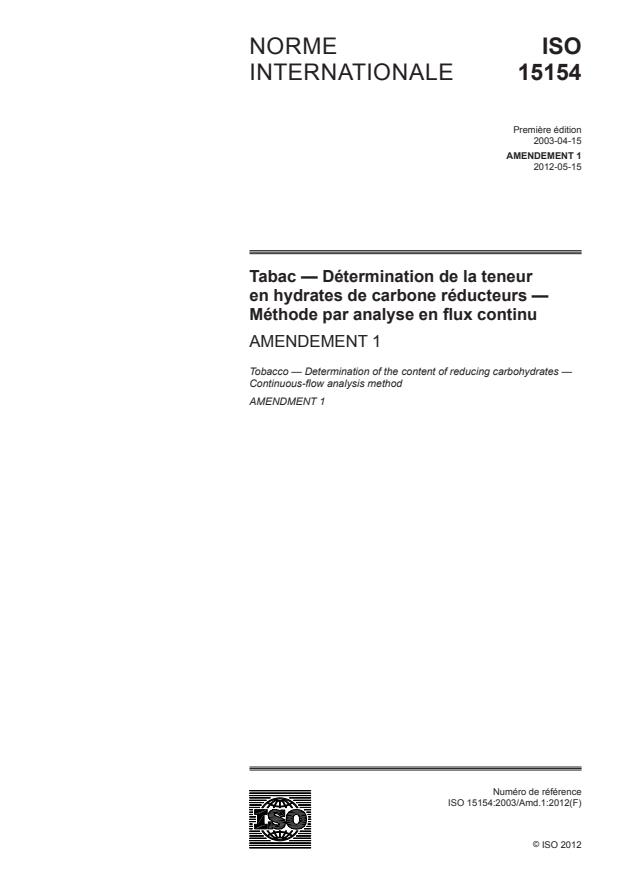
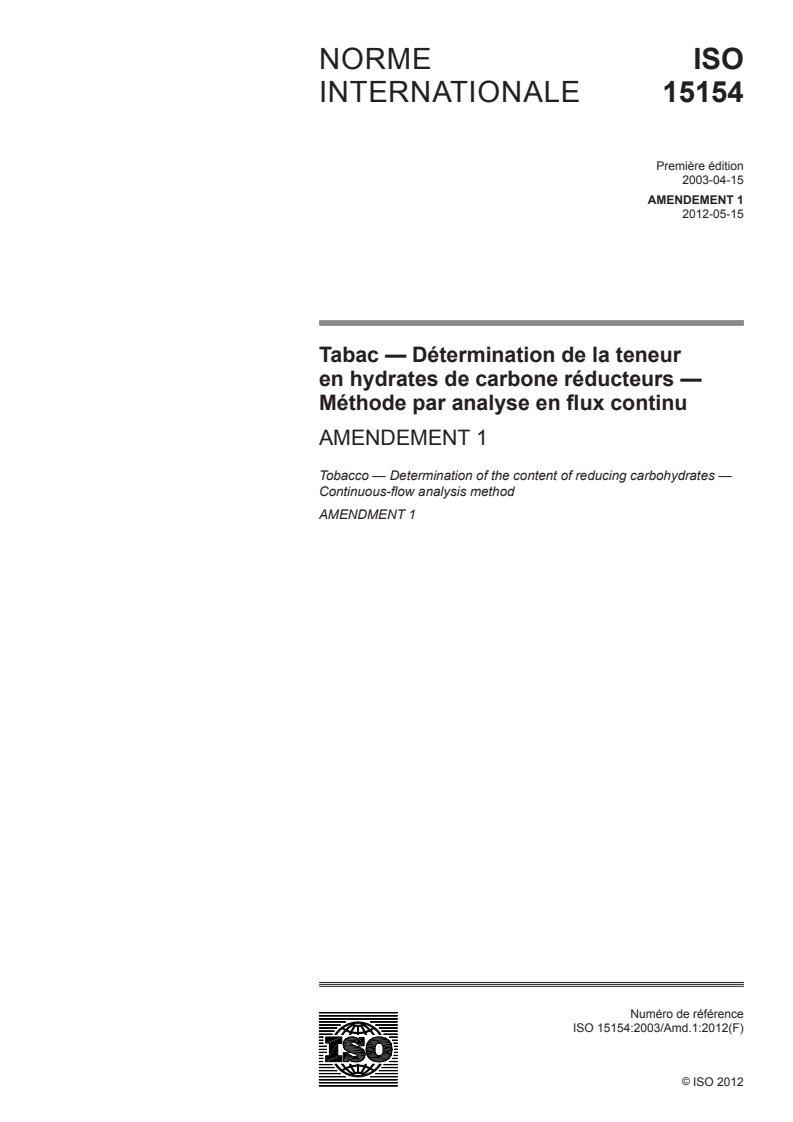
INTERNATIONAL ISO
STANDARD 15154
First edition
2003-04-15
AMENDMENT 1
2012-05-15
Tobacco — Determination of the
content of reducing carbohydrates —
Continuous-flow analysis method
AMENDMENT 1
Tabac — Détermination de la teneur en hydrates de carbone
réducteurs — Méthode par analyse en flux continu
AMENDEMENT 1
Reference number
ISO 15154:2003/Amd.1:2012(E)
©
ISO 2012
ISO 15154:2003/Amd.1:2012(E)
All rights reserved. Unless otherwise specified, no part of this publication may be reproduced or utilized in any form or by any means,
electronic or mechanical, including photocopying and microfilm, without permission in writing from either ISO at the address below or ISO’s
member body in the country of the requester.
ISO copyright office
Case postale 56 • CH-1211 Geneva 20
Tel. + 41 22 749 01 11
Fax + 41 22 749 09 47
E-mail copyright@iso.org
Web www.iso.org
Published in Switzerland
ii © ISO 2012 – All rights reserved
ISO 15154:2003/Amd.1:2012(E)
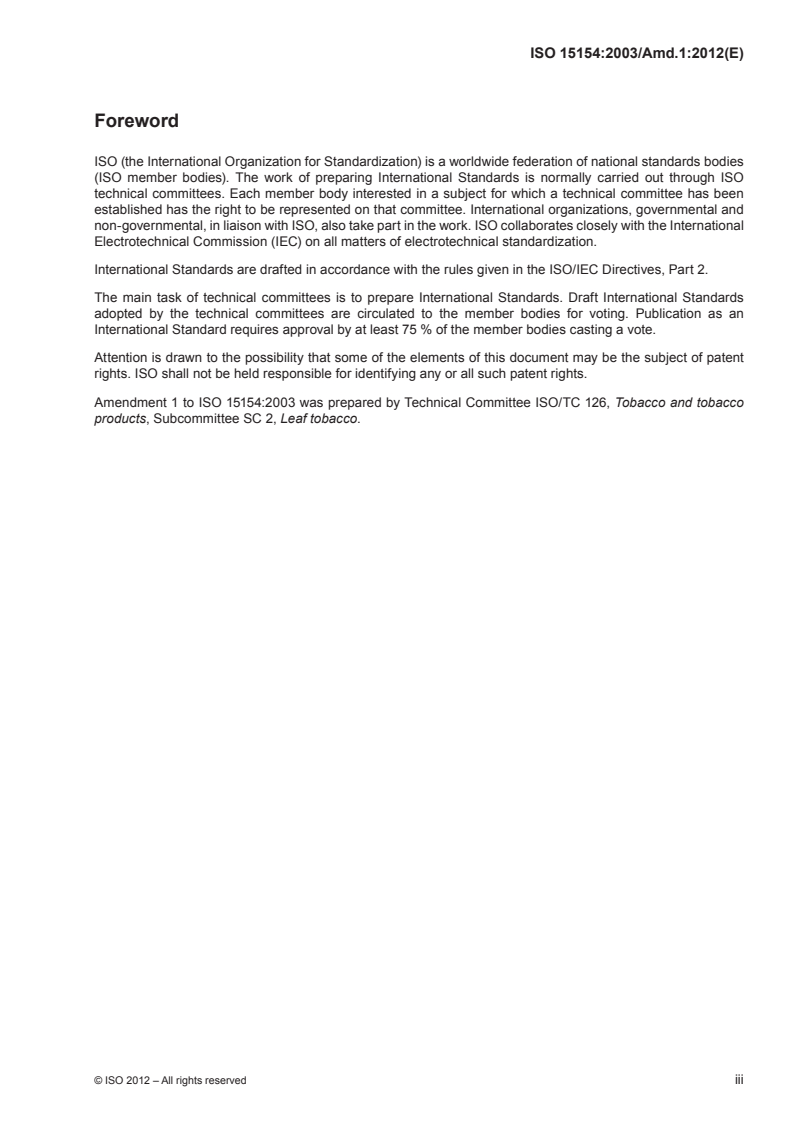
Foreword
ISO (the International Organization for Standardization) is a worldwide federation of national standards bodies
(ISO member bodies). The work of preparing International Standards is normally carried out through ISO
technical committees. Each member body interested in a subject for which a technical committee has been
established has the right to be represented on that committee. International organizations, governmental and
non-governmental, in liaison with ISO, also take part in the work. ISO collaborates closely with the International
Electrotechnical Commission (IEC) on all matters of electrotechnical standardization.
International Standards are drafted in accordance with the rules given in the ISO/IEC Directives, Part 2.
The main task of technical committees is to prepare International Standards. Draft International Standards
adopted by the technical committees are circulated to the member bodies for voting. Publication as an
International Standard requires approval by
...
INTERNATIONAL ISO
STANDARD 15154
First edition
2003-04-15
AMENDMENT 1
2012-05-15
Tobacco — Determination of the
content of reducing carbohydrates —
Continuous-flow analysis method
AMENDMENT 1
Tabac — Détermination de la teneur en hydrates de carbone
réducteurs — Méthode par analyse en flux continu
AMENDEMENT 1
Reference number
ISO 15154:2003/Amd.1:2012(E)
©
ISO 2012
ISO 15154:2003/Amd.1:2012(E)
All rights reserved. Unless otherwise specified, no part of this publication may be reproduced or utilized in any form or by any means,
electronic or mechanical, including photocopying and microfilm, without permission in writing from either ISO at the address below or ISO’s
member body in the country of the requester.
ISO copyright office
Case postale 56 • CH-1211 Geneva 20
Tel. + 41 22 749 01 11
Fax + 41 22 749 09 47
E-mail copyright@iso.org
Web www.iso.org
Published in Switzerland
ii © ISO 2012 – All rights reserved
ISO 15154:2003/Amd.1:2012(E)
Foreword
ISO (the International Organization for Standardization) is a worldwide federation of national standards bodies
(ISO member bodies). The work of preparing International Standards is normally carried out through ISO
technical committees. Each member body interested in a subject for which a technical committee has been
established has the right to be represented on that committee. International organizations, governmental and
non-governmental, in liaison with ISO, also take part in the work. ISO collaborates closely with the International
Electrotechnical Commission (IEC) on all matters of electrotechnical standardization.
International Standards are drafted in accordance with the rules given in the ISO/IEC Directives, Part 2.
The main task of technical committees is to prepare International Standards. Draft International Standards
adopted by the technical committees are circulated to the member bodies for voting. Publication as an
International Standard requires approval by
...
NORME ISO
INTERNATIONALE 15154
Première édition
2003-04-15
AMENDEMENT 1
2012-05-15
Tabac — Détermination de la teneur
en hydrates de carbone réducteurs —
Méthode par analyse en flux continu
AMENDEMENT 1
Tobacco — Determination of the content of reducing carbohydrates —
Continuous-flow analysis method
AMENDMENT 1
Numéro de référence
ISO 15154:2003/Amd.1:2012(F)
©
ISO 2012
ISO 15154:2003/Amd.1:2012(F)
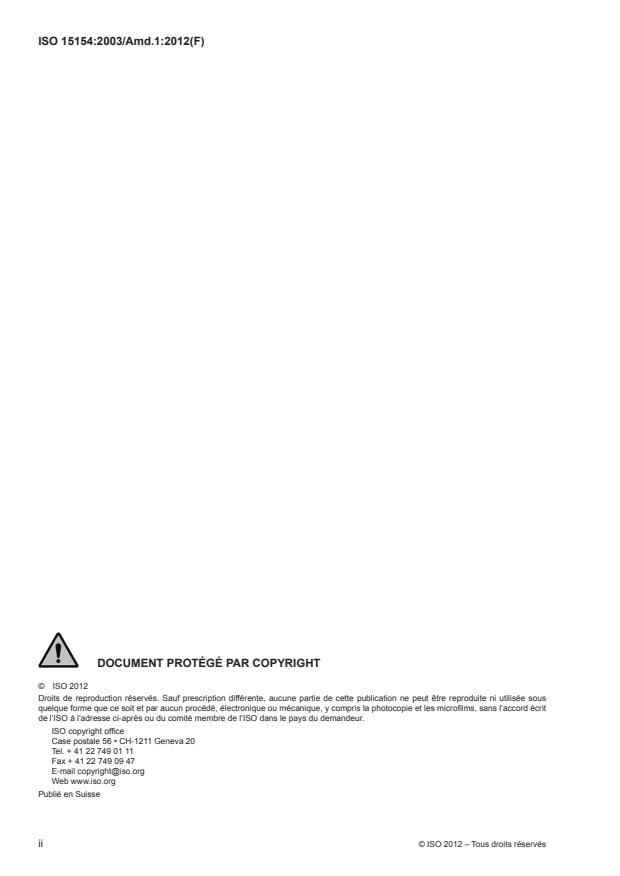
DOCUMENT PROTÉGÉ PAR COPYRIGHT
Droits de reproduction réservés. Sauf prescription différente, aucune partie de cette publication ne peut être reproduite ni utilisée sous
quelque forme que ce soit et par aucun procédé, électronique ou mécanique, y compris la photocopie et les microfilms, sans l’accord écrit
de l’ISO à l’adresse ci-après ou du comité membre de l’ISO dans le pays du demandeur.
ISO copyright office
Case postale 56 • CH-1211 Geneva 20
Tel. + 41 22 749 01 11
Fax + 41 22 749 09 47
E-mail copyright@iso.org
Web www.iso.org
Publié en Suisse
ii © ISO 2012 – Tous droits réservés
ISO 15154:2003/Amd.1:2012(F)
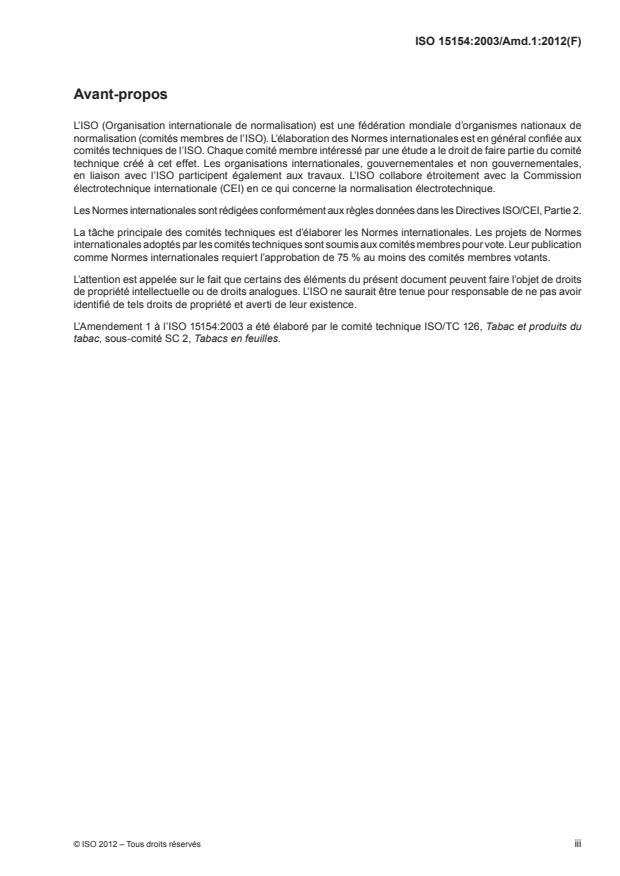
Avant-propos
L’ISO (Organisation internationale de normalisation) est une fédération mondiale d’organismes nationaux de
normalisation (comités membres de l’ISO). L’élaboration des Normes internationales est en général confiée aux
comités techniques de l’ISO. Chaque comité membre intéressé par une étude a le droit de faire partie du comité
technique créé à cet effet. Les organisations internationales, gouvernementales et non gouvernementales,
en liaison avec l’ISO participent également aux travaux. L’ISO collabore étroitement avec la Commission
électrotechnique internationale (CEI) en ce qui concerne la normalisation électrotechnique.
Les Normes internationales sont rédigées conformément aux règles données dans les Directives ISO/CEI, Partie 2.
La tâche principale des comités techniques est d’élaborer les Normes internationales. Les projets de Normes
internationales adoptés par les comités techniques sont soumis aux comités membres pour vote. Leur publication
comme Normes internationales requiert l’approbation de 75 % au moins des comités membres votants.
L’attention est appelée sur le fait que certains des éléments du présent docum
...
NORME ISO
INTERNATIONALE 15154
Première édition
2003-04-15
AMENDEMENT 1
2012-05-15
Tabac — Détermination de la teneur
en hydrates de carbone réducteurs —
Méthode par analyse en flux continu
AMENDEMENT 1
Tobacco — Determination of the content of reducing carbohydrates —
Continuous-flow analysis method
AMENDMENT 1
Numéro de référence
ISO 15154:2003/Amd.1:2012(F)
©
ISO 2012
ISO 15154:2003/Amd.1:2012(F)
DOCUMENT PROTÉGÉ PAR COPYRIGHT
Droits de reproduction réservés. Sauf prescription différente, aucune partie de cette publication ne peut être reproduite ni utilisée sous
quelque forme que ce soit et par aucun procédé, électronique ou mécanique, y compris la photocopie et les microfilms, sans l’accord écrit
de l’ISO à l’adresse ci-après ou du comité membre de l’ISO dans le pays du demandeur.
ISO copyright office
Case postale 56 • CH-1211 Geneva 20
Tel. + 41 22 749 01 11
Fax + 41 22 749 09 47
E-mail copyright@iso.org
Web www.iso.org
Publié en Suisse
ii © ISO 2012 – Tous droits réservés
ISO 15154:2003/Amd.1:2012(F)
Avant-propos
L’ISO (Organisation internationale de normalisation) est une fédération mondiale d’organismes nationaux de
normalisation (comités membres de l’ISO). L’élaboration des Normes internationales est en général confiée aux
comités techniques de l’ISO. Chaque comité membre intéressé par une étude a le droit de faire partie du comité
technique créé à cet effet. Les organisations internationales, gouvernementales et non gouvernementales,
en liaison avec l’ISO participent également aux travaux. L’ISO collabore étroitement avec la Commission
électrotechnique internationale (CEI) en ce qui concerne la normalisation électrotechnique.
Les Normes internationales sont rédigées conformément aux règles données dans les Directives ISO/CEI, Partie 2.
La tâche principale des comités techniques est d’élaborer les Normes internationales. Les projets de Normes
internationales adoptés par les comités techniques sont soumis aux comités membres pour vote. Leur publication
comme Normes internationales requiert l’approbation de 75 % au moins des comités membres votants.
L’attention est appelée sur le fait que certains des éléments du présent docum
...