

ISO/IEC 8613-5:1994
(Main)Information technology — Open Document Architecture (ODA) and Interchange Format: Open Document Interchange Format
General Information
- Abstract
Defines the format of the data stream used to interchange documents structured in accordance with ITU-T Rec. T.412 / ISO/IEC 8613-2 and the representation of the constituents which may appear in an interchanged document. The purpose is to facilitate the interchange of documents for either or both of the following purposes: to allow presentation as intended by the originator, to allow processing, such as editing and reformatting. Documents are to be items such as memoranda, letters, invoices, forms and reports, which may include pictures and tabular material. The content elements used within the documents may include graphic characters, raster graphics elements and geometric graphics elements.
- Status
- Published
- Publication Date
- 21-Dec-1994
- Technical Committee
- ISO/IEC JTC 1 - Information technology
- Drafting Committee
- ISO/IEC JTC 1 - Information technology
- Current Stage
- 9093 - International Standard confirmed
- Start Date
- 21-Feb-2025
- Completion Date
- 29-Aug-2026
Buy Documents
ISO/IEC 8613-5:1994 - Information technology — Open Document Architecture (ODA) and Interchange Format: Open Document Interchange Format Released:12/22/1994
ISO/IEC 8613-5:1994 - Technologies de l'information — Architecture de document ouverte (ODA) et format de transfert: Format ouvert de transfert de documents Released:9/21/1995
Overview
ISO/IEC 8613-5:1994 - Open Document Interchange Format (ODIF) - specifies the data-stream format and representation rules for interchanging documents structured according to ITU‑T Rec. T.412 / ISO/IEC 8613-2 (Open Document Architecture, ODA). Its aim is to enable reliable document interchange so recipients can either present documents as intended by the originator or process them (editing, reformatting, archiving). Typical document types covered include memoranda, letters, invoices, forms and reports, potentially containing pictures, tables, raster graphics and geometric graphics.
Key topics and technical requirements
- Interchange format classes - definitions of Format Class A and Class B for different interchange requirements.
- Descriptors and text units - metadata and structural units used to describe document constituents.
- Interchange data elements - canonical elements that make up the ODIF data stream.
- Document Profile descriptor - profile mechanism for indicating capabilities and expected processing behavior.
- Identifiers and expressions - naming and expression rules used throughout exchanged documents.
- Layout, logical and style descriptors - representation of visual layout, logical document structure and style inheritance.
- Default value lists, colour and protected part descriptors - default rendering values, color attributes and mechanisms to mark protected regions.
- ASN.1 encoding and cryptographic techniques - use of ASN.1 for encoding parts of the stream and support for enciphered/sealed information to protect content.
- Open Document Language (ODL) and SDIF - guidance on ODL representations, SGML constructs and use of Structured Document Interchange Format (SDIF).
- Annexes - coded representation, object identifier listings, example documents and canonical encoding guidance for implementers.
Practical applications and users
ISO/IEC 8613-5:1994 is relevant for:
- Software vendors implementing ODA/ODIF import-export, editors and converters.
- Document management and archiving systems requiring long-term, platform-independent document interchange and preservation.
- Interoperability engineers and standards implementers building cross-platform document workflows.
- Government and enterprise IT that exchange official forms, invoices and reports between heterogeneous systems.
- Archivists and digital preservation specialists who need precise, standardised encodings to retain presentation fidelity and editability.
Benefits include improved interoperability, preservation of layout and semantics, and mechanisms for secure interchange (enciphered/sealed content).
Related standards
- ISO/IEC 8613-2 / ITU‑T Rec. T.412 (ODA document structure)
- ISO/IEC 8613-4 (Document Profile)
- ITU‑T Recommendations referenced in annexes for profiles and examples
Keywords: ISO/IEC 8613-5, ODIF, ODA, Open Document Interchange Format, ODL, SDIF, ASN.1, document interchange, document interoperability, document profile.
Relations
- Effective Date
- 06-Jun-2022
- Effective Date
- 06-Jun-2022
- Effective Date
- 15-Apr-2008
- Effective Date
- 15-Apr-2008
- Effective Date
- 15-Apr-2008
Buy Documents
ISO/IEC 8613-5:1994 - Information technology — Open Document Architecture (ODA) and Interchange Format: Open Document Interchange Format Released:12/22/1994
ISO/IEC 8613-5:1994 - Technologies de l'information — Architecture de document ouverte (ODA) et format de transfert: Format ouvert de transfert de documents Released:9/21/1995
Get Certified
Connect with accredited certification bodies for this standard

BSI Group
BSI (British Standards Institution) is the business standards company that helps organizations make excellence a habit.

NYCE
Mexican standards and certification body.
Sponsored listings
Frequently Asked Questions
ISO/IEC 8613-5:1994 is a standard published by the International Organization for Standardization (ISO). Its full title is "Information technology — Open Document Architecture (ODA) and Interchange Format: Open Document Interchange Format". This standard covers: Defines the format of the data stream used to interchange documents structured in accordance with ITU-T Rec. T.412 / ISO/IEC 8613-2 and the representation of the constituents which may appear in an interchanged document. The purpose is to facilitate the interchange of documents for either or both of the following purposes: to allow presentation as intended by the originator, to allow processing, such as editing and reformatting. Documents are to be items such as memoranda, letters, invoices, forms and reports, which may include pictures and tabular material. The content elements used within the documents may include graphic characters, raster graphics elements and geometric graphics elements.
Defines the format of the data stream used to interchange documents structured in accordance with ITU-T Rec. T.412 / ISO/IEC 8613-2 and the representation of the constituents which may appear in an interchanged document. The purpose is to facilitate the interchange of documents for either or both of the following purposes: to allow presentation as intended by the originator, to allow processing, such as editing and reformatting. Documents are to be items such as memoranda, letters, invoices, forms and reports, which may include pictures and tabular material. The content elements used within the documents may include graphic characters, raster graphics elements and geometric graphics elements.
ISO/IEC 8613-5:1994 is classified under the following ICS (International Classification for Standards) categories: 35.240.20 - IT applications in office work. The ICS classification helps identify the subject area and facilitates finding related standards.
ISO/IEC 8613-5:1994 has the following relationships with other standards: It is inter standard links to ISO/IEC 8613-5:1994/Cor 2:1998, ISO/IEC 8613-5:1994/Cor 1:1998, ISO 8613-5:1989; is excused to ISO/IEC 8613-5:1994/Cor 1:1998, ISO/IEC 8613-5:1994/Cor 2:1998. Understanding these relationships helps ensure you are using the most current and applicable version of the standard.
ISO/IEC 8613-5:1994 is available in PDF format for immediate download after purchase. The document can be added to your cart and obtained through the secure checkout process. Digital delivery ensures instant access to the complete standard document.
Standards Content (Sample)
INTERNATIONAL
ISOJIEC
STANDARD
8613-5
Second edition
1994-12-15
Information technology - Open
Document Architecture (ODA) and
Interchange Format: Open Document
Interchange Format
Technologies de Yin forma tion - Architecture des documents ouverts
(ODA) et format d ’khange: Format d ’bchange des documents ouverts
Reference number
o ISO/IEC
ISOAEC 8613-5: 1994(E)
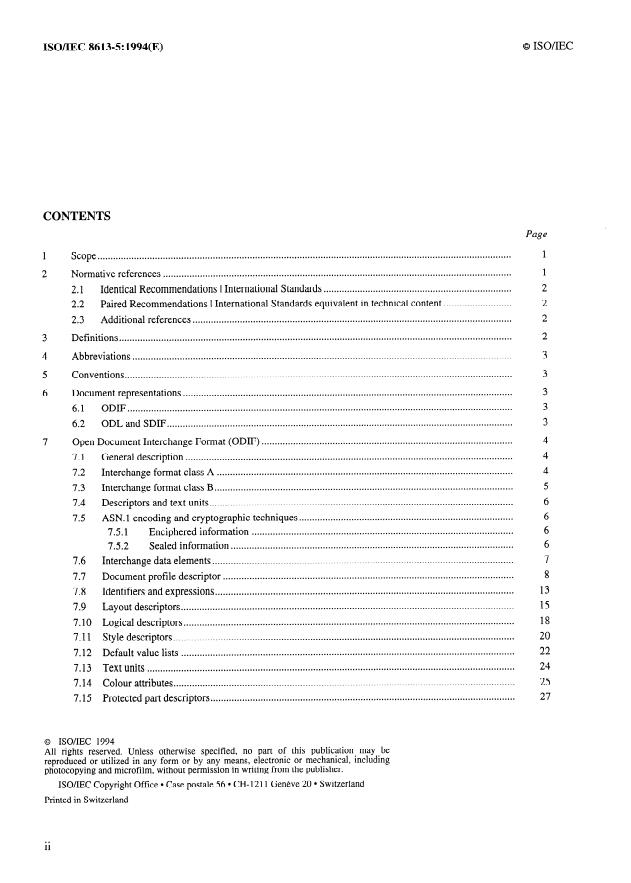
CONTENTS
Page
Scope .
.....................................................................................................................................
Normative references
........................................................................ 2
2.1 Identical Recommendations I International Standards
.......................... 2
2.2 Paired Recommendations I International Standards equivalent in technical content
2.3 Additional references .
Definitions .
Abbreviations .
Conventions .
Document representations .
61 . ODIF .
ODL and SDIF .
6.2
................................................................................................
Open Document Interchange Format (ODIF)
.............................................................................................................................
7.; General description
7.2 Interchange format class A .
..................................................................................................................
7.3 Interchange format class B
7.4 Descriptors and text units .
..................................................................................
7.5 ASN. 1 encoding and cryptographic techniques
....................................................................................................
7.5.1 Enciphered information
............................................................................................................ 6
7.5.2 Sealed information
...................................................................................................................
7.6 Interchange data elements
7.7 Document Profile descriptor .
..................................................................................................................
7.8 Identifiers and expressions
...............................................................................................................................
7.9 Layout descriptors
.............................................................................................................................. 18
7.10 Logical descriptors
..................................................................................................................................
7.11 Style descriptors
............................................................................................................................... 22
7.12 Default value lists
............................................................................................................................................
7.13 Text units
7.14 Colour attributes .
....................................................................................................................
7.15 Protected part descriptors
0 ISODEC 1994
All rights reserved. Unless otherwise specified, no part of this publication may be
reproduced or utilized in any form or by any means, electronie or mechanical, including
photocopying and microfilm, without permission in writing from the publisher.
ISOLIEC Copyright Office l Case postale 56 l CH-121 1 Geneve 20 l Switzerland
Printed in Switzerland
ii
o ISO/IEC ISO/IEC 8613-5: 1994(E)
. . . . . . . . . . . . . . . . . . . . . . . . . . . . . . . . . . . . . . . . . . . . . . . . . . . . . . . . . . . . . . . . . . . . . . . . . . . . . . . . . . . . . . . . . . . . . . . . . . . . . . . . . . . . . . . . . . . . . . . . .
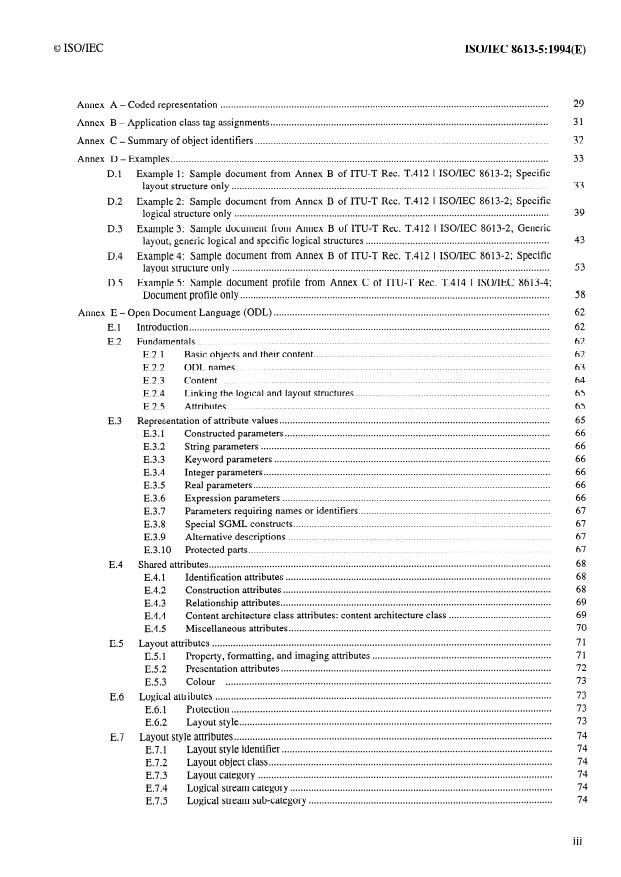
Annex A - Coded representation
Annex B - Application class tag assignments . . . . . . . . . . . . . . . . . . . . . . . . . . . . . . . . . . . . . . . . . . . . . . . . . . . . . . . . . . . . . . . . . . . . . . . . . . . . . . . . . . . . . . . . . . . . . . . . . . . . . . . . . .
. . . . . . . . . . . . . . . . . . . . . . . . . . . . . . . . . . . . . . . . . . . . . . . . . . . . . . . . . . . . . . . . . . . . . . . . . . . . . . . . . . . . . . . . . . . . . . . . . . . . . . . . . . . . . . . .
Annex C - Summary of Object identifiers
Annex D - Examples . . . . . . . . . . . . . . . . . . . . . . . . . . . . . . . . . . . . . . . . . . . . . . . . . . . . . . . . . . . . . . . . . . . . . . . . . . . . . . “.
D.l Example 1: Sample document from Annex B of ITU-T Rec. T.412 I ISO/IEC 8613-2; Specific
layout structure only . . . . . . . . . . . . . . . . . . . . . . . . . . . . . . . . . . . . . . . . . . . . . . . . . . . . . . . . . . . . . . . . . . . . . . . . . . . . . . . . . . . . . . . . . . . . . . . . . . . . . . . . . . . . . . . . . .*.
D.2 Example 2: Sample document from Annex B of ITU-T Rec. T.412 I ISO/IEC 8613-2; Specific
. . . . . . . . . . . . . . . . . . . . . . . . . . . .~. ”.
logical structure only
D.3 Example 3: Sample document from Annex B of ITU-T Rec. T.412 I ISO/IEC 8613-2; Generic
. . . . . . .*.
layout, generic logical and specific logical structures
D.4 Example 4: Sample document from Annex B of ITU-T Rec. T.412 I ISO/IEC 8613-2; Specific
. . . . . . . . . . . . . . . . . . . . . . . . . . . . . . . . . . . . . . . . . . . . . . . . . . . . . . . . . . . . . . . . . . . . . . . . . . . . . . . . . . . . . . . . . . . . . . . . . . . . . . . . . . . . . . . . . . . . . . . . .
layout structure only
D.5 Example 5: Sample document Profile from Annex C of ITU-T Rec. T.414 1 ISO/IEC 8613-4;
Document Profile only . .*.
.........................................................................................................
Annex E - Open Document Language (ODL)
Introduction .
E.1
......................................................................................................................................
E.2 Fundamentals
.......................................................................................... 62
E.2.1 Basic objects and their content
E.2.2 ODL names . . . . . . . . . . . . . . . . . . . . . . . . . .*.
............................................................................................................................ 64
E.2.3 Content
.......................................................................... 65
E.2.4 Linking the logical and layout structures
Attributes .
E.2.5
.......................................................................................................
E.3 Representation of attribute values
..................................................................................................... 66
E.3.1 Constructed Parameters
E.3.2 String Parameters .
......................................................................................................... 66
E.3.3 Keyword Parameters
E.3.4 Integer Parameters .
Real Parameters .
E.3.5
...................................................................................................... 66
E.3.6 Expression Parameters
E.3.7 Parameters requiring names or identifiers .
Special SGML constructs . 67
E.3.8
.................................................................................................... 67
E.3.9 Alternative descriptions
Protected parts .
E.3.10
..................................................................................................................................
E.4 Shared attributes
.....................................................................................................
E.4.1 Identification attributes
...................................................................................................... 68
E.4.2 Construction attributes
Relationship attributes .
E.4.3
....................................... 69
Content architecture class attributes: content architecture class
E.4.4
.................................................................................................... 70
Miscellaneous attributes
E.4.5
.................................................................................................................................
E.5 Layout attributes
.................................................................... 71
Property, formatting, and imaging attributes
E.5.1
Presentation attributes .
E.5.2
E.5.3 Colour .
................................................................................................................................
E.6 Logical attributes
Protection .
E.6.1
.......................................................................................................................
E.6.2 Layout style
.........................................................................................................................
E.7 Layout style attributes
.......................................................................................................
E.7.1 Layout style identifier
............................................................................................................ 74
E.7.2 Layout Object class
Layout category .
E.7.3
....................................................................................................
E.7.4 Logical stream category
.............................................................................................
E.7.5 Logical stream sub-category
ISO/IEC 8613-5: 1994(E) o ISO/IEC
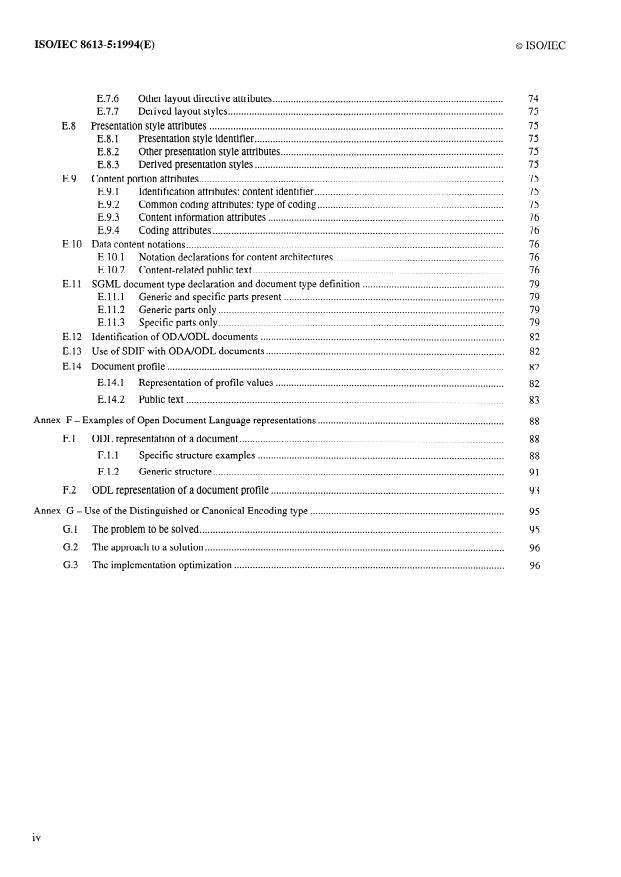
E.7.6 Other layout directive attributes .
E.7.7 Derived layout styles .
E.8 Presentation style attributes .
Presentation style identifier .
E.8.1
E.8.2 Other presentation style attributes .
E.8.3 Derived presentation styles .
E.9 Content Portion attributes .
E.9.1 Identification attributes: content identifier . 75
Common coding attributes: type of coding . 75
E.9.2
E.9.3 Content information attributes .
E.9.4 Coding attributes . 76
E. 10 Data content notations .
Notation declarations for content architectures . 76
E. 10.1
................................................................................................ 76
E. 10.2 Content-related public text
E.11 SGML document type declaration and document type definition . 79
.................................................................................... 79
E. 11.1 Generic and specific parts present
E.11.2 Generic parts only .
E. 11.3 Specific Parts only . 79
............................................................................................. 82
E. 12 Identification of ODA/ODL documents
E. 13 Use of SDIF with ODA/ODL documents . . . . . . . . . . . . . . . . . . . . . . . . . . . . . . . . . . . . . . . . . . . . . . . . . . . . . . . . . . . . . . . . . . . . . . . . . . . . . . . . . . . . . . . . . . . 82
E. 14 Document Profile . 82
E. 14.1 Representation of Profile values . 82
E.14.2 Public text . . . . . . . . . . . . . . . . . . . . . . . . . . . . . . . . . . . . . . . . . . . . . . . . . . . . . . . . . . . . . . . . . . . . . . . . . . . . . . . . . . . . . . . . . . . . . . . . . . . . . . . . . . . . . . . . . . . . . . . . . 83
Annex F - Examples of Open Document Language representations . . . . . . . . . . . . . . . . . . . . . . . . . . . . . . . . . . . . . . . . . . . . . . . . . . . . . . . . . . . . . . . . . . . . . . . 88
F.l . . . . . . . . . . . . . . . . . . . . . . . . . . . . . . . . . . . . . . . . . . . . . . . . . . . . . . . . . . . . . . . . . . . . . . . . . . . . . . . . . . . . . . . . . . . . . . . . . . . . .
ODL representation of a document 88
F.l.l Specific structure examples . . . . . . . . . . . . . . . . . . . . . . . . . . . . . . . . . . . . . . . . . . . . . . . . . . . . . . . . . . . . . . . . . . . . . . . . . . . . . . . . . . . . . . . . . . . . . . 88
Generic structure . . . . . . . . . . . . . . . . . . . . . . . . . . . . . . . . . . . . . . . . . . . . . . . . . . . . . . . . . . . . . . . . . . . . . . . . . . . . . . . . . . . . . . . . . . . . . . . . . . . . . . . . . . . . . . . 91
F.1.2
F.2 ODL representation of a document Profile . . . . . . . . . . . . . . . . . . . . . . . . . . . . . . . . . . . . . . . . . . . . . . . . . . . . . . . . . . . . . . . . . . . . . . . . . . . . . . . . . . . . . . . . . 93
Annex G - Use of the Distinguished or Canonical Encoding type . . . . . . . . . . . . . . . . . . . . . . . . . . . . . . . . . . . . . . . . . . . . . . . . . . . . . . . . . . . . . . . . . . . . . . . . . . 95
G.1 The Problem to be solved . . . . . . . . . . . . . . . . . . . . . . . . . . . . . . . . . . . . . . . . . . . . . . . . . . . . . . . . . . . . . . . . . . . . . . . . . . . . . . . . . . . . . . . . . . . . . . . . . . . . . . . . . . . . . . . . . . . . 95
. . . . . . . . . . . . . . . . . . . . . . . . . . . . . . . . . . . . . . . . . . . . . . . . . . . . . . . . . . . . . . . . . . . . . . . . . . . . . . . . . . . . . . . . . . . . . . . . . . . . . . . . . . . . . . . . . .
G.2 The approach to a Solution 96
G.3 The implementation optimization . . . . . . . . . . . . . . . . . . . . . . . . . . . . . . . . . . . . . . . . . . . . . . . . . . . . . . . . . . . . . . . . . . . . . . . . . . . . . . . . . . . . . . . . . . . . . . . . . . . . . . . 96
iv
o ISO/IEC ISO/IEC 8613-5: 1994(E)
Foreword
ISO (the International Organization for Standardization) and IEC (the Inter-
national Electrotechnical Commission) form the specialized System for worldwide
standardization. National bodies that are members of ISO or IEC participate in the
development of International Standards through technical committees established
by the respective organization to deal with particular fields of technical activity.
ISO and IEC technical committees collaborate in fields of mutual interest. Other
international organizations, governmental and non-governmental, in liaison with
ISO and IEC, also take part in the work.
In the field of information technology, ISO and IEC have established a joint
technical committee, ISOLEC JTC 1. Draft International Standards adopted by the
joint technical committee are circulated to national bodies for voting. Publication
as an International Standard requires approval by at least 75 % of the national
bodies casting a vote.
International Standard ISO/IEC 8613-5 was prepared by Joint Technical
Committee ISO/IEC JTC 1, Information technology, Subcommittee SC 18,
Document processing and related communication, in collaboration with ITU-T.
The identical text is published as ITU-T Rec. T.415.
This second edition cancels and replaces the first edition (ISO 8613-5: 1989),
which has been technically revised.
ISOfIEC 8613 consists of the following Parts, under the general title Information
technology - Open Document Architecture (ODA) and Interchange Format:
- Part 1: Introduction and general principles
- Part 2: Document structures
- Part 3: Abstract interface for the manipulation of ODA documents
- Part 4: Document Profile
- Part 5: Open Document Interchange Format
- Part 6: Character content architectures
- Part 7: Raster graphics content architectures
- Part 8: Geometrie graphics content architectures
- Part 9: Audio content architectures
- Part 10: Formal specifications
- Part 11: Tabular structures and tabular layout
- Part 12: Identification of documentfragments
- Part 13: Spreadsheet
- Part 14: Temporal relationships and non-linear structures
Annex E forms an integral part of this part of ISO/IEC 8613. Annexes A, B, C, D,
F and G are for information only.
o ISO/IEC
ISOAEC 8613-5: 1994(E)
INTRODUCTION
This ITU-T Recommendation I International Standard was prepared as a joint publication by CCITI’ Study Group VIII
and ISO/IEC Joint Technical Committee 1.
At present, ITU-T Rec. T.410 Series I ISO/IEC 8613 consists of:
-
Introduction and general principles;
-
Document structures;
-
Document Profile;
Open document interchange format;
-
Character content architectures;
-
Raster graphics content architectures;
-
Geometrie graphics content architectures;
-
Formal specification of the Open Document Architecture (FODA).
(The formal specification is applicable to ISO/IEC 8613 only.)
Further Recommendations I International Standards may be added to this set of Recommendations I International
Standards.
Development of this set of Recommendations I International Standards was originally in parallel with the ECMA-101
Standard: Open Document Architecture.
This set of Recommendations I International Standards is a new edition of the CCITT T.410 Series of Recommendations
(1988) and ISO 8613: 1989.
Significant technical changes are the inclusion of the following amendments as agreed by CCITT and ISO/IEC:
-
Alternative Representation;
-
Annex on use of MHS/MOTIS;
-
Colour;
-
Conformance Testing annex;
-
Document Application Profile Proforma and Notation;
-
Security ;
-
Streams;
-
Styles;
-
Tiled Raster Graphits.
In addition, a number of technical corrigenda have been applied.
This Recommendation I International Standard contains seven annexes:
-
Annex A (non-integral): Coded representation;
Annex B (non-integral): Application class tag assignments;
-
Annex C (non-integral): Summary of Object identifiers;
-
Annex D (non-integral): Examples;
-
Annex E (integral): Open Document Language (ODL) (this annex is applicable to ISO/IEC 8613-5 only);
-
Annex F (non-integral): Examples of Open Document Language representations (this annex is applicable
to ISO/IEC 8613-5 only);
-
Annex G (non-integral): Use of the Distinguished or Canonical Encoding Type.
vi
ISOAEC 8613-5 : 1994 (E)
INTERNATIONAL STANDARD
ITU-T RECOMMENDATION
INFORMATION TECHNOLOGY -
OPEN DOCUMENT ARCHITECTURE (ODA) AND INTERCHANGE FORMAT:
OPEN DOCUMENT INTERCHANGE FORMAT
1 Scope
The purpose of ITU-T Rec. T.3 10 Series I ISO/IEC 8613 is to facilitate the interchange of documents.
In the context of these Recommendations I International Standards, documents are considered to be items such as
memoranda, letters, invoices, forms and reports, which may include pictures and tabular material. The content elements
used within the documents may include graphic characters, raster graphics elements and geometric graphics elements, all
potentially within one document.
NOTE - These Recommendations I International Standards are designed to allow for extensions. including hvpermedia
e
features. Spreadsheets and additional types of content such as audio and Video.
In addition to the content types defined in these Recommendations I International Standards, ODA also provides for
arbitrary content types to be included in documents.
apply to the interchange of documents by means of data
These Recommendations I International Standards
communications or the exchange of storage media.
for the interchange of documents for either or both of the
These Recommendations I International Standards provide
follow mg purposes:
-
to allow presentation as intended by the originator;
to allow processing, such as editing and reformatting.
The composition of a document in interchange tan take several forms:
-
formatted form, allowing presentation of the document;
-
processable form, allowing processing of the document;
-
formatted processable form, allowing both presentation and processing of the document.
These Recommendations I International Standards also provide for the interchange of ODA information structures used
for the processing of interchanged documents.
This Recommendation I International Standard defines
-
the format of the data stream used to interchange documents structured in accordance with ITU-T
Rec. T.412 I ISO/IEC 8613-2;
-
the representation of the constituents which may appear in an interchanged document.
NOTES
1 This ITU-T Recommendation I International Standard does not specify the coded representation of content elements.
2 Data formats for presentation attributes and coding attributes are defined in other Recommendations I International
Standards in ITU-T Rec. T.4 10 Series I ISO/IEC 8613.
2 Normative references
The following Recommendations and International Standards contain provisions which, through reference in this text,
constitute provisions of this Recomrnendation I International Standard. At the time of publication, the editions indicated
were valid. All Recommendations and Standards are subject to revision, and Parties to agreements based on this
Recommendation I International Standard arc encouraged to investigate the possibility of applying the most recent
edition of the Recommendations and Standards listed below. Members of IEC and ISO maintain registers of currently
valid International Standards. The Telecommunication Standardization Bureau of the ITU maintains a list of currently
valid ITU-T Recommendations.
ITU-T Rec. T.415 (1993 E)
ISO/IEC 8613-5 : 1994 (E)
21 . Identical Recommendations I International Standards
-
ITU-T Recommendation T.4 11 (1993) I ISOfIEC 86 13- 1: 1994, Information technology - Open Document
Architecture (ODA) and Interchange Format: Introduction and general principles.
-
ITU-T Recommendation T.412 (1993) I ISO/IEC 8613-2: 1994, Information technology - Open Document
Architecture (ODA) and Interchange Format: Document structures.
-
ITU-T Recommendation T.414 (1993) I ISOLIEC 8613-4: 1994, Information technology - Open Document
Architecture (ODA) and Interchange Format: Document Profile.
-
ITU-T Recommendation T.4 16 (1993) I ISO/IEC 86 13-6: 1994, Information technology - Open Document
Architecture (ODA) and Interchange Format: Character content architectures.
-
ITU-T Recommendation T.417 (1993) I ISO/IEC 8613-7: 1994, Information technology - Open Document
Architecture (ODA) and Interchange Format: Raster graphics content architectures.
-
ITU-T Recommendation T.418 (1993) I ISO/IEC 86 13-8: 1994, Information technology - Open Document
Architature (ODA) and Interchange Format: Geometrie graphics content architectures.
-
ITU-T Recommendation X.209-3 ’) I ISO/IEC 88253:. ‘), Information technology - Open Systems
Specification of ASN. 1 Encoding Rules: Distinguished and Canonical encoding rules.
Interconnection -
-
ITU-T Recommendation X.509 (1993) I ISOKIEC 9594-8:1994, The Directory - Authentication
framework.
22 . Paired Recommendations I International Standards equivalent in technical content
-
CCITT Recommendation X.208 (1988), Specification of Abstract Syntax Notation One (ASN. 1).
ISOfIEC 8824: 1990, Information technology - Open Systems Interconnection - Specification of Abstract
Syntax Notation One (ASN.1).
-
CCITT Recommendation X.209 (1988), Specification of Basic Encoding Rules for Abstract Syntax
Notation One (ASN. 1).
Open Systems Interconnection - Specification of Basic
ISOIIEC 8825: 1990, Information technology -
Encoding Rules for Abstract Syntax Notation One (ASN. 1).
Additional references
23 .
-
ISO 2022: 1986, Information processing - ISO 7-bit and g-bit coded Character sets - Code extension
techniques.
-
ISO 8601:1988, Data elements and interchange formats - Information interchange - Representation of
dates and times.
-
ISOIIEC 8613- 10: 1991, Information processing - Text and ofice Systems - Ofice Document Architecture
(ODA) and Interchange Format - Part IO: Formal specifications.
-
ISO 8879~1986, Information processing - Text and Office Systems - Standard Generalized Markup
Language (SGML).
-
ISO 906911988, Information processing - SGML support facilities - SGML Document Interchange
Format (SDIF).
-
ISO/IEC 9541-2: 1991, Information technology - Font information interchange - Part 2: Interchange
format.
3 Definitions
For the purposes of this Recommendation I International Standard, the definitions given in ITU-T Rec. T.411 I ISO/IEC
8613-1 apply.
In addition, the definitions of CCITT Rec. X.208 I ISOLIEC 8824 and CCITT Rec. X.209 I ISO/IEC 8825 apply to this
Recommendation I International Standard.
‘1 Presently at the Stage of draft.
2 ITU-T Rec. T.415 (1993 E)
ISOiIEC 8613-5 : 1994 (E)
4 Abbreviations
For the purposes of this Specification, the abbreviations given in ITU-T Rec. T.411 I ISO/IEC 8613-1 apply.
For the purposes of this Specification, the following additional abbreviations apply:
Document type defmition
DTD
EOC End of contents
GI SGML generic identifier
International Alphabet no. 5
IA5
ID SGML unique identifier
LIT Litera1 Start or end
LITA Litera1 Start or end (alternative)
LPD Link process definition
OS1 Open Systems Interconnection
ULA Upper Layer Applications
UTC Coordinated Universal Time
5 Conventions
For the purpose of this Specification, the conventions given in ITU-T Rec. T.411 I ISO/IEC 8613-1 apply.
6 Document representations
A document structured in accordance with KU-T Rec. T.410 Series I ISO/IEC 8613 is represented for interchange by
either the Open Document Interchange Format (ODIF), or the Open Document Language (ODL) in conjunction with the
SGML Document Interchange Format (SDIF). The ODIF and ODWSDIF representations are technically equivalent; a
document tan be transformed from one to the other without loss of semantic information about the document
constituents and attributes.
The use of ODL and SDIF is applicable to ISO/IEC 8613 only.
NOTE - Both data structure (ODIF) and language (ODL) representations have been standardized in Order to meet the
document representation requirements of distinct application environments. ODIF, being a data structure specified using ASN.l, is
particularly intended for use in an OS1 environment. ODL is particularly appropriate for Systems that share information through
marked-up text files, especially where human users tan access the markup directly.
61 . ODIF
ODIF is an abstract data Syntax in which the constituents and attributes of the document are represented by a hierarchy
of data structures and data items, specified using the abstract Syntax notation ASN.l defined in CCITT Rec. X.208 i
ISOIIEC 8824.
The coded representation of each data structure or data item is obtained by applying a set of encoding rules.
ODIF is specified in clause 7.
NOTE - ASN. 1 is a formal description method that allows data types relevant to an application to be specified in terms of
other data types, including basic data types such as “integer” and “octet string” which are defined in CCITT Rec. X.208 I ISO/IEC
8824 itself. Basic encoding rules for ASN.l are defined in CCITT’ Rec. X.209 I ISO/IEC 8825 and are summarized in Annex A.
62 . ODL and SDIF
The use of ODL and SDIF is applicable to ISO/IEC 8613 only.
ODL is a language in which the constituents and attributes of the document are identified by descriptive tags, and are
grouped into one or more storage entities (e.g. files) as the user may require.
For interchange, each ODL entity is represented as a Single data structure or data item, specified using ASN.l, in a data
stream constructed according to the SGML Document Interchange Format defined in ISO 9069.
ODL is specified in Annex E.
NOTE - ODL is an SGML application conforming to ISO 8879.
ITU-T Rec. T.415 (1993 E) 3
ISO/IEC 8613-5 : 1994 (EJ
Open Document Interchange Format (ODIF)
71 . General description
A document structured in accordance with ITU-T Rec. T.410 Series I ISO/IEC 8613 is represented by a data stream
consisting of one or more data structures of the following types:
-
document Profile descriptor;
-
layout Object descriptor;
-
lavout Object class descriptor;
e
-
logical Object descriptor;
-
logical Object class descriptor;
-
presentation stvle descriptor;
d
-
layout style descriptor;
-
text un it;
-
sealed document Profile descriptor;
-
enciphered document Profile descriptor;
-
pre-enciphered document bodv part descriptor;
.
-
post-enciphered document body part descriptor.
These data structures are called interchange dara elenrents. Within a data stream, the interchange data elements are
ordered in accordance with certain rules which are specified below. This Specification defines two such sets of rulec;
they are called interchange fomat class A and interchange formt class B.
Which of these sets of rules applies to a given data stream is indicated in the document Profile descriptor. In all cases, a
data stream contains one and only one document Profile descriptor which is always the first interchange data element in
the data stream. The document Profile descriptor may be the only data structure in the data stream.
When an ODIF data stream is used as part of an ASN. 1 extemal data type, the abstract Syntax shall be formed by an
ASN.l SEQUENCE OF type referencing the Interchange-Data-Element type; the encoding of the data value shall
0 the ASN.l basic encoding rules; and the value of the
consist of an integral number of octets, formed by applyin,
associated ASN. 1 Object identifier shall be { 2 8 0 0 }.
NOTE - The manner of incorporating the interchange data elements. or the extemal data type. in an application protocol or
the manner of mapping them on Service data units (in an OS1 environment) is not defined by this Specification.
72 . Interchange format class A
According to interchange format class A, a data stream consists of one document Profile descriptor and, optionally, one
or more interchange data elements of the following types:
layout Object descriptor;
- layout Object class descriptor;
- logical Object descriptor;
- logical Object class descriptor;
- presentation style descriptor;
- layout style descriptor;
text unit;
- sealed document Profile descriptor;
- enciphered document Profile descriptor;
- pre-enciphered document body part descriptor;
- post-enciphered
document body part descriptor.
The Order of the interchange data elements is as follows:
document Profile descriptor;
d
layout Object class descriptors;
b)
4 ITU-T Rec. T.415 (1993 E)
ISOAEC 8613-5 : 1994 (E)
logical Object class descriptors;
d) text units representing generic content portions;
e) presentation style descriptors;
f) layout style descriptors;
g) layout Object descriptors;
h) logical Object descriptors;
text units representing specific content portions;
.
sealed document Profile descriptors;
J)
k) enciphered document Profile descriptors;
pre-enciphered document body part descriptors;
post-enciphered document body part descriptors.
m>
Within each of the groups of layout Object descriptors and logical Object descriptors, the Order of the descriptors is equal
to the sequential Order defined in ITU-T Rec. T.412 I ISO/IEC 8613-2.
If the data stream contains layout Object descriptors, the text units representing specific content portions are ordered
.ayout Order; otherwise, they are ordered according to the sequential logical Order.
according to the sequential 1
Within each of the other groups of interchange data elements, the Order is arbitrary.
For basic objects for which alternative descriptions have been specified there is one descriptor representing the primary
description and one descriptor for each alternative description. In the data stream, the descriptors for alternative
descriptions of basic Object descriptions follow immediately after the descriptors for their primary description, in the
Order of decreasing preference. The text units representing the content portions associated to alternative subtrees follow
immediately after the text units representing the content portions associated to the Primar-y subtree, in the Order of
decreasing preference.
73 . Interchange format class B
According to interchange format class B, a data stream consists of one document Profile descriptor and, optionally, one
or more interchange data elements of the following types:
-
layout Object descriptor;
-
layout Object class descriptor;
-
presentation style descriptor;
-
text unit;
-
sealed document Profile descriptor;
-
enciphered document Profile descriptor;
-
post-enciphered document body part descriptor.
specific or generic logical
Interchange format class B tan be used only to represent documents that do not contain any
structure, i.e. documents that conform to the formatted document architecture class.
NOTE - Interchange format class B is provided only for use with the document application Profile for the interchange of
Group 4 facsimile documents as specified in CCITT Rec. T.503.
The Order of the interchange data elements is as follows:
a) document Profile descriptor;
b) layout Object class descriptors and associated text units;
c) presentation style descriptors;
d) layout Object descriptors and associated text units;
sealed document Profile descriptors;
e)
enciphered document Profile descriptors;
fl
g) post-enciphered document body part descriptors.
ITU-T Rec. T.415 (1993 E)
ISOKEC 8613-5 : 1994 (E)
Within the group of layout Object class descriptors and associated text units, the Order is such that a group of descriptors
that have identical identifiers, except for the last number in each identifier, follow each other in the data stream without
any other descriptor between them. However, each descriptor of an Object class for a basic layout Object is followed
immediately by the associated text units.
Within the group of layout Object descriptors and associated text units, the Order of the descriptors is equal to the
sequential Order defined in ITU-T Rec. T.412 I ISO/IEC 8613-2. However, each descriptor of a basic layout Object is
followed immediately by the associated text units.
Within the group of presentation style descriptors, the Order is arbitrary.
74 . Descriptors and text units
A document Profile descriptor, layout Object descriptor, layout Object class descriptor, logical Object descriptor, logical
Object class descriptor, presentation style descriptor, layout style descriptor, sealed document Profile descriptor,
enciphered document Profile ciescriptor, pre-enciphered document body part descriptor or post-enciphered document
body part descriptor consists of simple and composite data items representing the attributes of the constituent concerned.
The document Profile, each Object class, each style, each Object and each protected part is represented by one descriptor.
A text unit consists of two parts:
an attribute field, i.e. a data structure consisting of simple and composite data items representing the
a)
attributes of the content Portion concerned;
b) an information field, i.e. a data structure that is either a data item or a set of data items representing the
content elements making up the content Portion concerned.
Esch content Portion is represented by one text unit.
The data formats of the interchange data elements arc specified in 7.6 to 7.15, using the abstract Syntax notation ASN. 1
defined in CCITT Rec. X.208 I ISO/IEC 8824.
NOTE - Subclauses 7.6 to 7.15 by themselves do not completely define the data stream format; additional rules are
specified in 7.1 to 7.5 of this Specification and in other Specifications in ITU-T Rec. T.410 Series I ISO/IEC 8613. For example, the
keyword OPTIONAL merely indicates that a particular data structure or data item is not part of every instance of the containing data
structure; the conditions controlling the presence or absence of the data structure or data item are specified in ITU-T Rec. T.412 or
T.414 I ISO/IEC 8613-2 or 8613-4.
75 . ASN.1 encoding and cryptographic techniques
Enciphered information
7.51
The parts of the document body or the parts of the document Profile which are the output of an encipherment process
will form a new constituent of the document. It consists of an identifier and the enciphered information. The latter is of
the ASN.l OCTET STRING type, the value of which will remain unchanged in any transfer.
7.5.2 Sealed information
The ODA security attributes and ODA document parts are defined in ASN. 1. To ensure a unique encoding of ASN. 1,
the ASN.l Distinguished or Canonical Encoding Rules are used. These rules are defmed in ITU-T Rec. X.209-3 I
ISO/IEC 8825-3, and information on how they tan be used is found in Annex G. The ASN.1 Distinguished and
Canonical Encoding Rules specify a set of restrictions on the ASN.l Basic Encoding Rules, which provide a unique
mapping between ASN.l and its representation. This is required from a cryptographical Point of view.
The main differente between the Distinguished and the Canonical Encoding Rules is that the former use definite length
encoding, while the latter use indefinite length. The Distinguished Encoding Rules are more suitable if the encoded
value is small enough to fit into the available memory and there is a need to skip rapidly over some nested values. The
Canonical Encoding Rules are more suitable if there is a need to encode values that are so large that they cannot readily
fit into the available memory or it is necessary to encode and transmit part of a value before the entire value is available.
The parts of the document Profile and the parts of the document body subject to sealing will remain unchanged after the
sealing process. The MN.1 Distinguished and Canonical Encoding Rules will assure that the Same encoding of the
information tan be established by the recipient as that used by the originator when sealing. This is necessary in Order to
obtain identical fingerprints of the information, the means by which one associates the content with the Seal.
6 ITU-T Rec. T.415 (1993 E)
ISODEC 8613-5 : 1994 (E)
The seal is composed of a set of data. Three basic Steps at-e performed to generate this Seal:
a) The Chosen information (encoded using the ASN.l Distinguished or Canonical Encoding Rules,
according to the document Profile attribute “sealed information encoding ”) is input to a hashing process
which generates a fingerprint, the encoded form of the fingerprint being an OCTET STRING.
b) The fingerprint together with additional optional information is called Sealed-Information. The optional
Parameters are the date and time of day, in accordance with ISO 8601, the name and the location of the
creator of the Seal. This is (again encoded using the ASN.l Distinguished or Canonical Encoding Rules,
according to the document Profile attribute “sealed information encoding ’!) input to a cryptographic
process which generates the Seal, the encoded form of the seal being an OCTET STRING.
c) Information on the seal method is provided such that the seal tan be checked. This is specified in the
Seal-Method type and consists of information on the generation of the fingerprint as well as information
on how to decipher the Seal.
The Order of the constituents is the same as the one specified by the interchange format class.
When
...
NORME ISO/CEI
INTERNATIONALE 8613-5
Deuxième édition
1994-I 2-l 5
Technologies de l’information -
Architecture de document ouverte (ODA)
et format de transfert: Format ouvert de
transfert de documents
Informa tien technology - Open Document Architecture (ODA) and
in terchange Format: Open Document In terchange Format
Numéro de référence
ISO/CEI 8613-5:1994(F)
ISO/CEI 8613-5: 1994(F)
Sommaire
Page
Domaine d’application . . . . . . . . . . . . . . . . . . . . . . . . . . . . . . . . . . . . . . . . . . . . . . . . . . . . . . . . . . . . . . . . . . . . . . . . . . . . .~.
Références normatives . . . . . . . . . . . . . . . .~.~.~.~~.~.~.~.~.~~.~.~. 1
2.1 Recommandations I Normes internationales identiques . . . .*.*.*.
2.2 Paires de Recommandations I Normes internationales équivalentes par leur contenu technique . . . . . . .
2.3 Références additionnelles . . .*.
. . . . . . . . . . . . . . . . . . . . . . . . . . . . . . . . . . . . . . . . . . . . . . . . . . . . . . . . . . . . . . . . . . . . . . . . . . . . . . . . . . . . . . . . . . . . . . . . . . . . . . . . . . . . . . . . . . . . . . . . .*.
Définitions
4 Abréviations . . . . . . . . . . . . . . . . . . . . . . . . . . . . . . . . . . . . . . . . . . . . . . . . . . . . . . . . . . . . . . . . . . . . . . . . . . . . . . . . . . . . . . . . . . . . . . . . . . . . . . . . . . . . . . . . . . . . . . . . .
Conventions .
Représentations des documents .
............................................................................................
Format ouvert d’échange de documents (ODIF)
7.1 Description générale .
7.2 Classe de format d’échange A .
Classe de format d’échange B .
7.3
7.4 Descripteurs et unités de texte .
7.5 Codage et cryptographie ASN. 1 .
7.5.1 Informations codées . 7
7.5.2 Informations encapsulées . 7
7.6 Eléments de données d’échange . 8
7.7 Descripteur de profil de document.
7.8 Identificateurs et expressions . 13
Descripteurs physiques . 15
7.9
7.10 Descripteurs logiques .
7.11 Descripteurs de style . 20
7.12 Liste de valeurs par défaut .
7.13 Unités de texte .
7.14 Attributs de couleur. 25
........................................................................................................ 27
7.15 Descripteurs de parties protégées
Annexe A - Représentation codée .
Assignation d’étiquettes de la classe application .
Annexe B -
Annexe C - Récapitulation des identificateurs d’objet *.
0 ISOKEI 1994
Droits de reproduction réservés. Sauf prescription différente, aucune partie de cette publi-
cation ne peut être reproduite ni utilisée sous quelque forme que ce soit et par aucun pro-
cédé, électronique ou mécanique, y compris la photocopie et les microfilms, sans l’accord
écrit de l’éditeur.
ISOKEI Copyright Office l Case Postale 56 l CII-121 1 Geneve 20 l Suisse
Version française tirée en 1995
Imprimé en Suisse
ii
o ISO/CEI ISOKEI 8613-5: 1994(F)
Annexe D - Exemples . . . . . . . . . . . . . . . . .*.
D. 1 Exemple 1: Document spécimen de 1’Annexe B de la Rec. UIT-T T.412 I ISOKEI 8613-2;
structure physique spécifique seulement . . . . . . . . . . . . . . . . . . . . . . . . . . . . . . . . . . . . . . . . . . . . . . . . . . . . . . . . . . . . . . . . . . . . . . . . . . . . . . . . . . . . . . . . . .
D.2 Exemple 2: Document spécimen de 1’Annexe B de la Rec. UIT-T T.412 I ISOKEI 8613-2;
structure logique spécifique seulement . . . . . . . . . . . . . . . . . . . . . . . . . . . . . . . . . . . . . . . . . . . . . . . . . . . . . . . . . . . . . . . . . . . . . . . . . . . . . . . . . . . . . . . . . . . . .
D.3 Exemple 3: Document spécimen de 1’Annexe B de la Rec. UIT-T T.412 I ISOKEI 8613-2;
. . . . . . . . . . . . . . . . . . . . . . . . . . . 43
structure physique générique, structures logique générique et logique spécifique
Exemple 4: Document spécimen de 1’Annexe B de la Rec. UIT-T T.412 I ISOKEI 8613-2;
D.4
. . . . . . . . . . . . . . . . . . . . . . . . . . . . . . . . . . . .*. 53
structure physique spécifique seulement
D.5 Exemple 5: Profil du document spécimen de 1’Annexe C de la Rec. UIT-T T.414 I ISOKEI 8613-
. . . . . . . . . . . . . . . . . . . . . . . . . . . . . . . . . . . . . . . . . . . . . . . . . . . . . . . . . . . . . . . . . . . . . . . . . . . . . . . . . . . . . . . . . . . . . . . . . . . . . . . 59
4; profil de document seulement
. . . . . . . . . . . . . . . . . . . . . . . . . . . . . . . . . . . . . . . . . . . . . . . . . . . . . . . . .
Annexe E - Langage de document ouvert (ODL) (open document language) 62
E.l Introduction . . . . . . . . . . . . . . . . . . . . . . . . . . . . . . . .*. 62
E.2 Fundamentals . . . . . . . . . . . . . . .*. 62
Representation of attribute values . . . . . . . . . . . . . . . . . . . . . . . . . . . . . . . . . . . . . . . . . . . . . . . . . . . . . . . . . . . . . . . . . . . . . . . . . . . . . . . . . . . . . . . . . . . . . . . . . . . . . . .
E.3 65
E.4 Shared attributes . . . . . . . . . . . . . . . . . . . . . . . . . . . . . . . . . . . . . . . . . . . . . . . . . . . . . . . . . . . . . . . . . . . . . . . . . . . . . . . . . . . . . . . . . . . . . . . . . . . . . . . . . . . . . . . . . . . . . . . . . 68
Layout attributes . . . . . . . . . . . . . . . . . . . . . . . . . . . . . . . . . . . . . . . . . . . . . . . . . . . . . . . . . . . . . . . . . . . . . . . . . . . . . . . . . . . . . . . . . . . . . . . . . . . . . . . . . . . . . . . . . . . . . . . . .
E.5 71
E.6 Logical attributes . . . . . . . . . . . . . . . . . . . . . . . . . . . . . . . . . . . . . . . . . . . . . . . . . . . . . . . . . . . . . . . . . . . . . . . . . . . . . . . . . . . . . . . . . . . . . . . . . . . . . . . . . . . . . . . . . . . . . . . . . 74
. . . . . . . . . . . . . . . . . . . . . . . . . . . . . . . . . . . . . . . . . . . . . . . . . . . . . . . . . . . . . . . . . . . . . . . . . . . . . . . . . . . . . . . . . .*.
E.7 Layout style attributes 74
E.8 Presentation style attributes . . . . . . . . . . . . . . . . . . . . . . . . . . . . . . . . . . . . . . . . . . . . . . . . . . . . . . . . . . . . . . . . . . . . . . . . . . . . . . . . . . . . . . . . . . . . . . . . . . . . . . . . . . . . . . . . 76
Content portion attributes . . . . . . . . . . . . . . . . . . . . . . . . . . . . . . . . . . . . . . . . . . . .~. 76
E.9
E.10 Data content notations . . . . . . . . . . . . . . . . . . . . . . . . . . . . . . . . . . . . . . . . . . . . . . . . . . . . . . . . . . . . . . . . . . . . . . . . . . . . . . . . . . . . . . . . . . . . . . . . . . . . . . . . . . . . . . . . . . . . . . . . . 77
SGML document type declaration and document type definition . . . . . . . . . . . . . . . . . . . . . . . . . . . . . . . . .*. 80
E.11
E.12 Identification of ODNODL documents . . . . . . . . . . . . . . . . . . . . . . . . . . . . . . . . . . . . . . . . . . . . . . . . . . . . . . . . . . . . . . . . . . . . . . . . . . . . . . . . . . . . . . . . . . . . . 84
E.13 Use of SDIF with ODNODL documents . . . . . . . . . . . . . . . . . . . . . . . . . . . . . . . . . . . . . . . . . . . . . . . . . . . . . . . . . . . . . . . . . . . . . . . . . . . . . . . . . . . . . . . . . . . 84
E.14 Document profile . . . . . . . . . . . . . . . . . . . . . . . . . . . . . . . . . . . . . . . . . . . . . . . . . . . . . . . . . . . . . . . . . . . . . . . . . . . . . . . . . . . . . . . . . . . . . . . . . . . . . . . . . . . . . . . . . . . . . . . . . 84
Annexe F - Exemples de représentations de langage de document ouvert. 90
F.l ODL representation of a document . 90
ODL representation of a document profile . 96
F.2
Annexe G - Utilisation du code de type élaboré ou canonique. 98
............................................................................................................................ 98
G. 1 Probleme à résoudre
G.2 Recherche d’une solution . 99
...................................................................................................... 99
G.3 Optimisation de la mise en oeuvre
0 . .
o ISO/CEI
ISO/CEI 8613-5: 1994(F)
Avant-propos
L’ISO (Organisation internationale de normalisation) et la CE1 (Commission
électrotechnique internationale) forment ensemble un système consacré à la
normalisation internationale considérée comme un tout. Les organismes nationaux
membres de 1’ISO ou de la CE1 participent au développement de Normes
internationales par l’intermédiaire des comités techniques créés par l’organisation
concernée afin de s’occuper des différents domaines particuliers de l’activité technique.
Les comités techniques de 1’ISO et de la CE1 collaborent dans des domaines d’intérêt
commun. D’autres organisations internationales, gouvernementales ou non gouveme-
mentales, en liaison avec 1’ISO et la CE1 participent également aux travaux.
Dans le domaine des technologies de l’information, 1’ISO et la CE1 ont créé un comité
technique mixte, I’ISOKEI JTC 1. Les projets de Normes internationales adoptés par le
comité technique mixte sont soumis aux organismes nationaux pour approbation, avant
leur acceptation comme Normes internationales. Les Normes internationales sont
approuvées conformément aux procédures qui requièrent l’approbation de 75 % au
moins des organismes nationaux votants.
La Norme internationale ISOKEI 8613-5 a été élaborée par le comité technique mixte
ISO/CEI JTC 1, Technologies de l’information, sous-comité SC 18, Traitement des
documents et communication associée, en collaboration avec l’IUT-T. Le texte
identique est publié en tant que Recommandation IUT-T T.415.
Cette deuxième édition annule et remplace la première édition (ISO 8613-5: 1989), qui
a fait l’objet d’une révision technique.
L’ISOKEI 8613 comprend les parties suivantes, présentées sous le titre général
Technologies de l’information - Architecture de document ouverte (ODA) et forrnut
de transfert:
- Partie 1: Introduction et principes généraux
- Partie 2: Structures de documents
Partie 3: Inter$ace abstraite pour la manipulation des documents d’ODA
- Partie 4: Pro81 de documents
Partie 5: Format ouvert de transfert de documents
Partie 6: Architecture de contenu de type caractères
- Partie 7: Architecture de contenu graphique en points
- Partie 8: Architecture de contenu graphique géométrique
- Partie 9: Architecture de système audio
- Partie 10: Spéctjkations formelles
- Partie II: Structures tabulaires et disposition tabulaire
- Partie 12: Idennjkation de fragments de document
- Partie 13: «Spreadsheet»
- Partie 14: Relations temporelles et structures non linéaires
L’annexe E fait partie intégrante de la présente partie de l’ISO/CEI 86 13. Les annexes
A, B, C, D, F et G sont données uniquement à titre d’information.
iv
o ISO/CEI
ISOKEI 8613-5: 1994(F)
Introduction
La présente Recommandation UIT-T I Norme internationale a été élaborée conjointement par la Commission d’études 8
de I’UIT-T et le Comité technique mixte JTC 1 de I’ISOKEI.
Actuellement, les Recommandations de la série UIT-T T.410 I ISOKEI 8613 comportent les titres suivants:
introduction et principes généraux;
structures des documents;
profil de document;
format ouvert de transfert de documents;
architecture de contenu de type caractères;
architecture de contenu graphique en points;
architecture de contenu graphique géométrique;
- spécifications formelles de l’architecture des documents ouverte (FODA) vormal specification of the open
document architecture).
(Les spécifications formelles ne sont applicables qu’à l’ISO/CEI 8613.)
D’autres Recommandations I Normes internationales pourront compléter cette liste.
A l’origine, cette série de Recommandations I Normes internationales a été élaborée parallèlement à la Norme 101 de
I’ECMA: Architecture de document ouverte.
Il s’agit d’une nouvelle édition des Recommandations de la série T.410 du CCITT (1988) et de l’ISO/CEI 8613 (1989).
Les principales modifications techniques décidées par I’UIT-T et I’ISOKEI portent sur les points suivants:
- variante de représentation;
- utilisation du MHS/MOTIS (annexe);
-
couleur;
tests de conformité (annexe);
-
profil d’application de document, formulaire et notation associés;
sécurité;
- flux d’information;
styles;
contenu graphique en pavés.
De plus, un certain nombre de rectificatifs techniques ont été apportés.
La présente Recommandation I Norme internationale comporte sept annexes:
Annexe A (non intégrale): Représentation codée;
-
-
Annexe B (non intégrale): Assignation d’étiquettes de la classe application;
- Annexe C (non intégrale): Récapitulation des identificateurs d’objet;
Annexe D (non intégrale): Exemples;
-
-
Open Document Language (ODL) (Cette annexe ne s’applique qu’à
Annexe E (intégrale):
I’ISOKEI 86 13-5);
-
Annexe F (non intégrale): Examples of Open Document Language Representations. (Cette annexe ne
s’applique qu’a l’ISOKE1 86 13-5);
-
Annexe G (non intégrale): Utilisation du codage de type élaboré ou canonique.
Page blanche
ISOKEI 8613-5 : 1994 (F)
NORME INTERNATIONALE
RECOMMANDATION UIT-T
TECHNOLOGIES DE L’INFORMATION - ARCHITECTURE DE DOCUMENT
OUVERTE (ODA) ET FORMAT DE TRANSFERT: FORMAT OUVERT DE TRANSFERT
DE DOCUMENTS
1 Domaine d’application
Les Recommandations UIT-T de la série T.410 I ISOKEI 8613 visent à faciliter l’échange de documents.
Dans le cadre de ces Recommandations I Normes internationales, par documents on entend des mémorandums, des
lettres, des factures, des formulaires et des rapports pouvant inclure des images et des tableaux. Les éléments de contenu
utilisés à l’intérieur des documents peuvent inclure des caractères graphiques, des éléments graphiques géométriques et
des éléments graphiques en points qui peuvent tous faire partie d’un même document.
NOTE - Ces Recommandations I Normes internationales sont conçues de maniere à permettre des extensions, concernant
notamment les caractéristiques des hypermédias, les tableurs et des types additionnels de contenu (son et vidéo par exemple).
L’architecture de document ouverte (ODA) (open document architecture) fournit, outre les types de contenu définis dans
ces Recommandations l Normes internationales, des types de contenu arbitraires destinés à être inclus dans les
documents.
Ces Recommandations I Normes internationales s’appliquent à l’échange de documents au moyen de transmissions de
données ou de l’échange de supports de stockage.
Ces Recommandations I Normes internationales concernent l’échange de documents pour l’une ou l’autre des fins
suivantes:
-
permettre la présentation voulue par l’expéditeur;
permettre un traitement tel que l’édition ou le reformatage.
La composition d’un document destiné à l’échange peut revêtir des formes diverses:
forme formatée, qui permet la présentation du document;
-
- forme retraitable, qui permet le traitement du document;
forme retraitable formatée, qui permet a la fois la présentation et le traitement du document.
l’échange d’informations de structures ODA
Ces Recommandations I Normes internationales prévoient également
utilisées pour le traitement des documents échangés.
La présente Recommandation I Norme internationale définit:
- le format du flot de données utilisé pour échanger des documents structurés conformément aux
dispositions de la Rec. UIT-T T.412 I ISO/CEI 8613-2;
-
la représentation des constituants qui peuvent apparaître dans un document échangé.
NOTES
La présente Recommandation UIT-T I Norme internationale ne spécifie pas la représentation codée des éléments de
contenu.
2 Les formats de données des attributs de présentation et des attributs de codage sont définis dans d’autres
Recommandations UIT-T I Normes internationales de la serie T.410 I ISOKEI 8613.
2 Références normatives
Les Recommandations et les Normes internationales suivantes contiennent des dispositions qui, par suite de la référence
qui y es faite, constituent des dispositions valables pour la présente Recommandation I Norme internationale. Au
moment de la publication, les éditions indiquées étaient en vigueur. Toute Recommandation ou Norme internationale est
Rec. UIT-T T.415 (1993 F) 1
ISO/CEI 8613-5 : 1994 (F)
sujette a révision et les parties prenantes aux accords fondés sur la présente Recommandation I Norme internationale sont
invitées a rechercher la possibilité d’appliquer les éditions les plus récentes des Recommandations et Normes
internationales indiquées ci-après. Les membres de la CE1 et de I’ISO possèdent le registres des Normes internationales
en vigueur. Le Bureau de la normalisation des télécommunications de I’UIT tient à jour une liste des
Recommandations UIT-T en vigueur.
21. Recommandations I Normes internationales identiques
- Recommandation UIT-T T.411 (1993) I ISOKEI 8613-1: 1994, Technologie de Z’infornzation -
- Introduction et principes généraux.
Architecture de document ouverte et format d’échange
-
Recommandation UIT-T T.412 (1993) l ISOKEI 8613-2: 1994, Technologie de l’information -
Architecture de document ouverte et format d’échange - Structures des documents.
-
Recommandation UIT-T T.414 (1993) I ISOKEI 8613-4: 1994, Technologie de l’information -
Architecture de document ouverte et format d’échange - Profil d’un document.
-
Recommandation UIT-T T.416 (1993) I ISOKEI 8613-6: 1994, Technologie de l’information -
Architecture de document ouverte et fomat d’échange - Architectures de contenu de caractère.
-
Recommandation UIT-T T.417 (1993) I ISOKEI 8613-7: 1994, Technologie de Z’information -
Architecture de document ouverte et format d’échange - Architectures de contenu graphique en points.
- Recommandation UIT-T T.418 (1993) I ISOKEI 8613-8: 1994, Technologie de l’information -
Architecture de document ouverte et format d’échange - Architectures de contenu graphique
géométrique.
-
Recommandation UIT-T X.209-3’) I ISOKEI 8825-3: . . . 1 1, Technologie de l’information - Interconnexion
de systèmes ouverts - Spécifkation de règles de codage de 1 ‘ASN. 1.
-
Recommandation UIT-T X.509 ( 1993) I ISOKEI 9594-8: 1994, L’annuaire: Cadre de 1 ‘authenti’cation.
22. Paires de Recommandations I Normes internationales équivalentes par leur contenu technique
-
Recommandation X.208 du CCITT (1988), Spécifïcation de la syntaxe abstraite numéro un (ASN. 1).
ISOKEI 8824: 1990, Technologie de l’information - Interconnexion de systèmes ouverts - Spécification
de la notation de syntaxe abstraite numéro un (ASN.1).
-
Recommandation X.209 du CCITT (1988), Spécification de règles de codage pour la notation de syntaxe
abstraite numéro un (ASN. I).
ISOICEI 8825: 1990, Technologie de l’information - Interconnexion de systèmes ouverts - Spécification
de règles de base pour coder la notation de syntaxe abstraite numéro un (ASN.1).
23. Références additionnelles
-
ISO 2022: 1986, Traitement de 1 ‘information - Jeux ISO de caractères codés à 7 et à 6 éléments -
Techniques d’extension de code.
-
ISO 8601: 1988, Eléments de données et formats d’échange - Echange d’informations - Représentation de
dates et d’heures.
-
ISOICEI 86 13- 10: 199 1, Technologie de l’information - Architecture de document ouverte (ODA) et
format d’échange - Partie 10: Spécifïcation formelle.
-
ISO 8879: 1986, Traitement de l’information - Systèmes bureautiques - Langage normalisé de balisage
généralisé (SGML).
- ISO 9069:1988, Traitement de l’information - Facilités de support SGML - Format d’échange de
documents SGML (SDIF).
-
ISOICEI 954 1-2: 199 1, Technologie de l’information - Echange d’informations sur les polices de
caractères - Partie 2: Format d’échange.
‘) Actuellement à l’état de projet.
2 Rec. UIT-T T.415 (1993 F)
ISOKEI 8613-5 : 1994 (F)
3 Définitions
Aux fins de la présente Recommandation I Norme internationale, les définitions donnees dans la Rec. UIT-T T.411 I
ISOKEI 86 13- 1 sont applicables.
Les définitions données dans les Recommandations X.208 du CCITT I ISOKEI 8824 et X.209 du CCITT I
ISOKEI 8825 sont aussi applicables à la présente Recommandation I Norme internationale.
Abréviations
Pour les besoins de la présente Spécification, les abréviations données dans la Rec. UIT-T T.411 I ISOKEI 8613-1
s’appliquent.
Les abréviations ci-dessous s’appliquent elles aussi à la présente Recommandation I Norme internationale:
DTD Définition de type de document (document type definition)
EOC Fin de contenu (end of contents)
GI Identificateur générique SGML (SGML generic identifier)
Alphabet international no 5 (international alphabet No. 5)
IA5
Identificateur unique SGML (SGML unique identifier)
ID
LIT Début ou fin littéral (literal star-t or end)
LITA Début ou fin littéral (de remplacement) [(literal start or end) (alternative)]
LPD Définition de processus de liaison (link process definition)
os1 Interconnexion de systèmes ouverts (open systems interconnection)
ULA Applications de couche supérieure (Upper layer applications)
Temps universel coordonné (coordinated universal time)
UTC
5 Conventions
Aux fins de la présente Spécification, les conventions figurant dans la Rec. UIT-T T.411 I ISOKEI 8613-1 sont
applicables.
6 Représentations des documents
Un document structuré conformément aux Rec. UIT-T de la série T.410 I ISOKEI 8613 est représenté pour l’échange
par le format ouvert d’échange de documents (ODIF) ou par le langage de document ouvert (ODL) avec le format
d’échange de documents SGML (SDIF). Les représentations ODIF et ODL/SDIF sont techniquement équivalentes;
un document peut être transformé de l’une dans l’autre sans perte d’information sémantique sur ses éléments constitutifs
et ses attributs.
L’utilisation d’ODL et SDIF n’est applicable qu’à I’ISOKEI 8613.
NOTE - Les représentations ODIF et ODL ont toutes deux été normalisées de manière à répondre aux besoins de
représentation de documents dans différents environnements d’application. L’ODIF étant une structure de données spécifiée à l’aide de
1’ASN. 1 est surtout destinée à être utilisée dans un environnement OSI. L’ODL convient particulièrement à des systèmes qui partagent
l’information grâce à des fichiers de textes balisés, surtout lorsque des utilisateurs humains peuvent accéder directement au balisage.
61. ODIF
ODIF est une syntaxe de données abstraite dans laquelle les constituants et les attributs du document sont représentés par
une hiérarchie de structures de données et d’éléments de données spécifiés à l’aide de la notation de syntaxe abstraite
ASN.1, définie dans la Rec. X.208 du CCITT I ISOKEI 8824.
La représentation codée de chaque structure de données ou élément de données est obtenue en appliquant un ensemble
de règles de codage.
ODIF est spécifiée à l’article 7.
NOTE - ASN.1 est une méthode de description formelle qui permet que des types de données applicables pour une
application soient spécifies en termes d’autres types de données, y compris les types de données de base tels que «les nombres entiers»
et «les chaînes d’octets» qui sont définis dans la Rec. X.208 du CCITT I ISO/CEI 8824. Les règles de codage de base ASN. 1 sont
définies dans la Rec. X.209 du CCITT I ISOKEI 8825 et résumées dans 1’Annexe A.
Rec UIT-T T.415 (1993 F)
ISOKEI 8613-5 : 1994 (F)
ODL et SDIF
L’utilisation d’ODL et SDIF ne s’applique qu’a I’ISOKEI 8613.
ODL est un langage dans lequel les cléments constitutifs et les attributs du document sont identifiés par des étiquettes
descriptives et sont groupés en une ou plusieurs entités de stockage (par exemple fichiers), selon les besoins de
l’utilisateur.
Pour l’échange, chaque entité ODL est représentée sous la forme d’une structure de données ou d’un élément de données
unique, spécifié à l’aide de l’ASN.l, dans un flot de données construit selon le format d’échange de documents SGML
défini dans I’ISO 9069.
ODL est spécifié dans 1’Annexe E.
NOTE - ODL est une application SGML conforme à ISO 8879.
Format ouvert d’échange de documents (ODIF)
711. Description générale
Un document structuré conformement aux Recommandations UIT-T de la série T.410 I ISOKEI 8613 est représenté par
un flot de données se composant d’une ou de plusieurs structures de données des types suivants:
- descripteur de profil de document;
descripteur d’objet physique;
-
descripteur de classe d’objets physiques;
-
descripteur d’objet logique;
-
descripteur de classe d’objets logiques;
-
descripteur de style de présentation;
descripteur de style de formatage;
unités de texte;
-
descripteur de profil de document encapsulé;
-
descripteur de profil de document codé;
-
descripteur de partie de corps de document précodé;
-
descripteur de partie de corps de document postcodé.
Ces structures sont appelées ékments de données d’échange. A l’intérieur d’un flot de données, les éléments de données
d’échange sont ordonnés selon certaines règles qui sont spécifiées ci-dessous. La presente Spécification définit deux
ensembles de règles de ce type, appelés classe de format d’échange A et classe de format d’e’change B.
Celui de ces ensembles de règles qui s’applique à un flot de données déterminé est indiqué dans le descripteur de profil
de document. Dans tous les cas, un flot de données contient un (et seulement un) descripteur de profil de document qui
est toujours le premier élément de données d’échange du flot de données. Le descripteur de profil de document peut être
la seule structure de données dans le flot de données.
Lorsqu’un flot de données ODIF est utilisé comme partie d’un type de données externes ASN. 1, la syntaxe abstraite doit
être formée par un SEQUENCE OF type ASN. 1 se référant au type d’élément de données d’échange (Interchange-
Data-Element); le codage de la valeur des données se compose d’un nombre entier d’octets, formé en appliquant les
règles de codage de base ASN. 1, et la valeur de l’identificateur d’objet ASN. 1 associé est de { 2 8 0 0 ).
NOTE - La manière selon laquelle les éléments de données d’échange, ou le type de données externes, sont incorporés
dans un protocole d’application ou celle dont on établit leur équivalence avec des unités de données de service (dans un
environnement OSI) ne sont pas définies dans la présente Spécifkation.
Rec. UIT-T T.415 (1993 F)
ISOKEI 8613-5 : 1994 (F)
72. Classe de format d’échange A
Selon la classe de format d’échange A, un flot de donnees se compose d’un descripteur de profil de document et,
facultativement, d’un ou de plusieurs éléments de données d’échange appartenant aux types suivants:
- descripteur d’objet physique;
descripteur de classe d’objets physiques;
descripteur d’objet logique;
- descripteur de classe d’objets logiques;
- descripteur de style de présentation;
- descripteur de style de formatage;
unités de texte;
descripteur de profil de document encapsulé;
descripteur de profil de document code;
descripteur de partie de corps de document précodé;
descripteur de partie de corps de document postcodé.
Les éléments de données d’échange se présentent dans l’ordre suivant:
a) descripteur de profil de document;
b) descripteurs de classe d’objets physiques;
c) descripteurs de classe d’objets logiques;
d) unités de texte représentant des portions de contenu génériques;
e) descripteurs de style de présentation;
descripteurs de style de formatage;
descripteurs d’objets physiques;
g)
descripteurs d’objets logiques;
l-0
unités de texte représentant des portions de contenu génériques;
.
descripteurs de profil de document encapsulé;
J)
descripteurs de profil de document codé;
k)
descripteurs de partie de corps de document précodé;
descripteurs de partie de corps de document postcodé.
m)
A l’intérieur de chacun des groupes de descripteurs d’objets physiques et de descripteurs d’objets logiques, l’ordre des
descripteurs est égal à l’ordre séquentiel défini dans la Rec. UIT-T T.412 I ISOKEI 8613-2.
Si le flot de données contient des descripteurs d’objets physiques, les unités de texte représentant des portions de contenu
spécifiques se présentent conformément à l’ordre physique séquentiel; dans le cas contraire, elles se présentent dans
l’ordre logique séquentiel.
A l’intérieur de chacun des autres groupes d’éléments de données d’échange, l’ordre est arbitraire.
S’agissant d’objets de base pour lesquels des descriptions de remplacement ont été spécifiées, il existe un descripteur
représentant la description primaire et un descripteur pour chaque description de remplacement. Dans le flot de données,
les descripteurs utilisés pour les descriptions de remplacement des descriptions d’objets de base suivent immédiatement
les descripteurs utilisés pour leur description primaire, dans l’ordre décroissant de préférence. Les unités de texte
représentant les portions de contenu associées aux sous-arborescences de remplacement suivent immédiatement les
unités de texte représentant les portions de contenu associées à la sous-arborescence primaire, dans l’ordre décroissant de
préférence.
73. Classe de format d’échange B
Dans la classe de format d’échange B, un flot de données se compose d’un descripteur de profil de document
et,
facultativement, d’un ou de plusieurs éléments de données d’échange des types suivants:
- descripteur d’objet physique;
- descripteur de classe d’objets physiques;
descripteur de style de présentation;
-
Rec. UIT-T T.415 (1993 F)
ISO/CEI 8613-5 : 1994 (F)
unités de texte;
- descripteur de profil de document encapsulé;
descripteur de profil de document code;
-
descripteur de partie de corps de document postcodé.
La classe de format d’échange B peut être utilisée uniquement pour représenter des documents ne contenant aucune
structure logique spécifique ou générique, c’est-a-dire des documents qui soient conformes à la classe d’architecture
formatée.
NOTE - La classe de format d’échange B est prévue seulement pour être utilisée avec le profil d’application de document
pour l’échange de télécopie de groupe 4, comme indiqué dans la Rec. T.503 du CCITT.
L’ordre des éléments de données d’échange est le suivant:
a) descripteur de profil de document;
descripteurs de classe d’objets physiques et unités de texte associées;
b)
c)
descripteurs de style de présentation;
descripteurs d’objets physiques et unités de texte associées;
d)
descripteurs de profil de document encapsulé;
e)
descripteurs de profil de document codé;
descripteurs de partie de corps de document postcodé.
g)
A l’intérieur du groupe de descripteurs de classe d’objets physiques et des unités de texte associées, l’ordre est tel qu’un
groupe de descripteurs qui ont des identificateurs identiques, exception faite de leur dernier numéro, se suivent dans le
flot de données sans être séparés par d’autres descripteurs. Mais, chaque descripteur d’une classe d’objets correspondant à
un objet physique de base est immédiatement suivi des unités de texte associées.
A l’intérieur du groupe des descripteurs des objets physiques et des unités de texte associées, l’ordre des descripteurs est
égal à l’ordre séquentiel défini dans la Rec. UIT-T T.412 I ISOKEI 8613-2. Mais chaque descripteur d’objet physique de
base est immédiatement suivi des unités de texte associées.
A l’intérieur du groupe des descripteurs de style de présentation, l’ordre est arbitraire.
74. Descripteurs et unités de texte
Un descripteur de profil de document, un descripteur d’objet physique, un descripteur de classe d’objets physiques, un
descripteur d’objet logique, un descripteur de classe d’objets logiques, un descripteur de style de présentation, un
descripteur de style de formatage, un descripteur de profil de document encapsulé, un descripteur de profil de document
codé, un déchiffreur de partie de corps de document précodé ou un descripteur de partie de corps de document postcodé
se composent d’éléments de données simples et composés représentant les attributs des constituants concernés.
Le profil de document, chaque classe d’objets, chaque style, chaque objet et chaque partie protégée sont représentés par
un descripteur.
Une unité de texte se compose de deux parties:
attributs, c’est-à-dire une structure de d’éléments de données simples et
un champ données se composant
a>
composes représentant les attributs de la portion de contenu
considérée;
Chaque portion de contenu est représentée par une unité de texte.
Les formats de données des éléments de données d’échange sont spécifiés aux ‘7.6 a 7.15 au moyen de la notation de
syntaxe abstraite ASN.l définie dans la Rec. X.208 du CCITT I ISOKEI 8824.
NOTE - Les paragraphes 7.6 à 7.15 ne définissent pas complètement par eux-mêmes le format du flot de données;
des regles additionnelles sont spécifiées aux 7.1 à 7.5 de la présente Spécification et dans d’autres Spécifications, dans les Rec. UIT-T
de la série T.410 I ISOKEI 8613. Par exemple, le mot clé OPTIONAL indique simplement qu’une structure de données particulière
ou qu’un élement de données particulier ne fait pas partie de chaque instance de la structure de données contenante; les conditions qui
régissent la présence ou l’absence de la structure de données ou de l’élément de données sont spécifiées dans la Rec. UIT-T T.412
ou T.414 I ISOKEI 8613-2 ou 86 13-4.
Rec. UIT-T T.415 (1993 F)
ISOKEI 8613-5 : 1994 (F)
75l Codage et cryptographie ASN.1
7.5.1 Informations codées
Après codage, les parties du corps de document ou les parties du profil de document forment un nouvel élément
constitutif du document, composé d’un identificateur et des informations codées. Celles-ci sont du type
OCTET STRING (CHAINE D’OCTETS), ASN. 1, dont la valeur reste constante pendant le transfert.
7.5.2 Informations encapsulées
Les attributs de sécurité ODA et les parties de document ODA sont définis dans I’ASN.l. L’utilisation des règles du
codage élaboré ou canonique ASN.l assure un codage unique. Ces règles sont définies dans la Rec. UIT-T X.209-3 I
ISOKEI 8825-3. L’Annexe G, quant à elle, fournit certaines informations sur leur utilisation. Les règles du codage
élaboré ou canonique spécifient un ensemble de restrictions applicables aux règles du codage ASN.l de base, qui
établissent elles-mêmes la correspondance entre les éléments de l’ASN.1 et leur représentation (ce qui est nécessaire pour
la cryptographie).
La principale différence entre les règles du codage élaboré et les règles du codage canonique réside dans le fait que les
premières utilisent un codage de longueur définie alors que les secondes utilisent un codage de longueur indéfinie.
Les règles du codage élaboré sont mieux appropriées si la valeur codée est assez petite pour entrer dans la mémoire
disponible et s’il est nécessaire de sauter rapidement certaines valeurs imbriquées. Les règles du codage canonique sont
mieux appropriées s’il est nécessaire de coder des valeurs tellement grandes qu’elles ne peuvent entrer aisément dans la
mémoire disponible ou s’il est nécessaire de coder et transmettre une partie de la valeur avant que la valeur totale soit
disponible.
Les parties du profil de document et du corps de document susceptibles d’être encapsulées resteront inchangées après le
processus d’encapsulage. L’utilisation des règles du codage élaboré ou canonique ASN.l garantit que le destinataire
pourra utiliser le même type de codage pour les informations que l’auteur pendant le processus d’encapsulage, ce qui est
nécessaire pour obtenir des empreintes identiques d’informations, c’est-à-dire pour pouvoir associer le contenu à la
capsule.
La capsule est composée d’un ensemble de données. Trois étapes de base sont nécessaires pour la produire:
a) l’information choisie (codée selon les règles du codage élaboré ou canonique ASN. 1, selon l’attribut de
profil de document «codage d’information encapsulée») est introduite dans un processus de découpage qui
produit une empreinte, sous la forme d’OCTET STRING;
b) on appelle information encapsulée (Sealed-Information) l’ensemble constitué de l’empreinte et des
informations facultatives complémentaires. Les paramètres facultatifs sont la date et l’heure,
selon ISO 8601, le nom et la localisation de l’auteur de la capsule. Ces éléments (a nouveau codés selon
les règles du codage élaboré ou canonique ASN. 1, selon l’attribut de profil de document «codage
d’information encapsulée») sont introduits dans un processus de cryptographie qui produit la capsule.
La forme codée de la capsule est OCTET STRING;
c) fournir des informations sur la méthode d’encapsulage de façon à pouvoir vérifier la capsule.
Ces éléments sont spécifiés dans la méthode d’encapsulage (Seal-Method) et comprennent les
informations relatives à la fois à l’obtention de l’empreinte et à la méthode de décodage de la capsule.
L’ordre des constituants est l’ordre spécifié par la classe de format d’échange.
Lorsque l’ordre des constituants n’est pas entièrement spécifié par la classe de format d’échange, les règles suivantes
s’appliquent:
- les classes d’objet sont encapsulées dans l’ordre de spécification indiqué par le paramètre «constituants
encapsulés);
- en ce qui concerne la classe de format d’échange A, les portions de contenu communes sont encapsulées
dans l’ordre des classes d’objet correspondantes;
-
les styles de présentation sont encapsulés de spécification indiqué par le paramètre
l’ordre
«constituants encapsulés»;
- les styles de mise en page sont encapsulés dans l’ordre de spécification indiqué par le paramètre
«constituants encapsuléw.
Rec. UIT-T T.415 (1993 F) 7
ISOKEI 8613-5 : 1994 (F)
76. Eléments de données d’échange
Interchange-Data-Elements { 2 8 15 5 }
DEFINITIONS ::= BEGIN
EXPORTS Interchange-Data-Element;
IMPORTS Document-Profile-Descriptor
-a voir 7.7
FROM Document-Profile-Descriptor
Layout-Glass-Descriptor, Layout-Object-Descriptor
FROM Layout-Descriptors -a voir 7.9
Logical-Glass-Descriptor, Logical-Object-Descriptor
-- voir
FROM Logical-Descriptors 7.10
Presentation-Style-Descriptor, Layout-Style-Descriptor
-- voir 7.1 I
FROM Style-Descriptors
Text-Unit
--
FROM Text-Units voir 7.13
Sealed-Dot-Prof-Descriptor, Enciphered-Dot-Prof-Descriptor,
Preenciphered-Bodypart-Descriptor, Postenciphered-Bodypart-Descriptor
--
voir 7.15
FROM Protected-Part-Descriptors;
::= CHOICE {
Interchange-Data-Element
document-profile [0] IMPLICIT Document-Profile-Descriptor,
layout-abject-class [l] IMPLICIT Layout-Class-Descriptor,
layout-abject [2] IMPLICIT Layout-Object-Descriptor,
[3] IMPLICIT Text-Unit,
content-portion
logical-abject-class [S] IMPLICIT Logical-Class-Descriptor,
logical-abject [6] IMPLICIT Logical-Object-Descriptor,
presentation-style [7] IMPLICIT Presentation-Style-Descriptor,
[8] IMPLICIT Layout-Style-Descriptor,
layout-style
sealed-dot-prof-descriptor [9] IMPLICIT Sealed-Dot-Prof-Descriptor,
enciphered-dot-prof-descriptor [ 101 IMPLICIT Enciphered-Dot-Prof-Descriptor,
[ll] IMPLICIT Preenciphered-Bodypart-Descriptor,
preenciphered-bodypart-descriptor
postenciphered-bodypart-descriptor [12] IMPLICIT Postenciphered-Bodypart-Descriptor )
770 Descripteur de profil de document
Document-Profile-Descriptor { 2 8 15 6 }
DEFINITIONS ::= BEGIN
EXPORTS Document-Profile-Descriptor, Character-Data;
IMPORTS Resource-Name, Object-or-Glass-Identifier, Protected-Part-Identifier, Style-Identifier
--
voir 7.8
FROM Identifiers-and-Expressions
Measure-Pair, Transparency, Colour, Dimension-Pair, One-Of-Four-Angles,
Border, Medium-Type, Comment-String,
Content-Background-Colour, Content-Foreground-Colour
-M
FROM Layout-Descriptors voir 7.9
Protection
me
voir 7.10
FROM Logical-Descriptors
Content-Architecture-Class, Content-Type, Block-Alignment, Fill-Order
--
voir 7. II
FROM Style-Descriptors
Type-Of-Coding
--
FROM Text-Units voir 7.13
Colour-Characteristics, Colour-Spaces-List, Colour-Expression, Colour-Table
--
voir 7.14
FROM Colour-Attributes
Character-Content-Defaults, Char-Presentation-Feature,
Character-Coding-Attribute
--
FROM Character-Profile-Attributes { 2 8 1 6 4 } voir Rec. UIT-T T.4 I6 I ISO/CEI 8613-6
Raster-Gr-Content-Defaults, Ra-Gr-Presentation-Feature,
Ra-Gr-Coding-Attribute
Rec. UIT-T T.415 (1993 F)
ISOKEI 8613-5 : 1994 (F)
FROM Raster-Gr-Profile-Attributes { 2 8 17 4 }
-- voir Rec. UIT-T T.417 I ISO/CEI 8613-7
Geo-Gr-Content-Defaults, Geo-Gr-Presentation-Feature,
Geo-Gr-Coding-Attribute
FROM Geo-Gr-Profile-Attributes ( 2 8 1 8 4 }
-- voir Rec. UIT-T T.418 i ISO/CEI 6613-8
Font-Attribute-Set
FROM ISO-STANDARD-95410FONT-ATTRHWTE-SET { 10 95412 2 );
-- voir ISOKEI 9541-2
Document-Profile-Descriptor ::= SET {
generic-layout-structure [0] IMPLICIT NumericString OPTIONAL,
specific-layout-structure [l] IMPLICIT NumericString OPTIONAL,
generic-logical-structure [4] IMPLICIT NumericString OPTIONAL,
specific-logical-structure
[5] IMPLICIT NumericString OPTIONAL,
presentation-styles
[6] IMPLICIT NumericString OPTIONAL,
layout-styles
[7] IMPLICIT NumericString OPTIONAL,
sealed-profiles
[12] IMP
...