


ISO 16311-4:2014
(Main)Maintenance and repair of concrete structures — Part 4: Execution of repairs and prevention
Maintenance and repair of concrete structures — Part 4: Execution of repairs and prevention
ISO 16311-4:2014 gives requirements for substrate condition before and during application, including structural stability, storage of materials, the preparation, and application of products and systems for the protection and repair of concrete structures, including quality control and qualifications of personnel, maintenance, health and safety, and the environment.
Entretien et réparation des structures en béton — Partie 4: Exécution des réparations et prévention
General Information
- Status
- Withdrawn
- Publication Date
- 06-Apr-2014
- Technical Committee
- ISO/TC 71/SC 7 - Maintenance and repair of concrete structures
- Drafting Committee
- ISO/TC 71/SC 7 - Maintenance and repair of concrete structures
- Current Stage
- 9599 - Withdrawal of International Standard
- Start Date
- 13-Mar-2024
- Completion Date
- 14-Feb-2026
Relations
- Revised
ISO 16311-4:2024 - Maintenance and repair of concrete structures — Part 4: Execution of repairs - Effective Date
- 23-Apr-2020


Get Certified
Connect with accredited certification bodies for this standard

ICC Evaluation Service
Building products evaluation and certification.

QAI Laboratories
Building and construction product testing and certification.

Aboma Certification B.V.
Specialized in construction, metal, and transport sectors.
Sponsored listings
Frequently Asked Questions
ISO 16311-4:2014 is a standard published by the International Organization for Standardization (ISO). Its full title is "Maintenance and repair of concrete structures — Part 4: Execution of repairs and prevention". This standard covers: ISO 16311-4:2014 gives requirements for substrate condition before and during application, including structural stability, storage of materials, the preparation, and application of products and systems for the protection and repair of concrete structures, including quality control and qualifications of personnel, maintenance, health and safety, and the environment.
ISO 16311-4:2014 gives requirements for substrate condition before and during application, including structural stability, storage of materials, the preparation, and application of products and systems for the protection and repair of concrete structures, including quality control and qualifications of personnel, maintenance, health and safety, and the environment.
ISO 16311-4:2014 is classified under the following ICS (International Classification for Standards) categories: 91.100.30 - Concrete and concrete products. The ICS classification helps identify the subject area and facilitates finding related standards.
ISO 16311-4:2014 has the following relationships with other standards: It is inter standard links to ISO 16311-4:2024. Understanding these relationships helps ensure you are using the most current and applicable version of the standard.
ISO 16311-4:2014 is available in PDF format for immediate download after purchase. The document can be added to your cart and obtained through the secure checkout process. Digital delivery ensures instant access to the complete standard document.
Standards Content (Sample)
INTERNATIONAL ISO
STANDARD 16311-4
First edition
2014-04-15
Maintenance and repair of concrete
structures —
Part 4:
Execution of repairs and prevention
Entretien et réparation des structures en béton —
Partie 4: Exécution des réparations et prévention
Reference number
©
ISO 2014
© ISO 2014
All rights reserved. Unless otherwise specified, no part of this publication may be reproduced or utilized otherwise in any form
or by any means, electronic or mechanical, including photocopying, or posting on the internet or an intranet, without prior
written permission. Permission can be requested from either ISO at the address below or ISO’s member body in the country of
the requester.
ISO copyright office
Case postale 56 • CH-1211 Geneva 20
Tel. + 41 22 749 01 11
Fax + 41 22 749 09 47
E-mail copyright@iso.org
Web www.iso.org
Published in Switzerland
ii © ISO 2014 – All rights reserved
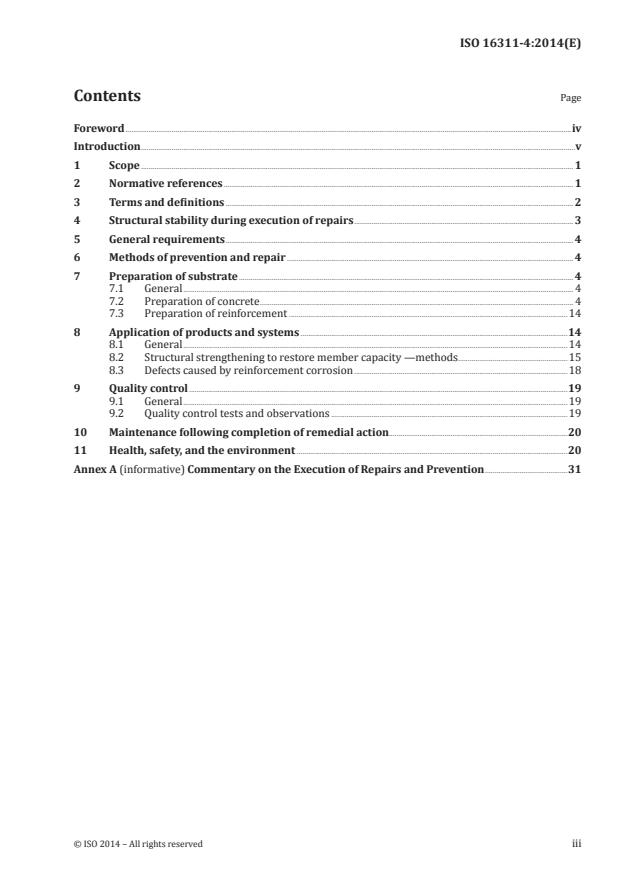
Contents Page
Foreword .iv
Introduction .v
1 Scope . 1
2 Normative references . 1
3 Terms and definitions . 2
4 Structural stability during execution of repairs . 3
5 General requirements . 4
6 Methods of prevention and repair . 4
7 Preparation of substrate . 4
7.1 General . 4
7.2 Preparation of concrete . 4
7.3 Preparation of reinforcement .14
8 Application of products and systems .14
8.1 General .14
8.2 Structural strengthening to restore member capacity —methods .15
8.3 Defects caused by reinforcement corrosion .18
9 Quality control .19
9.1 General .19
9.2 Quality control tests and observations .19
10 Maintenance following completion of remedial action.20
11 Health, safety, and the environment .20
Annex A (informative) Commentary on the Execution of Repairs and Prevention .31
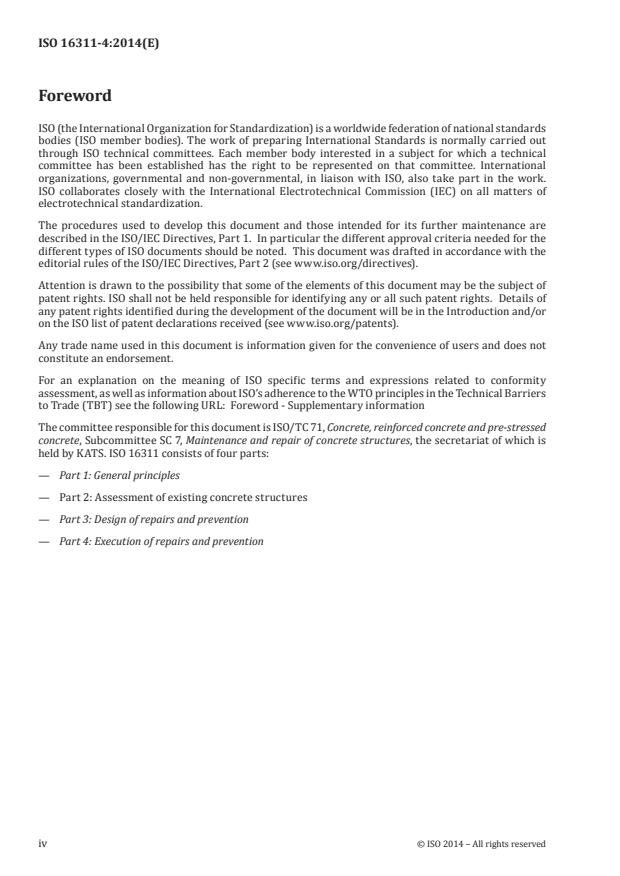
Foreword
ISO (the International Organization for Standardization) is a worldwide federation of national standards
bodies (ISO member bodies). The work of preparing International Standards is normally carried out
through ISO technical committees. Each member body interested in a subject for which a technical
committee has been established has the right to be represented on that committee. International
organizations, governmental and non-governmental, in liaison with ISO, also take part in the work.
ISO collaborates closely with the International Electrotechnical Commission (IEC) on all matters of
electrotechnical standardization.
The procedures used to develop this document and those intended for its further maintenance are
described in the ISO/IEC Directives, Part 1. In particular the different approval criteria needed for the
different types of ISO documents should be noted. This document was drafted in accordance with the
editorial rules of the ISO/IEC Directives, Part 2 (see www.iso.org/directives).
Attention is drawn to the possibility that some of the elements of this document may be the subject of
patent rights. ISO shall not be held responsible for identifying any or all such patent rights. Details of
any patent rights identified during the development of the document will be in the Introduction and/or
on the ISO list of patent declarations received (see www.iso.org/patents).
Any trade name used in this document is information given for the convenience of users and does not
constitute an endorsement.
For an explanation on the meaning of ISO specific terms and expressions related to conformity
assessment, as well as information about ISO’s adherence to the WTO principles in the Technical Barriers
to Trade (TBT) see the following URL: Foreword - Supplementary information
The committee responsible for this document is ISO/TC 71, Concrete, reinforced concrete and pre-stressed
concrete, Subcommittee SC 7, Maintenance and repair of concrete structures, the secretariat of which is
held by KATS. ISO 16311 consists of four parts:
— Part 1: General principles
— Part 2: Assessment of existing concrete structures
— Part 3: Design of repairs and prevention
— Part 4: Execution of repairs and prevention
iv © ISO 2014 – All rights reserved
Introduction
This part of ISO 16311 defines and specifies site application of products and systems and quality control
of the work. To be operable, this part of ISO 16311 needs a National Annex or a reference to where national
complementary provisions are given. This part of ISO 16311 can also be applied on specific projects
where a project specification will supplement the standards in lieu of a National Annex applicable in the
place of use.
The execution of maintenance and repair of concrete structures is an important and integral part of the
complex process of protection and repair, and this part of ISO 16311 specifies how it shall be carried out.
The specifications in this part of ISO 16311 are part of the definition of the intended use for the relevant
products and systems. The execution shall be in accordance with this series of International Standards:
ISO 22966, ISO 22965-1, ISO 22965-2, ISO 2394, and any other relevant ISO and National Standards valid
in the place of use.
This part of ISO 16311 incorporates rules for the use of maintenance and repair materials and systems
that are covered by International Standards. Until International Standards are developed, the standards
cited in the National Annex (often regional or national standards) for materials and systems shall be
followed.
Maintenance and repair methods applying traditional concrete construction work are listed in this part
of ISO 16311, but reference is made to relevant standards.
Maintenance and repair methods applying electrochemical methods, e.g. cathodic protection,
realkalisation of carbonated concrete, and chloride extraction, are listed in this part of ISO 16311, but
reference is made to standards or guidelines valid in the place of use.
Maintenance and repair shall be executed according to a project specification including the necessary
requirements on remedies, methods, and materials per ISO 16311-3.
This part of ISO 16311 contains an Annex A which provides guidance and background information to
the normative text. The contents of Annex A are numbered in the same way as the normative text to
facilitate reference, but prefixed with “A”.
INTERNATIONAL STANDARD ISO 16311-4:2014(E)
Maintenance and repair of concrete structures —
Part 4:
Execution of repairs and prevention
1 Scope
This part of ISO 16311 gives requirements for substrate condition before and during application,
including structural stability, storage of materials, the preparation, and application of products and
systems for the protection and repair of concrete structures, including quality control and qualifications
of personnel, maintenance, health and safety, and the environment.
2 Normative references
The following documents, in whole or in part, are normatively referenced in this document and are
indispensable for its application. For dated references, only the edition cited applies. For undated
references, the latest edition of the referenced document (including any amendments) applies.
ISO 1920-2, Testing of concrete — Part 2: Properties of fresh concrete
ISO 1920-3, Testing of concrete — Part 3: Making and curing test specimens
ISO 1920-4, Testing of concrete — Part 4: Strength of hardened concrete
ISO 1920-5:2004, Testing of concrete — Part 5: Properties of hardened concrete other than strength
ISO 1920-6, Testing of concrete — Part 6: Sampling, preparing and testing of concrete cores
ISO 1920-7:2004, Testing of concrete — Part 7: Non-destructive tests on hardened concrete
ISO 2394, General principles on reliability for structures
ISO 2409, Paints and varnishes — Cross-cut test
ISO 2808, Paints and varnishes — Determination of film thickness
ISO 3274, Geometrical Product Specifications (GPS) — Surface texture: Profile method — Nominal
characteristics of contact (stylus) instruments
ISO 4288, Geometrical Product Specifications (GPS) — Surface texture: Profile method — Rules and
procedures for the assessment of surface texture
ISO 4624, Paints and varnishes — Pull-off test for adhesion
ISO 4628-1, Paints and varnishes — Evaluation of degradation of coatings — Designation of quantity
and size of defects, and of intensity of uniform changes in appearance — Part 1: General introduction and
designation system
ISO 4628-2, Paints and varnishes — Evaluation of degradation of coatings — Designation of quantity and
size of defects, and of intensity of uniform changes in appearance — Part 2: Assessment of degree of blistering
ISO 4628-3, Paints and varnishes — Evaluation of degradation of coatings — Designation of quantity and
size of defects, and of intensity of uniform changes in appearance — Part 3: Assessment of degree of rusting
ISO 4628-4, Paints and varnishes — Evaluation of degradation of coatings — Designation of quantity and
size of defects, and of intensity of uniform changes in appearance — Part 4: Assessment of degree of cracking
ISO 4628-5, Paints and varnishes — Evaluation of degradation of coatings — Designation of quantity and
size of defects, and of intensity of uniform changes in appearance — Part 5: Assessment of degree of flaking
ISO 4628-6, Paints and varnishes — Evaluation of degradation of coatings — Designation of quantity and
size of defects, and of intensity of uniform changes in appearance — Part 6: Assessment of degree of chalking
by tape method
ISO 4677-1, Atmospheres for conditioning and testing — Determination of relative humidity — Part 1:
Aspirated psychrometer method
ISO 4677-2, Atmospheres for conditioning and testing — Determination of relative humidity — Part 2:
Whirling psychrometer method
ISO 6935-2, Steel for the reinforcement of concrete — Part 2: Ribbed bars
ISO 8501-1, Preparation of steel substrates before application of paints and related products — Visual
assessment of surface cleanliness — Part 1: Rust grades and preparation grades of uncoated steel substrates
and of steel substrates after overall removal of previous coatings
ISO 8501-1, Preparation of steel substrates before application of paints and related products — Visual
assessment of surface cleanliness — Part 1: Rust grades and preparation grades of uncoated steel substrates
and of steel substrates after overall removal of previous coatings
ISO 8502-2, Preparation of steel substrates before application of paints and related products — Tests for
the assessment of surface cleanliness — Part 2: Laboratory determination of chloride on cleaned surfaces
ISO 8502-3, Preparation of steel substrates before application of paints and related products — Tests for
the assessment of surface cleanliness — Part 3: Assessment of dust on steel surfaces prepared for painting
(pressure-sensitive tape method)
ISO 8502-4, Preparation of steel substrates before application of paints and related products — Tests for the
assessment of surface cleanliness — Part 4: Guidance on the estimation of the probability of condensation
prior to paint application
ISO 13822, Bases for design of structures — Assessment of existing structures
ISO 16311-1, Maintenance and repair of concrete structures — Part 1: General principles
ISO 16311-2, Maintenance and repair of concrete structures — Part 2: Assessment of existing concrete
structures
ISO 16311-3, Maintenance and repair of concrete structures — Part 3: Design of repairs and prevention
ISO 19338, Performance and assessment requirements for design standards on structural concrete
ISO 22965-1, Concrete — Part 1: Methods of specifying and guidance for the specifier
ISO 22965-2, Concrete — Part 2: Specification of constituent materials, production of concrete and
compliance of concrete
ISO 22966, Execution of concrete structures
3 Terms and definitions
For the purpose of this document, the terms and definitions given in ISO 16311-1, ISO 2394, ISO 13822,
and ISO 19338 and the following apply.
2 © ISO 2014 – All rights reserved
3.1
bond
the adhesion of the applied product or system to the substrate
Note 1 to entry: The bond requirements for a given repair can range from negligible (i.e. a bond breaker is
required) to firmly adherent.
3.2
cement grout
mixture of cement, water, and, in some cases, admixtures
3.3
cementitious repair products and systems
hydraulic or polymer hydraulic mortars, concretes, and grouts
3.4
dew point
temperature at which water vapour condenses
3.5
hydraulic mortars and hydraulic concrete
mortars or concrete based on a hydraulic binder which is blended together with graded aggregates and
can include admixtures and additions which, when mixed with mortar, set by hydrated reaction
3.6
mortars or concrete
hydraulic, polymer hydraulic, and polymer mortar and concrete
3.7
polymer hydraulic cement mortars and concrete
hydraulic mortars or concrete modified by the addition of a polymer
3.8
polymer mortars and polymer concretes
blended mixture of polymer binder and graded aggregate which set by polymerisation reaction
3.9
preformed hole
hole or slot formed or cut in concrete into which reinforcement or other fixing is to be anchored
3.10
quality plan
programme to ensure that the activities of a process are undertaken to comply with the intended design
3.11
overspray
airborne debris resulting from the application of sprayed concrete or mortar which can form an
unwanted coating on the substrate
3.12
sprayed mortar or concrete
mortar or concrete applied under pressure through a nozzle delivered through pipes
3.13
wet on wet
application of a cementitious mortar or concrete onto the surface of a similar material which has set but
not hardened
4 Structural stability during execution of repairs
Safety and stability before, during, and after repair shall be maintained in accordance with ISO 16311-3.
Any period required for gain of strength of the repair products and systems shall be a part of the duration
of the repair.
5 General requirements
Consideration shall be given to the chemical, electrochemical, and physical condition of the substrate
and any contaminants, the ability of the structure to accept loading, movement and vibration during
protection and repair, ambient conditions, and the characteristics of the materials contained in the
structure and those of the protection and repair products and systems.
The following requirements shall be met.
— The achievement of the required condition of the substrate regarding cleanliness, roughness,
cracking, tensile and compressive strength, chloride or other contaminant and their penetration,
depth of carbonation, moisture content, temperature, and degree of corrosion of reinforcement.
— The achievement of the compatibility of the original concrete and reinforcement with the protection
or repair products and systems and compatibility between any different products and systems,
including avoiding the risk of creating conditions which can cause corrosion.
— The achievement of the specified properties of products and systems when applied and in their
hardened condition regarding the fulfilment of their purpose for protection and repair of the
structure.
— The achievement of the required storage and application conditions regarding ambient temperature,
humidity and dew point, wind force and precipitation, and any temporary protection which is
needed.
6 Methods of prevention and repair
The remedies and methods of prevention and repair, given in Table 1 of ISO 16311-3, are described
below, excluding those methods specified in other International Standards or standards valid in the
place of use.
The preparation of substrate, application of products and systems, quality control, and maintenance for
each method shall comply with Clauses 7, 8, 9, and 10.
The relevant sub-clauses are given in Table 1 for each method together with any deviations, additions,
necessary precautions, and limitations.
7 Preparation of substrate
7.1 General
The preparation of the substrate of concrete and reinforcement shall be suitable for the required
condition of the substrate and the structural status of the structure, so that the products and systems
can be properly applied, and shall be carried out in such a way as to produce protection or repair which
is in accordance with this and other parts of this part of ISO 16311. The requirements for preparation
are given in the following sub-clauses and are related to the methods of repair and protection in Table 2.
7.2 Preparation of concrete
7.2.1 General
Weak, damaged, and deteriorated concrete and, where necessary, sound concrete shall be removed in
accordance with the repair remedy and method chosen from ISO 16311-3.
4 © ISO 2014 – All rights reserved
Table 1 — Table for each method together with any deviations, additions, necessary precautions and limitations
Preparation Application Quality control
Repair remedies and methods
See clauses See clauses See clauses
Method Methods to satisfy remedy 1 – Protection against ingress
The following methods satisfy the remedy of reducing or preventing the ingress of adverse agents e.g. water, other liquids, vapour gas such as carbon dioxide, chemicals such as chlorides,
and biological agents.
Hydrophobic impregnation
1.1 7.1, 7.2.1, 7.2.2 8.1, 8.2.7 9.1, 9.2
This method applies a product to prevent or reduce the passage of water by lining the surface pores
with material with hydrophobic properties.
Impregnation
1.2 7.1, 7.2.1, 7.2.2 8.1, 8.2.7 9.1, 9.2
This method is to apply liquid products which penetrate the concrete and block the pore system.
Coating
1.3 7.1, 7.2.1, 7.2.2 8.1, 8.2.1, 8.2.7 9.1, 9.2
This method applies a product to the surface of the concrete to prevent the passage of agents.
Surface bandaging of cracks
1.4 7.1, 7.2.1, 7.2.2 a, 8.1, 8.2.1, 8.2.2, 8.2.5, 8.2.6 9.1, 9.2
The method seals cracks in the concrete to prevent the passage of deleterious agents. Refer to A.5.
Filling of cracks
1.5 7.1, 7.2.1, 7.2.2 a, 8.1, 8.2.1, 8.2.2, 8.2.5, 8.2.6 9.1, 9.2
This method fills cracks to protect against ingress.
Transforming cracks into joints
1.6 7.1, 7.2.1, 7.2.2 8.1, 8.2.1, 8.2.6 9.1, 9.2
This method makes use of existing cracks as an integral part of the structure. Refer to A.5.
Erecting external panels
1.7 System dependent System dependent System dependent
This method installs barrier panels to protect or encapsulate the deteriorating substrate.
Applying membranes
1.8 System dependent System dependent System dependent
This method installs proprietary systems to protect or encapsulate the concrete substrate.
6 © ISO 2014 – All rights reserved
Table 1 — (continued)
Preparation Application Quality control
Remedies and methods
See clauses See clauses See clauses
Method Methods to satisfy remedy 2 – Moisture control
The following methods satisfy the remedy of adjusting and maintaining the moisture content in the concrete between a specified range of values.
Hydrophobic impregnation
2.1 7.1, 7.2.1, 7.2.2 8.1, 8.2.7 9.1, 9.2
This method applies a product to reduce the penetration of water and other agents into the treated
concrete by lining the surface pores with materials with hydrophobic properties.
Impregnation
2.2 7.1, 7.2.1, 7.2.2 8.1, 8.2.7 9.1, 9.2
This method applies liquid products which penetrate the concrete and block the pore system.
Coating
2.3 7.1, 7.2.1, 7.2.2 8.1, 8.2.1, 8.2.7 9.1, 9.2
This method applies a product to the surface of the concrete to prevent the passage of water or water
vapour.
2.4 Erecting external panels (Refer to method 1.7) System dependent System dependent System dependent
Electrochemical treatment
2.5 System dependent System dependent System dependent
This method applies an electo-osmotic pulse to reduce water content of the concrete. Refer to A.5.
Method Methods to satisfy remedy 3 – Concrete restoration
The following methods satisfy the remedy of restoring the original concrete of a member of the structure to the originally specified shape and function. Restoring the concrete structure
by replacing part of it.
3.1 Hand-applied localized patches 7.1, 7.2.1, 7.2.2, 7.2.3, 7.2.4 8.1, 8.2.1, 8.2.2, 8.2.5 9.1, 9.2
Recasting components with concrete or mortar 8.1, 8.2.1, 8.2.4, 8.2.5,
7.1, 7.2.1, 7.2.2, 7.2.3, 7.2.4,
3.2 ISO 22965-1, ISO 22965-2, and 9.1, 9.2
and ISO 22966
ISO 22966
Spraying concrete or mortar 7.1, 7.2.1, 7.2.2, 7.2.3, 7.2.4, 8.1, 8.2.1, 8.2.3, 8.2.5, and
3.3 9.1, 9.2
and ISO 22966 ISO 22966
3.4 Replacing structural members ISO 2394 ISO 22966 9.1, 9.2
Table 1 — (continued)
Preparation Application Quality control
Remedies and methods
See clauses See clauses See clauses
Method Methods to satisfy remedy 4 – Structural strengthening
The following methods satisfy the remedy of increasing or restoring the structural load bearing capacity of a member of the concrete structure.
Adding or replacing embedded or external reinforcing bars 8.1, 8.2.8, 8.3.1, 8.3.3, and
4.1 7.1, 7.3.1, 7.3.2, 8.2.1, 8.3.2 9.1, 9.2
ISO 22966
4.2 Adding reinforcement anchored in pre-formed or drilled holes 7.1, 7.2.1, 7.2.2 8.1, 8.2.1, 8.2.8, 8.3.1, 8.3.3 9.1, 9.2
Bonding plate reinforcement
4.3 7.1, 7.2.1, 7.2.2, 7.2.3, 7.2.4 8.1, 8.2.1, 8.2.6, 8.2.9 9.1, 9.2
This method bonds the strengthening plates externally to a member of the concrete structure.
Adding mortar or concrete
8.1, 8.2.1, 8.2.2, 8.2.3, 8.2.4,
4.4 7.1, 7.2.1, 7.2.2, 7.2.3, 7.2.4 9.1, 9.2
8.2.5
This method bonds additional mortar or concrete to the concrete structure.
Injecting cracks, voids or interstices
4.5 7.1, 7.2.1, 7.2.2 8.1, 8.2.1, 8.2.2, 8.2.5, 8.2.6 9.1, 9.2
This method injects the concrete with appropriate fluid.
4.6 Filling cracks, voids, or interstices 7.1, 7.2.1, 7.2.2 8.1, 8.2.1, 8.2.2, 8.2.5, 8.2.6 b 9.1, 9.2
4.7 Prestressing (post-tensioning) or FRP strengthening ISO 2394 ISO 22966 9.1, 9.2
8 © ISO 2014 – All rights reserved
Table 1 — (continued)
Preparation Application Quality control
Remedies and methods
See clauses See clauses See clauses
Method Methods to satisfy remedy 5 – Increasing physical resistance
The following methods satisfy the remedy of increasing resistance to physical or mechanical attack.
Coating
5.1 7.1, 7.2.1, 7.2.2 8.1, 8.2.1, 8.2.7 9.1, 9.2
This method increases the physical resistance with a coating.
Impregnation
5.2 7.1, 7.2.1, 7.2.2 8.1, 8.2.7 9.1, 9.2
This method applies liquid products which penetrate the concrete.
Adding mortar or concrete
8.1, 8.2.1, 8.2.2,
5.3 7.1, 7.2.1, 7.2.2, 7.2.3, 7.2.4 9.1, 9.2
8.2.3, 8.2.4, 8.2.5
This method bonds additional mortar or concrete to the concrete structure.
Applying membranes
5.4 System dependent System dependent System dependent
This method installs proprietary systems to protect or encapsulate the concrete substrate.
Method Methods to satisfy remedy 6 – Increasing resistance to chemicals
The following methods increase the resistance of the concrete surface to deterioration by reducing the penetration of chemical agents.
Coating
6.1 7.1, 7.2.1, 7.2.2 8.1, 8.2.1, 8.2.7 9.1, 9.2
This method increases the physical resistance with a coating.
Impregnation
6.2 7.1, 7.2.1, 7.2.2 8.1, 8.2.7 9.1, 9.2
This method applies liquid products that penetrate the concrete.
Adding mortar or concrete
8.1, 8.2.1, 8.2.2,
6.3 7.1, 7.2.1, 7.2.2, 7.2.3, 7.2.4 9.1, 9.2
8.2.3, 8.2.4, 8.2.5
This method bonds additional mortar or concrete to the concrete structure.
Table 1 — (continued)
Preparation Application Quality control
Remedies and methods
See clauses See clauses See clauses
Method Methods to satisfy remedy 7 – Preserving or restoring passivity
The following methods satisfy the remedy of creating chemical conditions in which the surface of the reinforcement is maintained at or is returned to a passive condition.
Increasing cover to reinforcement with additional cementitious mortar or concrete, or applying coat-
ings
These methods increase cover or provide surface coatings to prevent penetration of the de-passivating
agents:
7.1 8.1, 8.2.1, 8.2.2,
7.1, 7.2.1, 7.2.2, 7.2.3, 7.2.4 8.2.3, 8.2.4, 8.2.5 9.1, 9.2
— Concrete or mortar overlays
— Coatings 7.1, 7.2.1, 7.2.2 8.1, 8.2.1, 8.2.7 9.1, 9.2
Replacing contaminated or carbonated concrete 7.1, 7.2.1, 7.2.2, 7.2.3, 7.2.4 8.1, 8.2.1, 8.2.2, 9.1, 9.2
7.2
8.2.5
This method replaces carbonate concrete with uncontaminated mortar or concrete.
7.3 Electrochemical re-alkalisation of carbonated concrete System dependent. System dependent. 9.1, 9.2
Re-alkalisation of carbonated concrete by diffusion c, d, 7.1, 7.2.1, 7.2.2, 7.2.3, e, 8.1, 8.2.1, 8.2.2,
7.4 9.1, 9.2
7.2.4 8.2.3, 8.2.4, 8.2.5
Electrochemical chloride extraction System dependent, and
7.5 System dependent System dependent
9.1, 9.2
Applying membranes (Preserving passivity only) System dependent System dependent. System dependent.
7.6
This method installs proprietary systems to protect or encapsulate the concrete substrate, thereby main-
taining passivity.
10 © ISO 2014 – All rights reserved
Table 1 — (continued)
Preparation Application Quality control
Remedies and methods
See clauses See clauses See clauses
Method Methods to satisfy remedy 8 – Increasing resistivity
The following method satisfies the remedy of increasing the electrical resistivity of the concrete by limiting moisture content.
Hydrophobic impregnation 7.1, 7.2.1, 7.2.2 8.1, 8.2.7 9.1, 9.2
8.1
This is a method to reduce water content and as a result increase the electrical resistance of concrete.
Impregnation
8.2 7.1, 7.2.1, 7.2.2 8.1, 8.2.7 9.1, 9.2
This method applies liquid products that penetrate the concrete.
Coating
8.3 7.1, 7.2.1, 7.2.2 8.1, 8.2.1, 8.2.7 9.1, 9.2
This method increases the physical resistance with a coating.
Method Methods to satisfy remedy 9 – Cathodic control
The following methods satisfy the remedy of creating conditions in which potentially cathodic areas of reinforcement are unable to drive an anodic reaction.
9.1 Limiting oxygen content (at the cathode) by saturation or surface coating The concrete shall
be continuously
Saturation. 7.1, 7.2.1, 7.2.2 9.1, 9.2
saturated with
water
8.1, 8.2.1, 8.2.7
Surface coating. 7.1, 7.2.1, 7.2.2 9.1, 9.2
Method Method to satisfy remedy 10 – Cathodic protection
10.1 Applying an electrical current to achieve a protective electrochemical potential 9.1, 9.2
Table 1 — (continued)
Preparation Application Quality control
Remedies and methods
See clauses See clauses See clauses
Method Methods to satisfy remedy 11 – Control of anodic areas
The following methods satisfy the remedy of creating conditions in which potentially anodic areas of reinforcement are unable to take part in the corrosion reaction.
Active coating of the reinforcement
This is a method which provides either:
— Coatings to provide an alkaline environ-
ment;
11.1 7.1, 7.3.1, 7.3.2 8.1, 8.3.1 9.1, 9.2
— Coatings which function as inhibitors of
electrochemical action;
— Coatings provide sacrificial galvanic reac-
tion.
Barrier coating of the reinforcement
This is a method providing a barrier to prevent
11.2 7.1, 7.3.1, 7.3.2 8.1, 8.3.1 9.1, 9.2
pore water containing chlorides or other con-
taminants from reaching the reinforcement.
Applying corrosion inhibitors in or to con-
crete
11.3 7.1, 7.2.1, and 7.2.2. 8.1,8.2.6. 9.1, 9.2
Corrosion inhibitors are applied as a surface
treatment or are added to repair products and
systems. Refer to A.5 for additional information.
Installation of discrete galvanic anodes
This method is intended to counteract the incipi-
11.4 7.1, 7.3.1, 7.3.2 8.1, 8.3.1 9.1, 9.2
ent anode effect that occurs at the perimeter of
localized concrete patch repairs.
a
concrete at the edges of cracks shall be prepared and repaired in accordance with Clauses 7 and 8. 8.2.2 and 8.2.5 apply only to cementitious grouts.
b
8.2.1 and 8.2.5 apply only to cementitious grouts.
c
Coating to concrete which prevents repassivation shall be removed and the concrete shall be cleaned, roughened, and removed where necessary.
d
Concrete needs to be removed only to the depth to which it has been cracked or loosened. Embedded reinforcement shall be cleaned in accordance to 7.3.1 and 7.3.2.
e
Hydraulic mortar or concrete shall be used.
12 © ISO 2014 – All rights reserved
Table 2 — Preparation of substrate
Preparation Sub-clause References Method numbers
process numbers
Hydrophobic Surface coat- Filling cracks, Application Adding rein- Installing Plate bonding Coating reinforcement
(background
impregnation ing voids or inter- of mortar and forcing steel bonded
information
and impreg- stices concrete bars rebars in pre-
in Annex A)
nation formed holes
1.1, 1.2, 2.1, 1.3, 2.3, 5.1, 1.5, 4.5, 4.6 3.1, 3.2, 3.3, 4.1 4.2 4.3 5.4, 7.6, 9.1, 11.1, 11.2
2.2, 5.2, 6.2, 5.4, 6.1. 7.1, 7.6, 4.4, 5.3, 6.3,
8.1, 8.2 8.3, 9.1 7.1, 7.2, 7.4
General 7.1 X X X X X X X X
Preparation of concrete substrate
General 7.2.1 ISO 16311-3 X X X X X X
Cleaning X X X X X X
7.2.2
Roughening 7.2.3 X X
Concrete X X
7.2.4 ISO 16311-3
removal
Preparation of reinforcement
General 7.3.1 ISO 16311-3 X X X
Cleaning X X X
7.3.2 ISO 8501-1
If necessary, cleaning shall be carried out after roughening or concrete removal to comply with 7.2.2
unless water based methods are used, which might make this unnecessary.
Micro-cracked or delaminated concrete, including that caused by the techniques of cleaning, roughening,
or removal which reduces bond or structural integrity, shall be subsequently removed or remedied.
The finished surface shall be visually inspected and tested by tapping with a hammer to detect loose
concrete.
7.2.2 Cleaning
For those methods which require cleaning, the following requirements shall be met:
a) The substrate shall be free from dust, loose material, surface contamination, and materials which
reduce bond or prevent suction or wetting by repair materials;
b) Unless cleaning is carried out immediately before application of protection and repair materials, the
cleaned substrate shall be protected from further contamination.
7.2.3 Roughening
For those methods which require roughening, the following requirement shall be met:
The texture of the roughened surface shall be appropriate for the products and systems to be applied
and shall be specified.
7.2.4 Concrete removal
For those methods which require the removal of concrete, the following requirements shall be met.
a) The extent of the removal shall be appropriate to the repair remedy and method chosen from those
given in ISO 16311-3.
b) Removal shall be kept to a minimum.
c) Removal shall not reduce structural integrity beyond the ability of the structure to perform its
function. Temporary shoring and bracing might be necessary.
d) The depth of carbonation and the concentration profiles of chloride or other contamination in the
concrete shall be established and taken into account.
e) The extent of the removal of the concrete shall be in accordance with the method chosen and shall
be specified. It shall take into account the following:
1) the penetration resistance of the concrete against gases and fluids;
2) the nature and concentration of the contamination before and after the repair and its anticipated
effect on the design service life of the repaired structure;
3) the depth of the contamination;
4) the depth of the carbonation;
5) the corrosion activity of the reinforcement;
6) cover to reinforcement;
7) the need for compaction of the repair material;
8) the need for bond to the substrate;
9) the need for treatment of reinforcement.
7.3 Preparation of reinforcement
7.3.1 General
Before protection and repair systems are applied, the required condition of the existing and any new
reinforcement shall be prepared in accordance with the specification and the remedy and method chosen
from ISO 16311-3, and the required structural performance. The extent of any cleaning, coating, removal,
or replacement shall be specified taking into account the possible need for corrosion prevention and the
need to provide the specified bond between the repair products and systems and the reinforcement.
7.3.2 Cleaning
For those methods which require cleaning of the reinforcement, the following requirements shall be
met.
a) Rust, scale, mortar, concrete, dust, and other loose and deleterious material which reduce bond or
contribute to corrosion, shall be removed.
b) The whole circumference of the exposed reinforcement shall be uniformly cleaned, except where
structural considerations prevent it.
c) Unless the cleaning is carried out immediately before application of protection products and
systems, the cleaned substrates shall be protected against further contamination.
d) Reinforcement shall be cleaned without causing damage to it or damage to or contamination of the
adjacent concrete or environment.
e) Where exposed reinforcement is contaminated with chloride or other material which can cause
corrosion, the whole of the circumference of the contaminated reinforcement shall be cleaned by
water washing to remove the chlorides and other contaminants, unless electrochemical methods of
protection and repair are to be used (see A.6.3).
f) For method 11.2 the degree of cleaning shall be to Sa 21/2 (ISO 8501-1), or compliant with relevant
standards and guideline in the area of use. For method 11.1 and other methods, except method 11.2,
where reinforcement is to be coated, the degree of cleaning shall be specified and shall be suitable
for the coating to be applied. The specification, method, and choice of cleaning shall take into
account bar congestion, contact between bars, proximity to concrete substrate and other factors
which prevent access for cleaning (see A.6.3.
8 Application of products and systems
8.1 General
The application of the products and systems shall be suitable for the substrate and structure to which
it is applied and to produce protection and repair which is in accordance with other parts of ISO 16311
and ISO 22965-1, ISO 22965-2, and ISO 22966.
Products shall be stored before use so that their properties shall not be impaired.
Access for the work shall be adequate so that products and systems can be prepared and applied in
accordance with this part of ISO 16311.
Protection shall be provided so that preparation, application and subsequent curing shall be carried out
in accordance with this part of ISO 16311.
Before and during application of the products and systems, the substrate temperature and moisture
content, and the characteristics of the environment; for example temperature, relative humidity, dew
point, rate of change of moisture content, as influenced by precipitation and wind, shall be considered.
14 © ISO 2014 – All rights reserved
Mixing of products and systems shall be in accordance with ISO 22965-1, ISO 22965-2, and ISO 22966,
or shall be specified.
The thickness of layers of products and systems shall comply with this part of ISO 16311 or be specified.
The bond of the repair material with the substrate and between layers of repair material shall be not
less than the bond strength specified.
The requirements for application are given in the following sub-clauses and are related to the methods
of repair and protection in Table 3.
8.2 Structural strengthening to restore member capacity —methods
8.2.1 Bonding
Bonding requirements shall be specified and for applied mortar and concrete, shall comply with a
standard or guidelines valid in the place of use.
Any water required for wetting the substrate shall comply with the purity requirements for mixing
water of ISO 22965-2.
8.2.2 Hand applied mortar and concrete
Where non-proprietary cementitious products or systems are used without a bonding primer, the
concrete substrate shall be well pre-wetted but free from water on the surface at the time of the
application. The condition of the substrate shall be specified where a bonding primer is used and shall
comply with the proprietary product manufacturer’s requirements, if applicable.
Repair mortar shall be worked into the prepared substrate and shall be compacted without inclusion of
entrapped air pockets and in such a way that the required strength is achieved and the reinforcement
is protected against corrosion.
It shall be decided whether the repair mortar or concrete is to be built up in layers to prevent sagging
or slumping. The layer thickness, time between application of layers, and other requirements, shall be
specified. Where the application of layers is interrupted and layers cannot be applied wet on wet, surface
treatment for bonding to the previous layer shall be in accordance with 7.2.2, 7.2.3, and 8.2.1.
8.2.3 Sprayed repair mortar or concrete
Sprayed concrete and sprayed mortar used as repair material shall comply with the standard for sprayed
concrete or guidelines valid in the place of use.
The need for pre-wetting of the substrate shall be considered. It depends upon its condition and the
composition of the products and systems used.
Sprayed concrete and mortar shall be placed without the formation of voids and loose rebound material
and in such a way that the required strength is achieved and the reinforcement is protected against
corrosion.
Overspray and loose rebound material shall be removed from surrounding areas and from the substrate
before sprayed concrete or mortar is applied.
Where sprayed concrete or mortar is to be applied in more than one layer and, where the work is not
applied wet on wet, intermediate surfaces shall comply with 7.2.2 and 8.2.1.
No treatment shall be allowed to the surface of sprayed mortar or concrete, unless the sprayed mortar
or concrete is non-structural, to avoid the possibility of reducing bond. If treatment is required to
structural sprayed concrete or mortar, it shall be applied to the final layer which has not been applied
wet on wet to the structural material.
16 © ISO 2014 – All rights reserved
Table 3 — Application of products and systems
Method numbers
Sub-clause
numbers
Hydrophobic Installing
Application
Filling cracks, Application Adding rein- Plate bond-
(background References
impregnation bonded rebars Coating rein-
process
Surface coating voids or inter- of mortar and forcing steel ing and FRP
information
and impregna- in pre-formed forcement
stices concrete bars strengthening
in Annex A)
tion holes
1.1, 1.2, 2.1, 2.2, 1.3, 2.3, 5.1, 5.4, 1.5, 4.5, 4.6 3.1, 3.2, 3.3, 4.4, 4.1 4.2 4.3 5.4, 7.6, 9.1, 11.1,
5.2, 6.2, 8.1, 8.2 6.1, 7.1, 7.6, 8.3, 5.3, 6.3, 7.1, 7.2, 11.2
9.1 7.4
8.1 X X X X X X X X
Defects in concrete and structural strengthening
Bonding 8.2.1 ISO 22965-2 X X X X X
a a
Hand applied 8.2.2 ISO 22966 X X
mortar and con-
crete
a
Sprayed mortar 8.2.3 X
or concrete
a
Cast mortar or 8.2.4 ISO 22966 X
concrete
a
Curing 8.2.5 ISO 22966 X X
a
Cracks and joints 8.2.6 ISO 16311-3 X X
a
Surface coatings 8.2.7 X X X
and hydrophobic
impregnation and
impregnation
Anchoring 8.2.8 ISO 22966 X X
Plate bonding and 8.2.9 ISO 8501-1 X
FRP Strengthen-
ing
Defects caused by reinforcement corrosion
Coating rein- 8.3.1 X X
forcement
Removal 8.3.2 X
Replacement 8.3.3 ISO 22966 X
ISO 9635-2
a
Where relevant.
8.2.4 Cast repair mortar or concrete
Where cementitious products or systems are used without a bonding primer, the concrete substrate
shall be well pre-wetted but free from water on the surface at the time of application. The condition of
the substrate shall be specified where a bonding primer is used.
Concrete shall be replaced in accordance with ISO 22966 and shall be specified to avoid segregation
bleeding and loss of cement paste.
Formwork shall comply with ISO 22966.
Formwork shall be fixed in place as soon as possible after
...
Questions, Comments and Discussion
Ask us and Technical Secretary will try to provide an answer. You can facilitate discussion about the standard in here.
Loading comments...