


ISO 13643-3:2013
(Main)Ships and marine technology — Manoeuvring of ships — Part 3: Yaw stability and steering
Ships and marine technology — Manoeuvring of ships — Part 3: Yaw stability and steering
ISO 13643-3:2013 defines symbols and terms and provides guidelines for the conduct of tests to give evidence about the yaw stability and steering of surface ships, submarines, and models. It is meant to be read in conjunction with ISO 13643-1:2013.
Navires et technologie maritime — Manoeuvres des navires — Partie 3: Stabilité en lacet et pilotage
General Information
- Status
- Withdrawn
- Publication Date
- 18-Jun-2013
- Withdrawal Date
- 18-Jun-2013
- Technical Committee
- ISO/TC 8/SC 6 - Navigation and ship operations
- Drafting Committee
- ISO/TC 8/SC 6 - Navigation and ship operations
- Current Stage
- 9599 - Withdrawal of International Standard
- Start Date
- 09-Feb-2017
- Completion Date
- 14-Feb-2026
Relations
- Effective Date
- 28-May-2016
Get Certified
Connect with accredited certification bodies for this standard

DNV
DNV is an independent assurance and risk management provider.

Lloyd's Register
Lloyd's Register is a global professional services organisation specialising in engineering and technology.

ABS Quality Evaluations Inc.
American Bureau of Shipping quality certification.
Sponsored listings
Frequently Asked Questions
ISO 13643-3:2013 is a standard published by the International Organization for Standardization (ISO). Its full title is "Ships and marine technology — Manoeuvring of ships — Part 3: Yaw stability and steering". This standard covers: ISO 13643-3:2013 defines symbols and terms and provides guidelines for the conduct of tests to give evidence about the yaw stability and steering of surface ships, submarines, and models. It is meant to be read in conjunction with ISO 13643-1:2013.
ISO 13643-3:2013 defines symbols and terms and provides guidelines for the conduct of tests to give evidence about the yaw stability and steering of surface ships, submarines, and models. It is meant to be read in conjunction with ISO 13643-1:2013.
ISO 13643-3:2013 is classified under the following ICS (International Classification for Standards) categories: 47.020.70 - Navigation and control equipment. The ICS classification helps identify the subject area and facilitates finding related standards.
ISO 13643-3:2013 has the following relationships with other standards: It is inter standard links to ISO 13643-3:2017. Understanding these relationships helps ensure you are using the most current and applicable version of the standard.
ISO 13643-3:2013 is available in PDF format for immediate download after purchase. The document can be added to your cart and obtained through the secure checkout process. Digital delivery ensures instant access to the complete standard document.
Standards Content (Sample)
INTERNATIONAL ISO
STANDARD 13643-3
First edition
2013-07-01
Ships and marine technology —
Manoeuvring of ships —
Part 3:
Yaw stability and steering
Navires et technologie maritime — Manoeuvres des navires —
Partie 3: Stabilité en lacet et pilotage
Reference number
©
ISO 2013
© ISO 2013
All rights reserved. Unless otherwise specified, no part of this publication may be reproduced or utilized otherwise in any form
or by any means, electronic or mechanical, including photocopying, or posting on the internet or an intranet, without prior
written permission. Permission can be requested from either ISO at the address below or ISO’s member body in the country of
the requester.
ISO copyright office
Case postale 56 • CH-1211 Geneva 20
Tel. + 41 22 749 01 11
Fax + 41 22 749 09 47
E-mail copyright@iso.org
Web www.iso.org
Published in Switzerland
ii © ISO 2013 – All rights reserved
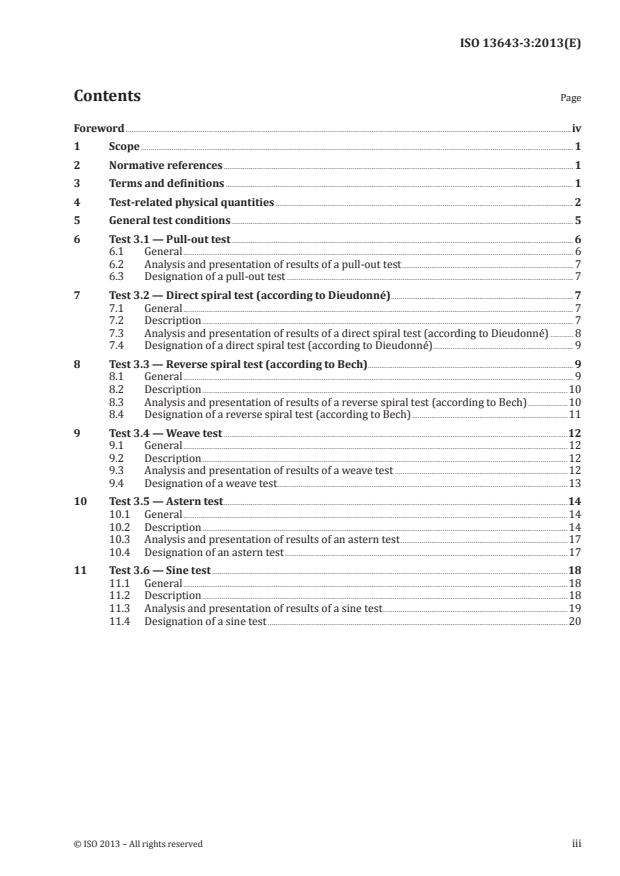
Contents Page
Foreword .iv
1 Scope . 1
2 Normative references . 1
3 Terms and definitions . 1
4 Test-related physical quantities . 2
5 General test conditions . 5
6 Test 3.1 — Pull-out test . 6
6.1 General . 6
6.2 Analysis and presentation of results of a pull-out test . 7
6.3 Designation of a pull-out test . 7
7 Test 3.2 — Direct spiral test (according to Dieudonné) . 7
7.1 General . 7
7.2 Description . 7
7.3 Analysis and presentation of results of a direct spiral test (according to Dieudonné) . 8
7.4 Designation of a direct spiral test (according to Dieudonné) . 9
8 Test 3.3 — Reverse spiral test (according to Bech). 9
8.1 General . 9
8.2 Description .10
8.3 Analysis and presentation of results of a reverse spiral test (according to Bech) .10
8.4 Designation of a reverse spiral test (according to Bech) .11
9 Test 3.4 — Weave test .12
9.1 General .12
9.2 Description .12
9.3 Analysis and presentation of results of a weave test .12
9.4 Designation of a weave test .13
10 Test 3.5 — Astern test .14
10.1 General .14
10.2 Description .14
10.3 Analysis and presentation of results of an astern test .17
10.4 Designation of an astern test .17
11 Test 3.6 — Sine test .18
11.1 General .18
11.2 Description .18
11.3 Analysis and presentation of results of a sine test .19
11.4 Designation of a sine test .20
Foreword
ISO (the International Organization for Standardization) is a worldwide federation of national standards
bodies (ISO member bodies). The work of preparing International Standards is normally carried out
through ISO technical committees. Each member body interested in a subject for which a technical
committee has been established has the right to be represented on that committee. International
organizations, governmental and non-governmental, in liaison with ISO, also take part in the work.
ISO collaborates closely with the International Electrotechnical Commission (IEC) on all matters of
electrotechnical standardization.
The procedures used to develop this document and those intended for its further maintenance are
described in the ISO/IEC Directives, Part 1. In particular the different approval criteria needed for the
different types of ISO documents should be noted. This document was drafted in accordance with the
editorial rules of the ISO/IEC Directives, Part 2. www.iso.org/directives
Attention is drawn to the possibility that some of the elements of this document may be the subject of
patent rights. ISO shall not be held responsible for identifying any or all such patent rights. Details of any
patent rights identified during the development of the document will be in the Introduction and/or on
the ISO list of patent declarations received. www.iso.org/patents
Any trade name used in this document is information given for the convenience of users and does not
constitute an endorsement.
The committee responsible for this document is ISO/TC 8, Ships and marine technology, Subcommittee
SC 6, Navigation and ship operations.
ISO 13643 consists of the following parts, under the general title Ships and marine technology —
Manoeuvring of ships:
— Part 1: General concepts, quantities and test conditions
— Part 2: Turning and yaw checking
— Part 3: Yaw stability and steering
— Part 4: Stopping, acceleration, traversing
— Part 5: Submarine specials
— Part 6: Model test specials
iv © ISO 2013 – All rights reserved
INTERNATIONAL STANDARD ISO 13643-3:2013(E)
Ships and marine technology — Manoeuvring of ships —
Part 3:
Yaw stability and steering
1 Scope
This part of ISO 13643 defines symbols and terms and provides guidelines for the conduct of tests to
give evidence about the yaw stability and steering of surface ships, submarines, and models. It is meant
to be read in conjunction with ISO 13643-1.
2 Normative references
The following documents, in whole or in part, are normatively referenced in this document and are
indispensable for its application. For dated references, only the edition cited applies. For undated
references, the latest edition of the referenced document (including any amendments) applies.
ISO 13643-1, Ships and marine technology — Manoeuvring of ships — Part 1: General concepts, quantities
and test conditions
ISO 13643-5, Ships and marine technology — Manoeuvring of ships — Part 5: Submarine specials
ISO 80000-1, Quantities and units — Part 1: General
ISO 80000-3, Quantities and units — Part 3: Space and time
3 Terms and definitions
For the purposes of this document, the following terms and definitions apply.
3.1
astern test
manoeuvring test to determine the ship’s ability to maintain course while making way astern
3.2
astern zig-zag test
manoeuvring test to determine the ship’s ability to maintain course while making way astern by
assessing manoeuvring devices efficiency from a zig-zag test
3.3
direct astern test
manoeuvring test to determine the ship’s ability to maintain course when making way astern using its
manoeuvring devices and tunnel thrusters as available
3.4
direct spiral test (according to Dieudonné)
manoeuvring test to determine the yaw stability and turning ability when using constant manoeuvring
device settings
3.5
manoeuvring device
rudder, azimuthing thruster, hydroplane, cycloidal propeller, or equivalent system used to
manoeuvre a vessel
3.6
pull-out test
manoeuvring test for quick determination of a ship’s yaw stability related to its speed through the water
3.7
reverse spiral test (according to Bech)
manoeuvring test to determine the yaw stability and turning ability when using constant yaw rates of turn
3.8
sine test
manoeuvring test to determine the ship’s turning and yaw-checking ability in relation to initial speed
and manoeuvring device settings for the purpose of setting up auto pilots
3.9
weave test
manoeuvring test to determine the extent of a ship’s potential yaw instability
4 Test-related physical quantities
Test-related physical quantities are listed in Table 1. The more general quantities and concepts concerning
the manoeuvring of ships are set out in ISO 13643-1.
For quantities and their units, ISO 80000-1 and ISO 80000-3 shall be used.
Table 1 — Test-related physical quantities
Concept
CC-
Symbol SI-Unit
Code
Term Definition or explanation
dψ
Gradient of the ψ δ
C ()
-1 CRi
GRDNTD s —
dδ
curve at δ
Ri
dψ
Gradient of the ψ δ
()
i
iR
-1
GRDNTB s —
dδ
curve at δ
R
L L m Length Reference length of a ship (see ISO 13643-1)
For a ship with yaw instability: measured
a
l LWRD rad Loop width
δ
between the two extremes of the curve δψ()
R
For a ship with yaw instability: measured
l -1b
between the intersections of the ψ()δ curve
LHRD rad s Loop height
ψ
R
with the axis δ = 0
R
-1
n NI s Test propeller speed —
i
P/D PDR 1 Pitch ratio —
Propeller pitch given relative to the pitch for zero
P PITCHI m Test propeller pitch
i
thrust at zero speed
Specified time to move the manoeuvring device,
Period of manoeuvring e.g. from the specified amplitude to starboard (S)
T TIP s
device oscillation to the same amplitude to port (P) and back to the
specified amplitude to starboard (S)
st
Elapsed time from initiating 1 application of
t TIC1 s First time to check yaw manoeuvring devices in the opposite direction
C1
until maximum change of heading is reached
a
For angles, the unit ° (degree), may be used.
b
For rate of turn, the unit °/s (degree per second) may be used.
c
The unit kn, common in navigation, may be used.
2 © ISO 2013 – All rights reserved
Table 1 (continued)
Concept
CC-
Symbol SI-Unit
Code
Term Definition or explanation
nd
Elapsed time from initiating 2 application of
t TIC2 s Second time to check yaw manoeuvring devices in the opposite direction
C2
until maximum change of heading is reached
Time during which the ship maintains course in
t TIF s Course keeping time
F
accordance with 10.2.1
-1c
V VF m s Final speed Speed at the end of test (run)
F
Speed corresponding to propeller speed/pitch
-1c
V VI m s Target speed
i
setting on straight track
-1c
V V0 m s Initial speed (See ISO 13643-1)
Coordinate in the direction of the initial head-
ing of the earth-fixed axis system moving with
x X0 m — the water, the origin of which coincides with
that of ship-fixed axis system at t = 0 (see also
ISO 13643-1)
x X0F m Sternboard x -component (astern) of the ship’s track at t
0F 0 F
Coordinate of the earth-fixed axis system in
y Y0 m Transverse axis water surface perpendicular to x , analogous
0 0
definition (see also ISO 13643-1)
Transfer at end of test
y Y0F m y -component of the ship’s track at t
0F 0 F
(run)
Coordinate of the earth-fixed axis system orthog-
z Z0 m Vertical axis onal to x and y , vertically down, analogous
0 0 0
definition (see also ISO 13643-1)
z -component of the ship’s track at t , relative to
0 F
Δz DZ0F m Change of dived depth
0F
the value at the commencement of a test (run)
Manoeuvring device angle
a
Δδ DANRUI rad ―
Ri
step
a
Δψ DPSIH rad Change of heading ψ – ψ
Specified absolute amount of change of heading
a
Δψ DPSIHE rad Execute change of heading for applying the manoeuvring devices into the
E
opposite direction
Change of heading at end
a
Δψ DPSIHF rad ψ – ψ
F F 0
of test
Maximum change of head-
a
Δψ DPSIHM rad —
MAX
ing
Difference between final
s-1b
Δψ
DYARTC rad Resulting from S and P turns at the same V
C
asymptotic rates of turn
If necessary, an equivalent manoeuvring device
Manoeuvring device angle
a
δ ANRUA rad amplitude shall be given, e.g. for submarines with
Ra
amplitude
X-planes: ¼ (δ + δ − δ − δ ).
Aa2 Aa3 Aa1 Aa4
Relative to δ
Test manoeuvring device
a If necessary, an equivalent test setting shall
δ ANRUI rad
Ri
setting
be given, e.g. for submarines with X-planes:
¼ (δ + δ − δ − δ ).
Ai2 Ai3 Ai1 Ai4
a
For angles, the unit ° (degree), may be used.
b
For rate of turn, the unit °/s (degree per second) may be used.
c
The unit kn, common in navigation, may be used.
Table 1 (continued)
Concept
CC-
Symbol SI-Unit
Code
Term Definition or explanation
Relative to δ
To which the manoeuvring devices are put at
First test manoeuvring
a
δ ANRUI1 rad
Ri1
the commencement of the test. If necessary, an
device setting
equivalent test setting shall be given, e.g. for sub-
marines with X-planes: ¼ (δ + δ − δ − δ ).
A2 A3 A1 A4
Relative to δ
Second test manoeuvring
st
a To which the manoeuvring devices are put at 1
δ ANRUI2 rad
Ri2
device setting
counter setting. If necessary, an equivalent test
setting shall be given as for δ .
Ri1
Relative to δ
Third test manoeuvring
nd
a To which the manoeuvring devices are put at 2
δ ANRUI3 rad
Ri3
device angle
counter setting. If necessary, an equivalent test
setting shall be given as for δ .
Ri1
Neutral manoeuvring
a
δ
ANRU0 rad (See ISO 13643-1)
device angle
Determined in each stage of the test during
Mean manoeuvring device
a
δ
ANRUM rad a period of sufficiently constant ship’s speed
R
angle
through the water and rate of turn
a
ε EPH rad Phase shift Between heading and manoeuvring device angle
a
θ TRIMSF rad Trim angle at end of test —
SF
a
θ TRIMSM rad Maximum trim angle —
SMAX
a
θ TRIMS0 rad Initial trim angle —
S0
a
ψ PSIH rad Heading (See ISO 13643-1)
ψ + Δψ
0 E
a
ψ PSIHE1 rad Heading for first execute
E1
Heading when the manoeuvring devices are
applied in the opposite direction (turn to P)
ψ − Δψ
0 E
Heading for second
a
ψ PSIHE2 rad
E2
Heading when the manoeuvring devices are
execute
applied back in the original direction (turn to S)
a
ψ PSIHF rad Final heading Heading at the end of a test (run)
F
During the turn, angle between the heading at
which the manoeuvring devices are applied in the
a
ψ PSIS1 rad First overshoot angle
S1
opposite direction and the heading at which the
vessel ceases to turn in the current direction
During the turn, angle between the heading at
which the manoeuvring devices are applied back
a
ψ PSIS2 rad Second overshoot angle
S2
in the original direction and the heading at which
the vessel ceases to turn in the current direction
Amplitude of the heading resulting from the sinu-
a
ψ PSIHA rad Amplitude of heading
a
soidal oscillation of the manoeuvring devices
Heading of a vessel at the commencement of a test
a
ψ PSIH0 rad Initial heading
(run)
-1b
ψ YART rad s Rate of turn —
a
For angles, the unit ° (degree), may be used.
b
For rate of turn, the unit °/s (degree per second) may be used.
c
The unit kn, common in navigation, may be used.
4 © ISO 2013 – All rights reserved
Table 1 (continued)
Concept
CC-
Symbol SI-Unit
Code
Term Definition or explanation
Amplitude of the rate of turn resulting from the
-1b
YARTA rad s Amplitude of rate of turn
ψ
a
sinusoidal oscillation of the manoeuvring devices
Mean value of the rate when the ship has reached
-1b
ψ YARTC rad s Constant rate of turn steady conditions after each change of manoeu-
C
vring device setting
Asymptotic rate of turn
-1b
ψ YARTCP rad s To which the ship pulls out in P turn
CP
(for P turn)
Asymptotic rate of turn
-1b
ψ YARTCS rad s To which the ship pulls out in S turn
CS
(for S turn)
-1b
ψ YARTI rad s Test turning rate Required rate of turn for a stage of the test
i
-1b
ω OMF rad s Angular frequency 2π/T
a
For angles, the unit ° (degree), may be used.
b
For rate of turn, the unit °/s (degree per second) may be used.
c
The unit kn, common in navigation, may be used.
5 General test conditions
The general test conditions in Clause 8 of ISO 13643-1 shall be observed.
When operating submerged, submarines shall be trimmed according to the results of the neutral level
flight test in Clause 8 of ISO 13643-5. During the test, the dived depth must be kept as constant as possible.
The dived depth and the plane angles are to be recorded continuously. If the submarine is equipped with
planes acting into the horizontal as well as into the vertical direction at the same time (e.g. X-planes),
these planes should be controlled in such a way that the dived depth is maintained with priority.
During the test, including the approach phase, each successive position of the ship is to be recorded —
e.g. using an on board navigation system during surface operations — at suitable time intervals (usually
every second).
The reference point on the vessel from where its track is measured should be defined in advance (e.g.
location of a positioning system antenna). This point is not necessarily identical with the origin of the ship-
fixed axis system for which the vessel’s track is given (see ISO 13643-1). Data which are to be recorded
continuously include (but need not be limited to) manoeuvring device angle of operation, power setting,
speed through the water, heading, rate of turn, angle of heel, propeller shaft speed/torque, propeller
pitch, true wind velocity and direction, and relative wind velocity and direction.
6 Test 3.1 — Pull-out test
6.1 General
In addition to the general test conditions outlined in ISO 13643-1 and Clause 5, the following conditions
shall be complied with:
— The ship shall approach on a steady heading and at a constant speed, V , before commencing the
test. During the test, the propulsion plant settings must remain unaltered.
— The ship is put into a steady turn, which is outside the expected range of yaw instability, e.g. with a
test manoeuvring device angle δ of at least 20° to either P or S. The description is for a turn to S.
Ri
— When the rate of turn and the speed of the ship have become constant, the manoeuvring device is
returned to amidships (zero-position) and held there until the rate of turn again reaches a sufficiently
steady final asymptotic value, ψ . Heading, manoeuvring device setting, and propeller speed/pitch
CS
are to be recorded continuously. The test comprises a second run turning in the opposite direction.
If the ship is stable in yaw, the rates of turn for alterations to both P and S will decrease to the same
residual rate of turn (not necessarily zero); if the ship is unstable, the residual rates of turn will differ.
The i
...
Questions, Comments and Discussion
Ask us and Technical Secretary will try to provide an answer. You can facilitate discussion about the standard in here.
Loading comments...