

ISO 17885:2021
(Main)Plastics piping systems — Mechanical fittings for pressure piping systems — Specifications
General Information
- Abstract
This document specifies the requirements and test methods for mechanical fittings intended to join plastic pressure piping systems including transition fittings to metal pipes for the following: — supply of gaseous fuels (GAS); — supply of water for human consumption (W), including raw water prior to treatment and for the supply of water for general purposes, as well as underground drainage and sewerage under pressure (P); — supply of water for irrigation (I); — industrial applications (IS). This document is applicable only to mechanical fittings with operating-temperature and pressure limits as indicated in the relevant systems standards. NOTE A list of International Standards for plastic pipes for which mechanical fittings can be used can be found in Annex A. Flanges are not covered by this document. Mechanical fittings for hot and cold water systems inside buildings, as well as for district heating applications, are not covered by this document.
- Status
- Published
- Publication Date
- 20-Jun-2021
- Drafting Committee
- ISO/TC 138/SC 4/WG 1 - Mechanical fittings
- Current Stage
- 9092 - International Standard to be revised
- Start Date
- 17-Jul-2026
- Completion Date
- 29-Aug-2026
Buy Documents
ISO 17885:2021 - Plastics piping systems -- Mechanical fittings for pressure piping systems -- Specifications
ISO 17885:2021 - Plastics piping systems — Mechanical fittings for pressure piping systems — Specifications/16/2021
Overview
ISO 17885:2021 specifies requirements and test methods for mechanical fittings used to join plastic pressure piping systems, including transition fittings to metal pipes. It covers applications for the supply of gaseous fuels (GAS), water for human consumption and general use (W/P), irrigation (I) and industrial services (IS). The standard applies only to fittings with operating temperature and pressure limits set by the relevant system standards. Not covered: flanges, mechanical fittings for hot/cold water systems inside buildings and district heating.
Key topics and technical requirements
ISO 17885:2021 provides a unified framework for evaluating and documenting mechanical fittings. Major technical topics include:
- Materials: requirements and verification for plastics, metals, elastomers, and permitted lubricants/greases.
- Manufacturer’s declaration: specifying the intended field of application (GAS, W/P, I, IS) and any operating limits.
- Geometrical and physical characteristics: dimensional, appearance, colour, weathering protection and thread requirements.
- Performance requirements and test methods: verification of pressure resistance of fitting bodies, assembly testing, long‑term behaviour of plastics (MRS evaluation), cyclic testing and resistance to specific media (e.g., gas constituents).
- Application‑related checks: effects on water quality, chemical resistance for industrial use, and transition fitting behavior with metal pipes.
- Product marking and packaging: identification, traceability and packaging requirements to support installation and regulatory compliance.
- Normative and informative annexes: include lists of pipe standards (Annex A) and detailed test procedures/parameters (Annexes B–G).
Practical applications
ISO 17885:2021 is used to:
- Ensure mechanical fittings meet safety, durability and leak tightness requirements for pressure piping systems.
- Provide harmonized test methods for manufacturers and third‑party test labs to demonstrate conformity.
- Support specifiers and purchasers in selecting fittings that are suitable for gas distribution, potable water, irrigation and industrial fluid transport.
- Aid regulatory bodies, utilities and infrastructure project teams to set procurement and acceptance criteria.
Who should use this standard
- Fitting manufacturers and product designers
- Test laboratories and certification bodies
- Pipeline and distribution system engineers and specifiers
- Utilities, installers and procurement teams seeking compliant components
Related standards
ISO 17885 references and aligns with other ISO standards for pipe materials and tests, for example: ISO 1167 (resistance to internal pressure), ISO 3451‑4, ISO 3458, ISO 7‑1, ISO 228‑1, ISO 306 and ISO 1133‑1. Annex A lists relevant pipe standards for which these mechanical fittings are suitable.
Keywords: ISO 17885:2021, mechanical fittings, plastics piping systems, pressure piping systems, gas supply, potable water, irrigation, industrial applications, test methods, materials.
Relations
- Effective Date
- 25-Aug-2026
- Effective Date
- 08-Apr-2026
- Effective Date
- 08-Apr-2026
- Effective Date
- 08-Apr-2026
- Effective Date
- 08-Apr-2026
- Effective Date
- 08-Apr-2026
- Effective Date
- 25-Mar-2026
- Effective Date
- 23-Apr-2020
- Effective Date
- 23-Apr-2020
Buy Documents
ISO 17885:2021 - Plastics piping systems -- Mechanical fittings for pressure piping systems -- Specifications
ISO 17885:2021 - Plastics piping systems — Mechanical fittings for pressure piping systems — Specifications/16/2021
Get Certified
Connect with accredited certification bodies for this standard

Element Materials Technology
Materials testing and product certification.

ABS Group Brazil
ABS Group certification services in Brazil.

ABS Quality Evaluations Inc.
American Bureau of Shipping quality certification.
Sponsored listings
Frequently Asked Questions
ISO 17885:2021 is a standard published by the International Organization for Standardization (ISO). Its full title is "Plastics piping systems — Mechanical fittings for pressure piping systems — Specifications". This standard covers: This document specifies the requirements and test methods for mechanical fittings intended to join plastic pressure piping systems including transition fittings to metal pipes for the following: — supply of gaseous fuels (GAS); — supply of water for human consumption (W), including raw water prior to treatment and for the supply of water for general purposes, as well as underground drainage and sewerage under pressure (P); — supply of water for irrigation (I); — industrial applications (IS). This document is applicable only to mechanical fittings with operating-temperature and pressure limits as indicated in the relevant systems standards. NOTE A list of International Standards for plastic pipes for which mechanical fittings can be used can be found in Annex A. Flanges are not covered by this document. Mechanical fittings for hot and cold water systems inside buildings, as well as for district heating applications, are not covered by this document.
This document specifies the requirements and test methods for mechanical fittings intended to join plastic pressure piping systems including transition fittings to metal pipes for the following: — supply of gaseous fuels (GAS); — supply of water for human consumption (W), including raw water prior to treatment and for the supply of water for general purposes, as well as underground drainage and sewerage under pressure (P); — supply of water for irrigation (I); — industrial applications (IS). This document is applicable only to mechanical fittings with operating-temperature and pressure limits as indicated in the relevant systems standards. NOTE A list of International Standards for plastic pipes for which mechanical fittings can be used can be found in Annex A. Flanges are not covered by this document. Mechanical fittings for hot and cold water systems inside buildings, as well as for district heating applications, are not covered by this document.
ISO 17885:2021 is classified under the following ICS (International Classification for Standards) categories: 23.040.45 - Plastics fittings; 75.200 - Petroleum products and natural gas handling equipment. The ICS classification helps identify the subject area and facilitates finding related standards.
ISO 17885:2021 has the following relationships with other standards: It is inter standard links to EN ISO 16486-3:2025, EN 12201-5:2024, EN 12201-3:2024, EN 1555-5:2021, EN 1555-3:2021, EN 1555-3:2025, CEN/TS 12201-7:2026, ISO 17885:2015/Amd 1:2016, ISO 17885:2015. Understanding these relationships helps ensure you are using the most current and applicable version of the standard.
ISO 17885:2021 is available in PDF format for immediate download after purchase. The document can be added to your cart and obtained through the secure checkout process. Digital delivery ensures instant access to the complete standard document.
Standards Content (Sample)
INTERNATIONAL ISO
STANDARD 17885
Second edition
2021-06
Corrected version
2021-12
Plastics piping systems — Mechanical
fittings for pressure piping systems —
Specifications
Systèmes de canalisations en plastiques — Raccords mécaniques pour
les canalisations sous pression — Spécifications
Reference number
© ISO 2021
All rights reserved. Unless otherwise specified, or required in the context of its implementation, no part of this publication may
be reproduced or utilized otherwise in any form or by any means, electronic or mechanical, including photocopying, or posting on
the internet or an intranet, without prior written permission. Permission can be requested from either ISO at the address below
or ISO’s member body in the country of the requester.
ISO copyright office
CP 401 • Ch. de Blandonnet 8
CH-1214 Vernier, Geneva
Phone: +41 22 749 01 11
Email: copyright@iso.org
Website: www.iso.org
Published in Switzerland
ii
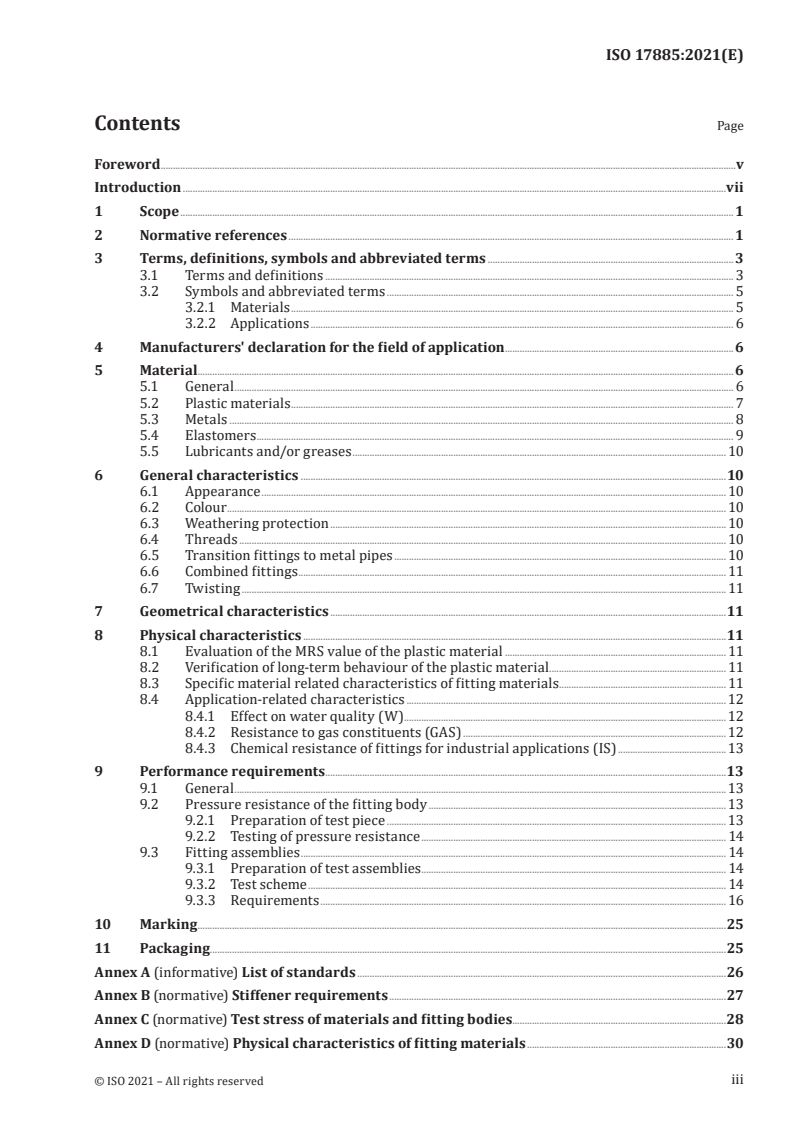
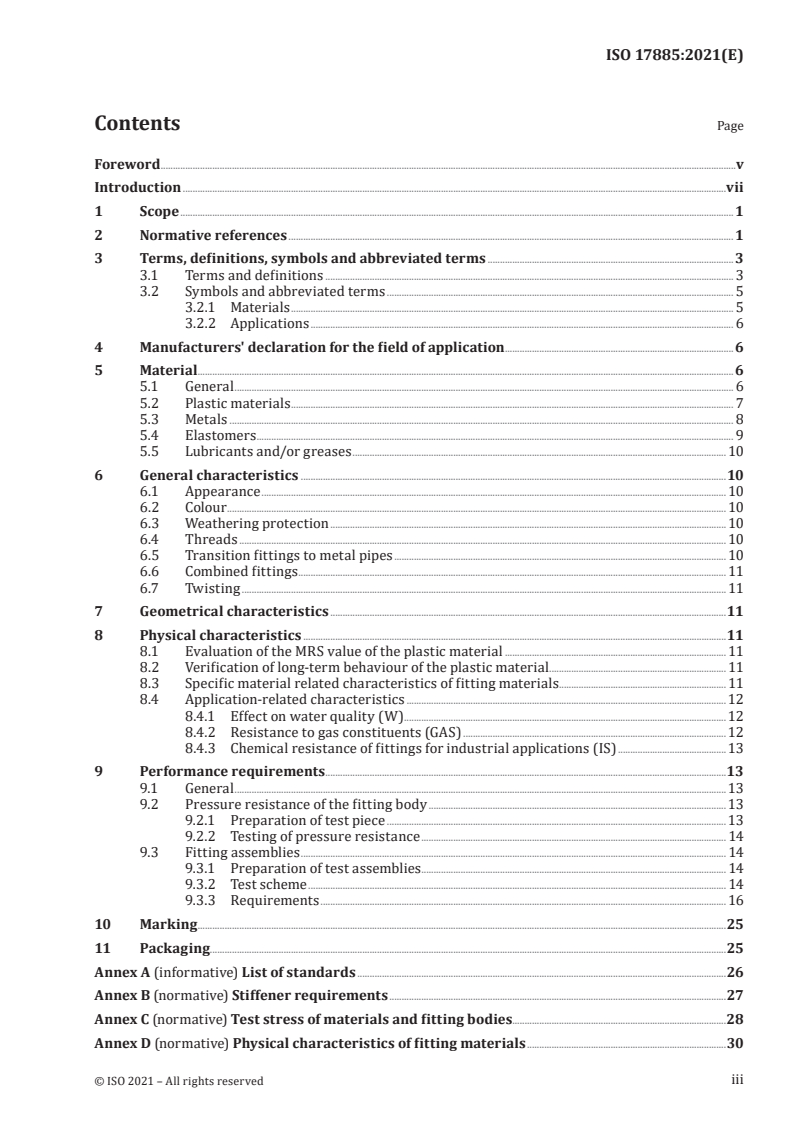
Contents Page
Foreword .v
Introduction .vii
1 Scope . 1
2 Normative references . 1
3 Terms, definitions, symbols and abbreviated terms . 3
3.1 Terms and definitions . 3
3.2 Symbols and abbreviated terms . 5
3.2.1 Materials . 5
3.2.2 Applications . 6
4 Manufacturers' declaration for the field of application . 6
5 Material. 6
5.1 General . 6
5.2 Plastic materials . 7
5.3 Metals . 8
5.4 Elastomers . 9
5.5 Lubricants and/or greases . 10
6 General characteristics .10
6.1 Appearance . 10
6.2 Colour . 10
6.3 Weathering protection . 10
6.4 Threads . 10
6.5 Transition fittings to metal pipes . 10
6.6 Combined fittings . 11
6.7 Twisting . 11
7 Geometrical characteristics .11
8 Physical characteristics .11
8.1 Evaluation of the MRS value of the plastic material . 11
8.2 Verification of long-term behaviour of the plastic material . 11
8.3 Specific material related characteristics of fitting materials . . 11
8.4 Application-related characteristics .12
8.4.1 Effect on water quality (W).12
8.4.2 Resistance to gas constituents (GAS) .12
8.4.3 Chemical resistance of fittings for industrial applications (IS) .13
9 Performance requirements . .13
9.1 General .13
9.2 Pressure resistance of the fitting body . 13
9.2.1 Preparation of test piece . 13
9.2.2 Testing of pressure resistance . 14
9.3 Fitting assemblies . 14
9.3.1 Preparation of test assemblies . 14
9.3.2 Test scheme . 14
9.3.3 Requirements . 16
10 Marking . .25
11 Packaging.25
Annex A (informative) List of standards .26
Annex B (normative) Stiffener requirements .27
Annex C (normative) Test stress of materials and fitting bodies.28
Annex D (normative) Physical characteristics of fitting materials .30
iii
Annex E (normative) Resistance to gas constituents .34
Annex F (normative) Test stresses .35
Annex G (normative) Cyclic test procedure . .37
Bibliography .38
iv
Foreword
ISO (the International Organization for Standardization) is a worldwide federation of national standards
bodies (ISO member bodies). The work of preparing International Standards is normally carried out
through ISO technical committees. Each member body interested in a subject for which a technical
committee has been established has the right to be represented on that committee. International
organizations, governmental and non-governmental, in liaison with ISO, also take part in the work.
ISO collaborates closely with the International Electrotechnical Commission (IEC) on all matters of
electrotechnical standardization.
The procedures used to develop this document and those intended for its further maintenance are
described in the ISO/IEC Directives, Part 1. In particular the different approval criteria needed for the
different types of ISO documents should be noted. This document was drafted in accordance with the
editorial rules of the ISO/IEC Directives, Part 2 (see www.iso.org/directives).
Attention is drawn to the possibility that some of the elements of this document may be the subject of
patent rights. ISO shall not be held responsible for identifying any or all such patent rights. Details of
any patent rights identified during the development of the document will be in the Introduction and/or
on the ISO list of patent declarations received (see www.iso.org/patents).
Any trade name used in this document is information given for the convenience of users and does not
constitute an endorsement.
For an explanation of the voluntary nature of standards, the meaning of ISO specific terms and
expressions related to conformity assessment, as well as information about ISO's adherence to
the World Trade Organization (WTO) principles in the Technical Barriers to Trade (TBT), see
www.iso.org/iso/foreword.html.
This document was prepared by Technical Committee ISO/TC 138, Plastics pipes, fittings and valves for
the transport of fluids, Subcommittee SC 4, Plastics pipes and fittings for the supply of gaseous fuels.
This second edition cancels and replaces the first edition (ISO 17885:2015), which has been technically
revised. It also incorporates the Amendment ISO 17885:2015/Amd 1:2016.
The main changes compared to the previous edition are as follows:
— a clarification for the relation between the nominal pressure and the MOP declared by the
manufacturer is given;
— the term ‘weathering’ is used instead of ‘ultraviolet radiation’, to be in line with PE pipe standards;
— a clarification that the own reprocessable material of glass reinforced materials with a fibre length
up to 3 mm may be used;
— the diameter for various pipe materials for the ‘Resistance of plastic pipe/pipe or pipe/fitting
assemblies to tensile loading at 23 °C has been increased from 63 mm to 250 mm;
— unplasticized polyamide (PA-U) is included in Table 7;
— errors in Table D.1 regarding the viscosity number of unplasticized polyamide (PA-U) are resolved;
— the requirement for the melt mass flow rate for PB in Table D.1 is aligned with ISO 15494;
— the requirement for the depth of dezincification for Cu in Table D.1 is aligned with EN 1254-3, -6 and
-8;
— Formulae (1) and (2) and Annex C are corrected;
— the test pressures for unplasticized polyamide (PA-U) in Table F.1 are increased;
— the test procedure in Annex G is clarified.
v
This corrected version of ISO 17885:2021 incorporates the following corrections:
— original Formula (1) from ISO 17885:2021 has been deleted and the subsequent formulae have been
renumbered accordingly;
— in Annex C, the term "pressure" has been replaced by the term "stress".
Any feedback or questions on this document should be directed to the user’s national standards body. A
complete listing of these bodies can be found at www.iso.org/members.html.
vi
Introduction
This document specifies the requirements for mechanical fittings for joining plastic piping systems for
the supply of gaseous fuels, the supply of water for human consumption and other purposes, as well as
for industrial application.
It provides a unified set of test methods to check the performance of the fittings, depending on their
intended use.
It is the responsibility of the purchaser or specifier to select the appropriate fitting, taking into account
their particular requirements and any relevant national guidance or regulations and installation
practices or codes.
vii
INTERNATIONAL STANDARD ISO 17885:2021(E)
Plastics piping systems — Mechanical fittings for pressure
piping systems — Specifications
1 Scope
This document specifies the requirements and test methods for mechanical fittings intended to join
plastic pressure piping systems including transition fittings to metal pipes for the following:
— supply of gaseous fuels (GAS);
— supply of water for human consumption (W), including raw water prior to treatment and for the
supply of water for general purposes, as well as underground drainage and sewerage under pressure
(P);
— supply of water for irrigation (I);
— industrial applications (IS).
This document is applicable only to mechanical fittings with operating-temperature and pressure
limits as indicated in the relevant systems standards.
NOTE A list of International Standards for plastic pipes for which mechanical fittings can be used can be
found in Annex A.
Flanges are not covered by this document.
Mechanical fittings for hot and cold water systems inside buildings, as well as for district heating
applications, are not covered by this document.
2 Normative references
The following documents are referred to in the text in such a way that some or all of their content
constitutes requirements of this document. For dated references, only the edition cited applies. For
undated references, the latest edition of the referenced document (including any amendments) applies.
ISO 7-1, Pipe threads where pressure-tight joints are made on the threads — Part 1: Dimensions, tolerances
and designation
ISO 75-2, Plastics — Determination of temperature of deflection under load — Part 2: Plastics and ebonite
ISO 228-1, Pipe threads where pressure-tight joints are not made on the threads — Part 1: Dimensions,
tolerances and designation
ISO 306, Plastics — Thermoplastic materials — Determination of Vicat softening temperature (VST)
ISO 307, Plastics — Polyamides — Determination of viscosity number
ISO 472, Plastics — Vocabulary
ISO 580:2005, Plastics piping and ducting systems — Injection-moulded thermoplastics fittings — Methods
for visually assessing the effects of heating
ISO 1043-1, Plastics — Symbols and abbreviated terms — Part 1: Basic polymers and their special
characteristics
ISO 1133-1, Plastics — Determination of the melt mass-flow rate (MFR) and melt volume-flow rate (MVR)
of thermoplastics — Part 1: Standard method
ISO 1167-1, Thermoplastics pipes, fittings and assemblies for the conveyance of fluids — Determination of
the resistance to internal pressure — Part 1: General method
ISO 1167-2, Thermoplastics pipes, fittings and assemblies for the conveyance of fluids — Determination of
the resistance to internal pressure — Part 2: Preparation of pipe test pieces
ISO 1167-4, Thermoplastics pipes, fittings and assemblies for the conveyance of fluids — Determination of
the resistance to internal pressure — Part 4: Preparation of assemblies
ISO 2507-1, Thermoplastics pipes and fittings — Vicat softening temperature — Part 1: General test method
ISO 2507-2, Thermoplastics pipes and fittings — Vicat softening temperature — Part 2: Test conditions for
unplasticized poly(vinyl chloride) (PVC-U) or chlorinated poly(vinyl chloride) (PVC-C) pipes and fittings and
for high impact resistance poly (vinyl chloride) (PVC-HI) pipes
ISO 3451-4, Plastics — Determination of ash — Part 4: Polyamides
ISO 3458, Plastics piping systems — Mechanical joints between fittings and pressure pipes — Test method
for leaktightness under internal pressure
ISO 3459, Plastic piping systems — Mechanical joints between fittings and pressure pipes — Test method
for leaktightness under negative pressure
ISO 3501, Plastics piping systems — Mechanical joints between fittings and pressure pipes — Test method
for resistance to pull-out under constant longitudinal force
ISO 3503, Plastics piping systems — Mechanical joints between fittings and pressure pipes — Test method
for leaktightness under internal pressure of assemblies subjected to bending
ISO 4633, Rubber seals — Joint rings for water supply, drainage and sewerage pipelines — Specification for
materials
ISO 6509-1, Corrosion of metals and alloys — Determination of dezincification resistance of copper alloys
with zinc — Part 1: Test method
ISO 6957, Copper alloys — Ammonia test for stress corrosion resistance
ISO 6993-1, Buried, high-impact poly(vinyl chloride) (PVC-HI) piping systems for the supply of gaseous fuels
— Part 1: Pipes for a maximum operating pressure of 1 bar (100 kPa)
ISO 6993-2, Buried, high-impact poly(vinyl chloride) (PVC-HI) piping systems for the supply of gaseous fuels
— Part 2: Fittings for a maximum operating pressure of 200 mbar (20 kPa)
ISO 6993-3, Buried, high-impact poly(vinyl chloride) (PVC-HI) piping systems for the supply of gaseous fuels
— Part 3: Fittings and saddles for a maximum operating pressure of 1 bar (100 kPa)
ISO 7686, Plastics pipes and fittings — Determination of opacity
ISO 9080, Plastics piping and ducting systems — Determination of the long-term hydrostatic strength of
thermoplastics materials in pipe form by extrapolation
ISO 10147, Pipes and fittings made of crosslinked polyethylene (PE-X) — Estimation of the degree of
crosslinking by determination of the gel content
ISO 12162, Thermoplastics materials for pipes and fittings for pressure applications — Classification,
designation and design coefficient
ISO 13783, Plastics piping systems — Unplasticized poly(vinyl chloride) (PVC-U) end-load-bearing double-
socket joints — Test method for leaktightness and strength while subjected to bending and internal pressure
ISO 13844, Plastics piping systems — Elastomeric-sealing-ring-type socket joints for use with plastic
pressure pipes — Test method for leaktightness under negative pressure, angular deflection and deformation
ISO 13845, Plastics piping systems — Elastomeric-sealing-ring-type socket joints for use with thermoplastic
pressure pipes — Test method for leaktightness under internal pressure and with angular deflection
ISO 13951, Plastics piping systems — Test method for the resistance of plastic pipe/pipe or pipe/fitting
assemblies to tensile loading
ISO 16010, Elastomeric seals — Material requirements for seals used in pipes and fittings carrying gaseous
fuels and hydrocarbon fluids
ISO 16486-1:2020, Plastics piping systems for the supply of gaseous fuels — Unplasticized polyamide (PA-
U) piping systems with fusion jointing and mechanical jointing — Part 1: General
ISO 17778, Plastics piping systems — Fittings, valves and ancillaries — Determination of gaseous flow
rate/pressure drop relationships
ISO 19899, Plastics piping systems — Polyolefin pipes and mechanical fitting assemblies — Test method for
the resistance to end load (AREL test)
ISO 23711, Elastomeric seals — Requirements for materials for pipe joint seals used in water and drainage
applications — Thermoplastic elastomers
3 Terms, definitions, symbols and abbreviated terms
3.1 Terms and definitions
For the purposes of this document, the terms and definitions given in ISO 472, ISO 1043-1, and the
following apply.
ISO and IEC maintain terminological databases for use in standardization at the following addresses:
— ISO Online browsing platform: available at https:// www .iso .org/ obp
— IEC Electropedia: available at https:// www .electropedia .org/
3.1.1
mechanical fitting
fitting for assembling plastics pipes with each other or with a metal pipe or fitting, that includes one or
more compression zones to provide pressure integrity, leak tightness and resistance to end loads
3.1.2
full-end-load resistance
combination of component and joint design and characteristics such that under any load condition the
plastic pipe will fail first
3.1.3
end-load resistance
resistance to end load transmitted via the connecting pipe and generated by internal pressure, pipeline
external interference, and thermally induced pipe stresses in any combination
3.1.4
non-end-load resistance
lack of resistance to axial loads without additional external mechanical axial support
3.1.5
lower confidence limit of predicted hydrostatic strength
σ
LPL
quantity, with the dimensions of stress, which represents the 97,5 % lower confidence limit of the
predicted hydrostatic strength at a temperature θ and time t
Note 1 to entry: It is expressed in megapascals.
Note 2 to entry: Temperature, θ, is expressed in degrees Celsius and time, t, is expressed in years.
[SOURCE: ISO 12162:2009, 3.2]
3.1.6
minimum required strength
MRS
value of σ (3.1.5) at 20 °C and 50 years, rounded down to the next smaller value of the R10 series
LPL
when σ is below 10 MPa, or to the next lower value of the R20 series when σ is 10 MPa or greater
LPL LPL
Note 1 to entry: The R10 series conforms to ISO 3 and the R20 series conforms to ISO 497.
[SOURCE: ISO 4437-1:2014, 3.3.2]
3.1.7
design coefficient
C
coefficient with a value greater than 1, which takes into consideration service conditions, as well as
properties of the components of a piping system other than those represented in the lower confidence
limit
Note 1 to entry: The minimum value of C, C , is defined and given for various thermoplastics pipe systems in
min
ISO 12162 and Annex C.
[SOURCE: ISO 12162:2009, 3.5, modified — The original notes 1 and 2 to entry have been replaced by a
new note 1 to entry.]
3.1.8
gaseous fuel
fuel which is in the gaseous state at a temperature of 15 °C and a pressure of 1 bar
5 2
Note 1 to entry: 1 bar = 0,1 MPa = 10 Pa; 1 MPa = 1 N/mm .
[SOURCE: ISO 4437-1:2014, 3.4.1, modified — Note 1 to entry has been added.]
3.1.9
standard dimension ratio
SDR
numerical designation of a pipe series, which is a convenient round number, approximately equal to the
dimension ratio of the nominal outside diameter, d , and the nominal wall thickness, e
n n
[SOURCE: ISO 4437-1:2014, 3.1.15]
3.1.10
nominal pressure
PN
numerical designation, which is a convenient rounded number for reference purposes
Note 1 to entry: For plastic piping systems conveying water, it corresponds to the maximum continuous operating
pressure, expressed in bar, which can be sustained with water at 20 °C, based on the minimum design coefficient
(3.1.7).
3.1.11
virgin material
material in a form such as granules or powder that has not been subjected to use or processing other
than that required for its manufacture and to which no reprocessable or recyclable materials have been
added
3.1.12
own reprocessable material
material, of the same grade, prepared from clean rejected unused components, that will be reprocessed
in a manufacturer’s plant after having been previously processed by the same manufacturer in the
production of same components by, for example, injection moulding
3.1.13
recycled material
material comprising one of the following:
a) material from used pipes or fittings which have been cleaned and crushed or ground
b) material from used thermoplastic products other than pipes or fittings which have been cleaned
and crushed or ground
3.2 Symbols and abbreviated terms
3.2.1 Materials
3.2.1.1 Plastics
ABS acrylonitrile-butadiene-styrene
ECTFE ethylene chlorotriflourethylene
PA-U unplasticized polyamide
PB polybutene
PE polyethylene
PE-RT polyethylene of raised temperature resistance
PE-X crosslinked polyethylene
POM polyoxymethylene, polyformaldehyde
PP-B polypropylene block-copolymer
PP-H polypropylene homopolymer
PP-R polypropylene random-copolymer
PP-RCT polypropylene random-copolymer with modified crystallinity
PPSU poly(phenylene sulfone)
PSU polysulfone
PVC-C chlorinated poly(vinyl chloride)
PVC-HI high-impact poly(vinyl chloride)
PVC-O oriented unplasticized poly(vinyl chloride)
PVC-U unplasticized poly(vinyl chloride)
PVDF poly(vinylidene fluoride)
3.2.1.2 Metals
Al aluminium
Cu copper
Cu-DHP phosphorus deoxidized copper
Cu-OF oxygen-free copper
Fe iron
Pb lead
Sn tin
Zn zinc
3.2.1.3 Other
As arsenic
C carbon
GF glass fibre
3.2.2 Applications
GAS supply of gaseous fuels
W supply of water for human consumption, including raw water prior to treatment and for the
supply of water for general purpose
P supply of underground drainage and sewerage under pressure
I supply of water for irrigation
IS industrial applications
NOTE Symbols taken from CEN/TR 15438.
4 Manufacturers' declaration for the field of application
The manufacturer shall declare, depending on the intended use, the medium supplied, the nominal
pressure (PN), the pipe material(s) to be jointed, the use of a stiffener, the end load resistance class, the
corrosion resistance, ash content for glass reinforced materials, installation and operating temperature
limits, as applicable, of the mechanical fittings. This declaration shall be included in the product's
technical file.
For GAS applications, the nominal pressure is determined by the MOP declared by the manufacturer,
multiplied by 1,6.
5 Material
5.1 General
Mechanical fittings can be made entirely from plastic materials, from metals, or a combination of plastic
materials and metals.
5.2 Plastic materials
The compound/formulation used to manufacture any plastic components of the fitting exposed to
weathering during storage and handling shall be weathering resistant. For longer use and operation,
the component shall be protected.
Pressure-bearing components shall be produced from virgin material, own reprocessable material or a
combination of virgin and own reprocessable material. Recycled materials shall not be used. The same
applies for glass-reinforced materials with a fibre length up to 3 mm. For glass-reinforced materials
with glass fibres longer than 3 mm, only virgin materials shall be used.
Table 1 lists components and fitting body materials in contact with the medium commonly used in
practice for GAS, W, P and I. The suitability of the materials with “no experience” or other materials,
which are not mentioned in Table 1, shall be demonstrated in agreement between the manufacturer
and the end-user.
The component and fitting body materials for IS depends on the medium supplied (see 8.4.3).
Table 1 — Plastic components and fitting body materials
Suitable for
Minimum value of MRS
Material
MPa
GAS W, P, I
ABS 12,5 N.E. Y
ECTFE 18,4 N.E. Y
PA-U 11 160 16,0 Y N
PA-U 11 180 18,0 Y N
PA-U 12 160 16,0 Y N
PA-U 12 180 18,0 Y N
PA-U 12-GF30 20,0 Y Y
PA-U 12-GF50 20,0 Y Y
PA-U 12-GF65 20,0 Y Y
PB 12,5 N.E. Y
PE 80 8,0 Y Y
PE 100 10,0 Y Y
PE-RT Type 1 8,0 N.E. Y
PE-RT Type 2 8,0 N.E. Y
PE-X 8,0 Y Y
a
POM 10,0 Y Y
PP-B 8,0 N.E. Y
PP-H 10,0 N.E. Y
PP-R 8,0 N.E. Y
PP-RCT 11,2 N.E. Y
PPSU 32,0 N.E. Y
PSU 16,0 N.E. Y
PVC-C 20,0 N Y
PVC-HI 14,0 Y Y
a
Copolymer and homopolymer.
Key
Y yes
N no
N.E. no experience with this material
Table 1 (continued)
Suitable for
Minimum value of MRS
Material
MPa
GAS W, P, I
PVC-O 315 31,5 N.E. Y
PVC-O 355 35,5 N.E. Y
PVC-O 400 40,0 N.E. Y
PVC-O 450 45,0 N.E. Y
PVC-O 500 50,0 N.E. Y
PVC-U 25,0 N Y
PVDF 25,0 N.E. Y
a
Copolymer and homopolymer.
Key
Y yes
N no
N.E. no experience with this material
5.3 Metals
For fittings made with metal components, these components should be made from one or more of the
materials listed in Table 2.
The materials should be corrosion resistant or should be protected against corrosion, according to their
intended end-use conditions unless otherwise stated in the manufacturer's declaration (see Clause 4).
Table 2 — Example of commonly used metal fitting materials
Material designation symbol Relevant standard
Copper Cu-DHP EN 12449
Cu-OF CEN/TS 13388
Copper alloys CuSn Zn Pb -C EN 1982
5 5 5
CuSn Zn Pb -C EN 1982
3 8 5
CuSn Zn Pb -C EN 1982
7 2 3
CuSn Zn Pb -C EN 1982
7 4 7
CuSn Zn Pb -C EN 1982
5 5 3
CuSi Zn MnP EN 1982
4 9
CuZn Pb EN 12164, EN 12165
39 3
CuZn Pb EN 12164, EN 12165
40 2
CuZn Pb As EN 12164, EN 12165
36 2
CuZn Pb Al-C EN 1982
35 2
CuZn Pb Al-C EN 1982
39 1
CuZn Pb -C EN 1982
33 2
CuZn As-C EN 1982
CuZn Si P EN 1982
21 3
Spheroidal graphite cast ISO 1083
iron
a
Malleable cast iron ISO 5922:2005
Unalloyed steel L235 (1.0252) EN 10224
a
Excluded material grade ISO 5922/JMB/275–5.
Table 2 (continued)
Material designation symbol Relevant standard
L355 (1.0419) EN 10224
EN 10216–1,
P235TR1 (1.0254)
EN 10217–1
EN 10216–1,
P235TR2 (1.0255)
EN 10217–1
EN 10216–3,
P355N (1.0562)
EN 10217–3
Stainless steel 1.4301 EN 10216–5
1.4401 EN 10216–5
1.4404 EN 10216–5
1.4408 EN 10213
1.4521 EN 10296–2
1.4571 EN 10216–5
1.4581 EN 10213
1.5710 EN 10216–5
a
Excluded material grade ISO 5922/JMB/275–5.
5.4 Elastomers
The material of elastomeric sealing elements in fittings shall conform to the standards given in Table 3
and Table 4 depending on the application.
For IS and I, the material used for elastomeric sealing elements should be chosen as appropriate.
Table 3 — W and P applications
Type Application Standards
a
WA Cold potable water ISO 4633
a
WC Cold non-potable water supply, drainage, sewerage and rainwater ISO 4633
a
WG Cold non potable water supply, drainage, sewerage and rainwater pipes with ISO 4633
oil resistance
b
WT Waste water and drainage application – Thermoplastic elastomers ISO 23711
b
WH Waste water and drainage application with oil resistance – Thermoplastic ISO 23711
elastomers
NOTE Attention is drawn to the need to comply with national regulations concerning the effects of materials in contact
with water for the purpose of drinking water supply.
a
If an International Standard with the same content exists, e.g. EN 681-1, conformance may alternatively be considered
as acceptable.
b
If an International Standard with the same content exists, e.g. EN 681-2, conformance may alternatively be considered
as acceptable.
Table 4 — GAS applications
Type Application Operating temperature Standards
°C
a
GA Gaseous fuel −5 to 50 ISO 16010
a
GAL Gaseous fuel −15 to 50 ISO 16010
a
GB Hydrocarbon fluids and gaseous fuels −5 to 50 ISO 16010
a
If an International Standard with the same content exists, e.g. EN 682, conformance may alternatively be considered as
acceptable.
Table 4 (continued)
Type Application Operating temperature Standards
°C
a
GBL Hydrocarbon fluids and gaseous fuels −15 to 50 ISO 16010
Aromatic hydrocarbon fluids and gaseous fuels –
a
H −5 to 50 ISO 16010
containing condensates
a
If an International Standard with the same content exists, e.g. EN 682, conformance may alternatively be considered as
acceptable.
5.5 Lubricants and/or greases
Lubricants and/or greases may be used to assist in joint assembly. The fitting manufacturer shall
provide evidence that the lubricant and/or grease shall not have a deleterious effect on the performance
of the component parts of the fitting likely to be in contact or of the connecting piping system.
NOTE Requirements for GAS can be found in EN 377.
6 General characteristics
6.1 Appearance
When viewed without magnification, the internal and external surfaces of fittings shall be smooth,
clean and shall have no scoring, cavities and other surface defects to an extent that would prevent
conformity to this document.
No component of the fitting shall show any signs of damage, scratches, pitting, bubbles, blisters,
inclusions or cracks to an extent that would prevent conformity of the fittings to the requirements of
this document.
6.2 Colour
The colour shall conform to the requirements given in the relevant product standards.
For W applications, plastic body material other than black shall be tested in accordance with ISO 7686;
the percentage of light which passes through the wall of the fitting shall be less than or equal to 0,2 %.
6.3 Weathering protection
The fitting parts, which are exposed to and affected by weathering, shall be protected against
weathering.
6.4 Threads
Joints made pressure-tight by the mating of the threads shall conform to ISO 7-1 and fastening pipe
threads to ISO 228-1.
NOTE If an International Standard with the same content as ISO 7-1 exists, e.g. EN 10226-1 and EN 10226-2,
conformance may alternatively be considered as acceptable.
6.5 Transition fittings to metal pipes
Where a fitting is connected to a metal pipe, the joint shall fulfil at least the performance requirements
of the plastic pipe systems. The fitting part connected to the metal pipe shall fulfil the dimensional
requirements of the corresponding metal product standards.
6.6 Combined fittings
Socket fusion ends, spigot ends, electrofusion sockets or others, when included in mechanical fittings,
shall conform to the relevant product standards.
6.7 Twisting
The fitting shall not induce twisting of pipes during assembly.
7 Geometrical characteristics
The mechanical fittings shall be manufactured with such dimensions and within such tolerances as will
permit their use with pipes conforming to the corresponding product standard.
Stiffeners are recommended for thin wall pipes (e.g. polyethylene pipes) for GAS applications. If
stiffeners are used, they shall conform with Annex B.
In order to avoid excessive pressure losses in straight-line fittings, any internal support used in internal/
external grip fittings should cause minimal narrowing of the internal cross-section of the fitting. The
minimal internal bore diameter shall be stated by the manufacturer in their technical file.
8 Physical characteristics
8.1 Evaluation of the MRS value of the plastic material
For plastic materials intended to be pressure-bearing and subject to continuous stress, either in hoop
or tension, determine the σ value in accordance with ISO 9080. Data provided by the compound
LPL
manufacturer may be taken into account. Classify the material (MRS) in accordance with ISO 12162.
NOTE Plastic materials used to manufacture screw caps, clamping rings and supporting rings do not need to
be classified.
8.2 Verification of long-term behaviour of the plastic material
The long-term behaviour of the plastic material of the fitting body shall be verified by a type test either
on an injection-moulded pipe or an extruded pipe specimen with an outside diameter, in accordance
with the material application, not less than 32 mm, produced in accordance with ISO 1167-2 from the
same material as that of the fitting body. In case of dispute, an injection-moulded pipe specimen shall
be used.
The test parameters given in Annex C shall be followed, using the test procedure given in ISO 1167-1.
The hoop stress to be induced by the applied pressure is given in Annex C as σ .
T,F
No failure shall occur during the test. Data provided by the compound manufacturer may be taken into
account.
8.3 Specific material related characteristics of fitting materials
Table 5 shows the minimum characteristics of the fitting materials to be tested. The detailed
requirements for parts given in Annex D shall apply.
Table 5 — Specific physical characteristics of fittings
Fitting material Characteristic(s) Test method
ABS Vicat softening temperature ISO 306
MFR ISO 1133-1
ECTFE
Heat deflection temperature ISO 75-2
a
PA-U Viscosity number ISO 307
b
PA-U 12-GF50 Viscosity number ISO 307
PA-U 12-GF30
Ash content ISO 3451-4
PA-U 12-GF65
PB MFR ISO 1133-1
c
PE MFR ISO 1133-1
PE-X Degree of cross linking ISO 10147
POM MFR ISO 1133-1
d
PP MFR ISO 1133-1
PPSU MFR ISO 1133-1
PSU MFR ISO 1133-1
Vicat softening temperature ISO 2507-1
e
PVC
Effects of heating ISO 580:2005
MFR ISO 1133-1
PVDF
Vicat softening temperature ISO 306
Manufacturer shall confirm corrosion resistance, ac-
Cu alloys Dezincification resistance cording to ISO 6509-1, for specific application where
the dezincification resistance is required.
Manufacturer shall declare corrosion resistance for
Fe alloys Corrosion resistance specific application or has to define how the end-user
has to provide a proper corrosion protection.
a
PA-U = PA-U 11 160, PA-U 11 180, PA-U 12 160 or PA-U 12 180.
b
On the base material, performed by the raw material producer.
c
PE = PE 80, PE 100, PE-RT type 1 or PE-RT type 2.
d
PP = PP-B, PP-H, PP-R or PP-RCT.
e
PVC = PVC-C, PVC-HI, PVC-O or PVC-U. Test for PVC-O are to be carried out on feedstock fitting material or on reverted
fitting.
8.4 Application-related characteristics
8.4.1 Effect on water quality (W)
Products conforming to this document may be used for the supply of water intended for human
consumption; it is presupposed that they comply with the relevant national, regional or local regulatory
provisions applicable in the place of use.
8.4.2 Resistance to gas constituents (GAS)
Fitting materials, intended to be used in contact with gaseous fuels, shall have a demonstrated
resistance to gas constituents.
For fittings made of PE, PE-RT, PE-X, PA-U, glass-reinforced PA-U or PVC-HI, the test parameters of
Table 6 shall be applied. The compound in the form of pipe used for the manufacture of the fittings shall
conform to the requirements given in Table 6.
For other materials, the test parameters and requirements should be agreed upon between the
manufacturer and the customer, as applicable, where the test method described in Annex E can be used
as a guideline.
Table 6 — Characteristic of the compound, tested in the form of pipe
Fitting
Property Test method Test parameters Requirements
material
Change in mean hoop stress at
burst between specimens tested
a
in reagent and in the corre-
PA-U
sponding control fluid ≤ 20 %
ISO 16486- Shall conform to
PA-U 12-GF30
Stress corrosion OR
1:2020, ISO 16486-1:2020,
resistance Change in tensile yield strength
PA-U 12-GF50
Annex B Annex B
of injection moulded bar spec-
PA-U 12-GF65
imens tested in reagent and in
the corresponding control fluid
≤ 20 %
80 °C
Resistance to gas
b
PE Annex E ≥ 20 h
constituents
2,0 MPa
80 °C
Resistance to gas
c
PE-RT Annex E ≥ 20 h
constituents
2,0 MPa
80 °C
Resistance to gas
PE-X Annex E ≥ 1 000 h
constituents
2,0 MPa
Stress corrosion Shall conform to
PVC-HI ISO 6993-1 No crazes of a depth > 30 μm
resistance ISO 6993-1
a
PA-U = PA-U 11 160, PA-U 11 180, PA-U 12 160 or PA-U 12 180.
b
PE = PE 80 or PE 100.
c
PE-RT = PE-RT type 1 or PE-RT type 2.
8.4.3 Chemical resistance of fittings for industrial applications (IS)
For industrial applications, the parts shall withstand the chemical demands to be expected and shall be
resistant to the fluids to be conveyed.
Where fluids for industrial application are to be conveyed, the effect of the fluid on the component
material(s) can be established by consulting the component manufacturer.
NOTE Guidance can be found in ISO/TR 10358 (for plastics) and ISO/TR 7620 (for rubbers)
9 Performance requirements
9.1 General
The characteristics to be tested and the related test requirements depend on the field(s) of application,
as declared by the manufacturer (see Clause 4).
9.2 Pressure resistance of the fitting body
9.2.1 Preparation of test piece
For testing fitting bodies, special sealing plugs according ISO 1167-3, as well as special (reinforced)
end-closures, may be used.
9.2.2 Testing of pressure resistance
For plastic materials where an ISO 9080 evaluation has been carried out or where requirements to the
long-term pressure resistance exists in a product standard, the test pressure for the fitting body is
given in Formula (1):
σ
T,F
pP=×NC × (1)
Tmin
MRS
where
p is the test pressure of the fitting body (bar);
T
PN is the nominal pressure of the fitting (bar);
σ is the test stress of the fitting material (MPa);
T,F
C is the minimum value of
...
INTERNATIONAL ISO
STANDARD 17885
Second edition
2021-06
Corrected version
2021-12
Plastics piping systems — Mechanical
fittings for pressure piping systems —
Specifications
Systèmes de canalisations en plastiques — Raccords mécaniques pour
les canalisations sous pression — Spécifications
Reference number
© ISO 2021
All rights reserved. Unless otherwise specified, or required in the context of its implementation, no part of this publication may
be reproduced or utilized otherwise in any form or by any means, electronic or mechanical, including photocopying, or posting on
the internet or an intranet, without prior written permission. Permission can be requested from either ISO at the address below
or ISO’s member body in the country of the requester.
ISO copyright office
CP 401 • Ch. de Blandonnet 8
CH-1214 Vernier, Geneva
Phone: +41 22 749 01 11
Email: copyright@iso.org
Website: www.iso.org
Published in Switzerland
ii
Contents Page
Foreword .v
Introduction .vii
1 Scope . 1
2 Normative references . 1
3 Terms, definitions, symbols and abbreviated terms . 3
3.1 Terms and definitions . 3
3.2 Symbols and abbreviated terms . 5
3.2.1 Materials . 5
3.2.2 Applications . 6
4 Manufacturers' declaration for the field of application . 6
5 Material. 6
5.1 General . 6
5.2 Plastic materials . 7
5.3 Metals . 8
5.4 Elastomers . 9
5.5 Lubricants and/or greases . 10
6 General characteristics .10
6.1 Appearance . 10
6.2 Colour . 10
6.3 Weathering protection . 10
6.4 Threads . 10
6.5 Transition fittings to metal pipes . 10
6.6 Combined fittings . 11
6.7 Twisting . 11
7 Geometrical characteristics .11
8 Physical characteristics .11
8.1 Evaluation of the MRS value of the plastic material . 11
8.2 Verification of long-term behaviour of the plastic material . 11
8.3 Specific material related characteristics of fitting materials . . 11
8.4 Application-related characteristics .12
8.4.1 Effect on water quality (W).12
8.4.2 Resistance to gas constituents (GAS) .12
8.4.3 Chemical resistance of fittings for industrial applications (IS) .13
9 Performance requirements . .13
9.1 General .13
9.2 Pressure resistance of the fitting body . 13
9.2.1 Preparation of test piece . 13
9.2.2 Testing of pressure resistance . 14
9.3 Fitting assemblies . 14
9.3.1 Preparation of test assemblies . 14
9.3.2 Test scheme . 14
9.3.3 Requirements . 16
10 Marking . .25
11 Packaging.25
Annex A (informative) List of standards .26
Annex B (normative) Stiffener requirements .27
Annex C (normative) Test stress of materials and fitting bodies.28
Annex D (normative) Physical characteristics of fitting materials .30
iii
Annex E (normative) Resistance to gas constituents .34
Annex F (normative) Test stresses .35
Annex G (normative) Cyclic test procedure . .37
Bibliography .38
iv
Foreword
ISO (the International Organization for Standardization) is a worldwide federation of national standards
bodies (ISO member bodies). The work of preparing International Standards is normally carried out
through ISO technical committees. Each member body interested in a subject for which a technical
committee has been established has the right to be represented on that committee. International
organizations, governmental and non-governmental, in liaison with ISO, also take part in the work.
ISO collaborates closely with the International Electrotechnical Commission (IEC) on all matters of
electrotechnical standardization.
The procedures used to develop this document and those intended for its further maintenance are
described in the ISO/IEC Directives, Part 1. In particular the different approval criteria needed for the
different types of ISO documents should be noted. This document was drafted in accordance with the
editorial rules of the ISO/IEC Directives, Part 2 (see www.iso.org/directives).
Attention is drawn to the possibility that some of the elements of this document may be the subject of
patent rights. ISO shall not be held responsible for identifying any or all such patent rights. Details of
any patent rights identified during the development of the document will be in the Introduction and/or
on the ISO list of patent declarations received (see www.iso.org/patents).
Any trade name used in this document is information given for the convenience of users and does not
constitute an endorsement.
For an explanation of the voluntary nature of standards, the meaning of ISO specific terms and
expressions related to conformity assessment, as well as information about ISO's adherence to
the World Trade Organization (WTO) principles in the Technical Barriers to Trade (TBT), see
www.iso.org/iso/foreword.html.
This document was prepared by Technical Committee ISO/TC 138, Plastics pipes, fittings and valves for
the transport of fluids, Subcommittee SC 4, Plastics pipes and fittings for the supply of gaseous fuels.
This second edition cancels and replaces the first edition (ISO 17885:2015), which has been technically
revised. It also incorporates the Amendment ISO 17885:2015/Amd 1:2016.
The main changes compared to the previous edition are as follows:
— a clarification for the relation between the nominal pressure and the MOP declared by the
manufacturer is given;
— the term ‘weathering’ is used instead of ‘ultraviolet radiation’, to be in line with PE pipe standards;
— a clarification that the own reprocessable material of glass reinforced materials with a fibre length
up to 3 mm may be used;
— the diameter for various pipe materials for the ‘Resistance of plastic pipe/pipe or pipe/fitting
assemblies to tensile loading at 23 °C has been increased from 63 mm to 250 mm;
— unplasticized polyamide (PA-U) is included in Table 7;
— errors in Table D.1 regarding the viscosity number of unplasticized polyamide (PA-U) are resolved;
— the requirement for the melt mass flow rate for PB in Table D.1 is aligned with ISO 15494;
— the requirement for the depth of dezincification for Cu in Table D.1 is aligned with EN 1254-3, -6 and
-8;
— Formulae (1) and (2) and Annex C are corrected;
— the test pressures for unplasticized polyamide (PA-U) in Table F.1 are increased;
— the test procedure in Annex G is clarified.
v
This corrected version of ISO 17885:2021 incorporates the following corrections:
— original Formula (1) from ISO 17885:2021 has been deleted and the subsequent formulae have been
renumbered accordingly;
— in Annex C, the term "pressure" has been replaced by the term "stress".
Any feedback or questions on this document should be directed to the user’s national standards body. A
complete listing of these bodies can be found at www.iso.org/members.html.
vi
Introduction
This document specifies the requirements for mechanical fittings for joining plastic piping systems for
the supply of gaseous fuels, the supply of water for human consumption and other purposes, as well as
for industrial application.
It provides a unified set of test methods to check the performance of the fittings, depending on their
intended use.
It is the responsibility of the purchaser or specifier to select the appropriate fitting, taking into account
their particular requirements and any relevant national guidance or regulations and installation
practices or codes.
vii
INTERNATIONAL STANDARD ISO 17885:2021(E)
Plastics piping systems — Mechanical fittings for pressure
piping systems — Specifications
1 Scope
This document specifies the requirements and test methods for mechanical fittings intended to join
plastic pressure piping systems including transition fittings to metal pipes for the following:
— supply of gaseous fuels (GAS);
— supply of water for human consumption (W), including raw water prior to treatment and for the
supply of water for general purposes, as well as underground drainage and sewerage under pressure
(P);
— supply of water for irrigation (I);
— industrial applications (IS).
This document is applicable only to mechanical fittings with operating-temperature and pressure
limits as indicated in the relevant systems standards.
NOTE A list of International Standards for plastic pipes for which mechanical fittings can be used can be
found in Annex A.
Flanges are not covered by this document.
Mechanical fittings for hot and cold water systems inside buildings, as well as for district heating
applications, are not covered by this document.
2 Normative references
The following documents are referred to in the text in such a way that some or all of their content
constitutes requirements of this document. For dated references, only the edition cited applies. For
undated references, the latest edition of the referenced document (including any amendments) applies.
ISO 7-1, Pipe threads where pressure-tight joints are made on the threads — Part 1: Dimensions, tolerances
and designation
ISO 75-2, Plastics — Determination of temperature of deflection under load — Part 2: Plastics and ebonite
ISO 228-1, Pipe threads where pressure-tight joints are not made on the threads — Part 1: Dimensions,
tolerances and designation
ISO 306, Plastics — Thermoplastic materials — Determination of Vicat softening temperature (VST)
ISO 307, Plastics — Polyamides — Determination of viscosity number
ISO 472, Plastics — Vocabulary
ISO 580:2005, Plastics piping and ducting systems — Injection-moulded thermoplastics fittings — Methods
for visually assessing the effects of heating
ISO 1043-1, Plastics — Symbols and abbreviated terms — Part 1: Basic polymers and their special
characteristics
ISO 1133-1, Plastics — Determination of the melt mass-flow rate (MFR) and melt volume-flow rate (MVR)
of thermoplastics — Part 1: Standard method
ISO 1167-1, Thermoplastics pipes, fittings and assemblies for the conveyance of fluids — Determination of
the resistance to internal pressure — Part 1: General method
ISO 1167-2, Thermoplastics pipes, fittings and assemblies for the conveyance of fluids — Determination of
the resistance to internal pressure — Part 2: Preparation of pipe test pieces
ISO 1167-4, Thermoplastics pipes, fittings and assemblies for the conveyance of fluids — Determination of
the resistance to internal pressure — Part 4: Preparation of assemblies
ISO 2507-1, Thermoplastics pipes and fittings — Vicat softening temperature — Part 1: General test method
ISO 2507-2, Thermoplastics pipes and fittings — Vicat softening temperature — Part 2: Test conditions for
unplasticized poly(vinyl chloride) (PVC-U) or chlorinated poly(vinyl chloride) (PVC-C) pipes and fittings and
for high impact resistance poly (vinyl chloride) (PVC-HI) pipes
ISO 3451-4, Plastics — Determination of ash — Part 4: Polyamides
ISO 3458, Plastics piping systems — Mechanical joints between fittings and pressure pipes — Test method
for leaktightness under internal pressure
ISO 3459, Plastic piping systems — Mechanical joints between fittings and pressure pipes — Test method
for leaktightness under negative pressure
ISO 3501, Plastics piping systems — Mechanical joints between fittings and pressure pipes — Test method
for resistance to pull-out under constant longitudinal force
ISO 3503, Plastics piping systems — Mechanical joints between fittings and pressure pipes — Test method
for leaktightness under internal pressure of assemblies subjected to bending
ISO 4633, Rubber seals — Joint rings for water supply, drainage and sewerage pipelines — Specification for
materials
ISO 6509-1, Corrosion of metals and alloys — Determination of dezincification resistance of copper alloys
with zinc — Part 1: Test method
ISO 6957, Copper alloys — Ammonia test for stress corrosion resistance
ISO 6993-1, Buried, high-impact poly(vinyl chloride) (PVC-HI) piping systems for the supply of gaseous fuels
— Part 1: Pipes for a maximum operating pressure of 1 bar (100 kPa)
ISO 6993-2, Buried, high-impact poly(vinyl chloride) (PVC-HI) piping systems for the supply of gaseous fuels
— Part 2: Fittings for a maximum operating pressure of 200 mbar (20 kPa)
ISO 6993-3, Buried, high-impact poly(vinyl chloride) (PVC-HI) piping systems for the supply of gaseous fuels
— Part 3: Fittings and saddles for a maximum operating pressure of 1 bar (100 kPa)
ISO 7686, Plastics pipes and fittings — Determination of opacity
ISO 9080, Plastics piping and ducting systems — Determination of the long-term hydrostatic strength of
thermoplastics materials in pipe form by extrapolation
ISO 10147, Pipes and fittings made of crosslinked polyethylene (PE-X) — Estimation of the degree of
crosslinking by determination of the gel content
ISO 12162, Thermoplastics materials for pipes and fittings for pressure applications — Classification,
designation and design coefficient
ISO 13783, Plastics piping systems — Unplasticized poly(vinyl chloride) (PVC-U) end-load-bearing double-
socket joints — Test method for leaktightness and strength while subjected to bending and internal pressure
ISO 13844, Plastics piping systems — Elastomeric-sealing-ring-type socket joints for use with plastic
pressure pipes — Test method for leaktightness under negative pressure, angular deflection and deformation
ISO 13845, Plastics piping systems — Elastomeric-sealing-ring-type socket joints for use with thermoplastic
pressure pipes — Test method for leaktightness under internal pressure and with angular deflection
ISO 13951, Plastics piping systems — Test method for the resistance of plastic pipe/pipe or pipe/fitting
assemblies to tensile loading
ISO 16010, Elastomeric seals — Material requirements for seals used in pipes and fittings carrying gaseous
fuels and hydrocarbon fluids
ISO 16486-1:2020, Plastics piping systems for the supply of gaseous fuels — Unplasticized polyamide (PA-
U) piping systems with fusion jointing and mechanical jointing — Part 1: General
ISO 17778, Plastics piping systems — Fittings, valves and ancillaries — Determination of gaseous flow
rate/pressure drop relationships
ISO 19899, Plastics piping systems — Polyolefin pipes and mechanical fitting assemblies — Test method for
the resistance to end load (AREL test)
ISO 23711, Elastomeric seals — Requirements for materials for pipe joint seals used in water and drainage
applications — Thermoplastic elastomers
3 Terms, definitions, symbols and abbreviated terms
3.1 Terms and definitions
For the purposes of this document, the terms and definitions given in ISO 472, ISO 1043-1, and the
following apply.
ISO and IEC maintain terminological databases for use in standardization at the following addresses:
— ISO Online browsing platform: available at https:// www .iso .org/ obp
— IEC Electropedia: available at https:// www .electropedia .org/
3.1.1
mechanical fitting
fitting for assembling plastics pipes with each other or with a metal pipe or fitting, that includes one or
more compression zones to provide pressure integrity, leak tightness and resistance to end loads
3.1.2
full-end-load resistance
combination of component and joint design and characteristics such that under any load condition the
plastic pipe will fail first
3.1.3
end-load resistance
resistance to end load transmitted via the connecting pipe and generated by internal pressure, pipeline
external interference, and thermally induced pipe stresses in any combination
3.1.4
non-end-load resistance
lack of resistance to axial loads without additional external mechanical axial support
3.1.5
lower confidence limit of predicted hydrostatic strength
σ
LPL
quantity, with the dimensions of stress, which represents the 97,5 % lower confidence limit of the
predicted hydrostatic strength at a temperature θ and time t
Note 1 to entry: It is expressed in megapascals.
Note 2 to entry: Temperature, θ, is expressed in degrees Celsius and time, t, is expressed in years.
[SOURCE: ISO 12162:2009, 3.2]
3.1.6
minimum required strength
MRS
value of σ (3.1.5) at 20 °C and 50 years, rounded down to the next smaller value of the R10 series
LPL
when σ is below 10 MPa, or to the next lower value of the R20 series when σ is 10 MPa or greater
LPL LPL
Note 1 to entry: The R10 series conforms to ISO 3 and the R20 series conforms to ISO 497.
[SOURCE: ISO 4437-1:2014, 3.3.2]
3.1.7
design coefficient
C
coefficient with a value greater than 1, which takes into consideration service conditions, as well as
properties of the components of a piping system other than those represented in the lower confidence
limit
Note 1 to entry: The minimum value of C, C , is defined and given for various thermoplastics pipe systems in
min
ISO 12162 and Annex C.
[SOURCE: ISO 12162:2009, 3.5, modified — The original notes 1 and 2 to entry have been replaced by a
new note 1 to entry.]
3.1.8
gaseous fuel
fuel which is in the gaseous state at a temperature of 15 °C and a pressure of 1 bar
5 2
Note 1 to entry: 1 bar = 0,1 MPa = 10 Pa; 1 MPa = 1 N/mm .
[SOURCE: ISO 4437-1:2014, 3.4.1, modified — Note 1 to entry has been added.]
3.1.9
standard dimension ratio
SDR
numerical designation of a pipe series, which is a convenient round number, approximately equal to the
dimension ratio of the nominal outside diameter, d , and the nominal wall thickness, e
n n
[SOURCE: ISO 4437-1:2014, 3.1.15]
3.1.10
nominal pressure
PN
numerical designation, which is a convenient rounded number for reference purposes
Note 1 to entry: For plastic piping systems conveying water, it corresponds to the maximum continuous operating
pressure, expressed in bar, which can be sustained with water at 20 °C, based on the minimum design coefficient
(3.1.7).
3.1.11
virgin material
material in a form such as granules or powder that has not been subjected to use or processing other
than that required for its manufacture and to which no reprocessable or recyclable materials have been
added
3.1.12
own reprocessable material
material, of the same grade, prepared from clean rejected unused components, that will be reprocessed
in a manufacturer’s plant after having been previously processed by the same manufacturer in the
production of same components by, for example, injection moulding
3.1.13
recycled material
material comprising one of the following:
a) material from used pipes or fittings which have been cleaned and crushed or ground
b) material from used thermoplastic products other than pipes or fittings which have been cleaned
and crushed or ground
3.2 Symbols and abbreviated terms
3.2.1 Materials
3.2.1.1 Plastics
ABS acrylonitrile-butadiene-styrene
ECTFE ethylene chlorotriflourethylene
PA-U unplasticized polyamide
PB polybutene
PE polyethylene
PE-RT polyethylene of raised temperature resistance
PE-X crosslinked polyethylene
POM polyoxymethylene, polyformaldehyde
PP-B polypropylene block-copolymer
PP-H polypropylene homopolymer
PP-R polypropylene random-copolymer
PP-RCT polypropylene random-copolymer with modified crystallinity
PPSU poly(phenylene sulfone)
PSU polysulfone
PVC-C chlorinated poly(vinyl chloride)
PVC-HI high-impact poly(vinyl chloride)
PVC-O oriented unplasticized poly(vinyl chloride)
PVC-U unplasticized poly(vinyl chloride)
PVDF poly(vinylidene fluoride)
3.2.1.2 Metals
Al aluminium
Cu copper
Cu-DHP phosphorus deoxidized copper
Cu-OF oxygen-free copper
Fe iron
Pb lead
Sn tin
Zn zinc
3.2.1.3 Other
As arsenic
C carbon
GF glass fibre
3.2.2 Applications
GAS supply of gaseous fuels
W supply of water for human consumption, including raw water prior to treatment and for the
supply of water for general purpose
P supply of underground drainage and sewerage under pressure
I supply of water for irrigation
IS industrial applications
NOTE Symbols taken from CEN/TR 15438.
4 Manufacturers' declaration for the field of application
The manufacturer shall declare, depending on the intended use, the medium supplied, the nominal
pressure (PN), the pipe material(s) to be jointed, the use of a stiffener, the end load resistance class, the
corrosion resistance, ash content for glass reinforced materials, installation and operating temperature
limits, as applicable, of the mechanical fittings. This declaration shall be included in the product's
technical file.
For GAS applications, the nominal pressure is determined by the MOP declared by the manufacturer,
multiplied by 1,6.
5 Material
5.1 General
Mechanical fittings can be made entirely from plastic materials, from metals, or a combination of plastic
materials and metals.
5.2 Plastic materials
The compound/formulation used to manufacture any plastic components of the fitting exposed to
weathering during storage and handling shall be weathering resistant. For longer use and operation,
the component shall be protected.
Pressure-bearing components shall be produced from virgin material, own reprocessable material or a
combination of virgin and own reprocessable material. Recycled materials shall not be used. The same
applies for glass-reinforced materials with a fibre length up to 3 mm. For glass-reinforced materials
with glass fibres longer than 3 mm, only virgin materials shall be used.
Table 1 lists components and fitting body materials in contact with the medium commonly used in
practice for GAS, W, P and I. The suitability of the materials with “no experience” or other materials,
which are not mentioned in Table 1, shall be demonstrated in agreement between the manufacturer
and the end-user.
The component and fitting body materials for IS depends on the medium supplied (see 8.4.3).
Table 1 — Plastic components and fitting body materials
Suitable for
Minimum value of MRS
Material
MPa
GAS W, P, I
ABS 12,5 N.E. Y
ECTFE 18,4 N.E. Y
PA-U 11 160 16,0 Y N
PA-U 11 180 18,0 Y N
PA-U 12 160 16,0 Y N
PA-U 12 180 18,0 Y N
PA-U 12-GF30 20,0 Y Y
PA-U 12-GF50 20,0 Y Y
PA-U 12-GF65 20,0 Y Y
PB 12,5 N.E. Y
PE 80 8,0 Y Y
PE 100 10,0 Y Y
PE-RT Type 1 8,0 N.E. Y
PE-RT Type 2 8,0 N.E. Y
PE-X 8,0 Y Y
a
POM 10,0 Y Y
PP-B 8,0 N.E. Y
PP-H 10,0 N.E. Y
PP-R 8,0 N.E. Y
PP-RCT 11,2 N.E. Y
PPSU 32,0 N.E. Y
PSU 16,0 N.E. Y
PVC-C 20,0 N Y
PVC-HI 14,0 Y Y
a
Copolymer and homopolymer.
Key
Y yes
N no
N.E. no experience with this material
Table 1 (continued)
Suitable for
Minimum value of MRS
Material
MPa
GAS W, P, I
PVC-O 315 31,5 N.E. Y
PVC-O 355 35,5 N.E. Y
PVC-O 400 40,0 N.E. Y
PVC-O 450 45,0 N.E. Y
PVC-O 500 50,0 N.E. Y
PVC-U 25,0 N Y
PVDF 25,0 N.E. Y
a
Copolymer and homopolymer.
Key
Y yes
N no
N.E. no experience with this material
5.3 Metals
For fittings made with metal components, these components should be made from one or more of the
materials listed in Table 2.
The materials should be corrosion resistant or should be protected against corrosion, according to their
intended end-use conditions unless otherwise stated in the manufacturer's declaration (see Clause 4).
Table 2 — Example of commonly used metal fitting materials
Material designation symbol Relevant standard
Copper Cu-DHP EN 12449
Cu-OF CEN/TS 13388
Copper alloys CuSn Zn Pb -C EN 1982
5 5 5
CuSn Zn Pb -C EN 1982
3 8 5
CuSn Zn Pb -C EN 1982
7 2 3
CuSn Zn Pb -C EN 1982
7 4 7
CuSn Zn Pb -C EN 1982
5 5 3
CuSi Zn MnP EN 1982
4 9
CuZn Pb EN 12164, EN 12165
39 3
CuZn Pb EN 12164, EN 12165
40 2
CuZn Pb As EN 12164, EN 12165
36 2
CuZn Pb Al-C EN 1982
35 2
CuZn Pb Al-C EN 1982
39 1
CuZn Pb -C EN 1982
33 2
CuZn As-C EN 1982
CuZn Si P EN 1982
21 3
Spheroidal graphite cast ISO 1083
iron
a
Malleable cast iron ISO 5922:2005
Unalloyed steel L235 (1.0252) EN 10224
a
Excluded material grade ISO 5922/JMB/275–5.
Table 2 (continued)
Material designation symbol Relevant standard
L355 (1.0419) EN 10224
EN 10216–1,
P235TR1 (1.0254)
EN 10217–1
EN 10216–1,
P235TR2 (1.0255)
EN 10217–1
EN 10216–3,
P355N (1.0562)
EN 10217–3
Stainless steel 1.4301 EN 10216–5
1.4401 EN 10216–5
1.4404 EN 10216–5
1.4408 EN 10213
1.4521 EN 10296–2
1.4571 EN 10216–5
1.4581 EN 10213
1.5710 EN 10216–5
a
Excluded material grade ISO 5922/JMB/275–5.
5.4 Elastomers
The material of elastomeric sealing elements in fittings shall conform to the standards given in Table 3
and Table 4 depending on the application.
For IS and I, the material used for elastomeric sealing elements should be chosen as appropriate.
Table 3 — W and P applications
Type Application Standards
a
WA Cold potable water ISO 4633
a
WC Cold non-potable water supply, drainage, sewerage and rainwater ISO 4633
a
WG Cold non potable water supply, drainage, sewerage and rainwater pipes with ISO 4633
oil resistance
b
WT Waste water and drainage application – Thermoplastic elastomers ISO 23711
b
WH Waste water and drainage application with oil resistance – Thermoplastic ISO 23711
elastomers
NOTE Attention is drawn to the need to comply with national regulations concerning the effects of materials in contact
with water for the purpose of drinking water supply.
a
If an International Standard with the same content exists, e.g. EN 681-1, conformance may alternatively be considered
as acceptable.
b
If an International Standard with the same content exists, e.g. EN 681-2, conformance may alternatively be considered
as acceptable.
Table 4 — GAS applications
Type Application Operating temperature Standards
°C
a
GA Gaseous fuel −5 to 50 ISO 16010
a
GAL Gaseous fuel −15 to 50 ISO 16010
a
GB Hydrocarbon fluids and gaseous fuels −5 to 50 ISO 16010
a
If an International Standard with the same content exists, e.g. EN 682, conformance may alternatively be considered as
acceptable.
Table 4 (continued)
Type Application Operating temperature Standards
°C
a
GBL Hydrocarbon fluids and gaseous fuels −15 to 50 ISO 16010
Aromatic hydrocarbon fluids and gaseous fuels –
a
H −5 to 50 ISO 16010
containing condensates
a
If an International Standard with the same content exists, e.g. EN 682, conformance may alternatively be considered as
acceptable.
5.5 Lubricants and/or greases
Lubricants and/or greases may be used to assist in joint assembly. The fitting manufacturer shall
provide evidence that the lubricant and/or grease shall not have a deleterious effect on the performance
of the component parts of the fitting likely to be in contact or of the connecting piping system.
NOTE Requirements for GAS can be found in EN 377.
6 General characteristics
6.1 Appearance
When viewed without magnification, the internal and external surfaces of fittings shall be smooth,
clean and shall have no scoring, cavities and other surface defects to an extent that would prevent
conformity to this document.
No component of the fitting shall show any signs of damage, scratches, pitting, bubbles, blisters,
inclusions or cracks to an extent that would prevent conformity of the fittings to the requirements of
this document.
6.2 Colour
The colour shall conform to the requirements given in the relevant product standards.
For W applications, plastic body material other than black shall be tested in accordance with ISO 7686;
the percentage of light which passes through the wall of the fitting shall be less than or equal to 0,2 %.
6.3 Weathering protection
The fitting parts, which are exposed to and affected by weathering, shall be protected against
weathering.
6.4 Threads
Joints made pressure-tight by the mating of the threads shall conform to ISO 7-1 and fastening pipe
threads to ISO 228-1.
NOTE If an International Standard with the same content as ISO 7-1 exists, e.g. EN 10226-1 and EN 10226-2,
conformance may alternatively be considered as acceptable.
6.5 Transition fittings to metal pipes
Where a fitting is connected to a metal pipe, the joint shall fulfil at least the performance requirements
of the plastic pipe systems. The fitting part connected to the metal pipe shall fulfil the dimensional
requirements of the corresponding metal product standards.
6.6 Combined fittings
Socket fusion ends, spigot ends, electrofusion sockets or others, when included in mechanical fittings,
shall conform to the relevant product standards.
6.7 Twisting
The fitting shall not induce twisting of pipes during assembly.
7 Geometrical characteristics
The mechanical fittings shall be manufactured with such dimensions and within such tolerances as will
permit their use with pipes conforming to the corresponding product standard.
Stiffeners are recommended for thin wall pipes (e.g. polyethylene pipes) for GAS applications. If
stiffeners are used, they shall conform with Annex B.
In order to avoid excessive pressure losses in straight-line fittings, any internal support used in internal/
external grip fittings should cause minimal narrowing of the internal cross-section of the fitting. The
minimal internal bore diameter shall be stated by the manufacturer in their technical file.
8 Physical characteristics
8.1 Evaluation of the MRS value of the plastic material
For plastic materials intended to be pressure-bearing and subject to continuous stress, either in hoop
or tension, determine the σ value in accordance with ISO 9080. Data provided by the compound
LPL
manufacturer may be taken into account. Classify the material (MRS) in accordance with ISO 12162.
NOTE Plastic materials used to manufacture screw caps, clamping rings and supporting rings do not need to
be classified.
8.2 Verification of long-term behaviour of the plastic material
The long-term behaviour of the plastic material of the fitting body shall be verified by a type test either
on an injection-moulded pipe or an extruded pipe specimen with an outside diameter, in accordance
with the material application, not less than 32 mm, produced in accordance with ISO 1167-2 from the
same material as that of the fitting body. In case of dispute, an injection-moulded pipe specimen shall
be used.
The test parameters given in Annex C shall be followed, using the test procedure given in ISO 1167-1.
The hoop stress to be induced by the applied pressure is given in Annex C as σ .
T,F
No failure shall occur during the test. Data provided by the compound manufacturer may be taken into
account.
8.3 Specific material related characteristics of fitting materials
Table 5 shows the minimum characteristics of the fitting materials to be tested. The detailed
requirements for parts given in Annex D shall apply.
Table 5 — Specific physical characteristics of fittings
Fitting material Characteristic(s) Test method
ABS Vicat softening temperature ISO 306
MFR ISO 1133-1
ECTFE
Heat deflection temperature ISO 75-2
a
PA-U Viscosity number ISO 307
b
PA-U 12-GF50 Viscosity number ISO 307
PA-U 12-GF30
Ash content ISO 3451-4
PA-U 12-GF65
PB MFR ISO 1133-1
c
PE MFR ISO 1133-1
PE-X Degree of cross linking ISO 10147
POM MFR ISO 1133-1
d
PP MFR ISO 1133-1
PPSU MFR ISO 1133-1
PSU MFR ISO 1133-1
Vicat softening temperature ISO 2507-1
e
PVC
Effects of heating ISO 580:2005
MFR ISO 1133-1
PVDF
Vicat softening temperature ISO 306
Manufacturer shall confirm corrosion resistance, ac-
Cu alloys Dezincification resistance cording to ISO 6509-1, for specific application where
the dezincification resistance is required.
Manufacturer shall declare corrosion resistance for
Fe alloys Corrosion resistance specific application or has to define how the end-user
has to provide a proper corrosion protection.
a
PA-U = PA-U 11 160, PA-U 11 180, PA-U 12 160 or PA-U 12 180.
b
On the base material, performed by the raw material producer.
c
PE = PE 80, PE 100, PE-RT type 1 or PE-RT type 2.
d
PP = PP-B, PP-H, PP-R or PP-RCT.
e
PVC = PVC-C, PVC-HI, PVC-O or PVC-U. Test for PVC-O are to be carried out on feedstock fitting material or on reverted
fitting.
8.4 Application-related characteristics
8.4.1 Effect on water quality (W)
Products conforming to this document may be used for the supply of water intended for human
consumption; it is presupposed that they comply with the relevant national, regional or local regulatory
provisions applicable in the place of use.
8.4.2 Resistance to gas constituents (GAS)
Fitting materials, intended to be used in contact with gaseous fuels, shall have a demonstrated
resistance to gas constituents.
For fittings made of PE, PE-RT, PE-X, PA-U, glass-reinforced PA-U or PVC-HI, the test parameters of
Table 6 shall be applied. The compound in the form of pipe used for the manufacture of the fittings shall
conform to the requirements given in Table 6.
For other materials, the test parameters and requirements should be agreed upon between the
manufacturer and the customer, as applicable, where the test method described in Annex E can be used
as a guideline.
Table 6 — Characteristic of the compound, tested in the form of pipe
Fitting
Property Test method Test parameters Requirements
material
Change in mean hoop stress at
burst between specimens tested
a
in reagent and in the corre-
PA-U
sponding control fluid ≤ 20 %
ISO 16486- Shall conform to
PA-U 12-GF30
Stress corrosion OR
1:2020, ISO 16486-1:2020,
resistance Change in tensile yield strength
PA-U 12-GF50
Annex B Annex B
of injection moulded bar spec-
PA-U 12-GF65
imens tested in reagent and in
the corresponding control fluid
≤ 20 %
80 °C
Resistance to gas
b
PE Annex E ≥ 20 h
constituents
2,0 MPa
80 °C
Resistance to gas
c
PE-RT Annex E ≥ 20 h
constituents
2,0 MPa
80 °C
Resistance to gas
PE-X Annex E ≥ 1 000 h
constituents
2,0 MPa
Stress corrosion Shall conform to
PVC-HI ISO 6993-1 No crazes of a depth > 30 μm
resistance ISO 6993-1
a
PA-U = PA-U 11 160, PA-U 11 180, PA-U 12 160 or PA-U 12 180.
b
PE = PE 80 or PE 100.
c
PE-RT = PE-RT type 1 or PE-RT type 2.
8.4.3 Chemical resistance of fittings for industrial applications (IS)
For industrial applications, the parts shall withstand the chemical demands to be expected and shall be
resistant to the fluids to be conveyed.
Where fluids for industrial application are to be conveyed, the effect of the fluid on the component
material(s) can be established by consulting the component manufacturer.
NOTE Guidance can be found in ISO/TR 10358 (for plastics) and ISO/TR 7620 (for rubbers)
9 Performance requirements
9.1 General
The characteristics to be tested and the related test requirements depend on the field(s) of application,
as declared by the manufacturer (see Clause 4).
9.2 Pressure resistance of the fitting body
9.2.1 Preparation of test piece
For testing fitting bodies, special sealing plugs according ISO 1167-3, as well as special (reinforced)
end-closures, may be used.
9.2.2 Testing of pressure resistance
For plastic materials where an ISO 9080 evaluation has been carried out or where requirements to the
long-term pressure resistance exists in a product standard, the test pressure for the fitting body is
given in Formula (1):
σ
T,F
pP=×NC × (1)
Tmin
MRS
where
p is the test pressure of the fitting body (bar);
T
PN is the nominal pressure of the fitting (bar);
σ is the test stress of the fitting material (MPa);
T,F
C is the minimum value of
...