

ISO/TS 10303-26:2011
(Main)Industrial automation systems — Product data representation and exchange — Part 26: Implementation methods: Binary representation of EXPRESS-driven data
General Information
- Abstract
ISO/TS 10303-26:2011 specifies a binary representation of EXPRESS-driven data using the Hierarchical Data Format Version 5 (HDF5).
- Status
- Published
- Publication Date
- 05-Dec-2011
- Technical Committee
- ISO/TC 184/SC 4 - Industrial data
- Drafting Committee
- ISO/TC 184/SC 4/WG 11 - Implementation methods and conformance methods
- Current Stage
- 9093 - International Standard confirmed
- Start Date
- 10-Nov-2023
- Completion Date
- 29-Aug-2026
Overview
ISO/TS 10303-26:2011 is a Technical Specification in the ISO 10303 (STEP) family that specifies a binary representation of EXPRESS-driven data using the Hierarchical Data Format Version 5 (HDF5). It defines an implementation method for packaging, storing and exchanging product data that is modelled with EXPRESS schemas in a compact, portable binary form. The intent is to enable efficient storage and reliable interchange of complex product and automation data in industrial automation and PLM contexts.
Key topics and requirements
- Binary representation using HDF5: The specification mandates use of the HDF5 container format as the basis for storing EXPRESS-derived data in binary form.
- EXPRESS-driven data: Focuses on data instances and structures defined by EXPRESS (the data modelling language used across ISO 10303).
- Implementation methods: Describes how EXPRESS concepts can be represented in HDF5 to preserve structure and semantics for interchange and reuse.
- Interoperability and portability: Emphasizes standardized packing to support cross-vendor data exchange and long-term archiving.
- Practical requirements (typical): Addresses how to organize data sets, group hierarchies, metadata, and references so consuming applications can interpret EXPRESS models contained in HDF5 files.
(Note: ISO/TS 10303-26:2011 specifies the general mapping to HDF5; implementers should consult the full text for exact mapping rules, naming conventions and required metadata.)
Applications
- Product lifecycle management (PLM) data exchange where EXPRESS schemas are used
- CAD/CAM/CAE data interchange needing compact, high-performance binary storage
- Archiving of product and manufacturing information in a portable, self-describing binary format
- System integration between engineering, manufacturing execution and simulation tools
- Handling large or complex datasets where binary storage (HDF5) improves read/write performance and file size
Who should use this standard
- CAD/CAM and PLM software developers implementing STEP/EXPRESS import or export
- Systems integrators and automation engineers working on cross-platform product data exchange
- Data architects and archivists needing standardized binary formats for stored EXPRESS data
- Organizations seeking improved interoperability between engineering and manufacturing systems
Related standards
- ISO 10303 (STEP) series - overall framework for product data representation and exchange
- ISO 10303-11 - EXPRESS data modelling language (defines the schemas that drive this mapping)
- HDF5 specification (The HDF Group) - technical basis for the binary container format
Keywords: ISO/TS 10303-26:2011, binary representation, EXPRESS, HDF5, product data exchange, STEP, industrial automation, PLM, interoperability.
Get Certified
Connect with accredited certification bodies for this standard

DVS-ZERT GmbH
German welding certification society.
CARES (UK Certification Authority for Reinforcing Steels)
UK certification for reinforcing steels and construction.
EWF/IIW (European/International Welding Federation)
International welding personnel certification.
Sponsored listings
Frequently Asked Questions
ISO/TS 10303-26:2011 is a technical specification published by the International Organization for Standardization (ISO). Its full title is "Industrial automation systems — Product data representation and exchange — Part 26: Implementation methods: Binary representation of EXPRESS-driven data". This standard covers: ISO/TS 10303-26:2011 specifies a binary representation of EXPRESS-driven data using the Hierarchical Data Format Version 5 (HDF5).
ISO/TS 10303-26:2011 specifies a binary representation of EXPRESS-driven data using the Hierarchical Data Format Version 5 (HDF5).
ISO/TS 10303-26:2011 is classified under the following ICS (International Classification for Standards) categories: 25.040.40 - Industrial process measurement and control. The ICS classification helps identify the subject area and facilitates finding related standards.
ISO/TS 10303-26:2011 is available in PDF format for immediate download after purchase. The document can be added to your cart and obtained through the secure checkout process. Digital delivery ensures instant access to the complete standard document.
Standards Content (Sample)
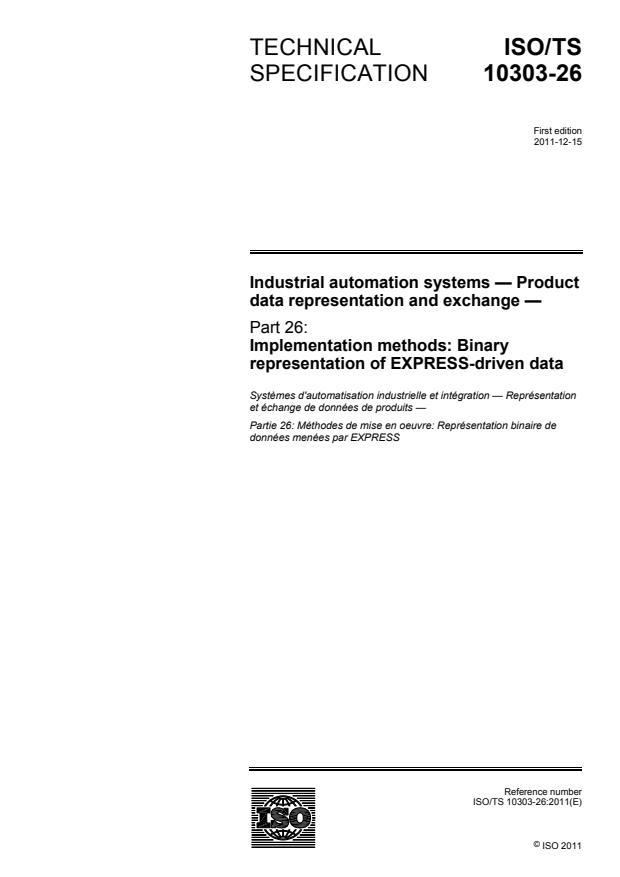
TECHNICAL ISO/TS
SPECIFICATION 10303-26
First edition
2011-12-15
Industrial automation systems — Product
data representation and exchange —
Part 26:
Implementation methods: Binary
representation of EXPRESS-driven data
Systèmes d'automatisation industrielle et intégration — Représentation
et échange de données de produits —
Partie 26: Méthodes de mise en oeuvre: Représentation binaire de
données menées par EXPRESS
Reference number
©
ISO 2011
This CD-ROM contains the publication ISO/TS 10303-26:2011 in HyperText Markup Language (HTML)
format.
© ISO 2011
All rights reserved. Unless required for installation or otherwise specified, no part of this CD-ROM may be reproduced, stored in a retrieval
system or transmitted in any form or by any means without prior permission from ISO. Requests for permission to reproduce this product
should be addressed to
ISO copyright office Case postale 56 CH-1211 Geneva 20 Switzerland
Internet copyright@iso.org
Reproduction may be subject to royalty payments or a licensing agreement.
Violators may be prosecuted.
Published in Switzerland
ii © ISO 2011 – All rights reserved
Installation
If this publication has been packaged as a zipped file, do NOT open the file from the CD-ROM, but copy it to
the desired location in your local environment. Onc
...