


ISO/IEC 18013-1:2005
(Main)Information technology — Personal identification — ISO-compliant driving licence — Part 1: Physical characteristics and basic data set
Information technology — Personal identification — ISO-compliant driving licence — Part 1: Physical characteristics and basic data set
ISO/IEC 18013-1:2005 establishes the design format and data content of an ISO-compliant driving licence (IDL) with regard to the human-readable (visual) features and the placement of ISO machine-readable technologies on the card. It creates a common basis for international use and mutual recognition of the IDL without restricting individual domestic or regional driver licensing authorities from incorporating their specific needs on the IDL. The intent of the ID-1 sized IDL is to allow one document to serve the purpose of both what is currently known amongst driver licensing authorities as a domestic driving permit and an international driving permit (IDP). Thus the IDL replaces the need for two separate documents. Alternatively, those countries that choose to maintain their individual domestic design can issue a second card (with or without ISO machine-readable technologies), a domestic driving licence (DDL), whilst the IDL serves to replace the current IDP paper document only. ISO/IEC 18013-1:2005 also specifies an explanatory booklet with sleeve insert pocket that may optionally accompany an IDL to facilitate its world wide interpretation when used instead of an IDP. The IDL comprises the following: minimum common mandatory data element set, common layout for ease of recognition, minimum set of security requirements. ISO/IEC 18013-1:2005 allows domestic or regional driver licensing authorities to exercise their own discretion in respect of the following aspects of the IDL in order to meet their specific needs: including supplementary optional data elements (in addition to the minimum common mandatory data element set); incorporating ISO/IEC JTC1/SC17 machine-readable technologies including magnetic stripe, integrated circuit with contacts, contactless integrated circuit or optical memory technology, and ISO/IEC JTC1/SC31 1-dimensional or 2-dimensional bar codes; incorporating current and future technologies (including biometrics, cryptography and data compression); adding physical document security elements (in addition to the mandatory elements). This new IDL design yields a document that is more secure from counterfeiting and alteration than the IDP document; allows authorities to verify the authenticity of the document; integrates the personal data into a secure ID-1 size medium; allows more reliable identification of the licence holder; allows for machine-readable technologies; facilitates information exchange and mutual recognition among driver licensing authorities; allows an ISO/IEC 18013-1:2005 compliant DDL to serve simultaneously as an IDL.
Technologies de l'information — Identification des personnes — Permis de conduire conforme à l'ISO — Partie 1: Caractéristiques physiques et jeu de données de base
General Information
- Status
- Withdrawn
- Publication Date
- 17-Aug-2005
- Withdrawal Date
- 17-Aug-2005
- Technical Committee
- ISO/IEC JTC 1/SC 17 - Cards and security devices for personal identification
- Current Stage
- 9599 - Withdrawal of International Standard
- Start Date
- 20-Jul-2018
- Completion Date
- 14-Feb-2026
Relations
- Effective Date
- 13-Apr-2013
Get Certified
Connect with accredited certification bodies for this standard

BSI Group
BSI (British Standards Institution) is the business standards company that helps organizations make excellence a habit.

NYCE
Mexican standards and certification body.
Sponsored listings
Frequently Asked Questions
ISO/IEC 18013-1:2005 is a standard published by the International Organization for Standardization (ISO). Its full title is "Information technology — Personal identification — ISO-compliant driving licence — Part 1: Physical characteristics and basic data set". This standard covers: ISO/IEC 18013-1:2005 establishes the design format and data content of an ISO-compliant driving licence (IDL) with regard to the human-readable (visual) features and the placement of ISO machine-readable technologies on the card. It creates a common basis for international use and mutual recognition of the IDL without restricting individual domestic or regional driver licensing authorities from incorporating their specific needs on the IDL. The intent of the ID-1 sized IDL is to allow one document to serve the purpose of both what is currently known amongst driver licensing authorities as a domestic driving permit and an international driving permit (IDP). Thus the IDL replaces the need for two separate documents. Alternatively, those countries that choose to maintain their individual domestic design can issue a second card (with or without ISO machine-readable technologies), a domestic driving licence (DDL), whilst the IDL serves to replace the current IDP paper document only. ISO/IEC 18013-1:2005 also specifies an explanatory booklet with sleeve insert pocket that may optionally accompany an IDL to facilitate its world wide interpretation when used instead of an IDP. The IDL comprises the following: minimum common mandatory data element set, common layout for ease of recognition, minimum set of security requirements. ISO/IEC 18013-1:2005 allows domestic or regional driver licensing authorities to exercise their own discretion in respect of the following aspects of the IDL in order to meet their specific needs: including supplementary optional data elements (in addition to the minimum common mandatory data element set); incorporating ISO/IEC JTC1/SC17 machine-readable technologies including magnetic stripe, integrated circuit with contacts, contactless integrated circuit or optical memory technology, and ISO/IEC JTC1/SC31 1-dimensional or 2-dimensional bar codes; incorporating current and future technologies (including biometrics, cryptography and data compression); adding physical document security elements (in addition to the mandatory elements). This new IDL design yields a document that is more secure from counterfeiting and alteration than the IDP document; allows authorities to verify the authenticity of the document; integrates the personal data into a secure ID-1 size medium; allows more reliable identification of the licence holder; allows for machine-readable technologies; facilitates information exchange and mutual recognition among driver licensing authorities; allows an ISO/IEC 18013-1:2005 compliant DDL to serve simultaneously as an IDL.
ISO/IEC 18013-1:2005 establishes the design format and data content of an ISO-compliant driving licence (IDL) with regard to the human-readable (visual) features and the placement of ISO machine-readable technologies on the card. It creates a common basis for international use and mutual recognition of the IDL without restricting individual domestic or regional driver licensing authorities from incorporating their specific needs on the IDL. The intent of the ID-1 sized IDL is to allow one document to serve the purpose of both what is currently known amongst driver licensing authorities as a domestic driving permit and an international driving permit (IDP). Thus the IDL replaces the need for two separate documents. Alternatively, those countries that choose to maintain their individual domestic design can issue a second card (with or without ISO machine-readable technologies), a domestic driving licence (DDL), whilst the IDL serves to replace the current IDP paper document only. ISO/IEC 18013-1:2005 also specifies an explanatory booklet with sleeve insert pocket that may optionally accompany an IDL to facilitate its world wide interpretation when used instead of an IDP. The IDL comprises the following: minimum common mandatory data element set, common layout for ease of recognition, minimum set of security requirements. ISO/IEC 18013-1:2005 allows domestic or regional driver licensing authorities to exercise their own discretion in respect of the following aspects of the IDL in order to meet their specific needs: including supplementary optional data elements (in addition to the minimum common mandatory data element set); incorporating ISO/IEC JTC1/SC17 machine-readable technologies including magnetic stripe, integrated circuit with contacts, contactless integrated circuit or optical memory technology, and ISO/IEC JTC1/SC31 1-dimensional or 2-dimensional bar codes; incorporating current and future technologies (including biometrics, cryptography and data compression); adding physical document security elements (in addition to the mandatory elements). This new IDL design yields a document that is more secure from counterfeiting and alteration than the IDP document; allows authorities to verify the authenticity of the document; integrates the personal data into a secure ID-1 size medium; allows more reliable identification of the licence holder; allows for machine-readable technologies; facilitates information exchange and mutual recognition among driver licensing authorities; allows an ISO/IEC 18013-1:2005 compliant DDL to serve simultaneously as an IDL.
ISO/IEC 18013-1:2005 is classified under the following ICS (International Classification for Standards) categories: 35.240.15 - Identification cards. Chip cards. Biometrics. The ICS classification helps identify the subject area and facilitates finding related standards.
ISO/IEC 18013-1:2005 has the following relationships with other standards: It is inter standard links to ISO/IEC 18013-1:2018. Understanding these relationships helps ensure you are using the most current and applicable version of the standard.
ISO/IEC 18013-1:2005 is available in PDF format for immediate download after purchase. The document can be added to your cart and obtained through the secure checkout process. Digital delivery ensures instant access to the complete standard document.
Standards Content (Sample)
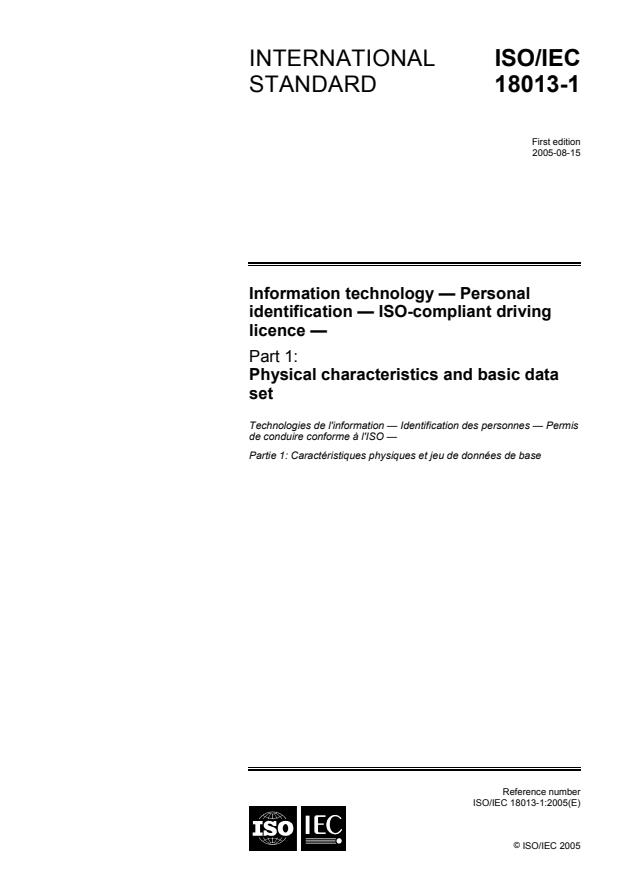
INTERNATIONAL ISO/IEC
STANDARD 18013-1
First edition
2005-08-15
Information technology — Personal
identification — ISO-compliant driving
licence —
Part 1:
Physical characteristics and basic data
set
Technologies de l'information — Identification des personnes — Permis
de conduire conforme à l'ISO —
Partie 1: Caractéristiques physiques et jeu de données de base
Reference number
©
ISO/IEC 2005
PDF disclaimer
This PDF file may contain embedded typefaces. In accordance with Adobe's licensing policy, this file may be printed or viewed but
shall not be edited unless the typefaces which are embedded are licensed to and installed on the computer performing the editing. In
downloading this file, parties accept therein the responsibility of not infringing Adobe's licensing policy. The ISO Central Secretariat
accepts no liability in this area.
Adobe is a trademark of Adobe Systems Incorporated.
Details of the software products used to create this PDF file can be found in the General Info relative to the file; the PDF-creation
parameters were optimized for printing. Every care has been taken to ensure that the file is suitable for use by ISO member bodies. In
the unlikely event that a problem relating to it is found, please inform the Central Secretariat at the address given below.
© ISO/IEC 2005
All rights reserved. Unless otherwise specified, no part of this publication may be reproduced or utilized in any form or by any means,
electronic or mechanical, including photocopying and microfilm, without permission in writing from either ISO at the address below or
ISO's member body in the country of the requester.
ISO copyright office
Case postale 56 • CH-1211 Geneva 20
Tel. + 41 22 749 01 11
Fax + 41 22 749 09 47
E-mail copyright@iso.org
Web www.iso.org
Published in Switzerland
ii © ISO/IEC 2005 – All rights reserved
Contents
Foreword.iv
0 Introduction.v
1 Scope .1
2 Conformance. .2
3 Normative references. .2
4 Terms and de.finitions.2
5 Human-readable data elements on IDL .6
Annex A (normative) Card Design .9
Annex B (normative) Coding System and Pictograph Descriptions.27
Annex C (normative) Document Security Elements.31
Annex D (informative) Procedures for securing the issuance and use of IDLs.41
Annex E (informative) Card durability .43
Annex F (informative) Distinguishing Signs of Countries .44
Annex G (normative) IDL Booklet .48
Bibliography .73
© ISO/IEC 2005 – All rights reserved iii
Foreword
ISO (the International Organization for Standardization) and IEC (the International Electrotechnical
Commission) form the specialized system for worldwide standardization. National bodies that are members of
ISO or IEC participate in the development of International Standards through technical committees
established by the respective organization to deal with particular fields of technical activity. ISO and IEC
technical committees collaborate in fields of mutual interest. Other international organizations, governmental
and non-governmental, in liaison with ISO and IEC, also take part in the work. In the field of information
technology, ISO and IEC have established a joint technical committee, ISO/IEC JTC 1.
International Standards are drafted in accordance with the rules given in the ISO/IEC Directives, Part 2.
The main task of the joint technical committee is to prepare International Standards. Draft International
Standards adopted by the joint technical committee are circulated to national bodies for voting. Publication as
an International Standard requires approval by at least 75 % of the national bodies casting a vote.
Attention is drawn to the possibility that some of the elements of this document may be the subject of patent
rights. ISO and IEC shall not be held responsible for identifying any or all such patent rights.
ISO/IEC 18013-1 was prepared by Joint Technical Committee ISO/IEC JTC 1, Information technology,
Subcommittee SC 17, Cards and personal identification.
ISO/IEC 18013 consists of the following parts, under the general title Information technology — Personal
identification — ISO-compliant driving licence:
— Part 1: Physical characteristics and basic data set
The following part is under preparation:
— Part 2: Machine readable technologies
iv © ISO/IEC 2005 – All rights reserved
0 Introduction
ISO/IEC 18013 prescribes requirements for an ISO compliant driving licence (IDL). The intent of ISO/IEC 18013 is to
allow the issuance of one document to serve the purpose of both an international driving permit (IDP) and a domestic driving
permit (DDP). Issuing authorities issuing domestic driving licences (DDLs) that do not conform to ISO/IEC 18013 can
benefit from using parts of ISO/IEC 18013 for their own domestic purpose. These issuing authorities should continue to issue a
second document that follows the requirements of the IDP for international use.
0.1 Definition, Function & Requirements of International Driving Permit
The United Nation Conventions on Road Traffic of 1949 Geneva and 1968 Vienna are the responsibility of the Secretary
General at the United Nations Headquarters, New York. The maintenance of the Conventions has been assigned to UN/ECE-
Transport Division, Geneva, Switzerland. The ultimate goal of the Conventions is road safety. The Conventions make
provisions for both an International Driving Permit (IDP) and a Domestic Driving Permit (DDP).
The IDP serves as a means of mutual recognition in that it is issued by the holder’s home country licensing authority requesting
another country who has ratified the Conventions to allow the holder the permission to operate a motor vehicle of authorized
categories under specific conditions/restrictions. The IDP is essentially a translation of the DDP except in a common worldwide-
recognized standardized format for global recognition and acceptance as specified in the Conventions. The IDP also makes
provision for a state to disqualify the holder of an IDP from driving in that country by recording such in the designated area.
0.2 Harmonisation and Interoperability
The above general definition of a driving licence implies a human-readable document with the following properties.
• The document contains sufficient information for the identification of the licence holder.
• The document is difficult to counterfeit.
• The document is secure to prevent alteration.
In today’s worldwide freedom of movement, modern driving licence systems impose additional requirements for facilitation with
the advent and need for machine-assisted storage, retrieval, reading and verification technologies that UN Conventions have
not addressed.
To achieve maximum global harmonisation and interoperability, standards are required to provide common platforms for visual
human-readable evidence as well as for machine-assisted storage, retrieval, reading and verification by the use of ISO data
storage technologies incorporated into the driving licence document.
0.3 Current Limitations of International Driving Permit
The problems and concerns with the current IDP that have been reported include the following.
• Easily copied, altered, or simulated and difficult for law enforcement authorities to detect fraudulent licences from
genuine documents.
• Many non-government IDP issuing authorities do not query their respective government motor vehicle agencies to
establish if the DDP presented is still valid and still current.
• There is no register/directory of national motor vehicle agency addresses for the inquiry and exchange of information
among the agencies to verify the validity of a presented IDP.
• Does not incorporate the ISO machine-assisted data storage technologies.
• Suspension or cancellation of domestic driving licence (DDL) or domestic driving permit (DDP) should result in an
automatic suspension or cancellation of the IDP; however, the current system does not facilitate that.
• The IDP holder may circumvent disqualifications entered on their original IDP by obtaining a new IDP.
• Validity of the IDP is currently limited to a maximum of 1 to 3 years, depending on the UN Convention followed.
© ISO/IEC 2005 – All rights reserved v
0.4 Replacement of International Driving Permit (IDP) with ISO compliant Driving Licence (IDL)
At one time, the conventions contained specifications in regard to a mandatory “model” data element set (particulars) and a
mandatory design layout of defined dimensions for both DDP and IDP. Subsequently, in 1990, the Convention’s mandatory
requirement for the defined design layout of the DDP was rescinded as some countries made preparations for issuing the DDP
in the form of an ISO ID-1 size card.
ISO/IEC 18013 similarly provides for the migration of the current mandatory design layout of defined dimensions for the IDP
paper document to an ISO ID-1 size card. This allows the use of ISO machine-readable technologies at the option of motor
vehicle authorities. Additionally, it provides the potential integration of the two documents (DDP&IDP) into a single document.
Compliance with International Standards is voluntary. No International Standards are mandated and use is at the sole discretion
of the motor vehicle authority.
vi © ISO/IEC 2005 – All rights reserved
INTERNATIONAL STANDARD ISO/IEC 18013-1:2005(E)
Information technology — Personal identification — ISO-compliant
driving licence —
Part 1:
Physical characteristics and basic data set
1 Scope
This part of ISO/IEC 18013 establishes guidelines for the design format and data content of an ISO compliant
driving licence (IDL) in regard to both visual human-readable features and ISO machine-readable technologies. It
creates a common basis for international use and mutual recognition of the IDL without impeding individual
national/community/regional motor vehicle authorities in taking care of their specific needs.
The design approach of the IDL ISO ID-1 size card and accompanying booklet with sleeve insert pocket is intended
to replace the international driving permit (IDP) paper document (see annex G).
The basis of document design premises includes
• a minimum common mandatory data element set;
• a common layout for ease of recognition;
• minimum security requirements.
At the discretion of national/community/regional motor vehicle authorities, it
• allows for inclusion of supplementary optional data elements to meet the needs of specific
national/community/regional requirements apart from the minimum common mandatory data element set;
• allows for the incorporation of ISO/IEC JTC1/SC17 machine-readable technologies including magnetic
stripe, integrated circuit with contacts, contactless integrated circuit and optical memory technology, and
ISO/IEC JTC1/SC31 1-dimensional / 2-dimensional bar codes, at the option of national/community/regional
authorities;
• allows for the incorporation of current and future technologies (including biometrics, cryptography, data
compression) at the option of national/community/regional authorities;
• allows for additional document physical security elements at the option of national/community/regional
authorities, and facilitates international procurements.
A major benefit of these design premises is that a single card may serve a dual purpose of both a
national/community/regional licence as well as an internationally recognized licence. Therefore, one card, in some
cases, can replace the need for two documents. Alternatively, those countries that choose to maintain their
individual domestic design can issue a second card with or without ISO machine-readable technologies to replace
the current IDP paper document.
© ISO/IEC 2005 — All rights reserved 1
This new IDL design yields a document that
• is more secure from counterfeiting and alteration than the previous IDP document;
• allows authorities to verify the authenticity of the document;
• integrates the personal data into a secure ID-1 size medium;
• allows a more reliable identification of the licence holder;
• allows for machine-readable technologies;
• facilitates information exchange and mutual recognition among motor vehicle authorities;
• allows the domestic driving licence (DDL) that meets this Standard to serve simultaneously as an ISO
compliant driving licence (IDL).
2 Conformance
A driving licence is in conformance with this part of ISO/IEC 18013 if it meets all mandatory requirements specified
directly or by reference herein.
3 Normative references
The following referenced documents are indispensable for the application of this document. For dated references,
only the edition cited applies. For undated references, the latest edition of the referenced document (including any
amendments) applies.
ISO/IEC 7810:2003, Identification cards — Physical characteristics
4 Terms and definitions
For the purposes of this document, the following terms and definitions apply.
4.1
alphabetic character
A
hexadecimal ranges 41 – 5A (Latin capital letters), 61 – 7A (Latin small letters), C0 – D6, D8 – F6 and F8 – FF of
ISO/IEC 8859-1
4.2
country distinguishing sign
abbreviation for issuing country identified to the UN Secretary General in accordance with the UN Conventions
(1949 and 1968) for vehicles in international traffic (see annex F), on the driving licence (human-readable)
4.3
card
document with nominal dimensions in conformance with ISO/IEC 7810 ID-1
4.4
data element
item of data that may appear on the driving licence in either human or machine-readable form
NOTE A distinction is made between static data elements and dynamic data elements.
4.4.1
static data element
data element associated with the issuing authority, and which is the same for all DLs issued on behalf of or by
that issuing authority
2 © ISO/IEC 2005 — All rights reserved
4.4.2
dynamic data element
data element associated with the licence holder and thus varies from one DL to the next for a particular licensing
authority, thus specifically excluding the issuing authority data element
4.5
document recognition
educational knowledge and ability to recognize the validity of the driving licence of both national and international
jurisdictions including data elements, formatting, visual biometrics (e.g. portrait, signature), electronic readable
features and document security features
4.6
driving licence
DL
document issued to a driving licence holder by an issuing authority granting the individual the privilege to operate a
motor vehicle within its jurisdiction
NOTE 1 The document may facilitate driving licence transactions and provide input data for such transactions. This issued
document incorporates several elements and qualifications regarding the licence holder: positive identification of the individual;
evidence of knowledge of laws and practices; practical driving proficiency in specific motor vehicle class categories; and, the
individual's health restrictions (e.g. corrective eye lenses).
NOTE 2 Driving licences are classified into four types of documents, namely domestic driving licence, domestic driving
permit, ISO compliant driving licence and international driving permit.
4.6.1
domestic driving licence
DDL
document conveying driving privilege for operating motor vehicles within country/community of issuance, and
which may or may not be issued in conformance with ISO/IEC 18013
4.6.2
domestic driving permit
DDP
driving licence issued in conformance with the UN Convention Geneva 1949, annex 9 or the UN Convention
Vienna 1968, annex 6
NOTE This is the UN terminology for a domestic driving licence.
4.6.3
ISO compliant driving licence
IDL
driving licence card issued in conformance with ISO/IEC 18013, which may be used for both domestic and
international use
4.6.4
international driving permit
IDP
driving licence issued in conformance with the UN Convention Geneva 1949, annex 10 or the UN Convention
Vienna 1968, annex 7
4.7
first line inspection
cursory examination without tools or aids that involves easily identifiable visual or tactile features for rapid
inspection at point of usage
4.8
human-readable data / information
data or information that is printed or engraved that is visually present on a driving licence and designed to be
interpreted by a human
© ISO/IEC 2005 — All rights reserved 3
4.9
image
representation of the visual likeness of a subject
EXAMPLE Portrait, finger print, or signature.
NOTE Images may be collected and stored digitally or otherwise, and rendered for visual inspection using a variety of
systems.
4.10
issuing authority
licensing authority, or issuing country if separate licensing authorities have not been authorised
4.11
issuing country
country according to annex F which issued the DL or within which the licensing authority is located
4.12
jurisdiction
territory (country, state, province) within which the licensing authority has the mandate and responsibility to apply
motor vehicle laws/directives
4.13
licence holder
individual to whom a DL is issued i.e. the legitimate holder of the driving privileges reflected on a DL
4.14
licensing authority
authorised agent organisation that issues a DL
EXAMPLE National, federal, state, provincial, regional, territorial or local Ministry of Transport, Department of Motor
Vehicles, or Police Agency.
4.15
machine-readable data / information
data or information that is encoded into a machine-readable medium, such as a magnetic stripe, bar code, optical
memory, or integrated circuit
4.16
mandatory element
element that is required
4.17
mutual recognition
privilege of citizens from two jurisdictions to drive an eligible vehicle under specified conditions/restrictions in each
other's jurisdictions without the requirement of undergoing additional practical and/or written testing
NOTE Mutual recognition is administered by way of agreements between the governments of the jurisdictions.
4.18
non-portrait side of card
opposite face from the portrait side
4.19
numeric character
N
hexadecimal range 30 – 39 (digits 0 to 9) of ISO/IEC 8859-1
4 © ISO/IEC 2005 — All rights reserved
4.20
optional element
element that may be used, but that is not mandatory
4.21
pictograph
graphical representation associated with a specific value or instance of a predefined classification or restriction,
such as a vehicle category or medical condition
NOTE See annex B.
4.22
portrait
two dimensional representation of the face of a person in a full-face frontal pose
NOTE See annex A.
4.23
portrait side of card
face of the card carrying visual information containing the reproduction of the portrait of the licence holder
4.24
second line inspection
examination by trained inspectors with simple equipment (magnifying glass, UV light, machine-reading equipment,
etc.)
4.25
security element
distinct physical element or property of a document that contributes to at least one security feature
NOTE Depending on the method of verification, one element may provide one or more security features that may apply to
the same or to different categories.
4.26
security feature
feature of a document that is linked to a specific method of verification and thus helps insure the document’s
integrity and/or authenticity as a properly issued document that has not been tampered with
NOTE Security features may be distinguished in different kinds of categories such as:
- overt or covert,
- for human or machine-verification,
- for first line, second line, or third line inspection.
Physical security elements applied during production of a document may contribute more than one feature and
therefore also cover more than one category of each kind.
4.27
special character
S
hexadecimal ranges 20 – 2F ( ! “ # $ % & ‘ ( ) * + , - . /), 3A (:), 3C – 40 (< = > ? @), 5B – 60 ([ \ ] ^ _ `),
7B – 7E ({ | } ~), A1 – AC (¡ ¢ £ ¤ ¥ ¦ § ¨ © ª « ¬), AE – A5 (® ¯ ° ± ² ³ ´ µ), and A7 – BF (· ¸ ¹ º » ¼ ½ ¾ ¿) of
ISO/IEC 8859-1
NOTE The semicolon “;”, multiplication sign "×" and division sign "÷" are defined as delimiters and the pilcrow sign "¶" is
defined as the end-of-file character in the machine-readable data / information.
© ISO/IEC 2005 — All rights reserved 5
4.28
supranational
extending beyond or transcending established borders or spheres of influence held by separate nations
NOTE The concept can apply equally to government entities (such as the European Union) and non-government entities
(such as the International Civil Aviation Organization).
4.29
text
human-readable A, N or S
4.30
third line inspection
inspection by forensic specialists conducting detailed examination allows for more in-depth evaluation and may
require special equipment to provide true certification
5 Human-readable data elements on IDL
5.1 Data element tables
The tables in 5.2 and 5.3 specify the mandatory and optional elements that appear on the IDL.
Column 1 (Item #): serves as a reference indicator for citation elsewhere in this Standard.
Column 2 (Data field reference code on IDL): reference code shall be visibly included as text on the IDL to
identify the data element for purposes of interpreting the data and other international interchange requirements.
The reference code may be depicted on the IDL with punctuation or without punctuation (as shown in Table 1 and
Table 2).
EXAMPLE "1." or "1" may be used to reference the data element "Family name" and likewise "4c." or "4c" may be used to
reference the data element "Issuing authority". Informative examples with punctuation and without punctuation are provided in
A.10.
Column 3 (Card zone placement): indicates the location on the IDL where the data element shall be placed.
Location of the zones are specified in annex A of this Standard.
Column 4 (Data element name): common name or phrase that is used to refer to the accompanying data element
definition.
Column 5 (Definition): description of the data element, including any exceptions.
Column 6 (Field maximum length/type): valid field length (i.e., the number of characters) for each data element.
The nature of the field length is defined by F=fixed length and V=variable length.
6 © ISO/IEC 2005 — All rights reserved
5.2 Mandatory data elements for international interchange
All the data elements appearing in Table 1, but for item f, the issuing authority, are dynamic data elements.
Table 1 — Mandatory data elements for international interchange
Item # Data field Card zone Data element Description/ Definition Field
reference placement name maximum
code on IDL length/
type
a 1 Zone II Family name Last name, surname, or primary identifier, V36AS
of the licen ce holde r
b 2 Zone II Given nam es First name(s), other name(s), or secondary V36AS
identifier, of the lice nce holder
c 3 Zone II Date of Birth Day, month, year on which the licence F8N
holder was born (if unknown, approximate
Date of Birth)
d 4a Zone II Date of Issue Date licence document was issued (same F8N
format as Date of Birth)
e 4b Zone II Date of Expiry Date licence document expires (same F8N
format as Date of Birth)
f 4c Zone II Issuing Authority Abbreviations may be used (see 4.10) V65ANS
g 5 Zone II Licence Number The number assigned or calculated by the V25AN
issuing authority
h 6 Zone III Portrait A reproduction of the licence holder’s (Image)
portrait
i 7 Zone II Signature A reproduction of the licence holder’s (Image)
signature, or usual mark, or thumb or finger
print
j 9 Zone II Categories of Vehicle types the licence holder is V3AN
Vehicles authorised to operate
(may be (or Picto-
repeated in graphs)
Zone IV)
k 10 Zone II or IV Date of issue per The date of issue for a specific class of F8N
category vehicle if it is before the date of issue of the
licence document (same format as Date of
Birth)
l 11 Zone II or IV Date of expiry per The date of expiry of the specific category if F8N
category it expires before or after the date of expiry
of the licence document (same format as
Date of Birth)
m 12 Zone II or IV Restrictions Restrictions or conditions which apply to the (Picto-
licence holder when operating a vehicle graphs)
(shown as pictographs defined in the
restriction codes)
n 12 Zone II or IV Conditions/ Any medical, administrative or legal (Picto-
Information limitations applying to the licence holder graphs)
and not covered under the standard
restriction codes
© ISO/IEC 2005 — All rights reserved 7
5.3 Optional data elements for international interchange
All the data elements appearing in Table 2 are dynamic data elements.
Table 2 — Optional data elements for international interchange
Item # Data field Card zone Data element Description/ Definition Field
reference placement name maximum
a
code on IDL length/
type
o 3 Zone II Place of Birth Country and municipality or state/province V33A
where the licence holder was born
p
4d Zone II Administrative An audit control number assigned by the V25ANS
Number licensing authority
q
8 Zone II Permanent Place The place where the licence holder resides V108ANS
of Residence and/or may be contacted (street/house
number, municipality etc.)
r 15 Zone II Gender Licence holder’s gender: M for male, F for F1A
female
s 16 Zone II Height (cm.) Licence holder’s height in centimetres F3N
t 16 Zone II Height (ft./in.) Licence holder’s height in feet 1), inches 2) F3N
for example. 509= 5ft 9in
u 17 Zone II Weight (kg.) Licence holder’s weight in kilograms F3N
v 17 Zone II Weight (lb.) Licence holder’s weight in pounds F3N
w 18 Zone II Eye Colour Licence holder’s eye colour: blue, brown, V12A
black, hazel, green, grey, pink, dichromatic
x 19 Zone II Hair Colour Licence holder’s hair colour: brown, black, V12A
blonde, grey, red/auburn, sandy, white,
bald
NOTE Data field reference codes 13 & 14 are not used as they are designated for domestic use in the EC Directives and in
the amendments to the Vienna Convention (proposed Rev.3 of WP.1, dated 5 Jan 2004).
a
The use of the reference code on the IDL is optional for the data elements in this table. However, if a reference code is
used, it shall be the reference code listed in this table.
8 © ISO/IEC 2005 — All rights reserved
Annex A
(normative)
Card Design
A.1 Introduction
This annex contains the requirements with regard to the human-readable content and layout of the data elements
on the IDL.
The main ideology for defining the design of the IDL is the minimum acceptable set of requirements to guarantee
global interoperability. Sufficient freedom is afforded to the issuing authorities of driving licences to meet their
national (domestic) needs (existing standards, data contents, security elements, etc).
A.2 Scope
Annex A defines the specifications of the card layout, together with informative examples for ease of understanding.
A.3 Informative references
The following international agreements and standards contain provisions, which were considered in defining the
requirements of this annex:
Convention on Road Traffic, Geneva of 19 September 1949
Convention on Road Traffic, Vienna of 8 November 1968
European Union Council Directive 91/439/EEC of 29 July 1991 O.J. EC No. L 237/1, as amended by:
European Union Council Directive 94/72EC of 19 December 1994 O.J. EC No L 337/86
European Union Council Directive 96/47/EC of 23 July 1996 O.J. EC No. L 235/1
European Union Council Directive 97/26/EC of 2 June 1997 O.J. EC No. L 150/41
Commission Directive 2000/56/EC of 14 September 2000 O.J. EC No L 237/45
AAMVA National Standard for Driver License/ Identification Card, 30 June 2000
SADC Driving Licence specifications, 1995
A.4 Dimensions and character set
The nominal dimensions of the IDL shall be in conformance with ISO/IEC 7810 ID-1. Where the IDL is to
incorporate machine-readable technology that requires the use of a slot reader, the dimensions and tolerances
specified in ISO/IEC 7810 shall be observed. Additional specifications may apply depending upon the machine-
readable technology incorporated on the card.
All mandatory human-readable data elements shall be printed in A, N or S characters.
© ISO/IEC 2005 — All rights reserved 9
A.5 Functions
The basis of the visual card design is to meet the minimum common mandatory set of data elements in the
following areas of function:
• Common recognition of the IDL by law enforcement agencies and users outside of the country of issue.
• Layout of the human-readable data elements and the machine-readable components.
• Text, images and/or pictographs of the human-readable data elements.
• Security of the card as a separate topic to avoid confusion between common recognition and integrity issues.
A.6 Common recognition
To assist law enforcement agencies in recognizing a driving licence presented by a driver outside the country of
issue as an IDL, the following shall appear on the card:
• Zone 1 of the card shall have a background, preferably formed of a rainbow printed duplex security pattern as
specified in annex C.6.2.1. Though several colours should be used in the background to assist in protection
against counterfeit by copying, the predominant colour shall be pink matched as closely as possible to a 30%
tint of Pantone 198, as a mandatory requirement. This match should be achieved without the use of the
primary colours (CMYK colours, as defined in annex C).
• The reproduction of the portrait of the licence holder is depicted on the left side on the portrait side of the card
as shown by the position of Zone III in Figure A.1 as a mandatory requirement.
• No machine-readable technology is permitted on the portrait side of the card.
• Mandatory static data elements in Zone I of the card.
• Dynamic data elements and the issuing authority identified by data field reference codes (but for the
photograph) as a mandatory requirement.
A.7 Layout
Because there are many licensing authorities, more than the number of issuing countries involved, the layout is not
fixed to a single format. The layout is grouped by different zones and the various options for the zones are
depicted in Figures A.1 to A.7.
The portrait and non-portrait side of the card shall carry the following:
Portrait side
Data Element Set of text, reproduction of portrait and signature, usual mark or thumb/ finger print of the licence
holder (mandatory).
Zones I, II and III.
Non-portrait side
Data Element Set of text (optional) and machine-readable technologies (optional).
Zones IV and V.
10 © ISO/IEC 2005 — All rights reserved
A.8 Contents of the zones
A.8.1 Data element placement
Mandatory and optional data elements are defined for each zone.
A.8.1.1 Zone I
Text “DRIVING LICENCE” in the language or languages of the issuing country (mandatory).
Text or alternatively in the background graphic design, the words “DRIVING LICENCE” in one of the languages
English (“DRIVING LICENCE”), French (“PERMIS DE CONDUIRE”) or Spanish (“PERMISO DE CONDUCCIÓN”)
(mandatory).
Distinguishing sign of the issuing country as identified to the UN Secretary General in accordance with the UN
Conventions (1949 and 1968) (mandatory). Annex F contains the current list of distinguishing signs identified to
the UN Secretary General.
The name of the issuing country (optional).
The name or acronym of supranational entity (optional).
Other national signs, such as the flag or logo of the issuing country (optional).
A.8.1.2 Zone II
Table A.1 — Zone II data elements
Data field
reference Description
code on IDL
1 Family name of the licence holder (mandatory).
2 Given name or other names of the licence holder (mandatory).
3 Date of birth (mandatory) and place of birth (optional)
4a Date of issue of the licence (mandatory).
4b Date of expiry of the licence (mandatory).
4c Name of the issuing authority (mandatory).
4d Administrative number, different from the one under reference code 5, for administrative
purposes (optional).
5 Number of the licence (mandatory).
7 Image of the signature or usual mark of the licence holder, or thumb or finger print (mandatory).
8 Permanent place of residence, or postal address (optional).
9 (Sub)category(ies) of vehicle(s) the licence holder is entitled to drive (mandatory).
10 Date of first issue of each (sub)category of vehicles (mandatory).
11 Date of expiry of each (sub)category of vehicles (mandatory).
12 Additional information/ restrictions, in pictograph form, facing the subcategory of vehicles
affected (pictographs stated in annex B mandatory, restriction code optional).
13 Reserved for domestic information essential for administration of licence by issuing authority
(optional).
© ISO/IEC 2005 — All rights reserved 11
Data field
reference Description
code on IDL
14 Reserved for domestic information related to road safety by issuing authority (optional).
15 Gender of the licence holder (optional).
16 Height of the licence holder (optional)
17 Weight of the licence holder (optional).
18 Eye colour of the licence holder (optional).
19 Hair colour of the licence holder (optional).
NOTE Data field reference codes 13 & 14 are designated for domestic use in the EC Directives and in the amendments to
the Vienna Convention (proposed Rev.3 of WP.1, dated 5 Jan 2004).
This zone may also include other data fields for national (domestic) or regional purposes in human-readable format
(optional).
Alternatively the data fields 10, 11, 12, 13 and 14 may be located in Zone IV and data field 9 may be repeated in
Zone IV.
A.8.1.3 Zone III
Table A.2 — Zone III data elements
Data field
reference Description
code on IDL
6 Image of the portrait of the licence holder (mandatory). The portrait image is not denoted by its
reference code on the licence.
A.8.1.4 Zone IV
Table A.3 — Zone IV data elements
Data field
Description
reference
code on IDL
9 (Sub)category(ies) of vehicle(s) the licence holder is entitled to drive (may be repeated from
Zone II).
10 Date of first issue of each (sub)category of vehicles (mandatory).
11 Date of expiry of each (sub)category of vehicles (mandatory).
12 Additional information/ restrictions, in pictograph form, facing the sub-category of vehicles
affected (pictograph mandatory, restriction code optional).
13 Reserved for domestic information essential for administration of licence by issuing authority
(optional).
14 Reserved for domestic information related to road safety by issuing authority (optional).
NOTE Data field reference codes 13 & 14 are designated for domestic use in the EC Directives and in the amendments to
the Vienna Convention (proposed Rev.3 of WP.1, dated 5 Jan 2004).
12 © ISO/IEC 2005 — All rights reserved
Alternatively the data fields 10, 11, 12, 13 and 14 may be located in Zone II.
This zone may also include national (domestic) or regional information in human-readable format for purposes of
administration of the licence or related to road safety (optional).
A.8.1.5 Zone V
Machine-readable technologies for international, national or regional purposes (optional).
The IDL may contain any or a combination of the following machine-readable technologies:
• Bar code, one or two dimensional.
• Magnetic stripe.
• Integrated circuit with contacts.
• Contactless integrated circuit.
• Optical memory.
The positions of the zones for the optional national or regional human-readable fields and optional machine-
readable technologies are presented in the figures of the annex. The position and size of Zones IV and V may be
adjusted in accordance with the machine-readable technologies incorporated on the card.
Within this Standard, the above technologies may co-exist except for a magnetic stripe and an integrated circuit
with contacts. Incorporation of a contactless integrated circuit is not depicted in the figures of this annex as it does
not occupy visible space.
NOTE Depending on the printing technology used, care should be taken when incorporating personalised data on the
portrait side of the card opposite the location of an integrated circuit.
A.8.2 Production of images
A.8.2.1 Portrait
Measures shall be taken by the issuing authority to ensure that the reproduction of the portrait of the licence holder
on the card is resistant to forgery and substitution as specified in annex C.6.4. Such image of the portrait shall
meet the following requirements:
Pose. The portrait shall depict the face of the rightful licence holder in a full-face frontal pose with both eyes visible;
i.e. captured perpendicular to an imaginary plane formed parallel to the front surface of the face or where the
additional detail of one ear is required (‘half-on profile’), at such an angle to the imaginary plane as to reveal the
detail of the ear while maintaining full-face frontal details on that side of the face opposite to the exposed ear. The
portrait may only show the licence holder with headgear, if the licence holder is a member of a religion requiring the
wearing thereof and provided that the headgear does not render the portrait inadequate for the identification of the
licence holder.
Depth of Field. The full-face frontal pose shall be in-focus from the crown (top of the hair) to the chin and from the
nose to the ears.
Orientation. The crown (top of the hair) shall be nearest the top edge of Zone III as defined in Figure A.1; i.e. the
crown to chin orientation covering the longest dimension defined for Zone III.
© ISO/IEC 2005 — All rights reserved 13
Face Size. The crown to chin portion of the full-face frontal pose shall be 70 to 80 percent of the longest dimension
defined for Zone III, maintaining the aspect ratio between the crown-to-chin and ear-to-ear details of the face of the
licence holder.
Lighting. Adequate and uniform illumination shall be used to capture the full-face frontal pose; i.e. appropriate
illumination techniques shall be employed and illumination used to achieve natural skin tones (and avoid any colour
cast) and a high level of detail, and minimize shadows, hot spots and reflections (such as sometimes caused by
spectacles).
Background. A uniform colour background shall be used to provide a contrast to the face and hair. For colour
portraits, light blue, beige, light brown, pale grey or white are recommended for the background.
Centring. The full-face frontal pose shall be centred within Zone III.
Border. A border or frame shall not be used to outline the portrait image.
Colour. The portrait image shall be black and white or a true colour representation of the licence holder.
Image resolution. The portrait image shall yield an accurate and recognisable representation of the rightful licence
holder. The quality of a digitally reproduced portrait shall be visually comparable to an acceptable photograph. To
achieve this comparable quality in a digital reproduction, care should be given to the image capture, processing,
digitisation, compression and printing technology and the process used to reproduce the portrait on the card,
including the final preparation of the IDL.
A.8.2.2 Signature or Usual Mark
Measures shall be taken by the issuing authority to ensure that the reproduction of the signature or usual mark on
the card is resistant to forgery and substitution as specified in annex C.6.4. Such image of the signature or usual
mark displayed on the card shall meet the following requirements:
Orientation. The signature or usual mark shall be displayed with its A-dimension parallel to the Top Reference
Edge of the card identified in Figure A.1.
B-dimension
A-dimension
Size. The signature or usual mark displayed shall be of such dimensions as to be discernible by the human eye
and maintain the aspect ratio (A-dimension to B-dimension) of the original signature or usual mark.
Scaling. In the event the signature or usual mark displayed is scaled-up or scaled-down, the aspect ratio (A-
dimension to B-dimension) of the original signature or usual mark shall be maintained. In the case of a scaled-
down image, the reproduction shall not be smaller than 50% of the original signature or usual mark.
Cropping. The issuing authority should take steps to eliminate or minimize cropping.
Colour. The reproduction of the signature or usual mark shall be printed in black to afford a definite contrast to the
background.
Borders. Borders or frames shall not be used to outline the image of the signature or usual mark.
Image resolution. The image shall yield an accurate and recognisable representation of the original signature or
usual mark of the rightful licence holder. To achieve this comparable quality in a digital reproduction, care should
be given to the image capture, processing, digitisation, compression and printing technology and the process used
to reproduce the signature or usual mark on the card, including the final preparation of the IDL.
14 © ISO/IEC 2005 — All rights reserved
A.8.2.3 Finger print
In the absence of the signature or usual mark of the licence holder, a reproduction of an original single-digit (ie a
flat and not rolled) finger print shall be printed on the card. Measures shall be tak
...
Questions, Comments and Discussion
Ask us and Technical Secretary will try to provide an answer. You can facilitate discussion about the standard in here.
Loading comments...