

ISO/IEC 30134-1:2016
(Main)Information technology — Data centres — Key performance indicators — Part 1: Overview and general requirements
General Information
- Abstract
ISO/IEC 30134-1:2016 specifies the following for the other parts of ISO/IEC 30134: a) a common structure; b) definitions, terminology and boundary conditions for KPIs of data centre resource usage effectiveness and efficiency; c) common requirements for KPIs of data centre resource usage effectiveness and efficiency; d) common objectives for KPIs of the data centre resource effectiveness and efficiency; e) general information regarding the use of KPIs of data centre resource usage effectiveness and efficiency.
- Status
- Published
- Publication Date
- 20-Mar-2016
- Technical Committee
- ISO/IEC JTC 1/SC 39 - Sustainability, IT and data centres
- Drafting Committee
- ISO/IEC JTC 1/SC 39 - Sustainability, IT and data centres
- Current Stage
- 9092 - International Standard to be revised
- Start Date
- 03-Sep-2026
- Completion Date
- 12-Sep-2026
Buy Documents

ISO/IEC 30134-1:2016 - Information technology -- Data centres -- Key performance indicators

ISO/IEC 30134-1:2016 - Information technology — Data centres — Key performance indicators — Part 1: Overview and general requirements/21/2016
Overview
ISO/IEC 30134-1:2016 - "Information technology - Data centres - Key performance indicators - Part 1: Overview and general requirements" provides the foundational framework for defining, using and publishing key performance indicators (KPIs) that measure data centre resource usage effectiveness and resource usage efficiency. It sets a common structure, terminology, boundary conditions and conformance requirements for KPIs used across the ISO/IEC 30134 series. The standard is descriptive and normative about KPI form and use but does not prescribe targets or aggregate overall KPI scores.
Key topics and requirements
- Common structure and definitions: establishes consistent terms (e.g., data centre, IT equipment, mechanical/electrical spaces) and the distinction between resource usage effectiveness and efficiency.
- KPI objectives: focuses on measuring effective use of resources (energy, water, reuse of heat, renewable energy) and enabling improvement roadmaps.
- KPI requirements: includes expectations for scale, evolution, formulae, clear boundary definitions (spatial and logical), measurement points and procedures, reporting and classifications.
- Data centre boundaries: defines spatial and logical boundaries to make KPIs comparable and repeatable across facilities.
- Measurement and reporting: requires documented measurement points, procedures and reporting formats to support conformance and benchmarking.
- Conformance criteria: a KPI to be part of the ISO/IEC 30134 family must meet the objectives, requirements, structure and use guidance in this part.
- Scope limitations: the standard does not set numeric limits, nor does it require aggregation of KPIs into a single combined metric.
Applications and who uses it
- Data centre operators and facility managers: to implement standardized KPIs (e.g., PUE) and define measurement boundaries for accurate monitoring and benchmarking.
- Sustainability and energy teams: to track resource effectiveness, assess renewable energy contributions and plan reduction strategies.
- Consultants and auditors: to evaluate KPI conformance, validate measurement procedures and support certification or reporting.
- Procurement and contract teams: to include KPI definitions and reporting requirements in SLAs and vendor agreements.
- Standards developers and regulators: to harmonize KPI terminology and measurement practices across jurisdictions.
Practical uses include KPI selection and implementation, accurate benchmarking, operational improvement roadmaps, transparent reporting to stakeholders, and consistent contractual KPI specifications.
Related standards
- ISO/IEC 30134 series - other parts address specific KPIs:
- Part 2: Power Usage Effectiveness (PUE)
- Part 3: Renewable Energy Factor (REF)
- Additional parts (e.g., IT equipment energy efficiency and utilization) are noted as under development within the series.
Keywords: ISO/IEC 30134-1:2016, data centre KPIs, resource usage effectiveness, data center energy efficiency, PUE, KPI measurement, data centre boundaries.
Relations
- Effective Date
- 11-Dec-2021
Buy Documents
ISO/IEC 30134-1:2016 - Information technology -- Data centres -- Key performance indicators
ISO/IEC 30134-1:2016 - Information technology — Data centres — Key performance indicators — Part 1: Overview and general requirements/21/2016
Get Certified
Connect with accredited certification bodies for this standard

BSI Group
BSI (British Standards Institution) is the business standards company that helps organizations make excellence a habit.

NYCE
Mexican standards and certification body.
Sponsored listings
Frequently Asked Questions
ISO/IEC 30134-1:2016 is a standard published by the International Organization for Standardization (ISO). Its full title is "Information technology — Data centres — Key performance indicators — Part 1: Overview and general requirements". This standard covers: ISO/IEC 30134-1:2016 specifies the following for the other parts of ISO/IEC 30134: a) a common structure; b) definitions, terminology and boundary conditions for KPIs of data centre resource usage effectiveness and efficiency; c) common requirements for KPIs of data centre resource usage effectiveness and efficiency; d) common objectives for KPIs of the data centre resource effectiveness and efficiency; e) general information regarding the use of KPIs of data centre resource usage effectiveness and efficiency.
ISO/IEC 30134-1:2016 specifies the following for the other parts of ISO/IEC 30134: a) a common structure; b) definitions, terminology and boundary conditions for KPIs of data centre resource usage effectiveness and efficiency; c) common requirements for KPIs of data centre resource usage effectiveness and efficiency; d) common objectives for KPIs of the data centre resource effectiveness and efficiency; e) general information regarding the use of KPIs of data centre resource usage effectiveness and efficiency.
ISO/IEC 30134-1:2016 is classified under the following ICS (International Classification for Standards) categories: 35.020 - Information technology (IT) in general. The ICS classification helps identify the subject area and facilitates finding related standards.
ISO/IEC 30134-1:2016 has the following relationships with other standards: It is inter standard links to ISO/IEC 30134-1:2016/Amd 1:2018. Understanding these relationships helps ensure you are using the most current and applicable version of the standard.
ISO/IEC 30134-1:2016 is available in PDF format for immediate download after purchase. The document can be added to your cart and obtained through the secure checkout process. Digital delivery ensures instant access to the complete standard document.
Standards Content (Sample)
INTERNATIONAL ISO/IEC
STANDARD 30134-1
First edition
2016-03-15
Information technology — Data
centres — Key performance
indicators —
Part 1:
Overview and general requirements
Technologies de l’information — Centres de données — Indicateurs de
performance clés —
Partie 1: Aperçu et exigences générales
Reference number
©
ISO/IEC 2016
© ISO/IEC 2016, Published in Switzerland
All rights reserved. Unless otherwise specified, no part of this publication may be reproduced or utilized otherwise in any form
or by any means, electronic or mechanical, including photocopying, or posting on the internet or an intranet, without prior
written permission. Permission can be requested from either ISO at the address below or ISO’s member body in the country of
the requester.
ISO copyright office
Ch. de Blandonnet 8 • CP 401
CH-1214 Vernier, Geneva, Switzerland
Tel. +41 22 749 01 11
Fax +41 22 749 09 47
copyright@iso.org
www.iso.org
ii © ISO/IEC 2016 – All rights reserved
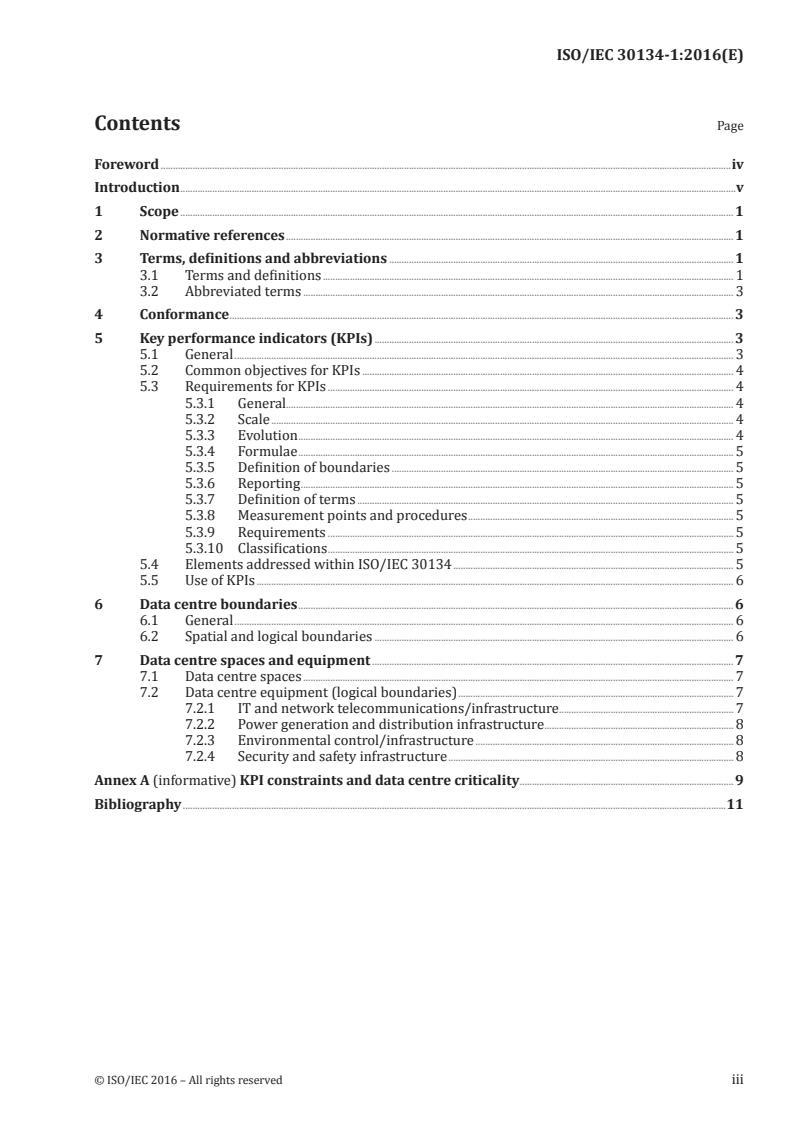
Contents Page
Foreword .iv
Introduction .v
1 Scope . 1
2 Normative references . 1
3 Terms, definitions and abbreviations . 1
3.1 Terms and definitions . 1
3.2 Abbreviated terms . 3
4 Conformance . 3
5 Key performance indicators (KPIs) . 3
5.1 General . 3
5.2 Common objectives for KPIs . 4
5.3 Requirements for KPIs . 4
5.3.1 General. 4
5.3.2 Scale . 4
5.3.3 Evolution . 4
5.3.4 Formulae . 5
5.3.5 Definition of boundaries . 5
5.3.6 Reporting . 5
5.3.7 Definition of terms . 5
5.3.8 Measurement points and procedures . 5
5.3.9 Requirements . 5
5.3.10 Classifications . 5
5.4 Elements addressed within ISO/IEC 30134 . 5
5.5 Use of KPIs . 6
6 Data centre boundaries . 6
6.1 General . 6
6.2 Spatial and logical boundaries . 6
7 Data centre spaces and equipment . 7
7.1 Data centre spaces . 7
7.2 Data centre equipment (logical boundaries) . 7
7.2.1 IT and network telecommunications/infrastructure . . 7
7.2.2 Power generation and distribution infrastructure . 8
7.2.3 Environmental control/infrastructure . 8
7.2.4 Security and safety infrastructure . 8
Annex A (informative) KPI constraints and data centre criticality . 9
Bibliography .11
© ISO/IEC 2016 – All rights reserved iii
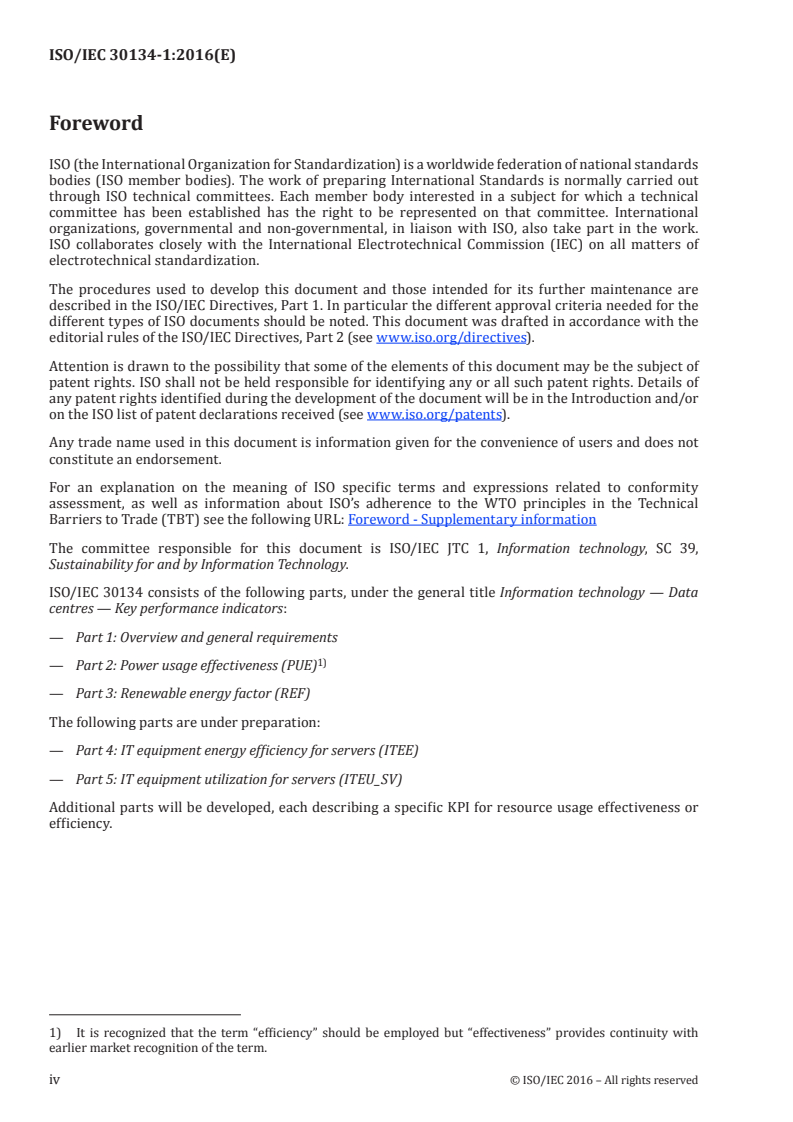
Foreword
ISO (the International Organization for Standardization) is a worldwide federation of national standards
bodies (ISO member bodies). The work of preparing International Standards is normally carried out
through ISO technical committees. Each member body interested in a subject for which a technical
committee has been established has the right to be represented on that committee. International
organizations, governmental and non-governmental, in liaison with ISO, also take part in the work.
ISO collaborates closely with the International Electrotechnical Commission (IEC) on all matters of
electrotechnical standardization.
The procedures used to develop this document and those intended for its further maintenance are
described in the ISO/IEC Directives, Part 1. In particular the different approval criteria needed for the
different types of ISO documents should be noted. This document was drafted in accordance with the
editorial rules of the ISO/IEC Directives, Part 2 (see www.iso.org/directives).
Attention is drawn to the possibility that some of the elements of this document may be the subject of
patent rights. ISO shall not be held responsible for identifying any or all such patent rights. Details of
any patent rights identified during the development of the document will be in the Introduction and/or
on the ISO list of patent declarations received (see www.iso.org/patents).
Any trade name used in this document is information given for the convenience of users and does not
constitute an endorsement.
For an explanation on the meaning of ISO specific terms and expressions related to conformity
assessment, as well as information about ISO’s adherence to the WTO principles in the Technical
Barriers to Trade (TBT) see the following URL: Foreword - Supplementary information
The committee responsible for this document is ISO/IEC JTC 1, Information technology, SC 39,
Sustainability for and by Information Technology.
ISO/IEC 30134 consists of the following parts, under the general title Information technology — Data
centres — Key performance indicators:
— Part 1: Overview and general requirements
1)
— Part 2: Power usage effectiveness (PUE)
— Part 3: Renewable energy factor (REF)
The following parts are under preparation:
— Part 4: IT equipment energy efficiency for servers (ITEE)
— Part 5: IT equipment utilization for servers (ITEU_SV)
Additional parts will be developed, each describing a specific KPI for resource usage effectiveness or
efficiency.
1) It is recognized that the term “efficiency” should be employed but “effectiveness” provides continuity with
earlier market recognition of the term.
iv © ISO/IEC 2016 – All rights reserved
Introduction
The global economy is now reliant on information and communication technologies and the associated
generation, transmission, dissemination, computation and storage of digital data. All markets have
experienced exponential growth in that data, for social, educational and business sectors and, while the
internet backbone carries the traffic, there are a wide variety of data centres at nodes and hubs within
both private enterprise and shared/collocation facilities.
The historical data generation growth rate exceeds the capacity growth rate of the information and
communications technology hardware and, with less than half (in 2014) of the world’s population
having access to an internet connection, that growth in data can only accelerate. In addition, with
many governments having “digital agendas” to provide both citizens and businesses with ever-faster
broadband access, the very increase in network speed and capacity will, by itself, generate ever more
usage (Jevons Paradox). Data generation and the consequential increase in data manipulation and
storage are directly linked to increasing power consumption.
With this background, it is clear that data centre growth, and power consumption in particular, is an
inevitable consequence and that growth will demand increasing power consumption despite the most
stringent energy efficiency strategies. This makes the need for key performance indicators (KPIs)
that cover the effective use of resources (including but not limited to energy) and the reduction of CO
emissions essential.
Within the ISO/IEC 30134 series, the term “resource usage effectiveness” is more generally used for
KPIs in preference to “resource usage efficiency”, which is restricted to situations where the input and
output parameters used to define the KPI have the same units.
In order to enable the optimum resource effectiveness of data centres, a suite of effective KPIs is needed
to measure and report on resources consumed in order to develop an improvement roadmap.
The ISO/IEC 30134 series is intended to accelerate the provision of operational infrastructures with
improved resource usage effectiveness.
The common objective of the KPIs is the effective or efficient use of resources. Examples are as follows:
a) the minimization of energy and other resource (e.g. water) consumption;
b) the task effectiveness of the IT load (data processing, storage and transport) within the data centre,
maximizing the IT output with the minimum energy consumption;
c) the energy reuse in the form of waste heat, if possible;
d) the use of renewable energy, both generated on site and off site.
The ISO/IEC 30134 series do not specify limits or targets for any KPI and do not describe or imply,
unless specifically stated, any form of aggregation of individual KPIs into a combined nor an overall KPI
for data centre resource usage effectiveness or efficiency.
© ISO/IEC 2016 – All rights reserved v
INTERNATIONAL STANDARD ISO/IEC 30134-1:2016(E)
Information technology — Data centres — Key
performance indicators —
Part 1:
Overview and general requirements
1 Scope
This part of ISO/IEC 30134 specifies the following for the other parts of ISO/IEC 30134:
a) a common structure;
b) definitions, terminology and boundary conditions for KPIs of data centre resource usage
effectiveness and efficiency;
c) common requirements for KPIs of data centre resource usage effectiveness and efficiency;
d) common objectives for KPIs of the data centre resource effectiveness and efficiency;
e) general information regarding the use of KPIs of data centre resource usage effectiveness and
efficiency.
2 Normative references
There are no normative references cited in this document.
3 Terms, definitions and abbreviations
3.1 Terms and definitions
For the purposes of this document, the following terms and definitions apply.
3.1.1
building entrance facility
facility that provides all necessary mechanical and electrical services for the entry of telecommunications
cables into a building and which may allow for transition from external to internal cable
3.1.2
computer room space
area within the data centre that accommodates the data processing, data storage and telecommunication
equipment that provides the primary function of the data centre
3.1.3
control room space
area within the data centre used to control the operation of the data centre and to act as a central point
for all control and monitoring functions
© ISO/IEC 2016 – All rights reserved 1
3.1.4
data centre
structure, or group of structures, dedicated to the centralized accommodation, interconnection and
operation of information technology and network telecommunications equipment providing data
storage, processing and transport services together with all the facilities and infrastructures for power
distribution and environmental control together with the necessary levels of resilience and security
required to provide the desired service availability
Note 1 to entry: A structure can consist of multiple buildings and/or spaces with specific functions to support the
primary function.
Note 2 to entry: The boundaries of the structure or space considered the data centre, which includes the
information and communication technology equipment and supporting environmental controls, can be defined
within a larger structure or building.
3.1.5
electrical distribution space
area used for housing facilities to distribute electrical power between the transformer space and
electrical spaces within the data centre or elsewhere within the premises or individual buildings within
the premises
3.1.6
electrical space
area within the data centre used for housing facilities to deliver and control electrical power to the data
centre spaces (including switchboards, batteries, uninterruptible power supplies (UPS), etc.)
3.1.7
generator space
area used for housing the installation of electrical power supply generation equipment together with
associated storage of fuels or energy conversion equipment
3.1.8
holding space
area within the data centre used for the holding of equipment prior to being brought into service or
having been taken out of service
3.1.9
information technology equipment
equipment providing data storage, processing and transport services including telecommunications
network equipment dedicated to providing direct connection to core and/or access networks
3.1.10
key performance indicator
number representing the resource usage effectiveness or efficiency of a given system
3.1
...
INTERNATIONAL ISO/IEC
STANDARD 30134-1
First edition
2016-03-15
Information technology — Data
centres — Key performance
indicators —
Part 1:
Overview and general requirements
Technologies de l’information — Centres de données — Indicateurs de
performance clés —
Partie 1: Aperçu et exigences générales
Reference number
©
ISO/IEC 2016
© ISO/IEC 2016, Published in Switzerland
All rights reserved. Unless otherwise specified, no part of this publication may be reproduced or utilized otherwise in any form
or by any means, electronic or mechanical, including photocopying, or posting on the internet or an intranet, without prior
written permission. Permission can be requested from either ISO at the address below or ISO’s member body in the country of
the requester.
ISO copyright office
Ch. de Blandonnet 8 • CP 401
CH-1214 Vernier, Geneva, Switzerland
Tel. +41 22 749 01 11
Fax +41 22 749 09 47
copyright@iso.org
www.iso.org
ii © ISO/IEC 2016 – All rights reserved
Contents Page
Foreword .iv
Introduction .v
1 Scope . 1
2 Normative references . 1
3 Terms, definitions and abbreviations . 1
3.1 Terms and definitions . 1
3.2 Abbreviated terms . 3
4 Conformance . 3
5 Key performance indicators (KPIs) . 3
5.1 General . 3
5.2 Common objectives for KPIs . 4
5.3 Requirements for KPIs . 4
5.3.1 General. 4
5.3.2 Scale . 4
5.3.3 Evolution . 4
5.3.4 Formulae . 5
5.3.5 Definition of boundaries . 5
5.3.6 Reporting . 5
5.3.7 Definition of terms . 5
5.3.8 Measurement points and procedures . 5
5.3.9 Requirements . 5
5.3.10 Classifications . 5
5.4 Elements addressed within ISO/IEC 30134 . 5
5.5 Use of KPIs . 6
6 Data centre boundaries . 6
6.1 General . 6
6.2 Spatial and logical boundaries . 6
7 Data centre spaces and equipment . 7
7.1 Data centre spaces . 7
7.2 Data centre equipment (logical boundaries) . 7
7.2.1 IT and network telecommunications/infrastructure . . 7
7.2.2 Power generation and distribution infrastructure . 8
7.2.3 Environmental control/infrastructure . 8
7.2.4 Security and safety infrastructure . 8
Annex A (informative) KPI constraints and data centre criticality . 9
Bibliography .11
© ISO/IEC 2016 – All rights reserved iii
Foreword
ISO (the International Organization for Standardization) is a worldwide federation of national standards
bodies (ISO member bodies). The work of preparing International Standards is normally carried out
through ISO technical committees. Each member body interested in a subject for which a technical
committee has been established has the right to be represented on that committee. International
organizations, governmental and non-governmental, in liaison with ISO, also take part in the work.
ISO collaborates closely with the International Electrotechnical Commission (IEC) on all matters of
electrotechnical standardization.
The procedures used to develop this document and those intended for its further maintenance are
described in the ISO/IEC Directives, Part 1. In particular the different approval criteria needed for the
different types of ISO documents should be noted. This document was drafted in accordance with the
editorial rules of the ISO/IEC Directives, Part 2 (see www.iso.org/directives).
Attention is drawn to the possibility that some of the elements of this document may be the subject of
patent rights. ISO shall not be held responsible for identifying any or all such patent rights. Details of
any patent rights identified during the development of the document will be in the Introduction and/or
on the ISO list of patent declarations received (see www.iso.org/patents).
Any trade name used in this document is information given for the convenience of users and does not
constitute an endorsement.
For an explanation on the meaning of ISO specific terms and expressions related to conformity
assessment, as well as information about ISO’s adherence to the WTO principles in the Technical
Barriers to Trade (TBT) see the following URL: Foreword - Supplementary information
The committee responsible for this document is ISO/IEC JTC 1, Information technology, SC 39,
Sustainability for and by Information Technology.
ISO/IEC 30134 consists of the following parts, under the general title Information technology — Data
centres — Key performance indicators:
— Part 1: Overview and general requirements
1)
— Part 2: Power usage effectiveness (PUE)
— Part 3: Renewable energy factor (REF)
The following parts are under preparation:
— Part 4: IT equipment energy efficiency for servers (ITEE)
— Part 5: IT equipment utilization for servers (ITEU_SV)
Additional parts will be developed, each describing a specific KPI for resource usage effectiveness or
efficiency.
1) It is recognized that the term “efficiency” should be employed but “effectiveness” provides continuity with
earlier market recognition of the term.
iv © ISO/IEC 2016 – All rights reserved
Introduction
The global economy is now reliant on information and communication technologies and the associated
generation, transmission, dissemination, computation and storage of digital data. All markets have
experienced exponential growth in that data, for social, educational and business sectors and, while the
internet backbone carries the traffic, there are a wide variety of data centres at nodes and hubs within
both private enterprise and shared/collocation facilities.
The historical data generation growth rate exceeds the capacity growth rate of the information and
communications technology hardware and, with less than half (in 2014) of the world’s population
having access to an internet connection, that growth in data can only accelerate. In addition, with
many governments having “digital agendas” to provide both citizens and businesses with ever-faster
broadband access, the very increase in network speed and capacity will, by itself, generate ever more
usage (Jevons Paradox). Data generation and the consequential increase in data manipulation and
storage are directly linked to increasing power consumption.
With this background, it is clear that data centre growth, and power consumption in particular, is an
inevitable consequence and that growth will demand increasing power consumption despite the most
stringent energy efficiency strategies. This makes the need for key performance indicators (KPIs)
that cover the effective use of resources (including but not limited to energy) and the reduction of CO
emissions essential.
Within the ISO/IEC 30134 series, the term “resource usage effectiveness” is more generally used for
KPIs in preference to “resource usage efficiency”, which is restricted to situations where the input and
output parameters used to define the KPI have the same units.
In order to enable the optimum resource effectiveness of data centres, a suite of effective KPIs is needed
to measure and report on resources consumed in order to develop an improvement roadmap.
The ISO/IEC 30134 series is intended to accelerate the provision of operational infrastructures with
improved resource usage effectiveness.
The common objective of the KPIs is the effective or efficient use of resources. Examples are as follows:
a) the minimization of energy and other resource (e.g. water) consumption;
b) the task effectiveness of the IT load (data processing, storage and transport) within the data centre,
maximizing the IT output with the minimum energy consumption;
c) the energy reuse in the form of waste heat, if possible;
d) the use of renewable energy, both generated on site and off site.
The ISO/IEC 30134 series do not specify limits or targets for any KPI and do not describe or imply,
unless specifically stated, any form of aggregation of individual KPIs into a combined nor an overall KPI
for data centre resource usage effectiveness or efficiency.
© ISO/IEC 2016 – All rights reserved v
INTERNATIONAL STANDARD ISO/IEC 30134-1:2016(E)
Information technology — Data centres — Key
performance indicators —
Part 1:
Overview and general requirements
1 Scope
This part of ISO/IEC 30134 specifies the following for the other parts of ISO/IEC 30134:
a) a common structure;
b) definitions, terminology and boundary conditions for KPIs of data centre resource usage
effectiveness and efficiency;
c) common requirements for KPIs of data centre resource usage effectiveness and efficiency;
d) common objectives for KPIs of the data centre resource effectiveness and efficiency;
e) general information regarding the use of KPIs of data centre resource usage effectiveness and
efficiency.
2 Normative references
There are no normative references cited in this document.
3 Terms, definitions and abbreviations
3.1 Terms and definitions
For the purposes of this document, the following terms and definitions apply.
3.1.1
building entrance facility
facility that provides all necessary mechanical and electrical services for the entry of telecommunications
cables into a building and which may allow for transition from external to internal cable
3.1.2
computer room space
area within the data centre that accommodates the data processing, data storage and telecommunication
equipment that provides the primary function of the data centre
3.1.3
control room space
area within the data centre used to control the operation of the data centre and to act as a central point
for all control and monitoring functions
© ISO/IEC 2016 – All rights reserved 1
3.1.4
data centre
structure, or group of structures, dedicated to the centralized accommodation, interconnection and
operation of information technology and network telecommunications equipment providing data
storage, processing and transport services together with all the facilities and infrastructures for power
distribution and environmental control together with the necessary levels of resilience and security
required to provide the desired service availability
Note 1 to entry: A structure can consist of multiple buildings and/or spaces with specific functions to support the
primary function.
Note 2 to entry: The boundaries of the structure or space considered the data centre, which includes the
information and communication technology equipment and supporting environmental controls, can be defined
within a larger structure or building.
3.1.5
electrical distribution space
area used for housing facilities to distribute electrical power between the transformer space and
electrical spaces within the data centre or elsewhere within the premises or individual buildings within
the premises
3.1.6
electrical space
area within the data centre used for housing facilities to deliver and control electrical power to the data
centre spaces (including switchboards, batteries, uninterruptible power supplies (UPS), etc.)
3.1.7
generator space
area used for housing the installation of electrical power supply generation equipment together with
associated storage of fuels or energy conversion equipment
3.1.8
holding space
area within the data centre used for the holding of equipment prior to being brought into service or
having been taken out of service
3.1.9
information technology equipment
equipment providing data storage, processing and transport services including telecommunications
network equipment dedicated to providing direct connection to core and/or access networks
3.1.10
key performance indicator
number representing the resource usage effectiveness or efficiency of a given system
3.1
...