


ISO 15590-1:2018
(Main)Petroleum and natural gas industries — Induction bends, fittings and flanges for pipeline transportation systems — Part 1: Induction bends
Petroleum and natural gas industries — Induction bends, fittings and flanges for pipeline transportation systems — Part 1: Induction bends
This document specifies the technical delivery conditions for bends made by the induction bending process for use in pipeline transportation systems for the petroleum and natural gas industries as defined in ISO 13623. This document is applicable to induction bends made from seamless and welded pipe of unalloyed or low-alloy steels. NOTE These are typically C-Mn steels or low-alloy steels that are appropriate for the corresponding level and grade of line pipe in accordance with ISO 3183. This document specifies the requirements for the manufacture of two product specification levels (PSLs) of induction bends corresponding to product specification levels given for pipe in ISO 3183. This document is not applicable to the selection of the induction bend PSL. It is the responsibility of the purchaser to specify the PSL, based upon the intended use and design requirements; see also ISO 3183, Introduction. This document is not applicable to pipeline bends made by other manufacturing processes.
Industries du pétrole et du gaz naturel — Coudes d'induction, raccords et brides pour systèmes de transport par conduites — Partie 1: Coudes d'induction
General Information
- Status
- Withdrawn
- Publication Date
- 02-Oct-2018
- Technical Committee
- ISO/TC 67/SC 2 - Pipeline transportation systems
- Drafting Committee
- ISO/TC 67/SC 2/WG 10 - Pipeline flanges, fittings and shopbends
- Current Stage
- 9599 - Withdrawal of International Standard
- Start Date
- 01-Jul-2024
- Completion Date
- 14-Feb-2026
Relations
- Effective Date
- 08-Oct-2022
- Effective Date
- 30-Apr-2016
Buy Documents

ISO 15590-1:2018 - Petroleum and natural gas industries — Induction bends, fittings and flanges for pipeline transportation systems — Part 1: Induction bends Released:10/3/2018

ISO 15590-1:2018 - Petroleum and natural gas industries -- Induction bends, fittings and flanges for pipeline transportation systems
Get Certified
Connect with accredited certification bodies for this standard

ABS Quality Evaluations Inc.
American Bureau of Shipping quality certification.

Element Materials Technology
Materials testing and product certification.

ABS Group Brazil
ABS Group certification services in Brazil.
Sponsored listings
Frequently Asked Questions
ISO 15590-1:2018 is a standard published by the International Organization for Standardization (ISO). Its full title is "Petroleum and natural gas industries — Induction bends, fittings and flanges for pipeline transportation systems — Part 1: Induction bends". This standard covers: This document specifies the technical delivery conditions for bends made by the induction bending process for use in pipeline transportation systems for the petroleum and natural gas industries as defined in ISO 13623. This document is applicable to induction bends made from seamless and welded pipe of unalloyed or low-alloy steels. NOTE These are typically C-Mn steels or low-alloy steels that are appropriate for the corresponding level and grade of line pipe in accordance with ISO 3183. This document specifies the requirements for the manufacture of two product specification levels (PSLs) of induction bends corresponding to product specification levels given for pipe in ISO 3183. This document is not applicable to the selection of the induction bend PSL. It is the responsibility of the purchaser to specify the PSL, based upon the intended use and design requirements; see also ISO 3183, Introduction. This document is not applicable to pipeline bends made by other manufacturing processes.
This document specifies the technical delivery conditions for bends made by the induction bending process for use in pipeline transportation systems for the petroleum and natural gas industries as defined in ISO 13623. This document is applicable to induction bends made from seamless and welded pipe of unalloyed or low-alloy steels. NOTE These are typically C-Mn steels or low-alloy steels that are appropriate for the corresponding level and grade of line pipe in accordance with ISO 3183. This document specifies the requirements for the manufacture of two product specification levels (PSLs) of induction bends corresponding to product specification levels given for pipe in ISO 3183. This document is not applicable to the selection of the induction bend PSL. It is the responsibility of the purchaser to specify the PSL, based upon the intended use and design requirements; see also ISO 3183, Introduction. This document is not applicable to pipeline bends made by other manufacturing processes.
ISO 15590-1:2018 is classified under the following ICS (International Classification for Standards) categories: 75.200 - Petroleum products and natural gas handling equipment. The ICS classification helps identify the subject area and facilitates finding related standards.
ISO 15590-1:2018 has the following relationships with other standards: It is inter standard links to ISO 15590-1:2024, ISO 15590-1:2009. Understanding these relationships helps ensure you are using the most current and applicable version of the standard.
ISO 15590-1:2018 is available in PDF format for immediate download after purchase. The document can be added to your cart and obtained through the secure checkout process. Digital delivery ensures instant access to the complete standard document.
Standards Content (Sample)
INTERNATIONAL ISO
STANDARD 15590-1
Third edition
2018-10
Petroleum and natural gas
industries — Induction bends,
fittings and flanges for pipeline
transportation systems —
Part 1:
Induction bends
Industries du pétrole et du gaz naturel — Coudes d'induction,
raccords et brides pour systèmes de transport par conduites —
Partie 1: Coudes d'induction
Reference number
©
ISO 2018
© ISO 2018
All rights reserved. Unless otherwise specified, or required in the context of its implementation, no part of this publication may
be reproduced or utilized otherwise in any form or by any means, electronic or mechanical, including photocopying, or posting
on the internet or an intranet, without prior written permission. Permission can be requested from either ISO at the address
below or ISO’s member body in the country of the requester.
ISO copyright office
CP 401 • Ch. de Blandonnet 8
CH-1214 Vernier, Geneva
Phone: +41 22 749 01 11
Fax: +41 22 749 09 47
Email: copyright@iso.org
Website: www.iso.org
Published in Switzerland
ii © ISO 2018 – All rights reserved
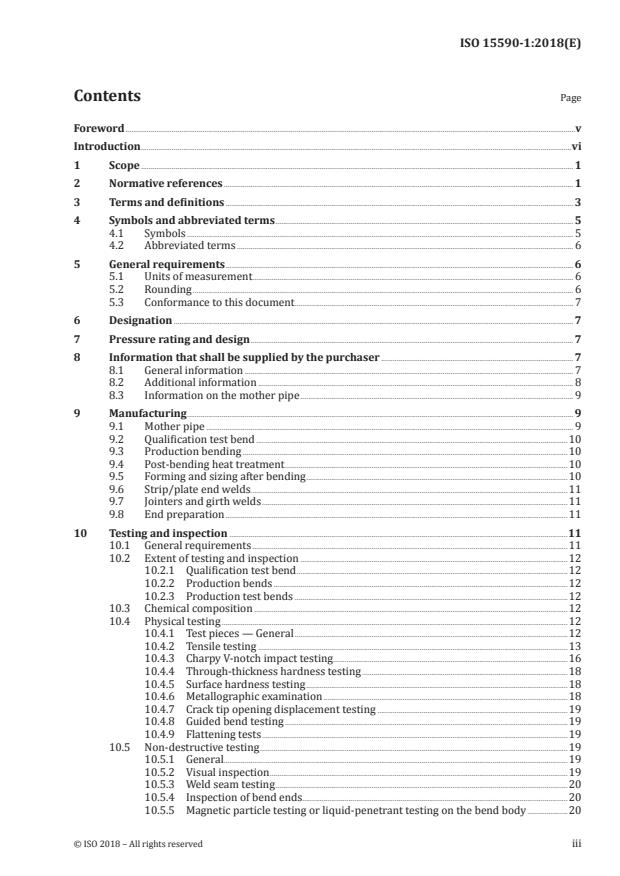
Contents Page
Foreword .v
Introduction .vi
1 Scope . 1
2 Normative references . 1
3 Terms and definitions . 3
4 Symbols and abbreviated terms . 5
4.1 Symbols . 5
4.2 Abbreviated terms . 6
5 General requirements . 6
5.1 Units of measurement . . 6
5.2 Rounding . 6
5.3 Conformance to this document . 7
6 Designation . 7
7 Pressure rating and design . 7
8 Information that shall be supplied by the purchaser . 7
8.1 General information . 7
8.2 Additional information . 8
8.3 Information on the mother pipe . 9
9 Manufacturing . 9
9.1 Mother pipe . 9
9.2 Qualification test bend .10
9.3 Production bending .10
9.4 Post-bending heat treatment .10
9.5 Forming and sizing after bending .10
9.6 Strip/plate end welds . .11
9.7 Jointers and girth welds .11
9.8 End preparation .11
10 Testing and inspection .11
10.1 General requirements .11
10.2 Extent of testing and inspection .12
10.2.1 Qualification test bend .12
10.2.2 Production bends .12
10.2.3 Production test bends .12
10.3 Chemical composition .12
10.4 Physical testing .12
10.4.1 Test pieces — General .12
10.4.2 Tensile testing .13
10.4.3 Charpy V-notch impact testing .16
10.4.4 Through-thickness hardness testing .18
10.4.5 Surface hardness testing .18
10.4.6 Metallographic examination .18
10.4.7 Crack tip opening displacement testing .19
10.4.8 Guided bend testing .19
10.4.9 Flattening tests .19
10.5 Non-destructive testing .19
10.5.1 General.19
10.5.2 Visual inspection .19
10.5.3 Weld seam testing .20
10.5.4 Inspection of bend ends . .20
10.5.5 Magnetic particle testing or liquid-penetrant testing on the bend body .20
10.5.6 Ultrasonic testing on the bend body .21
10.5.7 Level of residual magnetism .21
10.5.8 Repairs .21
10.5.9 NDT personnel .21
10.6 Dimensions .21
10.7 Gauging .24
10.8 Hydrostatic testing .24
11 Inspection document .25
12 Marking .25
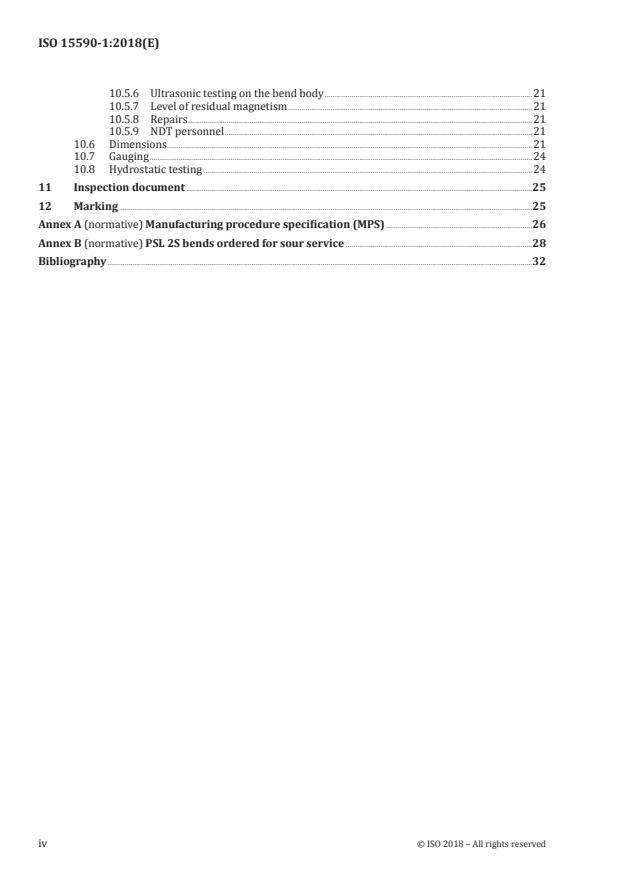
Annex A (normative) Manufacturing procedure specification (MPS) .26
Annex B (normative) PSL 2S bends ordered for sour service .28
Bibliography .32
iv © ISO 2018 – All rights reserved
Foreword
ISO (the International Organization for Standardization) is a worldwide federation of national standards
bodies (ISO member bodies). The work of preparing International Standards is normally carried out
through ISO technical committees. Each member body interested in a subject for which a technical
committee has been established has the right to be represented on that committee. International
organizations, governmental and non-governmental, in liaison with ISO, also take part in the work.
ISO collaborates closely with the International Electrotechnical Commission (IEC) on all matters of
electrotechnical standardization.
The procedures used to develop this document and those intended for its further maintenance are
described in the ISO/IEC Directives, Part 1. In particular, the different approval criteria needed for the
different types of ISO documents should be noted. This document was drafted in accordance with the
editorial rules of the ISO/IEC Directives, Part 2 (see www .iso .org/directives).
Attention is drawn to the possibility that some of the elements of this document may be the subject of
patent rights. ISO shall not be held responsible for identifying any or all such patent rights. Details of
any patent rights identified during the development of the document will be in the Introduction and/or
on the ISO list of patent declarations received (see www .iso .org/patents).
Any trade name used in this document is information given for the convenience of users and does not
constitute an endorsement.
For an explanation of the voluntary nature of standards, the meaning of ISO specific terms and
expressions related to conformity assessment, as well as information about ISO's adherence to the
World Trade Organization (WTO) principles in the Technical Barriers to Trade (TBT) see www .iso
.org/iso/foreword .html.
This document was prepared by Technical Committee ISO/TC 67, Materials, equipment and offshore
structures for petroleum, petrochemical and natural gas industries, Subcommittee SC 2, Pipeline
transportation systems.
This third edition cancels and replaces the second edition (ISO 15590-1:2009), which has been
technically revised.
A list of all parts in the ISO 15590 series can be found on the ISO website.
Any feedback or questions on this document should be directed to the user’s national standards body. A
complete listing of these bodies can be found at www .iso .org/members .html.
Introduction
This document makes reference to line pipe and bends with delivery conditions based on ISO 3183.
The requirements of the annex(es) apply only when specified on the purchase order.
This document does not provide guidance on when it is necessary to specify the above supplementary
requirements. It is the responsibility of the purchaser to specify, based upon the intended use and
design requirements, the supplementary requirements that will apply for a particular purchase order.
Users of this document should be aware that further or differing requirements can be needed for
individual applications. This document is not intended to inhibit a manufacturer from offering, or the
purchaser from accepting, alternative equipment or engineering solutions for the individual application.
This can be particularly applicable where there is innovative or developing technology. Where an
alternative is offered, it is the responsibility of the manufacturer to identify and provide details of any
variations from this document.
vi © ISO 2018 – All rights reserved
INTERNATIONAL STANDARD ISO 15590-1:2018(E)
Petroleum and natural gas industries — Induction bends,
fittings and flanges for pipeline transportation systems —
Part 1:
Induction bends
1 Scope
This document specifies the technical delivery conditions for bends made by the induction bending
process for use in pipeline transportation systems for the petroleum and natural gas industries as
defined in ISO 13623.
This document is applicable to induction bends made from seamless and welded pipe of unalloyed or
low-alloy steels.
NOTE These are typically C-Mn steels or low-alloy steels that are appropriate for the corresponding level
and grade of line pipe in accordance with ISO 3183.
This document specifies the requirements for the manufacture of two product specification levels
(PSLs) of induction bends corresponding to product specification levels given for pipe in ISO 3183.
This document is not applicable to the selection of the induction bend PSL. It is the responsibility of the
purchaser to specify the PSL, based upon the intended use and design requirements; see also ISO 3183,
Introduction.
This document is not applicable to pipeline bends made by other manufacturing processes.
2 Normative references
The following documents are referred to in the text in such a way that some or all of their content
constitutes requirements of this document. For dated references, only the edition cited applies. For
undated references, the latest edition of the referenced document (including any amendments) applies.
ISO 80000-1:2009, Quantities and units — Part 1: General
ISO 148-1, Metallic materials — Charpy pendulum impact test — Part 1: Test method
ISO 3183:2012, Petroleum and natural gas industries — Steel pipe for pipeline transportation systems
ISO 6507 (all parts), Metallic materials — Vickers hardness test
ISO 6508 (all parts), Metallic materials — Rockwell hardness test
ISO 6892-1, Metallic materials — Tensile testing — Part 1: Method of test at room temperature
ISO 6892-2, Metallic materials — Tensile testing — Part 2: Method of test at elevated temperature
ISO 7438, Metallic materials — Bend test
ISO 7539-2, Corrosion of metals and alloys — Stress corrosion testing — Part 2: Preparation and use of
bent-beam specimens
ISO 8501-1, Preparation of steel substrates before application of paints and related products — Visual
assessment of surface cleanliness — Part 1: Rust grades and preparation grades of uncoated steel substrates
and of steel substrates after overall removal of previous coatings
ISO 9712, Non-destructive testing — Qualification and certification of NDT personnel
ISO 10474, Steel and steel products — Inspection documents
ISO 10893-4, Non-destructive testing of steel tubes — Part 4: Liquid penetrant inspection of seamless and
welded steel tubes for the detection of surface imperfections
ISO 10893-5, Non-destructive testing of steel tubes — Part 5: Magnetic particle inspection of seamless and
welded ferromagnetic steel tubes for the detection of surface imperfections
ISO 10893-8, Non-destructive testing of steel tubes — Part 8: Automated ultrasonic testing of seamless and
welded steel tubes for the detection of laminar imperfections
ISO 10893-9, Non-destructive testing of steel tubes — Part 9: Automated ultrasonic testing for the detection
of laminar imperfections in strip/plate used for the manufacture of welded steel tubes
ISO 10893-10:2011, Non-destructive testing of steel tubes — Part 10: Automated full peripheral ultrasonic
testing of seamless and welded (except submerged arc-welded) steel tubes for the detection of longitudinal
and/or transverse imperfections
ISO 10893-11:2011, Non-destructive testing of steel tubes — Part 11: Automated ultrasonic testing of the
weld seam of welded steel tubes for the detection of longitudinal and/or transverse imperfections
ISO 12095, Seamless and welded steel tubes for pressure purposes – Liquid penetrant testing
ISO 13623, Petroleum and natural gas industries — Pipeline transportation systems
ISO 17640, Non-destructive testing of welds — Ultrasonic testing — Techniques, testing levels, and
assessment
1)
ASNT SNT-TC-1A , Recommended Practice No. SNT-TC-1A: Personnel Qualification and Certification in
Nondestructive Testing
2)
ASTM A370 , Standard Test Methods and Definitions for Mechanical Testing of Steel Products
ASTM A435, Standard Specification for Straight-Beam Ultrasonic Examination of Steel Plates
ASTM A578/A578M, Standard Specification for Straight-Beam Ultrasonic Examination of Rolled Steel
Plates for Special Applications
ASTM E18, Standard Test Methods for Rockwell Hardness of Metallic Materials
ASTM E92, Standard Test Method for Vickers Hardness of Metallic Materials
ASTM E112, Standard Test Methods for Determining Average Grain Size
ASTM E165, Standard Test Method for Liquid Penetrant Examination
ASTM E213, Standard Practice for Ultrasonic Testing of Metal Pipe and Tubing
ASTM E214, Standard Practice for Ultrasonic Pulse-Echo Straight-Beam Contact Testing
ASTM E340, Standard Test Method for Macroetching Metals and Alloys
ASTM E709, Standard Guide for Magnetic Particle Testing
ASTM E797, Standard Practice for Measuring Thickness by Manual Ultrasonic Pulse-Echo Contact Method
ASTM G39, Standard Practice for Preparation and Use of Bent-Beam Stress-Corrosion Test Specimens
1) American Society for Nondestructive Testing, 1711 Arlingate Lane, Columbus, OH 43228-0518, USA.
2) American Society for Testing and Materials, 100 Barr Harbor Drive, West Conshohocken, PA 19428-2959,
USA.
2 © ISO 2018 – All rights reserved
3)
N AC E T M0177: 2016 , Laboratory Testing of Metals for Resistance to Sulfide Stress Cracking in Hydrogen
Sulfide (H2S) Environments
NACE TM0284: 2016, Standard Test Method — Evaluation of Pipeline and Pressure Vessel Steels for
Resistance to Hydrogen-Induced Cracking
3 Terms and definitions
For the purposes of this document, the following terms and definitions apply.
ISO and IEC maintain terminological databases for use in standardization at the following addresses:
— ISO Online browsing platform: available at https: //www .iso .org/obp
— IEC Electropedia: available at http: //www .electropedia .org/
3.1
arc
curved portion of a bend
3.2
as agreed
agreed upon by the manufacturer and purchaser, and specified in the purchase order
3.3
bend angle
amount of directional change through the bend
3.4
bend qualification test
qualification test that produces a bend in accordance with the MPS and demonstrates that bends that
meet the specified requirements of this document can be produced
3.5
bend radius
distance from the centre of curvature to the centreline axis of the bent pipe
3.6
chord
line segment connecting start and stop points of the bend zone measured at the centreline axis
3.7
defect
imperfection of a size and/or population density greater than the acceptance criteria specified in this
document
3.8
extrados
outer curved section of the bend arc
3.9
heat
batch of steel prepared in one steel-making operation
3.10
if agreed
as prescribed, or more stringent than is prescribed, if agreed upon by the manufacturer and the
purchaser and specified in the purchase order
3) NACE International, 1440 South Creek Drive, P.O. Box 201009, Houston, TX 77084-4906, USA.
3.11
imperfection
discontinuity or irregularity in the product wall or on the product surface that is detectable by
inspection methods outlined in this document
3.12
indication
evidence obtained by non-destructive inspection
3.13
induction bending
continuous bending process that utilizes induction heating to create a narrow, circumferential, heated
band around the material being bent
3.14
inspection
activities, such as measuring, examining, testing, weighing or gauging one or more characteristics
of a product and comparing the results of such activities with the specified requirements in order to
determine conformity
3.15
intrados
inner curved section of the bend arc
3.16
lamination
internal metal separation that creates layers, generally parallel to the pipe/bend surface
3.17
manufacturer
firm, company, or corporation responsible for making and marking the product in accordance with the
requirements of this document
3.18
manufacturing procedure specification
MPS
document that specifies the properties and description of the mother pipe, the bending procedure,
the post-bending heat treatment equipment and cycle, the qualification bend testing results, the non-
destructive testing procedures and the weld end bevel details used for the manufacture of the bends
3.19
mother pipe
straight section of pipe from which an induction bend is made
3.20
non-destructive inspection
inspection to reveal imperfections, using radiographic, ultrasonic or other methods specified in this
document that do not involve disturbance, stressing or breaking of the materials
3.21
purchaser
party responsible for both the definition of requirements for a product order and for payment of that order
3.22
submerged-arc welding
SAW
welding process that produces melting and coalescence of metals by heating them with an arc or arcs
between a bare metal consumable electrode or electrodes and the workpiece, wherein the arc and
molten metal are shielded by a blanket of granular flux
4 © ISO 2018 – All rights reserved
3.23
service condition
condition of use that is specified by the purchaser in the purchase order
Note 1 to entry: In this document, the terms “sour service” and “offshore service” are service conditions.
3.24
strip/plate end weld
weld that joins strip or plate ends together
3.25
tangent
straight section at the end of an induction bend
3.26
transition zone
area of the start and stop points of induction heating, which includes material that extends from the
unheated mother pipe to the material that has been heated to the full bending temperature
3.27
wall thinning
amount of reduction from the original wall thickness of the pipe to the wall thickness in the extrados
after bending
4 Symbols and abbreviated terms
4.1 Symbols
A elongation of tensile test specimen after fracture, expressed as a percentage
CVD, L crest to valley depth
CVD
D and D outside diameters of two adjacent crests
2 4
D outside diameter of the intervening valley
D specified diameter, outside or inside
D maximum measured diameter, outside or inside
max
D minimum measured diameter, outside or inside
min
l distance between adjacent crests for waving
O out-of-roundness
r bend centreline radius
b
r nominal mid-thickness radius of the mother pipe
p
R ultimate tensile strength
m
R yield strength for 0,5 % total elongation
t0,5
T minimum design temperature specified by the purchaser
dmin
t minimum wall thickness at the bend intrados
i
t minimum wall thickness required in accordance with ISO 13623, or other applicable
min
design code, for the straight pipe adjacent to the bend, including any corrosion allowance
4.2 Abbreviated terms
BQT bend qualification test
CTOD crack tip opening displacement testing
HAZ heat-affected zone
HIC hydrogen-induced cracking
HFW high-frequency electric welding process for pipe during manufacturing
MPS manufacturing procedure specification
MT magnetic particle testing
NDT non-destructive testing
PSL product specification level
PT liquid-penetrant testing
RT radiographic testing
SAW submerged arc welding process for pipe during manufacture
SAWH submerged arc helical welding process for pipe during manufacture
SAWL submerged arc longitudinal welding process for pipe during manufacture
SSC sulfide stress-cracking
SWC step-wise cracking
UT ultrasonic testing
WPS welding procedure specification
5 General requirements
5.1 Units of measurement
In this document, data are expressed in both SI units and USC units. For a specific order item, unless
otherwise stated, only one system of units shall be used, without combining data expressed in the
other system.
For data expressed in SI units, a comma is used as the decimal separator and a space is used as the
thousands separator. For data expressed in USC units, a dot (on the line) is used as the decimal separator
and a space is used as the thousands separator.
5.2 Rounding
Unless otherwise stated in this document, to determine conformance with the specified requirements,
observed or calculated values shall be rounded to the nearest unit in the last right-hand place of figures
used in expressing the limiting value, in accordance with ISO 80000-1:2009, Annex B, Rule A.
[3]
NOTE For the purposes of this provision, the rounding method of ASTM E29-04 is equivalent to
ISO 80000-1:2009, Annex B, Rule A.
6 © ISO 2018 – All rights reserved
5.3 Conformance to this document
A quality management system should be applied to assist conformance to the requirements of this
document.
[2]
NOTE ISO/TS 29001 gives sector-specific guidance on quality management systems.
A contract may specify that the manufacturer is responsible for conforming to all the applicable
requirements of this document. It shall be permissible for the purchaser to make any investigation
necessary to be assured of conformance by the manufacturer and to reject any material that does not
conform.
6 Designation
Designation of induction bends shall take the form “IB xxx-PSL 1” or “IB xxx-PSL 2” or “IB xxx-
PSL 2S”, where
— “xxx” is the specified minimum yield strength, expressed in megapascals (MPa);
— the letters “PSL 1” or “PSL 2” identify the technical delivery conditions class for induction bends in
non-sour service;
— the letters “PSL 2S” identify PSL 2 bends for use in sour service conditions;
— the letters “PSL 2O” identify PSL 2 bends for use in offshore service conditions;
— the letters “PSL 2SO” identify PSL 2 bends for use in both offshore and sour service conditions.
7 Pressure rating and design
The hoop stress in the induction bend due to internal fluid pressure shall not exceed the hoop stress
permitted in ISO 13623, or other applicable design code, for straight pipe in the location of the bend.
NOTE 1 The purchaser normally performs the pressure design and specifies the minimum wall thickness t .
min
The wall thickness of the bend extrados shall be at least t .
min
The wall thickness at the bend intrados shall be at least as given in Formula (1):
2rr−
bp
tt=× (1)
i min
2 rr−
()
bp
NOTE 2 For pipelines not designed in accordance with ISO 13623, the minimum required wall thickness of the
bend extrados can be less than t .
min
NOTE 3 The requirements in this clause address the design of a bend against internal pressure. It is necessary
that the purchaser or designer also consider other loads, both static and dynamic, and pipeline test conditions to
demonstrate compliance with the strength requirements of ISO 13623.
8 Information that shall be supplied by the purchaser
8.1 General information
The purchaser shall provide the following information:
a) number of this document and year of publication (i.e. ISO 15590-1:2018);
b) bend designation of each bend;
c) quantity of bends;
d) supply of mother pipe by the purchaser or the manufacturer;
e) required bend dimensions, including
— diameter (inside or outside),
— minimum intrados and extrados wall thickness after bending,
— bend radius,
— bend angle,
— tangent lengths;
f) end preparation if different from square ends.
8.2 Additional information
The purchaser should specify the following additional information:
a) minimum design temperature;
b) maximum design temperature (and any requirement for high-temperature tensile testing);
c) maximum wall thickness;
d) special dimensional requirements;
e) requirements for supplementary inspection and testing;
f) requirements for gauging and other measurements of dimensions, if different from this part of
ISO 15590;
g) pipeline design standard or design factors, if different from ISO 13623;
h) pipeline operating conditions;
i) whether it is necessary to apply post-bending heat treatment;
j) mechanical-property requirements at the maximum design temperature;
k) Charpy impact test temperature;
l) requirements for proof, burst or hydrostatic testing;
m) hold-points for witness and approval by purchaser;
n) surface condition;
o) coating or painting requirements;
p) marking requirements, if different from this part of ISO 15590;
q) requirements for ends or bevel protection (e.g. end caps or bevel protectors);
r) packaging and shipping instructions;
s) third-party inspection organization;
t) standard designation of inspection document that is required in accordance with ISO 10474;
u) requirements for format and additional content of the inspection document;
v) additional requirements for hardness testing;
8 © ISO 2018 – All rights reserved
w) other special requirements.
8.3 Information on the mother pipe
The following information on the mother pipe shall be provided to the manufacturer:
a) purchasing specification;
b) pipe diameter, inside or outside;
c) pipe wall thickness, nominal or minimum;
d) pipe lengths;
e) pipe manufacturer;
f) pipe material specification and pipe material certificates, including chemical composition, heat
treatment, mechanical properties, dimensions and results of NDT;
g) welding procedure specification and weld metal chemical composition for SAWL and SAWH pipe;
h) weld-seam-repair welding-procedure specification for SAWL and SAWH pipe;
i) applicability of Annex B for sour service.
NOTE Information f), g) and h) is necessary for the design of the bending procedure by the manufacturer.
9 Manufacturing
9.1 Mother pipe
The mother pipe shall be manufactured in accordance with ISO 3183.
The mother pipe for the manufacture of PSL 2 bends shall be in accordance with ISO 3183 PSL 2.
The mother pipe for the manufacture of PSL 2S bends shall be made in accordance with ISO 3183:2012,
Annex H with the additional requirements specified in Annex B of this part of ISO 15590.
The mother pipe for the manufacture of PSL 2O bends shall be made in accordance with ISO 3183:2012,
Annex J.
The mother pipe for the manufacture of PSL 2SO bends shall be made in accordance with ISO 3183:2012,
Annex H, ISO3182: 2012 Annex J, and the additional requirements specified in Annex B of this document.
The mother pipe may be supplied by either the purchaser or the manufacturer.
If the mother pipe is supplied by the purchaser, the manufacturer should be consulted as to the required
chemical composition, properties and dimensions of the mother pipe, (including seam weld and seam
repair weld) with regard to its suitability for induction bending.
The mother pipe shall not contain weld repairs to the pipe body.
The wall thickness of the mother pipe shall have adequate allowance for wall thinning at the extrados
due to induction bending.
The surface of the mother pipe shall be free from contamination by low-melting-temperature metals,
such as copper, zinc, brass and aluminium, and may be blast cleaned to ISO 8501-1, Sa 2.
9.2 Qualification test bend
The manufacture of all PSL-level test bends shall be carried out in accordance with an MPS that shall
be qualified in accordance with Clause 9 before commencement of production, or at the beginning of
production if agreed.
NOTE Annex A gives details of MPS.
A test bend with at least sufficient arc length to allow extraction of the necessary test specimens shall be
manufactured in accordance with each preliminary MPS. The inspection and testing of the test bend shall
include sufficient tangents and both stop and start transition zones if included in the produced bends.
The test bend shall be tested and inspected in accordance with Clause 10. The MPS being used for
production shall, for each of the essential variables in Table 1, specify
— the values recorded during the manufacturing of the test bend;
— the permissible range during production bending.
The variation in essential variables shall not exceed the permissible limits shown in Table 1.
9.3 Production bending
Induction bending shall be carried out in accordance with a qualified MPS as specified in Annex A.
Interruption of the induction bending operation shall result in rejection of the bend.
9.4 Post-bending heat treatment
Post-bending heat treatment of bends is not mandatory for compliance with this document.
Post-bending heat treatment may be performed to achieve the required material properties, improve
corrosion resistance, remove transition zones at the ends of the bend arc or to relieve residual stresses.
The temperature of each furnace-load of bends shall be monitored by thermocouples connected
directly to selected bends and shall be recorded. The type and location of the thermocouples shall be as
specified in the MPS or in the dedicated drawings issued for heat treatment loading.
9.5 Forming and sizing after bending
Hot forming, including spot heating, or hot sizing after bending, shall not be performed unless followed
by a subsequent full heat treatment above the upper critical temperature.
Cold forming or sizing without subsequent heat treatment is permitted for ovality and diameter
corrections in the tangents provided the induced permanent strain does not exceed 1,5 %.
Table 1 — Essential variables and maximum permissible variations
a
Essential variable Maximum permissible variations
Heat of steel None
Mother pipe seam weld WPS and welding consumables None
Surface condition By agreement
Nominal mother pipe diameter None
Nominal mother pipe wall thickness ±3 mm (0.118 in) or ±10 % whichever is the smallest
a
The permissible variations apply to the values obtained in the approved bend qualification test (BQT).
b
The variation may be increased to ±20 % for test bends that will receive post-bend quench and temper heat treatment.
c
The pipe long seam is normally placed on the neutral axis during bending.
10 © ISO 2018 – All rights reserved
Table 1 (continued)
a
Essential variable Maximum permissible variations
Bend radius An approved MPS qualifies all larger radii (but not
smaller) in the following ranges:
1. Up to and including 3D
2. 3D up to and including 5D
3. 5D up to and including 10D
4. 10D up
Forming speed ±2,5 mm/min (0.098 in/min)
Forming temperature ±25 °C (±45 °F)
Coil design None
Coolant None
Coolant flow rate or pressure ±10 %
Coolant temperature ±15 °C (±27 °F)
b
Induction heating frequency ±10 %
c
Weld seam location ±15° from the location in the test bend
Post-bending heat treatment Method: no change
+15
Soaking time: min
Soaking temperature: ±15 °C (±27 °F)
Heating and cooling rates: by agreement
a
The permissible variations apply to the values obtained in the approved bend qualification test (BQT).
b
The variation may be increased to ±20 % for test bends that will receive post-bend quench and temper heat treatment.
c
The pipe long seam is normally placed on the neutral axis during bending.
9.6 Strip/plate end welds
Induction bends shall not contain coil-strip end welds or plate end welds.
9.7 Jointers and girth welds
Induction bends shall not contain girth welds.
9.8 End preparation
Bends shall be supplied with square ends unless otherwise specified by the purchaser.
10 Testing and inspection
10.1 General requirements
An MPS shall be approved or production bends accepted only after all testing and inspection activities
required in Clause 10 have been performed and all results meet the specified requirements.
Except where otherwise stated in Clause 10, the testing and inspection methods and acceptance criteria
for induction bends shall be as required by ISO 3183 for pipes of the same steel grade and type.
The upper limit of yield stress for offshore service pipes (PSL 2) may be increased by agreement.
Testing and inspection shall be carried out on bends after final heat treatment.
Test results already available for the mother pipe may be used in place of testing and inspections where
indicated in Table 2.
If the pipeline installation techniques require post-weld heat treatment of the bend, the purchaser may
require additional testing to demonstrate that the mechanical properties of the bend are also achieved
after post-weld heat treatment. The purchaser shall specify the details of the post-weld heat treatment
cycle that shall be used during the pipeline installation. The test requirements and acceptance criteria
shall be by agreement.
10.2 Extent of testing and inspection
10.2.1 Qualification test bend
The extent of testing and inspection that shall be performed on each test bend is as specified in Table 2
for each bend product specification level.
The location and type of tests shall be as specified in Table 3, with the locations for the extraction of
samples as shown in Figure 1.
For SAWH pipe, the inspection and testing requirements shall be by agreement.
If a mechanical test specimen of a qualification test bend fails to conform to the requirements in this
document and provided that R and R are not less than 95 % of the specified minimum values,
t0,5 m
then two additional specimens from the same test bend may be tested if agreed. The specimen shall
be taken in the same manner as the failed specimen and from the area adjacent to the area from the
failed specimens. The test requirements shall be considered to be met only if both retested specimens
conform to the specified requirements.
10.2.2 Production bends
The extent of testing and inspection that shall be performed during production is as specified in Table 2
for each bend product specification level.
10.2.3 Production test bends
For large bend quantities, the production-test bend frequency, extent of destructive testing and
retesting shall be by agreement.
10.3 Chemical composition
The chemical composition of each bend shall comply with the requirements for pipes of the same grade
and type as specified in ISO 3183.
NOTE In some instances, the aluminium and/or copper contents within the limits allowed by ISO 3183 can
give rise to embrittlement and cracking during bending.
10.4 Physical testing
10.4.1 Test pieces — General
Test pieces shall be prepared in accordance with ISO 3183.
If thermal cutting has been used to remove samples, the full extent of the heat-affected region shall be
removed during the preparation of the test pieces.
12 © ISO 2018 – All rights reserved
10.4.2 Tensile testing
10.4.2.1 Test pieces
Round-bar test pieces machined from unflattened samples may be used by agreement.
Welds shall be ground flush. Local imperfections and mill scale may be removed.
Table 2 — Summary of testing and inspection requirements
a a
Test PSL 1 PSL 2 Acceptance
Chemical analysis Chemical composition M M In accordance with
ISO 3183
b b
Physical tests Tensile T T In accordance with
c
ISO 3183
Impact N T In accordance with
ISO 3183
Through-thickne
...
INTERNATIONAL ISO
STANDARD 15590-1
Third edition
2018-10
Petroleum and natural gas
industries — Induction bends,
fittings and flanges for pipeline
transportation systems —
Part 1:
Induction bends
Industries du pétrole et du gaz naturel — Coudes d'induction,
raccords et brides pour systèmes de transport par conduites —
Partie 1: Coudes d'induction
Reference number
©
ISO 2018
© ISO 2018
All rights reserved. Unless otherwise specified, or required in the context of its implementation, no part of this publication may
be reproduced or utilized otherwise in any form or by any means, electronic or mechanical, including photocopying, or posting
on the internet or an intranet, without prior written permission. Permission can be requested from either ISO at the address
below or ISO’s member body in the country of the requester.
ISO copyright office
CP 401 • Ch. de Blandonnet 8
CH-1214 Vernier, Geneva
Phone: +41 22 749 01 11
Fax: +41 22 749 09 47
Email: copyright@iso.org
Website: www.iso.org
Published in Switzerland
ii © ISO 2018 – All rights reserved
Contents Page
Foreword .v
Introduction .vi
1 Scope . 1
2 Normative references . 1
3 Terms and definitions . 3
4 Symbols and abbreviated terms . 5
4.1 Symbols . 5
4.2 Abbreviated terms . 6
5 General requirements . 6
5.1 Units of measurement . . 6
5.2 Rounding . 6
5.3 Conformance to this document . 7
6 Designation . 7
7 Pressure rating and design . 7
8 Information that shall be supplied by the purchaser . 7
8.1 General information . 7
8.2 Additional information . 8
8.3 Information on the mother pipe . 9
9 Manufacturing . 9
9.1 Mother pipe . 9
9.2 Qualification test bend .10
9.3 Production bending .10
9.4 Post-bending heat treatment .10
9.5 Forming and sizing after bending .10
9.6 Strip/plate end welds . .11
9.7 Jointers and girth welds .11
9.8 End preparation .11
10 Testing and inspection .11
10.1 General requirements .11
10.2 Extent of testing and inspection .12
10.2.1 Qualification test bend .12
10.2.2 Production bends .12
10.2.3 Production test bends .12
10.3 Chemical composition .12
10.4 Physical testing .12
10.4.1 Test pieces — General .12
10.4.2 Tensile testing .13
10.4.3 Charpy V-notch impact testing .16
10.4.4 Through-thickness hardness testing .18
10.4.5 Surface hardness testing .18
10.4.6 Metallographic examination .18
10.4.7 Crack tip opening displacement testing .19
10.4.8 Guided bend testing .19
10.4.9 Flattening tests .19
10.5 Non-destructive testing .19
10.5.1 General.19
10.5.2 Visual inspection .19
10.5.3 Weld seam testing .20
10.5.4 Inspection of bend ends . .20
10.5.5 Magnetic particle testing or liquid-penetrant testing on the bend body .20
10.5.6 Ultrasonic testing on the bend body .21
10.5.7 Level of residual magnetism .21
10.5.8 Repairs .21
10.5.9 NDT personnel .21
10.6 Dimensions .21
10.7 Gauging .24
10.8 Hydrostatic testing .24
11 Inspection document .25
12 Marking .25
Annex A (normative) Manufacturing procedure specification (MPS) .26
Annex B (normative) PSL 2S bends ordered for sour service .28
Bibliography .32
iv © ISO 2018 – All rights reserved
Foreword
ISO (the International Organization for Standardization) is a worldwide federation of national standards
bodies (ISO member bodies). The work of preparing International Standards is normally carried out
through ISO technical committees. Each member body interested in a subject for which a technical
committee has been established has the right to be represented on that committee. International
organizations, governmental and non-governmental, in liaison with ISO, also take part in the work.
ISO collaborates closely with the International Electrotechnical Commission (IEC) on all matters of
electrotechnical standardization.
The procedures used to develop this document and those intended for its further maintenance are
described in the ISO/IEC Directives, Part 1. In particular, the different approval criteria needed for the
different types of ISO documents should be noted. This document was drafted in accordance with the
editorial rules of the ISO/IEC Directives, Part 2 (see www .iso .org/directives).
Attention is drawn to the possibility that some of the elements of this document may be the subject of
patent rights. ISO shall not be held responsible for identifying any or all such patent rights. Details of
any patent rights identified during the development of the document will be in the Introduction and/or
on the ISO list of patent declarations received (see www .iso .org/patents).
Any trade name used in this document is information given for the convenience of users and does not
constitute an endorsement.
For an explanation of the voluntary nature of standards, the meaning of ISO specific terms and
expressions related to conformity assessment, as well as information about ISO's adherence to the
World Trade Organization (WTO) principles in the Technical Barriers to Trade (TBT) see www .iso
.org/iso/foreword .html.
This document was prepared by Technical Committee ISO/TC 67, Materials, equipment and offshore
structures for petroleum, petrochemical and natural gas industries, Subcommittee SC 2, Pipeline
transportation systems.
This third edition cancels and replaces the second edition (ISO 15590-1:2009), which has been
technically revised.
A list of all parts in the ISO 15590 series can be found on the ISO website.
Any feedback or questions on this document should be directed to the user’s national standards body. A
complete listing of these bodies can be found at www .iso .org/members .html.
Introduction
This document makes reference to line pipe and bends with delivery conditions based on ISO 3183.
The requirements of the annex(es) apply only when specified on the purchase order.
This document does not provide guidance on when it is necessary to specify the above supplementary
requirements. It is the responsibility of the purchaser to specify, based upon the intended use and
design requirements, the supplementary requirements that will apply for a particular purchase order.
Users of this document should be aware that further or differing requirements can be needed for
individual applications. This document is not intended to inhibit a manufacturer from offering, or the
purchaser from accepting, alternative equipment or engineering solutions for the individual application.
This can be particularly applicable where there is innovative or developing technology. Where an
alternative is offered, it is the responsibility of the manufacturer to identify and provide details of any
variations from this document.
vi © ISO 2018 – All rights reserved
INTERNATIONAL STANDARD ISO 15590-1:2018(E)
Petroleum and natural gas industries — Induction bends,
fittings and flanges for pipeline transportation systems —
Part 1:
Induction bends
1 Scope
This document specifies the technical delivery conditions for bends made by the induction bending
process for use in pipeline transportation systems for the petroleum and natural gas industries as
defined in ISO 13623.
This document is applicable to induction bends made from seamless and welded pipe of unalloyed or
low-alloy steels.
NOTE These are typically C-Mn steels or low-alloy steels that are appropriate for the corresponding level
and grade of line pipe in accordance with ISO 3183.
This document specifies the requirements for the manufacture of two product specification levels
(PSLs) of induction bends corresponding to product specification levels given for pipe in ISO 3183.
This document is not applicable to the selection of the induction bend PSL. It is the responsibility of the
purchaser to specify the PSL, based upon the intended use and design requirements; see also ISO 3183,
Introduction.
This document is not applicable to pipeline bends made by other manufacturing processes.
2 Normative references
The following documents are referred to in the text in such a way that some or all of their content
constitutes requirements of this document. For dated references, only the edition cited applies. For
undated references, the latest edition of the referenced document (including any amendments) applies.
ISO 80000-1:2009, Quantities and units — Part 1: General
ISO 148-1, Metallic materials — Charpy pendulum impact test — Part 1: Test method
ISO 3183:2012, Petroleum and natural gas industries — Steel pipe for pipeline transportation systems
ISO 6507 (all parts), Metallic materials — Vickers hardness test
ISO 6508 (all parts), Metallic materials — Rockwell hardness test
ISO 6892-1, Metallic materials — Tensile testing — Part 1: Method of test at room temperature
ISO 6892-2, Metallic materials — Tensile testing — Part 2: Method of test at elevated temperature
ISO 7438, Metallic materials — Bend test
ISO 7539-2, Corrosion of metals and alloys — Stress corrosion testing — Part 2: Preparation and use of
bent-beam specimens
ISO 8501-1, Preparation of steel substrates before application of paints and related products — Visual
assessment of surface cleanliness — Part 1: Rust grades and preparation grades of uncoated steel substrates
and of steel substrates after overall removal of previous coatings
ISO 9712, Non-destructive testing — Qualification and certification of NDT personnel
ISO 10474, Steel and steel products — Inspection documents
ISO 10893-4, Non-destructive testing of steel tubes — Part 4: Liquid penetrant inspection of seamless and
welded steel tubes for the detection of surface imperfections
ISO 10893-5, Non-destructive testing of steel tubes — Part 5: Magnetic particle inspection of seamless and
welded ferromagnetic steel tubes for the detection of surface imperfections
ISO 10893-8, Non-destructive testing of steel tubes — Part 8: Automated ultrasonic testing of seamless and
welded steel tubes for the detection of laminar imperfections
ISO 10893-9, Non-destructive testing of steel tubes — Part 9: Automated ultrasonic testing for the detection
of laminar imperfections in strip/plate used for the manufacture of welded steel tubes
ISO 10893-10:2011, Non-destructive testing of steel tubes — Part 10: Automated full peripheral ultrasonic
testing of seamless and welded (except submerged arc-welded) steel tubes for the detection of longitudinal
and/or transverse imperfections
ISO 10893-11:2011, Non-destructive testing of steel tubes — Part 11: Automated ultrasonic testing of the
weld seam of welded steel tubes for the detection of longitudinal and/or transverse imperfections
ISO 12095, Seamless and welded steel tubes for pressure purposes – Liquid penetrant testing
ISO 13623, Petroleum and natural gas industries — Pipeline transportation systems
ISO 17640, Non-destructive testing of welds — Ultrasonic testing — Techniques, testing levels, and
assessment
1)
ASNT SNT-TC-1A , Recommended Practice No. SNT-TC-1A: Personnel Qualification and Certification in
Nondestructive Testing
2)
ASTM A370 , Standard Test Methods and Definitions for Mechanical Testing of Steel Products
ASTM A435, Standard Specification for Straight-Beam Ultrasonic Examination of Steel Plates
ASTM A578/A578M, Standard Specification for Straight-Beam Ultrasonic Examination of Rolled Steel
Plates for Special Applications
ASTM E18, Standard Test Methods for Rockwell Hardness of Metallic Materials
ASTM E92, Standard Test Method for Vickers Hardness of Metallic Materials
ASTM E112, Standard Test Methods for Determining Average Grain Size
ASTM E165, Standard Test Method for Liquid Penetrant Examination
ASTM E213, Standard Practice for Ultrasonic Testing of Metal Pipe and Tubing
ASTM E214, Standard Practice for Ultrasonic Pulse-Echo Straight-Beam Contact Testing
ASTM E340, Standard Test Method for Macroetching Metals and Alloys
ASTM E709, Standard Guide for Magnetic Particle Testing
ASTM E797, Standard Practice for Measuring Thickness by Manual Ultrasonic Pulse-Echo Contact Method
ASTM G39, Standard Practice for Preparation and Use of Bent-Beam Stress-Corrosion Test Specimens
1) American Society for Nondestructive Testing, 1711 Arlingate Lane, Columbus, OH 43228-0518, USA.
2) American Society for Testing and Materials, 100 Barr Harbor Drive, West Conshohocken, PA 19428-2959,
USA.
2 © ISO 2018 – All rights reserved
3)
N AC E T M0177: 2016 , Laboratory Testing of Metals for Resistance to Sulfide Stress Cracking in Hydrogen
Sulfide (H2S) Environments
NACE TM0284: 2016, Standard Test Method — Evaluation of Pipeline and Pressure Vessel Steels for
Resistance to Hydrogen-Induced Cracking
3 Terms and definitions
For the purposes of this document, the following terms and definitions apply.
ISO and IEC maintain terminological databases for use in standardization at the following addresses:
— ISO Online browsing platform: available at https: //www .iso .org/obp
— IEC Electropedia: available at http: //www .electropedia .org/
3.1
arc
curved portion of a bend
3.2
as agreed
agreed upon by the manufacturer and purchaser, and specified in the purchase order
3.3
bend angle
amount of directional change through the bend
3.4
bend qualification test
qualification test that produces a bend in accordance with the MPS and demonstrates that bends that
meet the specified requirements of this document can be produced
3.5
bend radius
distance from the centre of curvature to the centreline axis of the bent pipe
3.6
chord
line segment connecting start and stop points of the bend zone measured at the centreline axis
3.7
defect
imperfection of a size and/or population density greater than the acceptance criteria specified in this
document
3.8
extrados
outer curved section of the bend arc
3.9
heat
batch of steel prepared in one steel-making operation
3.10
if agreed
as prescribed, or more stringent than is prescribed, if agreed upon by the manufacturer and the
purchaser and specified in the purchase order
3) NACE International, 1440 South Creek Drive, P.O. Box 201009, Houston, TX 77084-4906, USA.
3.11
imperfection
discontinuity or irregularity in the product wall or on the product surface that is detectable by
inspection methods outlined in this document
3.12
indication
evidence obtained by non-destructive inspection
3.13
induction bending
continuous bending process that utilizes induction heating to create a narrow, circumferential, heated
band around the material being bent
3.14
inspection
activities, such as measuring, examining, testing, weighing or gauging one or more characteristics
of a product and comparing the results of such activities with the specified requirements in order to
determine conformity
3.15
intrados
inner curved section of the bend arc
3.16
lamination
internal metal separation that creates layers, generally parallel to the pipe/bend surface
3.17
manufacturer
firm, company, or corporation responsible for making and marking the product in accordance with the
requirements of this document
3.18
manufacturing procedure specification
MPS
document that specifies the properties and description of the mother pipe, the bending procedure,
the post-bending heat treatment equipment and cycle, the qualification bend testing results, the non-
destructive testing procedures and the weld end bevel details used for the manufacture of the bends
3.19
mother pipe
straight section of pipe from which an induction bend is made
3.20
non-destructive inspection
inspection to reveal imperfections, using radiographic, ultrasonic or other methods specified in this
document that do not involve disturbance, stressing or breaking of the materials
3.21
purchaser
party responsible for both the definition of requirements for a product order and for payment of that order
3.22
submerged-arc welding
SAW
welding process that produces melting and coalescence of metals by heating them with an arc or arcs
between a bare metal consumable electrode or electrodes and the workpiece, wherein the arc and
molten metal are shielded by a blanket of granular flux
4 © ISO 2018 – All rights reserved
3.23
service condition
condition of use that is specified by the purchaser in the purchase order
Note 1 to entry: In this document, the terms “sour service” and “offshore service” are service conditions.
3.24
strip/plate end weld
weld that joins strip or plate ends together
3.25
tangent
straight section at the end of an induction bend
3.26
transition zone
area of the start and stop points of induction heating, which includes material that extends from the
unheated mother pipe to the material that has been heated to the full bending temperature
3.27
wall thinning
amount of reduction from the original wall thickness of the pipe to the wall thickness in the extrados
after bending
4 Symbols and abbreviated terms
4.1 Symbols
A elongation of tensile test specimen after fracture, expressed as a percentage
CVD, L crest to valley depth
CVD
D and D outside diameters of two adjacent crests
2 4
D outside diameter of the intervening valley
D specified diameter, outside or inside
D maximum measured diameter, outside or inside
max
D minimum measured diameter, outside or inside
min
l distance between adjacent crests for waving
O out-of-roundness
r bend centreline radius
b
r nominal mid-thickness radius of the mother pipe
p
R ultimate tensile strength
m
R yield strength for 0,5 % total elongation
t0,5
T minimum design temperature specified by the purchaser
dmin
t minimum wall thickness at the bend intrados
i
t minimum wall thickness required in accordance with ISO 13623, or other applicable
min
design code, for the straight pipe adjacent to the bend, including any corrosion allowance
4.2 Abbreviated terms
BQT bend qualification test
CTOD crack tip opening displacement testing
HAZ heat-affected zone
HIC hydrogen-induced cracking
HFW high-frequency electric welding process for pipe during manufacturing
MPS manufacturing procedure specification
MT magnetic particle testing
NDT non-destructive testing
PSL product specification level
PT liquid-penetrant testing
RT radiographic testing
SAW submerged arc welding process for pipe during manufacture
SAWH submerged arc helical welding process for pipe during manufacture
SAWL submerged arc longitudinal welding process for pipe during manufacture
SSC sulfide stress-cracking
SWC step-wise cracking
UT ultrasonic testing
WPS welding procedure specification
5 General requirements
5.1 Units of measurement
In this document, data are expressed in both SI units and USC units. For a specific order item, unless
otherwise stated, only one system of units shall be used, without combining data expressed in the
other system.
For data expressed in SI units, a comma is used as the decimal separator and a space is used as the
thousands separator. For data expressed in USC units, a dot (on the line) is used as the decimal separator
and a space is used as the thousands separator.
5.2 Rounding
Unless otherwise stated in this document, to determine conformance with the specified requirements,
observed or calculated values shall be rounded to the nearest unit in the last right-hand place of figures
used in expressing the limiting value, in accordance with ISO 80000-1:2009, Annex B, Rule A.
[3]
NOTE For the purposes of this provision, the rounding method of ASTM E29-04 is equivalent to
ISO 80000-1:2009, Annex B, Rule A.
6 © ISO 2018 – All rights reserved
5.3 Conformance to this document
A quality management system should be applied to assist conformance to the requirements of this
document.
[2]
NOTE ISO/TS 29001 gives sector-specific guidance on quality management systems.
A contract may specify that the manufacturer is responsible for conforming to all the applicable
requirements of this document. It shall be permissible for the purchaser to make any investigation
necessary to be assured of conformance by the manufacturer and to reject any material that does not
conform.
6 Designation
Designation of induction bends shall take the form “IB xxx-PSL 1” or “IB xxx-PSL 2” or “IB xxx-
PSL 2S”, where
— “xxx” is the specified minimum yield strength, expressed in megapascals (MPa);
— the letters “PSL 1” or “PSL 2” identify the technical delivery conditions class for induction bends in
non-sour service;
— the letters “PSL 2S” identify PSL 2 bends for use in sour service conditions;
— the letters “PSL 2O” identify PSL 2 bends for use in offshore service conditions;
— the letters “PSL 2SO” identify PSL 2 bends for use in both offshore and sour service conditions.
7 Pressure rating and design
The hoop stress in the induction bend due to internal fluid pressure shall not exceed the hoop stress
permitted in ISO 13623, or other applicable design code, for straight pipe in the location of the bend.
NOTE 1 The purchaser normally performs the pressure design and specifies the minimum wall thickness t .
min
The wall thickness of the bend extrados shall be at least t .
min
The wall thickness at the bend intrados shall be at least as given in Formula (1):
2rr−
bp
tt=× (1)
i min
2 rr−
()
bp
NOTE 2 For pipelines not designed in accordance with ISO 13623, the minimum required wall thickness of the
bend extrados can be less than t .
min
NOTE 3 The requirements in this clause address the design of a bend against internal pressure. It is necessary
that the purchaser or designer also consider other loads, both static and dynamic, and pipeline test conditions to
demonstrate compliance with the strength requirements of ISO 13623.
8 Information that shall be supplied by the purchaser
8.1 General information
The purchaser shall provide the following information:
a) number of this document and year of publication (i.e. ISO 15590-1:2018);
b) bend designation of each bend;
c) quantity of bends;
d) supply of mother pipe by the purchaser or the manufacturer;
e) required bend dimensions, including
— diameter (inside or outside),
— minimum intrados and extrados wall thickness after bending,
— bend radius,
— bend angle,
— tangent lengths;
f) end preparation if different from square ends.
8.2 Additional information
The purchaser should specify the following additional information:
a) minimum design temperature;
b) maximum design temperature (and any requirement for high-temperature tensile testing);
c) maximum wall thickness;
d) special dimensional requirements;
e) requirements for supplementary inspection and testing;
f) requirements for gauging and other measurements of dimensions, if different from this part of
ISO 15590;
g) pipeline design standard or design factors, if different from ISO 13623;
h) pipeline operating conditions;
i) whether it is necessary to apply post-bending heat treatment;
j) mechanical-property requirements at the maximum design temperature;
k) Charpy impact test temperature;
l) requirements for proof, burst or hydrostatic testing;
m) hold-points for witness and approval by purchaser;
n) surface condition;
o) coating or painting requirements;
p) marking requirements, if different from this part of ISO 15590;
q) requirements for ends or bevel protection (e.g. end caps or bevel protectors);
r) packaging and shipping instructions;
s) third-party inspection organization;
t) standard designation of inspection document that is required in accordance with ISO 10474;
u) requirements for format and additional content of the inspection document;
v) additional requirements for hardness testing;
8 © ISO 2018 – All rights reserved
w) other special requirements.
8.3 Information on the mother pipe
The following information on the mother pipe shall be provided to the manufacturer:
a) purchasing specification;
b) pipe diameter, inside or outside;
c) pipe wall thickness, nominal or minimum;
d) pipe lengths;
e) pipe manufacturer;
f) pipe material specification and pipe material certificates, including chemical composition, heat
treatment, mechanical properties, dimensions and results of NDT;
g) welding procedure specification and weld metal chemical composition for SAWL and SAWH pipe;
h) weld-seam-repair welding-procedure specification for SAWL and SAWH pipe;
i) applicability of Annex B for sour service.
NOTE Information f), g) and h) is necessary for the design of the bending procedure by the manufacturer.
9 Manufacturing
9.1 Mother pipe
The mother pipe shall be manufactured in accordance with ISO 3183.
The mother pipe for the manufacture of PSL 2 bends shall be in accordance with ISO 3183 PSL 2.
The mother pipe for the manufacture of PSL 2S bends shall be made in accordance with ISO 3183:2012,
Annex H with the additional requirements specified in Annex B of this part of ISO 15590.
The mother pipe for the manufacture of PSL 2O bends shall be made in accordance with ISO 3183:2012,
Annex J.
The mother pipe for the manufacture of PSL 2SO bends shall be made in accordance with ISO 3183:2012,
Annex H, ISO3182: 2012 Annex J, and the additional requirements specified in Annex B of this document.
The mother pipe may be supplied by either the purchaser or the manufacturer.
If the mother pipe is supplied by the purchaser, the manufacturer should be consulted as to the required
chemical composition, properties and dimensions of the mother pipe, (including seam weld and seam
repair weld) with regard to its suitability for induction bending.
The mother pipe shall not contain weld repairs to the pipe body.
The wall thickness of the mother pipe shall have adequate allowance for wall thinning at the extrados
due to induction bending.
The surface of the mother pipe shall be free from contamination by low-melting-temperature metals,
such as copper, zinc, brass and aluminium, and may be blast cleaned to ISO 8501-1, Sa 2.
9.2 Qualification test bend
The manufacture of all PSL-level test bends shall be carried out in accordance with an MPS that shall
be qualified in accordance with Clause 9 before commencement of production, or at the beginning of
production if agreed.
NOTE Annex A gives details of MPS.
A test bend with at least sufficient arc length to allow extraction of the necessary test specimens shall be
manufactured in accordance with each preliminary MPS. The inspection and testing of the test bend shall
include sufficient tangents and both stop and start transition zones if included in the produced bends.
The test bend shall be tested and inspected in accordance with Clause 10. The MPS being used for
production shall, for each of the essential variables in Table 1, specify
— the values recorded during the manufacturing of the test bend;
— the permissible range during production bending.
The variation in essential variables shall not exceed the permissible limits shown in Table 1.
9.3 Production bending
Induction bending shall be carried out in accordance with a qualified MPS as specified in Annex A.
Interruption of the induction bending operation shall result in rejection of the bend.
9.4 Post-bending heat treatment
Post-bending heat treatment of bends is not mandatory for compliance with this document.
Post-bending heat treatment may be performed to achieve the required material properties, improve
corrosion resistance, remove transition zones at the ends of the bend arc or to relieve residual stresses.
The temperature of each furnace-load of bends shall be monitored by thermocouples connected
directly to selected bends and shall be recorded. The type and location of the thermocouples shall be as
specified in the MPS or in the dedicated drawings issued for heat treatment loading.
9.5 Forming and sizing after bending
Hot forming, including spot heating, or hot sizing after bending, shall not be performed unless followed
by a subsequent full heat treatment above the upper critical temperature.
Cold forming or sizing without subsequent heat treatment is permitted for ovality and diameter
corrections in the tangents provided the induced permanent strain does not exceed 1,5 %.
Table 1 — Essential variables and maximum permissible variations
a
Essential variable Maximum permissible variations
Heat of steel None
Mother pipe seam weld WPS and welding consumables None
Surface condition By agreement
Nominal mother pipe diameter None
Nominal mother pipe wall thickness ±3 mm (0.118 in) or ±10 % whichever is the smallest
a
The permissible variations apply to the values obtained in the approved bend qualification test (BQT).
b
The variation may be increased to ±20 % for test bends that will receive post-bend quench and temper heat treatment.
c
The pipe long seam is normally placed on the neutral axis during bending.
10 © ISO 2018 – All rights reserved
Table 1 (continued)
a
Essential variable Maximum permissible variations
Bend radius An approved MPS qualifies all larger radii (but not
smaller) in the following ranges:
1. Up to and including 3D
2. 3D up to and including 5D
3. 5D up to and including 10D
4. 10D up
Forming speed ±2,5 mm/min (0.098 in/min)
Forming temperature ±25 °C (±45 °F)
Coil design None
Coolant None
Coolant flow rate or pressure ±10 %
Coolant temperature ±15 °C (±27 °F)
b
Induction heating frequency ±10 %
c
Weld seam location ±15° from the location in the test bend
Post-bending heat treatment Method: no change
+15
Soaking time: min
Soaking temperature: ±15 °C (±27 °F)
Heating and cooling rates: by agreement
a
The permissible variations apply to the values obtained in the approved bend qualification test (BQT).
b
The variation may be increased to ±20 % for test bends that will receive post-bend quench and temper heat treatment.
c
The pipe long seam is normally placed on the neutral axis during bending.
9.6 Strip/plate end welds
Induction bends shall not contain coil-strip end welds or plate end welds.
9.7 Jointers and girth welds
Induction bends shall not contain girth welds.
9.8 End preparation
Bends shall be supplied with square ends unless otherwise specified by the purchaser.
10 Testing and inspection
10.1 General requirements
An MPS shall be approved or production bends accepted only after all testing and inspection activities
required in Clause 10 have been performed and all results meet the specified requirements.
Except where otherwise stated in Clause 10, the testing and inspection methods and acceptance criteria
for induction bends shall be as required by ISO 3183 for pipes of the same steel grade and type.
The upper limit of yield stress for offshore service pipes (PSL 2) may be increased by agreement.
Testing and inspection shall be carried out on bends after final heat treatment.
Test results already available for the mother pipe may be used in place of testing and inspections where
indicated in Table 2.
If the pipeline installation techniques require post-weld heat treatment of the bend, the purchaser may
require additional testing to demonstrate that the mechanical properties of the bend are also achieved
after post-weld heat treatment. The purchaser shall specify the details of the post-weld heat treatment
cycle that shall be used during the pipeline installation. The test requirements and acceptance criteria
shall be by agreement.
10.2 Extent of testing and inspection
10.2.1 Qualification test bend
The extent of testing and inspection that shall be performed on each test bend is as specified in Table 2
for each bend product specification level.
The location and type of tests shall be as specified in Table 3, with the locations for the extraction of
samples as shown in Figure 1.
For SAWH pipe, the inspection and testing requirements shall be by agreement.
If a mechanical test specimen of a qualification test bend fails to conform to the requirements in this
document and provided that R and R are not less than 95 % of the specified minimum values,
t0,5 m
then two additional specimens from the same test bend may be tested if agreed. The specimen shall
be taken in the same manner as the failed specimen and from the area adjacent to the area from the
failed specimens. The test requirements shall be considered to be met only if both retested specimens
conform to the specified requirements.
10.2.2 Production bends
The extent of testing and inspection that shall be performed during production is as specified in Table 2
for each bend product specification level.
10.2.3 Production test bends
For large bend quantities, the production-test bend frequency, extent of destructive testing and
retesting shall be by agreement.
10.3 Chemical composition
The chemical composition of each bend shall comply with the requirements for pipes of the same grade
and type as specified in ISO 3183.
NOTE In some instances, the aluminium and/or copper contents within the limits allowed by ISO 3183 can
give rise to embrittlement and cracking during bending.
10.4 Physical testing
10.4.1 Test pieces — General
Test pieces shall be prepared in accordance with ISO 3183.
If thermal cutting has been used to remove samples, the full extent of the heat-affected region shall be
removed during the preparation of the test pieces.
12 © ISO 2018 – All rights reserved
10.4.2 Tensile testing
10.4.2.1 Test pieces
Round-bar test pieces machined from unflattened samples may be used by agreement.
Welds shall be ground flush. Local imperfections and mill scale may be removed.
Table 2 — Summary of testing and inspection requirements
a a
Test PSL 1 PSL 2 Acceptance
Chemical analysis Chemical composition M M In accordance with
ISO 3183
b b
Physical tests Tensile T T In accordance with
c
ISO 3183
Impact N T In accordance with
ISO 3183
Through-thickne
...
Questions, Comments and Discussion
Ask us and Technical Secretary will try to provide an answer. You can facilitate discussion about the standard in here.
Loading comments...