

ISO 244:1979
(Main)Aircraft — Sealing wire
General Information
- Abstract
Gives the requirements of steel sealing wire. This wire is for use in aerospace assemblies and has the following purposes: the enable a check to be made as to whether equipment has been used and to prevent in advertent use of equipment. The requirements for dimensions, material, surface treatment, breaking strength, linear density and procurement are given.
- Status
- Published
- Publication Date
- 31-Oct-1979
- Technical Committee
- ISO/TC 20 - Aircraft and space vehicles
- Drafting Committee
- ISO/TC 20 - Aircraft and space vehicles
- Current Stage
- 9060 - Close of review
- Completion Date
- 04-Jun-2029
Buy Documents

ISO 244:1979 - Aircraft — Sealing wire Released:11/1/1979

ISO 244:1979 - Aéronefs — Fil a plomber Released:11/1/1979

ISO 244:1979 - Aéronefs — Fil a plomber Released:11/1/1979
Overview - ISO 244:1979 (Aircraft - Sealing wire)
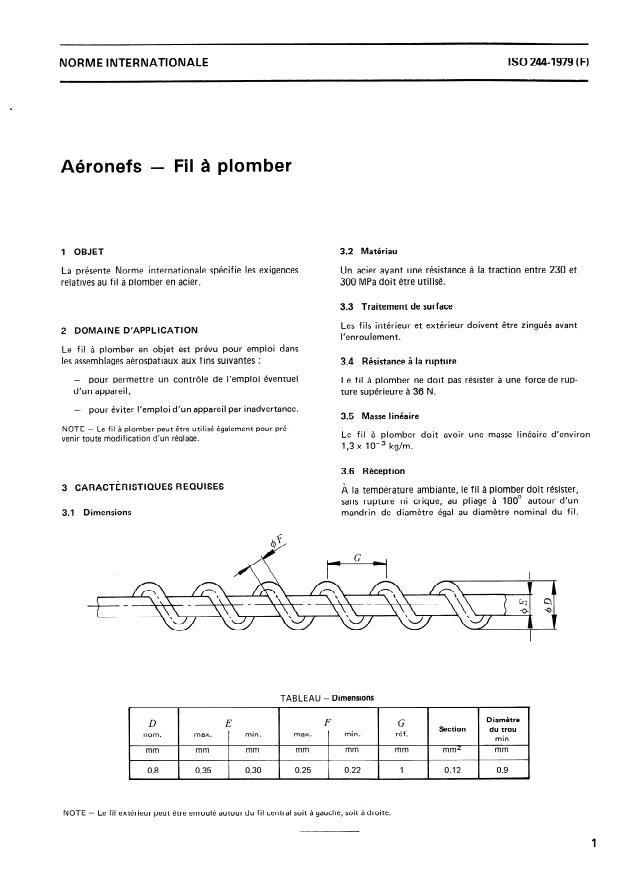
ISO 244:1979 specifies requirements for steel sealing wire used in aerospace assemblies. The standard defines material, mechanical and physical properties, surface treatment, dimensional limits and procurement/acceptance requirements for wire intended to indicate equipment use or to prevent inadvertent operation. Typical uses include tamper-evident seals, locking of access panels and preservation of calibrated adjustments.
Key topics and technical requirements
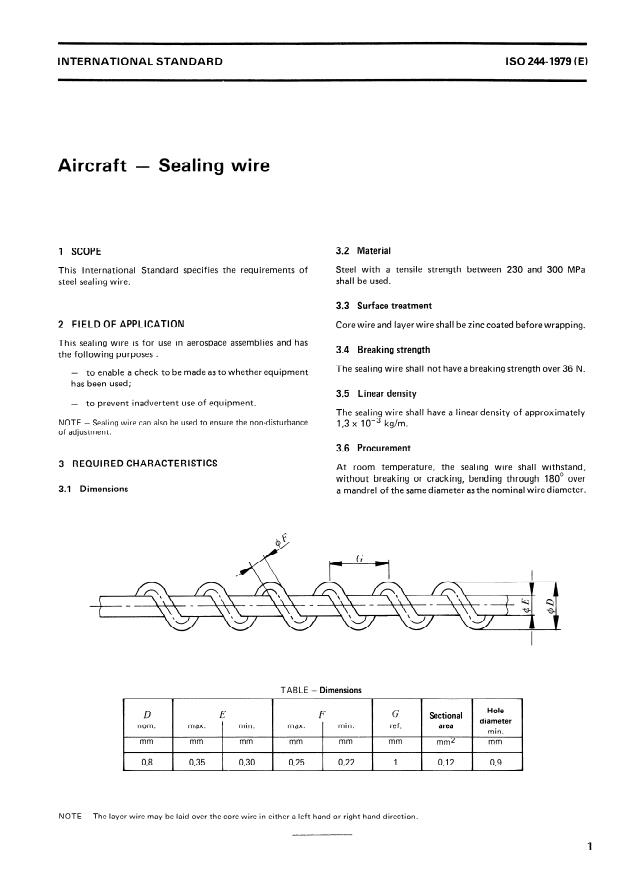
- Material: Steel wire with a specified tensile strength range (230–300 MPa).
- Surface treatment: Core and layer wires shall be zinc coated before wrapping to provide corrosion resistance.
- Breaking strength: The wire shall not have a breaking strength over 36 N, establishing a predictable failure point for inspection and safety.
- Linear density: Specified as approximately 1.3 × 10^-3 kg/m (as given in the document).
- Ductility/bending test: At room temperature the sealing wire must withstand, without breaking or cracking, bending through 180° over a mandrel of the same diameter as the nominal wire diameter.
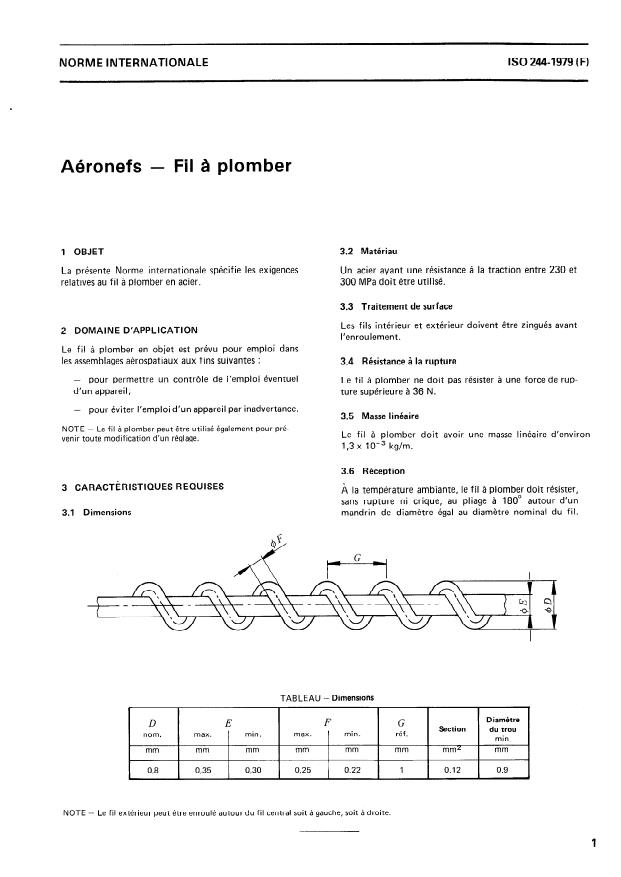
- Dimensions and form: Nominal diameters, sectional area and wrapping (core + layer) dimensions are defined in the standard (including allowance for left- or right-hand laying of the layer wire).
- Procurement: The standard sets out procurement and acceptance criteria so purchasers and suppliers can ensure consistent compliance with mechanical and surface requirements.
Practical applications and users
ISO 244 is aimed at the aerospace industry where controlled access and tamper evidence are required. Typical users include:
- Aircraft manufacturers and integrators specifying tamper seals on components and panels
- Maintenance, Repair and Overhaul (MRO) organizations applying or inspecting seals
- Quality assurance and procurement teams defining purchase specifications for sealing wire
- Suppliers of aerospace wire, fasteners and security seals who must meet dimensional and mechanical requirements
- Regulatory and certification bodies referencing consistent sealing practices
Practical applications include wiring seals for fuel panels, avionics access covers, control system locking, and securing calibrated or safety-critical adjustments.
Related standards
ISO 244 complements other aerospace standards covering fasteners, coatings, corrosion protection and material testing. When specifying sealing wire in procurement documents, pair ISO 244 requirements with relevant fastener and coating standards used by the organization or regulatory authority.
Keywords: ISO 244:1979, aircraft sealing wire, steel sealing wire, aerospace sealing wire, zinc coated, breaking strength, tensile strength, linear density, wire sealing requirements, aircraft maintenance.
Buy Documents
ISO 244:1979 - Aircraft — Sealing wire Released:11/1/1979
ISO 244:1979 - Aéronefs — Fil a plomber Released:11/1/1979
ISO 244:1979 - Aéronefs — Fil a plomber Released:11/1/1979
Get Certified
Connect with accredited certification bodies for this standard

BUREAU VERITAS Certification Germany
Bureau Veritas certification in Germany.

Element Materials Technology
Materials testing and product certification.

AQMS Ltd.
AQMS provides ISO certification to SMEs across the UK.
Sponsored listings
Frequently Asked Questions
ISO 244:1979 is a standard published by the International Organization for Standardization (ISO). Its full title is "Aircraft — Sealing wire". This standard covers: Gives the requirements of steel sealing wire. This wire is for use in aerospace assemblies and has the following purposes: the enable a check to be made as to whether equipment has been used and to prevent in advertent use of equipment. The requirements for dimensions, material, surface treatment, breaking strength, linear density and procurement are given.
Gives the requirements of steel sealing wire. This wire is for use in aerospace assemblies and has the following purposes: the enable a check to be made as to whether equipment has been used and to prevent in advertent use of equipment. The requirements for dimensions, material, surface treatment, breaking strength, linear density and procurement are given.
ISO 244:1979 is classified under the following ICS (International Classification for Standards) categories: 49.030.99 - Other fasteners. The ICS classification helps identify the subject area and facilitates finding related standards.
ISO 244:1979 is available in PDF format for immediate download after purchase. The document can be added to your cart and obtained through the secure checkout process. Digital delivery ensures instant access to the complete standard document.
Standards Content (Sample)
International Standard
INTERNATIONAL ORGANIZATION FOR STANDARDIZATION.ME~YHAPO~HAFl OPl-AHblSAUHfl l-l0 CTAH&V ’TH3A4MM~RGANISATION INTERNATIONALE DE NORMALISATION
Aircraft - Sealing wire
Ahronefs
- Fils plomber
First editisn - 1979-11-15
Ref. No. ISO 244-1979 (E)
UDC 629.7 : 669.14426
dimensions, mechanical properties.
Descriptors : aircraft industry, aircraft equipment, wire, sealing wire,
Price based on 1 page
FOREWORD
ISO (the International Organization for Standardization) is a worldwide federation
of national Standards institutes (ISO member bodies). The work of developing
International Standards is carried out through ISO technical committees. Every
member body interested in a subject for which a technical committee has been set
up has the right to be represented on that committee. International organizations,
governmental and non-governmental, in liaison with ISO, also take part in the work.
Draft International Standards adopted by the technical committees are circulated
to the member bodies for approval before their acceptance as International
Standards by the ISO Council.
International Standard ISO 244 was developed by Technical Committee lSO/TC 20,
Aircraft and space vehicles, and was circulated to the member bodies in November
1977.
lt has been approved by the member bodies of the following countries :
I taly South Africa, Rep. of
Australia
Austria Japan Spain
Belgium Mexico Turkey
Canada Netherlands United Kingdom
Philippines
Czechoslovakia USA
Poland Yugoslavia
Germany, F.R.
India Romania
e member bodies of the following countries expressed disapproval of the document
Th
technical ground s :
on
Brazil
France
USSR
Thi
...
Norme internationale
INTERNATIONAL ORGANIZATION FOR STANDARDIZATIONWEIKAYHAPO~HAR OPTAHM3ALWlR IlO CTAH~APTbl3ALU&l.ORGANISATlON INTERNATIONALE DE NORMALISATION
Ahonefs - Fil 6 plomber
Aircraft -
Sealing wire
Premihe Edition - 1979-11-15
CDU 629.7 : 669.14-426 Ref. no : IS0 244-1979 (F)
LL
Descripteurs : industrie ahonautique, materiel d’akronef, fii m&allique, fil i plomber, dimension, propriM mkanique.
Prix bask sur 1 page
AVANT-PROPOS
L’ISO (Organisation internationale de normalisation) est une federation mondiale
d’organismes nationaux de normalisation (comites membres de I’ISO). L’elaboration
des Normes internationales est confide aux comites techniques de I’ISO. Chaque
comite membre interesse par une etude a le droit de faire partiedu comite technique
correspondant. Les organisations internationales, gouvernementales et non
gouvernementales, en liaison avec I’ISO, participent egalement aux travaux.
Les projets de Normes internationales adopt& par les comites techniques sont
soumis aux comites membres pour approbation, avant leur acceptation comme
Normes internationales par le Conseil de I’ISO.
La Norme internationale IS0 244 a ete elaboree par le comite technique ISO/TC 20,
Mronautique et espace, et a ete soumise aux comites membres en novembre 1977.
Les comites membres des pays suivants I’ont approuvee :
Afrique du Sud, Rep. d’ lnde Roumanie
Allemagne, R.F. ltalie Royaume-Uni
Australie Japon Tchecoslovaquie
Autriche Mexique Turquie
Belgique Pays-Bas USA
Philippines Yougoslavie
Canada
Pologne
Espagne
Les comites membres des pays suivants I’ont desapprouvee pour des raisons techni-
ques :
Bresil
France
U RSS
Cette Norme internationale annul
...
Norme internationale
INTERNATIONAL ORGANIZATION FOR STANDARDIZATIONWEIKAYHAPO~HAR OPTAHM3ALWlR IlO CTAH~APTbl3ALU&l.ORGANISATlON INTERNATIONALE DE NORMALISATION
Ahonefs - Fil 6 plomber
Aircraft -
Sealing wire
Premihe Edition - 1979-11-15
CDU 629.7 : 669.14-426 Ref. no : IS0 244-1979 (F)
LL
Descripteurs : industrie ahonautique, materiel d’akronef, fii m&allique, fil i plomber, dimension, propriM mkanique.
Prix bask sur 1 page
AVANT-PROPOS
L’ISO (Organisation internationale de normalisation) est une federation mondiale
d’organismes nationaux de normalisation (comites membres de I’ISO). L’elaboration
des Normes internationales est confide aux comites techniques de I’ISO. Chaque
comite membre interesse par une etude a le droit de faire partiedu comite technique
correspondant. Les organisations internationales, gouvernementales et non
gouvernementales, en liaison avec I’ISO, participent egalement aux travaux.
Les projets de Normes internationales adopt& par les comites techniques sont
soumis aux comites membres pour approbation, avant leur acceptation comme
Normes internationales par le Conseil de I’ISO.
La Norme internationale IS0 244 a ete elaboree par le comite technique ISO/TC 20,
Mronautique et espace, et a ete soumise aux comites membres en novembre 1977.
Les comites membres des pays suivants I’ont approuvee :
Afrique du Sud, Rep. d’ lnde Roumanie
Allemagne, R.F. ltalie Royaume-Uni
Australie Japon Tchecoslovaquie
Autriche Mexique Turquie
Belgique Pays-Bas USA
Philippines Yougoslavie
Canada
Pologne
Espagne
Les comites membres des pays suivants I’ont desapprouvee pour des raisons techni-
ques :
Bresil
France
U RSS
Cette Norme internationale annul
...