

ISO 4037-2:2019
(Main)Radiological protection — X and gamma reference radiation for calibrating dosemeters and doserate meters and for determining their response as a function of photon energy — Part 2: Dosimetry for radiation protection over the energy ranges from 8 keV to 1,3 MeV and 4 MeV to 9 MeV
General Information
- Abstract
This document specifies the procedures for the dosimetry of X and gamma reference radiation for the calibration of radiation protection instruments over the energy range from approximately 8 keV to 1,3 MeV and from 4 MeV to 9 MeV and for air kerma rates above 1 µGy/h. The considered measuring quantities are the air kerma free-in-air, Ka, and the phantom related operational quantities of the International Commission on Radiation Units and Measurements (ICRU)[2], H*(10), Hp(10), H'(3), Hp(3), H'(0,07) and Hp(0,07), together with the respective dose rates. The methods of production are given in ISO 4037-1. This document can also be used for the radiation qualities specified in ISO 4037-1:2019, Annexes A, B and C, but this does not mean that a calibration certificate for radiation qualities described in these annexes is in conformity with the requirements of ISO 4037. The requirements and methods given in this document are targeted at an overall uncertainty (k = 2) of the dose(rate) of about 6 % to 10 % for the phantom related operational quantities in the reference fields. To achieve this, two production methods of the reference fields are proposed in ISO 4037-1. The first is to produce "matched reference fields", which follow the requirements so closely that recommended conversion coefficients can be used. The existence of only a small difference in the spectral distribution of the "matched reference field" compared to the nominal reference field is validated by procedures, which are given and described in detail in this document. For matched reference radiation fields, recommended conversion coefficients are given in ISO 4037-3 only for specified distances between source and dosemeter, e.g., 1,0 m and 2,5 m. For other distances, the user has to decide if these conversion coefficients can be used. The second method is to produce "characterized reference fields". Either this is done by determining the conversion coefficients using spectrometry, or the required value is measured directly using secondary standard dosimeters. This method applies to any radiation quality, for any measuring quantity and, if applicable, for any phantom and angle of radiation incidence. The conversion coefficients can be determined for any distance, provided the air kerma rate is not below 1 µGy/h. Both methods require charged particle equilibrium for the reference field. However this is not always established in the workplace field for which the dosemeter shall be calibrated. This is especially true at photon energies without inherent charged particle equilibrium at the reference depth d, which depends on the actual combination of energy and reference depth d. Electrons of energies above 65 keV, 0,75 MeV and 2,1 MeV can just penetrate 0,07 mm, 3 mm and 10 mm of ICRU tissue, respectively, and the radiation qualities with photon energies above these values are considered as radiation qualities without inherent charged particle equilibrium for the quantities defined at these depths. This document is not applicable for the dosimetry of pulsed reference fields.
- Status
- Published
- Publication Date
- 17-Jan-2019
- Technical Committee
- ISO/TC 85/SC 2 - Radiological protection
- Drafting Committee
- ISO/TC 85/SC 2/WG 2 - Reference radiations fields
- Current Stage
- 9093 - International Standard confirmed
- Start Date
- 05-Nov-2024
- Completion Date
- 29-Aug-2026
Buy Documents

ISO 4037-2:2019 - Radiological protection -- X and gamma reference radiation for calibrating dosemeters and doserate meters and for determining their response as a function of photon energy

ISO 4037-2:2019 - Radiological protection — X and gamma reference radiation for calibrating dosemeters and doserate meters and for determining their response as a function of photon energy — Part 2: Dosimetry for radiation protection over the energy ranges from 8 keV to 1,3 MeV and 4 MeV to 9 MeV/26/2019

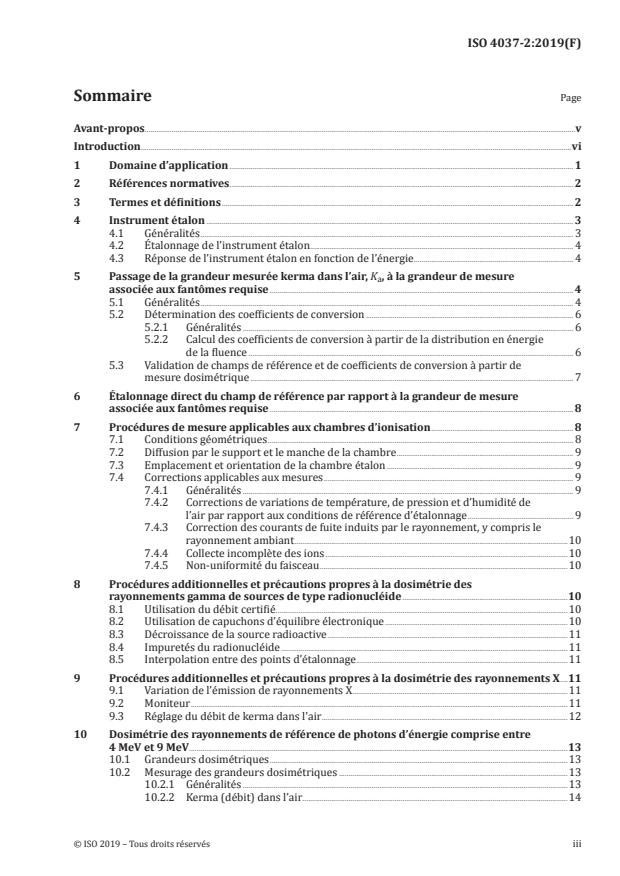
ISO 4037-2:2019 - Radioprotection -- Rayonnements X et gamma de référence pour l'étalonnage des dosimetres et des débitmetres, et pour la détermination de leur réponse en fonction de l'énergie des photons

ISO 4037-2:2019 - Radioprotection — Rayonnements X et gamma de référence pour l'étalonnage des dosimètres et des débitmètres, et pour la détermination de leur réponse en fonction de l'énergie des photons — Partie 2: Dosimétrie pour la radioprotection dans les gammes d'énergie de 8 keV à 1,3 MeV et de 4 MeV à 9 MeV/18/2019
Overview
ISO 4037-2:2019 - Radiological protection - Dosimetry for X and gamma reference radiation - defines procedures for dosimetry used to calibrate dosemeters and doserate meters and to determine their response as a function of photon energy. The standard covers photon energy ranges ≈ 8 keV to 1.3 MeV and 4 MeV to 9 MeV, and applies for air kerma rates above 1 µGy/h. Measured quantities include air kerma free‑in‑air (Ka) and the ICRU phantom‑related operational quantities H(10), Hp(10), H'(3), Hp(3), H'(0.07) and Hp(0.07)* and their dose rates.
Key topics and technical requirements
- Two reference‑field approaches
- Matched reference fields: produced to closely meet ISO 4037‑1 requirements so that recommended conversion coefficients (see ISO 4037‑3) may be used - coefficients are given for specified source‑to‑dosemeter distances (e.g., 1.0 m and 2.5 m).
- Characterized reference fields: conversion coefficients are determined by spectrometry or direct measurement with secondary standard dosimeters; applicable for any radiation quality, distance (subject to Ka ≥ 1 µGy/h), phantom and angle.
- Primary dosimetric quantity: air kerma free‑in‑air (Ka) and conversion to phantom‑related operational quantities using validated coefficients.
- Measurement methods and instrumentation
- Use of secondary standard instruments (nearly constant energy dependence) and ionization chambers.
- Detailed procedures for geometry, chamber support, stem scatter, positioning and orientation.
- Required corrections: temperature, pressure, humidity, radiation‑induced leakage, incomplete ion collection, beam non‑uniformity.
- Uncertainty target: overall uncertainty (k = 2) for phantom‑related operational quantities of approximately 6% to 10%.
- Special considerations: gamma‑ and X‑ray specific procedures (source certification, decay, output stability, monitoring); not applicable to pulsed reference fields.
- Charged particle equilibrium: addressed; note that certain photon energies do not establish inherent charged particle equilibrium at shallow depths. Example electron penetrations given: electrons >65 keV, 0.75 MeV and 2.1 MeV can just penetrate 0.07 mm, 3 mm and 10 mm of ICRU tissue, respectively.
Practical applications
- Calibration of workplace and personal dosemeters and dose‑rate meters used in radiation protection.
- Development and validation of reference radiation fields for calibration laboratories and national metrology institutes.
- Determination of instrument energy response and conversion coefficients via spectrometry or secondary standards.
- Establishing traceable measurement uncertainty budgets for regulatory compliance and quality assurance.
Who should use this standard
- Calibration laboratories and secondary standard dosimetry services
- National metrology institutes and accreditation bodies
- Health physics and radiation protection teams in nuclear, industrial and medical sectors
- Instrument manufacturers and test laboratories
Related standards
- ISO 4037‑1 (production and characterization of reference fields)
- ISO 4037‑3 (conversion coefficients and calibration methods for dosemeters/doserate meters)
- ISO 4037‑4 (low energy X reference fields)
- ICRU publications referenced for operational quantities
Keywords: ISO 4037-2:2019, radiological protection, X and gamma reference radiation, calibration, dosimetry, air kerma, H*(10), Hp(10), conversion coefficients, matched reference fields, characterized reference fields, ionization chamber.
Relations
- Effective Date
- 09-Sep-2026
- Effective Date
- 25-Aug-2026
- Effective Date
- 25-Aug-2026
- Effective Date
- 25-Aug-2026
- Effective Date
- 25-Aug-2026
- Effective Date
- 10-Jun-2026
- Effective Date
- 05-Jul-2014
Buy Documents
ISO 4037-2:2019 - Radiological protection -- X and gamma reference radiation for calibrating dosemeters and doserate meters and for determining their response as a function of photon energy
ISO 4037-2:2019 - Radiological protection — X and gamma reference radiation for calibrating dosemeters and doserate meters and for determining their response as a function of photon energy — Part 2: Dosimetry for radiation protection over the energy ranges from 8 keV to 1,3 MeV and 4 MeV to 9 MeV/26/2019
ISO 4037-2:2019 - Radioprotection -- Rayonnements X et gamma de référence pour l'étalonnage des dosimetres et des débitmetres, et pour la détermination de leur réponse en fonction de l'énergie des photons
ISO 4037-2:2019 - Radioprotection — Rayonnements X et gamma de référence pour l'étalonnage des dosimètres et des débitmètres, et pour la détermination de leur réponse en fonction de l'énergie des photons — Partie 2: Dosimétrie pour la radioprotection dans les gammes d'énergie de 8 keV à 1,3 MeV et de 4 MeV à 9 MeV/18/2019
Get Certified
Connect with accredited certification bodies for this standard

BSMI (Bureau of Standards, Metrology and Inspection)
Taiwan's standards and inspection authority.
Sponsored listings
Frequently Asked Questions
ISO 4037-2:2019 is a standard published by the International Organization for Standardization (ISO). Its full title is "Radiological protection — X and gamma reference radiation for calibrating dosemeters and doserate meters and for determining their response as a function of photon energy — Part 2: Dosimetry for radiation protection over the energy ranges from 8 keV to 1,3 MeV and 4 MeV to 9 MeV". This standard covers: This document specifies the procedures for the dosimetry of X and gamma reference radiation for the calibration of radiation protection instruments over the energy range from approximately 8 keV to 1,3 MeV and from 4 MeV to 9 MeV and for air kerma rates above 1 µGy/h. The considered measuring quantities are the air kerma free-in-air, Ka, and the phantom related operational quantities of the International Commission on Radiation Units and Measurements (ICRU)[2], H*(10), Hp(10), H'(3), Hp(3), H'(0,07) and Hp(0,07), together with the respective dose rates. The methods of production are given in ISO 4037-1. This document can also be used for the radiation qualities specified in ISO 4037-1:2019, Annexes A, B and C, but this does not mean that a calibration certificate for radiation qualities described in these annexes is in conformity with the requirements of ISO 4037. The requirements and methods given in this document are targeted at an overall uncertainty (k = 2) of the dose(rate) of about 6 % to 10 % for the phantom related operational quantities in the reference fields. To achieve this, two production methods of the reference fields are proposed in ISO 4037-1. The first is to produce "matched reference fields", which follow the requirements so closely that recommended conversion coefficients can be used. The existence of only a small difference in the spectral distribution of the "matched reference field" compared to the nominal reference field is validated by procedures, which are given and described in detail in this document. For matched reference radiation fields, recommended conversion coefficients are given in ISO 4037-3 only for specified distances between source and dosemeter, e.g., 1,0 m and 2,5 m. For other distances, the user has to decide if these conversion coefficients can be used. The second method is to produce "characterized reference fields". Either this is done by determining the conversion coefficients using spectrometry, or the required value is measured directly using secondary standard dosimeters. This method applies to any radiation quality, for any measuring quantity and, if applicable, for any phantom and angle of radiation incidence. The conversion coefficients can be determined for any distance, provided the air kerma rate is not below 1 µGy/h. Both methods require charged particle equilibrium for the reference field. However this is not always established in the workplace field for which the dosemeter shall be calibrated. This is especially true at photon energies without inherent charged particle equilibrium at the reference depth d, which depends on the actual combination of energy and reference depth d. Electrons of energies above 65 keV, 0,75 MeV and 2,1 MeV can just penetrate 0,07 mm, 3 mm and 10 mm of ICRU tissue, respectively, and the radiation qualities with photon energies above these values are considered as radiation qualities without inherent charged particle equilibrium for the quantities defined at these depths. This document is not applicable for the dosimetry of pulsed reference fields.
This document specifies the procedures for the dosimetry of X and gamma reference radiation for the calibration of radiation protection instruments over the energy range from approximately 8 keV to 1,3 MeV and from 4 MeV to 9 MeV and for air kerma rates above 1 µGy/h. The considered measuring quantities are the air kerma free-in-air, Ka, and the phantom related operational quantities of the International Commission on Radiation Units and Measurements (ICRU)[2], H*(10), Hp(10), H'(3), Hp(3), H'(0,07) and Hp(0,07), together with the respective dose rates. The methods of production are given in ISO 4037-1. This document can also be used for the radiation qualities specified in ISO 4037-1:2019, Annexes A, B and C, but this does not mean that a calibration certificate for radiation qualities described in these annexes is in conformity with the requirements of ISO 4037. The requirements and methods given in this document are targeted at an overall uncertainty (k = 2) of the dose(rate) of about 6 % to 10 % for the phantom related operational quantities in the reference fields. To achieve this, two production methods of the reference fields are proposed in ISO 4037-1. The first is to produce "matched reference fields", which follow the requirements so closely that recommended conversion coefficients can be used. The existence of only a small difference in the spectral distribution of the "matched reference field" compared to the nominal reference field is validated by procedures, which are given and described in detail in this document. For matched reference radiation fields, recommended conversion coefficients are given in ISO 4037-3 only for specified distances between source and dosemeter, e.g., 1,0 m and 2,5 m. For other distances, the user has to decide if these conversion coefficients can be used. The second method is to produce "characterized reference fields". Either this is done by determining the conversion coefficients using spectrometry, or the required value is measured directly using secondary standard dosimeters. This method applies to any radiation quality, for any measuring quantity and, if applicable, for any phantom and angle of radiation incidence. The conversion coefficients can be determined for any distance, provided the air kerma rate is not below 1 µGy/h. Both methods require charged particle equilibrium for the reference field. However this is not always established in the workplace field for which the dosemeter shall be calibrated. This is especially true at photon energies without inherent charged particle equilibrium at the reference depth d, which depends on the actual combination of energy and reference depth d. Electrons of energies above 65 keV, 0,75 MeV and 2,1 MeV can just penetrate 0,07 mm, 3 mm and 10 mm of ICRU tissue, respectively, and the radiation qualities with photon energies above these values are considered as radiation qualities without inherent charged particle equilibrium for the quantities defined at these depths. This document is not applicable for the dosimetry of pulsed reference fields.
ISO 4037-2:2019 is classified under the following ICS (International Classification for Standards) categories: 17.240 - Radiation measurements. The ICS classification helps identify the subject area and facilitates finding related standards.
ISO 4037-2:2019 has the following relationships with other standards: It is inter standard links to EN ISO 18090-1:2026, EN ISO 4037-3:2021, EN ISO 4037-4:2021, EN ISO 4037-1:2021, EN ISO 14146:2024, EN ISO 15382:2025, ISO 4037-2:1997. Understanding these relationships helps ensure you are using the most current and applicable version of the standard.
ISO 4037-2:2019 is available in PDF format for immediate download after purchase. The document can be added to your cart and obtained through the secure checkout process. Digital delivery ensures instant access to the complete standard document.
Standards Content (Sample)
INTERNATIONAL ISO
STANDARD 4037-2
Second edition
2019-01
Corrected version
2019-03
Radiological protection — X and
gamma reference radiation for
calibrating dosemeters and doserate
meters and for determining their
response as a function of photon
energy —
Part 2:
Dosimetry for radiation protection
over the energy ranges from 8 keV to
1,3 MeV and 4 MeV to 9 MeV
Radioprotection — Rayonnements X et gamma de référence
pour l'étalonnage des dosimètres et des débitmètres, et pour la
détermination de leur réponse en fonction de l'énergie des photons —
Partie 2: Dosimétrie pour la radioprotection dans les gammes
d'énergie de 8 keV à 1,3 MeV et de 4 MeV à 9 MeV
Reference number
©
ISO 2019
© ISO 2019
All rights reserved. Unless otherwise specified, or required in the context of its implementation, no part of this publication may
be reproduced or utilized otherwise in any form or by any means, electronic or mechanical, including photocopying, or posting
on the internet or an intranet, without prior written permission. Permission can be requested from either ISO at the address
below or ISO’s member body in the country of the requester.
ISO copyright office
CP 401 • Ch. de Blandonnet 8
CH-1214 Vernier, Geneva
Phone: +41 22 749 01 11
Fax: +41 22 749 09 47
Email: copyright@iso.org
Website: www.iso.org
Published in Switzerland
ii © ISO 2019 – All rights reserved
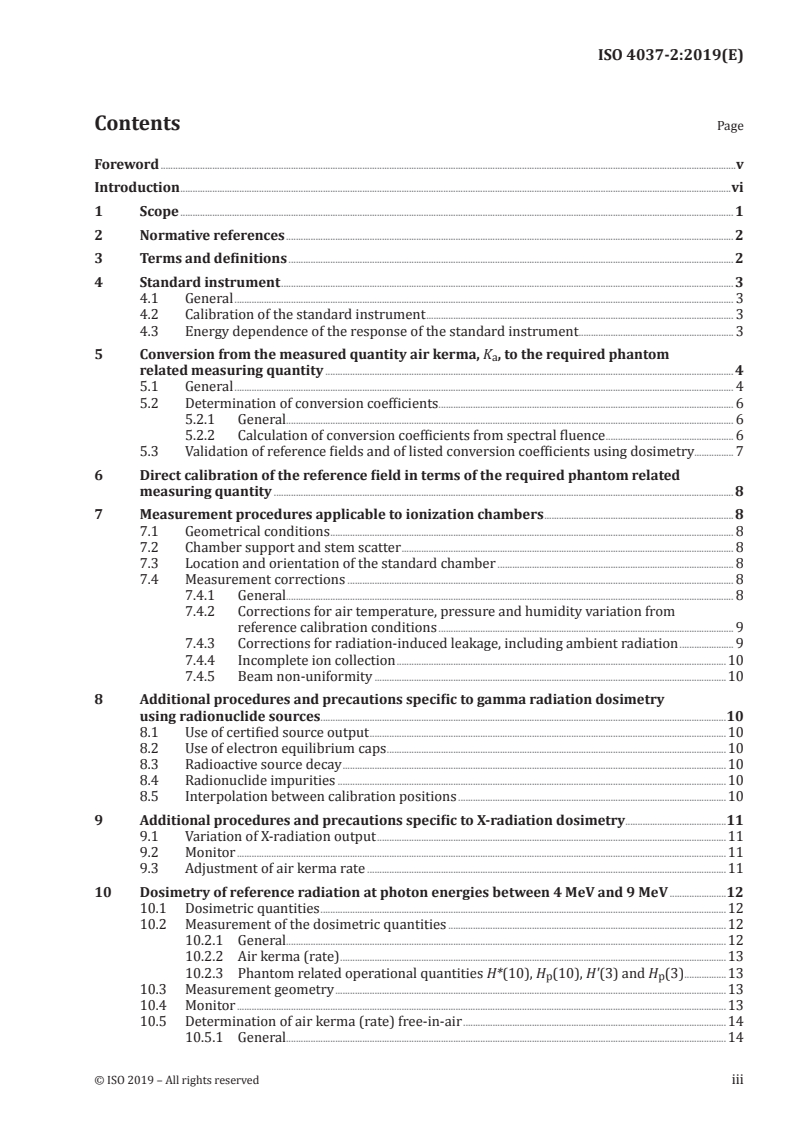
Contents Page
Foreword .v
Introduction .vi
1 Scope . 1
2 Normative references . 2
3 Terms and definitions . 2
4 Standard instrument . 3
4.1 General . 3
4.2 Calibration of the standard instrument . 3
4.3 Energy dependence of the response of the standard instrument . 3
5 Conversion from the measured quantity air kerma, K , to the required phantom
a
related measuring quantity . 4
5.1 General . 4
5.2 Determination of conversion coefficients . 6
5.2.1 General. 6
5.2.2 Calculation of conversion coefficients from spectral fluence . 6
5.3 Validation of reference fields and of listed conversion coefficients using dosimetry. 7
6 Direct calibration of the reference field in terms of the required phantom related
measuring quantity . 8
7 Measurement procedures applicable to ionization chambers . 8
7.1 Geometrical conditions . 8
7.2 Chamber support and stem scatter . 8
7.3 Location and orientation of the standard chamber . 8
7.4 Measurement corrections . 8
7.4.1 General. 8
7.4.2 Corrections for air temperature, pressure and humidity variation from
reference calibration conditions . 9
7.4.3 Corrections for radiation-induced leakage, including ambient radiation . 9
7.4.4 Incomplete ion collection .10
7.4.5 Beam non-uniformity .10
8 Additional procedures and precautions specific to gamma radiation dosimetry
using radionuclide sources .10
8.1 Use of certified source output .10
8.2 Use of electron equilibrium caps .10
8.3 Radioactive source decay .10
8.4 Radionuclide impurities .10
8.5 Interpolation between calibration positions .10
9 Additional procedures and precautions specific to X-radiation dosimetry .11
9.1 Variation of X-radiation output .11
9.2 Monitor .11
9.3 Adjustment of air kerma rate .11
10 Dosimetry of reference radiation at photon energies between 4 MeV and 9 MeV .12
10.1 Dosimetric quantities .12
10.2 Measurement of the dosimetric quantities .12
10.2.1 General.12
10.2.2 Air kerma (rate) .13
10.2.3 Phantom related operational quantities H*(10), H (10), H'(3) and H (3) .13
p p
10.3 Measurement geometry .13
10.4 Monitor .13
10.5 Determination of air kerma (rate) free-in-air .14
10.5.1 General.14
10.5.2 Measurement conditions .14
10.5.3 Direct measurement with an ionization chamber .14
10.5.4 Determination of air kerma (rate) from photon fluence (rate) .17
11 Uncertainty of measurement .18
11.1 General .18
11.2 Components of uncertainty .18
11.2.1 General.18
11.2.2 Uncertainties in the calibration of a secondary standard .18
11.2.3 Uncertainties in the measurements of the reference radiation due to the
standard instrument and its use .19
11.3 Statement of uncertainty .19
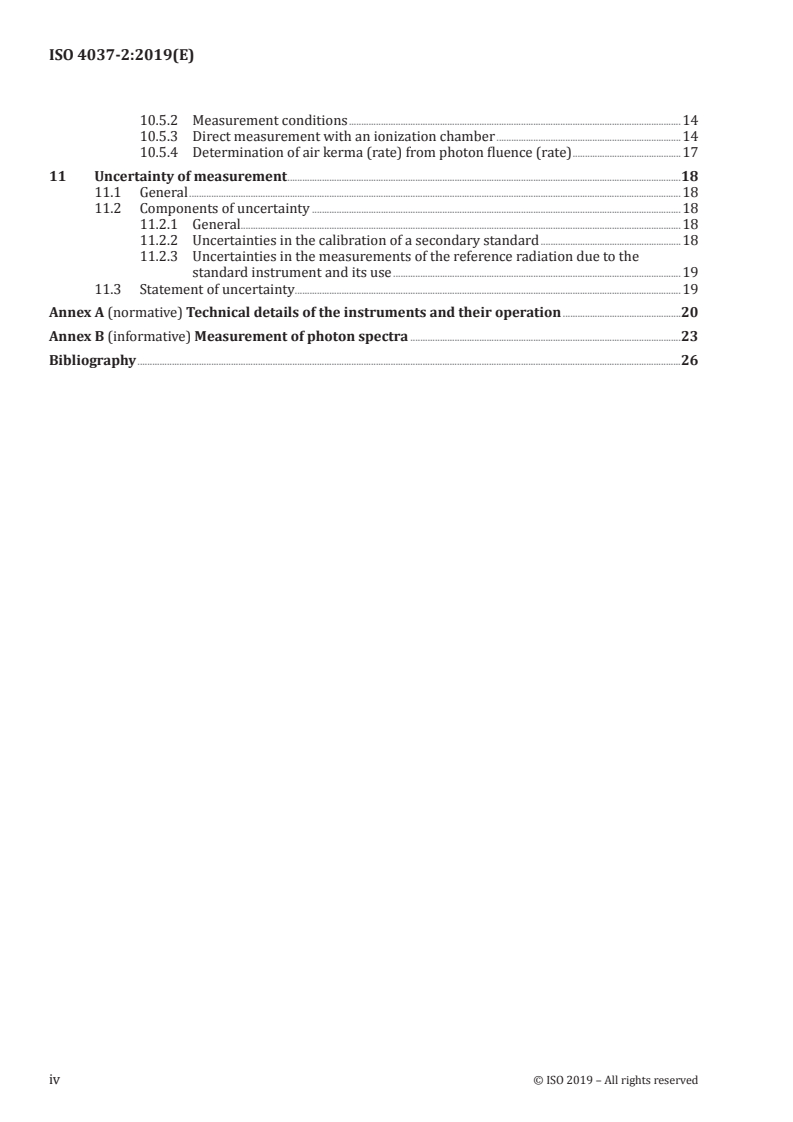
Annex A (normative) Technical details of the instruments and their operation .20
Annex B (informative) Measurement of photon spectra .23
Bibliography .26
iv © ISO 2019 – All rights reserved
Foreword
ISO (the International Organization for Standardization) is a worldwide federation of national standards
bodies (ISO member bodies). The work of preparing International Standards is normally carried out
through ISO technical committees. Each member body interested in a subject for which a technical
committee has been established has the right to be represented on that committee. International
organizations, governmental and non-governmental, in liaison with ISO, also take part in the work.
ISO collaborates closely with the International Electrotechnical Commission (IEC) on all matters of
electrotechnical standardization.
The procedures used to develop this document and those intended for its further maintenance are
described in the ISO/IEC Directives, Part 1. In particular the different approval criteria needed for the
different types of ISO documents should be noted. This document was drafted in accordance with the
editorial rules of the ISO/IEC Directives, Part 2 (see www .iso .org/directives).
Attention is drawn to the possibility that some of the elements of this document may be the subject of
patent rights. ISO shall not be held responsible for identifying any or all such patent rights. Details of
any patent rights identified during the development of the document will be in the Introduction and/or
on the ISO list of patent declarations received (see www .iso .org/patents).
Any trade name used in this document is information given for the convenience of users and does not
constitute an endorsement.
For an explanation on the voluntary nature of standards, the meaning of ISO specific terms and
expressions related to conformity assessment, as well as information about ISO's adherence to the
World Trade Organization (WTO) principles in the Technical Barriers to Trade (TBT) see the following
URL: www .iso .org/iso/foreword .html.
This document was prepared by Technical Committee ISO/TC 85, Nuclear energy, nuclear technologies
and radiological protection, Subcommittee SC 2, Radiological protection.
This second edition cancels and replaces the first edition (ISO 4037-2:1997), which has been technically
revised.
A list of all the parts in the ISO 4037 series can be found on the ISO website.
Any feedback or questions on this document should be directed to the user’s national standards body. A
complete listing of these bodies can be found at www .iso .org/members .html.
This corrected version of ISO 4037-2:2019 incorporates the following corrections:
— In 10.5.2.2, the subscripts to the values have been reapplied;
— In Table 5, the headers in columns 4 and 5 have been reinserted.
Introduction
The maintenance release of this document incorporates the improvements to high voltage generators
from 1996 to 2017 (e.g., the use of high frequency switching supplies providing nearly constant
potential), and the spectral measurements at irradiation facilities equipped with such generators
[1]
(e.g., the catalogue of X-ray spectra by Ankerhold ). It also incorporates all published information
with the aim to adjust the requirements for the technical parameters of the reference fields to the
targeted overall uncertainty of about 6 % to 10 % for the phantom related operational quantities of
[2]
the International Commission on Radiation Units and Measurements (ICRU) . It does not change the
general concept of the existing ISO 4037.
ISO 4037, focusing on photon reference radiation fields, is divided into four parts. ISO 4037-1 gives the
methods of production and characterization of reference radiation fields in terms of the quantities
spectral photon fluence and air kerma free-in-air. This document describes the dosimetry of the
reference radiation qualities in terms of air kerma and in terms of the phantom related operational
[2]
quantities of the International Commission on Radiation Units and Measurements (ICRU) . ISO 4037-3
describes the methods for calibrating and determining the response of dosemeters and doserate
[2]
meters in terms of the phantom related operational quantities of the ICRU . ISO 4037-4 gives special
considerations and additional requirements for calibration of area and personal dosemeters in low
energy X reference radiation fields, which are reference fields with generating potential lower or equal
to 30 kV.
In this document, two methods are given to determine the phantom related operational quantities.
Both methods need a reference field according to ISO 4037-1. The first method requires the dosimetry
with respect to air kerma free-in-air and after that the selected operational quantity is derived by the
application of a conversion coefficient that relates the air kerma free-in-air to the selected operational
quantity. For matched reference fields, this conversion coefficient is taken from ISO 4037-3, for
characterized reference fields the conversion coefficient is determined using spectrometry. The second
method, applicable for characterized reference fields, requires the direct dosimetry with respect to the
selected operational quantity. For all calibrations secondary standard instruments are required, which
have a nearly constant energy dependence of the response to the selected quantity.
The general procedures described in ISO 29661 are used as far as possible in this document. Also, the
used symbols are in line with ISO 29661.
vi © ISO 2019 – All rights reserved
INTERNATIONAL STANDARD ISO 4037-2:2019(E)
Radiological protection — X and gamma reference
radiation for calibrating dosemeters and doserate meters
and for determining their response as a function of photon
energy —
Part 2:
Dosimetry for radiation protection over the energy ranges
from 8 keV to 1,3 MeV and 4 MeV to 9 MeV
1 Scope
This document specifies the procedures for the dosimetry of X and gamma reference radiation for the
calibration of radiation protection instruments over the energy range from approximately 8 keV to
1,3 MeV and from 4 MeV to 9 MeV and for air kerma rates above 1 µGy/h. The considered measuring
quantities are the air kerma free-in-air, K , and the phantom related operational quantities of the
a
[2]
International Commission on Radiation Units and Measurements (ICRU) , H*(10), H (10), H'(3), H (3),
p p
H'(0,07) and H (0,07), together with the respective dose rates. The methods of production are given in
p
ISO 4037-1.
This document can also be used for the radiation qualities specified in ISO 4037-1:2019, Annexes A, B
and C, but this does not mean that a calibration certificate for radiation qualities described in these
annexes is in conformity with the requirements of ISO 4037.
The requirements and methods given in this document are targeted at an overall uncertainty (k = 2)
of the dose(rate) of about 6 % to 10 % for the phantom related operational quantities in the reference
fields. To achieve this, two production methods of the reference fields are proposed in ISO 4037-1.
The first is to produce “matched reference fields”, which follow the requirements so closely that
recommended conversion coefficients can be used. The existence of only a small difference in the
spectral distribution of the “matched reference field” compared to the nominal reference field is
validated by procedures, which are given and described in detail in this document. For matched
reference radiation fields, recommended conversion coefficients are given in ISO 4037-3 only for
specified distances between source and dosemeter, e.g., 1,0 m and 2,5 m. For other distances, the user
has to decide if these conversion coefficients can be used.
The second method is to produce “characterized reference fields”. Either this is done by determining the
conversion coefficients using spectrometry, or the required value is measured directly using secondary
standard dosimeters. This method applies to any radiation quality, for any measuring quantity and,
if applicable, for any phantom and angle of radiation incidence. The conversion coefficients can be
determined for any distance, provided the air kerma rate is not below 1 µGy/h.
Both methods require charged particle equilibrium for the reference field. However this is not always
established in the workplace field for which the dosemeter shall be calibrated. This is especially true
at photon energies without inherent charged particle equilibrium at the reference depth d, which
depends on the actual combination of energy and reference depth d. Electrons of energies above 65 keV,
0,75 MeV and 2,1 MeV can just penetrate 0,07 mm, 3 mm and 10 mm of ICRU tissue, respectively, and
the radiation qualities with photon energies above these values are considered as radiation qualities
without inherent charged particle equilibrium for the quantities defined at these depths.
This document is not applicable for the dosimetry of pulsed reference fields.
2 Normative references
The following documents, in whole or in part, are normatively referenced in this document and are
indispensable for its application. For dated references, only the edition cited applies. For undated
references, the latest edition of the referenced document (including any amendments) applies.
ISO 4037-1, Radiological protection — X and gamma reference radiation for calibrating dosemeters and
doserate meters and for determining their response as a function of photon energy — Part 1: Radiation
characteristics and production methods
ISO 4037-3, Radiological protection — X and gamma reference radiation for calibrating dosemeters and
doserate meters and for determining their response as a function of photon energy — Part 3: Calibration of
area and personal dosemeters and the measurement of their response as a function of energy and angle of
incidence
ISO 4037-4, Radiological protection — X and gamma reference radiation for calibrating dosemeters and
doserate meters and for determining their response as a function of photon energy — Part 4: Calibration of
area and personal dosemeters in low energy X reference radiation fields
ISO 29661, Reference radiation fields for radiation protection — Definitions and fundamental concepts
ISO 80000-10, Quantities and units — Part 10: Atomic and nuclear physics
ISO/IEC Guide 98-3, Uncertainty of measurement — Part 3: Guide to the expression of uncertainty in
me a s ur ement (GUM: 1995)
ISO/IEC Guide 99, International vocabulary of metrology — Basic and general concepts and associated
terms (VIM)
3 Terms and definitions
For the purposes of this document, the terms and definitions given in ISO 4037-1, ISO 29661,
ISO 80000-10, ISO/IEC Guide 99, and the following apply.
ISO and IEC maintain terminological databases for use in standardization at the following addresses:
— ISO Online browsing platform: available at https: //www .iso .org/obp
— IEC Electropedia: available at http: //www .electropedia .org/
3.1
ionization chamber
ionization detector consisting of a chamber filled with a suitable gas, in which an electric field,
insufficient to induce gas multiplication, is provided for the collection at the electrodes of charges
associated with the ions and the electrons produced in the sensitive volume of the detector by the
[3]
ionizing radiation
Note 1 to entry: The ionization chamber includes the sensitive volume, the collecting and polarizing electrodes,
the guard electrode, if any, the chamber wall, the parts of the insulator adjacent to the sensitive volume and any
necessary caps to ensure electron equilibrium.
3.2
ionization chamber assembly
ionization chamber (3.1) and all other parts to which the chamber is permanently attached, except the
measuring assembly
Note 1 to entry: For a cable-connected chamber, it includes the stem, the electrical fitting and any permanently
attached cable or pre-amplifier. For a thin-window chamber, it includes any block of material in which the
ionization chamber is permanently embedded.
2 © ISO 2019 – All rights reserved
3.3
leakage current
total detector current flowing at the operating bias in the absence of radiation
[SOURCE: International Electrotechnical Vocabulary]
3.4
measuring assembly
device for measuring the current or charge from the ionization chamber (3.1) and converting it into a
form suitable for display, control or storage
3.5
pulse height spectrum
distribution of number of pulses N with respect to charge Q generated in the detector, dN/dQ
3.6
unfolding
determination of the spectral fluence Φ from the (measured) pulse height spectrum (3.5), dN/dQ
Ε
3.7
zero shift
sudden change in the scale reading of either polarity of a measuring assembly (3.4) when the setting
control is changed from the "zero" mode to the "measure" mode, with the input connected to an
ionization chamber (3.1) in the absence of ionizing radiation other than ambient radiation
4 Standard instrument
4.1 General
The instrument to be used for the measurement of the reference radiation shall be a primary or
secondary standard or other appropriate instrument, whose calibration is traceable to a primary
standard. Generally, this comprises an ionization chamber assembly and a measuring assembly. The
instrument shall be operated as described in Annex A and be specific for the dosimetric quantity to be
measured. Therefore, several different types of instruments for the measuring quantities, K , H*(10),
a
H (10), H'(3), H (3), H'(0,07) and H (0,07) and the appropriate phantoms are required for characterized
p p p
reference fields. This means, for the example of a H (10) chamber, that it is put into the reference field
p
without any further phantom and the indication is the H (10) value at the reference point of the H (10)
p p
chamber. If conversion coefficients from the measured quantity to the required quantity according to
Clause 5 are used, then only one type of instrument for the measuring quantity air kerma free-in-air,
K , is routinely required. For matched reference fields a second instrument, preferably for the definition
a
depth 10 mm, is required for the verification.
4.2 Calibration of the standard instrument
The standard instrument shall be either a primary standard or a secondary standard traceably
calibrated for the ranges of energies, air kerma rates and quantity values for which it is intended to be
used. The expanded overall uncertainty (k = 2) of the calibration factor(s) of this instrument shall not
exceed 4 % in the energy range from above 30 keV to 1,5 MeV and shall not exceed 6 % in the energy
range above and below this energy range.
4.3 Energy dependence of the response of the standard instrument
The standard instrument shall fulfil two requirements. First, the ratio of the maximum value to the
minimum value of the response of the instrument, R /R , shall not exceed the limit values, (R /
max min max
R ) , given in Table 1 over the energy range for which the standard instrument is to be used. This is
min lim
valid for the mean energy values, E Φ , see ISO 4037-1:2019, 3.8. The requirements depend on the
()
measuring quantity, as given in Table 1. Second, if determined for two different radiation qualities of a
given series, which are adjacent to each other with respect to mean energy, this response ratio shall not
exceed 1 + 0,4 × [(R /R ) − 1]. If both requirements cannot be met for the whole range, at least
max min lim
the second requirement shall be met.
Table 1 — Requirements on energy dependence of the response of standard instrument
Range of mean
Upper limit of the response ratio, [R /R ] , within the range of mean
max min lim
energy for the measuring quantity
energy, E Φ
()
keV K H'(0,07), H (0,07) H'(3), H (3) H*(10), H (10)
a p p p
8 to ≤30 1,2 1,2 1,3 1,4
>30 1,1 1,1 1,15 1,2
The calibration factor and the correction factors for the standard instrument refer to specific spectra.
If the energy dependence of the response of the standard instrument cannot be neglected and if the
spectral distribution of the radiation for which the dosimetry shall be performed differs significantly
from that used for the calibration, a correction factor may have to be applied. This may be the case if
the radiation series for the calibration of the standard instrument and the radiation series for which
the dosimetry shall be performed are different. The aim shall be that the expanded overall uncertainty
(k = 2) of the calibration factor used shall not exceed 5 %.
Whenever practicable, the reference radiations used to calibrate the secondary standard instrument
should be the same as those used for the calibration of radiation protection instruments.
5 Conversion from the measured quantity air kerma, K , to the required
a
phantom related measuring quantity
5.1 General
If only a standard instrument for the air kerma, K , free-in-air is used for dosimetric measurements,
a
then for all the other phantom related operational quantities H*(10), H (10), H'(3), H (3), H'(0,07) and
p p
H (0,07) appropriate conversion coefficients shall be applied to the measured air kerma values. These
p
conversion coefficients shall, in principle, be determined by spectrometry for any reference field, any
measuring quantity and, if applicable, for any phantom and angle of radiation incidence.
The air kerma is given by the sum of the air collision kerma, K , and the air radiative kerma,
a,coll
K : K = K +K The air collision kerma, K , is related to the air kerma by the equation
a,rad a a,coll a,rad a,coll
K = K · (1 − g ), where g is the fraction of the energy of the electrons liberated by photons that
a,coll a a a
is lost by radiative processes (bremsstrahlung, fluorescence radiation or annihilation radiation
of positrons). Values of (1 − g ) for mono-energetic radiation are those from Seltzer (calculated as
a
described in Reference [5]) and are given in the upper part of Table 2. In the lower part of that Table 2,
values for the reference radiations S-Cs, S-Co, R-C and R-F are given. Values are interpolated for S-Cs,
[8] [9]
taken from Roos and Grosswendt for S-Co and from PTB-Dos-32 for R-C and R-F. For water or air
and for energies lower than 1,3 MeV, g is less than 0,003 and below 1,5 MeV the values of (1 − g ) can be
a a
[35]
considered to be unity, see ICRU Report 47 , A.2.1.
The air collision kerma is the part that leads to the production of electrons that dissipate their energy
as ionization in or near the electron tracks in the medium – and is consequently obtained in Monte
Carlo calculations as the energy deposited. The interpretation that was made in ISO 29661 was that the
original conversion coefficients which were derived from ICRU Report 57 actually refer to air collision
kerma. This approach is adopted in ISO 4037 in the following way: For energies up to and including that
of the S-Co reference field the original values are used, as the application of the factor (1 − g ) does not
a
change numerical values truncated to three significant digits. Conversion coefficients for the R-C and
R-F given in ISO 4037-3 differ from those given in ICRU and the previous edition of ISO 4037-3:1999 by
the factor (1 − g ) = 0,987 and (1 − g ) = 0,978, respectively.
a a
4 © ISO 2019 – All rights reserved
Table 2 — Typical values for the bremsstrahlung correction
Photon energy Recommended value of
MeV
1− g
a
0,2 1,000
0,3 0,999
0,4 0,999
0,6 0,999
0,8 0,998
1,0 0,997
1,25 0,997
1,5 0,996
2,0 0,994
3,0 0,991
4,0 0,987
5,0 0,983
6,0 0,979
8,0 0,971
10,0 0,963
a
S-Cs 0,998
b
S-Co 0,997
c
R-C 0,987
c
R-F 0,978
a
Value obtained by interpolation to 0,662 MeV.
b [8]
Value taken from Roos and Grosswendt .
c [9]
Values taken from PTB-Dos-32 .
For the highest level of dissemination of the phantom related quantities, e.g., by National Metrology
Institutes, spectrometry is required for X-ray qualities with generating potential of and below 60 kV
and for high energy photon fields with energies above that of the S-Co reference field. The air kerma,
K , shall be determined by a primary or at least directly traceable standard and spectrometry of the
a
reference field shall be performed, e.g. according to Annex B, both at the point of test.
For secondary standard laboratories for the realization of the phantom related quantities and for
matched reference radiation fields, recommended values of conversion coefficients can be used, which
are given in ISO 4037-3. These coefficients are determined at an X-ray unit with a constant potential
high voltage generator deemed to be representative of the reference radiations specified in ISO 4037-1.
The phantom related operational quantities, here indicated by the symbol H, are then calculated as
given by Formula (1).
Hh=⋅K (1)
K a
where
H is one of the phantom related operational quantities H*(10), H (10), H'(3), H (3), H'(0,07) or
p p
H (0,07);
p
h is the conversion coefficient for the quantity under consideration; and
K
K is the air kerma determined according to this document.
a
5.2 Determination of conversion coefficients
5.2.1 General
The determination of the appropriate conversion coefficients is based on spectrometry. A suitable
spectrometer is used to measure the spectrum of the radiation quality under consideration. From this
spectrum, the exact conversion coefficient can be calculated and applied to the measured value of the
air kerma, K , free-in-air. This calculation uses conversion coefficients pertaining to mono-energetic
a
[4]
radiation given by both ICRP and ICRU from air kerma free-in-air to the phantom related quantity
under consideration. Such spectrometry and the calculation of the exact conversion coefficient shall,
in principle, be performed for the X-ray unit used to produce the reference radiation fields and for
any required measuring quantity. A possible method to avoid the complex spectrometry is the use of
recommended conversion coefficients listed in ISO 4037-3 for matched reference radiation fields. This
is described in Clause 6.
5.2.2 Calculation of conversion coefficients from spectral fluence
The spectral fluence of the reference field is determined for every radiation quality, U, with a
spectrometer. Details of the spectrometer and its use can be found in Annex B. The spectral fluence
is then converted to a spectral air kerma by multiplying the spectral fluence with the conversion
coefficients pertaining to mono-energetic radiation. For the conversion coefficients pertaining to mono-
[4]
energetic radiation see, e.g., ICRU Report 57 or use Φ·E·(µ /ρ) as value of the conversion coefficient.
tr
[10]
Values for (µ /ρ) can be calculated from the µ values for air from ICRU Report 90 and the (1 – g)
tr en
values from Seltzer by using µ = µ /(1 – g). For (1 – g) values see Table 2. The integral over this
tr en
distribution of the spectral air kerma gives the air kerma, K , of the reference field with the radiation
a
quality, U. The distribution itself is then multiplied with the conversion coefficients pertaining to mono-
energetic radiation from air kerma to the respective measurand, H*(10), H (10), H'(3), H (3), H'(0,07)
p p
[4]
and H (0,07), (see ICRP and ICRU and ISO 4037-3), to get the conversion coefficient for the spectrum
p
considered. For H (10), H'(3), H (3), H'(0,07) and H (0,07), the conversion coefficients pertaining to
p p p
mono-energetic radiation depend also on the angle α between the reference direction of the dosemeter
and the direction of radiation incidence of the unidirectional reference field and for H (10), H (3) and
p p
H (0,07) on the type of the phantom. These spectral distributions for the respective phantom related
p
quantities are then integrated to get the value of the respective measurand. The value of this measurand
divided by the value of the air kerma, K , and multiplied, where necessary, by the factor (1 – g ) gives
a a
the conversion coefficients, h* (10, U), h (10, U, α) , h' (3; U, α), h (3, U, α) , h' (0,07; U, α) and
K pK ph K pK ph K
h (0,07; U, α) from the air kerma free-in-air to the respective phantom related qualities.
pK ph
The notation used for the presentation of conversion coefficients is explained in the following: The
example of h' (0,07; U, α) refers to the conversion coefficient from air kerma K to directional dose
K a
equivalent in a depth of 0,07 mm for the reference field of the radiation quality, U, and angle of
radiation incidence, α. The prime is replaced by an asterisk for ambient dose equivalent or by the letter
p as a subscript for personal dose equivalent. For personal dose equivalent, the type of the phantom
is indicated by a subscript at the end. The subscripts rod, pill, cyl and slab stand for rod phantom,
pillar phantom, cylinder phantom and slab phantom, respectively. Recommended values of all these
conversion coefficients valid for matched reference fields are given in ISO 4037-3:2019, Clauses 6 and 8.
6 © ISO 2019 – All rights reserved
5.3 Validation of reference fields and of listed conversion coefficients using dosimetry
In case of matched reference radiation fields, the recommended conversion coefficients listed in
ISO 4037-3:2019, Clauses 6 and 8 can be used. A prerequisite is a proof of the applicability of these
recommended conversion coefficients for the X-ray unit used to produce the reference radiation fields
and for any required measuring quantity. This is done by a validation of the reference radiation field
produced to demonstrate that the spectral fluence distribution is sufficiently close to that of a reference
radiation field with nominal parameters. The validation method described in this subclause is by using
dosimetry. Other methods for the validation of the conformity of the reference radiation field under
consideration with the requirements of this document, e.g., using HVL measurements, are given in
ISO 4037-1:2019, 4.5.
If a validation is performed for the definition phantom depth of 10 mm the validation is also valid for the
definition phantom depths 3 mm and 0,07 mm. If a validation is performed for the definition phantom
depth of 3 mm the validation is also valid for the definition phantom depth 0,07 mm but not for the
definition phantom depth 10 mm. Consequently, if a validation is performed for the definition phantom
depth 0,07 mm the validation is not valid for the definition phantom depths 3 mm and 10 mm.
The way to perform this validation of the conversion coefficients using dosimetry is as follows:
a) The dosimetric measurements are performed with a standard instrument for air kerma, K , free-
a
in-air. Annex A shall be considered for further details.
b) The dosimetric measurements are repeated with a standard instrument for the phantom related
quantity at the definition phantom depth d = 10 mm, d = 3 mm or d = 0,07 mm, see 4.1. Annex A
shall be considered. This standard instrument is either
— for the definition phantom depth d = 10 mm a H*(10) or H (10) chamber, the latter at 0° radiation
p
incidence;
— for the definition phantom depth d = 3 mm a H'(3) or H (3) chamber, both at 0° radiation
p
incidence; or
— for the definition phantom depth d = 0,07 mm a H'(0,07) or H (0,07) chamber, both at 0° radiation
p
incidence;
c) The conversion coefficients, h, from air kerma, K , to the chosen quantity at the chosen definition
a
phantom depth, d, are determined from these measurements for all radiation qualities to be
used, h = H(d)/K . In addition, the uncertainty of any of these measured conversion coefficients is
a
determined.
d) The measured conversion coefficients, as determined in step c), together with their 95 % confidence
intervals are compared to the recommended conversion coefficients given in ISO 4037-3. For
those radiation qualities, where the recommended conversion coefficient of ISO 4037-3 is within
the 95 % confidence interval of the measured conversion coefficient, the corresponding radiation
quality is considered to be validated for the chosen definition phantom depth, if all the other
requirements of this document are fulfilled. The corresponding reference field is then a matched
reference radiation field.
e) For all the other non-validated radiation qualities, the recommended conversion coefficients cannot
be used. For these radiation qualities, if they fulfil the requirements for characterized reference
radiation fields, the dosimetry according to Clause 6 or the spectrometry according to 5.2 shall be
performed for any radiation quality, any measuring quantity and, if applicable, for any phantom and
any angle of radiation incidence. The requirements of ISO 4037-4 shall be followed for generating
potentials of 30 kV and below.
f) For the radiation qualities, for which the validation measurements according to step b) are
performed, the values of the recommended conversion coefficients as listed in ISO 4037-3 shall be
used. The uncertainty (k = 2) of these recommended conversion coefficients shall be set equal to
that of the measured conversion coefficient according to step c) if the latter is larger than 4 %,
otherwise the uncertainty of the recommended conversion coefficients shall be set to 4 %.
If the reference radiation field is only used by a (primary) standard laboratory to perform calibrations
in terms of air kerma, K , then the mean photon energy shall be determined for characterized reference
a
fields and the value given in the calibration certificate.
6 Direct calibration of the reference field in terms of the required phantom
related measuring quantity
A direct calibration is required for characterized reference fields if spectrometry shall be avoided.
The instrument to be used for the measurement of the reference radiation shall either be a secondary
standard or another appropriate instrument, which is traceably calibrated to a primary standard.
Generally, this comprises an ionization chamber assembly and a measuring assembly. Several different
types of instruments for the measuring quantities H*(10), H (10), H'(3), H (3), H'(0,07) and H (0,07)
p p p
and for the appropriate phantoms are required for the direct calibration. The standard instrument shall
follow the requirements given in Clause 4, shall be operated as described in Annex A, and the procedures
in Clause 7 shall be followed. The calibration shall be performed for each calibration distance for which
the reference field is intended to be used.
7 Measurement procedures applicable to ionization chambers
7.1 Geometrical conditions
The cross-sectional area of the reference-radiation beam should be sufficient to irradiate the standard
chamber or the device to be calibrated, whichever is the larger. The variation of kerma rate over the
useful beam area shall be less than 5 %, and the contribution of scattered radiation to the total kerma
rate shall be less than 5 % (see ISO 4037-1). Corrections shall be applied if considered necessary.
The finite size of the chamber may affect the measurement of the radiation at small source-chamber
distances, see Reference [11], e.g., due to divergence of the beam.
7.2 Chamber support and stem scatter
The structure supporting the standard chamber in the beam shall be designed to contribute a minimum
of scattered radiation. Since the effect of stem scatter and radiation-induced currents in the stem
under the calibration conditions is included in the calibration factor for the standard instrument, no
correction factor for these effects should be applied unless the
...
INTERNATIONAL ISO
STANDARD 4037-2
Second edition
2019-01
Corrected version
2019-03
Radiological protection — X and
gamma reference radiation for
calibrating dosemeters and doserate
meters and for determining their
response as a function of photon
energy —
Part 2:
Dosimetry for radiation protection
over the energy ranges from 8 keV to
1,3 MeV and 4 MeV to 9 MeV
Radioprotection — Rayonnements X et gamma de référence
pour l'étalonnage des dosimètres et des débitmètres, et pour la
détermination de leur réponse en fonction de l'énergie des photons —
Partie 2: Dosimétrie pour la radioprotection dans les gammes
d'énergie de 8 keV à 1,3 MeV et de 4 MeV à 9 MeV
Reference number
©
ISO 2019
© ISO 2019
All rights reserved. Unless otherwise specified, or required in the context of its implementation, no part of this publication may
be reproduced or utilized otherwise in any form or by any means, electronic or mechanical, including photocopying, or posting
on the internet or an intranet, without prior written permission. Permission can be requested from either ISO at the address
below or ISO’s member body in the country of the requester.
ISO copyright office
CP 401 • Ch. de Blandonnet 8
CH-1214 Vernier, Geneva
Phone: +41 22 749 01 11
Fax: +41 22 749 09 47
Email: copyright@iso.org
Website: www.iso.org
Published in Switzerland
ii © ISO 2019 – All rights reserved
Contents Page
Foreword .v
Introduction .vi
1 Scope . 1
2 Normative references . 2
3 Terms and definitions . 2
4 Standard instrument . 3
4.1 General . 3
4.2 Calibration of the standard instrument . 3
4.3 Energy dependence of the response of the standard instrument . 3
5 Conversion from the measured quantity air kerma, K , to the required phantom
a
related measuring quantity . 4
5.1 General . 4
5.2 Determination of conversion coefficients . 6
5.2.1 General. 6
5.2.2 Calculation of conversion coefficients from spectral fluence . 6
5.3 Validation of reference fields and of listed conversion coefficients using dosimetry. 7
6 Direct calibration of the reference field in terms of the required phantom related
measuring quantity . 8
7 Measurement procedures applicable to ionization chambers . 8
7.1 Geometrical conditions . 8
7.2 Chamber support and stem scatter . 8
7.3 Location and orientation of the standard chamber . 8
7.4 Measurement corrections . 8
7.4.1 General. 8
7.4.2 Corrections for air temperature, pressure and humidity variation from
reference calibration conditions . 9
7.4.3 Corrections for radiation-induced leakage, including ambient radiation . 9
7.4.4 Incomplete ion collection .10
7.4.5 Beam non-uniformity .10
8 Additional procedures and precautions specific to gamma radiation dosimetry
using radionuclide sources .10
8.1 Use of certified source output .10
8.2 Use of electron equilibrium caps .10
8.3 Radioactive source decay .10
8.4 Radionuclide impurities .10
8.5 Interpolation between calibration positions .10
9 Additional procedures and precautions specific to X-radiation dosimetry .11
9.1 Variation of X-radiation output .11
9.2 Monitor .11
9.3 Adjustment of air kerma rate .11
10 Dosimetry of reference radiation at photon energies between 4 MeV and 9 MeV .12
10.1 Dosimetric quantities .12
10.2 Measurement of the dosimetric quantities .12
10.2.1 General.12
10.2.2 Air kerma (rate) .13
10.2.3 Phantom related operational quantities H*(10), H (10), H'(3) and H (3) .13
p p
10.3 Measurement geometry .13
10.4 Monitor .13
10.5 Determination of air kerma (rate) free-in-air .14
10.5.1 General.14
10.5.2 Measurement conditions .14
10.5.3 Direct measurement with an ionization chamber .14
10.5.4 Determination of air kerma (rate) from photon fluence (rate) .17
11 Uncertainty of measurement .18
11.1 General .18
11.2 Components of uncertainty .18
11.2.1 General.18
11.2.2 Uncertainties in the calibration of a secondary standard .18
11.2.3 Uncertainties in the measurements of the reference radiation due to the
standard instrument and its use .19
11.3 Statement of uncertainty .19
Annex A (normative) Technical details of the instruments and their operation .20
Annex B (informative) Measurement of photon spectra .23
Bibliography .26
iv © ISO 2019 – All rights reserved
Foreword
ISO (the International Organization for Standardization) is a worldwide federation of national standards
bodies (ISO member bodies). The work of preparing International Standards is normally carried out
through ISO technical committees. Each member body interested in a subject for which a technical
committee has been established has the right to be represented on that committee. International
organizations, governmental and non-governmental, in liaison with ISO, also take part in the work.
ISO collaborates closely with the International Electrotechnical Commission (IEC) on all matters of
electrotechnical standardization.
The procedures used to develop this document and those intended for its further maintenance are
described in the ISO/IEC Directives, Part 1. In particular the different approval criteria needed for the
different types of ISO documents should be noted. This document was drafted in accordance with the
editorial rules of the ISO/IEC Directives, Part 2 (see www .iso .org/directives).
Attention is drawn to the possibility that some of the elements of this document may be the subject of
patent rights. ISO shall not be held responsible for identifying any or all such patent rights. Details of
any patent rights identified during the development of the document will be in the Introduction and/or
on the ISO list of patent declarations received (see www .iso .org/patents).
Any trade name used in this document is information given for the convenience of users and does not
constitute an endorsement.
For an explanation on the voluntary nature of standards, the meaning of ISO specific terms and
expressions related to conformity assessment, as well as information about ISO's adherence to the
World Trade Organization (WTO) principles in the Technical Barriers to Trade (TBT) see the following
URL: www .iso .org/iso/foreword .html.
This document was prepared by Technical Committee ISO/TC 85, Nuclear energy, nuclear technologies
and radiological protection, Subcommittee SC 2, Radiological protection.
This second edition cancels and replaces the first edition (ISO 4037-2:1997), which has been technically
revised.
A list of all the parts in the ISO 4037 series can be found on the ISO website.
Any feedback or questions on this document should be directed to the user’s national standards body. A
complete listing of these bodies can be found at www .iso .org/members .html.
This corrected version of ISO 4037-2:2019 incorporates the following corrections:
— In 10.5.2.2, the subscripts to the values have been reapplied;
— In Table 5, the headers in columns 4 and 5 have been reinserted.
Introduction
The maintenance release of this document incorporates the improvements to high voltage generators
from 1996 to 2017 (e.g., the use of high frequency switching supplies providing nearly constant
potential), and the spectral measurements at irradiation facilities equipped with such generators
[1]
(e.g., the catalogue of X-ray spectra by Ankerhold ). It also incorporates all published information
with the aim to adjust the requirements for the technical parameters of the reference fields to the
targeted overall uncertainty of about 6 % to 10 % for the phantom related operational quantities of
[2]
the International Commission on Radiation Units and Measurements (ICRU) . It does not change the
general concept of the existing ISO 4037.
ISO 4037, focusing on photon reference radiation fields, is divided into four parts. ISO 4037-1 gives the
methods of production and characterization of reference radiation fields in terms of the quantities
spectral photon fluence and air kerma free-in-air. This document describes the dosimetry of the
reference radiation qualities in terms of air kerma and in terms of the phantom related operational
[2]
quantities of the International Commission on Radiation Units and Measurements (ICRU) . ISO 4037-3
describes the methods for calibrating and determining the response of dosemeters and doserate
[2]
meters in terms of the phantom related operational quantities of the ICRU . ISO 4037-4 gives special
considerations and additional requirements for calibration of area and personal dosemeters in low
energy X reference radiation fields, which are reference fields with generating potential lower or equal
to 30 kV.
In this document, two methods are given to determine the phantom related operational quantities.
Both methods need a reference field according to ISO 4037-1. The first method requires the dosimetry
with respect to air kerma free-in-air and after that the selected operational quantity is derived by the
application of a conversion coefficient that relates the air kerma free-in-air to the selected operational
quantity. For matched reference fields, this conversion coefficient is taken from ISO 4037-3, for
characterized reference fields the conversion coefficient is determined using spectrometry. The second
method, applicable for characterized reference fields, requires the direct dosimetry with respect to the
selected operational quantity. For all calibrations secondary standard instruments are required, which
have a nearly constant energy dependence of the response to the selected quantity.
The general procedures described in ISO 29661 are used as far as possible in this document. Also, the
used symbols are in line with ISO 29661.
vi © ISO 2019 – All rights reserved
INTERNATIONAL STANDARD ISO 4037-2:2019(E)
Radiological protection — X and gamma reference
radiation for calibrating dosemeters and doserate meters
and for determining their response as a function of photon
energy —
Part 2:
Dosimetry for radiation protection over the energy ranges
from 8 keV to 1,3 MeV and 4 MeV to 9 MeV
1 Scope
This document specifies the procedures for the dosimetry of X and gamma reference radiation for the
calibration of radiation protection instruments over the energy range from approximately 8 keV to
1,3 MeV and from 4 MeV to 9 MeV and for air kerma rates above 1 µGy/h. The considered measuring
quantities are the air kerma free-in-air, K , and the phantom related operational quantities of the
a
[2]
International Commission on Radiation Units and Measurements (ICRU) , H*(10), H (10), H'(3), H (3),
p p
H'(0,07) and H (0,07), together with the respective dose rates. The methods of production are given in
p
ISO 4037-1.
This document can also be used for the radiation qualities specified in ISO 4037-1:2019, Annexes A, B
and C, but this does not mean that a calibration certificate for radiation qualities described in these
annexes is in conformity with the requirements of ISO 4037.
The requirements and methods given in this document are targeted at an overall uncertainty (k = 2)
of the dose(rate) of about 6 % to 10 % for the phantom related operational quantities in the reference
fields. To achieve this, two production methods of the reference fields are proposed in ISO 4037-1.
The first is to produce “matched reference fields”, which follow the requirements so closely that
recommended conversion coefficients can be used. The existence of only a small difference in the
spectral distribution of the “matched reference field” compared to the nominal reference field is
validated by procedures, which are given and described in detail in this document. For matched
reference radiation fields, recommended conversion coefficients are given in ISO 4037-3 only for
specified distances between source and dosemeter, e.g., 1,0 m and 2,5 m. For other distances, the user
has to decide if these conversion coefficients can be used.
The second method is to produce “characterized reference fields”. Either this is done by determining the
conversion coefficients using spectrometry, or the required value is measured directly using secondary
standard dosimeters. This method applies to any radiation quality, for any measuring quantity and,
if applicable, for any phantom and angle of radiation incidence. The conversion coefficients can be
determined for any distance, provided the air kerma rate is not below 1 µGy/h.
Both methods require charged particle equilibrium for the reference field. However this is not always
established in the workplace field for which the dosemeter shall be calibrated. This is especially true
at photon energies without inherent charged particle equilibrium at the reference depth d, which
depends on the actual combination of energy and reference depth d. Electrons of energies above 65 keV,
0,75 MeV and 2,1 MeV can just penetrate 0,07 mm, 3 mm and 10 mm of ICRU tissue, respectively, and
the radiation qualities with photon energies above these values are considered as radiation qualities
without inherent charged particle equilibrium for the quantities defined at these depths.
This document is not applicable for the dosimetry of pulsed reference fields.
2 Normative references
The following documents, in whole or in part, are normatively referenced in this document and are
indispensable for its application. For dated references, only the edition cited applies. For undated
references, the latest edition of the referenced document (including any amendments) applies.
ISO 4037-1, Radiological protection — X and gamma reference radiation for calibrating dosemeters and
doserate meters and for determining their response as a function of photon energy — Part 1: Radiation
characteristics and production methods
ISO 4037-3, Radiological protection — X and gamma reference radiation for calibrating dosemeters and
doserate meters and for determining their response as a function of photon energy — Part 3: Calibration of
area and personal dosemeters and the measurement of their response as a function of energy and angle of
incidence
ISO 4037-4, Radiological protection — X and gamma reference radiation for calibrating dosemeters and
doserate meters and for determining their response as a function of photon energy — Part 4: Calibration of
area and personal dosemeters in low energy X reference radiation fields
ISO 29661, Reference radiation fields for radiation protection — Definitions and fundamental concepts
ISO 80000-10, Quantities and units — Part 10: Atomic and nuclear physics
ISO/IEC Guide 98-3, Uncertainty of measurement — Part 3: Guide to the expression of uncertainty in
me a s ur ement (GUM: 1995)
ISO/IEC Guide 99, International vocabulary of metrology — Basic and general concepts and associated
terms (VIM)
3 Terms and definitions
For the purposes of this document, the terms and definitions given in ISO 4037-1, ISO 29661,
ISO 80000-10, ISO/IEC Guide 99, and the following apply.
ISO and IEC maintain terminological databases for use in standardization at the following addresses:
— ISO Online browsing platform: available at https: //www .iso .org/obp
— IEC Electropedia: available at http: //www .electropedia .org/
3.1
ionization chamber
ionization detector consisting of a chamber filled with a suitable gas, in which an electric field,
insufficient to induce gas multiplication, is provided for the collection at the electrodes of charges
associated with the ions and the electrons produced in the sensitive volume of the detector by the
[3]
ionizing radiation
Note 1 to entry: The ionization chamber includes the sensitive volume, the collecting and polarizing electrodes,
the guard electrode, if any, the chamber wall, the parts of the insulator adjacent to the sensitive volume and any
necessary caps to ensure electron equilibrium.
3.2
ionization chamber assembly
ionization chamber (3.1) and all other parts to which the chamber is permanently attached, except the
measuring assembly
Note 1 to entry: For a cable-connected chamber, it includes the stem, the electrical fitting and any permanently
attached cable or pre-amplifier. For a thin-window chamber, it includes any block of material in which the
ionization chamber is permanently embedded.
2 © ISO 2019 – All rights reserved
3.3
leakage current
total detector current flowing at the operating bias in the absence of radiation
[SOURCE: International Electrotechnical Vocabulary]
3.4
measuring assembly
device for measuring the current or charge from the ionization chamber (3.1) and converting it into a
form suitable for display, control or storage
3.5
pulse height spectrum
distribution of number of pulses N with respect to charge Q generated in the detector, dN/dQ
3.6
unfolding
determination of the spectral fluence Φ from the (measured) pulse height spectrum (3.5), dN/dQ
Ε
3.7
zero shift
sudden change in the scale reading of either polarity of a measuring assembly (3.4) when the setting
control is changed from the "zero" mode to the "measure" mode, with the input connected to an
ionization chamber (3.1) in the absence of ionizing radiation other than ambient radiation
4 Standard instrument
4.1 General
The instrument to be used for the measurement of the reference radiation shall be a primary or
secondary standard or other appropriate instrument, whose calibration is traceable to a primary
standard. Generally, this comprises an ionization chamber assembly and a measuring assembly. The
instrument shall be operated as described in Annex A and be specific for the dosimetric quantity to be
measured. Therefore, several different types of instruments for the measuring quantities, K , H*(10),
a
H (10), H'(3), H (3), H'(0,07) and H (0,07) and the appropriate phantoms are required for characterized
p p p
reference fields. This means, for the example of a H (10) chamber, that it is put into the reference field
p
without any further phantom and the indication is the H (10) value at the reference point of the H (10)
p p
chamber. If conversion coefficients from the measured quantity to the required quantity according to
Clause 5 are used, then only one type of instrument for the measuring quantity air kerma free-in-air,
K , is routinely required. For matched reference fields a second instrument, preferably for the definition
a
depth 10 mm, is required for the verification.
4.2 Calibration of the standard instrument
The standard instrument shall be either a primary standard or a secondary standard traceably
calibrated for the ranges of energies, air kerma rates and quantity values for which it is intended to be
used. The expanded overall uncertainty (k = 2) of the calibration factor(s) of this instrument shall not
exceed 4 % in the energy range from above 30 keV to 1,5 MeV and shall not exceed 6 % in the energy
range above and below this energy range.
4.3 Energy dependence of the response of the standard instrument
The standard instrument shall fulfil two requirements. First, the ratio of the maximum value to the
minimum value of the response of the instrument, R /R , shall not exceed the limit values, (R /
max min max
R ) , given in Table 1 over the energy range for which the standard instrument is to be used. This is
min lim
valid for the mean energy values, E Φ , see ISO 4037-1:2019, 3.8. The requirements depend on the
()
measuring quantity, as given in Table 1. Second, if determined for two different radiation qualities of a
given series, which are adjacent to each other with respect to mean energy, this response ratio shall not
exceed 1 + 0,4 × [(R /R ) − 1]. If both requirements cannot be met for the whole range, at least
max min lim
the second requirement shall be met.
Table 1 — Requirements on energy dependence of the response of standard instrument
Range of mean
Upper limit of the response ratio, [R /R ] , within the range of mean
max min lim
energy for the measuring quantity
energy, E Φ
()
keV K H'(0,07), H (0,07) H'(3), H (3) H*(10), H (10)
a p p p
8 to ≤30 1,2 1,2 1,3 1,4
>30 1,1 1,1 1,15 1,2
The calibration factor and the correction factors for the standard instrument refer to specific spectra.
If the energy dependence of the response of the standard instrument cannot be neglected and if the
spectral distribution of the radiation for which the dosimetry shall be performed differs significantly
from that used for the calibration, a correction factor may have to be applied. This may be the case if
the radiation series for the calibration of the standard instrument and the radiation series for which
the dosimetry shall be performed are different. The aim shall be that the expanded overall uncertainty
(k = 2) of the calibration factor used shall not exceed 5 %.
Whenever practicable, the reference radiations used to calibrate the secondary standard instrument
should be the same as those used for the calibration of radiation protection instruments.
5 Conversion from the measured quantity air kerma, K , to the required
a
phantom related measuring quantity
5.1 General
If only a standard instrument for the air kerma, K , free-in-air is used for dosimetric measurements,
a
then for all the other phantom related operational quantities H*(10), H (10), H'(3), H (3), H'(0,07) and
p p
H (0,07) appropriate conversion coefficients shall be applied to the measured air kerma values. These
p
conversion coefficients shall, in principle, be determined by spectrometry for any reference field, any
measuring quantity and, if applicable, for any phantom and angle of radiation incidence.
The air kerma is given by the sum of the air collision kerma, K , and the air radiative kerma,
a,coll
K : K = K +K The air collision kerma, K , is related to the air kerma by the equation
a,rad a a,coll a,rad a,coll
K = K · (1 − g ), where g is the fraction of the energy of the electrons liberated by photons that
a,coll a a a
is lost by radiative processes (bremsstrahlung, fluorescence radiation or annihilation radiation
of positrons). Values of (1 − g ) for mono-energetic radiation are those from Seltzer (calculated as
a
described in Reference [5]) and are given in the upper part of Table 2. In the lower part of that Table 2,
values for the reference radiations S-Cs, S-Co, R-C and R-F are given. Values are interpolated for S-Cs,
[8] [9]
taken from Roos and Grosswendt for S-Co and from PTB-Dos-32 for R-C and R-F. For water or air
and for energies lower than 1,3 MeV, g is less than 0,003 and below 1,5 MeV the values of (1 − g ) can be
a a
[35]
considered to be unity, see ICRU Report 47 , A.2.1.
The air collision kerma is the part that leads to the production of electrons that dissipate their energy
as ionization in or near the electron tracks in the medium – and is consequently obtained in Monte
Carlo calculations as the energy deposited. The interpretation that was made in ISO 29661 was that the
original conversion coefficients which were derived from ICRU Report 57 actually refer to air collision
kerma. This approach is adopted in ISO 4037 in the following way: For energies up to and including that
of the S-Co reference field the original values are used, as the application of the factor (1 − g ) does not
a
change numerical values truncated to three significant digits. Conversion coefficients for the R-C and
R-F given in ISO 4037-3 differ from those given in ICRU and the previous edition of ISO 4037-3:1999 by
the factor (1 − g ) = 0,987 and (1 − g ) = 0,978, respectively.
a a
4 © ISO 2019 – All rights reserved
Table 2 — Typical values for the bremsstrahlung correction
Photon energy Recommended value of
MeV
1− g
a
0,2 1,000
0,3 0,999
0,4 0,999
0,6 0,999
0,8 0,998
1,0 0,997
1,25 0,997
1,5 0,996
2,0 0,994
3,0 0,991
4,0 0,987
5,0 0,983
6,0 0,979
8,0 0,971
10,0 0,963
a
S-Cs 0,998
b
S-Co 0,997
c
R-C 0,987
c
R-F 0,978
a
Value obtained by interpolation to 0,662 MeV.
b [8]
Value taken from Roos and Grosswendt .
c [9]
Values taken from PTB-Dos-32 .
For the highest level of dissemination of the phantom related quantities, e.g., by National Metrology
Institutes, spectrometry is required for X-ray qualities with generating potential of and below 60 kV
and for high energy photon fields with energies above that of the S-Co reference field. The air kerma,
K , shall be determined by a primary or at least directly traceable standard and spectrometry of the
a
reference field shall be performed, e.g. according to Annex B, both at the point of test.
For secondary standard laboratories for the realization of the phantom related quantities and for
matched reference radiation fields, recommended values of conversion coefficients can be used, which
are given in ISO 4037-3. These coefficients are determined at an X-ray unit with a constant potential
high voltage generator deemed to be representative of the reference radiations specified in ISO 4037-1.
The phantom related operational quantities, here indicated by the symbol H, are then calculated as
given by Formula (1).
Hh=⋅K (1)
K a
where
H is one of the phantom related operational quantities H*(10), H (10), H'(3), H (3), H'(0,07) or
p p
H (0,07);
p
h is the conversion coefficient for the quantity under consideration; and
K
K is the air kerma determined according to this document.
a
5.2 Determination of conversion coefficients
5.2.1 General
The determination of the appropriate conversion coefficients is based on spectrometry. A suitable
spectrometer is used to measure the spectrum of the radiation quality under consideration. From this
spectrum, the exact conversion coefficient can be calculated and applied to the measured value of the
air kerma, K , free-in-air. This calculation uses conversion coefficients pertaining to mono-energetic
a
[4]
radiation given by both ICRP and ICRU from air kerma free-in-air to the phantom related quantity
under consideration. Such spectrometry and the calculation of the exact conversion coefficient shall,
in principle, be performed for the X-ray unit used to produce the reference radiation fields and for
any required measuring quantity. A possible method to avoid the complex spectrometry is the use of
recommended conversion coefficients listed in ISO 4037-3 for matched reference radiation fields. This
is described in Clause 6.
5.2.2 Calculation of conversion coefficients from spectral fluence
The spectral fluence of the reference field is determined for every radiation quality, U, with a
spectrometer. Details of the spectrometer and its use can be found in Annex B. The spectral fluence
is then converted to a spectral air kerma by multiplying the spectral fluence with the conversion
coefficients pertaining to mono-energetic radiation. For the conversion coefficients pertaining to mono-
[4]
energetic radiation see, e.g., ICRU Report 57 or use Φ·E·(µ /ρ) as value of the conversion coefficient.
tr
[10]
Values for (µ /ρ) can be calculated from the µ values for air from ICRU Report 90 and the (1 – g)
tr en
values from Seltzer by using µ = µ /(1 – g). For (1 – g) values see Table 2. The integral over this
tr en
distribution of the spectral air kerma gives the air kerma, K , of the reference field with the radiation
a
quality, U. The distribution itself is then multiplied with the conversion coefficients pertaining to mono-
energetic radiation from air kerma to the respective measurand, H*(10), H (10), H'(3), H (3), H'(0,07)
p p
[4]
and H (0,07), (see ICRP and ICRU and ISO 4037-3), to get the conversion coefficient for the spectrum
p
considered. For H (10), H'(3), H (3), H'(0,07) and H (0,07), the conversion coefficients pertaining to
p p p
mono-energetic radiation depend also on the angle α between the reference direction of the dosemeter
and the direction of radiation incidence of the unidirectional reference field and for H (10), H (3) and
p p
H (0,07) on the type of the phantom. These spectral distributions for the respective phantom related
p
quantities are then integrated to get the value of the respective measurand. The value of this measurand
divided by the value of the air kerma, K , and multiplied, where necessary, by the factor (1 – g ) gives
a a
the conversion coefficients, h* (10, U), h (10, U, α) , h' (3; U, α), h (3, U, α) , h' (0,07; U, α) and
K pK ph K pK ph K
h (0,07; U, α) from the air kerma free-in-air to the respective phantom related qualities.
pK ph
The notation used for the presentation of conversion coefficients is explained in the following: The
example of h' (0,07; U, α) refers to the conversion coefficient from air kerma K to directional dose
K a
equivalent in a depth of 0,07 mm for the reference field of the radiation quality, U, and angle of
radiation incidence, α. The prime is replaced by an asterisk for ambient dose equivalent or by the letter
p as a subscript for personal dose equivalent. For personal dose equivalent, the type of the phantom
is indicated by a subscript at the end. The subscripts rod, pill, cyl and slab stand for rod phantom,
pillar phantom, cylinder phantom and slab phantom, respectively. Recommended values of all these
conversion coefficients valid for matched reference fields are given in ISO 4037-3:2019, Clauses 6 and 8.
6 © ISO 2019 – All rights reserved
5.3 Validation of reference fields and of listed conversion coefficients using dosimetry
In case of matched reference radiation fields, the recommended conversion coefficients listed in
ISO 4037-3:2019, Clauses 6 and 8 can be used. A prerequisite is a proof of the applicability of these
recommended conversion coefficients for the X-ray unit used to produce the reference radiation fields
and for any required measuring quantity. This is done by a validation of the reference radiation field
produced to demonstrate that the spectral fluence distribution is sufficiently close to that of a reference
radiation field with nominal parameters. The validation method described in this subclause is by using
dosimetry. Other methods for the validation of the conformity of the reference radiation field under
consideration with the requirements of this document, e.g., using HVL measurements, are given in
ISO 4037-1:2019, 4.5.
If a validation is performed for the definition phantom depth of 10 mm the validation is also valid for the
definition phantom depths 3 mm and 0,07 mm. If a validation is performed for the definition phantom
depth of 3 mm the validation is also valid for the definition phantom depth 0,07 mm but not for the
definition phantom depth 10 mm. Consequently, if a validation is performed for the definition phantom
depth 0,07 mm the validation is not valid for the definition phantom depths 3 mm and 10 mm.
The way to perform this validation of the conversion coefficients using dosimetry is as follows:
a) The dosimetric measurements are performed with a standard instrument for air kerma, K , free-
a
in-air. Annex A shall be considered for further details.
b) The dosimetric measurements are repeated with a standard instrument for the phantom related
quantity at the definition phantom depth d = 10 mm, d = 3 mm or d = 0,07 mm, see 4.1. Annex A
shall be considered. This standard instrument is either
— for the definition phantom depth d = 10 mm a H*(10) or H (10) chamber, the latter at 0° radiation
p
incidence;
— for the definition phantom depth d = 3 mm a H'(3) or H (3) chamber, both at 0° radiation
p
incidence; or
— for the definition phantom depth d = 0,07 mm a H'(0,07) or H (0,07) chamber, both at 0° radiation
p
incidence;
c) The conversion coefficients, h, from air kerma, K , to the chosen quantity at the chosen definition
a
phantom depth, d, are determined from these measurements for all radiation qualities to be
used, h = H(d)/K . In addition, the uncertainty of any of these measured conversion coefficients is
a
determined.
d) The measured conversion coefficients, as determined in step c), together with their 95 % confidence
intervals are compared to the recommended conversion coefficients given in ISO 4037-3. For
those radiation qualities, where the recommended conversion coefficient of ISO 4037-3 is within
the 95 % confidence interval of the measured conversion coefficient, the corresponding radiation
quality is considered to be validated for the chosen definition phantom depth, if all the other
requirements of this document are fulfilled. The corresponding reference field is then a matched
reference radiation field.
e) For all the other non-validated radiation qualities, the recommended conversion coefficients cannot
be used. For these radiation qualities, if they fulfil the requirements for characterized reference
radiation fields, the dosimetry according to Clause 6 or the spectrometry according to 5.2 shall be
performed for any radiation quality, any measuring quantity and, if applicable, for any phantom and
any angle of radiation incidence. The requirements of ISO 4037-4 shall be followed for generating
potentials of 30 kV and below.
f) For the radiation qualities, for which the validation measurements according to step b) are
performed, the values of the recommended conversion coefficients as listed in ISO 4037-3 shall be
used. The uncertainty (k = 2) of these recommended conversion coefficients shall be set equal to
that of the measured conversion coefficient according to step c) if the latter is larger than 4 %,
otherwise the uncertainty of the recommended conversion coefficients shall be set to 4 %.
If the reference radiation field is only used by a (primary) standard laboratory to perform calibrations
in terms of air kerma, K , then the mean photon energy shall be determined for characterized reference
a
fields and the value given in the calibration certificate.
6 Direct calibration of the reference field in terms of the required phantom
related measuring quantity
A direct calibration is required for characterized reference fields if spectrometry shall be avoided.
The instrument to be used for the measurement of the reference radiation shall either be a secondary
standard or another appropriate instrument, which is traceably calibrated to a primary standard.
Generally, this comprises an ionization chamber assembly and a measuring assembly. Several different
types of instruments for the measuring quantities H*(10), H (10), H'(3), H (3), H'(0,07) and H (0,07)
p p p
and for the appropriate phantoms are required for the direct calibration. The standard instrument shall
follow the requirements given in Clause 4, shall be operated as described in Annex A, and the procedures
in Clause 7 shall be followed. The calibration shall be performed for each calibration distance for which
the reference field is intended to be used.
7 Measurement procedures applicable to ionization chambers
7.1 Geometrical conditions
The cross-sectional area of the reference-radiation beam should be sufficient to irradiate the standard
chamber or the device to be calibrated, whichever is the larger. The variation of kerma rate over the
useful beam area shall be less than 5 %, and the contribution of scattered radiation to the total kerma
rate shall be less than 5 % (see ISO 4037-1). Corrections shall be applied if considered necessary.
The finite size of the chamber may affect the measurement of the radiation at small source-chamber
distances, see Reference [11], e.g., due to divergence of the beam.
7.2 Chamber support and stem scatter
The structure supporting the standard chamber in the beam shall be designed to contribute a minimum
of scattered radiation. Since the effect of stem scatter and radiation-induced currents in the stem
under the calibration conditions is included in the calibration factor for the standard instrument, no
correction factor for these effects should be applied unless the
...
NORME ISO
INTERNATIONALE 4037-2
Deuxième édition
2019-01
Radioprotection — Rayonnements X et
gamma de référence pour l'étalonnage
des dosimètres et des débitmètres,
et pour la détermination de leur
réponse en fonction de l'énergie des
photons —
Partie 2:
Dosimétrie pour la radioprotection
dans les gammes d'énergie de 8 keV à
1,3 MeV et de 4 MeV à 9 MeV
Radiological protection — X and gamma reference radiation for
calibrating dosemeters and doserate meters and for determining their
response as a function of photon energy —
Part 2: Dosimetry for radiation protection over the energy ranges
from 8 keV to 1,3 MeV and 4 MeV to 9 MeV
Numéro de référence
©
ISO 2019
DOCUMENT PROTÉGÉ PAR COPYRIGHT
© ISO 2019
Tous droits réservés. Sauf prescription différente ou nécessité dans le contexte de sa mise en œuvre, aucune partie de cette
publication ne peut être reproduite ni utilisée sous quelque forme que ce soit et par aucun procédé, électronique ou mécanique,
y compris la photocopie, ou la diffusion sur l’internet ou sur un intranet, sans autorisation écrite préalable. Une autorisation peut
être demandée à l’ISO à l’adresse ci-après ou au comité membre de l’ISO dans le pays du demandeur.
ISO copyright office
Case postale 401 • Ch. de Blandonnet 8
CH-1214 Vernier, Genève
Tél.: +41 22 749 01 11
Fax: +41 22 749 09 47
E-mail: copyright@iso.org
Web: www.iso.org
Publié en Suisse
ii © ISO 2019 – Tous droits réservés
Sommaire Page
Avant-propos .v
Introduction .vi
1 Domaine d’application . 1
2 Références normatives . 2
3 Termes et définitions . 2
4 Instrument étalon . 3
4.1 Généralités . 3
4.2 Étalonnage de l’instrument étalon . 4
4.3 Réponse de l’instrument étalon en fonction de l’énergie . 4
5 Passage de la grandeur mesurée kerma dans l’air, K , à la grandeur de mesure
a
associée aux fantômes requise . 4
5.1 Généralités . 4
5.2 Détermination des coefficients de conversion . 6
5.2.1 Généralités . 6
5.2.2 Calcul des coefficients de conversion à partir de la distribution en énergie
de la fluence . 6
5.3 Validation de champs de référence et de coefficients de conversion à partir de
mesure dosimétrique . 7
6 Étalonnage direct du champ de référence par rapport à la grandeur de mesure
associée aux fantômes requise . 8
7 Procédures de mesure applicables aux chambres d’ionisation . 8
7.1 Conditions géométriques . 8
7.2 Diffusion par le support et le manche de la chambre . 9
7.3 Emplacement et orientation de la chambre étalon . 9
7.4 Corrections applicables aux mesures . 9
7.4.1 Généralités . 9
7.4.2 Corrections de variations de température, de pression et d’humidité de
l’air par rapport aux conditions de référence d’étalonnage . 9
7.4.3 Correction des courants de fuite induits par le rayonnement, y compris le
rayonnement ambiant .10
7.4.4 Collecte incomplète des ions .10
7.4.5 Non-uniformité du faisceau .10
8 Procédures additionnelles et précautions propres à la dosimétrie des
rayonnements gamma de sources de type radionucléide .10
8.1 Utilisation du débit certifié.10
8.2 Utilisation de capuchons d’équilibre électronique .10
8.3 Décroissance de la source radioactive .11
8.4 Impuretés du radionucléide .11
8.5 Interpolation entre des points d’étalonnage .11
9 Procédures additionnelles et précautions propres à la dosimétrie des rayonnements X .11
9.1 Variation de l’émission de rayonnements X .11
9.2 Moniteur .11
9.3 Réglage du débit de kerma dans l'air .12
10 Dosimétrie des rayonnements de référence de photons d’énergie comprise entre
4 MeV et 9 MeV.13
10.1 Grandeurs dosimétriques .13
10.2 Mesurage des grandeurs dosimétriques .13
10.2.1 Généralités .13
10.2.2 Kerma (débit) dans l’air .14
10.2.3 Grandeurs opérationnelles associées aux fantômes H*(10), H (10), H’(3)
p
et H (3) .14
p
10.3 Géométrie de mesure .14
10.4 Moniteur .14
10.5 Détermination du kerma (débit) dans l’air en champ non perturbé .15
10.5.1 Généralités .15
10.5.2 Conditions de mesure .15
10.5.3 Mesurage direct à l’aide d’une chambre d’ionisation.15
10.5.4 Détermination du kerma dans l’air (débit) à partir de la fluence (débit) de
photons .19
11 Incertitude de mesure .20
11.1 Généralités .20
11.2 Composantes de l’incertitude .20
11.2.1 Généralités .20
11.2.2 Incertitudes sur l’étalonnage de l’étalon secondaire.20
11.2.3 Incertitudes de mesure du rayonnement de référence dues à l’instrument
étalon et à son utilisation .20
11.3 Expression de l’incertitude .21
Annexe A (normative) Détails techniques des instruments et de leur fonctionnement .22
Annexe B (informative) Mesurage des spectres de photons .25
Bibliographie .28
iv © ISO 2019 – Tous droits réservés
Avant-propos
L’ISO (Organisation internationale de normalisation) est une fédération mondiale d’organismes
nationaux de normalisation (comités membres de l’ISO). L’élaboration des Normes internationales est
en général confiée aux comités techniques de l’ISO. Chaque comité membre intéressé par une étude
a le droit de faire partie du comité technique créé à cet effet. Les organisations internationales,
gouvernementales et non gouvernementales, en liaison avec l’ISO participent également aux travaux.
L’ISO collabore étroitement avec la Commission électrotechnique internationale (IEC) en ce qui
concerne la normalisation électrotechnique.
Les procédures utilisées pour élaborer le présent document et celles destinées à sa mise à jour sont
décrites dans les Directives ISO/IEC, Partie 1. Il convient, en particulier de prendre note des différents
critères d’approbation requis pour les différents types de documents ISO. Le présent document a été
rédigé conformément aux règles de rédaction données dans les Directives ISO/IEC, Partie 2 (voir www
.iso .org/directives).
L’attention est attirée sur le fait que certains des éléments du présent document peuvent faire l’objet de
droits de propriété intellectuelle ou de droits analogues. L’ISO ne saurait être tenue pour responsable
de ne pas avoir identifié de tels droits de propriété et averti de leur existence. Les détails concernant
les références aux droits de propriété intellectuelle ou autres droits analogues identifiés lors de
l’élaboration du document sont indiqués dans l’Introduction et/ou dans la liste des déclarations de
brevets reçues par l’ISO (voir www .iso .org/brevets).
Les appellations commerciales éventuellement mentionnées dans le présent document sont données
pour information, par souci de commodité, à l’intention des utilisateurs et ne sauraient constituer un
engagement.
Pour une explication de la nature volontaire des normes, la signification des termes et expressions
spécifiques de l’ISO liés à l’évaluation de la conformité, ou pour toute information au sujet de l’adhésion
de l’ISO aux principes de l’Organisation mondiale du commerce (OMC) concernant les obstacles
techniques au commerce (OTC), voir le lien suivant: www .iso .org/iso/fr/avant -propos.
Le présent document a été élaboré par le comité technique ISO/TC 85, Énergie nucléaire, technologies
nucléaires et radioprotection, sous-comité SC 2, Radioprotection.
Cette deuxième édition annule et remplace la première édition (ISO 4037-2:1997), qui a fait l’objet d’une
révision technique.
Une liste de toutes les parties de la série ISO 4037 se trouve sur le site web de l’ISO.
Il convient que l’utilisateur adresse tout retour d’information ou toute question concernant le présent
document à l’organisme national de normalisation de son pays. Une liste exhaustive desdits organismes
se trouve à l’adresse www .iso .org/fr/members .html.
Introduction
L’édition de mise à jour du présent document intègre les améliorations apportées aux générateurs haute
tension entre 1996 et 2017 (par exemple l’utilisation d’alimentations à découpage haute fréquence
fournissant une tension quasi constante), et les mesurages spectrométriques au niveau des installations
d’irradiation équipées de tels générateurs (par exemple le catalogue de spectres de rayons X de
[1]
Ankerhold ). Elle intègre également toutes les informations publiées dans le but d’ajuster les exigences
applicables aux paramètres techniques des champs de référence par rapport à l’incertitude globale
ciblée comprise entre environ 6 % et 10 % pour les grandeurs opérationnelles associées aux fantômes
[2]
de l’International Commission on Radiation Units et Measurements (ICRU). Elle ne change pas le
concept général de l’ISO 4037 existante.
La série de normes ISO 4037, traitant des champs de rayonnement de référence de photons, se divise en
quatre parties. L’ISO 4037-1 présente les méthodes de production et de caractérisation de champs de
rayonnement de référence en termes de distribution en énergie de la fluence des photons et de kerma
dans l’air en champ non perturbé. Le présent document décrit la dosimétrie des qualités de rayonnement
de référence en termes de kerma dans l’air et en termes des grandeurs opérationnelles associées aux
[2]
fantômes de l’International Commission on Radiation Units et Measurements (ICRU). L’ISO 4037-3
décrit les méthodes d’étalonnage et de détermination de la réponse de dosimètres et de débitmètres en
[2]
termes des grandeurs opérationnelles associées aux fantômes de l’ICRU. L’ISO 4037-4 présente des
considérations spéciales et des exigences supplémentaires pour l’étalonnage de dosimètres de zone et
individuels dans des champs de rayonnement X de référence de faible énergie, qui sont des champs de
référence avec une tension génératrice inférieure ou égale à 30 kV.
Dans le présent document, deux méthodes sont spécifiées pour la détermination des grandeurs
opérationnelles associées au fantôme. Les deux méthodes nécessitent un champ de référence conforme
à l’ISO 4037-1. La première méthode consiste à quantifier par dosimétrie le kerma dans l’air en champ
non perturbé, puis à calculer la grandeur opérationnelle choisie par l’application d’un coefficient
de conversion qui définit la relation entre le kerma dans l’air en champ non perturbé et la grandeur
opérationnelle choisie. Pour les champs de référence adaptés, ce coefficient de conversion est tiré de
l’ISO 4037-3, pour les champs de référence caractérisés, le coefficient de conversion est déterminé
par spectrométrie. La deuxième méthode, applicable aux champs de référence caractérisés, consiste à
déterminer la grandeur opérationnelle choisie directement par dosimétrie. Pour tous les étalonnages,
il est nécessaire d’utiliser des instruments étalons secondaires, dont la réponse en fonction de l’énergie
du rayonnement est quasi constante pour la grandeur choisie.
Les procédures générales décrites dans l’ISO 29661 sont utilisées autant que possible dans le présent
document. De même, les symboles utilisés sont conformes à l’ISO 29661.
vi © ISO 2019 – Tous droits réservés
NORME INTERNATIONALE ISO 4037-2:2019(F)
Radioprotection — Rayonnements X et gamma de
référence pour l'étalonnage des dosimètres et des
débitmètres, et pour la détermination de leur réponse en
fonction de l'énergie des photons —
Partie 2:
Dosimétrie pour la radioprotection dans les gammes
d'énergie de 8 keV à 1,3 MeV et de 4 MeV à 9 MeV
1 Domaine d’application
Le présent document définit les procédures de dosimétrie des rayonnements X et gamma de référence
destinés à l’étalonnage des instruments de radioprotection dans les gammes d’énergie allant
approximativement de 8 keV à 1,3 MeV et de 4 MeV à 9 MeV et pour des débits de kerma dans l’air
supérieurs à 1 µGy/h. Les grandeurs de mesure considérées sont le kerma dans l’air en champ non
perturbé, K , et les grandeurs opérationnelles associées aux fantômes de l’International Commission on
a
[2]
Radiation Units et Measurements (ICRU) , H*(10), H (10), H’(3), H (3), H’(0,07) et H (0,07), ainsi que
p p p
les débits de dose respectifs. Les méthodes de production sont données dans l’ISO 4037-1.
Le présent document peut également être utilisé pour les qualités de rayonnement spécifiées dans
l’ISO 4037-1:2019, Annexes A, B et C, mais cela ne signifie pas qu’un certificat d’étalonnage pour les
qualités de rayonnement décrites dans ces annexes est conforme aux exigences de l’ISO 4037.
Les exigences et méthodes données dans le présent document ciblent une incertitude globale (k = 2)
de la valeur (de débit) de dose d’environ 6 % à 10 % pour les grandeurs opérationnelles associées
aux fantômes dans les champs de référence. À cet effet, deux méthodes de production des champs de
référence sont proposées dans l’ISO 4037-1.
La première consiste à produire des «champs de référence adaptés» qui suivent si étroitement les
exigences qu’il est possible d’utiliser les coefficients de conversion recommandés. Les «champs de
référence adaptés» ne présentent qu’une légère différence de distribution spectrale par rapport au
champ de référence nominal, qui est validée par des procédures qui sont données et décrites en détail
dans le présent document. Pour les champs de rayonnement de référence adaptés, les coefficients de
conversion recommandés sont donnés dans l’ISO 4037-3 uniquement pour des distances spécifiées
entre la source et le dosimètre, par exemple 1,0 m et 2,5 m. Pour d’autres distances, l’utilisateur doit
décider si ces coefficients de conversion peuvent être utilisés.
La deuxième méthode consiste à produire des «champs de référence caractérisés». Soit cela est fait
en déterminant les coefficients de conversion par spectrométrie, soit la valeur requise est mesurée
directement en utilisant des dosimètres étalons secondaires. Cette méthode s’applique à toute qualité
de rayonnement, pour toute grandeur de mesure et, le cas échéant, pour tout fantôme et tout angle
d’incidence du rayonnement. Les coefficients de conversion peuvent être déterminés pour toute
distance, à condition que le débit de kerma dans l’air ne soit pas inférieur à 1 µGy/h.
Les deux méthodes nécessitent des conditions d’équilibre électronique pour le champ de référence.
Cependant, celles-ci ne sont pas toujours établies au poste de travail pour lequel le dosimètre doit être
étalonné. Ceci est, en particulier, vrai à des énergies de photons hors condition d’équilibre électronique
intrinsèque à la profondeur de référence d, qui dépend de la combinaison réelle de l’énergie et de la
profondeur de référence d. Les électrons d’énergies supérieures à 65 keV, 0,75 MeV et 2,1 MeV peuvent
seulement pénétrer respectivement 0,07 mm, 3 mm et 10 mm de tissu de l’ICRU, et les qualités de
rayonnement avec des énergies de photons supérieures à ces valeurs sont considérées comme des
qualités de rayonnement hors condition d’équilibre électronique intrinsèque pour les qualités définies
à ces profondeurs.
Le présent document n’est pas applicable pour la dosimétrie de champs de référence pulsés.
2 Références normatives
Les documents suivants sont cités dans le texte de sorte qu'ils constituent, pour tout ou partie de leur
contenu, des exigences du présent document. Pour les références datées, seule l’édition citée s’applique.
Pour les références non datées, la dernière édition du document de référence s’applique (y compris les
éventuels amendements).
ISO 4037-1, Radioprotection — Rayonnements X et gamma de référence pour l’étalonnage des dosimètres
et des débitmètres, et pour la détermination de leur réponse en fonction de l’énergie des photons — Partie 1:
Caractéristiques des rayonnements et méthodes de production
ISO 4037-3, Radioprotection — Rayonnements X et gamma de référence pour l’étalonnage des dosimètres
et des débitmètres, et pour la détermination de leur réponse en fonction de l’énergie des photons — Partie 3:
Étalonnage des dosimètres de zone et individuels et mesurage de leur réponse en fonction de l’énergie et de
l’angle d’incidence
ISO 4037-4, Radioprotection — Rayonnements X et gamma de référence pour l’étalonnage des dosimètres
et des débitmètres, et pour la détermination de leur réponse en fonction de l’énergie des photons — Partie 4:
Étalonnage des dosimètres de zone et individuels dans des champs de référence X de faible énergie
ISO 29661, Champs de rayonnement de référence pour la radioprotection — Définitions et concepts
fondamentaux
1)
ISO 80000-10, Grandeurs et unités — Partie 10: Physique atomique et nucléaire
Guide ISO/IEC 98-3, Incertitude de mesure — Partie 3: Guide pour l’expression de l’incertitude de mesure
(GUM: 1995)
Guide ISO/IEC 99, Vocabulaire international de métrologie — Concepts fondamentaux et généraux et
termes associés (VIM)
3 Termes et définitions
Pour les besoins du présent document, les termes et définitions de l’ISO 4037-1, l’ISO 29661,
l’ISO 80000-10, le Guide ISO/IEC 99, ainsi que les suivants, s’appliquent.
L’ISO et l’IEC tiennent à jour des bases de données terminologiques destinées à être utilisées en
normalisation, consultables aux adresses suivantes:
— ISO Online browsing platform: disponible à l’adresse https: //www .iso .org/obp;
— IEC Electropedia: disponible à l’adresse http: //www .electropedia .org/.
3.1
chambre d’ionisation
détecteur d’ionisation constitué d’une chambre remplie d’un gaz approprié, dans lequel un champ
électrique, insuffisamment fort pour provoquer une multiplication gazeuse, assure la collecte, sur les
électrodes, des charges associées aux ions et aux électrons produits par le rayonnement ionisant dans
[3]
le volume sensible du détecteur
Note 1 à l'article: La chambre d’ionisation comprend le volume sensible, les électrodes de collecte et de
polarisation, l’anneau de garde s’il y en a un, la paroi de la chambre, les isolants adjacents au volume sensible et
tout capuchon nécessaire pour assurer l’équilibre électronique.
1) En cours d’élaboration. Stade au moment de la publication ISO/FDIS 80000-10:2019.
2 © ISO 2019 – Tous droits réservés
3.2
sous-ensemble à chambre d’ionisation
chambre d’ionisation (3.1) et tout composant auquel la chambre est reliée de façon permanente, à
l’exception de l’ensemble de mesure
Note 1 à l'article: Dans le cas d’une chambre reliée à un câble, le sous-ensemble comprend aussi la tige, le
connecteur électrique et tout câble ou pré-amplificateur qui lui sont attachés en permanence. Dans le cas d’une
chambre à fenêtre mince, il comprend toute pièce massive dans laquelle la chambre d’ionisation se trouve incluse
de façon permanente.
3.3
courant de fuite
valeur totale du courant issu du détecteur polarisé à sa tension de fonctionnement, en l’absence de
rayonnement
[SOURCE: Vocabulaire Électrotechnique International]
3.4
ensemble de mesure
dispositif de mesure du courant ou de la charge d’une chambre d’ionisation (3.1) qui traduit cette mesure
sous une forme appropriée à l’affichage, au contrôle ou au stockage
3.5
distribution de la hauteur des impulsions
répartition du nombre d’impulsions N en fonction de la charge Q générée dans le détecteur, dN/dQ
3.6
déconvolution
détermination de la distribution en énergie de la fluence, Φ , à partir de la distribution de la hauteur des
Ε
impulsions (3.5) (mesurée), dN/dQ
3.7
décalage du zéro
changement brutal de la lecture d’échelle d’un ensemble de mesure (3.4), quelle qu’en soit la polarité,
lorsque le commutateur du mode de fonctionnement passe de la position «zéro» à la position «mesure»,
l’entrée étant connectée à une chambre d’ionisation (3.1) en l’absence de rayonnement ionisant autre
que le rayonnement ambiant
4 Instrument étalon
4.1 Généralités
L’instrument à utiliser pour le mesurage des rayonnements de référence doit être un étalon primaire
ou secondaire ou un autre instrument approprié, dont l’étalonnage est traçable par rapport à un étalon
primaire. Généralement, celui-ci comprend un ensemble de mesure et un sous-ensemble à chambre
d’ionisation. L’instrument doit être mis en œuvre comme décrit à l’Annexe A et être dédié à la mesure de
la grandeur dosimétrique à mesurer. Par conséquent, différents types d’instrument pour le mesurage
des grandeurs, K , H*(10), H (10), H’(3), H (3), H’(0,07) et H (0,07) et des fantômes appropriés sont
a p p p
nécessaires pour les champs de référence caractérisés. Cela signifie, pour l’exemple d’une chambre
H (10), qu’il est placé dans le champ de référence sans autre fantôme et que l’indication est la valeur
p
H (10) au niveau du point de référence de la chambre H (10). Si, pour convertir la grandeur mesurée
p p
en la grandeur requise, des coefficients de conversion conformes à l’Article 5 sont utilisés, alors un seul
type d’instrument de mesure de la grandeur kerma dans l’air en champ non perturbé, K , suffit pour les
a
mesurages de routine. Pour les champs de référence adaptés, un deuxième instrument, de préférence
pour la profondeur de définition de 10 mm, est nécessaire aux fins d’une vérification.
4.2 Étalonnage de l’instrument étalon
L’instrument étalon doit être un étalon primaire ou secondaire étalonné de manière traçable pour les
gammes d’énergies, les débits de kerma dans l’air et les valeurs de grandeur pour lesquels il est destiné
à être utilisé. L’incertitude globale élargie (k = 2) du coefficient d’étalonnage de cet instrument ne doit
pas excéder 4 % dans la gamme d’énergie de 30 keV à 1,5 MeV et ne doit pas excéder 6 % dans les
gammes d’énergies supérieures et inférieures à celle susmentionnée.
4.3 Réponse de l’instrument étalon en fonction de l’énergie
L’instrument étalon doit satisfaire à deux exigences. Premièrement, le rapport de la valeur maximale
sur la valeur minimale de la réponse de l’instrument, R /R , ne doit pas dépasser les valeurs limites,
max min
(R /R ) , données dans le Tableau 1 sur toute la gamme d’énergie pour laquelle l’instrument
max min lim
étalon doit être utilisé. Cela est valable pour les valeurs d’énergie moyenne, E Φ , voir l’ISO 4037-1:2019,
()
3.8. Les exigences dépendent de la grandeur de mesure, comme indiqué dans le Tableau 1. Deuxièmement,
si ce rapport est déterminé pour deux qualités de rayonnement différentes d’une série donnée, qui sont
voisines en termes d’énergie moyenne, ce rapport de réponse ne doit pas excéder 1 + 0,4 × [(R /R )
max min
− 1]. Si ces deux exigences ne peuvent être satisfaites sur toute la gamme d’énergie, la deuxième
lim
exigence doit au moins être remplie.
Tableau 1 — Exigences relatives à la réponse de l’instrument étalon en fonction de l’énergie
Gamme d’énergie
moyenne,
Limite supérieure du rapport de réponse, [R /R ] , dans la gamme d’énergie
max min lim
moyenne concernée et pour la grandeur de mesure
E()Φ
keV K H’(0,07), H (0,07) H’(3), H (3) H*(10), H (10)
a p p p
8 à ≤30 1,2 1,2 1,3 1,4
>30 1,1 1,1 1,15 1,2
Le coefficient d’étalonnage et les facteurs de correction de l’instrument étalon se réfèrent à un spectre
donné. Si la réponse de l’instrument étalon varie en fonction de l’énergie de manière non négligeable et
si la distribution spectrale du rayonnement pour laquelle l’analyse par dosimétrie doit être réalisée est
significativement différente de celle du rayonnement utilisé pour l’étalonnage, un facteur de correction
peut devoir être appliqué. Cela peut être le cas lorsque le rayonnement utilisé pour l’étalonnage de
l’instrument étalon et celui pour lequel une mesure dosimétrique doit être réalisée appartiennent à des
séries différentes. Cette correction doit être effectuée dans un but précis: l’incertitude globale élargie
(k = 2) du coefficient d’étalonnage utilisé ne doit pas dépasser 5 %.
Chaque fois que cela est possible, il convient que les rayonnements de référence utilisés pour étalonner
l’instrument étalon secondaire soient les mêmes que ceux utilisés pour étalonner les instruments de
radioprotection.
5 Passage de la grandeur mesurée kerma dans l’air, K , à la grandeur de mesure
a
associée aux fantômes requise
5.1 Généralités
Si les seuls mesurages dosimétriques réalisés par un instrument étalon sont ceux du kerma dans l’air, K ,
a
en champ non perturbé, alors pour toutes les autres grandeurs opérationnelles associées aux fantômes
H*(10), H (10), H’(3), H (3), H’(0,07) et H (0,07), des coefficients de conversion appropriés doivent être
p p p
appliqués aux valeurs mesurées de kerma dans l’air. Ces coefficients de conversion doivent, en principe,
être déterminés par spectrométrie pour tout champ de référence, toute grandeur de mesure et, le cas
échéant, pour tout fantôme et tout angle d’incidence du rayonnement.
Le kerma dans l’air est donné par la somme du kerma de collision dans l’air, K , et du kerma
a,coll
radiatif dans l’air, K : K = K +K . Le kerma de collision dans l’air, K , est lié au kerma
a,rad a a,coll a,rad a,coll
4 © ISO 2019 – Tous droits réservés
dans l’air par l’équation K = K · (1 − g ), où g est la fraction de l’énergie des électrons libérés par
a,coll a a a
les photons qui est perdue par des processus radiatifs (rayonnement de freinage, rayonnement de
fluorescence ou rayonnement d’annihilation des positrons). Les valeurs de (1 – g ) pour le rayonnement
a
monoénergétique sont celles de Seltzer (calculées comme décrit dans la Référence [5]) et sont indiquées
dans la partie supérieure du Tableau 2. Les valeurs pour les rayonnements de référence S-Cs, S-Co, R-C
et R-F sont données dans la partie inférieure du Tableau 2. Les valeurs sont obtenues par interpolation
[8] [9]
ou sont tirées du document de Roos et Grosswendt pour S-Cs et du document PTB-Dos-32 pour R-C
et R-F. Pour l’eau, l’air, ou pour les énergies inférieures à 1,3 MeV, g est inférieur à 0,003 et, en dessous
a
[35]
de 1,5 MeV, les valeurs de (1 − g ) peuvent être arrondies à un; voir le Rapport 47 de l’ICRU , A.2.1.
a
Le kerma de collision dans l’air est la partie qui aboutit à la production d’électrons qui dissipent leur
énergie d’ionisation dans ou près des traces d’électron dans le milieu. Par conséquent, lors de calculs
Monte-Carlo, il est calculé comme l’énergie déposée. Dans l’ISO 29661, l’interprétation a été faite que les
coefficients de conversion originaux qui étaient tirés du Rapport 57 de l’ICRU se rapportaient en fait au
kerma de collision dans l’air. Cette approche est adoptée dans l’ISO 4037 de la manière suivante: pour les
énergies inférieures ou égales à celle du champ de référence S-Co, les valeurs originales sont utilisées,
car l’application du facteur (1 – g ) ne modifie pas les valeurs numériques tronquées à trois chiffres
a
significatifs. Les coefficients de conversion pour les R-C et R-F donnés dans l’ISO 4037-3 diffèrent de
ceux donnés dans l’ICRU et dans la précédente édition de l’ISO 4037-3:1999 respectivement du facteur
(1 – g ) = 0,987 et du facteur (1 – g ) = 0,978.
a a
Tableau 2 — Valeurs caractéristiques de la correction de rayonnement de freinage
Énergie des photons Valeur de recommandées
MeV
1− g
a
0,2 1,000
0,3 0,999
0,4 0,999
0,6 0,999
0,8 0,998
1,0 0,997
1,25 0,997
1,5 0,996
2,0 0,994
3,0 0,991
4,0 0,987
5,0 0,983
6,0 0,979
8,0 0,971
10,0 0,963
a
S-Cs 0,998
b
S-Co 0,997
c
R-C 0,987
c
R-F 0,978
a
Valeurs obtenues par interpolation à 0,662 MeV.
b [8]
Valeurs tirées du document de Roos et Grosswendt .
c [9]
Valeurs tirées du document PTB-Dos-32 .
Pour que la dissemination des grandeurs associées au fantôme, par exemple par des instituts nationaux
de métrologie, soit la meilleure possible, la spectrométrie est nécessaire pour les qualités de rayons X
avec une tension génératrice inférieure ou égale à 60 kV et pour les champs de photons de haute énergie
avec des énergies supérieures à celle du champ de référence S-Co. Le kerma dans l’air, K , doit être
a
déterminé par un étalon primaire, ou au moins par un étalon directement traçable, et une spectrométrie
du champ de référence doit être réalisée, par exemple, conformément à l’Annexe B, la détermination du
kerma et la spectrométrie étant toutes deux réalisées au niveau du point de mesure.
Pour les laboratoires d’étalonnage secondaire pour la réalisation des grandeurs associées aux fantômes
et pour les champs de rayonnement de référence adaptés, les valeurs de coefficient de conversion
recommandées peuvent être utilisées, lesquelles sont données dans l’ISO 4037-3. Ces coefficients sont
déterminés au niveau d’une installation de production de rayons X dotée d’un générateur de haute
tension constante jugé représentatif pour les rayonnements de référence spécifiés dans l’ISO 4037-1.
Les grandeurs opérationnelles associées au fantôme, représentées ici par la lettre H, sont ensuite
calculées comme spécifié par la Formule (1):
Hh=⋅K (1)
K a
où
H est l’une des grandeurs opérationnelles associées aux fantômes H*(10), H (10), H’(3), H (3),
p p
H’(0,07) ou H (0,07);
p
h est le coefficient de conversion pour la grandeur considérée; et
K
K est le kerma dans l’air déterminé conformément au présent document.
a
5.2 Détermination des coefficients de conversion
5.2.1 Généralités
La détermination des coefficients de conversion appropriés s’appuie sur la spectrométrie. Un
spectromètre adéquat est utilisé pour mesurer le spectre de la qualité de rayonnement étudiée. À partir
de ce spectre, le coefficient de conversion exact peut être calculé et appliqué à la valeur mesurée du
kerma dans l’air, K , en champ non perturbé. Ce calcul utilise des coefficients de conversion applicables
a
[4]
aux rayonnements monoénergétiques donnés par l’ICRP et l’ICRU pour passer du kerma dans l’air
en champ non perturbé à la grandeur associée aux fantômes étudiée. Cette analyse spectrométrique
et le calcul du coefficient de conversion exact doivent, en principe, être effectués pour l’installation de
production de rayons X utilisée pour produire les champs de rayonnement de référence et pour toute
grandeur de mesure requise. Il est possible d’éviter la complexe analyse spectrométrique en utilisant les
coefficients de conversion recommandés énumérés dans l’ISO 4037-3 pour les champs de rayonnement
de référence adaptés. Cela est décrit dans l’Article 6.
5.2.2 Calcul des coefficients de conversion à partir de la distribution en énergie de la fluence
La distribution en énergie de la fluence du champ de référence est déterminée pour chaque qualité de
rayonnement U, à l’aide d’un spectromètre. Les détails concernant le spectromètre et son utilisation
sont donnés à l’Annexe B. La distribution en énergie de la fluence est ensuite convertie en distribution
en énergie du kerma dans l’air en la multipliant par les coefficients de conversion applicables aux
rayonnements monoénergétiques. Pour les coefficients de conversion applicables aux rayonnements
[4]
monoénergétiques, se référer par exemple au Rapport 57 de l’ICRU ou utiliser Φ·E·(µ /ρ) en tant
tr
que coefficient de conversion. Les valeurs de (µ /ρ) peuvent être calculées à partir des valeurs de
tr
[10]
µ pour l’air, tirées du Rapport 90 de l’ICRU , et des valeurs (1 – g) de Seltzer en utilisant µ = µ /
en tr en
(1 – g). Pour les valeurs (1 – g), se reporter au Tableau 2. L’intégrale de la distribution en énergie du
kerma dans l’air donne le kerma dans l’air, K , du champ de référence avec la qualité de rayonnement,
a
U. La distribution elle-même est ensuite multipliée par les coefficients de conversion applicables aux
rayonnements monoénergétiques pour passer du kerma dans l’air à la grandeur respective, H*(10),
[4]
H (10), H’(3), H (3), H’(0,07) et H (0,07), (voir l’ICRP et l’ICRU , ainsi que l’ISO 4037-3), afin d’obtenir
p p p
le coefficient de conversion du spectre considéré. Pour H (10), H’(3), H (3), H’(0,07) et H (0,07), les
p p p
coefficients de conversion applicables aux rayonnements monoénergétiques dépendent également de
l’angle α entre la direction de référence du dosimètre et la direction incidente du rayonnement pour un
champ de référence unidirectionnel et de plus pour H (10), H (3) et H (0,07) du type du fantôme. Ces
p p p
6 © ISO 2019 – Tous droits réservés
distributions spectrales pour les grandeurs associées aux fantômes respectives sont ensuite intégrées
pour obtenir la valeur de la grandeur respective. La valeur de cette grandeur est divisée par la valeur
du kerma dans l’air, K , puis multipliée, si nécessaire, par le facteur (1 – g ) donnant les coefficients
a a
de conversion h* (10, U), h (10, U, α) , h’K(3; U, α), h (3, U, α) , h’K(0,07; U, α) et h (0,07; U, α) ,
K pK ph pK ph pK ph
permettant de passer du kerma dans l’air en champ non perturbé aux grandeurs associées aux fantômes
respectives.
La notation utilisée pour la présentation des coefficients de conversion est expliquée ci-dessous. Par
exemple, h’ (0,07; U, α) correspond au coefficient de conversion pour passer du kerma dans l’air, K , à
K a
l’équivalent de dose directionnel pour une profondeur de 0,07 mm et pour le champ de référence de la
qualité de rayonnement, U, et l’angle d’incidence du rayonnement, α. L’apostrophe est remplacée par un
astérisque pour l’équivalent de dose ambiant ou par la lettre p positionnée en indice pour l’équivalent de
dose individuel. Pour l’équivalent de dose individuel, le type du fantôme est indiqué à la fin par un indice.
Les indices «rod», «pill», «cyl» et «slab» représentent respectivement un fantôme rondin, un fantôme
colonne, un fantôme cylindre et un fantôme plaque. Les valeurs recommandées de tous ces coefficients
de conversion valables pour les champs de référence adaptés sont données dans l’ISO 4037-3:2019,
Articles 6 et 8.
5.3 Validation de champs de référence et de coefficients de conversion à partir de
mesure dosimétrique
Dans le cas de champs de rayonnement de référence adaptés, il est possible d’utiliser les coefficients
de conversion recommandés énumérés dans l’ISO 4037-3:2019, Articles 6 et 8. Toutefois, il est
préalablement requis de vérifier l’applicabilité de ces coefficients de conversion recommandés pour
l’installation de production de rayons X utilisée pour produire les champs de rayonnement de référence
et pour toute grandeur de mesure requise. Cette vérification est effectuée par une validation du champ
de rayonnement de référence produit pour démontrer que la distribution en énergie de la fluence est
suffisamment proche de celle d’un champ de rayonnement de référence avec des paramètres nominaux.
La méthode de validation décrite dans le présent paragraphe est dosimétrique. D’autres méthodes de
validation de la conformité du champ de rayonnement de référence considéré avec les exigences du
présent document, par exemple en mesurant les CDA, sont données dans l’ISO 4037-1:2019, 4.5.
Si une validation est effectuée pour la profondeur de définition dans le fantôme de 10 mm, la validation
est également valable pour les profondeurs de définition dans le fantôme de 3 mm et 0,07 mm. Si
une validation est effectuée pour la profondeur de définition dans le fantôme de 3 mm, la validation
est également valable pour la profondeur de définition dans le fantôme de 0,07 mm, mais pas pour
la profondeur de définition dans le fantôme de 10 mm, et si une validation est effectuée pour la
profondeur de définition dans le fantôme de 0,07 mm, la validation n’est pas valide pour les profondeurs
de définition dans le fantôme de 3 mm et 10 mm.
La validation des coefficients de conversion par dosimétrie se fait de la façon suivante:
a) les mesurages dosimétriques sont effectués avec un instrument étalon de mesure du kerma dans
l’air, K , en champ non perturbé. L’Annexe A doit être consultée pour de plus amples détails;
a
b) les mesurages dosimétriques sont répétés avec un instrument étalon de mesure de la grandeur
associée aux fantômes à la profondeur de définition dans le fantôme d = 10 mm, d = 3 mm ou
d = 0,07 mm; voir 4.1. L’Annexe A doit être consultée. Cet instrument étalon est:
— pour la prof
...
NORME ISO
INTERNATIONALE 4037-2
Deuxième édition
2019-01
Radioprotection — Rayonnements X et
gamma de référence pour l'étalonnage
des dosimètres et des débitmètres,
et pour la détermination de leur
réponse en fonction de l'énergie des
photons —
Partie 2:
Dosimétrie pour la radioprotection
dans les gammes d'énergie de 8 keV à
1,3 MeV et de 4 MeV à 9 MeV
Radiological protection — X and gamma reference radiation for
calibrating dosemeters and doserate meters and for determining their
response as a function of photon energy —
Part 2: Dosimetry for radiation protection over the energy ranges
from 8 keV to 1,3 MeV and 4 MeV to 9 MeV
Numéro de référence
©
ISO 2019
DOCUMENT PROTÉGÉ PAR COPYRIGHT
© ISO 2019
Tous droits réservés. Sauf prescription différente ou nécessité dans le contexte de sa mise en œuvre, aucune partie de cette
publication ne peut être reproduite ni utilisée sous quelque forme que ce soit et par aucun procédé, électronique ou mécanique,
y compris la photocopie, ou la diffusion sur l’internet ou sur un intranet, sans autorisation écrite préalable. Une autorisation peut
être demandée à l’ISO à l’adresse ci-après ou au comité membre de l’ISO dans le pays du demandeur.
ISO copyright office
Case postale 401 • Ch. de Blandonnet 8
CH-1214 Vernier, Genève
Tél.: +41 22 749 01 11
Fax: +41 22 749 09 47
E-mail: copyright@iso.org
Web: www.iso.org
Publié en Suisse
ii © ISO 2019 – Tous droits réservés
Sommaire Page
Avant-propos .v
Introduction .vi
1 Domaine d’application . 1
2 Références normatives . 2
3 Termes et définitions . 2
4 Instrument étalon . 3
4.1 Généralités . 3
4.2 Étalonnage de l’instrument étalon . 4
4.3 Réponse de l’instrument étalon en fonction de l’énergie . 4
5 Passage de la grandeur mesurée kerma dans l’air, K , à la grandeur de mesure
a
associée aux fantômes requise . 4
5.1 Généralités . 4
5.2 Détermination des coefficients de conversion . 6
5.2.1 Généralités . 6
5.2.2 Calcul des coefficients de conversion à partir de la distribution en énergie
de la fluence . 6
5.3 Validation de champs de référence et de coefficients de conversion à partir de
mesure dosimétrique . 7
6 Étalonnage direct du champ de référence par rapport à la grandeur de mesure
associée aux fantômes requise . 8
7 Procédures de mesure applicables aux chambres d’ionisation . 8
7.1 Conditions géométriques . 8
7.2 Diffusion par le support et le manche de la chambre . 9
7.3 Emplacement et orientation de la chambre étalon . 9
7.4 Corrections applicables aux mesures . 9
7.4.1 Généralités . 9
7.4.2 Corrections de variations de température, de pression et d’humidité de
l’air par rapport aux conditions de référence d’étalonnage . 9
7.4.3 Correction des courants de fuite induits par le rayonnement, y compris le
rayonnement ambiant .10
7.4.4 Collecte incomplète des ions .10
7.4.5 Non-uniformité du faisceau .10
8 Procédures additionnelles et précautions propres à la dosimétrie des
rayonnements gamma de sources de type radionucléide .10
8.1 Utilisation du débit certifié.10
8.2 Utilisation de capuchons d’équilibre électronique .10
8.3 Décroissance de la source radioactive .11
8.4 Impuretés du radionucléide .11
8.5 Interpolation entre des points d’étalonnage .11
9 Procédures additionnelles et précautions propres à la dosimétrie des rayonnements X .11
9.1 Variation de l’émission de rayonnements X .11
9.2 Moniteur .11
9.3 Réglage du débit de kerma dans l'air .12
10 Dosimétrie des rayonnements de référence de photons d’énergie comprise entre
4 MeV et 9 MeV.13
10.1 Grandeurs dosimétriques .13
10.2 Mesurage des grandeurs dosimétriques .13
10.2.1 Généralités .13
10.2.2 Kerma (débit) dans l’air .14
10.2.3 Grandeurs opérationnelles associées aux fantômes H*(10), H (10), H’(3)
p
et H (3) .14
p
10.3 Géométrie de mesure .14
10.4 Moniteur .14
10.5 Détermination du kerma (débit) dans l’air en champ non perturbé .15
10.5.1 Généralités .15
10.5.2 Conditions de mesure .15
10.5.3 Mesurage direct à l’aide d’une chambre d’ionisation.15
10.5.4 Détermination du kerma dans l’air (débit) à partir de la fluence (débit) de
photons .19
11 Incertitude de mesure .20
11.1 Généralités .20
11.2 Composantes de l’incertitude .20
11.2.1 Généralités .20
11.2.2 Incertitudes sur l’étalonnage de l’étalon secondaire.20
11.2.3 Incertitudes de mesure du rayonnement de référence dues à l’instrument
étalon et à son utilisation .20
11.3 Expression de l’incertitude .21
Annexe A (normative) Détails techniques des instruments et de leur fonctionnement .22
Annexe B (informative) Mesurage des spectres de photons .25
Bibliographie .28
iv © ISO 2019 – Tous droits réservés
Avant-propos
L’ISO (Organisation internationale de normalisation) est une fédération mondiale d’organismes
nationaux de normalisation (comités membres de l’ISO). L’élaboration des Normes internationales est
en général confiée aux comités techniques de l’ISO. Chaque comité membre intéressé par une étude
a le droit de faire partie du comité technique créé à cet effet. Les organisations internationales,
gouvernementales et non gouvernementales, en liaison avec l’ISO participent également aux travaux.
L’ISO collabore étroitement avec la Commission électrotechnique internationale (IEC) en ce qui
concerne la normalisation électrotechnique.
Les procédures utilisées pour élaborer le présent document et celles destinées à sa mise à jour sont
décrites dans les Directives ISO/IEC, Partie 1. Il convient, en particulier de prendre note des différents
critères d’approbation requis pour les différents types de documents ISO. Le présent document a été
rédigé conformément aux règles de rédaction données dans les Directives ISO/IEC, Partie 2 (voir www
.iso .org/directives).
L’attention est attirée sur le fait que certains des éléments du présent document peuvent faire l’objet de
droits de propriété intellectuelle ou de droits analogues. L’ISO ne saurait être tenue pour responsable
de ne pas avoir identifié de tels droits de propriété et averti de leur existence. Les détails concernant
les références aux droits de propriété intellectuelle ou autres droits analogues identifiés lors de
l’élaboration du document sont indiqués dans l’Introduction et/ou dans la liste des déclarations de
brevets reçues par l’ISO (voir www .iso .org/brevets).
Les appellations commerciales éventuellement mentionnées dans le présent document sont données
pour information, par souci de commodité, à l’intention des utilisateurs et ne sauraient constituer un
engagement.
Pour une explication de la nature volontaire des normes, la signification des termes et expressions
spécifiques de l’ISO liés à l’évaluation de la conformité, ou pour toute information au sujet de l’adhésion
de l’ISO aux principes de l’Organisation mondiale du commerce (OMC) concernant les obstacles
techniques au commerce (OTC), voir le lien suivant: www .iso .org/iso/fr/avant -propos.
Le présent document a été élaboré par le comité technique ISO/TC 85, Énergie nucléaire, technologies
nucléaires et radioprotection, sous-comité SC 2, Radioprotection.
Cette deuxième édition annule et remplace la première édition (ISO 4037-2:1997), qui a fait l’objet d’une
révision technique.
Une liste de toutes les parties de la série ISO 4037 se trouve sur le site web de l’ISO.
Il convient que l’utilisateur adresse tout retour d’information ou toute question concernant le présent
document à l’organisme national de normalisation de son pays. Une liste exhaustive desdits organismes
se trouve à l’adresse www .iso .org/fr/members .html.
Introduction
L’édition de mise à jour du présent document intègre les améliorations apportées aux générateurs haute
tension entre 1996 et 2017 (par exemple l’utilisation d’alimentations à découpage haute fréquence
fournissant une tension quasi constante), et les mesurages spectrométriques au niveau des installations
d’irradiation équipées de tels générateurs (par exemple le catalogue de spectres de rayons X de
[1]
Ankerhold ). Elle intègre également toutes les informations publiées dans le but d’ajuster les exigences
applicables aux paramètres techniques des champs de référence par rapport à l’incertitude globale
ciblée comprise entre environ 6 % et 10 % pour les grandeurs opérationnelles associées aux fantômes
[2]
de l’International Commission on Radiation Units et Measurements (ICRU). Elle ne change pas le
concept général de l’ISO 4037 existante.
La série de normes ISO 4037, traitant des champs de rayonnement de référence de photons, se divise en
quatre parties. L’ISO 4037-1 présente les méthodes de production et de caractérisation de champs de
rayonnement de référence en termes de distribution en énergie de la fluence des photons et de kerma
dans l’air en champ non perturbé. Le présent document décrit la dosimétrie des qualités de rayonnement
de référence en termes de kerma dans l’air et en termes des grandeurs opérationnelles associées aux
[2]
fantômes de l’International Commission on Radiation Units et Measurements (ICRU). L’ISO 4037-3
décrit les méthodes d’étalonnage et de détermination de la réponse de dosimètres et de débitmètres en
[2]
termes des grandeurs opérationnelles associées aux fantômes de l’ICRU. L’ISO 4037-4 présente des
considérations spéciales et des exigences supplémentaires pour l’étalonnage de dosimètres de zone et
individuels dans des champs de rayonnement X de référence de faible énergie, qui sont des champs de
référence avec une tension génératrice inférieure ou égale à 30 kV.
Dans le présent document, deux méthodes sont spécifiées pour la détermination des grandeurs
opérationnelles associées au fantôme. Les deux méthodes nécessitent un champ de référence conforme
à l’ISO 4037-1. La première méthode consiste à quantifier par dosimétrie le kerma dans l’air en champ
non perturbé, puis à calculer la grandeur opérationnelle choisie par l’application d’un coefficient
de conversion qui définit la relation entre le kerma dans l’air en champ non perturbé et la grandeur
opérationnelle choisie. Pour les champs de référence adaptés, ce coefficient de conversion est tiré de
l’ISO 4037-3, pour les champs de référence caractérisés, le coefficient de conversion est déterminé
par spectrométrie. La deuxième méthode, applicable aux champs de référence caractérisés, consiste à
déterminer la grandeur opérationnelle choisie directement par dosimétrie. Pour tous les étalonnages,
il est nécessaire d’utiliser des instruments étalons secondaires, dont la réponse en fonction de l’énergie
du rayonnement est quasi constante pour la grandeur choisie.
Les procédures générales décrites dans l’ISO 29661 sont utilisées autant que possible dans le présent
document. De même, les symboles utilisés sont conformes à l’ISO 29661.
vi © ISO 2019 – Tous droits réservés
NORME INTERNATIONALE ISO 4037-2:2019(F)
Radioprotection — Rayonnements X et gamma de
référence pour l'étalonnage des dosimètres et des
débitmètres, et pour la détermination de leur réponse en
fonction de l'énergie des photons —
Partie 2:
Dosimétrie pour la radioprotection dans les gammes
d'énergie de 8 keV à 1,3 MeV et de 4 MeV à 9 MeV
1 Domaine d’application
Le présent document définit les procédures de dosimétrie des rayonnements X et gamma de référence
destinés à l’étalonnage des instruments de radioprotection dans les gammes d’énergie allant
approximativement de 8 keV à 1,3 MeV et de 4 MeV à 9 MeV et pour des débits de kerma dans l’air
supérieurs à 1 µGy/h. Les grandeurs de mesure considérées sont le kerma dans l’air en champ non
perturbé, K , et les grandeurs opérationnelles associées aux fantômes de l’International Commission on
a
[2]
Radiation Units et Measurements (ICRU) , H*(10), H (10), H’(3), H (3), H’(0,07) et H (0,07), ainsi que
p p p
les débits de dose respectifs. Les méthodes de production sont données dans l’ISO 4037-1.
Le présent document peut également être utilisé pour les qualités de rayonnement spécifiées dans
l’ISO 4037-1:2019, Annexes A, B et C, mais cela ne signifie pas qu’un certificat d’étalonnage pour les
qualités de rayonnement décrites dans ces annexes est conforme aux exigences de l’ISO 4037.
Les exigences et méthodes données dans le présent document ciblent une incertitude globale (k = 2)
de la valeur (de débit) de dose d’environ 6 % à 10 % pour les grandeurs opérationnelles associées
aux fantômes dans les champs de référence. À cet effet, deux méthodes de production des champs de
référence sont proposées dans l’ISO 4037-1.
La première consiste à produire des «champs de référence adaptés» qui suivent si étroitement les
exigences qu’il est possible d’utiliser les coefficients de conversion recommandés. Les «champs de
référence adaptés» ne présentent qu’une légère différence de distribution spectrale par rapport au
champ de référence nominal, qui est validée par des procédures qui sont données et décrites en détail
dans le présent document. Pour les champs de rayonnement de référence adaptés, les coefficients de
conversion recommandés sont donnés dans l’ISO 4037-3 uniquement pour des distances spécifiées
entre la source et le dosimètre, par exemple 1,0 m et 2,5 m. Pour d’autres distances, l’utilisateur doit
décider si ces coefficients de conversion peuvent être utilisés.
La deuxième méthode consiste à produire des «champs de référence caractérisés». Soit cela est fait
en déterminant les coefficients de conversion par spectrométrie, soit la valeur requise est mesurée
directement en utilisant des dosimètres étalons secondaires. Cette méthode s’applique à toute qualité
de rayonnement, pour toute grandeur de mesure et, le cas échéant, pour tout fantôme et tout angle
d’incidence du rayonnement. Les coefficients de conversion peuvent être déterminés pour toute
distance, à condition que le débit de kerma dans l’air ne soit pas inférieur à 1 µGy/h.
Les deux méthodes nécessitent des conditions d’équilibre électronique pour le champ de référence.
Cependant, celles-ci ne sont pas toujours établies au poste de travail pour lequel le dosimètre doit être
étalonné. Ceci est, en particulier, vrai à des énergies de photons hors condition d’équilibre électronique
intrinsèque à la profondeur de référence d, qui dépend de la combinaison réelle de l’énergie et de la
profondeur de référence d. Les électrons d’énergies supérieures à 65 keV, 0,75 MeV et 2,1 MeV peuvent
seulement pénétrer respectivement 0,07 mm, 3 mm et 10 mm de tissu de l’ICRU, et les qualités de
rayonnement avec des énergies de photons supérieures à ces valeurs sont considérées comme des
qualités de rayonnement hors condition d’équilibre électronique intrinsèque pour les qualités définies
à ces profondeurs.
Le présent document n’est pas applicable pour la dosimétrie de champs de référence pulsés.
2 Références normatives
Les documents suivants sont cités dans le texte de sorte qu'ils constituent, pour tout ou partie de leur
contenu, des exigences du présent document. Pour les références datées, seule l’édition citée s’applique.
Pour les références non datées, la dernière édition du document de référence s’applique (y compris les
éventuels amendements).
ISO 4037-1, Radioprotection — Rayonnements X et gamma de référence pour l’étalonnage des dosimètres
et des débitmètres, et pour la détermination de leur réponse en fonction de l’énergie des photons — Partie 1:
Caractéristiques des rayonnements et méthodes de production
ISO 4037-3, Radioprotection — Rayonnements X et gamma de référence pour l’étalonnage des dosimètres
et des débitmètres, et pour la détermination de leur réponse en fonction de l’énergie des photons — Partie 3:
Étalonnage des dosimètres de zone et individuels et mesurage de leur réponse en fonction de l’énergie et de
l’angle d’incidence
ISO 4037-4, Radioprotection — Rayonnements X et gamma de référence pour l’étalonnage des dosimètres
et des débitmètres, et pour la détermination de leur réponse en fonction de l’énergie des photons — Partie 4:
Étalonnage des dosimètres de zone et individuels dans des champs de référence X de faible énergie
ISO 29661, Champs de rayonnement de référence pour la radioprotection — Définitions et concepts
fondamentaux
1)
ISO 80000-10, Grandeurs et unités — Partie 10: Physique atomique et nucléaire
Guide ISO/IEC 98-3, Incertitude de mesure — Partie 3: Guide pour l’expression de l’incertitude de mesure
(GUM: 1995)
Guide ISO/IEC 99, Vocabulaire international de métrologie — Concepts fondamentaux et généraux et
termes associés (VIM)
3 Termes et définitions
Pour les besoins du présent document, les termes et définitions de l’ISO 4037-1, l’ISO 29661,
l’ISO 80000-10, le Guide ISO/IEC 99, ainsi que les suivants, s’appliquent.
L’ISO et l’IEC tiennent à jour des bases de données terminologiques destinées à être utilisées en
normalisation, consultables aux adresses suivantes:
— ISO Online browsing platform: disponible à l’adresse https: //www .iso .org/obp;
— IEC Electropedia: disponible à l’adresse http: //www .electropedia .org/.
3.1
chambre d’ionisation
détecteur d’ionisation constitué d’une chambre remplie d’un gaz approprié, dans lequel un champ
électrique, insuffisamment fort pour provoquer une multiplication gazeuse, assure la collecte, sur les
électrodes, des charges associées aux ions et aux électrons produits par le rayonnement ionisant dans
[3]
le volume sensible du détecteur
Note 1 à l'article: La chambre d’ionisation comprend le volume sensible, les électrodes de collecte et de
polarisation, l’anneau de garde s’il y en a un, la paroi de la chambre, les isolants adjacents au volume sensible et
tout capuchon nécessaire pour assurer l’équilibre électronique.
1) En cours d’élaboration. Stade au moment de la publication ISO/FDIS 80000-10:2019.
2 © ISO 2019 – Tous droits réservés
3.2
sous-ensemble à chambre d’ionisation
chambre d’ionisation (3.1) et tout composant auquel la chambre est reliée de façon permanente, à
l’exception de l’ensemble de mesure
Note 1 à l'article: Dans le cas d’une chambre reliée à un câble, le sous-ensemble comprend aussi la tige, le
connecteur électrique et tout câble ou pré-amplificateur qui lui sont attachés en permanence. Dans le cas d’une
chambre à fenêtre mince, il comprend toute pièce massive dans laquelle la chambre d’ionisation se trouve incluse
de façon permanente.
3.3
courant de fuite
valeur totale du courant issu du détecteur polarisé à sa tension de fonctionnement, en l’absence de
rayonnement
[SOURCE: Vocabulaire Électrotechnique International]
3.4
ensemble de mesure
dispositif de mesure du courant ou de la charge d’une chambre d’ionisation (3.1) qui traduit cette mesure
sous une forme appropriée à l’affichage, au contrôle ou au stockage
3.5
distribution de la hauteur des impulsions
répartition du nombre d’impulsions N en fonction de la charge Q générée dans le détecteur, dN/dQ
3.6
déconvolution
détermination de la distribution en énergie de la fluence, Φ , à partir de la distribution de la hauteur des
Ε
impulsions (3.5) (mesurée), dN/dQ
3.7
décalage du zéro
changement brutal de la lecture d’échelle d’un ensemble de mesure (3.4), quelle qu’en soit la polarité,
lorsque le commutateur du mode de fonctionnement passe de la position «zéro» à la position «mesure»,
l’entrée étant connectée à une chambre d’ionisation (3.1) en l’absence de rayonnement ionisant autre
que le rayonnement ambiant
4 Instrument étalon
4.1 Généralités
L’instrument à utiliser pour le mesurage des rayonnements de référence doit être un étalon primaire
ou secondaire ou un autre instrument approprié, dont l’étalonnage est traçable par rapport à un étalon
primaire. Généralement, celui-ci comprend un ensemble de mesure et un sous-ensemble à chambre
d’ionisation. L’instrument doit être mis en œuvre comme décrit à l’Annexe A et être dédié à la mesure de
la grandeur dosimétrique à mesurer. Par conséquent, différents types d’instrument pour le mesurage
des grandeurs, K , H*(10), H (10), H’(3), H (3), H’(0,07) et H (0,07) et des fantômes appropriés sont
a p p p
nécessaires pour les champs de référence caractérisés. Cela signifie, pour l’exemple d’une chambre
H (10), qu’il est placé dans le champ de référence sans autre fantôme et que l’indication est la valeur
p
H (10) au niveau du point de référence de la chambre H (10). Si, pour convertir la grandeur mesurée
p p
en la grandeur requise, des coefficients de conversion conformes à l’Article 5 sont utilisés, alors un seul
type d’instrument de mesure de la grandeur kerma dans l’air en champ non perturbé, K , suffit pour les
a
mesurages de routine. Pour les champs de référence adaptés, un deuxième instrument, de préférence
pour la profondeur de définition de 10 mm, est nécessaire aux fins d’une vérification.
4.2 Étalonnage de l’instrument étalon
L’instrument étalon doit être un étalon primaire ou secondaire étalonné de manière traçable pour les
gammes d’énergies, les débits de kerma dans l’air et les valeurs de grandeur pour lesquels il est destiné
à être utilisé. L’incertitude globale élargie (k = 2) du coefficient d’étalonnage de cet instrument ne doit
pas excéder 4 % dans la gamme d’énergie de 30 keV à 1,5 MeV et ne doit pas excéder 6 % dans les
gammes d’énergies supérieures et inférieures à celle susmentionnée.
4.3 Réponse de l’instrument étalon en fonction de l’énergie
L’instrument étalon doit satisfaire à deux exigences. Premièrement, le rapport de la valeur maximale
sur la valeur minimale de la réponse de l’instrument, R /R , ne doit pas dépasser les valeurs limites,
max min
(R /R ) , données dans le Tableau 1 sur toute la gamme d’énergie pour laquelle l’instrument
max min lim
étalon doit être utilisé. Cela est valable pour les valeurs d’énergie moyenne, E Φ , voir l’ISO 4037-1:2019,
()
3.8. Les exigences dépendent de la grandeur de mesure, comme indiqué dans le Tableau 1. Deuxièmement,
si ce rapport est déterminé pour deux qualités de rayonnement différentes d’une série donnée, qui sont
voisines en termes d’énergie moyenne, ce rapport de réponse ne doit pas excéder 1 + 0,4 × [(R /R )
max min
− 1]. Si ces deux exigences ne peuvent être satisfaites sur toute la gamme d’énergie, la deuxième
lim
exigence doit au moins être remplie.
Tableau 1 — Exigences relatives à la réponse de l’instrument étalon en fonction de l’énergie
Gamme d’énergie
moyenne,
Limite supérieure du rapport de réponse, [R /R ] , dans la gamme d’énergie
max min lim
moyenne concernée et pour la grandeur de mesure
E()Φ
keV K H’(0,07), H (0,07) H’(3), H (3) H*(10), H (10)
a p p p
8 à ≤30 1,2 1,2 1,3 1,4
>30 1,1 1,1 1,15 1,2
Le coefficient d’étalonnage et les facteurs de correction de l’instrument étalon se réfèrent à un spectre
donné. Si la réponse de l’instrument étalon varie en fonction de l’énergie de manière non négligeable et
si la distribution spectrale du rayonnement pour laquelle l’analyse par dosimétrie doit être réalisée est
significativement différente de celle du rayonnement utilisé pour l’étalonnage, un facteur de correction
peut devoir être appliqué. Cela peut être le cas lorsque le rayonnement utilisé pour l’étalonnage de
l’instrument étalon et celui pour lequel une mesure dosimétrique doit être réalisée appartiennent à des
séries différentes. Cette correction doit être effectuée dans un but précis: l’incertitude globale élargie
(k = 2) du coefficient d’étalonnage utilisé ne doit pas dépasser 5 %.
Chaque fois que cela est possible, il convient que les rayonnements de référence utilisés pour étalonner
l’instrument étalon secondaire soient les mêmes que ceux utilisés pour étalonner les instruments de
radioprotection.
5 Passage de la grandeur mesurée kerma dans l’air, K , à la grandeur de mesure
a
associée aux fantômes requise
5.1 Généralités
Si les seuls mesurages dosimétriques réalisés par un instrument étalon sont ceux du kerma dans l’air, K ,
a
en champ non perturbé, alors pour toutes les autres grandeurs opérationnelles associées aux fantômes
H*(10), H (10), H’(3), H (3), H’(0,07) et H (0,07), des coefficients de conversion appropriés doivent être
p p p
appliqués aux valeurs mesurées de kerma dans l’air. Ces coefficients de conversion doivent, en principe,
être déterminés par spectrométrie pour tout champ de référence, toute grandeur de mesure et, le cas
échéant, pour tout fantôme et tout angle d’incidence du rayonnement.
Le kerma dans l’air est donné par la somme du kerma de collision dans l’air, K , et du kerma
a,coll
radiatif dans l’air, K : K = K +K . Le kerma de collision dans l’air, K , est lié au kerma
a,rad a a,coll a,rad a,coll
4 © ISO 2019 – Tous droits réservés
dans l’air par l’équation K = K · (1 − g ), où g est la fraction de l’énergie des électrons libérés par
a,coll a a a
les photons qui est perdue par des processus radiatifs (rayonnement de freinage, rayonnement de
fluorescence ou rayonnement d’annihilation des positrons). Les valeurs de (1 – g ) pour le rayonnement
a
monoénergétique sont celles de Seltzer (calculées comme décrit dans la Référence [5]) et sont indiquées
dans la partie supérieure du Tableau 2. Les valeurs pour les rayonnements de référence S-Cs, S-Co, R-C
et R-F sont données dans la partie inférieure du Tableau 2. Les valeurs sont obtenues par interpolation
[8] [9]
ou sont tirées du document de Roos et Grosswendt pour S-Cs et du document PTB-Dos-32 pour R-C
et R-F. Pour l’eau, l’air, ou pour les énergies inférieures à 1,3 MeV, g est inférieur à 0,003 et, en dessous
a
[35]
de 1,5 MeV, les valeurs de (1 − g ) peuvent être arrondies à un; voir le Rapport 47 de l’ICRU , A.2.1.
a
Le kerma de collision dans l’air est la partie qui aboutit à la production d’électrons qui dissipent leur
énergie d’ionisation dans ou près des traces d’électron dans le milieu. Par conséquent, lors de calculs
Monte-Carlo, il est calculé comme l’énergie déposée. Dans l’ISO 29661, l’interprétation a été faite que les
coefficients de conversion originaux qui étaient tirés du Rapport 57 de l’ICRU se rapportaient en fait au
kerma de collision dans l’air. Cette approche est adoptée dans l’ISO 4037 de la manière suivante: pour les
énergies inférieures ou égales à celle du champ de référence S-Co, les valeurs originales sont utilisées,
car l’application du facteur (1 – g ) ne modifie pas les valeurs numériques tronquées à trois chiffres
a
significatifs. Les coefficients de conversion pour les R-C et R-F donnés dans l’ISO 4037-3 diffèrent de
ceux donnés dans l’ICRU et dans la précédente édition de l’ISO 4037-3:1999 respectivement du facteur
(1 – g ) = 0,987 et du facteur (1 – g ) = 0,978.
a a
Tableau 2 — Valeurs caractéristiques de la correction de rayonnement de freinage
Énergie des photons Valeur de recommandées
MeV
1− g
a
0,2 1,000
0,3 0,999
0,4 0,999
0,6 0,999
0,8 0,998
1,0 0,997
1,25 0,997
1,5 0,996
2,0 0,994
3,0 0,991
4,0 0,987
5,0 0,983
6,0 0,979
8,0 0,971
10,0 0,963
a
S-Cs 0,998
b
S-Co 0,997
c
R-C 0,987
c
R-F 0,978
a
Valeurs obtenues par interpolation à 0,662 MeV.
b [8]
Valeurs tirées du document de Roos et Grosswendt .
c [9]
Valeurs tirées du document PTB-Dos-32 .
Pour que la dissemination des grandeurs associées au fantôme, par exemple par des instituts nationaux
de métrologie, soit la meilleure possible, la spectrométrie est nécessaire pour les qualités de rayons X
avec une tension génératrice inférieure ou égale à 60 kV et pour les champs de photons de haute énergie
avec des énergies supérieures à celle du champ de référence S-Co. Le kerma dans l’air, K , doit être
a
déterminé par un étalon primaire, ou au moins par un étalon directement traçable, et une spectrométrie
du champ de référence doit être réalisée, par exemple, conformément à l’Annexe B, la détermination du
kerma et la spectrométrie étant toutes deux réalisées au niveau du point de mesure.
Pour les laboratoires d’étalonnage secondaire pour la réalisation des grandeurs associées aux fantômes
et pour les champs de rayonnement de référence adaptés, les valeurs de coefficient de conversion
recommandées peuvent être utilisées, lesquelles sont données dans l’ISO 4037-3. Ces coefficients sont
déterminés au niveau d’une installation de production de rayons X dotée d’un générateur de haute
tension constante jugé représentatif pour les rayonnements de référence spécifiés dans l’ISO 4037-1.
Les grandeurs opérationnelles associées au fantôme, représentées ici par la lettre H, sont ensuite
calculées comme spécifié par la Formule (1):
Hh=⋅K (1)
K a
où
H est l’une des grandeurs opérationnelles associées aux fantômes H*(10), H (10), H’(3), H (3),
p p
H’(0,07) ou H (0,07);
p
h est le coefficient de conversion pour la grandeur considérée; et
K
K est le kerma dans l’air déterminé conformément au présent document.
a
5.2 Détermination des coefficients de conversion
5.2.1 Généralités
La détermination des coefficients de conversion appropriés s’appuie sur la spectrométrie. Un
spectromètre adéquat est utilisé pour mesurer le spectre de la qualité de rayonnement étudiée. À partir
de ce spectre, le coefficient de conversion exact peut être calculé et appliqué à la valeur mesurée du
kerma dans l’air, K , en champ non perturbé. Ce calcul utilise des coefficients de conversion applicables
a
[4]
aux rayonnements monoénergétiques donnés par l’ICRP et l’ICRU pour passer du kerma dans l’air
en champ non perturbé à la grandeur associée aux fantômes étudiée. Cette analyse spectrométrique
et le calcul du coefficient de conversion exact doivent, en principe, être effectués pour l’installation de
production de rayons X utilisée pour produire les champs de rayonnement de référence et pour toute
grandeur de mesure requise. Il est possible d’éviter la complexe analyse spectrométrique en utilisant les
coefficients de conversion recommandés énumérés dans l’ISO 4037-3 pour les champs de rayonnement
de référence adaptés. Cela est décrit dans l’Article 6.
5.2.2 Calcul des coefficients de conversion à partir de la distribution en énergie de la fluence
La distribution en énergie de la fluence du champ de référence est déterminée pour chaque qualité de
rayonnement U, à l’aide d’un spectromètre. Les détails concernant le spectromètre et son utilisation
sont donnés à l’Annexe B. La distribution en énergie de la fluence est ensuite convertie en distribution
en énergie du kerma dans l’air en la multipliant par les coefficients de conversion applicables aux
rayonnements monoénergétiques. Pour les coefficients de conversion applicables aux rayonnements
[4]
monoénergétiques, se référer par exemple au Rapport 57 de l’ICRU ou utiliser Φ·E·(µ /ρ) en tant
tr
que coefficient de conversion. Les valeurs de (µ /ρ) peuvent être calculées à partir des valeurs de
tr
[10]
µ pour l’air, tirées du Rapport 90 de l’ICRU , et des valeurs (1 – g) de Seltzer en utilisant µ = µ /
en tr en
(1 – g). Pour les valeurs (1 – g), se reporter au Tableau 2. L’intégrale de la distribution en énergie du
kerma dans l’air donne le kerma dans l’air, K , du champ de référence avec la qualité de rayonnement,
a
U. La distribution elle-même est ensuite multipliée par les coefficients de conversion applicables aux
rayonnements monoénergétiques pour passer du kerma dans l’air à la grandeur respective, H*(10),
[4]
H (10), H’(3), H (3), H’(0,07) et H (0,07), (voir l’ICRP et l’ICRU , ainsi que l’ISO 4037-3), afin d’obtenir
p p p
le coefficient de conversion du spectre considéré. Pour H (10), H’(3), H (3), H’(0,07) et H (0,07), les
p p p
coefficients de conversion applicables aux rayonnements monoénergétiques dépendent également de
l’angle α entre la direction de référence du dosimètre et la direction incidente du rayonnement pour un
champ de référence unidirectionnel et de plus pour H (10), H (3) et H (0,07) du type du fantôme. Ces
p p p
6 © ISO 2019 – Tous droits réservés
distributions spectrales pour les grandeurs associées aux fantômes respectives sont ensuite intégrées
pour obtenir la valeur de la grandeur respective. La valeur de cette grandeur est divisée par la valeur
du kerma dans l’air, K , puis multipliée, si nécessaire, par le facteur (1 – g ) donnant les coefficients
a a
de conversion h* (10, U), h (10, U, α) , h’K(3; U, α), h (3, U, α) , h’K(0,07; U, α) et h (0,07; U, α) ,
K pK ph pK ph pK ph
permettant de passer du kerma dans l’air en champ non perturbé aux grandeurs associées aux fantômes
respectives.
La notation utilisée pour la présentation des coefficients de conversion est expliquée ci-dessous. Par
exemple, h’ (0,07; U, α) correspond au coefficient de conversion pour passer du kerma dans l’air, K , à
K a
l’équivalent de dose directionnel pour une profondeur de 0,07 mm et pour le champ de référence de la
qualité de rayonnement, U, et l’angle d’incidence du rayonnement, α. L’apostrophe est remplacée par un
astérisque pour l’équivalent de dose ambiant ou par la lettre p positionnée en indice pour l’équivalent de
dose individuel. Pour l’équivalent de dose individuel, le type du fantôme est indiqué à la fin par un indice.
Les indices «rod», «pill», «cyl» et «slab» représentent respectivement un fantôme rondin, un fantôme
colonne, un fantôme cylindre et un fantôme plaque. Les valeurs recommandées de tous ces coefficients
de conversion valables pour les champs de référence adaptés sont données dans l’ISO 4037-3:2019,
Articles 6 et 8.
5.3 Validation de champs de référence et de coefficients de conversion à partir de
mesure dosimétrique
Dans le cas de champs de rayonnement de référence adaptés, il est possible d’utiliser les coefficients
de conversion recommandés énumérés dans l’ISO 4037-3:2019, Articles 6 et 8. Toutefois, il est
préalablement requis de vérifier l’applicabilité de ces coefficients de conversion recommandés pour
l’installation de production de rayons X utilisée pour produire les champs de rayonnement de référence
et pour toute grandeur de mesure requise. Cette vérification est effectuée par une validation du champ
de rayonnement de référence produit pour démontrer que la distribution en énergie de la fluence est
suffisamment proche de celle d’un champ de rayonnement de référence avec des paramètres nominaux.
La méthode de validation décrite dans le présent paragraphe est dosimétrique. D’autres méthodes de
validation de la conformité du champ de rayonnement de référence considéré avec les exigences du
présent document, par exemple en mesurant les CDA, sont données dans l’ISO 4037-1:2019, 4.5.
Si une validation est effectuée pour la profondeur de définition dans le fantôme de 10 mm, la validation
est également valable pour les profondeurs de définition dans le fantôme de 3 mm et 0,07 mm. Si
une validation est effectuée pour la profondeur de définition dans le fantôme de 3 mm, la validation
est également valable pour la profondeur de définition dans le fantôme de 0,07 mm, mais pas pour
la profondeur de définition dans le fantôme de 10 mm, et si une validation est effectuée pour la
profondeur de définition dans le fantôme de 0,07 mm, la validation n’est pas valide pour les profondeurs
de définition dans le fantôme de 3 mm et 10 mm.
La validation des coefficients de conversion par dosimétrie se fait de la façon suivante:
a) les mesurages dosimétriques sont effectués avec un instrument étalon de mesure du kerma dans
l’air, K , en champ non perturbé. L’Annexe A doit être consultée pour de plus amples détails;
a
b) les mesurages dosimétriques sont répétés avec un instrument étalon de mesure de la grandeur
associée aux fantômes à la profondeur de définition dans le fantôme d = 10 mm, d = 3 mm ou
d = 0,07 mm; voir 4.1. L’Annexe A doit être consultée. Cet instrument étalon est:
— pour la prof
...