


ISO/IEC 13818-7:2003
(Main)Information technology — Generic coding of moving pictures and associated audio information — Part 7: Advanced Audio Coding (AAC)
Information technology — Generic coding of moving pictures and associated audio information — Part 7: Advanced Audio Coding (AAC)
Technologies de l'information — Codage générique des images animées et du son associé — Partie 7: Codage du son avancé (AAC)
General Information
- Status
- Withdrawn
- Publication Date
- 28-Jul-2003
- Withdrawal Date
- 28-Jul-2003
- Current Stage
- 9599 - Withdrawal of International Standard
- Start Date
- 14-Oct-2004
- Completion Date
- 12-Feb-2026
Relations
- Consolidated By
ISO 17228:2015 - Leather — Tests for colour fastness — Change in colour with accelerated ageing - Effective Date
- 06-Jun-2022
- Effective Date
- 06-Jun-2022
- Effective Date
- 15-Apr-2008
- Effective Date
- 15-Apr-2008
- Effective Date
- 15-Apr-2008
- Effective Date
- 15-Apr-2008
Get Certified
Connect with accredited certification bodies for this standard

BSI Group
BSI (British Standards Institution) is the business standards company that helps organizations make excellence a habit.

NYCE
Mexican standards and certification body.
Sponsored listings
Frequently Asked Questions
ISO/IEC 13818-7:2003 is a standard published by the International Organization for Standardization (ISO). Its full title is "Information technology — Generic coding of moving pictures and associated audio information — Part 7: Advanced Audio Coding (AAC)". This standard covers: Information technology — Generic coding of moving pictures and associated audio information — Part 7: Advanced Audio Coding (AAC)
Information technology — Generic coding of moving pictures and associated audio information — Part 7: Advanced Audio Coding (AAC)
ISO/IEC 13818-7:2003 is classified under the following ICS (International Classification for Standards) categories: 35.040 - Information coding; 35.040.40 - Coding of audio, video, multimedia and hypermedia information. The ICS classification helps identify the subject area and facilitates finding related standards.
ISO/IEC 13818-7:2003 has the following relationships with other standards: It is inter standard links to ISO 17228:2015, ISO/IEC 13818-7:2003/Amd 1:2004, ISO/IEC 13818-7:2004, ISO/IEC 13818-7:1997/Cor 1:1998, ISO/IEC 13818-7:1997; is excused to ISO/IEC 13818-7:2003/Amd 1:2004. Understanding these relationships helps ensure you are using the most current and applicable version of the standard.
ISO/IEC 13818-7:2003 is available in PDF format for immediate download after purchase. The document can be added to your cart and obtained through the secure checkout process. Digital delivery ensures instant access to the complete standard document.
Standards Content (Sample)
INTERNATIONAL ISO/IEC
STANDARD 13818-7
Second edition
2003-08-01
Information technology — Generic
coding of moving pictures and
associated audio information —
Part 7:
Advanced Audio Coding (AAC)
Technologies de l'information — Codage générique des images
animées et du son associé —
Partie 7: Codage du son avancé (AAC)
Reference number
©
ISO/IEC 2003
PDF disclaimer
This PDF file may contain embedded typefaces. In accordance with Adobe's licensing policy, this file may be printed or viewed but
shall not be edited unless the typefaces which are embedded are licensed to and installed on the computer performing the editing. In
downloading this file, parties accept therein the responsibility of not infringing Adobe's licensing policy. The ISO Central Secretariat
accepts no liability in this area.
Adobe is a trademark of Adobe Systems Incorporated.
Details of the software products used to create this PDF file can be found in the General Info relative to the file; the PDF-creation
parameters were optimized for printing. Every care has been taken to ensure that the file is suitable for use by ISO member bodies. In
the unlikely event that a problem relating to it is found, please inform the Central Secretariat at the address given below.
© ISO/IEC 2003
All rights reserved. Unless otherwise specified, no part of this publication may be reproduced or utilized in any form or by any means,
electronic or mechanical, including photocopying and microfilm, without permission in writing from either ISO at the address below or
ISO's member body in the country of the requester.
ISO copyright office
Case postale 56 • CH-1211 Geneva 20
Tel. + 41 22 749 01 11
Fax + 41 22 749 09 47
E-mail copyright@iso.org
Web www.iso.org
Published in Switzerland
ii © ISO/IEC 2003 – All rights reserved
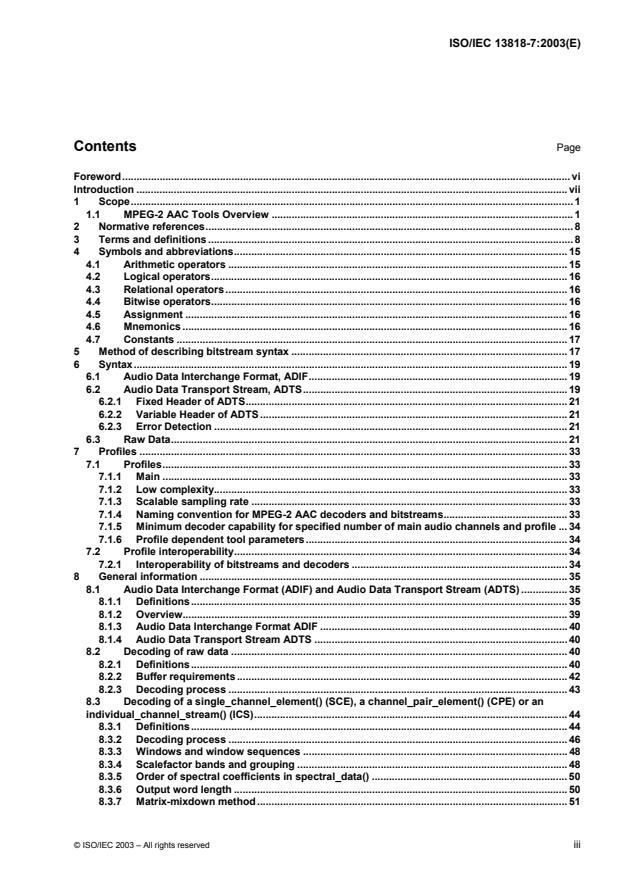
Contents Page
Foreword. vi
Introduction . vii
1 Scope. 1
1.1 MPEG-2 AAC Tools Overview . 1
2 Normative references. 8
3 Terms and definitions . 8
4 Symbols and abbreviations. 15
4.1 Arithmetic operators. 15
4.2 Logical operators. 16
4.3 Relational operators. 16
4.4 Bitwise operators. 16
4.5 Assignment. 16
4.6 Mnemonics. 16
4.7 Constants. 17
5 Method of describing bitstream syntax . 17
6 Syntax. 19
6.1 Audio Data Interchange Format, ADIF. 19
6.2 Audio Data Transport Stream, ADTS. 19
6.2.1 Fixed Header of ADTS. 21
6.2.2 Variable Header of ADTS. 21
6.2.3 Error Detection. 21
6.3 Raw Data. 21
7 Profiles. 33
7.1 Profiles. 33
7.1.1 Main. 33
7.1.2 Low complexity. 33
7.1.3 Scalable sampling rate . 33
7.1.4 Naming convention for MPEG-2 AAC decoders and bitstreams. 33
7.1.5 Minimum decoder capability for specified number of main audio channels and profile . 34
7.1.6 Profile dependent tool parameters. 34
7.2 Profile interoperability. 34
7.2.1 Interoperability of bitstreams and decoders . 34
8 General information. 35
8.1 Audio Data Interchange Format (ADIF) and Audio Data Transport Stream (ADTS) . 35
8.1.1 Definitions. 35
8.1.2 Overview. 39
8.1.3 Audio Data Interchange Format ADIF . 40
8.1.4 Audio Data Transport Stream ADTS . 40
8.2 Decoding of raw data . 40
8.2.1 Definitions. 40
8.2.2 Buffer requirements. 42
8.2.3 Decoding process. 43
8.3 Decoding of a single_channel_element() (SCE), a channel_pair_element() (CPE) or an
individual_channel_stream() (ICS). 44
8.3.1 Definitions. 44
8.3.2 Decoding process. 46
8.3.3 Windows and window sequences . 48
8.3.4 Scalefactor bands and grouping . 48
8.3.5 Order of spectral coefficients in spectral_data() . 50
8.3.6 Output word length. 50
8.3.7 Matrix-mixdown method. 51
© ISO/IEC 2003 – All rights reserved iii
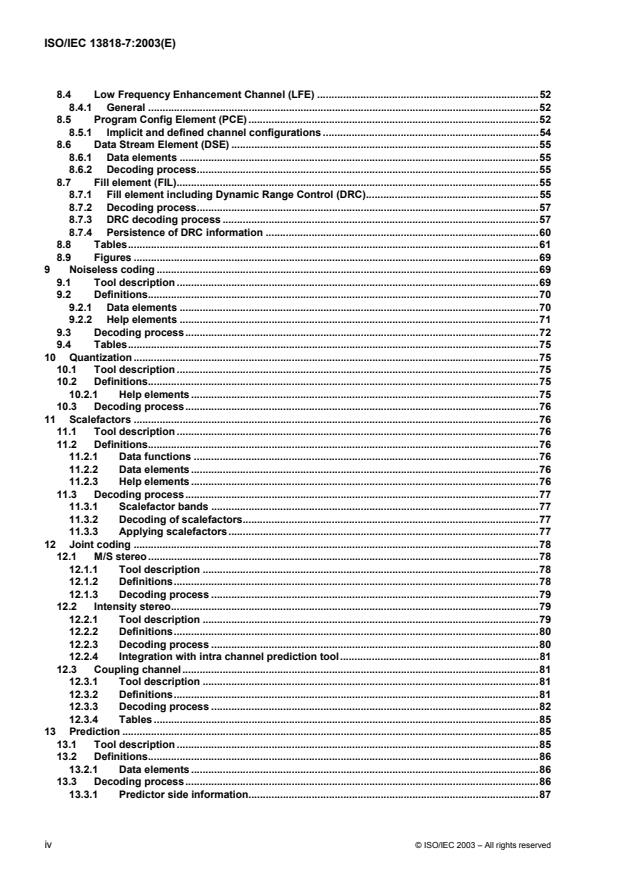
8.4 Low Frequency Enhancement Channel (LFE) .52
8.4.1 General.52
8.5 Program Config Element (PCE).52
8.5.1 Implicit and defined channel configurations .54
8.6 Data Stream Element (DSE) .55
8.6.1 Data elements.55
8.6.2 Decoding process.55
8.7 Fill element (FIL).55
8.7.1 Fill element including Dynamic Range Control (DRC).55
8.7.2 Decoding process.57
8.7.3 DRC decoding process .57
8.7.4 Persistence of DRC information .60
8.8 Tables.61
8.9 Figures.69
9 Noiseless coding.69
9.1 Tool description.69
9.2 Definitions.70
9.2.1 Data elements.70
9.2.2 Help elements.71
9.3 Decoding process.72
9.4 Tables.75
10 Quantization.75
10.1 Tool description.75
10.2 Definitions.75
10.2.1 Help elements.75
10.3 Decoding process.76
11 Scalefactors.76
11.1 Tool description.76
11.2 Definitions.76
11.2.1 Data functions.76
11.2.2 Data elements.76
11.2.3 Help elements.76
11.3 Decoding process.77
11.3.1 Scalefactor bands.77
11.3.2 Decoding of scalefactors.77
11.3.3 Applying scalefactors.77
12 Joint coding.78
12.1 M/S stereo.78
12.1.1 Tool description.78
12.1.2 Definitions.78
12.1.3 Decoding process.79
12.2 Intensity stereo.79
12.2.1 Tool description.79
12.2.2 Definitions.80
12.2.3 Decoding process.80
12.2.4 Integration with intra channel prediction tool.81
12.3 Coupling channel.81
12.3.1 Tool description.81
12.3.2 Definitions.81
12.3.3 Decoding process.82
12.3.4 Tables.85
13 Prediction.85
13.1 Tool description.85
13.2 Definitions.86
13.2.1 Data elements.86
13.3 Decoding process.86
13.3.1 Predictor side information.87
iv © ISO/IEC 2003 – All rights reserved
13.3.2 Predictor processing. 87
13.3.3 Predictor reset. 91
13.4 Diagrams. 92
14 Temporal Noise Shaping (TNS). 93
14.1 Tool description. 93
14.2 Definitions. 93
14.2.1 Data elements. 93
14.3 Decoding process. 94
15 Filterbank and block switching. 96
15.1 Tool description. 96
15.2 Definitions. 96
15.2.1 Data elements. 96
15.3 Decoding process. 96
15.3.1 IMDCT. 96
15.3.2 Windowing and block switching . 97
15.3.3 Overlapping and adding with previous window sequence . 100
16 Gain control. 100
16.1 Tool description. 100
16.2 Definitions. 101
16.2.1 Data elements. 101
16.2.2 Help elements. 101
16.3 Decoding process. 102
16.3.1 Gain control data decoding . 102
16.3.2 Gain control function setting. 103
16.3.3 Gain control windowing and overlapping . 105
16.3.4 Synthesis filter. 106
16.4 Diagrams. 107
16.5 Tables. 107
Annex A (normative) Huffman Codebook Tables . 109
Annex B (informative) Information on unused codebooks. 129
Annex C (informative) Encoder. 130
C.1 Psychoacoustic model. 130
C.2 Gain control. 165
C.3 Filterbank and block switching . 166
C.4 Prediction. 168
C.5 Temporal Noise Shaping (TNS). 171
C.6 Joint coding. 173
C.7 Quantization. 175
C.8 Noiseless coding. 181
Annex D (informative) Patent holders . 184
D.1 List of patent holders . 184
Annex E (informative) Registration procedure . 185
E.1 Procedure for the request of a Registered Identifier (RID). 185
E.2 Responsibilities of the Registration Authority . 185
E.3 Contact information of the Registration Authority. 185
E.4 Responsibilities of parties requesting an RID. 185
E.5 Appeal procedure for denied applications. 186
Annex F (informative) Registration application form. 187
Annex G (informative) Registration Authority. 188
Bibliography . 189
© ISO/IEC 2003 – All rights reserved v
Foreword
ISO (the International Organization for Standardization) and IEC (the International Electrotechnical
Commission) form the specialized system for worldwide standardization. National bodies that are members of
ISO or IEC participate in the development of International Standards through technical committees
established by the respective organization to deal with particular fields of technical activity. ISO and IEC
technical committees collaborate in fields of mutual interest. Other international organizations, governmental
and non-governmental, in liaison with ISO and IEC, also take part in the work. In the field of information
technology, ISO and IEC have established a joint technical committee, ISO/IEC JTC 1.
International Standards are drafted in accordance with the rules given in the ISO/IEC Directives, Part 2.
The main task of the joint technical committee is to prepare International Standards. Draft International
Standards adopted by the joint technical committee are circulated to national bodies for voting. Publication as
an International Standard requires approval by at least 75 % of the national bodies casting a vote.
ISO/IEC 13818-7 was prepared by Joint Technical Committee ISO/IEC JTC 1, Information technology,
Subcommittee SC 29, Coding of audio, picture, multimedia and hypermedia information.
This second edition cancels and replaces the first edition (ISO/IEC 13818-7:1997), which has been technically
revised.
ISO/IEC 13818 consists of the following parts, under the general title Information technology — Generic
coding of moving pictures and associated audio information:
― Part 1: Systems
― Part 2: Video
― Part 3: Audio
― Part 4: Conformance testing
― Part 5: Software simulation
― Part 6: Extensions for DSM-CC
― Part 7: Advanced Audio Coding (AAC)
― Part 9: Extension for real time interface for systems decoders
― Part 10: Conformance extensions for Digital Storage Media Command and Control (DSM-CC)
― Part 11: IPMP on MPEG-2 systems
vi © ISO/IEC 2003 – All rights reserved
Introduction
The standardization body ISO/IEC JTC 1/SC 29/WG 11, also known as the Moving Pictures Experts Group
(MPEG), was established in 1988 to specify digital video and audio coding schemes at low data rates. MPEG
completed its first phase of audio specifications (MPEG-1) in November 1992, ISO/IEC 11172-3. In its second
phase of development, the MPEG Audio subgroup defined a multichannel extension to MPEG-1 audio that is
backwards compatible with existing MPEG-1 systems (MPEG-2 BC) and defined an audio coding standard at
lower sampling frequencies than MPEG-1, ISO/IEC 13818-3.
© ISO/IEC 2003 – All rights reserved vii
INTERNATIONAL STANDARD ISO/IEC 13818-7:2003(E)
Information technology — Generic coding of moving pictures
and associated audio information —
Part 7:
Advanced Audio Coding (AAC)
1 Scope
This International Standard describes the MPEG-2 audio non-backwards compatible standard called
MPEG-2 Advanced Audio Coding, AAC [1], a higher quality multichannel standard than achievable
while requiring MPEG-1 backwards compatibility. This MPEG-2 AAC audio standard allows for
ITU-R ‘indistinguishable’ quality according to [2] at data rates of 320 kbit/s for five full-bandwidth
channel audio signals.
The AAC decoding process makes use of a number of required tools and a number of optional tools.
Table 1 lists the tools and their status as required or optional. Required tools are mandatory in any
possible profile. Optional tools may not be required in some profiles.
Table 1 — AAC decoder tools
Tool Name Required / Optional
Bitstream Formatter Required
Noiseless Decoding Required
Inverse quantization Required
Rescaling Required
M/S Optional
Prediction Optional
Intensity Optional
Dependently switched coupling Optional
TNS Optional
Filterbank / block switching Required
Gain control Optional
Independently switched coupling Optional
1.1 MPEG-2 AAC Tools Overview
The basic structure of the MPEG-2 AAC system is shown in Figure 1 and Figure 2. As is shown in
Table 1, there are both required and optional tools in the decoder. The data flow in this diagram is
from left to right, top to bottom. The functions of the decoder are to find the description of the
quantized audio spectra in the bitstream, decode the quantized values and other reconstruction
information, reconstruct the quantized spectra, process the reconstructed spectra through whatever
tools are active in the bitstream in order to arrive at the actual signal spectra as described by the input
bitstream, and finally convert the frequency domain spectra to the time domain, with or without an
optional gain control tool. Following the initial reconstruction and scaling of the spectrum
reconstruction, there are many optional tools that modify one or more of the spectra in order to
provide more efficient coding. For each of the optional tools that operate in the spectral domain, the
option to “pass through” is retained, and in all cases where a spectral operation is omitted, the spectra
at its input are passed directly through the tool without modification.
The input to the bitstream demultiplexer tool is the MPEG-2 AAC bitstream. The demultiplexer
separates the parts of the MPEG-AAC data stream into the parts for each tool, and provides each of
the tools with the bitstream information related to that tool.
© ISO/IEC 2003 – All rights reserved 1
The outputs from the bitstream demultiplexer tool are:
• The sectioning information for the noiselessly coded spectra
• The noiselessly coded spectra
• The M/S decision information (optional)
• The predictor state information (optional)
• The intensity stereo control information and coupling channel control information (both
optional)
• The temporal noise shaping (TNS) information (optional)
• The filterbank control information
• The gain control information (optional)
The noiseless decoding tool takes information from the bitstream demultiplexer, parses that
information, decodes the Huffman coded data, and reconstructs the quantized spectra and the
Huffman and DPCM coded scalefactors.
The inputs to the noiseless decoding tool are:
• The sectioning information for the noiselessly coded spectra
• The noiselessly coded spectra
The outputs of the Noiseless Decoding tool are:
• The decoded integer representation of the scalefactors:
• The quantized values for the spectra
The inverse quantizer tool takes the quantized values for the spectra, and converts the integer values
to the non-scaled, reconstructed spectra. This quantizer is a non-uniform quantizer.
The input to the Inverse Quantizer tool is:
• The quantized values for the spectra
The output of the inverse quantizer tool is:
• The un-scaled, inversely quantized spectra
The rescaling tool converts the integer representation of the scalefactors to the actual values, and
multiplies the un-scaled inversely quantized spectra by the relevant scalefactors.
The inputs to the rescaling tool are:
• The decoded integer representation of the scalefactors
• The un-scaled, inversely quantized spectra
The output from the scalefactors tool is:
• The scaled, inversely quantized spectra
2 © ISO/IEC 2003 – All rights reserved
The M/S tool converts spectra pairs from Mid/Side to Left/Right under control of the M/S decision
information in order to improve coding efficiency.
The inputs to the M/S tool are:
• The M/S decision information
• The scaled, inversely quantized spectra related to pairs of channels
The output from the M/S tool is:
• The scaled, inversely quantized spectra related to pairs of channels, after M/S decoding
NOTE The scaled, inversely quantized spectra of individually coded channels are not processed by the M/S block, rather they are
passed directly through the block without modification. If the M/S block is not active, all spectra are passed through this block
unmodified.
The prediction tool reverses the prediction process carried out at the encoder. This prediction process
re-inserts the redundancy that was extracted by the prediction tool at the encoder, under the control
of the predictor state information. This tool is implemented as a second order backward adaptive
predictor. The inputs to the prediction tool are:
• The predictor state information
• The scaled, inversely quantized spectra
The output from the prediction tool is:
• The scaled, inversely quantized spectra, after prediction is applied.
NOTE If the prediction is disabled, the scaled, inversely quantized spectra are passed directly through the block without
modification.
The intensity stereo tool implements intensity stereo decoding on pairs of spectra.
The inputs to the intensity stereo tool are:
• The inversely quantized spectra
• The intensity stereo control information
The output from the intensity stereo tool is:
• The inversely quantized spectra after intensity channel decoding.
NOTE The scaled, inversely quantized spectra of individually coded channels are passed directly through this tool without
modification, if intensity stereo is not indicated. The intensity stereo tool and M/S tool are arranged so that the operation of M/S and
intensity stereo are mutually exclusive on any given scalefactor band and group of one pair of spectra.
The coupling tool for dependently switched coupling channels adds the relevant data from
dependently switched coupling channels to the spectra, as directed by the coupling control
information.
The inputs to the coupling tool are:
• The inversely quantized spectra
• The coupling control information
© ISO/IEC 2003 – All rights reserved 3
The output from the coupling tool is:
• The inversely quantized spectra coupled with the dependently switched coupling channels.
NOTE The scaled, inversely quantized spectra are passed directly through this tool without modification, if coupling is not
indicated. Depending on the coupling control information, dependently switched coupling channels might either be coupled before or
after the TNS processing.
The coupling tool for independently switched coupling channels adds the relevant data from
independently switched coupling channels to the time signal, as directed by the coupling control
information.
The inputs to the coupling tool are:
• The time signal as output by the filterbank
• The coupling control information
The output from the coupling tool is:
• The time signal coupled with the independently switched coupling channels.
NOTE The time signal is passed directly through this tool without modification, if coupling is not indicated.
The temporal noise shaping (TNS) tool implements a control of the fine time structure of the coding
noise. In the encoder, the TNS process has flattened the temporal envelope of the signal to which it
has been applied. In the decoder, the inverse process is used to restore the actual temporal
envelope(s), under control of the TNS information. This is done by applying a filtering process to
parts of the spectral data.
The inputs to the TNS tool are:
• The inversely quantized spectra
• The TNS information
The output from the TNS block is:
• The inversely quantized spectra
NOTE If this block is disabled, the inversely quantized spectra are passed through without modification.
The filterbank / block switching tool applies the inverse of the frequency mapping that was carried
out in the encoder. An inverse modified discrete cosine transform (IMDCT) is used for the filterbank
tool. The IMDCT can be configured to support either one set of 128 or 1024, or four sets of 32 or
256 spectral coefficients.
The inputs to the filterbank tool are:
• The inversely quantized spectra
• The filterbank control information
The output(s) from the filterbank tool is (are):
• The time domain reconstructed audio signal(s).
4 © ISO/IEC 2003 – All rights reserved
When present, the gain control tool applies a separate time domain gain control to each of 4
frequency bands that have been created by the gain control PQF filterbank in the encoder. Then, it
assembles the 4 frequency bands and reconstructs the time waveform through the gain control tool’s
filterbank.
The inputs to the gain control tool are:
• The time domain reconstructed audio signal(s)
• The gain control information
The output(s) from the gain control tool is (are):
• The time domain reconstructed audio signal(s)
If the gain control tool is not active, the time domain reconstructed audio signal(s) are passed directly
from the filterbank tool to the output of the decoder. This tool is used for the scalable sampling rate
(SSR) profile only.
© ISO/IEC 2003 – All rights reserved 5
input time signal
Legend:
data
control
AAC
gain control
psychoacoustic
model
window length block
decision switching
filterbank
threshold
TNS
calculation
coded
audio
intensity
stream
bitstream
formatter
spectral
prediction
processing
M/S
scaling
quantization
quantization
and noiseless
coding
Huffman coding
Figure 1 — MPEG-2 AAC Encoder Block Diagram
6 © ISO/IEC 2003 – All rights reserved
Legend:
data
control
Huffman decoding
noiseless
inverse
decoding and
quantization
inverse
quantization
rescaling
M/S
bitstream
deformatter
prediction
coded
audio
intensity
stream
spectral
dependently
processing
switched
coupling
TNS
dependently
switched
coupling
block
switching
filterbank
AAC
gain control
output
time
signal
independently
switched
coupling
Figure 2 — MPEG-2 AAC Decoder Block Diagram
© ISO/IEC 2003 – All rights reserved 7
2 Normative references
The following referenced documents are indispensable for the application of this document. For
dated references, only the edition cited applies. For undated references, the latest edition of the
referenced document (including any amendments) applies.
ISO/IEC 11172-3:1993, Information technology — Coding of moving pictures and associated audio
for digital storage media at up to about 1,5 Mbit/s — Part 3: Audio
ISO/IEC 13818-1:2000, Information technology — Generic coding of moving pictures and
associated audio information: Systems
ISO/IEC 13818-3:1998, Information technology — Generic coding of moving pictures and
associated audio information — Part 3: Audio
ISO/IEC 14496-3:2001, Information technology — Coding of audio-visual objects — Part 3: Audio
3 Terms and definitions
For the purposes of this document, the following terms and definitions apply.
3.1
access unit
in the case of compressed audio an access unit is an audio access unit
3.2
alias
mirrored signal component resulting from sampling
3.3
analysis filterbank
filterbank in the encoder that transforms a broadband PCM audio signal into a set of spectral
coefficients
3.4
ancillary data
part of the bitstream that might be used for transmission of ancillary data
3.5
audio access unit
for AAC, an audio access unit is defined as the smallest part of the encoded bitstream which can be
decoded by itself, where decoded means "fully reconstructed sound". Typically this is a segment of
the encoded bitstream starting after the end of the byte containing the last bit of one ID_END
id_syn_ele() through the end of the byte containing the last bit of the next ID_END id_syn_ele
3.6
audio buffer
a buffer in the system target decoder (see ISO/IEC 13818-1) for storage of compressed audio data
3.7
Bark
the Bark is the standard unit corresponding to one critical band width of human hearing
3.8
backward compatibility
a newer coding standard is backward compatible with an older coding standard if decoders designed
to operate with the older coding standard are able to continue to operate by decoding all or part of a
bitstream produced according to the newer coding standard
3.9
bitrate
the rate at which the compressed bitstream is delivered to the input of a decoder
8 © ISO/IEC 2003 – All rights reserved
3.10
bitstream; stream
an ordered series of bits that forms the coded representation of the data
3.11
bitstream verifier
a process by which it is possible to test and verify that all the requirements specified in this part of
ISO/IEC 13818 are met by the bitstream
3.12
block companding
normalising of the digital representation of an audio signal within a certain time period
3.13
byte aligned
a bit in a coded bitstream is byte-aligned if its position is a multiple of 8-bits from either the first bit
in the stream for the Audio Data Interchange Format (see subclause 6.1) or the first bit in the
syncword for the Audio Data Transport Stream Format (see subclause 6.2)
3.14
byte
sequence of 8-bits
3.15
centre channel
an audio presentation channel used to stabilise the central component of the frontal stereo image
3.16
channel
a sequence of data representing an audio signal intended to be reproduced at one listening position
3.17
coded audio bitstream
a coded representation of an audio signal
3.18
coded representation
a data element as represented in its encoded form
3.19
compression
reduction in the number of bits used to represent an item of data
3.20
constant bitrate
operation where the bitrate is constant from start to finish of the coded bitstream
3.21
CRC
the Cyclic Redundancy Check to verify the correctness of data
3.22
critical band
this unit of bandwidth represents the standard unit of bandwidth expressed in human auditory terms,
corresponding to a fixed length on the human cochlea. It is approximately equal to 100 Hz at low
frequencies and 1/3 octave at higher frequencies, above approximately 700 Hz
© ISO/IEC 2003 – All rights reserved 9
3.23
data element
an item of data as represented before encoding and after decoding
3.24
decoded stream
the decoded reconstruction of a compressed bitstream
3.25
decoder
an embodiment of a decoding process
3.26
decoding (process)
the process defined in this part of ISO/IEC 13818 that reads an input coded bitstream and outputs
decoded audio samples
3.27
digital storage media; DSM
a digital storage or transmission device or system
3.28
discrete cosine transform; DCT
either the forward discrete cosine transform or the inverse discrete cosine transform. The DCT is an
invertible, discrete orthogonal transformation
3.29
downmix
a matrixing of n channels to obtain less than n channels
3.30
editing
the process by which one or more coded bitstreams are manipulated to produce a new coded
bitstream. Conforming edited bitstreams must meet the requirements defined in this part of
ISO/IEC 13818
3.31
encoder
an embodiment of an encoding process
3.32
encoding (process)
a
...
Questions, Comments and Discussion
Ask us and Technical Secretary will try to provide an answer. You can facilitate discussion about the standard in here.
Loading comments...