

ISO/IEC 23006-3:2016
(Main)Information technology — Multimedia service platform technologies — Part 3: Conformance and reference software
General Information
- Abstract
ISO/IEC 23006-3:2016 describes the reference software implementing the normative clauses of ISO/IEC 23006‑1, ISO/IEC 23006‑2 and ISO/IEC 23006‑4 and specifies conformance criteria. The information provided are applicable for determining the reference software modules available for ISO/IEC 23006‑1, understanding the functionality of the available reference software modules and utilizing the available reference software modules. The conformance profiles are applicable to MPEG-M Services as defined in ISO/IEC 23006‑4 and in ISO/IEC 23006‑5.
- Status
- Published
- Publication Date
- 04-Dec-2016
- Current Stage
- 9060 - Close of review
- Completion Date
- 04-Jun-2027
Buy Documents

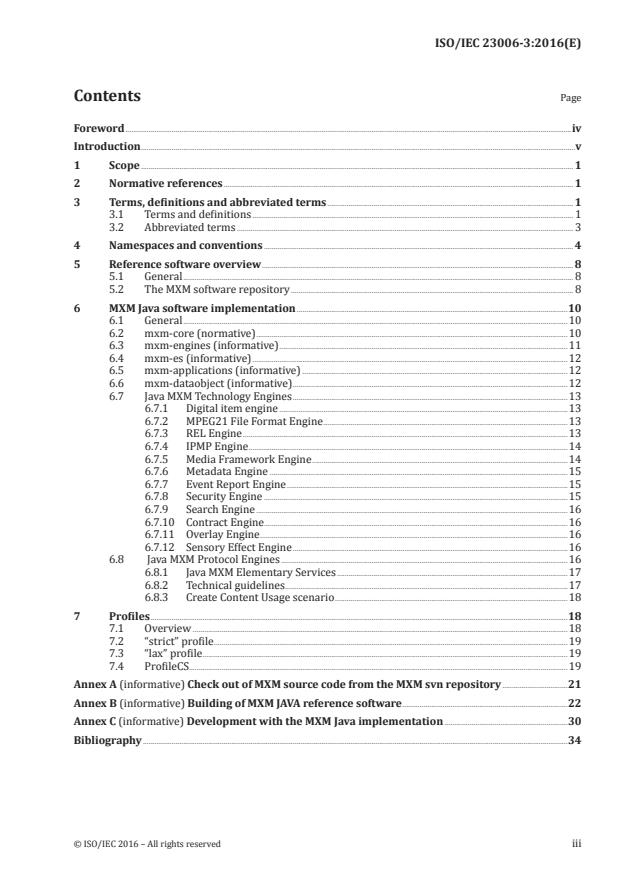

ISO/IEC 23006-3:2016 - Information technology -- Multimedia service platform technologies

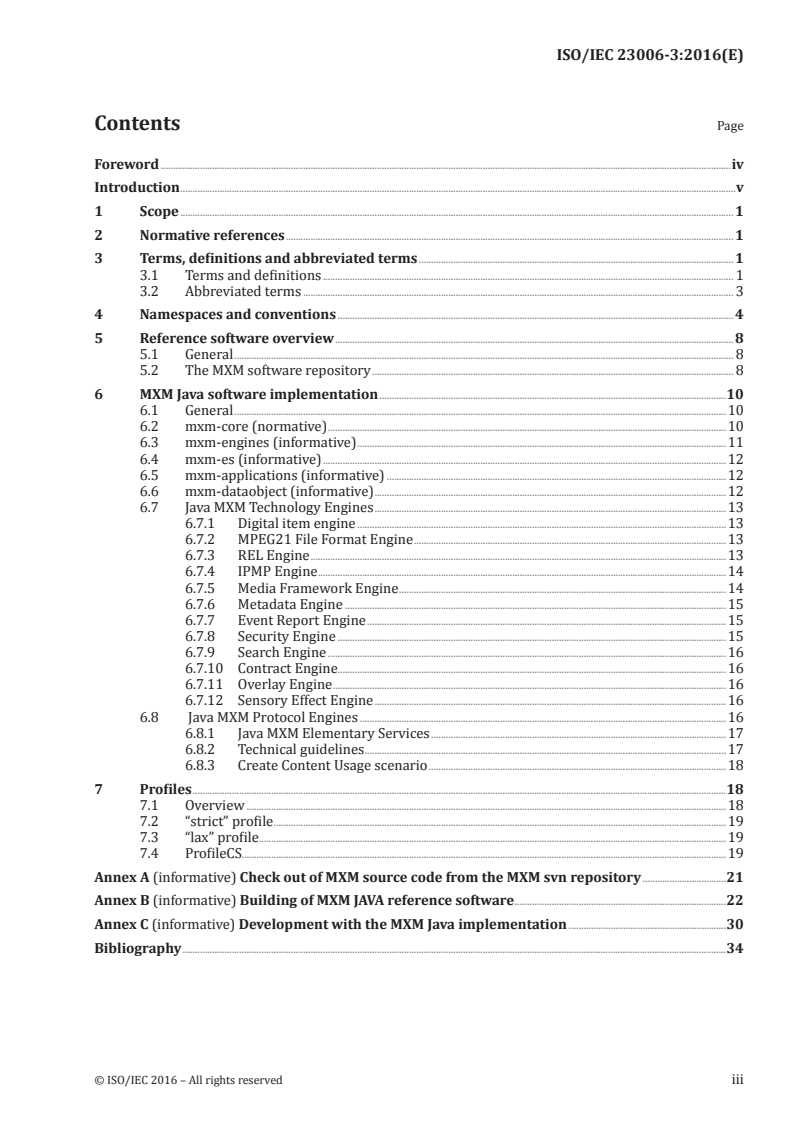

ISO/IEC 23006-3:2016 - Information technology — Multimedia service platform technologies — Part 3: Conformance and reference software/5/2016
Overview
ISO/IEC 23006-3:2016 - Information technology - Multimedia service platform technologies - Part 3: Conformance and reference software - defines the reference software and conformance criteria for the MPEG-M / MXM (MPEG Extensible Middleware) family. The standard documents the software modules that implement the normative clauses of ISO/IEC 23006‑1 (architecture), ISO/IEC 23006‑2 (MXM API) and ISO/IEC 23006‑4 (elementary services), and describes how to use and test those reference modules. Conformance profiles in this part apply to MPEG‑M Services as specified in ISO/IEC 23006‑4 and ISO/IEC 23006‑5.
Key Topics and Technical Requirements
- Reference software repository: Describes the MXM software repository and the organization of reference modules for implementers.
- MXM Java implementation: Details the Java reference implementation structure including:
- mxm-core (normative): core APIs and mandatory behavior.
- mxm-engines, mxm-es, mxm-applications, mxm-dataobject (informative): engine implementations, elementary services, example applications, and data object support.
- MPEG‑M Engines: Defines modular engine categories implemented in reference software (e.g., Digital Item, MPEG‑21 File Format, REL/Rights, IPMP, Media Framework, Metadata, Event Report, Security, Search, Contract, Overlay, Sensory Effect).
- Protocol engines and elementary services: Guidance for Java protocol engines and elementary service implementations consistent with ISO/IEC 23006‑4.
- Conformance profiles: Defines profiles such as “strict”, “lax” and ProfileCS to classify device/service conformance and interoperability expectations.
- Normative vs informative material: Clarifies which reference modules have normative status for conformance testing and which are provided as informative examples or development aids.
Practical Applications and Users
ISO/IEC 23006-3 is intended for:
- Middleware and platform developers building MXM-compliant MPEG‑M devices and services.
- Device manufacturers integrating MXM Engines and verifying conformance.
- Service providers and system integrators implementing interoperable multimedia value chains.
- Conformance test labs and QA teams using the reference software to validate implementations.
- Researchers and developers seeking a reference Java implementation and examples for prototyping MXM APIs and elementary services.
Practical uses include implementing interoperable multimedia middleware, validating engine APIs, assembling aggregated services from elementary services, and running reference-based conformance tests.
Related Standards
- ISO/IEC 23006-1: Architecture (MXM)
- ISO/IEC 23006-2: MXM API
- ISO/IEC 23006-4: Elementary services (MPEG‑M Services)
- ISO/IEC 23006-5: Service aggregation
- Related MPEG standards such as ISO/IEC 21000 (MPEG‑21) and ISO/IEC 23000 (MPEG‑A) are referenced for context and interoperability.
Keywords: ISO/IEC 23006-3, MXM, MPEG‑M, reference software, conformance, MXM Java, elementary services, middleware, MPEG‑M Engines.
Relations
- Effective Date
- 06-Jun-2022
- Effective Date
- 05-Nov-2015
Buy Documents
ISO/IEC 23006-3:2016 - Information technology -- Multimedia service platform technologies
ISO/IEC 23006-3:2016 - Information technology — Multimedia service platform technologies — Part 3: Conformance and reference software/5/2016
Get Certified
Connect with accredited certification bodies for this standard

BSI Group
BSI (British Standards Institution) is the business standards company that helps organizations make excellence a habit.

NYCE
Mexican standards and certification body.
Sponsored listings
Frequently Asked Questions
ISO/IEC 23006-3:2016 is a standard published by the International Organization for Standardization (ISO). Its full title is "Information technology — Multimedia service platform technologies — Part 3: Conformance and reference software". This standard covers: ISO/IEC 23006-3:2016 describes the reference software implementing the normative clauses of ISO/IEC 23006‑1, ISO/IEC 23006‑2 and ISO/IEC 23006‑4 and specifies conformance criteria. The information provided are applicable for determining the reference software modules available for ISO/IEC 23006‑1, understanding the functionality of the available reference software modules and utilizing the available reference software modules. The conformance profiles are applicable to MPEG-M Services as defined in ISO/IEC 23006‑4 and in ISO/IEC 23006‑5.
ISO/IEC 23006-3:2016 describes the reference software implementing the normative clauses of ISO/IEC 23006‑1, ISO/IEC 23006‑2 and ISO/IEC 23006‑4 and specifies conformance criteria. The information provided are applicable for determining the reference software modules available for ISO/IEC 23006‑1, understanding the functionality of the available reference software modules and utilizing the available reference software modules. The conformance profiles are applicable to MPEG-M Services as defined in ISO/IEC 23006‑4 and in ISO/IEC 23006‑5.
ISO/IEC 23006-3:2016 is classified under the following ICS (International Classification for Standards) categories: 35.040 - Information coding; 35.040.40 - Coding of audio, video, multimedia and hypermedia information. The ICS classification helps identify the subject area and facilitates finding related standards.
ISO/IEC 23006-3:2016 has the following relationships with other standards: It is inter standard links to ISO 15213-1:2023, ISO/IEC 23006-3:2013. Understanding these relationships helps ensure you are using the most current and applicable version of the standard.
ISO/IEC 23006-3:2016 is available in PDF format for immediate download after purchase. The document can be added to your cart and obtained through the secure checkout process. Digital delivery ensures instant access to the complete standard document.
Standards Content (Sample)
INTERNATIONAL ISO/IEC
STANDARD 23006-3
Third edition
2016-12-01
Information technology — Multimedia
service platform technologies —
Part 3:
Conformance and reference software
Technologies de l’information — Technologies de la plate-forme de
services multimédia —
Partie 3: Conformité et logiciel de référence
Reference number
©
ISO/IEC 2016
© ISO/IEC 2016, Published in Switzerland
All rights reserved. Unless otherwise specified, no part of this publication may be reproduced or utilized otherwise in any form
or by any means, electronic or mechanical, including photocopying, or posting on the internet or an intranet, without prior
written permission. Permission can be requested from either ISO at the address below or ISO’s member body in the country of
the requester.
ISO copyright office
Ch. de Blandonnet 8 • CP 401
CH-1214 Vernier, Geneva, Switzerland
Tel. +41 22 749 01 11
Fax +41 22 749 09 47
copyright@iso.org
www.iso.org
ii © ISO/IEC 2016 – All rights reserved
Contents Page
Foreword .iv
Introduction .v
1 Scope . 1
2 Normative references . 1
3 Terms, definitions and abbreviated terms . 1
3.1 Terms and definitions . 1
3.2 Abbreviated terms . 3
4 Namespaces and conventions . 4
5 Reference software overview . 8
5.1 General . 8
5.2 The MXM software repository . 8
6 MXM Java software implementation .10
6.1 General .10
6.2 mxm-core (normative) .10
6.3 mxm-engines (informative) .11
6.4 mxm-es (informative) .12
6.5 mxm-applications (informative) .12
6.6 mxm-dataobject (informative) .12
6.7 Java MXM Technology Engines .13
6.7.1 Digital item engine .13
6.7.2 MPEG21 File Format Engine .13
6.7.3 REL Engine .13
6.7.4 IPMP Engine .14
6.7.5 Media Framework Engine .14
6.7.6 Metadata Engine .15
6.7.7 Event Report Engine .15
6.7.8 Security Engine .15
6.7.9 Search Engine .16
6.7.10 Contract Engine.16
6.7.11 Overlay Engine .16
6.7.12 Sensory Effect Engine .16
6.8 Java MXM Protocol Engines .16
6.8.1 Java MXM Elementary Services .17
6.8.2 Technical guidelines .17
6.8.3 Create Content Usage scenario .18
7 Profiles .18
7.1 Overview .18
7.2 “strict” profile .19
7.3 “lax” profile .19
7.4 ProfileCS.19
Annex A (informative) Check out of MXM source code from the MXM svn repository .21
Annex B (informative) Building of MXM JAVA reference software .22
Annex C (informative) Development with the MXM Java implementation .30
Bibliography .34
© ISO/IEC 2016 – All rights reserved iii
Foreword
ISO (the International Organization for Standardization) and IEC (the International Electrotechnical
Commission) form the specialized system for worldwide standardization. National bodies that are
members of ISO or IEC participate in the development of International Standards through technical
committees established by the respective organization to deal with particular fields of technical
activity. ISO and IEC technical committees collaborate in fields of mutual interest. Other international
organizations, governmental and non-governmental, in liaison with ISO and IEC, also take part in the
work. In the field of information technology, ISO and IEC have established a joint technical committee,
ISO/IEC JTC 1.
The procedures used to develop this document and those intended for its further maintenance are
described in the ISO/IEC Directives, Part 1. In particular the different approval criteria needed for the
different types of ISO documents should be noted. This document was drafted in accordance with the
editorial rules of the ISO/IEC Directives, Part 2 (see www.iso.org/directives).
Attention is drawn to the possibility that some of the elements of this document may be the subject of
patent rights. ISO shall not be held responsible for identifying any or all such patent rights. Details of
any patent rights identified during the development of the document will be in the Introduction and/or
on the ISO list of patent declarations received (see www.iso.org/patents).
Any trade name used in this document is information given for the convenience of users and does not
constitute an endorsement.
For an explanation on the meaning of ISO specific terms and expressions related to conformity assessment,
as well as information about ISO’s adherence to the World Trade Organization (WTO) principles in the
Technical Barriers to Trade (TBT) see the following URL: www.iso.org/iso/foreword.html.
The committee responsible for this document is ISO/IEC JTC 1, Information technology, SC 29, Coding of
audio, picture, multimedia and hypermedia information.
This third edition cancels and replaces the second edition (ISO/IEC 23006-3:2013), which has been
technically revised.
A list of all parts in the ISO/IEC 23006 series can be found on the ISO website.
iv © ISO/IEC 2016 – All rights reserved
Introduction
The ISO/IEC 23006 series is a suite of standards that has been developed for the purpose of enabling the
easy design and implementation of media-handling value chains whose devices interoperate because
they are all based on the same set of technologies, especially MPEG technologies, accessible from the
middleware APIs, elementary services and aggregated services.
The ISO/IEC 23006 series is referred to as MPEG Extensible Middleware (MXM) in its first edition, and
it specifies an architecture (ISO/IEC 23006-1), an API (ISO/IEC 23006-2), a conformance and reference
software (ISO/IEC 23006-3) and a set of protocols which MXM Devices had to adhere (ISO/IEC 23006-
4). It specifies also how to combine elementary services into aggregated services (ISO/IEC 23006-5).
The ISO/IEC 23006 series is subdivided in five parts:
Part 1 — Architecture: specifies the architecture that can be used as a guide to an MPEG-M
implementation;
Part 2 — MPEG Extensible Middleware (MXM) Application Programming Interface (APIs): specifies the
middleware APIs;
Part 3 — Conformance and Reference Software (the present document): specifies conformance criteria
and a reference software implementation with a normative value;
Part 4 — Elementary Services: specifies elementary service protocols between MPEG-M applications;
Part 5 — Service Aggregation: specifies mechanisms enabling the combination of Elementary Services
and other services to build Aggregated Services.
© ISO/IEC 2016 – All rights reserved v
INTERNATIONAL STANDARD ISO/IEC 23006-3:2016(E)
Information technology — Multimedia service platform
technologies —
Part 3:
Conformance and reference software
1 Scope
This document describes the reference software implementing the normative clauses of ISO/IEC 23006-
1, ISO/IEC 23006-2 and ISO/IEC 23006-4 and specifies conformance criteria. The information provided
are applicable for determining the reference software modules available for ISO/IEC 23006-1,
understanding the functionality of the available reference software modules and utilizing the available
reference software modules.
The conformance profiles are applicable to MPEG-M Services as defined in ISO/IEC 23006-4 and in
ISO/IEC 23006-5.
2 Normative references
The following documents are referred to in the text in such a way that some or all of their content
constitutes requirements of this document. For dated references, only the edition cited applies. For
undated references, the latest edition of the referenced document (including any amendments) applies.
ISO/IEC 23006-2:2016, Information technology — MPEG-M (Multimedia Service Platform Technologies) —
Part 2: MPEG extensible middleware (MXM) API
ISO/IEC 23006-4:2013, Information technology — MPEG-M (Multimedia Service Platform Technologies) —
Part 4: Elementary services
3 Terms, definitions and abbreviated terms
3.1 Terms and definitions
For the purposes of this document, the following terms and definitions apply.
ISO and IEC maintain terminological databases for use in standardization at the following addresses:
— IEC Electropedia: available at http://www.electropedia.org/
— ISO Online browsing platform: available at http://www.iso.org/obp
3.1.1
Aggregated Service
service resulting from the combination of Elementary Services (3.1.2)
3.1.2
Elementary Service
basic unit of service (3.1.13)
3.1.3
content
Digital Item and its component elements, namely resources (e.g. media, scripts, executable), identifiers,
descriptions (e.g. metadata), event reports
© ISO/IEC 2016 – All rights reserved 1
3.1.4
contract
set of metadata, license (3.1.8), promises and signers agreed by users of a multimedia value chain, where
a promise is a signed collection of statements about, e.g. obligations, prohibitions and assertions, and a
signer is a user (3.1.15) whose signature makes the contract valid
3.1.5
device
hardware/software or simply software apparatus that enables a user (3.1.15) to play a role in
multimedia value chains (3.1.16)
3.1.6
event
performance of a specified set of functions or operations
3.1.7
entity
one of the following elements in the multimedia value chain: content (3.1.3), contract (3.1.4), device
(3.1.5), event (3.1.6), license (3.1.8), service (3.1.13), and user (3.1.15)
3.1.8
license
collection of authorizations, conditions and payment terms granted by a user (3.1.15) to other users
3.1.9
protocol
set of rules and data format used by two devices (3.1.5) to communicate
3.1.10
resource
individually identifiable asset or a sequence of assets such as a video or audio clip, a 3D synthetic scene,
an image, a textual asset, a 2D LASeR scene, a web page, a single program or a full 24 h programming of
a TV broadcast, a script or executable, etc.
3.1.11
right
ability of a user (3.1.15) to perform an operation in the multimedia value chain (3.1.16)
3.1.12
role
ability of a user (3.1.15) to perform a set of operations in the multimedia value chain (3.1.16)
3.1.13
service
operation performed on an entity (3.1.7) by a user (3.1.15) on behalf of other users
3.1.14
service provider
user (3.1.15) offering services (3.1.13) to other users
3.1.15
user
participant in multimedia value chains (3.1.16)
3.1.16
value chain
collection of users , including creators, end users and service providers, that conform to this document
2 © ISO/IEC 2016 – All rights reserved
3.1.17
MPEG-M Application
application that runs on an MPEG-M Device (3.1.18) and makes calls to the MPEG-M Application API and
MPEG-M Engine (3.1.19) APIs
3.1.18
MPEG-M Device
device (3.1.5) equipped with a selected set of MPEG-M Engines (3.1.19)
3.1.19
MPEG-M Engine
collection of specific technologies that are bundled together to provide a specific functionality that is
needed by MPEG-M Applications (3.1.17)
3.1.20
MPEG-M Engine API
API of a single MPEG-M Engine (3.1.19)
3.1.21
MPEG-M Orchestrator API
API of the MPEG-M Orchestrator Engine (3.1.22).
3.1.22
MPEG-M Orchestrator Engine
special MPEG-M Engine (3.1.19) capable of creating chains of MPEG-M Engines (3.1.19)
EXAMPLE To set-up a sequence of connected MPEG-M engines (3.1.19) for the purpose of executing a high-
level application call, such as Play.
3.1.23
MPEG-M Technology
technology that is required to implement (a profile of) MPEG-M
3.2 Abbreviated terms
AIT Advanced IPTV Terminal
AS Aggregated Service
BBL Bitstream Binding Language
BPMN Business Process Model and Notation
CEL Contract Expression Language
DI Digital Item
DIA Digital Item Adaptation
DID Digital Item Declaration
DIDL Digital Item Declaration Language
DII Digital Item Identification
DIS Digital Item Streaming
ER Event Report
ERR Event Report Request
© ISO/IEC 2016 – All rights reserved 3
ES Elementary Service
IPMP Intellectual Property Management and Protection
IPTV Internet Protocol Television
MDS Multimedia Description Schemes
MPEG Moving Picture Experts Group
MPEG-21 Multimedia Framework [see ISO/IEC 21000 (all parts)]
MPEG-A Multimedia Application Format [see ISO/IEC 23000 (all parts)]
MPEG-M Multimedia Service Platform Technologies [see ISO/IEC 23006 (all parts)]
MPEG-V Multimedia Context and Control [see ISO/IEC 23005 (all parts)]
MPQF MPEG Query Format
REL Rights Expression Language
RTP Real Time Protocol
RTSP Real Time Streaming Protocol
SE Sensory Effect
SEM Sensory Effect Metadata
URI Uniform Resource Identifier
URL Uniform Resource Locator
WSDL Web Services Description Language
XML Extensible Markup Language
XSD XML Schema Definition
XSLT Extensible Stylesheet Language Transformations
4 Namespaces and conventions
For clarity, throughout this document, consistent namespace prefixes are used.
“xml:” and “xmlns:” are normative prefixes defined in W3C XMLNAMES. The prefix “xml:” is by
definition bound to “http://www.w3.org/XML/1998/namespace”. The prefix “xmlns:” is used only for
namespace bindings and is not itself bound to any namespace name.
“xsi:” prefix is not normative. It is a naming convention in this document to refer to an element of the
http://www.w3.org/2001/XMLSchema-instance namespace. All other prefixes used in either the text
or examples of this specification are not normative, e.g. “mpegm:”, “dia:”.
In particular, most of the informative examples in this document are provided as XML fragments
without the normally required XML document declaration and, thus, miss a correct namespace binding
context declaration.
Unless specified otherwise, all unqualified descriptions fragments assume the default namespace
“urn:mpeg:mpegM:schema:02-service-NS:2012”.
4 © ISO/IEC 2016 – All rights reserved
In these descriptions fragments, the different prefixes are bound to the namespaces as given in Table 1.
The schema locations of the namespaces in Table 1 are only an informative indication as schema
locations may change over time.
© ISO/IEC 2016 – All rights reserved 5
Table 1 — Mapping of prefixes to namespaces used in examples and text
Prefix Corresponding namespace Schema location
mpegm urn:mpeg:mpegM:schema:02-service-NS:2011
mpegmb urn:mpeg:mpegM:schema:01-base-NS:2011
dia urn:mpeg:mpeg21:2003:01-DIA-NS
http://standards.
iso.org/ittf/Public-
lyAvailableStand-
ards/MPEG-21_sche-
ma_files/dia-2nd/
UED-2nd.xsd
erl urn:mpeg:mpeg21:2005:01-ERL-NS
http://standards.
iso.org/ittf/Public-
lyAvailableStand-
ards/MPEG-21_sche-
ma_files/er/er.xsd
fru urn:mpeg:mpegB:schema:FragmentRequestUnits:2007
Defined in ISO/
IEC 23001-2:2008
mpeg7 urn:mpeg:mpeg7:schema:2004
mpeg7s urn:mpeg:mpeg7:systems:2001
cel urn:mpeg:mpeg21:cel:contract:2011
bbl urn:mpeg:mpeg21:2007:01-BBL-NS
http://standards.
iso.org/ittf/Public-
lyAvailableStand-
ards/MPEG-21_sche-
ma_files/dis/bbl.xsd
dii urn:mpeg:mpeg21:2002:01-DII-NS
mpqf urn:mpeg:mpqf:schema:2008
Defined in ISO/
IEC 15938-12
mpeg4ipmp urn:mpeg:mpeg4:IPMPSchema:2002
Defined in ISO/
IEC 14496-13:2004
ipmpdidl urn:mpeg:mpeg21:2004:01-IPMPDIDL-NS
http://standards.
iso.org/ittf/Public-
lyAvailableStand-
ards/MPEG-21_sche-
ma_files/ipmp/ipmp-
didl.xsd
ipmpmsg urn:mpeg:mpegB:schema:IPMP-XML-MESSAGES:2007
Defined in ISO/
IEC 23001-3:2008
ipmpinfo urn:mpeg:mpeg21:2004:01-IPMPINFO-NS
http://standards.
iso.org/ittf/Public-
lyAvailableStand-
ards/MPEG-21_sche-
ma_files/ipmp/ipmp-
general.xsd
didl urn:mpeg:mpeg21:2002:02-DIDL-NS
http://standards.
iso.org/ittf/Public-
lyAvailableStand-
ards/MPEG-21_sche-
ma_files/did/didl.xsd
mpegm-didl urn:mpeg:mpegM:schema:06-didl-NS:2012
6 © ISO/IEC 2016 – All rights reserved
Table 1 (continued)
Prefix Corresponding namespace Schema location
didmodel urn:mpeg:mpeg21:2002:02-DIDMODEL-NS
http://standards.
iso.org/ittf/Public-
lyAvailableStand-
ards/MPEG-21_sche-
ma_files/did/did-
model.xsd
didl-msx urn:mpeg:maf:schema:mediastreaming:DIDLextensions
Defined in ISO/
IEC 23000-5:2011
dii urn:mpeg:mpeg21:2002:01-DII-NS
http://standards.
iso.org/ittf/Public-
lyAvailableStand-
ards/MPEG-21_sche-
ma_files/dii/dii.xsd
rel-r urn:mpeg:mpeg21:2003:01-REL-R-NS
http://standards.
iso.org/ittf/Public-
lyAvailableStand-
ards/MPEG-21_sche-
ma_files/rel-r/rel-r.
xsd
rel-sx urn:mpeg:mpeg21:2003:01-REL-SX-NS
http://standards.
iso.org/ittf/Public-
lyAvailableStand-
ards/MPEG-21_sche-
ma_files/rel-r/rel-sx.
xsd
xsd
http://www.w3.org/2001/XMLSchema http://www.
w3.org/2001/
XMLSchema.xsd
xsi http://www.w3.org/2001/XMLSchema-instance
dsig
http://www.w3.org/2000/09/xmldsig# http://www.w3.org/
TR/2002/REC-xm-
ldsig-core-20020212/
xmldsig-core-sche-
ma.xsd
xenc
http://www.w3.org/2001/04/xmlenc#
bpmn
http://www.omg.org/spec/BPMN/20100524/MODEL http://www.
omg.org/spec/
BPMN/20100501/
BPMN20.xsd
bpmnext1 urn:mpeg:mpegM:schema:04-bpmn-ext-mfr-NS:2012
ca urn:mpeg:mpegM:service-type:04-content-adaptation-NS:2012
cel urn:mpeg:mpeg21:2010:01-CEL-NS
cidl urn:mpeg:mpeg-v:2010:01-CIDL-NS
dc
http://purl.org/dc/elements/1.1/ http://dublincore.
org/schemas/xmls/
qdc/2008/02/11/
dc.xsd
dcdv urn:mpeg:mpeg-v:2010:01-DCDV-NS
ebucore urn:ebu:metadata-schema:ebuCore_2010
http://www.ebu.ch/
metadata/schemas/
EBUCore/20100820/
EBU_
CORE_20100820.xsd
© ISO/IEC 2016 – All rights reserved 7
Table 1 (continued)
Prefix Corresponding namespace Schema location
esi urn:mpeg:mpegM:service-type:03-extract-sensory-infor-
mation-NS:2012
etsi urn:dvb:metadata:iptv:sdns:2008-1
Defined in
[22]
ETSI TS 102 034
ipmpin - urn:mpeg:maf:Schema:mediastreaming:IPMPINFOexten-
Defined in ISO/
fo-msx sions:2007
IEC 23000-5:2011
rs urn:mpeg:mpegM:service-type:01-recognize-speech-NS:2012
saml urn:oasis:names:tc:SAML:2.0:assertion
http://docs.oa-
sis-open.org/se-
curity/saml/v2.0/
saml-schema-asser-
tion-2.0.xsd
samlp urn:oasis:names:tc:SAML:2.0:protocol
http://docs.oa-
sis-open.org/se-
curity/saml/v2.0/
saml-schema-proto-
col-2.0.xsd
sedl urn:mpeg:mpeg-v:2010:01-SEDL-NS
sepv urn:mpeg:mpeg-v:2010:01-SEPV-NS
sev urn:mpeg:mpeg-v:2010:01-SEV-NS
sid urn:mpeg:mpegM:schema:05-sid-NS:2012
ss urn:mpeg:mpegM:service-type:02-synthesize-speech-NS:2012
tva urn:tva:metadata:2010
Defined in
ETSI TS 102 822-3-
[23]
wsdl
http://www.w3.org/ns/wsdl http://www.
w3.org/2002/ws/
desc/ns/wsdl20.xsd
xsl
http://www.w3.org/1999/XSL/Transform http://www.
w3.org/2007/sche-
ma-for-xslt20.xsd
xhtml
http://www.w3.org/1999/xhtml http://www.w3.org/
MarkUp/SCHEMA/
xhtml11.xsd
5 Reference software overview
5.1 General
The reference software described in this document covers all the main functionalities highlighted in
ISO/IEC 23006-1, ISO/IEC 23006-2 and ISO/IEC 23006-4.
5.2 The MXM software repository
Figure 1 shows a graphical representation of the MXM software structure. The MXM software is
[17]
provided in attach or on the official MPEG-M svn repository.
The JAVA trunk folder contains all the JAVA MXM reference software modules. At the moment no C/C++
reference software for MXM is provided.
8 © ISO/IEC 2016 – All rights reserved
Figure 1 — MXM software structure
© ISO/IEC 2016 – All rights reserved 9
6 MXM Java software implementation
6.1 General
[18]
The Java MXM software is available in source code under the terms of the BSD License. The software
[21]
is organized in a number of projects, whose build is managed by Maven. All projects have a common
structure:
— src/main/java, containing the main classes and/or interfaces organised in packages;
— src/main/resources, containing the resources (e.g. xml files, properties files, etc.) used by the engine
or the application at runtime;
— src/test/java, containing the unit test classes used to test the main classes;
— src/test/resources, containing those resources which are used by the tests when being executed.
The Java MXM software is divided in the mxm-core, mxm-engines, mxm-es, mxm-applications and
mxm-dataobject modules.
6.2 mxm-core (normative)
It defines the MXM APIs and it provides a thin layer of code implementing MXM as a factory of MXM
Engines based on the contents of the MXM Configuration File passed to MXM when instantiated.
Summarizing, mxm-core contains the following categories of classes:
— all the interfaces defining the MXM API conforming but not limited to ISO/IEC 23006-2 API
specifications of Protocol and Technology Engines;
— a number of classes for:
— parsing the MXM Configuration File (conforming to the MXM Configuration Schema depicted in
ISO/IEC 23006-2:2016, Annex A) defining which MXM Engines specific implementations shall
be loaded;
— loading the specified MXM Engines. mxm-core acts as a factory providing to the MXM
Applications one or more instances of the MXM Engines listed in the MXM Configuration File.
The mxm-core is the part of MXM that essentially enables the interoperability between the various
implementations of MXM Engines and guarantees the conformance of the software to the standard. The
former is achieved by:
— using a general container to carry the data units;
— defining all the interfaces provided by the MXM APIs, so that, even if their implementation is
different, the same calls will be made to the Technology Engines transparently, using the methods
defined in the core interfaces.
The latter is achieved because the MXM Engines implement a standard interfaces; hence, an MXM
Application that only relies on the standard APIs to make the calls to the MXM Technology Engines will
only work if the underlying middleware implementation conforms to the standard APIs.
MXM defines a fundamental interface called MXMObject and the class implementing is the MXMAdapter.
These two are the basic containers for the data exchanged between the MXM Engines ensuring the
interoperability between different MXM Engine implementations. Every information unit has to be
wrapped inside an MXMObject to be passed to another MXM Engine, which in turn converts it back to a
data structure that can be handled.
Other important parts of mxm-core are the MXM Engine related classes and interfaces that define
the basic operations that all MXM Engines should implement, their possible responses and a generic
exception class. Furthermore, it defines the generic interfaces that should be implemented by the
10 © ISO/IEC 2016 – All rights reserved
classes handling the portions of data in the engines (i.e. classes creating and parsing the data units
exchanged by the engines).
The mxm-core is responsible for initializing the MXM Engines, for checking if they exist and they are
operational and for exposing them to the MXM Orchestrators and other higher level components. The
mxm-core discovers the MXM Engines using the MXM Configuration File, which provides a mapping
between the engine name and the JAVA classes that implements the MXM Engine APIs in each
middleware instance.
Finally, the mxm-core defines a generic event class called MXMEvent. This provides a level of flexibility
to the technology engines implementation, in the sense that they can asynchronously communicate,
without having any dependencies between them.
6.3 mxm-engines (informative)
It contains the current software implementations of MXM Engines APIs. The list of MXM Engines
already developed is:
— Technology Engines:
— Digital Item Engine;
— MPEG-21 File Format Engine;
— REL Engine;
— IPMP Engine;
— Media Framework Engine;
— Metadata Engine;
— Event Reporting Engine;
— Security Engine;
— Search Engine;
— Contract Engine;
— Overlay Engine;
— Sensory Effect Engine;
— Protocol Engines:
— Authenticate Content and User Engines;
— Authorize User Engine;
— Check with License Engine;
— Create Content and License Engines;
— Describe Content Engines;
— Identify Content, Device and User Engines;
— Package Content Engines;
— Post Content Engines;
— Request Event Engines;
© ISO/IEC 2016 – All rights reserved 11
— Revoke License Engines;
— Search License Engine;
— Store Event and License Engine.
This several components contain the implementation of the MXM Engines APIs for reference software.
The MXM Engines implement the corresponding standard interfaces that have been defined in the
mxm-core module (and specified in ISO/IEC 23006-2). The MXM Engines shall be implemented in such
a way that they can exist independently of each other.
6.4 mxm-es (informative)
It hosts the interface definitions of the elementary services defined in ISO/IEC 23006-4. Bearing in
mind that current state-of-the-art frameworks which can be exploited to implement MPEG-M reference
software (Web Services, RMI, etc.) are using such interfaces to define what the client and the server
part should implement, this package provide the single point of reference for both the server and the
client implementation.
6.5 mxm-applications (informative)
It contains examples of MXM Applications which can be customised or used for conformance test
purposes. The following MXM applications have been provided:
— DIMaker: it permits to create a Digital Item locally via DigitalItemTE or remotely via CreateContentPE,
identify it remotely via IdentifyContentPE, embedding in it a Metadata description and save it locally
in an MP21 File;
— DIReader: it permits to access a Digital Item retrieved from a MPEG21 File, retrieve from it the
Resource URL and pass it to the MediaFrameworkTE to render on display;
— DISignerVerifier: it permits to sign a Digital Item and to verify if the Digital Item in the meantime
was tampered or not;
— DMAGTests: it permits to read an example’s license and to call the Authorize User ES using
information from the license and the passed parameters (user, right and resource). Moreover it
permits to parse the same license and to make calls to Revoke License Service, Store License Service
and Search License Service, invoking local implementations;
— LicenseMaker: it permits to create remotely a dummy License to embed in a Digital Item;
— User Authenticator: it permits to check remotely if a User is authenticated to do some kind of
operations.
6.6 mxm-dataobject (informative)
It contains the data representation of the XML schemas managed by the MXM Engines. These schemas
may either be related to the data structures that the MXM technology Engines are called to deal with (for
example, the REL Engine has to be able to deal with the REL XML schema, specified in ISO/IEC 21000-5)
or with the protocols specified for the elementary services and implemented by the Protocol Engines.
The reference MXM software implementation relies on the Java Architecture for XML Binding
[26]
(JAXB) to bind the XML schemas to Java classes that can, then, be easily handled by the MXM Engines.
The way to generate from sketch the JAXB classes is highlighted in Annex A.
12 © ISO/IEC 2016 – All rights reserved
6.7 Java MXM Technology Engines
6.7.1 Digital item engine
[24]
A preliminary implementation of the Digital Item Engine has been provided by the Chillout project
[28]
and has been refactored by the Convergence project. The Digital Item Engine is used to generate and
conversely to parse a Digital Item. By means of this engine, it is possible to add to or retrieve from a
Digital Item the following Content and Content element information:
— Content Identifier;
— Related content identifiers;
— Inner Item Identifiers;
— MPEG-7 metadata;
— IPMPGeneralInfoDescriptors and ProtectedAssets;
— LaserObjects;
— Signatures;
— Resource information (mimeType, ref, encoding).
6.7.2 MPEG21 File Format Engine
[24] [28]
MPEG21 File Engine and its extension made by the Convergence project are used to
The Chillout
generate and conversely to parse ISO/IEC 21000-9 (MPEG-21 File Format) files. By means of this engine,
it is possible to create and to extract from an MPEG-21 file the following information:
— A Digital Item (to/from the XML Box);
— A number of resources (to/from the MediaData Box).
6.7.3 REL Engine
[24]
A preliminary implementation of the REL Engine has been provided by the Chillout project and has
[28]
been extended by the Convergence project. The REL Engine is used to generate and conversely to
parse ISO/IEC 21000-5 data structures. By means of this engine, it is possible to add to or retrieve from
an REL license the following information:
— Grants containing;
— Principals;
— Right;
— Resource;
— Conditions;
— Issuer.
This engine also supports the creation, as well as the retrieval of other information from a REL License
as implementations of mxm-core interfaces, thus allowing managing more complex ISO/IEC 21000-5
data structures.
The inventory of a REL license is a collection of LicensePart elements. Each LicensePart is identified
by a licensePartId attribute that shall be set. In order to use a LicensePart element created inside the
Inventory, it is enough to declare an empty element having licensePartIdRef attribute set. Actually, the
© ISO/IEC 2016 – All rights reserved 13
LicensePart that can be only used are: DigitalResource, KeyHolder, ProtectedResource, IdentityHolder,
ServiceReference, DiReference and other elements like Conditions.
The second important part in the license is the Grant. The Grant is made up of the following elements:
— ForAll: is the element that allows to store information that can be useful hereinafter. Each variable is
defined by a ForAll element with a varName attribute set. Actually the only element type that can be
used with the ForAll is the PropertyPossessor element. The PropertyPossessor element lets declare
a set of TrustRoot members of the same URI. Using the variables stored in the ForAll elements is
very similar to using Inventory elements, but in this case it is enough to declare an empty element
having the varRef attribute set.
— Principal: this element represents the recipient of the Grant. The elements that can be used to
declare a Principal are two: KeyHolder and IdentityHolder. Another way to represent a Principal
is using the variable stored in the ForAll elements. Using this expedient, it is possible to declare a
Principal like a PropertyPossessor, so allowing to set more than one Principal for a Resource.
— Right: this element expresses what kind of “action” can be done with a Grant. For instance if the
Right is “play” then the Principal will be able to play the Resource if the Conditions are met.
— Resource: with this element the Resource (or Service) that the Grant permits to use can be
represented. Actually the Resource that can be used is: DigitalResource, ProtectedResource, Grant,
GrantGroup, ServiceReference, and DiReference. As soon as possible, all the other Resource will be
implemented. Using the Grant/GrantGroup resource, it is possible to create a chain of rights.
— Conditions: this element explains how and when the Resource can be consumed; if necessary, it is
possible to specify whether a fee per use should be paid.
The last element in the license is the Issuer. This element represents the entity that issues the license.
Finally, the REL Engine is capable of performing a basic license authorization procedure, evaluating a
query against a license and providing applications with the result.
6.7.4 IPMP Engine
[24]
A preliminary implementation of the IPMP Engine has been provided by the Chillout project. The
Chillout IPMP Engine is used to generate and conversely to parse ISO/IEC 21000-4 and ISO/IEC 23001-3
data structures. By means of this engine, it is possible to add to create, as well as parse the following
information:
— IPMPInfoDescriptors, IPMPGeneralInfoDescriptors and ToolDescriptions;
— InitializationSettings and InitialisationData;
— ProtectedAssets;
— IPMP XML messages.
6.7.5 Media Framework Engine
The implementation of the Media Framework Engine, provided by CEDEO, is based on the GStreamer
[20]
libraries. The Media Framework Engine can be used to render a passed resource on a specified java.
awt.Canvas. The Canvas can also be omitted; in this case a java.swing.JFrame will be created with a
java.awt.Canvas embedded inside.
To be able to use this Media Framework Engine within an MPEG-M Application, final users have to install
the GStreamer libraries (for Windows, available on http://code.google.com/p/ossbuild/downloads/
list) and launch the MPEG-M Application passing the path where the GStreamer libraries are installed,
i.e. -Djna.library.path=“\v0.10.6\lib”. Moreover, to enable logging of the
GStreamer libraries, please set the GStreamer environment logging variable: “GST_DEBUG” to the value
“*:3” or higher.
14 © ISO/IEC 2016 – All rights reserved
The GStreamer Media Framework implements the Access Media side of the Media Framework APIs
depicted in ISO/IEC 23006-3, but can be easily adapted to implement also the Creation Media side.
6.7.6 Metadata Engine
[24]
A preliminary implementation of the Metadata Engine has been provided by the Chillout project.
[28]
This implementation has been updated by the Convergence Project. The Metadata Engine is used
to generate and conversely to parse MPEG-7 (MDS) metadata structures. By means of this engine, it is
possible to add to or retrieve from an MPEG-7 description the following Content and Content element
information:
— CreationDescription containing;
— titles;
— titleMedia;
— abstracts;
— creators;
— creationCoordinates;
— copyrightStrings;
— genres;
— parentalGuidances;
— contentManagementDescriptions;
— classificationSchemeDescriptions;
— contentEntityDescriptions.
6.7.7 Event Report Engine
The Event Report engine is used to generate and conversely parse an Event Report and Event Report
Request. The current implementation provides the following functionalities:
— creation of ERRs and ERs respectively, through dedicated APIs (Creator classes) for the description
of their components;
— storage and retrieval of the ERs and ERRs respectively, through dedicated APIs (Keeper classes).
The storage is done locally and the ER and ERRs can be retrieved either directly (using ids) or
though subscription VDI identifiers;
— access to ERRs and ERs respectively, through dedicated APIs (Parser classes) for accessing their
components.
The Event Report engine runs a service on a particular device and listens to incoming messages on
a dedicated Service Access Point and it is orchestrated through the OrchestratorTE to handle newly
created ERs.
6.7.8 Security Engine
The Security Engine is used to generate and conversely to parse Digital Signature and XML Encryption
data structures, to create, store and manage digital certificates and symmetric/asymmetric keys, and
to store sensitive data in a secure repository. The Security Engine also includes methods which provide
atomic actions needed for challenge-response authentication.
© ISO/IEC 2016 – All rights reserved 15
The Security Engine provides a number of security-related functionalities that, when operating
combined with external hardware or software tools, may enable applications to operate in a security-
aware context.
6.7.9 Search Engine
[28]
The implementation of the Search Engine that has been provided by the Convergence project is able
to create and parse MPQF queries. By means of this engine, it is possible to add to or retrieve from a
MPQF Query the following:
— InputQuery;
— QueryConditions including the following:
— logical conditions : AND/OR/NOT;
— comparison conditions : Equal/NotEqual/LessThan/GreaterThan;
— query type conditions : QueryBySPARQL /QueryByFreeText.
6.7.10 Contract Engine
The implementation of the Contract Engine is still in progress.
6.7.11 Overlay Engine
[28]
The implementation of the Overlay Engine has been provided by the Convergence project and is able
to provide the following functionality:
— maintain an overlay of MPEG-M Devices. This overlay may be a distributed one (meaning that a
distributed overlay of MPEG-M Devices is implemented) or a centralized one. In the former case,
the devices are exchanging content between themselves, while in the latter case they are using a
centralized service to send this content;
— send Content to the other MPEG-M Devices of the overlay or to the centralized service hosting them.
6.7.12 Sensory Effect Engine
The Sensory Effect Engine is used to manipulate, retrieve, adapt and actuate SEM structures. The
current implementation provides the following functionalities:
— accessing SEM structures respectively, through dedicated APIs(SE manipulation classes) for
manipulating SEMs;
— retrieving SEM structures respectively, through dedicated APIs(SE retrieval classes) for
searching SEMs;
— getting the information of device capabilities, user preferences, sensor capabilities and sensed data
respectively, through dedicated APIs(SE adaptation classes) for mapping SEMs;
— setting device commands of the actuator respectively, through dedicated API(SE actuation class) for
actuating device commands.
6.8 Java MXM Protocol Engines
The Protocol Engines, whose API is spe
...
INTERNATIONAL ISO/IEC
STANDARD 23006-3
Third edition
2016-12-01
Information technology — Multimedia
service platform technologies —
Part 3:
Conformance and reference software
Technologies de l’information — Technologies de la plate-forme de
services multimédia —
Partie 3: Conformité et logiciel de référence
Reference number
©
ISO/IEC 2016
© ISO/IEC 2016, Published in Switzerland
All rights reserved. Unless otherwise specified, no part of this publication may be reproduced or utilized otherwise in any form
or by any means, electronic or mechanical, including photocopying, or posting on the internet or an intranet, without prior
written permission. Permission can be requested from either ISO at the address below or ISO’s member body in the country of
the requester.
ISO copyright office
Ch. de Blandonnet 8 • CP 401
CH-1214 Vernier, Geneva, Switzerland
Tel. +41 22 749 01 11
Fax +41 22 749 09 47
copyright@iso.org
www.iso.org
ii © ISO/IEC 2016 – All rights reserved
Contents Page
Foreword .iv
Introduction .v
1 Scope . 1
2 Normative references . 1
3 Terms, definitions and abbreviated terms . 1
3.1 Terms and definitions . 1
3.2 Abbreviated terms . 3
4 Namespaces and conventions . 4
5 Reference software overview . 8
5.1 General . 8
5.2 The MXM software repository . 8
6 MXM Java software implementation .10
6.1 General .10
6.2 mxm-core (normative) .10
6.3 mxm-engines (informative) .11
6.4 mxm-es (informative) .12
6.5 mxm-applications (informative) .12
6.6 mxm-dataobject (informative) .12
6.7 Java MXM Technology Engines .13
6.7.1 Digital item engine .13
6.7.2 MPEG21 File Format Engine .13
6.7.3 REL Engine .13
6.7.4 IPMP Engine .14
6.7.5 Media Framework Engine .14
6.7.6 Metadata Engine .15
6.7.7 Event Report Engine .15
6.7.8 Security Engine .15
6.7.9 Search Engine .16
6.7.10 Contract Engine.16
6.7.11 Overlay Engine .16
6.7.12 Sensory Effect Engine .16
6.8 Java MXM Protocol Engines .16
6.8.1 Java MXM Elementary Services .17
6.8.2 Technical guidelines .17
6.8.3 Create Content Usage scenario .18
7 Profiles .18
7.1 Overview .18
7.2 “strict” profile .19
7.3 “lax” profile .19
7.4 ProfileCS.19
Annex A (informative) Check out of MXM source code from the MXM svn repository .21
Annex B (informative) Building of MXM JAVA reference software .22
Annex C (informative) Development with the MXM Java implementation .30
Bibliography .34
© ISO/IEC 2016 – All rights reserved iii
Foreword
ISO (the International Organization for Standardization) and IEC (the International Electrotechnical
Commission) form the specialized system for worldwide standardization. National bodies that are
members of ISO or IEC participate in the development of International Standards through technical
committees established by the respective organization to deal with particular fields of technical
activity. ISO and IEC technical committees collaborate in fields of mutual interest. Other international
organizations, governmental and non-governmental, in liaison with ISO and IEC, also take part in the
work. In the field of information technology, ISO and IEC have established a joint technical committee,
ISO/IEC JTC 1.
The procedures used to develop this document and those intended for its further maintenance are
described in the ISO/IEC Directives, Part 1. In particular the different approval criteria needed for the
different types of ISO documents should be noted. This document was drafted in accordance with the
editorial rules of the ISO/IEC Directives, Part 2 (see www.iso.org/directives).
Attention is drawn to the possibility that some of the elements of this document may be the subject of
patent rights. ISO shall not be held responsible for identifying any or all such patent rights. Details of
any patent rights identified during the development of the document will be in the Introduction and/or
on the ISO list of patent declarations received (see www.iso.org/patents).
Any trade name used in this document is information given for the convenience of users and does not
constitute an endorsement.
For an explanation on the meaning of ISO specific terms and expressions related to conformity assessment,
as well as information about ISO’s adherence to the World Trade Organization (WTO) principles in the
Technical Barriers to Trade (TBT) see the following URL: www.iso.org/iso/foreword.html.
The committee responsible for this document is ISO/IEC JTC 1, Information technology, SC 29, Coding of
audio, picture, multimedia and hypermedia information.
This third edition cancels and replaces the second edition (ISO/IEC 23006-3:2013), which has been
technically revised.
A list of all parts in the ISO/IEC 23006 series can be found on the ISO website.
iv © ISO/IEC 2016 – All rights reserved
Introduction
The ISO/IEC 23006 series is a suite of standards that has been developed for the purpose of enabling the
easy design and implementation of media-handling value chains whose devices interoperate because
they are all based on the same set of technologies, especially MPEG technologies, accessible from the
middleware APIs, elementary services and aggregated services.
The ISO/IEC 23006 series is referred to as MPEG Extensible Middleware (MXM) in its first edition, and
it specifies an architecture (ISO/IEC 23006-1), an API (ISO/IEC 23006-2), a conformance and reference
software (ISO/IEC 23006-3) and a set of protocols which MXM Devices had to adhere (ISO/IEC 23006-
4). It specifies also how to combine elementary services into aggregated services (ISO/IEC 23006-5).
The ISO/IEC 23006 series is subdivided in five parts:
Part 1 — Architecture: specifies the architecture that can be used as a guide to an MPEG-M
implementation;
Part 2 — MPEG Extensible Middleware (MXM) Application Programming Interface (APIs): specifies the
middleware APIs;
Part 3 — Conformance and Reference Software (the present document): specifies conformance criteria
and a reference software implementation with a normative value;
Part 4 — Elementary Services: specifies elementary service protocols between MPEG-M applications;
Part 5 — Service Aggregation: specifies mechanisms enabling the combination of Elementary Services
and other services to build Aggregated Services.
© ISO/IEC 2016 – All rights reserved v
INTERNATIONAL STANDARD ISO/IEC 23006-3:2016(E)
Information technology — Multimedia service platform
technologies —
Part 3:
Conformance and reference software
1 Scope
This document describes the reference software implementing the normative clauses of ISO/IEC 23006-
1, ISO/IEC 23006-2 and ISO/IEC 23006-4 and specifies conformance criteria. The information provided
are applicable for determining the reference software modules available for ISO/IEC 23006-1,
understanding the functionality of the available reference software modules and utilizing the available
reference software modules.
The conformance profiles are applicable to MPEG-M Services as defined in ISO/IEC 23006-4 and in
ISO/IEC 23006-5.
2 Normative references
The following documents are referred to in the text in such a way that some or all of their content
constitutes requirements of this document. For dated references, only the edition cited applies. For
undated references, the latest edition of the referenced document (including any amendments) applies.
ISO/IEC 23006-2:2016, Information technology — MPEG-M (Multimedia Service Platform Technologies) —
Part 2: MPEG extensible middleware (MXM) API
ISO/IEC 23006-4:2013, Information technology — MPEG-M (Multimedia Service Platform Technologies) —
Part 4: Elementary services
3 Terms, definitions and abbreviated terms
3.1 Terms and definitions
For the purposes of this document, the following terms and definitions apply.
ISO and IEC maintain terminological databases for use in standardization at the following addresses:
— IEC Electropedia: available at http://www.electropedia.org/
— ISO Online browsing platform: available at http://www.iso.org/obp
3.1.1
Aggregated Service
service resulting from the combination of Elementary Services (3.1.2)
3.1.2
Elementary Service
basic unit of service (3.1.13)
3.1.3
content
Digital Item and its component elements, namely resources (e.g. media, scripts, executable), identifiers,
descriptions (e.g. metadata), event reports
© ISO/IEC 2016 – All rights reserved 1
3.1.4
contract
set of metadata, license (3.1.8), promises and signers agreed by users of a multimedia value chain, where
a promise is a signed collection of statements about, e.g. obligations, prohibitions and assertions, and a
signer is a user (3.1.15) whose signature makes the contract valid
3.1.5
device
hardware/software or simply software apparatus that enables a user (3.1.15) to play a role in
multimedia value chains (3.1.16)
3.1.6
event
performance of a specified set of functions or operations
3.1.7
entity
one of the following elements in the multimedia value chain: content (3.1.3), contract (3.1.4), device
(3.1.5), event (3.1.6), license (3.1.8), service (3.1.13), and user (3.1.15)
3.1.8
license
collection of authorizations, conditions and payment terms granted by a user (3.1.15) to other users
3.1.9
protocol
set of rules and data format used by two devices (3.1.5) to communicate
3.1.10
resource
individually identifiable asset or a sequence of assets such as a video or audio clip, a 3D synthetic scene,
an image, a textual asset, a 2D LASeR scene, a web page, a single program or a full 24 h programming of
a TV broadcast, a script or executable, etc.
3.1.11
right
ability of a user (3.1.15) to perform an operation in the multimedia value chain (3.1.16)
3.1.12
role
ability of a user (3.1.15) to perform a set of operations in the multimedia value chain (3.1.16)
3.1.13
service
operation performed on an entity (3.1.7) by a user (3.1.15) on behalf of other users
3.1.14
service provider
user (3.1.15) offering services (3.1.13) to other users
3.1.15
user
participant in multimedia value chains (3.1.16)
3.1.16
value chain
collection of users , including creators, end users and service providers, that conform to this document
2 © ISO/IEC 2016 – All rights reserved
3.1.17
MPEG-M Application
application that runs on an MPEG-M Device (3.1.18) and makes calls to the MPEG-M Application API and
MPEG-M Engine (3.1.19) APIs
3.1.18
MPEG-M Device
device (3.1.5) equipped with a selected set of MPEG-M Engines (3.1.19)
3.1.19
MPEG-M Engine
collection of specific technologies that are bundled together to provide a specific functionality that is
needed by MPEG-M Applications (3.1.17)
3.1.20
MPEG-M Engine API
API of a single MPEG-M Engine (3.1.19)
3.1.21
MPEG-M Orchestrator API
API of the MPEG-M Orchestrator Engine (3.1.22).
3.1.22
MPEG-M Orchestrator Engine
special MPEG-M Engine (3.1.19) capable of creating chains of MPEG-M Engines (3.1.19)
EXAMPLE To set-up a sequence of connected MPEG-M engines (3.1.19) for the purpose of executing a high-
level application call, such as Play.
3.1.23
MPEG-M Technology
technology that is required to implement (a profile of) MPEG-M
3.2 Abbreviated terms
AIT Advanced IPTV Terminal
AS Aggregated Service
BBL Bitstream Binding Language
BPMN Business Process Model and Notation
CEL Contract Expression Language
DI Digital Item
DIA Digital Item Adaptation
DID Digital Item Declaration
DIDL Digital Item Declaration Language
DII Digital Item Identification
DIS Digital Item Streaming
ER Event Report
ERR Event Report Request
© ISO/IEC 2016 – All rights reserved 3
ES Elementary Service
IPMP Intellectual Property Management and Protection
IPTV Internet Protocol Television
MDS Multimedia Description Schemes
MPEG Moving Picture Experts Group
MPEG-21 Multimedia Framework [see ISO/IEC 21000 (all parts)]
MPEG-A Multimedia Application Format [see ISO/IEC 23000 (all parts)]
MPEG-M Multimedia Service Platform Technologies [see ISO/IEC 23006 (all parts)]
MPEG-V Multimedia Context and Control [see ISO/IEC 23005 (all parts)]
MPQF MPEG Query Format
REL Rights Expression Language
RTP Real Time Protocol
RTSP Real Time Streaming Protocol
SE Sensory Effect
SEM Sensory Effect Metadata
URI Uniform Resource Identifier
URL Uniform Resource Locator
WSDL Web Services Description Language
XML Extensible Markup Language
XSD XML Schema Definition
XSLT Extensible Stylesheet Language Transformations
4 Namespaces and conventions
For clarity, throughout this document, consistent namespace prefixes are used.
“xml:” and “xmlns:” are normative prefixes defined in W3C XMLNAMES. The prefix “xml:” is by
definition bound to “http://www.w3.org/XML/1998/namespace”. The prefix “xmlns:” is used only for
namespace bindings and is not itself bound to any namespace name.
“xsi:” prefix is not normative. It is a naming convention in this document to refer to an element of the
http://www.w3.org/2001/XMLSchema-instance namespace. All other prefixes used in either the text
or examples of this specification are not normative, e.g. “mpegm:”, “dia:”.
In particular, most of the informative examples in this document are provided as XML fragments
without the normally required XML document declaration and, thus, miss a correct namespace binding
context declaration.
Unless specified otherwise, all unqualified descriptions fragments assume the default namespace
“urn:mpeg:mpegM:schema:02-service-NS:2012”.
4 © ISO/IEC 2016 – All rights reserved
In these descriptions fragments, the different prefixes are bound to the namespaces as given in Table 1.
The schema locations of the namespaces in Table 1 are only an informative indication as schema
locations may change over time.
© ISO/IEC 2016 – All rights reserved 5
Table 1 — Mapping of prefixes to namespaces used in examples and text
Prefix Corresponding namespace Schema location
mpegm urn:mpeg:mpegM:schema:02-service-NS:2011
mpegmb urn:mpeg:mpegM:schema:01-base-NS:2011
dia urn:mpeg:mpeg21:2003:01-DIA-NS
http://standards.
iso.org/ittf/Public-
lyAvailableStand-
ards/MPEG-21_sche-
ma_files/dia-2nd/
UED-2nd.xsd
erl urn:mpeg:mpeg21:2005:01-ERL-NS
http://standards.
iso.org/ittf/Public-
lyAvailableStand-
ards/MPEG-21_sche-
ma_files/er/er.xsd
fru urn:mpeg:mpegB:schema:FragmentRequestUnits:2007
Defined in ISO/
IEC 23001-2:2008
mpeg7 urn:mpeg:mpeg7:schema:2004
mpeg7s urn:mpeg:mpeg7:systems:2001
cel urn:mpeg:mpeg21:cel:contract:2011
bbl urn:mpeg:mpeg21:2007:01-BBL-NS
http://standards.
iso.org/ittf/Public-
lyAvailableStand-
ards/MPEG-21_sche-
ma_files/dis/bbl.xsd
dii urn:mpeg:mpeg21:2002:01-DII-NS
mpqf urn:mpeg:mpqf:schema:2008
Defined in ISO/
IEC 15938-12
mpeg4ipmp urn:mpeg:mpeg4:IPMPSchema:2002
Defined in ISO/
IEC 14496-13:2004
ipmpdidl urn:mpeg:mpeg21:2004:01-IPMPDIDL-NS
http://standards.
iso.org/ittf/Public-
lyAvailableStand-
ards/MPEG-21_sche-
ma_files/ipmp/ipmp-
didl.xsd
ipmpmsg urn:mpeg:mpegB:schema:IPMP-XML-MESSAGES:2007
Defined in ISO/
IEC 23001-3:2008
ipmpinfo urn:mpeg:mpeg21:2004:01-IPMPINFO-NS
http://standards.
iso.org/ittf/Public-
lyAvailableStand-
ards/MPEG-21_sche-
ma_files/ipmp/ipmp-
general.xsd
didl urn:mpeg:mpeg21:2002:02-DIDL-NS
http://standards.
iso.org/ittf/Public-
lyAvailableStand-
ards/MPEG-21_sche-
ma_files/did/didl.xsd
mpegm-didl urn:mpeg:mpegM:schema:06-didl-NS:2012
6 © ISO/IEC 2016 – All rights reserved
Table 1 (continued)
Prefix Corresponding namespace Schema location
didmodel urn:mpeg:mpeg21:2002:02-DIDMODEL-NS
http://standards.
iso.org/ittf/Public-
lyAvailableStand-
ards/MPEG-21_sche-
ma_files/did/did-
model.xsd
didl-msx urn:mpeg:maf:schema:mediastreaming:DIDLextensions
Defined in ISO/
IEC 23000-5:2011
dii urn:mpeg:mpeg21:2002:01-DII-NS
http://standards.
iso.org/ittf/Public-
lyAvailableStand-
ards/MPEG-21_sche-
ma_files/dii/dii.xsd
rel-r urn:mpeg:mpeg21:2003:01-REL-R-NS
http://standards.
iso.org/ittf/Public-
lyAvailableStand-
ards/MPEG-21_sche-
ma_files/rel-r/rel-r.
xsd
rel-sx urn:mpeg:mpeg21:2003:01-REL-SX-NS
http://standards.
iso.org/ittf/Public-
lyAvailableStand-
ards/MPEG-21_sche-
ma_files/rel-r/rel-sx.
xsd
xsd
http://www.w3.org/2001/XMLSchema http://www.
w3.org/2001/
XMLSchema.xsd
xsi http://www.w3.org/2001/XMLSchema-instance
dsig
http://www.w3.org/2000/09/xmldsig# http://www.w3.org/
TR/2002/REC-xm-
ldsig-core-20020212/
xmldsig-core-sche-
ma.xsd
xenc
http://www.w3.org/2001/04/xmlenc#
bpmn
http://www.omg.org/spec/BPMN/20100524/MODEL http://www.
omg.org/spec/
BPMN/20100501/
BPMN20.xsd
bpmnext1 urn:mpeg:mpegM:schema:04-bpmn-ext-mfr-NS:2012
ca urn:mpeg:mpegM:service-type:04-content-adaptation-NS:2012
cel urn:mpeg:mpeg21:2010:01-CEL-NS
cidl urn:mpeg:mpeg-v:2010:01-CIDL-NS
dc
http://purl.org/dc/elements/1.1/ http://dublincore.
org/schemas/xmls/
qdc/2008/02/11/
dc.xsd
dcdv urn:mpeg:mpeg-v:2010:01-DCDV-NS
ebucore urn:ebu:metadata-schema:ebuCore_2010
http://www.ebu.ch/
metadata/schemas/
EBUCore/20100820/
EBU_
CORE_20100820.xsd
© ISO/IEC 2016 – All rights reserved 7
Table 1 (continued)
Prefix Corresponding namespace Schema location
esi urn:mpeg:mpegM:service-type:03-extract-sensory-infor-
mation-NS:2012
etsi urn:dvb:metadata:iptv:sdns:2008-1
Defined in
[22]
ETSI TS 102 034
ipmpin - urn:mpeg:maf:Schema:mediastreaming:IPMPINFOexten-
Defined in ISO/
fo-msx sions:2007
IEC 23000-5:2011
rs urn:mpeg:mpegM:service-type:01-recognize-speech-NS:2012
saml urn:oasis:names:tc:SAML:2.0:assertion
http://docs.oa-
sis-open.org/se-
curity/saml/v2.0/
saml-schema-asser-
tion-2.0.xsd
samlp urn:oasis:names:tc:SAML:2.0:protocol
http://docs.oa-
sis-open.org/se-
curity/saml/v2.0/
saml-schema-proto-
col-2.0.xsd
sedl urn:mpeg:mpeg-v:2010:01-SEDL-NS
sepv urn:mpeg:mpeg-v:2010:01-SEPV-NS
sev urn:mpeg:mpeg-v:2010:01-SEV-NS
sid urn:mpeg:mpegM:schema:05-sid-NS:2012
ss urn:mpeg:mpegM:service-type:02-synthesize-speech-NS:2012
tva urn:tva:metadata:2010
Defined in
ETSI TS 102 822-3-
[23]
wsdl
http://www.w3.org/ns/wsdl http://www.
w3.org/2002/ws/
desc/ns/wsdl20.xsd
xsl
http://www.w3.org/1999/XSL/Transform http://www.
w3.org/2007/sche-
ma-for-xslt20.xsd
xhtml
http://www.w3.org/1999/xhtml http://www.w3.org/
MarkUp/SCHEMA/
xhtml11.xsd
5 Reference software overview
5.1 General
The reference software described in this document covers all the main functionalities highlighted in
ISO/IEC 23006-1, ISO/IEC 23006-2 and ISO/IEC 23006-4.
5.2 The MXM software repository
Figure 1 shows a graphical representation of the MXM software structure. The MXM software is
[17]
provided in attach or on the official MPEG-M svn repository.
The JAVA trunk folder contains all the JAVA MXM reference software modules. At the moment no C/C++
reference software for MXM is provided.
8 © ISO/IEC 2016 – All rights reserved
Figure 1 — MXM software structure
© ISO/IEC 2016 – All rights reserved 9
6 MXM Java software implementation
6.1 General
[18]
The Java MXM software is available in source code under the terms of the BSD License. The software
[21]
is organized in a number of projects, whose build is managed by Maven. All projects have a common
structure:
— src/main/java, containing the main classes and/or interfaces organised in packages;
— src/main/resources, containing the resources (e.g. xml files, properties files, etc.) used by the engine
or the application at runtime;
— src/test/java, containing the unit test classes used to test the main classes;
— src/test/resources, containing those resources which are used by the tests when being executed.
The Java MXM software is divided in the mxm-core, mxm-engines, mxm-es, mxm-applications and
mxm-dataobject modules.
6.2 mxm-core (normative)
It defines the MXM APIs and it provides a thin layer of code implementing MXM as a factory of MXM
Engines based on the contents of the MXM Configuration File passed to MXM when instantiated.
Summarizing, mxm-core contains the following categories of classes:
— all the interfaces defining the MXM API conforming but not limited to ISO/IEC 23006-2 API
specifications of Protocol and Technology Engines;
— a number of classes for:
— parsing the MXM Configuration File (conforming to the MXM Configuration Schema depicted in
ISO/IEC 23006-2:2016, Annex A) defining which MXM Engines specific implementations shall
be loaded;
— loading the specified MXM Engines. mxm-core acts as a factory providing to the MXM
Applications one or more instances of the MXM Engines listed in the MXM Configuration File.
The mxm-core is the part of MXM that essentially enables the interoperability between the various
implementations of MXM Engines and guarantees the conformance of the software to the standard. The
former is achieved by:
— using a general container to carry the data units;
— defining all the interfaces provided by the MXM APIs, so that, even if their implementation is
different, the same calls will be made to the Technology Engines transparently, using the methods
defined in the core interfaces.
The latter is achieved because the MXM Engines implement a standard interfaces; hence, an MXM
Application that only relies on the standard APIs to make the calls to the MXM Technology Engines will
only work if the underlying middleware implementation conforms to the standard APIs.
MXM defines a fundamental interface called MXMObject and the class implementing is the MXMAdapter.
These two are the basic containers for the data exchanged between the MXM Engines ensuring the
interoperability between different MXM Engine implementations. Every information unit has to be
wrapped inside an MXMObject to be passed to another MXM Engine, which in turn converts it back to a
data structure that can be handled.
Other important parts of mxm-core are the MXM Engine related classes and interfaces that define
the basic operations that all MXM Engines should implement, their possible responses and a generic
exception class. Furthermore, it defines the generic interfaces that should be implemented by the
10 © ISO/IEC 2016 – All rights reserved
classes handling the portions of data in the engines (i.e. classes creating and parsing the data units
exchanged by the engines).
The mxm-core is responsible for initializing the MXM Engines, for checking if they exist and they are
operational and for exposing them to the MXM Orchestrators and other higher level components. The
mxm-core discovers the MXM Engines using the MXM Configuration File, which provides a mapping
between the engine name and the JAVA classes that implements the MXM Engine APIs in each
middleware instance.
Finally, the mxm-core defines a generic event class called MXMEvent. This provides a level of flexibility
to the technology engines implementation, in the sense that they can asynchronously communicate,
without having any dependencies between them.
6.3 mxm-engines (informative)
It contains the current software implementations of MXM Engines APIs. The list of MXM Engines
already developed is:
— Technology Engines:
— Digital Item Engine;
— MPEG-21 File Format Engine;
— REL Engine;
— IPMP Engine;
— Media Framework Engine;
— Metadata Engine;
— Event Reporting Engine;
— Security Engine;
— Search Engine;
— Contract Engine;
— Overlay Engine;
— Sensory Effect Engine;
— Protocol Engines:
— Authenticate Content and User Engines;
— Authorize User Engine;
— Check with License Engine;
— Create Content and License Engines;
— Describe Content Engines;
— Identify Content, Device and User Engines;
— Package Content Engines;
— Post Content Engines;
— Request Event Engines;
© ISO/IEC 2016 – All rights reserved 11
— Revoke License Engines;
— Search License Engine;
— Store Event and License Engine.
This several components contain the implementation of the MXM Engines APIs for reference software.
The MXM Engines implement the corresponding standard interfaces that have been defined in the
mxm-core module (and specified in ISO/IEC 23006-2). The MXM Engines shall be implemented in such
a way that they can exist independently of each other.
6.4 mxm-es (informative)
It hosts the interface definitions of the elementary services defined in ISO/IEC 23006-4. Bearing in
mind that current state-of-the-art frameworks which can be exploited to implement MPEG-M reference
software (Web Services, RMI, etc.) are using such interfaces to define what the client and the server
part should implement, this package provide the single point of reference for both the server and the
client implementation.
6.5 mxm-applications (informative)
It contains examples of MXM Applications which can be customised or used for conformance test
purposes. The following MXM applications have been provided:
— DIMaker: it permits to create a Digital Item locally via DigitalItemTE or remotely via CreateContentPE,
identify it remotely via IdentifyContentPE, embedding in it a Metadata description and save it locally
in an MP21 File;
— DIReader: it permits to access a Digital Item retrieved from a MPEG21 File, retrieve from it the
Resource URL and pass it to the MediaFrameworkTE to render on display;
— DISignerVerifier: it permits to sign a Digital Item and to verify if the Digital Item in the meantime
was tampered or not;
— DMAGTests: it permits to read an example’s license and to call the Authorize User ES using
information from the license and the passed parameters (user, right and resource). Moreover it
permits to parse the same license and to make calls to Revoke License Service, Store License Service
and Search License Service, invoking local implementations;
— LicenseMaker: it permits to create remotely a dummy License to embed in a Digital Item;
— User Authenticator: it permits to check remotely if a User is authenticated to do some kind of
operations.
6.6 mxm-dataobject (informative)
It contains the data representation of the XML schemas managed by the MXM Engines. These schemas
may either be related to the data structures that the MXM technology Engines are called to deal with (for
example, the REL Engine has to be able to deal with the REL XML schema, specified in ISO/IEC 21000-5)
or with the protocols specified for the elementary services and implemented by the Protocol Engines.
The reference MXM software implementation relies on the Java Architecture for XML Binding
[26]
(JAXB) to bind the XML schemas to Java classes that can, then, be easily handled by the MXM Engines.
The way to generate from sketch the JAXB classes is highlighted in Annex A.
12 © ISO/IEC 2016 – All rights reserved
6.7 Java MXM Technology Engines
6.7.1 Digital item engine
[24]
A preliminary implementation of the Digital Item Engine has been provided by the Chillout project
[28]
and has been refactored by the Convergence project. The Digital Item Engine is used to generate and
conversely to parse a Digital Item. By means of this engine, it is possible to add to or retrieve from a
Digital Item the following Content and Content element information:
— Content Identifier;
— Related content identifiers;
— Inner Item Identifiers;
— MPEG-7 metadata;
— IPMPGeneralInfoDescriptors and ProtectedAssets;
— LaserObjects;
— Signatures;
— Resource information (mimeType, ref, encoding).
6.7.2 MPEG21 File Format Engine
[24] [28]
MPEG21 File Engine and its extension made by the Convergence project are used to
The Chillout
generate and conversely to parse ISO/IEC 21000-9 (MPEG-21 File Format) files. By means of this engine,
it is possible to create and to extract from an MPEG-21 file the following information:
— A Digital Item (to/from the XML Box);
— A number of resources (to/from the MediaData Box).
6.7.3 REL Engine
[24]
A preliminary implementation of the REL Engine has been provided by the Chillout project and has
[28]
been extended by the Convergence project. The REL Engine is used to generate and conversely to
parse ISO/IEC 21000-5 data structures. By means of this engine, it is possible to add to or retrieve from
an REL license the following information:
— Grants containing;
— Principals;
— Right;
— Resource;
— Conditions;
— Issuer.
This engine also supports the creation, as well as the retrieval of other information from a REL License
as implementations of mxm-core interfaces, thus allowing managing more complex ISO/IEC 21000-5
data structures.
The inventory of a REL license is a collection of LicensePart elements. Each LicensePart is identified
by a licensePartId attribute that shall be set. In order to use a LicensePart element created inside the
Inventory, it is enough to declare an empty element having licensePartIdRef attribute set. Actually, the
© ISO/IEC 2016 – All rights reserved 13
LicensePart that can be only used are: DigitalResource, KeyHolder, ProtectedResource, IdentityHolder,
ServiceReference, DiReference and other elements like Conditions.
The second important part in the license is the Grant. The Grant is made up of the following elements:
— ForAll: is the element that allows to store information that can be useful hereinafter. Each variable is
defined by a ForAll element with a varName attribute set. Actually the only element type that can be
used with the ForAll is the PropertyPossessor element. The PropertyPossessor element lets declare
a set of TrustRoot members of the same URI. Using the variables stored in the ForAll elements is
very similar to using Inventory elements, but in this case it is enough to declare an empty element
having the varRef attribute set.
— Principal: this element represents the recipient of the Grant. The elements that can be used to
declare a Principal are two: KeyHolder and IdentityHolder. Another way to represent a Principal
is using the variable stored in the ForAll elements. Using this expedient, it is possible to declare a
Principal like a PropertyPossessor, so allowing to set more than one Principal for a Resource.
— Right: this element expresses what kind of “action” can be done with a Grant. For instance if the
Right is “play” then the Principal will be able to play the Resource if the Conditions are met.
— Resource: with this element the Resource (or Service) that the Grant permits to use can be
represented. Actually the Resource that can be used is: DigitalResource, ProtectedResource, Grant,
GrantGroup, ServiceReference, and DiReference. As soon as possible, all the other Resource will be
implemented. Using the Grant/GrantGroup resource, it is possible to create a chain of rights.
— Conditions: this element explains how and when the Resource can be consumed; if necessary, it is
possible to specify whether a fee per use should be paid.
The last element in the license is the Issuer. This element represents the entity that issues the license.
Finally, the REL Engine is capable of performing a basic license authorization procedure, evaluating a
query against a license and providing applications with the result.
6.7.4 IPMP Engine
[24]
A preliminary implementation of the IPMP Engine has been provided by the Chillout project. The
Chillout IPMP Engine is used to generate and conversely to parse ISO/IEC 21000-4 and ISO/IEC 23001-3
data structures. By means of this engine, it is possible to add to create, as well as parse the following
information:
— IPMPInfoDescriptors, IPMPGeneralInfoDescriptors and ToolDescriptions;
— InitializationSettings and InitialisationData;
— ProtectedAssets;
— IPMP XML messages.
6.7.5 Media Framework Engine
The implementation of the Media Framework Engine, provided by CEDEO, is based on the GStreamer
[20]
libraries. The Media Framework Engine can be used to render a passed resource on a specified java.
awt.Canvas. The Canvas can also be omitted; in this case a java.swing.JFrame will be created with a
java.awt.Canvas embedded inside.
To be able to use this Media Framework Engine within an MPEG-M Application, final users have to install
the GStreamer libraries (for Windows, available on http://code.google.com/p/ossbuild/downloads/
list) and launch the MPEG-M Application passing the path where the GStreamer libraries are installed,
i.e. -Djna.library.path=“\v0.10.6\lib”. Moreover, to enable logging of the
GStreamer libraries, please set the GStreamer environment logging variable: “GST_DEBUG” to the value
“*:3” or higher.
14 © ISO/IEC 2016 – All rights reserved
The GStreamer Media Framework implements the Access Media side of the Media Framework APIs
depicted in ISO/IEC 23006-3, but can be easily adapted to implement also the Creation Media side.
6.7.6 Metadata Engine
[24]
A preliminary implementation of the Metadata Engine has been provided by the Chillout project.
[28]
This implementation has been updated by the Convergence Project. The Metadata Engine is used
to generate and conversely to parse MPEG-7 (MDS) metadata structures. By means of this engine, it is
possible to add to or retrieve from an MPEG-7 description the following Content and Content element
information:
— CreationDescription containing;
— titles;
— titleMedia;
— abstracts;
— creators;
— creationCoordinates;
— copyrightStrings;
— genres;
— parentalGuidances;
— contentManagementDescriptions;
— classificationSchemeDescriptions;
— contentEntityDescriptions.
6.7.7 Event Report Engine
The Event Report engine is used to generate and conversely parse an Event Report and Event Report
Request. The current implementation provides the following functionalities:
— creation of ERRs and ERs respectively, through dedicated APIs (Creator classes) for the description
of their components;
— storage and retrieval of the ERs and ERRs respectively, through dedicated APIs (Keeper classes).
The storage is done locally and the ER and ERRs can be retrieved either directly (using ids) or
though subscription VDI identifiers;
— access to ERRs and ERs respectively, through dedicated APIs (Parser classes) for accessing their
components.
The Event Report engine runs a service on a particular device and listens to incoming messages on
a dedicated Service Access Point and it is orchestrated through the OrchestratorTE to handle newly
created ERs.
6.7.8 Security Engine
The Security Engine is used to generate and conversely to parse Digital Signature and XML Encryption
data structures, to create, store and manage digital certificates and symmetric/asymmetric keys, and
to store sensitive data in a secure repository. The Security Engine also includes methods which provide
atomic actions needed for challenge-response authentication.
© ISO/IEC 2016 – All rights reserved 15
The Security Engine provides a number of security-related functionalities that, when operating
combined with external hardware or software tools, may enable applications to operate in a security-
aware context.
6.7.9 Search Engine
[28]
The implementation of the Search Engine that has been provided by the Convergence project is able
to create and parse MPQF queries. By means of this engine, it is possible to add to or retrieve from a
MPQF Query the following:
— InputQuery;
— QueryConditions including the following:
— logical conditions : AND/OR/NOT;
— comparison conditions : Equal/NotEqual/LessThan/GreaterThan;
— query type conditions : QueryBySPARQL /QueryByFreeText.
6.7.10 Contract Engine
The implementation of the Contract Engine is still in progress.
6.7.11 Overlay Engine
[28]
The implementation of the Overlay Engine has been provided by the Convergence project and is able
to provide the following functionality:
— maintain an overlay of MPEG-M Devices. This overlay may be a distributed one (meaning that a
distributed overlay of MPEG-M Devices is implemented) or a centralized one. In the former case,
the devices are exchanging content between themselves, while in the latter case they are using a
centralized service to send this content;
— send Content to the other MPEG-M Devices of the overlay or to the centralized service hosting them.
6.7.12 Sensory Effect Engine
The Sensory Effect Engine is used to manipulate, retrieve, adapt and actuate SEM structures. The
current implementation provides the following functionalities:
— accessing SEM structures respectively, through dedicated APIs(SE manipulation classes) for
manipulating SEMs;
— retrieving SEM structures respectively, through dedicated APIs(SE retrieval classes) for
searching SEMs;
— getting the information of device capabilities, user preferences, sensor capabilities and sensed data
respectively, through dedicated APIs(SE adaptation classes) for mapping SEMs;
— setting device commands of the actuator respectively, through dedicated API(SE actuation class) for
actuating device commands.
6.8 Java MXM Protocol Engines
The Protocol Engines, whose API is spe
...