

ISO 17943:2016
(Main)Water quality — Determination of volatile organic compounds in water — Method using headspace solid-phase micro-extraction (HS-SPME) followed by gas chromatography-mass spectrometry (GC-MS)
General Information
- Abstract
ISO 17943:2016 specifies a method for the determination of volatile organic compounds (see Table 1). This comprises, for example, halogenated hydrocarbons, trihalogenated methanes, gasoline components (such as BTEX, MTBE, and ETBE), naphthalene, 2-ethyl-4-methyl-1,3-dioxolane, and highly odorous substances like geosmin and 2-methylisoborneol in drinking water, ground water, surface water, and treated waste water, by means of headspace solid-phase micro-extraction (HS-SPME) followed by gas chromatography-mass spectrometry (GC-MS). The limit of determination depends on the matrix, on the specific compound to be analysed, and on the sensitivity of the mass spectrometer. For most compounds to which this International Standard applies, it is at least 0,01 µg/l. Validation data related to a concentration range between 0,02 µg/l and 2,6 µg/l have been demonstrated in an interlaboratory trial. Additional validation data derived from standardization work show applicability of the method within a concentration range from 0,01 µg/l to 100 µg/l of individual substances. All determinations are performed on small sample amounts (e.g. sample volumes of 10 ml).
- Status
- Published
- Publication Date
- 04-Apr-2016
- Technical Committee
- ISO/TC 147/SC 2 - Physical, chemical and biochemical methods
- Drafting Committee
- ISO/TC 147/SC 2 - Physical, chemical and biochemical methods
- Current Stage
- 9020 - International Standard under periodical review
- Start Date
- 15-Jul-2026
- Completion Date
- 15-Jul-2026
Buy Documents


ISO 17943:2016 - Water quality -- Determination of volatile organic compounds in water -- Method using headspace solid-phase micro-extraction (HS-SPME) followed by gas chromatography-mass spectrometry (GC-MS)

ISO 17943:2016 - Water quality — Determination of volatile organic compounds in water — Method using headspace solid-phase micro-extraction (HS-SPME) followed by gas chromatography-mass spectrometry (GC-MS)/5/2016

ISO 17943:2016 - Qualité de l'eau -- Détermination de composés organiques volatils dans l'eau -- Méthode utilisant une micro-extraction sur phase solide (MEPS) de l'espace de tete suivie d'une chromatographie en phase gazeuse-spectrométrie de masse (CG-SM)
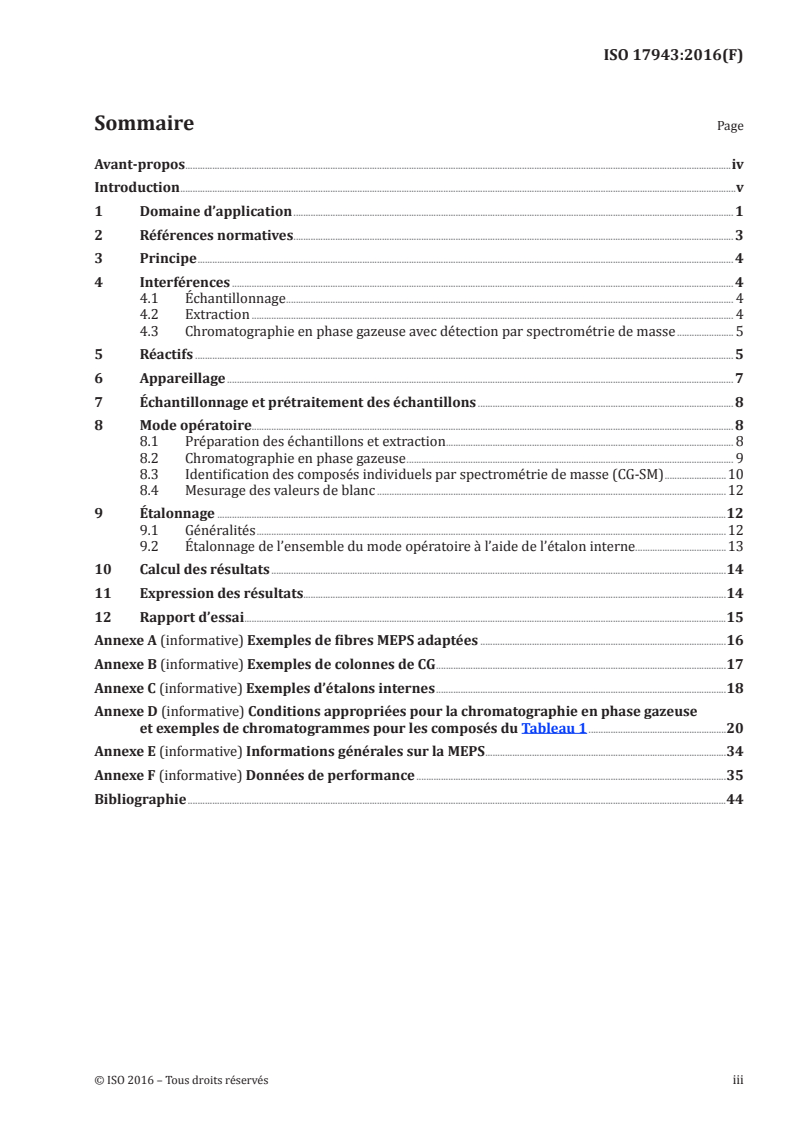
ISO 17943:2016 - Qualité de l'eau — Détermination de composés organiques volatils dans l'eau — Méthode utilisant une micro-extraction sur phase solide (MEPS) de l'espace de tête suivie d'une chromatographie en phase gazeuse-spectrométrie de masse (CG-SM)/28/2016
Overview - ISO 17943:2016 for VOCs in water
ISO 17943:2016 specifies a laboratory method for determination of volatile organic compounds (VOCs) in water using headspace solid‑phase micro‑extraction (HS‑SPME) followed by gas chromatography‑mass spectrometry (GC‑MS). The scope covers a wide range of analytes (see Table 1 in the Standard) including halogenated hydrocarbons, trihalomethanes, gasoline components (BTEX, MTBE, ETBE), naphthalene and odorous compounds such as geosmin and 2‑methylisoborneol (MIB). Typical matrices are drinking water, groundwater, surface water and treated wastewater. Most compounds have a limit of determination of at least 0.01 µg/L, with validated ranges demonstrated from 0.02–2.6 µg/L (interlaboratory trial) and broader applicability from 0.01–100 µg/L for individual substances. Analyses use small sample volumes (e.g., 10 mL).
Key topics and technical requirements
- Principle: VOCs partition to the headspace and are adsorbed onto an SPME fibre, thermally desorbed in the GC injector, separated by GC and identified/quantified by MS.
- Target analytes: Comprehensive list of volatile compounds (see Table 1) including BTEX, chlorinated solvents, ethers and odourants.
- Sensitivity & validation: Limits depend on matrix and MS sensitivity; method validated across low µg/L ranges with interlaboratory data and additional performance data in Annex F.
- Sample handling: Follow ISO sampling guidance (ISO 5667 series) and use high‑quality water for standards (ISO 3696).
- SPME fibre management: Preconditioning/conditioning of fibres, monitoring of fibre performance and blank measurements to avoid carryover (Annex A, E).
- Calibration & quality control: Use internal standards and calibration of the total procedure; blank checks and periodic reference measurements during sequences (Clause 9).
- Documentation: Test report content and expression of results specified (Clauses 11–12).
Practical applications and users
- Environmental and public‑health laboratories conducting water quality testing for regulatory compliance or monitoring.
- Water utilities assessing drinking water, groundwater remediation projects, surface water monitoring and treated wastewater effluent.
- Contract analytical labs, environmental consultants and research institutions performing VOC screening or targeted analysis.
- Manufacturers and users of SPME fibres, GC‑MS vendors and method validation specialists.
Practical benefits include minimal sample volume requirements, solvent‑free extraction, and high sensitivity for low‑level VOCs suitable for compliance and monitoring programs.
Related standards (if applicable)
- ISO 3696 - Water for analytical laboratory use
- ISO 5667‑1, ‑3, ‑5 - Water sampling guidance, preservation and handling
- ISO 8466‑1 - Calibration and evaluation of analytical methods
Keywords: ISO 17943:2016, VOCs in water, HS‑SPME, GC‑MS, water quality testing, BTEX, MTBE, detection limit, method validation.
Relations
- Effective Date
- 12-Feb-2026
- Consolidates
ISO/PAS 22720:2005 - ASAM Open Data Services 5.0 - Effective Date
- 06-Jun-2022
Buy Documents
ISO 17943:2016 - Water quality -- Determination of volatile organic compounds in water -- Method using headspace solid-phase micro-extraction (HS-SPME) followed by gas chromatography-mass spectrometry (GC-MS)
ISO 17943:2016 - Water quality — Determination of volatile organic compounds in water — Method using headspace solid-phase micro-extraction (HS-SPME) followed by gas chromatography-mass spectrometry (GC-MS)/5/2016
ISO 17943:2016 - Qualité de l'eau -- Détermination de composés organiques volatils dans l'eau -- Méthode utilisant une micro-extraction sur phase solide (MEPS) de l'espace de tete suivie d'une chromatographie en phase gazeuse-spectrométrie de masse (CG-SM)
ISO 17943:2016 - Qualité de l'eau — Détermination de composés organiques volatils dans l'eau — Méthode utilisant une micro-extraction sur phase solide (MEPS) de l'espace de tête suivie d'une chromatographie en phase gazeuse-spectrométrie de masse (CG-SM)/28/2016
Get Certified
Connect with accredited certification bodies for this standard

CIS Institut d.o.o.
Personal Protective Equipment (PPE) certification body. Notified Body NB-2890 for EU Regulation 2016/425 PPE.

Kiwa BDA Testing
Building and construction product certification.
Kmetijski inštitut Slovenije
Agricultural Institute of Slovenia. Soil testing, plant health, agricultural product analysis.
Sponsored listings
Frequently Asked Questions
ISO 17943:2016 is a standard published by the International Organization for Standardization (ISO). Its full title is "Water quality — Determination of volatile organic compounds in water — Method using headspace solid-phase micro-extraction (HS-SPME) followed by gas chromatography-mass spectrometry (GC-MS)". This standard covers: ISO 17943:2016 specifies a method for the determination of volatile organic compounds (see Table 1). This comprises, for example, halogenated hydrocarbons, trihalogenated methanes, gasoline components (such as BTEX, MTBE, and ETBE), naphthalene, 2-ethyl-4-methyl-1,3-dioxolane, and highly odorous substances like geosmin and 2-methylisoborneol in drinking water, ground water, surface water, and treated waste water, by means of headspace solid-phase micro-extraction (HS-SPME) followed by gas chromatography-mass spectrometry (GC-MS). The limit of determination depends on the matrix, on the specific compound to be analysed, and on the sensitivity of the mass spectrometer. For most compounds to which this International Standard applies, it is at least 0,01 µg/l. Validation data related to a concentration range between 0,02 µg/l and 2,6 µg/l have been demonstrated in an interlaboratory trial. Additional validation data derived from standardization work show applicability of the method within a concentration range from 0,01 µg/l to 100 µg/l of individual substances. All determinations are performed on small sample amounts (e.g. sample volumes of 10 ml).
ISO 17943:2016 specifies a method for the determination of volatile organic compounds (see Table 1). This comprises, for example, halogenated hydrocarbons, trihalogenated methanes, gasoline components (such as BTEX, MTBE, and ETBE), naphthalene, 2-ethyl-4-methyl-1,3-dioxolane, and highly odorous substances like geosmin and 2-methylisoborneol in drinking water, ground water, surface water, and treated waste water, by means of headspace solid-phase micro-extraction (HS-SPME) followed by gas chromatography-mass spectrometry (GC-MS). The limit of determination depends on the matrix, on the specific compound to be analysed, and on the sensitivity of the mass spectrometer. For most compounds to which this International Standard applies, it is at least 0,01 µg/l. Validation data related to a concentration range between 0,02 µg/l and 2,6 µg/l have been demonstrated in an interlaboratory trial. Additional validation data derived from standardization work show applicability of the method within a concentration range from 0,01 µg/l to 100 µg/l of individual substances. All determinations are performed on small sample amounts (e.g. sample volumes of 10 ml).
ISO 17943:2016 is classified under the following ICS (International Classification for Standards) categories: 13.060.50 - Examination of water for chemical substances. The ICS classification helps identify the subject area and facilitates finding related standards.
ISO 17943:2016 has the following relationships with other standards: It is inter standard links to EN ISO 17943:2016, ISO/PAS 22720:2005. Understanding these relationships helps ensure you are using the most current and applicable version of the standard.
ISO 17943:2016 is available in PDF format for immediate download after purchase. The document can be added to your cart and obtained through the secure checkout process. Digital delivery ensures instant access to the complete standard document.
Standards Content (Sample)
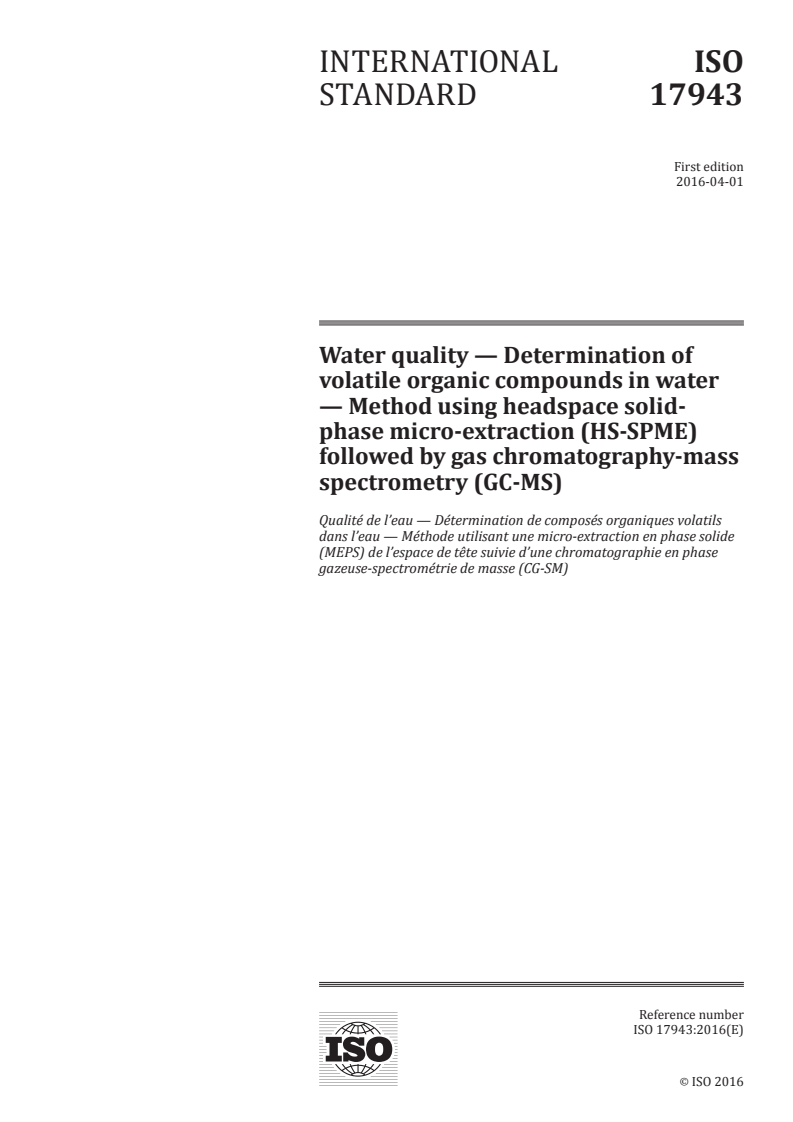
INTERNATIONAL ISO
STANDARD 17943
First edition
2016-04-01
Water quality — Determination of
volatile organic compounds in water
— Method using headspace solid-
phase micro-extraction (HS-SPME)
followed by gas chromatography-mass
spectrometry (GC-MS)
Qualité de l’eau — Détermination de composés organiques volatils
dans l’eau — Méthode utilisant une micro-extraction en phase solide
(MEPS) de l’espace de tête suivie d’une chromatographie en phase
gazeuse-spectrométrie de masse (CG-SM)
Reference number
©
ISO 2016
© ISO 2016, Published in Switzerland
All rights reserved. Unless otherwise specified, no part of this publication may be reproduced or utilized otherwise in any form
or by any means, electronic or mechanical, including photocopying, or posting on the internet or an intranet, without prior
written permission. Permission can be requested from either ISO at the address below or ISO’s member body in the country of
the requester.
ISO copyright office
Ch. de Blandonnet 8 • CP 401
CH-1214 Vernier, Geneva, Switzerland
Tel. +41 22 749 01 11
Fax +41 22 749 09 47
copyright@iso.org
www.iso.org
ii © ISO 2016 – All rights reserved
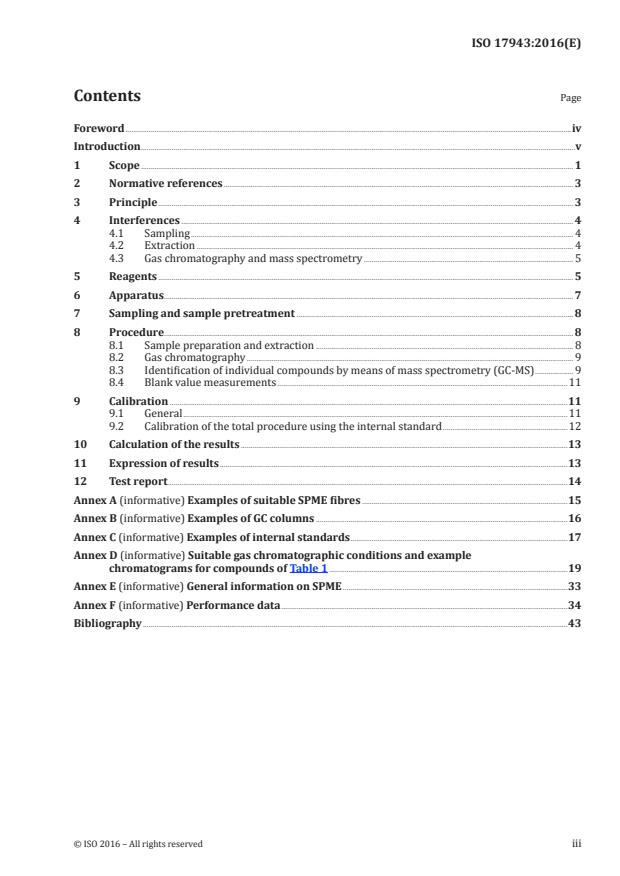
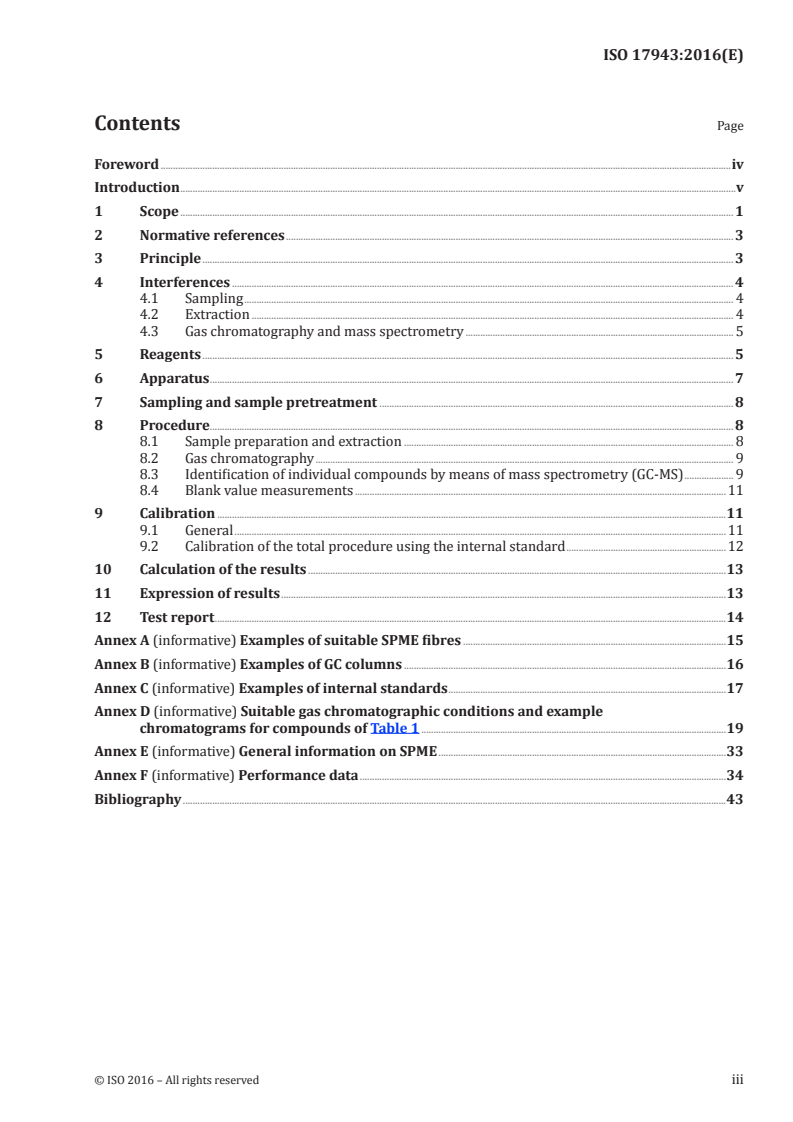
Contents Page
Foreword .iv
Introduction .v
1 Scope . 1
2 Normative references . 3
3 Principle . 3
4 Interferences . 4
4.1 Sampling . 4
4.2 Extraction . 4
4.3 Gas chromatography and mass spectrometry . 5
5 Reagents . 5
6 Apparatus . 7
7 Sampling and sample pretreatment . 8
8 Procedure. 8
8.1 Sample preparation and extraction . 8
8.2 Gas chromatography . 9
8.3 Identification of individual compounds by means of mass spectrometry (GC-MS) . 9
8.4 Blank value measurements .11
9 Calibration .11
9.1 General .11
9.2 Calibration of the total procedure using the internal standard .12
10 Calculation of the results .13
11 Expression of results .13
12 Test report .14
Annex A (informative) Examples of suitable SPME fibres .15
Annex B (informative) Examples of GC columns .16
Annex C (informative) Examples of internal standards .17
Annex D (informative) Suitable gas chromatographic conditions and example
chromatograms for compounds of Table 1 .19
Annex E (informative) General information on SPME .33
Annex F (informative) Performance data .34
Bibliography .43
Foreword
ISO (the International Organization for Standardization) is a worldwide federation of national standards
bodies (ISO member bodies). The work of preparing International Standards is normally carried out
through ISO technical committees. Each member body interested in a subject for which a technical
committee has been established has the right to be represented on that committee. International
organizations, governmental and non-governmental, in liaison with ISO, also take part in the work.
ISO collaborates closely with the International Electrotechnical Commission (IEC) on all matters of
electrotechnical standardization.
The procedures used to develop this document and those intended for its further maintenance are
described in the ISO/IEC Directives, Part 1. In particular the different approval criteria needed for the
different types of ISO documents should be noted. This document was drafted in accordance with the
editorial rules of the ISO/IEC Directives, Part 2 (see www.iso.org/directives).
Attention is drawn to the possibility that some of the elements of this document may be the subject of
patent rights. ISO shall not be held responsible for identifying any or all such patent rights. Details of
any patent rights identified during the development of the document will be in the Introduction and/or
on the ISO list of patent declarations received (see www.iso.org/patents).
Any trade name used in this document is information given for the convenience of users and does not
constitute an endorsement.
For an explanation on the meaning of ISO specific terms and expressions related to conformity
assessment, as well as information about ISO’s adherence to the WTO principles in the Technical
Barriers to Trade (TBT) see the following URL: Foreword - Supplementary information
The committee responsible for this document is ISO/TC 147, Water quality, Subcommittee SC 2, Physical,
chemical and biochemical methods.
iv © ISO 2016 – All rights reserved
Introduction
Volatile organic compounds (VOCs) are often found in the manufacturing processes of paints,
adhesives, petroleum products, pharmaceuticals, and refrigerants. Some are used as gasoline additives,
solvents, hydraulic fluids, and dry-cleaning agents. This group of compounds belongs to the group of
anthropogenic chemicals. VOC contamination of water resources is a human-health concern because
many are toxic and are known or suspected human carcinogens.
For the determination of VOCs, several published procedures are available (see References
[4],[5],[6],[7],[9],[12],[13], and [14]).
INTERNATIONAL STANDARD ISO 17943:2016(E)
Water quality — Determination of volatile organic
compounds in water — Method using headspace solid-
phase micro-extraction (HS-SPME) followed by gas
chromatography-mass spectrometry (GC-MS)
WARNING — Persons using this International Standard should be familiar with normal
laboratory practice. This International Standard does not purport to address all of the
safety problems, if any, associated with its use. It is the responsibility of the user to establish
appropriate safety and health practices and to ensure compliance with any national regulatory
conditions.
IMPORTANT — It is absolutely essential that tests conducted in accordance with this
International Standard be carried out by suitably qualified staff.
1 Scope
This International Standard specifies a method for the determination of volatile organic compounds
(see Table 1). This comprises, for example, halogenated hydrocarbons, trihalogenated methanes,
gasoline components (such as BTEX, MTBE, and ETBE), naphthalene, 2-ethyl-4-methyl-1,3-dioxolane,
and highly odorous substances like geosmin and 2-methylisoborneol in drinking water, ground water,
surface water, and treated waste water, by means of headspace solid-phase micro-extraction (HS-SPME)
followed by gas chromatography-mass spectrometry (GC-MS). The limit of determination depends on
the matrix, on the specific compound to be analysed, and on the sensitivity of the mass spectrometer.
For most compounds to which this International Standard applies, it is at least 0,01 µg/l. Validation
data related to a concentration range between 0,02 µg/l and 2,6 µg/l have been demonstrated in an
interlaboratory trial. Additional validation data derived from standardization work show applicability
of the method within a concentration range from 0,01 µg/l to 100 µg/l of individual substances. All
determinations are performed on small sample amounts (e.g. sample volumes of 10 ml).
This method may be applicable to other compounds not explicitly covered by this International Standard
or to other types of water. However, it is necessary to demonstrate the applicability for each case.
Table 1 — Volatile organic compounds determinable by this method
d
Name Molecular formula CAS registry no. Molar mass Density
g/mol kg/l
tert-amyl methyl ether (TAME) C H O 994–05–8 102,17 0,76
6 14
benzene C H 71–43–2 78,12 0,88
6 6
bromobenzene C H Br 108–86–1 157,01 1,50
6 5
bromochloromethane CH BrCl 74–97–5 129,38 1,99
bromodichloromethane CHBrCl 75–27–4 163,83 1,98
n-butylbenzene C H 104–51–8 134,22 0,86
10 14
sec-butylbenzene C H 135–98–8 134,22 0,86
10 14
tert-butylbenzene C H 98–06–6 134,22 0,87
10 14
chlorobenzene C H Cl 108–90–7 112,56 1,11
6 5
a
Signals of substances may overlap in chromatograms as they might co-elute.
b
Density of liquid at boiling point (−13,4 °C)
c
Refer to Tables F.1 and F.2 for validation data and additional information.
d
CAS: Chemical Abstracts Service.
Table 1 (continued)
d
Name Molecular formula CAS registry no. Molar mass Density
g/mol kg/l
2-chlorotoluene C H Cl 95–49–8 126,59 1,08
7 7
4-chlorotoluene C H Cl 106–43–4 126,59 1,07
7 7
dibromochloromethane CHBr Cl 124–48–1 208,34 2,45
1,2-dibromo-3-chloropropane (DBCP) C H Br Cl 96–12–8 236,33 2,03
3 5 2
1,2-dibromoethane C H Br 106–93–4 187,86 2,18
2 4 2
dibromomethane CH Br 74–95–3 173,83 2,48
2 2
1,2-dichlorobenzene C H Cl 95–50–1 147,00 1,30
6 4 2
1,3-dichlorobenzene C H Cl 541–73–1 147,00 1,29
6 4 2
1,4-dichlorobenzene C H Cl 106–46–7 147,00 1,25
6 4 2
1,1-dichloroethane C H Cl 75–34–3 98,96 1,20
2 4 2
1,2-dichloroethane C H Cl 107–06–2 98,96 1,25
2 4 2
1,1-dichloroethene C H Cl 75–35–4 96,95 1,21
2 2 2
cis-1,2-dichloroethene C H Cl 156–59–2 96,94 1,28
2 2 2
trans-1,2-dichloroethene C H Cl 156–60–5 96,94 1,26
2 2 2
dichloromethane CH Cl 75–09–2 84,93 1,33
2 2
1,2-dichloropropane C H Cl 78–87–5 112,99 1,16
3 6 2
1,3-dichloropropane C H Cl 142–28–9 112,99 1,19
3 6 2
c
2,2-dichloropropane C H Cl 594–20–7 112,99 1,08
3 6 2
1,1-dichloropropene C H Cl 563–58–6 110,97 1,19
3 4 2
c
cis -1,3-dichloropropene C H Cl 10061–01–5 110,97 1,23
3 4 2
c
trans-1,3-dichloropropene C H Cl 10061–02–6 110,97 1,21
3 4 2
ethylbenzene C H 100–41–4 106,17 0,86
8 10
ethyl tert-butyl ether (ETBE) C H O 637–92–3 102,17 0,73
6 14
2-ethyl-4-methyl-1,3-dioxolane C H O 4359–46–0 116,16 0,90
6 12 2
2-ethyl-5,5-dimethyl-1,3-dioxane C H O 768–58–1 144,21 0,88
8 16 2
geosmin C H O 16423–19–1 182,30 0,99
12 22
hexachlorobutadiene C Cl 87–68–3 260,76 1,67
4 6
isopropylbenzene (cumene) C H 98–82–8 120,19 0,86
9 12
4-isopropyltoluene (p-cymene) C H 99–87–6 134,21 0,86
10 14
2-methylisoborneol C H O 2371–42–8 168,28 0,97
11 20
methyl tert-butyl ether (MTBE) C H O 1634–04–4 88,15 0,74
5 12
naphthalene C H 91–20–3 128,17 1,14
10 8
n-propylbenzene C H 103–65–1 120,19 0,86
9 12
styrene C H 100–42–5 104,15 0,91
8 8
1,1,1,2-tetrachloroethane C H Cl 630–20–6 167,85 1,55
2 2 4
1,1,2,2-tetrachloroethane C H Cl 79–34–5 167,85 1,59
2 2 4
tetrachloroethene C Cl 127–18–4 165,83 1,62
2 4
tetrachloromethane CCl 56–23–5 153,82 1,59
toluene C H 108–88–3 92,14 0,87
7 8
a
Signals of substances may overlap in chromatograms as they might co-elute.
b
Density of liquid at boiling point (−13,4 °C)
c
Refer to Tables F.1 and F.2 for validation data and additional information.
d
CAS: Chemical Abstracts Service.
2 © ISO 2016 – All rights reserved
Table 1 (continued)
d
Name Molecular formula CAS registry no. Molar mass Density
g/mol kg/l
tribromomethane (bromoform) CHBr 75–25–2 252,75 2,89
1,2,3-trichlorobenzene C H Cl 87–61–6 181,45 1,68
6 3 3
1,2,4-trichlorobenzene C H Cl 120–82–1 181,45 1,45
6 3 3
1,3,5-trichlorobenzene C H Cl 108–70–3 181,45 1,87
6 3 3
1,1,1-trichloroethane C H Cl 71–55–6 133,40 1,34
2 3 3
1,1,2-trichloroethane C H Cl 79–00–5 133,40 1,44
2 3 3
trichloroethene C HCl 79–01–6 131,39 1,46
2 3
trichloromethane (chloroform) CHCl 67–66–3 119,38 1,47
1,2,3-trichloropropane C H Cl 96–18–4 147,43 1,38
3 5 3
1,2,4-trimethylbenzene C H 95–63–6 120,19 0,88
9 12
(pseudocumene)
1,3,5-trimethylbenzene (mesitylene) C H 108–67–8 120,19 0,86
9 12
b
vinyl chloride C H Cl 75–01–4 62,5 1,88
2 3
a
m-xylene C H 108–38–3 106,17 0,86
8 10
o-xylene C H 95–47–6 106,17 0,88
8 10
a
p-xylene C H 106–42–3 106,17 0,86
8 10
a
Signals of substances may overlap in chromatograms as they might co-elute.
b
Density of liquid at boiling point (−13,4 °C)
c
Refer to Tables F.1 and F.2 for validation data and additional information.
d
CAS: Chemical Abstracts Service.
2 Normative references
The following documents, in whole or in part, are normatively referenced in this document and are
indispensable for its application. For dated references, only the edition cited applies. For undated
references, the latest edition of the referenced document (including any amendments) applies.
ISO 3696, Water for analytical laboratory use — Specification and test methods
ISO 5667-1, Water quality — Sampling — Part 1: Guidance on the design of sampling programmes and
sampling techniques
ISO 5667-3, Water quality — Sampling — Part 3: Preservation and handling of water samples
ISO 5667-5, Water quality — Sampling — Part 5: Guidance on sampling of drinking water from treatment
works and piped distribution systems
ISO 8466-1, Water quality — Calibration and evaluation of analytical methods and estimation of
performance characteristics — Part 1: Statistical evaluation of the linear calibration function
3 Principle
The analytes to be determined are extracted from the headspace above the water sample by means of
solid-phase micro-extraction (SPME) according to their equilibrium of distribution. Extraction fibres
are used whose surface is coated with suitable adsorbents. After the extraction, the SPME fibre is
removed from the sample vial (headspace vial) and introduced into the injector of a gas chromatograph.
The analytes are transferred to the capillary column by thermal desorption. The substances are
separated and detected using GC-MS.
4 Interferences
4.1 Sampling
To avoid interferences, collect samples as specified in Clause 7 observing the instructions specified in
ISO 5667-1, ISO 5667-3, and ISO 5667-5.
4.2 Extraction
Commercially available SPME fibres often differ in quality. There may also be variations in the
selectivity of the materials of the individual batches, thus, possibly causing significant deviations in
extraction yield (see Annex E). However, apart from a higher detection limit of individual substances,
which may be the result, this does not generally impair the suitability of such fibres.
Inadequately conditioned fibres often result in lower extraction yields (see Annex E) and poorly
reproducible results, therefore, precondition new fibres by baking them out according to Clause 8.
Used fibres shall also be conditioned before they are used again. For this purpose, use two sample vials
containing only water (5.2) at the beginning of each sample sequence before starting with the first
sample (see 8.1).
The performance of the fibres used may decrease slightly throughout a long sample sequence. Therefore,
measure reference solutions (see 5.8.4) at regular intervals within the sample sequence. The fibre can
be used as long as the method shows the sensitivity required for the substances under investigation.
Depending on the matrix to be analysed, the durability of the fibre can be expected to be sufficient for
the analysis of more than 500 samples.
Adding sodium chloride to the sample results in an improvement of the extraction yield for the majority
of the substances listed in Table 1. It is recommended to add salt until the sample is nearly saturated
(see 8.1). It is necessary to add exactly the same amount of salt to all samples of a calibration sequence
and/or a sample sequence.
Salt deposits may accumulate in the metal syringe needle of the fibre holder after extended use. Heavier
salt encrustations will always have to be expected if the metal syringe needle of the fibre holder is
accidentally immersed in the water sample. This may damage the fibre and the injector liner. Therefore,
precisely adjust the immersion depth of the metal syringe needle into the vial. If there are visible salt
deposits, rinse the needle with water (5.2) to dissolve any salt deposits.
For automatic operation, sample, vials should be used with caps having thin septa (e.g. 0,9 mm to
1,3 mm) to avoid any mechanical problems when piercing the septum with the metal syringe needle
(see 6.4).
Thin septa should always be used when using autosamplers that agitate the sample vials with a circular
motion during the extraction process. Otherwise, the metal syringe needle (and the exposed fibre) may
be damaged during extraction.
To ensure the precision and accuracy of the measurement results, maintain the extraction times
constant during sample measurements or while measuring reference solutions (e.g. 10 min). For this
purpose, preferably use automatic samplers which are suitable for SPME.
The extraction of some of the substances listed in Table 1 applying the procedure described in Clause 8
depends on the temperature. It is therefore necessary to maintain the extraction temperature constant
for all samples of a sample sequence (e.g. at 40 °C). Somewhat higher extraction yields are often obtained
at higher temperatures. However, the extraction temperature should not be significantly higher than
40 °C (see 8.1) so as to minimize desorption of the analytes resulting from higher temperatures and to
avoid condensation on the fibre.
4 © ISO 2016 – All rights reserved
4.3 Gas chromatography and mass spectrometry
Seek the help of experienced operators and refer to the information given in the user manual to
eliminate interferences caused, for example, by the injection system or by insufficient separation.
Check the performance and stability of the analytical system at regular intervals (e.g. by performing
measurements with reference solutions of known composition).
Use an injector liner with an internal diameter which is as small as possible (e.g. 1 mm) to enable
focusing of those substances on the column which elute particularly early (e.g. vinyl chloride).
The required immersion depth (position) of the fibre in the GC injector shall be determined for thermal
desorption. It corresponds to the hottest point of the injector and shall be maintained constant over a
sequence of measurements.
When using injectors with a septum, preferably, use SPME syringe needles with a diameter which is as
small as possible (e.g. 24-gauge needles) so as to avoid damaging the septum. Before piercing a septum,
the fibre should be drawn into the needle over a length of at least 1 mm to prevent the fibre from
fracturing. Use pre-pierced septa where possible. When using septumless injectors, it is preferable to
use SPME syringe needles with a larger diameter (e.g. 23-gauge needles) as they are more stable and
easier to seal (see 6.14).
5 Reagents
5.1 General
The content of impurities present in the reagents and contributing to the blank value shall be negligibly
small as compared to the analyte concentration which is to be determined. Check the blank value (8.4)
at regular intervals and particularly, when using a new batch of SPME fibres. The reagents to be used
are of highest quality or “analytical grade”, if available.
5.2 Water, complying with the requirements of ISO 3696, grade 1 or equivalent without any interfering
blank values.
The water quality shall be tested.
5.3 Operating gases for gas chromatography and mass spectrometry, of high purity and in
accordance with the specifications of the instrument manufacturer.
5.4 Sodium chloride, NaCl.
5.5 Solvents, for preparing stock solutions and as solutisers in aqueous reference solutions, e.g.
methanol, CH OH or propylene carbonate, C H O .
3 4 6 3
5.6 Sodium thiosulfate pentahydrate, Na S O ∙5H O.
2 2 3 2
5.7 Internal standard, examples for suitable internal standards are given below (see Annex C for
further information).
Prepare stock solutions of individual internal standards in the same way as specified for the reference
substances (5.8.2) or use commercially available certified solutions of individual substances (e.g.
in methanol). Prepare spiking solutions for spiking the samples (8.1) by further diluting the stock
solutions with the solvent (see 5.5).
5.8 Preparation of reference solutions
5.8.1 Reference substances
Reference substances (as listed in Table 1) of defined concentration for the preparation of aqueous
reference solutions used for calibration of the total procedure (see 9.2).
5.8.2 Stock solutions of reference substances
As an example, introduce solvent (5.5) into a 100 ml volumetric flask nearly up to the mark. Inject below
the liquid surface 50 µl to 300 µl each of a reference substance using a microlitre syringe (6.9) and make
up to the mark with solvent. Close the volumetric flask with a ground-glass stopper and agitate gently.
Calculate the concentration of the added substance taking into account the density given in Table 1.
NOTE Alternatively, the concentration can also be calculated by weighing. For this purpose, determine
the weight increase resulting from the addition of the reference substance with the microlitre syringe (e.g. for
geosmin and 2-methylisoborneol and the internal standards).
Keep the stock solutions at a temperature not exceeding 6 °C and protect them from light.
They are stable for at least 12 months.
5.8.3 Multi-component stock solutions of reference substances
As an example, introduce methanol or propylene carbonate (5.5) into a 100 ml volumetric flask nearly up
to the mark. Inject below the liquid surface 50 µl to 300 µl each of the required stock solutions of single
reference substances (solutions in accordance with 5.8.2) using a microlitre syringe (6.9) and make up to
the mark with solvent. Close the volumetric flask with a ground-glass stopper and agitate gently.
NOTE Alternatively, commercially available certified stock solutions of individual (or mixtures of several)
reference substances, e.g. in methanol, can be used for preparing multi-component stock solutions.
Keep the multi-component stock solutions at a temperature not exceeding 6 °C and protect them
from light.
They are stable for at least six months.
5.8.4 Aqueous multi-component reference solutions used for calibration of the total procedure
Prepare the aqueous reference solution for calibration of the total procedure, for example, as follows:
Measure 100 ml of water (e.g. into a volumetric flask) and add a magnetic stir bar.
Place the flask on a magnetic stirrer (6.10) and switch on.
Using a microlitre syringe (6.9), measure out, for example, 10 µl of the multi-component stock solution
(5.8.3), inject it below the water surface of the stirred water, and stir for about 5 min with the flask closed.
Adjust the stirring rate such that no turbulence vortex will form.
Prepare reference solutions of higher and lower concentrations in the same way using correspondingly
prepared multi-component stock solutions (5.8.3). All aqueous multi-component reference solutions
used for multipoint calibration shall contain equal spiking volume of the respective multi-component
stock solution required.
Do not dilute the spiked aqueous solutions.
A small spiking volume (e.g. 10 µl in 100 ml of water) is recommended to minimize interferences of the
solutizer with the adsorption process of the substances of Table 1.
6 © ISO 2016 – All rights reserved
Keep the aqueous reference solutions at temperatures between 1 °C and 6 °C and protected from light
until their use.
The solutions may be stable for a very short time only and thus, shall be prepared each working day.
6 Apparatus
6.1 General
Equipment or parts of equipment which will come into contact with the water sample or the extract
shall be free from residues which might cause interfering blank values. Preferably, use equipment made
of glass, stainless steel, or polytetrafluoroethylene (PTFE).
6.2 Sample flask, glass bottle, e.g. flat-bottomed of amber glass, with glass or PTFE coated stopper,
nominal capacity 100 ml or 250 ml, e.g. an ISO 4796-2 — 250 NJ laboratory bottle.
6.3 Headspace vials, e.g. crimp neck vials or threaded bottles, nominal capacity 20 ml.
6.4 Magnetic crimp or screw caps, with PTFE-coated septa (e.g. butyl/PTFE septum with a thickness
of 0,9 mm to 1,5 mm).
6.5 Crimper and decapper, e.g. manual crimper and manual decapper, 20 mm.
6.6 Volumetric flask, nominal capacities of 10 ml, 25 ml, 50 ml, and 100 ml, e.g. an ISO 1042 — A10 —
C volumetric flask.
6.7 Volumetric pipette, of different nominal capacities from 1 ml to 50 ml, e.g. pipette according to
ISO 648.
6.8 Glass piston-type pipette, with ground-glass piston, e.g. 10 ml.
6.9 Microlitre syringes, of different nominal capacities from 5 µl to 500 µl.
6.10 Magnetic stirrer, with magnetic stir bar.
6.11 Capillary gas chromatograph with mass spectrometric detector (GC-MS), gas supply in
accordance with manufacturer’s instructions.
6.12 Injector, with e.g. split/splitless or programmable temperature vaporising (PTV) injector.
6.13 Automatic sampler, equipped for SPME including the required driver software.
1)
® ® 1)
6.14 SPME fibres, e.g. Carboxen /PDMS (85 µm), DVB/Carboxen /PDMS (50/30 µm). Examples
are given in Annex A.
Preferably, use fibres with 23-gauge needles in combination with septumless injectors. If using a
septum-type injection system, 24-gauge needles should be used (see 4.3) to avoid damaging the septa.
6.15 Capillary columns, for gas chromatography, e.g. columns recommended for the analysis of volatile
compounds preferably with a coating thickness of >1 µm (see Annex B for examples).
® ®
1) Carboxen /PDMS and DVB/Carboxen /PDMS are examples of suitable products which are commercially
available. These examples are given only as information for the users of this International Standard and do not
constitute an endorsement by ISO of these products.
7 Sampling and sample pretreatment
For sampling, use thoroughly cleaned, sample flasks (6.2). Before use, rinse bottles and ground-glass
stoppers with the water to be sampled.
Fill the bottles completely with the water to be analysed and close them carefully avoiding any
entrapment of air.
To fill the bottles, preferably use a metal tube connected to the tap and inserted down to the bottom of
the bottle. Adjust the water flow such that the bottle can be filled avoiding any turbulences.
Add sodium thiosulfate pentahydrate (5.6) to water samples containing chlorine, thus, obtaining a
concentration of approximately 80 mg/l to 100 mg/l.
Sodium thiosulfate can, for example, be added by means of a spatula spoon prior to inserting the stopper.
The mass of sodium thiosulfate added to the sample is non-critical. It shall be sufficient, however, to
dechlorinate the water sample.
Treat and analyse the water samples as soon as possible after their collection. Keep the water sample in
a dark place at temperatures between 1 °C and 5 °C. Storage shall not exceed 5 days.
Keep the samples from heating up during transport.
8 Procedure
8.1 Sample preparation and extraction
As an example, introduce 3,0 g sodium chloride (5.4) to a 20 ml headspace vial (6.3). Keep the added
amount of NaCl constant for all samples of a sample sequence.
The amount of NaCl added should lead to nearly saturation, i.e. 0,3 g per millilitre of the sample volume
(e.g. 3,0 g NaCl in 10 ml of water).
Measure 10 ml of the water sample to be analysed, e.g. using a piston-type pipette (6.8), and add to the
headspace vial (6.3). The measured-out volume shall be the same for both sample measurements and
the reference solutions used for calibration.
Add the internal standard (5.7), dissolved in solvent (5.5) to the sample, and the reference solutions
for calibration, e.g. by injecting 10 µl below the water surface using a microlitre syringe (6.9). The total
volume of solvent (5.5) added per headspace vial shall not exceed 20 µl.
Close the headspace vial (6.3) tightly and dissolve the salt.
Place, for example, the headspace vials on the automatic sampler equipped for SPME (6.13) according to
their sample sequence and select a sample incubation time of, e.g. 10 min.
The incubation time selected for all samples should be between 10 min and 15 min so as to reach
the extraction temperature. Always maintain the incubation time constant for all samples over one
sequence.
Preferably use SPME fibres as specified in 6.14.
Condition new fibres by heating them in the “bake-out” station of the SPME autosampler or in the GC
injector. Select the duration and temperature of the fibre bake-out according to the manufacturer’s
instructions. Prior to starting with the first sample of a sequence, process at least two headspace vials
containing only water (5.2). Recalibration is required whenever a new fibre has been installed.
Adjust the extraction temperature to, for example, 40 °C (recommended) and always maintain this
temperature constant over one sample sequence.
Extraction temperatures below 30 °C and above 45 °C should be avoided.
8 © ISO 2016 – All rights reserved
−1
Always maintain the stirring rate constant over one sample sequence (e.g. adjust to 250 min ). In
systems using a magnetic stirrer, insert the SPME needle approximately 3 mm from the middle.
The extraction time should be set to approximately 10 min and shall be maintained constant over one
sample sequence.
NOTE The extraction time can be adjusted (e.g. to 20 min or 30 min) for increasing sensitivity of medium
volatile substances (e.g. geosmin or 2-methylisoborneol).
Desorb in the injector (e.g. for 10 min at 280 °C). If the maximum operating temperature specified by
the manufacturer is below 280 °C, this temperature shall be selected.
8.2 Gas chromatography
Optimize the instrument parameters in accordance with the manufacturer’s operating instructions.
For separation, use capillary columns as specified in 6.15 (see Annex B for examples).
Select splitless injection to achieve the highest sensitivity.
A reduced split ratio (e.g. 5:1) may also be used if the required sensitivity is ensured. This can give an
improved signal symmetry for early-eluting substances.
8.3 Identification of individual compounds by means of mass spectrometry (GC-MS)
Identify a compound in the sample by comparing the measured retention times and the corresponding
relative intensities of selected identification masses (Table 2) with those of the references substances
in the multi-component reference solution (5.8.4).
The target compound in the sample is to be regarded as identified if
— the relative or absolute retention time (RT) of the substance in the SIM chromatogram matches the
relative or absolute retention time of the corresponding reference substance in the chromatogram
of the most recently measured multi-component reference solution (5.8.4) with a limit deviation of
no more than ±0,2 %,
— at least two to three selected identification masses (Table 2) are present at the substance-specific
retention time, and
— the relative intensities of all selected identification masses of individual substances measured in the
sample do not deviate by more than ±(0,1 × I + 10) % from those of the corresponding substances in
the reference solution (where I is the relative intensity of the identification mass of the individual
reference substance).
EXAMPLE Three selected identification masses have the following relative intensities: 100 %, 50 %, and
15 %. The maximum acceptable deviation for I and I in the sample is (I is by definition 100 % in both the
2 3 1
sample and reference standard):
— I : ±(0,1 × 50 + 10) % = ±15 %, the relative intensity in the sample shall be between 35 % and 65 %;
— I : ±(0,1 × 15 + 10) % = ±11,5 %, the relative intensity in the sample shall be between 3,5 % and 26,5 %.
In general, the following condition applies. After background subtraction, no ion of significant intensity
should be present in the mass spectrum which has a mass larger than the maximum possible mass of a
compound to be identified.
Table 2 — Examples of ions for identification and quantification in mass spectrometric
detection
Name Selected ions for identification
a
(compounds of Table 1) and quantification
m/z
tert-amyl methyl ether (TAME) 73, 87
benzene 50, 77, 78
bromobenzene 77, (156, 158)
bromochloromethane (128, 130, 132)
bromodichloromethane 47, (83, 85, 87), (127, 129)
n -butylbenzene 91, 92, 134
sec-butylbenzene 105, 134
tert-butylbenzene 91, 119, 134
chlorobenzene 77, 112
2-chlorotoluene 91, (126, 128)
4-chlorotoluene 91, (126, 128)
dibromochloromethane (127, 129, 131)
1,2-dibromo-3-chloropropane (DBCP) 75, (155, 157, 159)
1,2-dibromoethane (107, 109)
dibromomethane (172, 174, 176)
1,2-dichlorobenzene 146, 148, 150
1,3-dichlorobenzene 146, 148, 150
1,4-dichlorobenzene 146, 148, 150
1,1-dichloroethane (63, 65)
1,2-dichloroethane (62, 64)
1,1-dichloroethene (61, 63), (96, 98)
cis-1,2-dichloroethene (61, 63), (96, 98)
trans-1,2-dichloroethene (61, 63), (96, 98)
dichloromethane (49, 51), (84, 86)
1,2-dichloropropane 63, 76
1,3-dichloropropane 63, (76, 78)
2,2-dichloropropane (77, 79)
1,1-dichloropropene (75, 77), (110, 112)
cis -1,3-dichloropropene (75, 77), 110
trans -1,3-dichloropropene (75, 77), 110
ethylbenzene 91, 106
ethyl tert-butyl ether (ETBE) 57, 59, 87
2-ethyl-4-methyl-1,3-dioxolane 59, 87
2-ethyl-5,5-dimethyl-1,3-dioxane 56, 115
geosmin 97, 111, 112, 125
hexachlorobutadiene (223, 225, 227), (260, 262)
isopropylbenzene (cumene) 105, 120
4-isopropyltoluene (p-cymene) 91, 119, 134
2-methylisoborneol 95, 107
methyl tert-butyl ether (MTBE) 57, 73
a
Other options may be possible. Base peaks often used for quantification are underlined.
Groups of ions in brackets belong to the same cluster of a halogen isotope distribution.
10 © ISO 2016 – All rights reserved
Table 2 (continued)
Name Selected ions for identification
a
(compounds of Table 1) and quantification
m/z
naphthalene 127, 128, 129
n-propylbenzene 91, 120
styrene 78, 103, 104
1,1,1,2-tetrachloroethane (131, 133, 135)
1,1,2,2-tetrachloroethane (83, 85), (166, 168)
tetrachloroethene (129, 131, 133), (164, 166, 168)
tetrachloromethane (117, 119, 121)
toluene 65, 91, 92
tribromomethane (bromoform) (79, 81), (171, 173, 175), (251, 253)
1,2,3-trichlorobenzene (180, 182, 184)
1,2,4-trichlorobenzene (180, 182, 184)
1,3,5-trichlorobenzene (180, 182, 184)
1,1,1-trichloroethane 61, (97, 99), (117, 119)
1,1,2-trichloroethane 61, (97, 99)
trichloroethene (95, 97), (130, 132, 134)
trichloromethane (chloroform) 47, (83, 85, 87)
1,2,3-trichloropropane 75, 110
1,2,4-trimethylbenzene (pseudocumene) 105, 120
1,3,5-trimethylbenzene (mesitylene) 105, 120
vinyl chloride (62, 64)
m-xylene 91, 105, 106
o-xylene 91, 105, 106
p-xylene 91, 105, 106
a
Other options may be possible. Base peaks often used for quantification are underlined.
Groups of ions in brackets belong to the same cluster of a halogen isotope distribution.
8.4 Blank value measurements
Perform blank value measurements using water (5.2) as specified in 8.1. Use periodic blank value
measurements (at least one measurement per sequence) to check the faultless condition of the
instruments and chemicals. Blank value measurements shall comprise all steps of the analysis
procedure. If blank values are abnormally high (over 50 % of the lowest reporting level), review every
step in the procedure and determine the cause by systematic checks so as to be able to eliminate the
contamination source. Try to reduce the blank values as much as possible by applying various measures
such as avoiding contamination by ambient air and using suitable solvents (5.5), as well as checking the
analytical instrumentation (e.g. GC-MS, autosampler).
9 Calibration
9.1 General
Correct calibration requires knowing the retention times of the analytes to be determined (see also
Table 1). These shall be determined with aqueous reference solutions of individual reference substances
at the specified chromatographic conditions. Furthermore, the fibre used shall be sensitivity sufficient
for the substances to be analysed (4.2). The calibration function determined for a substance applies
only to the concentration range covered by it. Moreover, it depends on the operating condition of the
gas chromatograph and on the type or age of the fibre and shall be checked at regular intervals.
— For each target compound, calibrate the determination procedure using aqueous individual or,
more conveniently, multi-component reference solutions (5.8.4). Adjust the calibration range to the
existing requirements.
— Design the total determination procedure such that a linear dependence of measurement signal to
concentration is achieved for each compound to be determined (ISO 8466-1). Determine the linear
working range using at least five concentration levels (which are distributed as evenly as possible
over the working range).
— For routine operation, it is sufficient to recalibrate by measuring two concentration levels.
Recalibrate at regular intervals within one sample sequence (e.g. after 10 to 12 samples).
Table 3 gives an explanation of the subscripts used in the formulae and in the following text.
Table 3 — Definition of subscripts
Subscript Meaning
i Substance
e Calibration step
g Total procedure
j Consecutive figure for pairs of values
I Internal standard
9.2 Calibration of the total procedure using the internal standard
The use of an internal standard helps to minimize unavoidable minor errors which may occur
throughout the SPME procedure.
The determination of the concentrations will become, to a certain degree, independent of matrix effects
in the water sample. It will become relatively independent of a potential deterioration of the fibre
performance if recalibration of the reference function is done for routine operation at intervals of, for
example, 10 to 12 samples (see 4.2).
NOTE Deterioration of the fibre is an unavoidable process. Under normal operating conditions, the
sensitivity of the fibre gradually decreases throughout a longer sample sequence. The fibre may remain in use as
long as it still shows the required sensitivity (4.2).
Suitable internal standards are substances having similar physico-chemical properties to those of the
substances to be determined with regard to their extraction behaviours and their retention times.
The internal standard itself shall not be present in the water sample to be analysed. The selection
of a suitable substance can be difficult and shall be done taking into account the aim of the analysis.
Several deuterated and C-labelled standards of the substances to be determined given in Table 1 are
particularly suitable (5.8). More than one internal standard should be used.
Add a known mass of the internal standard, I, to the water sample prior to analysis (see 8.1).
The mass concentration, ρ , shall be the same for both calibration and the sample series. All aqueous
I
multi-component reference solutions suitable for multipoint calibration should contain the same mass
concentration of the internal standard (5.8.4).
For calibration of the total procedure, prepare aqueous multi-component reference solutions according
to 5.8.4 and treat and analyse them as described in Clause 8 (e.g. in each case, 10 ml).
12 © ISO 2016 – All rights reserved
F
...
INTERNATIONAL ISO
STANDARD 17943
First edition
2016-04-01
Water quality — Determination of
volatile organic compounds in water
— Method using headspace solid-
phase micro-extraction (HS-SPME)
followed by gas chromatography-mass
spectrometry (GC-MS)
Qualité de l’eau — Détermination de composés organiques volatils
dans l’eau — Méthode utilisant une micro-extraction en phase solide
(MEPS) de l’espace de tête suivie d’une chromatographie en phase
gazeuse-spectrométrie de masse (CG-SM)
Reference number
©
ISO 2016
© ISO 2016, Published in Switzerland
All rights reserved. Unless otherwise specified, no part of this publication may be reproduced or utilized otherwise in any form
or by any means, electronic or mechanical, including photocopying, or posting on the internet or an intranet, without prior
written permission. Permission can be requested from either ISO at the address below or ISO’s member body in the country of
the requester.
ISO copyright office
Ch. de Blandonnet 8 • CP 401
CH-1214 Vernier, Geneva, Switzerland
Tel. +41 22 749 01 11
Fax +41 22 749 09 47
copyright@iso.org
www.iso.org
ii © ISO 2016 – All rights reserved
Contents Page
Foreword .iv
Introduction .v
1 Scope . 1
2 Normative references . 3
3 Principle . 3
4 Interferences . 4
4.1 Sampling . 4
4.2 Extraction . 4
4.3 Gas chromatography and mass spectrometry . 5
5 Reagents . 5
6 Apparatus . 7
7 Sampling and sample pretreatment . 8
8 Procedure. 8
8.1 Sample preparation and extraction . 8
8.2 Gas chromatography . 9
8.3 Identification of individual compounds by means of mass spectrometry (GC-MS) . 9
8.4 Blank value measurements .11
9 Calibration .11
9.1 General .11
9.2 Calibration of the total procedure using the internal standard .12
10 Calculation of the results .13
11 Expression of results .13
12 Test report .14
Annex A (informative) Examples of suitable SPME fibres .15
Annex B (informative) Examples of GC columns .16
Annex C (informative) Examples of internal standards .17
Annex D (informative) Suitable gas chromatographic conditions and example
chromatograms for compounds of Table 1 .19
Annex E (informative) General information on SPME .33
Annex F (informative) Performance data .34
Bibliography .43
Foreword
ISO (the International Organization for Standardization) is a worldwide federation of national standards
bodies (ISO member bodies). The work of preparing International Standards is normally carried out
through ISO technical committees. Each member body interested in a subject for which a technical
committee has been established has the right to be represented on that committee. International
organizations, governmental and non-governmental, in liaison with ISO, also take part in the work.
ISO collaborates closely with the International Electrotechnical Commission (IEC) on all matters of
electrotechnical standardization.
The procedures used to develop this document and those intended for its further maintenance are
described in the ISO/IEC Directives, Part 1. In particular the different approval criteria needed for the
different types of ISO documents should be noted. This document was drafted in accordance with the
editorial rules of the ISO/IEC Directives, Part 2 (see www.iso.org/directives).
Attention is drawn to the possibility that some of the elements of this document may be the subject of
patent rights. ISO shall not be held responsible for identifying any or all such patent rights. Details of
any patent rights identified during the development of the document will be in the Introduction and/or
on the ISO list of patent declarations received (see www.iso.org/patents).
Any trade name used in this document is information given for the convenience of users and does not
constitute an endorsement.
For an explanation on the meaning of ISO specific terms and expressions related to conformity
assessment, as well as information about ISO’s adherence to the WTO principles in the Technical
Barriers to Trade (TBT) see the following URL: Foreword - Supplementary information
The committee responsible for this document is ISO/TC 147, Water quality, Subcommittee SC 2, Physical,
chemical and biochemical methods.
iv © ISO 2016 – All rights reserved
Introduction
Volatile organic compounds (VOCs) are often found in the manufacturing processes of paints,
adhesives, petroleum products, pharmaceuticals, and refrigerants. Some are used as gasoline additives,
solvents, hydraulic fluids, and dry-cleaning agents. This group of compounds belongs to the group of
anthropogenic chemicals. VOC contamination of water resources is a human-health concern because
many are toxic and are known or suspected human carcinogens.
For the determination of VOCs, several published procedures are available (see References
[4],[5],[6],[7],[9],[12],[13], and [14]).
INTERNATIONAL STANDARD ISO 17943:2016(E)
Water quality — Determination of volatile organic
compounds in water — Method using headspace solid-
phase micro-extraction (HS-SPME) followed by gas
chromatography-mass spectrometry (GC-MS)
WARNING — Persons using this International Standard should be familiar with normal
laboratory practice. This International Standard does not purport to address all of the
safety problems, if any, associated with its use. It is the responsibility of the user to establish
appropriate safety and health practices and to ensure compliance with any national regulatory
conditions.
IMPORTANT — It is absolutely essential that tests conducted in accordance with this
International Standard be carried out by suitably qualified staff.
1 Scope
This International Standard specifies a method for the determination of volatile organic compounds
(see Table 1). This comprises, for example, halogenated hydrocarbons, trihalogenated methanes,
gasoline components (such as BTEX, MTBE, and ETBE), naphthalene, 2-ethyl-4-methyl-1,3-dioxolane,
and highly odorous substances like geosmin and 2-methylisoborneol in drinking water, ground water,
surface water, and treated waste water, by means of headspace solid-phase micro-extraction (HS-SPME)
followed by gas chromatography-mass spectrometry (GC-MS). The limit of determination depends on
the matrix, on the specific compound to be analysed, and on the sensitivity of the mass spectrometer.
For most compounds to which this International Standard applies, it is at least 0,01 µg/l. Validation
data related to a concentration range between 0,02 µg/l and 2,6 µg/l have been demonstrated in an
interlaboratory trial. Additional validation data derived from standardization work show applicability
of the method within a concentration range from 0,01 µg/l to 100 µg/l of individual substances. All
determinations are performed on small sample amounts (e.g. sample volumes of 10 ml).
This method may be applicable to other compounds not explicitly covered by this International Standard
or to other types of water. However, it is necessary to demonstrate the applicability for each case.
Table 1 — Volatile organic compounds determinable by this method
d
Name Molecular formula CAS registry no. Molar mass Density
g/mol kg/l
tert-amyl methyl ether (TAME) C H O 994–05–8 102,17 0,76
6 14
benzene C H 71–43–2 78,12 0,88
6 6
bromobenzene C H Br 108–86–1 157,01 1,50
6 5
bromochloromethane CH BrCl 74–97–5 129,38 1,99
bromodichloromethane CHBrCl 75–27–4 163,83 1,98
n-butylbenzene C H 104–51–8 134,22 0,86
10 14
sec-butylbenzene C H 135–98–8 134,22 0,86
10 14
tert-butylbenzene C H 98–06–6 134,22 0,87
10 14
chlorobenzene C H Cl 108–90–7 112,56 1,11
6 5
a
Signals of substances may overlap in chromatograms as they might co-elute.
b
Density of liquid at boiling point (−13,4 °C)
c
Refer to Tables F.1 and F.2 for validation data and additional information.
d
CAS: Chemical Abstracts Service.
Table 1 (continued)
d
Name Molecular formula CAS registry no. Molar mass Density
g/mol kg/l
2-chlorotoluene C H Cl 95–49–8 126,59 1,08
7 7
4-chlorotoluene C H Cl 106–43–4 126,59 1,07
7 7
dibromochloromethane CHBr Cl 124–48–1 208,34 2,45
1,2-dibromo-3-chloropropane (DBCP) C H Br Cl 96–12–8 236,33 2,03
3 5 2
1,2-dibromoethane C H Br 106–93–4 187,86 2,18
2 4 2
dibromomethane CH Br 74–95–3 173,83 2,48
2 2
1,2-dichlorobenzene C H Cl 95–50–1 147,00 1,30
6 4 2
1,3-dichlorobenzene C H Cl 541–73–1 147,00 1,29
6 4 2
1,4-dichlorobenzene C H Cl 106–46–7 147,00 1,25
6 4 2
1,1-dichloroethane C H Cl 75–34–3 98,96 1,20
2 4 2
1,2-dichloroethane C H Cl 107–06–2 98,96 1,25
2 4 2
1,1-dichloroethene C H Cl 75–35–4 96,95 1,21
2 2 2
cis-1,2-dichloroethene C H Cl 156–59–2 96,94 1,28
2 2 2
trans-1,2-dichloroethene C H Cl 156–60–5 96,94 1,26
2 2 2
dichloromethane CH Cl 75–09–2 84,93 1,33
2 2
1,2-dichloropropane C H Cl 78–87–5 112,99 1,16
3 6 2
1,3-dichloropropane C H Cl 142–28–9 112,99 1,19
3 6 2
c
2,2-dichloropropane C H Cl 594–20–7 112,99 1,08
3 6 2
1,1-dichloropropene C H Cl 563–58–6 110,97 1,19
3 4 2
c
cis -1,3-dichloropropene C H Cl 10061–01–5 110,97 1,23
3 4 2
c
trans-1,3-dichloropropene C H Cl 10061–02–6 110,97 1,21
3 4 2
ethylbenzene C H 100–41–4 106,17 0,86
8 10
ethyl tert-butyl ether (ETBE) C H O 637–92–3 102,17 0,73
6 14
2-ethyl-4-methyl-1,3-dioxolane C H O 4359–46–0 116,16 0,90
6 12 2
2-ethyl-5,5-dimethyl-1,3-dioxane C H O 768–58–1 144,21 0,88
8 16 2
geosmin C H O 16423–19–1 182,30 0,99
12 22
hexachlorobutadiene C Cl 87–68–3 260,76 1,67
4 6
isopropylbenzene (cumene) C H 98–82–8 120,19 0,86
9 12
4-isopropyltoluene (p-cymene) C H 99–87–6 134,21 0,86
10 14
2-methylisoborneol C H O 2371–42–8 168,28 0,97
11 20
methyl tert-butyl ether (MTBE) C H O 1634–04–4 88,15 0,74
5 12
naphthalene C H 91–20–3 128,17 1,14
10 8
n-propylbenzene C H 103–65–1 120,19 0,86
9 12
styrene C H 100–42–5 104,15 0,91
8 8
1,1,1,2-tetrachloroethane C H Cl 630–20–6 167,85 1,55
2 2 4
1,1,2,2-tetrachloroethane C H Cl 79–34–5 167,85 1,59
2 2 4
tetrachloroethene C Cl 127–18–4 165,83 1,62
2 4
tetrachloromethane CCl 56–23–5 153,82 1,59
toluene C H 108–88–3 92,14 0,87
7 8
a
Signals of substances may overlap in chromatograms as they might co-elute.
b
Density of liquid at boiling point (−13,4 °C)
c
Refer to Tables F.1 and F.2 for validation data and additional information.
d
CAS: Chemical Abstracts Service.
2 © ISO 2016 – All rights reserved
Table 1 (continued)
d
Name Molecular formula CAS registry no. Molar mass Density
g/mol kg/l
tribromomethane (bromoform) CHBr 75–25–2 252,75 2,89
1,2,3-trichlorobenzene C H Cl 87–61–6 181,45 1,68
6 3 3
1,2,4-trichlorobenzene C H Cl 120–82–1 181,45 1,45
6 3 3
1,3,5-trichlorobenzene C H Cl 108–70–3 181,45 1,87
6 3 3
1,1,1-trichloroethane C H Cl 71–55–6 133,40 1,34
2 3 3
1,1,2-trichloroethane C H Cl 79–00–5 133,40 1,44
2 3 3
trichloroethene C HCl 79–01–6 131,39 1,46
2 3
trichloromethane (chloroform) CHCl 67–66–3 119,38 1,47
1,2,3-trichloropropane C H Cl 96–18–4 147,43 1,38
3 5 3
1,2,4-trimethylbenzene C H 95–63–6 120,19 0,88
9 12
(pseudocumene)
1,3,5-trimethylbenzene (mesitylene) C H 108–67–8 120,19 0,86
9 12
b
vinyl chloride C H Cl 75–01–4 62,5 1,88
2 3
a
m-xylene C H 108–38–3 106,17 0,86
8 10
o-xylene C H 95–47–6 106,17 0,88
8 10
a
p-xylene C H 106–42–3 106,17 0,86
8 10
a
Signals of substances may overlap in chromatograms as they might co-elute.
b
Density of liquid at boiling point (−13,4 °C)
c
Refer to Tables F.1 and F.2 for validation data and additional information.
d
CAS: Chemical Abstracts Service.
2 Normative references
The following documents, in whole or in part, are normatively referenced in this document and are
indispensable for its application. For dated references, only the edition cited applies. For undated
references, the latest edition of the referenced document (including any amendments) applies.
ISO 3696, Water for analytical laboratory use — Specification and test methods
ISO 5667-1, Water quality — Sampling — Part 1: Guidance on the design of sampling programmes and
sampling techniques
ISO 5667-3, Water quality — Sampling — Part 3: Preservation and handling of water samples
ISO 5667-5, Water quality — Sampling — Part 5: Guidance on sampling of drinking water from treatment
works and piped distribution systems
ISO 8466-1, Water quality — Calibration and evaluation of analytical methods and estimation of
performance characteristics — Part 1: Statistical evaluation of the linear calibration function
3 Principle
The analytes to be determined are extracted from the headspace above the water sample by means of
solid-phase micro-extraction (SPME) according to their equilibrium of distribution. Extraction fibres
are used whose surface is coated with suitable adsorbents. After the extraction, the SPME fibre is
removed from the sample vial (headspace vial) and introduced into the injector of a gas chromatograph.
The analytes are transferred to the capillary column by thermal desorption. The substances are
separated and detected using GC-MS.
4 Interferences
4.1 Sampling
To avoid interferences, collect samples as specified in Clause 7 observing the instructions specified in
ISO 5667-1, ISO 5667-3, and ISO 5667-5.
4.2 Extraction
Commercially available SPME fibres often differ in quality. There may also be variations in the
selectivity of the materials of the individual batches, thus, possibly causing significant deviations in
extraction yield (see Annex E). However, apart from a higher detection limit of individual substances,
which may be the result, this does not generally impair the suitability of such fibres.
Inadequately conditioned fibres often result in lower extraction yields (see Annex E) and poorly
reproducible results, therefore, precondition new fibres by baking them out according to Clause 8.
Used fibres shall also be conditioned before they are used again. For this purpose, use two sample vials
containing only water (5.2) at the beginning of each sample sequence before starting with the first
sample (see 8.1).
The performance of the fibres used may decrease slightly throughout a long sample sequence. Therefore,
measure reference solutions (see 5.8.4) at regular intervals within the sample sequence. The fibre can
be used as long as the method shows the sensitivity required for the substances under investigation.
Depending on the matrix to be analysed, the durability of the fibre can be expected to be sufficient for
the analysis of more than 500 samples.
Adding sodium chloride to the sample results in an improvement of the extraction yield for the majority
of the substances listed in Table 1. It is recommended to add salt until the sample is nearly saturated
(see 8.1). It is necessary to add exactly the same amount of salt to all samples of a calibration sequence
and/or a sample sequence.
Salt deposits may accumulate in the metal syringe needle of the fibre holder after extended use. Heavier
salt encrustations will always have to be expected if the metal syringe needle of the fibre holder is
accidentally immersed in the water sample. This may damage the fibre and the injector liner. Therefore,
precisely adjust the immersion depth of the metal syringe needle into the vial. If there are visible salt
deposits, rinse the needle with water (5.2) to dissolve any salt deposits.
For automatic operation, sample, vials should be used with caps having thin septa (e.g. 0,9 mm to
1,3 mm) to avoid any mechanical problems when piercing the septum with the metal syringe needle
(see 6.4).
Thin septa should always be used when using autosamplers that agitate the sample vials with a circular
motion during the extraction process. Otherwise, the metal syringe needle (and the exposed fibre) may
be damaged during extraction.
To ensure the precision and accuracy of the measurement results, maintain the extraction times
constant during sample measurements or while measuring reference solutions (e.g. 10 min). For this
purpose, preferably use automatic samplers which are suitable for SPME.
The extraction of some of the substances listed in Table 1 applying the procedure described in Clause 8
depends on the temperature. It is therefore necessary to maintain the extraction temperature constant
for all samples of a sample sequence (e.g. at 40 °C). Somewhat higher extraction yields are often obtained
at higher temperatures. However, the extraction temperature should not be significantly higher than
40 °C (see 8.1) so as to minimize desorption of the analytes resulting from higher temperatures and to
avoid condensation on the fibre.
4 © ISO 2016 – All rights reserved
4.3 Gas chromatography and mass spectrometry
Seek the help of experienced operators and refer to the information given in the user manual to
eliminate interferences caused, for example, by the injection system or by insufficient separation.
Check the performance and stability of the analytical system at regular intervals (e.g. by performing
measurements with reference solutions of known composition).
Use an injector liner with an internal diameter which is as small as possible (e.g. 1 mm) to enable
focusing of those substances on the column which elute particularly early (e.g. vinyl chloride).
The required immersion depth (position) of the fibre in the GC injector shall be determined for thermal
desorption. It corresponds to the hottest point of the injector and shall be maintained constant over a
sequence of measurements.
When using injectors with a septum, preferably, use SPME syringe needles with a diameter which is as
small as possible (e.g. 24-gauge needles) so as to avoid damaging the septum. Before piercing a septum,
the fibre should be drawn into the needle over a length of at least 1 mm to prevent the fibre from
fracturing. Use pre-pierced septa where possible. When using septumless injectors, it is preferable to
use SPME syringe needles with a larger diameter (e.g. 23-gauge needles) as they are more stable and
easier to seal (see 6.14).
5 Reagents
5.1 General
The content of impurities present in the reagents and contributing to the blank value shall be negligibly
small as compared to the analyte concentration which is to be determined. Check the blank value (8.4)
at regular intervals and particularly, when using a new batch of SPME fibres. The reagents to be used
are of highest quality or “analytical grade”, if available.
5.2 Water, complying with the requirements of ISO 3696, grade 1 or equivalent without any interfering
blank values.
The water quality shall be tested.
5.3 Operating gases for gas chromatography and mass spectrometry, of high purity and in
accordance with the specifications of the instrument manufacturer.
5.4 Sodium chloride, NaCl.
5.5 Solvents, for preparing stock solutions and as solutisers in aqueous reference solutions, e.g.
methanol, CH OH or propylene carbonate, C H O .
3 4 6 3
5.6 Sodium thiosulfate pentahydrate, Na S O ∙5H O.
2 2 3 2
5.7 Internal standard, examples for suitable internal standards are given below (see Annex C for
further information).
Prepare stock solutions of individual internal standards in the same way as specified for the reference
substances (5.8.2) or use commercially available certified solutions of individual substances (e.g.
in methanol). Prepare spiking solutions for spiking the samples (8.1) by further diluting the stock
solutions with the solvent (see 5.5).
5.8 Preparation of reference solutions
5.8.1 Reference substances
Reference substances (as listed in Table 1) of defined concentration for the preparation of aqueous
reference solutions used for calibration of the total procedure (see 9.2).
5.8.2 Stock solutions of reference substances
As an example, introduce solvent (5.5) into a 100 ml volumetric flask nearly up to the mark. Inject below
the liquid surface 50 µl to 300 µl each of a reference substance using a microlitre syringe (6.9) and make
up to the mark with solvent. Close the volumetric flask with a ground-glass stopper and agitate gently.
Calculate the concentration of the added substance taking into account the density given in Table 1.
NOTE Alternatively, the concentration can also be calculated by weighing. For this purpose, determine
the weight increase resulting from the addition of the reference substance with the microlitre syringe (e.g. for
geosmin and 2-methylisoborneol and the internal standards).
Keep the stock solutions at a temperature not exceeding 6 °C and protect them from light.
They are stable for at least 12 months.
5.8.3 Multi-component stock solutions of reference substances
As an example, introduce methanol or propylene carbonate (5.5) into a 100 ml volumetric flask nearly up
to the mark. Inject below the liquid surface 50 µl to 300 µl each of the required stock solutions of single
reference substances (solutions in accordance with 5.8.2) using a microlitre syringe (6.9) and make up to
the mark with solvent. Close the volumetric flask with a ground-glass stopper and agitate gently.
NOTE Alternatively, commercially available certified stock solutions of individual (or mixtures of several)
reference substances, e.g. in methanol, can be used for preparing multi-component stock solutions.
Keep the multi-component stock solutions at a temperature not exceeding 6 °C and protect them
from light.
They are stable for at least six months.
5.8.4 Aqueous multi-component reference solutions used for calibration of the total procedure
Prepare the aqueous reference solution for calibration of the total procedure, for example, as follows:
Measure 100 ml of water (e.g. into a volumetric flask) and add a magnetic stir bar.
Place the flask on a magnetic stirrer (6.10) and switch on.
Using a microlitre syringe (6.9), measure out, for example, 10 µl of the multi-component stock solution
(5.8.3), inject it below the water surface of the stirred water, and stir for about 5 min with the flask closed.
Adjust the stirring rate such that no turbulence vortex will form.
Prepare reference solutions of higher and lower concentrations in the same way using correspondingly
prepared multi-component stock solutions (5.8.3). All aqueous multi-component reference solutions
used for multipoint calibration shall contain equal spiking volume of the respective multi-component
stock solution required.
Do not dilute the spiked aqueous solutions.
A small spiking volume (e.g. 10 µl in 100 ml of water) is recommended to minimize interferences of the
solutizer with the adsorption process of the substances of Table 1.
6 © ISO 2016 – All rights reserved
Keep the aqueous reference solutions at temperatures between 1 °C and 6 °C and protected from light
until their use.
The solutions may be stable for a very short time only and thus, shall be prepared each working day.
6 Apparatus
6.1 General
Equipment or parts of equipment which will come into contact with the water sample or the extract
shall be free from residues which might cause interfering blank values. Preferably, use equipment made
of glass, stainless steel, or polytetrafluoroethylene (PTFE).
6.2 Sample flask, glass bottle, e.g. flat-bottomed of amber glass, with glass or PTFE coated stopper,
nominal capacity 100 ml or 250 ml, e.g. an ISO 4796-2 — 250 NJ laboratory bottle.
6.3 Headspace vials, e.g. crimp neck vials or threaded bottles, nominal capacity 20 ml.
6.4 Magnetic crimp or screw caps, with PTFE-coated septa (e.g. butyl/PTFE septum with a thickness
of 0,9 mm to 1,5 mm).
6.5 Crimper and decapper, e.g. manual crimper and manual decapper, 20 mm.
6.6 Volumetric flask, nominal capacities of 10 ml, 25 ml, 50 ml, and 100 ml, e.g. an ISO 1042 — A10 —
C volumetric flask.
6.7 Volumetric pipette, of different nominal capacities from 1 ml to 50 ml, e.g. pipette according to
ISO 648.
6.8 Glass piston-type pipette, with ground-glass piston, e.g. 10 ml.
6.9 Microlitre syringes, of different nominal capacities from 5 µl to 500 µl.
6.10 Magnetic stirrer, with magnetic stir bar.
6.11 Capillary gas chromatograph with mass spectrometric detector (GC-MS), gas supply in
accordance with manufacturer’s instructions.
6.12 Injector, with e.g. split/splitless or programmable temperature vaporising (PTV) injector.
6.13 Automatic sampler, equipped for SPME including the required driver software.
1)
® ® 1)
6.14 SPME fibres, e.g. Carboxen /PDMS (85 µm), DVB/Carboxen /PDMS (50/30 µm). Examples
are given in Annex A.
Preferably, use fibres with 23-gauge needles in combination with septumless injectors. If using a
septum-type injection system, 24-gauge needles should be used (see 4.3) to avoid damaging the septa.
6.15 Capillary columns, for gas chromatography, e.g. columns recommended for the analysis of volatile
compounds preferably with a coating thickness of >1 µm (see Annex B for examples).
® ®
1) Carboxen /PDMS and DVB/Carboxen /PDMS are examples of suitable products which are commercially
available. These examples are given only as information for the users of this International Standard and do not
constitute an endorsement by ISO of these products.
7 Sampling and sample pretreatment
For sampling, use thoroughly cleaned, sample flasks (6.2). Before use, rinse bottles and ground-glass
stoppers with the water to be sampled.
Fill the bottles completely with the water to be analysed and close them carefully avoiding any
entrapment of air.
To fill the bottles, preferably use a metal tube connected to the tap and inserted down to the bottom of
the bottle. Adjust the water flow such that the bottle can be filled avoiding any turbulences.
Add sodium thiosulfate pentahydrate (5.6) to water samples containing chlorine, thus, obtaining a
concentration of approximately 80 mg/l to 100 mg/l.
Sodium thiosulfate can, for example, be added by means of a spatula spoon prior to inserting the stopper.
The mass of sodium thiosulfate added to the sample is non-critical. It shall be sufficient, however, to
dechlorinate the water sample.
Treat and analyse the water samples as soon as possible after their collection. Keep the water sample in
a dark place at temperatures between 1 °C and 5 °C. Storage shall not exceed 5 days.
Keep the samples from heating up during transport.
8 Procedure
8.1 Sample preparation and extraction
As an example, introduce 3,0 g sodium chloride (5.4) to a 20 ml headspace vial (6.3). Keep the added
amount of NaCl constant for all samples of a sample sequence.
The amount of NaCl added should lead to nearly saturation, i.e. 0,3 g per millilitre of the sample volume
(e.g. 3,0 g NaCl in 10 ml of water).
Measure 10 ml of the water sample to be analysed, e.g. using a piston-type pipette (6.8), and add to the
headspace vial (6.3). The measured-out volume shall be the same for both sample measurements and
the reference solutions used for calibration.
Add the internal standard (5.7), dissolved in solvent (5.5) to the sample, and the reference solutions
for calibration, e.g. by injecting 10 µl below the water surface using a microlitre syringe (6.9). The total
volume of solvent (5.5) added per headspace vial shall not exceed 20 µl.
Close the headspace vial (6.3) tightly and dissolve the salt.
Place, for example, the headspace vials on the automatic sampler equipped for SPME (6.13) according to
their sample sequence and select a sample incubation time of, e.g. 10 min.
The incubation time selected for all samples should be between 10 min and 15 min so as to reach
the extraction temperature. Always maintain the incubation time constant for all samples over one
sequence.
Preferably use SPME fibres as specified in 6.14.
Condition new fibres by heating them in the “bake-out” station of the SPME autosampler or in the GC
injector. Select the duration and temperature of the fibre bake-out according to the manufacturer’s
instructions. Prior to starting with the first sample of a sequence, process at least two headspace vials
containing only water (5.2). Recalibration is required whenever a new fibre has been installed.
Adjust the extraction temperature to, for example, 40 °C (recommended) and always maintain this
temperature constant over one sample sequence.
Extraction temperatures below 30 °C and above 45 °C should be avoided.
8 © ISO 2016 – All rights reserved
−1
Always maintain the stirring rate constant over one sample sequence (e.g. adjust to 250 min ). In
systems using a magnetic stirrer, insert the SPME needle approximately 3 mm from the middle.
The extraction time should be set to approximately 10 min and shall be maintained constant over one
sample sequence.
NOTE The extraction time can be adjusted (e.g. to 20 min or 30 min) for increasing sensitivity of medium
volatile substances (e.g. geosmin or 2-methylisoborneol).
Desorb in the injector (e.g. for 10 min at 280 °C). If the maximum operating temperature specified by
the manufacturer is below 280 °C, this temperature shall be selected.
8.2 Gas chromatography
Optimize the instrument parameters in accordance with the manufacturer’s operating instructions.
For separation, use capillary columns as specified in 6.15 (see Annex B for examples).
Select splitless injection to achieve the highest sensitivity.
A reduced split ratio (e.g. 5:1) may also be used if the required sensitivity is ensured. This can give an
improved signal symmetry for early-eluting substances.
8.3 Identification of individual compounds by means of mass spectrometry (GC-MS)
Identify a compound in the sample by comparing the measured retention times and the corresponding
relative intensities of selected identification masses (Table 2) with those of the references substances
in the multi-component reference solution (5.8.4).
The target compound in the sample is to be regarded as identified if
— the relative or absolute retention time (RT) of the substance in the SIM chromatogram matches the
relative or absolute retention time of the corresponding reference substance in the chromatogram
of the most recently measured multi-component reference solution (5.8.4) with a limit deviation of
no more than ±0,2 %,
— at least two to three selected identification masses (Table 2) are present at the substance-specific
retention time, and
— the relative intensities of all selected identification masses of individual substances measured in the
sample do not deviate by more than ±(0,1 × I + 10) % from those of the corresponding substances in
the reference solution (where I is the relative intensity of the identification mass of the individual
reference substance).
EXAMPLE Three selected identification masses have the following relative intensities: 100 %, 50 %, and
15 %. The maximum acceptable deviation for I and I in the sample is (I is by definition 100 % in both the
2 3 1
sample and reference standard):
— I : ±(0,1 × 50 + 10) % = ±15 %, the relative intensity in the sample shall be between 35 % and 65 %;
— I : ±(0,1 × 15 + 10) % = ±11,5 %, the relative intensity in the sample shall be between 3,5 % and 26,5 %.
In general, the following condition applies. After background subtraction, no ion of significant intensity
should be present in the mass spectrum which has a mass larger than the maximum possible mass of a
compound to be identified.
Table 2 — Examples of ions for identification and quantification in mass spectrometric
detection
Name Selected ions for identification
a
(compounds of Table 1) and quantification
m/z
tert-amyl methyl ether (TAME) 73, 87
benzene 50, 77, 78
bromobenzene 77, (156, 158)
bromochloromethane (128, 130, 132)
bromodichloromethane 47, (83, 85, 87), (127, 129)
n -butylbenzene 91, 92, 134
sec-butylbenzene 105, 134
tert-butylbenzene 91, 119, 134
chlorobenzene 77, 112
2-chlorotoluene 91, (126, 128)
4-chlorotoluene 91, (126, 128)
dibromochloromethane (127, 129, 131)
1,2-dibromo-3-chloropropane (DBCP) 75, (155, 157, 159)
1,2-dibromoethane (107, 109)
dibromomethane (172, 174, 176)
1,2-dichlorobenzene 146, 148, 150
1,3-dichlorobenzene 146, 148, 150
1,4-dichlorobenzene 146, 148, 150
1,1-dichloroethane (63, 65)
1,2-dichloroethane (62, 64)
1,1-dichloroethene (61, 63), (96, 98)
cis-1,2-dichloroethene (61, 63), (96, 98)
trans-1,2-dichloroethene (61, 63), (96, 98)
dichloromethane (49, 51), (84, 86)
1,2-dichloropropane 63, 76
1,3-dichloropropane 63, (76, 78)
2,2-dichloropropane (77, 79)
1,1-dichloropropene (75, 77), (110, 112)
cis -1,3-dichloropropene (75, 77), 110
trans -1,3-dichloropropene (75, 77), 110
ethylbenzene 91, 106
ethyl tert-butyl ether (ETBE) 57, 59, 87
2-ethyl-4-methyl-1,3-dioxolane 59, 87
2-ethyl-5,5-dimethyl-1,3-dioxane 56, 115
geosmin 97, 111, 112, 125
hexachlorobutadiene (223, 225, 227), (260, 262)
isopropylbenzene (cumene) 105, 120
4-isopropyltoluene (p-cymene) 91, 119, 134
2-methylisoborneol 95, 107
methyl tert-butyl ether (MTBE) 57, 73
a
Other options may be possible. Base peaks often used for quantification are underlined.
Groups of ions in brackets belong to the same cluster of a halogen isotope distribution.
10 © ISO 2016 – All rights reserved
Table 2 (continued)
Name Selected ions for identification
a
(compounds of Table 1) and quantification
m/z
naphthalene 127, 128, 129
n-propylbenzene 91, 120
styrene 78, 103, 104
1,1,1,2-tetrachloroethane (131, 133, 135)
1,1,2,2-tetrachloroethane (83, 85), (166, 168)
tetrachloroethene (129, 131, 133), (164, 166, 168)
tetrachloromethane (117, 119, 121)
toluene 65, 91, 92
tribromomethane (bromoform) (79, 81), (171, 173, 175), (251, 253)
1,2,3-trichlorobenzene (180, 182, 184)
1,2,4-trichlorobenzene (180, 182, 184)
1,3,5-trichlorobenzene (180, 182, 184)
1,1,1-trichloroethane 61, (97, 99), (117, 119)
1,1,2-trichloroethane 61, (97, 99)
trichloroethene (95, 97), (130, 132, 134)
trichloromethane (chloroform) 47, (83, 85, 87)
1,2,3-trichloropropane 75, 110
1,2,4-trimethylbenzene (pseudocumene) 105, 120
1,3,5-trimethylbenzene (mesitylene) 105, 120
vinyl chloride (62, 64)
m-xylene 91, 105, 106
o-xylene 91, 105, 106
p-xylene 91, 105, 106
a
Other options may be possible. Base peaks often used for quantification are underlined.
Groups of ions in brackets belong to the same cluster of a halogen isotope distribution.
8.4 Blank value measurements
Perform blank value measurements using water (5.2) as specified in 8.1. Use periodic blank value
measurements (at least one measurement per sequence) to check the faultless condition of the
instruments and chemicals. Blank value measurements shall comprise all steps of the analysis
procedure. If blank values are abnormally high (over 50 % of the lowest reporting level), review every
step in the procedure and determine the cause by systematic checks so as to be able to eliminate the
contamination source. Try to reduce the blank values as much as possible by applying various measures
such as avoiding contamination by ambient air and using suitable solvents (5.5), as well as checking the
analytical instrumentation (e.g. GC-MS, autosampler).
9 Calibration
9.1 General
Correct calibration requires knowing the retention times of the analytes to be determined (see also
Table 1). These shall be determined with aqueous reference solutions of individual reference substances
at the specified chromatographic conditions. Furthermore, the fibre used shall be sensitivity sufficient
for the substances to be analysed (4.2). The calibration function determined for a substance applies
only to the concentration range covered by it. Moreover, it depends on the operating condition of the
gas chromatograph and on the type or age of the fibre and shall be checked at regular intervals.
— For each target compound, calibrate the determination procedure using aqueous individual or,
more conveniently, multi-component reference solutions (5.8.4). Adjust the calibration range to the
existing requirements.
— Design the total determination procedure such that a linear dependence of measurement signal to
concentration is achieved for each compound to be determined (ISO 8466-1). Determine the linear
working range using at least five concentration levels (which are distributed as evenly as possible
over the working range).
— For routine operation, it is sufficient to recalibrate by measuring two concentration levels.
Recalibrate at regular intervals within one sample sequence (e.g. after 10 to 12 samples).
Table 3 gives an explanation of the subscripts used in the formulae and in the following text.
Table 3 — Definition of subscripts
Subscript Meaning
i Substance
e Calibration step
g Total procedure
j Consecutive figure for pairs of values
I Internal standard
9.2 Calibration of the total procedure using the internal standard
The use of an internal standard helps to minimize unavoidable minor errors which may occur
throughout the SPME procedure.
The determination of the concentrations will become, to a certain degree, independent of matrix effects
in the water sample. It will become relatively independent of a potential deterioration of the fibre
performance if recalibration of the reference function is done for routine operation at intervals of, for
example, 10 to 12 samples (see 4.2).
NOTE Deterioration of the fibre is an unavoidable process. Under normal operating conditions, the
sensitivity of the fibre gradually decreases throughout a longer sample sequence. The fibre may remain in use as
long as it still shows the required sensitivity (4.2).
Suitable internal standards are substances having similar physico-chemical properties to those of the
substances to be determined with regard to their extraction behaviours and their retention times.
The internal standard itself shall not be present in the water sample to be analysed. The selection
of a suitable substance can be difficult and shall be done taking into account the aim of the analysis.
Several deuterated and C-labelled standards of the substances to be determined given in Table 1 are
particularly suitable (5.8). More than one internal standard should be used.
Add a known mass of the internal standard, I, to the water sample prior to analysis (see 8.1).
The mass concentration, ρ , shall be the same for both calibration and the sample series. All aqueous
I
multi-component reference solutions suitable for multipoint calibration should contain the same mass
concentration of the internal standard (5.8.4).
For calibration of the total procedure, prepare aqueous multi-component reference solutions according
to 5.8.4 and treat and analyse them as described in Clause 8 (e.g. in each case, 10 ml).
12 © ISO 2016 – All rights reserved
F
...
NORME ISO
INTERNATIONALE 17943
Première édition
2016-04-01
Qualité de l’eau — Détermination de
composés organiques volatils dans
l’eau — Méthode utilisant une micro-
extraction sur phase solide (MEPS)
de l’espace de tête suivie d’une
chromatographie en phase gazeuse-
spectrométrie de masse (CG-SM)
Water quality — Determination of volatile organic compounds in
water — Method using headspace solid-phase micro-extraction (HS-
SPME) followed by gas chromatography-mass spectrometry (GC-MS)
Numéro de référence
©
ISO 2016
DOCUMENT PROTÉGÉ PAR COPYRIGHT
© ISO 2016, Publié en Suisse
Droits de reproduction réservés. Sauf indication contraire, aucune partie de cette publication ne peut être reproduite ni utilisée
sous quelque forme que ce soit et par aucun procédé, électronique ou mécanique, y compris la photocopie, l’affichage sur
l’internet ou sur un Intranet, sans autorisation écrite préalable. Les demandes d’autorisation peuvent être adressées à l’ISO à
l’adresse ci-après ou au comité membre de l’ISO dans le pays du demandeur.
ISO copyright office
Ch. de Blandonnet 8 • CP 401
CH-1214 Vernier, Geneva, Switzerland
Tel. +41 22 749 01 11
Fax +41 22 749 09 47
copyright@iso.org
www.iso.org
ii © ISO 2016 – Tous droits réservés
Sommaire Page
Avant-propos .iv
Introduction .v
1 Domaine d’application . 1
2 Références normatives . 3
3 Principe . 4
4 Interférences . 4
4.1 Échantillonnage . 4
4.2 Extraction . 4
4.3 Chromatographie en phase gazeuse avec détection par spectrométrie de masse . 5
5 Réactifs . 5
6 Appareillage . 7
7 Échantillonnage et prétraitement des échantillons . 8
8 Mode opératoire. 8
8.1 Préparation des échantillons et extraction . 8
8.2 Chromatographie en phase gazeuse . 9
8.3 Identification des composés individuels par spectrométrie de masse (CG-SM) .10
8.4 Mesurage des valeurs de blanc .12
9 Étalonnage .12
9.1 Généralités .12
9.2 Étalonnage de l’ensemble du mode opératoire à l’aide de l’étalon interne.13
10 Calcul des résultats .14
11 Expression des résultats.14
12 Rapport d’essai .15
Annexe A (informative) Exemples de fibres MEPS adaptées .16
Annexe B (informative) Exemples de colonnes de CG .17
Annexe C (informative) Exemples d’étalons internes .18
Annexe D (informative) Conditions appropriées pour la chromatographie en phase gazeuse
et exemples de chromatogrammes pour les composés du Tableau 1 .20
Annexe E (informative) Informations générales sur la MEPS .34
Annexe F (informative) Données de performance .35
Bibliographie .44
Avant-propos
L’ISO (Organisation internationale de normalisation) est une fédération mondiale d’organismes
nationaux de normalisation (comités membres de l’ISO). L’élaboration des Normes internationales est
en général confiée aux comités techniques de l’ISO. Chaque comité membre intéressé par une étude
a le droit de faire partie du comité technique créé à cet effet. Les organisations internationales,
gouvernementales et non gouvernementales, en liaison avec l’ISO participent également aux travaux.
L’ISO collabore étroitement avec la Commission électrotechnique internationale (IEC) en ce qui
concerne la normalisation électrotechnique.
Les procédures utilisées pour élaborer le présent document et celles destinées à sa mise à jour sont
décrites dans les Directives ISO/IEC, Partie 1. Il convient, en particulier de prendre note des différents
critères d’approbation requis pour les différents types de documents ISO. Le présent document a été
rédigé conformément aux règles de rédaction données dans les Directives ISO/IEC, Partie 2 (voir www.
iso.org/directives).
L’attention est appelée sur le fait que certains des éléments du présent document peuvent faire l’objet de
droits de propriété intellectuelle ou de droits analogues. L’ISO ne saurait être tenue pour responsable
de ne pas avoir identifié de tels droits de propriété et averti de leur existence. Les détails concernant
les références aux droits de propriété intellectuelle ou autres droits analogues identifiés lors de
l’élaboration du document sont indiqués dans l’Introduction et/ou dans la liste des déclarations de
brevets reçues par l’ISO (voir www.iso.org/brevets).
Les appellations commerciales éventuellement mentionnées dans le présent document sont données
pour information, par souci de commodité, à l’intention des utilisateurs et ne sauraient constituer un
engagement.
Pour une explication de la signification des termes et expressions spécifiques de l’ISO liés à
l’évaluation de la conformité, ou pour toute information au sujet de l’adhésion de l’ISO aux principes
de l’OMC concernant les obstacles techniques au commerce (OTC), voir le lien suivant: Avant-propos —
Informations supplémentaires.
Le comité chargé de l’élaboration du présent document est l’ISO/TC 147, Qualité de l’eau, sous-comité
SC 2, Méthodes physiques, chimiques et biochimiques.
iv © ISO 2016 – Tous droits réservés
Introduction
Les composés organiques volatils (COV) sont souvent utilisés dans les processus de fabrication de
peintures, d’adhésifs, de produits pétroliers, de médicaments et de fluides caloporteurs. Certains sont
employés en tant qu’additifs pour carburants, solvants, fluides hydrauliques ou agents de nettoyage
à sec. Ce groupe de composés appartient au groupe des produits chimiques anthropiques. La
contamination des ressources en eau par les COV est une préoccupation en matière de santé publique
puisque de nombreux COV sont toxiques et sont reconnus comme cancérigènes pour l’homme ou
suspectés de l’être.
Pour la détermination des COV, plusieurs modes opératoires publiés sont disponibles (voir Références [4],
[5], [6], [7], [9], [12], [13] et [14]).
NORME INTERNATIONALE ISO 17943:2016(F)
Qualité de l’eau — Détermination de composés organiques
volatils dans l’eau — Méthode utilisant une micro-
extraction sur phase solide (MEPS) de l’espace de
tête suivie d’une chromatographie en phase gazeuse-
spectrométrie de masse (CG-SM)
AVERTISSEMENT — Il convient que l’utilisateur de la présente Norme internationale connaisse
bien les pratiques courantes de laboratoire. La présente Norme internationale n’a pas pour but
de traiter tous les problèmes de sécurité qui sont, le cas échéant, liés à son utilisation. Il incombe
à l’utilisateur du présent document d’établir des pratiques appropriées en matière d’hygiène et
de sécurité, et de s’assurer de la conformité à la réglementation nationale en vigueur.
IMPORTANT — Il est absolument essentiel que les essais effectués conformément à la présente
Norme internationale soient réalisés par du personnel ayant reçu une qualification appropriée.
1 Domaine d’application
La présente Norme internationale spécifie une méthode pour la détermination des composés
organiques volatils (voir Tableau 1). Cela comprend, par exemple, la détermination des hydrocarbures
halogénés, des trihalométhanes, des composants des carburants (tels que les BTEX, le MTBE et l’ETBE),
du naphtalène, du 2-éthyl-4méthyl-1,3-dioxolane et de substances fortement odorantes comme la
géosmine et le 2-méthylisobornéol, dans l’eau potable, les eaux souterraines, les eaux de surface et
les eaux usées traitées, par micro-extraction sur phase solide (MEPS) de l’espace de tête suivie d’une
chromatographie en phase gazeuse avec détection par spectrométrie de masse (CG-SM). La limite de
la détermination dépend de la matrice, du composé à analyser et de la sensibilité du spectromètre de
masse. Pour la plupart des composés auxquels la présente Norme internationale s’applique, elle est
d’au moins 0,01 µg/l. Les données de validation relatives à une plage de concentration située entre
0,02 µg/l et 2,6 µg/l ont été démontrées dans un essai interlaboratoires. Des données de validation
supplémentaires tirées de travaux de normalisation montrent une applicabilité de la méthode
pour une plage de concentration allant de 0,01 µg/l à 100 µg/l des substances individuelles. Toutes
les déterminations sont réalisées sur de petites quantités d’échantillon (par exemple, des volumes
d’échantillon de 10 ml).
Cette méthode peut être applicable à d’autres composés non explicitement couverts par la présente
Norme internationale ou à d’autres types d’eau. Il est néanmoins nécessaire de démontrer son
applicabilité dans chaque cas.
Tableau 1 — Composés organiques volatils pouvant être déterminés par la présente méthode
Masse Masse volu-
Formule molécu-
molaire mique
d
Nom Numéro CAS
laire
g/mol kg/l
tert-amyl méthyl éther (TAME) C H O 994–05–8 102,17 0,76
6 14
benzène C H 71–43–2 78,12 0,88
6 6
bromobenzène C H Br 108–86–1 157,01 1,50
6 5
bromochlorométhane CH BrCl 74–97–5 129,38 1,99
a
Les signaux de ces substances peuvent se chevaucher sur les chromatogrammes puisqu’ils peuvent co-éluer.
b
Masse volumique du liquide au point d’ébullition (−13,4 °C).
c
Se référer aux Tableaux F.1 et F.2 pour les données de validation et des informations supplémentaires.
d
CAS: Chemical Abstracts Service.
Tableau 1 (suite)
Masse Masse volu-
Formule molécu-
molaire mique
d
Nom Numéro CAS
laire
g/mol kg/l
bromodichlorométhane CHBrCl 75–27–4 163,83 1,98
n-butylbenzène C H 104–51–8 134,22 0,86
10 14
sec-butylbenzène C H 135–98–8 134,22 0,86
10 14
tert-butylbenzène C H 98–06–6 134,22 0,87
10 14
chlorobenzène C H Cl 108–90–7 112,56 1,11
6 5
2-chlorotoluène C H Cl 95–49–8 126,59 1,08
7 7
4-chlorotoluène C H Cl 106–43–4 126,59 1,07
7 7
dibromochlorométhane CHBr Cl 124–48–1 208,34 2,45
1,2-dibromo-3-chloropropane (DBCP) C H Br Cl 96–12–8 236,33 2,03
3 5 2
1,2-dibromoéthane C H Br 106–93–4 187,86 2,18
2 4 2
dibromométhane CH Br 74–95–3 173,83 2,48
2 2
1,2-dichlorobenzène C H Cl 95–50–1 147,00 1,30
6 4 2
1,3-dichlorobenzène C H Cl 541–73–1 147,00 1,29
6 4 2
1,4-dichlorobenzène C H Cl 106–46–7 147,00 1,25
6 4 2
1,1-dichloroéthane C H Cl 75–34–3 98,96 1,20
2 4 2
1,2-dichloroéthane C H Cl 107–06–2 98,96 1,25
2 4 2
1,1-dichloroéthylène C H Cl 75–35–4 96,95 1,21
2 2 2
cis-1,2-dichloroéthylène C H Cl 156–59–2 96,94 1,28
2 2 2
trans-1,2-dichloroéthylène C H Cl 156–60–5 96,94 1,26
2 2 2
dichlorométhane CH Cl 75–09–2 84,93 1,33
2 2
1,2-dichloropropane C H Cl 78–87–5 112,99 1,16
3 6 2
1,3-dichloropropane C H Cl 142–28–9 112,99 1,19
3 6 2
c
2,2-dichloropropane C H Cl 594–20–7 112,99 1,08
3 6 2
1,1-dichloropropène C H Cl 563–58–6 110,97 1,19
3 4 2
c
cis-1,3-dichloropropène C H Cl 10061–01–5 110,97 1,23
3 4 2
c
trans-1,3-dichloropropène C H Cl 10061–02–6 110,97 1,21
3 4 2
éthylbenzène C H 100–41–4 106,17 0,86
8 10
éthyl tert-butyl éther (ETBE) C H O 637–92–3 102,17 0,73
6 14
2-éthyl-4-méthyl-1,3-dioxolane C H O 4359–46–0 116,16 0,90
6 12 2
2-éthyl-5,5-diméthyl-1,3-dioxane C H O 768–58–1 144,21 0,88
8 16 2
géosmine C H O 16423–19–1 182,30 0,99
12 22
hexachlorobutadiène C Cl 87–68–3 260,76 1,67
4 6
isopropylbenzène (cumène) C H 98–82–8 120,19 0,86
9 12
4-isopropyltoluène (p-cymène) C H 99–87–6 134,21 0,86
10 14
2-méthylisobornéol C H O 2371–42–8 168,28 0,97
11 20
méthyl tert-butyl éther (MTBE) C H O 1634–04–4 88,15 0,74
5 12
naphtalène C H 91–20–3 128,17 1,14
10 8
n-propylbenzène C H 103–65–1 120,19 0,86
9 12
a
Les signaux de ces substances peuvent se chevaucher sur les chromatogrammes puisqu’ils peuvent co-éluer.
b
Masse volumique du liquide au point d’ébullition (−13,4 °C).
c
Se référer aux Tableaux F.1 et F.2 pour les données de validation et des informations supplémentaires.
d
CAS: Chemical Abstracts Service.
2 © ISO 2016 – Tous droits réservés
Tableau 1 (suite)
Masse Masse volu-
Formule molécu-
molaire mique
d
Nom Numéro CAS
laire
g/mol kg/l
styrène C H 100–42–5 104,15 0,91
8 8
1,1,1,2-tétrachloroéthane C H Cl 630–20–6 167,85 1,55
2 2 4
1,1,2,2-tétrachloroéthane C H Cl 79–34–5 167,85 1,59
2 2 4
tétrachloroéthylène C Cl 127–18–4 165,83 1,62
2 4
tétrachlorométhane CCl 56–23–5 153,82 1,59
toluène C H 108–88–3 92,14 0,87
7 8
tribromométhane (bromoforme) CHBr 75–25–2 252,75 2,89
1,2,3-trichlorobenzène C H Cl 87–61–6 181,45 1,68
6 3 3
1,2,4-trichlorobenzène C H Cl 120–82–1 181,45 1,45
6 3 3
1,3,5-trichlorobenzène C H Cl 108–70–3 181,45 1,87
6 3 3
1,1,1-trichloroéthane C H Cl 71–55–6 133,40 1,34
2 3 3
1,1,2-trichloroéthane C H Cl 79–00–5 133,40 1,44
2 3 3
trichloroéthylène C HCl 79–01–6 131,39 1,46
2 3
trichlorométhane (chloroforme) CHCl 67–66–3 119,38 1,47
1,2,3-trichloropropane C H Cl 96–18–4 147,43 1,38
3 5 3
1,2,4-triméthylbenzène (pseudocumène) C H 95-63-6 120,19 0,88
9 12
1,3,5-triméthylbenzène (mésitylène) C H 108–67–8 120,19 0,86
9 12
b
chlorure de vinyle C H Cl 75–01–4 62,5 1,88
2 3
a
m-xylène C H 108–38–3 106,17 0,86
8 10
o-xylène C H 95–47–6 106,17 0,88
8 10
a
p-xylène C H 106–42–3 106,17 0,86
8 10
a
Les signaux de ces substances peuvent se chevaucher sur les chromatogrammes puisqu’ils peuvent co-éluer.
b
Masse volumique du liquide au point d’ébullition (−13,4 °C).
c
Se référer aux Tableaux F.1 et F.2 pour les données de validation et des informations supplémentaires.
d
CAS: Chemical Abstracts Service.
2 Références normatives
Les documents suivants, en tout ou partie, sont référencés de manière normative dans le présent
document et sont indispensables pour son application. Pour les références datées, seule l’édition citée
s’applique. Pour les références non datées, la dernière édition du document de référence s’applique (y
compris les éventuels amendements).
ISO 3696, Eau pour laboratoire à usage analytique — Spécification et méthodes d’essai.
ISO 5667-1, Qualité de l’eau — Échantillonnage — Partie 1: Lignes directrices pour la conception des
programmes et des techniques d’échantillonnage.
ISO 5667-3, Qualité de l’eau — Échantillonnage — Partie 3: Conservation et manipulation des
échantillons d’eau.
ISO 5667-5, Qualité de l’eau — Échantillonnage — Partie 5: Lignes directrices pour l’échantillonnage de
l’eau potable des usines de traitement et du réseau de distribution.
ISO 8466-1, Qualité de l’eau — Étalonnage et évaluation des méthodes d’analyse et estimation des
caractères de performance — Partie 1: Évaluation statistique de la fonction linéaire d’étalonnage.
3 Principe
Les analytes à déterminer sont extraits de l’espace de tête au-dessus de l’échantillon d’eau par
micro-extraction sur phase solide (MEPS) selon leur équilibre de distribution. La surface des fibres
d’extraction utilisées est recouverte avec des adsorbants adaptés. Après l’extraction, la fibre MEPS est
retirée du flacon à échantillons (flacon à espace de tête) et introduite dans l’injecteur d’un appareil
de chromatographie en phase gazeuse. Les analytes sont transférés vers la colonne capillaire par
désorption thermique. Les substances sont séparées et détectées par CG-SM.
4 Interférences
4.1 Échantillonnage
Afin d’éviter les interférences, collecter les échantillons comme spécifié à l’Article 7 en respectant les
instructions spécifiées dans l’ISO 5667-1, l’ISO 5667-3 et l’ISO 5667-5.
4.2 Extraction
Les fibres MEPS disponibles dans le commerce diffèrent souvent en termes de qualité. Il peut également
exister des variations dans la sélectivité des matériaux des lots individuels, pouvant ainsi causer des
écarts significatifs dans le rendement d’extraction (voir Annexe E). Néanmoins, à l’exception d’une
limite de détection des substances individuelles pouvant être plus élevée, ces variations n’altèrent
généralement pas l’aptitude à l’usage de telles fibres.
Des fibres mal conditionnées engendrent souvent des rendements d’extraction plus faibles
(voir Annexe E) et des résultats difficiles à reproduire; pré-conditionner donc les nouvelles fibres en les
étuvant conformément à l’Article 8. Les fibres usées doivent également être conditionnées avant d’être
utilisées à nouveau. À cette fin, utiliser deux flacons à échantillons contenant uniquement de l’eau (5.2)
au début de chaque série d’échantillons avant de commencer l’analyse du premier échantillon (voir 8.1).
La performance des fibres utilisées peut diminuer légèrement durant une longue série d’échantillons.
Mesurer donc les solutions de référence (voir 5.8.4) à intervalles réguliers pendant la série d’échantillons.
La fibre peut continuer à être utilisée tant que la méthode atteint la sensibilité nécessaire pour les
substances étudiées. Selon la matrice à analyser, il peut être supposé que la fibre est suffisamment
durable pour l’analyse de plus de 500 échantillons.
L’ajout de chlorure de sodium à l’échantillon permet d’améliorer le rendement d’extraction pour la
majorité des substances répertoriées dans le Tableau 1. Il est recommandé d’ajouter du sel jusqu’à ce
que l’échantillon soit presque saturé (voir 8.1). Il est nécessaire d’ajouter exactement la même quantité
de sel dans chaque échantillon lors d’une série d’étalonnage et/ou lors d’une série d’échantillons.
Des dépôts de sel peuvent s’accumuler dans l’aiguille métallique de la seringue du support de fibre après
une utilisation prolongée. Des incrustations importantes de sel seront à prévoir si l’aiguille métallique
de la seringue du support de fibre est accidentellement immergée dans l’échantillon d’eau. Cela peut
endommager la fibre et l’insert de l’injecteur. Ajuster donc précisément la profondeur d’immersion de
l’aiguille métallique de la seringue dans le flacon. Si des dépôts de sel sont visibles, rincer l’aiguille avec
de l’eau (5.2) pour dissoudre tout dépôt de sel.
Dans le cadre d’opérations automatiques, il convient d’utiliser des flacons à échantillons avec des
bouchons possédant des septums fins (par exemple, entre 0,9 mm et 1,3 mm) afin d’éviter tout problème
mécanique lorsque l’aiguille métallique de la seringue transperce le septum (voir 6.4).
Il convient de toujours utiliser des septums fins lorsque des échantillonneurs automatiques sont
utilisés pour agiter les flacons à échantillons avec un mouvement planétaire pendant le processus
d’extraction. Sinon, l’aiguille métallique de la seringue (et la fibre exposée) peut être endommagée
pendant l’extraction.
4 © ISO 2016 – Tous droits réservés
Pour assurer la précision et l’exactitude des résultats mesurés, maintenir des durées d’extraction
constantes pendant le mesurage des échantillons ou le mesurage des solutions de référence (par exemple,
10 min). À cette fin, utiliser de préférence des échantillonneurs automatiques adaptés à la MEPS.
L’extraction de certaines substances répertoriées dans le Tableau 1, conformément au mode opératoire
décrit à l’Article 8, dépend de la température. Il est ainsi nécessaire de maintenir une température
d’extraction constante pour tous les échantillons d’une même série d’échantillons (par exemple,
40 °C). Des rendements d’extraction légèrement supérieurs sont souvent obtenus à des températures
plus élevées. Néanmoins, il convient de ne pas utiliser une température d’extraction considérablement
supérieure à 40 °C (voir 8.1) afin de minimiser la désorption des analytes due à des températures
élevées et d’éviter une condensation sur la fibre.
4.3 Chromatographie en phase gazeuse avec détection par spectrométrie de masse
Demander l’aide d’opérateurs expérimentés et se référer aux informations données dans le manuel
d’utilisation pour éliminer les interférences causées, par exemple, par le système d’injection ou par
une séparation insuffisante. Vérifier la performance et la stabilité du système analytique à intervalles
réguliers (par exemple, en réalisant des mesures avec des solutions de référence de compositions
connues).
Utiliser un insert d’injecteur ayant un diamètre intérieur aussi faible que possible (par exemple,
1 mm) afin de permettre la concentration dans la colonne des substances qui éluent particulièrement
rapidement (par exemple, le chlorure de vinyle).
La profondeur (position) d’immersion requise de la fibre dans l’injecteur de l’appareil de chromatographie
en phase gazeuse (CG) doit être déterminée pour la désorption thermique. Elle correspond au point le
plus chaud de l’injecteur et doit être maintenue constante tout au long d’une série de mesurage.
Lorsque des injecteurs avec septum sont utilisés, utiliser de préférence des aiguilles de seringue
pour MEPS ayant un diamètre aussi faible que possible (par exemple, des aiguilles de calibre 24 G)
afin d’éviter d’endommager le septum. Avant de percer le septum, il convient de rentrer la fibre dans
l’aiguille sur une longueur d’au moins 1 mm pour éviter d’endommager la fibre. Utiliser des septums
pré-percés lorsque possible. Lorsque des injecteurs sans septum sont utilisés, il est préférable d’utiliser
des aiguilles de seringue pour MEPS ayant des diamètres plus importants (par exemple, des aiguilles de
calibre 23 G), car elles sont plus stables et plus faciles à sceller (voir 6.14).
5 Réactifs
5.1 Généralités
Le contenu des impuretés présentes dans les réactifs et contribuant à la valeur de blanc doit être
négligeable par rapport à la concentration de l’analyte à déterminer. Vérifier la valeur de blanc (8.4)
à intervalles réguliers, en particulier lorsqu’un nouveau lot de fibres MEPS est utilisé. Les réactifs à
utiliser sont de la plus haute qualité ou de «qualité pour analyse», si disponibles.
5.2 Eau, respectant les exigences de l’ISO 3696, de qualité 1 ou équivalente, sans aucune valeur de
blanc d’interférence.
La qualité de l’eau doit être vérifiée.
5.3 Gaz porteurs pour chromatographie en phase gazeuse avec détection par spectrométrie de
masse, de grande pureté et conformes aux spécifications du fabricant de l’instrument.
5.4 Chlorure de sodium, NaCl.
5.5 Solvants, utilisés pour la préparation de solutions mères et comme agents de solubilisation pour des
solutions de référence aqueuses, par exemple, du méthanol, CH OH ou du carbonate de propylène, C H O .
3 4 6 3
5.6 Thiosulfate de sodium pentahydraté, Na S O ∙5H O.
2 2 3 2
5.7 Étalon interne, des exemples d’étalons internes adaptés sont donnés ci-dessous (voir Annexe C
pour tout complément d’information).
Préparer des solutions mères de substances étalons internes individuelles en procédant de la même
manière que pour les substances de référence (5.8.2) ou utiliser des solutions certifiées de substances
individuelles disponibles dans le commerce (par exemple, du méthanol). Préparer des solutions
de dopage pour doper les échantillons (8.1) en diluant davantage les solutions mères avec le solvant
(voir 5.5).
5.8 Préparation des solutions de référence
5.8.1 Substances de référence
Substances de référence (telles que répertoriées dans le Tableau 1) de concentration définie pour la
préparation de solutions de référence aqueuses utilisées pour l’étalonnage de l’ensemble du mode
opératoire (voir 9.2).
5.8.2 Solutions mères de substances de référence
À titre d’exemple, introduire le solvant (5.5) dans une fiole jaugée de 100 ml presque à hauteur du repère.
Injecter sous la surface du liquide entre 50 µl et 300 µl d’une substance de référence en utilisant une
microseringue (6.9) et remplir jusqu’au repère avec le solvant. Fermer la fiole jaugée avec un bouchon en
verre rodé et agiter doucement. Calculer la concentration de la substance ajoutée en prenant en compte
la masse volumique indiquée dans le Tableau 1.
NOTE Alternativement, la concentration peut également être calculée par pesage. À cette fin, déterminer
l’augmentation de poids résultant de l’addition de la substance de référence avec la microseringue (par exemple,
pour la géosmine, le 2-méthylisobornéol et les étalons internes).
Garder les solutions mères à une température inférieure à 6 °C et les protéger de la lumière.
Les solutions mères multi-composants sont stables pendant au moins 12 mois.
5.8.3 Solutions mères multi-composants de substances de référence
À titre d’exemple, introduire le méthanol ou le carbonate de propylène (5.5) dans une fiole jaugée de
100 ml presque à hauteur du repère. Injecter sous la surface du liquide entre 50 µl et 300 µl de chaque
solution mère requise de substance de référence individuelle (solutions conformes à 5.8.2) en utilisant
une microseringue (6.9) et remplir jusqu’au repère avec le solvant. Fermer la fiole jaugée avec un
bouchon en verre rodé et agiter doucement.
NOTE Alternativement, des solutions mères certifiées disponibles dans le commerce, composées de
substances de référence individuelles (ou mélangées), diluées dans du méthanol par exemple, peuvent être
utilisées pour préparer des solutions mères multi-composants.
Garder les solutions mères multi-composants à une température inférieure à 6 °C et les protéger de la
lumière.
Les solutions mères multi-composants sont stables pendant au moins six mois.
5.8.4 Solutions de référence aqueuses multi-composants utilisées pour l’étalonnage de
l’ensemble du mode opératoire
Préparer la solution de référence aqueuse pour l’étalonnage de l’ensemble du mode opératoire, par
exemple, comme suit:
Mesurer 100 ml d’eau (par exemple, dans une fiole jaugée) et ajouter un barreau magnétique.
6 © ISO 2016 – Tous droits réservés
Placer la fiole sur un agitateur magnétique (6.10) et allumer ce dernier.
Utiliser une microseringue (6.9) pour prélever, par exemple, 10 µl de solution mère
multicomposants (5.8.3), l’injecter sous la surface de l’eau agitée et agiter pendant environ 5 minutes
avec la fiole fermée.
Ajuster la vitesse d’agitation afin d’éviter la formation d’un vortex de turbulence.
Préparer les solutions de référence de plus fortes et de plus faibles concentrations de la même manière
en utilisant les solutions mères multi-composants préparées correspondantes (5.8.3). Toutes les
solutions de référence multi-composants aqueuses utilisées pour l’étalonnage multipoint doivent
contenir un volume de dopage égal de solution mère multi-composants requise respective.
Ne pas diluer les solutions aqueuses de dopage.
Un faible volume de dopage (par exemple, 10 µl dans 100 ml d’eau) est recommandé pour réduire au
minimum les interférences des agents de solubilisation avec le processus d’adsorption des substances
du Tableau 1.
Garder les solutions de référence aqueuses à des températures comprises entre 1 °C et 6 °C et les
protéger de la lumière jusqu’à leur utilisation.
Les solutions peuvent n’être stables que pour une durée très courte et doivent donc être préparées
chaque jour.
6 Appareillage
6.1 Généralités
L’équipement ou les parties de celui-ci qui entreront en contact avec l’échantillon d’eau ou son extrait
doivent être exempts de résidus pouvant engendrer des valeurs de blanc d’interférence. Utiliser de
préférence des équipements en verre, en acier inoxydable ou en polytétrafluoroéthylène (PTFE).
6.2 Fiole à échantillons, flacon en verre, par exemple en verre ambré à fond plat, avec bouchon
recouvert de PTFE ou en verre, capacité nominale de 100 ml ou 250 ml, par exemple: un flacon de
laboratoire ISO 4796-2 — 250 NJ.
6.3 Flacons à espace de tête, par exemple: flacons à sertir ou flacons filetés, capacité nominale de 20 ml.
6.4 Bouchons à vis ou bouchons sertis magnétiques avec septums recouverts de PTFE (par
exemple: septum en butyl/PTFE d’une épaisseur de 0,9 mm à 1,5 mm).
6.5 Pinces à sertir et dessertir, par exemple: pince à sertir manuelle et pince à dessertir manuelle,
20 mm.
6.6 Fioles jaugées de capacités nominales de 10 ml, 25 ml, 50 ml et 100 ml, par exemple: une fiole
jaugée ISO 1042 — A10 — C.
6.7 Pipettes jaugées de différentes capacités nominales de 1 ml à 50 ml, par exemple: une pipette
conforme à l’ISO 648.
6.8 Pipette à piston en verre avec piston en verre rodé, par exemple, de 10 ml.
6.9 Microseringues de différentes capacités nominales de 5 µl à 500 µl.
6.10 Agitateur magnétique avec un barreau magnétique.
6.11 Appareil de chromatographie en phase gazeuse sur capillaire avec détecteur par
spectrométrie de masse (CG-SM) ayant une alimentation en gaz conforme aux instructions des
fabricants.
6.12 Injecteur avec, par exemple, un injecteur-vaporisateur à température programmable (PTV), avec
ou sans diviseur.
6.13 Échantillonneur automatique équipé pour la MEPS, avec le logiciel pilote requis.
® 1) ® 1)
6.14 Fibres MEPS, par exemple: Carboxen /PDMS (85 µm), DVB/Carboxen /PDMS (50/30 µm).
Des exemples sont donnés dans l’Annexe A.
Utiliser de préférence des fibres avec des aiguilles de calibre 23 G en association avec des injecteurs
sans septum. Si un système d’injection avec septum est utilisé, il convient d’utiliser des aiguilles de
calibre 24 G (voir 4.3) pour éviter d’endommager les septums.
6.15 Colonnes capillaires pour chromatographie en phase gazeuse, par exemple: des colonnes
recommandées pour l’analyse de composés volatils, de préférence avec une épaisseur de
revêtement > 1 µm (pour des exemples, voir Annexe B).
7 Échantillonnage et prétraitement des échantillons
Pour l’échantillonnage, utiliser des fioles à échantillons (6.2) soigneusement nettoyées. Avant utilisation,
rincer les flacons et les bouchons en verre rodé avec l’eau à échantillonner.
Remplir complètement les flacons avec l’eau à analyser et les fermer, en évitant soigneusement de piéger
de l’air.
Pour remplir les flacons, utiliser de préférence un tube métallique connecté au robinet et inséré
jusqu’au fond du flacon. Ajuster le débit de l’eau afin de pouvoir remplir le flacon en évitant de créer des
turbulences.
Ajouter du thiosulfate de sodium pentahydraté 5.6) aux échantillons d’eau contenant du chlore, pour
obtenir une concentration de 80 mg/l à 100 mg/l approximativement.
Le thiosulfate de sodium peut, par exemple, être ajouté au moyen d’une cuillère-spatule avant d’insérer
le bouchon. La masse de thiosulfate de sodium ajoutée à l’échantillon n’est pas cruciale. Elle doit
néanmoins être suffisante pour déchlorer l’échantillon d’eau.
Traiter et analyser les échantillons d’eau dès que possible après leur prélèvement. Garder les échantillons
d’eau dans un endroit sombre, à une température comprise entre 1 °C et 5 °C. Le stockage ne doit pas
dépasser 5 jours.
Éviter de chauffer les échantillons pendant le transport.
8 Mode opératoire
8.1 Préparation des échantillons et extraction
À titre d’exemple, introduire 3,0 g de chlorure de sodium (5.4) dans un flacon à espace de tête de
20 ml (6.3). Ajouter une quantité de NaCl constante pour tous les échantillons d’une série d’échantillons.
Il convient que la quantité de NaCl ajoutée conduise à une quasi-saturation, c’est-à-dire 0,3 g par
millilitre de volume de l’échantillon (par exemple: 3,0 g de NaCl dans 10 ml d’eau).
1) Carboxen®/PDMS et DVB/Carboxen®/PDMS sont des exemples de produits adaptés, disponibles dans
le commerce. Ces exemples ne sont donnés qu’à titre d’information pour les utilisateurs de la présente Norme
internationale et ne sauraient constituer un engagement de l’ISO à l’égard de ces produits.
8 © ISO 2016 – Tous droits réservés
Prélever 10 ml d’échantillon d’eau à analyser, par exemple, avec une pipette à piston (6.8) et l’ajouter
dans le flacon à espace de tête (6.3). Le volume prélevé doit être le même pour le mesurage des
échantillons et des solutions de référence utilisées pour l’étalonnage.
Ajouter l’étalon interne (5.7), dissous dans un solvant (5.5) dans l’échantillon et les solutions de
référence pour l’étalonnage, par exemple, en injectant 10 µl sous la surface de l’eau en utilisant une
microseringue (6.9). Le volume total de solvant (5.5) ajouté par flacon à espace de tête ne doit pas
dépasser 20 µl.
Fermer fermement le flacon à espace de tête (6.3) et dissoudre le sel.
Placer, par exemple, les flacons à espace de tête sur l’échantillonneur automatique équipé pour la
MEPS (6.13) en respectant l’ordre de la série d’échantillons et sélectionner une période d’incubation des
échantillons de 10 min par exemple.
Il convient que les périodes d’incubation sélectionnées pour tous les échantillons soient comprises
entre 10 min et 15 min afin d’atteindre la température d’extraction. Toujours maintenir des périodes
d’incubation constantes pour tous les échantillons d’une même série.
Utiliser de préférence des fibres MEPS comme spécifié au paragraphe 6.14.
Conditionner les nouvelles fibres en les chauffant dans le four « de décontamination » de l’échantillonneur
automatique pour MEPS ou dans l’injecteur du CG. Sélectionner la durée et la température d’étuvage de
la fibre en suivant les instructions des fabricants. Avant de commencer l’analyse du premier échantillon
de la série, préparer au moins deux flacons à espace de tête contenant uniquement de l’eau (5.2). Un
réétalonnage est nécessaire à chaque fois qu’une nouvelle fibre est installée.
Ajuster la température d’extraction à 40 °C par exemple (recommandé) et toujours maintenir cette
température constante tout au long d’une même série.
Il convient d’éviter des températures d’extraction en dessous de 30 °C et au-dessus de 45 °C.
Toujours maintenir la vitesse d’agitation constante tout au long d’une même série d’échantillons (par
−1
exemple, à 250 min ). Dans le cadre de systèmes utilisant un agitateur magnétique, insérer l’aiguille de
la MEPS à approximativement 3 mm du centre.
Il convient de régler le temps d’extraction à environ 10 min; le temps d’extraction doit rester constant
tout au long d’une même série d’échantillons.
NOTE Le temps d’extraction peut être ajusté (par exemple, entre 20 min et 30 min) pour augmenter la
sensibilité des substances de volatilité moyenne (par exemple, la géosmine ou le 2-méthylisobornéol).
Désorber dans l’injecteur (par exemple, pendant 10 min à 280 °C). Si la température de fonctionnement
maximale spécifiée par le fabricant est en dessous de 280 °C, cette température doit être sélectionnée.
8.2 Chromatographie en phase gazeuse
Optimiser les paramètres de l’instrument conformément aux instructions de fonctionnement du
fabricant.
Pour la séparation, utiliser les colonnes capillaires comme spécifié au paragraphe 6.15 (pour des
exemples, voir Annexe B).
Sélectionner l’injection sans division pour obtenir la plus grande sensibilité.
Un ratio de division réduit (par exemple, 5:1) peut également être utilisé si la sensibilité requise est
assurée. Cela peut permettre une symétrie de signal améliorée pour les substances à élution rapide.
8.3 Identification des composés individuels par spectrométrie de masse (CG-SM)
Identifier un composé de l’échantillon en comparant les temps de rétention mesurés et les intensités
relatives correspondantes des masses d’identification sélectionnées (voir Tableau 2) à ceux des
substances de référence de la solution de référence multi-composants (5.8.4).
On considère que le composé cible est identifié dans l’échantillon si:
— le temps de rétention relatif ou absolu (TR) de la substance dans le chromatogramme SIM coïncide
avec le temps de rétention relatif ou absolu de la substance de référence correspondante dans le
chromatogramme de la solution de référence multi-composants mesurée la plus récente (5.8.4),
avec un écart limite inférieur ou égal à ± 0,2 %;
— au moins deux à trois masses d’identification sélectionnées (voir Tableau 2) sont présentes au temps
de rétention spécifique de la substance; et
— les intensités relatives de toutes les masses d’identification sélectionnées des substances
individuelles, mesurées dans l’échantillon, ne s’écartent pas de plus de ± (0,1 × I + 10) % par rapport
aux intensités relatives des substances correspondantes déterminées dans la solution de référence
(où I est l’intensité relative de la masse d’identification de la substance de référence individuelle).
EXEMPLE Trois masses d’identification sélectionnées ont les intensités relatives suivantes: 100 %,
50 % et 15 %. L’écart maximal accepté pour I et I dans l’échantillon (I est, par définition, de 100 % dans
2 3 1
l’échantillon et dans l’étalon de référence):
— I : ± (0,1 × 50 + 10) % = ± 15 %; l’intensité relative dans l’échantillon doit être comprise entre 35 %
et 65 %;
— I : ± (0,1 × 15 + 10) % = ± 11,5 %; l’intensité relative dans l’échantillon doit être comprise entre
3,5 % et 26,5 %.
En général la condition suivante s’applique: Après soustraction du bruit de fond, il convient qu’aucun ion
d’intensité significative dont la masse est supérieure à la masse la plus élevée possible pour un composé
à identifier ne soit présent dans le spectre de masse.
Tableau 2 — Exemples d’ions pour l’identification et la quantification par détection par
spectrométrie de masse
a
Ions sélectionnés pour l’identification et la quantification
Nom (composés du Tableau 1)
m/z
tert-amyl méthyl éther (TAME) 73, 87
benzène 50, 77, 78
bromobenzène 77, (156, 158)
bromochlorométhane (128, 130, 132)
bromodichlorométhane 47, (83, 85, 87), (127, 129)
n-butylbenzène 91, 92, 134
sec-butylbenzène 105, 134
tert-butylbenzène 91, 119, 134
chlorobenzène 77, 112
2-chlorotoluène 91, (126, 128)
4-chlorotoluène 91, (126, 128)
dibromochlorométhane (127, 129, 131)
1,2-dibromo-3-chloropropane (DBCP) 75, (155, 157, 159)
1,2-dibromoéthane (107, 109)
a
D’autres options peuvent être possibles. Les pics de base fréquemment utilisés sont soulignés. Les groupes d’ions entre
parenthèses appartiennent au même groupe d’une distribution isotopique d’halogènes.
10 © ISO 2016 – Tous droits réservés
Tableau 2 (suite)
a
Ions sélectionnés pour l’identification et la quantification
Nom (composés du Tableau 1)
m/z
dibromométhane (172, 174, 176)
1,2-dichlorobenzène 146, 148, 150
1,3-dichlorobenzène 146, 148, 150
1,4-dichlorobenzène 146, 148, 150
1,1-dichloroéthane (63, 65)
1,2-dichloroéthane (62, 64)
1,1-dichloroéthylène (61, 63), (96, 98)
cis-1,2-dichloroéthylène (61, 63), (96, 98)
trans-1,2-dichloroéthylène (61, 63), (96, 98)
dichlorométhane (49, 51), (84, 86)
1,2-dichloropropane 63, 76
1,3-dichloropropane 63, (76, 78)
2,2-dichloropropane (77, 79)
1,1-dichloropropène (75, 77), (110, 112)
cis-1,3-dichloropropène (75, 77), 110
trans-1,3-dichloropropène (75, 77), 110
éthylbenzène 91, 106
éthyl tert-butyl éther (ETBE) 57, 59, 87
2-éthyl-4-méthyl-1,3-dioxolane 59, 87
2-éthyl-5,5-diméthyl-1,3-dioxane 56, 115
géosmine 97, 111, 112, 125
hexachlorobutadiène (223, 225, 227), (260, 262)
isopropylbenzène (cumène) 105, 120
4-isopropyltoluène (p-cymène) 91, 119, 134
2-méthylisobornéol 95, 107
méthyl tert-butyl éther (MTBE) 57, 73
naphtalène 127, 128, 129
n-propylbenzène 91, 120
styrène 78, 103, 104
1,1,1,2-tétrachloroéthane (131, 133, 135)
1,1,2,2-tétrachloroéthane (83, 85), (166, 168)
tétrachloroéthylène (129, 131, 133), (164, 166, 168)
tétrachlorométhane (117, 119, 121)
toluène 65, 91, 92
tribromométhane (bromoforme) (79, 81), (171, 173, 175), (251, 253)
1,2,3-trichlorobenzène (180, 182, 184)
1,2,4-trichlorobenzène (180, 182, 184)
1,3,5-trichlorobenzène (180, 182, 184)
1,1,1-trichloroéthane 61, (97, 99), (117, 119)
1,1,2-trichloroéthane 61, (97, 99)
trichloroéthylène (95, 97), (130, 132, 134)
a
D’autres options peuvent être possibles. Les pics de base fréquemment utilisés sont soulignés. Les groupes d’ions entre
parenthèses appartiennent au même groupe d’une distribution isotopique d’halogènes.
Tableau 2 (suite)
a
I
...
NORME ISO
INTERNATIONALE 17943
Première édition
2016-04-01
Qualité de l’eau — Détermination de
composés organiques volatils dans
l’eau — Méthode utilisant une micro-
extraction sur phase solide (MEPS)
de l’espace de tête suivie d’une
chromatographie en phase gazeuse-
spectrométrie de masse (CG-SM)
Water quality — Determination of volatile organic compounds in
water — Method using headspace solid-phase micro-extraction (HS-
SPME) followed by gas chromatography-mass spectrometry (GC-MS)
Numéro de référence
©
ISO 2016
DOCUMENT PROTÉGÉ PAR COPYRIGHT
© ISO 2016, Publié en Suisse
Droits de reproduction réservés. Sauf indication contraire, aucune partie de cette publication ne peut être reproduite ni utilisée
sous quelque forme que ce soit et par aucun procédé, électronique ou mécanique, y compris la photocopie, l’affichage sur
l’internet ou sur un Intranet, sans autorisation écrite préalable. Les demandes d’autorisation peuvent être adressées à l’ISO à
l’adresse ci-après ou au comité membre de l’ISO dans le pays du demandeur.
ISO copyright office
Ch. de Blandonnet 8 • CP 401
CH-1214 Vernier, Geneva, Switzerland
Tel. +41 22 749 01 11
Fax +41 22 749 09 47
copyright@iso.org
www.iso.org
ii © ISO 2016 – Tous droits réservés
Sommaire Page
Avant-propos .iv
Introduction .v
1 Domaine d’application . 1
2 Références normatives . 3
3 Principe . 4
4 Interférences . 4
4.1 Échantillonnage . 4
4.2 Extraction . 4
4.3 Chromatographie en phase gazeuse avec détection par spectrométrie de masse . 5
5 Réactifs . 5
6 Appareillage . 7
7 Échantillonnage et prétraitement des échantillons . 8
8 Mode opératoire. 8
8.1 Préparation des échantillons et extraction . 8
8.2 Chromatographie en phase gazeuse . 9
8.3 Identification des composés individuels par spectrométrie de masse (CG-SM) .10
8.4 Mesurage des valeurs de blanc .12
9 Étalonnage .12
9.1 Généralités .12
9.2 Étalonnage de l’ensemble du mode opératoire à l’aide de l’étalon interne.13
10 Calcul des résultats .14
11 Expression des résultats.14
12 Rapport d’essai .15
Annexe A (informative) Exemples de fibres MEPS adaptées .16
Annexe B (informative) Exemples de colonnes de CG .17
Annexe C (informative) Exemples d’étalons internes .18
Annexe D (informative) Conditions appropriées pour la chromatographie en phase gazeuse
et exemples de chromatogrammes pour les composés du Tableau 1 .20
Annexe E (informative) Informations générales sur la MEPS .34
Annexe F (informative) Données de performance .35
Bibliographie .44
Avant-propos
L’ISO (Organisation internationale de normalisation) est une fédération mondiale d’organismes
nationaux de normalisation (comités membres de l’ISO). L’élaboration des Normes internationales est
en général confiée aux comités techniques de l’ISO. Chaque comité membre intéressé par une étude
a le droit de faire partie du comité technique créé à cet effet. Les organisations internationales,
gouvernementales et non gouvernementales, en liaison avec l’ISO participent également aux travaux.
L’ISO collabore étroitement avec la Commission électrotechnique internationale (IEC) en ce qui
concerne la normalisation électrotechnique.
Les procédures utilisées pour élaborer le présent document et celles destinées à sa mise à jour sont
décrites dans les Directives ISO/IEC, Partie 1. Il convient, en particulier de prendre note des différents
critères d’approbation requis pour les différents types de documents ISO. Le présent document a été
rédigé conformément aux règles de rédaction données dans les Directives ISO/IEC, Partie 2 (voir www.
iso.org/directives).
L’attention est appelée sur le fait que certains des éléments du présent document peuvent faire l’objet de
droits de propriété intellectuelle ou de droits analogues. L’ISO ne saurait être tenue pour responsable
de ne pas avoir identifié de tels droits de propriété et averti de leur existence. Les détails concernant
les références aux droits de propriété intellectuelle ou autres droits analogues identifiés lors de
l’élaboration du document sont indiqués dans l’Introduction et/ou dans la liste des déclarations de
brevets reçues par l’ISO (voir www.iso.org/brevets).
Les appellations commerciales éventuellement mentionnées dans le présent document sont données
pour information, par souci de commodité, à l’intention des utilisateurs et ne sauraient constituer un
engagement.
Pour une explication de la signification des termes et expressions spécifiques de l’ISO liés à
l’évaluation de la conformité, ou pour toute information au sujet de l’adhésion de l’ISO aux principes
de l’OMC concernant les obstacles techniques au commerce (OTC), voir le lien suivant: Avant-propos —
Informations supplémentaires.
Le comité chargé de l’élaboration du présent document est l’ISO/TC 147, Qualité de l’eau, sous-comité
SC 2, Méthodes physiques, chimiques et biochimiques.
iv © ISO 2016 – Tous droits réservés
Introduction
Les composés organiques volatils (COV) sont souvent utilisés dans les processus de fabrication de
peintures, d’adhésifs, de produits pétroliers, de médicaments et de fluides caloporteurs. Certains sont
employés en tant qu’additifs pour carburants, solvants, fluides hydrauliques ou agents de nettoyage
à sec. Ce groupe de composés appartient au groupe des produits chimiques anthropiques. La
contamination des ressources en eau par les COV est une préoccupation en matière de santé publique
puisque de nombreux COV sont toxiques et sont reconnus comme cancérigènes pour l’homme ou
suspectés de l’être.
Pour la détermination des COV, plusieurs modes opératoires publiés sont disponibles (voir Références [4],
[5], [6], [7], [9], [12], [13] et [14]).
NORME INTERNATIONALE ISO 17943:2016(F)
Qualité de l’eau — Détermination de composés organiques
volatils dans l’eau — Méthode utilisant une micro-
extraction sur phase solide (MEPS) de l’espace de
tête suivie d’une chromatographie en phase gazeuse-
spectrométrie de masse (CG-SM)
AVERTISSEMENT — Il convient que l’utilisateur de la présente Norme internationale connaisse
bien les pratiques courantes de laboratoire. La présente Norme internationale n’a pas pour but
de traiter tous les problèmes de sécurité qui sont, le cas échéant, liés à son utilisation. Il incombe
à l’utilisateur du présent document d’établir des pratiques appropriées en matière d’hygiène et
de sécurité, et de s’assurer de la conformité à la réglementation nationale en vigueur.
IMPORTANT — Il est absolument essentiel que les essais effectués conformément à la présente
Norme internationale soient réalisés par du personnel ayant reçu une qualification appropriée.
1 Domaine d’application
La présente Norme internationale spécifie une méthode pour la détermination des composés
organiques volatils (voir Tableau 1). Cela comprend, par exemple, la détermination des hydrocarbures
halogénés, des trihalométhanes, des composants des carburants (tels que les BTEX, le MTBE et l’ETBE),
du naphtalène, du 2-éthyl-4méthyl-1,3-dioxolane et de substances fortement odorantes comme la
géosmine et le 2-méthylisobornéol, dans l’eau potable, les eaux souterraines, les eaux de surface et
les eaux usées traitées, par micro-extraction sur phase solide (MEPS) de l’espace de tête suivie d’une
chromatographie en phase gazeuse avec détection par spectrométrie de masse (CG-SM). La limite de
la détermination dépend de la matrice, du composé à analyser et de la sensibilité du spectromètre de
masse. Pour la plupart des composés auxquels la présente Norme internationale s’applique, elle est
d’au moins 0,01 µg/l. Les données de validation relatives à une plage de concentration située entre
0,02 µg/l et 2,6 µg/l ont été démontrées dans un essai interlaboratoires. Des données de validation
supplémentaires tirées de travaux de normalisation montrent une applicabilité de la méthode
pour une plage de concentration allant de 0,01 µg/l à 100 µg/l des substances individuelles. Toutes
les déterminations sont réalisées sur de petites quantités d’échantillon (par exemple, des volumes
d’échantillon de 10 ml).
Cette méthode peut être applicable à d’autres composés non explicitement couverts par la présente
Norme internationale ou à d’autres types d’eau. Il est néanmoins nécessaire de démontrer son
applicabilité dans chaque cas.
Tableau 1 — Composés organiques volatils pouvant être déterminés par la présente méthode
Masse Masse volu-
Formule molécu-
molaire mique
d
Nom Numéro CAS
laire
g/mol kg/l
tert-amyl méthyl éther (TAME) C H O 994–05–8 102,17 0,76
6 14
benzène C H 71–43–2 78,12 0,88
6 6
bromobenzène C H Br 108–86–1 157,01 1,50
6 5
bromochlorométhane CH BrCl 74–97–5 129,38 1,99
a
Les signaux de ces substances peuvent se chevaucher sur les chromatogrammes puisqu’ils peuvent co-éluer.
b
Masse volumique du liquide au point d’ébullition (−13,4 °C).
c
Se référer aux Tableaux F.1 et F.2 pour les données de validation et des informations supplémentaires.
d
CAS: Chemical Abstracts Service.
Tableau 1 (suite)
Masse Masse volu-
Formule molécu-
molaire mique
d
Nom Numéro CAS
laire
g/mol kg/l
bromodichlorométhane CHBrCl 75–27–4 163,83 1,98
n-butylbenzène C H 104–51–8 134,22 0,86
10 14
sec-butylbenzène C H 135–98–8 134,22 0,86
10 14
tert-butylbenzène C H 98–06–6 134,22 0,87
10 14
chlorobenzène C H Cl 108–90–7 112,56 1,11
6 5
2-chlorotoluène C H Cl 95–49–8 126,59 1,08
7 7
4-chlorotoluène C H Cl 106–43–4 126,59 1,07
7 7
dibromochlorométhane CHBr Cl 124–48–1 208,34 2,45
1,2-dibromo-3-chloropropane (DBCP) C H Br Cl 96–12–8 236,33 2,03
3 5 2
1,2-dibromoéthane C H Br 106–93–4 187,86 2,18
2 4 2
dibromométhane CH Br 74–95–3 173,83 2,48
2 2
1,2-dichlorobenzène C H Cl 95–50–1 147,00 1,30
6 4 2
1,3-dichlorobenzène C H Cl 541–73–1 147,00 1,29
6 4 2
1,4-dichlorobenzène C H Cl 106–46–7 147,00 1,25
6 4 2
1,1-dichloroéthane C H Cl 75–34–3 98,96 1,20
2 4 2
1,2-dichloroéthane C H Cl 107–06–2 98,96 1,25
2 4 2
1,1-dichloroéthylène C H Cl 75–35–4 96,95 1,21
2 2 2
cis-1,2-dichloroéthylène C H Cl 156–59–2 96,94 1,28
2 2 2
trans-1,2-dichloroéthylène C H Cl 156–60–5 96,94 1,26
2 2 2
dichlorométhane CH Cl 75–09–2 84,93 1,33
2 2
1,2-dichloropropane C H Cl 78–87–5 112,99 1,16
3 6 2
1,3-dichloropropane C H Cl 142–28–9 112,99 1,19
3 6 2
c
2,2-dichloropropane C H Cl 594–20–7 112,99 1,08
3 6 2
1,1-dichloropropène C H Cl 563–58–6 110,97 1,19
3 4 2
c
cis-1,3-dichloropropène C H Cl 10061–01–5 110,97 1,23
3 4 2
c
trans-1,3-dichloropropène C H Cl 10061–02–6 110,97 1,21
3 4 2
éthylbenzène C H 100–41–4 106,17 0,86
8 10
éthyl tert-butyl éther (ETBE) C H O 637–92–3 102,17 0,73
6 14
2-éthyl-4-méthyl-1,3-dioxolane C H O 4359–46–0 116,16 0,90
6 12 2
2-éthyl-5,5-diméthyl-1,3-dioxane C H O 768–58–1 144,21 0,88
8 16 2
géosmine C H O 16423–19–1 182,30 0,99
12 22
hexachlorobutadiène C Cl 87–68–3 260,76 1,67
4 6
isopropylbenzène (cumène) C H 98–82–8 120,19 0,86
9 12
4-isopropyltoluène (p-cymène) C H 99–87–6 134,21 0,86
10 14
2-méthylisobornéol C H O 2371–42–8 168,28 0,97
11 20
méthyl tert-butyl éther (MTBE) C H O 1634–04–4 88,15 0,74
5 12
naphtalène C H 91–20–3 128,17 1,14
10 8
n-propylbenzène C H 103–65–1 120,19 0,86
9 12
a
Les signaux de ces substances peuvent se chevaucher sur les chromatogrammes puisqu’ils peuvent co-éluer.
b
Masse volumique du liquide au point d’ébullition (−13,4 °C).
c
Se référer aux Tableaux F.1 et F.2 pour les données de validation et des informations supplémentaires.
d
CAS: Chemical Abstracts Service.
2 © ISO 2016 – Tous droits réservés
Tableau 1 (suite)
Masse Masse volu-
Formule molécu-
molaire mique
d
Nom Numéro CAS
laire
g/mol kg/l
styrène C H 100–42–5 104,15 0,91
8 8
1,1,1,2-tétrachloroéthane C H Cl 630–20–6 167,85 1,55
2 2 4
1,1,2,2-tétrachloroéthane C H Cl 79–34–5 167,85 1,59
2 2 4
tétrachloroéthylène C Cl 127–18–4 165,83 1,62
2 4
tétrachlorométhane CCl 56–23–5 153,82 1,59
toluène C H 108–88–3 92,14 0,87
7 8
tribromométhane (bromoforme) CHBr 75–25–2 252,75 2,89
1,2,3-trichlorobenzène C H Cl 87–61–6 181,45 1,68
6 3 3
1,2,4-trichlorobenzène C H Cl 120–82–1 181,45 1,45
6 3 3
1,3,5-trichlorobenzène C H Cl 108–70–3 181,45 1,87
6 3 3
1,1,1-trichloroéthane C H Cl 71–55–6 133,40 1,34
2 3 3
1,1,2-trichloroéthane C H Cl 79–00–5 133,40 1,44
2 3 3
trichloroéthylène C HCl 79–01–6 131,39 1,46
2 3
trichlorométhane (chloroforme) CHCl 67–66–3 119,38 1,47
1,2,3-trichloropropane C H Cl 96–18–4 147,43 1,38
3 5 3
1,2,4-triméthylbenzène (pseudocumène) C H 95-63-6 120,19 0,88
9 12
1,3,5-triméthylbenzène (mésitylène) C H 108–67–8 120,19 0,86
9 12
b
chlorure de vinyle C H Cl 75–01–4 62,5 1,88
2 3
a
m-xylène C H 108–38–3 106,17 0,86
8 10
o-xylène C H 95–47–6 106,17 0,88
8 10
a
p-xylène C H 106–42–3 106,17 0,86
8 10
a
Les signaux de ces substances peuvent se chevaucher sur les chromatogrammes puisqu’ils peuvent co-éluer.
b
Masse volumique du liquide au point d’ébullition (−13,4 °C).
c
Se référer aux Tableaux F.1 et F.2 pour les données de validation et des informations supplémentaires.
d
CAS: Chemical Abstracts Service.
2 Références normatives
Les documents suivants, en tout ou partie, sont référencés de manière normative dans le présent
document et sont indispensables pour son application. Pour les références datées, seule l’édition citée
s’applique. Pour les références non datées, la dernière édition du document de référence s’applique (y
compris les éventuels amendements).
ISO 3696, Eau pour laboratoire à usage analytique — Spécification et méthodes d’essai.
ISO 5667-1, Qualité de l’eau — Échantillonnage — Partie 1: Lignes directrices pour la conception des
programmes et des techniques d’échantillonnage.
ISO 5667-3, Qualité de l’eau — Échantillonnage — Partie 3: Conservation et manipulation des
échantillons d’eau.
ISO 5667-5, Qualité de l’eau — Échantillonnage — Partie 5: Lignes directrices pour l’échantillonnage de
l’eau potable des usines de traitement et du réseau de distribution.
ISO 8466-1, Qualité de l’eau — Étalonnage et évaluation des méthodes d’analyse et estimation des
caractères de performance — Partie 1: Évaluation statistique de la fonction linéaire d’étalonnage.
3 Principe
Les analytes à déterminer sont extraits de l’espace de tête au-dessus de l’échantillon d’eau par
micro-extraction sur phase solide (MEPS) selon leur équilibre de distribution. La surface des fibres
d’extraction utilisées est recouverte avec des adsorbants adaptés. Après l’extraction, la fibre MEPS est
retirée du flacon à échantillons (flacon à espace de tête) et introduite dans l’injecteur d’un appareil
de chromatographie en phase gazeuse. Les analytes sont transférés vers la colonne capillaire par
désorption thermique. Les substances sont séparées et détectées par CG-SM.
4 Interférences
4.1 Échantillonnage
Afin d’éviter les interférences, collecter les échantillons comme spécifié à l’Article 7 en respectant les
instructions spécifiées dans l’ISO 5667-1, l’ISO 5667-3 et l’ISO 5667-5.
4.2 Extraction
Les fibres MEPS disponibles dans le commerce diffèrent souvent en termes de qualité. Il peut également
exister des variations dans la sélectivité des matériaux des lots individuels, pouvant ainsi causer des
écarts significatifs dans le rendement d’extraction (voir Annexe E). Néanmoins, à l’exception d’une
limite de détection des substances individuelles pouvant être plus élevée, ces variations n’altèrent
généralement pas l’aptitude à l’usage de telles fibres.
Des fibres mal conditionnées engendrent souvent des rendements d’extraction plus faibles
(voir Annexe E) et des résultats difficiles à reproduire; pré-conditionner donc les nouvelles fibres en les
étuvant conformément à l’Article 8. Les fibres usées doivent également être conditionnées avant d’être
utilisées à nouveau. À cette fin, utiliser deux flacons à échantillons contenant uniquement de l’eau (5.2)
au début de chaque série d’échantillons avant de commencer l’analyse du premier échantillon (voir 8.1).
La performance des fibres utilisées peut diminuer légèrement durant une longue série d’échantillons.
Mesurer donc les solutions de référence (voir 5.8.4) à intervalles réguliers pendant la série d’échantillons.
La fibre peut continuer à être utilisée tant que la méthode atteint la sensibilité nécessaire pour les
substances étudiées. Selon la matrice à analyser, il peut être supposé que la fibre est suffisamment
durable pour l’analyse de plus de 500 échantillons.
L’ajout de chlorure de sodium à l’échantillon permet d’améliorer le rendement d’extraction pour la
majorité des substances répertoriées dans le Tableau 1. Il est recommandé d’ajouter du sel jusqu’à ce
que l’échantillon soit presque saturé (voir 8.1). Il est nécessaire d’ajouter exactement la même quantité
de sel dans chaque échantillon lors d’une série d’étalonnage et/ou lors d’une série d’échantillons.
Des dépôts de sel peuvent s’accumuler dans l’aiguille métallique de la seringue du support de fibre après
une utilisation prolongée. Des incrustations importantes de sel seront à prévoir si l’aiguille métallique
de la seringue du support de fibre est accidentellement immergée dans l’échantillon d’eau. Cela peut
endommager la fibre et l’insert de l’injecteur. Ajuster donc précisément la profondeur d’immersion de
l’aiguille métallique de la seringue dans le flacon. Si des dépôts de sel sont visibles, rincer l’aiguille avec
de l’eau (5.2) pour dissoudre tout dépôt de sel.
Dans le cadre d’opérations automatiques, il convient d’utiliser des flacons à échantillons avec des
bouchons possédant des septums fins (par exemple, entre 0,9 mm et 1,3 mm) afin d’éviter tout problème
mécanique lorsque l’aiguille métallique de la seringue transperce le septum (voir 6.4).
Il convient de toujours utiliser des septums fins lorsque des échantillonneurs automatiques sont
utilisés pour agiter les flacons à échantillons avec un mouvement planétaire pendant le processus
d’extraction. Sinon, l’aiguille métallique de la seringue (et la fibre exposée) peut être endommagée
pendant l’extraction.
4 © ISO 2016 – Tous droits réservés
Pour assurer la précision et l’exactitude des résultats mesurés, maintenir des durées d’extraction
constantes pendant le mesurage des échantillons ou le mesurage des solutions de référence (par exemple,
10 min). À cette fin, utiliser de préférence des échantillonneurs automatiques adaptés à la MEPS.
L’extraction de certaines substances répertoriées dans le Tableau 1, conformément au mode opératoire
décrit à l’Article 8, dépend de la température. Il est ainsi nécessaire de maintenir une température
d’extraction constante pour tous les échantillons d’une même série d’échantillons (par exemple,
40 °C). Des rendements d’extraction légèrement supérieurs sont souvent obtenus à des températures
plus élevées. Néanmoins, il convient de ne pas utiliser une température d’extraction considérablement
supérieure à 40 °C (voir 8.1) afin de minimiser la désorption des analytes due à des températures
élevées et d’éviter une condensation sur la fibre.
4.3 Chromatographie en phase gazeuse avec détection par spectrométrie de masse
Demander l’aide d’opérateurs expérimentés et se référer aux informations données dans le manuel
d’utilisation pour éliminer les interférences causées, par exemple, par le système d’injection ou par
une séparation insuffisante. Vérifier la performance et la stabilité du système analytique à intervalles
réguliers (par exemple, en réalisant des mesures avec des solutions de référence de compositions
connues).
Utiliser un insert d’injecteur ayant un diamètre intérieur aussi faible que possible (par exemple,
1 mm) afin de permettre la concentration dans la colonne des substances qui éluent particulièrement
rapidement (par exemple, le chlorure de vinyle).
La profondeur (position) d’immersion requise de la fibre dans l’injecteur de l’appareil de chromatographie
en phase gazeuse (CG) doit être déterminée pour la désorption thermique. Elle correspond au point le
plus chaud de l’injecteur et doit être maintenue constante tout au long d’une série de mesurage.
Lorsque des injecteurs avec septum sont utilisés, utiliser de préférence des aiguilles de seringue
pour MEPS ayant un diamètre aussi faible que possible (par exemple, des aiguilles de calibre 24 G)
afin d’éviter d’endommager le septum. Avant de percer le septum, il convient de rentrer la fibre dans
l’aiguille sur une longueur d’au moins 1 mm pour éviter d’endommager la fibre. Utiliser des septums
pré-percés lorsque possible. Lorsque des injecteurs sans septum sont utilisés, il est préférable d’utiliser
des aiguilles de seringue pour MEPS ayant des diamètres plus importants (par exemple, des aiguilles de
calibre 23 G), car elles sont plus stables et plus faciles à sceller (voir 6.14).
5 Réactifs
5.1 Généralités
Le contenu des impuretés présentes dans les réactifs et contribuant à la valeur de blanc doit être
négligeable par rapport à la concentration de l’analyte à déterminer. Vérifier la valeur de blanc (8.4)
à intervalles réguliers, en particulier lorsqu’un nouveau lot de fibres MEPS est utilisé. Les réactifs à
utiliser sont de la plus haute qualité ou de «qualité pour analyse», si disponibles.
5.2 Eau, respectant les exigences de l’ISO 3696, de qualité 1 ou équivalente, sans aucune valeur de
blanc d’interférence.
La qualité de l’eau doit être vérifiée.
5.3 Gaz porteurs pour chromatographie en phase gazeuse avec détection par spectrométrie de
masse, de grande pureté et conformes aux spécifications du fabricant de l’instrument.
5.4 Chlorure de sodium, NaCl.
5.5 Solvants, utilisés pour la préparation de solutions mères et comme agents de solubilisation pour des
solutions de référence aqueuses, par exemple, du méthanol, CH OH ou du carbonate de propylène, C H O .
3 4 6 3
5.6 Thiosulfate de sodium pentahydraté, Na S O ∙5H O.
2 2 3 2
5.7 Étalon interne, des exemples d’étalons internes adaptés sont donnés ci-dessous (voir Annexe C
pour tout complément d’information).
Préparer des solutions mères de substances étalons internes individuelles en procédant de la même
manière que pour les substances de référence (5.8.2) ou utiliser des solutions certifiées de substances
individuelles disponibles dans le commerce (par exemple, du méthanol). Préparer des solutions
de dopage pour doper les échantillons (8.1) en diluant davantage les solutions mères avec le solvant
(voir 5.5).
5.8 Préparation des solutions de référence
5.8.1 Substances de référence
Substances de référence (telles que répertoriées dans le Tableau 1) de concentration définie pour la
préparation de solutions de référence aqueuses utilisées pour l’étalonnage de l’ensemble du mode
opératoire (voir 9.2).
5.8.2 Solutions mères de substances de référence
À titre d’exemple, introduire le solvant (5.5) dans une fiole jaugée de 100 ml presque à hauteur du repère.
Injecter sous la surface du liquide entre 50 µl et 300 µl d’une substance de référence en utilisant une
microseringue (6.9) et remplir jusqu’au repère avec le solvant. Fermer la fiole jaugée avec un bouchon en
verre rodé et agiter doucement. Calculer la concentration de la substance ajoutée en prenant en compte
la masse volumique indiquée dans le Tableau 1.
NOTE Alternativement, la concentration peut également être calculée par pesage. À cette fin, déterminer
l’augmentation de poids résultant de l’addition de la substance de référence avec la microseringue (par exemple,
pour la géosmine, le 2-méthylisobornéol et les étalons internes).
Garder les solutions mères à une température inférieure à 6 °C et les protéger de la lumière.
Les solutions mères multi-composants sont stables pendant au moins 12 mois.
5.8.3 Solutions mères multi-composants de substances de référence
À titre d’exemple, introduire le méthanol ou le carbonate de propylène (5.5) dans une fiole jaugée de
100 ml presque à hauteur du repère. Injecter sous la surface du liquide entre 50 µl et 300 µl de chaque
solution mère requise de substance de référence individuelle (solutions conformes à 5.8.2) en utilisant
une microseringue (6.9) et remplir jusqu’au repère avec le solvant. Fermer la fiole jaugée avec un
bouchon en verre rodé et agiter doucement.
NOTE Alternativement, des solutions mères certifiées disponibles dans le commerce, composées de
substances de référence individuelles (ou mélangées), diluées dans du méthanol par exemple, peuvent être
utilisées pour préparer des solutions mères multi-composants.
Garder les solutions mères multi-composants à une température inférieure à 6 °C et les protéger de la
lumière.
Les solutions mères multi-composants sont stables pendant au moins six mois.
5.8.4 Solutions de référence aqueuses multi-composants utilisées pour l’étalonnage de
l’ensemble du mode opératoire
Préparer la solution de référence aqueuse pour l’étalonnage de l’ensemble du mode opératoire, par
exemple, comme suit:
Mesurer 100 ml d’eau (par exemple, dans une fiole jaugée) et ajouter un barreau magnétique.
6 © ISO 2016 – Tous droits réservés
Placer la fiole sur un agitateur magnétique (6.10) et allumer ce dernier.
Utiliser une microseringue (6.9) pour prélever, par exemple, 10 µl de solution mère
multicomposants (5.8.3), l’injecter sous la surface de l’eau agitée et agiter pendant environ 5 minutes
avec la fiole fermée.
Ajuster la vitesse d’agitation afin d’éviter la formation d’un vortex de turbulence.
Préparer les solutions de référence de plus fortes et de plus faibles concentrations de la même manière
en utilisant les solutions mères multi-composants préparées correspondantes (5.8.3). Toutes les
solutions de référence multi-composants aqueuses utilisées pour l’étalonnage multipoint doivent
contenir un volume de dopage égal de solution mère multi-composants requise respective.
Ne pas diluer les solutions aqueuses de dopage.
Un faible volume de dopage (par exemple, 10 µl dans 100 ml d’eau) est recommandé pour réduire au
minimum les interférences des agents de solubilisation avec le processus d’adsorption des substances
du Tableau 1.
Garder les solutions de référence aqueuses à des températures comprises entre 1 °C et 6 °C et les
protéger de la lumière jusqu’à leur utilisation.
Les solutions peuvent n’être stables que pour une durée très courte et doivent donc être préparées
chaque jour.
6 Appareillage
6.1 Généralités
L’équipement ou les parties de celui-ci qui entreront en contact avec l’échantillon d’eau ou son extrait
doivent être exempts de résidus pouvant engendrer des valeurs de blanc d’interférence. Utiliser de
préférence des équipements en verre, en acier inoxydable ou en polytétrafluoroéthylène (PTFE).
6.2 Fiole à échantillons, flacon en verre, par exemple en verre ambré à fond plat, avec bouchon
recouvert de PTFE ou en verre, capacité nominale de 100 ml ou 250 ml, par exemple: un flacon de
laboratoire ISO 4796-2 — 250 NJ.
6.3 Flacons à espace de tête, par exemple: flacons à sertir ou flacons filetés, capacité nominale de 20 ml.
6.4 Bouchons à vis ou bouchons sertis magnétiques avec septums recouverts de PTFE (par
exemple: septum en butyl/PTFE d’une épaisseur de 0,9 mm à 1,5 mm).
6.5 Pinces à sertir et dessertir, par exemple: pince à sertir manuelle et pince à dessertir manuelle,
20 mm.
6.6 Fioles jaugées de capacités nominales de 10 ml, 25 ml, 50 ml et 100 ml, par exemple: une fiole
jaugée ISO 1042 — A10 — C.
6.7 Pipettes jaugées de différentes capacités nominales de 1 ml à 50 ml, par exemple: une pipette
conforme à l’ISO 648.
6.8 Pipette à piston en verre avec piston en verre rodé, par exemple, de 10 ml.
6.9 Microseringues de différentes capacités nominales de 5 µl à 500 µl.
6.10 Agitateur magnétique avec un barreau magnétique.
6.11 Appareil de chromatographie en phase gazeuse sur capillaire avec détecteur par
spectrométrie de masse (CG-SM) ayant une alimentation en gaz conforme aux instructions des
fabricants.
6.12 Injecteur avec, par exemple, un injecteur-vaporisateur à température programmable (PTV), avec
ou sans diviseur.
6.13 Échantillonneur automatique équipé pour la MEPS, avec le logiciel pilote requis.
® 1) ® 1)
6.14 Fibres MEPS, par exemple: Carboxen /PDMS (85 µm), DVB/Carboxen /PDMS (50/30 µm).
Des exemples sont donnés dans l’Annexe A.
Utiliser de préférence des fibres avec des aiguilles de calibre 23 G en association avec des injecteurs
sans septum. Si un système d’injection avec septum est utilisé, il convient d’utiliser des aiguilles de
calibre 24 G (voir 4.3) pour éviter d’endommager les septums.
6.15 Colonnes capillaires pour chromatographie en phase gazeuse, par exemple: des colonnes
recommandées pour l’analyse de composés volatils, de préférence avec une épaisseur de
revêtement > 1 µm (pour des exemples, voir Annexe B).
7 Échantillonnage et prétraitement des échantillons
Pour l’échantillonnage, utiliser des fioles à échantillons (6.2) soigneusement nettoyées. Avant utilisation,
rincer les flacons et les bouchons en verre rodé avec l’eau à échantillonner.
Remplir complètement les flacons avec l’eau à analyser et les fermer, en évitant soigneusement de piéger
de l’air.
Pour remplir les flacons, utiliser de préférence un tube métallique connecté au robinet et inséré
jusqu’au fond du flacon. Ajuster le débit de l’eau afin de pouvoir remplir le flacon en évitant de créer des
turbulences.
Ajouter du thiosulfate de sodium pentahydraté 5.6) aux échantillons d’eau contenant du chlore, pour
obtenir une concentration de 80 mg/l à 100 mg/l approximativement.
Le thiosulfate de sodium peut, par exemple, être ajouté au moyen d’une cuillère-spatule avant d’insérer
le bouchon. La masse de thiosulfate de sodium ajoutée à l’échantillon n’est pas cruciale. Elle doit
néanmoins être suffisante pour déchlorer l’échantillon d’eau.
Traiter et analyser les échantillons d’eau dès que possible après leur prélèvement. Garder les échantillons
d’eau dans un endroit sombre, à une température comprise entre 1 °C et 5 °C. Le stockage ne doit pas
dépasser 5 jours.
Éviter de chauffer les échantillons pendant le transport.
8 Mode opératoire
8.1 Préparation des échantillons et extraction
À titre d’exemple, introduire 3,0 g de chlorure de sodium (5.4) dans un flacon à espace de tête de
20 ml (6.3). Ajouter une quantité de NaCl constante pour tous les échantillons d’une série d’échantillons.
Il convient que la quantité de NaCl ajoutée conduise à une quasi-saturation, c’est-à-dire 0,3 g par
millilitre de volume de l’échantillon (par exemple: 3,0 g de NaCl dans 10 ml d’eau).
1) Carboxen®/PDMS et DVB/Carboxen®/PDMS sont des exemples de produits adaptés, disponibles dans
le commerce. Ces exemples ne sont donnés qu’à titre d’information pour les utilisateurs de la présente Norme
internationale et ne sauraient constituer un engagement de l’ISO à l’égard de ces produits.
8 © ISO 2016 – Tous droits réservés
Prélever 10 ml d’échantillon d’eau à analyser, par exemple, avec une pipette à piston (6.8) et l’ajouter
dans le flacon à espace de tête (6.3). Le volume prélevé doit être le même pour le mesurage des
échantillons et des solutions de référence utilisées pour l’étalonnage.
Ajouter l’étalon interne (5.7), dissous dans un solvant (5.5) dans l’échantillon et les solutions de
référence pour l’étalonnage, par exemple, en injectant 10 µl sous la surface de l’eau en utilisant une
microseringue (6.9). Le volume total de solvant (5.5) ajouté par flacon à espace de tête ne doit pas
dépasser 20 µl.
Fermer fermement le flacon à espace de tête (6.3) et dissoudre le sel.
Placer, par exemple, les flacons à espace de tête sur l’échantillonneur automatique équipé pour la
MEPS (6.13) en respectant l’ordre de la série d’échantillons et sélectionner une période d’incubation des
échantillons de 10 min par exemple.
Il convient que les périodes d’incubation sélectionnées pour tous les échantillons soient comprises
entre 10 min et 15 min afin d’atteindre la température d’extraction. Toujours maintenir des périodes
d’incubation constantes pour tous les échantillons d’une même série.
Utiliser de préférence des fibres MEPS comme spécifié au paragraphe 6.14.
Conditionner les nouvelles fibres en les chauffant dans le four « de décontamination » de l’échantillonneur
automatique pour MEPS ou dans l’injecteur du CG. Sélectionner la durée et la température d’étuvage de
la fibre en suivant les instructions des fabricants. Avant de commencer l’analyse du premier échantillon
de la série, préparer au moins deux flacons à espace de tête contenant uniquement de l’eau (5.2). Un
réétalonnage est nécessaire à chaque fois qu’une nouvelle fibre est installée.
Ajuster la température d’extraction à 40 °C par exemple (recommandé) et toujours maintenir cette
température constante tout au long d’une même série.
Il convient d’éviter des températures d’extraction en dessous de 30 °C et au-dessus de 45 °C.
Toujours maintenir la vitesse d’agitation constante tout au long d’une même série d’échantillons (par
−1
exemple, à 250 min ). Dans le cadre de systèmes utilisant un agitateur magnétique, insérer l’aiguille de
la MEPS à approximativement 3 mm du centre.
Il convient de régler le temps d’extraction à environ 10 min; le temps d’extraction doit rester constant
tout au long d’une même série d’échantillons.
NOTE Le temps d’extraction peut être ajusté (par exemple, entre 20 min et 30 min) pour augmenter la
sensibilité des substances de volatilité moyenne (par exemple, la géosmine ou le 2-méthylisobornéol).
Désorber dans l’injecteur (par exemple, pendant 10 min à 280 °C). Si la température de fonctionnement
maximale spécifiée par le fabricant est en dessous de 280 °C, cette température doit être sélectionnée.
8.2 Chromatographie en phase gazeuse
Optimiser les paramètres de l’instrument conformément aux instructions de fonctionnement du
fabricant.
Pour la séparation, utiliser les colonnes capillaires comme spécifié au paragraphe 6.15 (pour des
exemples, voir Annexe B).
Sélectionner l’injection sans division pour obtenir la plus grande sensibilité.
Un ratio de division réduit (par exemple, 5:1) peut également être utilisé si la sensibilité requise est
assurée. Cela peut permettre une symétrie de signal améliorée pour les substances à élution rapide.
8.3 Identification des composés individuels par spectrométrie de masse (CG-SM)
Identifier un composé de l’échantillon en comparant les temps de rétention mesurés et les intensités
relatives correspondantes des masses d’identification sélectionnées (voir Tableau 2) à ceux des
substances de référence de la solution de référence multi-composants (5.8.4).
On considère que le composé cible est identifié dans l’échantillon si:
— le temps de rétention relatif ou absolu (TR) de la substance dans le chromatogramme SIM coïncide
avec le temps de rétention relatif ou absolu de la substance de référence correspondante dans le
chromatogramme de la solution de référence multi-composants mesurée la plus récente (5.8.4),
avec un écart limite inférieur ou égal à ± 0,2 %;
— au moins deux à trois masses d’identification sélectionnées (voir Tableau 2) sont présentes au temps
de rétention spécifique de la substance; et
— les intensités relatives de toutes les masses d’identification sélectionnées des substances
individuelles, mesurées dans l’échantillon, ne s’écartent pas de plus de ± (0,1 × I + 10) % par rapport
aux intensités relatives des substances correspondantes déterminées dans la solution de référence
(où I est l’intensité relative de la masse d’identification de la substance de référence individuelle).
EXEMPLE Trois masses d’identification sélectionnées ont les intensités relatives suivantes: 100 %,
50 % et 15 %. L’écart maximal accepté pour I et I dans l’échantillon (I est, par définition, de 100 % dans
2 3 1
l’échantillon et dans l’étalon de référence):
— I : ± (0,1 × 50 + 10) % = ± 15 %; l’intensité relative dans l’échantillon doit être comprise entre 35 %
et 65 %;
— I : ± (0,1 × 15 + 10) % = ± 11,5 %; l’intensité relative dans l’échantillon doit être comprise entre
3,5 % et 26,5 %.
En général la condition suivante s’applique: Après soustraction du bruit de fond, il convient qu’aucun ion
d’intensité significative dont la masse est supérieure à la masse la plus élevée possible pour un composé
à identifier ne soit présent dans le spectre de masse.
Tableau 2 — Exemples d’ions pour l’identification et la quantification par détection par
spectrométrie de masse
a
Ions sélectionnés pour l’identification et la quantification
Nom (composés du Tableau 1)
m/z
tert-amyl méthyl éther (TAME) 73, 87
benzène 50, 77, 78
bromobenzène 77, (156, 158)
bromochlorométhane (128, 130, 132)
bromodichlorométhane 47, (83, 85, 87), (127, 129)
n-butylbenzène 91, 92, 134
sec-butylbenzène 105, 134
tert-butylbenzène 91, 119, 134
chlorobenzène 77, 112
2-chlorotoluène 91, (126, 128)
4-chlorotoluène 91, (126, 128)
dibromochlorométhane (127, 129, 131)
1,2-dibromo-3-chloropropane (DBCP) 75, (155, 157, 159)
1,2-dibromoéthane (107, 109)
a
D’autres options peuvent être possibles. Les pics de base fréquemment utilisés sont soulignés. Les groupes d’ions entre
parenthèses appartiennent au même groupe d’une distribution isotopique d’halogènes.
10 © ISO 2016 – Tous droits réservés
Tableau 2 (suite)
a
Ions sélectionnés pour l’identification et la quantification
Nom (composés du Tableau 1)
m/z
dibromométhane (172, 174, 176)
1,2-dichlorobenzène 146, 148, 150
1,3-dichlorobenzène 146, 148, 150
1,4-dichlorobenzène 146, 148, 150
1,1-dichloroéthane (63, 65)
1,2-dichloroéthane (62, 64)
1,1-dichloroéthylène (61, 63), (96, 98)
cis-1,2-dichloroéthylène (61, 63), (96, 98)
trans-1,2-dichloroéthylène (61, 63), (96, 98)
dichlorométhane (49, 51), (84, 86)
1,2-dichloropropane 63, 76
1,3-dichloropropane 63, (76, 78)
2,2-dichloropropane (77, 79)
1,1-dichloropropène (75, 77), (110, 112)
cis-1,3-dichloropropène (75, 77), 110
trans-1,3-dichloropropène (75, 77), 110
éthylbenzène 91, 106
éthyl tert-butyl éther (ETBE) 57, 59, 87
2-éthyl-4-méthyl-1,3-dioxolane 59, 87
2-éthyl-5,5-diméthyl-1,3-dioxane 56, 115
géosmine 97, 111, 112, 125
hexachlorobutadiène (223, 225, 227), (260, 262)
isopropylbenzène (cumène) 105, 120
4-isopropyltoluène (p-cymène) 91, 119, 134
2-méthylisobornéol 95, 107
méthyl tert-butyl éther (MTBE) 57, 73
naphtalène 127, 128, 129
n-propylbenzène 91, 120
styrène 78, 103, 104
1,1,1,2-tétrachloroéthane (131, 133, 135)
1,1,2,2-tétrachloroéthane (83, 85), (166, 168)
tétrachloroéthylène (129, 131, 133), (164, 166, 168)
tétrachlorométhane (117, 119, 121)
toluène 65, 91, 92
tribromométhane (bromoforme) (79, 81), (171, 173, 175), (251, 253)
1,2,3-trichlorobenzène (180, 182, 184)
1,2,4-trichlorobenzène (180, 182, 184)
1,3,5-trichlorobenzène (180, 182, 184)
1,1,1-trichloroéthane 61, (97, 99), (117, 119)
1,1,2-trichloroéthane 61, (97, 99)
trichloroéthylène (95, 97), (130, 132, 134)
a
D’autres options peuvent être possibles. Les pics de base fréquemment utilisés sont soulignés. Les groupes d’ions entre
parenthèses appartiennent au même groupe d’une distribution isotopique d’halogènes.
Tableau 2 (suite)
a
I
...