


ISO 4586-3:2018
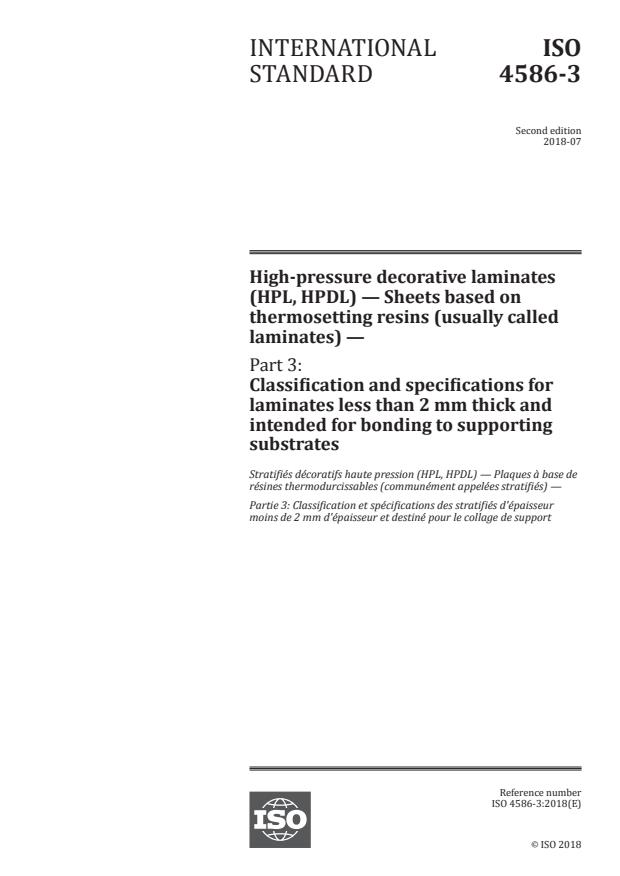
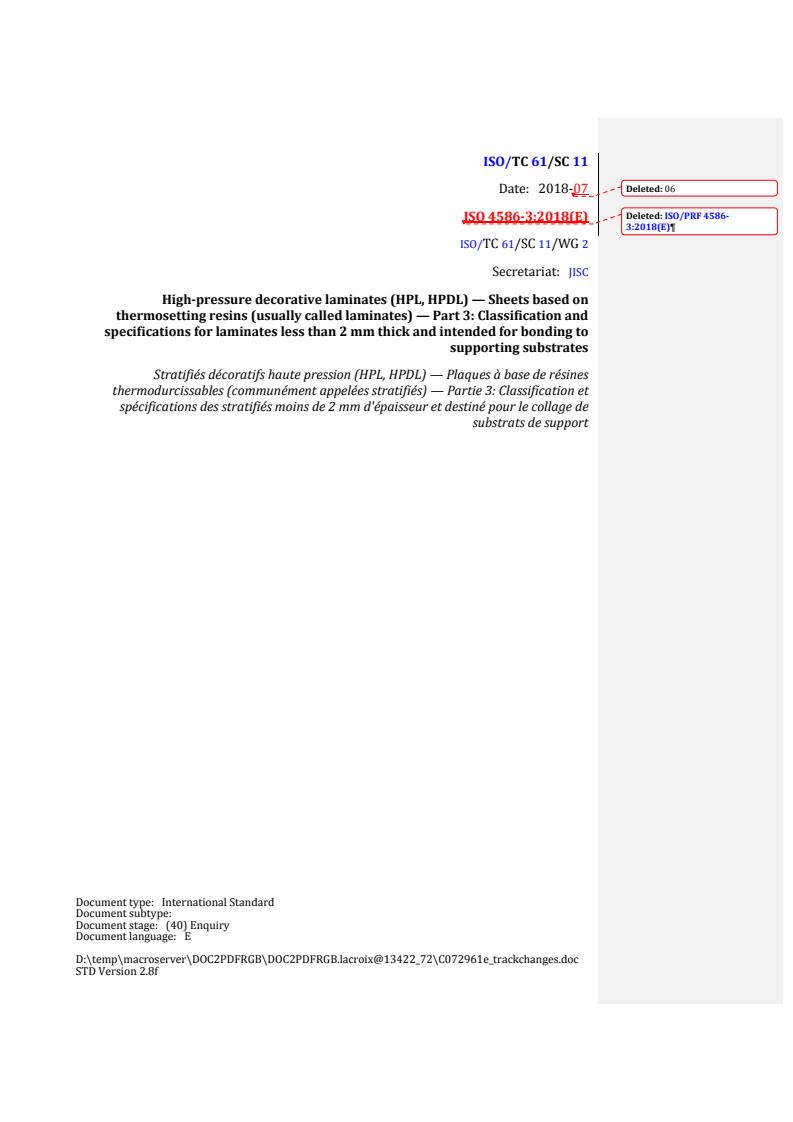
(Main)High-pressure decorative laminates (HPL, HPDL) — Sheets based on thermosetting resins (usually called laminates) — Part 3: Classification and specifications for laminates less than 2 mm thick and intended for bonding to supporting substrates
High-pressure decorative laminates (HPL, HPDL) — Sheets based on thermosetting resins (usually called laminates) — Part 3: Classification and specifications for laminates less than 2 mm thick and intended for bonding to supporting substrates
This document applies to high-pressure laminates (HPL) less than 2 mm thick normally intended for bonding to supporting substrates to produce HPL composite panels and establishes a classification system for high-pressure decorative laminates according to their performance and main recommended fields of application, including materials with special characteristics, for example formability or defined reaction to fire. This document also specifies requirements for the properties of the various types of laminates covered by this classification system. ISO 4586‑2 specifies the methods of test relevant to this document. ISO 4586‑4 through ISO 4586‑8 are reserved for other types of HPL materials.
Stratifiés décoratifs haute pression (HPL, HPDL) — Plaques à base de résines thermodurcissables (communément appelées stratifiés) — Partie 3: Classification et spécifications des stratifiés d'épaisseur moins de 2 mm d'épaisseur et destiné pour le collage de support
General Information
- Status
- Published
- Publication Date
- 01-Jul-2018
- Technical Committee
- ISO/TC 61/SC 11 - Products
- Current Stage
- 9093 - International Standard confirmed
- Start Date
- 29-Dec-2022
- Completion Date
- 12-Feb-2026
Relations
- Effective Date
- 24-Dec-2016
Overview
ISO 4586-3:2018 defines classification and specifications for high-pressure decorative laminates (HPL, HPDL) less than 2 mm thick that are intended to be bonded to supporting substrates to make HPL composite panels. The standard sets out a classification system by performance and intended application (including special characteristics such as postformability and defined reaction to fire) and specifies property requirements. Test methods referenced for verification are given in ISO 4586-2. ISO 4586-3 is harmonized with EN 438-3 where possible.
Key topics and technical requirements
- Scope and materials: Covers sheets based on thermosetting resins (surface layers, core layers) made by the high‑pressure process (temperature ≥ 120 °C and pressure ≥ 5 MPa).
- Material types:
- Type S - Standard grade
- Type P - Postformable grade (formable at elevated temperature)
- Type F - Flame‑retardant grade (meets specified fire‑test requirements)
- Classification systems: Two alternatives are allowed:
- Numerical classification: Letter for material type + three index numbers for wear, impact and scratch resistance. Index levels 2, 3 and 4 indicate increasing performance (e.g., wear index 2/3/4 correspond to progressively higher abrasion resistance; impact index examples: ≥15 N, ≥20 N, ≥25 N).
- Alphabetical classification: Three-letter code (e.g., HGP, VGS) that indicates orientation (Horizontal/Vertical), general purpose/heavy duty, and special properties (Postformable/Flame‑retardant).
- Inspection and visual requirements: Colour and pattern matching under daylight (D65) and tungsten A, surface‑finish consistency across viewing angles, reverse side suitable for bonding (sanded backs permitted with slight chatter).
- Verification and testing: Dimensional tolerances, abrasion, impact, scratch, heat, staining and other properties are tested per ISO 4586-2. Annexes cover fire performance (Annex B) and electrostatic properties (Annex C).
Applications and practical value
- Use ISO 4586-3 when specifying thin HPL sheets for laminated composite panels, furniture cladding, wall/ceiling panels, doors, counters and interior linings where panels are fabricated by bonding HPL to supports.
- Helps manufacturers, specifiers, architects, fabricators and procurement teams select the right HPL grade (standard, postformable, flame‑retardant) based on wear, impact and scratch performance and regulatory needs.
- Standardized nomenclature (e.g., HPL/ISO 4586-3/P33 or HPDL/ISO 4586-3/HGP) simplifies procurement and compliance documentation.
Related standards
- ISO 4586-2:2018 - Determination of properties (test methods referenced by ISO 4586-3)
- ISO 4586-4 to ISO 4586-8 - Reserved for other HPL material types
- Harmonized where possible with EN 438-3
Keywords: ISO 4586-3:2018, high-pressure decorative laminates, HPL, HPDL, laminates less than 2 mm, classification, postformable, flame-retardant, ISO 4586-2, HPL composite panels, surface finish, inspection.
ISO 4586-3:2018 - High-pressure decorative laminates (HPL, HPDL) -- Sheets based on thermosetting resins (usually called laminates)
REDLINE ISO 4586-3:2018 - High-pressure decorative laminates (HPL, HPDL) — Sheets based on thermosetting resins (usually called laminates) — Part 3: Classification and specifications for laminates less than 2 mm thick and intended for bonding to supporting substrates Released:7/2/2018
Get Certified
Connect with accredited certification bodies for this standard

Smithers Quality Assessments
US management systems and product certification.

DIN CERTCO
DIN Group product certification.
Sponsored listings
Frequently Asked Questions
ISO 4586-3:2018 is a standard published by the International Organization for Standardization (ISO). Its full title is "High-pressure decorative laminates (HPL, HPDL) — Sheets based on thermosetting resins (usually called laminates) — Part 3: Classification and specifications for laminates less than 2 mm thick and intended for bonding to supporting substrates". This standard covers: This document applies to high-pressure laminates (HPL) less than 2 mm thick normally intended for bonding to supporting substrates to produce HPL composite panels and establishes a classification system for high-pressure decorative laminates according to their performance and main recommended fields of application, including materials with special characteristics, for example formability or defined reaction to fire. This document also specifies requirements for the properties of the various types of laminates covered by this classification system. ISO 4586‑2 specifies the methods of test relevant to this document. ISO 4586‑4 through ISO 4586‑8 are reserved for other types of HPL materials.
This document applies to high-pressure laminates (HPL) less than 2 mm thick normally intended for bonding to supporting substrates to produce HPL composite panels and establishes a classification system for high-pressure decorative laminates according to their performance and main recommended fields of application, including materials with special characteristics, for example formability or defined reaction to fire. This document also specifies requirements for the properties of the various types of laminates covered by this classification system. ISO 4586‑2 specifies the methods of test relevant to this document. ISO 4586‑4 through ISO 4586‑8 are reserved for other types of HPL materials.
ISO 4586-3:2018 is classified under the following ICS (International Classification for Standards) categories: 83.140.20 - Laminated sheets. The ICS classification helps identify the subject area and facilitates finding related standards.
ISO 4586-3:2018 has the following relationships with other standards: It is inter standard links to ISO 4586-3:2015. Understanding these relationships helps ensure you are using the most current and applicable version of the standard.
ISO 4586-3:2018 is available in PDF format for immediate download after purchase. The document can be added to your cart and obtained through the secure checkout process. Digital delivery ensures instant access to the complete standard document.
Standards Content (Sample)
INTERNATIONAL ISO
STANDARD 4586-3
Second edition
2018-07
High-pressure decorative laminates
(HPL, HPDL) — Sheets based on
thermosetting resins (usually called
laminates) —
Part 3:
Classification and specifications for
laminates less than 2 mm thick and
intended for bonding to supporting
substrates
Stratifiés décoratifs haute pression (HPL, HPDL) — Plaques à base de
résines thermodurcissables (communément appelées stratifiés) —
Partie 3: Classification et spécifications des stratifiés d'épaisseur
moins de 2 mm d'épaisseur et destiné pour le collage de support
Reference number
©
ISO 2018
© ISO 2018
All rights reserved. Unless otherwise specified, or required in the context of its implementation, no part of this publication may
be reproduced or utilized otherwise in any form or by any means, electronic or mechanical, including photocopying, or posting
on the internet or an intranet, without prior written permission. Permission can be requested from either ISO at the address
below or ISO’s member body in the country of the requester.
ISO copyright office
CP 401 • Ch. de Blandonnet 8
CH-1214 Vernier, Geneva
Phone: +41 22 749 01 11
Fax: +41 22 749 09 47
Email: copyright@iso.org
Website: www.iso.org
Published in Switzerland
ii © ISO 2018 – All rights reserved
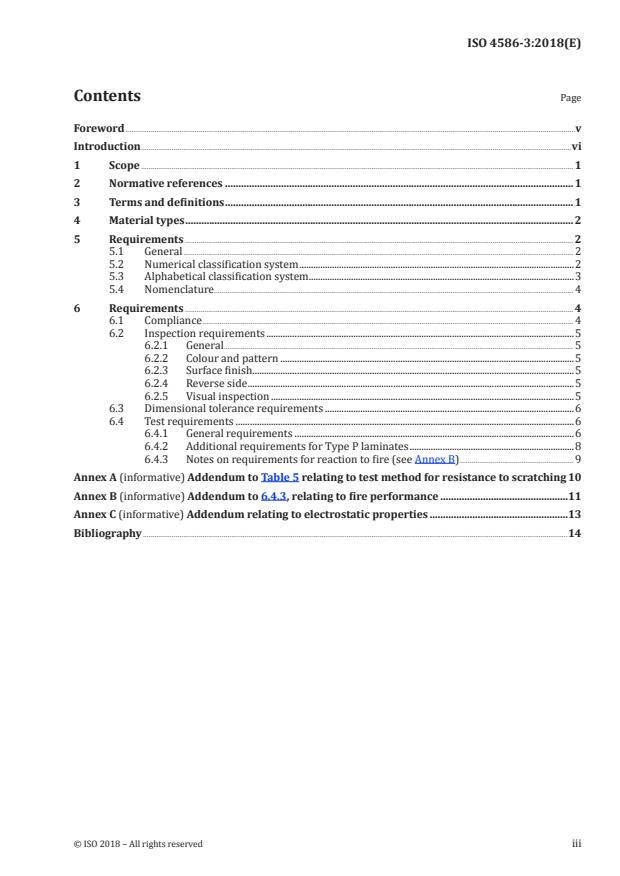
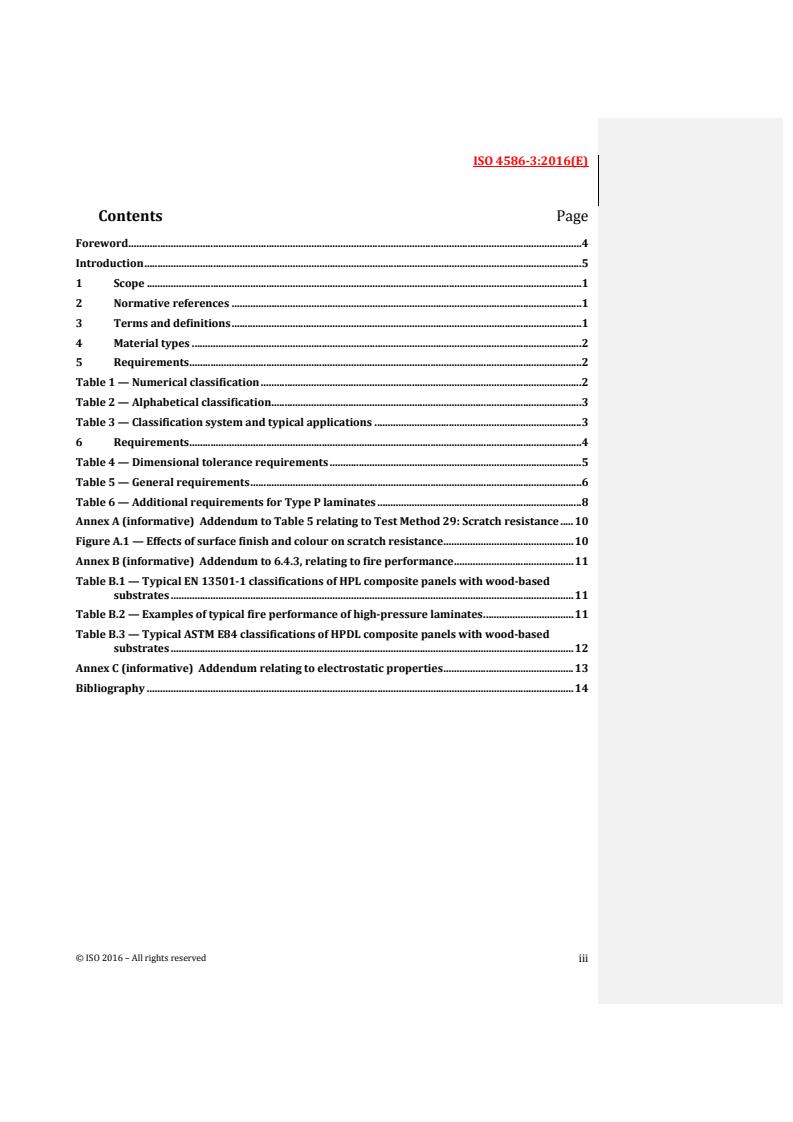
Contents Page
Foreword .v
Introduction .vi
1 Scope . 1
2 Normative references . 1
3 Terms and definitions . 1
4 Material types . 2
5 Requirements . 2
5.1 General . 2
5.2 Numerical classification system .2
5.3 Alphabetical classification system.3
5.4 Nomenclature. 4
6 Requirements . 4
6.1 Compliance . 4
6.2 Inspection requirements .5
6.2.1 General. 5
6.2.2 Colour and pattern .5
6.2.3 Surface finish . .5
6.2.4 Reverse side .5
6.2.5 Visual inspection .5
6.3 Dimensional tolerance requirements .6
6.4 Test requirements .6
6.4.1 General requirements .6
6.4.2 Additional requirements for Type P laminates .8
6.4.3 Notes on requirements for reaction to fire (see Annex B) . 9
Annex A (informative) Addendum to Table 5 relating to test method for resistance to scratching 10
Annex B (informative) Addendum to 6.4.3, relating to fire performance .11
Annex C (informative) Addendum relating to electrostatic properties .13
Bibliography .14
Foreword
ISO (the International Organization for Standardization) is a worldwide federation of national standards
bodies (ISO member bodies). The work of preparing International Standards is normally carried out
through ISO technical committees. Each member body interested in a subject for which a technical
committee has been established has the right to be represented on that committee. International
organizations, governmental and non-governmental, in liaison with ISO, also take part in the work.
ISO collaborates closely with the International Electrotechnical Commission (IEC) on all matters of
electrotechnical standardization.
The procedures used to develop this document and those intended for its further maintenance are
described in the ISO/IEC Directives, Part 1. In particular the different approval criteria needed for the
different types of ISO documents should be noted. This document was drafted in accordance with the
editorial rules of the ISO/IEC Directives, Part 2 (see www .iso .org/directives).
Attention is drawn to the possibility that some of the elements of this document may be the subject of
patent rights. ISO shall not be held responsible for identifying any or all such patent rights. Details of
any patent rights identified during the development of the document will be in the Introduction and/or
on the ISO list of patent declarations received (see www .iso .org/patents).
Any trade name used in this document is information given for the convenience of users and does not
constitute an endorsement.
For an explanation on the voluntary nature of standards, the meaning of ISO specific terms and
expressions related to conformity assessment, as well as information about ISO's adherence to the
World Trade Organization (WTO) principles in the Technical Barriers to Trade (TBT) see the following
URL: www .iso .org/iso/foreword .html.
This document was prepared by Technical Committee ISO/TC 61, Plastics, Subcommittee SC 11,
Products.
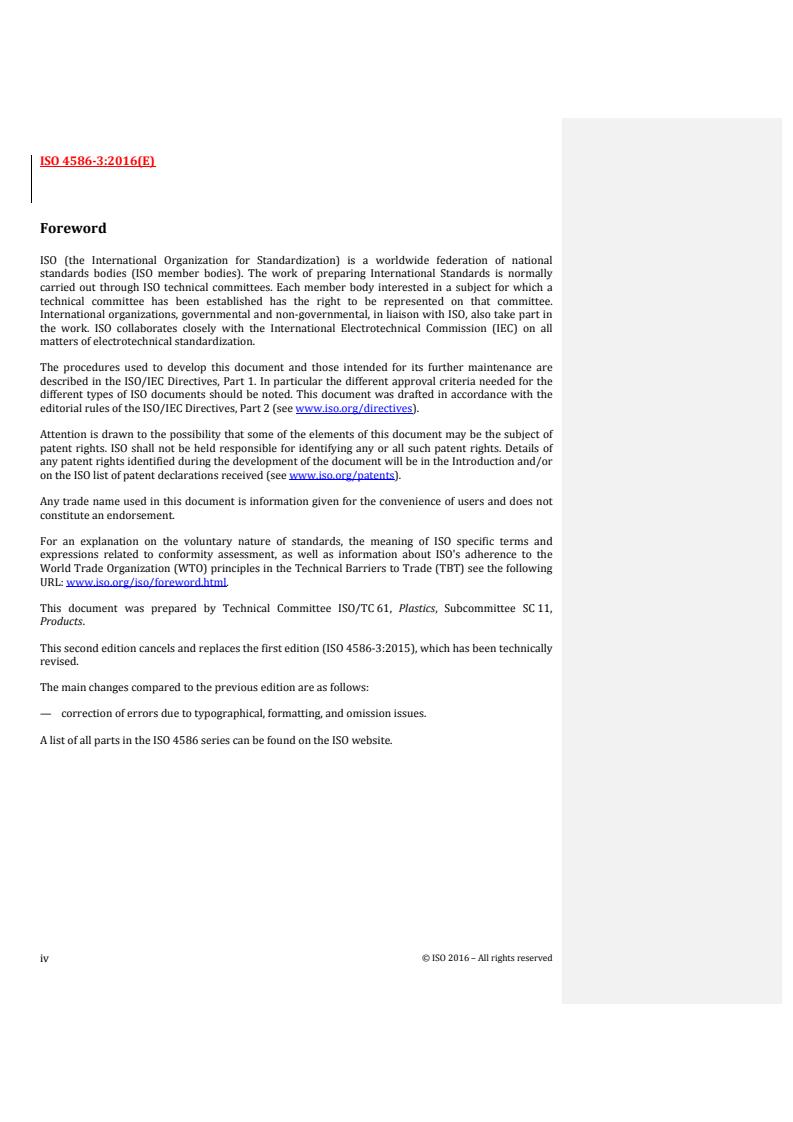
This second edition cancels and replaces the first edition (ISO 4586-3:2015), which has been technically
revised.
The main changes compared to the previous edition are as follows:
— correction of errors due to typographical, formatting, and omission issues.
A list of all parts in the ISO 4586 series can be found on the ISO website.
iv © ISO 2018 – All rights reserved
Introduction
High-pressure decorative laminates are characterized by their qualities, durability, and functional
performance. High-pressure laminate sheets are available in a wide variety of colours, patterns and
surface finishes. They are resistant to wear, scratching, impact, moisture, heat, and staining; and
possess good hygienic and anti-static properties, being easy to clean and maintain.
In an effort to harmonize ISO 4586 with other high-pressure decorative laminate standards, multiple
methods may be published that demonstrate similar properties. In these instances, the same test method
title is given and is annotated as either “Method A” or “Method B”. This is the case in the following tests:
Edge squareness — 8/9, Dry heat — 17/18 Dimensional stability at elevated temperatures — 19/20,
Dimensional stability at ambient temperature — 21/22, Staining — 30/31, Lightfastness — 32/33,
Formability — 38/39, and Blistering — 40/41. In these instances, either method may be utilized in
testing. Compliance to both methods is not required. While these tests are similar they are by no means
identical and results of one method do not necessarily correspond to the results of the accompanying
test. In these situations, it is intended that specific parts of ISO 4586 for performance requirements be
consulted. Each specific method has performance requirements particular to that method for individual
grades of high-pressure decorative laminate.
This document has been harmonized with EN 438-3 whenever possible.
In addition, Annex C provides information on electrostatic properties and is included as a convenient
reference to answer common questions.
INTERNATIONAL STANDARD ISO 4586-3:2018(E)
High-pressure decorative laminates (HPL, HPDL) —
Sheets based on thermosetting resins (usually called
laminates) —
Part 3:
Classification and specifications for laminates less than
2 mm thick and intended for bonding to supporting
substrates
1 Scope
This document applies to high-pressure laminates (HPL) less than 2 mm thick normally intended for
bonding to supporting substrates to produce HPL composite panels and establishes a classification
system for high-pressure decorative laminates according to their performance and main recommended
fields of application, including materials with special characteristics, for example formability or defined
reaction to fire. This document also specifies requirements for the properties of the various types of
laminates covered by this classification system.
ISO 4586-2 specifies the methods of test relevant to this document. ISO 4586-4 through ISO 4586-8 are
reserved for other types of HPL materials.
2 Normative references
The following documents are referred to in the text in such a way that some or all of their content
constitutes requirements of this document. For dated references, only the edition cited applies. For
undated references, the latest edition of the referenced document (including any amendments) applies.
ISO 1183-1, Plastics — Methods for determining the density of non-cellular plastics — Part 1: Immersion
method, liquid pyknometer method and titration method
ISO 4586-2:2018, High-pressure decorative laminates (HPL, HPDL) — Sheets based on thermosetting resins
(usually called laminates) — Part 2: Determination of properties
3 Terms and definitions
For the purposes of this document, the following terms and definitions apply.
ISO and IEC maintain terminological databases for use in standardization at the following addresses:
— IEC Electropedia: available at https:/ /www.e lectropedia. org/
— ISO Online browsing platform: available at https:/ /www. iso. org/obp
3.1
high-pressure decorative laminate
HPL
HPDL
sheet consisting of layers of cellulosic fibrous material (normally paper) impregnated with
thermosetting resins and bonded together by the high-pressure process (3.2)
Note 1 to entry: This is a general definition of high-pressure decorative laminate(s). More specific product
definitions can be found in ISO 4586-3 to ISO 4586-8.
3.2
high-pressure process
simultaneous application of heat (temperature ≥ 120 °C) and high specific pressure (≥ 5 MPa), to
provide flowing and subsequent curing of the thermosetting resins to obtain a homogeneous non-
porous material with increased density (≥ 1,35 g/cm ), and with the required surface finish
3.3
surface layer
upper decorative layer consisting in one or more sheets of fibrous material (usually paper) impregnated
with aminoplastic thermosetting resins (usually melamine based resins) or other curable resins or
other decorative design surfaces such as metal foils, wood-veneers, and textiles, etc. which are not
necessarily treated with thermosetting resin
3.4
core layer
fibrous material (usually paper) impregnated with thermosetting resins (usually phenolic based resins)
or other curable resins, possibly reinforced by metal layer(s) or metal mesh(es) and others which are
not necessarily treated with thermosetting resin
4 Material types
4.1 Type S — Standard grade decorative laminates.
4.2 Type P — Postformable decorative laminates, similar to type S but can also be formed at
elevated temperature.
4.3 Type F — Decorative laminates with improved fire retardance, similar to types S or P but also
meeting special requirements of specified fire tests which may vary according to the application (e.g.
construction, marine, transport) and the country of use (see 6.4.3 and Annex B).
5 Requirements
5.1 General
Two different HPL classification systems are commonly used and both have been included in this
document as alternatives.
5.2 Numerical classification system
In this system the classification of a letter denoting material type (see Clause 4) followed by three
index numbers showing the levels of performance for wear resistance, impact resistance and scratch
resistance respectively.
Table 1 shows the performance levels corresponding to the index numbers.
2 © ISO 2018 – All rights reserved
Table 1 — Numerical classification
First index number — Wear resistance
Initial point(revs) 2 3 4
≥ 50 ≥ 150 ≥ 350
Wear value (revs)
≥ 150 ≥ 350 ≥ 1 000
Second index number — Impact resistance
Small diameter ball (N) 2 3 4
≥ 15 ≥ 20 ≥ 25
Third index number — Scratch resistance
Scratch resistance (Rating) 2 3 4
2 3 4
NOTE Index numbers 2, 3, and 4 are specified to maintain consistency with earlier editions of ISO 4586 parts. Index
number 1 represents a lower quality level that does not apply to HPL as defined by the scope of this document.
5.3 Alphabetical classification system
This system uses three letters to classify laminates as shown in Table 2.
Table 2 — Alphabetical classification
First letter Second letter Third letter
H (Horizontal grade) G (General purpose) S (Standard grade)
or V (Vertical grade) or D (Heavy duty) or P (Postformable grade)
or F (Flame-retardant grade)
Table 3 compares the alternative classification systems and shows how different HPL products relate to
some typical applications. The list of typical applications shown for each category is for guidance only
and is not intended to be comprehensive.
Table 3 — Classification system and typical applications
Performance Material Numerical classification Equivalent Examples of typical
category type alphabetical applications
Index numbers
classification
Wear re- Impact re- Scratch
sistance sistance resistance
HDS (Horizon- Countertops, insti-
Very high tal Heavy Duty tutional applications
resistance to Standard), (prisons, military,
surface wear barracks, etc.)
HDF (Horizon-
Very high resist- tal Heavy Duty
S, F or P 4 4 4
ance to impact Flame-retardant),
or
Very high
resistance to HDP (Horizontal
scratching Heavy Duty Post-
forming)
HGS (Horizontal Kitchen and office
General purpose work surfaces, res-
High resistance Standard), taurant and hotel ta-
to surface wear bles, doors and wall
HGF (Horizontal
coverings in public
High resistance General purpose
S, F or P 3 3 3 areas, interior walls
to impact Flame-retardant),
of public transport
or
High resistance vehicles
to scratching HGP (Horizontal
General purpose
Postforming)
VGS (Vertical Front panels for
Medium resist- General purpose kitchen, office and
ance to surface Standard), bathroom furniture,
wear wall coverings, ceiling
VGF (Vertical
panels, shelves, and
Medium resist- General purpose
S, F or P 2 2 2 furniture elements
ance to impact Flame retardant),
or
Medium
resistance to VGP (Vertical
scratching General purpose
Postforming)
Combinations of wear, impact and scratch resistance index numbers other than those shown in Table 3 are possible and
can be specified using the numerical classification system. In such cases properties ot
...
ISO/TC 61/SC 11
Deleted: 06
Date: 2018‐07
Deleted: ISO/PRF 4586-
3:2018(E)
ISO/TC 61/SC 11/WG 2
Secretariat: JISC
High-pressure decorative laminates (HPL, HPDL) — Sheets based on
thermosetting resins (usually called laminates) — Part 3: Classification and
specifications for laminates less than 2 mm thick and intended for bonding to
supporting substrates
Stratifiés décoratifs haute pression (HPL, HPDL) — Plaques à base de résines
thermodurcissables (communément appelées stratifiés) — Partie 3: Classification et
spécifications des stratifiés moins de 2 mm d'épaisseur et destiné pour le collage de
substrats de support
Document type: International Standard
Document subtype:
Document stage: (40) Enquiry
Document language: E
D:\temp\macroserver\DOC2PDFRGB\DOC2PDFRGB.lacroix@13422_72\C072961e_trackchanges.doc
STD Version 2.8f
ISO 4586-3:2016(E)
Deleted: Copyright notice
This ISO document is a Draft International
Standard and is copyright‐protected by
ISO. Except as permitted under the
applicable laws of the user's country,
neither this ISO draft nor any extract from
it may be reproduced, stored in a retrieval
system or transmitted in any form or by
any means, electronic, photocopying,
recording or otherwise, without prior
written permission being secured.
Requests for permission to reproduce
should be addressed to either ISO at the
address below or ISO's member body in
the country of the requester.
ISO copyright office
Case postale 56 • CH‐1211 Geneva 20
Tel. + 41 22 749 01 11
Fax + 41 22 749 09 47
E‐mail copyright@iso.org
Web www.iso.org
Reproduction may be subject to royalty
payments or a licensing agreement.
Violators may be prosecuted.
© ISO 2016 – All rights reserved
ii
ISO 4586-3:2016(E)
Contents Page
Foreword . 4
Introduction . 5
1 Scope . 1
2 Normative references . 1
3 Terms and definitions . 1
4 Material types . 2
5 Require ments . . . . . . . . . . . . . . . . . . 2
Table 1 — Numerical classification . 2
Table 2 — Alphabetical classification. 3
Table 3 — Classification system and typical applications . 3
6 Require ments . . . . . . . . . . . . . . . . . . 4
Table 4 — Dimensional tolerance requirements . 5
Table 5 — General requirements . 6
Table 6 — Additional requirements for Type P laminates . 8
Annex A (informative) Addendum to Table 5 relating to Test Method 29: Scratch resistance . 10
Figure A.1 — Effects of surface finish and colour on scratch resistance . 10
Annex B (informative) Addendum to 6.4.3, relating to fire performance . 11
Table B.1 — Typical EN 13501-1 classifications of HPL composite panels with wood-based
substrates . 11
Table B.2 — Examples of typical fire performance of high-pressure laminates . 11
Table B.3 — Typical ASTM E84 classifications of HPDL composite panels with wood-based
substrates . 12
Annex C (informative) Addendum relating to electrostatic properties . 13
Bibliography . 14
© ISO 2016 – All rights reserved
iii
ISO 4586-3:2016(E)
Foreword
ISO (the International Organization for Standardization) is a worldwide federation of national
standards bodies (ISO member bodies). The work of preparing International Standards is normally
carried out through ISO technical committees. Each member body interested in a subject for which a
technical committee has been established has the right to be represented on that committee.
International organizations, governmental and non‐governmental, in liaison with ISO, also take part in
the work. ISO collaborates closely with the International Electrotechnical Commission (IEC) on all
matters of electrotechnical standardization.
The procedures used to develop this document and those intended for its further maintenance are
described in the ISO/IEC Directives, Part 1. In particular the different approval criteria needed for the
different types of ISO documents should be noted. This document was drafted in accordance with the
editorial rules of the ISO/IEC Directives, Part 2 (see www.iso.org/directives).
Attention is drawn to the possibility that some of the elements of this document may be the subject of
patent rights. ISO shall not be held responsible for identifying any or all such patent rights. Details of
any patent rights identified during the development of the document will be in the Introduction and/or
on the ISO list of patent declarations received (see www.iso.org/patents).
Any trade name used in this document is information given for the convenience of users and does not
constitute an endorsement.
For an explanation on the voluntary nature of standards, the meaning of ISO specific terms and
expressions related to conformity assessment, as well as information about ISO's adherence to the
World Trade Organization (WTO) principles in the Technical Barriers to Trade (TBT) see the following
URL: www.iso.org/iso/foreword.html.
This document was prepared by Technical Committee ISO/TC 61, Plastics, Subcommittee SC 11,
Products.
This second edition cancels and replaces the first edition (ISO 4586‐3:2015), which has been technically
revised.
The main changes compared to the previous edition are as follows:
— correction of errors due to typographical, formatting, and omission issues.
A list of all parts in the ISO 4586 series can be found on the ISO website.
© ISO 2016 – All rights reserved
iv
ISO 4586-3:2016(E)
Introduction
High‐pressure decorative laminates are characterized by their qualities, durability, and functional
performance. High‐pressure laminate sheets are available in a wide variety of colours, patterns and
surface finishes. They are resistant to wear, scratching, impact, moisture, heat, and staining; and
possess good hygienic and anti‐static properties, being easy to clean and maintain.
In an effort to harmonize ISO 4586 with other high‐pressure decorative laminate standards, multiple
methods may be published that demonstrate similar properties. In these instances, the same test
method title is given and is annotated as either “Method A” or “Method B”. This is the case in the
following tests: Edge squareness — 8/9, Dry heat — 17/18 Dimensional stability at elevated
temperatures — 19/20, Dimensional stability at ambient temperature — 21/22, Staining — 30/31,
Lightfastness — 32/33, Formability — 38/39, and Blistering — 40/41. In these instances, either
method may be utilized in testing. Compliance to both methods is not required. While these tests are
similar they are by no means identical and results of one method do not necessarily correspond to the
results of the accompanying test. In these situations, it is intended that specific parts of ISO 4586 for
performance requirements be consulted. Each specific method has performance requirements
particular to that method for individual grades of high‐pressure decorative laminate.
This document has been harmonized with EN 438‐3 whenever possible.
In addition, Annex C provides information on electrostatic properties and is included as a convenient
reference to answer common questions.
© ISO 2016 – All rights reserved
v
Deleted: /PRF
INTERNATIONAL STANDARD ISO 4586‐3:2018(E)
Deleted: High-pressure
decorative laminates (HPL,
HPDL) — Sheets based on
High-pressure decorative laminates (HPL, HPDL) — Sheets
thermosetting resins (usually
based on thermosetting resins (usually called laminates) —
called Laminates) — Part 3:
Classification and Specifications
Part 3: Classification and specifications for laminates less than
for laminates less than 2 mm
thick and intended for bonding to
2 mm thick and intended for bonding to supporting substrates
supporting substrates
1 Scope
This document applies to high‐pressure laminates (HPL) less than 2 mm thick normally intended for
bonding to supporting substrates to produce HPL composite panels and establishes a classification
system for high‐pressure decorative laminates according to their performance and main recommended
fields of application, including materials with special characteristics, for example formability or defined
reaction to fire. This document also specifies requirements for the properties of the various types of
laminates covered by this classification system.
ISO 4586‐2 specifies the methods of test relevant to this document. ISO 4586‐4 through ISO 4586‐8 are
reserved for other types of HPL materials.
2 Normative references
The following documents are referred to in the text in such a way that some or all of their content
constitutes requirements of this document. For dated references, only the edition cited applies. For
undated references, the latest edition of the referenced document (including any amendments) applies.
ISO 1183‐1, Plastics — Methods for determining the density of non-cellular plastics — Part 1: Immersion
method, liquid pyknometer method and titration method
ISO 4586‐2:2018, High-pressure decorative laminates (HPL, HPDL) — Sheets based on thermosetting
resins (usually called laminates) — Part 2: Determination of properties Deleted: Usually
Deleted: Laminates
3 Terms and definitions
For the purposes of this document, the following terms and definitions apply.
ISO and IEC maintain terminological databases for use in standardization at the following addresses:
— IEC Electropedia: available at https://www.electropedia.org/
— ISO Online browsing platform: available at https://www.iso.org/obp
3.1
high-pressure decorative laminate
HPL
HPDL
sheet consisting of layers of cellulosic fibrous material (normally paper) impregnated with
thermosetting resins and bonded together by the high-pressure process (3.2)
Note 1 to entry: This is a general definition of high‐pressure decorative laminate(s). More specific product
definitions can be found in ISO 4586‐3 to ISO 4586‐8.
© ISO 2016 – All rights reserved
ISO 4586-3:2016(E)
3.2
high-pressure process
simultaneous application of heat (temperature ≥ 120 °C) and high specific pressure (≥ 5 MPa), to
provide flowing and subsequent curing of the thermosetting resins to obtain a homogeneous non‐
porous material with increased density (≥ 1,35 g/cm), and with the required surface finish
3.3
surface layer
upper decorative layer consisting in one or more sheets of fibrous material (usually paper)
impregnated with aminoplastic thermosetting resins (usually melamine based resins) or other curable
resins or other decorative design surfaces such as metal foils, wood‐veneers, and textiles, etc. which are
not necessarily treated with thermosetting resin
3.4
core layer
fibrous material (usually paper) impregnated with thermosetting resins (usually phenolic based resins)
or other curable resins, possibly reinforced by metal layer(s) or metal mesh(es) and others which are
not necessarily treated with thermosetting resin
4 Material types
4.1 Type S — Standard grade decorative laminates.
4.2 Type P — Postformable decorative laminates, similar to type S but can also be formed at
elevated temperature.
4.3 Type F — Decorative laminates with improved fire retardance, similar to types S or P but also
meeting special requirements of specified fire tests which may vary according to the application (e.g.
construction, marine, transport) and the country of use (see 6.4.3 and Annex B).
5 Requirements
5.1 General
Two different HPL classification systems are commonly used and both have been included in this
document as alternatives.
5.2 Numerical classification system
In this system the classification of a letter denoting material type (see Clause 4) followed by three index
numbers showing the levels of performance for wear resistance, impact resistance and scratch
resistance respectively.
Table 1 shows the performance levels corresponding to the index numbers.
Table 1 — Numerical classification
First index number — Wear resistance
Initial point(revs) 2 3 4
Wear value (revs)
≥ 50 ≥ 150 ≥ 350
≥ 150 ≥ 350 ≥ 1 000
Second index number — Impact resistance
Small diameter ball (N)
2 3 4
© ISO 2016 – All rights reserved
ISO 4586-3:2016(E)
≥ 15 ≥ 20 ≥ 25
Third index number — Scratch resistance
Scratch resistance (Rating) 2 3 4
2 3 4
NOTE Index numbers 2, 3, and 4 are specified to maintain consistency with earlier editions of ISO 4586 parts. Index
number 1 represents a lower quality level that does not apply to HPL as defined by the scope of this document.
5.3 Alphabetical classification system
This system uses three letters to classify laminates as shown in Table 2.
Table 2 — Alphabetical classification
First letter Second letter Third letter
H (Horizontal grade) G (General purpose) S (Standard grade)
or V (Vertical grade) or D (Heavy duty) or P (Postformable grade)
or F (Flame‐retardant grade)
Table 3 compares the alternative classification systems and shows how different HPL products relate to
some typical applications. The list of typical applications shown for each category is for guidance only
and is not intended to be comprehensive.
Table 3 — Classification system and typical applications
Performance Material Numerical classification Equivalent Examples of
category type alphabetical typical
Index numbers
classification applications
Wear Impact Scratch
resistanc resistanc resistanc
e e e
HDS (Horizontal Countertops,
Very high
Heavy Duty institutional
resistance to
Standard), applications
surface wear
(prisons, military,
HDF (Horizontal
Very high
barracks, etc.)
Heavy Duty
resistance to S, F or P 4 4 4
Flame‐
impact
retardant), or
Very high
HDP (Horizontal
resistance to
Heavy Duty
scratching
Postforming)
HGS (Horizontal Kitchen and office
High
General purpose work surfaces,
resistance to
Standard), restaurant and hotel
surface wear
tables, doors and
HGF (Horizontal
High
wall coverings in
General purpose
resistance to S, F or P 3 3 3
public areas,
Flame‐
impact
interior walls of
retardant), or
High public transport
HGP (Horizontal
vehicles
resistance to
General purpose
scratching
Postforming)
Medium VGS (Vertical Front panels for
S, F or P 2 2 2
resistance to General purpose kitchen, office and
© ISO 2016 – All rights reserved
ISO 4586-3:2016(E)
Performance Material Numerical classification Equivalent Examples of
category type alphabetical typical
Index numbers
classification applications
Wear Impact Scratch
resistanc resistanc resistanc
e e e
surface wear Standard), bathroom furniture,
wall coverings,
Medium VGF (Vertical
ceiling panels,
resistance to General purpose
shelves, and
impact Flame
furniture elements
retardant), or
Medium
resistance to VGP (Vertical
scratching General purpose
Postforming)
Combinations of wear, impact and scratch resistance index numbers other than those shown in Table 3 are possible and can
be specified using the numerical classification system. In such cases properties other than wear resistan
...
Questions, Comments and Discussion
Ask us and Technical Secretary will try to provide an answer. You can facilitate discussion about the standard in here.
Loading comments...