


ISO 23028:2019
(Main)Aluminium oxide primarily used for the production of aluminium - Preparation and storage of test samples
Aluminium oxide primarily used for the production of aluminium - Preparation and storage of test samples
This document describes methods for the sample preparation of smelter-grade aluminium oxide. It covers the reduction of a bulk sample between 1 kg and 20 kg to produce a sample that is suitable for chemical and physical analysis. The reduced sample produced will be representative of the initial bulk sample. The bulk sample is considered to be from one source. The methods are suitable for dry, free-flowing aluminium oxide. As the moisture content will influence many physical analyses, the method aims to minimize the exposure of the sample to the atmosphere to avoid water absorption.
Titre manque
General Information
Relations
Overview
ISO 23028:2019 specifies methods for the preparation and storage of test samples of smelter‑grade aluminium oxide (alumina). The standard covers reduction of a bulk sample (1 kg to 20 kg) to representative portions suitable for chemical and physical analysis. It is intended for dry, free‑flowing aluminium oxide and emphasizes minimizing atmospheric exposure to avoid water absorption that can affect analytical results.
Keywords: ISO 23028:2019, aluminium oxide sample preparation, smelter‑grade aluminium oxide, sample storage, test samples.
Key topics and technical requirements
- Scope and principle
- Procedures ensure the reduced sample is representative of the initial bulk from one source.
- Mixing and rotary splitting are the primary methods for homogenization and division.
- Apparatus
- Rotary splitter (large): stainless steel recommended; minimum of eight receivers; receiver capacity up to 2 kg; design to minimize fall distance and fines loss.
- Small rotary splitter: receivers up to 250 g; minimum eight receivers; may require vibratory feeder.
- Laboratory top‑pan balance: capacity ~4 kg with 1 g readability.
- Airtight sample bottles, brush, powder funnel.
- Fines control
- If determining particles <20 µm, test work shall ensure no more than 0.2% loss of fines over the division process.
- Procedure highlights
- Mix by rotary splitting (repeat splits and recombine for blending).
- Divide to required mass using calculated recombination of receivers (Annex B gives worked example).
- Transfer quantitatively to containers using funnels; brush and tap receivers to recover adhering material.
- Typical analytical portions: e.g., 35–50 g (sieve particle size), 50–60 g (attrition index).
- Identify containers (ID, date) and store in clean, dry conditions; tumble containers before taking analytical portions.
- Sample integrity
- Minimize contamination and exposure to air, limit handling time, and keep equipment dedicated to alumina where possible.
Applications and users
ISO 23028:2019 is used by:
- Quality control and analytical laboratories in aluminium smelting and refining operations
- Material engineers and metallurgists evaluating feedstock chemistry and physical properties
- Sampling technicians preparing representative test samples for particle size, moisture, attrition, and chemical assays
- Standards and regulatory bodies overseeing alumina testing protocols
Practical benefits include reproducible, representative sampling for accurate laboratory analysis, reduced analytical bias from moisture or fines loss, and standardized sample storage practices.
Related standards
- Prepared by ISO/TC 226 (Materials for the production of primary aluminium).
- The document contains no normative references; users should consult other ISO standards relevant to specific analytical tests (e.g., particle size or chemical assay methods) as needed.
Standards Content (Sample)
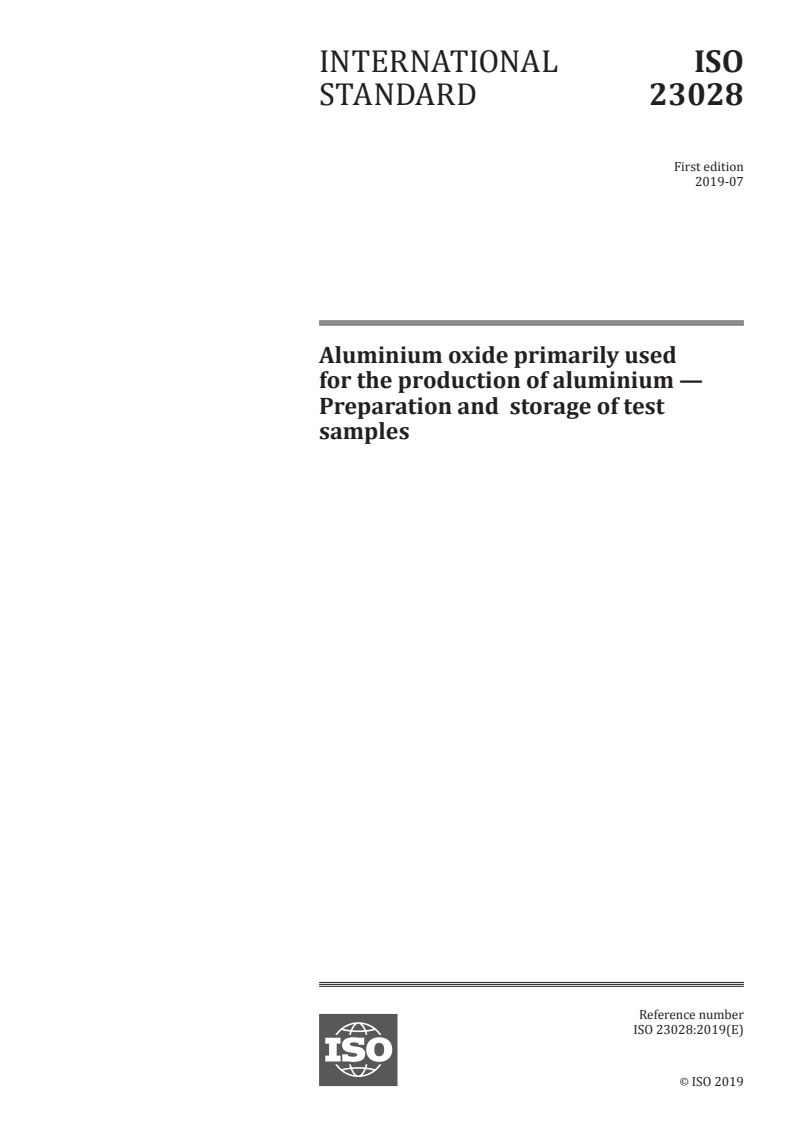
INTERNATIONAL ISO
STANDARD 23028
First edition
2019-07
Aluminium oxide primarily used
for the production of aluminium —
Preparation and storage of test
samples
Reference number
©
ISO 2019
© ISO 2019
All rights reserved. Unless otherwise specified, or required in the context of its implementation, no part of this publication may
be reproduced or utilized otherwise in any form or by any means, electronic or mechanical, including photocopying, or posting
on the internet or an intranet, without prior written permission. Permission can be requested from either ISO at the address
below or ISO’s member body in the country of the requester.
ISO copyright office
CP 401 • Ch. de Blandonnet 8
CH-1214 Vernier, Geneva
Phone: +41 22 749 01 11
Fax: +41 22 749 09 47
Email: copyright@iso.org
Website: www.iso.org
Published in Switzerland
ii © ISO 2019 – All rights reserved
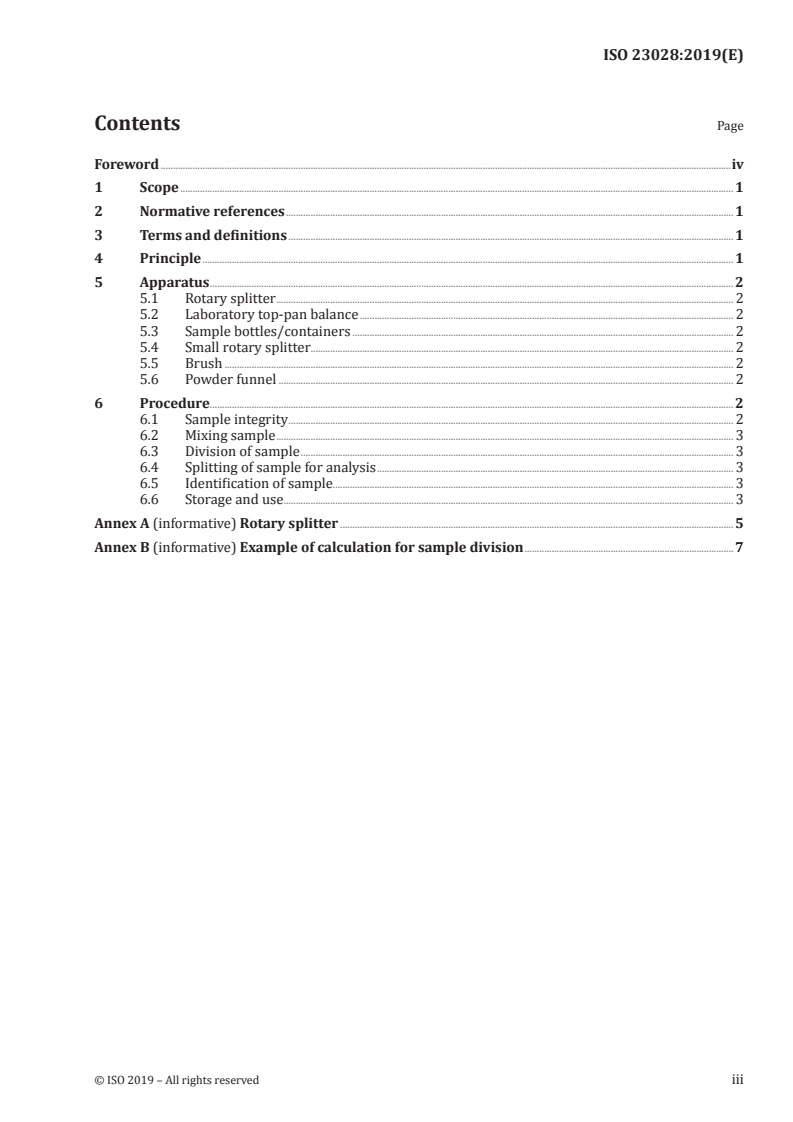
Contents Page
Foreword .iv
1 Scope . 1
2 Normative references . 1
3 Terms and definitions . 1
4 Principle . 1
5 Apparatus . 2
5.1 Rotary splitter . 2
5.2 Laboratory top-pan balance . 2
5.3 Sample bottles/containers . 2
5.4 Small rotary splitter . 2
5.5 Brush . 2
5.6 Powder funnel . 2
6 Procedure. 2
6.1 Sample integrity . 2
6.2 Mixing sample . 3
6.3 Division of sample . 3
6.4 Splitting of sample for analysis . 3
6.5 Identification of sample. 3
6.6 Storage and use . . 3
Annex A (informative) Rotary splitter . 5
Annex B (informative) Example of calculation for sample division . 7
Foreword
ISO (the International Organization for Standardization) is a worldwide federation of national standards
bodies (ISO member bodies). The work of preparing International Standards is normally carried out
through ISO technical committees. Each member body interested in a subject for which a technical
committee has been established has the right to be represented on that committee. International
organizations, governmental and non-governmental, in liaison with ISO, also take part in the work.
ISO collaborates closely with the International Electrotechnical Commission (IEC) on all matters of
electrotechnical standardization.
The procedures used to develop this document and those intended for its further maintenance are
described in the ISO/IEC Directives, Part 1. In particular, the different approval criteria needed for the
different types of ISO documents should be noted. This document was drafted in accordance with the
editorial rules of the ISO/IEC Directives, Part 2 (see www .iso .org/directives).
Attention is drawn to the possibility that some of the elements of this document may be the subject of
patent rights. ISO shall not be held responsible for identifying any or all such patent rights. Details of
any patent rights identified during the development of the document will be in the Introduction and/or
on the ISO list of patent declarations received (see www .iso .org/patents).
Any trade name used in this document is information given for the convenience of users and does not
constitute an endorsement.
For an explanation of the voluntary nature of standards, the meaning of ISO specific terms and
expressions related to conformity assessment, as well as information about ISO's adherence to the
World Trade Organization (WTO) principles in the Technical Barriers to Trade (TBT) see www .iso
.org/iso/foreword .html.
This document was prepared by Technical Committee ISO/TC 226, Materials for the production of
primary aluminium.
Any feedback or questions on this document should be directed to the user’s national standards body. A
complete listing of these bodies can be found at www .iso .org/members .html.
iv © ISO 2019 – All rights reserved
INTERNATIONAL STANDARD ISO 23028:2019(E)
Aluminium oxide primarily used for the production of
aluminium — Preparation and storage of test samples
1 Scope
This document describes methods for the sample preparation of smelter-grade aluminium oxide. It
covers the reduction of a bulk sample between 1 kg and 20 kg to produce a sample that is suitable for
chemical and physical analysis. The reduced sample produced will be representative of the initial bulk
sample. The bulk sample is considered to be from one source.
The methods are suitable for dry, free-flowing aluminium oxide.
As the moisture content will influence many physical analyses, the method aims to minimize the
exposure of the sample to the atmosphere to avoid water absorption.
2 Normative references
There are no normative references in this document.
3 Terms and definitions
For the purposes of this document, the following terms and definitions apply.
ISO and IEC maintain terminological databases for use in standardization at the following addresses:
— ISO Online browsing platform: available at https: //www .iso .org/obp
— IEC Electropedia: available at http: //www .electropedia .org/
3.1
increment
quantity of material collected in a single operation of a sample device
3.2
sample preparation
process of preparing the sample for analysis or testing, which may involve air-drying, particle size
reduction, mixing and division, and may be performed in several stages
3.3
sample preparation stage
stage in the sample preparation sequence of operations that may consist of sample drying, reduction in
particle size or mixing, and which culminates in sample
...
Frequently Asked Questions
ISO 23028:2019 is a standard published by the International Organization for Standardization (ISO). Its full title is "Aluminium oxide primarily used for the production of aluminium - Preparation and storage of test samples". This standard covers: This document describes methods for the sample preparation of smelter-grade aluminium oxide. It covers the reduction of a bulk sample between 1 kg and 20 kg to produce a sample that is suitable for chemical and physical analysis. The reduced sample produced will be representative of the initial bulk sample. The bulk sample is considered to be from one source. The methods are suitable for dry, free-flowing aluminium oxide. As the moisture content will influence many physical analyses, the method aims to minimize the exposure of the sample to the atmosphere to avoid water absorption.
This document describes methods for the sample preparation of smelter-grade aluminium oxide. It covers the reduction of a bulk sample between 1 kg and 20 kg to produce a sample that is suitable for chemical and physical analysis. The reduced sample produced will be representative of the initial bulk sample. The bulk sample is considered to be from one source. The methods are suitable for dry, free-flowing aluminium oxide. As the moisture content will influence many physical analyses, the method aims to minimize the exposure of the sample to the atmosphere to avoid water absorption.
ISO 23028:2019 is classified under the following ICS (International Classification for Standards) categories: 71.100.10 - Materials for aluminium production. The ICS classification helps identify the subject area and facilitates finding related standards.
ISO 23028:2019 has the following relationships with other standards: It is inter standard links to ISO 7213:2021, ISO 802:1976. Understanding these relationships helps ensure you are using the most current and applicable version of the standard.
You can purchase ISO 23028:2019 directly from iTeh Standards. The document is available in PDF format and is delivered instantly after payment. Add the standard to your cart and complete the secure checkout process. iTeh Standards is an authorized distributor of ISO standards.
Questions, Comments and Discussion
Ask us and Technical Secretary will try to provide an answer. You can facilitate discussion about the standard in here.
Loading comments...