

ISO 7825:2017
(Main)Shipbuilding — Deck machinery — General requirements
General Information
- Abstract
ISO 7825 specifies the characteristics common to all deck machinery of any type not detailed in the relevant specific International Standards. ISO 7825 is applicable to ships in all navigation zones.
- Status
- Published
- Publication Date
- 04-Oct-2017
- Technical Committee
- ISO/TC 8/SC 4 - Outfitting and deck machinery
- Drafting Committee
- ISO/TC 8/SC 4/WG 2 - Deck machinery
- Parallel Committee
- ISO/TC 4 - Rolling bearings
- Current Stage
- 9093 - International Standard confirmed
- Start Date
- 02-Sep-2024
- Completion Date
- 29-Aug-2026
Buy Documents


ISO 7825:2017 - Shipbuilding -- Deck machinery -- General requirements
ISO 7825:2017 - Shipbuilding — Deck machinery — General requirements/5/2017
Overview
ISO 7825:2017 - Shipbuilding - Deck machinery - General requirements provides the common technical and safety characteristics that apply to all types of deck machinery not fully covered by specific product standards. Applicable to ships in all navigation zones, this second edition (2017) updates environmental, material, drum and surface-protection requirements and supersedes ISO 7825:1985. Key uses include design, manufacture, installation, inspection and maintenance of anchoring, mooring, hoisting and hatch‑cover equipment.
Key topics and technical requirements
- Scope and applicability: Common requirements for all deck machinery on ships in all navigation zones.
- Environmental conditions: Designed to operate between −25 °C and +45 °C; resist damp conditions, salt mist, mould, vibration, inclination and sea/wind loads. Specified ship inclination allowances (heeling ±15°, rolling ±22.5°, trimming ±5°, pitching ±7.5°).
- Material and construction: Carbon content limits for welded castings and forgings (e.g., ≤0.23% for welded carbon steels; higher limits for non‑welded castings subject to approval). Welding procedures per ISO 15607; asbestos prohibited.
- Drums and spooling: Minimum flange diameter tied to rope diameter/length; spooling rules require overlapping layers, and specified clearances (e.g., 1.5× cable diameter for steel, 1.0× for synthetic where no spooling gear).
- Operation & safety: Requirements for control ergonomics and forces - lever travel limits (max 600 mm one‑way or 300 mm each side), pedal travel (≤250 mm) and maximum operator efforts (e.g., brake lever ≤160 N, handwheel forces for continuous/short operation). Push‑button control conventions, permanent operational markings and guards for external gears and hot surfaces (>50 °C).
- Inspection & lubrication: Accessible inspection points for gears, bearings and brakes; lubrication nipples per ISO 7824, accessible level checks and drainage; lubrication effective up to 15° inclination.
- Surface protection: Surface preparation to ISO 8501-1 grades (Sa2½ or St3 as applicable) and agreed coating thicknesses.
- Hydraulic & electrical: Hydraulic systems per ISO 4413; shipboard electrical per IEC 60092; minimum weather‑deck electrical protection IP56 (IEC 60529).
- Markings: Permanent product and manufacturer identification and designation according to product standard.
Applications and users
ISO 7825:2017 is used by:
- Shipbuilders and naval architects for deck machinery specification and procurement
- Marine equipment manufacturers and system integrators for design and testing
- Classification societies, ship operators and vessel inspection departments for compliance and survey
- Marine engineers and maintenance teams for installation, inspection and safe operation
Keywords: ISO 7825:2017, deck machinery, shipbuilding standard, drums, lubrication, surface protection, marine safety.
Related standards
Normative references in ISO 7825:2017 include: ISO 3828, ISO 4413, ISO 7824, ISO 8501‑1, ISO 15607, IEC 60092, IEC 60529.
Relations
- Effective Date
- 04-Nov-2015
Buy Documents
ISO 7825:2017 - Shipbuilding -- Deck machinery -- General requirements
ISO 7825:2017 - Shipbuilding — Deck machinery — General requirements/5/2017
Get Certified
Connect with accredited certification bodies for this standard

DNV
DNV is an independent assurance and risk management provider.

Lloyd's Register
Lloyd's Register is a global professional services organisation specialising in engineering and technology.

FSC International
Forest Stewardship Council certification.
Sponsored listings
Frequently Asked Questions
ISO 7825:2017 is a standard published by the International Organization for Standardization (ISO). Its full title is "Shipbuilding — Deck machinery — General requirements". This standard covers: ISO 7825 specifies the characteristics common to all deck machinery of any type not detailed in the relevant specific International Standards. ISO 7825 is applicable to ships in all navigation zones.
ISO 7825 specifies the characteristics common to all deck machinery of any type not detailed in the relevant specific International Standards. ISO 7825 is applicable to ships in all navigation zones.
ISO 7825:2017 is classified under the following ICS (International Classification for Standards) categories: 47.020.50 - Deck equipment and installations. The ICS classification helps identify the subject area and facilitates finding related standards.
ISO 7825:2017 has the following relationships with other standards: It is inter standard links to ISO 7825:1985. Understanding these relationships helps ensure you are using the most current and applicable version of the standard.
ISO 7825:2017 is available in PDF format for immediate download after purchase. The document can be added to your cart and obtained through the secure checkout process. Digital delivery ensures instant access to the complete standard document.
Standards Content (Sample)
INTERNATIONAL ISO
STANDARD 7825
Second edition
2017-10
Shipbuilding — Deck machinery —
General requirements
Construction navale — Auxiliaires de pont — Prescriptions générales
Reference number
©
ISO 2017
© ISO 2017, Published in Switzerland
All rights reserved. Unless otherwise specified, no part of this publication may be reproduced or utilized otherwise in any form
or by any means, electronic or mechanical, including photocopying, or posting on the internet or an intranet, without prior
written permission. Permission can be requested from either ISO at the address below or ISO’s member body in the country of
the requester.
ISO copyright office
Ch. de Blandonnet 8 • CP 401
CH-1214 Vernier, Geneva, Switzerland
Tel. +41 22 749 01 11
Fax +41 22 749 09 47
copyright@iso.org
www.iso.org
ii © ISO 2017 – All rights reserved
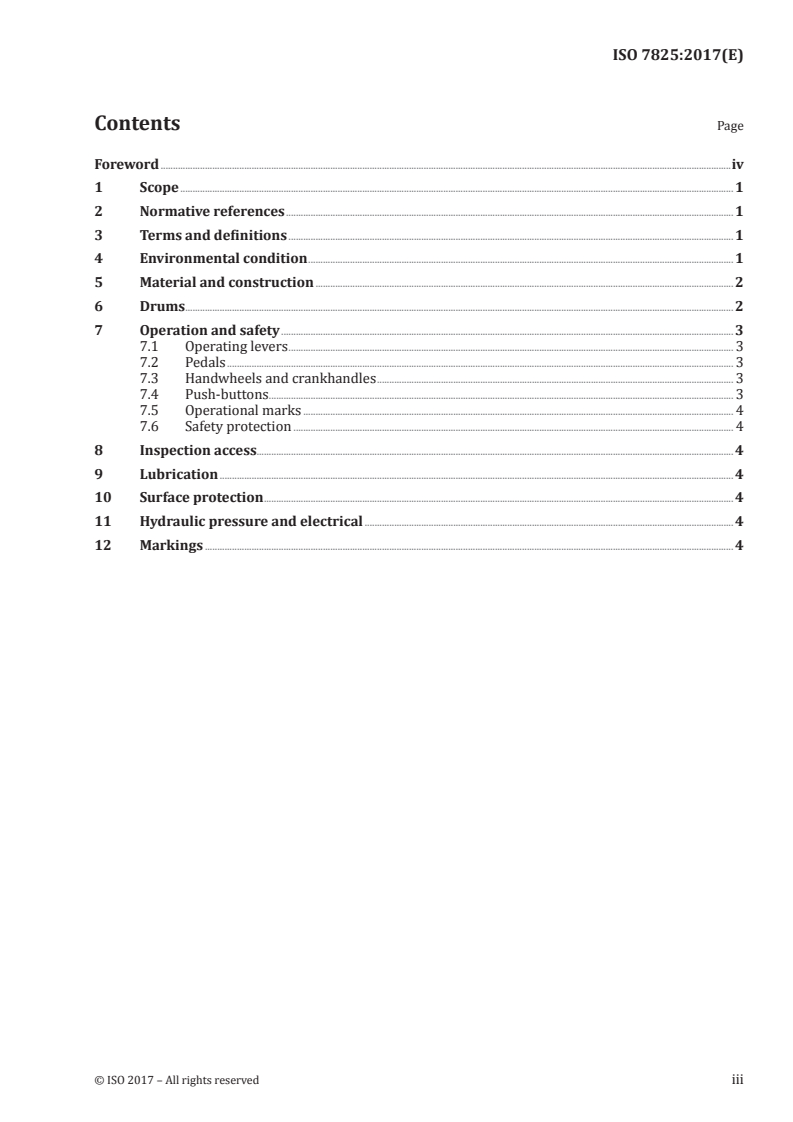
Contents Page
Foreword .iv
1 Scope . 1
2 Normative references . 1
3 Terms and definitions . 1
4 Environmental condition . 1
5 Material and construction . 2
6 Drums . 2
7 Operation and safety . 3
7.1 Operating levers . 3
7.2 Pedals . 3
7.3 Handwheels and crankhandles . 3
7.4 Push-buttons . 3
7.5 Operational marks . 4
7.6 Safety protection . 4
8 Inspection access. 4
9 Lubrication . 4
10 Surface protection . 4
11 Hydraulic pressure and electrical . 4
12 Markings . 4
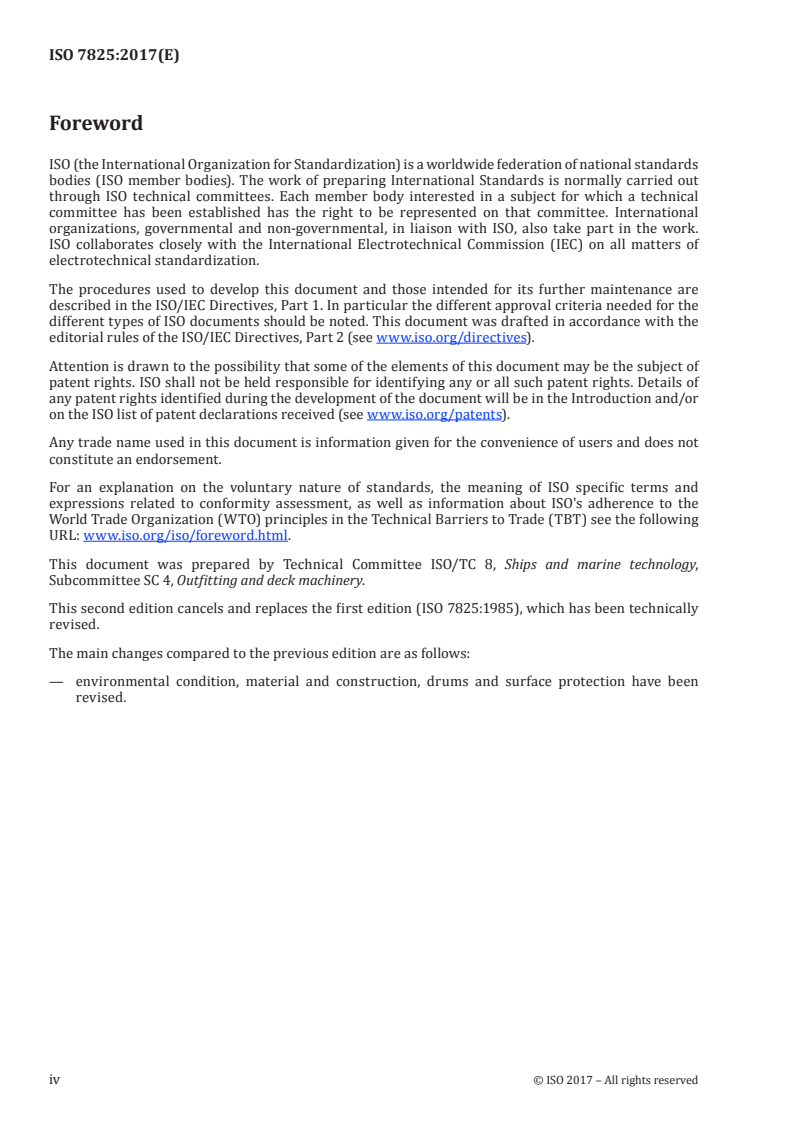
Foreword
ISO (the International Organization for Standardization) is a worldwide federation of national standards
bodies (ISO member bodies). The work of preparing International Standards is normally carried out
through ISO technical committees. Each member body interested in a subject for which a technical
committee has been established has the right to be represented on that committee. International
organizations, governmental and non-governmental, in liaison with ISO, also take part in the work.
ISO collaborates closely with the International Electrotechnical Commission (IEC) on all matters of
electrotechnical standardization.
The procedures used to develop this document and those intended for its further maintenance are
described in the ISO/IEC Directives, Part 1. In particular the different approval criteria needed for the
different types of ISO documents should be noted. This document was drafted in accordance with the
editorial rules of the ISO/IEC Directives, Part 2 (see www.iso.org/directives).
Attention is drawn to the possibility that some of the elements of this document may be the subject of
patent rights. ISO shall not be held responsible for identifying any or all such patent rights. Details of
any patent rights identified during the development of the document will be in the Introduction and/or
on the ISO list of patent declarations received (see www.iso.org/patents).
Any trade name used in this document is information given for the convenience of users and does not
constitute an endorsement.
For an explanation on the voluntary nature of standards, the meaning of ISO specific terms and
expressions related to conformity assessment, as well as information about ISO's adherence to the
World Trade Organization (WTO) principles in the Technical Barriers to Trade (TBT) see the following
URL: www.iso.org/iso/foreword.html.
This document was prepared by Technical Committee ISO/TC 8, Ships and marine technology,
Subcommittee SC 4, Outfitting and deck machinery.
This second edition cancels and replaces the first edition (ISO 7825:1985), which has been technically
revised.
The main changes compared to the previous edition are as follows:
— environmental condition, material and construction, drums and surface protection have been
revised.
iv © ISO 2017 – All rights reserved
INTERNATIONAL STANDARD ISO 7825:2017(E)
Shipbuilding — Deck machinery — General requirements
1 Scope
This document specifies the characteristics common to all deck machinery of any type not detailed in
the relevant specific International Standards.
This document is applicable to ships in all navigation zones.
2 Normative references
The following documents are referred to in the text in such a way that some or all of their content
constitutes requirements of this document. For dated references, only the edition cited applies. For
undated references, the latest edition of the referenced document (including any amendments) applies.
ISO 3828, Shipbuilding and marine structures — Deck machinery — Vocabulary and symbols
ISO 4413, Hydraulic fluid power — General rules and safety requirements for systems and their components
ISO 7824, Shipbuilding and marine structures — Lubrication nipples — Cone and flat types
ISO 8501-1, Preparation of steel substrates before application of paints and related products — Visual
assessment of surface cleanliness — Part 1: Rust grades and preparation grades of uncoated steel substrates
and of steel substrates after overall removal of previous coatings
ISO 15607, Specification and qualification of welding procedures for metallic materials — General rules
IEC 60092, Electrical installations in ships
IEC 60529, Degrees of protection provided by enclosures
3 Terms and definitions
For the purposes of this document, the terms and definitions given in ISO 3828 and the following apply.
ISO and IEC maintain terminological databases for use in standardization at the following addresses:
— IEC Electropedia: available at http://www.electropedia.org/
— ISO Online browsing platform: av
...
INTERNATIONAL ISO
STANDARD 7825
Second edition
2017-10
Shipbuilding — Deck machinery —
General requirements
Construction navale — Auxiliaires de pont — Prescriptions générales
Reference number
©
ISO 2017
© ISO 2017, Published in Switzerland
All rights reserved. Unless otherwise specified, no part of this publication may be reproduced or utilized otherwise in any form
or by any means, electronic or mechanical, including photocopying, or posting on the internet or an intranet, without prior
written permission. Permission can be requested from either ISO at the address below or ISO’s member body in the country of
the requester.
ISO copyright office
Ch. de Blandonnet 8 • CP 401
CH-1214 Vernier, Geneva, Switzerland
Tel. +41 22 749 01 11
Fax +41 22 749 09 47
copyright@iso.org
www.iso.org
ii © ISO 2017 – All rights reserved
Contents Page
Foreword .iv
1 Scope . 1
2 Normative references . 1
3 Terms and definitions . 1
4 Environmental condition . 1
5 Material and construction . 2
6 Drums . 2
7 Operation and safety . 3
7.1 Operating levers . 3
7.2 Pedals . 3
7.3 Handwheels and crankhandles . 3
7.4 Push-buttons . 3
7.5 Operational marks . 4
7.6 Safety protection . 4
8 Inspection access. 4
9 Lubrication . 4
10 Surface protection . 4
11 Hydraulic pressure and electrical . 4
12 Markings . 4
Foreword
ISO (the International Organization for Standardization) is a worldwide federation of national standards
bodies (ISO member bodies). The work of preparing International Standards is normally carried out
through ISO technical committees. Each member body interested in a subject for which a technical
committee has been established has the right to be represented on that committee. International
organizations, governmental and non-governmental, in liaison with ISO, also take part in the work.
ISO collaborates closely with the International Electrotechnical Commission (IEC) on all matters of
electrotechnical standardization.
The procedures used to develop this document and those intended for its further maintenance are
described in the ISO/IEC Directives, Part 1. In particular the different approval criteria needed for the
different types of ISO documents should be noted. This document was drafted in accordance with the
editorial rules of the ISO/IEC Directives, Part 2 (see www.iso.org/directives).
Attention is drawn to the possibility that some of the elements of this document may be the subject of
patent rights. ISO shall not be held responsible for identifying any or all such patent rights. Details of
any patent rights identified during the development of the document will be in the Introduction and/or
on the ISO list of patent declarations received (see www.iso.org/patents).
Any trade name used in this document is information given for the convenience of users and does not
constitute an endorsement.
For an explanation on the voluntary nature of standards, the meaning of ISO specific terms and
expressions related to conformity assessment, as well as information about ISO's adherence to the
World Trade Organization (WTO) principles in the Technical Barriers to Trade (TBT) see the following
URL: www.iso.org/iso/foreword.html.
This document was prepared by Technical Committee ISO/TC 8, Ships and marine technology,
Subcommittee SC 4, Outfitting and deck machinery.
This second edition cancels and replaces the first edition (ISO 7825:1985), which has been technically
revised.
The main changes compared to the previous edition are as follows:
— environmental condition, material and construction, drums and surface protection have been
revised.
iv © ISO 2017 – All rights reserved
INTERNATIONAL STANDARD ISO 7825:2017(E)
Shipbuilding — Deck machinery — General requirements
1 Scope
This document specifies the characteristics common to all deck machinery of any type not detailed in
the relevant specific International Standards.
This document is applicable to ships in all navigation zones.
2 Normative references
The following documents are referred to in the text in such a way that some or all of their content
constitutes requirements of this document. For dated references, only the edition cited applies. For
undated references, the latest edition of the referenced document (including any amendments) applies.
ISO 3828, Shipbuilding and marine structures — Deck machinery — Vocabulary and symbols
ISO 4413, Hydraulic fluid power — General rules and safety requirements for systems and their components
ISO 7824, Shipbuilding and marine structures — Lubrication nipples — Cone and flat types
ISO 8501-1, Preparation of steel substrates before application of paints and related products — Visual
assessment of surface cleanliness — Part 1: Rust grades and preparation grades of uncoated steel substrates
and of steel substrates after overall removal of previous coatings
ISO 15607, Specification and qualification of welding procedures for metallic materials — General rules
IEC 60092, Electrical installations in ships
IEC 60529, Degrees of protection provided by enclosures
3 Terms and definitions
For the purposes of this document, the terms and definitions given in ISO 3828 and the following apply.
ISO and IEC maintain terminological databases for use in standardization at the following addresses:
— IEC Electropedia: available at http://www.electropedia.org/
— ISO Online browsing platform: av
...