


ISO/FDIS 8100-2
(Main)Lifts for the transport of persons and goods - Part 2: Design rules, calculations, verifications and tests of lift components
Lifts for the transport of persons and goods - Part 2: Design rules, calculations, verifications and tests of lift components
Titre manque — Partie 2: Titre manque
General Information
- Status
- Not Published
- Technical Committee
- ISO/TC 178 - Lifts, escalators and moving walks
- Drafting Committee
- ISO/TC 178/WG 4 - Safety requirements and risk assessment
- Current Stage
- 5020 - FDIS ballot initiated: 2 months. Proof sent to secretariat
- Start Date
- 03-Dec-2025
- Completion Date
- 03-Dec-2025
Relations
- Effective Date
- 23-Apr-2020
Overview
ISO/FDIS 8100-2 (ISO 8100-2) - "Lifts for the transport of persons and goods - Part 2: Design rules, calculations, verifications and tests of lift components" is a Type C international standard that defines engineering, verification and test requirements for lift components used in passenger and goods passenger lifts. This second-edition document updates and replaces the earlier edition and is intended for new installations and manufactured components from its publication date onward. It complements Part 1 (safety rules for construction and installation) and is used together with other parts of the ISO 8100 series.
Key Topics
The standard covers a broad set of technical requirements and verification methods, including:
- Verification of safety devices: door locking devices, safety gears, overspeed governors, buffers, ascending car overspeed protection and unintended car movement protection.
- Safety and SIL-rated circuits: design rules, mechanical and temperature tests, verification of safety circuits and SIL (safety integrity level) rated circuits, and fault exclusion for electronic components.
- Suspension, compensation and power transmission: verification of suspension and compensation means (including alternatives to steel wire ropes), discard criteria for suspension means, sheaves and sprockets.
- Structural and hydraulic elements: calculation and verification of guide rails, rams, cylinders, rigid pipes and fittings.
- Traction and performance: evaluation of traction, safety factors on suspension means and examples for traction calculation and equivalent pulley numbers.
- Mechanical testing: pendulum shock tests, Charpy pendulum references, and other environmental and mechanical test methods.
- Annexes and examples: normative Annex A on SIL-rated circuits and informative annexes with worked examples for guide rails, traction calculations and pulley equivalence; Annex ZA maps to EU Directive requirements.
Applications
ISO 8100-2 is intended for:
- Lift designers and manufacturers implementing design rules, calculations and component verifications.
- Test laboratories and notified bodies performing type and routine tests on lift components.
- Maintenance and service organizations that need to apply discard criteria and verify component condition.
- Regulators and safety assessors referencing harmonized methods for compliance with machine and lift safety requirements.
Practical benefits include improved component reliability, clearer verification procedures for safety systems, and harmonized calculation methods for traction, guide rails and suspension systems.
Related standards
- ISO 8100-1 (safety rules for construction and installation)
- ISO/TS 8100-3 (comparative guidance)
- EN 81-50 (noted as superseded by the current edition in the European foreword)
- Relevant test standards cited in normative references (e.g., ISO 148-1, ISO 4344, IEC environmental and testing standards)
Keywords: ISO 8100-2, lifts standard, lift components, design rules, suspension means, SIL-rated circuits, safety circuits, guide rail calculation, traction evaluation.
ISO/FDIS 8100-2 - Lifts for the transport of persons and goods — Part 2: Design rules, calculations, verifications and tests of lift components Released:19. 11. 2025
REDLINE ISO/FDIS 8100-2 - Lifts for the transport of persons and goods — Part 2: Design rules, calculations, verifications and tests of lift components Released:19. 11. 2025
Frequently Asked Questions
ISO/FDIS 8100-2 is a draft published by the International Organization for Standardization (ISO). Its full title is "Lifts for the transport of persons and goods - Part 2: Design rules, calculations, verifications and tests of lift components". This standard covers: Lifts for the transport of persons and goods - Part 2: Design rules, calculations, verifications and tests of lift components
Lifts for the transport of persons and goods - Part 2: Design rules, calculations, verifications and tests of lift components
ISO/FDIS 8100-2 is classified under the following ICS (International Classification for Standards) categories: 91.140.90 - Lifts. Escalators. The ICS classification helps identify the subject area and facilitates finding related standards.
ISO/FDIS 8100-2 has the following relationships with other standards: It is inter standard links to ISO 8100-2:2019. Understanding these relationships helps ensure you are using the most current and applicable version of the standard.
ISO/FDIS 8100-2 is available in PDF format for immediate download after purchase. The document can be added to your cart and obtained through the secure checkout process. Digital delivery ensures instant access to the complete standard document.
Standards Content (Sample)
FINAL DRAFT
International
Standard
ISO/TC 178
Lifts for the transport of persons
Secretariat: AFNOR
and goods —
Voting begins on:
2025-12-03
Part 2:
Design rules, calculations,
Voting terminates on:
2026-01-28
verifications and tests of lift
components
RECIPIENTS OF THIS DRAFT ARE INVITED TO SUBMIT,
WITH THEIR COMMENTS, NOTIFICATION OF ANY
RELEVANT PATENT RIGHTS OF WHICH THEY ARE AWARE
AND TO PROVIDE SUPPOR TING DOCUMENTATION.
IN ADDITION TO THEIR EVALUATION AS
BEING ACCEPTABLE FOR INDUSTRIAL, TECHNO-
ISO/CEN PARALLEL PROCESSING LOGICAL, COMMERCIAL AND USER PURPOSES, DRAFT
INTERNATIONAL STANDARDS MAY ON OCCASION HAVE
TO BE CONSIDERED IN THE LIGHT OF THEIR POTENTIAL
TO BECOME STAN DARDS TO WHICH REFERENCE MAY BE
MADE IN NATIONAL REGULATIONS.
Reference number
FINAL DRAFT
International
Standard
ISO/TC 178
Lifts for the transport of persons
Secretariat: AFNOR
and goods —
Voting begins on:
Part 2:
Design rules, calculations,
Voting terminates on:
verifications and tests of lift
components
RECIPIENTS OF THIS DRAFT ARE INVITED TO SUBMIT,
WITH THEIR COMMENTS, NOTIFICATION OF ANY
RELEVANT PATENT RIGHTS OF WHICH THEY ARE AWARE
AND TO PROVIDE SUPPOR TING DOCUMENTATION.
© ISO 2025
IN ADDITION TO THEIR EVALUATION AS
All rights reserved. Unless otherwise specified, or required in the context of its implementation, no part of this publication may
BEING ACCEPTABLE FOR INDUSTRIAL, TECHNO-
ISO/CEN PARALLEL PROCESSING
LOGICAL, COMMERCIAL AND USER PURPOSES, DRAFT
be reproduced or utilized otherwise in any form or by any means, electronic or mechanical, including photocopying, or posting on
INTERNATIONAL STANDARDS MAY ON OCCASION HAVE
the internet or an intranet, without prior written permission. Permission can be requested from either ISO at the address below
TO BE CONSIDERED IN THE LIGHT OF THEIR POTENTIAL
or ISO’s member body in the country of the requester.
TO BECOME STAN DARDS TO WHICH REFERENCE MAY BE
MADE IN NATIONAL REGULATIONS.
ISO copyright office
CP 401 • Ch. de Blandonnet 8
CH-1214 Vernier, Geneva
Phone: +41 22 749 01 11
Email: copyright@iso.org
Website: www.iso.org
Published in Switzerland Reference number
ii
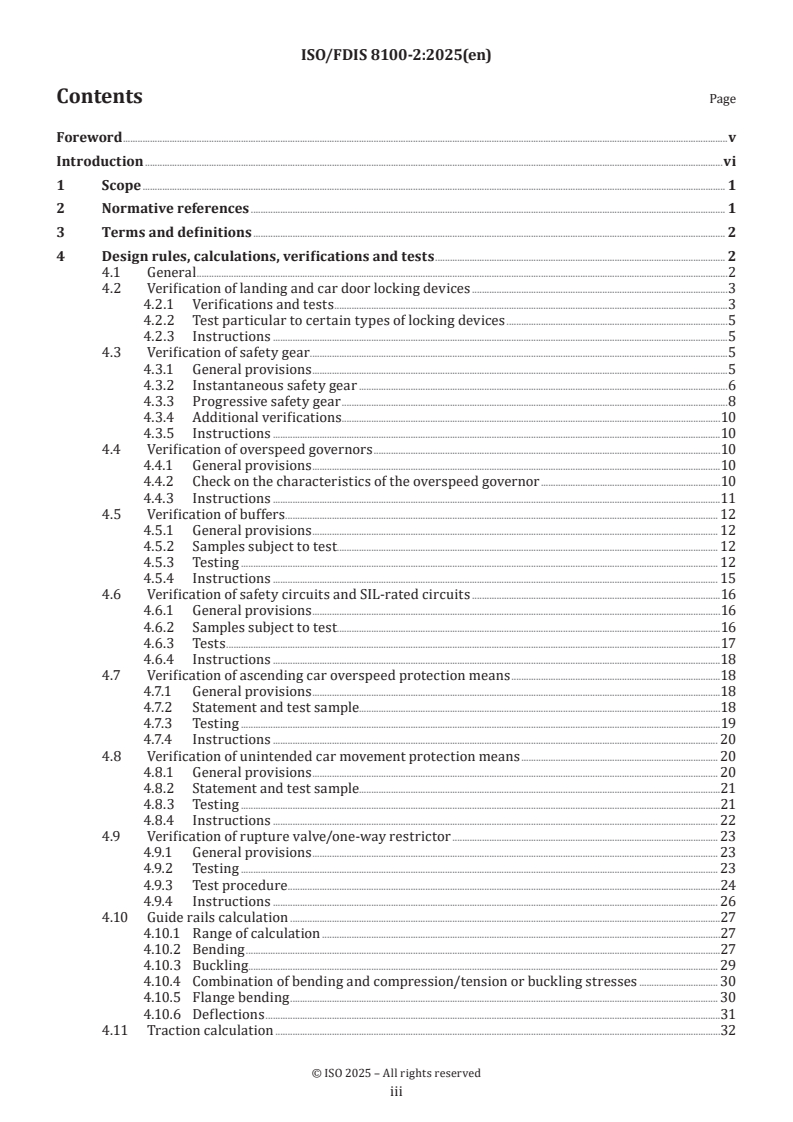
Contents Page
Foreword .v
Introduction .vi
1 Scope . 1
2 Normative references . 1
3 Terms and definitions . 2
4 Design rules, calculations, verifications and tests . 2
4.1 General .2
4.2 Verification of landing and car door locking devices .3
4.2.1 Verifications and tests .3
4.2.2 Test particular to certain types of locking devices .5
4.2.3 Instructions .5
4.3 Verification of safety gear .5
4.3.1 General provisions .5
4.3.2 Instantaneous safety gear .6
4.3.3 Progressive safety gear .8
4.3.4 Additional verifications.10
4.3.5 Instructions .10
4.4 Verification of overspeed governors .10
4.4.1 General provisions .10
4.4.2 Check on the characteristics of the overspeed governor .10
4.4.3 Instructions .11
4.5 Verification of buffers . . 12
4.5.1 General provisions . 12
4.5.2 Samples subject to test. 12
4.5.3 Testing . 12
4.5.4 Instructions . 15
4.6 Verification of safety circuits and SIL-rated circuits .16
4.6.1 General provisions .16
4.6.2 Samples subject to test.16
4.6.3 Tests .17
4.6.4 Instructions .18
4.7 Verification of ascending car overspeed protection means .18
4.7.1 General provisions .18
4.7.2 Statement and test sample.18
4.7.3 Testing .19
4.7.4 Instructions . 20
4.8 Verification of unintended car movement protection means . 20
4.8.1 General provisions . 20
4.8.2 Statement and test sample.21
4.8.3 Testing .21
4.8.4 Instructions . 22
4.9 Verification of rupture valve/one-way restrictor . 23
4.9.1 General provisions . 23
4.9.2 Testing . 23
4.9.3 Test procedure.24
4.9.4 Instructions . 26
4.10 Guide rails calculation .27
4.10.1 Range of calculation .27
4.10.2 Bending .27
4.10.3 Buckling . . 29
4.10.4 Combination of bending and compression/tension or buckling stresses . 30
4.10.5 Flange bending . 30
4.10.6 Deflections .31
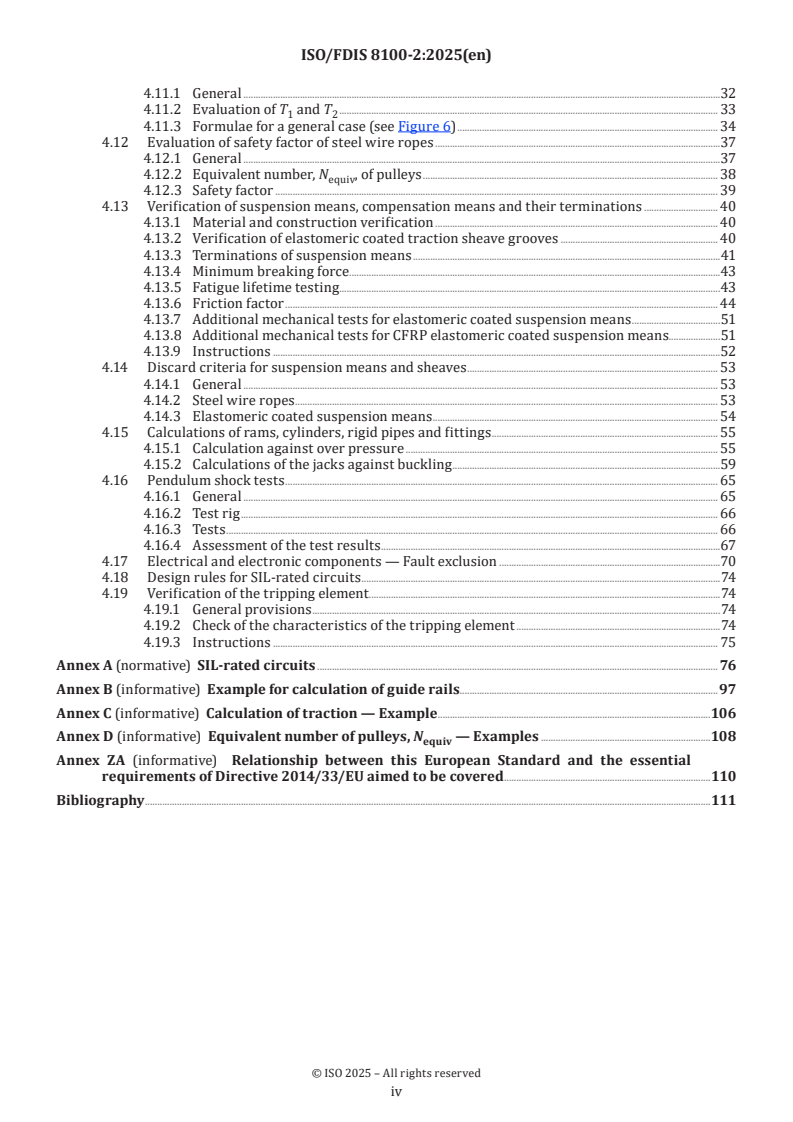
4.11 Traction calculation .32
iii
4.11.1 General .32
4.11.2 Evaluation of T and T . 33
1 2
4.11.3 Formulae for a general case (see Figure 6) . 34
4.12 Evaluation of safety factor of steel wire ropes .37
4.12.1 General .37
4.12.2 Equivalent number, N , of pulleys . 38
equiv
4.12.3 Safety factor . 39
4.13 Verification of suspension means, compensation means and their terminations . 40
4.13.1 Material and construction verification . 40
4.13.2 Verification of elastomeric coated traction sheave grooves . 40
4.13.3 Terminations of suspension means .41
4.13.4 Minimum breaking force.43
4.13.5 Fatigue lifetime testing . .43
4.13.6 Friction factor . 44
4.13.7 Additional mechanical tests for elastomeric coated suspension means .51
4.13.8 Additional mechanical tests for CFRP elastomeric coated suspension means.51
4.13.9 Instructions .52
4.14 Discard criteria for suspension means and sheaves . 53
4.14.1 General . 53
4.14.2 Steel wire ropes . 53
4.14.3 Elastomeric coated suspension means . 54
4.15 Calculations of rams, cylinders, rigid pipes and fittings . 55
4.15.1 Calculation against over pressure . 55
4.15.2 Calculations of the jacks against buckling .59
4.16 Pendulum shock tests . 65
4.16.1 General . 65
4.16.2 Test rig . 66
4.16.3 Tests . 66
4.16.4 Assessment of the test results .67
4.17 Electrical and electronic components — Fault exclusion .70
4.18 Design rules for SIL-rated circuits .74
4.19 Verification of the tripping element .74
4.19.1 General provisions .74
4.19.2 Check of the characteristics of the tripping element .74
4.19.3 Instructions . 75
Annex A (normative) SIL-rated circuits . 76
Annex B (informative) Example for calculation of guide rails .97
Annex C (informative) Calculation of traction — Example .106
Annex D (informative) Equivalent number of pulleys, N — Examples .108
equiv
Annex ZA (informative) Relationship between this European Standard and the essential
requirements of Directive 2014/33/EU aimed to be covered .110
Bibliography .111
iv
Foreword
ISO (the International Organization for Standardization) is a worldwide federation of national standards
bodies (ISO member bodies). The work of preparing International Standards is normally carried out through
ISO technical committees. Each member body interested in a subject for which a technical committee
has been established has the right to be represented on that committee. International organizations,
governmental and non-governmental, in liaison with ISO, also take part in the work. ISO collaborates closely
with the International Electrotechnical Commission (IEC) on all matters of electrotechnical standardization.
The procedures used to develop this document and those intended for its further maintenance are described
in the ISO/IEC Directives, Part 1. In particular, the different approval criteria needed for the different types
of ISO document should be noted. This document was drafted in accordance with the editorial rules of the
ISO/IEC Directives, Part 2 (see www.iso.org/directives).
ISO draws attention to the possibility that the implementation of this document may involve the use of (a)
patent(s). ISO takes no position concerning the evidence, validity or applicability of any claimed patent
rights in respect thereof. As of the date of publication of this document, ISO had not received notice of (a)
patent(s) which may be required to implement this document. However, implementers are cautioned that
this may not represent the latest information, which may be obtained from the patent database available at
www.iso.org/patents. ISO shall not be held responsible for identifying any or all such patent rights.
Any trade name used in this document is information given for the convenience of users and does not
constitute an endorsement.
For an explanation of the voluntary nature of standards, the meaning of ISO specific terms and expressions
related to conformity assessment, as well as information about ISO's adherence to the World Trade
Organization (WTO) principles in the Technical Barriers to Trade (TBT), see www.iso.org/iso/foreword.html.
This document was prepared by Technical Committee ISO/TC 178, Lifts, escalators, passenger conveyors, in
collaboration with the European Committee for Standardization (CEN) Technical Committee CEN/TC 10,
Lifts, escalators and moving walks, in accordance with the Agreement on technical cooperation between ISO
and CEN (Vienna Agreement).
This second edition cancels and replaces the first edition (ISO 8100-2:2019), which has been technically
revised.
The main changes are as follows:
— mechanical tests and temperature tests of safety circuits and SIL-rated circuits have been updated;
— errors in the formulae for traction calculation have been corrected;
— verification methods for suspension and compensation means other than steel wire ropes have been added;
— discard criteria for suspension means and sheaves and sprockets have been added;
— requirements for SIL-rated circuits (previously called PESSRAL) have been revised;
— the document structure has been revised as per the ISO/IEC Directives, Part 2.
ISO/TS 8100-3:2019 provides information on the differences between this document and local standards
(ASME A17.1/CSA B44 and JIS A 4307 1/JIS A 4307 2) not included in this document.
This document is intended to be used in conjunction with documents calling for the use of this document
(e.g. ISO 8100-1:2025).
A list of all parts in the ISO 8100 series can be found on the ISO website.
Any feedback or questions on this document should be directed to the user’s national standards body. A
complete listing of these bodies can be found at www.iso.org/members.html.
v
Introduction
This document is a type C standard as stated in ISO 12100:2010.
This document is of relevance, in particular, for the following stakeholder groups representing the market
players with regard to machinery safety:
— machine manufacturers (small, medium and large enterprises);
— health and safety bodies (regulators, accident prevention organizations, market surveillance, etc.).
Others can be affected by the level of machinery safety achieved with the means of the document by the
above-mentioned stakeholder groups:
— machine users/employers (small, medium and large enterprises);
— machine users/employees (e.g. trade unions, organizations for people with special needs);
— service providers, e.g. for maintenance (small, medium and large enterprises);
— consumers (in case of machinery intended for use by consumers).
The above-mentioned stakeholder groups have been given the possibility to participate in the drafting
process of this document
The machinery concerned and the extent to which hazards, hazardous situations and hazardous events are
covered are indicated in the scope of this document.
When requirements of this type-C standard are different from those which are stated in type-A or type-B
standards, the requirements of this type-C standard take precedence over the requirements of the other
standards for machines that have been designed and built according to the requirements of this type-C
standard.
vi
FINAL DRAFT International Standard ISO/FDIS 8100-2:2025(en)
Lifts for the transport of persons and goods —
Part 2:
Design rules, calculations, verifications and tests of lift
components
1 Scope
This document specifies for passenger lifts and goods passenger lifts:
— the verification of door locking devices;
— the verification of safety gears;
— the verification of overspeed governors;
— the verification of buffers;
— the verification of safety circuits and SIL-rated circuits;
— the verification of ascending car overspeed protection means;
— the verification of unintended car movement protection means;
— the verification of rupture valves and one-way restrictors;
— the verification of suspension and compensation means;
— the discard criteria for suspension means and power transmission contact;
— the calculation of guide rails;
— the calculation of rams, cylinders, rigid pipes and fittings;
— the evaluation of the traction;
— the evaluation of the safety factor on suspension means;
— the pendulum shock tests;
— the fault exclusion for electric and electronic components;
— the design rules for SIL-rated circuits.
This document is not applicable to passenger lifts, goods passenger lifts or lift components, which are
installed or manufactured before the date of its publication.
2 Normative references
The following documents are referred to in the text in such a way that some or all of their content constitutes
requirements of this document. For dated references, only the edition cited applies. For undated references,
the latest edition of the referenced document (including any amendments) applies.
ISO 148-1:2016, Metallic materials — Charpy pendulum impact test — Part 1: Test method
ISO 3108:2017, Steel wire ropes — Test method — Determination of measured breaking force
ISO 4344:2022, Steel wire ropes for lifts — Minimum requirements
ISO 7500-1:2018, Metallic materials — Calibration and verification of static uniaxial testing machines — Part 1:
Tension/compression testing machines — Calibration and verification of the force-measuring system
ISO 8100-1:2025, Lifts for the transport of persons and goods — Part 1: Safety rules for the construction and
installation of passenger and goods passenger lifts
ISO 12100:2010, Safety of machinery — General principles for design — Risk assessment and risk reduction
ISO 17638:2016, Non-destructive testing of welds — Magnetic particle testing
ISO 23277:2015, Non-destructive testing of welds — Penetrant testing — Acceptance levels
ISO 29584:2015, Glass in building — Pendulum impact testing and classification of safety glass
IEC 60068-2-6:2007, Environmental testing — Part 2-6: Tests — Test Fc: Vibration (sinusoidal)
IEC 60068-2-14:2023, Environmental testing — Part 2-14: Tests — Test N: Change of temperature
IEC 60068-2-27:2008, Environmental testing — Part 2-27: Tests — Test Ea and guidance: Shock
IEC 60947-5-1:2024, Low-voltage switchgear and control gear — Part 5-1: Control circuit devices and switching
elements — Electromechanical control circuit devices
IEC 61508-1:2010, Functional safety of electrical/electronic/programmable electronic safety-related systems —
Part 1: General requirements
IEC 61508-2:2010, Functional safety of electrical/electronic/programmable electronic safety-related systems —
Part 2: Requirements for electrical/electronic/programmable electronic safety-related systems
IEC 61508-3:2010, Functional safety of electrical/electronic/programmable electronic safety-related systems —
Part 3: Software requirements
IEC 61709:2017, Electric components — Reliability — Reference conditions for failure rates and stress models
for conversion
EN 10025-2:2019, Hot rolled products of structural steels — Part 2: Technical delivery conditions for non-alloy
structural steels
3 Terms and definitions
For the purposes of this document, the terms and definitions given in ISO 12100:2010 and ISO 8100-1:2025 apply.
ISO and IEC maintain terminological databases for use in standardization at the following addresses:
— ISO Online browsing platform: available at https:// www .iso .org/ obp
— IEC Electropedia: available at https:// www .electropedia .org/
4 Design rules, calculations, verifications and tests
4.1 General
Passenger and goods passenger lifts shall be in accordance with the safety requirements and/or protective
measures of the following clauses. In addition, the passenger and goods passenger lifts shall be designed in
accordance with the principles of ISO 12100:2010 for hazards relevant but not significant that are not dealt
with by this document.
The precision of the instruments shall allow measurements to be made within the following accuracy:
a) ±1 % for masses, forces, distances, speeds;
b) ±2 % for accelerations, retardations;
c) ±5 % for voltages, currents;
d) ±5 °C for temperatures;
e) ±2,5 % for flow rate;
f) ±1 % for pressure, P, below 200 kPa;
g) ±5 % for pressure, P, above 200 kPa.
Recording equipment shall be capable of detecting signals, which vary in time of 0,01 s.
4.2 Verification of landing and car door locking devices
4.2.1 Verifications and tests
4.2.1.1 Verification of operation
It shall be verified that the electric safety device is not activated unless the locking element is engaged as
specified by the standard calling for the use of this document (e.g. 7 mm as per ISO 8100-1:2025, 4.3.9.1.2).
4.2.1.2 Mechanical tests
4.2.1.2.1 General
The mechanical tests shall be performed in the following sequence:
a) endurance test as per 4.2.1.2.2;
b) static test as per 4.2.1.2.3;
c) dynamic test as per 4.2.1.2.4.
The static test and the dynamic test shall be carried out with the same test sample used in the endurance test.
4.2.1.2.2 Endurance test
The locking device shall be submitted to 1 000 000 (±1 %) complete cycles; one cycle comprises one forward
and return movement over the full travel possible in both directions.
During the endurance test, the electrical contact of the lock shall close a resistive circuit under the rated
voltage and at a current value double that of the rated current of the locking device.
If the locking device is provided with a mechanical checking device for the locking pin or the position of
the locking element, this mechanical checking device shall additionally be submitted to an endurance test
of 100 000 (±1 %) cycles with the counterpart (means allowing the positive operation of the means used to
prove the position of a locking element) not in place and the mechanical locking and the electrical contact
being not made.
The driving of the device shall be at a rate of 60 (±10 %) cycles per minute.
The number of the operation of the locking element and the mechanical checking device shall be recorded by
mechanical or electrical counters.
4.2.1.2.3 Static test
The test shall be made consisting of the application of a force, applied at the level of the lock, increasing to
the value laid down in the standard calling for the use of this document [e.g. ISO 8100-1:2025, 4.3.9.1.6 a)]
between 30 s to 60 s. The force shall be applied for a period of 300 s.
4.2.1.2.4 Dynamic test
The test shall be made consisting of the shock laid down in the standard calling for the use of this document
[e.g. ISO 8100-1:2025, 4.3.9.1.6 b)] at the height of the locking device.
4.2.1.3 Criteria for the mechanical tests
After the endurance test (4.2.1.2.2), the static test (4.2.1.2.3) and the dynamic test (4.2.1.2.4), carried out on
the locking device, there shall not be:
— wear reducing the minimum engagement of the locking element(s) as specified in the standard calling
for the use of this document (e.g. ISO 8100-1:2025, 4.3.9.1.2); or
— permanent deformation; or
— breakage of parts of the locking device or of the mechanical linkage.
4.2.1.4 Electrical test
4.2.1.4.1 Endurance test of safety contacts
This test is included in the endurance test laid down in 4.2.1.2.2.
4.2.1.4.2 Test of ability to break circuit
4.2.1.4.2.1 This test shall be carried out after the endurance test to check the ability to break a live circuit.
This test shall be made in accordance with the procedure in IEC 60947-5-1:2024. The values of current and
rated voltage serving as a basis for the tests shall be those specified for the locking device.
The capacity to break circuit shall be verified for both A.C. and D.C. conditions.
The tests shall be carried out with the locking device in all assembly positions specified in the instructions
(see 4.2.3).
The sample tested shall be provided with covers and electric wiring.
4.2.1.4.2.2 Locking devices for A.C. current shall open and close an electric circuit under a voltage equal
to 110 % of the specified rated voltage of the safety contact 50 times at intervals of 5 s to 10 s. The contact
shall remain closed for at least 0,5 s.
The testing circuit shall comprise of an inductor and a resistor in series. Its power factor shall be 0,7 ± 0,05
and the test current shall be 11 times the specified rated current of the locking device.
4.2.1.4.2.3 Locking devices for D.C. current shall open and close an electric circuit under a voltage equal to
110 % of the specified rated voltage of the safety contact 20 times at intervals of 5 s to 10 s. The contact shall
remain closed for at least 0,5 s.
The testing circuit shall comprise of an inductor and a resistor in series, having values such that the current
reaches 95 % of the steady-state value of the test current in 300 ms.
The test current shall be 110 % of the specified rated current of the locking device.
4.2.1.4.2.4 The tests are considered satisfactory if the contact has the ability to break a live circuit.
4.2.1.4.3 Verification of clearances and creepage distances
The clearances in air and creepage distances shall be in accordance with the requirements laid down in the
standards calling for the use of this document (e.g. ISO 8100-1:2025, 4.11.2.2.4).
4.2.1.4.4 Verification of the protection against direct contact
In case of access to hazardous voltage this verification shall be made taking into account the mounting
position, the orientation and the layout of the locking device (e.g. ISO 8100-1:2025, 4.10.1.2).
4.2.2 Test particular to certain types of locking devices
4.2.2.1 Locking device for horizontally or vertically sliding doors with several panels
Devices providing direct mechanical linkage between panels shall be included in the tests mentioned in
4.2.1.2.2.
4.2.2.2 Flap type locking device for hinged door
For the flap type locking device the following shall be verified:
— the specified minimum overlap-dimensions as required by the standard calling for this device [e.g.
ISO 8100-1:2025, 4.3.9.1.12 b) and 4.3.9.1.12 c)];
— the locking device cannot engage when the landing door is not fully in the closed position as required by
the standard calling for this device [e.g. ISO 8100-1:2025, 4.3.9.1.12 d)];
— the locking force limiter as in the standard calling for the use of this document [e.g. ISO 8100-1:2025,
4.3.9.1.12 f)] shall be tested on an operationally constructed door by pushing open the door panels with
a steadily increasing force until the locking force limiter releases the flap. The force shall be applied
as required by the standard calling for this device [e.g. ISO 8100-1:2025, 4.3.9.1.12 f)]. The flap shall
not release before the force exceeds the force required by the standard calling for this device [e.g.
ISO 8100-1:2025, 4.3.9.1.12 f)].
The test shall be carried out on a door with the largest width.
In the case of elements to limit the load on the flap that are triggered via a predetermined breaking point,
the locked door shall be force-opened three times, each time with renewed trigger elements. In the case
of non-destructive release elements, a limited endurance test with 50 force openings is required.
There shall be no permanent deformation or breakage on the locking device after the test.
4.2.3 Instructions
In addition to the information for assembly, connection, adjustment and maintenance, the instructions of the
locking device shall contain the following information based on the verification:
a) type and application of locking device;
b) type (A.C. and/or D.C.) and values of the rated voltage and rated current of the locking device safety
contact;
c) in the case of flap type door locking devices: the necessary force to actuate the locking force limiter.
4.3 Verification of safety gear
4.3.1 General provisions
Safety gears shall be verified as described in 4.3.2, 4.3.3 and 4.3.4.
4.3.2 Instantaneous safety gear
4.3.2.1 Test samples
Two gripping assemblies with wedges or clamps and two lengths of guide rail shall be provided.
The arrangement and the fixing details for the samples shall be determined in accordance with the
equipment that it uses.
If the same gripping assemblies can be used with different types of guide rails, a new test shall not be
required if the thickness of the guide rails, the width of the grip needed for the safety gear, and the surface
state (drawn, milled, ground) are the same.
4.3.2.2 Testing
4.3.2.2.1 Method of test
The test shall be made using a press or similar device, which moves continuously. Measurements shall be
made of:
a) the distance travelled as a function of the force;
b) the deformation of the safety gear block as a function of the force or as a function of the distance
travelled.
4.3.2.2.2 Test procedure
The guide rail shall be moved through the safety gear.
Reference marks shall be traced onto the blocks in order to be able to measure their deformation.
The distance travelled shall be recorded as a function of the force.
4.3.2.2.3 Documents
4.3.2.2.3.1 Two charts shall be drawn up as follows:
a) the first one shall show the distance travelled as a function of the force;
b) the second one shall show the deformation of the block. It shall be done in such a way that it can be
related to the first chart.
4.3.2.2.3.2 The capacity of the safety gears shall be established by integration of the area of the distance-
force chart.
The area of the chart to be taken into consideration shall be:
a) the total area, if there is no permanent deformation;
b) if permanent deformation or rupture has occurred, either:
1) the area up to the value at which the elastic limit has been reached; or
2) the area up to the value corresponding to the maximum force.
4.3.2.3 Determination of the permissible mass
4.3.2.3.1 Energy absorbed by the safety gear
The distance of free fall in metres, h, shall be taken as Formula (1):
v
h= ++01,,003 (1)
2⋅g
n
where
g is the standard acceleration of free fall in metres per square second;
n
v is the maximum tripping speed of the safety gear expressed in metres per second;
0,1 corresponds to the distance travelled during the response time, in metres;
0,03 corresponds to the travel during take-up of clearance between the gripping elements and the
guide rails, in metres.
The total energy the safety gear is capable of absorbing is calculated with Formulae (2) and (3):
2⋅=KP +Qg⋅⋅h (2)
()
n
2 ⋅K
from which: ()PQ + = (3)
gh⋅
n
where
K is the energy absorbed by one safety gear block, in joules (calculated in accordance with the chart);
P are the masses of the empty car and components supported by the car, i.e. part of the travelling
cable, compensation means (if any), etc., in kilograms;
Q is the rated load, in kilograms;
(P + Q) is the permissible mass, in kilograms.
4.3.2.3.2 Permissible mass
a) If the elastic limit has not been exceeded, the permissible mass in kilograms, (P + Q) , is calculated with
Formula (4):
2⋅K
()PQ+ = (4)
2⋅⋅gh
n
where
K is calculated by the integration of the area defined in 4.3.2.2.3.2 a);
2 is taken as the dividing safety coefficient.
b) If the elastic limit has been exceeded, Formulae (5) and (6) shall be used and the higher permissible
mass may be selected.
2⋅K
()PQ+ = (5)
2 ⋅⋅gh
n
where
K is calculated by the integration of the area defined in 4.3.2.2.3.2 b) 1);
2 is taken as the dividing safety coefficient.
2⋅K
()PQ + = (6)
35, ⋅⋅gh
n
where
K is calculated by the integration of the area defined in 4.3.2.2.3.2 b) 2);
3,5 is taken as the dividing safety coefficient.
4.3.3 Progressive safety gear
4.3.3.1 Testing
4.3.3.1.1 Method of test
4.3.3.1.1.1 The test shall be carried out in free fall. Direct or indirect measurements shall be made of:
a) the total height of the fall;
b) the braking distance on the guide rails;
c) the sliding distance of the overspeed governor rope, or that of the device used in its place;
d) the total travel of the elements forming the spring.
Measurements a) and b) shall be recorded as a function of the time.
4.3.3.1.1.2 The following shall be determined:
a) the average braking force;
b) the greatest instantaneous braking force;
c) the smallest instantaneous braking force.
4.3.3.1.2 Test procedure
4.3.3.1.2.1 Safety gear for a single mass
Four tests with the mass (P + Q) shall be carried out. Between each test, the friction parts shall be allowed
to return to the ambient temperature.
If during the tests, the friction parts are replaced, each set shall be capable of:
a) three tests, if the rated speed does not exceed 4 m/s;
b) two tests, if the rated speed exceeds 4 m/s.
The height of free fall shall be calculated to correspond to the maximum tripping speed of the safety gear.
The engagements of the safety gear shall be achieved by a means allowing the tripping speed to be fixed
precisely.
4.3.3.1.2.2 Safety gear for different masses
Where adjustment is in stages or continuous, two series of tests in accordance with 4.3.3.1.2.1 shall be
carried out for:
a) the maximum; and
b) the minimum values applied for.
A formula or a chart shall be provided showing the variation of the braking force as a function of a given
parameter.
The validity of the supplied formula or chart shall be verified by one series of tests for a linear chart or two
...
Style Definition
...
ISO/DIS FDIS 8100-2:2023(E)
Formatted: zzCover large
Second edition
Formatted: Right: 1.5 cm, Bottom: 1 cm, Section start: New
page, Header distance from edge: 1.27 cm, Footer distance
from edge: 1.27 cm
ISO /TC 178/WG 04
Secretariat: AFNOR
Date: 2023-09-052025-11-17
Lifts for the transport of persons and goods —
Formatted: Regular
Part 2:
Formatted: Cover Title_A2
Design rules, calculations, verifications and tests of lift components
Formatted: Regular
FDIS stage
ISO/DIS FDIS 8100-2:2023(E2025(en) Formatted: Font: Bold
Formatted: Font: Bold
Formatted: Font: Bold
Formatted: HeaderCentered, Space After: 0 pt
Formatted: Font: 11 pt, Bold
All rights reserved. Unless otherwise specified, or required in the context of its implementation, no part of this publication
Formatted: Adjust space between Latin and Asian text,
may be reproduced or utilized otherwise in any form or by any means, electronic or mechanical, including photocopying,
Adjust space between Asian text and numbers
or posting on the internet or an intranet, without prior written permission. Permission can be requested from either ISO
Formatted: Default Paragraph Font
at the address below or ISO’s member body in the country of the requester.
ISO copyright office
CP 401 • Ch. de Blandonnet 8
CH-1214 Vernier, Geneva
Phone: + 41 22 749 01 11
Formatted: French (Switzerland)
EmailE-mail: copyright@iso.org
Formatted: French (Switzerland)
Website: www.iso.orgwww.iso.org
Formatted: French (Switzerland)
Formatted: English (United Kingdom)
Published in Switzerland
Formatted: English (United Kingdom)
Formatted: FooterPageRomanNumber, Space Before: 0 pt,
After: 0 pt, Line spacing: single, Tab stops: Not at 17.2 cm
Formatted: Font: 11 pt
ii © ISO 2023 – All rights reserved
ii
ISO/DIS FDIS 8100-2:2023(E2025(en) Formatted: Font: Bold
Formatted: HeaderCentered, Left, Space After: 0 pt
Formatted: Font: Bold
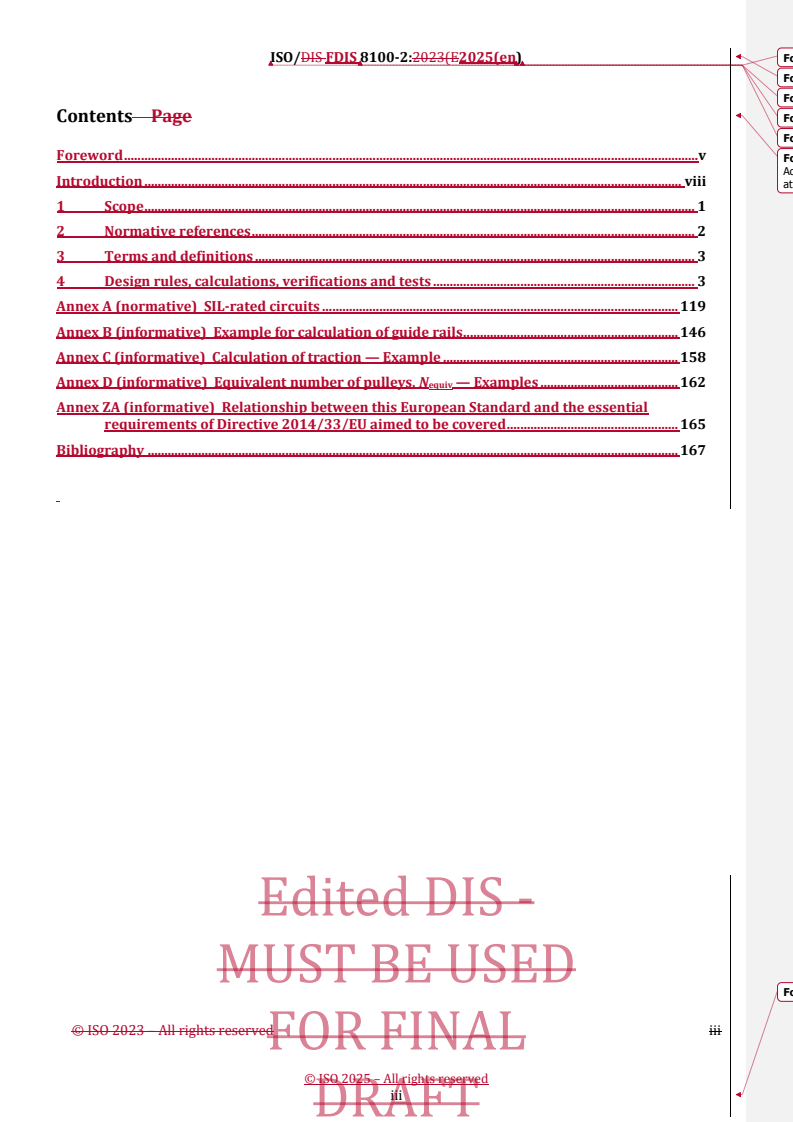
Contents Page Formatted: Font: Bold
Formatted: Font: 11 pt, Bold
Foreword . v
Formatted: Adjust space between Latin and Asian text,
Adjust space between Asian text and numbers, Tab stops: Not
Introduction . viii
at 0.71 cm
1 Scope . 1
2 Normative references . 2
3 Terms and definitions . 3
4 Design rules, calculations, verifications and tests . 3
Annex A (normative) SIL-rated circuits . 119
Annex B (informative) Example for calculation of guide rails . 146
Annex C (informative) Calculation of traction — Example . 158
Annex D (informative) Equivalent number of pulleys, N — Examples . 162
equiv
Annex ZA (informative) Relationship between this European Standard and the essential
requirements of Directive 2014/33/EU aimed to be covered . 165
Bibliography . 167
Formatted: FooterPageRomanNumber
iii
ISO/DIS FDIS 8100-2:2023(E2025(en) Formatted: Font: Bold
Formatted: Font: Bold
Formatted: HeaderCentered, Space After: 0 pt
European Foreword Formatted: Font: Bold
Formatted: Font: 11 pt, Bold
This document (prEN ISO 8100-2:2025) has been prepared by Technical Committee CEN/TC 10 “Lifts,
escalators and moving walks”, the secretariat of which is held by AFNOR.
This document is currently submitted to the CEN Enquiry.
This document will supersede EN 81-50:2020.
This document is part of the European series of standards for lifts. The structure includes general safety
standards as well as supplementary standards addressing specific applications for lifts .
This document has been prepared under a Standardization Request given to CEN by the European Commission
and the European Free Trade Association and supports essential requirements of EU Directive(s) /
Regulation(s).
For relationship with EU Directive(s) / Regulation(s), see informative Annex ZA, which is an integral part of
this document.
According to the CEN-CENELEC Internal Regulations, the national standards organizations of the following
countries are bound to implement this European Standard: Austria, Belgium, Bulgaria, Croatia, Cyprus, Czech
Republic, Denmark, Estonia, Finland, Republic of North Macedonia, France, Germany, Greece, Hungary,
Iceland, Ireland, Italy, Latvia, Lithuania, Luxembourg, Malta, Netherlands, Norway, Poland, Portugal, Romania,
Slovakia, Slovenia, Spain, Sweden, Switzerland, Türkiye and the United Kingdom.
Formatted: FooterPageRomanNumber, Space Before: 0 pt,
After: 0 pt, Line spacing: single, Tab stops: Not at 17.2 cm
Formatted: Font: 11 pt
iv © ISO 2023 – All rights reserved
iv
ISO/DIS FDIS 8100-2:2023(E2025(en) Formatted: Font: Bold
Formatted: Font: Bold
Formatted: Font: Bold
Foreword Formatted: Font: 11 pt, Bold
Formatted: HeaderCentered, Left, Space After: 0 pt
ISO (the International Organization for Standardization) is a worldwide federation of national standards
Formatted: Adjust space between Latin and Asian text,
bodies (ISO member bodies). The work of preparing International Standards is normally carried out through
Adjust space between Asian text and numbers
ISO technical committees. Each member body interested in a subject for which a technical committee has been
established has the right to be represented on that committee. International organizations, governmental and
non-governmental, in liaison with ISO, also take part in the work. ISO collaborates closely with the
International Electrotechnical Commission (IEC) on all matters of electrotechnical standardization.
The procedures used to develop this document and those intended for its further maintenance are described
in the ISO/IEC Directives, Part 1. In particular, the different approval criteria needed for the different types of
ISO document should be noted. This document was drafted in accordance with the editorial rules of the
ISO/IEC Directives, Part 2 (see www.iso.org/directives). Formatted: English (United Kingdom)
ISO draws attention to the possibility that the implementation of this document may involve the use of (a)
patent(s). ISO takes no position concerning the evidence, validity or applicability of any claimed patent rights
in respect thereof. As of the date of publication of this document, ISO had not received notice of (a) patent(s)
which may be required to implement this document. However, implementers are cautioned that this may not
represent the latest information, which may be obtained from the patent database available at
www.iso.org/patents.www.iso.org/patents. ISO shall not be held responsible for identifying any or all such
patent rights.
Any trade name used in this document is information given for the convenience of users and does not
constitute an endorsement.
For an explanation of the voluntary nature of standards, the meaning of ISO specific terms and expressions
related to conformity assessment, as well as information about ISO's adherence to the World Trade
Organization (WTO) principles in the Technical Barriers to Trade (TBT), see
www.iso.org/iso/foreword.htmlwww.iso.org/iso/foreword.html. Formatted: English (United Kingdom)
This document was prepared by Technical Committee ISO/TC 178, Lifts, escalators, passenger conveyors, in Formatted: Font: Not Italic
collaboration with the European Committee for Standardization (CEN) Technical Committee CEN/TC
Formatted: Font: Not Italic
CEN/TC 10, Lifts, escalators and moving walks, in accordance with the Agreement on technical cooperation
between ISO and CEN (Vienna Agreement).
This second edition cancels and replaces the first edition (ISO 8100--2:2019), which has been technically Formatted: Adjust space between Latin and Asian text,
Adjust space between Asian text and numbers
revised.
Formatted: Default Paragraph Font
The main changes are as follows:
Formatted: Default Paragraph Font
Formatted: Default Paragraph Font
— editorial revision of the document structure as per the ISO/IEC Directives, part 2;
Formatted: Default Paragraph Font
— — mechanical tests and temperature tests of safety circuits and SIL-‑rated circuits have been updated; Formatted: Adjust space between Latin and Asian text,
Adjust space between Asian text and numbers, Tab stops: Not
at 0.7 cm + 1.4 cm + 2.1 cm + 2.8 cm + 3.5 cm + 4.2
— — errors in the formulae for traction calculation have been corrected;
cm + 4.9 cm + 5.6 cm + 6.3 cm + 7 cm
— — verification methods for suspension and compensation means other than steel wire ropes have been
added;
— — discard criteria for suspension means and sheaves and sprockets have been added,;
— — requirements for SIL-rated circuits (previously called PESSRAL) have been revised,;
Formatted: FooterPageRomanNumber
v
ISO/DIS FDIS 8100-2:2023(E2025(en) Formatted: Font: Bold
Formatted: Font: Bold
Formatted: Font: Bold
Formatted: Font: 11 pt, Bold
Formatted: HeaderCentered, Space After: 0 pt
— For relationship withthe document structure has been revised as per the ISO/IEC Directives, Part 2.
ISO/TS 8100-3:2019 provides information on the differences between this document and ISO 8100-20:2018,
see Annex E, which is an integral part of this document.
A list of all parts in the ISO 8100 series can be found on the ISO website.
ISO/TS 8100-3:2019, includes requirements from other Standardslocal standards (ASME A17.1/CSA B44 Formatted: English (United Kingdom)
and JIS A 4307 1/JIS A 4307- 2) not included in this document.
Formatted: English (United Kingdom)
Formatted: English (United Kingdom)
This document is intended to be used in conjunction with documents calling for the use of this document (e.g.
Formatted: English (United Kingdom)
ISO 8100-1:2025).
Formatted: English (United Kingdom)
A list of all parts in the ISO 8100 series can be found on the ISO website. Formatted: English (United Kingdom)
Formatted: English (United Kingdom)
Any feedback or questions on this document should be directed to the user’s national standards body. A
Formatted: English (United Kingdom)
complete listing of these bodies can be found at www.iso.org/members.html.
Formatted: English (United Kingdom)
Formatted: English (United Kingdom)
Field Code Changed
Formatted: English (United Kingdom)
Formatted: FooterPageRomanNumber, Space Before: 0 pt,
After: 0 pt, Line spacing: single, Tab stops: Not at 17.2 cm
Formatted: Font: 11 pt
vi © ISO 2023 – All rights reserved
vi
ISO/DIS FDIS 8100-2:2023(E2025(en) Formatted: Font: Bold
Formatted: HeaderCentered, Left, Space After: 0 pt
Formatted: Font: Bold
Formatted: Font: Bold
Introduction
Formatted: Font: 11 pt, Bold
Formatted: FooterPageRomanNumber
vii
ISO/DIS FDIS 8100-2:2023(E2025(en) Formatted: Font: Bold
Formatted: Font: Bold
Formatted: Font: Bold
Formatted: Font: 11 pt, Bold
Introduction
Formatted: HeaderCentered, Space After: 0 pt
This document is a type C standard as stated in ISO 12100:2010. Formatted: English (United Kingdom)
Formatted: Adjust space between Latin and Asian text,
This document is of relevance, in particular, for the following stakeholder groups representing the market Adjust space between Asian text and numbers
players with regard to machinery safety:
Formatted: Default Paragraph Font, English (United
Kingdom)
— — machine manufacturers (small, medium and large enterprises);
Formatted: English (United Kingdom)
Formatted: Default Paragraph Font, English (United
— — health and safety bodies (regulators, accident prevention organizations, market surveillance, etc.).
Kingdom)
Formatted: English (United Kingdom)
Others can be affected by the level of machinery safety achieved with the means of the document by the above-
Formatted: Default Paragraph Font, English (United
mentioned stakeholder groups:
Kingdom)
Formatted: English (United Kingdom)
— — machine users/employers (small, medium and large enterprises);
Formatted: Adjust space between Latin and Asian text,
Adjust space between Asian text and numbers, Tab stops: Not
— — machine users/employees (e.g. trade unions, organizations for people with special needs);
at 0.7 cm + 1.4 cm + 2.1 cm + 2.8 cm + 3.5 cm + 4.2
cm + 4.9 cm + 5.6 cm + 6.3 cm + 7 cm
— — service providers, e.g. for maintenance (small, medium and large enterprises);
Formatted: Adjust space between Latin and Asian text,
Adjust space between Asian text and numbers
— — consumers (in case of machinery intended for use by consumers).
Formatted: Adjust space between Latin and Asian text,
Adjust space between Asian text and numbers, Tab stops: Not
at 0.7 cm + 1.4 cm + 2.1 cm + 2.8 cm + 3.5 cm + 4.2
The above-mentioned stakeholder groups have been given the possibility to participate in the drafting process
cm + 4.9 cm + 5.6 cm + 6.3 cm + 7 cm
of this document
Formatted: Adjust space between Latin and Asian text,
Adjust space between Asian text and numbers
The machinery concerned and the extent to which hazards, hazardous situations and hazardous events are
covered are indicated in the scope of this document.
When requirements of this type-C standard are different from those which are stated in type-A or type-B
standards, the requirements of this type-C standard take precedence over the requirements of the other
standards for machines that have been designed and built according to the requirements of this type-C
standard.
Formatted: FooterPageRomanNumber, Space Before: 0 pt,
After: 0 pt, Line spacing: single, Tab stops: Not at 17.2 cm
Formatted: Font: 11 pt
viii © ISO 2023 – All rights reserved
viii
DRAFT INTERNATIONAL STANDARD ISO/DIS 8100-2:2023(E)
Lifts for the transport of persons and goods — —
Formatted: Main Title 2, Adjust space between Latin and
Part 2:
Asian text, Adjust space between Asian text and numbers
Design rules, calculations, examinationsverifications and tests of lift
components
1 Scope
This document specifies for passenger lifts and goods passenger lifts:
— — the verification of door locking devices; Formatted: Adjust space between Latin and Asian text,
Adjust space between Asian text and numbers, Tab stops: Not
at 0.7 cm + 1.4 cm + 2.1 cm + 2.8 cm + 3.5 cm + 4.2
— — the verification of safety gears;
cm + 4.9 cm + 5.6 cm + 6.3 cm + 7 cm
— — the verification of overspeed governors;
— — the verification of buffers;
— — the verification of safety circuits and SIL-rated circuits;
— — the verification of ascending car overspeed protection means;
— — the verification of unintended car movement protection means;
— — the verification of rupture valves and one-way restrictors;
— — the verification of suspension and compensation means;
— — the discard criteria for suspension means and power transmission contact;
— — the calculation of guide rails;
— — the calculation of rams, cylinders, rigid pipes and fittings;
— — the evaluation of the traction;
— — the evaluation of the safety factor on suspension means;
— — the pendulum shock tests;
— — the fault exclusion for electric and electronic components;
— — the design rules for SIL-rated circuits.
This document is not applicable to passenger lifts, goods passenger lifts or lift components, which are installed Formatted: Adjust space between Latin and Asian text,
Adjust space between Asian text and numbers
or manufactured before the date of its publication.
ISO/DIS FDIS 8100-2:2023(E2025(en) Formatted: Font: Bold
Formatted
...
Formatted: HeaderCentered, Space After: 0 pt, Line spacing:
single, Tab stops: Not at 0.71 cm
2 Normative references
The following documents are referred to in the text in such a way that some or all of their content constitutes Formatted: Don't keep with next, Adjust space between Latin
and Asian text, Adjust space between Asian text and numbers
requirements of this document. For dated references, only the edition cited applies. For undated references,
the latest edition of the referenced document (including any amendments) applies.
ISO 148--1:2016, Metallic materials — Charpy pendulum impact test — Part 1: Test method Formatted: Default Paragraph Font
Formatted: Adjust space between Latin and Asian text,
ISO 3108:2017, Steel wire ropes — Test method — Determination of measured breaking force Adjust space between Asian text and numbers, Tab stops: Not
at 0.7 cm + 1.4 cm + 2.1 cm + 2.8 cm + 3.5 cm + 4.2
cm + 4.9 cm + 5.6 cm + 6.3 cm + 7 cm
ISO 4344:2022, Steel wire ropes for lifts — Minimum requirements
Formatted
...
Formatted
ISO 7500-1:2018, Metallic materials — Calibration and verification of static uniaxial testing machines —
...
Part 1: Tension/compression testing machines — Calibration and verification of the force-measuring system
Formatted
...
Formatted
...
ISO 8100--1:2025, Lifts for the transport of persons and goods — Part 1: Safety rules for the construction and
Formatted
...
installation of passenger and goods passenger lifts
ISO 12100:2010, Safety of machinery — General principles for design — Risk assessment and risk reduction Formatted
...
ISO 17638:2016, Non-destructive testing of welds — Magnetic particle testing Formatted: Default Paragraph Font, Font: Italic
ISO 23277:2015, Non-destructive testing of welds — Penetrant testing — Acceptance levels Formatted
...
ISO 29584:2015, Glass in building — Pendulum impact testing and classification of safety glass Formatted
...
IEC 60068--2--6:2007, Environmental testing — Part 2-‑6: Tests — Test Fc: Vibration (sinusoidal) Formatted
...
IEC 60068--2--14:2023, Environmental testing — Part 2-‑14: Tests — Test N: Change of temperature Formatted
...
IEC 60068--2--27:2008, Environmental testing — Part 2-27: Tests — Test Ea and guidance: Shock Formatted
...
IEC 60112:2020, Method for the determination of the proof and the comparative tracking indices of solid
insulating materials
IEC 60947--5--1:2024, Low-voltage switchgear and control gear — Part 5-1: Control circuit devices and Formatted: Default Paragraph Font
switching elements — Electromechanical control circuit devices
Formatted: Adjust space between Latin and Asian text,
Adjust space between Asian text and numbers, Tab stops: Not
at 0.7 cm + 1.4 cm + 2.1 cm + 2.8 cm + 3.5 cm + 4.2
IEC 61508--1:2010, Functional safety of electrical/electronic/programmable electronic safety-related
cm + 4.9 cm + 5.6 cm + 6.3 cm + 7 cm
systems — Part 1: General requirements
Formatted
...
IEC 61508--2:2010, Functional safety of electrical/electronic/ programmable electronic safety-related systems Formatted: Default Paragraph Font
–— Part 2: Requirements for electrical/electronic/programmable electronic safety-related systems
Formatted: Adjust space between Latin and Asian text,
Adjust space between Asian text and numbers, Tab stops: Not
at 0.7 cm + 1.4 cm + 2.1 cm + 2.8 cm + 3.5 cm + 4.2
IEC 61508--3:2010, Functional safety of electrical/electronic/programmable electronic safety-related systems –
cm + 4.9 cm + 5.6 cm + 6.3 cm + 7 cm
— Part 3: Software requirements
Formatted
...
Formatted
IEC 61709:2017, Electric components -— Reliability -— Reference conditions for failure rates and stress models .
for conversion Formatted
...
EN 1369:2012, Founding - Magnetic particle testing
Formatted: FooterPageNumber, Space Before: 0 pt, After: 0
pt, Line spacing: single, Tab stops: Not at 17.2 cm
EN 1371-1:2011, Founding - Liquid penetrant testing- Part 1: Sand, gravity die and low pressure die castings
Formatted: Font: 11 pt
2 © ISO 2023 – All rights reserved
ISO/DIS FDIS 8100-2:2023(E2025(en) Formatted: Font: Bold
Formatted: Font: Bold
Formatted: Font: Bold
EN 10025--2:2019, Hot rolled products of structural steels — Part 2: Technical delivery conditions for non-alloy
Formatted: Font: 11 pt, Bold
structural steels
Formatted: HeaderCentered, Left, Space After: 0 pt
Formatted: Default Paragraph Font
3 Terms and definitions
Formatted: Adjust space between Latin and Asian text,
Adjust space between Asian text and numbers, Tab stops: Not
For the purposes of this document, the terms and definitions given in ISO 12100:2010 and ISO 8100--1:2025
at 0.7 cm + 1.4 cm + 2.1 cm + 2.8 cm + 3.5 cm + 4.2
cm + 4.9 cm + 5.6 cm + 6.3 cm + 7 cm
apply.
Formatted: Default Paragraph Font
ISO and IEC maintain terminological databases for use in standardization at the following addresses:
Formatted: Default Paragraph Font
Formatted: Default Paragraph Font
— — ISO Online browsing platform: available at https://www.iso.org/obphttps://www.iso.org/obp
Formatted: Default Paragraph Font, Font: Italic
— — IEC Electropedia: available at https://www.electropedia.org/https://www.electropedia.org/ Formatted: Adjust space between Latin and Asian text,
Adjust space between Asian text and numbers
Formatted: Don't keep with next, Adjust space between Latin
4 Design rules, calculations, verifications and tests
and Asian text, Adjust space between Asian text and numbers
Formatted: Default Paragraph Font
4.1 General
Formatted: Default Paragraph Font
Passenger and goods passenger lifts shall be in accordance with the safety requirements and/or protective
Formatted: Default Paragraph Font
measures of the following clauses. In addition, the passenger and goods passenger lifts shall be designed in
Formatted: Default Paragraph Font
accordance with the principles of ISO 12100:2010 for hazards relevant but not significant that are not dealt
Formatted: Adjust space between Latin and Asian text,
with by this document.
Adjust space between Asian text and numbers
Formatted: Adjust space between Latin and Asian text,
The precision of the instruments shall allow measurements to be made within the following accuracy:
Adjust space between Asian text and numbers, Tab stops: Not
at 0.7 cm + 1.4 cm + 2.1 cm + 2.8 cm + 3.5 cm + 4.2
cm + 4.9 cm + 5.6 cm + 6.3 cm + 7 cm
a) a) ±1 % for masses, forces, distances, speeds;
Formatted: Adjust space between Latin and Asian text,
Adjust space between Asian text and numbers
b) b) ±2 % for accelerations, retardations;
Formatted: Adjust space between Latin and Asian text,
Adjust space between Asian text and numbers, Tab stops: Not
c) c) ±5 % for voltages, currents;
at 0.71 cm
Formatted: Adjust space between Latin and Asian text,
d) d) ±5 °C for temperatures;
Adjust space between Asian text and numbers
Formatted: Default Paragraph Font
e) e) ±2,5 % for flow rate;
Formatted: Default Paragraph Font
f) f) ±1 % for pressure, P, below 200 kPa;
Formatted: Don't keep with next, Adjust space between Latin
and Asian text, Adjust space between Asian text and numbers
g) g) ±5 % for pressure, P, above 200 kPa.
Formatted: Numbered + Level: 1 + Numbering Style: a, b, c,
… + Start at: 1 + Alignment: Left + Aligned at: 0 cm + Indent
at: 0 cm, Don't keep with next, Adjust space between Latin
Recording equipment shall be capable of detecting signals, which vary in time of 0,01 s.
and Asian text, Adjust space between Asian text and numbers,
Tab stops: Not at 0.7 cm + 1.4 cm + 2.1 cm + 2.8 cm +
4.2 Verification of landing and car door locking devices
3.5 cm + 4.2 cm + 4.9 cm + 5.6 cm + 6.3 cm + 7 cm
Formatted: Adjust space between Latin and Asian text,
4.2.1 Verifications and tests
Adjust space between Asian text and numbers, Tab stops: Not
at 0.71 cm
4.2.1.1 Verification of operation
Formatted
...
Formatted
...
It shall be verified that:
a) there is at least 7 mm engagement of the locking elements before the electric safety device operates;
b) itis not activated unless the locking element is not possible to operateengaged as specified by Formatted
...
the lift from positions normally accessible to persons with a door open or unlocked, after one single action not
Formatted
...
ISO/DIS FDIS 8100-2:2023(E2025(en) Formatted: Font: Bold
Formatted: Font: Bold
Formatted: HeaderCentered, Space After: 0 pt, Line spacing:
single, Tab stops: Not at 0.71 cm
forming part ofstandard calling for the normal operation.use of this document (e.g. 7 mm as per ISO 8100-
Formatted: Font: Bold
1:2025, 4.3.9.1.2).
Formatted: Font: 11 pt, Bold
4.2.1.2 Mechanical tests
4.2.1.2.1 General
The mechanical tests shall be performed in the following sequence: Formatted: Adjust space between Latin and Asian text,
Adjust space between Asian text and numbers
a) Endurance test as per 4.2.1.2.2
b) Static test as per 4.2.1.2.3
c) Dynamic test as per 4.2.1.2.4
a) endurance test as per 4.2.1.2.2;
b) static test as per 4.2.1.2.3;
c) dynamic test as per 4.2.1.2.4.
The static test and the dynamic test shall be carried out with the same test sample used in the endurance test. Formatted: Adjust space between Latin and Asian text,
Adjust space between Asian text and numbers
4.2.1.2.2 Endurance test
Formatted: Adjust space between Latin and Asian text,
Adjust space between Asian text and numbers, Tab stops: Not
at 0.71 cm + 0.99 cm + 1.27 cm + 1.55 cm + 1.66 cm +
The locking device shall be submitted to 1 000 000 (±1 %) complete cycles; one cycle comprises one forward
1.9 cm + 2.01 cm + 2.4 cm
and return movement over the full travel possible in both directions.
Formatted: Adjust space between Latin and Asian text,
Adjust space between Asian text and numbers
During the endurance test, the electrical contact of the lock shall close a resistive circuit under the rated
voltage and at a current value double that of the rated current of the locking device.
If the locking device is provided with a mechanical checking device for the locking pin or the position of the
locking element, this mechanical checking device shall additionally be submitted to an endurance test of
100 000 (±1 %) cycles with the counterpart (means allowing the positive operation of the means used to prove
Formatted: Adjust space between Latin and Asian text,
the position of a locking element) not in place and the mechanical locking and the electrical contact being not
Adjust space between Asian text and numbers, Tab stops: Not
made.
at 0.71 cm + 0.99 cm + 1.27 cm + 1.55 cm + 1.66 cm +
1.9 cm + 2.01 cm + 2.4 cm
The driving of the device shall be at a rate of 60 (±10 %) cycles per minute.
Formatted: Adjust space between Latin and Asian text,
Adjust space between Asian text and numbers
The number of the operation of the locking element and the mechanical checking device shall be recorded by
Formatted: Default Paragraph Font
mechanical or electrical counters.
Formatted: Default Paragraph Font
Formatted: Default Paragraph Font
4.2.1.2.3 Static test
Formatted: Default Paragraph Font
The test shall be made consisting of the application of a force, applied at the level of the lock, increasing to the
Formatted: Default Paragraph Font
value laid down in the standard calling for the use of this document [e.g. ISO 8100--1:2025, 4.3.9.1.6 a)]
Formatted: Adjust space between Latin and Asian text,
between 30 s to 60 s. The force shall be applied for a period of 300 s.
Adjust space between Asian text and numbers, Tab stops: Not
at 0.71 cm + 0.99 cm + 1.27 cm + 1.55 cm + 1.66 cm +
1.9 cm + 2.01 cm + 2.4 cm
4.2.1.2.4 Dynamic test
Formatted: Adjust space between Latin and Asian text,
Adjust space between Asian text and numbers
The test shall be made consisting of the shock laid down in the standard calling for the use of this document
[e.g. ISO 8100--1:2025, 4.3.9.1.6 b)] at the height of the locking device.
Formatted: FooterPageNumber, Space Before: 0 pt, After: 0
pt, Line spacing: single, Tab stops: Not at 17.2 cm
Formatted: Font: 11 pt
4 © ISO 2023 – All rights reserved
ISO/DIS FDIS 8100-2:2023(E2025(en) Formatted: Font: Bold
Formatted: Font: Bold
Formatted: Font: Bold
4.2.1.3 Criteria for the mechanical tests
Formatted: Font: 11 pt, Bold
Formatted: HeaderCentered, Left, Space After: 0 pt
After the endurance test (4.2.1.2.2),(4.2.1.2.2), the static test (4.2.1.2.3)(4.2.1.2.3) and the dynamic test
Formatted: Adjust space between Latin and Asian text,
(4.2.1.2.4),(4.2.1.2.4), carried out on the locking device, there shall not be:
Adjust space between Asian text and numbers, Tab stops: Not
at 0.71 cm + 0.99 cm + 1.27 cm + 1.55 cm + 1.9 cm
— — wear reducing the 7 mm lockingminimum engagement laid downof the locking element(s) as specified
Formatted: Adjust space between Latin and Asian text,
in the standard calling for the use of this document (e.g. ISO 8100-1:2025, 4.3.9.1.2); or
Adjust space between Asian text and numbers
— — permanent deformation bigger than 1 mm; or
— — breakage of parts of the locking device or of the mechanical linkage.
Formatted: Adjust space between Latin and Asian text,
Adjust space between Asian text and numbers, Tab stops: Not
4.2.1.4 Electrical test
at 0.71 cm + 0.99 cm + 1.27 cm + 1.55 cm + 1.9 cm
4.2.1.4.1 Endurance test of safety contacts Formatted: Adjust space between Latin and Asian text,
Adjust space between Asian text and numbers
This test is included in the endurance test laid down in 4.2.1.2.2.4.2.1.2.2. Formatted: Adjust space between Latin and Asian text,
Adjust space between Asian text and numbers, Tab stops: Not
at 0.71 cm + 0.99 cm + 1.27 cm + 1.55 cm + 1.66 cm +
4.2.1.4.2 Test of ability to break circuit
1.9 cm + 2.01 cm + 2.4 cm
Formatted: Font: Not Bold
4.2.1.4.2.1 4.2.1.4.2.1 This test shall be carried out after the endurance test to check the ability to
break a live circuit. This test shall be made in accordance with the procedure in IEC 60947--5--
Formatted: Default Paragraph Font, Font: Not Bold
1:2024. The values of current and rated voltage serving as a basis for the tests shall be those
Formatted: Font: Not Bold
specified for the locking device.
Formatted: Default Paragraph Font, Font: Not Bold
Formatted: Default Paragraph Font, Font: Not Bold
The capacity to break circuit shall be verified for both A.C. and D.C. conditions.
Formatted: Default Paragraph Font, Font: Not Bold
The tests shall be carried out with the locking device in all assembly positions specified in the instructions
Formatted: Font: Not Bold
(see 4.2.3).4.2.3).
Formatted: Adjust space between Latin and Asian text,
Adjust space between Asian text and numbers
The sample tested shall be provided with covers and electric wiring.
Formatted: Adjust space between Latin and Asian text,
Adjust space between Asian text and numbers, Tab stops: Not
4.2.1.4.2.2 4.2.1.4.2.2 Locking devices for A.C. current shall open and close an electric circuit under a
at 0.7 cm + 1.4 cm + 2.1 cm + 2.8 cm + 3.5 cm + 4.2
cm + 4.9 cm + 5.6 cm + 6.3 cm + 7 cm
voltage equal to 110 % of the specified rated voltage of the safety contact 50 times at intervals of
5 s to 10 s. The contact shall remain closed for at least 0,5 s.
Formatted: Font: Not Bold
Formatted: Adjust space between Latin and Asian text,
The testing circuit shall comprise of an inductor and a resistor in series. Its power factor shall be 0,7 ± 0,05
Adjust space between Asian text and numbers
and the test current shall be 11 times the specified rated current of the locking device.
Formatted: Adjust space between Latin and Asian text,
Adjust space between Asian text and numbers, Tab stops: Not
4.2.1.4.2.3 4.2.1.4.2.3 Locking devices for D.C. current shall open and close an electric circuit under a at 0.7 cm + 1.4 cm + 2.1 cm + 2.8 cm + 3.5 cm + 4.2
cm + 4.9 cm + 5.6 cm + 6.3 cm + 7 cm
voltage equal to 110 % of the specified rated voltage of the safety contact 20 times at intervals of
5 s to 10 s. The contact shall remain closed for at least 0,5 s.
Formatted: Font: Not Bold
Formatted: Adjust space between Latin and Asian text,
The testing circuit shall comprise of an inductor and a resistor in series, having values such that the current
Adjust space between Asian text and numbers
reaches 95 % of the steady-state value of the test current in 300 ms.
Formatted
...
Formatted: Font: Not Bold
The test current shall be 110 % of the specified rated current of the locking device.
Formatted
...
4.2.1.4.2.4 4.2.1.4.2.4 The tests are considered satisfactory if the contact has the ability to break a live
Formatted: Default Paragraph Font
circuit.
Formatted: Default Paragraph Font
Formatted: Default Paragraph Font
4.2.1.4.3 Verification of clearances and creepage distances
Formatted: Default Paragraph Font
The clearances in air and creepage distances shall be in accordance with the requirements laid down in the
Formatted: Default Paragraph Font
standards calling for the use of this document (e.g. ISO 8100-1:2025, 4.11.2.2.4).
Formatted
...
ISO/DIS FDIS 8100-2:2023(E2025(en) Formatted: Font: Bold
Formatted: Font: Bold
Formatted: HeaderCentered, Space After: 0 pt, Line spacing:
single, Tab stops: Not at 0.71 cm
4.2.1.4.4 Verification of the protection against direct contact
Formatted: Font: Bold
In case of access to hazardous voltage this verification shall be made taking into account the mounting
Formatted: Font: 11 pt, Bold
position, the orientation and the layout of the locking device (e.g. ISO 8100--1:2025, 4.10.1.2).
Formatted: Adjust space between Latin and Asian text,
Adjust space between Asian text and numbers, Tab stops: Not
4.2.2 Test particular to certain types of locking devices
at 0.71 cm + 0.99 cm + 1.27 cm + 1.55 cm + 1.66 cm +
1.9 cm + 2.01 cm + 2.4 cm
4.2.2.1 Locking device for horizontally or vertically sliding doors with several panels
Formatted: Adjust space between Latin and Asian text,
Adjust space between Asian text and numbers
Devices providing direct mechanical linkage between panels shall be included in the tests mentioned in
Formatted: Adjust space between Latin and Asian text,
Adjust space between Asian text and numbers, Tab stops: Not
4.2.1.2.2.4.2.1.2.2.
at 0.71 cm + 0.99 cm + 1.27 cm
4.2.2.2 Flap type locking device for hinged door Formatted: Adjust space between Latin and Asian text,
Adjust space between Asian text and numbers, Tab stops: Not
at 0.71 cm + 0.99 cm + 1.27 cm + 1.55 cm + 1.9 cm
For the flap type locking device the following shall be verified:
Formatted: Adjust space between Latin and Asian text,
Adjust space between Asian text and numbers
— — the specified minimum overlap-dimensions as required by the standard calling for this device [e.g.
Formatted: Adjust space between Latin and Asian text,
ISO 8100--1:2025, 4.3.9.1.12 b) and 4.3.9.1.12 c)];
Adjust space between Asian text and numbers, Tab stops: Not
at 0.71 cm + 0.99 cm + 1.27 cm + 1.55 cm + 1.9 cm
— — the locking device cannot engage when the landing door is not fully in the closed position as required
Formatted: Don't keep with next, Adjust space between Latin
by the standard calling for this device [e.g. ISO 8100--1:2025, 4.3.9.1.12 d)];
and Asian text, Adjust space between Asian text and numbers
Formatted
...
— — Thethe locking force limiter as in the standard calling for the use of this document [e.g. ISO 8100--
Formatted: Default Paragraph Font
1:2025, 4.3.9.1.12 f)] shall be tested on an operationally constructed door by pushing open the door panels
Formatted: Default Paragraph Font
with a steadily increasing force until the locking force limiter releases the flap. The force shall be applied
Formatted: Default Paragraph Font
as required by the standard calling for this device ([e.g. ISO 8100--1:2025, 4.3.9.1.12 f).)]. The flap shall
not release before the force exceeds the force required by the standard calling for this device [e.g.
Formatted: Default Paragraph Font
ISO 8100--1:2025, 4.3.9.1.12 f)].
Formatted: Default Paragraph Font
Formatted: Default Paragraph Font
The test shall be carried out on a door with the largest width.
Formatted: Default Paragraph Font
In the case of elements to limit the load on the flap that are triggered via a predetermined breaking point, Formatted: Default Paragraph Font
the locked door shall be force-opened three times, each time with renewed trigger elements. In the case
Formatted: Default Paragraph Font
of non-destructive release elements, a limited endurance test with 50 force openings is required.
Formatted: Default Paragraph Font
Formatted: Default Paragraph Font
There shall be no permanent deformation or breakage on the locking device after the test.
Formatted: Default Paragraph Font
4.2.3 Instructions Formatted: Default Paragraph Font
Formatted: Default Paragraph Font
In addition to the information for assembly, connection, adjustment and maintenance, the instructions of the
Formatted: Default Paragraph Font
locking device shall contain the following information based on the verification:
Formatted: Default Paragraph Font
Formatted: Default Paragraph Font
a) a) type and application of locking device;
Formatted
...
b) b) type (A.C. and/or D.C.) and values of the rated voltage and rated current of the locking device
Formatted
...
safety contact;
Formatted
...
c) c) in the case of flap type door locking devices: the necessary force to actuate the locking force
limiter.
Formatted
...
Formatted: Font: 11 pt
6 © ISO 2023 – All rights reserved
ISO/DIS FDIS 8100-2:2023(E2025(en) Formatted: Font: Bold
Formatted: Font: Bold
Formatted: Font: Bold
4.3 Verification of safety gear
Formatted: Font: 11 pt, Bold
Formatted: HeaderCentered, Left, Space After: 0 pt
4.3.1 General provisions
Formatted: Adjust space between Latin and Asian text,
Adjust space between Asian text and numbers, Tab stops: Not
Safety gears shall be verified as described in 4.3.2, 4.3.3 and 4.3.4.4.3.2, 4.3.3 and 4.3.4.
at 0.71 cm
Formatted: Adjust space between Latin and Asian text,
4.3.2 Instantaneous safety gear
Adjust space between Asian text and numbers, Tab stops: Not
at 0.71 cm + 0.99 cm + 1.27 cm
4.3.2.1 Test samples
Formatted: Adjust space between Latin and Asian text,
Adjust space between Asian text and numbers
Two gripping assemblies with wedges or clamps and two lengths of guide rail shall be provided.
Formatted: Adjust space between Latin and Asian text,
Adjust space between Asian text and numbers, Tab stops: Not
The arrangement and the fixing details for the samples shall be determined in accordance with the equipment at 0.71 cm + 0.99 cm + 1.27 cm
that it uses.
Formatted: Adjust space between Latin and Asian text,
Adjust space between Asian text and numbers, Tab stops: Not
at 0.71 cm + 0.99 cm + 1.27 cm + 1.55 cm + 1.9 cm
If the same gripping assemblies can be used with different types of guide rails, a new test shall not be required
Formatted: Don't keep with next, Adjust space between Latin
if the thickness of the guide rails, the width of the grip needed for the safety gear, and the surface state (drawn,
and Asian text, Adjust space between Asian text and numbers
milled, ground) are the same.
Formatted: Adjust space between Latin and Asian text,
Adjust space between Asian text and numbers
4.3.2.2 Testing
Formatted: Adjust space between Latin and Asian text,
Adjust space between Asian text and numbers, Tab stops: Not
4.3.2.2.1 Method of test
at 0.71 cm + 0.99 cm + 1.27 cm + 1.55 cm + 1.9 cm
The test shall be made using a press or similar device, which moves continuously. Measurements shall be made Formatted: Adjust space between Latin and Asian text,
Adjust space between Asian text and numbers
of:
a) a) the distance travelled as a function of the force; Formatted: Numbered + Level: 1 + Numbering Style: a, b, c,
… + Start at: 1 + Alignment: Left + Aligned at: 0 cm + Indent
at: 0 cm, Adjust space between Latin and Asian text, Adjust
b) b) the deformation of the safety gear block as a function of the force or as a function of the distance
space between Asian text and numbers, Tab stops: Not at 0.7
travelled.
cm + 1.4 cm + 2.1 cm + 2.8 cm + 3.5 cm + 4.2 cm + 4.9
cm + 5.6 cm + 6.3 cm + 7 cm
4.3.2.2.2 Test procedure
The guide rail shall be moved through the safety gear. Formatted: Adjust space between Latin and Asian text,
Adjust space between Asian text and numbers
Reference marks shall be traced onto the blocks in order to be able to measure their deformation.
The distance travelled shall be recorded as a function of the force.
After the test, a visual check shall ascertain that no deterioration, except on replaceable friction components,
which affects the operation of the safety gear has occurred.
4.3.2.2.3 Documents
Formatted: Adjust space between Latin and Asian text,
Adjust space between Asian text and numbers, Tab stops: Not
at 0.71 cm + 0.99 cm + 1.27 cm + 1.55 cm + 1.66 cm +
4.3.2.2.3.1 4.3.2.2.3.1 Two charts shall be drawn up as follows:
1.9 cm + 2.01 cm + 2.4 cm
Formatted: Font: Not Bold
a) a) the first one shall show the distance travelled as a function of the force;
b) b) the second one shall show the deformation of the block. It shall be done in such a way that it
can be related to the first chart.
4.3.2.2.3.2 4.3.2.2.3.2 The capacity of the safety gears shall be established by integration of the area
Formatted: Font: Not Bold
of the distance-force chart.
Formatted: FooterPageNumber, Space Before: 0 pt, After: 0
pt, Line spacing: single, Tab stops: Not at 17.2 cm
ISO/DIS FDIS 8100-2:2023(E2025(en) Formatted: Font: Bold
Formatted: Font: Bold
Formatted: HeaderCentered, Space After: 0 pt, Line spacing:
single, Tab stops: Not at 0.71 cm
The area of the chart to be taken into consideration shall be:
Formatted: Font: Bold
a) a) the total area, if there is no permanent deformation;
Formatted: Font: 11 pt, Bold
Formatted: Adjust space between Latin and Asian text,
b) b) if permanent deformation or rupture has occurred, either:
Adjust space between Asian text and numbers
Formatted: Numbered + Level: 1 + Numbering Style: a, b, c,
1) 1) the area up to the value at which the elastic limit has been reached; or
… + Start at: 1 + Alignment: Left + Aligned at: 0 cm + Indent
at: 0 cm, Adjust space between Latin and Asian text, Adjust
space between Asian text and numbers, Tab stops: Not at 0.7
2) 2) the area up to the value corresponding to the maximum force.
cm + 1.4 cm + 2.1 cm + 2.8 cm + 3.5 cm + 4.2 cm + 4.9
cm + 5.6 cm + 6.3 cm + 7 cm
4.3.2.3 Determination of the permissible mass
4.3.2.3.1 Energy absorbed by the safety gear
The distance of free fall in metres, h, shall be taken as Formula (1):0: Formatted: Don't keep with next, Adjust space between Latin
and Asian text, Adjust s
...
Questions, Comments and Discussion
Ask us and Technical Secretary will try to provide an answer. You can facilitate discussion about the standard in here.
Loading comments...