

ISO 8100-2:2019
(Main)Lifts for the transport of persons and goods — Part 2: Design rules, calculations, examinations and tests of lift components
General Information
- Abstract
This document specifies the design rules, calculations, examinations and tests of lift components which are referred to by other standards used for the design of passenger lifts, goods passenger lifts, goods only lifts, and other similar types of lifting appliances.
- Status
- Withdrawn
- Publication Date
- 10-Mar-2019
- Technical Committee
- ISO/TC 178 - Lifts, escalators and moving walks
- Drafting Committee
- ISO/TC 178/WG 4 - Safety requirements and risk assessment
- Current Stage
- 9599 - Withdrawal of International Standard
- Start Date
- 27-Mar-2026
- Completion Date
- 29-Aug-2026
Buy Documents

ISO 8100-2:2019 - Lifts for the transport of persons and goods
ISO 8100-2:2019 - Lifts for the transport of persons and goods — Part 2: Design rules, calculations, examinations and tests of lift components/11/2019
Overview
ISO 8100-2:2019 - "Lifts for the transport of persons and goods - Part 2" - defines design rules, calculations, examinations and tests of lift components referenced by other lift design standards. It applies to passenger lifts, goods‑passenger lifts, goods‑only lifts and similar lifting appliances. This part of the ISO 8100 series focuses on component-level safety, verification and type‑examination to support safe lift design, manufacture and certification.
Key topics and technical requirements
ISO 8100-2:2019 covers a comprehensive set of component requirements and test methods, including:
- Type examinations and certificates for safety components, with general provisions for scope and test reporting.
- Tests and examinations for mechanical safety items such as landing and car door locking devices, safety gear (instantaneous and progressive), overspeed governors and buffers.
- Guide rails calculations: bending, buckling, deflection and combined stress evaluations.
- Traction and suspension systems: traction calculations and evaluation of safety factors for suspension ropes.
- Hydraulic components: calculations for rams, cylinders, rigid pipes and fittings (pressure and buckling).
- Dynamic tests such as pendulum shock tests and interpretation of results.
- Requirements and tests for safety circuits containing electronic components and programmable electronic systems (PESSRAL), including failure exclusion and design rules for programmable safety‑related systems.
- Annexes and examples: calculation examples, model type‑examination certificates, and guidance on using related technical specifications (e.g., ISO/TS 8100-3).
Practical applications
ISO 8100-2 is used to:
- Guide design engineers in selecting and verifying components to meet safety and structural requirements.
- Provide test laboratories and notified bodies with standardized procedures for type examinations and issuing certificates.
- Support manufacturers in validating component performance (doors, brakes, governors, buffers, PESSRAL).
- Help maintenance teams and safety assessors interpret acceptable component condition limits following testing protocols.
- Assist regulators and building owners in specifying compliance for lift installations and procurement.
Who should use this standard
- Lift and elevator designers and manufacturers
- Test and certification bodies (type examination)
- Maintenance engineers, safety assessors and inspectors
- Building services engineers, architects and clients specifying lifts
- Regulatory authorities and standards committees
Related standards
- ISO 8100 series (other parts for overall lift safety and installation)
- ISO/TS 8100-3 (technical specification referenced for use)
- References to IEC/ISO guidance for programmable safety systems (see normative references and Annex F)
Keywords: ISO 8100-2:2019, lifts, elevator components, design rules, type examination, safety gear, overspeed governor, guide rails calculation, PESSRAL, traction calculation.
Relations
- Consolidated By
ISO 13000-1:2021 - Plastics — Polytetrafluoroethylene (PTFE) semi-finished products — Part 1: Requirements and designation - Effective Date
- 06-Jun-2022
- Effective Date
- 23-Apr-2020
Buy Documents
ISO 8100-2:2019 - Lifts for the transport of persons and goods
ISO 8100-2:2019 - Lifts for the transport of persons and goods — Part 2: Design rules, calculations, examinations and tests of lift components/11/2019
Get Certified
Connect with accredited certification bodies for this standard

DIBt (Deutsches Institut für Bautechnik)
German Institute for Building Technology.
DIN CERTCO
DIN Group product certification.

Aboma Certification B.V.
Specialized in construction, metal, and transport sectors.
Sponsored listings
Frequently Asked Questions
ISO 8100-2:2019 is a standard published by the International Organization for Standardization (ISO). Its full title is "Lifts for the transport of persons and goods — Part 2: Design rules, calculations, examinations and tests of lift components". This standard covers: This document specifies the design rules, calculations, examinations and tests of lift components which are referred to by other standards used for the design of passenger lifts, goods passenger lifts, goods only lifts, and other similar types of lifting appliances.
This document specifies the design rules, calculations, examinations and tests of lift components which are referred to by other standards used for the design of passenger lifts, goods passenger lifts, goods only lifts, and other similar types of lifting appliances.
ISO 8100-2:2019 is classified under the following ICS (International Classification for Standards) categories: 91.140.90 - Lifts. Escalators. The ICS classification helps identify the subject area and facilitates finding related standards.
ISO 8100-2:2019 has the following relationships with other standards: It is inter standard links to ISO 13000-1:2021, ISO 8100-2:2026. Understanding these relationships helps ensure you are using the most current and applicable version of the standard.
ISO 8100-2:2019 is available in PDF format for immediate download after purchase. The document can be added to your cart and obtained through the secure checkout process. Digital delivery ensures instant access to the complete standard document.
Standards Content (Sample)
INTERNATIONAL ISO
STANDARD 8100-2
First edition
2019-03
Lifts for the transport of persons and
goods —
Part 2:
Design rules, calculations,
examinations and tests of lift
components
Elévateurs pour le transport de personnes et d'objets —
Partie 2: Règles de conception, calculs, examens et essais des
composants pour élévateurs
Reference number
©
ISO 2019
© ISO 2019
All rights reserved. Unless otherwise specified, or required in the context of its implementation, no part of this publication may
be reproduced or utilized otherwise in any form or by any means, electronic or mechanical, including photocopying, or posting
on the internet or an intranet, without prior written permission. Permission can be requested from either ISO at the address
below or ISO’s member body in the country of the requester.
ISO copyright office
CP 401 • Ch. de Blandonnet 8
CH-1214 Vernier, Geneva
Phone: +41 22 749 01 11
Fax: +41 22 749 09 47
Email: copyright@iso.org
Website: www.iso.org
Published in Switzerland
ii © ISO 2019 – All rights reserved
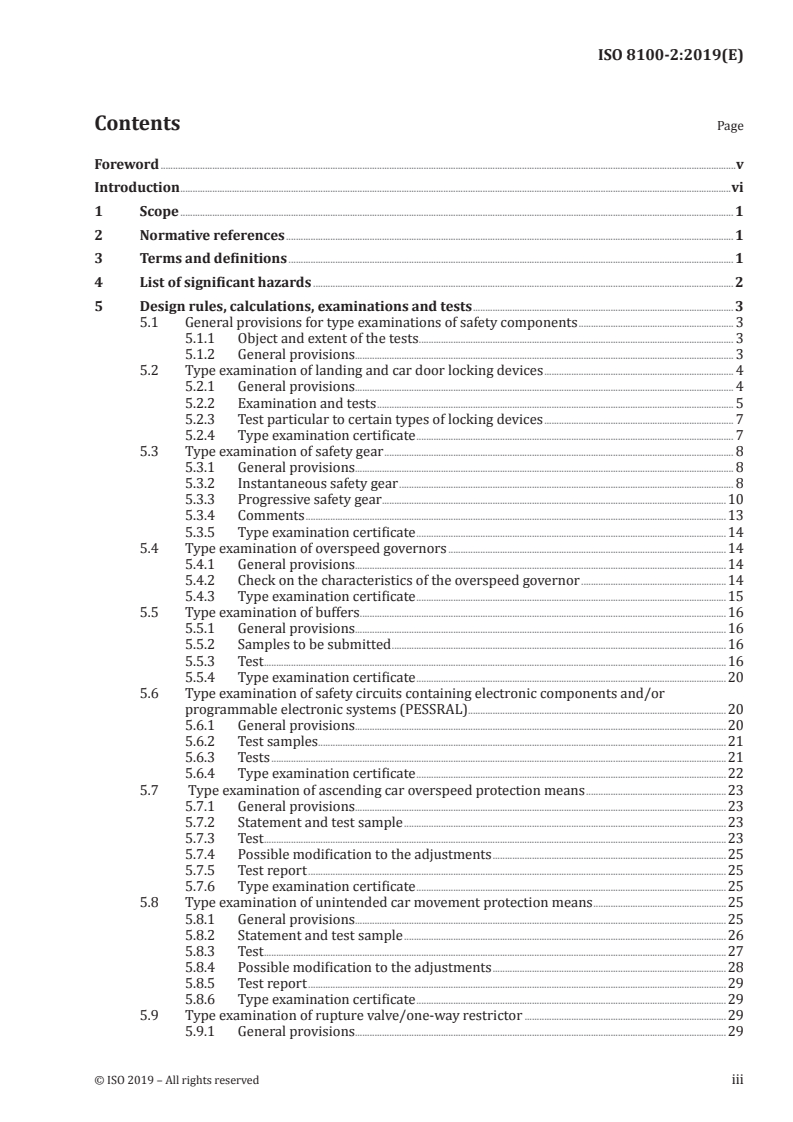
Contents Page
Foreword .v
Introduction .vi
1 Scope . 1
2 Normative references . 1
3 Terms and definitions . 1
4 List of significant hazards . 2
5 Design rules, calculations, examinations and tests . 3
5.1 General provisions for type examinations of safety components . 3
5.1.1 Object and extent of the tests . 3
5.1.2 General provisions. 3
5.2 Type examination of landing and car door locking devices . 4
5.2.1 General provisions. 4
5.2.2 Examination and tests . 5
5.2.3 Test particular to certain types of locking devices . 7
5.2.4 Type examination certificate . 7
5.3 Type examination of safety gear . 8
5.3.1 General provisions. 8
5.3.2 Instantaneous safety gear . 8
5.3.3 Progressive safety gear . .10
5.3.4 Comments .13
5.3.5 Type examination certificate .14
5.4 Type examination of overspeed governors .14
5.4.1 General provisions.14
5.4.2 Check on the characteristics of the overspeed governor .14
5.4.3 Type examination certificate .15
5.5 Type examination of buffers .16
5.5.1 General provisions.16
5.5.2 Samples to be submitted .16
5.5.3 Test .16
5.5.4 Type examination certificate .20
5.6 Type examination of safety circuits containing electronic components and/or
programmable electronic systems (PESSRAL).20
5.6.1 General provisions.20
5.6.2 Test samples.21
5.6.3 Tests .21
5.6.4 Type examination certificate .22
5.7 Type examination of ascending car overspeed protection means .23
5.7.1 General provisions.23
5.7.2 Statement and test sample .23
5.7.3 Test .23
5.7.4 Possible modification to the adjustments .25
5.7.5 Test report .25
5.7.6 Type examination certificate .25
5.8 Type examination of unintended car movement protection means .25
5.8.1 General provisions.25
5.8.2 Statement and test sample .26
5.8.3 Test .27
5.8.4 Possible modification to the adjustments .28
5.8.5 Test report .29
5.8.6 Type examination certificate .29
5.9 Type examination of rupture valve/one-way restrictor .29
5.9.1 General provisions.29
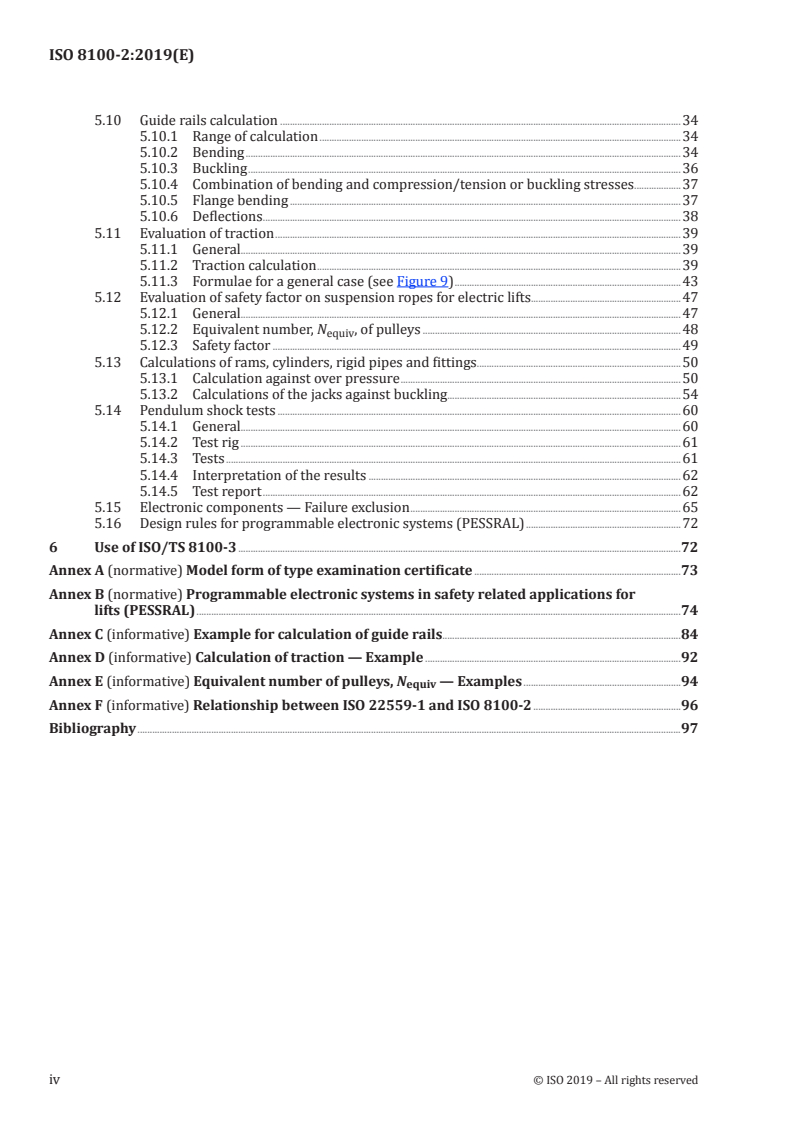
5.10 Guide rails calculation .34
5.10.1 Range of calculation .34
5.10.2 Bending .34
5.10.3 Buckling .36
5.10.4 Combination of bending and compression/tension or buckling stresses .37
5.10.5 Flange bending .37
5.10.6 Deflections .38
5.11 Evaluation of traction .39
5.11.1 General.39
5.11.2 Traction calculation .39
5.11.3 Formulae for a general case (see Figure 9) .43
5.12 Evaluation of safety factor on suspension ropes for electric lifts.47
5.12.1 General.47
5.12.2 Equivalent number, N , of pulleys .48
equiv
5.12.3 Safety factor .49
5.13 Calculations of rams, cylinders, rigid pipes and fittings.50
5.13.1 Calculation against over pressure .50
5.13.2 Calculations of the jacks against buckling.54
5.14 Pendulum shock tests .60
5.14.1 General.60
5.14.2 Test rig .61
5.14.3 Tests .61
5.14.4 Interpretation of the results .62
5.14.5 Test report .62
5.15 Electronic components — Failure exclusion .65
5.16 Design rules for programmable electronic systems (PESSRAL) .72
6 Use of ISO/TS 8100-3 .72
Annex A (normative) Model form of type examination certificate .73
Annex B (normative) Programmable electronic systems in safety related applications for
lifts (PESSRAL) .74
Annex C (informative) Example for calculation of guide rails.84
Annex D (informative) Calculation of traction — Example .92
Annex E (informative) Equivalent number of pulleys, N — Examples .94
equiv
Annex F (informative) Relationship between ISO 22559-1 and ISO 8100-2 .96
Bibliography .97
iv © ISO 2019 – All rights reserved
Foreword
ISO (the International Organization for Standardization) is a worldwide federation of national standards
bodies (ISO member bodies). The work of preparing International Standards is normally carried out
through ISO technical committees. Each member body interested in a subject for which a technical
committee has been established has the right to be represented on that committee. International
organizations, governmental and non-governmental, in liaison with ISO, also take part in the work.
ISO collaborates closely with the International Electrotechnical Commission (IEC) on all matters of
electrotechnical standardization.
The procedures used to develop this document and those intended for its further maintenance are
described in the ISO/IEC Directives, Part 1. In particular, the different approval criteria needed for the
different types of ISO documents should be noted. This document was drafted in accordance with the
editorial rules of the ISO/IEC Directives, Part 2 (see www. iso. org/directives).
Attention is drawn to the possibility that some of the elements of this document may be the subject of
patent rights. ISO shall not be held responsible for identifying any or all such patent rights. Details of
any patent rights identified during the development of the document will be in the Introduction and/or
on the ISO list of patent declarations received (see www. iso.o rg/patents).
Any trade name used in this document is information given for the convenience of users and does not
constitute an endorsement.
For an explanation of the voluntary nature of standards, the meaning of ISO specific terms and
expressions related to conformity assessment, as well as information about ISO's adherence to the
World Trade Organization (WTO) principles in the Technical Barriers to Trade (TBT) see www. iso
.org/iso/foreword. html.
This document was prepared by Technical Committee ISO/TC 178, Lifts, escalators, passenger conveyors.
Any feedback or questions on this document should be directed to the user’s national standards body. A
complete listing of these bodies can be found at www. iso. org/members. html.
A list of all parts in the ISO 8100 series can be found on the ISO website.
Introduction
The content of this document was already published in EN 81-50:2014. This document contains only
editorial changes and update of references.
The object of this document is to define safety rules related to lifts with a view to safeguarding
persons and objects against the risk of accidents associated with the use, maintenance and emergency
operations of lifts.
Reference is made to the respective introductions of the standards (e.g. ISO 8100-1:2019) calling for the
use of this document with regard to persons and objects to be safeguarded, assumptions, principles, etc.
vi © ISO 2019 – All rights reserved
INTERNATIONAL STANDARD ISO 8100-2:2019(E)
Lifts for the transport of persons and goods —
Part 2:
Design rules, calculations, examinations and tests of lift
components
1 Scope
This document specifies the design rules, calculations, examinations and tests of lift components which
are referred to by other standards used for the design of passenger lifts, goods passenger lifts, goods
only lifts, and other similar types of lifting appliances.
2 Normative references
The following documents are referred to in the text in such a way that some or all of their content
constitutes requirements of this document. For dated references, only the edition cited applies. For
undated references, the latest edition of the referenced document (including any amendments) applies.
ISO 4344, Steel wire ropes for lifts — Minimum requirements
ISO 8100-1:2019, Safety rules for the construction and installation of lifts — Lifts for the transport of
persons and goods — Passenger and goods passenger lifts
ISO/TS 8100-3, Requirements from Other Standards (ASME A17.1/CSA B44 and JIS A 4307-1/ JIS A 4307-2)
not included in ISO 8100-1 or ISO 8100-2
IEC 60068-2-6, Environmental testing — Part 2: Tests — Test Fc: Vibration (sinusoidal)
IEC 60068-2-27, Environmental testing — Part 2-27: Tests — Test Ea and guidance: Shock
IEC 60112, Method for the determination of the proof and the comparative tracking indices of solid
insulating materials
IEC 60664-1, Insulation coordination for equipment within low-voltage systems — Part 1: Principles,
requirements and tests
IEC 60947-4-1, Low-voltage switchgear and control gear — Part 4-1: Contactors and motor-starters —
Electromechanical contactors and motor-starters
IEC 60947-5-1, Low-voltage switchgear and control gear — Part 5-1: Control circuit devices and switching
elements — Electromechanical control circuit devices
EN 10025 (all parts), Hot rolled products of non-alloy structural steels — Technical delivery conditions
EN 12385-5, Steel wire ropes — Safety — Part 5: Stranded ropes for lifts
3 Terms and definitions
For the purposes of this document, the following terms and definitions apply.
ISO and IEC maintain terminological databases for use in standardization at the following addresses:
— ISO Online browsing platform: available at https: //www .iso .org/obp
— IEC Electropedia: available at http: //www .electropedia .org/
3.1
approved body
organization or manufacturer, operating an approved full quality assurance system to undertake
testing of safety components (3.2)
3.2
safety component
component provided to fulfil a safety function when in use
3.3
type examination certificate
document issued by an approved body (3.1) carrying out a type-examination in which it certifies that
the product example under consideration complies with the provisions applicable to it
4 List of significant hazards
This clause contains all the significant hazards, hazardous situations and events, as far as they are dealt
with in this document, identified by risk assessment as significant for this type of machinery, and they
require action to eliminate or reduce the risk (see Table 1).
Table 1 — List of significant hazards
Hazards as listed in
No. Relevant clauses
ISO 12100:2010, Annex B
1 Mechanical hazards due to:
Acceleration, deceleration (kinetic energy) 5.3; 5.4; 5.5; 5.7; 5.8; 5.9
Approach of a moving element to a fixed part 5.2
Elastic elements 5.10; 5.11; 5.12; 5.13
Falling objects 5.3; 5.4; 5.5; 5.9
Gravity (stored energy) 5.3; 5.4; 5.5; 5.9
Height from the ground 5.3; 5.4; 5.5; 5.9
High pressure 5.13
Moving elements 5.2; 5.3; 5.4; 5.5; 5.6; 5.7; 5.8; 5.9; 5.10; 5.11; 5.12;
5.13; 5.14; 5.15; 5.16
Rotating elements 5.4; 5.11; 5.12
Stability 5.10; 5.11; 5.12; 5.13; 5.14
Strength 5.10; 5.11; 5.12; 5.13; 5.14
2 Electrical hazards
Arc 5,2; 5.4; 5.6; 5.7; 5.8; 5.15; 5.16
Electrostatic phenomena 5,2; 5.4; 5.6; 5.7; 5.8; 5.15; 5.16
Live parts 5,2; 5.4; 5.6; 5.7; 5.8; 5.15; 5.16
Not enough distance to live parts under high voltage 5,2; 5.4; 5.6; 5.7; 5.8; 5.15; 5.16
Overload 5,2; 5.4; 5.6; 5.7; 5.8; 5.15; 5.16
Parts which have become live under faulty condi- 5,2; 5.4; 5.6; 5.7; 5.8; 5.15; 5.16
tions
Short-circuit 5,2; 5.4; 5.6; 5.7; 5.8; 5.15; 5.16
2 © ISO 2019 – All rights reserved
Table 1 (continued)
Hazards as listed in
No. Relevant clauses
ISO 12100:2010, Annex B
6 Hazards generated by radiation
Low frequency electromagnetic radiation 5.6; 5.15; 5.16
Radio frequency electromagnetic radiation 5.6; 5.15; 5.16
9 Hazards associated with the environment in 5.2; 5.3; 5.4; 5.5; 5.6; 5.7; 5.8; 5.9; 5.10; 5.11; 5.12;
which the machine is used 5.13; 5.14; 5.15; 5.16
5 Design rules, calculations, examinations and tests
5.1 General provisions for type examinations of safety components
5.1.1 Object and extent of the tests
The safety component/device is submitted to a test procedure to verify that insofar as construction and
operation are concerned, it conforms to the requirements imposed by this document. It shall be checked,
in particular, that the mechanical, electrical and electronic components of the device are properly rated
and that, in the course of time, the device does not lose its effectiveness, particularly through wear
or aging. If the safety component is needed to satisfy particular requirements (waterproof, dust proof
or explosion proof construction), supplementary examinations and/or tests under appropriate criteria
shall be made.
5.1.2 General provisions
5.1.2.1 For the purposes of this document, it is assumed that the laboratory undertakes both the testing
and the certification as an approved body. An approved body may be that of a manufacturer operating an
approved full quality assurance system. In certain cases, the test laboratory and the body approved for
the issue of type examination certificates may be separate. In these cases, the administrative procedures
can differ from those described in this document.
5.1.2.2 The application for type examination shall be made by the manufacturer of the component, or
their authorized representative, and shall be addressed to an approved test laboratory.
5.1.2.3 The dispatch of samples for examination shall be made by agreement between the laboratory
and the applicant.
5.1.2.4 The applicant may attend the tests.
5.1.2.5 If the laboratory entrusted with the complete examination of one of the components requiring
the supply of a type examination certificate has no appropriate means available for certain tests or
examinations, it may, under its responsibility, have these made by other laboratories with the agreement
of the applicant.
5.1.2.6 Unless specified otherwise, the precision of the instruments shall allow measurements to be
made within the following accuracy:
a) ±1 % for masses, forces, distances, speeds;
b) ±2 % for accelerations, retardations;
c) ±5 % for voltages, currents;
d) ±5 °C for temperatures;
e) recording equipment shall be capable of detecting signals, which vary in time of 0,01 s;
f) ±2,5 % for flow rate;
g) ±1 % for pressure, P, below 200 kPa;
h) ±5 % for pressure, P, above 200 kPa.
5.2 Type examination of landing and car door locking devices
5.2.1 General provisions
5.2.1.1 Field of application
These procedures are applicable to locking devices for landing and car doors. It is understood that
each component taking part in the locking of doors and in the checking of the locking forms part of the
locking device.
5.2.1.2 Documents to be submitted
5.2.1.2.1 Schematic arrangement drawing with description of operation
This drawing shall clearly show all the details relating to the operation and the safety of the locking
device, including:
a) the operation of the device in normal service, showing the effective engagement of the locking
elements and the point at which the electrical safety device operates;
b) the operation of the device for mechanical checking of the locking position if this device exists;
c) the control and operation of the emergency unlocking device;
d) the type (A.C. and/or D.C.), rated voltage and rated current.
5.2.1.2.2 Assembly drawing with key
This drawing shall show all parts important to the operation of the locking device, in particular those
required to conform to the requirements of this document. A key shall indicate the list of the principal
parts, the type of materials used, and the characteristics of the fixing elements.
5.2.1.3 Test samples
One door-locking device shall be submitted to the laboratory.
If the test is carried out on a prototype, it shall be repeated later on a production model.
If the test of the locking device is only possible when the device is mounted in the corresponding door,
the device shall be mounted on a complete door in working order. However, the door dimensions may
be reduced by comparison with a production model, on the condition that it does not falsify the test
results.
4 © ISO 2019 – All rights reserved
5.2.2 Examination and tests
5.2.2.1 Examination of operation
This examination aims to verify that:
— the mechanical and electrical components of the locking device are operating correctly with respect
to safety, and in conformity with:
— the requirements of this document;
— the standard calling for this locking device; and
— the device is in conformity with the particulars provided in the application.
In particular, it shall be verified that:
a) there is at least 7 mm engagement of the locking elements before the electric safety device operates;
b) it is not possible to operate the lift from positions normally accessible to persons with a door open
or unlocked, after one single action not forming part of the normal operation.
5.2.2.2 Mechanical tests
5.2.2.2.1 General
These tests have the purpose of verifying the strength of the mechanical locking components and the
electrical components.
The sample of the locking device in its normal operating position is controlled by the devices normally
used to operate it.
The sample shall be lubricated in accordance with the requirements of the manufacturer of the
locking device.
When there are several possible means of control and positions of operation, the endurance test shall
be made in the arrangement which is regarded as the most unfavourable from the point of view of the
forces on the components.
The number of complete cycles of operation and the travel of the locking components shall be registered
by mechanical or electrical counters.
5.2.2.2.2 Endurance test
The locking device shall be submitted to 1 000 000 (±1 %) complete cycles; one cycle comprises one
forward and return movement over the full travel possible in both directions.
The driving of the device shall be smooth, without shocks, and at a rate of 60 (±10 %) cycles per minute.
During the endurance test, the electrical contact of the lock shall close a resistive circuit under the
rated voltage and at a current value double that of the rated current.
If the locking device is provided with a mechanical checking device for the locking pin or the position of
the locking element, this device shall be submitted to an endurance test of 100 000 (±1 %) cycles.
The driving of the device shall be smooth, without shocks, and at a rate of 60 (±10 %) cycles per minute.
5.2.2.2.3 Static test
For locking devices intended for hinged doors, a test shall be made consisting of the application over a
total period of 300 s of a static force, increasing progressively to a value of 3 000 N.
This force shall be applied in the opening direction of the door and in a position corresponding as far as
possible to that which can be applied when a user attempts to open the door. The force applied shall be
1 000 N in the case of a locking device intended for sliding doors.
5.2.2.2.4 Dynamic test
The locking device, in the locked position, shall be submitted to a shock test in the opening direction of
the door.
The shock shall correspond to the impact of a rigid mass of 4 kg falling in free fall from a height of 0,50 m.
5.2.2.3 Criteria for the mechanical tests
After the endurance test (5.2.2.2.2), the static test (5.2.2.2.3) and the dynamic test (5.2.2.2.4), there
shall not be any wear, deformation or breakage, which could adversely affect safety.
5.2.2.4 Electrical test
5.2.2.4.1 Endurance test of contacts
This test is included in the endurance test laid down in 5.2.2.2.2.
5.2.2.4.2 Test of ability to break circuit
5.2.2.4.2.1 General
This test shall be carried out after the endurance test. It shall check that the ability to break a live
circuit is sufficient. This test shall be made in accordance with the procedure in IEC 60947-4-1 and
IEC 60947-5-1. The values of current and rated voltage serving as a basis for the tests shall be those
indicated by the manufacturer of the device.
If nothing is specified, the rated values shall be as follows:
a) alternating current: 230 V, 2 A;
b) direct current: 200 V, 2 A.
Unless indicated otherwise, the capacity to break circuit shall be examined for both A.C. and D.C.
conditions.
The tests shall be carried out with the locking device in the working position. If several positions are
possible, the test shall be made in the most unfavourable position.
The sample tested shall be provided with covers and electric wiring as used in normal service.
5.2.2.4.2.2 A.C. locking devices shall open and close an electric circuit under a voltage equal to 110 %
of the rated voltage 50 times, at normal speed and at intervals of 5 s to 10 s. The contact shall remain
closed for at least 0,5 s.
The circuit shall comprise a choke and a resistance in series. Its power factor shall be 0,7 ± 0,05 and the
test current shall be 11 times the rated current indicated by the manufacturer of the device.
5.2.2.4.2.3 D.C. locking devices shall open and close an electric circuit under a voltage equal to 110 %
of the rated voltage 20 times, at normal speed and at intervals of 5 s to 10 s. The contact shall remain
closed for at least 0,5 s.
The circuit shall comprise a choke and a resistance in series having values such that the current reaches
95 % of the steady-state value of the test current in 300 ms.
6 © ISO 2019 – All rights reserved
The test current shall be 110 % of the rated current indicated by the manufacturer of the device.
5.2.2.4.2.4 The tests are considered satisfactory if no tracking or arcing is produced and if no
deterioration occurs which can adversely affect safety.
5.2.2.4.3 Test for resistance to leakage currents
This test shall be made in accordance with the procedure in IEC 60112. The electrodes shall be
connected to a source providing an A.C. voltage which is sinusoidal at 175 V, 50 Hz.
5.2.2.4.4 Examination of clearances and creepage distances
The clearances in air and creepage distances shall be in accordance with the requirements laid down in
the standards calling for the use of this document (e.g. ISO 8100-1:2019, 5.11.2.2.4).
5.2.2.4.5 Examination of the requirements appropriate to safety contacts and their
accessibility
This examination shall be made taking account of the mounting position and the layout of the locking
device, as appropriate.
5.2.3 Test particular to certain types of locking devices
5.2.3.1 Locking device for horizontally or vertically sliding doors with several panels
According to the requirements laid down in the standards calling for the use of this document, the
devices providing direct mechanical linkage between panels (e.g. ISO 8100-1:2019, 5.3.14.1) or indirect
mechanical linkage (e.g. ISO 8100-1:2019, 5.3.14.2) are considered forming part of the locking device.
These devices shall be submitted to the tests mentioned in 5.2.2. The number of cycles per minute in
such endurance tests shall be suited to the dimensions of the construction.
5.2.3.2 Flap type locking device for hinged door
If this device is provided with an electric safety device required to check the possible deformation of
the flap, and if, after the static test envisaged in 5.2.2.2.3, there are any doubts on the strength of the
device, the load shall be increased progressively until the safety device begins to open. No component
of the locking device or of the door shall be damaged or permanently deformed by the load applied.
If, after the static test, the dimensions and construction leave no doubt as to its strength, it is not
necessary to proceed to the endurance test on the flap.
5.2.4 Type examination certificate
The certificate shall indicate the following:
a) information according to Annex A;
b) type and application of locking device;
c) type (A.C. and/or D.C.) and values of the rated voltage and rated current;
d) in the case of flap type door locking devices: the necessary force to actuate the electric safety
device for checking the elastic deformation of the flap.
5.3 Type examination of safety gear
5.3.1 General provisions
The applicant shall state the range of use provided, i.e.:
— minimum and maximum masses;
— maximum rated speed and maximum tripping speed.
Detailed information shall be provided on the materials used, the type of guide rails and their surface
condition (drawn, milled, ground).
The following documents shall be attached to the application:
a) detailed and assembly drawings showing the construction, operation, materials used, dimensions
and tolerances of the construction components;
b) in the case of progressive safety gear, also a load diagram relating to elastic parts.
5.3.2 Instantaneous safety gear
5.3.2.1 Test samples
Two gripping assemblies with wedges or clamps and two lengths of guide rail shall be submitted to the
laboratory.
The arrangement and the fixing details for the samples shall be determined by the laboratory in
accordance with the equipment that it uses.
If the same gripping assemblies can be used with different types of guide rails, a new test shall not be
required if the thickness of the guide rails, the width of the grip needed for the safety gear, and the
surface state (drawn, milled, ground) are the same.
5.3.2.2 Test
5.3.2.2.1 Method of test
The test shall be made using a press or similar device, which moves without abrupt speed change.
Measurements shall be made of:
a) the distance travelled as a function of the force;
b) the deformation of the safety gear block as a function of the force or as a function of the distance
travelled.
5.3.2.2.2 Test procedure
The guide rail shall be moved through the safety gear.
Reference marks shall be traced onto the blocks in order to be able to measure their deformation.
The distance travelled shall be recorded as a function of the force.
After the test:
a) the hardness of the block and the gripping element shall be compared with the original values
quoted by the applicant. Other analyses may be carried out in special cases;
b) if there is no fracture, deformations and other changes shall be examined (for example, cracks,
deformations or wear of the gripping elements, appearance of the rubbed surfaces);
8 © ISO 2019 – All rights reserved
c) if necessary, photographs shall be taken of the block, the gripping elements and the guide rail for
evidence of deformations or fractures.
5.3.2.2.3 Documents
5.3.2.2.3.1 Two charts shall be drawn up as follows:
a) the first one shall show the distance travelled as a function of the force;
b) the other shall show the deformation of the block. It shall be done in such a way that it can be
related to the first chart.
5.3.2.2.3.2 The capacity of the safety gears shall be established by integration of the area of the
distance-force chart.
The area of the chart to be taken into consideration shall be:
a) the total area, if there is no permanent deformation;
b) if permanent deformation or rupture has occurred, either:
1) the area up to the value at which the elastic limit has been reached; or
2) the area up to the value corresponding to the maximum force.
5.3.2.3 Determination of the permissible mass
5.3.2.3.1 Energy absorbed by the safety gear
A distance of free fall, calculated with reference to the maximum tripping speed of the overspeed
governor fixed in the requirements laid down in the standards calling for the use of this document (e.g.
ISO 8100-1:2019, 5.6.2.2.1.2), shall be adopted.
The distance of free fall in metres, h, shall be taken as Formula (1):
v
h=+0,10+ ,03 (1)
2.g
n
where
g is the standard acceleration of free fall in metres per square second;
n
v is the tripping speed of overspeed governor in metres per second;
0,1 corresponds to the distance travelled during the response time, in metres;
0,03 corresponds to the travel during take-up of clearance between the gripping elements and
the guide rails, in metres.
The total energy the safety gear is capable of absorbing is calculated with Formulae (2) and (3):
2⋅=KP +Qg⋅⋅n h (2)
()
K
from which: PQ + = (3)
()
gh⋅
n
where
K is the energy absorbed by one safety gear block, in joules (calculated in accordance with
the chart);
P are the masses of the empty car and components supported by the car, i.e. part of the
travelling cable, compensating ropes/chains (if any), etc., in kilograms;
Q is the rated load, in kilograms;
(P + Q) is the permissible mass, in kilograms.
5.3.2.3.2 Permissible mass
a) If the elastic limit has not been exceeded, the permissible mass in kilograms, (P + Q) , is calculated
with Formula (4):
2⋅K
PQ+ = (4)
()
2⋅⋅gh
n
where
K is calculated by the integration of the area defined in 5.3.2.2.3.2 a);
2 is taken as the dividing safety coefficient.
b) If the elastic limit has been exceeded, Formulae (5) and (6) shall be used and the higher permissible
mass may be selected.
K
PQ + = (5)
()
gh⋅
n
where
K is calculated by the integration of the area defined in 5.3.2.2.3.2 b) 1);
2 is taken as the dividing safety coefficient.
2⋅K
PQ + = (6)
()
35, ⋅⋅gh
n
where
K is calculated by the integration of the area defined in 5.3.2.2.3.2 b) 2);
3,5 is taken as the dividing safety coefficient.
5.3.3 Progressive safety gear
5.3.3.1 Statement and test sample
The applicant shall state for what mass in kilograms, and tripping speed in metres per second, of the
overspeed governor the test will be carried out. If the safety gear needs to be certified for various
10 © ISO 2019 – All rights reserved
masses, the applicant shall specify them and indicate, in addition, whether the adjustment is by stages
or continuous.
The applicant should choose the suspended mass in kilograms by dividing the anticipated braking force
in newtons by 16, to aim at an average retardation of 0,6 g .
n
A complete safety gear assembly, as agreed with the laboratory, together with the number of brake
shoes necessary for all the tests, shall be placed at the disposal of the laboratory. The number of sets
of brake shoes necessary for all the tests shall be attached. For the type of guide rail used, the length
specified by the laboratory shall also be supplied.
5.3.3.2 Test
5.3.3.2.1 Method of test
5.3.3.2.1.1 The test shall be carried out in free fall. Direct or indirect measurements shall be made of:
a) the total height of the fall;
b) the braking distance on the guide rails;
c) the sliding distance of the overspeed governor rope, or that of the device used in its place;
d) the total travel of the elements forming the spring.
Measurements a) and b) shall be recorded as a function of the time.
5.3.3.2.1.2 The following shall be determined:
a) the average braking force;
b) the greatest instantaneous braking force;
c) the smallest instantaneous braking force.
5.3.3.2.2 Test procedure
5.3.3.2.2.1 Safety gear certified for a single mass
The laboratory shall carry out four tests with the mass (P + Q) . Between each test, the friction parts
shall be allowed to return to their normal temperature.
During the tests, several identical sets of friction parts may be used.
However, one set of parts shall be capable of:
a) three tests, if the rated speed does not exceed 4 m/s;
b) two tests, if the rated speed exceeds 4 m/s.
The height of free fall shall be calculated to correspond to the maximum tripping speed of the overspeed
governor for which the safety gear can be used.
The engagements of the safety gear shall be achieved by a means allowing the tripping speed to be fixed
precisely.
For example, a rope may be used, the slack of which should be carefully calculated, fixed to a sleeve
which can slide with friction over a fixed smooth rope. The friction effort should be the same as the
effort applied to the operating rope by
...
INTERNATIONAL ISO
STANDARD 8100-2
First edition
2019-03
Lifts for the transport of persons and
goods —
Part 2:
Design rules, calculations,
examinations and tests of lift
components
Elévateurs pour le transport de personnes et d'objets —
Partie 2: Règles de conception, calculs, examens et essais des
composants pour élévateurs
Reference number
©
ISO 2019
© ISO 2019
All rights reserved. Unless otherwise specified, or required in the context of its implementation, no part of this publication may
be reproduced or utilized otherwise in any form or by any means, electronic or mechanical, including photocopying, or posting
on the internet or an intranet, without prior written permission. Permission can be requested from either ISO at the address
below or ISO’s member body in the country of the requester.
ISO copyright office
CP 401 • Ch. de Blandonnet 8
CH-1214 Vernier, Geneva
Phone: +41 22 749 01 11
Fax: +41 22 749 09 47
Email: copyright@iso.org
Website: www.iso.org
Published in Switzerland
ii © ISO 2019 – All rights reserved
Contents Page
Foreword .v
Introduction .vi
1 Scope . 1
2 Normative references . 1
3 Terms and definitions . 1
4 List of significant hazards . 2
5 Design rules, calculations, examinations and tests . 3
5.1 General provisions for type examinations of safety components . 3
5.1.1 Object and extent of the tests . 3
5.1.2 General provisions. 3
5.2 Type examination of landing and car door locking devices . 4
5.2.1 General provisions. 4
5.2.2 Examination and tests . 5
5.2.3 Test particular to certain types of locking devices . 7
5.2.4 Type examination certificate . 7
5.3 Type examination of safety gear . 8
5.3.1 General provisions. 8
5.3.2 Instantaneous safety gear . 8
5.3.3 Progressive safety gear . .10
5.3.4 Comments .13
5.3.5 Type examination certificate .14
5.4 Type examination of overspeed governors .14
5.4.1 General provisions.14
5.4.2 Check on the characteristics of the overspeed governor .14
5.4.3 Type examination certificate .15
5.5 Type examination of buffers .16
5.5.1 General provisions.16
5.5.2 Samples to be submitted .16
5.5.3 Test .16
5.5.4 Type examination certificate .20
5.6 Type examination of safety circuits containing electronic components and/or
programmable electronic systems (PESSRAL).20
5.6.1 General provisions.20
5.6.2 Test samples.21
5.6.3 Tests .21
5.6.4 Type examination certificate .22
5.7 Type examination of ascending car overspeed protection means .23
5.7.1 General provisions.23
5.7.2 Statement and test sample .23
5.7.3 Test .23
5.7.4 Possible modification to the adjustments .25
5.7.5 Test report .25
5.7.6 Type examination certificate .25
5.8 Type examination of unintended car movement protection means .25
5.8.1 General provisions.25
5.8.2 Statement and test sample .26
5.8.3 Test .27
5.8.4 Possible modification to the adjustments .28
5.8.5 Test report .29
5.8.6 Type examination certificate .29
5.9 Type examination of rupture valve/one-way restrictor .29
5.9.1 General provisions.29
5.10 Guide rails calculation .34
5.10.1 Range of calculation .34
5.10.2 Bending .34
5.10.3 Buckling .36
5.10.4 Combination of bending and compression/tension or buckling stresses .37
5.10.5 Flange bending .37
5.10.6 Deflections .38
5.11 Evaluation of traction .39
5.11.1 General.39
5.11.2 Traction calculation .39
5.11.3 Formulae for a general case (see Figure 9) .43
5.12 Evaluation of safety factor on suspension ropes for electric lifts.47
5.12.1 General.47
5.12.2 Equivalent number, N , of pulleys .48
equiv
5.12.3 Safety factor .49
5.13 Calculations of rams, cylinders, rigid pipes and fittings.50
5.13.1 Calculation against over pressure .50
5.13.2 Calculations of the jacks against buckling.54
5.14 Pendulum shock tests .60
5.14.1 General.60
5.14.2 Test rig .61
5.14.3 Tests .61
5.14.4 Interpretation of the results .62
5.14.5 Test report .62
5.15 Electronic components — Failure exclusion .65
5.16 Design rules for programmable electronic systems (PESSRAL) .72
6 Use of ISO/TS 8100-3 .72
Annex A (normative) Model form of type examination certificate .73
Annex B (normative) Programmable electronic systems in safety related applications for
lifts (PESSRAL) .74
Annex C (informative) Example for calculation of guide rails.84
Annex D (informative) Calculation of traction — Example .92
Annex E (informative) Equivalent number of pulleys, N — Examples .94
equiv
Annex F (informative) Relationship between ISO 22559-1 and ISO 8100-2 .96
Bibliography .97
iv © ISO 2019 – All rights reserved
Foreword
ISO (the International Organization for Standardization) is a worldwide federation of national standards
bodies (ISO member bodies). The work of preparing International Standards is normally carried out
through ISO technical committees. Each member body interested in a subject for which a technical
committee has been established has the right to be represented on that committee. International
organizations, governmental and non-governmental, in liaison with ISO, also take part in the work.
ISO collaborates closely with the International Electrotechnical Commission (IEC) on all matters of
electrotechnical standardization.
The procedures used to develop this document and those intended for its further maintenance are
described in the ISO/IEC Directives, Part 1. In particular, the different approval criteria needed for the
different types of ISO documents should be noted. This document was drafted in accordance with the
editorial rules of the ISO/IEC Directives, Part 2 (see www. iso. org/directives).
Attention is drawn to the possibility that some of the elements of this document may be the subject of
patent rights. ISO shall not be held responsible for identifying any or all such patent rights. Details of
any patent rights identified during the development of the document will be in the Introduction and/or
on the ISO list of patent declarations received (see www. iso.o rg/patents).
Any trade name used in this document is information given for the convenience of users and does not
constitute an endorsement.
For an explanation of the voluntary nature of standards, the meaning of ISO specific terms and
expressions related to conformity assessment, as well as information about ISO's adherence to the
World Trade Organization (WTO) principles in the Technical Barriers to Trade (TBT) see www. iso
.org/iso/foreword. html.
This document was prepared by Technical Committee ISO/TC 178, Lifts, escalators, passenger conveyors.
Any feedback or questions on this document should be directed to the user’s national standards body. A
complete listing of these bodies can be found at www. iso. org/members. html.
A list of all parts in the ISO 8100 series can be found on the ISO website.
Introduction
The content of this document was already published in EN 81-50:2014. This document contains only
editorial changes and update of references.
The object of this document is to define safety rules related to lifts with a view to safeguarding
persons and objects against the risk of accidents associated with the use, maintenance and emergency
operations of lifts.
Reference is made to the respective introductions of the standards (e.g. ISO 8100-1:2019) calling for the
use of this document with regard to persons and objects to be safeguarded, assumptions, principles, etc.
vi © ISO 2019 – All rights reserved
INTERNATIONAL STANDARD ISO 8100-2:2019(E)
Lifts for the transport of persons and goods —
Part 2:
Design rules, calculations, examinations and tests of lift
components
1 Scope
This document specifies the design rules, calculations, examinations and tests of lift components which
are referred to by other standards used for the design of passenger lifts, goods passenger lifts, goods
only lifts, and other similar types of lifting appliances.
2 Normative references
The following documents are referred to in the text in such a way that some or all of their content
constitutes requirements of this document. For dated references, only the edition cited applies. For
undated references, the latest edition of the referenced document (including any amendments) applies.
ISO 4344, Steel wire ropes for lifts — Minimum requirements
ISO 8100-1:2019, Safety rules for the construction and installation of lifts — Lifts for the transport of
persons and goods — Passenger and goods passenger lifts
ISO/TS 8100-3, Requirements from Other Standards (ASME A17.1/CSA B44 and JIS A 4307-1/ JIS A 4307-2)
not included in ISO 8100-1 or ISO 8100-2
IEC 60068-2-6, Environmental testing — Part 2: Tests — Test Fc: Vibration (sinusoidal)
IEC 60068-2-27, Environmental testing — Part 2-27: Tests — Test Ea and guidance: Shock
IEC 60112, Method for the determination of the proof and the comparative tracking indices of solid
insulating materials
IEC 60664-1, Insulation coordination for equipment within low-voltage systems — Part 1: Principles,
requirements and tests
IEC 60947-4-1, Low-voltage switchgear and control gear — Part 4-1: Contactors and motor-starters —
Electromechanical contactors and motor-starters
IEC 60947-5-1, Low-voltage switchgear and control gear — Part 5-1: Control circuit devices and switching
elements — Electromechanical control circuit devices
EN 10025 (all parts), Hot rolled products of non-alloy structural steels — Technical delivery conditions
EN 12385-5, Steel wire ropes — Safety — Part 5: Stranded ropes for lifts
3 Terms and definitions
For the purposes of this document, the following terms and definitions apply.
ISO and IEC maintain terminological databases for use in standardization at the following addresses:
— ISO Online browsing platform: available at https: //www .iso .org/obp
— IEC Electropedia: available at http: //www .electropedia .org/
3.1
approved body
organization or manufacturer, operating an approved full quality assurance system to undertake
testing of safety components (3.2)
3.2
safety component
component provided to fulfil a safety function when in use
3.3
type examination certificate
document issued by an approved body (3.1) carrying out a type-examination in which it certifies that
the product example under consideration complies with the provisions applicable to it
4 List of significant hazards
This clause contains all the significant hazards, hazardous situations and events, as far as they are dealt
with in this document, identified by risk assessment as significant for this type of machinery, and they
require action to eliminate or reduce the risk (see Table 1).
Table 1 — List of significant hazards
Hazards as listed in
No. Relevant clauses
ISO 12100:2010, Annex B
1 Mechanical hazards due to:
Acceleration, deceleration (kinetic energy) 5.3; 5.4; 5.5; 5.7; 5.8; 5.9
Approach of a moving element to a fixed part 5.2
Elastic elements 5.10; 5.11; 5.12; 5.13
Falling objects 5.3; 5.4; 5.5; 5.9
Gravity (stored energy) 5.3; 5.4; 5.5; 5.9
Height from the ground 5.3; 5.4; 5.5; 5.9
High pressure 5.13
Moving elements 5.2; 5.3; 5.4; 5.5; 5.6; 5.7; 5.8; 5.9; 5.10; 5.11; 5.12;
5.13; 5.14; 5.15; 5.16
Rotating elements 5.4; 5.11; 5.12
Stability 5.10; 5.11; 5.12; 5.13; 5.14
Strength 5.10; 5.11; 5.12; 5.13; 5.14
2 Electrical hazards
Arc 5,2; 5.4; 5.6; 5.7; 5.8; 5.15; 5.16
Electrostatic phenomena 5,2; 5.4; 5.6; 5.7; 5.8; 5.15; 5.16
Live parts 5,2; 5.4; 5.6; 5.7; 5.8; 5.15; 5.16
Not enough distance to live parts under high voltage 5,2; 5.4; 5.6; 5.7; 5.8; 5.15; 5.16
Overload 5,2; 5.4; 5.6; 5.7; 5.8; 5.15; 5.16
Parts which have become live under faulty condi- 5,2; 5.4; 5.6; 5.7; 5.8; 5.15; 5.16
tions
Short-circuit 5,2; 5.4; 5.6; 5.7; 5.8; 5.15; 5.16
2 © ISO 2019 – All rights reserved
Table 1 (continued)
Hazards as listed in
No. Relevant clauses
ISO 12100:2010, Annex B
6 Hazards generated by radiation
Low frequency electromagnetic radiation 5.6; 5.15; 5.16
Radio frequency electromagnetic radiation 5.6; 5.15; 5.16
9 Hazards associated with the environment in 5.2; 5.3; 5.4; 5.5; 5.6; 5.7; 5.8; 5.9; 5.10; 5.11; 5.12;
which the machine is used 5.13; 5.14; 5.15; 5.16
5 Design rules, calculations, examinations and tests
5.1 General provisions for type examinations of safety components
5.1.1 Object and extent of the tests
The safety component/device is submitted to a test procedure to verify that insofar as construction and
operation are concerned, it conforms to the requirements imposed by this document. It shall be checked,
in particular, that the mechanical, electrical and electronic components of the device are properly rated
and that, in the course of time, the device does not lose its effectiveness, particularly through wear
or aging. If the safety component is needed to satisfy particular requirements (waterproof, dust proof
or explosion proof construction), supplementary examinations and/or tests under appropriate criteria
shall be made.
5.1.2 General provisions
5.1.2.1 For the purposes of this document, it is assumed that the laboratory undertakes both the testing
and the certification as an approved body. An approved body may be that of a manufacturer operating an
approved full quality assurance system. In certain cases, the test laboratory and the body approved for
the issue of type examination certificates may be separate. In these cases, the administrative procedures
can differ from those described in this document.
5.1.2.2 The application for type examination shall be made by the manufacturer of the component, or
their authorized representative, and shall be addressed to an approved test laboratory.
5.1.2.3 The dispatch of samples for examination shall be made by agreement between the laboratory
and the applicant.
5.1.2.4 The applicant may attend the tests.
5.1.2.5 If the laboratory entrusted with the complete examination of one of the components requiring
the supply of a type examination certificate has no appropriate means available for certain tests or
examinations, it may, under its responsibility, have these made by other laboratories with the agreement
of the applicant.
5.1.2.6 Unless specified otherwise, the precision of the instruments shall allow measurements to be
made within the following accuracy:
a) ±1 % for masses, forces, distances, speeds;
b) ±2 % for accelerations, retardations;
c) ±5 % for voltages, currents;
d) ±5 °C for temperatures;
e) recording equipment shall be capable of detecting signals, which vary in time of 0,01 s;
f) ±2,5 % for flow rate;
g) ±1 % for pressure, P, below 200 kPa;
h) ±5 % for pressure, P, above 200 kPa.
5.2 Type examination of landing and car door locking devices
5.2.1 General provisions
5.2.1.1 Field of application
These procedures are applicable to locking devices for landing and car doors. It is understood that
each component taking part in the locking of doors and in the checking of the locking forms part of the
locking device.
5.2.1.2 Documents to be submitted
5.2.1.2.1 Schematic arrangement drawing with description of operation
This drawing shall clearly show all the details relating to the operation and the safety of the locking
device, including:
a) the operation of the device in normal service, showing the effective engagement of the locking
elements and the point at which the electrical safety device operates;
b) the operation of the device for mechanical checking of the locking position if this device exists;
c) the control and operation of the emergency unlocking device;
d) the type (A.C. and/or D.C.), rated voltage and rated current.
5.2.1.2.2 Assembly drawing with key
This drawing shall show all parts important to the operation of the locking device, in particular those
required to conform to the requirements of this document. A key shall indicate the list of the principal
parts, the type of materials used, and the characteristics of the fixing elements.
5.2.1.3 Test samples
One door-locking device shall be submitted to the laboratory.
If the test is carried out on a prototype, it shall be repeated later on a production model.
If the test of the locking device is only possible when the device is mounted in the corresponding door,
the device shall be mounted on a complete door in working order. However, the door dimensions may
be reduced by comparison with a production model, on the condition that it does not falsify the test
results.
4 © ISO 2019 – All rights reserved
5.2.2 Examination and tests
5.2.2.1 Examination of operation
This examination aims to verify that:
— the mechanical and electrical components of the locking device are operating correctly with respect
to safety, and in conformity with:
— the requirements of this document;
— the standard calling for this locking device; and
— the device is in conformity with the particulars provided in the application.
In particular, it shall be verified that:
a) there is at least 7 mm engagement of the locking elements before the electric safety device operates;
b) it is not possible to operate the lift from positions normally accessible to persons with a door open
or unlocked, after one single action not forming part of the normal operation.
5.2.2.2 Mechanical tests
5.2.2.2.1 General
These tests have the purpose of verifying the strength of the mechanical locking components and the
electrical components.
The sample of the locking device in its normal operating position is controlled by the devices normally
used to operate it.
The sample shall be lubricated in accordance with the requirements of the manufacturer of the
locking device.
When there are several possible means of control and positions of operation, the endurance test shall
be made in the arrangement which is regarded as the most unfavourable from the point of view of the
forces on the components.
The number of complete cycles of operation and the travel of the locking components shall be registered
by mechanical or electrical counters.
5.2.2.2.2 Endurance test
The locking device shall be submitted to 1 000 000 (±1 %) complete cycles; one cycle comprises one
forward and return movement over the full travel possible in both directions.
The driving of the device shall be smooth, without shocks, and at a rate of 60 (±10 %) cycles per minute.
During the endurance test, the electrical contact of the lock shall close a resistive circuit under the
rated voltage and at a current value double that of the rated current.
If the locking device is provided with a mechanical checking device for the locking pin or the position of
the locking element, this device shall be submitted to an endurance test of 100 000 (±1 %) cycles.
The driving of the device shall be smooth, without shocks, and at a rate of 60 (±10 %) cycles per minute.
5.2.2.2.3 Static test
For locking devices intended for hinged doors, a test shall be made consisting of the application over a
total period of 300 s of a static force, increasing progressively to a value of 3 000 N.
This force shall be applied in the opening direction of the door and in a position corresponding as far as
possible to that which can be applied when a user attempts to open the door. The force applied shall be
1 000 N in the case of a locking device intended for sliding doors.
5.2.2.2.4 Dynamic test
The locking device, in the locked position, shall be submitted to a shock test in the opening direction of
the door.
The shock shall correspond to the impact of a rigid mass of 4 kg falling in free fall from a height of 0,50 m.
5.2.2.3 Criteria for the mechanical tests
After the endurance test (5.2.2.2.2), the static test (5.2.2.2.3) and the dynamic test (5.2.2.2.4), there
shall not be any wear, deformation or breakage, which could adversely affect safety.
5.2.2.4 Electrical test
5.2.2.4.1 Endurance test of contacts
This test is included in the endurance test laid down in 5.2.2.2.2.
5.2.2.4.2 Test of ability to break circuit
5.2.2.4.2.1 General
This test shall be carried out after the endurance test. It shall check that the ability to break a live
circuit is sufficient. This test shall be made in accordance with the procedure in IEC 60947-4-1 and
IEC 60947-5-1. The values of current and rated voltage serving as a basis for the tests shall be those
indicated by the manufacturer of the device.
If nothing is specified, the rated values shall be as follows:
a) alternating current: 230 V, 2 A;
b) direct current: 200 V, 2 A.
Unless indicated otherwise, the capacity to break circuit shall be examined for both A.C. and D.C.
conditions.
The tests shall be carried out with the locking device in the working position. If several positions are
possible, the test shall be made in the most unfavourable position.
The sample tested shall be provided with covers and electric wiring as used in normal service.
5.2.2.4.2.2 A.C. locking devices shall open and close an electric circuit under a voltage equal to 110 %
of the rated voltage 50 times, at normal speed and at intervals of 5 s to 10 s. The contact shall remain
closed for at least 0,5 s.
The circuit shall comprise a choke and a resistance in series. Its power factor shall be 0,7 ± 0,05 and the
test current shall be 11 times the rated current indicated by the manufacturer of the device.
5.2.2.4.2.3 D.C. locking devices shall open and close an electric circuit under a voltage equal to 110 %
of the rated voltage 20 times, at normal speed and at intervals of 5 s to 10 s. The contact shall remain
closed for at least 0,5 s.
The circuit shall comprise a choke and a resistance in series having values such that the current reaches
95 % of the steady-state value of the test current in 300 ms.
6 © ISO 2019 – All rights reserved
The test current shall be 110 % of the rated current indicated by the manufacturer of the device.
5.2.2.4.2.4 The tests are considered satisfactory if no tracking or arcing is produced and if no
deterioration occurs which can adversely affect safety.
5.2.2.4.3 Test for resistance to leakage currents
This test shall be made in accordance with the procedure in IEC 60112. The electrodes shall be
connected to a source providing an A.C. voltage which is sinusoidal at 175 V, 50 Hz.
5.2.2.4.4 Examination of clearances and creepage distances
The clearances in air and creepage distances shall be in accordance with the requirements laid down in
the standards calling for the use of this document (e.g. ISO 8100-1:2019, 5.11.2.2.4).
5.2.2.4.5 Examination of the requirements appropriate to safety contacts and their
accessibility
This examination shall be made taking account of the mounting position and the layout of the locking
device, as appropriate.
5.2.3 Test particular to certain types of locking devices
5.2.3.1 Locking device for horizontally or vertically sliding doors with several panels
According to the requirements laid down in the standards calling for the use of this document, the
devices providing direct mechanical linkage between panels (e.g. ISO 8100-1:2019, 5.3.14.1) or indirect
mechanical linkage (e.g. ISO 8100-1:2019, 5.3.14.2) are considered forming part of the locking device.
These devices shall be submitted to the tests mentioned in 5.2.2. The number of cycles per minute in
such endurance tests shall be suited to the dimensions of the construction.
5.2.3.2 Flap type locking device for hinged door
If this device is provided with an electric safety device required to check the possible deformation of
the flap, and if, after the static test envisaged in 5.2.2.2.3, there are any doubts on the strength of the
device, the load shall be increased progressively until the safety device begins to open. No component
of the locking device or of the door shall be damaged or permanently deformed by the load applied.
If, after the static test, the dimensions and construction leave no doubt as to its strength, it is not
necessary to proceed to the endurance test on the flap.
5.2.4 Type examination certificate
The certificate shall indicate the following:
a) information according to Annex A;
b) type and application of locking device;
c) type (A.C. and/or D.C.) and values of the rated voltage and rated current;
d) in the case of flap type door locking devices: the necessary force to actuate the electric safety
device for checking the elastic deformation of the flap.
5.3 Type examination of safety gear
5.3.1 General provisions
The applicant shall state the range of use provided, i.e.:
— minimum and maximum masses;
— maximum rated speed and maximum tripping speed.
Detailed information shall be provided on the materials used, the type of guide rails and their surface
condition (drawn, milled, ground).
The following documents shall be attached to the application:
a) detailed and assembly drawings showing the construction, operation, materials used, dimensions
and tolerances of the construction components;
b) in the case of progressive safety gear, also a load diagram relating to elastic parts.
5.3.2 Instantaneous safety gear
5.3.2.1 Test samples
Two gripping assemblies with wedges or clamps and two lengths of guide rail shall be submitted to the
laboratory.
The arrangement and the fixing details for the samples shall be determined by the laboratory in
accordance with the equipment that it uses.
If the same gripping assemblies can be used with different types of guide rails, a new test shall not be
required if the thickness of the guide rails, the width of the grip needed for the safety gear, and the
surface state (drawn, milled, ground) are the same.
5.3.2.2 Test
5.3.2.2.1 Method of test
The test shall be made using a press or similar device, which moves without abrupt speed change.
Measurements shall be made of:
a) the distance travelled as a function of the force;
b) the deformation of the safety gear block as a function of the force or as a function of the distance
travelled.
5.3.2.2.2 Test procedure
The guide rail shall be moved through the safety gear.
Reference marks shall be traced onto the blocks in order to be able to measure their deformation.
The distance travelled shall be recorded as a function of the force.
After the test:
a) the hardness of the block and the gripping element shall be compared with the original values
quoted by the applicant. Other analyses may be carried out in special cases;
b) if there is no fracture, deformations and other changes shall be examined (for example, cracks,
deformations or wear of the gripping elements, appearance of the rubbed surfaces);
8 © ISO 2019 – All rights reserved
c) if necessary, photographs shall be taken of the block, the gripping elements and the guide rail for
evidence of deformations or fractures.
5.3.2.2.3 Documents
5.3.2.2.3.1 Two charts shall be drawn up as follows:
a) the first one shall show the distance travelled as a function of the force;
b) the other shall show the deformation of the block. It shall be done in such a way that it can be
related to the first chart.
5.3.2.2.3.2 The capacity of the safety gears shall be established by integration of the area of the
distance-force chart.
The area of the chart to be taken into consideration shall be:
a) the total area, if there is no permanent deformation;
b) if permanent deformation or rupture has occurred, either:
1) the area up to the value at which the elastic limit has been reached; or
2) the area up to the value corresponding to the maximum force.
5.3.2.3 Determination of the permissible mass
5.3.2.3.1 Energy absorbed by the safety gear
A distance of free fall, calculated with reference to the maximum tripping speed of the overspeed
governor fixed in the requirements laid down in the standards calling for the use of this document (e.g.
ISO 8100-1:2019, 5.6.2.2.1.2), shall be adopted.
The distance of free fall in metres, h, shall be taken as Formula (1):
v
h=+0,10+ ,03 (1)
2.g
n
where
g is the standard acceleration of free fall in metres per square second;
n
v is the tripping speed of overspeed governor in metres per second;
0,1 corresponds to the distance travelled during the response time, in metres;
0,03 corresponds to the travel during take-up of clearance between the gripping elements and
the guide rails, in metres.
The total energy the safety gear is capable of absorbing is calculated with Formulae (2) and (3):
2⋅=KP +Qg⋅⋅n h (2)
()
K
from which: PQ + = (3)
()
gh⋅
n
where
K is the energy absorbed by one safety gear block, in joules (calculated in accordance with
the chart);
P are the masses of the empty car and components supported by the car, i.e. part of the
travelling cable, compensating ropes/chains (if any), etc., in kilograms;
Q is the rated load, in kilograms;
(P + Q) is the permissible mass, in kilograms.
5.3.2.3.2 Permissible mass
a) If the elastic limit has not been exceeded, the permissible mass in kilograms, (P + Q) , is calculated
with Formula (4):
2⋅K
PQ+ = (4)
()
2⋅⋅gh
n
where
K is calculated by the integration of the area defined in 5.3.2.2.3.2 a);
2 is taken as the dividing safety coefficient.
b) If the elastic limit has been exceeded, Formulae (5) and (6) shall be used and the higher permissible
mass may be selected.
K
PQ + = (5)
()
gh⋅
n
where
K is calculated by the integration of the area defined in 5.3.2.2.3.2 b) 1);
2 is taken as the dividing safety coefficient.
2⋅K
PQ + = (6)
()
35, ⋅⋅gh
n
where
K is calculated by the integration of the area defined in 5.3.2.2.3.2 b) 2);
3,5 is taken as the dividing safety coefficient.
5.3.3 Progressive safety gear
5.3.3.1 Statement and test sample
The applicant shall state for what mass in kilograms, and tripping speed in metres per second, of the
overspeed governor the test will be carried out. If the safety gear needs to be certified for various
10 © ISO 2019 – All rights reserved
masses, the applicant shall specify them and indicate, in addition, whether the adjustment is by stages
or continuous.
The applicant should choose the suspended mass in kilograms by dividing the anticipated braking force
in newtons by 16, to aim at an average retardation of 0,6 g .
n
A complete safety gear assembly, as agreed with the laboratory, together with the number of brake
shoes necessary for all the tests, shall be placed at the disposal of the laboratory. The number of sets
of brake shoes necessary for all the tests shall be attached. For the type of guide rail used, the length
specified by the laboratory shall also be supplied.
5.3.3.2 Test
5.3.3.2.1 Method of test
5.3.3.2.1.1 The test shall be carried out in free fall. Direct or indirect measurements shall be made of:
a) the total height of the fall;
b) the braking distance on the guide rails;
c) the sliding distance of the overspeed governor rope, or that of the device used in its place;
d) the total travel of the elements forming the spring.
Measurements a) and b) shall be recorded as a function of the time.
5.3.3.2.1.2 The following shall be determined:
a) the average braking force;
b) the greatest instantaneous braking force;
c) the smallest instantaneous braking force.
5.3.3.2.2 Test procedure
5.3.3.2.2.1 Safety gear certified for a single mass
The laboratory shall carry out four tests with the mass (P + Q) . Between each test, the friction parts
shall be allowed to return to their normal temperature.
During the tests, several identical sets of friction parts may be used.
However, one set of parts shall be capable of:
a) three tests, if the rated speed does not exceed 4 m/s;
b) two tests, if the rated speed exceeds 4 m/s.
The height of free fall shall be calculated to correspond to the maximum tripping speed of the overspeed
governor for which the safety gear can be used.
The engagements of the safety gear shall be achieved by a means allowing the tripping speed to be fixed
precisely.
For example, a rope may be used, the slack of which should be carefully calculated, fixed to a sleeve
which can slide with friction over a fixed smooth rope. The friction effort should be the same as the
effort applied to the operating rope by
...