

ISO 29581-1:2009
(Main)Cement — Test methods — Part 1: Analysis by wet chemistry
General Information
- Abstract
ISO 29581-1:2009 specifies the methods for the analysis of cement by wet chemistry. ISO 29581-1:2009 gives the reference methods and, in certain cases, an alternative method that can be considered to be equivalent. In the case of a dispute, only the reference methods are used. It is permitted to use other methods provided they are calibrated, either against the reference methods or against internationally accepted reference materials, in order to demonstrate their equivalence. In case of dispute, only the reference methods are used. ISO 29581-1:2009 describes methods that apply principally to cements, but which can also be applied to their constituent materials. They can also be applied to other materials, the standards for which call up these methods. Standard specifications state which methods are used.
- Status
- Published
- Publication Date
- 03-Mar-2009
- Technical Committee
- ISO/TC 74 - Cement and lime
- Drafting Committee
- ISO/TC 74 - Cement and lime
- Current Stage
- 9093 - International Standard confirmed
- Start Date
- 30-Mar-2022
- Completion Date
- 29-Aug-2026
Buy Documents
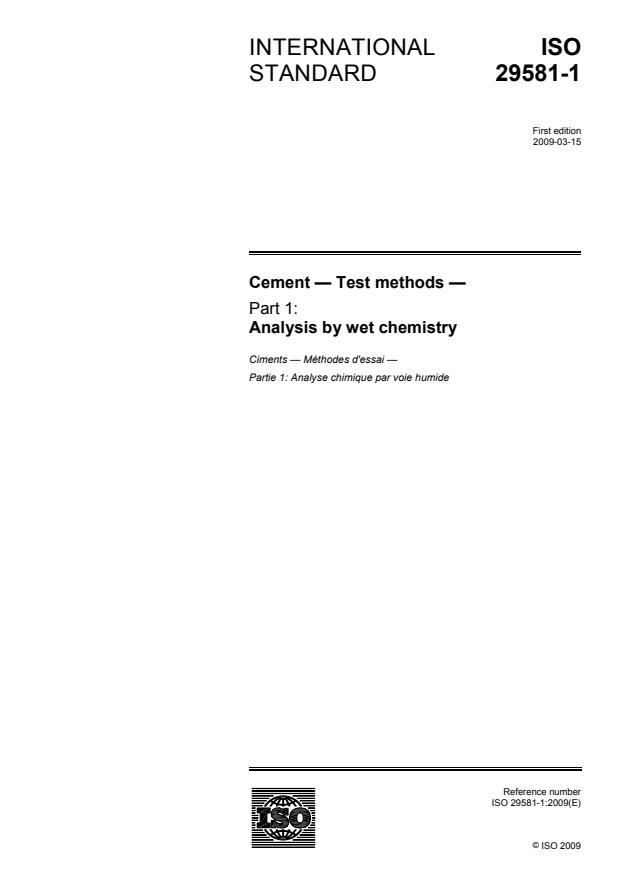
ISO 29581-1:2009 - Cement — Test methods — Part 1: Analysis by wet chemistry Released:3/4/2009
ISO 29581-1:2009 - Ciments — Méthodes d'essai — Partie 1: Analyse chimique par voie humide Released:3/4/2009
Overview
ISO 29581-1:2009 - Cement - Test methods - Part 1: Analysis by wet chemistry specifies standardized wet-chemistry procedures for the chemical analysis of cement and its constituent materials. The standard defines reference methods and, where indicated, alternative methods that may be considered equivalent. Other analytical techniques may be used only if calibrated against the reference methods or internationally accepted reference materials. In case of dispute, only the reference methods are authoritative.
Key topics and technical requirements
- Scope and applicability: Methods apply principally to cements but can be used for constituent materials or other materials that reference these procedures.
- General testing requirements: Number of tests (including provisions for series under statistical control), repeatability and reproducibility criteria, blank determinations, expression of results, ignition and constant-mass determination.
- Sample preparation, reagents and apparatus: Detailed requirements for preparing a representative test sample, specified reagents, and laboratory equipment.
- Major analytes and methods:
- Loss on ignition (LOI) and correction for sulfide oxidation (specified ignition temperature guidance).
- Sulfate determination before/after ignition when correcting for sulfide.
- Residues insoluble in HCl plus carbonate or KOH.
- Sulfide and manganese (photometry).
- Silica (SiO2): reference double evaporation method; alternative polyethylene oxide and acid decomposition methods; procedures for soluble and total silica.
- Decomposition techniques: sodium peroxide decomposition and other validated routes.
- Major oxides: determination of Fe2O3, Al2O3, CaO and MgO (reference titrations using EGTA/DCTA; EDTA alternatives).
- Chloride: reference titration and potentiometric alternative.
- Carbon dioxide (CO2): reference and alternative methods.
- Alkali (Na2Oeq): flame photometry reference method and atomic absorption alternative.
- Calibration and validation: Alternative or instrumental methods (e.g., atomic absorption, XRF) are permitted only when calibrated against the reference methods or internationally accepted reference materials. A Part 2 (XRF) is under development.
Applications and users
ISO 29581-1:2009 is used by:
- Cement manufacturing quality-control laboratories
- Third‑party testing and certification bodies
- Construction-materials laboratories and research institutions
- Regulatory and standards organizations specifying test protocols Practical uses include product conformity testing, contractual dispute resolution (using reference methods), method validation, and calibration of rapid/instrumental techniques.
Related standards
- ISO 29581-2 (under development) - Analysis by X‑ray fluorescence (XRF)
- Other cement and concrete standards that reference the chemical-analysis methods in ISO 29581-1
Keywords: ISO 29581-1:2009, cement test methods, wet chemistry, cement analysis, silica determination, loss on ignition, alkali, chloride, carbon dioxide, reference methods, laboratory calibration.
Relations
- Effective Date
- 15-Apr-2008
Buy Documents
ISO 29581-1:2009 - Cement — Test methods — Part 1: Analysis by wet chemistry Released:3/4/2009
ISO 29581-1:2009 - Ciments — Méthodes d'essai — Partie 1: Analyse chimique par voie humide Released:3/4/2009
Get Certified
Connect with accredited certification bodies for this standard

DIBt (Deutsches Institut für Bautechnik)
German Institute for Building Technology.
DIN CERTCO
DIN Group product certification.

Aboma Certification B.V.
Specialized in construction, metal, and transport sectors.
Sponsored listings
Frequently Asked Questions
ISO 29581-1:2009 is a standard published by the International Organization for Standardization (ISO). Its full title is "Cement — Test methods — Part 1: Analysis by wet chemistry". This standard covers: ISO 29581-1:2009 specifies the methods for the analysis of cement by wet chemistry. ISO 29581-1:2009 gives the reference methods and, in certain cases, an alternative method that can be considered to be equivalent. In the case of a dispute, only the reference methods are used. It is permitted to use other methods provided they are calibrated, either against the reference methods or against internationally accepted reference materials, in order to demonstrate their equivalence. In case of dispute, only the reference methods are used. ISO 29581-1:2009 describes methods that apply principally to cements, but which can also be applied to their constituent materials. They can also be applied to other materials, the standards for which call up these methods. Standard specifications state which methods are used.
ISO 29581-1:2009 specifies the methods for the analysis of cement by wet chemistry. ISO 29581-1:2009 gives the reference methods and, in certain cases, an alternative method that can be considered to be equivalent. In the case of a dispute, only the reference methods are used. It is permitted to use other methods provided they are calibrated, either against the reference methods or against internationally accepted reference materials, in order to demonstrate their equivalence. In case of dispute, only the reference methods are used. ISO 29581-1:2009 describes methods that apply principally to cements, but which can also be applied to their constituent materials. They can also be applied to other materials, the standards for which call up these methods. Standard specifications state which methods are used.
ISO 29581-1:2009 is classified under the following ICS (International Classification for Standards) categories: 91.100.10 - Cement. Gypsum. Lime. Mortar. The ICS classification helps identify the subject area and facilitates finding related standards.
ISO 29581-1:2009 has the following relationships with other standards: It is inter standard links to ISO 680:1990. Understanding these relationships helps ensure you are using the most current and applicable version of the standard.
ISO 29581-1:2009 is available in PDF format for immediate download after purchase. The document can be added to your cart and obtained through the secure checkout process. Digital delivery ensures instant access to the complete standard document.
Standards Content (Sample)
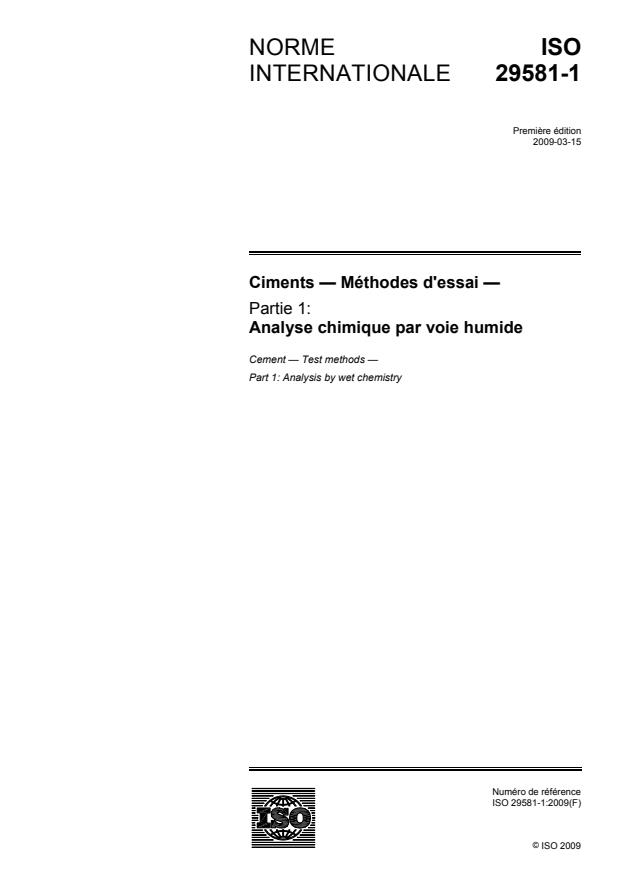
INTERNATIONAL ISO
STANDARD 29581-1
First edition
2009-03-15
Cement — Test methods —
Part 1:
Analysis by wet chemistry
Ciments — Méthodes d'essai —
Partie 1: Analyse chimique par voie humide
Reference number
©
ISO 2009
PDF disclaimer
This PDF file may contain embedded typefaces. In accordance with Adobe's licensing policy, this file may be printed or viewed but
shall not be edited unless the typefaces which are embedded are licensed to and installed on the computer performing the editing. In
downloading this file, parties accept therein the responsibility of not infringing Adobe's licensing policy. The ISO Central Secretariat
accepts no liability in this area.
Adobe is a trademark of Adobe Systems Incorporated.
Details of the software products used to create this PDF file can be found in the General Info relative to the file; the PDF-creation
parameters were optimized for printing. Every care has been taken to ensure that the file is suitable for use by ISO member bodies. In
the unlikely event that a problem relating to it is found, please inform the Central Secretariat at the address given below.
© ISO 2009
All rights reserved. Unless otherwise specified, no part of this publication may be reproduced or utilized in any form or by any means,
electronic or mechanical, including photocopying and microfilm, without permission in writing from either ISO at the address below or
ISO's member body in the country of the requester.
ISO copyright office
Case postale 56 • CH-1211 Geneva 20
Tel. + 41 22 749 01 11
Fax + 41 22 749 09 47
E-mail copyright@iso.org
Web www.iso.org
Published in Switzerland
ii © ISO 2009 – All rights reserved
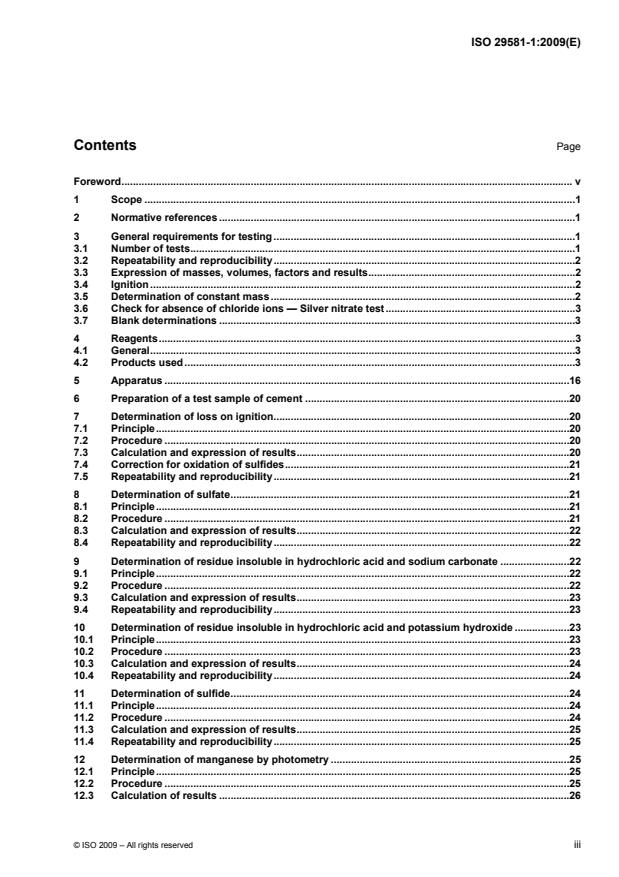
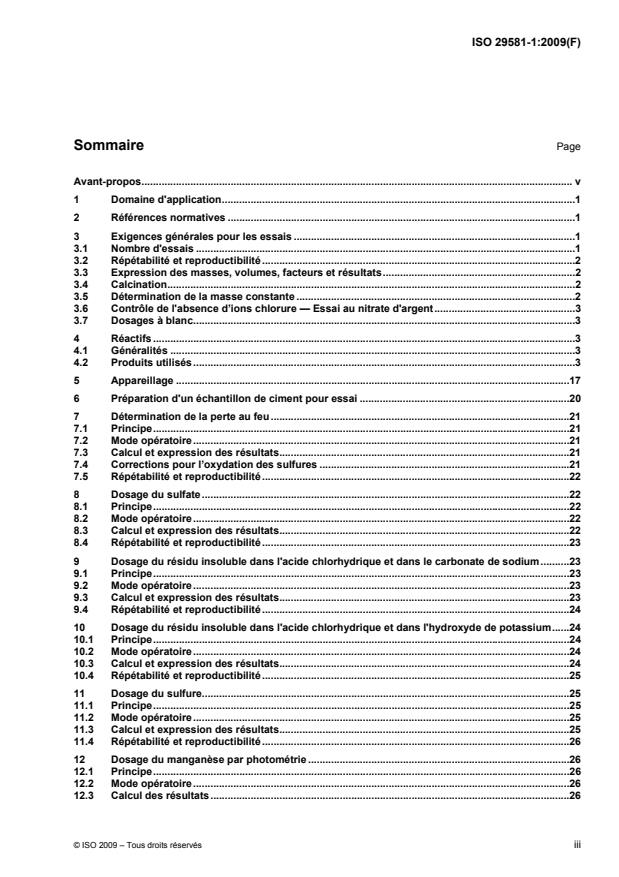
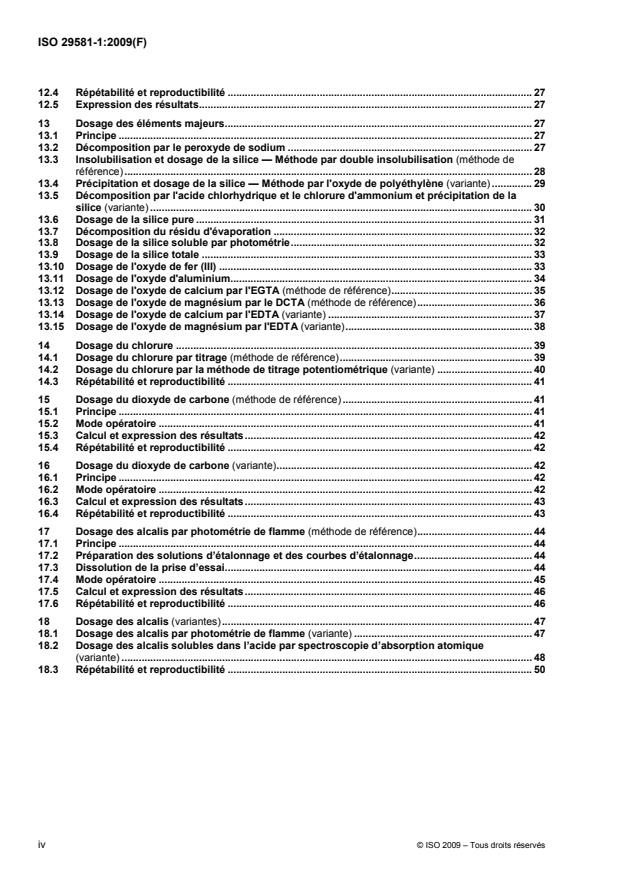
Contents Page
Foreword. v
1 Scope .1
2 Normative references .1
3 General requirements for testing.1
3.1 Number of tests.1
3.2 Repeatability and reproducibility.2
3.3 Expression of masses, volumes, factors and results.2
3.4 Ignition .2
3.5 Determination of constant mass.2
3.6 Check for absence of chloride ions — Silver nitrate test.3
3.7 Blank determinations .3
4 Reagents.3
4.1 General.3
4.2 Products used.3
5 Apparatus .16
6 Preparation of a test sample of cement .20
7 Determination of loss on ignition.20
7.1 Principle.20
7.2 Procedure .20
7.3 Calculation and expression of results.20
7.4 Correction for oxidation of sulfides.21
7.5 Repeatability and reproducibility.21
8 Determination of sulfate.21
8.1 Principle.21
8.2 Procedure .21
8.3 Calculation and expression of results.22
8.4 Repeatability and reproducibility.22
9 Determination of residue insoluble in hydrochloric acid and sodium carbonate .22
9.1 Principle.22
9.2 Procedure .22
9.3 Calculation and expression of results.23
9.4 Repeatability and reproducibility.23
10 Determination of residue insoluble in hydrochloric acid and potassium hydroxide .23
10.1 Principle.23
10.2 Procedure .23
10.3 Calculation and expression of results.24
10.4 Repeatability and reproducibility.24
11 Determination of sulfide.24
11.1 Principle.24
11.2 Procedure .24
11.3 Calculation and expression of results.25
11.4 Repeatability and reproducibility.25
12 Determination of manganese by photometry .25
12.1 Principle.25
12.2 Procedure .25
12.3 Calculation of results .26
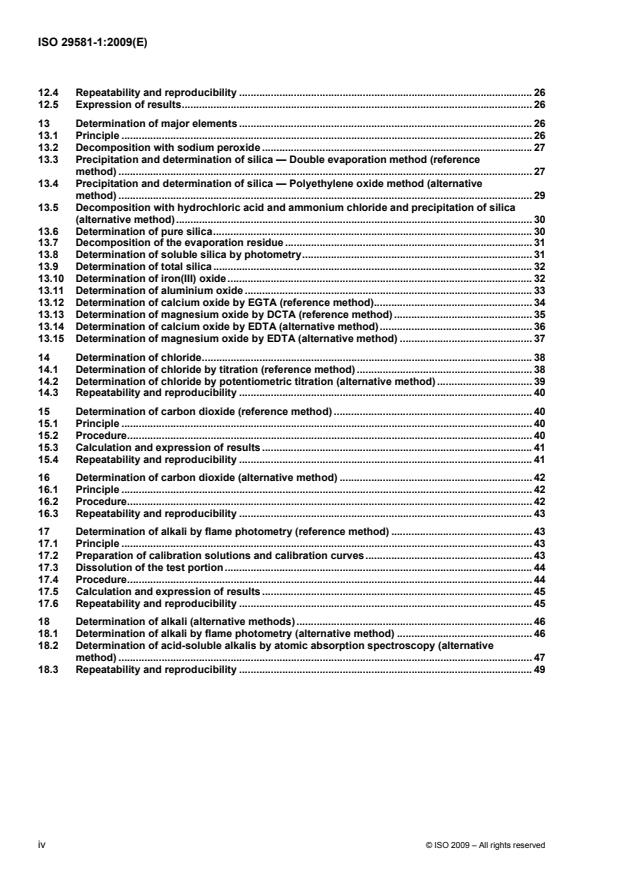
12.4 Repeatability and reproducibility . 26
12.5 Expression of results. 26
13 Determination of major elements . 26
13.1 Principle . 26
13.2 Decomposition with sodium peroxide .27
13.3 Precipitation and determination of silica — Double evaporation method (reference
method) . 27
13.4 Precipitation and determination of silica — Polyethylene oxide method (alternative
method) . 29
13.5 Decomposition with hydrochloric acid and ammonium chloride and precipitation of silica
(alternative method). 30
13.6 Determination of pure silica. 30
13.7 Decomposition of the evaporation residue . 31
13.8 Determination of soluble silica by photometry. 31
13.9 Determination of total silica. 32
13.10 Determination of iron(III) oxide. 32
13.11 Determination of aluminium oxide . 33
13.12 Determination of calcium oxide by EGTA (reference method). 34
13.13 Determination of magnesium oxide by DCTA (reference method). 35
13.14 Determination of calcium oxide by EDTA (alternative method). 36
13.15 Determination of magnesium oxide by EDTA (alternative method) . 37
14 Determination of chloride. 38
14.1 Determination of chloride by titration (reference method) . 38
14.2 Determination of chloride by potentiometric titration (alternative method) . 39
14.3 Repeatability and reproducibility . 40
15 Determination of carbon dioxide (reference method) . 40
15.1 Principle . 40
15.2 Procedure. 40
15.3 Calculation and expression of results . 41
15.4 Repeatability and reproducibility . 41
16 Determination of carbon dioxide (alternative method) . 42
16.1 Principle . 42
16.2 Procedure. 42
16.3 Repeatability and reproducibility . 43
17 Determination of alkali by flame photometry (reference method) . 43
17.1 Principle . 43
17.2 Preparation of calibration solutions and calibration curves. 43
17.3 Dissolution of the test portion. 44
17.4 Procedure. 44
17.5 Calculation and expression of results . 45
17.6 Repeatability and reproducibility . 45
18 Determination of alkali (alternative methods). 46
18.1 Determination of alkali by flame photometry (alternative method) . 46
18.2 Determination of acid-soluble alkalis by atomic absorption spectroscopy (alternative
method) . 47
18.3 Repeatability and reproducibility . 49
iv © ISO 2009 – All rights reserved
Foreword
ISO (the International Organization for Standardization) is a worldwide federation of national standards bodies
(ISO member bodies). The work of preparing International Standards is normally carried out through ISO
technical committees. Each member body interested in a subject for which a technical committee has been
established has the right to be represented on that committee. International organizations, governmental and
non-governmental, in liaison with ISO, also take part in the work. ISO collaborates closely with the
International Electrotechnical Commission (IEC) on all matters of electrotechnical standardization.
International Standards are drafted in accordance with the rules given in the ISO/IEC Directives, Part 2.
The main task of technical committees is to prepare International Standards. Draft International Standards
adopted by the technical committees are circulated to the member bodies for voting. Publication as an
International Standard requires approval by at least 75 % of the member bodies casting a vote.
Attention is drawn to the possibility that some of the elements of this document may be the subject of patent
rights. ISO shall not be held responsible for identifying any or all such patent rights.
ISO 29581-1 was prepared by Technical Committee ISO/TC 74, Cement and lime.
This first edition of ISO 29581 cancels and replaces ISO 680:1990, which has been technically revised as
follows, based on comments received by the secretariat.
a) The scope of the analyses has been extended to include determination of chloride, carbon dioxide and
alkali.
b) Calibration against internationally accepted reference materials is permitted.
c) The number of tests carried out when the analysis is part of a series subject to statistical control has been
reduced to one.
d) A requirement for blank determinations has been included.
e) Limiting ranges have been set for masses, volumes and temperatures wherever these are significant.
f) The required accuracy of the balance is consistent with that of equipment traditionally used.
g) A specification for a laboratory oven has been included.
h) The calibration procedure for the standard silica solution has been simplified.
i) Additional indicators have been included for the visual determination of EDTA titrations.
j) An ignition temperature of (950 ± 25) °C has been set for the determination of loss on ignition and the
ignition of barium sulfate and insoluble residues.
k) Determination of sulfate before and after ignition in the determination of loss on ignition becomes the
reference method when correcting for sulfide.
l) Determination of silica by the double evaporation method becomes the reference method.
m) Alternative ignition temperatures during the analysis for silica are permitted, where validated by the
laboratory.
n) An alternative method for the determination of chloride by potentiometric titration is included.
o) An alternative method for the determination of acid-soluble alkali by atomic absorption spectroscopy is
included.
p) XRF and other instrumental methods, such as differential thermal analysis for determination of carbon
dioxide, atomic absorption spectroscopy, etc. may be used as alternative methods provided they are
calibrated against the reference methods, or against internationally accepted reference materials.
NOTE Analytical methods utilizing x-ray fluorescence (XRF) were considered during this revision but no published
standardized method was considered sufficiently comprehensive to be included. A new Part 2 to ISO 29581 is under
development in order to prepare a method based on XRF.
ISO 29581 consists of the following parts, under the general title Cement — Test methods:
⎯ Part 1: Analysis by wet chemistry
⎯ Part 2: Analysis by x-ray fluorescence
vi © ISO 2009 – All rights reserved
INTERNATIONAL STANDARD ISO 29581-1:2009(E)
Cement — Test methods —
Part 1:
Analysis by wet chemistry
1 Scope
This part of ISO 29581 specifies the methods for the analysis of cement by wet chemistry.
This part of ISO 29581 gives the reference methods and, in certain cases, an alternative method that can be
considered to be equivalent. In the case of a dispute, only the reference methods are used.
It is permitted to use other methods provided they are calibrated, either against the reference methods or
against internationally accepted reference materials, in order to demonstrate their equivalence. In case of
dispute, only the reference methods are used.
This part of ISO 29581 describes methods that apply principally to cements, but which can also be applied to
their constituent materials. They can also be applied to other materials, the standards for which call up these
methods.
Standard specifications state which methods are used.
2 Normative references
The following referenced documents are indispensable for the application of this document. For dated
references, only the edition cited applies. For undated references, the latest edition of the referenced
document (including any amendments) applies.
ISO 385, Laboratory glassware — Burettes
ISO 835, Laboratory glassware — Graduated pipettes
3 General requirements for testing
3.1 Number of tests
Analysis of a cement can require the determination of a number of its chemical properties. For each
determination, one or more tests shall be carried out in which the number of measurements taken shall be as
specified in the relevant clause of this part of ISO 29581.
Where the analysis is one of a series subject to statistical control, determination of each chemical property by
a single test shall be the minimum required.
Where the analysis is not part of a series subject to statistical control, the number of tests for determination of
each chemical property shall be two (see also 3.3).
In the case of a dispute, the number of tests for determination of each chemical property shall be two (see
also 3.3).
3.2 Repeatability and reproducibility
3.2.1 General
Repeatability and reproducibility in this part of ISO 29581 are expressed as repeatability standard deviation(s)
and reproducibility standard deviation(s) in, for example, absolute percent, grams, etc., according to the
property tested.
3.2.2 Repeatability
Precision under repeatability conditions applies where independent test results are obtained with the same
method on identical test items (material) in the same laboratory by the same operator using the same
equipment within short intervals of time.
3.2.3 Reproducibility
Precision under reproducibility conditions applies where test results are obtained with the same method on
identical test items (material) in different laboratories with different operators using different equipment.
3.3 Expression of masses, volumes, factors and results
Express masses in grams to the nearest 0,000 1 g and volumes from burettes in millilitres to the nearest
0,05 ml.
Express the factors of solutions, given by the mean of three measurements, to three decimal places.
Express the results, where a single test result has been obtained, as a percentage generally to two decimal
places.
Express the results, where two test results have been obtained, as the mean of the results, as a percentage
generally to two decimal places.
If the two test results differ by more than twice the standard deviation of repeatability, repeat the test and take
the mean of the two closest test results.
The results of all individual tests shall be recorded.
3.4 Ignition
Carry out ignition as follows.
Place the filter paper and its contents into a crucible which has been previously ignited and tared. Dry it, then
incinerate slowly in an oxidizing atmosphere in order to avoid immediate flaming, while ensuring complete
combustion. Ignite the crucible and its contents at the stated temperature, then allow to cool to the laboratory
temperature in a desiccator. Weigh the crucible and its contents.
3.5 Determination of constant mass
Determine constant mass by making successive 15 min ignitions followed each time by cooling and then
weighing. Constant mass is reached when the difference between two successive weighings is less than
0,000 5 g.
2 © ISO 2009 – All rights reserved
3.6 Check for absence of chloride ions — Silver nitrate test
After generally five to six washes of a precipitate, rinse the base of the filter stem with a few drops of water.
Wash the filter paper and its contents with several millilitres of water and collect this in a test tube. Add several
drops of silver nitrate solution (4.2.43). Check the absence of turbidity or precipitate in the solution. If present,
continue washing while carrying out periodic checks until the silver nitrate test is negative.
3.7 Blank determinations
Carry out a blank determination without a sample, where relevant, following the same procedure and using the
same amounts of reagents. Correct the results obtained for the analytical determination accordingly.
4 Reagents
4.1 General
Use only reagents of analytical quality. References to water mean distilled or de-ionized water having an
electrical conductivity u 0,5 mS/m.
Unless otherwise stated, percent means percent mass fraction.
Unless otherwise stated, the concentrated liquid reagents used in this part of ISO 29581 have the following
densities, ρ, at 20 °C, expressed in grams per cubic centimetre:
hydrochloric acid 1,18 to 1,19 acetic acid 1,05 to 1,06
nitric acid 1,40 to 1,42 phosphoric acid 1,71 to 1,75
perchloric acid 1,60 to 1,67 ammonium hydroxide 0,88 to 0,91
The degree of dilution is always given as a volumetric sum, for example: dilute hydrochloric acid 1 + 2 means
that 1 volume of concentrated hydrochloric acid is mixed with 2 volumes of water.
4.2 Products used
4.2.1 Hydrochloric acid (HCl), concentrated,
4.2.2 Hydrochloric acid, dilute, 1 + 1.
4.2.3 Hydrochloric acid, dilute, 1 + 2.
4.2.4 Hydrochloric acid, dilute, 1 + 3.
4.2.5 Hydrochloric acid, dilute, 1 + 9.
4.2.6 Hydrochloric acid, dilute, 1 + 11.
4.2.7 Hydrochloric acid, dilute, 1 + 19.
4.2.8 Hydrochloric acid, dilute, 1 + 99.
4.2.9 Hydrochloric acid, dilute, pH 1,60 + 0,05.
Prepare by adjusting the pH of 2 l of water to 1,60 ± 0,05 by adding five or six drops of concentrated
hydrochloric acid (HCI) (4.2.1). Control using the pH meter (5.18.1). Store the solution in a polyethylene
container.
4.2.10 Hydrofluoric acid, (HF), concentrated, > 40 %.
4.2.11 Hydrofluoric acid, dilute, 1 + 3.
4.2.12 Nitric acid (HNO ), concentrated.
4.2.13 Nitric acid, dilute, 1 + 2.
4.2.14 Nitric acid, dilute, 1 + 100.
4.2.15 Sulfuric acid, concentrated, (> 98 %) (H SO ).
2 4
4.2.16 Sulfuric acid, dilute, 1 + 1.
4.2.17 Sulfuric acid, dilute, 1 + 4.
4.2.18 Perchloric acid (HClO ), concentrated.
4.2.19 Phosphoric acid (H PO ), concentrated.
3 4
4.2.20 Phosphoric acid, dilute, 1 + 19.
Store this solution in a polyethylene container.
4.2.21 Boric acid (H BO ).
3 3
4.2.22 Acetic acid (CH COOH), concentrated.
4.2.23 Aminoacetic acid (NH CH COOH).
2 2
4.2.24 Chromium (Cr), metallic, in powder form.
4.2.25 Ammonium hydroxide (NH OH), concentrated.
4.2.26 Ammonium hydroxide, dilute, 1 + 1.
4.2.27 Ammonium hydroxide, dilute, 1 + 10.
4.2.28 Ammonium hydroxide, dilute, 1 + 16.
4.2.29 Sodium hydroxide (NaOH).
4.2.30 Sodium hydroxide solution, 4 mol/l.
Dissolve 160 g of sodium hydroxide (NaOH) (4.2.29) in water and make up to 1 000 ml. Store in a
polyethylene container.
4.2.31 Sodium hydroxide solution, 2 mol/l.
Dissolve 80 g of sodium hydroxide (NaOH) (4.2.29) in water and make up to 1 000 ml. Store in a polyethylene
container.
4 © ISO 2009 – All rights reserved
4.2.32 Ammonium chloride (NH Cl).
4.2.33 Tin(II) chloride (SnCl⋅2H O).
4.2.34 Potassium iodate (KIO ), dried to constant mass at (120 ± 5) °C.
4.2.35 Potassium periodate (KIO ).
4.2.36 Sodium peroxide (Na O ), in powder form.
2 2
4.2.37 Sodium chloride (NaCl), dried to constant mass at (110 ± 5) °C.
4.2.38 Potassium chloride (KCl), dried to constant mass at (110 ± 5) °C.
4.2.39 Sodium carbonate (Na CO ), dried to constant mass at (250 ± 10) °C.
2 3
4.2.40 Sodium carbonate and sodium chloride, mixture.
Mix 7 g of sodium carbonate (Na CO ) (4.2.39) with 1 g sodium chloride (NaCl) (4.2.37).
2 3
4.2.41 Barium chloride solution.
Dissolve 120 g of barium chloride (BaCl⋅2H O) in water and make up to 1 000 ml.
2 2
4.2.42 Silver nitrate (AgNO ), dried to constant mass at (150 ± 5) °C.
4.2.43 Silver nitrate solution.
Dissolve 5 g of silver nitrate (AgNO ) (4.2.42) in water, add 10 ml of concentrated nitric acid (HNO ) (4.2.12)
3 3
and make up to 1 000 ml with water.
4.2.44 Silver nitrate solution, 0,05 mol/l.
Dissolve (8,494 0 ± 0,000 5) g of silver nitrate (AgNO ) (4.2.42) in water in a 1 000 ml volumetric flask and
make up to the mark. Store in a brown glass container and protect from the light.
4.2.45 Sodium carbonate solution.
Dissolve 50 g of anhydrous sodium carbonate (4.2.39) in water and make up to 1 000 ml.
4.2.46 Potassium hydroxide solution.
Dissolve 250 g of potassium hydroxide (KOH) in water and make up to 1 000 ml. Store in a polyethylene
container.
4.2.47 Ammoniacal zinc sulfate solution.
Dissolve 50 g of zinc sulfate (ZnSO⋅7H O) in 150 ml water and add 350 ml of concentrated ammonium
4 2
hydroxide (4.2.25). Leave to stand for at least 24 h and filter.
4.2.48 Lead acetate solution. Dissolve approximately 0,2 g of lead acetate [Pb(CH COO)⋅3H O] in water
3 2 2
and make up to 100 ml.
4.2.49 Starch solution.
To 1 g of starch (water soluble), add 1 g of potassium iodide (KI), dissolve in water and make up to 100 ml.
Use within two weeks.
4.2.50 Polyethylene oxide solution.
Dissolve 0,25 g of polyethylene oxide (-CH -CH -O-) of average molecular mass 200 000 to 600 000, in
2 2 n
100 ml water while stirring vigorously. Use within two weeks.
4.2.51 Boric acid solution, saturated.
Dissolve approximately 50 g of boric acid (H BO ) in water and make up to 1 000 ml.
3 3
4.2.52 Citric acid solution.
Dissolve 10 g of citric acid (C H O⋅H O) in water and make up to 100 ml.
6 8 7 2
4.2.53 Calcium carbonate (CaCO ), dried to constant mass at (200 ± 10) °C (of purity > 99,9 %).
4.2.54 Ammonium molybdate solution.
Dissolve 10 g of ammonium molybdate [(NH ) Mo O ⋅4H O] in water and make up to 100 ml. Store the
4 6 7 24 2
solution in a polyethylene flask. Use within one week.
4.2.55 Copper sulfate solution.
Dissolve 0,45 g of copper sulfate (CuSO⋅5H O) in water and make up to 50 ml in a volumetric flask.
4 2
4.2.56 Ammonium acetate solution.
Dissolve 250 g of ammonium acetate (CH COONH ) in water and make up to 1 000 ml.
3 4
4.2.57 Triethanolamine [N(CH CH OH) ], of purity > 99 %, diluted to 1 + 4 solution.
2 2 3
4.2.58 Reducing solution.
Dissolve 1 g of tin(II) chloride (SnCl⋅2H O) (4.2.33) in water to which has been added 1 ml of concentrated
2 2
hydrochloric acid (4.2.1). Make up to 100 ml with water. Use within one day.
4.2.59 Buffer solution, pH 1,40.
Dissolve (7,505 ± 0,001) g of amino-acetic acid (4.2.23) and (5,850 ± 0,001) g of sodium chloride (NaCl)
(4.2.37) in water and make up to 1 000 ml. Dilute 300 ml of this solution to 1 000 ml with hydrochloric acid
1 + 99 (4.2.8).
4.2.60 Standard potassium iodate solution, approximately 0,016 6 mol/l.
Weigh, to ± 0,000 5 g, (3,6 ± 0,1) g, of potassium iodate (KIO ) (4.2.34), record as m , and place in a 1 000 ml
3 1
volumetric flask. Add 0,2 g of sodium hydroxide (4.2.29), 25 g of potassium iodide (KI), dissolve all the solids
in freshly boiled and cooled water and make up to the mark using the same water.
Calculate the factor, F, of the potassium iodate solution from Equation (1):
m
F = (1)
35, 668
where m is the mass of the weighed portion of potassium iodate, expressed in grams.
6 © ISO 2009 – All rights reserved
4.2.61 Sodium thiosulfate solution, approximately 0,1 mol/l.
4.2.61.1 Preparation
Dissolve (24,82 ± 0,01) g of sodium thiosulfate (Na S O⋅5H O) in water and make up to 1 000 ml. Before
2 2 3 2
each test series, determine the factor, f , of this solution from Equation (2).
S
4.2.61.2 Standardization
4.2.61.2.1 This standardization is carried out preferably using the standard potassium iodate solution
(4.2.60).
For this standardization, pipette 20 ml of the standard potassium iodate solution (4.2.60) into a 500 ml conical
flask and dilute with approximately 150 ml of water. Acidify with 25 ml of hydrochloric acid 1 + 1 (4.2.2) and
titrate with the approximately 0,1 mol/l sodium thiosulfate solution (4.2.61) to a pale yellow colour. Add 2 ml of
the starch solution (4.2.49) and continue the titration until the colour changes from blue to colourless.
Calculate the factor, f , of the sodium thiosulfate solution from Equation (2):
S
20 ××0, 01667 214,01 ×F
f =
S
3, 5668×
V
(2)
F
= 20×
V
where
F is the factor of the standard potassium iodate solution (4.2.60);
V is the volume of the approximately 0,1 mol/l sodium thiosulfate solution used for the titration,
expressed in millilitres;
3,566 8 is the mass of potassium iodate corresponding to a solution with exactly 0,016 67 mol/l of
potassium iodate, expressed in grams;
214,01 is the relative molecular mass of KIO , expressed in grams.
4.2.61.2.2 The standardization may alternatively be carried out using a known quantity of potassium iodate.
For this standardization, weigh, to ± 0,000 5 g, (0,070 ± 0,005) g of potassium iodate (4.2.34), record as m ,
and place in a 500 ml conical flask. Dissolve in approximately 150 ml of water. Add about 1 g of potassium
iodide, acidify with 25 ml of hydrochloric acid 1 + 1 (4.2.2) and titrate with the approximately 0,1 mol/l sodium
thiosulfate solution (4.2.61) until a pale yellow colour is obtained. Then add 2 ml of the starch solution (4.2.49)
and titrate until the colour changes from blue to colourless.
Calculate the factor, f , of the sodium thiosulfate solution from Equation (3):
S
1000 ×
mm
f= = 280,3634× (3)
S
3,5668×
VV
where
m is the mass of potassium iodate, expressed in grams;
V is the volume of the approximately 0,1 mol/l sodium thiosulfate solution used for the titration,
expressed in millilitres;
3,566 8 is the mass of potassium iodate corresponding to a solution with exactly 0,016 67 mol/l of
potassium iodate, expressed in grams.
4.2.62 Manganese
4.2.62.1 Anhydrous manganese sulfate.
Dry hydrated manganese sulfate (MnSO⋅xH O) to constant mass at (250 ± 10) °C. The composition of the
4 2
product obtained corresponds to the formula MnSO .
4.2.62.2 Standard manganese solution.
4.2.62.2.1 Preparation
Into a 1 000 ml volumetric flask, weigh, to ± 0,000 5 g, (2,75 ± 0,05) g of anhydrous manganese sulfate,
record as m , dissolve in water and make up to the mark. Calculate the concentration, c , of
3 Mn(II)
2+
manganese(II) ions of this solution, expressed in milligrams of Mn per millilitre, from Equation (4):
m
c = (4)
Mn(II)
2,748 5
where m is the mass of anhydrous manganese sulfate, expressed in grams.
4.2.62.2.2 Construction of the calibration curve
Into each of two volumetric flasks, respectively, 500 ml (No. 1) and 1 000 ml (No. 2), pipette 20 ml of the
standard manganese solution. Make up to the mark with water. Into each of three volumetric flasks,
respectively, 200 ml (No. 3), 500 ml (No. 4) and 1 000 ml (No. 5), pipette 100 ml of the solution from flask
No. 2 and make up to the mark with water.
Take 100 ml of each solution from flasks 1 to 5 and pipette each portion into a 400 ml beaker. Add 20 ml of
concentrated nitric acid (4.2.12), 1,5 g of potassium periodate (4.2.35) and 10 ml of phosphoric acid (4.2.19),
heat to boiling and boil gently for 30 min.
Allow to cool to room temperature and transfer the contents of each beaker to a 200 ml volumetric flask and
make up to the mark with water. Measure the absorbance of the solutions using a photometer (5.10) at a
wavelength of around 525 nm, against water [use one or more cells (5.11) of appropriate sizes]. Record the
absorbance values to three decimal places.
For each cell optical length, construct a separate curve of the absorbance of these calibration solutions E1 to
E5 as a function of the corresponding manganese concentrations in milligrams of Mn per 200 ml. The
corresponding manganese concentrations are given in Table 1. They can be used as given if the content,
c , obtained in accordance with Equation (4) has the value 1,000 0. Otherwise, multiply the manganese
Mn(II)
concentrations in Table 1 by the value of c calculated from Equation (4).
Mn(II)
Table 1 — Concentrations of manganese calibration solutions
Calibration solution
E1 E2 E3 E4 E5
Concentration of manganese, expressed 4,0 2,0 1,0 0,4 0,2
in milligrams of Mn per 200 ml
4.2.63 Standard silica solution.
4.2.63.1 Silica (SiO ), of purity > 99,9 % after ignition to constant mass at (1 175 ± 25) °C.
4.2.63.2 Basic solution.
Weigh (0,200 0 ± 0,000 5) g of freshly ignited silica (4.2.63.1), in a platinum crucible already containing
(2,0 ± 0,1) g of anhydrous sodium carbonate (4.2.39).
8 © ISO 2009 – All rights reserved
Heat the mixture and fuse it at a bright-red heat for at least 15 min. After cooling to room temperature, place
the fused solid in a polyethylene beaker, dissolve it in water, then transfer the solution quantitatively to a
200 ml volumetric flask and make up to the mark with water.
Store the solution in a polyethylene container.
This solution contains 1 mg of SiO per millilitre.
4.2.63.3 Standard solution.
Pipette 5 ml of the basic solution into a 250 ml volumetric flask and make up to the mark with water. Store the
solution in a polyethylene container. This solution contains 0,02 mg silica per millilitre. Use within one week.
4.2.63.4 Compensating solutions.
Prepare the compensating solutions according to the procedure adopted in the determination of silica content
(13.3 to 13.5) by dissolving the amounts of the reagents given in Table 2 in water and making up to 500 ml.
4.2.63.5 Construction of the calibration curve
Add from a burette the volumes of the silica calibration solutions given in Table 3 into 100 ml polyethylene
beakers each containing a magnetic stirrer bar. Add 20 ml of the compensating solution by pipette and make
up to 40 ml with water from a burette. The volumes required for this are also given in Table 3. While stirring
with a magnetic stirrer, add 15 drops of hydrofluoric acid 1 + 3 (4.2.11). Stir for at least 1 min. Then pipette
15 ml of the boric acid solution (4.2.51) into the solution.
Table 2 — Composition of the compensating solutions for a volume of 500 ml
Component and unit Precipitation by double Precipitation by Decomposition by HCl
evaporation polyethylene oxide and NH Cl
(see 13.3) (see 13.4) (see13.5)
HCl, concentrated, millilitres 75 70 15
H SO 1 + 1, millilitres 1 1 —
2 4
HNO , concentrated, millilitres — — 1
Polyethylene oxide solution, millilitres — 5 -
NH Cl, grams — — 1
Na CO , grams
1,75 1,75 1,75
2 3
NaCl, grams 0,25 0,25 0,25
Na O , grams 3 3 —
2 2
Table 3 — Composition of the silica calibration solutions and their silica content
Serial No. Blank 1 2 3 4
Standard SiO solution, millilitres 0 2 5 10 20
Water, millilitres 20 18 15 10 0
Silica content, mg SiO /100 ml 0 0,04 0,10 0,20 0,40
Add, from a pipette, 5 ml of the ammonium molybdate solution (4.2.54). Adjust the pH of this solution to
1,60 ± 0,05 by adding, drop by drop, sodium hydroxide solution (4.2.30) or hydrochloric acid 1 + 2 (4.2.3)
using the pH meter (5.18.1) calibrated with a buffer solution of similar pH (e.g. 1,40; see 4.2.59). Transfer the
solution to a 100 ml volumetric flask and rinse the beaker with dilute hydrochloric acid (4.2.9). After 20 min,
add, from a pipette, 5 ml of the citric acid solution (4.2.52), stir and leave to stand for 5 min. Then add, from a
pipette, 2 ml of the reducing solution (4.2.58). Consider this as time 0.
Make up to the mark with dilute hydrochloric acid (4.2.9) and mix. At time (0 + 30) min measure the
absorbance with the photometer (5.10) using a cell (5.11) of 1 cm optical length against the blank solution
prepared in the same way, using the wavelength 815 nm. Construct a curve giving the measured absorbance
as a function of the corresponding silica contents given in Table 3.
The blank solution used in constructing the calibration curve may be used as the blank solution here. The
calibration curve enables a determination of the silica content in mg SiO /100 ml.
4.2.64 Standard calcium ion solution, approximately 0,01 mol/l.
Weigh, to ± 0,000 5 g, (1,00 ± 0,01) g of calcium carbonate (4.2.53), record as m and place it in a 400 ml
beaker with approximately 100 ml of water. Cover the beaker with a watch glass and carefully introduce
approximately 10 ml of hydrochloric acid 1 + 2 (4.2.3). Stir with a glass rod and ensure that dissolution is
complete; bring to the boil in order to expel the dissolved carbon dioxide. Cool to room temperature, transfer
to a 1 000 ml volumetric flask, washing the beaker and watch glass carefully, and make up to the mark with
water.
4.2.65 EDTA solution, approximately 0,03 mol/l.
4.2.65.1 Ethylenediaminetetra-acetic acid disodium salt dihydrate (EDTA).
4.2.65.2 Preparation
Dissolve (11,17 ± 0,01) g of EDTA in water and make up to 1 000 ml. Store in a polyethylene container.
4.2.65.3 Standardization
Pipette 50 ml of the standard calcium ion solution (4.2.64) into a beaker suitable for the measuring apparatus
(5.12). Then dilute with water to a volume suitable for the operation of the apparatus.
Using the pH meter (5.18.1), adjust the pH of this solution to 12,5 ± 0,2 with either of the sodium hydroxide
solutions (4.2.30 or 4.2.31).
Determine the end-point using one of the following two methods.
a) Photometric determination of the end-point (reference method):
Add, without weighing, about 0,1 g of murexide (4.2.69) or of mixed calcein and methylthymol blue
indicator (4.2.75). Place the beaker in the apparatus (5.12) set at 620 nm when using murexide or at
520 nm when using the mixed indicator and, while stirring continuously, titrate with the approximately
0,03 mol/l EDTA solution. In the vicinity of the indicator colour change, construct a curve giving the
absorbance values as a function of the volume of EDTA added. The volume, V , used is determined from
the intersection of the line of greatest slope near the colour change and the line of almost constant
absorbance after the colour change.
10 © ISO 2009 – All rights reserved
Calculate the factor, f , of the EDTA solution from Equation (5):
D
50 ×mm
f = = 16,652 × (5)
D
100, 09××0,03 V V
where
m is the mass of calcium carbonate taken to prepare the standard calcium ion solution (4.2.64),
expressed in grams;
V is the volume of the EDTA solution used for the titration, expressed in millilitres.
b) Visual determination of the end-point (alternative method):
Add, without weighing, about 0,1 g of either the calcon indicator (4.2.71) or the Patton and Reeders
indicator (4.2.76). Stir and titrate with the approximately 0,03 mol/l EDTA solution (4.2.65) until the colour
changes from pink to blue (calcon) or purple to blue (Patton and Reeders), volume V , and one drop in
excess does not further increase the intensity of the blue colour. Calculate the standardization factor, f ,
D
of the EDTA solution using Equation (5).
4.2.66 Copper complexonate solution.
Pipette 25 ml of the copper sulfate solution (4.2.55) into a 400 ml beaker and add from a burette an equivalent
volume, V , of the approximately 0,03 mol/l EDTA solution (4.2.65). Determine the required volume, V , of
5 5
EDTA solution as follows.
Pipette 10 ml of the copper sulfate solution (4.2.55) into a 600 ml beaker. Dilute to approximately 200 ml with
water and add 10 ml of concentrated ammonium hydroxide (4.2.25) and, without weighing, about 0,1 g of
murexide indicator (4.2.69). Titrate with the approximately 0,03 mol/l EDTA solution (4.2.65) until the colour
changes from pink to violet; record this volume as V .
Calculate the volume, V , of the approximately 0,03 mol/l EDTA solution that is necessary to add to 25 ml of
the copper sulfate solution to obtain the copper complexonate from Equation (6):
V
...
NORME ISO
INTERNATIONALE 29581-1
Première édition
2009-03-15
Ciments — Méthodes d'essai —
Partie 1:
Analyse chimique par voie humide
Cement — Test methods —
Part 1: Analysis by wet chemistry
Numéro de référence
©
ISO 2009
PDF – Exonération de responsabilité
Le présent fichier PDF peut contenir des polices de caractères intégrées. Conformément aux conditions de licence d'Adobe, ce fichier
peut être imprimé ou visualisé, mais ne doit pas être modifié à moins que l'ordinateur employé à cet effet ne bénéficie d'une licence
autorisant l'utilisation de ces polices et que celles-ci y soient installées. Lors du téléchargement de ce fichier, les parties concernées
acceptent de fait la responsabilité de ne pas enfreindre les conditions de licence d'Adobe. Le Secrétariat central de l'ISO décline toute
responsabilité en la matière.
Adobe est une marque déposée d'Adobe Systems Incorporated.
Les détails relatifs aux produits logiciels utilisés pour la création du présent fichier PDF sont disponibles dans la rubrique General Info
du fichier; les paramètres de création PDF ont été optimisés pour l'impression. Toutes les mesures ont été prises pour garantir
l'exploitation de ce fichier par les comités membres de l'ISO. Dans le cas peu probable où surviendrait un problème d'utilisation,
veuillez en informer le Secrétariat central à l'adresse donnée ci-dessous.
DOCUMENT PROTÉGÉ PAR COPYRIGHT
© ISO 2009
Droits de reproduction réservés. Sauf prescription différente, aucune partie de cette publication ne peut être reproduite ni utilisée sous
quelque forme que ce soit et par aucun procédé, électronique ou mécanique, y compris la photocopie et les microfilms, sans l'accord écrit
de l'ISO à l'adresse ci-après ou du comité membre de l'ISO dans le pays du demandeur.
ISO copyright office
Case postale 56 • CH-1211 Geneva 20
Tel. + 41 22 749 01 11
Fax + 41 22 749 09 47
E-mail copyright@iso.org
Web www.iso.org
Publié en Suisse
ii © ISO 2009 – Tous droits réservés
Sommaire Page
Avant-propos. v
1 Domaine d'application.1
2 Références normatives .1
3 Exigences générales pour les essais .1
3.1 Nombre d'essais .1
3.2 Répétabilité et reproductibilité.2
3.3 Expression des masses, volumes, facteurs et résultats.2
3.4 Calcination.2
3.5 Détermination de la masse constante .2
3.6 Contrôle de l'absence d’ions chlorure — Essai au nitrate d'argent.3
3.7 Dosages à blanc.3
4 Réactifs .3
4.1 Généralités .3
4.2 Produits utilisés.3
5 Appareillage .17
6 Préparation d'un échantillon de ciment pour essai .20
7 Détermination de la perte au feu.21
7.1 Principe.21
7.2 Mode opératoire.21
7.3 Calcul et expression des résultats.21
7.4 Corrections pour l’oxydation des sulfures .21
7.5 Répétabilité et reproductibilité.22
8 Dosage du sulfate.22
8.1 Principe.22
8.2 Mode opératoire.22
8.3 Calcul et expression des résultats.22
8.4 Répétabilité et reproductibilité.23
9 Dosage du résidu insoluble dans l'acide chlorhydrique et dans le carbonate de sodium.23
9.1 Principe.23
9.2 Mode opératoire.23
9.3 Calcul et expression des résultats.23
9.4 Répétabilité et reproductibilité.24
10 Dosage du résidu insoluble dans l'acide chlorhydrique et dans l'hydroxyde de potassium.24
10.1 Principe.24
10.2 Mode opératoire.24
10.3 Calcul et expression des résultats.24
10.4 Répétabilité et reproductibilité.25
11 Dosage du sulfure.25
11.1 Principe.25
11.2 Mode opératoire.25
11.3 Calcul et expression des résultats.25
11.4 Répétabilité et reproductibilité.26
12 Dosage du manganèse par photométrie .26
12.1 Principe.26
12.2 Mode opératoire.26
12.3 Calcul des résultats.26
12.4 Répétabilité et reproductibilité . 27
12.5 Expression des résultats. 27
13 Dosage des éléments majeurs. 27
13.1 Principe . 27
13.2 Décomposition par le peroxyde de sodium . 27
13.3 Insolubilisation et dosage de la silice — Méthode par double insolubilisation (méthode de
référence). 28
13.4 Précipitation et dosage de la silice — Méthode par l'oxyde de polyéthylène (variante) . 29
13.5 Décomposition par l'acide chlorhydrique et le chlorure d'ammonium et précipitation de la
silice (variante) . 30
13.6 Dosage de la silice pure . 31
13.7 Décomposition du résidu d'évaporation . 32
13.8 Dosage de la silice soluble par photométrie. 32
13.9 Dosage de la silice totale . 33
13.10 Dosage de l'oxyde de fer (III) . 33
13.11 Dosage de l'oxyde d'aluminium. 34
13.12 Dosage de l'oxyde de calcium par l'EGTA (méthode de référence). 35
13.13 Dosage de l'oxyde de magnésium par le DCTA (méthode de référence). 36
13.14 Dosage de l'oxyde de calcium par l'EDTA (variante) . 37
13.15 Dosage de l'oxyde de magnésium par l'EDTA (variante). 38
14 Dosage du chlorure . 39
14.1 Dosage du chlorure par titrage (méthode de référence). 39
14.2 Dosage du chlorure par la méthode de titrage potentiométrique (variante) . 40
14.3 Répétabilité et reproductibilité . 41
15 Dosage du dioxyde de carbone (méthode de référence) . 41
15.1 Principe . 41
15.2 Mode opératoire . 41
15.3 Calcul et expression des résultats. 42
15.4 Répétabilité et reproductibilité . 42
16 Dosage du dioxyde de carbone (variante). 42
16.1 Principe . 42
16.2 Mode opératoire . 42
16.3 Calcul et expression des résultats. 43
16.4 Répétabilité et reproductibilité . 43
17 Dosage des alcalis par photométrie de flamme (méthode de référence). 44
17.1 Principe . 44
17.2 Préparation des solutions d’étalonnage et des courbes d’étalonnage. 44
17.3 Dissolution de la prise d’essai. 44
17.4 Mode opératoire . 45
17.5 Calcul et expression des résultats. 46
17.6 Répétabilité et reproductibilité . 46
18 Dosage des alcalis (variantes). 47
18.1 Dosage des alcalis par photométrie de flamme (variante) . 47
18.2 Dosage des alcalis solubles dans l’acide par spectroscopie d’absorption atomique
(variante) . 48
18.3 Répétabilité et reproductibilité . 50
iv © ISO 2009 – Tous droits réservés
Avant-propos
L'ISO (Organisation internationale de normalisation) est une fédération mondiale d'organismes nationaux de
normalisation (comités membres de l'ISO). L'élaboration des Normes internationales est en général confiée
aux comités techniques de l'ISO. Chaque comité membre intéressé par une étude a le droit de faire partie du
comité technique créé à cet effet. Les organisations internationales, gouvernementales et non
gouvernementales, en liaison avec l'ISO participent également aux travaux. L'ISO collabore étroitement avec
la Commission électrotechnique internationale (CEI) en ce qui concerne la normalisation électrotechnique.
Les Normes internationales sont rédigées conformément aux règles données dans les Directives ISO/CEI,
Partie 2.
La tâche principale des comités techniques est d'élaborer les Normes internationales. Les projets de Normes
internationales adoptés par les comités techniques sont soumis aux comités membres pour vote. Leur
publication comme Normes internationales requiert l'approbation de 75 % au moins des comités membres
votants.
L'attention est appelée sur le fait que certains des éléments du présent document peuvent faire l'objet de
droits de propriété intellectuelle ou de droits analogues. L'ISO ne saurait être tenue pour responsable de ne
pas avoir identifié de tels droits de propriété et averti de leur existence.
L'ISO 29581-1 a été élaborée par le comité technique ISO/TC 74, Ciments et chaux.
Cette première édition annule et remplace l’ISO 680:1990, qui a fait l'objet d'une révision technique, fondée
sur les commentaires reçus du secrétariat.
a) Le champ des analyses a été élargi afin d’inclure le dosage du chlorure, du dioxyde de carbone et des
alcalis.
b) L’étalonnage par rapport à des matériaux de référence acceptés internationalement est autorisé.
c) Le nombre d’essais à effectuer, lorsque l’analyse fait partie d’une série soumise à un contrôle statistique,
a été réduit à un.
d) Une exigence concernant des solutions de blanc a été ajoutée.
e) Des limites de tolérance ont été fixées pour les masses, les volumes et les températures, chaque fois que
ces limites ont une importance.
f) L’exactitude requise pour la balance dépend de celle de l’équipement traditionnellement utilisé.
g) Une spécification concernant une étuve de laboratoire à été ajoutée.
h) Le mode opératoire d’étalonnage pour la solution étalon de silice a été simplifié.
i) Des indicateurs supplémentaires ont été inclus pour la détermination visuelle des titrages à l’EDTA.
j) Une température de calcination de (950 ± 25) °C a été fixée pour la détermination de la perte au feu et
pour la calcination du sulfate de baryum et des résidus insolubles.
k) Le dosage du sulfate, avant et après calcination, pour la détermination de la perte au feu devient la
méthode de référence lorsqu’on effectue une correction pour le sulfure.
l) Le dosage de la silice par la méthode de la double insolubilisation devient la méthode de référence.
m) D’autres températures de calcination pendant l’analyse du silice sont autorisées, si le laboratoire les
valide.
n) Une variante de méthode de dosage du chlorure par titrage potentiométrique est incluse.
o) Une variante de méthode de dosage des alcalis acido-solubles par spectroscopie d’absorption atomique
est incluse.
p) Les méthodes XRF et d’autres méthodes instrumentales comme l’analyse thermique différentielle pour le
dosage du dioxyde de carbone et la spectroscopie d’absorption atomique, peuvent être utilisées comme
variante, à condition qu’elles soient étalonnées par rapport à des méthodes de référence ou par rapport à
des matériaux de référence acceptés internationalement.
NOTE Des méthodes analytiques utilisant la fluorescence X (XRF) ont été étudiées au cours de cette révision, mais
aucune méthode normalisée, publiée, n’a été jugée suffisamment complète pour être incluse ici. Une nouvelle Partie 2 de
l’ISO 29581 est en cours d’élaboration pour préparer une méthode fondée sur l’analyse XRF.
L'ISO 29581 comprend les parties suivantes, présentées sous le titre général Ciments — Méthodes d'essai:
⎯ Partie 1: Analyse chimique par voie humide
⎯ Partie 2: Analyse par spectrométrie de fluorescence X
vi © ISO 2009 – Tous droits réservés
NORME INTERNATIONALE ISO 29581-1:2009(F)
Ciments — Méthodes d'essai —
Partie 1:
Analyse chimique par voie humide
1 Domaine d'application
La présente partie de l’ISO 29581 spécifie les méthodes d'analyse chimique des ciments par voie humide.
La présente partie de l’ISO 29581 donne les méthodes de référence et, dans certains cas, une variante qui
peut être considérée comme une méthode équivalente. En cas de litige, seules les méthodes de référence
doivent être utilisées.
D'autres méthodes encore peuvent être utilisées, à condition qu’elles soient étalonnées, soit par rapport à des
méthodes de référence, soit par rapport à des matériaux de référence acceptés internationalement, pour
démontrer leur équivalence. En cas de désaccord, seules les méthodes de référence peuvent être utilisées.
La présente partie de l’ISO 29581 décrit les méthodes qui s’appliquent principalement aux ciments, mais qui
peuvent être aussi appliquées à leurs matériaux constitutifs. Elles peuvent être également appliquées à
d’autres matériaux, pour lesquels les normes prescrivent ces méthodes.
Les spécifications normalisées indiquent les méthodes qui doivent être utilisées.
2 Références normatives
Les documents de référence suivants sont indispensables pour l'application du présent document. Pour les
références datées, seule l'édition citée s'applique. Pour les références non datées, la dernière édition du
document de référence (y compris les éventuels amendements) s'applique.
ISO 385, Verrerie de laboratoire — Burettes
ISO 835, Verrerie de laboratoire — Pipettes graduées
3 Exigences générales pour les essais
3.1 Nombre d'essais
L’analyse d’un ciment peut nécessiter la détermination d’un certain nombre de ses propriétés chimiques. Pour
déterminer chacune de ces propriétés, on doit réaliser un ou plusieurs essais au cours desquels on doit
effectuer le nombre de mesurages qui est spécifié dans l’article applicable de la présente partie de
l’ISO 29581.
Lorsque l’analyse fait partie d’une série soumise à un contrôle statistique, la détermination de chaque
propriété chimique par un seul essai doit constituer le minimum requis.
Lorsque l’analyse ne fait pas partie d’une série soumise à un contrôle statistique, le nombre d’essais pour la
détermination de chaque propriété chimique doit être de deux (voir également 3.3).
En cas de litige, le nombre d’essais pour la détermination de chaque propriété chimique doit être de deux (voir
également 3.3).
3.2 Répétabilité et reproductibilité
3.2.1 Généralités
Dans la présente partie de l’ISO 29581, la répétabilité et la reproductibilité sont exprimées en termes
d’écart(s)-type(s) de répétabilité et d’écart(s)-type(s) de reproductibilité, par exemple en pourcentage absolu,
en grammes, etc., selon la propriété soumise à essai.
3.2.2 Répétabilité
Fidélité dans les conditions de répétabilité où les résultats d’essais indépendants sont obtenus par la même
méthode, sur des échantillons pour essai identiques (matériau), dans le même laboratoire, par le même
opérateur, en utilisant le même équipement, à de courts intervalles de temps.
3.2.3 Reproductibilité
Fidélité dans les conditions de reproductibililité où les résultats d’essais sont obtenus par la même méthode,
sur des échantillons pour essai identiques (matériau), dans des laboratoires différents, par des opérateurs
différents, en utilisant des équipements différents.
3.3 Expression des masses, volumes, facteurs et résultats
Exprimer les masses en grammes, à 0,000 1 g près, et les volumes à la burette en millilitres, à 0,05 ml près.
Exprimer les facteurs des solutions, obtenus par la moyenne de trois mesurages, avec trois décimales.
Lorsqu’un seul résultat d’essai a été obtenu, exprimer les résultats en pourcentage, généralement avec deux
décimales.
Lorsque deux résultats d’essai ont été obtenus, exprimer les résultats comme la moyenne de ces résultats, en
pourcentage, généralement avec deux décimales.
Si l’écart entre les deux résultats est égal à plus de deux fois l'écart-type de répétabilité, refaire l’essai et
prendre la moyenne des deux résultats d’essai les plus proches.
Les résultats de tous les essais individuels doivent être consignés.
3.4 Calcination
On effectue la calcination de la manière suivante.
Placer le papier-filtre et son contenu dans un creuset préalablement calciné et taré. Sécher, puis incinérer
lentement en atmosphère oxydante, sans enflammer, tout en assurant la combustion complète. Calciner le
creuset et son contenu à la température spécifiée, puis laisser refroidir à la température du laboratoire dans
un dessiccateur. Peser le creuset et son contenu.
3.5 Détermination de la masse constante
Déterminer la masse constante en procédant à des calcinations successives de 15 min, suivies chaque fois
d’un refroidissement puis d’une pesée. La masse constante est atteinte lorsque la différence entre deux
pesées successives est inférieure à 0,000 5 g.
2 © ISO 2009 – Tous droits réservés
3.6 Contrôle de l'absence d’ions chlorure — Essai au nitrate d'argent
Après généralement cinq ou six lavages d'un précipité, rincer la base de la tige de l'entonnoir avec quelques
gouttes d'eau. Laver le papier-filtre et son contenu avec plusieurs millilitres d'eau et recueillir le filtrat dans un
tube à essais. Ajouter quelques gouttes de la solution de nitrate d'argent (4.2.43). Contrôler l'absence de
turbidité ou de précipité dans la solution. Dans le cas contraire, continuer le lavage en contrôlant
périodiquement, jusqu'à ce que le test au nitrate d'argent soit négatif.
3.7 Dosages à blanc
Effectuer un dosage à blanc, sans échantillon, lorsque cela est nécessaire, en suivant le même mode
opératoire et en utilisant les mêmes quantités de réactifs. Corriger en conséquence les résultats obtenus pour
les dosages analytiques.
4 Réactifs
4.1 Généralités
Utiliser seulement des réactifs de qualité analytique. Le terme «eau» désigne de l'eau distillée ou de l'eau
déionisée ayant une conductivité électrique u 0,5 mS/m.
Sauf indication contraire, «pourcentage» signifie pourcentage en masse.
Sauf indication contraire, les réactifs liquides concentrés utilisés dans la présente partie de l’ISO 29581 ont
les masses volumiques, ρ, suivantes à 20 °C, exprimées en grammes par centimètre cube:
acide chlorhydrique 1,18 à 1,19 acide acétique 1,05 à 1,06
acide nitrique 1,40 à 1,42 acide phosphorique 1,71 à 1,75
acide perchlorique 1,60 à 1,67 hydroxyde d'ammonium 0,88 à 0,91
Le degré de dilution est toujours donné sous forme d'une somme volumétrique, par exemple acide
chlorhydrique dilué 1 + 2 signifie qu'il faut mélanger un volume d'acide chlorhydrique concentré à deux
volumes d'eau.
4.2 Produits utilisés
4.2.1 Acide chlorhydrique (HCl) concentré.
4.2.2 Acide chlorhydrique, dilué 1 + 1.
4.2.3 Acide chlorhydrique, dilué 1 + 2.
4.2.4 Acide chlorhydrique, dilué 1 + 3.
4.2.5 Acide chlorhydrique, dilué 1 + 9.
4.2.6 Acide chlorhydrique, dilué 1 + 11.
4.2.7 Acide chlorhydrique, dilué 1 + 19.
4.2.8 Acide chlorhydrique, dilué 1 + 99.
4.2.9 Acide chlorhydrique dilué, à pH (1,60 ± 0,05).
Préparer en dosant le pH de deux litres d’eau à (1,60 ± 0,05), en ajoutant cinq ou six gouttes d'acide
chlorhydrique concentré (HCL) (4.2.1). Contrôler au moyen d'un pH-mètre (5.18.1). Conserver la solution
dans un récipient en polyéthylène.
4.2.10 Acide fluorhydrique concentré (HF), > 40 %.
4.2.11 Acide fluorhydrique, dilué 1 + 3.
4.2.12 Acide nitrique concentré (HNO ).
4.2.13 Acide nitrique, dilué 1 + 2.
4.2.14 Acide nitrique, dilué 1 + 100.
4.2.15 Acide sulfurique concentré (H SO ), > 98 %.
2 4
4.2.16 Acide sulfurique, dilué 1 + 1.
4.2.17 Acide sulfurique, dilué 1 + 4.
4.2.18 Acide perchlorique concentré (HClO ).
4.2.19 Acide phosphorique concentré (H PO ).
3 4
4.2.20 Acide phosphorique, dilué 1 + 19.
Conserver la solution dans un récipient en polyéthylène.
4.2.21 Acide borique (H BO ).
3 3
4.2.22 Acide acétique concentré (CH COOH).
4.2.23 Acide amino-acétique (NH CH COOH).
2 2
4.2.24 Chrome métallique (Cr), en poudre.
4.2.25 Hydroxyde d'ammonium concentré (NH OH).
4.2.26 Hydroxyde d'ammonium, dilué 1 + 1.
4.2.27 Hydroxyde d'ammonium, dilué 1 + 10.
4.2.28 Hydroxyde d'ammonium, dilué 1 + 16.
4.2.29 Hydroxyde de sodium (NaOH).
4.2.30 Solution d'hydroxyde de sodium, 4 mol/l.
Dissoudre 160 g d'hydroxyde de sodium (NaOH) (4.2.29) dans de l'eau et compléter à 1 000 ml. Conserver
dans un récipient en polyéthylène.
4 © ISO 2009 – Tous droits réservés
4.2.31 Solution d'hydroxyde de sodium, 2 mol/l.
Dissoudre 80 g d'hydroxyde de sodium (NaOH) (4.2.29) dans de l'eau et compléter à 1 000 ml. Conserver
dans un récipient en polyéthylène.
4.2.32 Chlorure d'ammonium (NH Cl).
4.2.33 Chlorure d'étain (II) (SnCl , 2H O).
2 2
4.2.34 Iodate de potassium (KIO ), séché à masse constante à (120 ± 5) °C.
4.2.35 Periodate de potassium (KIO ).
4.2.36 Peroxyde de sodium (Na O ), en poudre.
2 2
4.2.37 Chlorure de sodium (NaCl), séché à masse constante à (110 ± 5) °C.
4.2.38 Chlorure de potassium (KCl), séché à masse constante à (110 ± 5) °C.
4.2.39 Carbonate de sodium (Na CO ), séché à masse constante à (250 ± 5) °C.
2 3
4.2.40 Mélange de carbonate de sodium et de chlorure de sodium.
Mélanger 7 g de carbonate de sodium (Na CO ) (4.2.39) avec 1 g de chlorure de sodium (NaCl) (4.2.37).
2 3
4.2.41 Solution de chlorure de baryum.
Dissoudre 120 g de chlorure de baryum (BaCl , 2H O) dans de l'eau et compléter à 1 000 ml.
2 2
4.2.42 Nitrate d’argent (AgNO ), séché à masse constante à (150 ± 5) °C.
4.2.43 Solution de nitrate d'argent.
Dissoudre 5 g de nitrate d'argent (AgNO ) (4.2.42) dans de l'eau, ajouter 10 ml d'acide nitrique concentré
(HNO ) (4.2.12) et compléter à 1 000 ml avec de l'eau.
4.2.44 Solution de nitrate d'argent, 0,05 mol/l.
Dissoudre (8,494 0 ± 0,000 5) g de nitrate d’argent (AgNO ) (4.2.42) dans de l’eau dans un ballon jaugé de
1 000 ml et porter à la marque. Conserver dans un récipient en verre brun et protéger de la lumière.
4.2.45 Solution de carbonate de sodium.
Dissoudre 50 g de carbonate de sodium anhydre (4.2.39) dans de l'eau et compléter à 1 000 ml.
4.2.46 Solution d'hydroxyde de potassium.
Dissoudre 250 g d'hydroxyde de potassium (KOH) dans de l'eau et compléter à 1 000 ml. Conserver dans un
récipient en polyéthylène.
4.2.47 Solution ammoniacale de sulfate de zinc.
Dissoudre 50 g de sulfate de zinc (ZnSO , 7H O) dans 150 ml d'eau et ajouter 350 ml d'hydroxyde
4 2
d'ammonium concentré (4.2.25). Laisser reposer pendant au moins 24 h et filtrer.
4.2.48 Solution d'acétate de plomb.
Dissoudre environ 0,2 g d'acétate de plomb [Pb(CH COO) , 3H O] dans de l'eau et compléter à 100 ml.
3 2 2
4.2.49 Solution d'empois d'amidon.
À 1 g d'empois d'amidon (soluble dans l'eau), ajouter 1 g d'iodure de potassium (KI), dissoudre dans de l'eau
et compléter à 100 ml. Utiliser dans les deux semaines.
4.2.50 Solution d'oxyde de polyéthylène.
Dissoudre 0,25 g d'oxyde de polyéthylène (-CH -CH -O-) de masse moléculaire moyenne comprise entre
2 2 n
200 000 et 600 000, dans 100 ml d'eau en agitant vigoureusement. Utiliser dans les deux semaines.
4.2.51 Solution d'acide borique saturée.
Dissoudre environ 50 g d'acide borique (H BO ) dans de l'eau et compléter à 1 000 ml.
3 3
4.2.52 Solution d'acide citrique.
Dissoudre 10 g d'acide citrique (C H O , H O) dans de l'eau et compléter à 100 ml.
6 8 7 2
4.2.53 Carbonate de calcium (CaCO ), séché à masse constante à (200 ± 10) °C, d’une pureté > 99,9 %.
4.2.54 Solution de molybdate d'ammonium.
Dissoudre 10 g de molybdate d'ammonium [(NH ) Mo O , 4H O] dans de l'eau et compléter à 100 ml.
4 6 7 24 2
Conserver la solution dans un flacon en polyéthylène. Utiliser dans la semaine.
4.2.55 Solution de sulfate de cuivre.
Dissoudre 0,45 g de sulfate de cuivre (CuSO , 5H O) dans de l'eau et compléter à 50 ml dans un ballon
4 2
jaugé.
4.2.56 Solution d'acétate d'ammonium.
Dissoudre 250 g d'acétate d'ammonium (CH COONH ) dans de l'eau et compléter à 1 000 ml.
3 4
4.2.57 Triéthanolamine [N(CH CH OH) ], d’un pureté > 99 %, dilué en une solution 1 + 4.
2 2 3
4.2.58 Solution réductrice.
Dissoudre 1 g de chlorure stanneux (SnCl , 2H O) (4.2.33) dans de l’eau, à laquelle on a ajouté 1 ml d’acide
2 2
chlorhydrique concentré (4.2.1). Compléter à 100 ml avec de l’eau. Utiliser dans la journée.
4.2.59 Solution tampon, à pH 1,40.
Dissoudre (7,505 ± 0,001) g d'acide amino-acétique (4.2.23) et (5,850 ± 0,001) g de chlorure de sodium
(NaCl) (4.2.37) dans de l'eau et porter à 1 000 ml. Diluer 300 ml de cette solution jusqu’à 1 000 ml avec de
l'acide chlorhydrique 1 + 99 (4.2.8).
4.2.60 Solution étalon d'iodate de potassium, renfermant environ 0,016 6 mol/l.
Peser, à ± 0,000 5 g, une masse, m , de (3,6 ± 0,1) g d'iodate de potassium (KIO ) (4.2.34) et l’introduire dans
1 3
un ballon jaugé de 1 000 ml. Ajouter 0,2 g d'hydroxyde de sodium (4.2.29), 25 g d'iodate de potassium (KI),
dissoudre tous les solides dans de l’eau fraîchement bouillie et refroidie et compléter à la marque avec la
même eau.
6 © ISO 2009 – Tous droits réservés
Calculer le facteur, F, de la solution d'iodate de potassium par l’Équation (1):
m
F = (1)
35, 668
où m est la masse de la prise d'iodate de potassium, en grammes.
4.2.61 Solution de thiosulfate de sodium, à environ 0,1 mol/l.
4.2.61.1 Préparation
Dissoudre (24,82 ± 0,01) g de thiosulfate de sodium (Na S O , 5H O) dans de l'eau et compléter à 1 000 ml.
2 2 3 2
Avant chaque série d'essais, déterminer le facteur, f , de cette solution suivant l’Équation (2).
S
4.2.61.2 Étalonnage
4.2.61.2.1 Cet étalonnage est effectué de préférence en utilisant la solution étalon d'iodate de potassium
(4.2.60).
Pour réaliser cet étalonnage, introduire, au moyen d'une pipette, 20 ml de la solution étalon d'iodate de
potassium (4.2.60) dans une fiole conique de 500 ml et diluer avec environ 150 ml d'eau. Acidifier avec 25 ml
d'acide chlorhydrique 1 + 1 (4.2.2) et titrer avec la solution de thiosulfate de sodium à environ 0,1 mol/l
(4.2.61), jusqu'à une coloration jaune pâle. Ajouter 2 ml de la solution d'empois d'amidon (4.2.49) et continuer
le titrage jusqu'au virage du bleu à l'incolore.
Calculer le facteur, f , de la solution de thiosulfate de sodium par l’Équation (2):
S
20 ××0, 01667 214,01 ×F
f =
S
3, 5668×
V
(2)
F
= 20×
V
où
F est le facteur de la solution étalon d'iodate de potassium (4.2.60);
V est le volume de solution de thiosulfate de sodium à environ 0,1 mol/l, utilisé pour le titrage, en
millilitres;
3,566 8 est la masse d'iodate de potassium correspondant à une solution contenant exactement
0,016 67 mol/l d'iodate de potassium, en grammes;
214,01 est la masse moléculaire de KIO en grammes.
4.2.61.2.2 Comme variante, l'étalonnage peut être effectué en utilisant une quantité connue d'iodate de
potassium.
Pour réaliser cet étalonnage, peser à ± 0,000 5 g, une masse, m , de (0,070 ± 0,005) g, d’iodate de potassium
(4.2.34) et l’introduire dans une fiole conique de 500 ml. Dissoudre dans environ 150 ml d’eau. Ajouter environ
1 g d'iodure de potassium, acidifier avec 25 ml d'acide chlorhydrique 1 + 1 (4.2.2) et titrer avec la solution de
thiosulfate de sodium à environ 0,1 mol/l (4.2.61) jusqu'à une coloration jaune pâle. Ajouter ensuite 2 ml de la
solution d'empois d'amidon (4.2.49) et titrer jusqu'au virage du bleu à l'incolore.
Calculer le facteur, f , de la solution de thiosulfate de sodium par l’Équation (3):
S
1000 ×
mm
f= = 280,3634× (3)
S
3,5668×
VV
où
m est la masse d'iodate de potassium, en grammes;
V est le volume de solution de thiosulfate de sodium à environ 0,1 mol/l, utilisé pour le titrage, en
millilitres;
3,566 8 est la masse d'iodate de potassium correspondant à une solution contenant exactement
0,016 67 mol/l d'iodate de potassium, en grammes.
4.2.62 Manganèse
4.2.62.1 Sulfate de manganèse anhydre.
Sécher du sulfate de manganèse hydraté (MnSO , xH O) à masse constante à une température de
4 2
(250 ± 10) °C. La composition du produit obtenu correspond à la formule de MnSO .
4.2.62.2 Solution étalon de manganèse.
4.2.62.2.1 Préparation
Peser, à ± 0,000 5 g, une masse, m , de (2,75 ± 0,05) g de sulfate de manganèse anhydre et l’introduire dans
un ballon jaugé de 1 000 ml. Dissoudre dans de l'eau et compléter à la marque. Calculer la concentration,
2+
c , de ions manganèse (II) de cette solution, exprimée en milligrammes de Mn par millilitre, par
Mn(II)
l’Équation (4):
m
c = (4)
Mn(II)
2,748 5
où m est la masse de sulfate de manganèse anhydre, en grammes.
4.2.62.2.2 Établissement de la courbe d'étalonnage
Dans deux fioles jaugées, respectivement de 500 ml (n° 1) et 1 000 ml (n° 2), introduire, au moyen d’une
pipette, 20 ml de la solution étalon d'ions manganèse. Compléter à la marque avec de l'eau. Dans trois fioles
jaugées, respectivement de 200 ml (n° 3), 500 ml (n° 4) et 1 000 ml (n° 5), introduire, au moyen d’une pipette,
100 ml de la solution de la fiole jaugée n° 2 et compléter à la marque avec de l'eau.
Au moyen d’une pipette, prélever 100 ml de chaque solution dans les fioles jaugées n° 1 à n° 5 et introduire
chaque prise dans un bécher de 400 ml. Ajouter 20 ml d'acide nitrique concentré (4.2.12), 1,5 g de periodate
de potassium (4.2.35) et 10 ml d'acide phosphorique (4.2.19), porter à ébullition et laisser bouillir doucement
pendant 30 min.
Laisser refroidir à température ambiante, transvaser le contenu de chaque bécher dans une fiole jaugée de
200 ml et compléter à la marque avec de l'eau. Mesurer la densité optique des solutions au photomètre
(5.10), à une longueur d'onde d'environ 525 nm, par rapport à l'eau [utiliser une ou plusieurs cuves (5.11) de
dimensions appropriées]. Enregistrer les valeurs de la densité optique avec trois décimales.
Pour chaque longueur optique de cuve, tracer une courbe séparée des densités optiques des solutions
d’étalonnage E1 à E5 en fonction des concentrations de manganèse correspondantes, en milligrammes de
Mn par 200 ml. Les concentrations de manganèse correspondantes sont données dans le Tableau 1. Elles
peuvent être utilisées telles quelles si la concentration, c , obtenue suivant l’Équation (4), prend la valeur
Mn(II)
1,000 0. Autrement, multiplier les concentrations de manganèse du Tableau 1 par la valeur de c calculée
Mn(II)
par l’Équation (4).
8 © ISO 2009 – Tous droits réservés
Tableau 1 — Concentration des solutions d’étalonnage de manganèse
Solution d’étalonnage
E1 E2 E3 E4 E5
Concentration de manganèse, par
4,0 2,0 1,0 0,4 0,2
200 ml
4.2.63 Solution étalon de silice.
4.2.63.1 Silice (SiO ), d’une pureté > 99,9 % après calcination à masse constante à une température de
(1 175 ± 25) °C.
4.2.63.2 Solution de base.
Peser (0,200 0 ± 0,000 5) g de silice fraîchement calcinée (4.2.63.1) et l’introduire dans un creuset en platine
contenant déjà (2,0 ± 0,1) g de carbonate de sodium anhydre (4.2.39).
Chauffer le mélange et faire fondre au rouge vif pendant au moins 15 min. Après refroidissement à
température ambiante, placer le solide fondu dans un bécher en polyéthylène et le dissoudre dans de l’eau,
puis transvaser la solution quantitativement dans un ballon jaugé de 200 ml et compléter à la marque avec de
l'eau.
Conserver la solution dans un récipient en polyéthylène.
Cette solution contient 1 mg de SiO par millilitre.
4.2.63.3 Solution étalon.
À l’aide d’une pipette, introduire 5 ml de la solution de base dans un ballon jaugé de 250 ml et compléter à la
marque avec de l'eau. Conserver la solution dans un récipient en polyéthylène. Cette solution contient
0,02 mg de silice par millilitre. Utiliser dans la semaine.
4.2.63.4 Solution de compensation.
Préparer la solution de compensation suivant le mode opératoire adopté pour la détermination de la teneur en
silice (de 13.3 à 13.5), en dissolvant les quantités de réactifs indiquées dans le Tableau 2 dans de l'eau et en
complétant à 500 ml.
4.2.63.5 Établissement de la courbe d'étalonnage.
Dans des béchers en polyéthylène de 100 ml, contenant chacun un barreau magnétique, introduire, au moyen
d'une burette, les volumes de solution d'étalonnage de silice indiqués dans le Tableau 3. Ajouter 20 ml de la
solution de compensation, au moyen d’une pipette, et porter à 40 ml avec de l'eau versée d’une burette. Les
volumes nécessaires ici sont également donnés dans le Tableau 3. Tout en agitant avec le barreau
magnétique, ajouter 15 gouttes d'acide fluorhydrique 1 + 3 (4.2.11). Agiter pendant au moins 1 min. Introduire
ensuite, au moyen d'une pipette, 15 ml de la solution d'acide borique (4.2.51) dans la solution.
Tableau 2 — Composition de la solution de compensation pour un volume de 500 ml
Composant et unité Double insolubilisation Insolubilisation par Décomposition par
l'oxyde de polyéthylène HCl et NH Cl
(voir 13.3) (voir 13.4)
(voir 13.5)
HCl concentré, en millitres 75 70 15
H SO , dilué à 1 + 1, en millilitres
1 1 —
2 4
HNO concentré, en millilitres
— — 1
Solution d'oxyde de polyéthylène, en —
5 —
millilitres
NH Cl, en grammes
— — 1
Na CO , en grammes
1,75 1,75 1,75
2 3
NaCl, grammes 0,25 0,25 0,25
Na O , grammes
3 3 —
2 2
Tableau 3 — Composition des solutions d'étalonnage de silice et leur teneur en silice
Numéro d'ordre Blanc 1 2 3 4
Solution étalon SiO , en millilitres 0 2 5 10 20
Eau, en millilitres 20 18 15 10 0
Teneur en silice, mg SiO /100 ml 0 0,04 0,10 0,20 0,40
Au moyen d'une pipette, ajouter 5 ml de la solution de molybdate d'ammonium (4.2.54). À l’aide du pH-mètre
(5.18.1) étalonné avec une solution tampon de même pH (par exemple 1,40, voir 4.2.59), ajuster le pH de
cette solution à 1,60 ± 0,05 en ajoutant, goutte à goutte, de la solution d'hydroxyde de sodium (4.2.30) ou de
l'acide chlorhydrique 1 + 2 (4.2.3). Transvaser la solution dans un ballon jaugé de 100 ml et rincer le bécher
avec de l’acide chlorhydrique dilué (4.2.9). Après 20 min, ajouter, au moyen d'une pipette, 5 ml de la solution
d'acide citrique (4.2.52), agiter et laisser reposer pendant 5 min. Introduire ensuite, au moyen d'une pipette,
2 ml de la solution réductrice (4.2.58). Prendre ce temps comme le temps 0.
Compléter à la marque avec de l'acide chlorhydrique dilué (4.2.9) et homogénéiser. Au temps (0 + 30) min,
mesurer la densité optique au photomètre (5.10), avec une cuve (5.11) d’une longueur optique de 1 cm, par
rapport à la solution de blanc préparée de manière identique, et en utilisant la longueur d'onde d'extinction de
815 nm. Tracer la courbe donnant les densités optiques mesurées en fonction des teneurs en silice
correspondantes indiquées dans le Tableau 3.
La solution de blanc utilisée ici peut être celle qui a servi pour tracer la courbe d'étalonnage. La courbe
d'étalonnage permet de déterminer la teneur en silice en mg de SiO /100 ml.
4.2.64 Solution étalon d'ions calcium, à environ 0,01 mol/l.
Peser, à ± 0,000 5 g, une masse, m , de (1,00 ± 0,01) g de carbonate de calcium (4.2.53) et l’introduire dans
un bécher de 400 ml, avec 100 ml environ d'eau. Couvrir le bécher d'un verre de montre et introduire avec
précaution 10 ml environ d'acide chlorhydrique 1 + 2 (4.2.3). Agiter avec un agitateur en verre et vérifier que
la dissolution est complète. Porter à ébullition pour chasser le dioxyde de carbone dissous. Laisser refroidir à
température ambiante, transvaser dans un ballon jaugé de 1 000 ml, laver soigneusement le bécher et le
verre de montre, et compléter à la marque avec de l’eau.
10 © ISO 2009 – Tous droits réservés
4.2.65 Solution d’EDTA, à environ 0,03 mol/l.
4.2.65.1 Sel disodique dihydraté de l'acide éthylène diamine tétracétique (EDTA).
4.2.65.2 Préparation
Dissoudre (11,17 ± 0,01) g d'EDTA dans de l'eau et
...