

ISO 23161:2018
(Main)Soil quality — Determination of selected organotin compounds — Gas-chromatographic method
General Information
- Abstract
This document specifies a gas-chromatographic method for the identification and quantification of organotin compounds (OTCs) in soils as specified in Table 1. This document is also applicable to samples from sediments, sludges and wastes (soil-like materials). The working range depends on the detection technique used and the amount of sample taken for analysis. The limit of quantification for each compound is about 10 µg/kg.
- Status
- Published
- Publication Date
- 08-Oct-2018
- Technical Committee
- ISO/TC 190/SC 3 - Chemical and physical characterization
- Drafting Committee
- ISO/TC 190/SC 3/WG 6 - Organic analysis
- Current Stage
- 9092 - International Standard to be revised
- Start Date
- 22-Aug-2025
- Completion Date
- 29-Aug-2026
Buy Documents

ISO 23161:2018 - Soil quality -- Determination of selected organotin compounds -- Gas-chromatographic method
ISO 23161:2018 - Soil quality — Determination of selected organotin compounds — Gas-chromatographic method/9/2018

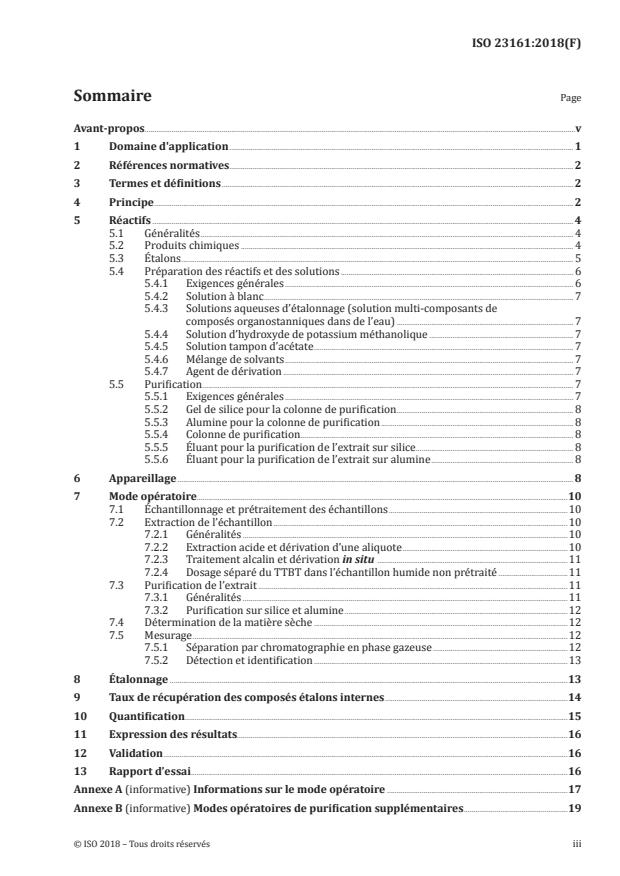
ISO 23161:2018 - Qualité du sol -- Dosage d'une sélection de composés organostanniques -- Méthode par chromatographie en phase gazeuse
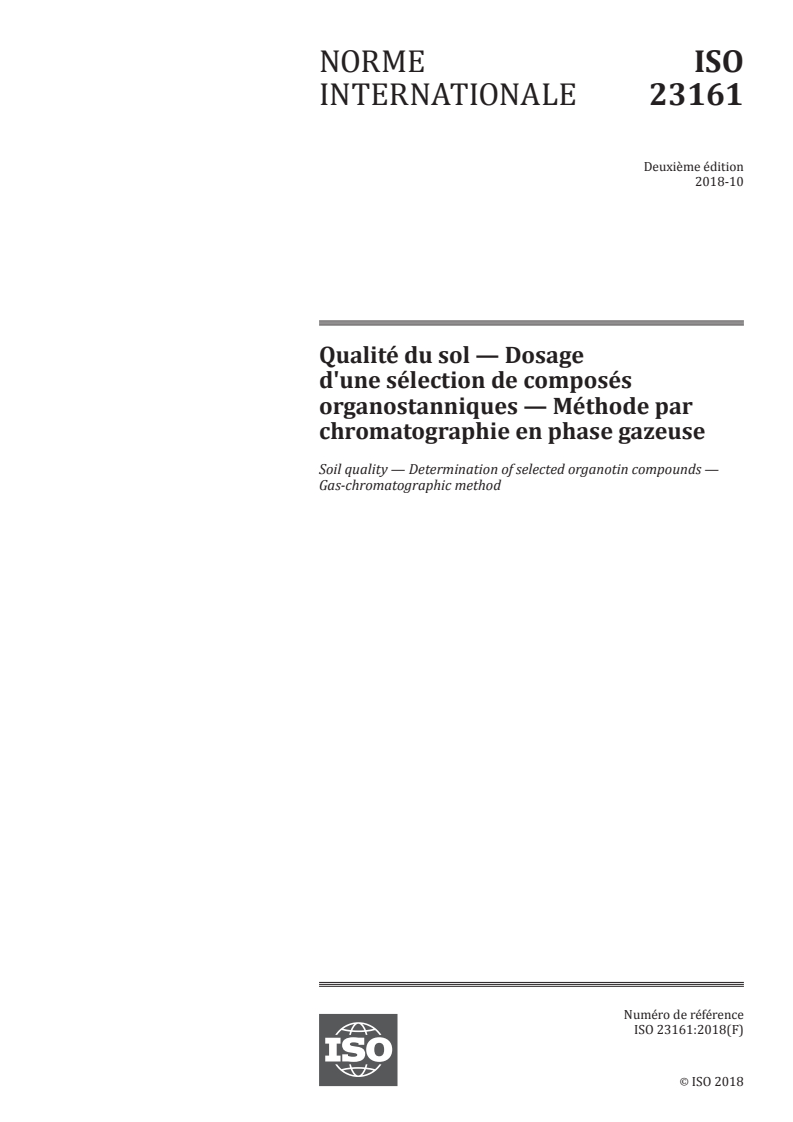
ISO 23161:2018 - Qualité du sol — Dosage d'une sélection de composés organostanniques — Méthode par chromatographie en phase gazeuse/9/2018
Overview
ISO 23161:2018 - "Soil quality - Determination of selected organotin compounds - Gas‑chromatographic method" - defines a validated gas‑chromatographic procedure for identifying and quantifying selected organotin compounds (OTCs) in soils. The standard is also applicable to sediments, sludges and wastes (soil‑like materials). It covers sample pretreatment, extraction, in‑situ derivatization, clean‑up, chromatographic separation and detection. The typical limit of quantification (LOQ) for each compound is about 10 µg/kg, while the working range depends on the detection technique and sample mass.
Key topics and technical requirements
- Target analytes: mono‑, di‑ and tri‑substituted organotin cations and selected peralkylated compounds - e.g. MBT (monobutyltin), DBT (dibutyltin), TBT (tributyltin), MOT, DOT, TPhT, TCyT and TTBT (tetrabutyltin).
- Sample pretreatment:
- Freeze‑drying and grinding recommended for organotin cations to achieve homogeneity.
- TTBT (peralkylated) must be determined on field‑moist samples to avoid evaporation losses.
- Other validated pretreatment methods may be used if suitability is demonstrated.
- Extraction / derivatization:
- Two alternative extraction approaches, both followed by in‑situ derivatization with a tetraethylborate reagent and simultaneous extraction into hexane:
- Acidic treatment (acetic acid).
- Alkaline treatment (methanolic KOH) - recommended for matrices with high organic/biological content.
- Organotin cations are determined after derivatization (converted to neutral derivatives); peralkylated TTBT is measured directly.
- Two alternative extraction approaches, both followed by in‑situ derivatization with a tetraethylborate reagent and simultaneous extraction into hexane:
- Clean‑up and analysis:
- Silica gel and aluminium oxide clean‑up options are provided.
- Gas‑chromatographic separation and detection (including GC‑MS identification guidance) are specified; instrumental conditions and validation data are included in informative annexes.
- Quality control:
- Calibration, internal standards, recovery checks and expression of results are defined.
- Tests must be performed by qualified personnel using appropriate laboratory safety practices.
Practical applications and users
- Environmental testing laboratories conducting routine or investigative analyses for organotin contamination in soils, sediments and wastes.
- Remediation consultants and contaminated‑land specialists assessing historic TBT/organotin pollution from antifouling paints, industrial discharges or landfill leachate.
- Regulatory agencies setting compliance monitoring, risk assessment and site‑characterization programs.
- Research laboratories studying organotin fate, transport and ecotoxicology in soils and sediments.
Related standards
- ISO 22892 - Guidelines for identification of target compounds by GC and MS (referenced for GC‑MS identification).
- ISO 3696 - Water for analytical laboratory use.
- ISO 11465 - Determination of dry matter and water content.
- ISO 16720 - Pretreatment by freeze‑drying for subsequent analysis.
Keywords: ISO 23161, organotin compounds, soil quality, gas chromatography, GC‑MS, TBT, TTBT, derivatization, sample pretreatment, limit of quantification.
Relations
- Effective Date
- 12-Feb-2026
- Effective Date
- 17-Jun-2017
Buy Documents
ISO 23161:2018 - Soil quality -- Determination of selected organotin compounds -- Gas-chromatographic method
ISO 23161:2018 - Soil quality — Determination of selected organotin compounds — Gas-chromatographic method/9/2018
ISO 23161:2018 - Qualité du sol -- Dosage d'une sélection de composés organostanniques -- Méthode par chromatographie en phase gazeuse
ISO 23161:2018 - Qualité du sol — Dosage d'une sélection de composés organostanniques — Méthode par chromatographie en phase gazeuse/9/2018
Get Certified
Connect with accredited certification bodies for this standard

CIS Institut d.o.o.
Personal Protective Equipment (PPE) certification body. Notified Body NB-2890 for EU Regulation 2016/425 PPE.

Kiwa BDA Testing
Building and construction product certification.
Kmetijski inštitut Slovenije
Agricultural Institute of Slovenia. Soil testing, plant health, agricultural product analysis.
Sponsored listings
Frequently Asked Questions
ISO 23161:2018 is a standard published by the International Organization for Standardization (ISO). Its full title is "Soil quality — Determination of selected organotin compounds — Gas-chromatographic method". This standard covers: This document specifies a gas-chromatographic method for the identification and quantification of organotin compounds (OTCs) in soils as specified in Table 1. This document is also applicable to samples from sediments, sludges and wastes (soil-like materials). The working range depends on the detection technique used and the amount of sample taken for analysis. The limit of quantification for each compound is about 10 µg/kg.
This document specifies a gas-chromatographic method for the identification and quantification of organotin compounds (OTCs) in soils as specified in Table 1. This document is also applicable to samples from sediments, sludges and wastes (soil-like materials). The working range depends on the detection technique used and the amount of sample taken for analysis. The limit of quantification for each compound is about 10 µg/kg.
ISO 23161:2018 is classified under the following ICS (International Classification for Standards) categories: 13.080.10 - Chemical characteristics of soils. The ICS classification helps identify the subject area and facilitates finding related standards.
ISO 23161:2018 has the following relationships with other standards: It is inter standard links to EN ISO 23161:2018, ISO 23161:2009. Understanding these relationships helps ensure you are using the most current and applicable version of the standard.
ISO 23161:2018 is available in PDF format for immediate download after purchase. The document can be added to your cart and obtained through the secure checkout process. Digital delivery ensures instant access to the complete standard document.
Standards Content (Sample)
INTERNATIONAL ISO
STANDARD 23161
Second edition
2018-10
Soil quality — Determination of
selected organotin compounds — Gas-
chromatographic method
Qualité du sol — Dosage d'une sélection de composés
organostanniques — Méthode par chromatographie en phase gazeuse
Reference number
©
ISO 2018
© ISO 2018
All rights reserved. Unless otherwise specified, or required in the context of its implementation, no part of this publication may
be reproduced or utilized otherwise in any form or by any means, electronic or mechanical, including photocopying, or posting
on the internet or an intranet, without prior written permission. Permission can be requested from either ISO at the address
below or ISO’s member body in the country of the requester.
ISO copyright office
CP 401 • Ch. de Blandonnet 8
CH-1214 Vernier, Geneva
Phone: +41 22 749 01 11
Fax: +41 22 749 09 47
Email: copyright@iso.org
Website: www.iso.org
Published in Switzerland
ii © ISO 2018 – All rights reserved
Contents Page
Foreword .v
1 Scope . 1
2 Normative references . 2
3 Terms and definitions . 2
4 Principle . 2
5 Reagents . 4
5.1 General . 4
5.2 Chemicals . 4
5.3 Standards . 5
5.4 Preparation of reagents and solutions . 6
5.4.1 General requirements . 6
5.4.2 Blank solution . 6
5.4.3 Aqueous calibration solutions (multicomponent solution of organotin
compounds in water) . 6
5.4.4 Methanolic potassium hydroxide solution . 7
5.4.5 Acetate buffer solution . 7
5.4.6 Solvent mixture . 7
5.4.7 Derivatization agent . 7
5.5 Clean-up . 7
5.5.1 General requirements . 7
5.5.2 Silica gel for the clean-up column . 7
5.5.3 Aluminium oxide for the clean-up column . 7
5.5.4 Clean-up column . 7
5.5.5 Eluent for extract cleaning with silica gel . 8
5.5.6 Eluent for extract cleaning with aluminium oxide . 8
6 Apparatus . 8
7 Procedure. 9
7.1 Sampling and sample pretreatment . 9
7.2 Sample extraction . 9
7.2.1 General. 9
7.2.2 Acidic extraction and derivatization of an aliquot .10
7.2.3 Alkaline treatment and in situ derivatization .10
7.2.4 Separate determination of TTBT in the field-moist sample .10
7.3 Clean-up of the extract .11
7.3.1 General.11
7.3.2 Silica and aluminium oxide clean-up.11
7.4 Determination of dry mass .11
7.5 Measurement .11
7.5.1 Gas chromatographic separation .11
7.5.2 Detection and identification .12
8 Calibration .12
9 Recovery rates of the internal standard compounds .13
10 Quantification .14
11 Expression of results .14
12 Validation .15
13 Test report .15
Annex A (informative) Information about the procedure .16
Annex B (informative) Additional clean-up procedures .18
Annex C (informative) Information about typical instrumental conditions .20
Annex D (informative) Information about GC-MS identification.31
Annex E (informative) Performance data .33
Bibliography .36
iv © ISO 2018 – All rights reserved
Foreword
ISO (the International Organization for Standardization) is a worldwide federation of national standards
bodies (ISO member bodies). The work of preparing International Standards is normally carried out
through ISO technical committees. Each member body interested in a subject for which a technical
committee has been established has the right to be represented on that committee. International
organizations, governmental and non-governmental, in liaison with ISO, also take part in the work.
ISO collaborates closely with the International Electrotechnical Commission (IEC) on all matters of
electrotechnical standardization.
The procedures used to develop this document and those intended for its further maintenance are
described in the ISO/IEC Directives, Part 1. In particular the different approval criteria needed for the
different types of ISO documents should be noted. This document was drafted in accordance with the
editorial rules of the ISO/IEC Directives, Part 2 (see www .iso .org/directives).
Attention is drawn to the possibility that some of the elements of this document may be the subject of
patent rights. ISO shall not be held responsible for identifying any or all such patent rights. Details of
any patent rights identified during the development of the document will be in the Introduction and/or
on the ISO list of patent declarations received (see www .iso .org/patents).
Any trade name used in this document is information given for the convenience of users and does not
constitute an endorsement.
For an explanation on the voluntary nature of standards, the meaning of ISO specific terms and
expressions related to conformity assessment, as well as information about ISO's adherence to the
World Trade Organization (WTO) principles in the Technical Barriers to Trade (TBT) see the following
URL: www .iso .org/iso/foreword .html.
This document was prepared by Technical Committee ISO/TC 190, Soil quality, Subcommittee SC 3,
Chemical methods and soil characteristics.
This second edition cancels and replaces the first edition (ISO 23161:2009), which has been technically
revised.
The main changes compared to the previous edition are as follows:
— note in Clause 1 (converted to normal text) and Table 2 have been moved to Clause 4;
— former Note 4 in Clause 4 has been changed to normal text and moved above Note 1;
— other pretreatment procedures allowed in Clause 4 and in 7.1;
— former second sentence in 5.5.5 has been changed to Note;
— storage conditions has been changed to be consistent with ISO 5667-15;
— the Bibliography has been updated.
Any feedback or questions on this document should be directed to the user’s national standards body. A
complete listing of these bodies can be found at www .iso .org/members .html.
INTERNATIONAL STANDARD ISO 23161:2018(E)
Soil quality — Determination of selected organotin
compounds — Gas-chromatographic method
WARNING — Persons using this document should be familiar with usual laboratory practice.
This document does not purport to address all of the safety problems, if any, associated with its
use. It is the responsibility of the user to establish appropriate safety and health practices.
IMPORTANT — It is absolutely essential that tests, conducted in accordance with this document,
be carried out by suitably qualified staff. It can be noted whether, and to what extent, particular
problems will require the specification of additional boundary conditions.
1 Scope
This document specifies a gas-chromatographic method for the identification and quantification of
organotin compounds (OTCs) in soils as specified in Table 1.
This document is also applicable to samples from sediments, sludges and wastes (soil-like materials).
The working range depends on the detection technique used and the amount of sample taken for
analysis.
The limit of quantification for each compound is about 10 µg/kg.
Table 1 — Organotin compounds
(4−n)+
R Sn R n Name Acronym
n
a
Organotin cations
3+
BuSn Butyl 1 Monobutyltin cation MBT
2+
Bu Sn Butyl 2 Dibutyltin cation DBT
+
Bu Sn Butyl 3 Tributyltin cation TBT
3+
OcSn Octyl 1 Monooctyltin cation MOT
2+
Oc Sn Octyl 2 Dioctyltin cation DOT
+
Ph Sn Phenyl 3 Triphenyltin cation TPhT
+
Cy Sn Cyclohexyl 3 Tricyclohexyltin cation TCyT
Peralkylated organotin
Bu Sn Butyl 4 Tetrabutyltin TTBT
a
Organotin compounds are measured after derivatization.
Organotin cations can only be determined in accordance with this document after derivatization. The
anionic part bound to the organotin cation is mainly dependent on the chemical environment and is
not determined using this method. The peralkylated organotin compounds behave in a completely
different way from their parent compounds. Tetraalkylated organotin compounds which are already
peralkylated, such as tetrabutyltin, are determined directly without derivatization.
The properties such as particle size distribution, water content and organic matter content of the solids
to be analysed using this document vary widely. Sample pretreatment is designed adequately with
respect to both the properties of the organotin compounds and the matrix to be analysed.
2 Normative references
The following documents are referred to in the text in such a way that some or all of their content
constitutes requirements of this document. For dated references, only the edition cited applies. For
undated references, the latest edition of the referenced document (including any amendments) applies.
ISO 3696, Water for analytical laboratory use — Specification and test methods
ISO 11465, Soil quality — Determination of dry matter and water content on a mass basis —
Gravimetric method
ISO 16720, Soil quality — Pretreatment of samples by freeze-drying for subsequent analysis
ISO 22892, Soil quality — Guidelines for the identification of target compounds by gas chromatography and
mass spectrometry
3 Terms and definitions
For the purposes of this document, the following terms and definitions apply.
ISO and IEC maintain terminological databases for use in standardization at the following addresses:
— ISO Online browsing platform: available at https: //www .iso .org/obp
— IEC Electropedia: available at http: //www .electropedia .org/
3.1
organotin compound
substance containing 1 to 4 Sn-C bonds
Note 1 to entry: The number of Sn-C bonds is a measure for the degree of substitution.
3.2
organotin cation
part of the organotin compound (3.1) that contains all Sn-C bonds and is formally charged
3.3
organotin cation derivatives
non-dissociated tetrasubstituted organotin compounds which are produced by derivatization
3.4
solid
soil, sediment, sludge and waste (soil-like material)
4 Principle
For the ionic and the non-ionic organotin compounds (see Table 1), a different sample pretreatment
and sample preparation are necessary. For the determination of organotin cations, laboratory samples
are pretreated by freeze drying and grinding. This procedure enables to achieve homogeneity of the
sample. The determination of non-ionic TTBT cannot be carried out with freeze-dried materials due to
evaporation losses; thus, it shall be determined in the field-moist sample. Organotin cations can only be
determined after derivatization, whereas TTBT is already peralkylated and can be determined without
derivatization (see the flowchart in Figure 1).
2 © ISO 2018 – All rights reserved
Figure 1 — Flowchart for the pretreatment and analysis of selected organotin compounds
Beside freeze drying, other pretreatment procedures can be carried out, if the suitability has been proven.
For the determination of organotin compounds, two alternative extraction methods are given, both
followed by in situ derivatization with a tetraethylborate compound and simultaneous extraction
with hexane:
a) treatment with acetic acid;
b) treatment with methanolic potassium hydroxide.
Treatment with potassium hydroxide provides some degree of digestion and is recommended especially
when the solid contains high amounts of organic and biological materials.
NOTE 1 If it is necessary to take a large amount of sample, extraction and derivatization can be done in two
steps. An aliquot of the extract can be taken for derivatization. This also applies for samples with high levels of
contamination by organotin compounds.
NOTE 2 During in situ derivatization, the solid phase is still present. This supports the extraction by
continuous changing of the polar organotin cations to the non-polar organotin cation derivatives. In situ methods
can improve the extraction efficiency, particularly for monoalkylated organotin compounds.
NOTE 3 Other extraction techniques can be applied if a comparable extraction efficiency is achieved.
When applying this method to the determination of other organotin compounds not specified in
the scope, its suitability has to be proven by proper in-house validation experiments, e.g. methyltin
compounds (see Table 2). Methyltin cations are unlikely to evaporate from aqueous solvents, but
peralkylated methyltin compounds are volatile and subject to losses (see C.3). Therefore, additional
precautions are established.
Table 2 — Methyltin compounds
(4−n)+
R Sn R n Name Acronym
n
3+
MeSn Methyl 1 Monomethyltin cation MMT
2+
Me Sn Methyl 2 Dimethyltin cation DMT
Me Sn+ Methyl 3 Trimethyltin cation TMT
The internal standard mix comprises four compounds representing four alkylation states in order to
mimic the behaviour of the target compounds. After alkylation, they cover a wide range of volatility.
A recovery of at least 80 % for derivatization/extraction and again 80 % for each clean-up step of the
internal standard compounds should be achieved. (For more information, see A.3.) Tetraalkylborate
is very reactive and will also alkylate other compounds in the matrix. Those compounds (and also
boroxines) may interfere with the target compounds during gas chromatographic determination and
influence detection. In order to protect the column and to reduce the interference in chromatography, it
will be necessary to apply a pre-cleaning step. Clean-up with silica or aluminium oxide is the minimum;
further clean-up steps (e.g. aluminium oxide/silver nitrate, silica/silver nitrate, pyrogenic copper; see
Annex B) may be applied if necessary.
The determination of the tetrasubstituted organotin compounds is carried out after clean-up and
concentration steps by separation with capillary gas chromatography and detected with a suitable
system [mass spectrometer (MS), (MS/MS), flame photometric detector (FPD), atomic absorption
spectrometer (AAS), atomic emission detector (AED), inductively coupled plasma/mass spectrometer
ICP/MS]. The concentrations are determined by calibration over the total procedure using aqueous
multi-component calibration standard solutions in accordance with 5.4.3.
5 Reagents
5.1 General
Use reagents of highest purity, typically of pesticide grade or better. The reagents and the glassware
can contain impurities of organotin compounds. It is absolutely essential to verify the blanks.
5.1.1 Water, in accordance with grade 3 of ISO 3696, the water shall be free of interferences.
5.2 Chemicals
5.2.1 Acetic acid, CH COOH, glacial.
5.2.2 Sodium hydroxide solution, NaOH, approximately 400 g/l (aqueous solution).
5.2.3 Sodium acetate, CH COONa.
5.2.4 Sodium sulfate, Na SO , anhydrous.
2 4
5.2.5 Potassium hydroxide, KOH.
5.2.6 Silica gel, grain size 0,085 mm to 0,28 mm (63 mesh to 200 mesh).
4 © ISO 2018 – All rights reserved
5.2.7 Aluminium oxide, Al O , alkaline.
2 3
5.2.8 Tetrahydrofurane, C H O, free of peroxides, free of water.
4 8
5.2.9 Acetone, (CH ) CO.
3 2
5.2.10 Hexane, C H .
6 14
NOTE Both n-hexane and 2-methylpentane (i-hexane) have been found to be suitable.
5.2.11 Tetraethylborate compound, e.g sodium tetraethylborate, NaB(C H ) .
2 5 4
NOTE The active species during derivatization is the tetraethylborate anion. The choice of the cation
is arbitrary. Sodium tetraethylborate was chosen since it is commercially available. In principle, any other
tetraethylborate compound can be used for analysis, including complexes formed with tetrahydrofuran (THF). A
simple and rapid synthesis of a suitable derivatization agent is described in A.1.
WARNING — Sodium tetraethylborate may contain traces of triethylboron, which may cause
instantaneous combustion.
5.2.12 Methanol, CH OH.
5.2.13 Dichloromethane, CH Cl .
2 2
5.3 Standards
WARNING — Organotin compounds vary largely regarding toxicological properties towards
mammals with respect to the alkylation stage and type of alkyl group. Cautious handling of
reagents is mandatory at any time.
Table 3 lists the standards used for calibration of the target compounds (solution A), internal standards
(solution B) and injection standard (solution C). Additional information is provided concerning weighing
factors for calculation to organotin cations (for 100 % purity of the substances).
Table 3 — Standards and internal standards for calibration of target compounds
a b c
No. Standard Abbreviation Formula CAS-RN WF Solution
5.3.1 Monobutyltin trichloride MBTCl C H SnCl 1 118–46–3 0,623 A
4 9 3
5.3.2 Dibutyltin dichloride DBTCl (C H ) SnCl 683–18–1 0,767 A
4 9 2 2
5.3.3 Tributyltin chloride TBTCl (C H ) SnCl 1 461–22–9 0,891 A
4 9 3
5.3.4 Tetrabutyltin TTBT (C H ) Sn 1 461–25–2 1,000 A
4 9 4
5.3.5 Monooctyltin trichloride MOTCl C H SnCl 3 091–25–6 0,686 A
8 17 3
5.3.6 Dioctyltin dichloride DOTCl (C H ) SnCl 3 542–36–7 0,830 A
8 17 2 2
5.3.7 Triphenyltin chloride TPhTCl (C H ) SnCl 6 39–58–7 0,908 A
6 5 3
5.3.8 Tricyclohexyltin chloride TCyTCl (C H ) SnCl 3 091–32–5 0,912 A
6 11 3
Internal standards
5.3.9 Monoheptyltin trichloride MHTCl C H SnCl 59 344–47–7 0,672 B
7 15 3
5.3.10 Diheptyltin dichloride DHTCl (C H ) SnCl 74 340–12–8 0,817 B
7 15 2 2
a
Chemical Abstracts Registration Number.
b
WF = Weighing factor = Molar mass of organotin cation/molar mass of organotin compound.
c
A for the multicomponent standard solution in methanol.
B for the solution of the internal standards in methanol.
C for the solution of the injection standards in hexane.
Table 3 (continued)
a b c
No. Standard Abbreviation Formula CAS-RN WF Solution
5.3.11 Tripropyltin chloride TPTCl (C H ) SnCl 2 279–76–7 0,875 B
3 7 3
5.3.12 Tetrapropyltin TTPT (C H ) Sn 2 176–98–9 1,000 B
3 7 4
5.3.13 Tetrapentyltin TTPeT (C H ) Sn 3 765–65–9 1,000 C
5 11 4
a
Chemical Abstracts Registration Number.
b
WF = Weighing factor = Molar mass of organotin cation/molar mass of organotin compound.
c
A for the multicomponent standard solution in methanol.
B for the solution of the internal standards in methanol.
C for the solution of the injection standards in hexane.
Internal standards other than those given in Table 3 may be used, if suitability has been proven.
Examples of suitable internal standards are:
— Monobutyltin-D9 for monobutyltin;
— Tripropyltin for dibutyltin and tributyltin;
— Monoheptyltin for monooctyltin;
— Diheptyltin for tetrabutyltin, dioctyltin and tricyclohexyltin;
— Triphenyltin-D15 for triphenyltin.
5.4 Preparation of reagents and solutions
5.4.1 General requirements
Prepare the following (see also Table 3):
— multicomponent standard stock solution A in methanol (e.g. 1 mg/ml);
— multicomponent standard spiking solutions for calibration, by diluting solution A with methanol;
— stock solution B of internal standards in methanol (e.g. 1 mg/ml);
— spiking solution of the internal standards, by diluting solution B with methanol (e.g. 100 ng/ml);
— stock solution C of the injection standard in methanol (e.g. 2 mg/ml);
— injection standard solution, by diluting solution C (e.g. 2 µg/ml).
5.4.2 Blank solution
Add 20 ml of water (5.1) to an Erlenmeyer flask with a ground joint or a screw-capped PTFE lined vial.
5.4.3 Aqueous calibration solutions (multicomponent solution of organotin compounds in
water)
For each working range, prepare at least six calibration solutions with appropriate concentration levels.
Add 20 ml of water (5.1) to an Erlenmeyer flask with a ground joint or a screw-capped (PTFE-lined) vial.
While stirring vigorously, pipette an appropriate volume of the respective spiking solution underneath
the surface and ensure that the spiking solution is well distributed in the water. Stir for additional 20 min.
6 © ISO 2018 – All rights reserved
5.4.4 Methanolic potassium hydroxide solution
Dissolve 25 g potassium hydroxide (5.2.5) in 100 ml methanol (5.2.12). This is the methanolic potassium
hydroxide solution.
5.4.5 Acetate buffer solution
Dissolve about 1 mol of sodium acetate (equal to 82 g of anhydrous sodium acetate) (5.2.3) in 500 ml
of water (5.1) in a 1 l volumetric flask. Add sufficient glacial acetic acid (5.2.1) to adjust to a pH of 4,5.
Dilute to volume with water (5.1) and mix well.
5.4.6 Solvent mixture
Prepare a solvent mixture of acetic acid, methanol and water with a volume ratio of 1:1:1.
5.4.7 Derivatization agent
Prepare a solution of approximately 10 g tetraethylborate compound (5.2.11) in 100 ml tetrahydrofurane
(5.2.8).
NOTE This solution is stable for about three months if stored under an inert-gas blanket.
5.5 Clean-up
5.5.1 General requirements
A silica or aluminium oxide clean-up is the minimum requirement. Further clean-up steps (aluminium
oxide/silver nitrate, silica/silver nitrate, pyrogenic copper) may be applied if necessary (see Annex B).
A recovery of ≥80 % of the internal standards and target compounds shall be achieved for each clean-
up step.
5.5.2 Silica gel for the clean-up column
Heat silica gel (5.2.6) for at least 12 h at (500 ± 20) °C on a quartz plate in a muffle furnace. Ensure that
the temperature does not exceed 520 °C.
Allow the plate to cool in an oven to about 200 °C, transfer the silica to a wide-necked glass bottle and
allow cooling to room temperature in a desiccator.
Add water to the cooled silica until 3 % mass fraction is reached. Close the bottle and homogenize the
contents for 2 h on a shaker.
5.5.3 Aluminium oxide for the clean-up column
Activate aluminium oxide (5.2.7) by heating to 600 °C for a minimum of 24 h.
Allow to cool in the oven to about 200 °C, transfer the aluminium oxide to a wide-necked glass bottle
and allow cooling to room temperature in a desiccator.
Add water to the cooled aluminium oxide until 10 % mass fraction is reached. Close the bottle and
homogenize the contents for 2 h on a shaker.
5.5.4 Clean-up column
Add about 5 g of adsorbent (5.5.2) or (5.5.3) to one column, and add about 3 g of drying agent. Ensure
that the clean-up column is filled homogeneously, for example, by using hexane as a moistening agent
during the filling process.
Commercially pre-packed columns may be used as an alternative if the requirement for recovery is met.
5.5.5 Eluent for extract cleaning with silica gel
A mixture of hexane (5.2.10) with a more polar solvent can be used as an eluent to obtain a quantitative
elution of all organotin compounds. The concentration of polar solvent in hexane and the volume of
total eluent shall be determined prior to application.
NOTE In routine work, about 5 % of acetone (5.2.9) or 20 % of dichloromethane (5.2.13) was used
successfully.
5.5.6 Eluent for extract cleaning with aluminium oxide
Generally, hexane (5.2.10) is used as the eluent. The volume of the eluent should be determined prior to
application.
6 Apparatus
6.1 Requirements for glassware
Customary laboratory glassware shall be used.
All glassware and material that come into contact with the sample or extract shall be thoroughly
cleaned e.g. with concentrated mineral acid or by heating for 10 h at 400 °C.
NOTE Glass surfaces can be impregnated with organotin compounds and release these into the sample
solution, as well as they can adsorb organotin compounds from the solution.
6.2 Sampling apparatus
Sampling devices shall not be a source of contamination. The use of stainless steel, glass or PTFE is
recommended.
NOTE For example, PVC can contain large amounts of organotin compounds.
Containers shall be inert and appropriate for storing and transport.
The size of the container shall be appropriate to ensure sampling of a suitable amount of solid to provide
a representative sample and facilitate a determination in accordance with this document within the
calibrated working range.
6.3 Additional apparatus
Usual laboratory apparatus and the following.
6.3.1 Centrifuge.
WARNING — The use of organic solvents in centrifuges needs to be assessed for safety reasons.
6.3.2 Glass column for clean-up, e.g. length 15 cm, inner diameter 1 cm, with frit, without a cock.
6.3.3 Shaker.
6.3.4 Ultrasonic bath or horn-type transducer.
6.3.5 Analytical balance, with suitable reading accuracy and range.
6.3.6 Concentration apparatus, e.g. rotary evaporator, Kuderna Danish.
8 © ISO 2018 – All rights reserved
6.3.7 Gas chromatograph, equipped with a high-resolution capillary column of suitable polarity and
injector, split or splitless, preferably with an automated sampling device (C.1).
6.3.8 Detectors, (for typical detector configurations, see C.2). The following detector types may be
used for the measurement of alkylated organotin compounds:
— atomic absorption spectrometer (AAS), quartz oven, tin(Sn) lamp;
— flame photometric detector (FPD), equipped with a cut-off filter of 590 nm or interference filter
of 610 nm;
— pulsed flame photometric detector (PFPD) equipped with a large pass-band filter working at 610 nm
or 390 nm with a time-selective acquisition;
— mass spectrometer (MS) for electron impact mode (EI-mode);
— atomic emission detector (AED);
— inductively coupled plasma/mass spectrometric detector (ICP/MS).
6.3.9 Data processing system, suitable for the respective detector for acquisition and data evaluation.
7 Procedure
7.1 Sampling and sample pretreatment
Sample pretreatment should be carried out according to ISO 14507 or ISO 16720.
Store the sample until pretreatment under the following conditions.
If the storage time is less than 7 days, store the sample in a dark, cool place (1 °C to 5 °C) until
pretreatment.
If the storage time exceeds 7 days, the sample shall be stored frozen (≤−18 °C) in the dark.
The laboratory sample should represent the field sample. The amount of sample taken depends on
homogeneity and on the resulting dry mass after preparation. If necessary, select coarse material and
sieve to particle size <2 mm. Stir with a metal spoon.
For the preparation of freeze-dried samples, take, for example, 250 g of original field-moist sample and
proceed with freeze drying in accordance with ISO 16720.
Grind the freeze-dried material, for example, in an agate centrifugal ball mill, to a homogeneous
powdery consistency. Prevent high temperatures in the mill by grinding for a short time.
Determine the dry mass of the freeze-dried material in accordance with ISO 11465.
For the determination of organotin compounds in original field-moist material, take the sieved and
stirred sample as described above. From this homogenized laboratory sample, suitable amounts of sub-
samples (test samples) are taken for subsequent analysis for the determination of organotin compounds
and dry mass in accordance with ISO 11465.
7.2 Sample extraction
7.2.1 General
Add 1 g to 5 g of solid to a container that can be closed (e.g. an Erlenmeyer flask with a ground joint or a
screw-capped vial, PTFE lined). It is recommended to choose two samples, varying in size at least by a
factor of 2. Ensure that the mass of analytes in the samples is covered by the working range.
Pretreat samples of solids, blank solutions (5.4.2) and aqueous calibration solutions (5.4.3) as follows.
7.2.2 Acidic extraction and derivatization of an aliquot
Add an appropriate amount of internal standard mixture and of a solvent mixture of acetic acid:
methanol: water (1:1:1) to the freeze-dried sample to obtain a sample slurry containing 20 % mass
fraction or less of solid material.
Sonicate for 30 min in an ultrasonic bath.
Transfer all the slurry to a centrifuge glass tube and then centrifuge to obtain a liquid/solid phase
separation. The liquid phase is then transferred (e.g. by a pipette) to another container. The extraction
procedure is repeated in the same way by adding half of the volume of extraction solvent mixture used
for the first extraction step. The two extraction solutions are combined prior to derivatization.
For derivatization, add aqueous sodium hydroxide (5.2.2) to an appropriate aliquot (at least 5 ml) of
the extraction solution obtained above and adjust to a range from pH 4,0 to pH 4,4 using acetic acid
(5.2.1). After the addition of 5 ml of hexane (5.2.10) and the solution of tetraethylborate compound in
tetrahydrofurane (5.4.7) (0,5 ml per g of sample taken), the solution is immediately shaken by hand
for 1 min. Afterwards, the whole mixture is shaken for 20 min on a mechanical shaking machine. The
procedure is then repeated. The hexane phases separated are combined and dried over sodium sulfate
(5.2.4) and concentrated to 1 ml.
Blank solutions and aqueous calibration solutions (5.4.2) and (5.4.3) shall be treated in the same way as
the samples.
7.2.3 Alkaline treatment and in situ derivatization
Add an appropriate amount of the internal standard solution and water (5.1) to the freeze-dried sample
to obtain a sample slurry with 20 % or less of solid material.
Shake for about 20 min and ensure that the spiking solution is well distributed in the water or water/
solid slurry.
Add methanolic potassium hydroxide solution (1,2 ml/g of sample taken) (see 5.4.4) and 20 ml of hexane
(5.2.10). Heat to 70 °C for 1 h in a closed container (ensure the tightness). Choose a volume of methanolic
potassium hydroxide solution to ensure that the slurry is alkaline. Instead of treatment at 70 °C for
1 h, ultrasonic treatment (e.g. for a few minutes followed by 1 h of shaking) or treatment overnight at
ambient temperature may be applied.
Add acetic acid (5.2.1) to adjust to a range from pH 4,0 to pH 4,4. Add 10 ml of acetate buffer solution
(5.4.5) and shake for about 1 min. To the buffered solution, add the solution of tetraethylborate
compound in tetrahydrofurane (see 5.4.7) (0,5 ml per g of sample taken). Shake for about 2 h. Repeat
the derivatization procedure and shake for 1 h minimum. Ensure that the phases are well mixed.
Separate the phases using a centrifuge. Collect the hexane layer and dry it with sodium sulfate (5.2.4),
and reduce the volume of the organic phase to 1 ml using a suitable apparatus, but avoid reduction to
dryness in every case.
Blank solutions and aqueous calibration solutions (5.4.2) and (5.4.3) shall be treated in the same way as
the samples.
7.2.4 Separate determination of TTBT in the field-moist sample
The determination of TTBT can be carried out by extraction of the field-moist sample with hexane
without the derivatization step. Therefore, it is possible to take a larger amount of homogenized field-
moist sample (5 g or more) and to use only tetrapropyltin as the internal standard.
10 © ISO 2018 – All rights reserved
7.3 Clean-up of the extract
7.3.1 General
In order to protect the GC-column and to reduce the interference in chromatography, sample extracts
should be subjected to an adsorption chromatography clean-up. If the chromatographic measurements
of the target compounds are still disturbed by interferences, apply further appropriate clean-up
procedures (see Annex B) provided a recovery of ≥80 % of the internal standard compounds is achieved
for each clean-up step. The reference and blank solutions shall be treated in the same way.
NOTE 1 Triphenyltin (TPhT) elutes later from the clean-up column than the other organotin compounds. If
TPhT is not to be analysed, the clean-up efficiency can be improved by reducing the eluent volume, the water
content of the adsorbent or the concentration of the polar solvent in hexane.
NOTE 2 Boroxins will be formed during derivatization, which can affect the gas chromatography (GC)
column. These are eliminated by silica clean-up with hexane, but can be eluted if acetone is added to the eluent.
An alternative separation method is to shake with sodium hydroxide (NaOH) solution; peralkylated organotin
compounds are stable against NaOH solution. A combination of both steps can be advisable when interferences in
chromatography occur.
7.3.2 Silica and aluminium oxide clean-up
Rinse the clean-up column, freshly prepared in accordance with 5.5.4, with 30 ml of hexane (5.2.10).
Transfer the concentrated extract in hexane to the clean-up column (5.5.4). After the extract has
penetrated the top of the adsorbent layer, cautiously add the volume of eluant (5.5.5 or 5.5.6) found to
be necessary.
Collect the eluate and reduce the volume of the organic phase to 1 ml using a suitable apparatus, but
avoid reduction to dryness in every case. If appropriate, e.g. 200 µL of octane can be added as keeper.
If the chromatography turns out to be unacceptable, apply further clean-up procedures (see Annex B).
7.4 Determination of dry mass
Determine the fraction of dry mass gravimetrically in accordance with ISO 11465. The fraction of dry
mass of original field-moist samples or of freeze-dried materials is expressed as a percentage.
[1]
NOTE The following standards can be used for other solids: EN 15934 for sediments or sludges.
7.5 Measurement
7.5.1 Gas chromatographic separation
Optimize the instrument in accordance with the manufacturer's instructions. In case a non-specific
detector is used, ensure at least baseline separation of the target peaks of interest. Higher resolution
is recommended to avoid co-elution of matrix compounds as far as appropriate (for typical gas
chromatographic conditions, see C.1).
In case a specific detector is used, the resolution of triphenylethyltin and tricyclohexylethyltin should
be at least 0,8.
Before injection, add, for example, 50 µl of the injection standard (see 5.4.1) to the final sample extract
of 1 ml. Proceed the same way with solutions of blanks and references.
Inject an appropriate volume of the prepared sample extracts into the injection port of a gas
chromatograph. Record retention times and the signal intensity of each compound.
Quantify the gas chromatographic signals either as peak areas or as peak heights. In the case of non-
continuous detection (e.g. mass spectrometry), evaluation using peak areas is recommended.
NOTE In this document, only the evaluation using peak areas is described as an example.
7.5.2 Detection and identification
Use an appropriate detector (see 6.3.8) for monitoring the target peaks.
Independent from the detection system, identify the analytes by comparison of the retention times for
samples and references. Minimal requirements for identification are retention times within ± 0,02 min
and relative retention times within ±0,1 % over the total run of a chromatogram.
Following the retention time criteria, three identification points are necessary. For GC-MS, this
procedure is conducted according to ISO 22892. Each individual mass meeting the criteria gives one
identification point. Identification points for other detectors are described in Table 4. If the detector
does not give three identification points, additional points can be obtained by, for instance, using a
second column or by pattern recognition (see also ISO 22892).
Table 4 — Identification points
Detector Number of identification points Remarks
FPD, PFPD 2
MS 1 for each individual mass According to ISO 22892
MS/MS 2 for each mass transfer
n
MS 1 for each mass transfer
AED 3 Different spectral lines
ICP/MS 3
AAS 3
8 Calibration
Calibration is carried out by putting standards, including internal standards, through the whole
procedure. The underivatized organotin compounds are added to water to give the aqueous calibration
solutions (5.4.3). The whole procedure of derivatization, extraction, clean-up and concentration is
carried out to establish calibration curves. At least six calibration solutions at different concentrations
should be used to prepare the calibration curve.
The calibration function is only valid under specific operational conditions and should be re-established
if these conditions are changed. The calibration function does not need to be renewed for every batch of
samples. For routine analysis, it is sufficient to check the calibration function by a two-point calibration.
In this document, the formulae given relate to a linear calibration model. Other calibration models (e.g.
a quadratic calibration function) may be used if proven to be suitable.
For quantification of monobutyltin an
...
INTERNATIONAL ISO
STANDARD 23161
Second edition
2018-10
Soil quality — Determination of
selected organotin compounds — Gas-
chromatographic method
Qualité du sol — Dosage d'une sélection de composés
organostanniques — Méthode par chromatographie en phase gazeuse
Reference number
©
ISO 2018
© ISO 2018
All rights reserved. Unless otherwise specified, or required in the context of its implementation, no part of this publication may
be reproduced or utilized otherwise in any form or by any means, electronic or mechanical, including photocopying, or posting
on the internet or an intranet, without prior written permission. Permission can be requested from either ISO at the address
below or ISO’s member body in the country of the requester.
ISO copyright office
CP 401 • Ch. de Blandonnet 8
CH-1214 Vernier, Geneva
Phone: +41 22 749 01 11
Fax: +41 22 749 09 47
Email: copyright@iso.org
Website: www.iso.org
Published in Switzerland
ii © ISO 2018 – All rights reserved
Contents Page
Foreword .v
1 Scope . 1
2 Normative references . 2
3 Terms and definitions . 2
4 Principle . 2
5 Reagents . 4
5.1 General . 4
5.2 Chemicals . 4
5.3 Standards . 5
5.4 Preparation of reagents and solutions . 6
5.4.1 General requirements . 6
5.4.2 Blank solution . 6
5.4.3 Aqueous calibration solutions (multicomponent solution of organotin
compounds in water) . 6
5.4.4 Methanolic potassium hydroxide solution . 7
5.4.5 Acetate buffer solution . 7
5.4.6 Solvent mixture . 7
5.4.7 Derivatization agent . 7
5.5 Clean-up . 7
5.5.1 General requirements . 7
5.5.2 Silica gel for the clean-up column . 7
5.5.3 Aluminium oxide for the clean-up column . 7
5.5.4 Clean-up column . 7
5.5.5 Eluent for extract cleaning with silica gel . 8
5.5.6 Eluent for extract cleaning with aluminium oxide . 8
6 Apparatus . 8
7 Procedure. 9
7.1 Sampling and sample pretreatment . 9
7.2 Sample extraction . 9
7.2.1 General. 9
7.2.2 Acidic extraction and derivatization of an aliquot .10
7.2.3 Alkaline treatment and in situ derivatization .10
7.2.4 Separate determination of TTBT in the field-moist sample .10
7.3 Clean-up of the extract .11
7.3.1 General.11
7.3.2 Silica and aluminium oxide clean-up.11
7.4 Determination of dry mass .11
7.5 Measurement .11
7.5.1 Gas chromatographic separation .11
7.5.2 Detection and identification .12
8 Calibration .12
9 Recovery rates of the internal standard compounds .13
10 Quantification .14
11 Expression of results .14
12 Validation .15
13 Test report .15
Annex A (informative) Information about the procedure .16
Annex B (informative) Additional clean-up procedures .18
Annex C (informative) Information about typical instrumental conditions .20
Annex D (informative) Information about GC-MS identification.31
Annex E (informative) Performance data .33
Bibliography .36
iv © ISO 2018 – All rights reserved
Foreword
ISO (the International Organization for Standardization) is a worldwide federation of national standards
bodies (ISO member bodies). The work of preparing International Standards is normally carried out
through ISO technical committees. Each member body interested in a subject for which a technical
committee has been established has the right to be represented on that committee. International
organizations, governmental and non-governmental, in liaison with ISO, also take part in the work.
ISO collaborates closely with the International Electrotechnical Commission (IEC) on all matters of
electrotechnical standardization.
The procedures used to develop this document and those intended for its further maintenance are
described in the ISO/IEC Directives, Part 1. In particular the different approval criteria needed for the
different types of ISO documents should be noted. This document was drafted in accordance with the
editorial rules of the ISO/IEC Directives, Part 2 (see www .iso .org/directives).
Attention is drawn to the possibility that some of the elements of this document may be the subject of
patent rights. ISO shall not be held responsible for identifying any or all such patent rights. Details of
any patent rights identified during the development of the document will be in the Introduction and/or
on the ISO list of patent declarations received (see www .iso .org/patents).
Any trade name used in this document is information given for the convenience of users and does not
constitute an endorsement.
For an explanation on the voluntary nature of standards, the meaning of ISO specific terms and
expressions related to conformity assessment, as well as information about ISO's adherence to the
World Trade Organization (WTO) principles in the Technical Barriers to Trade (TBT) see the following
URL: www .iso .org/iso/foreword .html.
This document was prepared by Technical Committee ISO/TC 190, Soil quality, Subcommittee SC 3,
Chemical methods and soil characteristics.
This second edition cancels and replaces the first edition (ISO 23161:2009), which has been technically
revised.
The main changes compared to the previous edition are as follows:
— note in Clause 1 (converted to normal text) and Table 2 have been moved to Clause 4;
— former Note 4 in Clause 4 has been changed to normal text and moved above Note 1;
— other pretreatment procedures allowed in Clause 4 and in 7.1;
— former second sentence in 5.5.5 has been changed to Note;
— storage conditions has been changed to be consistent with ISO 5667-15;
— the Bibliography has been updated.
Any feedback or questions on this document should be directed to the user’s national standards body. A
complete listing of these bodies can be found at www .iso .org/members .html.
INTERNATIONAL STANDARD ISO 23161:2018(E)
Soil quality — Determination of selected organotin
compounds — Gas-chromatographic method
WARNING — Persons using this document should be familiar with usual laboratory practice.
This document does not purport to address all of the safety problems, if any, associated with its
use. It is the responsibility of the user to establish appropriate safety and health practices.
IMPORTANT — It is absolutely essential that tests, conducted in accordance with this document,
be carried out by suitably qualified staff. It can be noted whether, and to what extent, particular
problems will require the specification of additional boundary conditions.
1 Scope
This document specifies a gas-chromatographic method for the identification and quantification of
organotin compounds (OTCs) in soils as specified in Table 1.
This document is also applicable to samples from sediments, sludges and wastes (soil-like materials).
The working range depends on the detection technique used and the amount of sample taken for
analysis.
The limit of quantification for each compound is about 10 µg/kg.
Table 1 — Organotin compounds
(4−n)+
R Sn R n Name Acronym
n
a
Organotin cations
3+
BuSn Butyl 1 Monobutyltin cation MBT
2+
Bu Sn Butyl 2 Dibutyltin cation DBT
+
Bu Sn Butyl 3 Tributyltin cation TBT
3+
OcSn Octyl 1 Monooctyltin cation MOT
2+
Oc Sn Octyl 2 Dioctyltin cation DOT
+
Ph Sn Phenyl 3 Triphenyltin cation TPhT
+
Cy Sn Cyclohexyl 3 Tricyclohexyltin cation TCyT
Peralkylated organotin
Bu Sn Butyl 4 Tetrabutyltin TTBT
a
Organotin compounds are measured after derivatization.
Organotin cations can only be determined in accordance with this document after derivatization. The
anionic part bound to the organotin cation is mainly dependent on the chemical environment and is
not determined using this method. The peralkylated organotin compounds behave in a completely
different way from their parent compounds. Tetraalkylated organotin compounds which are already
peralkylated, such as tetrabutyltin, are determined directly without derivatization.
The properties such as particle size distribution, water content and organic matter content of the solids
to be analysed using this document vary widely. Sample pretreatment is designed adequately with
respect to both the properties of the organotin compounds and the matrix to be analysed.
2 Normative references
The following documents are referred to in the text in such a way that some or all of their content
constitutes requirements of this document. For dated references, only the edition cited applies. For
undated references, the latest edition of the referenced document (including any amendments) applies.
ISO 3696, Water for analytical laboratory use — Specification and test methods
ISO 11465, Soil quality — Determination of dry matter and water content on a mass basis —
Gravimetric method
ISO 16720, Soil quality — Pretreatment of samples by freeze-drying for subsequent analysis
ISO 22892, Soil quality — Guidelines for the identification of target compounds by gas chromatography and
mass spectrometry
3 Terms and definitions
For the purposes of this document, the following terms and definitions apply.
ISO and IEC maintain terminological databases for use in standardization at the following addresses:
— ISO Online browsing platform: available at https: //www .iso .org/obp
— IEC Electropedia: available at http: //www .electropedia .org/
3.1
organotin compound
substance containing 1 to 4 Sn-C bonds
Note 1 to entry: The number of Sn-C bonds is a measure for the degree of substitution.
3.2
organotin cation
part of the organotin compound (3.1) that contains all Sn-C bonds and is formally charged
3.3
organotin cation derivatives
non-dissociated tetrasubstituted organotin compounds which are produced by derivatization
3.4
solid
soil, sediment, sludge and waste (soil-like material)
4 Principle
For the ionic and the non-ionic organotin compounds (see Table 1), a different sample pretreatment
and sample preparation are necessary. For the determination of organotin cations, laboratory samples
are pretreated by freeze drying and grinding. This procedure enables to achieve homogeneity of the
sample. The determination of non-ionic TTBT cannot be carried out with freeze-dried materials due to
evaporation losses; thus, it shall be determined in the field-moist sample. Organotin cations can only be
determined after derivatization, whereas TTBT is already peralkylated and can be determined without
derivatization (see the flowchart in Figure 1).
2 © ISO 2018 – All rights reserved
Figure 1 — Flowchart for the pretreatment and analysis of selected organotin compounds
Beside freeze drying, other pretreatment procedures can be carried out, if the suitability has been proven.
For the determination of organotin compounds, two alternative extraction methods are given, both
followed by in situ derivatization with a tetraethylborate compound and simultaneous extraction
with hexane:
a) treatment with acetic acid;
b) treatment with methanolic potassium hydroxide.
Treatment with potassium hydroxide provides some degree of digestion and is recommended especially
when the solid contains high amounts of organic and biological materials.
NOTE 1 If it is necessary to take a large amount of sample, extraction and derivatization can be done in two
steps. An aliquot of the extract can be taken for derivatization. This also applies for samples with high levels of
contamination by organotin compounds.
NOTE 2 During in situ derivatization, the solid phase is still present. This supports the extraction by
continuous changing of the polar organotin cations to the non-polar organotin cation derivatives. In situ methods
can improve the extraction efficiency, particularly for monoalkylated organotin compounds.
NOTE 3 Other extraction techniques can be applied if a comparable extraction efficiency is achieved.
When applying this method to the determination of other organotin compounds not specified in
the scope, its suitability has to be proven by proper in-house validation experiments, e.g. methyltin
compounds (see Table 2). Methyltin cations are unlikely to evaporate from aqueous solvents, but
peralkylated methyltin compounds are volatile and subject to losses (see C.3). Therefore, additional
precautions are established.
Table 2 — Methyltin compounds
(4−n)+
R Sn R n Name Acronym
n
3+
MeSn Methyl 1 Monomethyltin cation MMT
2+
Me Sn Methyl 2 Dimethyltin cation DMT
Me Sn+ Methyl 3 Trimethyltin cation TMT
The internal standard mix comprises four compounds representing four alkylation states in order to
mimic the behaviour of the target compounds. After alkylation, they cover a wide range of volatility.
A recovery of at least 80 % for derivatization/extraction and again 80 % for each clean-up step of the
internal standard compounds should be achieved. (For more information, see A.3.) Tetraalkylborate
is very reactive and will also alkylate other compounds in the matrix. Those compounds (and also
boroxines) may interfere with the target compounds during gas chromatographic determination and
influence detection. In order to protect the column and to reduce the interference in chromatography, it
will be necessary to apply a pre-cleaning step. Clean-up with silica or aluminium oxide is the minimum;
further clean-up steps (e.g. aluminium oxide/silver nitrate, silica/silver nitrate, pyrogenic copper; see
Annex B) may be applied if necessary.
The determination of the tetrasubstituted organotin compounds is carried out after clean-up and
concentration steps by separation with capillary gas chromatography and detected with a suitable
system [mass spectrometer (MS), (MS/MS), flame photometric detector (FPD), atomic absorption
spectrometer (AAS), atomic emission detector (AED), inductively coupled plasma/mass spectrometer
ICP/MS]. The concentrations are determined by calibration over the total procedure using aqueous
multi-component calibration standard solutions in accordance with 5.4.3.
5 Reagents
5.1 General
Use reagents of highest purity, typically of pesticide grade or better. The reagents and the glassware
can contain impurities of organotin compounds. It is absolutely essential to verify the blanks.
5.1.1 Water, in accordance with grade 3 of ISO 3696, the water shall be free of interferences.
5.2 Chemicals
5.2.1 Acetic acid, CH COOH, glacial.
5.2.2 Sodium hydroxide solution, NaOH, approximately 400 g/l (aqueous solution).
5.2.3 Sodium acetate, CH COONa.
5.2.4 Sodium sulfate, Na SO , anhydrous.
2 4
5.2.5 Potassium hydroxide, KOH.
5.2.6 Silica gel, grain size 0,085 mm to 0,28 mm (63 mesh to 200 mesh).
4 © ISO 2018 – All rights reserved
5.2.7 Aluminium oxide, Al O , alkaline.
2 3
5.2.8 Tetrahydrofurane, C H O, free of peroxides, free of water.
4 8
5.2.9 Acetone, (CH ) CO.
3 2
5.2.10 Hexane, C H .
6 14
NOTE Both n-hexane and 2-methylpentane (i-hexane) have been found to be suitable.
5.2.11 Tetraethylborate compound, e.g sodium tetraethylborate, NaB(C H ) .
2 5 4
NOTE The active species during derivatization is the tetraethylborate anion. The choice of the cation
is arbitrary. Sodium tetraethylborate was chosen since it is commercially available. In principle, any other
tetraethylborate compound can be used for analysis, including complexes formed with tetrahydrofuran (THF). A
simple and rapid synthesis of a suitable derivatization agent is described in A.1.
WARNING — Sodium tetraethylborate may contain traces of triethylboron, which may cause
instantaneous combustion.
5.2.12 Methanol, CH OH.
5.2.13 Dichloromethane, CH Cl .
2 2
5.3 Standards
WARNING — Organotin compounds vary largely regarding toxicological properties towards
mammals with respect to the alkylation stage and type of alkyl group. Cautious handling of
reagents is mandatory at any time.
Table 3 lists the standards used for calibration of the target compounds (solution A), internal standards
(solution B) and injection standard (solution C). Additional information is provided concerning weighing
factors for calculation to organotin cations (for 100 % purity of the substances).
Table 3 — Standards and internal standards for calibration of target compounds
a b c
No. Standard Abbreviation Formula CAS-RN WF Solution
5.3.1 Monobutyltin trichloride MBTCl C H SnCl 1 118–46–3 0,623 A
4 9 3
5.3.2 Dibutyltin dichloride DBTCl (C H ) SnCl 683–18–1 0,767 A
4 9 2 2
5.3.3 Tributyltin chloride TBTCl (C H ) SnCl 1 461–22–9 0,891 A
4 9 3
5.3.4 Tetrabutyltin TTBT (C H ) Sn 1 461–25–2 1,000 A
4 9 4
5.3.5 Monooctyltin trichloride MOTCl C H SnCl 3 091–25–6 0,686 A
8 17 3
5.3.6 Dioctyltin dichloride DOTCl (C H ) SnCl 3 542–36–7 0,830 A
8 17 2 2
5.3.7 Triphenyltin chloride TPhTCl (C H ) SnCl 6 39–58–7 0,908 A
6 5 3
5.3.8 Tricyclohexyltin chloride TCyTCl (C H ) SnCl 3 091–32–5 0,912 A
6 11 3
Internal standards
5.3.9 Monoheptyltin trichloride MHTCl C H SnCl 59 344–47–7 0,672 B
7 15 3
5.3.10 Diheptyltin dichloride DHTCl (C H ) SnCl 74 340–12–8 0,817 B
7 15 2 2
a
Chemical Abstracts Registration Number.
b
WF = Weighing factor = Molar mass of organotin cation/molar mass of organotin compound.
c
A for the multicomponent standard solution in methanol.
B for the solution of the internal standards in methanol.
C for the solution of the injection standards in hexane.
Table 3 (continued)
a b c
No. Standard Abbreviation Formula CAS-RN WF Solution
5.3.11 Tripropyltin chloride TPTCl (C H ) SnCl 2 279–76–7 0,875 B
3 7 3
5.3.12 Tetrapropyltin TTPT (C H ) Sn 2 176–98–9 1,000 B
3 7 4
5.3.13 Tetrapentyltin TTPeT (C H ) Sn 3 765–65–9 1,000 C
5 11 4
a
Chemical Abstracts Registration Number.
b
WF = Weighing factor = Molar mass of organotin cation/molar mass of organotin compound.
c
A for the multicomponent standard solution in methanol.
B for the solution of the internal standards in methanol.
C for the solution of the injection standards in hexane.
Internal standards other than those given in Table 3 may be used, if suitability has been proven.
Examples of suitable internal standards are:
— Monobutyltin-D9 for monobutyltin;
— Tripropyltin for dibutyltin and tributyltin;
— Monoheptyltin for monooctyltin;
— Diheptyltin for tetrabutyltin, dioctyltin and tricyclohexyltin;
— Triphenyltin-D15 for triphenyltin.
5.4 Preparation of reagents and solutions
5.4.1 General requirements
Prepare the following (see also Table 3):
— multicomponent standard stock solution A in methanol (e.g. 1 mg/ml);
— multicomponent standard spiking solutions for calibration, by diluting solution A with methanol;
— stock solution B of internal standards in methanol (e.g. 1 mg/ml);
— spiking solution of the internal standards, by diluting solution B with methanol (e.g. 100 ng/ml);
— stock solution C of the injection standard in methanol (e.g. 2 mg/ml);
— injection standard solution, by diluting solution C (e.g. 2 µg/ml).
5.4.2 Blank solution
Add 20 ml of water (5.1) to an Erlenmeyer flask with a ground joint or a screw-capped PTFE lined vial.
5.4.3 Aqueous calibration solutions (multicomponent solution of organotin compounds in
water)
For each working range, prepare at least six calibration solutions with appropriate concentration levels.
Add 20 ml of water (5.1) to an Erlenmeyer flask with a ground joint or a screw-capped (PTFE-lined) vial.
While stirring vigorously, pipette an appropriate volume of the respective spiking solution underneath
the surface and ensure that the spiking solution is well distributed in the water. Stir for additional 20 min.
6 © ISO 2018 – All rights reserved
5.4.4 Methanolic potassium hydroxide solution
Dissolve 25 g potassium hydroxide (5.2.5) in 100 ml methanol (5.2.12). This is the methanolic potassium
hydroxide solution.
5.4.5 Acetate buffer solution
Dissolve about 1 mol of sodium acetate (equal to 82 g of anhydrous sodium acetate) (5.2.3) in 500 ml
of water (5.1) in a 1 l volumetric flask. Add sufficient glacial acetic acid (5.2.1) to adjust to a pH of 4,5.
Dilute to volume with water (5.1) and mix well.
5.4.6 Solvent mixture
Prepare a solvent mixture of acetic acid, methanol and water with a volume ratio of 1:1:1.
5.4.7 Derivatization agent
Prepare a solution of approximately 10 g tetraethylborate compound (5.2.11) in 100 ml tetrahydrofurane
(5.2.8).
NOTE This solution is stable for about three months if stored under an inert-gas blanket.
5.5 Clean-up
5.5.1 General requirements
A silica or aluminium oxide clean-up is the minimum requirement. Further clean-up steps (aluminium
oxide/silver nitrate, silica/silver nitrate, pyrogenic copper) may be applied if necessary (see Annex B).
A recovery of ≥80 % of the internal standards and target compounds shall be achieved for each clean-
up step.
5.5.2 Silica gel for the clean-up column
Heat silica gel (5.2.6) for at least 12 h at (500 ± 20) °C on a quartz plate in a muffle furnace. Ensure that
the temperature does not exceed 520 °C.
Allow the plate to cool in an oven to about 200 °C, transfer the silica to a wide-necked glass bottle and
allow cooling to room temperature in a desiccator.
Add water to the cooled silica until 3 % mass fraction is reached. Close the bottle and homogenize the
contents for 2 h on a shaker.
5.5.3 Aluminium oxide for the clean-up column
Activate aluminium oxide (5.2.7) by heating to 600 °C for a minimum of 24 h.
Allow to cool in the oven to about 200 °C, transfer the aluminium oxide to a wide-necked glass bottle
and allow cooling to room temperature in a desiccator.
Add water to the cooled aluminium oxide until 10 % mass fraction is reached. Close the bottle and
homogenize the contents for 2 h on a shaker.
5.5.4 Clean-up column
Add about 5 g of adsorbent (5.5.2) or (5.5.3) to one column, and add about 3 g of drying agent. Ensure
that the clean-up column is filled homogeneously, for example, by using hexane as a moistening agent
during the filling process.
Commercially pre-packed columns may be used as an alternative if the requirement for recovery is met.
5.5.5 Eluent for extract cleaning with silica gel
A mixture of hexane (5.2.10) with a more polar solvent can be used as an eluent to obtain a quantitative
elution of all organotin compounds. The concentration of polar solvent in hexane and the volume of
total eluent shall be determined prior to application.
NOTE In routine work, about 5 % of acetone (5.2.9) or 20 % of dichloromethane (5.2.13) was used
successfully.
5.5.6 Eluent for extract cleaning with aluminium oxide
Generally, hexane (5.2.10) is used as the eluent. The volume of the eluent should be determined prior to
application.
6 Apparatus
6.1 Requirements for glassware
Customary laboratory glassware shall be used.
All glassware and material that come into contact with the sample or extract shall be thoroughly
cleaned e.g. with concentrated mineral acid or by heating for 10 h at 400 °C.
NOTE Glass surfaces can be impregnated with organotin compounds and release these into the sample
solution, as well as they can adsorb organotin compounds from the solution.
6.2 Sampling apparatus
Sampling devices shall not be a source of contamination. The use of stainless steel, glass or PTFE is
recommended.
NOTE For example, PVC can contain large amounts of organotin compounds.
Containers shall be inert and appropriate for storing and transport.
The size of the container shall be appropriate to ensure sampling of a suitable amount of solid to provide
a representative sample and facilitate a determination in accordance with this document within the
calibrated working range.
6.3 Additional apparatus
Usual laboratory apparatus and the following.
6.3.1 Centrifuge.
WARNING — The use of organic solvents in centrifuges needs to be assessed for safety reasons.
6.3.2 Glass column for clean-up, e.g. length 15 cm, inner diameter 1 cm, with frit, without a cock.
6.3.3 Shaker.
6.3.4 Ultrasonic bath or horn-type transducer.
6.3.5 Analytical balance, with suitable reading accuracy and range.
6.3.6 Concentration apparatus, e.g. rotary evaporator, Kuderna Danish.
8 © ISO 2018 – All rights reserved
6.3.7 Gas chromatograph, equipped with a high-resolution capillary column of suitable polarity and
injector, split or splitless, preferably with an automated sampling device (C.1).
6.3.8 Detectors, (for typical detector configurations, see C.2). The following detector types may be
used for the measurement of alkylated organotin compounds:
— atomic absorption spectrometer (AAS), quartz oven, tin(Sn) lamp;
— flame photometric detector (FPD), equipped with a cut-off filter of 590 nm or interference filter
of 610 nm;
— pulsed flame photometric detector (PFPD) equipped with a large pass-band filter working at 610 nm
or 390 nm with a time-selective acquisition;
— mass spectrometer (MS) for electron impact mode (EI-mode);
— atomic emission detector (AED);
— inductively coupled plasma/mass spectrometric detector (ICP/MS).
6.3.9 Data processing system, suitable for the respective detector for acquisition and data evaluation.
7 Procedure
7.1 Sampling and sample pretreatment
Sample pretreatment should be carried out according to ISO 14507 or ISO 16720.
Store the sample until pretreatment under the following conditions.
If the storage time is less than 7 days, store the sample in a dark, cool place (1 °C to 5 °C) until
pretreatment.
If the storage time exceeds 7 days, the sample shall be stored frozen (≤−18 °C) in the dark.
The laboratory sample should represent the field sample. The amount of sample taken depends on
homogeneity and on the resulting dry mass after preparation. If necessary, select coarse material and
sieve to particle size <2 mm. Stir with a metal spoon.
For the preparation of freeze-dried samples, take, for example, 250 g of original field-moist sample and
proceed with freeze drying in accordance with ISO 16720.
Grind the freeze-dried material, for example, in an agate centrifugal ball mill, to a homogeneous
powdery consistency. Prevent high temperatures in the mill by grinding for a short time.
Determine the dry mass of the freeze-dried material in accordance with ISO 11465.
For the determination of organotin compounds in original field-moist material, take the sieved and
stirred sample as described above. From this homogenized laboratory sample, suitable amounts of sub-
samples (test samples) are taken for subsequent analysis for the determination of organotin compounds
and dry mass in accordance with ISO 11465.
7.2 Sample extraction
7.2.1 General
Add 1 g to 5 g of solid to a container that can be closed (e.g. an Erlenmeyer flask with a ground joint or a
screw-capped vial, PTFE lined). It is recommended to choose two samples, varying in size at least by a
factor of 2. Ensure that the mass of analytes in the samples is covered by the working range.
Pretreat samples of solids, blank solutions (5.4.2) and aqueous calibration solutions (5.4.3) as follows.
7.2.2 Acidic extraction and derivatization of an aliquot
Add an appropriate amount of internal standard mixture and of a solvent mixture of acetic acid:
methanol: water (1:1:1) to the freeze-dried sample to obtain a sample slurry containing 20 % mass
fraction or less of solid material.
Sonicate for 30 min in an ultrasonic bath.
Transfer all the slurry to a centrifuge glass tube and then centrifuge to obtain a liquid/solid phase
separation. The liquid phase is then transferred (e.g. by a pipette) to another container. The extraction
procedure is repeated in the same way by adding half of the volume of extraction solvent mixture used
for the first extraction step. The two extraction solutions are combined prior to derivatization.
For derivatization, add aqueous sodium hydroxide (5.2.2) to an appropriate aliquot (at least 5 ml) of
the extraction solution obtained above and adjust to a range from pH 4,0 to pH 4,4 using acetic acid
(5.2.1). After the addition of 5 ml of hexane (5.2.10) and the solution of tetraethylborate compound in
tetrahydrofurane (5.4.7) (0,5 ml per g of sample taken), the solution is immediately shaken by hand
for 1 min. Afterwards, the whole mixture is shaken for 20 min on a mechanical shaking machine. The
procedure is then repeated. The hexane phases separated are combined and dried over sodium sulfate
(5.2.4) and concentrated to 1 ml.
Blank solutions and aqueous calibration solutions (5.4.2) and (5.4.3) shall be treated in the same way as
the samples.
7.2.3 Alkaline treatment and in situ derivatization
Add an appropriate amount of the internal standard solution and water (5.1) to the freeze-dried sample
to obtain a sample slurry with 20 % or less of solid material.
Shake for about 20 min and ensure that the spiking solution is well distributed in the water or water/
solid slurry.
Add methanolic potassium hydroxide solution (1,2 ml/g of sample taken) (see 5.4.4) and 20 ml of hexane
(5.2.10). Heat to 70 °C for 1 h in a closed container (ensure the tightness). Choose a volume of methanolic
potassium hydroxide solution to ensure that the slurry is alkaline. Instead of treatment at 70 °C for
1 h, ultrasonic treatment (e.g. for a few minutes followed by 1 h of shaking) or treatment overnight at
ambient temperature may be applied.
Add acetic acid (5.2.1) to adjust to a range from pH 4,0 to pH 4,4. Add 10 ml of acetate buffer solution
(5.4.5) and shake for about 1 min. To the buffered solution, add the solution of tetraethylborate
compound in tetrahydrofurane (see 5.4.7) (0,5 ml per g of sample taken). Shake for about 2 h. Repeat
the derivatization procedure and shake for 1 h minimum. Ensure that the phases are well mixed.
Separate the phases using a centrifuge. Collect the hexane layer and dry it with sodium sulfate (5.2.4),
and reduce the volume of the organic phase to 1 ml using a suitable apparatus, but avoid reduction to
dryness in every case.
Blank solutions and aqueous calibration solutions (5.4.2) and (5.4.3) shall be treated in the same way as
the samples.
7.2.4 Separate determination of TTBT in the field-moist sample
The determination of TTBT can be carried out by extraction of the field-moist sample with hexane
without the derivatization step. Therefore, it is possible to take a larger amount of homogenized field-
moist sample (5 g or more) and to use only tetrapropyltin as the internal standard.
10 © ISO 2018 – All rights reserved
7.3 Clean-up of the extract
7.3.1 General
In order to protect the GC-column and to reduce the interference in chromatography, sample extracts
should be subjected to an adsorption chromatography clean-up. If the chromatographic measurements
of the target compounds are still disturbed by interferences, apply further appropriate clean-up
procedures (see Annex B) provided a recovery of ≥80 % of the internal standard compounds is achieved
for each clean-up step. The reference and blank solutions shall be treated in the same way.
NOTE 1 Triphenyltin (TPhT) elutes later from the clean-up column than the other organotin compounds. If
TPhT is not to be analysed, the clean-up efficiency can be improved by reducing the eluent volume, the water
content of the adsorbent or the concentration of the polar solvent in hexane.
NOTE 2 Boroxins will be formed during derivatization, which can affect the gas chromatography (GC)
column. These are eliminated by silica clean-up with hexane, but can be eluted if acetone is added to the eluent.
An alternative separation method is to shake with sodium hydroxide (NaOH) solution; peralkylated organotin
compounds are stable against NaOH solution. A combination of both steps can be advisable when interferences in
chromatography occur.
7.3.2 Silica and aluminium oxide clean-up
Rinse the clean-up column, freshly prepared in accordance with 5.5.4, with 30 ml of hexane (5.2.10).
Transfer the concentrated extract in hexane to the clean-up column (5.5.4). After the extract has
penetrated the top of the adsorbent layer, cautiously add the volume of eluant (5.5.5 or 5.5.6) found to
be necessary.
Collect the eluate and reduce the volume of the organic phase to 1 ml using a suitable apparatus, but
avoid reduction to dryness in every case. If appropriate, e.g. 200 µL of octane can be added as keeper.
If the chromatography turns out to be unacceptable, apply further clean-up procedures (see Annex B).
7.4 Determination of dry mass
Determine the fraction of dry mass gravimetrically in accordance with ISO 11465. The fraction of dry
mass of original field-moist samples or of freeze-dried materials is expressed as a percentage.
[1]
NOTE The following standards can be used for other solids: EN 15934 for sediments or sludges.
7.5 Measurement
7.5.1 Gas chromatographic separation
Optimize the instrument in accordance with the manufacturer's instructions. In case a non-specific
detector is used, ensure at least baseline separation of the target peaks of interest. Higher resolution
is recommended to avoid co-elution of matrix compounds as far as appropriate (for typical gas
chromatographic conditions, see C.1).
In case a specific detector is used, the resolution of triphenylethyltin and tricyclohexylethyltin should
be at least 0,8.
Before injection, add, for example, 50 µl of the injection standard (see 5.4.1) to the final sample extract
of 1 ml. Proceed the same way with solutions of blanks and references.
Inject an appropriate volume of the prepared sample extracts into the injection port of a gas
chromatograph. Record retention times and the signal intensity of each compound.
Quantify the gas chromatographic signals either as peak areas or as peak heights. In the case of non-
continuous detection (e.g. mass spectrometry), evaluation using peak areas is recommended.
NOTE In this document, only the evaluation using peak areas is described as an example.
7.5.2 Detection and identification
Use an appropriate detector (see 6.3.8) for monitoring the target peaks.
Independent from the detection system, identify the analytes by comparison of the retention times for
samples and references. Minimal requirements for identification are retention times within ± 0,02 min
and relative retention times within ±0,1 % over the total run of a chromatogram.
Following the retention time criteria, three identification points are necessary. For GC-MS, this
procedure is conducted according to ISO 22892. Each individual mass meeting the criteria gives one
identification point. Identification points for other detectors are described in Table 4. If the detector
does not give three identification points, additional points can be obtained by, for instance, using a
second column or by pattern recognition (see also ISO 22892).
Table 4 — Identification points
Detector Number of identification points Remarks
FPD, PFPD 2
MS 1 for each individual mass According to ISO 22892
MS/MS 2 for each mass transfer
n
MS 1 for each mass transfer
AED 3 Different spectral lines
ICP/MS 3
AAS 3
8 Calibration
Calibration is carried out by putting standards, including internal standards, through the whole
procedure. The underivatized organotin compounds are added to water to give the aqueous calibration
solutions (5.4.3). The whole procedure of derivatization, extraction, clean-up and concentration is
carried out to establish calibration curves. At least six calibration solutions at different concentrations
should be used to prepare the calibration curve.
The calibration function is only valid under specific operational conditions and should be re-established
if these conditions are changed. The calibration function does not need to be renewed for every batch of
samples. For routine analysis, it is sufficient to check the calibration function by a two-point calibration.
In this document, the formulae given relate to a linear calibration model. Other calibration models (e.g.
a quadratic calibration function) may be used if proven to be suitable.
For quantification of monobutyltin an
...
NORME ISO
INTERNATIONALE 23161
Deuxième édition
2018-10
Qualité du sol — Dosage
d'une sélection de composés
organostanniques — Méthode par
chromatographie en phase gazeuse
Soil quality — Determination of selected organotin compounds —
Gas-chromatographic method
Numéro de référence
©
ISO 2018
DOCUMENT PROTÉGÉ PAR COPYRIGHT
© ISO 2018
Tous droits réservés. Sauf prescription différente ou nécessité dans le contexte de sa mise en œuvre, aucune partie de cette
publication ne peut être reproduite ni utilisée sous quelque forme que ce soit et par aucun procédé, électronique ou mécanique,
y compris la photocopie, ou la diffusion sur l’internet ou sur un intranet, sans autorisation écrite préalable. Une autorisation peut
être demandée à l’ISO à l’adresse ci-après ou au comité membre de l’ISO dans le pays du demandeur.
ISO copyright office
Case postale 401 • Ch. de Blandonnet 8
CH-1214 Vernier, Genève
Tél.: +41 22 749 01 11
Fax: +41 22 749 09 47
E-mail: copyright@iso.org
Web: www.iso.org
Publié en Suisse
ii © ISO 2018 – Tous droits réservés
Sommaire Page
Avant-propos .v
1 Domaine d'application . 1
2 Références normatives . 2
3 Termes et définitions . 2
4 Principe . 2
5 Réactifs . 4
5.1 Généralités . 4
5.2 Produits chimiques . 4
5.3 Étalons . 5
5.4 Préparation des réactifs et des solutions . 6
5.4.1 Exigences générales . 6
5.4.2 Solution à blanc . 7
5.4.3 Solutions aqueuses d’étalonnage (solution multi-composants de
composés organostanniques dans de l’eau) . 7
5.4.4 Solution d’hydroxyde de potassium méthanolique . 7
5.4.5 Solution tampon d’acétate . 7
5.4.6 Mélange de solvants . 7
5.4.7 Agent de dérivation . 7
5.5 Purification . 7
5.5.1 Exigences générales . 7
5.5.2 Gel de silice pour la colonne de purification . 8
5.5.3 Alumine pour la colonne de purification . 8
5.5.4 Colonne de purification . . 8
5.5.5 Éluant pour la purification de l’extrait sur silice . 8
5.5.6 Éluant pour la purification de l’extrait sur alumine . 8
6 Appareillage . 8
7 Mode opératoire.10
7.1 Échantillonnage et prétraitement des échantillons .10
7.2 Extraction de l’échantillon .10
7.2.1 Généralités .10
7.2.2 Extraction acide et dérivation d’une aliquote .10
7.2.3 Traitement alcalin et dérivation in situ .11
7.2.4 Dosage séparé du TTBT dans l’échantillon humide non prétraité .11
7.3 Purification de l’extrait .11
7.3.1 Généralités .11
7.3.2 Purification sur silice et alumine .12
7.4 Détermination de la matière sèche .12
7.5 Mesurage .12
7.5.1 Séparation par chromatographie en phase gazeuse .12
7.5.2 Détection et identification .13
8 Étalonnage .13
9 Taux de récupération des composés étalons internes .14
10 Quantification .15
11 Expression des résultats.16
12 Validation .16
13 Rapport d’essai .16
Annexe A (informative) Informations sur le mode opératoire .17
Annexe B (informative) Modes opératoires de purification supplémentaires .19
Annexe C (informative) Informations concernant les conditions instrumentales types .22
Annexe D (informative) Informations concernant l’identification GC-MS .34
Annexe E (informative) Données de performance .36
Bibliographie .39
iv © ISO 2018 – Tous droits réservés
Avant-propos
L'ISO (Organisation internationale de normalisation) est une fédération mondiale d'organismes
nationaux de normalisation (comités membres de l'ISO). L'élaboration des Normes internationales est
en général confiée aux comités techniques de l'ISO. Chaque comité membre intéressé par une étude
a le droit de faire partie du comité technique créé à cet effet. Les organisations internationales,
gouvernementales et non gouvernementales, en liaison avec l'ISO participent également aux travaux.
L'ISO collabore étroitement avec la Commission électrotechnique internationale (IEC) en ce qui
concerne la normalisation électrotechnique.
Les procédures utilisées pour élaborer le présent document et celles destinées à sa mise à jour sont
décrites dans les Directives ISO/IEC, Partie 1. Il convient, en particulier, de prendre note des différents
critères d'approbation requis pour les différents types de documents ISO. Le présent document a été
rédigé conformément aux règles de rédaction données dans les Directives ISO/IEC, Partie 2 (voir www
.iso .org/directives).
L'attention est attirée sur le fait que certains des éléments du présent document peuvent faire l'objet de
droits de propriété intellectuelle ou de droits analogues. L'ISO ne saurait être tenue pour responsable
de ne pas avoir identifié de tels droits de propriété et averti de leur existence. Les détails concernant
les références aux droits de propriété intellectuelle ou autres droits analogues identifiés lors de
l'élaboration du document sont indiqués dans l'Introduction et/ou dans la liste des déclarations de
brevets reçues par l'ISO (voir www .iso .org/brevets).
Les appellations commerciales éventuellement mentionnées dans le présent document sont données
pour information, par souci de commodité, à l’intention des utilisateurs et ne sauraient constituer un
engagement.
Pour une explication de la nature volontaire des normes, la signification des termes et expressions
spécifiques de l'ISO liés à l'évaluation de la conformité, ou pour toute information au sujet de l'adhésion
de l'ISO aux principes de l’Organisation mondiale du commerce (OMC) concernant les obstacles
techniques au commerce (OTC), voir www .iso .org/avant -propos.
Le présent document a été élaboré par le comité technique ISO/TC 190, Qualité du sol, sous-comité SC 3,
Méthodes chimiques et caractéristiques du sol.
Cette deuxième édition annule et remplace la première édition (ISO 23161:2009), qui a fait l’objet d’une
révision technique.
Les principales modifications par rapport à l’édition précédente sont les suivantes:
— la note de l’Article 1 (transformée en corps de texte) et le Tableau 2 ont été déplacés à l’Article 4;
— l’ancienne Note 4 de l’Article 4 a été modifiée en corps de texte et déplacée avant la Note 1;
— d’autres modes opératoires de prétraitement autorisés ont été ajoutés à l’Article 4 et en 7.1;
— l’ancienne deuxième phrase de 5.5.5 a été modifiée en Note;
— les conditions de conservation ont été modifiées pour être cohérentes par rapport à l’ISO 5667-15;
— la Bibliographie a été mise à jour.
Il convient que l’utilisateur adresse tout retour d’information ou toute question concernant le présent
document à l’organisme national de normalisation de son pays. Une liste exhaustive desdits organismes
se trouve à l’adresse www .iso .org/fr/members .html.
NORME INTERNATIONALE ISO 23161:2018(F)
Qualité du sol — Dosage d'une sélection de composés
organostanniques — Méthode par chromatographie en
phase gazeuse
AVERTISSEMENT — Il convient que l’utilisateur du présent document connaisse bien les
pratiques courantes de laboratoire. Le présent document n’a pas pour but de traiter tous les
problèmes de sécurité qui sont, le cas échéant, liés à son utilisation. Il incombe à l’utilisateur
d’établir des pratiques appropriées en matière d’hygiène et de sécurité.
IMPORTANT — Il est absolument essentiel que les essais réalisés conformément au présent
document soient exécutés par un personnel ayant reçu une formation adéquate. Il peut être noté
si, et dans quelle mesure, la spécification de conditions limites supplémentaires sera nécessaire
en cas de problèmes particuliers.
1 Domaine d'application
Le présent document spécifie une méthode d’identification et de quantification des composés
organostanniques (OTC) dans les sols comme spécifié dans le Tableau 1.
Le présent document est également applicable aux échantillons de sédiments, de boues et de déchets
(matières semblables au sol).
La plage de travail dépend de la technique de détection utilisée et de la quantité d’échantillon prélevée
pour l’analyse.
La limite de quantification applicable à chaque composé est d’environ 10 µg/kg.
Tableau 1 — Composés organostanniques
(4−n)+
R Sn R n Nom Acronyme
n
a
Cations organostanniques
3+
BuSn Butyle 1 Cation monobutylétain MBT
2+
Bu Sn Butyle 2 Cation dibutylétain DBT
+
Bu Sn Butyle 3 Cation tributylétain TBT
3+
OcSn Octyle 1 Cation monooctylétain MOT
2+
Oc Sn Octyle 2 Cation dioctylétain DOT
+
Ph Sn Phényle 3 Cation triphénylétain TPhT
+
Cy Sn Cyclohexyle 3 Cation tricyclohexylétain TCyT
Composé organostannique peralkylé
Bu Sn Butyle 4 Tétrabutylétain TTBT
a
Les composés organostanniques sont dosés après dérivation.
Les cations organostanniques peuvent être dosés conformément au présent document uniquement
après dérivation. La partie anionique liée au cation organostannique dépend principalement
de l’environnement chimique et n’est pas déterminée par la présente méthode. Les composés
organostanniques peralkylés se comportent de manière totalement différente de leurs composés
parents. Les composés organostanniques tétraalkylés comme le tétrabutylétain, qui sont déjà
peralkylés, sont dosés directement, sans dérivation.
Les caractéristiques telles que la granulométrie, la teneur en eau ou la teneur en matière organique des
solides à analyser à l’aide du présent document varient beaucoup. Le prétraitement des échantillons est
conçu de manière adéquate par rapport aux propriétés des composés organostanniques ainsi qu’à la
matrice à analyser.
2 Références normatives
Les documents suivants cités dans le texte constituent, pour tout ou partie de leur contenu, des
exigences du présent document. Pour les références datées, seule l’édition citée s’applique. Pour les
références non datées, la dernière édition du document de référence s’applique (y compris les éventuels
amendements).
ISO 3696, Eau pour laboratoire à usage analytique — Spécification et méthodes d'essai
ISO 11465, Qualité du sol — Détermination de la teneur pondérale en matière sèche et en eau — Méthode
gravimétrique
ISO 16720, Qualité du sol — Prétraitement des échantillons par lyophilisation pour analyse subséquente
ISO 22892, Qualité du sol — Lignes directrices pour l'identification de composés cibles par chromatographie
en phase gazeuse et spectrométrie de masse
3 Termes et définitions
Pour les besoins du présent document, les termes et définitions suivants s’appliquent.
L’ISO et l’IEC tiennent à jour des bases de données terminologiques destinées à être utilisées en
normalisation, consultables aux adresses suivantes:
— ISO Online browsing platform: disponible à l’adresse https: //www .iso .org/obp
— IEC Electropedia: disponible à l’adresse http: //www .electropedia .org/
3.1
composé organostannique
substance comportant de 1 à 4 liaisons Sn-C
Note 1 à l'article: Le nombre de liaisons Sn-C détermine le degré de substitution.
3.2
cation organostannique
partie du composé organostannique (3.1) qui contient toutes les liaisons Sn-C et qui est chargée
formellement
3.3
dérivé de cation organostannique
composé organostannique tétrasubstitué non dissocié produit par dérivation
3.4
solide
sols, sédiments, boues et déchets (matières semblables au sol)
4 Principe
Les composés organostanniques ioniques et non ioniques (voir Tableau 1) nécessitent un prétraitement
de l’échantillon différent ainsi qu’une préparation de l’échantillon. Pour le dosage des cations
organostanniques, les échantillons pour laboratoire sont prétraités par lyophilisation et rectification.
Ce mode opératoire permet d’obtenir l’homogénéité de l’échantillon. Le dosage du TTBT non ionique
ne peut être réalisé sur des matières lyophilisées du fait de pertes par évaporation; par conséquent, il
doit être effectué sur l’échantillon humide non prétraité. Les cations organostanniques ne peuvent être
2 © ISO 2018 – Tous droits réservés
dosés qu’après dérivation, tandis que le TTBT est déjà peralkylé et peut être dosé sans dérivation (voir
le schéma fonctionnel à la Figure 1).
f
ff
Figure 1 — Schéma fonctionnel pour le prétraitement et l’analyse des composés
organostanniques sélectionnés
Des modes opératoires de prétraitement autres que la lyophilisation peuvent être appliqués, dans la
mesure où leur adéquation a été démontrée.
Deux méthodes d’extraction possibles sont données pour le dosage des composés organostanniques,
toutes deux étant suivies par une dérivation in situ avec un composé de tétraéthylborate et une
extraction simultanée par l’hexane:
a) traitement par acide acétique;
b) traitement par hydroxyde de potassium méthanolique.
Le traitement par hydroxyde de potassium assure un certain degré de digestion et est surtout
recommandé quand le solide a une teneur élevée en matières biologiques et organiques.
NOTE 1 S’il est nécessaire de prélever une quantité importante d’échantillon, l’extraction et la dérivation
peuvent être réalisées en deux étapes. Une aliquote de l’extrait peut être utilisée pour la dérivation. Cela s’applique
également à des échantillons présentant un niveau élevé de contamination par les composés organostanniques.
NOTE 2 Lors de la dérivation in situ, la phase solide est toujours présente. Elle favorise l’extraction
en permettant un changement en continu des cations organostanniques polaires en dérivés de cations
organostanniques non polaires. Les méthodes in situ peuvent améliorer l’efficacité de l’extraction en particulier
pour les composés organostanniques monoalkylés.
NOTE 3 D’autres techniques d’extraction peuvent être appliquées si une efficacité comparable de l’extraction
est atteinte.
Lorsque la présente méthode est utilisée pour doser d’autres composés organostanniques non spécifiés
dans le domaine d’application, son adéquation doit être démontrée par des expériences de validation
interne appropriées, par exemple pour le dosage des composés de méthylétain (voir Tableau 2). Il
est peu probable que les cations de méthylétain s’évaporent de solvants aqueux, mais les composés
peralkylés de méthylétain sont volatils et sujets à des pertes (voir C.3). Par conséquent, des précautions
supplémentaires sont à mettre en œuvre.
Tableau 2 — Composés de méthylétain
(4−n)+
R Sn R n Nom Acronyme
n
3+
MeSn Méthyle 1 Cation monométhylétain MMT
2+
Me Sn Méthyle 2 Cation diméthylétain DMT
Me Sn+ Méthyle 3 Cation triméthylétain TMT
Le mélange d’étalons internes comprend quatre composés représentant quatre états d’alkylation afin
de reproduire le comportement des composés cibles. Après alkylation, ces composés couvrent une plage
étendue de volatilité. Il convient qu’un taux de récupération d’au moins 80 % des composés d’étalons
internes soit obtenu pour la dérivation/extraction ainsi que pour chaque étape de la purification. (Pour
plus d’informations, voir A.3.) Le tétraalkylborate est très réactif et va alkyler également d’autres
composés dans la matrice. Ces composés (y compris les boroxines) peuvent interférer avec les composés
cibles au moment du dosage par chromatographie en phase gazeuse et influer sur la détection. Afin
de protéger la colonne et d’éviter les interférences chromatographiques, il est nécessaire de mettre
en œuvre une étape de pré-purification. La purification sur silice ou alumine constitue une exigence
minimale et, si nécessaire, des étapes supplémentaires de purification (par exemple sur alumine/nitrate
d’argent, sur silice/nitrate d’argent, sur cuivre pyrogène; voir Annexe B), peuvent être effectuées.
Le dosage des composés organostanniques tétrasubstitués est effectué après les étapes de purification
et de concentration par séparation sur la colonne capillaire d’un chromatographe en phase gazeuse
et détection à l’aide d’un système adapté [spectrométrie de masse (MS), spectrométrie de masse en
tandem (MS-MS), photométrie de flamme (FPD), spectrométrie d’absorption atomique (AAS), détection
par émission atomique (AED), plasma à couplage inductif avec détection par spectrométrie de masse
(ICP-MS)]. Les concentrations sont déterminées par étalonnage sur l’ensemble du mode opératoire à
l’aide des solutions aqueuses d’étalonnage multi-composants conformément à 5.4.3.
5 Réactifs
5.1 Généralités
Utiliser des réactifs ultrapurs, généralement de qualité «pour analyse de résidus de pesticides» ou
meilleure. Les réactifs et la verrerie peuvent contenir des composés organostanniques en impureté. Il
est absolument essentiel de contrôler les blancs.
5.1.1 Eau, de qualité 3 conformément à l’ISO 3696; l’eau doit être exempte d’interférences.
5.2 Produits chimiques
5.2.1 Acide acétique, CH COOH, glacial.
4 © ISO 2018 – Tous droits réservés
5.2.2 Solution d’hydroxyde de sodium, NaOH, à environ 400 g/l (solution aqueuse).
5.2.3 Acétate de sodium, CH COONa.
5.2.4 Sulfate de sodium, Na SO , anhydre.
2 4
5.2.5 Hydroxyde de potassium, KOH.
5.2.6 Gel de silice, granulométrie de 0,085 mm à 0,28 mm (63 mesh à 200 mesh).
5.2.7 Alumine, Al O , alcaline.
2 3
5.2.8 Tétrahydrofurane (THF), C H O, exempt de peroxydes et d’eau.
4 8
5.2.9 Acétone, (CH ) CO.
3 2
5.2.10 Hexane, C H .
6 14
NOTE Le n-hexane ainsi que le 2-méthylpentane (isohexane) ont été jugés appropriés.
5.2.11 Composé de tétraéthylborate, par exemple tétraéthylborate de sodium, NaB(C H ) .
2 5 4
NOTE L’espèce active lors de la dérivation est l’anion tétraéthylborate. Le choix du cation est arbitraire. Le
tétraéthylborate de sodium a été choisi parce qu’il est disponible dans le commerce. En principe, n’importe quel
autre composé de tétraéthylborate peut être utilisé pour l’analyse, y compris des complexes formés avec du THF.
Une synthèse simple et rapide d’un agent de dérivation approprié est décrite en A.1.
AVERTISSEMENT — Le tétraéthylborate de sodium peut contenir des traces de triéthylbore qui
peuvent provoquer une combustion spontanée.
5.2.12 Méthanol, CH OH.
5.2.13 Dichlorométhane, CH Cl .
2 2
5.3 Étalons
AVERTISSEMENT — L’effet toxicologique des composés organostanniques sur les mammifères
varie beaucoup en fonction du stade d’alkylation et du type de groupe alkyle. Les réactifs doivent
être manipulés avec précaution en toutes circonstances.
Le Tableau 3 énumère les étalons utilisés pour l’étalonnage des composés cibles (solution A), les étalons
internes (solution B) et de l’étalon d’injection (solution C). Il contient des informations supplémentaires
concernant les facteurs de pondération pour le calcul des cations organostanniques (correspondant à
une pureté des substances de 100 %).
Tableau 3 — Étalons et étalons internes pour l’étalonnage des composés cibles
o o a b c
N Étalon Abréviation Formule N CAS FP Solution
5.3.1 Trichlorure de MBTCl C H SnCl 1 118–46–3 0,623 A
4 9 3
monobutylétain
5.3.2 Dichlorure de DBTCl (C H ) SnCl 683–18–1 0,767 A
4 9 2 2
dibutylétain
5.3.3 Chlorure de TBTCl (C H ) SnCl 1 461–22–9 0,891 A
4 9 3
tributylétain
5.3.4 Tétrabutylétain TTBT (C H ) Sn 1 461–25–2 1,000 A
4 9 4
5.3.5 Trichlorure de MOTCl C H SnCl 3 091–25–6 0,686 A
8 17 3
monooctylétain
5.3.6 Dichlorure de DOTCl (C H ) SnCl 3 542–36–7 0,830 A
8 17 2 2
dioctylétain
5.3.7 Chlorure de TPhTCl (C H ) SnCl 6 39–58–7 0,908 A
6 5 3
triphénylétain
5.3.8 Chlorure de TCyTCl (C H ) SnCl 3 091–32–5 0,912 A
6 11 3
tricyclohexylétain
Étalons internes
5.3.9 Trichlorure de MHTCl C H SnCl 59 344–47–7 0,672 B
7 15 3
monoheptyltétain
5.3.10 Dichlorure de DHTCl (C H ) SnCl 74 340–12–8 0,817 B
7 15 2 2
diheptylétain
5.3.11 Chlorure de TPTCl (C H ) SnCl 2 279–76–7 0,875 B
3 7 3
tripropylétain
5.3.12 Tétrapropylétain TTPT (C H ) Sn 2 176–98–9 1,000 B
3 7 4
5.3.13 Tétrapentylétain TTPeT (C H ) Sn 3 765–65–9 1,000 C
5 11 4
a
Numéro d’enregistrement des résumés analytiques de chimie.
b
FP = Facteur de pondération = Masse molaire du cation organostannique/masse molaire du composé organostannique.
c
A pour la solution étalon multi-composants dans du méthanol.
B pour la solution des étalons internes dans du méthanol.
C pour la solution d’étalons d’injection dans de l’hexane.
Des étalons internes autres que ceux figurant dans le Tableau 3 peuvent être utilisés, dans la mesure où
leur adéquation a été démontrée. Quelques exemples d’étalons internes appropriés:
— monobutylétain-D9, pour le monobutylétain;
— tripropylétain, pour le dibutylétain et le tributylétain;
— monoheptylétain, pour le monooctylétain;
— diheptylétain, pour le tétrabutylétain, le dioctylétain et le tricyclohexylétain;
— triphénylétain-D15, pour le triphénylétain.
5.4 Préparation des réactifs et des solutions
5.4.1 Exigences générales
Préparer les solutions suivantes (voir aussi le Tableau 3):
— une solution étalon mère multi-composants A dans du méthanol (par exemple, 1 mg/ml);
— des solutions étalons de dopage multi-composants pour étalonnage en diluant la solution A avec du
méthanol;
6 © ISO 2018 – Tous droits réservés
— une solution mère B des étalons internes dans du méthanol (par exemple, 1 mg/ml);
— une solution de dopage des étalons internes en diluant la solution B avec du méthanol (par exemple,
100 ng/ml);
— une solution mère C d’étalon d’injection dans du méthanol (par exemple, 2 mg/ml);
— une solution étalon d’injection en diluant la solution C (par exemple, 2 µg/ml).
5.4.2 Solution à blanc
Ajouter 20 ml d’eau (5.1) dans une fiole Erlenmeyer à col rodé ou un flacon muni d’un bouchon à vis à
opercule en PTFE.
5.4.3 Solutions aqueuses d’étalonnage (solution multi-composants de composés
organostanniques dans de l’eau)
Pour chaque plage de travail, préparer au moins six solutions d’étalonnage, à des niveaux de
concentration appropriés.
Ajouter 20 ml d’eau (5.1) dans une fiole Erlenmeyer à col rodé ou un flacon muni d’un bouchon à vis (à
opercule en PTFE). Sous agitation vigoureuse, transférer à la pipette un volume approprié de la solution
de dopage respective en dessous de la surface et s’assurer que la solution de dopage est correctement
répartie dans l’eau. Agiter pendant 20 min supplémentaires.
5.4.4 Solution d’hydroxyde de potassium méthanolique
Dissoudre 25 g d’hydroxyde de potassium (5.2.5) dans 100 ml de méthanol (5.2.12). Cela constitue la
solution d’hydroxyde de potassium méthanolique.
5.4.5 Solution tampon d’acétate
Dissoudre environ 1 mol d’acétate de sodium (équivalant à 82 g d’acétate de sodium anhydre) (5.2.3)
dans 500 ml d’eau (5.1) dans une fiole jaugée de 1 l. Ajouter suffisamment d’acide acétique glacial (5.2.1)
pour ajuster le pH à 4,5. Compléter au volume avec de l’eau (5.1) et homogénéiser.
5.4.6 Mélange de solvants
Préparer un mélange solvant d’acide acétique, de méthanol et d’eau à un rapport volumique de 1:1:1.
5.4.7 Agent de dérivation
Préparer une solution avec environ 10 g de composé de tétraéthylborate (5.2.11) dans 100 ml de
tétrahydrofurane (5.2.8).
NOTE Cette solution est stable pendant environ trois mois si elle est conservée sous gaz inerte.
5.5 Purification
5.5.1 Exigences générales
Au minimum, une purification sur silice ou alumine doit être effectuée. Des étapes supplémentaires de
purification (par exemple sur alumine/nitrate d’argent, sur silice/nitrate d’argent, sur cuivre pyrogène)
peuvent être effectuées si nécessaire (voir Annexe B). Un taux de récupération ≥ 80 % des étalons
internes et des composés cibles doit être obtenu pour chaque étape de purification.
5.5.2 Gel de silice pour la colonne de purification
Chauffer le gel de silice (5.2.6) pendant au moins 12 h à (500 ± 20) °C sur une plaque en quartz dans un
four à moufle. S’assurer que la température ne dépasse pas 520 °C.
Laisser la plaque refroidir dans le four jusqu’à environ 200 °C, transférer la silice dans un flacon en
verre à col large et laisser refroidir jusqu’à température ambiante dans un dessiccateur.
Ajouter de l’eau à la silice refroidie jusqu’à atteindre une fraction massique de 3 %. Fermer le flacon et
homogénéiser son contenu pendant 2 h dans un agitateur.
5.5.3 Alumine pour la colonne de purification
Activer l’alumine (5.2.7) en la chauffant à 600 °C pendant au moins 24 h.
Laisser refroidir dans le four à environ 200 °C, transférer l’alumine dans un flacon en verre à col large et
laisser refroidir à température ambiante dans un dessiccateur.
Ajouter de l’eau à l’alumine refroidie jusqu’à atteindre une fraction massique de 10 %. Fermer le flacon
et homogénéiser son contenu pendant 2 h dans un agitateur.
5.5.4 Colonne de purification
Ajouter environ 5 g d’adsorbant (5.5.2) ou (5.5.3) à une colonne et environ 3 g d’agent déshydratant.
S’assurer que la colonne de purification est remplie de manière homogène, par exemple en utilisant de
l’hexane en tant qu’agent humidifiant pendant le processus de remplissage.
Des colonnes préremplies disponibles dans le commerce peuvent également être utilisées si elles
satisfont aux exigences de récupération.
5.5.5 Éluant pour la purification de l’extrait sur silice
Un mélange d’hexane (5.2.10) et de solvant plus polaire peut être utilisé comme éluant afin d’obtenir
une élution quantitative de tous les composés organostanniques. La concentration du solvant polaire
dans l’hexane et le volume total de l’éluant doivent être déterminés avant la mise en œuvre.
NOTE Pour des travaux de routine, environ 5 % d’acétone (5.2.9) ou 20 % de dichlorométhane (5.2.13) ont
été utilisés de manière satisfaisante.
5.5.6 Éluant pour la purification de l’extrait sur alumine
Généralement, l’hexane (5.2.10) est utilisé comme éluant. Il convient de déterminer le volume d’éluant
avant l’application.
6 Appareillage
6.1 Exigences relatives à la verrerie
La verrerie de laboratoire habituelle doit être utilisée.
Toute la verrerie et le matériel qui entrent en contact avec l’échantillon ou l’extrait doivent être
soigneusement nettoyés, par exemple avec de l’acide minéral concentré ou par chauffage à 400 °C
pendant 10 h.
NOTE Les surfaces en verre peuvent être imprégnées de composés organostanniques et libérer ceux-ci dans
la solution échantillon; elles peuvent également adsorber les composés organostanniques de la solution.
8 © ISO 2018 – Tous droits réservés
6.2 Appareillage d’échantillonnage
Les dispositifs d’échantillonnage ne doivent pas être source de contamination. Il est recommandé
d’utiliser de l’acier inoxydable, du verre ou du PTFE.
NOTE Le PVC, par exemple, peut contenir d’importantes quantités de composés organostanniques.
Les récipients doivent être inertes et appropriés à la conservation et au transport.
La taille du récipient doit être adaptée au prélèvement d’une quantité appropriée de solide afin d’obtenir
un échantillon représentatif et de faciliter le dosage conformément au présent document dans la plage
de travail étalonnée.
6.3 Appareillage supplémentaire
Matériel courant de laboratoire ainsi que ce qui suit.
6.3.1 Centrifugeuse.
AVERTISSEMENT — L’utilisation de solvants organiques dans des centrifugeuses doit être
évaluée pour des raisons de sécurité.
6.3.2 Colonne en verre pour la purification, par exemple de 15 cm de longueur, d’un diamètre
interne de 1 cm, avec un verre fritté, sans robinet.
6.3.3 Agitateur.
6.3.4 Bain à ultrasons ou transducteur à corne.
6.3.5 Balance analytique, de précision et d’étendue de mesure appropriées.
6.3.6 Appareillage de concentration, par exemple un évaporateur rotatif, Kuderna Danish.
6.3.7 Chromatographe en phase gazeuse, équipé d’une colonne capillaire haute résolution de
polarité adaptée, et injecteur, avec ou sans division, de préférence muni d’un dispositif de prélèvement
automatique (voir C.1).
6.3.8 Détecteurs (pour des configurations de détecteur types, voir C.2). Les types suivants de
détecteurs peuvent être utilisés pour mesurer les composés organostanniques alkylés:
— spectromètre d’absorption atomique (AAS), four à quartz, lampe spécifique de l’étain (Sn);
— détecteur à photométrie de flamme (FPD), équipé d’un filtre de coupure à 590 nm ou d’un filtre
interférentiel à 610 nm;
— détecteur à photométrie de flamme pulsée (PFPD), doté d’un filtre large bande fonctionnant à
610 nm ou à 390 nm avec une acquisition temporelle sélective;
— spectromètre de masse (MS) pour mode EI (impact électronique);
— détecteur à émission atomique (AED);
— détecteur spectrométrique de masse avec plasma à couplage inductif (ICP-MS).
6.3.9 Système de traitement de données, adapté au détecteur employé pour l’acquisition et
l’évaluation des données.
7 Mode opératoire
7.1 Échantillonnage et prétraitement des échantillons
Il convient de prétraiter les échantillons conformément à l’ISO 14507 ou à l’ISO 16720.
Jusqu’au prétraitement, conserver les échantillons selon les conditions énoncées ci-après.
Si la durée de conservation est inférieure à 7 jours, conserver l’échantillon dans un endroit frais
(1 °C à 5 °C) à l’abri de la lumière jusqu’au prétraitement.
Si la durée de conservation dépasse 7 jours, l’échantillon doit être conservé par congélation (≤−18 °C) et
à l’abri de la lumière.
Il convient que l’échantillon pour laboratoire représente l’échantillon non prétraité. La quantité
d’échantillon prélevée dépend de l’homogénéité et de la masse sèche obtenue après préparation. Si
nécessaire, choisir un matériau grossier et tamiser à une granulométrie < 2 mm. Mélanger avec une
cuillère en métal.
Pour la préparation des échantillons lyophilisés, prendre par exemple 250 g d’échantillon humide non
prétraité puis procéder à la lyophilisation conformément à l’ISO 16720.
Broyer la matière lyophilisée, par exemple dans un broyeur à billes centrifuge en agate, afin d’obtenir
une consistance pulvérulente homogène. Éviter des températures élevées dans le broyeur par un
broyage de courte durée.
Déterminer la masse sèche de la matière lyophilisée conformément à l’ISO 11465.
Pour doser les composés organostanniques dans le matériau humide non prétraité, prendre l’échantillon
agité et tamisé comme décrit ci-dessus. Prélever dans cet échantillon pour laboratoire homogène des
quantités appropriées de sous-échantillons (échantillons pour essai) pour une analyse ultérieure,
pour le dosage des composés organostanniques et la détermination de la masse sèche conformément à
l’ISO 11465.
7.2 Extraction de l’échantillon
7.2.1 Généralités
Ajouter, dans un récipient pouvant être fermé (par exemple une fiole Erlenmeyer à col rodé ou un flacon
muni d’un bouchon à vis à opercule en PTFE), 1 g à 5 g de matière solide. Il est recommandé de choisir
deux tailles d’échantillon qui ont un écart d’au moins un facteur 2. S’assurer que la masse des analytes
des échantillons est couverte par la plage de travail.
Prétraiter les échantillons de matières solides, les solutions à blanc (5.4.2) et les solutions aqueuses
d’étalonnage (5.4.3) comme suit.
7.2.2 Extraction acide et dérivation d’une aliquote
Ajouter une quantité appropriée d’un mélange d’étalons internes et d’un mélange solvant acide acétique/
méthanol/eau (1:1:1) à l’échantillon lyophilisé, afin d’obtenir un liquide épais contenant, au maximum,
une fraction massique de 20 % de matière solide.
Traiter l’échantillon obtenu au bain à ultrasons pendant 30 min.
Transférer toute la boue liquide dans un tube à centrifuger en verre et centrifuger afin d’obtenir une
séparation des phases liquide/solide. Transférer la phase liquide (par exemple, à l’aide d’une pipette)
dans un autre récipient. Répéter la procédure d’extraction de la même manière en ajoutant la moitié du
volume du mélange solvant d’extraction utilisé pour la première étape d’extraction. Combiner les deux
solutions d’extraction avant la dérivation.
10 © ISO 2018 – Tous droits réservés
Pour la dérivation, ajouter de l’hydroxyde de sodium aqueux (5.2.2) à une aliquote appropriée (au
moins 5 ml) de la solution d’extraction obtenue ci-dessus et ajuster le pH à une valeur comprise
entre 4,0 et 4,4 en utilisant de l’acide acétique (5.2.1). Après avoir ajouté 5 ml d’hexane (5.2.10) et la
solution de composé à base de tétraéthylborate dans du tétrahydrofurane (5.4.7) (0,5 ml par gramme
d’échantillon prélevé), agiter immédiatement la solution, manuellement, pendant 1 min. Ensuite, agiter
tout le mélange pendant 20 min dans un appareil à secouer mécanique. Répéter l’opération. Les phases
d’hexane séparées sont combinées et séchées sur du sulfate de sodium (5.2.4) et concentrées à 1 ml.
Les solutions à blanc et les solutions aqueuses d’étalonnage (5.4.2) et (5.4.3) doivent être traitées de la
même manière que les échantillons.
7.2.3 Traitement alcalin et dérivation in situ
Ajouter une quantité appropriée de la solution d’étalons internes et d’eau (5.1) à l’échantillon lyophilisé
afin d’obtenir une boue d’échantillon contenant au maximum 20 % de matières solides.
Agiter pendant environ 20 min et s’assurer que la solution de dopage est correctement distribuée dans
l’eau ou la boue liquide.
Ajouter de la solution d’hydroxyde de potassium méthanolique (1,2 ml/g d’échantillon prélevé)
(voir 5.4.4) et 20 ml d’hexane (5.2.10). Chauffer à 70 °C pendant 1 h dans un récipient fermé (vérifier
l’étanchéité). Choisir un volume de solution d’hydroxyde de potassium méthanolique de manière à
s’assurer que la boue liquide est alcaline. Un traitement aux ultrasons (par exemple pendant quelques
minutes suivi d’une agitation pendant 1 h) ou un traitement pendant une nuit à température ambiante
peut remplacer le traitement à 70 °C pendant 1 h.
Ajouter de l’acide acétique (5.2.1) afin d’ajuster le pH à une valeur comprise entre 4,0 et 4,4. Ajouter 10 ml
de solution tampon d’acétate (5.4.5) et agiter pendant environ 1 min. Ajouter à la solution tamponnée
la solution de composé à base de tétraéthylborate dans du tétrahydrofurane (voir 5.4.7) (0,5 ml par
gramme d’échantillon prélevé). Agiter pendant environ 2 h. Répéter l’opération de dérivation et agiter
pendant au moins 1 h. S’assurer que les phases sont bien mélangées.
Séparer les phases à l’aide d’une centrifugeuse. Recueillir la couche d’hexane et la sécher avec du sulfate
de sodium (5.2.4) puis réduire le volume de la phase organique à 1 ml en utilisant un appareil approprié,
mais en évitant en tout cas la réduction à sec.
Les solutions à blanc et les solutions aqueuses d’étalonnage (5.4.2) et (5.4.3) doivent être traitées de la
même manière que les échantillons.
7.2.4 Dosage séparé du TTBT dans l’échantillon humide non prétraité
Le dosage du TTBT peut être effectué par extraction de l’échantillon humide non prétraité avec
de l’hexane sans étape de dérivation. Par conséquent, il est possible de prélever une quantité plus
importante d’échantillon humide non prétraité homogénéisé (5 g ou plus) et d’utiliser uniquement du
tétrapropylétain comme étalon interne.
7.3 Purification de l’extrait
7.3.1 Généralités
Afin de protéger la colonne de chromatographie en phase gazeuse et d’éviter les interférences
chromatographiques, il convient que les extraits d’échantillons soient soumis à une purification par
chromatographie d’adsorption. Si les mesurages par chromatographie des composés cibles sont toujours
perturbés par des interférences, appliquer d’autres modes opératoires appropriés pour la purification
(voir Annexe B) à condition d’obtenir un taux de récupération des composés d’étalons internes ≥ 80 %
pour chaque étape de purification. Les solutions à blanc et les solutions de référence doivent être
traitées de la même manière.
NOTE 1 Le triphénylétain (TPhT) élue de la colonne de purification plus tard que les autres composés
organostanniques. Si le TPhT n’est pas à analyser, l’efficacité de la purification peut être améliorée en réduisant le
volume d’éluant, la teneur en eau de l’adsorbant ou la concentration du solvant polaire en hexane.
NOTE 2 Des boroxines se forment pendant la dérivation et peuvent interférer avec la colonne de
chromatographie en phase gazeuse. Elles sont éliminées par purification sur silice avec de l’hexane, mais elles
peuvent être éluées si de l’acétone est rajoutée à l’éluant. Une autre méthode de séparation consiste à agiter avec
une solution de NaOH; les composés organostanniques peralkylés sont stables par rapport à la solution de NaOH.
En cas d’interférences chromatographiques, il est recommandé d’appliquer ces deux étapes.
7.3.2 Purification sur silice et alumine
Rincer la colonne de purification préparée extemporanément conformément à 5.5.4 avec 30 ml d’hexane
(5.2.10).
Transférer l’extrait concentré dans l’hexane sur la colonne de purification (5.5.4). Une fois l’extrait
introduit dans la partie supérieure de la couche absorbante, ajouter avec précauti
...
NORME ISO
INTERNATIONALE 23161
Deuxième édition
2018-10
Qualité du sol — Dosage
d'une sélection de composés
organostanniques — Méthode par
chromatographie en phase gazeuse
Soil quality — Determination of selected organotin compounds —
Gas-chromatographic method
Numéro de référence
©
ISO 2018
DOCUMENT PROTÉGÉ PAR COPYRIGHT
© ISO 2018
Tous droits réservés. Sauf prescription différente ou nécessité dans le contexte de sa mise en œuvre, aucune partie de cette
publication ne peut être reproduite ni utilisée sous quelque forme que ce soit et par aucun procédé, électronique ou mécanique,
y compris la photocopie, ou la diffusion sur l’internet ou sur un intranet, sans autorisation écrite préalable. Une autorisation peut
être demandée à l’ISO à l’adresse ci-après ou au comité membre de l’ISO dans le pays du demandeur.
ISO copyright office
Case postale 401 • Ch. de Blandonnet 8
CH-1214 Vernier, Genève
Tél.: +41 22 749 01 11
Fax: +41 22 749 09 47
E-mail: copyright@iso.org
Web: www.iso.org
Publié en Suisse
ii © ISO 2018 – Tous droits réservés
Sommaire Page
Avant-propos .v
1 Domaine d'application . 1
2 Références normatives . 2
3 Termes et définitions . 2
4 Principe . 2
5 Réactifs . 4
5.1 Généralités . 4
5.2 Produits chimiques . 4
5.3 Étalons . 5
5.4 Préparation des réactifs et des solutions . 6
5.4.1 Exigences générales . 6
5.4.2 Solution à blanc . 7
5.4.3 Solutions aqueuses d’étalonnage (solution multi-composants de
composés organostanniques dans de l’eau) . 7
5.4.4 Solution d’hydroxyde de potassium méthanolique . 7
5.4.5 Solution tampon d’acétate . 7
5.4.6 Mélange de solvants . 7
5.4.7 Agent de dérivation . 7
5.5 Purification . 7
5.5.1 Exigences générales . 7
5.5.2 Gel de silice pour la colonne de purification . 8
5.5.3 Alumine pour la colonne de purification . 8
5.5.4 Colonne de purification . . 8
5.5.5 Éluant pour la purification de l’extrait sur silice . 8
5.5.6 Éluant pour la purification de l’extrait sur alumine . 8
6 Appareillage . 8
7 Mode opératoire.10
7.1 Échantillonnage et prétraitement des échantillons .10
7.2 Extraction de l’échantillon .10
7.2.1 Généralités .10
7.2.2 Extraction acide et dérivation d’une aliquote .10
7.2.3 Traitement alcalin et dérivation in situ .11
7.2.4 Dosage séparé du TTBT dans l’échantillon humide non prétraité .11
7.3 Purification de l’extrait .11
7.3.1 Généralités .11
7.3.2 Purification sur silice et alumine .12
7.4 Détermination de la matière sèche .12
7.5 Mesurage .12
7.5.1 Séparation par chromatographie en phase gazeuse .12
7.5.2 Détection et identification .13
8 Étalonnage .13
9 Taux de récupération des composés étalons internes .14
10 Quantification .15
11 Expression des résultats.16
12 Validation .16
13 Rapport d’essai .16
Annexe A (informative) Informations sur le mode opératoire .17
Annexe B (informative) Modes opératoires de purification supplémentaires .19
Annexe C (informative) Informations concernant les conditions instrumentales types .22
Annexe D (informative) Informations concernant l’identification GC-MS .34
Annexe E (informative) Données de performance .36
Bibliographie .39
iv © ISO 2018 – Tous droits réservés
Avant-propos
L'ISO (Organisation internationale de normalisation) est une fédération mondiale d'organismes
nationaux de normalisation (comités membres de l'ISO). L'élaboration des Normes internationales est
en général confiée aux comités techniques de l'ISO. Chaque comité membre intéressé par une étude
a le droit de faire partie du comité technique créé à cet effet. Les organisations internationales,
gouvernementales et non gouvernementales, en liaison avec l'ISO participent également aux travaux.
L'ISO collabore étroitement avec la Commission électrotechnique internationale (IEC) en ce qui
concerne la normalisation électrotechnique.
Les procédures utilisées pour élaborer le présent document et celles destinées à sa mise à jour sont
décrites dans les Directives ISO/IEC, Partie 1. Il convient, en particulier, de prendre note des différents
critères d'approbation requis pour les différents types de documents ISO. Le présent document a été
rédigé conformément aux règles de rédaction données dans les Directives ISO/IEC, Partie 2 (voir www
.iso .org/directives).
L'attention est attirée sur le fait que certains des éléments du présent document peuvent faire l'objet de
droits de propriété intellectuelle ou de droits analogues. L'ISO ne saurait être tenue pour responsable
de ne pas avoir identifié de tels droits de propriété et averti de leur existence. Les détails concernant
les références aux droits de propriété intellectuelle ou autres droits analogues identifiés lors de
l'élaboration du document sont indiqués dans l'Introduction et/ou dans la liste des déclarations de
brevets reçues par l'ISO (voir www .iso .org/brevets).
Les appellations commerciales éventuellement mentionnées dans le présent document sont données
pour information, par souci de commodité, à l’intention des utilisateurs et ne sauraient constituer un
engagement.
Pour une explication de la nature volontaire des normes, la signification des termes et expressions
spécifiques de l'ISO liés à l'évaluation de la conformité, ou pour toute information au sujet de l'adhésion
de l'ISO aux principes de l’Organisation mondiale du commerce (OMC) concernant les obstacles
techniques au commerce (OTC), voir www .iso .org/avant -propos.
Le présent document a été élaboré par le comité technique ISO/TC 190, Qualité du sol, sous-comité SC 3,
Méthodes chimiques et caractéristiques du sol.
Cette deuxième édition annule et remplace la première édition (ISO 23161:2009), qui a fait l’objet d’une
révision technique.
Les principales modifications par rapport à l’édition précédente sont les suivantes:
— la note de l’Article 1 (transformée en corps de texte) et le Tableau 2 ont été déplacés à l’Article 4;
— l’ancienne Note 4 de l’Article 4 a été modifiée en corps de texte et déplacée avant la Note 1;
— d’autres modes opératoires de prétraitement autorisés ont été ajoutés à l’Article 4 et en 7.1;
— l’ancienne deuxième phrase de 5.5.5 a été modifiée en Note;
— les conditions de conservation ont été modifiées pour être cohérentes par rapport à l’ISO 5667-15;
— la Bibliographie a été mise à jour.
Il convient que l’utilisateur adresse tout retour d’information ou toute question concernant le présent
document à l’organisme national de normalisation de son pays. Une liste exhaustive desdits organismes
se trouve à l’adresse www .iso .org/fr/members .html.
NORME INTERNATIONALE ISO 23161:2018(F)
Qualité du sol — Dosage d'une sélection de composés
organostanniques — Méthode par chromatographie en
phase gazeuse
AVERTISSEMENT — Il convient que l’utilisateur du présent document connaisse bien les
pratiques courantes de laboratoire. Le présent document n’a pas pour but de traiter tous les
problèmes de sécurité qui sont, le cas échéant, liés à son utilisation. Il incombe à l’utilisateur
d’établir des pratiques appropriées en matière d’hygiène et de sécurité.
IMPORTANT — Il est absolument essentiel que les essais réalisés conformément au présent
document soient exécutés par un personnel ayant reçu une formation adéquate. Il peut être noté
si, et dans quelle mesure, la spécification de conditions limites supplémentaires sera nécessaire
en cas de problèmes particuliers.
1 Domaine d'application
Le présent document spécifie une méthode d’identification et de quantification des composés
organostanniques (OTC) dans les sols comme spécifié dans le Tableau 1.
Le présent document est également applicable aux échantillons de sédiments, de boues et de déchets
(matières semblables au sol).
La plage de travail dépend de la technique de détection utilisée et de la quantité d’échantillon prélevée
pour l’analyse.
La limite de quantification applicable à chaque composé est d’environ 10 µg/kg.
Tableau 1 — Composés organostanniques
(4−n)+
R Sn R n Nom Acronyme
n
a
Cations organostanniques
3+
BuSn Butyle 1 Cation monobutylétain MBT
2+
Bu Sn Butyle 2 Cation dibutylétain DBT
+
Bu Sn Butyle 3 Cation tributylétain TBT
3+
OcSn Octyle 1 Cation monooctylétain MOT
2+
Oc Sn Octyle 2 Cation dioctylétain DOT
+
Ph Sn Phényle 3 Cation triphénylétain TPhT
+
Cy Sn Cyclohexyle 3 Cation tricyclohexylétain TCyT
Composé organostannique peralkylé
Bu Sn Butyle 4 Tétrabutylétain TTBT
a
Les composés organostanniques sont dosés après dérivation.
Les cations organostanniques peuvent être dosés conformément au présent document uniquement
après dérivation. La partie anionique liée au cation organostannique dépend principalement
de l’environnement chimique et n’est pas déterminée par la présente méthode. Les composés
organostanniques peralkylés se comportent de manière totalement différente de leurs composés
parents. Les composés organostanniques tétraalkylés comme le tétrabutylétain, qui sont déjà
peralkylés, sont dosés directement, sans dérivation.
Les caractéristiques telles que la granulométrie, la teneur en eau ou la teneur en matière organique des
solides à analyser à l’aide du présent document varient beaucoup. Le prétraitement des échantillons est
conçu de manière adéquate par rapport aux propriétés des composés organostanniques ainsi qu’à la
matrice à analyser.
2 Références normatives
Les documents suivants cités dans le texte constituent, pour tout ou partie de leur contenu, des
exigences du présent document. Pour les références datées, seule l’édition citée s’applique. Pour les
références non datées, la dernière édition du document de référence s’applique (y compris les éventuels
amendements).
ISO 3696, Eau pour laboratoire à usage analytique — Spécification et méthodes d'essai
ISO 11465, Qualité du sol — Détermination de la teneur pondérale en matière sèche et en eau — Méthode
gravimétrique
ISO 16720, Qualité du sol — Prétraitement des échantillons par lyophilisation pour analyse subséquente
ISO 22892, Qualité du sol — Lignes directrices pour l'identification de composés cibles par chromatographie
en phase gazeuse et spectrométrie de masse
3 Termes et définitions
Pour les besoins du présent document, les termes et définitions suivants s’appliquent.
L’ISO et l’IEC tiennent à jour des bases de données terminologiques destinées à être utilisées en
normalisation, consultables aux adresses suivantes:
— ISO Online browsing platform: disponible à l’adresse https: //www .iso .org/obp
— IEC Electropedia: disponible à l’adresse http: //www .electropedia .org/
3.1
composé organostannique
substance comportant de 1 à 4 liaisons Sn-C
Note 1 à l'article: Le nombre de liaisons Sn-C détermine le degré de substitution.
3.2
cation organostannique
partie du composé organostannique (3.1) qui contient toutes les liaisons Sn-C et qui est chargée
formellement
3.3
dérivé de cation organostannique
composé organostannique tétrasubstitué non dissocié produit par dérivation
3.4
solide
sols, sédiments, boues et déchets (matières semblables au sol)
4 Principe
Les composés organostanniques ioniques et non ioniques (voir Tableau 1) nécessitent un prétraitement
de l’échantillon différent ainsi qu’une préparation de l’échantillon. Pour le dosage des cations
organostanniques, les échantillons pour laboratoire sont prétraités par lyophilisation et rectification.
Ce mode opératoire permet d’obtenir l’homogénéité de l’échantillon. Le dosage du TTBT non ionique
ne peut être réalisé sur des matières lyophilisées du fait de pertes par évaporation; par conséquent, il
doit être effectué sur l’échantillon humide non prétraité. Les cations organostanniques ne peuvent être
2 © ISO 2018 – Tous droits réservés
dosés qu’après dérivation, tandis que le TTBT est déjà peralkylé et peut être dosé sans dérivation (voir
le schéma fonctionnel à la Figure 1).
f
ff
Figure 1 — Schéma fonctionnel pour le prétraitement et l’analyse des composés
organostanniques sélectionnés
Des modes opératoires de prétraitement autres que la lyophilisation peuvent être appliqués, dans la
mesure où leur adéquation a été démontrée.
Deux méthodes d’extraction possibles sont données pour le dosage des composés organostanniques,
toutes deux étant suivies par une dérivation in situ avec un composé de tétraéthylborate et une
extraction simultanée par l’hexane:
a) traitement par acide acétique;
b) traitement par hydroxyde de potassium méthanolique.
Le traitement par hydroxyde de potassium assure un certain degré de digestion et est surtout
recommandé quand le solide a une teneur élevée en matières biologiques et organiques.
NOTE 1 S’il est nécessaire de prélever une quantité importante d’échantillon, l’extraction et la dérivation
peuvent être réalisées en deux étapes. Une aliquote de l’extrait peut être utilisée pour la dérivation. Cela s’applique
également à des échantillons présentant un niveau élevé de contamination par les composés organostanniques.
NOTE 2 Lors de la dérivation in situ, la phase solide est toujours présente. Elle favorise l’extraction
en permettant un changement en continu des cations organostanniques polaires en dérivés de cations
organostanniques non polaires. Les méthodes in situ peuvent améliorer l’efficacité de l’extraction en particulier
pour les composés organostanniques monoalkylés.
NOTE 3 D’autres techniques d’extraction peuvent être appliquées si une efficacité comparable de l’extraction
est atteinte.
Lorsque la présente méthode est utilisée pour doser d’autres composés organostanniques non spécifiés
dans le domaine d’application, son adéquation doit être démontrée par des expériences de validation
interne appropriées, par exemple pour le dosage des composés de méthylétain (voir Tableau 2). Il
est peu probable que les cations de méthylétain s’évaporent de solvants aqueux, mais les composés
peralkylés de méthylétain sont volatils et sujets à des pertes (voir C.3). Par conséquent, des précautions
supplémentaires sont à mettre en œuvre.
Tableau 2 — Composés de méthylétain
(4−n)+
R Sn R n Nom Acronyme
n
3+
MeSn Méthyle 1 Cation monométhylétain MMT
2+
Me Sn Méthyle 2 Cation diméthylétain DMT
Me Sn+ Méthyle 3 Cation triméthylétain TMT
Le mélange d’étalons internes comprend quatre composés représentant quatre états d’alkylation afin
de reproduire le comportement des composés cibles. Après alkylation, ces composés couvrent une plage
étendue de volatilité. Il convient qu’un taux de récupération d’au moins 80 % des composés d’étalons
internes soit obtenu pour la dérivation/extraction ainsi que pour chaque étape de la purification. (Pour
plus d’informations, voir A.3.) Le tétraalkylborate est très réactif et va alkyler également d’autres
composés dans la matrice. Ces composés (y compris les boroxines) peuvent interférer avec les composés
cibles au moment du dosage par chromatographie en phase gazeuse et influer sur la détection. Afin
de protéger la colonne et d’éviter les interférences chromatographiques, il est nécessaire de mettre
en œuvre une étape de pré-purification. La purification sur silice ou alumine constitue une exigence
minimale et, si nécessaire, des étapes supplémentaires de purification (par exemple sur alumine/nitrate
d’argent, sur silice/nitrate d’argent, sur cuivre pyrogène; voir Annexe B), peuvent être effectuées.
Le dosage des composés organostanniques tétrasubstitués est effectué après les étapes de purification
et de concentration par séparation sur la colonne capillaire d’un chromatographe en phase gazeuse
et détection à l’aide d’un système adapté [spectrométrie de masse (MS), spectrométrie de masse en
tandem (MS-MS), photométrie de flamme (FPD), spectrométrie d’absorption atomique (AAS), détection
par émission atomique (AED), plasma à couplage inductif avec détection par spectrométrie de masse
(ICP-MS)]. Les concentrations sont déterminées par étalonnage sur l’ensemble du mode opératoire à
l’aide des solutions aqueuses d’étalonnage multi-composants conformément à 5.4.3.
5 Réactifs
5.1 Généralités
Utiliser des réactifs ultrapurs, généralement de qualité «pour analyse de résidus de pesticides» ou
meilleure. Les réactifs et la verrerie peuvent contenir des composés organostanniques en impureté. Il
est absolument essentiel de contrôler les blancs.
5.1.1 Eau, de qualité 3 conformément à l’ISO 3696; l’eau doit être exempte d’interférences.
5.2 Produits chimiques
5.2.1 Acide acétique, CH COOH, glacial.
4 © ISO 2018 – Tous droits réservés
5.2.2 Solution d’hydroxyde de sodium, NaOH, à environ 400 g/l (solution aqueuse).
5.2.3 Acétate de sodium, CH COONa.
5.2.4 Sulfate de sodium, Na SO , anhydre.
2 4
5.2.5 Hydroxyde de potassium, KOH.
5.2.6 Gel de silice, granulométrie de 0,085 mm à 0,28 mm (63 mesh à 200 mesh).
5.2.7 Alumine, Al O , alcaline.
2 3
5.2.8 Tétrahydrofurane (THF), C H O, exempt de peroxydes et d’eau.
4 8
5.2.9 Acétone, (CH ) CO.
3 2
5.2.10 Hexane, C H .
6 14
NOTE Le n-hexane ainsi que le 2-méthylpentane (isohexane) ont été jugés appropriés.
5.2.11 Composé de tétraéthylborate, par exemple tétraéthylborate de sodium, NaB(C H ) .
2 5 4
NOTE L’espèce active lors de la dérivation est l’anion tétraéthylborate. Le choix du cation est arbitraire. Le
tétraéthylborate de sodium a été choisi parce qu’il est disponible dans le commerce. En principe, n’importe quel
autre composé de tétraéthylborate peut être utilisé pour l’analyse, y compris des complexes formés avec du THF.
Une synthèse simple et rapide d’un agent de dérivation approprié est décrite en A.1.
AVERTISSEMENT — Le tétraéthylborate de sodium peut contenir des traces de triéthylbore qui
peuvent provoquer une combustion spontanée.
5.2.12 Méthanol, CH OH.
5.2.13 Dichlorométhane, CH Cl .
2 2
5.3 Étalons
AVERTISSEMENT — L’effet toxicologique des composés organostanniques sur les mammifères
varie beaucoup en fonction du stade d’alkylation et du type de groupe alkyle. Les réactifs doivent
être manipulés avec précaution en toutes circonstances.
Le Tableau 3 énumère les étalons utilisés pour l’étalonnage des composés cibles (solution A), les étalons
internes (solution B) et de l’étalon d’injection (solution C). Il contient des informations supplémentaires
concernant les facteurs de pondération pour le calcul des cations organostanniques (correspondant à
une pureté des substances de 100 %).
Tableau 3 — Étalons et étalons internes pour l’étalonnage des composés cibles
o o a b c
N Étalon Abréviation Formule N CAS FP Solution
5.3.1 Trichlorure de MBTCl C H SnCl 1 118–46–3 0,623 A
4 9 3
monobutylétain
5.3.2 Dichlorure de DBTCl (C H ) SnCl 683–18–1 0,767 A
4 9 2 2
dibutylétain
5.3.3 Chlorure de TBTCl (C H ) SnCl 1 461–22–9 0,891 A
4 9 3
tributylétain
5.3.4 Tétrabutylétain TTBT (C H ) Sn 1 461–25–2 1,000 A
4 9 4
5.3.5 Trichlorure de MOTCl C H SnCl 3 091–25–6 0,686 A
8 17 3
monooctylétain
5.3.6 Dichlorure de DOTCl (C H ) SnCl 3 542–36–7 0,830 A
8 17 2 2
dioctylétain
5.3.7 Chlorure de TPhTCl (C H ) SnCl 6 39–58–7 0,908 A
6 5 3
triphénylétain
5.3.8 Chlorure de TCyTCl (C H ) SnCl 3 091–32–5 0,912 A
6 11 3
tricyclohexylétain
Étalons internes
5.3.9 Trichlorure de MHTCl C H SnCl 59 344–47–7 0,672 B
7 15 3
monoheptyltétain
5.3.10 Dichlorure de DHTCl (C H ) SnCl 74 340–12–8 0,817 B
7 15 2 2
diheptylétain
5.3.11 Chlorure de TPTCl (C H ) SnCl 2 279–76–7 0,875 B
3 7 3
tripropylétain
5.3.12 Tétrapropylétain TTPT (C H ) Sn 2 176–98–9 1,000 B
3 7 4
5.3.13 Tétrapentylétain TTPeT (C H ) Sn 3 765–65–9 1,000 C
5 11 4
a
Numéro d’enregistrement des résumés analytiques de chimie.
b
FP = Facteur de pondération = Masse molaire du cation organostannique/masse molaire du composé organostannique.
c
A pour la solution étalon multi-composants dans du méthanol.
B pour la solution des étalons internes dans du méthanol.
C pour la solution d’étalons d’injection dans de l’hexane.
Des étalons internes autres que ceux figurant dans le Tableau 3 peuvent être utilisés, dans la mesure où
leur adéquation a été démontrée. Quelques exemples d’étalons internes appropriés:
— monobutylétain-D9, pour le monobutylétain;
— tripropylétain, pour le dibutylétain et le tributylétain;
— monoheptylétain, pour le monooctylétain;
— diheptylétain, pour le tétrabutylétain, le dioctylétain et le tricyclohexylétain;
— triphénylétain-D15, pour le triphénylétain.
5.4 Préparation des réactifs et des solutions
5.4.1 Exigences générales
Préparer les solutions suivantes (voir aussi le Tableau 3):
— une solution étalon mère multi-composants A dans du méthanol (par exemple, 1 mg/ml);
— des solutions étalons de dopage multi-composants pour étalonnage en diluant la solution A avec du
méthanol;
6 © ISO 2018 – Tous droits réservés
— une solution mère B des étalons internes dans du méthanol (par exemple, 1 mg/ml);
— une solution de dopage des étalons internes en diluant la solution B avec du méthanol (par exemple,
100 ng/ml);
— une solution mère C d’étalon d’injection dans du méthanol (par exemple, 2 mg/ml);
— une solution étalon d’injection en diluant la solution C (par exemple, 2 µg/ml).
5.4.2 Solution à blanc
Ajouter 20 ml d’eau (5.1) dans une fiole Erlenmeyer à col rodé ou un flacon muni d’un bouchon à vis à
opercule en PTFE.
5.4.3 Solutions aqueuses d’étalonnage (solution multi-composants de composés
organostanniques dans de l’eau)
Pour chaque plage de travail, préparer au moins six solutions d’étalonnage, à des niveaux de
concentration appropriés.
Ajouter 20 ml d’eau (5.1) dans une fiole Erlenmeyer à col rodé ou un flacon muni d’un bouchon à vis (à
opercule en PTFE). Sous agitation vigoureuse, transférer à la pipette un volume approprié de la solution
de dopage respective en dessous de la surface et s’assurer que la solution de dopage est correctement
répartie dans l’eau. Agiter pendant 20 min supplémentaires.
5.4.4 Solution d’hydroxyde de potassium méthanolique
Dissoudre 25 g d’hydroxyde de potassium (5.2.5) dans 100 ml de méthanol (5.2.12). Cela constitue la
solution d’hydroxyde de potassium méthanolique.
5.4.5 Solution tampon d’acétate
Dissoudre environ 1 mol d’acétate de sodium (équivalant à 82 g d’acétate de sodium anhydre) (5.2.3)
dans 500 ml d’eau (5.1) dans une fiole jaugée de 1 l. Ajouter suffisamment d’acide acétique glacial (5.2.1)
pour ajuster le pH à 4,5. Compléter au volume avec de l’eau (5.1) et homogénéiser.
5.4.6 Mélange de solvants
Préparer un mélange solvant d’acide acétique, de méthanol et d’eau à un rapport volumique de 1:1:1.
5.4.7 Agent de dérivation
Préparer une solution avec environ 10 g de composé de tétraéthylborate (5.2.11) dans 100 ml de
tétrahydrofurane (5.2.8).
NOTE Cette solution est stable pendant environ trois mois si elle est conservée sous gaz inerte.
5.5 Purification
5.5.1 Exigences générales
Au minimum, une purification sur silice ou alumine doit être effectuée. Des étapes supplémentaires de
purification (par exemple sur alumine/nitrate d’argent, sur silice/nitrate d’argent, sur cuivre pyrogène)
peuvent être effectuées si nécessaire (voir Annexe B). Un taux de récupération ≥ 80 % des étalons
internes et des composés cibles doit être obtenu pour chaque étape de purification.
5.5.2 Gel de silice pour la colonne de purification
Chauffer le gel de silice (5.2.6) pendant au moins 12 h à (500 ± 20) °C sur une plaque en quartz dans un
four à moufle. S’assurer que la température ne dépasse pas 520 °C.
Laisser la plaque refroidir dans le four jusqu’à environ 200 °C, transférer la silice dans un flacon en
verre à col large et laisser refroidir jusqu’à température ambiante dans un dessiccateur.
Ajouter de l’eau à la silice refroidie jusqu’à atteindre une fraction massique de 3 %. Fermer le flacon et
homogénéiser son contenu pendant 2 h dans un agitateur.
5.5.3 Alumine pour la colonne de purification
Activer l’alumine (5.2.7) en la chauffant à 600 °C pendant au moins 24 h.
Laisser refroidir dans le four à environ 200 °C, transférer l’alumine dans un flacon en verre à col large et
laisser refroidir à température ambiante dans un dessiccateur.
Ajouter de l’eau à l’alumine refroidie jusqu’à atteindre une fraction massique de 10 %. Fermer le flacon
et homogénéiser son contenu pendant 2 h dans un agitateur.
5.5.4 Colonne de purification
Ajouter environ 5 g d’adsorbant (5.5.2) ou (5.5.3) à une colonne et environ 3 g d’agent déshydratant.
S’assurer que la colonne de purification est remplie de manière homogène, par exemple en utilisant de
l’hexane en tant qu’agent humidifiant pendant le processus de remplissage.
Des colonnes préremplies disponibles dans le commerce peuvent également être utilisées si elles
satisfont aux exigences de récupération.
5.5.5 Éluant pour la purification de l’extrait sur silice
Un mélange d’hexane (5.2.10) et de solvant plus polaire peut être utilisé comme éluant afin d’obtenir
une élution quantitative de tous les composés organostanniques. La concentration du solvant polaire
dans l’hexane et le volume total de l’éluant doivent être déterminés avant la mise en œuvre.
NOTE Pour des travaux de routine, environ 5 % d’acétone (5.2.9) ou 20 % de dichlorométhane (5.2.13) ont
été utilisés de manière satisfaisante.
5.5.6 Éluant pour la purification de l’extrait sur alumine
Généralement, l’hexane (5.2.10) est utilisé comme éluant. Il convient de déterminer le volume d’éluant
avant l’application.
6 Appareillage
6.1 Exigences relatives à la verrerie
La verrerie de laboratoire habituelle doit être utilisée.
Toute la verrerie et le matériel qui entrent en contact avec l’échantillon ou l’extrait doivent être
soigneusement nettoyés, par exemple avec de l’acide minéral concentré ou par chauffage à 400 °C
pendant 10 h.
NOTE Les surfaces en verre peuvent être imprégnées de composés organostanniques et libérer ceux-ci dans
la solution échantillon; elles peuvent également adsorber les composés organostanniques de la solution.
8 © ISO 2018 – Tous droits réservés
6.2 Appareillage d’échantillonnage
Les dispositifs d’échantillonnage ne doivent pas être source de contamination. Il est recommandé
d’utiliser de l’acier inoxydable, du verre ou du PTFE.
NOTE Le PVC, par exemple, peut contenir d’importantes quantités de composés organostanniques.
Les récipients doivent être inertes et appropriés à la conservation et au transport.
La taille du récipient doit être adaptée au prélèvement d’une quantité appropriée de solide afin d’obtenir
un échantillon représentatif et de faciliter le dosage conformément au présent document dans la plage
de travail étalonnée.
6.3 Appareillage supplémentaire
Matériel courant de laboratoire ainsi que ce qui suit.
6.3.1 Centrifugeuse.
AVERTISSEMENT — L’utilisation de solvants organiques dans des centrifugeuses doit être
évaluée pour des raisons de sécurité.
6.3.2 Colonne en verre pour la purification, par exemple de 15 cm de longueur, d’un diamètre
interne de 1 cm, avec un verre fritté, sans robinet.
6.3.3 Agitateur.
6.3.4 Bain à ultrasons ou transducteur à corne.
6.3.5 Balance analytique, de précision et d’étendue de mesure appropriées.
6.3.6 Appareillage de concentration, par exemple un évaporateur rotatif, Kuderna Danish.
6.3.7 Chromatographe en phase gazeuse, équipé d’une colonne capillaire haute résolution de
polarité adaptée, et injecteur, avec ou sans division, de préférence muni d’un dispositif de prélèvement
automatique (voir C.1).
6.3.8 Détecteurs (pour des configurations de détecteur types, voir C.2). Les types suivants de
détecteurs peuvent être utilisés pour mesurer les composés organostanniques alkylés:
— spectromètre d’absorption atomique (AAS), four à quartz, lampe spécifique de l’étain (Sn);
— détecteur à photométrie de flamme (FPD), équipé d’un filtre de coupure à 590 nm ou d’un filtre
interférentiel à 610 nm;
— détecteur à photométrie de flamme pulsée (PFPD), doté d’un filtre large bande fonctionnant à
610 nm ou à 390 nm avec une acquisition temporelle sélective;
— spectromètre de masse (MS) pour mode EI (impact électronique);
— détecteur à émission atomique (AED);
— détecteur spectrométrique de masse avec plasma à couplage inductif (ICP-MS).
6.3.9 Système de traitement de données, adapté au détecteur employé pour l’acquisition et
l’évaluation des données.
7 Mode opératoire
7.1 Échantillonnage et prétraitement des échantillons
Il convient de prétraiter les échantillons conformément à l’ISO 14507 ou à l’ISO 16720.
Jusqu’au prétraitement, conserver les échantillons selon les conditions énoncées ci-après.
Si la durée de conservation est inférieure à 7 jours, conserver l’échantillon dans un endroit frais
(1 °C à 5 °C) à l’abri de la lumière jusqu’au prétraitement.
Si la durée de conservation dépasse 7 jours, l’échantillon doit être conservé par congélation (≤−18 °C) et
à l’abri de la lumière.
Il convient que l’échantillon pour laboratoire représente l’échantillon non prétraité. La quantité
d’échantillon prélevée dépend de l’homogénéité et de la masse sèche obtenue après préparation. Si
nécessaire, choisir un matériau grossier et tamiser à une granulométrie < 2 mm. Mélanger avec une
cuillère en métal.
Pour la préparation des échantillons lyophilisés, prendre par exemple 250 g d’échantillon humide non
prétraité puis procéder à la lyophilisation conformément à l’ISO 16720.
Broyer la matière lyophilisée, par exemple dans un broyeur à billes centrifuge en agate, afin d’obtenir
une consistance pulvérulente homogène. Éviter des températures élevées dans le broyeur par un
broyage de courte durée.
Déterminer la masse sèche de la matière lyophilisée conformément à l’ISO 11465.
Pour doser les composés organostanniques dans le matériau humide non prétraité, prendre l’échantillon
agité et tamisé comme décrit ci-dessus. Prélever dans cet échantillon pour laboratoire homogène des
quantités appropriées de sous-échantillons (échantillons pour essai) pour une analyse ultérieure,
pour le dosage des composés organostanniques et la détermination de la masse sèche conformément à
l’ISO 11465.
7.2 Extraction de l’échantillon
7.2.1 Généralités
Ajouter, dans un récipient pouvant être fermé (par exemple une fiole Erlenmeyer à col rodé ou un flacon
muni d’un bouchon à vis à opercule en PTFE), 1 g à 5 g de matière solide. Il est recommandé de choisir
deux tailles d’échantillon qui ont un écart d’au moins un facteur 2. S’assurer que la masse des analytes
des échantillons est couverte par la plage de travail.
Prétraiter les échantillons de matières solides, les solutions à blanc (5.4.2) et les solutions aqueuses
d’étalonnage (5.4.3) comme suit.
7.2.2 Extraction acide et dérivation d’une aliquote
Ajouter une quantité appropriée d’un mélange d’étalons internes et d’un mélange solvant acide acétique/
méthanol/eau (1:1:1) à l’échantillon lyophilisé, afin d’obtenir un liquide épais contenant, au maximum,
une fraction massique de 20 % de matière solide.
Traiter l’échantillon obtenu au bain à ultrasons pendant 30 min.
Transférer toute la boue liquide dans un tube à centrifuger en verre et centrifuger afin d’obtenir une
séparation des phases liquide/solide. Transférer la phase liquide (par exemple, à l’aide d’une pipette)
dans un autre récipient. Répéter la procédure d’extraction de la même manière en ajoutant la moitié du
volume du mélange solvant d’extraction utilisé pour la première étape d’extraction. Combiner les deux
solutions d’extraction avant la dérivation.
10 © ISO 2018 – Tous droits réservés
Pour la dérivation, ajouter de l’hydroxyde de sodium aqueux (5.2.2) à une aliquote appropriée (au
moins 5 ml) de la solution d’extraction obtenue ci-dessus et ajuster le pH à une valeur comprise
entre 4,0 et 4,4 en utilisant de l’acide acétique (5.2.1). Après avoir ajouté 5 ml d’hexane (5.2.10) et la
solution de composé à base de tétraéthylborate dans du tétrahydrofurane (5.4.7) (0,5 ml par gramme
d’échantillon prélevé), agiter immédiatement la solution, manuellement, pendant 1 min. Ensuite, agiter
tout le mélange pendant 20 min dans un appareil à secouer mécanique. Répéter l’opération. Les phases
d’hexane séparées sont combinées et séchées sur du sulfate de sodium (5.2.4) et concentrées à 1 ml.
Les solutions à blanc et les solutions aqueuses d’étalonnage (5.4.2) et (5.4.3) doivent être traitées de la
même manière que les échantillons.
7.2.3 Traitement alcalin et dérivation in situ
Ajouter une quantité appropriée de la solution d’étalons internes et d’eau (5.1) à l’échantillon lyophilisé
afin d’obtenir une boue d’échantillon contenant au maximum 20 % de matières solides.
Agiter pendant environ 20 min et s’assurer que la solution de dopage est correctement distribuée dans
l’eau ou la boue liquide.
Ajouter de la solution d’hydroxyde de potassium méthanolique (1,2 ml/g d’échantillon prélevé)
(voir 5.4.4) et 20 ml d’hexane (5.2.10). Chauffer à 70 °C pendant 1 h dans un récipient fermé (vérifier
l’étanchéité). Choisir un volume de solution d’hydroxyde de potassium méthanolique de manière à
s’assurer que la boue liquide est alcaline. Un traitement aux ultrasons (par exemple pendant quelques
minutes suivi d’une agitation pendant 1 h) ou un traitement pendant une nuit à température ambiante
peut remplacer le traitement à 70 °C pendant 1 h.
Ajouter de l’acide acétique (5.2.1) afin d’ajuster le pH à une valeur comprise entre 4,0 et 4,4. Ajouter 10 ml
de solution tampon d’acétate (5.4.5) et agiter pendant environ 1 min. Ajouter à la solution tamponnée
la solution de composé à base de tétraéthylborate dans du tétrahydrofurane (voir 5.4.7) (0,5 ml par
gramme d’échantillon prélevé). Agiter pendant environ 2 h. Répéter l’opération de dérivation et agiter
pendant au moins 1 h. S’assurer que les phases sont bien mélangées.
Séparer les phases à l’aide d’une centrifugeuse. Recueillir la couche d’hexane et la sécher avec du sulfate
de sodium (5.2.4) puis réduire le volume de la phase organique à 1 ml en utilisant un appareil approprié,
mais en évitant en tout cas la réduction à sec.
Les solutions à blanc et les solutions aqueuses d’étalonnage (5.4.2) et (5.4.3) doivent être traitées de la
même manière que les échantillons.
7.2.4 Dosage séparé du TTBT dans l’échantillon humide non prétraité
Le dosage du TTBT peut être effectué par extraction de l’échantillon humide non prétraité avec
de l’hexane sans étape de dérivation. Par conséquent, il est possible de prélever une quantité plus
importante d’échantillon humide non prétraité homogénéisé (5 g ou plus) et d’utiliser uniquement du
tétrapropylétain comme étalon interne.
7.3 Purification de l’extrait
7.3.1 Généralités
Afin de protéger la colonne de chromatographie en phase gazeuse et d’éviter les interférences
chromatographiques, il convient que les extraits d’échantillons soient soumis à une purification par
chromatographie d’adsorption. Si les mesurages par chromatographie des composés cibles sont toujours
perturbés par des interférences, appliquer d’autres modes opératoires appropriés pour la purification
(voir Annexe B) à condition d’obtenir un taux de récupération des composés d’étalons internes ≥ 80 %
pour chaque étape de purification. Les solutions à blanc et les solutions de référence doivent être
traitées de la même manière.
NOTE 1 Le triphénylétain (TPhT) élue de la colonne de purification plus tard que les autres composés
organostanniques. Si le TPhT n’est pas à analyser, l’efficacité de la purification peut être améliorée en réduisant le
volume d’éluant, la teneur en eau de l’adsorbant ou la concentration du solvant polaire en hexane.
NOTE 2 Des boroxines se forment pendant la dérivation et peuvent interférer avec la colonne de
chromatographie en phase gazeuse. Elles sont éliminées par purification sur silice avec de l’hexane, mais elles
peuvent être éluées si de l’acétone est rajoutée à l’éluant. Une autre méthode de séparation consiste à agiter avec
une solution de NaOH; les composés organostanniques peralkylés sont stables par rapport à la solution de NaOH.
En cas d’interférences chromatographiques, il est recommandé d’appliquer ces deux étapes.
7.3.2 Purification sur silice et alumine
Rincer la colonne de purification préparée extemporanément conformément à 5.5.4 avec 30 ml d’hexane
(5.2.10).
Transférer l’extrait concentré dans l’hexane sur la colonne de purification (5.5.4). Une fois l’extrait
introduit dans la partie supérieure de la couche absorbante, ajouter avec précauti
...