

ISO/TS 12901-2:2014
(Main)Nanotechnologies — Occupational risk management applied to engineered nanomaterials — Part 2: Use of the control banding approach
General Information
- Abstract
ISO/TS 12901-2:2014 describes the use of a control banding approach for controlling the risks associated with occupational exposures to nano-objects, and their aggregates and agglomerates greater than 100 nm (NOAA), even if knowledge regarding their toxicity and quantitative exposure estimations is limited or lacking. The ultimate purpose of control banding is to control exposure in order to prevent any possible adverse effects on workers' health. The control banding tool described here is specifically designed for inhalation control. Some guidance for skin and eye protection is given in ISO/TS 12901‑1. ISO/TS 12901-2:2014 is focused on intentionally produced nano-objects such as nanoparticles, nanopowders, nanofibres, nanotubes, nanowires, as well as of aggregates and agglomerates of the same. As used in ISO/TS 12901-2:2014, the term "NOAA" applies to such components, whether in their original form or incorporated in materials or preparations from which they could be released during their lifecycle. ISO/TS 12901-2:2014 is intended to help businesses and others, including research organizations engaged in the manufacturing, processing or handling of NOAA, by providing an easy-to-understand, pragmatic approach for the control of occupational exposures.
- Status
- Withdrawn
- Publication Date
- 15-Jan-2014
- Technical Committee
- ISO/TC 229 - Nanotechnologies
- Current Stage
- 9599 - Withdrawal of International Standard
- Start Date
- 18-Feb-2026
- Completion Date
- 29-Aug-2026
Buy Documents

ISO/TS 12901-2:2014 - Nanotechnologies — Occupational risk management applied to engineered nanomaterials — Part 2: Use of the control banding approach Released:1/16/2014

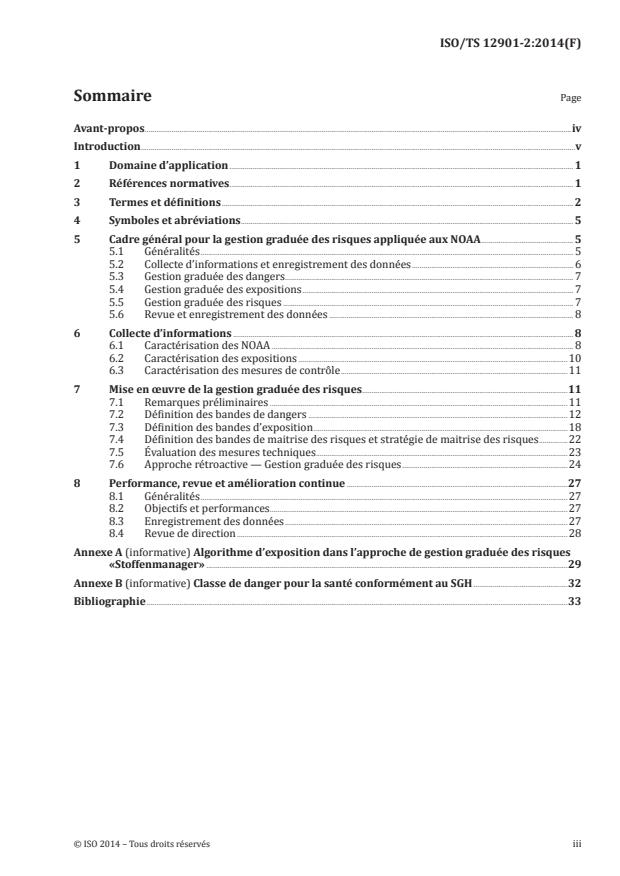
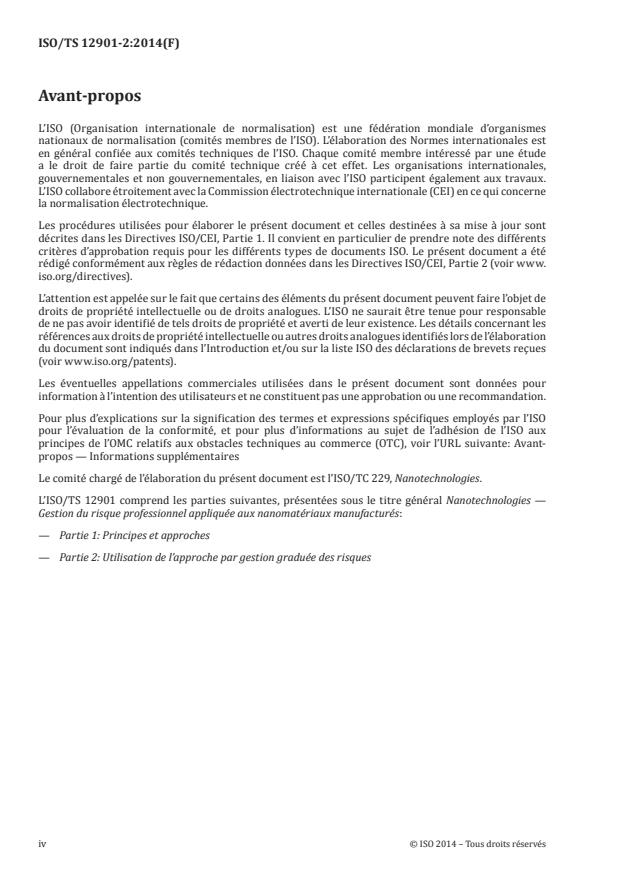
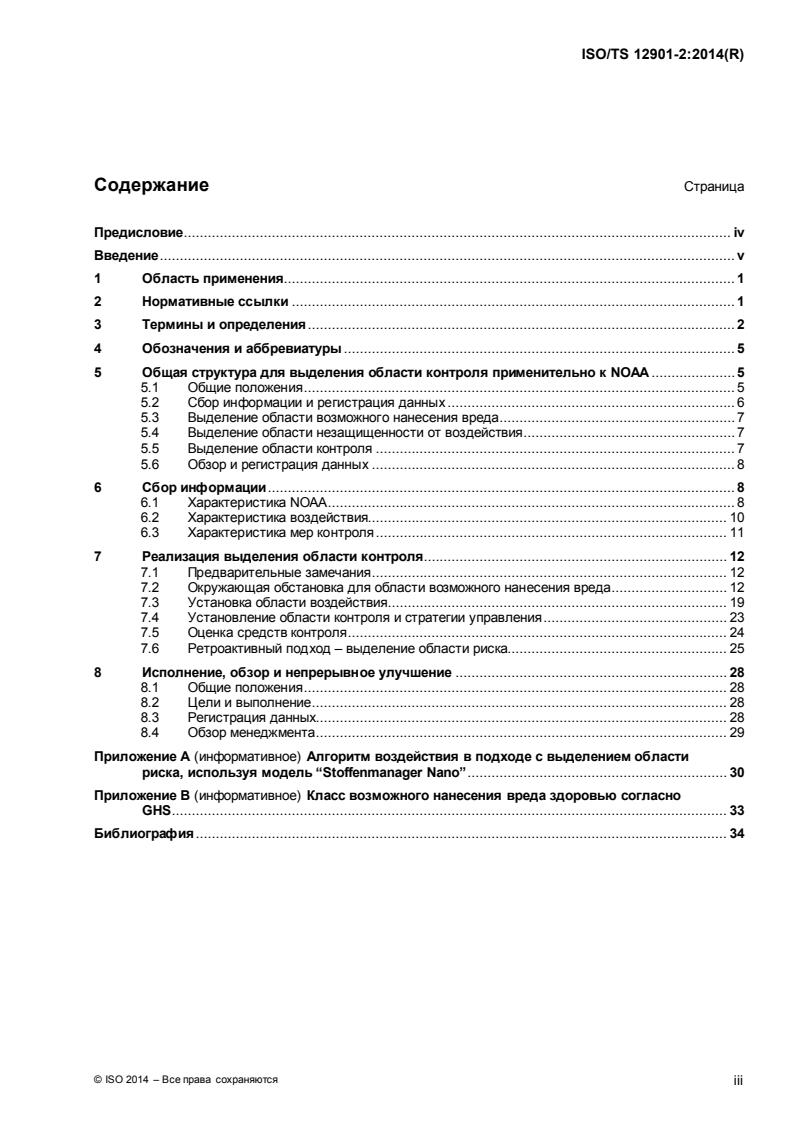
ISO/TS 12901-2:2014 - Nanotechnologies — Gestion du risque professionnel appliquée aux nanomatériaux manufacturés — Partie 2: Utilisation de l'approche par bandes de dangers Released:3/11/2014

ISO/TS 12901-2:2014 - Nanotechnologies — Occupational risk management applied to engineered nanomaterials — Part 2: Use of the control banding approach Released:12/16/2015
Overview
ISO/TS 12901-2:2014 - "Nanotechnologies - Occupational risk management applied to engineered nanomaterials - Part 2: Use of the control banding approach" provides guidance for applying a control banding method to control occupational exposures to nano-objects, aggregates and agglomerates greater than 100 nm (NOAA). Focused primarily on inhalation exposure, the technical specification offers a pragmatic framework for workplaces where toxicological data or quantitative exposure limits (OELs) are limited or lacking. The goal is to prevent adverse health effects by grouping hazards and exposures into bands and assigning appropriate control strategies.
Key Topics
- Scope and definitions: Intentional NOAA such as nanoparticles, nanopowders, nanofibres, nanotubes and nanowires, whether standalone or incorporated in materials.
- Information gathering: Characterization of NOAA, exposure scenarios and existing control measures; systematic data recording.
- Hazard banding: Classifying nano-objects into hazard bands using available toxicological and material information.
- Exposure banding: Assessing likelihood and magnitude of inhalation exposure using qualitative or semi-quantitative indicators.
- Control banding matrix: Combining hazard and exposure bands to determine the appropriate level of control (from general ventilation to containment).
- Implementation and review: Practical steps for applying controls, evaluating effectiveness, and continual improvement of protective measures.
- Proactive vs retroactive approaches: Using control banding without (proactive) or with (retroactive/risk banding) existing control measures as inputs.
- Annexes: Includes references to exposure algorithms (e.g., Stoffenmanager approach) and GHS health hazard class guidance.
Applications
ISO/TS 12901-2:2014 is intended for:
- Manufacturers and importers of engineered nanomaterials to inform safety data sheets and workplace guidance.
- Employers, safety officers and occupational hygienists who need a practical, non‑quantitative method to manage inhalation risks when OELs are unavailable.
- Research organizations and laboratories handling NOAA at small or larger scales.
- Small and medium-sized enterprises (SMEs) seeking an accessible risk-management tool without extensive exposure monitoring.
Practical benefits include a structured decision process for selecting controls, improved worker protection where data are limited, and a complement to traditional air monitoring and OEL-based methods.
Related Standards
- ISO/TS 12901-1 - Principles and approaches (skin and eye protection guidance referenced)
- Other control banding tools and guidance (e.g., COSHH Essentials, Stoffenmanager) are noted as complementary approaches in developing practical exposure-control schemes.
Keywords: ISO/TS 12901-2:2014, nanotechnologies, control banding, NOAA, engineered nanomaterials, inhalation exposure, occupational risk management, hazard banding, exposure banding.
Relations
- Effective Date
- 06-Jun-2022
Buy Documents
ISO/TS 12901-2:2014 - Nanotechnologies — Occupational risk management applied to engineered nanomaterials — Part 2: Use of the control banding approach Released:1/16/2014
ISO/TS 12901-2:2014 - Nanotechnologies — Gestion du risque professionnel appliquée aux nanomatériaux manufacturés — Partie 2: Utilisation de l'approche par bandes de dangers Released:3/11/2014
ISO/TS 12901-2:2014 - Nanotechnologies — Occupational risk management applied to engineered nanomaterials — Part 2: Use of the control banding approach Released:12/16/2015
Get Certified
Connect with accredited certification bodies for this standard

BSI Group
BSI (British Standards Institution) is the business standards company that helps organizations make excellence a habit.

Bureau Veritas
Bureau Veritas is a world leader in laboratory testing, inspection and certification services.

DNV
DNV is an independent assurance and risk management provider.
Sponsored listings
Frequently Asked Questions
ISO/TS 12901-2:2014 is a technical specification published by the International Organization for Standardization (ISO). Its full title is "Nanotechnologies — Occupational risk management applied to engineered nanomaterials — Part 2: Use of the control banding approach". This standard covers: ISO/TS 12901-2:2014 describes the use of a control banding approach for controlling the risks associated with occupational exposures to nano-objects, and their aggregates and agglomerates greater than 100 nm (NOAA), even if knowledge regarding their toxicity and quantitative exposure estimations is limited or lacking. The ultimate purpose of control banding is to control exposure in order to prevent any possible adverse effects on workers' health. The control banding tool described here is specifically designed for inhalation control. Some guidance for skin and eye protection is given in ISO/TS 12901‑1. ISO/TS 12901-2:2014 is focused on intentionally produced nano-objects such as nanoparticles, nanopowders, nanofibres, nanotubes, nanowires, as well as of aggregates and agglomerates of the same. As used in ISO/TS 12901-2:2014, the term "NOAA" applies to such components, whether in their original form or incorporated in materials or preparations from which they could be released during their lifecycle. ISO/TS 12901-2:2014 is intended to help businesses and others, including research organizations engaged in the manufacturing, processing or handling of NOAA, by providing an easy-to-understand, pragmatic approach for the control of occupational exposures.
ISO/TS 12901-2:2014 describes the use of a control banding approach for controlling the risks associated with occupational exposures to nano-objects, and their aggregates and agglomerates greater than 100 nm (NOAA), even if knowledge regarding their toxicity and quantitative exposure estimations is limited or lacking. The ultimate purpose of control banding is to control exposure in order to prevent any possible adverse effects on workers' health. The control banding tool described here is specifically designed for inhalation control. Some guidance for skin and eye protection is given in ISO/TS 12901‑1. ISO/TS 12901-2:2014 is focused on intentionally produced nano-objects such as nanoparticles, nanopowders, nanofibres, nanotubes, nanowires, as well as of aggregates and agglomerates of the same. As used in ISO/TS 12901-2:2014, the term "NOAA" applies to such components, whether in their original form or incorporated in materials or preparations from which they could be released during their lifecycle. ISO/TS 12901-2:2014 is intended to help businesses and others, including research organizations engaged in the manufacturing, processing or handling of NOAA, by providing an easy-to-understand, pragmatic approach for the control of occupational exposures.
ISO/TS 12901-2:2014 is classified under the following ICS (International Classification for Standards) categories: 07.030 - Physics. Chemistry; 07.120 - Nanotechnologies; 13.100 - Occupational safety. Industrial hygiene. The ICS classification helps identify the subject area and facilitates finding related standards.
ISO/TS 12901-2:2014 has the following relationships with other standards: It is inter standard links to ISO/TS 12901-2:2026. Understanding these relationships helps ensure you are using the most current and applicable version of the standard.
ISO/TS 12901-2:2014 is available in PDF format for immediate download after purchase. The document can be added to your cart and obtained through the secure checkout process. Digital delivery ensures instant access to the complete standard document.
Standards Content (Sample)
TECHNICAL ISO/TS
SPECIFICATION 12901-2
First edition
2014-01-15
Nanotechnologies — Occupational risk
management applied to engineered
nanomaterials —
Part 2:
Use of the control banding approach
Nanotechnologies — Gestion du risque professionnel appliquée aux
nanomatériaux manufacturés —
Partie 2: Utilisation de l’approche par bandes de dangers
Reference number
©
ISO 2014
© ISO 2014
All rights reserved. Unless otherwise specified, no part of this publication may be reproduced or utilized otherwise in any form
or by any means, electronic or mechanical, including photocopying, or posting on the internet or an intranet, without prior
written permission. Permission can be requested from either ISO at the address below or ISO’s member body in the country of
the requester.
ISO copyright office
Case postale 56 • CH-1211 Geneva 20
Tel. + 41 22 749 01 11
Fax + 41 22 749 09 47
E-mail copyright@iso.org
Web www.iso.org
Published in Switzerland
ii © ISO 2014 – All rights reserved
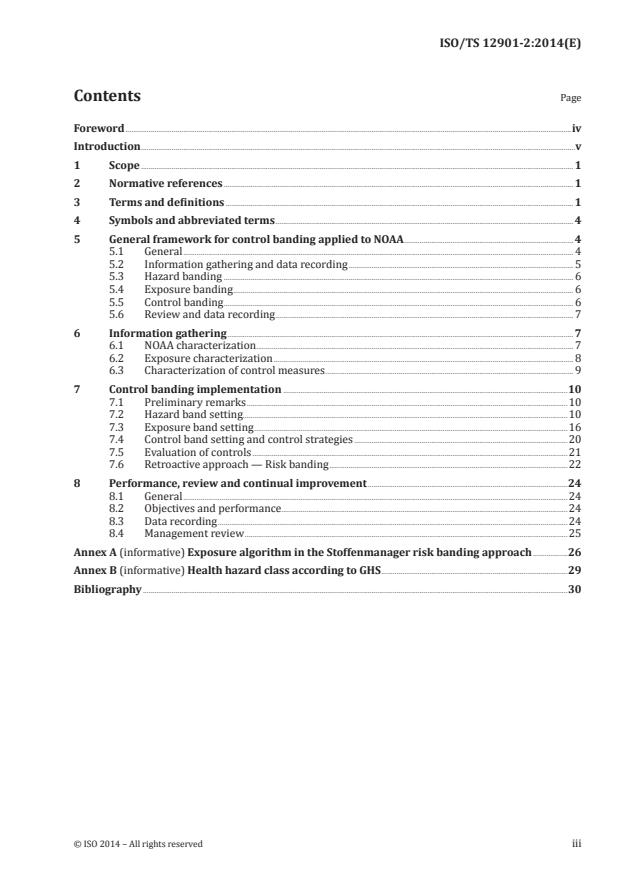
Contents Page
Foreword .iv
Introduction .v
1 Scope . 1
2 Normative references . 1
3 Terms and definitions . 1
4 Symbols and abbreviated terms . 4
5 General framework for control banding applied to NOAA . 4
5.1 General . 4
5.2 Information gathering and data recording . 5
5.3 Hazard banding . 6
5.4 Exposure banding . 6
5.5 Control banding . 6
5.6 Review and data recording . 7
6 Information gathering . 7
6.1 NOAA characterization . 7
6.2 Exposure characterization . 8
6.3 Characterization of control measures . 9
7 Control banding implementation .10
7.1 Preliminary remarks .10
7.2 Hazard band setting.10
7.3 Exposure band setting .16
7.4 Control band setting and control strategies .20
7.5 Evaluation of controls .21
7.6 Retroactive approach — Risk banding .22
8 Performance, review and continual improvement .24
8.1 General .24
8.2 Objectives and performance .24
8.3 Data recording .24
8.4 Management review .25
Annex A (informative) Exposure algorithm in the Stoffenmanager risk banding approach .26
Annex B (informative) Health hazard class according to GHS .29
Bibliography .30
Foreword
ISO (the International Organization for Standardization) is a worldwide federation of national standards
bodies (ISO member bodies). The work of preparing International Standards is normally carried out
through ISO technical committees. Each member body interested in a subject for which a technical
committee has been established has the right to be represented on that committee. International
organizations, governmental and non-governmental, in liaison with ISO, also take part in the work.
ISO collaborates closely with the International Electrotechnical Commission (IEC) on all matters of
electrotechnical standardization.
The procedures used to develop this document and those intended for its further maintenance are
described in the ISO/IEC Directives, Part 1. In particular the different approval criteria needed for the
different types of ISO documents should be noted. This document was drafted in accordance with the
editorial rules of the ISO/IEC Directives, Part 2 (see www.iso.org/directives).
Attention is drawn to the possibility that some of the elements of this document may be the subject of
patent rights. ISO shall not be held responsible for identifying any or all such patent rights. Details of any
patent rights identified during the development of the document will be in the Introduction and/or on
the ISO list of patent declarations received (see www.iso.org/patents).
Any trade name used in this document is information given for the convenience of users and does not
constitute an endorsement.
For an explanation on the meaning of ISO specific terms and expressions related to conformity
assessment, as well as information about ISO’s adherence to the WTO principles in the Technical Barriers
to Trade (TBT) see the following URL: Foreword - Supplementary information
The committee responsible for this document is ISO/TC 229, Nanotechnologies.
ISO/TS 12901 consists of the following parts, under the general title Nanotechnologies — Occupational
risk management applied to engineered nanomaterials:
— Part 1: Principles and approaches
— Part 2: Use of the control banding approach
iv © ISO 2014 – All rights reserved
Introduction
According to the current state of knowledge, nano-objects, and their aggregates and agglomerates greater
than 100 nm (NOAA) can exhibit properties, including toxicological properties, which are different from
those of non-nanoscale (bulk) material. Therefore, current occupational exposure limits (OELs), which
are mostly established for bulk materials might not be appropriate for NOAA. In the absence of relevant
regulatory specifications for NOAA, the control banding approach can be used as a first approach to
controlling workplace exposure to NOAA.
NOTE 1 Aggregates and agglomerates smaller than 100 nm are to be considered as nano-objects.
Control banding is a pragmatic approach which can be used for the control of workplace exposure to
possibly hazardous agents with unknown or uncertain toxicological properties and for which quantitative
exposure estimations are lacking. It may complement the traditional quantitative methods based on
air sampling and analysis with reference to OELs when they exist. It can provide an alternative risk
assessment and risk management process, by grouping occupational settings in categories presenting
similarities of hazards and/or exposure, while incorporating professional judgment and monitoring.
This process applies a range of control techniques (such as general ventilation or containment) to a
specific chemical, considering its range (or band) of hazard and the range (or band) of exposure.
In general, control banding is based on the idea that while workers can be exposed to a diversity of
chemicals, implying a diversity in risks, the number of common approaches to risk control is limited.
These approaches are grouped into levels based on how much protection the approach offers (with
“stringent” controls being the most protective). The greater the potential for harm, the greater the levels
of protection needed for exposure control.
Control banding was originally developed by the pharmaceutical industry as a way to safely work
with new chemicals that had little or no toxicity information. These new chemicals were classified into
“bands” based on the toxicity of analogous and better known chemicals and were linked to anticipated
safe work practices, taking into consideration exposure assessments. Each band was then aligned with a
[1]
control scheme. Following this concept, the Health and Safety Executive (HSE) in the UK has developed
[2][3][4]
a user-friendly scheme called COSHH Essentials, primarily for the benefit of small- and medium-
sized enterprises that might not benefit from the expertise of a resident occupational hygienist. Similar
schemes are used in the practical guidance given by the German Federal Institute for Occupational
[5] [6]
Safety and Health. The Stoffenmanager Tool represents a further development, combining a hazard
banding scheme similar to that of COSHH Essentials and an exposure banding scheme based on an
exposure process model, which was customized in order to allow non-expert users to understand and
use the model.
Control banding can be particularly useful for the risk assessment and management of nanomaterials,
given the level of uncertainty in work-related potential health risks from NOAA. It may be used for
risk management in a proactive manner and in a retroactive manner. In the proactive manner existing
control measures, if any, are not used as input variables in the potential exposure banding while in
a retroactive manner existing control measures are used as input variables. Both approaches are
described in this part of ISO/TS 12901. While control banding appears, in theory, to be appropriate for
nanoscale materials exposure control, very few comprehensive tools are currently available for ongoing
[7]
nanotechnology operations. A conceptual control banding model was presented by Maynard offering
the same four control approaches as COSHH. A slightly different approach, called “Control Banding
[8][9]
Nanotool”, was presented by Paik et al. This approach takes into account existing knowledge of
NOAA toxicology and uses the control banding framework proposed in earlier publications. However,
the ranges of values used in the “Control Banding Nanotool” correspond to those ranges that one would
expect in small-scale research type operations (less than one gram) and might not seem appropriate for
larger scale uses. In the meantime several other specific control banding tools have been published to
[10][11][12][13][14]
control inhalation exposure to engineered nanomaterials for larger scale uses. All these
tools define hazard bands and exposure bands for inhalatory exposure and combine these in a two-
dimensional matrix, resulting in a score for risk control (proactive approach).
[15]
Schneider et al. have developed a conceptual model for assessment of inhalation exposure to engineered
nanomaterials, suggesting a general framework for future exposure models. This framework follows
the same structure as the conceptual model for inhalation exposure used in the Stoffenmanager Tool
[6][16][17]
and the Advanced REACH Tool (ART). Based on this conceptual framework, a control banding
[18]
tool called “Stoffenmanager Nano” has been developed, encompassing both proactive approach and
retroactive (risk banding) approach.
In addition, the French agency for food, environmental and occupational health and safety (ANSES)
have developed a control banding tool specifically for nanomaterials which is described in the report
[31]
“Development of a specific control banding tool for nanomaterials” .
The biggest challenge in developing any control banding approach for NOAA is to decide which parameters
are to be considered and what criteria are relevant to assign a nano-object to a control band, and what
operational control strategies ought to be implemented at different operational levels.
This part of ISO/TS 12901 proposes guidelines for controlling and managing occupational risk based
on a control banding approach specifically designed for NOAA. It is the responsibility of manufacturers
and importers to determine whether a material of concern contains NOAA, and to provide relevant
information in safety data sheets (SDS) and labels, in compliance with any national or international
existing regulation. Employers can use this information to identify hazards and implement appropriate
controls. This part of ISO/TS 12901 does not intend to give recommendations on this decision-making
process. It cannot replace regulation and employers are expected to comply with the existing regulations.
It is emphasized that the control banding method applied to manufactured NOAA requires assumptions
to be formulated on information that is desirable but unavailable. Thus the user of the control banding
tool needs to have proven skills in chemical risk prevention and more specifically in risk issues known
to be related to that type of material. The successful implementation of this approach requires a
solid expertise combined with a capacity for critical evaluation of potential occupational exposures
and training to use control banding tools to ensure appropriate control measures and an adequately
conservative approach.
In parallel to the approach described in this part of ISO/TS 12901, a full hazard assessment is advisable
to consider all substance-related hazards, including explosive risk (see NOTE 2), and environmental
hazards.
NOTE 2 Explosive dust clouds can be generated from most organic materials, many metals and even some non-
metallic inorganic materials. The primary factor influencing the ignition sensitivity and explosive violence of a
dust cloud is the particle size or specific surface area (i.e. the total surface area per unit volume or unit mass of the
dust) and the particle composition. As the particle size decreases the specific surface area increases. The general
trend is for the violence of the dust explosion and the ease of ignition to increase as the particle size decreases,
though for many dusts this trend begins to level out at particle sizes of the order of tens of micrometres (µm).
However, no lower particle size limit has been established below which dust explosions cannot occur and it has to
be considered that many nanoparticle types have the potential to cause explosions.
vi © ISO 2014 – All rights reserved
TECHNICAL SPECIFICATION ISO/TS 12901-2:2014(E)
Nanotechnologies — Occupational risk management
applied to engineered nanomaterials —
Part 2:
Use of the control banding approach
1 Scope
The purpose of this part of ISO/TS 12901 is to describe the use of a control banding approach for
controlling the risks associated with occupational exposures to nano-objects, and their aggregates and
agglomerates greater than 100 nm (NOAA), even if knowledge regarding their toxicity and quantitative
exposure estimations is limited or lacking.
The ultimate purpose of control banding is to control exposure in order to prevent any possible adverse
effects on workers’ health. The control banding tool described here is specifically designed for inhalation
[19]
control. Some guidance for skin and eye protection is given in ISO/TS 12901-1.
This part of ISO/TS 12901 is focused on intentionally produced NOAA that consist of nano-objects
such as nanoparticles, nanopowders, nanofibres, nanotubes, nanowires, as well as of aggregates
and agglomerates of the same. As used in this part of ISO/TS 12901, the term “NOAA” applies to
such components, whether in their original form or incorporated in materials or preparations from
which they could be released during their lifecycle. However, as for many other industrial processes,
nanotechnological processes can generate by-products in the form of unintentionally produced NOAA
which might be linked to health and safety issues that need to be addressed as well.
This part of ISO/TS 12901 is intended to help businesses and others, including research organizations
engaged in the manufacturing, processing or handling of NOAA, by providing an easy-to-understand,
pragmatic approach for the control of occupational exposures.
Control banding applies to issues related to occupational health in the development, manufacturing and
use of NOAA under normal or reasonably predictable conditions, including maintenance and cleaning
operations but excluding incidental or accidental situations.
Control banding is not intended to apply to the fields of safety management, environment or
transportation; it is considered as only one part of a comprehensive risk management process.
Materials of biological origin are outside the scope of this part of ISO/TS 12901.
2 Normative references
The following documents, in whole or in part, are normatively referenced in this document and are
indispensable for its application. For dated references, only the edition cited applies. For undated
references, the latest edition of the referenced document (including any amendments) applies.
ISO/TS 27687, Nanotechnologies — Terminology and definitions for nano-objects — Nanoparticle, nanofibre
and nanoplate
3 Terms and definitions
For the purposes of this document, the terms and definitions given in ISO/TS 27687 and the following
apply.
3.1
agglomerate
collection of weakly bound particles or aggregates or mixtures of the two where the resulting external
surface area is similar to the sum of the surface areas of the individual components
Note 1 to entry: The forces holding an agglomerate together are weak forces, for example van der Waals forces, or
simple physical entanglement.
Note 2 to entry: Agglomerates are also termed secondary particles and the original source particles are termed
primary particles.
[SOURCE: ISO/TS 27687:2008, definition 3.2]
3.2
aggregate
particle comprising strongly bonded or fused particles where the resulting external surface area may be
significantly smaller than the sum of calculated surface areas of the individual components
Note 1 to entry: The forces holding an aggregate together are strong forces, for example covalent bonds, or those
resulting from sintering or complex physical entanglement.
Note 2 to entry: Aggregates are also termed secondary particles and the original source particles are termed
primary particles.
[SOURCE: ISO/TS 27687:2008, definition 3.3]
3.3
analogous material
material of the same chemical category, with a similar composition and/or crystalline phase and
documented similar physicochemical properties (metal oxides, graphite, ceramics, etc.)
3.4
bulk material
material of the same chemical composition as the NOAA, at a scale greater than the nanoscale
3.5
classification and labelling
system to communicate hazard information about a specific substance based on the principles of the
GHS (Globally Harmonized System of classification and labelling of chemicals), or equivalent, and GHS’
transposition into national legislation (e.g.: Regulation (EC) No 1272/2008 for the European Union)
3.6
chemical category
group of chemicals whose physicochemical and human health and/or ecotoxicological properties and/or
environmental fate properties are likely to be similar or follow a regular pattern, usually as a result of
structural similarity
3.7
dustiness
tendency of particles to separate from the main bulk of powder and then to be dispersed into the
atmosphere
3.8
exposure
contact with a chemical, physical or biological agent by swallowing, breathing, or touching the skin or
eyes
Note 1 to entry: Exposure can be short-term (acute exposure), of intermediate duration, or long term (chronic).
2 © ISO 2014 – All rights reserved
3.9
health hazard
potential source of harm to health
[SOURCE: ISO 10993-17:2002, definition 3.7]
3.10
health risk
combination of the likelihood of occurrence of harm to health and the severity of that harm
[SOURCE: ISO 10993-17:2002, definition 3.8]
3.11
nanofibre
nano-object with two similar external dimensions in the nanoscale and the third dimension being
significantly larger
Note 1 to entry: A nanofibre can be flexible or rigid.
Note 2 to entry: The two similar external dimensions are considered to differ in size by less than three times and
the significantly larger external dimension is considered to differ from the other two by more than three times.
Note 3 to entry: The largest external dimension is not necessarily in the nanoscale.
[SOURCE: ISO/TS 27687:2008, definition 4.3]
3.12
nano-object
material with one, two or three external dimensions in the nanoscale
Note 1 to entry: Generic term for all discrete nanoscale objects.
[SOURCE: ISO/TS 27687:2008, definition 2.2]
3.13
nanoparticle
nano-object with all three dimensions in the nanoscale
Note 1 to entry: If the lengths of the longest to the shortest axes of the nano-object differ significantly (typically by
more than three times), the terms nanorod or nanoplate are intended to be used instead of the term nanoparticle.
[SOURCE: ISO/TS 27687:2008, definition 4.1]
3.14
nanoplate
nano-object with one external dimension in the nanoscale and the two other external dimensions
significantly larger
Note 1 to entry: The smallest external dimension is the thickness of the nanoplate.
Note 2 to entry: The two significantly larger dimensions are considered to differ from the nanoscale dimension
by more than three times.
Note 3 to entry: The larger external dimensions are not necessarily in the nanoscale.
[SOURCE: ISO/TS 27687:2008, definition 4.2]
3.15
nanoscale
size range from approximately 1 nm to 100 nm
Note 1 to entry: Properties that are not extrapolations from a larger size will typically, but not exclusively, be
exhibited in this size range. For such properties the size limits are considered approximate.
Note 2 to entry: The lower limit in this definition (approximately 1 nm) is introduced to avoid single and small
groups of atoms from being designated as nano-objects or elements of nanostructures, which might be implied by
the absence of a lower limit.
[SOURCE: ISO/TS 27687:2008, definition 2.1]
3.16
particle
minute piece of matter with defined physical boundaries
Note 1 to entry: A physical boundary can also be described as an interface.
Note 2 to entry: A particle can move as a unit.
Note 3 to entry: This general particle definition applies to nano-objects.
[SOURCE: ISO/TS 27687:2008, definition 3.1]
3.17
solubility
maximum mass of a nanomaterial that is soluble in a given volume of a particular solvent under specified
conditions
Note 1 to entry: Solubility is expressed in grams per litre of solvent.
[SOURCE: ISO/TR 13014, definition 2.27]
4 Symbols and abbreviated terms
CMRS carcinogenicity, mutagenicity, reprotoxicity or sensitization
COSHH control of substances hazardous to health
GHS Globally Harmonized System of classification and labelling of chemicals
SDS safety data sheet
NOAA nano-objects, and their aggregates and agglomerates greater than 100 nm
OEL occupational exposure limit
PPE personal protective equipment
STOP substitution, technical measures, organizational measures, personal protective equipment
TEM transmission electron microscopy
5 General framework for control banding applied to NOAA
5.1 General
The control banding tool described in this part of ISO/TS 12901 applies to NOAA and materials containing
NOAA. It is important to note that this control banding tool can only be considered as one part, though
an integral part, of an overall system for health and safety risk management. It requires input data,
irrespective of the phase of the NOAA life cycle, such as information collected at the place of work
through observation of actual work by an occupational hygienist with a solid expertise and training to
use control banding tools as well as the enunciation of hazards and the best toxicology data available.
4 © ISO 2014 – All rights reserved
The foundations of this approach are the hazard identification process, which is based on the current
knowledge of the specific NOAA (toxicology or health effect data; physical and chemical properties)
and the assessment of potential worker exposure. The hazard and exposure information is combined to
determine an appropriate level of control (such as general ventilation, local exhaust, or containment).
This approach is based on the opinion of experts developing this part of ISO/TS 12901 that the
engineering control techniques for nanoparticle exposure can build on the knowledge and experience
from current exposure control to aerosols. This knowledge and control has already been applied to
aerosols containing ultrafine particles (e.g. welding fumes, carbon black or viruses). Effective techniques
can be obtained by adapting and redesigning current technology. This applies to techniques for general
ventilation, local and process ventilation, containments, enclosures and filtration.
The control banding approach allows shifting from exposure assessment to exposure control and vice
versa. Thus it can be performed either in a proactive way, based on anticipated exposures and using
basic factors mitigating exposure potential, or in a retroactive way (or risk banding approach), based
on a risk assessment that will take more exposure mitigating factors into account including control
measures actually implemented or to be implemented. In both cases, hazard banding is a common step.
The general structure of the process is presented in Figure 1 and includes the following elements:
— information gathering;
— assignment of the NOAA to a hazard band: hazard banding;
— description of potential exposure characteristics: exposure banding;
— definition of recommended work environments and handling practices: control banding;
— evaluation of the control strategy or risk banding.
Figure 1 — Control banding process
5.2 Information gathering and data recording
The methodology presented in this part of ISO/TS 12901 is information driven; it does not implicitly
assume the presence of risk or hazard in any material. Where there is little or no information to guide
decisions on the potential for a particular hazard or exposure, “reasonable worst-case assumptions”
should be used along with management practices appropriate for those options. The methodology is
also designed to encourage replacing assumptions with real information and refining management
practices accordingly.
Input data are pre-required in order to implement control banding. Especially considering NOAA for
which no health-based limit values can be established, it is important to document substances being
used, control measures taken, working conditions and possibly exposure measurements, given that
these factors are not always easy to determine with complete certainty, and that they depend on the
extent to which the hazard is known and on the accuracy of the methods used for exposure assessment.
All input data should be documented and be traceable through an appropriate documentation
management system.
5.3 Hazard banding
Hazard banding consists in assigning a hazard band to NOAA on the basis of a comprehensive evaluation
of all available data on this material, taking into account parameters such as toxicity, in vivo biopersistence
and factors influencing the ability of particles to reach the respiratory tract, their ability to deposit in
various regions of the respiratory tract, their ability to elicit biological responses. These factors can be
related to physical and chemical properties such as surface area, surface chemistry, shape, particle size,
etc.
5.4 Exposure banding
Exposure banding consists in assigning an exposure scenario (a set of conditions under which exposure
may occur) at a workplace or a workstation to an exposure band on the basis of a comprehensive
evaluation of all available data of the exposure scenario under consideration, e.g. physical form of NOAA,
amount of NOAA, dust generation potential of processes and actual exposure measurement data.
5.5 Control banding
5.5.1 Proactive implementation of control banding
Control banding can be used for risk control management in a proactive manner. In that case,
recommended work environments and handling practices may be defined on the basis of hazard
banding as well as of fundamental factors mitigating anticipated exposure potential, e.g. propensity of
the material to become airborne, the type of process and amounts of material being handled.
Such an approach is used to determine the control measures appropriate for the operation being assessed
but not to determine an actual level of risk, as the existing control measures, if any, are not used as an
input variable in the exposure banding process.
5.5.2 Retroactive implementation approach: evaluation of control banding and risk banding
In a retroactive approach, control banding may be used either to evaluate the controls recommended as
outputs of the proactive approach, or for risk assessment on its own.
In that case, both hazard and actual exposure need to be characterized in order to define a risk level.
The major difference with the proactive use of control banding is that exposure mitigating factors (such
as implemented control measures) are taken into account using an exposure algorithm (see Annex A).
The approach then includes the following elements:
— assignment of the NOAA to a hazard band;
— exposure banding;
— overview of risks based on risk banding as a result of hazard and exposure banding;
— iterative examination of control measures until the risk is reduced to an acceptable level;
— design of an action plan based on the chosen specific control scenario.
6 © ISO 2014 – All rights reserved
Such an approach may be used to determine the actual risk level using the existing control measures as
an input variable. In this respect, the retroactive approach can be considered as a means for periodic
reevaluation of the proactive approach.
5.6 Review and data recording
In this “review and adapt” step, a system of periodic and as-needed reviews should be implemented to
ensure that the information, evaluations, decisions and actions of the previous steps are kept up-to-date.
Reviews should be performed when new information has been generated or has emerged. The adequacy
of the risk management process for the material or the application at hand should be reassessed. It should
be questioned whether the current risk evaluation needs to be revised in light of the new information
and, if so, whether the current risk management practices need to be changed as well.
6 Information gathering
6.1 NOAA characterization
6.1.1 General
The lists of characteristics and end points given in 6.1.2 to 6.1.4 are to be taken into account when
assessing human health hazards of NOAA. Addressing this data set should lead to the development of
dossiers describing basic characterization parameters and available mammalian toxicity information.
These end points are based upon the list proposed by the OECD testing program for a set of manufactured
[22]
nanomaterials for human health and environmental safety. It can be considered as a starting point
when assessing human health hazards of NOAA. Epidemiological data, when available, should also be
taken into account.
6.1.2 NOAA information and identification
— NOAA name
— CAS Number
— structural formula/molecular structure
— composition of NOAA being tested
— basic morphology
— description of surface chemistry
— method of production
6.1.3 Physicochemical properties and NOAA characterization
— agglomeration/aggregation
— solubility (e.g. in water or biologically relevant fluids)
— crystalline phase
— dustiness
— crystallite size
— representative TEM picture(s)
— particle size distribution
— specific surface area
— surface chemistry (where appropriate)
— catalytic or photocatalytic activity
— pour density
— porosity
— octanol-water partition coefficient, where relevant
— redox potential
— radical formation potential
— other relevant information (where available)
Although some of the above characteristics might not be available, and very few of these characteristics
will actually be taken into account in the control banding process, NOAA’s characteristics should be
documented and recorded as accurately as possible (including reference to size and measurement
conditions). This will be needed in the case of possible future medical issues. When utilizing characteristics
relating to non-nanoscale materials, it should be taken into account that these characteristics can differ
significantly from those for the material in the nanoscale.
6.1.4 NOAA toxicological data
— pharmacokinetics (absorption, distribution, metabolism, elimination)
— acute toxicity
— repeated dose toxicity
— chronic toxicity
— reproductive toxicity
— developmental toxicity
— genetic toxicity
— experience with human exposure
— epidemiological data
— other relevant test data
Although some of the above data might not be available, and some of these data might not be taken into
account in the control banding process, NOAA’s toxicological data should be documented and recorded
as accurately as possible.
A list of hazard indications is presented in Annex B.
6.2 Exposure characterization
6.2.1 General exposure characterization elements
The main goal of exposure characterization is to provide a summary and a synthesis of available
exposure information. General exposure characterization includes the following elements:
a) a statement of purpose, scope, level of detail, as well as the approach used in the exposure
characterization;
b) estimates of exposure for each relevant pathway, both for individuals and populations (e.g. groups
of workers);
8 © ISO 2014 – All rights reserved
c) an evaluation of the overall quality of the assessment and the degree of confidence in the exposure
estimates and in the conclusions drawn, including sources and the extent of uncertainty (see
ISO/TS 12901-1);
d) in this control banding approach, the critical elements of exposure characterization, which are
necessary to determine exposure band and include:
— the physical form of NOAA,
— the amount of NOAA,
— the determination of dust generation potential during the processes,
— the actual exposure measurement data.
6.2.2 Physical form
The actual stage in the NOAA’s life cycle is an important parameter to consider as it can influence the
potential for worker exposure and thus the selection of risk control parameters.
NOAA can be in different forms, as produced (e.g. as a powder), or as used (e.g. embedded in a solid
matrix or attached to a substrate), suspended in a gas or in a liquid; or as waste. Each of these different
stages will have its own exposure pattern.
Thus, the NOAA’s physical form (i.e. exposure availability) should be characterized throughout the
product lifecycle. This information is critical for the appropriate and safe handling of the material.
6.2.3 Amount of NOAA
The amounts of nanomaterial processed or manufactured in the workplace is one of the most important
determinants of exposure. The presence of large amounts of NOAA in the workplace increases the
potential for the generation of a higher concentration in the air and, therefore, can lead to higher
exposures.
6.2.4 Potential for dust generation
Workplace processes, such as spraying, packaging, maintenance activities and dumping can lead to
generation of airborne particles. As a consequence, it is important to analyse the details of the operator’s
activities and process operations in order to estimate the potency of the process to release NOAA into
the workplace air. This implies performing an inventory of operators’ tasks, including start and stop
operations, process steps, etc.
6.2.5 Quantitative exposure measurements
Actual exposure measurements, when feasible, represent the best information for the selection of the
appropriate exposure band. Therefore they should be encouraged and when both personal sampling and
area measurements are available, the preference should be given to individual exposure measurements.
The results should be taken into account when determining the corresponding exposure band.
ISO/TS 12901-1 provides information on available measurement equipment, possible measurement
strategies and results interpretations.
6.3 Characterization of control measures
6.3.1 General
Exposure control measures implemented in the workplace should be characterized. They can lower
exposures by reducing emission, transmission and immission.
6.3.2 Reduction of emission
The reduction of NOAA emission from the source can be achieved in several ways such as handling
NOAA in suspension into a liquid or dispersed into a paste or a solid matrix rather than in the form of dry
powders; avoiding high energy processes or any activity likely to release free NOAA in the workplaces.
6.3.3 Reduction of transmission
Reduction of transmission from the source towards the worker is possible in several ways. Two generic
control measures are:
— local control, e.g. containment and/or local exhaust ventilation,
— general ventilation, e.g. natural or mechanical ventilation.
6.3.4 Reduction of immission
The reduction of immission has three generic control measures:
— personal enclosure/separating the worker from the source, e.g. a ventilated cabin,
— segregation of the source from the worker, i.e. isolation of sources from the work environment in a
separate room without direct containment of the source itself,
— use of personal protective equipment.
6.3.5 Workplace area and personal exposure monitoring data
When feasible, actual exposure measurements provide important information on the effectiveness of
controls and workers protection level.
7 Control banding implementation
7.1 Preliminary remarks
Whatever the approach, control banding implementation should be consistent with the hierarchy of
controls (and the so-called STOP principle): substitution, technical measures, organizational measures
and personal protective equipment (PPE) as the last resort when measures do not provide adequate
control.
Control banding should incorporate general industrial hygiene good practices. In the case when control
measures recommended by the nano-specific control banding differ from other industrial hygiene
considerations, then the more stringent control measures should be applied.
As mentioned above, control banding can be used in two different ways, a proactive approach and
a retroactive, evaluation or risk banding approach. Both approaches are described in this part of
ISO/TS 12901. They present a first common step which is the hazard banding process.
7.2 Hazard band setting
7.2.1 Hazard categorization of chemicals and general hazard banding process for bulk materi-
als
Hazard bands are defined, for a specific chemical, according to the severity level of the hazard resulting
from the analysis of the available information as evaluated by knowledgeable and experienced
10 © ISO 2014 – All rights reserved
professionals. This information can relate to various criteria for toxicity, described or suspected, in the
literature or technical documentation (labelling, product classification).
NOTE A knowledgeable and experienced professional is an individual who will properly perform a specific
job. This person utilizes a combination of knowledge, skills and behaviour to improve performance. More generally,
competence is the state or quality of being adequately or well qualified, having the ability to perform a specific
role.
[23]
The approach presented in the International Labour Organization Control Banding Toolkit is to
group chemicals into one of five inhalation hazard groups (A to E) and the Skin (S) group according to
the increasing severity described in GHS hazard classification applicable to the chemical (see in Table 1
and Annex B). The dose ranges given in this table correspond to the criteria set for classification under
GHS. Hazard band allocation can vary depending on national statutory provisions.
Hazard group allocation table a
...
SPÉCIFICATION ISO/TS
TECHNIQUE 12901-2
Première édition
2014-01-15
Nanotechnologies — Gestion du
risque professionnel appliquée aux
nanomatériaux manufacturés —
Partie 2:
Utilisation de l’approche par bandes
de dangers
Nanotechnologies — Occupational risk management applied to
engineered nanomaterials —
Part 2: Use of the control banding approach
Numéro de référence
©
ISO 2014
DOCUMENT PROTÉGÉ PAR COPYRIGHT
© ISO 2014
Droits de reproduction réservés. Sauf indication contraire, aucune partie de cette publication ne peut être reproduite ni utilisée
sous quelque forme que ce soit et par aucun procédé, électronique ou mécanique, y compris la photocopie, l’affichage sur
l’internet ou sur un Intranet, sans autorisation écrite préalable. Les demandes d’autorisation peuvent être adressées à l’ISO à
l’adresse ci-après ou au comité membre de l’ISO dans le pays du demandeur.
ISO copyright office
Case postale 56 • CH-1211 Geneva 20
Tel. + 41 22 749 01 11
Fax + 41 22 749 09 47
E-mail copyright@iso.org
Web www.iso.org
Publié en Suisse
ii © ISO 2014 – Tous droits réservés
Sommaire Page
Avant-propos .iv
Introduction .v
1 Domaine d’application . 1
2 Références normatives . 1
3 Termes et définitions . 2
4 Symboles et abréviations . 5
5 Cadre général pour la gestion graduée des risques appliquée aux NOAA .5
5.1 Généralités . 5
5.2 Collecte d’informations et enregistrement des données . 6
5.3 Gestion graduée des dangers . 7
5.4 Gestion graduée des expositions . 7
5.5 Gestion graduée des risques . 7
5.6 Revue et enregistrement des données . 8
6 Collecte d’informations . 8
6.1 Caractérisation des NOAA . 8
6.2 Caractérisation des expositions .10
6.3 Caractérisation des mesures de contrôle .11
7 Mise en œuvre de la gestion graduée des risques .11
7.1 Remarques préliminaires .11
7.2 Définition des bandes de dangers .12
7.3 Définition des bandes d’exposition .18
7.4 Définition des bandes de maitrise des risques et stratégie de maitrise des risques .22
7.5 Évaluation des mesures techniques.23
7.6 Approche rétroactive — Gestion graduée des risques .24
8 Performance, revue et amélioration continue .27
8.1 Généralités .27
8.2 Objectifs et performances.27
8.3 Enregistrement des données .27
8.4 Revue de direction .28
Annexe A (informative) Algorithme d’exposition dans l’approche de gestion graduée des risques
«Stoffenmanager» .29
Annexe B (informative) Classe de danger pour la santé conformément au SGH .32
Bibliographie .33
Avant-propos
L’ISO (Organisation internationale de normalisation) est une fédération mondiale d’organismes
nationaux de normalisation (comités membres de l’ISO). L’élaboration des Normes internationales est
en général confiée aux comités techniques de l’ISO. Chaque comité membre intéressé par une étude
a le droit de faire partie du comité technique créé à cet effet. Les organisations internationales,
gouvernementales et non gouvernementales, en liaison avec l’ISO participent également aux travaux.
L’ISO collabore étroitement avec la Commission électrotechnique internationale (CEI) en ce qui concerne
la normalisation électrotechnique.
Les procédures utilisées pour élaborer le présent document et celles destinées à sa mise à jour sont
décrites dans les Directives ISO/CEI, Partie 1. Il convient en particulier de prendre note des différents
critères d’approbation requis pour les différents types de documents ISO. Le présent document a été
rédigé conformément aux règles de rédaction données dans les Directives ISO/CEI, Partie 2 (voir www.
iso.org/directives).
L’attention est appelée sur le fait que certains des éléments du présent document peuvent faire l’objet de
droits de propriété intellectuelle ou de droits analogues. L’ISO ne saurait être tenue pour responsable
de ne pas avoir identifié de tels droits de propriété et averti de leur existence. Les détails concernant les
références aux droits de propriété intellectuelle ou autres droits analogues identifiés lors de l’élaboration
du document sont indiqués dans l’Introduction et/ou sur la liste ISO des déclarations de brevets reçues
(voir www.iso.org/patents).
Les éventuelles appellations commerciales utilisées dans le présent document sont données pour
information à l’intention des utilisateurs et ne constituent pas une approbation ou une recommandation.
Pour plus d’explications sur la signification des termes et expressions spécifiques employés par l’ISO
pour l’évaluation de la conformité, et pour plus d’informations au sujet de l’adhésion de l’ISO aux
principes de l’OMC relatifs aux obstacles techniques au commerce (OTC), voir l’URL suivante: Avant-
propos — Informations supplémentaires
Le comité chargé de l’élaboration du présent document est l’ISO/TC 229, Nanotechnologies.
L’ISO/TS 12901 comprend les parties suivantes, présentées sous le titre général Nanotechnologies —
Gestion du risque professionnel appliquée aux nanomatériaux manufacturés:
— Partie 1: Principes et approches
— Partie 2: Utilisation de l’approche par gestion graduée des risques
iv © ISO 2014 – Tous droits réservés
Introduction
Dans l’état actuel des connaissances, les nano-objets, et leurs agrégats et agglomérats de plus de 100 nm
(NOAA) peuvent présenter des propriétés, y compris des propriétés toxicologiques, différentes de celles
de matériaux (en masse) à une échelle plus grande que la nano-échelle. Par conséquent, les valeurs
limites d’exposition professionnelle (VLEP), établies dans la plupart des cas pour des matériaux en
masse, pourraient s’avérer inappropriées pour les NOAA. En l’absence de spécifications réglementaires
pertinentes pour les NOAA, l’approche par gestion graduée des risques peut être utilisée comme une
première approche pour contrôler l’exposition sur les lieux de travail aux NOAA.
NOTE 1 Les agrégats et agglomérats de taille inférieure à 100 nm doivent être considérés comme des nano-
objets.
L’approche par gestion graduée des risques est une approche pragmatique qui peut être utilisée pour le
contrôle de l’exposition sur les lieux de travail à des agents potentiellement dangereux ayant des propriétés
toxicologiques incertaines et pour lesquels il n’existe pas d’estimations quantitatives d’exposition.
Cette approche peut être utilisée en complément des méthodes quantitatives classiques basées sur le
prélèvement et l’analyse de l’air en se référant aux valeurs limites d’exposition professionnelle (VLEP)
lorsqu’elles existent. Elle peut fournir une méthode alternative d’évaluation du risque et de gestion
du risque, par regroupement des milieux professionnels en catégories présentant des similarités en
termes de dangers et/ou d’exposition et par intégration d’un jugement professionnel et de moyens de
surveillance. Ce processus applique une gamme de techniques de contrôle (par exemple, ventilation ou
confinement) à une substance chimique spécifique, tenant compte de sa gamme (ou bande) de dangers
et de la gamme (ou bande) d’expositions.
En général, la gestion graduée des risques est fondée sur l’idée selon laquelle le nombre d’approches
communes pour le contrôle des risques est limité, bien que le personnel puisse être exposé à une grande
variété de produits chimiques impliquant un large éventail de risques. Ces approches sont regroupées
en niveaux basés sur le degré de protection procuré par l’approche (les contrôles «rigoureux» étant
ceux qui assurent une protection maximale). Plus le dommage potentiel est élevé et plus les niveaux de
protection nécessaire pour le contrôle de l’exposition sont élevés.
La gestion graduée des risques avait été initialement développée par l’industrie pharmaceutique comme
une méthode de travail en toute sécurité avec de nouveaux produits chimiques pour lesquels peu
d’informations sur la toxicité étaient disponibles. Ces nouveaux produits chimiques ont été classés en
«bandes» sur la base de la toxicité de produits chimiques analogues et mieux connus, puis associés à des
pratiques de travail sûres, tenant compte d’une évaluation des expositions. Chaque bande a été ensuite
[1]
associée à un programme de contrôle. Suivant ce concept, l’organisme britannique HSE (Health and
[2][3][4]
Safety Executive) a élaboré un programme convivial appelé «COSHH Essentials», s’adressant
principalement aux petites et moyennes entreprises susceptibles de ne pas bénéficier de l’expertise
d’un hygiéniste du travail en poste dans l’entreprise. Des programmes similaires sont utilisés dans
le guide pratique fourni par l’institut fédéral allemand chargé de la santé et de la sécurité au travail
[5] [6]
(German Federal Institute for Occupational Safety and Healt). Le Stoffenmanager Tool représente le
développement d’un autre outil, combinant une approche par gestion graduée des risques semblable à
celle de COSHH Essentials et une approche par bandes d’expositions fondée sur un modèle de processus
d’exposition, qui a été adapté de manière à permettre à des utilisateurs non spécialisés de comprendre
et d’utiliser le modèle.
L’approche par gestion graduée des risques peut être particulièrement utile pour l’évaluation et la gestion
des risques des nanomatériaux, compte tenu de l’incertitude liée aux risques professionnels potentiels
présentés par les NOAA. L’approche par gestion graduée des risques peut être utilisée pour la gestion
des risques selon une approche proactive et selon une approche rétroactive. Dans l’approche proactive,
les mesures de contrôle, si elles existent, ne sont pas utilisées comme des variables d’entrée dans les
bandes d’expositions potentielles, alors que dans l’approche rétroactive, les mesures de contrôle sont
utilisées comme des variables d’entrée. Les deux approches sont décrites dans la présente partie de
l’ISO/TS 12901. Bien que la gestion graduée des risques semble, en théorie, appropriée pour le contrôle
de l’exposition aux matériaux à la nano-échelle, un très faible nombre d’outils est actuellement disponible
pour les opérations en cours dans le domaine des nanotechnologies. Un modèle conceptuel de gestion
[7]
graduée des risques a été présenté par Maynard , ce modèle proposant les quatre mêmes approches de
contrôle que le COSHH. Une méthode légèrement différente, appelée «Control Banding Nanotool» (Nano-
[8][9]
outil de gestion graduée des risques), a été présentée par Paik et al. Cette approche tient compte des
connaissances existantes concernant la toxicologie des NOAA et utilise le cadre de la gestion graduée
des risques proposé dans des publications antérieures. Toutefois, les gammes de valeurs utilisées dans
le «Control Banding Nanotool» (Nano-outil de gestion graduée des risques) correspondent aux gammes
que l’on pourrait s’attendre à rencontrer dans les opérations du type recherche à petite échelle (moins
d’un gramme) et peuvent ne pas paraître appropriées pour des utilisations à plus grande échelle. Entre-
temps, des publications ont fait état de plusieurs autres outils de gestion graduée des risques spécifiques
destinés à contrôler l’exposition par inhalation aux nanomatériaux manufacturés pour des utilisations
[10][11][12][13][14]
à plus grande échelle. Tous ces outils définissent des bandes de dangers et des bandes
d’expositions pour l’exposition par inhalation et les combinent en une matrice bidimensionnelle,
permettant d’obtenir une notation (score) pour la maîtrise du risque (approche proactive).
[15]
Schneider et al. ont élaboré un modèle conceptuel pour l’évaluation de l’exposition par inhalation aux
nanomatériaux manufacturés, suggérant un cadre général pour des modèles d’expositions ultérieurs. Ce
cadre suit la même structure que le modèle conceptuel pour l’exposition par inhalation utilisé dans le
[6][16][17]
Stoffenmanager Tool et dans l’Advanced REACH Tool (ART). Sur la base de ce cadre conceptuel,
[18]
il a été élaboré un outil de gestion graduée des risques appelé «Stoffenmanager Nano» englobant à la
fois l’approche proactive et l’approche rétroactive (bandes de risques).
En outre, l’Agence nationale de sécurité sanitaire de l’alimentation, de l’environnement et du travail
(ANSES) a développé, en France, un outil de gestion graduée des risques spécifiques aux nanomatériaux;
cet outil est décrit dans le rapport intitulé «Développement d’un outil de gestion graduée des risques,
[31]
spécifique au cas des nanomatériaux» .
Le plus grand défi à relever lors de l’élaboration de toute approche par gestion graduée des risques
concernant les NOAA réside dans le choix des paramètres devant être pris en compte et des critères
devant être considérés comme pertinents pour affecter un nano-objet à une bande de contrôle, ainsi
que des stratégies de contrôle opérationnel qui devraient être mises en œuvre à différents niveaux
opérationnels.
La présente partie de l’ISO/TS 12901 propose des lignes directrices pour contrôler et gérer les risques
professionnels en s’appuyant sur une approche par gestion graduée des risques spécifiquement conçue
pour les NOAA. Il incombe aux fabricants et aux importateurs de déterminer si un matériau d’intérêt
contient ou non des NOAA et de fournir des informations dans les fiches de données de sécurité (FDS)
et les étiquettes, conformément à toute réglementation nationale ou internationale existante. Les
employeurs peuvent utiliser ces informations pour identifier les dangers et mettre en œuvre les contrôles
appropriés. La présente partie de l’ISO/TS 12901 n’est pas destinée à donner des recommandations
concernant ce processus décisionnel. Elle ne peut pas remplacer la réglementation et les employeurs
sont tenus de respecter les règlements existants.
L’accent est mis sur le fait que la méthode de gestion graduée des risques appliquée aux NOAA
manufacturés exige que des hypothèses soient formulées concernant les informations souhaitées mais
non disponibles. De ce fait, il est nécessaire que l’utilisateur de l’outil de gestion graduée des risques ait
des compétences prouvées dans la prévention des risques chimiques et plus particulièrement dans la
prévention des risques connus comme étant liés à ce type de matériau. Le succès de la mise en œuvre
de cette approche nécessite une expertise confirmée associée à une capacité d’évaluation critique des
expositions professionnelles potentielles et à une formation sur l’utilisation des outils de gestion graduée
des risques afin d’assurer des mesures de contrôle appropriées et une approche prudente adéquate.
La gestion graduée des risques s’applique aux questions de santé au travail lors du développement, de
la fabrication et l’utilisation de nano-objets et leur agglomérats et agrégats (NOAA) dans des conditions
normales ou raisonnablement prévisibles, y compris les opérations d’entretien et de nettoyage, mais à
l’exclusion des situations d’incidents ou d’accidents.
La gestion graduée des risques n’est pas destinée à être appliquée aux domaines de la gestion de la
sécurité, de l’environnement ou du transport; elle est considérée comme faisant uniquement partie d’un
processus complet de gestion des risques.
vi © ISO 2014 – Tous droits réservés
Parallèlement à l’approche décrite dans la présente partie de l’ISO/TS 12901, une évaluation exhaustive
des risques peut être effectuée en tenant compte de tous les dangers liés aux substances, y compris le
risque d’explosion (voir NOTE 2), et les dangers pour l’environnement.
NOTE 2 Des nuages de poussière explosives peuvent être produits par la plupart des matériaux organiques,
par de nombreux métaux et même par certains matériaux inorganiques non métalliques. La taille des particules
ou la surface spécifique (c’est-à-dire la surface totale par unité de volume ou par unité de masse de la poussière)
et la composition de la poussière constituent les principaux facteurs ayant une influence sur la sensibilité à
l’inflammation et sur la violence d’explosion d’un nuage de poussière. La surface spécifique augmente lorsque
la taille des particules diminue. La tendance générale est que la violence d’explosion de poussière et la facilité
d’inflammation augmentent lorsque la taille des particules diminue, bien que, pour bon nombre de poussières,
cette tendance commence à se stabiliser pour des tailles de particules de l’ordre de quelques dizaines de microns
(µm). Toutefois, on n’a établi aucune limite inférieure de taille de particules au-dessous de laquelle les explosions
de poussières ne peuvent pas avoir lieu et il est nécessaire de considérer que de nombreux types de particules
sont capables de provoquer des explosions.
SPÉCIFICATION TECHNIQUE ISO/TS 12901-2:2014(F)
Nanotechnologies — Gestion du risque professionnel
appliquée aux nanomatériaux manufacturés —
Partie 2:
Utilisation de l’approche par bandes de dangers
1 Domaine d’application
L’objectif de la présente partie de l’ISO/TS 12901 est de décrire l’utilisation d’une approche par gestion
graduée des risques pour maîtriser les risques associés aux expositions professionnelles aux nano-
objets, et leurs agrégats et agglomérats de plus de 100 nm (NOAA) ayant des propriétés toxicologiques
incertaines et pour lesquels il n’existe pas d’estimations quantitatives d’exposition.
L’objectif final de la gestion graduée des risques est de maîtriser l’exposition afin de prévenir
d’éventuels effets nocifs pour la santé du personnel. L’outil de gestion graduée des risques décrit dans
le présent document est spécifiquement destiné au contrôle des expositions par inhalation. Quelques
recommandations concernant la protection de la peau et des yeux sont données dans l’ISO/TS 12901-1.
[19]
La présente partie de l’ISO/TS 12901 s’intéresse tout particulièrement aux NOAA produits volontairement
et composés de nano-objets tels que des nanoparticules, des nanopoudres, des nanofibres, des
nanotubes, des nanofils, ainsi que d’agrégats et d’agglomérats de ceux-ci. Dans le sens où il est utilisé
dans la présente partie de l’ISO/TS 12901, le terme «NOAA» s’applique à des tels éléments, qu’ils soient
sous leur forme initiale ou incorporés dans des matériaux ou des préparations à partir desquels ils
pourraient être libérés au cours de leur cycle de vie. Cependant, comme c’est le cas pour de nombreux
autres processus industriels, les processus nanotechnologiques peuvent engendrer des sous-produits
se présentant sous la forme de NOAA produits involontairement et pouvant être liés à des questions de
santé et de sécurité qui doivent être également abordés.
La présente partie de l’ISO/TS 12901 est destinée à aider les entreprises et autres acteurs, y compris
les organismes de recherche impliqués dans la fabrication, le traitement ou la manipulation de NOAA,
en leur proposant une approche pragmatique et facile à comprendre pour le contrôle des expositions
professionnelles.
La gestion graduée des risques s’applique aux problèmes relatifs à la santé du travail dans le
développement, la fabrication et l’utilisation de NOAA dans des conditions normales ou raisonablement
prévisibles, y compris les opérations d’entretien et de nettoyage, à l’exclusion des situations accidentelles
ou incidentelles.
La gestion graduée des risques n’est pas destinée à s’appliquer aux domaines du management de la
sécurité, de l’environnement ou des transports; elle est considérée seulement comme une partie d’un
processus de management du risque compréhensible.
Les matériaux d’origine biologique ne relèvent pas du domaine d’application de la présente partie de
l’ISO/TS 12901.
2 Références normatives
Les documents ci-après, dans leur intégralité ou non, sont des références normatives indispensables à
l’application du présent document. Pour les références datées, seule l’édition citée s’applique. Pour les
références non datées, la dernière édition du document de référence s’applique (y compris les éventuels
amendements).
ISO/TS 27687, Nanotechnologies — Terminologie et définitions relatives aux nano-objets — Nanoparticule,
nanofibre et nanofeuillet
3 Termes et définitions
Pour les besoins du présent document, les termes et définitions donnés dans l’ISO/TS 27687 ainsi que
les suivants s’appliquent.
3.1
agglomérat
ensemble de particules faiblement liées, d’agrégats ou mélange des deux dont l’aire de la surface externe
résultante est similaire à la somme des aires de surface de chacun des composants
Note 1 à l’article: Les forces assurant la cohésion d’un agglomérat sont des forces faibles, par exemple forces de
Van der Waals ou un simple enchevêtrement physique.
Note 2 à l’article: Les agglomérats sont également appelés particules secondaires et les particules sources initiales
sont appelées particules primaires.
[SOURCE: ISO/TS 27687:2008, définition 3.2]
3.2
agrégat
ensemble de particules comprenant des particules fortement liées ou fusionnées dont l’aire de la surface
externe résultante peut être significativement plus petite que la somme des aires de surface calculées
de chacun des composants
Note 1 à l’article: Les forces assurant la cohésion d’un agrégat sont des forces intenses, par exemple liaisons
covalentes ou forces résultant d’un frittage ou d’un enchevêtrement physique complexe.
Note 2 à l’article: Les agrégats sont également appelés particules secondaires et les particules sources initiales
sont appelées particules primaires.
[SOURCE: ISO/TS 27687:2008, définition 3.3]
3.3
matériau analogue
matériau appartenant à la même catégorie de produits chimiques, ayant une composition et/ou une
phase cristalline similaire(s) et des propriétés physico-chimiques similaires documentées (oxydes
métalliques, graphite, céramique, etc.)
3.4
matériau en masse
matériau de même composition chimique que les NOAA, à une échelle plus grande que la nano-échelle
3.5
classification et étiquetage
système pour communiquer des informations sur les dangers d’une substance spécifique, fondé sur les
principes du SGH (Système général harmonisé de classification et d’étiquetage des produits chimiques),
ou d’un système équivalent, et transposition du SGH dans la législation nationale (par exemple: Règlement
(CE) n° 1272/2008 pour l’Union européenne)
3.6
catégorie chimique
groupe de substances dont les propriétés physico-chimiques, toxicologiques, écotoxicologiques et/ou le
devenir dans l’environnement sont probablement similaires ou suivent un schéma régulier, en raison de
leur similarité structurale
2 © ISO 2014 – Tous droits réservés
3.7
aptitude à l’empoussièrement
propension des particules à se séparer de la masse principale de poudre et à se disperser dans
l’atmosphère
3.8
exposition
contact avec un agent chimique, physique ou biologique par ingestion, inhalation, ou contact avec la peau
ou les yeux
Note 1 à l’article: L’exposition peut être de courte durée (exposition aigüe), de durée intermédiaire, ou de longue
durée (chronique).
3.9
danger pour la santé
source potentielle d’atteinte à la santé
[SOURCE: ISO 10993-17:2002, définition 3.7]
3.10
risque pour la santé
combinaison de la probabilité de voir un danger pour la santé se réaliser et du degré de gravité de celui-
ci
[SOURCE: ISO 10993-17:2002, définition 3.8]
3.11
nanofibre
nano-objet dont deux dimensions externes similaires sont à la nano-échelle et dont la troisième
dimension est significativement plus grande
Note 1 à l’article: Une nanofibre peut être flexible ou rigide.
Note 2 à l’article: On considère que les deux dimensions externes similaires ont une différence de taille plus petite
qu’un facteur trois et on considère que la dimension externe significativement plus grande diffère des deux autres
d’un facteur supérieur à trois.
Note 3 à l’article: La dimension externe la plus grande n’est pas nécessairement à la nano-échelle.
[SOURCE: ISO/TS 27687:2008, définition 4.3]
3.12
nano-objet
matériau dont une, deux ou les trois dimensions externes sont à la nano-échelle
Note 1 à l’article: Terme générique pour tous les objets discrets à la nano-échelle.
[SOURCE: ISO/TS 27687:2008, définition 2.2]
3.13
nanoparticule
nano-objet dont les trois dimensions externes sont à la nano-échelle
Note 1 à l’article: Si les valeurs de la plus longue dimension et de la plus courte dimension du nano-objet diffèrent de
façon significative (généralement d’un facteur plus grand que trois), on utilise les termes nanotige ou nanofeuillet
à la place du terme nanoparticule.
[SOURCE: ISO/TS 27687:2008, définition 4.1]
3.14
nanofeuillet
nano-objet dont une dimension externe est à la nano-échelle et dont les deux autres sont significativement
plus grandes
Note 1 à l’article: La dimension externe la plus petite est l’épaisseur du nanofeuillet.
Note 2 à l’article: On considère que les deux dimensions significativement les plus grandes diffèrent de la dimension
à la nano échelle d’un facteur supérieur à trois.
Note 3 à l’article: Les dimensions externes les plus grandes ne sont pas nécessairement à la nano-échelle.
[SOURCE: ISO/TS 27687:2008, définition 4.2]
3.15
échelle nanométrique
gamme de dimensions s’étendant approximativement de 1 nm à 100 nm
Note 1 à l’article: Les propriétés qui ne constituent pas des extrapolations par rapport à des dimensions plus
grandes seront présentées typiquement, mais pas exclusivement, dans cette gamme de dimensions. Pour ces
propriétés, on considère que les limites dimensionnelles sont approximatives.
Note 2 à l’article: Dans cette définition, on indique une limite inférieure (approximativement 1 nm) pour éviter
à des atomes isolés et à de petits groupes d’atomes d’être désignés en tant que nano-objets ou éléments de
nanostructures, ce qui pourrait être le cas en l’absence de limite inférieure.
[SOURCE: ISO/TS 27687:2008, définition 2.1]
3.16
particule
élément minuscule de matière avec un périmètre physique défini
Note 1 à l’article: Une limite physique peut également être décrite sous la forme d’une interface.
Note 2 à l’article: Une particule peut se déplacer sous la forme d’une unité.
Note 3 à l’article: Cette définition générale de «particule» s’applique aux nano-objets.
[SOURCE: ISO/TS 27687:2008, définition 3.1]
3.17
solubilité
masse maximale d’un nanomatériau qui soit soluble dans un volume donné d’un solvant particulier dans
des conditions précises
Note 1 à l’article: La solubilité est exprimée en grammes par litre de solvant.
[SOURCE: ISO/TR 13014, définition 2.27]
4 © ISO 2014 – Tous droits réservés
4 Symboles et abréviations
CMRS cancérogénicité, mutagénicité, reprotoxicité ou sensibilisation
[2] [3] [4]
CSDS contrôle des substances dangereuses pour la santé (en anglais COSSH; références , , )
SGH Système Général Harmonisé de classification et d’étiquetage des produits chimiques (en
anglais GHS)
FDS Fiches de Données de Sécurité
NOAA Nano-Objets, et leurs Agrégats et Agglomérats de plus de 100 nm
VLEP Valeur Limite d’Exposition Professionnelle
EPI Equipement de Protection Individuelle
STOP Substitution, mesures Techniques, mesures Organisationnelles, équipements de Protection
individuelle
MET microscopie électronique en transmission
5 Cadre général pour la gestion graduée des risques appliquée aux NOAA
5.1 Généralités
L’outil de gestion graduée des risques décrit dans la présente partie de l’ISO/TS 12901 s’applique aux
NOAA et aux matériaux contenant des NOAA. Il est important de noter que cet outil de gestion graduée
des risques ne peut être considéré que comme une partie distincte, bien qu’il fasse partie intégrante d’un
système global pour la gestion des risques pour la santé et la sécurité. Cet outil nécessite des données
d’entrée, indépendamment de la phase du cycle de vie des NOAA, telles que des informations recueillies
sur le lieu de travail grâce à l’observation du travail réel, effectuée par un hygiéniste du travail disposant
d’une expertise confirmée et formé pour l’utilisation des outils de gestion graduée des risques ainsi que
pour l’identification des dangers et des meilleures données toxicologiques disponibles.
Cette approche s’appuie essentiellement sur le processus d’identification des dangers qui est fondé
sur l’état actuel des connaissances sur des NOAA spécifiques (toxicologie ou données relatives à l’effet
sur la santé; propriétés physico-chimiques) et l’évaluation de l’exposition potentielle du personnel. Les
informations relatives aux dangers et celles relatives à l’exposition sont combinées pour déterminer
un niveau de risques approprié (par exemple, ventilation générale, système d’évacuation locale, ou
confinement).
Cette approche est basée sur l’avis des experts chargés de l’élaboration de la présente partie de
l’ISO/TS 12901 d’après lesquels le développement de techniques de contrôle d’ingénierie pour l’exposition
aux nanoparticules peut s’appuyer sur les connaissances et l’expérience acquises concernant la maîtrise
de l’exposition aux aérosols. Ces connaissances et cette maîtrise ont déjà été appliquées à des aérosols
contenant des particules ultrafines (par exemple, fumées de soudage, noir de carbone ou virus). Des
techniques efficaces peuvent être obtenues en adaptant et en révisant la conception de la technologie
actuelle. Cela s’applique aux techniques relatives à la ventilation générale, à la ventilation locale, aux
confinements, aux enceintes et à la filtration.
L’approche par gestion graduée des risques permet de passer de l’évaluation de l’exposition au contrôle
de l’exposition et réciproquement. De ce fait, cette approche peut être utilisée de manière proactive,
en se fondant sur des expositions prévues et en utilisant des facteurs fondamentaux qui atténuent le
potentiel d’exposition, ou de manière rétroactive (ou approche par gestion graduée des risques), en se
fondant sur une évaluation des risques qui prendra en compte un nombre plus important de facteurs
d’atténuation du potentiel d’exposition, y compris des mesures de contrôle réellement mises en œuvre
ou devant l’être. Dans les deux cas, la gestion graduée des dangers est une étape commune. La structure
générale du processus est présentée dans la Figure 1 et comprend les éléments suivants:
— collecte d’informations;
— affectation des NOAA à une bande de danger: gestion graduée des dangers;
— description des caractéristiques d’exposition potentielle: gestion graduée des expositions;
— définition des environnements de travail recommandés et des pratiques de manipulation: gestion
graduée des risques;
— évaluation de la stratégie de contrôle ou de la gestion graduée des risques.
Figure 1 — Processus de gestion graduée des risques
5.2 Collecte d’informations et enregistrement des données
La méthodologie présentée dans la présente partie de l’ISO/TS 12901 s’appuie sur les informations
disponibles; elle ne suppose pas implicitement la présence de risque ou de danger dans un matériau. Si l’on
ne dispose que de peu d’informations, voire d’aucune information, pour guider les décisions concernant
la présence potentielle d’une exposition ou d’un danger particulier, il convient d’utiliser des «hypothèses
raisonnables des cas les plus défavorables» en même temps que des pratiques de gestion appropriées
pour ces options. La méthodologie est également destinée à inciter à remplacer des hypothèses par des
informations réelles et à affiner les pratiques de gestion en conséquence.
La présence de données d’entrée est indispensable à la mise en œuvre de la gestion graduée des contrôles.
Surtout en ce qui concerne les NOAA pour lesquels il n’est pas possible d’établir des valeurs limites basées
sur la santé, il est important de documenter les substances utilisées, les mesures de contrôle prises, les
conditions de travail et éventuellement les mesurages de l’exposition, sachant que ces facteurs ne sont
pas toujours faciles à déterminer avec une certitude totale et qu’ils dépendent du degré auquel le danger
est connu et de l’exactitude des méthodes utilisées pour l’évaluation de l’exposition.
Il convient que toutes les données d’entrée soient documentées et que leur traçabilité soit assurée au
moyen d’un système approprié de gestion de la documentation.
6 © ISO 2014 – Tous droits réservés
5.3 Gestion graduée des dangers
La gestion graduée des dangers consiste à affecter une bande de danger à un NOAA sur la base d’une
évaluation exhaustive de toutes les données disponibles concernant ce matériau, en tenant compte
de paramètres tels que la toxicité, la biopersistance in vivo et de paramètres influençant l’aptitude
des particules à atteindre l’appareil respiratoire, leur aptitude à se déposer dans diverses régions de
l’appareil respiratoire, leur aptitude à obtenir des réponses biologiques. Ces facteurs peuvent être liés à
des propriétés physiques et chimiques telles que la surface spécifique, la chimie de surface, la forme, la
taille des particules, etc.
5.4 Gestion graduée des expositions
La gestion graduée des expositions consiste à affecter, à une bande d’exposition, un scénario d’exposition
(un ensemble de conditions dans lesquelles une exposition peut avoir lieu) sur un lieu de travail ou
un poste de travail, en s’appuyant sur une évaluation exhaustive de toutes les données disponibles du
scénario d’exposition considéré, par exemple forme physique des NOAA, quantité de NOAA, potentiel de
production de poussière des processus et données réelles de mesurage de l’exposition.
5.5 Gestion graduée des risques
5.5.1 Mise en œuvre proactive de la gestion graduée des risques
La gestion graduée des risques peut être utilisée pour maîtriser les risques de manière proactive. Dans
ce cas, les environnements de travail et les pratiques de manipulation peuvent être déterminés en
s’appuyant sur une gestion graduée des dangers ainsi que sur des facteurs fondamentaux d’atténuation
du potentiel d’exposition estimé, par exemple, la propension du matériau à se trouver en suspension
dans l’air, le type de processus et les quantités de matériaux manipulés.
Cette approche permet de déterminer les mesures de contrôle appropriées pour l’opération faisant
l’objet de l’évaluation; elle n’est pas employée pour déterminer un niveau réel de risque, car les mesures
de contrôle existantes, s’il y en a, ne sont pas utilisées comme une variable d’entrée dans le processus de
gestion graduée des expositions.
5.5.2 Approche par mise en œuvre rétroactive: évaluation de la gestion graduée des risques
Dans une approche rétroactive, la gestion graduée des risques peut être utilisée soit pour évaluer les
contrôles recommandés en tant que résultats de l’approche proactive, soit pour l’évaluation des risques
uniquement.
Dans ce cas, le danger et l’exposition réelle doivent être caractérisés pour définir un niveau de risque. La
principale différence avec l’utilisation proactive de la gestion graduée des risques réside dans le fait que
les facteurs d’atténuation des expositions (telles que les mesures de contrôle mises en œuvre) sont pris
en compte en utilisant un algorithme d’exposition (voir Annexe A).
L’approche comprend alors les éléments suivants:
— affectation des NOAA à une bande de danger;
— gestion graduée des expositions;
— aperçu général des risques en se basant sur la gestion graduée des expositions en tant que résultat
de la gestion graduée des dangers et des expositions;
— examen itératif des mesures de contrôle jusqu’à la réduction des risques à un niveau acceptable;
— élaboration d’un plan d’action basé sur le scénario de contrôle spécifique choisi.
Une telle approche peut être utilisée pour déterminer le niveau de risque réel en utilisant les mesures de
contrôle comme une variable d’entrée. À cet égard, l’approche rétroactive peut être considérée comme
un moyen pour la réévaluation périodique de l’approche proactive.
5.6 Revue et enregistrement des données
Pour cette étape «revue et adaptation», il convient de mettre en œuvre un système de revues périodiques
et de revues à la demande pour s’assurer que les informations, évaluations, décisions et actions de l’étape
précédente sont tenues à jour. Il convient que des revues soient effectuées en cas de production ou
d’émergence de nouvelles informations. Il convient que l’adéquation du processus de gestion du risque
pour le matériau ou l’application concerné(e) fasse l’objet d’une réévaluation. Il convient de s’interroger
sur la nécessité ou non de réviser l’évaluation du risque actuel à la lumière des nouvelles informations et,
dans l’affirmative, de s’interroger également sur la nécessité ou non de modifier les pratiques actuelles
de gestion du risque.
6 Collecte d’informations
6.1 Caractérisation des NOAA
6.1.1 Généralités
Les listes de caractéristiques et de résultats données aux paragraphes 6.1.2 à 6.1.4 doivent être prises
en compte lors de l’évaluation des dangers pour la santé humaine présentés par les NOAA. Il convient
que le traitement de ces données conduise à l’élaboration de dossiers décrivant les paramètres de
caractérisation de base et fournissant les informations disponibles sur la toxicité pour les mammifères.
Ces résultats sont fondés sur la liste proposée par le programme d’essais de l’OCDE portant sur les effets
d’un ensemble de nanomatériaux manufacturés sur la santé humaine et sur la sécurité de l’environnement.
[22]
Ce programme peut être considéré comme un point de départ lors de l’évaluation des dangers pour
la santé humaine présentés par les NOAA. Il convient que les données épidémiologiques soient prises en
compte, lorsqu’elles sont disponibles.
6.1.2 Informations relatives au NOAA et leur identification
— nom des NOAA
— numéro CAS
— formule structurale/structure moléculaire
— composition des NOAA soumis à essai
— morphologie de base
— description de la chimie de surface
— méthode de production
6.1.3 Propriétés physico-chimiques et caractérisation des NOAA
— agglomération/agrégation
— solubilité (par exemple dans l’eau ou dans des liquides biologiquement pertinents)
— phase cristalline
— aptitude à l’empoussièrement
— taille des cristallites
— image(s) MET représentative(s)
— distribution granulométrique
— surface spécifique
8 © ISO 2014 – Tous droits réservés
— chimie de surface (le cas échéant)
— activité catalytique ou photocatalytique
— masse volumique
— porosité
— coefficient de partage entre octanol et eau, le cas échéant
— potentiel d’oxydoréduction (redox)
— potentiel de formation de radicaux libres
— autres informations pertinentes (si disponibles)
Bien qu’il soit possible que certaines des caractéristiques ci-dessus ne soient pas disponibles, et qu’une
très faible proportion de ces caractéristiques soit réellement prise en compte dans le processus de
gestion graduée des risques, il convient que les caractéristiques des NOAA soient documentées et
enregistrées de manière aussi précise que possible (y compris la référence à la taille et aux conditions de
mesurage). Cela sera nécessaire en cas d’éventuels problèmes médicaux ultérieurs. Lors de l’utilisation
de caractéristiques relatives à des matériaux à une
...
ТЕХНИЧЕСКИЕ ISO/TS
УСЛОВИЯ 12901-2
Первое издание
2014-01-15
Нанотехнологии. Менеджмент
профессиональных рисков, связанных
с разработанными наноматериалами.
Часть 2.
Использование подхода с выделением
области контроля (на основе продукта
и процесса при отсутствии полной
информации об их потенциальной
опасности и воздействии)
Nanotechnologies — Occupational risk management applied to
engineered nanomaterials —
Part 2: Use of the control banding approach
Ответственность за подготовку русской версии несёт GOST R
(Российская Федерация) в соответствии со статьёй 18.1 Устава ISO
Ссылочный номер
©
ISO 2014
ДОКУМЕНТ ЗАЩИЩЕН АВТОРСКИМ ПРАВОМ
Все права сохраняются. Если не указано иное, никакую часть настоящей публикации нельзя копировать или использовать в
какой-либо форме или каким-либо электронным или механическим способом, включая фотокопии и микрофильмы, без
предварительного письменного согласия ISO, которое должно быть получено после запроса о разрешении, направленного по
адресу, приведенному ниже, или в комитет-член ISO в стране запрашивающей стороны.
ISO copyright office
Case postale 56 • CH-1211 Geneva 20
Tel. + 41 22 749 01 11
Fax + 41 22 734 09 47
E-mail copyright @ iso.org
Web www.iso.org
Опубликовано в Швейцарии
ii © ISO 2014 – Все права сохраняются
Содержание Страница
Предисловие. iv
Введение . v
1 Область применения. 1
2 Нормативные ссылки . 1
3 Термины и определения . 2
4 Обозначения и аббревиатуры . 5
5 Общая структура для выделения области контроля применительно к NOAA . 5
5.1 Общие положения. 5
5.2 Сбор информации и регистрация данных . 6
5.3 Выделение области возможного нанесения вреда. 7
5.4 Выделение области незащищенности от воздействия . 7
5.5 Выделение области контроля . 7
5.6 Обзор и регистрация данных . 8
6 Сбор информации . 8
6.1 Характеристика NOAA. 8
6.2 Характеристика воздействия. 10
6.3 Характеристика мер контроля . 11
7 Реализация выделения области контроля. 12
7.1 Предварительные замечания. 12
7.2 Окружающая обстановка для области возможного нанесения вреда. 12
7.3 Установка области воздействия . 19
7.4 Установление области контроля и стратегии управления . 23
7.5 Оценка средств контроля . 24
7.6 Ретроактивный подход – выделение области риска. 25
8 Исполнение, обзор и непрерывное улучшение . 28
8.1 Общие положения. 28
8.2 Цели и выполнение . 28
8.3 Регистрация данных. 28
8.4 Обзор менеджмента. 29
Приложение А (информативное) Алгоритм воздействия в подходе с выделением области
риска, используя модель “Stoffenmanager Nano”. 30
Приложение B (информативное) Класс возможного нанесения вреда здоровью согласно
GHS . 33
Библиография . 34
iii
Предисловие
Международная организация по стандартизации (ISO) является всемирной федерацией национальных
организаций по стандартизации (комитетов-членов ISO). Разработка международных стандартов
обычно осуществляется техническими комитетами ISO. Каждый комитет-член, заинтересованный в
деятельности, для которой был создан технический комитет, имеет право быть представленным в этом
комитете. Международные правительственные и неправительственные организации, имеющие связи с
ISO, также принимают участие в работах. ISO тесно сотрудничает с Международной
электротехнической комиссией (IEC) по всем вопросам стандартизации в области электротехники.
Методики, использованные для разработки настоящих технических условий и документов,
предназначенных для дальнейшей поддержки этих условий, изложены в Части 1 Директив ISO/IEC.
В частности, следует отметить разные критерии одобрения, необходимые для разных типов
документов ISO. Проект настоящего документа был разработан в соответствии с редакционными
правилами Части 2 Директив ISO/IEC (смотрите www.iso.org/directives).
Следует учитывать возможность того, что некоторые элементы настоящего документа могут быть
предметом патентных прав. ISO не должна нести ответственность за идентификацию любого или всех
таких патентных прав. Подробности в отношении любых патентных прав, выявленных во время
разработки настоящего документа, даются в разделе Введение и/или в перечне патентных деклараций,
).
полученных в ISO (смотрите www.iso.org/patents
Любое название фирмы или товара в этом документе является информацией, которая дана для
удобства пользователей и не служит одобрением со стороны ISO.
Разъяснение смысла специальных терминов и выражений ISO, имеющих отношение к оценке
соответствия, а также информацию о приверженности ISO принципам ВТО в технических торговых
барьерах (ТТБ), смотрите по адресу URL: Foreword – Supplementary Information
Комитет, ответственный за этот документ, - ISO/TC 229, Нанотехнологии.
ISO/TS 12901-1 включает следующие части под общим заголовком Нанотехнологии. Менеджмент
профессиональных рисков, связанных с разработанными наноматериалами:
Часть 1. Принципы и подходы
Часть 2. Использование подхода с выделением области контроля (на основе продукта и
процесса при отсутствии полной информации об их потенциальной опасности и воздействии)
iv
Введение
Согласно текущему состоянию знаний, нано-объекты, их совокупности и агломераты размером больше
100 нм (NOAA – nano-objects, their aggregate and agglomerate) могут демонстрировать свойства, в том
числе токсикологические, которые отличаются от свойств массивного материала, т.е. не относящегося
к наноразмерным объектам. Поэтому современные пределы профессиональной незащищенности
(OELs – occupational exposure limits), которые установлены по большей части для массивных
материалов, не могут быть применены для NOAA. Когда законные технические нормы для NOAA
отсутствуют, то можно использовать выделение области контроля на основе ограниченных данных о
нано-объектах и процессах их производства в качестве первого шага, чтобы управлять защитой
рабочего места от воздействия NOAA.
ПРИМЕЧАНИЕ 1 Совокупности и агломераты меньше 100 нм надо считать нано-объектами.
Выделение области контроля на основе ограниченных данных о возможностях нано-объектов и
процессов их производства наносить вред или создавать риски на рабочем месте является
прагматическим подходом, чтобы контролировать незащищенность рабочего места от возможных
вредных агентов с неизвестными или неопределенными токсикологическими свойствами, для которых
отсутствуют количественные оценки возможного воздействия. Этот подход может дополнять
традиционные количественные методы на основе отбора проб и анализа воздуха со ссылкой на
пределы профессиональной незащищенности (OELs), если они существуют. Он может обеспечивать
альтернативную оценку рисков и процесс менеджмента рисков (путем группирования
профессиональных установочных параметров в категории, представляющие сходные элементы
потенциальных опасностей и/или воздействий), включая профессиональное суждение и мониторинг.
Этот процесс применяет ряд технологий контроля (например, общее вентилирование или сдерживание
распространения) к специфическому химикату, рассматривая его диапазон (или область) возможного
нанесения вреда и диапазон (или область) воздействия.
Вообще, выделение области контроля базируется на идее, что пока рабочие могут подвергаться
воздействию разнообразных химикатов, подразумевая разнообразие в рисках, ряд общих подходов к
управлению рисками является ограниченным. Эти подходы группируются в уровни на основе того,
какую защиту предлагает определенный подход (при самых оградительных “строгих” средствах
контроля). Чем больше потенциал нанесения вреда, тем выше уровни защиты, необходимые для
контроля незащищенности от воздействия.
Подход с выделением области контроля был первоначально разработан в фармацевтической отрасли
как путь к безопасной работе с новыми химикатами, о токсичности которых было мало или никакой
информации. Эти новые химикаты были классифицированы в “области” на основе токсичности
аналогичных и лучше известных химикатов и связаны с ожидаемой практической безопасной работой,
принимая во внимание оценки незащищенности от воздействия. Затем каждая область выверялась со
схемой контроля.[1] Следуя этой концепции правительственная организация Великобритании по
гигиене и охране труда (HSE) разработала удобную для пользователей схему контроля веществ,
опасных для здоровья (Control of Substances Hazardous to Health (COSHH Essentials )[2] [3] [4]. Она
вначале предназначалась для малых и средних предприятий, которые не могли пользоваться
преимуществом от экспертизы профессионального гигиениста. Подобная схема используется в
практическом руководстве Германского федерального института охраны труда и техники безопасности
[5]. Инструментальное средство ”Stoffenmanager Tool” представляет дальнейшую разработку,
объединяющую схему выделения области риска, подобную английской схеме COSHH Essentials, и
схему выделения области незащищенности на основе модели воздействия технологического процесса,
которая была приспособленная для понимания и применения неопытными пользователями.
Подход с выделением области контроля может быть особенно полезным для оценки рисков и
менеджмента наноматериалов, задавая уровень неопределенности в связанные с работой,
потенциальные риски здоровью от NOAA. Этот подход может быть использован для управления
рисками в профилактической и ретроактивной манере. Когда применяется профилактический
v
менеджмент рисков, то существующие меры контроля, при наличии, не используются в качестве
входных переменных для выделения области потенциального воздействия, тогда как в ретроактивном
менеджменте рисков существующие меры контроля применяются как переменные величины для ввода.
Оба подхода подробно изложены в этой части ISO/TS 12901. Хотя теоретически кажется, что метод
выделения области контроля может быть пригодным для контроля незащищенности от воздействия
наноразмерных материалов, в настоящее время имеется в распоряжении всего несколько
комплексных инструментов для текущих нанотехнологических операций. Концептуальная модель
выделения области контроля на основе некоторых данных о продукте и процессе была представлена в
статье А. Мэйнарда [7], где предлагаются те же самые четыре подхода контроля, как в упомянутой
выше схеме COSHH. Несколько другой подход под названием ”Control banding Nanotool” –
(Инструментальное средство для выделения области контроля нано-объектов) был представлен в
статьях по ссылкам [8] и [9]. В этом подходе учитываются существующие знания о технологии NOAA и
используется структура выделения области контроля, которая была предложена в более ранних
публикациях. Однако диапазоны значений, которые использованы в ”Control banding Nanotool”,
соответствуют тем областям контроля, которые можно было бы ожидать в малоразиерных
исследовательских типовых операциях (с нано-объектом .меньше 1 грамма), но похоже, что они не
подходят для крупномасштабных применений. Между тем, несколько других специальных
инструментов выделения области контроля были опубликованы, чтобы контролировать
незащищенность от вдыхания разработанных наноматериалов для крупномасштабных применений
[10], [11], [12], [13], [14]. Все эти инструментальные средства определяют области возможного
нанесения вреда и области незащищенности от воздействия и объединяют эти области в двухмерную
матрицу, дающую в результате оценку контроля рисков.
Шнайдер [15] предложил концептуальную модель оценки воздействия при вдыхании разработанных
наноматериалов и общую структуру будущих моделей воздействия. Эта структура придерживается той
же самой концептуальной модели воздействия при вдыхании, которая была использована в
инструментальных средствах ”Stoffenmanager Tool” и “Advanced REACH (ART)” [6],[16],[17]. На основе
этой концептуальной структуры было разработано инструментальное средство выделения области
контроля под названием ”Stoffenmanager Nano” [18], которое обобщает как профилактический, так и
ретроактивный подходы (к выделению области риска).
Дополнительно, французское агентство по вопросам питания, окружающей среды, гигиены труда и
техники безопасности (ANSES) разработало инструментальное средство выделения области контроля
специально для наноматериалов. Описание этого средства дано в докладе ”Development of specific
control banding tool for nanomaterials” [31].
Самый большой вызов в разработке любого подхода с выделением области контроля для NOAA
состоит в том, чтобы принять решении, какие параметры надо принимать во внимание и какие
критерии являются уместными для назначения нано-объекта в область контроля, а также какие
операционные стратегии управления надо применять на разных рабочих уровнях.
Настоящая часть ISO/TS 12901 предлагает руководящие указания для контроля и управления
профессиональными рисками на основе подхода с выделением области контроля, который
специально предназначен для NOAA. Производители и импортеры должна брать на себя
ответственность, чтобы устанавливать, какой материал, вызывающий беспокойство, содержит NOAA, а
также давать соответствующую информацию в паспорте безопасности (safety data sheet – SDS) и на
этикетках в соответствии с любыми существующими национальными или международными правилами.
Работники могут использовать эту информацию для выявления рисков и применять подходящие
средства контроля. Настоящая часть ISO/TS 12901 не дает рекомендации по этому процессу принятия
решений. Она не может заменять предписание или инструкцию, так как ожидается, что работники
будут соблюдать существующие правила и распоряжения.
Особо подчеркивается, что метод с выделением области контроля на основе неполных данных о
продукте и процессе применительно к созданным NOAA требует допущений, которые надо
формулировать в информации о том, что эта информация является желательной, но ее нет в наличии.
Таким образом, пользователь инструментального средства для выделения области контроля должен
иметь проверенные на практике навыки в предохранении от химического риска, а более конкретно в
проблемах риска, о которых известно, что они относятся к данному типу материала. Успешная
реализация настоящего подхода требует солидной экспертизы, объединенной с возможностью
vi
критической оценки профессиональной незащищенности от воздействий. Она также требует обучения
и тренировок по использованию инструментальных средств, чтобы гарантировать подходящие меры
контроля и адекватный консервативный подход с выделение области такого контроля.
Параллельно с подходом, изложенном в этой части ISO/TS 12901, для полной оценки возможности
нанесения вреда рекомендуется рассматривать все риски, связанные с веществом, включая риск
взрыва (см. Примечание 2) и потенциальные опасности вредного воздействия окружающей среды.
ПРИМЕЧАНИЕ 2 Взрывоопасные облака пыли могут появляться от большинства органических материалов,
многих металлов и даже некоторых неметаллических неорганических материалов. Первичным фактором,
влияющим на чувствительность воспламенения и взрывное буйство пыли, является размер частицы или удельная
площадь поверхности (т.е. общая площадь поверхности в единице объема или единичной массе пыли) и состав
частиц. По мере того, как размер частица уменьшается, удельная площадь поверхности увеличивается. Общая
тенденция к взрыву пыли и быстроте легкого воспламенения связана с уменьшением размера частицы, хотя для
многих типов пыли эта тенденция начинает выравниваться на одном уровне при размерах частиц порядка
десятков микрометров (мкм). Однако не установлен нижний предел размера частицы, после которого взрыв пыли
не может случиться. Приходится считать, что многие типы наночастиц имеют потенциал для взрывы.
vii
ТЕХНИЧЕСКИЕ УСЛОВИЯ ISO/TS 12901-2:2014(R)
Нанотехнологии. Менеджмент профессиональных рисков,
связанных с разработанными наноматериалами.
Часть 2.
Использование подхода с выделением области контроля
(на основе продукта и процесса при отсутствии полной
информации об их потенциальной опасности и
воздействии)
1 Область применения
Целью настоящей части ISO/TS 12901 является описание и использование подхода с выделением области
контроля для управления рисками, которые ассоциируются с профессиональной незащищенностью от
воздействия нано-объектов, их совокупностей и агломератов размером больше 100 нм (NOAA), даже если
знания в отношении их токсичности и количественных оценок воздействия являются ограниченными или
отсутствующими.
Конечная цель выделения области контроля – это контроль воздействия для того, чтобы предотвращать
любые возможные вредные влияния на здоровье рабочих. Инструментальное средство подхода с
выделением области контроля, описание которого дается в этом документе, специально предназначается
для контроля токсичности при вдыхании. Некоторое руководство по защите кожного покрова и глаз дается в
ISO/TS 12901-1 [19].
Настоящая часть ISO/TS 12901 обращает внимание на преднамеренно изготовленные нано-объекты,
например, наночастицы, нановолокона, нанопроволока, а также совокупности и агломераты того же самого.
Термин “NOAA”, используемый в этой части ISO/TS 12901, применяется к таким компонентам независимо
от того, представлены ли они в их первоначальной форме или включены в материалы или препараты,
из которых они могли бы выделяться на протяжении их жизненного цикла. Однако, как многие другие
промышленные процессы, нанотехнологические процессы могут создавать побочные продукты в
форме непреднамеренно выпускаемых NOAA, которые могут быть связаны с проблемами здоровья и
техники безопасности и поэтому также нуждаются в том, чтобы на их обращали внимание.
Настоящая часть ISO/TS 12901 предназначена оказывать помощь бизнесу и в других сферах
деятельности, включая исследовательские организации, вовлеченные в производство, обработку и
манипулирование с NOAA путем предоставления легкого для понимания и прагматического подхода для
контроля профессиональной незащищенности от внешнего воздействия.
Выделение области контроля применяется к проблемам, имеющим отношение к сохранению здоровья при
разработке, производстве и использованию NOAA в нормальных и легко прогнозируемых условиях, включая
операции технического обслуживания и очистки, но исключая непредвиденные или аварийные ситуации.
Выделение области контроля не предполагается применять в сферах менеджмента техники безопасности,
окружающей среды и транспорта. Этот подход считается только частью всестороннего процесса
менеджмента рисков.
Материалы биологического происхождения выходят за рамки применения настоящей части ISO/TS 12901.
2 Нормативные ссылки
Следующие документы, целиком или частично, являются нормативно ссылочными и обязательными
для применения. Для устаревших ссылок применяется только цитируемое издание. Для
недатированных ссылок применяется самое последнее издание ссылочного документа (включая
поправки).
ISO/TS 27687, Нанотехнологии. Терминология и определения для нано-объектов. Наночастица,
нановолокно и нанопластина
3 Термины и определения
В настоящем документе используются термины и определения, данные в ISO/TS 27687, и следующие.
3.1
агломерат
agglomerate
скопление слабо связанных частиц или совокупностей или смесей того и другого, когда
результирующая площадь наружной поверхности равна сумме площадей поверхности отдельных
компонентов
Примечание 1 для ввода: Силы, удерживающие агломерат вместе, являются слабыми, например, как ван-дер-
ваальсовы силы или простое физическое переплетение.
Примечание 2 для ввода: Агломераты также называют вторичными частицами, а частицы первоисточника
называют первичными частицами.
[ISO/TS 27687:2008, определение 3.2]
3.2
совокупность
aggregate
частица, включающая прочно связанные или сплавленные частицы, где результирующая площадь
наружной поверхности может быть значительно меньше суммы вычисленных площадей поверхности
отдельных компонентов
Примечание 1 для ввода: Силы, удерживающие совокупность вместе, являются значительными, например,
ковалентные связи, или силы, возникающие при спекании, или сложное физическое переплетение.
Примечание 2 для ввода: Совокупности также называют вторичными частицами, а частицы первоисточника
называют первичными частицами.
[ISO/TS 27687:2008, определение 3.3]
3.3
аналогичный материал
analogous material
материал одной и той же химической категории с подобным составом и/или кристаллической фазой и
подобными физико-химическими свойствами (окислы металлов, графит, керамика и т.д.), которые
подтверждены документами
3.4
массивный материал
bulk material
материал такого же химического состава, как NOAA, в масштабе больше, чем наноразмер
3.5
классификация и нанесение этикеток
classification and labelling
система для передачи информации о специфическом веществе, способном наносить вред, которая
строится на основе принципов GHS (Глобальная гармонизированная система классификации и
этикетирования химикатов) или эквивалента и транспозиции GHS в национальное законодательство
(например, Правило (EC) № 1272/2008 для Европейского Союза)
2 © ISO 2014 – Все права сохраняются
3.6
химическая категория
chemical category
группа химикатов, чьи физико-химические и здравоохранительные и/или экотоксикологические и/или
предопределенные окружающей средой свойства являются похожими или следуют в заданном
порядке, как правило, в результате структурного подобия
3.7
запыленность
dustiness
тенденция частиц отделяться от главного массива порошка с последующим рассеиванием в
атмосфере
3.8
незащищенность от воздействия (воздействие)
exposure
контакт с химическим, физическим или биологическим агентом путем глотания, вдыхания или касания
кожного покрова или глаз
Примечание 1 для ввода: Незащищенность от воздействия может быть кратковременной (острое воздействие)
или промежуточной длительности, или долговременной (хронической)
3.9
возможность нанесения вреда здоровью
health hazard
потенциальный источник вреда здоровью
[ISO 10993-17:2002, определение 3.7]
3.10
риск здоровью
health risk
комбинация вероятности возникновения вреда здоровью и серьезности этого вреда
[ISO 10993-17:2002, определение 3.8]
3.11
нановолокно
nanofibre
нано-объект, имеющий два подобных внешних размера в наномасштабе и третий значимо больший
размер
Примечание 1 для ввода: Нановолокно может быть гибкое или жесткое
Примечание 2 для ввода: Считается, что два подобных внешних размера отличаются по размеру меньше чем в
три раза, а значимо больший внешний размер отличается от двух других размеров больше чем в три раза.
Примечание 3 для ввода: Необязательно, чтобы самый большой внешний размер был в наномасштабе.
[ISO/TS 27687:2008, определение 4.3]
3.12
нано-объект
nano-object
материал, имеющий один, два или три внешних размера в наномасштабе
Примечание 1 для ввода: Общий термин для всех дискретных наномасштабных объектов
[ISO/TS 27687:2008, определение 2.2]
3.13
наночастица
nanoparticle
нано-объект, имеющий три размера в наномасштабе
Примечание 1 для ввода: Если значения длины от самой длинной до самой короткой оси нано-объекта
отличаются значительно (типично больше чем в три раза), то термины нанопруток или нанопластина надо
использовать по назначению вместо термина наночастица
[ISO/TS 27687:2008, определение 4.1]
3.14
нанопластина
nanoplate
нано-объект, имеющий один наружный размер в наномасштабе и два других наружных размера,
которые значимо больше
Примечание 1 для ввода: Наименьшим наружным размером является толщина нанопластины.
Примечание 2 для ввода: Считается, что два значимо больших размера отличаются от наномасштабного
размера больше чем в три раза.
Примечание 3 для ввода: Большие наружные размеры необязательно должны быть в наномасштабе.
[ISO/TS 27687:2008, определение 4.2]
3.15
наномасштаб
nanoscale
диапазон размеров приблизительно от 1 нм до 100 нм
Примечание 1 для ввода: В этом диапазоне размеров обычно, но не исключительно, проявляются свойства, которые не
являются экстраполяцией от большего размера. Для таких свойств размерные пределы считаются приблизительными.
Примечание 2 для ввода: Нижний предел в этом определении (приблизительно 1 нм) введен для того, чтобы не
относить к нанообъектам или элементам наноструктур отдельные атомы и небольшие группы атомов, которые
могли бы предполагаться путем отсутствия нижнего предела.
[ISO/TS 27687:2008, определение 2.1]
3.16
частица
particle
мелкая часть вещества с определенными физическими границами
Примечание 1 для ввода: Физическая граница может также быть описана как граница раздела.
Примечание 2 для ввода: Частица может перемещаться как одно целое.
Примечание 3 для ввода: Такое общее определение частицы применимо к нанообъектам.
[ISO/TS 27687:2008, определение 3.1]
3.17
растворимость
solubility
максимальная масса наноматериала, которая растворяется в заданном объеме конкретного
растворителя в точно определенных условиях
Примечание 1 для ввода: Растворимость выражается в граммах на литр растворителя
[ISO/TR 13014, определение 2.27]
4 © ISO 2014 – Все права сохраняются
4 Обозначения и аббревиатуры
CMRS канцерогенезис, мутагенезис, репротоксичность или сенсибилизация (carcinogenicity,
mutagenicity, reprotoxicity or sensitivity)
COSHH учет опасных для здоровья человека веществ (control of substances hazardous to health)
GHS Глобальная гармонизованная система классификации и этикетирования химикатов (Global
Harmonized System of classification and labeling of chemicals)
SDS паспорт безопасности (safety data sheet)
NOAA нано-объекты, и их агломераты и совокупности размером больше 100 нм (nano-objects and
their aggregates and agglomerates greater than 100 nm)
OEL пределы профессиональной незащищенности от воздействия (occupational exposure limits)
PPE средства индивидуальной защиты (personal protective equipment)
STOP замена, технические меры, организационные меры, средства индивидуальной защиты
(substitution, technical measures, organizational measures, personal protective equipment)
TEM просвечивающая электронная микроскопия (transmission electron microscopy)
5 Общая структура для выделения области контроля применительно к NOAA
5.1 Общие положения
Инструментальное средство выделения области контроля, описание которого дается в настоящей
части ISO/TS 12901, применяется к NOAA и материалам, содержащим NOAA. Важно заметить, что это
средство выделения области контроля может считаться лишь одной, хотя и неотъемлемой частью, для
всесторонней системы управления рисками в сфере профессионального здоровья и безопасности. Для
него требуются входные данные независимо от фазы жизненного цикла NOAA, например, информация,
собранная на рабочем месте путем наблюдения профессионального гигиениста за реальной работой.
Кроме того, требуется устойчивая экспертиза и обучение использованию инструментальных средств
выделения области контроля, а также формулирование возможностей нанесения вреда и самые
доступные данные по токсикологии.
В основе рассматриваемого подхода лежит процесс идентификации потенциальной опасности,
который базируется на текущем знании специфических NOAA (токсикологии или данных влияния на
здоровье; физических и химических свойств) и оценки потенциального воздействия на рабочего.
Информация о возможности нанесения вреда и незащищенности рабочего от воздействия
объединяется, чтобы установить подходящий уровень контроля (например, общее вентилирование,
местная вытяжка или сдерживание распространения).
Рассматриваемый подход базируется на мнении экспертов, разрабатывающих эту часть ISO/TS 12901,
что средства технического контроля для подверженности воздействию наночастиц можно строить на
знании и опыте от текущего контроля воздействия аэрозолей. Это знание и такой контроль были уже
применены к аэрозолям, содержащим очень мелкие аэрозольные частицы (например, сварочный дым,
сажа или вирусы). Эффективные технические приемы могут быть получены путем адаптации и
модернизации текущей технологии. Это относится к технике общей и местной вентиляции, вентиляции
технологического процесса, сдерживанию распространения, ограждениям и фильтрации.
Подход с выделением области контроля допускает перемещение от оценки незащищенности к области
контроля воздействия и наоборот. Таким образом, это может быть выполнено либо путем
профилактики на основе ожидаемых воздействий и использования основных факторов, смягчающих
потенциал воздействия, либо ретроактивным путем (или подходом с выделением области риска) на
основе оценки рисков, которая будет учитывать больше факторов смягчения воздействия, включая
меры контроля, фактически примененные или подлежащие реализации. В обоих случаях выделение
области возможного нанесения вреда является общим шагом. Общая структура этого процесса
представлена на Рисунке 1. Она включает следующие элементы:
— сбор информации;
— назначение NOAA в область возможного нанесения вреда: выделение области потенциальной
опасности;
— описание характеристик потенциальной незащищенности от воздействия: выделение области
воздействия;
— определение рекомендованных рабочих окружающих условий и практических манипуляций:
выделение области контроля;
— оценка стратегии управления или выделения области риска.
Рисунок 1 — Процесс выделения области контроля
5.2 Сбор информации и регистрация данных
Методология, представленная в этой части ISO/TS 12901, выведена из информации. Она не допускает
неявным образом присутствие риска или возможности нанесения вреда в любом материале. В случае,
когда имеется мало или нет информации, чтобы руководствоваться в принятии решений о потенциале
конкретного вреда или воздействия, “целесообразные предположения наихудшего случая” следует
использовать вместе с практикой управления, подходящей для упомянутых выше вариантов. Эта
методология предназначается также для поддержки заменяющих предположений с реальной
информацией и уточнением практики управления соответственно.
Предварительно требуются входные данные, чтобы реализовать выделение области контроля.
Рассматривая в особенности NOAA, для которых нельзя установить предельные значения на основе
профессионального здоровья, весьма важно подтвердить документами используемые вещества,
предпринятые меры контроля, рабочие условия и возможные измерения воздействия. При этом
следует учитывать, что эти факторы не всегда легко установить с полной определенностью и что они
зависят от степени, до которой возможность нанесения вреда является известной, и от правильности
методов, использованных для оценки воздействия.
Все входные данные следует подтвердить документами и проследить через подходящую систему
управления документооборотом.
6 © ISO 2014 – Все права сохраняются
5.3 Выделение области возможного нанесения вреда
Выделение области возможного нанесения вреда состоит в назначении к NOAA области
потенциальной опасности на основе всесторонней оценки всех имеющихся в распоряжении данных по
этому материалу. При этом следует учитывать такие параметры, как токсичность, биологическая
живучесть in vivo и факторы, влияющие на способность частиц проникать в дыхательные пути, оседать
в разных местах дыхательных путей и вызывать биологические реакции. Эти факторы могут быть
отнесены к физическим или химическим свойствам, например, площадь поверхности, поверхностная
химия, форма, размер частицы и т.д.
5.4 Выделение области незащищенности от воздействия
Выделение области незащищенности от воздействия состоит в назначении сценария воздействия
(набор условий, в которых воздействие может случиться) в рабочем месте или рабочей станции на
основе всесторонней оценки всех доступных данных рассматриваемого сценария воздействия,
например, физическая форма NOAA, величина NOAA, потенциал возникновения пыли от
технологических процессов и данные измерения реального воздействия.
5.5 Выделение области контроля
5.5.1 Профилактическая реализация выделения области контроля
Выделение области контроля может быть использовано для менеджмента контроля рисков в
профилактической манере. В этом случае рекомендованные рабочие окружающие условия и
практическое обращение с материалами может быть определено на основе выделения области
возможного нанесения вреда, а также основополагающих факторов смягчения ожидаемого потенциала
воздействия, например, переносимости материала по воздуху, типа и величины материала, с которым
приходится работать.
Такой подход используется для того, чтобы установить меры контроля, подходящие для оцениваемой
операции, но не действительный уровень риска, так как существующие меры контроля, если они есть,
не используются в качестве входной переменной в процессе выделения области воздействия.
5.5.2 Ретроактивный подход реализации: оценка выделения области контроля и риска
При ретроактивном подходе выделение области контроля может быть использовано либо для оценки
контрольных средств, рекомендованных в качестве результатов профилактического подхода, либо для
оценки рисков самих по себе.
В этом случае, возможность нанесения вреда и действительное воздействие нуждаются в
характеристике, чтобы определить уровень риска. Главное различие с профилактическим
использованием выделения области контроля заключается в том, что факторы смягчения воздействия
(такие как реализованные меры контроля) учитываются с использованием алгоритма воздействия
(смотрите Приложение A).
Тогда ретроактивный подход включает следующие элементы:
— назначение NOAA в область возможного нанесения вреда;
— выделение области воздействия;
— обзор рисков на основе выделения области рисков как результат выделения области возможного
нанесения вреда и области воздействия;
— итеративное исследование средств контроля до тех пор, пока риск не уменьшится до приемлемого
уровня;
— замысел плана действий на основе выборки специфического сценария контроля.
Такой подход может быть использован для того, чтобы установить действительный уровень риска,
используя существующие меры контроля в качестве входной переменной. В этом отношении
ретроактивный подход может считаться средством для периодической переоценки профилактического
подхода.
5.6 Обзор и регистрация данных
В этом шаге “рассмотреть еще раз и адаптировать” следует применять периодические и по
необходимости обзоры для гарантии, что информация, расчеты, решения и действия предыдущих
шагов соответствуют современным требования. Обзоры следует выполнять с получением или
появлением новой информации. Следует снова оценить адекватность процесса управления рисками
для материала или применения в пределах досягаемости. Следует поставить вопрос, есть ли
необходимость пересмотра текущей оценки рисков в свете новой информации, а также, если такая
необходимость назрела, то надо ли изменять текущие практики управления рисками.
6 Сбор информации
6.1 Характеристика NOAA
6.1.1 Общие положения
Перечни характеристик и конечных точек, данных в 6.1.2 – 6.1.4, надо принимать во внимание при
оценке возможного нанесения вреда здоровью человека от воздействия NOAA. Обращение к этим
данным ведет к разработке досье, дающих описание характеристических параметров и доступную
информацию о млекопитающей токсичности. Эти конечные точки базируются на списке, предложенном
программой OECD (Организация экономического сотрудничества и развития) для тестирования набора
готовых наноматериалов, которое проводилось с целью охраны здоровья человека и экологической
безопасности [22]. Эти тесты можно считать отправным моментом в оценке возможностей нанесения
вреда здоровью человека от NOAA. Эпидемиологические данные, когда имеются в распоряжении,
следует также принимать во внимание.
6.1.2 Информация о NOAA и их идентификация
— название NOAA
— регистрационный номер CAS (уникальный численный идентификатор химических соединений,
полимеров, биологических последовательностей нуклеотидов или аминокислот, смесей и сплавов,
внесенных в реестр Chemical Abstract service)
— структурная формула/молекулярная структура
— состав NOAA, представленного для испытания
— основная морфология
— описание химии поверхности
— метод производства
6.1.3 Физико-химические свойства и характеристика NOAA
— агломерация/агрегация
— растворимость (например, в воде или биологически уместных флюидах)
— кристаллическая фаза
8 © ISO 2014 – Все права сохраняются
— запыленность (помещения)
— размер кристаллита
— представительная картинка TEM (просвечивающая электронная микроскопия)
— гранулометрический состав
— удельная площадь поверхности
— химия поверхности (в приемлемом случае)
— каталитическая и фотокаталитическая активность
— насыпная плотность
— пористость
— соотношение между концентрациями вещества в двух фазах равновесной смеси н-октанола и
воды, в приемлемом случае
— окислительно-восстановительный потенциал
— потенциал образования радикала
— другая уместная информация (когда имеется в распоряжении)
Хотя некоторые из упомянутых выше характеристик не могут быть доступными и только несколько из
этих характеристик будут действительно учтены в процессе выделения области контроля,
характеристики NOAA следует подтвердить документами и зарегистрировать как можно точнее
(включая ссылку на размер и условия измерений). Это потребуется в случае возможных будущих
медицинских проблем. При использовании характеристик, имеющих отношение к не наномасктабным
материалам, следует учитывать, что эти характеристики могут отличаться значительно от
характеристик материалов в наномасштабе.
6.1.4 Токсикологические данные NOAA
— фармакокинетика (учение о превращениях лекарств в организмах и механизмах их действия)
— кратковременный токсический эффект
— токсичность повторной дозы
— хроническая токсичность
— репродуктивная токсичность
— неблагоприятное воздействие на внутриутробное развитие (отдаленная токсичность)
— генетическая токсичность
— опыт с воздействием на человека
— эпидемиологические данные
— другие уместные данные испытаний
Хотя некоторые из упомянутых выше данных не могут быть доступными, а некоторые эти данные не
могут быть учтены в процессе выделения области контроля, токсикологические данные NOAA следует
подтвердить документами и зарегистрировать как можно точнее.
Список индикаций возможного нанесения вреда представлен в Приложении B.
6.2 Характеристика воздействия
6.2.1 Общие элементы характеристики воздействия
Главная цель характеристики воздействия – это дать краткое изложение и синтез доступной
информации о воздействии. Общая характеристика воздействия включает следующие элементы:
a) заявление цели, объема, уровня детализации, а также подхода, используемого в характеристике
воздействия;
b) предварительные расчеты воздействия для каждой уместного пути, как для индивидуумов, так и
популяций (например, групп рабочих);
c) оценка всестороннего качества определения и степени доверия в расчетах воздействия и
выведенных заключениях, включая источники и степень неопределенности (см. ISO/TS 12901-1);
d) в настоящем подходе с выделением области контроля, критические элементы характеристики
воздействия, которые необходимы, чтобы установить область воздействия, включают следующее:
― физическую форму NOAA,
― величину NOAA,
― определение потенциала образования пыли в течение технологических процессов,
― данные измерений действительного воздействия.
6.2.2 Физическая форма
Действительная стадия жизненного цикла NOAA является важным параметром для рассмотрения, так
как он может влиять на потенциал незащищенности рабочего от воздействия и, следовательно, выбор
параметров контроля рисков.
Могут быть NOAA разной формы в состояния после производства (например, в форме порошка) или в
состоянии для использования (например, встроенные в твердотельную матрицу или прикрепленные к
подложке), взвешенные в газе или в жидкости, или в виде отхода. Каждая из этих разных стадий будет
иметь свой собственный образец воздействия.
Таким образом, физическую форму NOAA (т.е. возможность воздействия) следует характеризовать
через срок службы продукта. Эта информация является критической для подходящего и безопасного
обращения с материалом.
6.2.3 Величины NOAA
Величина наноматериала, обработанного или выработанного в рабочем месте, является одним из
наиболее важных определений воздействия. Присутствие NOAA в большом количестве в рабочем
месте увеличивает потенциал образования более высокой концентрации в воздухе и поэтому может
вести к более сильным воздействиям.
10 © ISO 2014 – Все права сохраняются
6.2.4 Потенциал для образования пыли
Процессы рабочего места, например, разбрызгивание, уп
...