

ISO 24147:2023
(Main)Road operation machinery and associated equipment — Sweepers — Commercial specifications
General Information
- Abstract
This document establishes content for commercial specifications for sweepers that are self-propelled (see Annex A) with an integrated chassis, chassis-mounted, pedestrian-controlled or towed behind a vehicle. This document applies to road surface cleaning machines used in outdoor improved surface applications for cleaning debris from public areas, roads, airports and industrial plants. This document does not specifically cover the carrier vehicle or towing vehicle (e.g. lorry). This document does not apply to: — cleaning machines for winter maintenance; — cleaning machines for indoor applications; — rotary road brush attachments which can be coupled to tractors and other machinery; — machines or components that are specifically designed for cleaning tram lines and rail tracks; — industrial sweepers.
- Status
- Published
- Publication Date
- 11-Dec-2023
- Technical Committee
- ISO/TC 195/SC 2 - Road operation machinery and associated equipment
- Drafting Committee
- ISO/TC 195/SC 2/WG 2 - Sweeper
- Current Stage
- 6060 - International Standard published
- Start Date
- 12-Dec-2023
- Due Date
- 11-Oct-2023
- Completion Date
- 12-Dec-2023


Overview - ISO 24147:2023 (Sweepers: Commercial specifications)
ISO 24147:2023 defines the commercial specifications for road operation machinery - specifically sweepers used to clean debris from outdoor improved surfaces (streets, public areas, airports, industrial plants). It covers self‑propelled (integrated chassis), chassis‑mounted, pedestrian‑controlled and towed sweepers, and sets the content that manufacturers, buyers and specifiers should include in commercial data and procurement documentation. The standard excludes winter‑maintenance machines, indoor cleaners, rotary brush tractor attachments, rail/tram‑specific equipment and industrial sweepers.
Key topics and technical requirements
ISO 24147:2023 organizes requirements and recommended commercial data into clear technical areas that typically appear on datasheets and tender documents:
- Classification of sweeper types (self‑propelled, chassis‑mounted, pedestrian‑controlled, towed) and subtype definitions (mechanical, vacuum, regenerative‑air, suction).
- General machine data: shipping mass, gross/net hopper volume, dimensions and turning/sweeping geometry (see Annexes A and B).
- Sweeping performance: sweeping path width, broom configurations (side/gutter, main/extension, transfer), and brush inclination angles (Annex C).
- Drive and power systems: internal combustion engine data and requirements, plus alternative electrically/battery‑powered drive options.
- Sweeping gear transmission: transmission device characteristics and control of sweeping functions.
- Air systems: blower, vacuum and regenerative air system descriptions and performance expectations.
- Dust suppression and water systems: freshwater street‑washing vs. water recirculation systems and tank volumes (Annex E).
- Debris handling: hopper capacity, discharge angle, dumping height and hopper design (Annexes D and E).
- Hydraulics and auxiliary systems: work hydraulics (continuous/rotating and linear functions) and auxiliary drives for attachments.
- Mass, loads and safety‑relevant dimensions required for transport and operation.
Practical applications - who uses ISO 24147
This standard is useful for:
- Manufacturers creating consistent commercial specifications and datasheets for sweepers.
- Procurement officers and fleet managers in municipalities, airports and industrial plants writing tenders and comparing offers.
- Equipment dealers and specifiers preparing product literature and ensuring compatibility with operational needs (hopper size, sweeping width, drive type).
- Testing bodies and conformity assessors checking that supplied commercial data meet buyer requirements.
ISO 24147 helps ensure clarity in procurement, reduces misinterpretation of capabilities, and supports selection of the right sweeper type for traffic areas, pedestrian zones and large pavements.
Related standards
- ISO 22242 (identification and description of road construction/maintenance machinery)
- ISO 14396 (engine power and exhaust emission testing) For full implementation, consult the normative references and annexes within ISO 24147:2023.
Relations
- Effective Date
- 13-May-2023
Get Certified
Connect with accredited certification bodies for this standard

Zavod za gradbeništvo Slovenije (ZAG) - Inšpekcija
ZAG inspection body for construction products, structures, and materials.
Sponsored listings
Frequently Asked Questions
ISO 24147:2023 is a standard published by the International Organization for Standardization (ISO). Its full title is "Road operation machinery and associated equipment — Sweepers — Commercial specifications". This standard covers: This document establishes content for commercial specifications for sweepers that are self-propelled (see Annex A) with an integrated chassis, chassis-mounted, pedestrian-controlled or towed behind a vehicle. This document applies to road surface cleaning machines used in outdoor improved surface applications for cleaning debris from public areas, roads, airports and industrial plants. This document does not specifically cover the carrier vehicle or towing vehicle (e.g. lorry). This document does not apply to: — cleaning machines for winter maintenance; — cleaning machines for indoor applications; — rotary road brush attachments which can be coupled to tractors and other machinery; — machines or components that are specifically designed for cleaning tram lines and rail tracks; — industrial sweepers.
This document establishes content for commercial specifications for sweepers that are self-propelled (see Annex A) with an integrated chassis, chassis-mounted, pedestrian-controlled or towed behind a vehicle. This document applies to road surface cleaning machines used in outdoor improved surface applications for cleaning debris from public areas, roads, airports and industrial plants. This document does not specifically cover the carrier vehicle or towing vehicle (e.g. lorry). This document does not apply to: — cleaning machines for winter maintenance; — cleaning machines for indoor applications; — rotary road brush attachments which can be coupled to tractors and other machinery; — machines or components that are specifically designed for cleaning tram lines and rail tracks; — industrial sweepers.
ISO 24147:2023 is classified under the following ICS (International Classification for Standards) categories: 93.080.10 - Road construction. The ICS classification helps identify the subject area and facilitates finding related standards.
ISO 24147:2023 has the following relationships with other standards: It is inter standard links to ISO 10993-4:2017/Amd 1:2025. Understanding these relationships helps ensure you are using the most current and applicable version of the standard.
ISO 24147:2023 is available in PDF format for immediate download after purchase. The document can be added to your cart and obtained through the secure checkout process. Digital delivery ensures instant access to the complete standard document.
Standards Content (Sample)
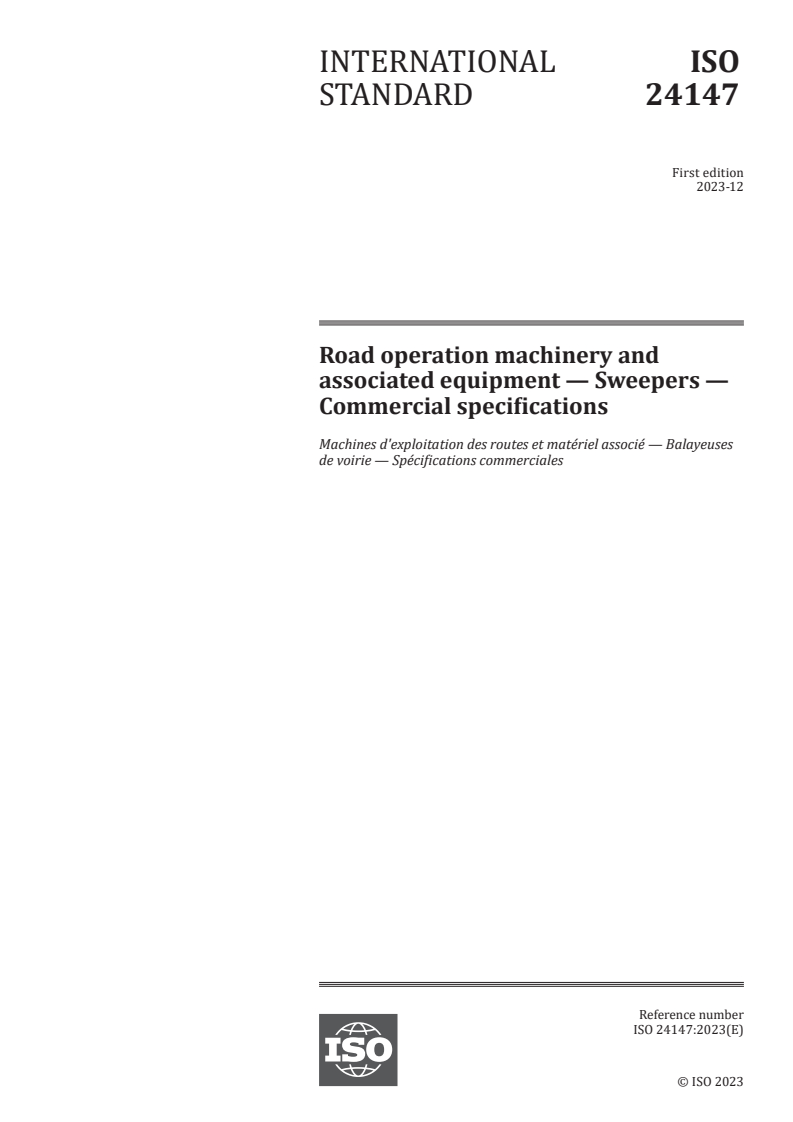
INTERNATIONAL ISO
STANDARD 24147
First edition
2023-12
Road operation machinery and
associated equipment — Sweepers —
Commercial specifications
Machines d'exploitation des routes et matériel associé — Balayeuses
de voirie — Spécifications commerciales
Reference number
© ISO 2023
All rights reserved. Unless otherwise specified, or required in the context of its implementation, no part of this publication may
be reproduced or utilized otherwise in any form or by any means, electronic or mechanical, including photocopying, or posting on
the internet or an intranet, without prior written permission. Permission can be requested from either ISO at the address below
or ISO’s member body in the country of the requester.
ISO copyright office
CP 401 • Ch. de Blandonnet 8
CH-1214 Vernier, Geneva
Phone: +41 22 749 01 11
Email: copyright@iso.org
Website: www.iso.org
Published in Switzerland
ii
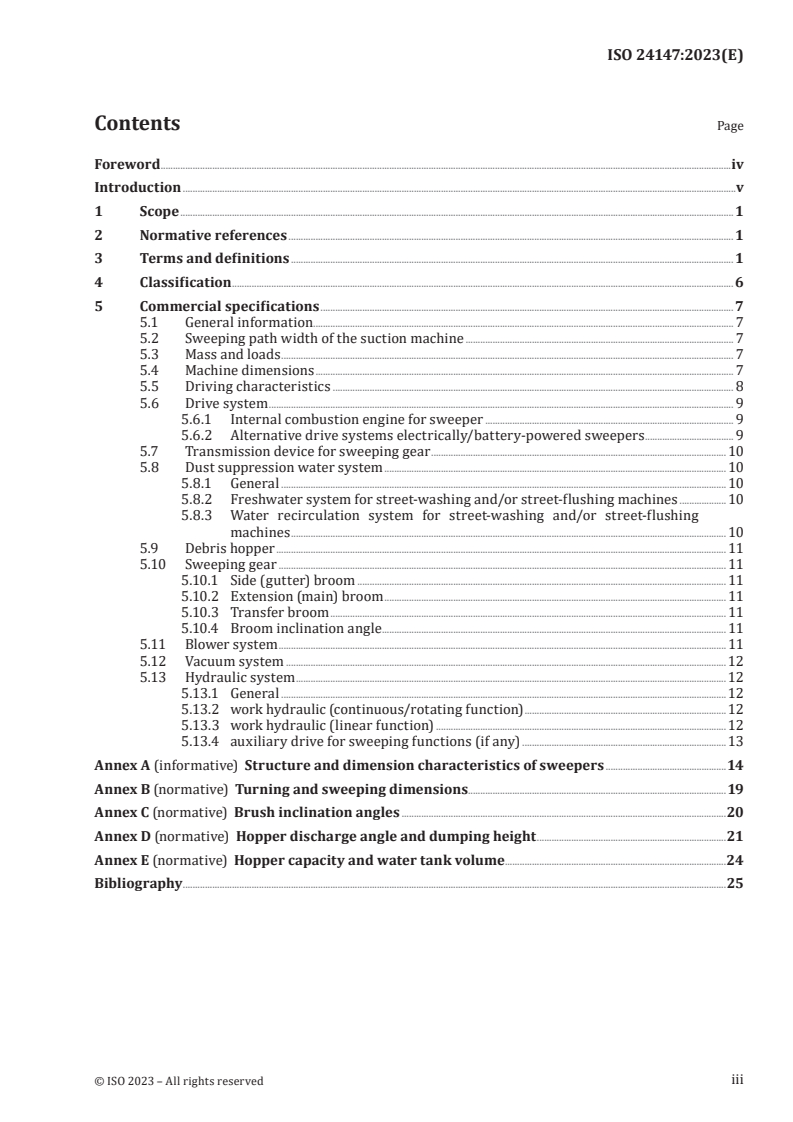
Contents Page
Foreword .iv
Introduction .v
1 Scope . 1
2 Normative references . 1
3 Terms and definitions . 1
4 Classification . 6
5 Commercial specifications . 7
5.1 General information. 7
5.2 Sweeping path width of the suction machine . 7
5.3 Mass and loads . 7
5.4 Machine dimensions . 7
5.5 Driving characteristics . 8
5.6 Drive system . 9
5.6.1 Internal combustion engine for sweeper . 9
5.6.2 Alternative drive systems electrically/battery-powered sweepers . 9
5.7 Transmission device for sweeping gear . 10
5.8 Dust suppression water system . 10
5.8.1 General . 10
5.8.2 Freshwater system for street-washing and/or street-flushing machines . 10
5.8.3 Water recirculation system for street-washing and/or street-flushing
machines . 10
5.9 Debris hopper . 11
5.10 Sweeping gear . 11
5.10.1 Side (gutter) broom . 11
5.10.2 Extension (main) broom . 11
5.10.3 Transfer broom . 11
5.10.4 Broom inclination angle . . 11
5.11 Blower system . 11
5.12 Vacuum system .12
5.13 Hydraulic system .12
5.13.1 General .12
5.13.2 work hydraulic (continuous/rotating function) .12
5.13.3 work hydraulic (linear function) .12
5.13.4 auxiliary drive for sweeping functions (if any) .13
Annex A (informative) Structure and dimension characteristics of sweepers .14
Annex B (normative) Turning and sweeping dimensions .19
Annex C (normative) Brush inclination angles .20
Annex D (normative) Hopper discharge angle and dumping height .21
Annex E (normative) Hopper capacity and water tank volume .24
Bibliography .25
iii
Foreword
ISO (the International Organization for Standardization) is a worldwide federation of national standards
bodies (ISO member bodies). The work of preparing International Standards is normally carried out
through ISO technical committees. Each member body interested in a subject for which a technical
committee has been established has the right to be represented on that committee. International
organizations, governmental and non-governmental, in liaison with ISO, also take part in the work.
ISO collaborates closely with the International Electrotechnical Commission (IEC) on all matters of
electrotechnical standardization.
The procedures used to develop this document and those intended for its further maintenance are
described in the ISO/IEC Directives, Part 1. In particular, the different approval criteria needed for the
different types of ISO document should be noted. This document was drafted in accordance with the
editorial rules of the ISO/IEC Directives, Part 2 (see www.iso.org/directives).
ISO draws attention to the possibility that the implementation of this document may involve the use
of (a) patent(s). ISO takes no position concerning the evidence, validity or applicability of any claimed
patent rights in respect thereof. As of the date of publication of this document, ISO had not received
notice of (a) patent(s) which may be required to implement this document. However, implementers are
cautioned that this may not represent the latest information, which may be obtained from the patent
database available at www.iso.org/patents. ISO shall not be held responsible for identifying any or all
such patent rights.
Any trade name used in this document is information given for the convenience of users and does not
constitute an endorsement.
For an explanation of the voluntary nature of standards, the meaning of ISO specific terms and
expressions related to conformity assessment, as well as information about ISO's adherence to
the World Trade Organization (WTO) principles in the Technical Barriers to Trade (TBT), see
www.iso.org/iso/foreword.html.
This document was prepared by Technical Committee ISO/TC 195, Building construction machinery and
equipment, Subcommittee SC 2, Road operation machinery and associated equipment.
Any feedback or questions on this document should be directed to the user’s national standards body. A
complete listing of these bodies can be found at www.iso.org/members.html.
iv
Introduction
This document defines commercial specifications for road surface cleaning machines which are designed
to clean debris from improved road and pavement surfaces. These machines are typically equipped
with a pick-up system and can convey the spoil into the hopper which can be then be discharged at a
dumping ground, unload station, in a debris container or refuse reload stations. Road surface cleaning
machines are equipped with sweep gear to scarify debris.
Chassis-mounted sweepers typically have a large capacity hopper and are designed to operate on
streets, highways, airports and large vehicle parking areas (i.e. traffic areas) or industrial plants where
a larger volume of debris needs to be swept.
Self-propelled sweepers and pedestrian-controlled sweepers typically have a lesser capacity hopper
and, by design, are more manoeuvrable to clean debris from narrow streets, pedestrian zones or small
parking lots.
Towed sweepers (e.g. towed by a tractor or other vehicle) can be used for similar applications as
mentioned above.
Additional equipment for special cleaning applications can also be attached to a sweeper.
v
INTERNATIONAL STANDARD ISO 24147:2023(E)
Road operation machinery and associated equipment —
Sweepers — Commercial specifications
1 Scope
This document establishes content for commercial specifications for sweepers that are self-propelled
(see Annex A) with an integrated chassis, chassis-mounted, pedestrian-controlled or towed behind a
vehicle.
This document applies to road surface cleaning machines used in outdoor improved surface applications
for cleaning debris from public areas, roads, airports and industrial plants. This document does not
specifically cover the carrier vehicle or towing vehicle (e.g. lorry).
This document does not apply to:
— cleaning machines for winter maintenance;
— cleaning machines for indoor applications;
— rotary road brush attachments which can be coupled to tractors and other machinery;
— machines or components that are specifically designed for cleaning tram lines and rail tracks;
— industrial sweepers.
2 Normative references
The following documents are referred to in the text in such a way that some or all of their content
constitutes requirements of this document. For dated references, only the edition cited applies. For
undated references, the latest edition of the referenced document (including any amendments) applies.
ISO 22242, Road construction and road maintenance machinery and equipment — Basic types —
Identification and description
ISO 14396, Reciprocating internal combustion engines — Determination and method for the measurement
of engine power — Additional requirements for exhaust emission tests in accordance with ISO 8178
3 Terms and definitions
For the purposes of this document, the terms and definitions given in ISO 22242 and the following apply.
ISO and IEC maintain terminology databases for use in standardization at the following addresses:
— ISO Online browsing platform: available at https:// www .iso .org/ obp
— IEC Electropedia: available at https:// www .electropedia .org/
3.1
road surface cleaning machine
sweeper
machine designed for cleaning debris from improved surfaces
Note 1 to entry: Road surface cleaning machines can move debris to a hopper (3.3) or other type of disposal
container which is attached to the machine by mechanical or pneumatic means, or by combination of each.
Note 2 to entry: Combinations of these types of road surface cleaning machines are possible.
3.1.1
chassis-mounted sweeper
sweeper (3.1), where the sweeping attachments are fixed or mounted on a carrier vehicle chassis
EXAMPLE Truck.
Note 1 to entry: Chassis-mounted sweepers are classified as large or small depending on the net volume capacity.
Note 2 to entry: See Table 1.
3.1.2
self-propelled sweeper
sweeper (3.1) with a specially designed chassis, where the sweeping attachments are integrated
Note 1 to entry: This machine can be a ride-on machine, operator-assisted machine or pedestrian-controlled
machine fitted with a seat or a sulky. See Figures A.1 to A.3 for further information.
Note 2 to entry: Self-propelled sweepers are categorized as maxi-compact, compact, midi-compact, or mini-
compact depending on the net volume capacity.
Note 3 to entry: See Figures A.1 to A.6.
3.1.3
mechanical sweeper
machine whereby debris collected by a sweeping gear (3.4) from the road surface is transported and
deposited into the hopper (3.3) by means of a mechanical device
EXAMPLE A conveyor system is used.
Note 1 to entry: See Figure A.4.
3.1.4
vacuum sweeper
machine whereby debris collected by a sweeping gear (3.4) from the road surface is transported and
deposited into the hopper (3.3) by means of air movement, provided by an impeller or a fan, with the air
subsequently ventilated to atmosphere
Note 1 to entry: See Figure A.6.
3.1.5
regenerative air sweeper
machine whereby debris collected by a sweeping gear (3.4) from the road surface is transported and
deposited into the hopper (3.3) by means of air movement, provided by an impeller or a fan, with the air
recirculating back to the pick-up device
Note 1 to entry: See Figure A.5.
3.1.6
street-washing machine
machine that deposits water under pressure onto the road surface from an onboard water tank
3.1.7
street-flushing machine
machine that deposits water without pressure onto the road from an onboard water tank
3.1.8
suction machine
machine whereby debris collected from the road surface by an air suction system with pickup heads is
transported and deposited into the hopper (3.3) by means of air movement, provided by an impeller or
a fan
3.1.9
towed sweeper
sweeper (3.1) with a sweeping gear (3.4) with or without a collecting system
EXAMPLE Trailer sweeper as shown in Figure A.8.
3.1.10
pedestrian-controlled sweeper
self-propelled sweeper (3.1.2) normally controlled by the operator walking with the unit
Note 1 to entry: See Figure A.7.
3.2
traffic area
paved area in which there is vehicular and or pedestrian traffic
Note 1 to entry: Not included are railway tracks, which are solely for rail-mounted traffic, as well as traffic areas
inside buildings and underground.
3.3
hopper
container to collect debris
3.4
sweeping gear
gear that transports road debris to the pick-up location of the sweeper (3.1)
Note 1 to entry: Sweeping gear is the collective name for all components such as broom(s) (3.5) and related
control systems.
3.5
broom
brush
device with bristles that rotates to move debris
Note 1 to entry: Broom(s) can be of various types and be used in various configurations. Rotation axis of broom(s)
can be horizontal or vertical.
3.6
water recirculation system
system which allows water to return to the sweeping process after separating debris, e.g. by filters or
sieves and, in some cases, by a separator
3.7
debris pick-up system
air suction system with pick-up heads, tubes, hoses and fan system or mechanical pick-up system with
broom(s) (3.5) and conveyer belts with any hybrid system in between to transport the debris into the
hopper (3.3)
Note 1 to entry: See Figure E.1.
Note 2 to entry: The debris pick-up system can either be an air suction system or a mechanical pick-up system
with broom(s) and conveyer belts.
3.8
shipping mass
SM
mass of the sweeper (3.1) without an operator, with the fuel level at 10 % of tank capacity or with the
minimum fuel level needed for machine shipping purposes as specified by the manufacturer, whichever
is higher, with all fluid systems at the levels specified by the manufacturer and with empty water
tank(s), when applicable, and with or without equipment, attachment(s) as stated by the manufacturer
Note 1 to entry: If the manufacturer intends that the machine be partially disassembled for shipping purposes,
the masses of the disassembled items are also be stated and included in any transportation skid (e.g. wooden
pallets) and protective packaging.
3.9
gross volume capacity of the hopper
total inner volume of the hopper (3.3)
Note 1 to entry: See Figure E.1.
Note 2 to entry: The volume is measured by calculation by determining the inner volume below the screen (if not
fitted, then up to roof le
...