


ISO 78-2:1982
(Main)Layouts for standards — Part 2: Standard for chemical analysis
Layouts for standards — Part 2: Standard for chemical analysis
Plans de normes — Partie 2: Norme d'analyse chimique
General Information
- Status
- Withdrawn
- Publication Date
- 31-Mar-1982
- Withdrawal Date
- 31-Mar-1982
- Technical Committee
- ISO/TC 47 - Chemistry
- Drafting Committee
- ISO/TC 47 - Chemistry
- Current Stage
- 9599 - Withdrawal of International Standard
- Start Date
- 04-Mar-1999
- Completion Date
- 12-Feb-2026
Relations
- Effective Date
- 15-Apr-2008
Get Certified
Connect with accredited certification bodies for this standard

ECOCERT
Organic and sustainability certification.

Eurofins Food Testing Global
Global leader in food, environment, and pharmaceutical product testing.

Intertek Bangladesh
Intertek certification and testing services in Bangladesh.
Sponsored listings
Frequently Asked Questions
ISO 78-2:1982 is a standard published by the International Organization for Standardization (ISO). Its full title is "Layouts for standards — Part 2: Standard for chemical analysis". This standard covers: Layouts for standards — Part 2: Standard for chemical analysis
Layouts for standards — Part 2: Standard for chemical analysis
ISO 78-2:1982 is classified under the following ICS (International Classification for Standards) categories: 71.040.40 - Chemical analysis. The ICS classification helps identify the subject area and facilitates finding related standards.
ISO 78-2:1982 has the following relationships with other standards: It is inter standard links to ISO 78-2:1999. Understanding these relationships helps ensure you are using the most current and applicable version of the standard.
ISO 78-2:1982 is available in PDF format for immediate download after purchase. The document can be added to your cart and obtained through the secure checkout process. Digital delivery ensures instant access to the complete standard document.
Standards Content (Sample)
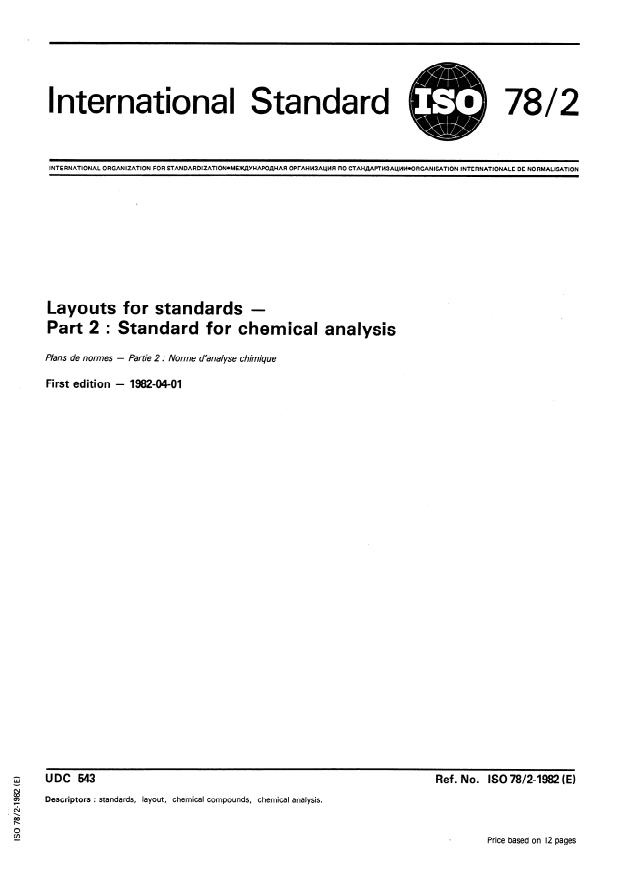
International Standard
INTERNATIONAL ORGANIZATION FOR STANDARDlZATIONWlE)KLLYHAPO~HAfl OPTAHH3AlJMR fl0 CTAH&WTb’l3A~MM.ORGANlSATlON INTERNATIONALE DE NORMALISATION
Layouts for standards -
Part 2 : Standard for chemical analysis
Plans de normes - Partie 2 : Norme d’analyse chimique
First edition - 1982-04-01
UDC 543 Ref. No. IS0 78/2-1982 (E)
Descriptors : standards, layout, chemical compounds, chemical analysis.
Price based on 12 pages
Foreword
IS0 (the International Organization for Standardization) is a worldwide federation of
national standards institutes (IS0 member bodies). The work of developing lnter-
national Standards is carried out through IS0 technical committees. Every member
body interested in a subject for which a technical committee has been set up has the
right to be represented on that committee. International organizations, governmental
and non-governmental, in liaison with ISO, also take part in the work.
Draft International Standards adopted by the technical committees are circulated to
the member bodies for approval before their acceptance as International Standards by
the IS0 Council.
International Standard IS0 78/2 was developed by Technical Committee ISO/TC 47,
Chemistry.
This first edition was submitted directly to the IS0 Council, in accordance with clause
5.10.1 of part 1 of the Directives for the technical work of ISO. It cancels and replaces
pages 11 to 23 of IS0 Recommendation R 78-1969, which had been approved by the
member bodies of the following countries :
Australia South Africa, Rep. of
Hungary
Austria Iran Spain
Belgium
Israel Switzerland
Brazil Italy Thailand
Cuba
Netherlands Turkey
Czechoslovakia United Kingdom
New Zealand
Egypt, Arab Rep. of Poland USA
France Portugal USSR
Germany, F. R.
Romania
The member body of the fol lowing country had expressed disapproval of the docu-
ment on technical grounds :
India
It also cancels and replaces IS0 Guide 181978.
0 International Organization for Standardization, 1982
Printed in Switzerland
IS0 78/24982 (El
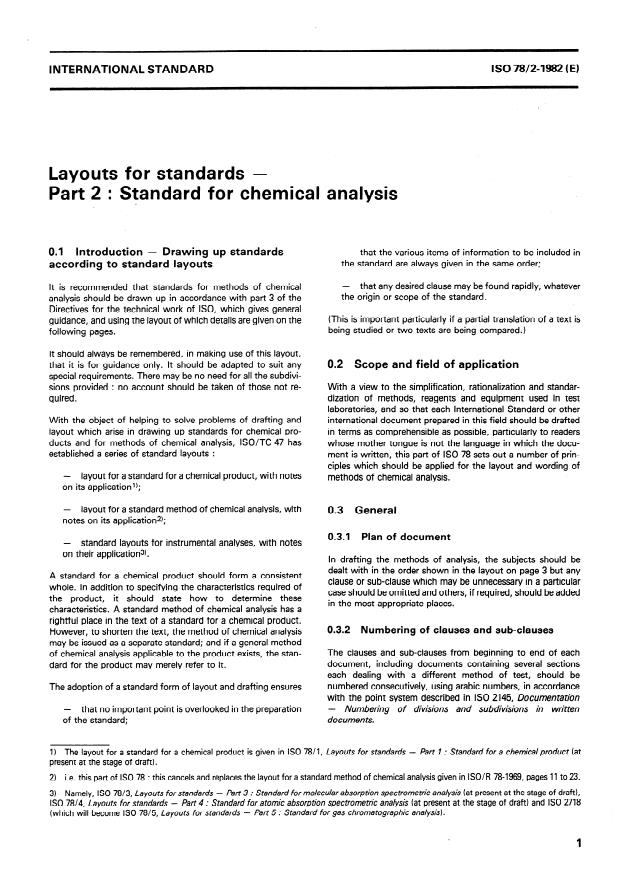
INTERNATIONAL STANDARD
Layouts for standards -
Part 2 3: Standard for chemical analysis
-
0.1 Introduction - Drawing up standards that the various items of information to be included in
the standard are always given in the same order;
according to standard layouts
-
that any desired clause may be found rapidly, whatever
It is recommended that standards for methods of chemical
the origin or scope of the standard.
analysis should be drawn up in accordance with part 3 of the
Directives for the technical work of ISO, which gives general
(This is important particularly if a partial translation of a text is
guidance, and using the layout of which details are given on the
being studied or two texts are being compared.)
following pages.
It should always be remembered, in making use of this layout,
that it is for guidance only. It should be adapted to suit any 0.2 Scope and field of application
special requirements. There may be no need for all the subdivi-
sions provided : no account should be taken of those not re- With a view to the simplification, rationalization and standar-
quired. dization of methods, reagents and equipment used in test
laboratories, and so that each International Standard or other
With the object of helping to solve problems of drafting and international document prepared in this field should be drafted
layout which arise in drawing up standards for chemical pro- in terms as comprehensible as possible, particularly to readers
ducts and for methods of chemical analysis, ISO/TC 47 has
whose mother tongue is not the language in which the docu-
established a series of standard layouts :
ment is written, this part of IS0 78 sets out a number of prin-
ciples which should be applied for the layout and wording of
- layout for a standard for a chemical product, with notes
methods of chemical analysis.
on its applicationl);
- layout for a standard method of chemical analysis, with
0.3 General
notes on its application*);
0.3.1 Plan of document
-
standard layouts for instrumental analyses, with notes
on their application?
In drafting the methods of analysis, the subjects should be
dealt with in the order shown in the layout on page 3 but any
A standard for a chemical product should form a consistent
clause or sub-clause which may be unnecessary in a particular
whole. In addition to specifying the characteristics required of
case should be omitted and others, if required, should be added
the product, it should state how to determine these
in the most appropriate places.
characteristics. A standard method of chemical analysis has a
rightful place in the text of a standard for a chemical product.
0.3.2 Numbering of clauses and sub-clauses
However, to shorten the text, the method of chemical analysis
may be issued as a separate standard; and if a general method
The clauses and sub-clauses from beginning to end of each
of chemical analysis applicable to the product exists, the stan-
document, including documents containing several sections
dard for the product may merely refer to it.
each dealing with a different method of test, should be
numbered consecutively, using arabic numbers, in accordance
The adoption of a standard form of layout and drafting ensures
with the point system described in IS0 2145, Documentation
-
that no important point is overlooked in the preparation - Numbering of divisions and subdivisions in written
of the standard; documents.
1) The layout for a standard for a chemical product is given in IS0 78/l, Lay~ts for standards - Part I : Standard for a chemical product (at
present at the stage of draft).
2) i.e. this part of IS0 78 : this cancels and replaces the layout for a standard method of chemical analysis given in ISO/R 78-1969, pages 11 to 23.
3) Namely, IS0 7813, Layouts for standards - Part 3 : Standard for molecular absorption spectrometric analysis (at present at the stage of draft),
IS0 7814, Layouts for standards - Part 4 : Standard for atomic absorption spectrometric analysis (at present at the stage of draft) and IS0 2718
Part 5 : Standard for gas chromatographic analysis).
(which will become IS0 78/5, Layouts for standards -
IS0 78/2-1982 (El
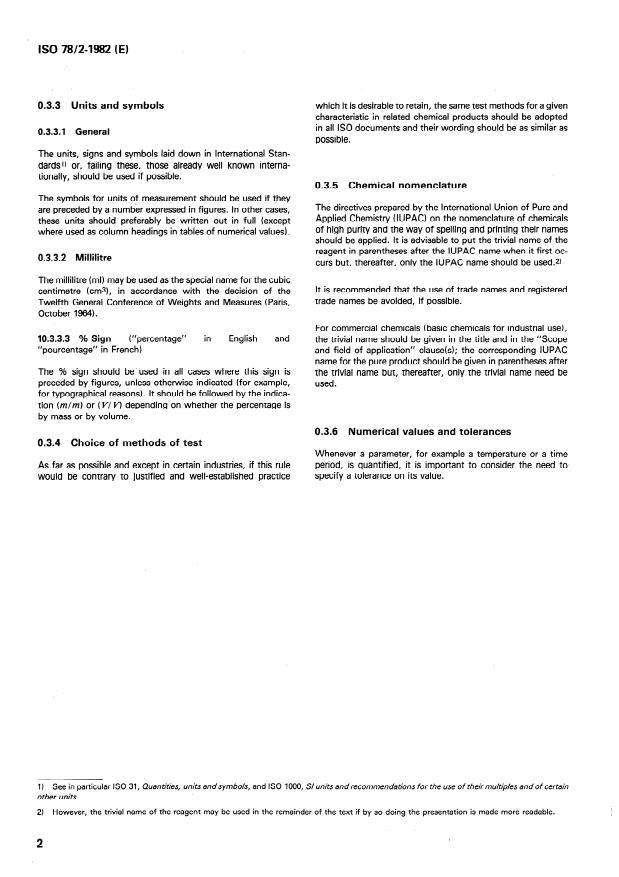
0.3.3 Units and symbols which it is desirable to retain, the same test methods for a given
characteristic in related chemical products should be adopted
in all IS0 documents and their wording should be as similar as
0.3.3.1 General
possible.
The units, signs and symbols laid down in International Stan-
dards’) or, failing these, those already well known interna-
tionally, should be used if possible.
0.3.5 Chemical nomenclature
The symbols for units of measurement should be used if they
The directives prepared by the International Union of Pure and
are preceded by a numb& expressed in figures. In other cases,
Applied Chemistry (IUPAC) on the nomenclature of chemicals
these units should preferably be written out in full (except
of high purity and the way of spelling and printing their names
where used as column headings in tables of numerical values).
should be applied. It is advisable to put the trivial name of the
reagent in parentheses after the IUPAC name when it first oc-
0.3.3.2 Mitlilitre
curs but, thereafter, only the IUPAC name should be used3
The millilitre (ml) may be used as the special name for the cubic
It is recommended that the use of trade names and registered
centimetre (ems), in accordance with the decision of the
trade names be avoided, if possible.
Twelfth General Conference of Weights and Measures (Paris,
October 1964).
For commercial chemicals (basic chemicals for industrial use),
10.3.3.3 % Sign (“percentage” in English and
the trivial name should be given in the title and in the “Scope
“pourcentage” in French) and field of application” clause(s); the corresponding IUPAC
name for the pure product should be given in parentheses after
The % sign should be’ used in all cases where this sign is
the trivial name but, thereafter, only the trivial name need be
preceded by figures, unless otherwise indicated (for example,
used.
for typographical reasons). It should be followed by the indica-
tion (m/m) or (V/ v) depending on whether the percentage is
by mass or by volume.
0.3.6 Numerical values and tolerances
0.3.4 Choice of methods of test
Whenever a parameter, for example a temperature or a time
period, is quantified, it is important to consider the need to.
As far as possible and except in certain industries, if this rule
justified and well-established practice specify a tolerance on its value.
would be contrary to
1) See in particular IS0 31, Quantities, units and symbols, and IS0 1000, Sl units and recommendations for the use of their mu/tip/es and of certain
0 ther units.
However, the trivial name of the reagent may be used in the remainder of the text if by so doing the presentation is made more readable.
2)
a
ISO78/2-1982 (El
Preferred order for the layout
bee 0.3.1)
For comments
see clause
Title
Warning and safety precautions
introduction
Scope
Field of application
References
Definitions
Principle
Reactions
Reagents and materials
Numbered
Apparatus
clauses
Sampling and samples
Procedure
Expression of results
Special cases
Notes on procedure
Test report
Schematic representation of procedure
Bibliography
Annexes
IS0 78/2-1982 0
Notes on the application of the layout for a standard method of
chemical analysis
1 Title If interferences arise in a method, they should be mentioned in
this sub-clause. If it is necessary to provide for modifications to
The title of the document should express concisely and without the basic method, for instance to ensure the elimination of cer-
ambiguity the products to which the method of test applies, the tain interfering factors, these modifications should be treated
constituent or the characteristic to be determined and the as special cases. These special cases should be indicated in the
nature of the determination. “Field of application” clause and the corresponding modifica-
tions should be described in the “Special cases” clause.
Example :
NOTES
Sodium hexa fluorosilica te for industrial use - Determination
of iron content - I, I@Phenanthroline spectrometric method.
1 It is sometimes necessary to provide several methods for the deter-
mination of a given component, depending, for example, on the com-
position of the product or on its differing contents of that component,
or the accuracy required, each method having its own field of applica-
2 Warning and safety precautions
tion. A clear distinction should be drawn between the individual fields
of application of the methods laid down if the document includes
If the product being analysed or the reagents or the procedure
several methods.
are dangerous, it is essential to draw attention to the hazards
and to describe the precautions necessary to avoid them. This 2 In simple cases, it may be preferable to amalgamate the clauses
“Scope”and “Field of application” into a single clause entitled “Scope
information should be printed in capital letters or in bold type
and field of application”.
-
immediately after the title of the standard if the danger
to be encountered is due to the product being analysed;
-
6 References
after the name of the reagent of material if the danger
to be encountered is d ue to a particular reagent or material;
This clause should give a list of IS0 documents which are
-
as stated in 13.1 if the danger to be encou ntered is due
necessary for the application of the International Standard.
to the proced ure.
NOTE - Documents which have merely served as references in the
This part of the text should not be numbered.
preparation of the standard should be indicated in the “Bibliography”
clause or mentioned in the “Introduction” clause.
3 Introduction
7 Definitions
information on the method is required, it should be
If special
included in this clause, which is given the number zero (0).
This clause should give any definitions of terms used in the text
that may be necessary for its complete understanding.
4 Scope
This clause of the document should state succinctly the
8 Principle
method of analysis of test and specifically the products to
which it applies.
This clause should indicate the essential steps of the method
used (preferably using substantive phrases), the basic prin-
It should contain any additional, useful, information which
ciples and the properties of which use is made and, if ap-
could not be included i n the title.
propriate, the reasons justifying the choice of certain pro-
cedures.
5 Field of application
9 Reactions
This clause should contain sufficient information to enable the
user to judge quickly whether the standard is applicable to the
This clause should indicate the essential reactions, if they are
products being considered, or whether limitations exist.
considered necessary for the comprehension of the text or the
calculations. These reactions should, if appropriate, be ex-
It should contain an indication of the products to which the
pressed in ionic form.
method of analysis applies and the limits of contents between
which the method can be used without alteration.
The reactions are given only for guidance and do not claim to
settle any controversial questions. They justify the calculations
These limits should take into account the presence of the other
components of the product or products in question and of their made from the data obtained in the determinations and may
own limiting contents. lead to a better understanding of the method, especially if
IS0 7812-1982 (E)
several successive changes occur in the state of oxidation of cedure” clause after the name of the reagent or material, it is
the element being determined.
possible, by referring back to the “Reagents and materials”
I -
clause, to avoid repeating all the characteristics of the reagent
Any additional information required should be given either in a
or material in question and thus to keep the text short. It is not,
note to this clause or in the clause “Notes on procedure”.
however, necessary to repeat this reference every time if no
ambiguity is introduced.
10 Reagents and materials
10.2 Products used in their commercially available
form
10.1 General -
In the list of reagents and materials, products used in their com-
The title of this clause should be “Reagents” or “Materials” or
mercially available form should be described unambiguously,
“Reagents and materials”, as appropriate. This clause should
giving the particulars necessary for their identification (for ex-
begin, if applicable with the following sentence :
ample, the chemical formula, concentration, etc.) and, for solid
products in particular, the presence of any water or crystalliza-
“During the analysis, unless otherwise stated, use only
tion.
reagents of recognized analytical grade and only distilled water
or water of equivalent purity.”
10.3 Aqueous solutions
It should give the list of all the reagents and materials used dur-
ing the test, together with their essential characteristics (con-
In the list of reagents and materials, solutions for which the sol-
centration, density 11, etc.) and should specify, if necessary,
vent is not specified are aqueous by convention. The use of the
their degree of purity in relation to their specific use. The list
term “aqueous” in the list is superfluous.
should not include products used only in the preparation of
these reagents.
If necessary, the precautions to be taken for storing the 10.4 Solutions with defined concentration
reagents, and the time for which they may be stored, should be
If a solution has to be prepared to a concentration specified on
specified.
a volume by volume or mass by volume basis, the temperature
If a standard volumetric solution or other standard solution is at which the volume or volumes are measured should be given
wherever measurement at ambient temperature would have a
called for, its preparation and, if necessary, its standardization
significant effect on the accuracy of the determination.
should be described in this clause. In other cases, these par-
ticulars are not necessary, but if general methods for the
The following equivalent terms in the official IS0 languages
preparation and checking of certain reagents used are the sub-
[English, French (F) and Russian (RI1 should be used.
ject of an International Standard, a reference to the latter
should be made.
10.4.1 Standard volumetric solution
If the absence of an interfering component in the reagents has
to be verified, the details of the tests to be used for this purpose
F : Solution tit&e
should be given.
R : TMTpOBaHHblk PaCTBOp
It is desirable to draw up this clause in the following systematic
order :
10.4.1 .l Definition
- products (excluding solutions) used in their commer-
Solution for titrimetric analysis, the concentration of which is
cially available form;
defined accurately.
-
solutions or suspensions (excluding standard
volumetric solutions and standard solutions), with their ap-
10.4.1.2 Expression of concentration
proximate concentrations stated;
The concentrations of these solutions should be expressed as
-
standard volumetric solutions and standard solutions;
amount-of-substance (molar) concentrations with the unit
mole per cubic metre (moVm3) or mole per litre (mol/W. The
-
indicators;
concentration shall be represented either by a whole number
(for example, 2 mol/m3, 1 mol/l) or by a decimal number (for
-
auxiliary materials (drying agents, etc. 1. example, 0,06 moVm3, 0,l mol/l). In certain cases, the con-
centration of the solutions may be expressed as mass concen-
The reagents and materials should be identified by a serial
trations, in which case the unit may be, for example, grams per
number. By showing this number, in parentheses, in the “Pro- millilitre (g/ml).
density (symbol Q) : Quotient of the mass by the volume. (See IS0 31/3, Quantities and units of mechanics.)
1)
Throughout the rest of this document, only the unit mole per litre (mol/l) is used.
2)
IS0 78/2-1982 0
or 2 N, that is containing 472,08 g of mer-
The amount-of-substance concentration of component B
cury(l) chloride per litre. The elementary en-
(symbol ce) is defined as the amount of substance of compo-
tity is the molecule of mercury(l) chloride.
nent B divided by the volume of the mixture. (See IS0 31/8,
Quantities and units of physical chemistry and molecular
= 1 mol/l is the molar concentration cor-
physics. 1 c(Hg;+)
responding to that hitherto described as 1 M
substance is the mole, defined as or 2 N, that is containing 401,18 g of the
The base SI unit of amount of
follows : mercury(I) cation per litre. The elementary
entity is the mercury(l) cation.
The mole is the amount of substances of a system which
contains as many elementary entities as there are atoms in cW2 Ca2+) = 1 mol/l is the molar concentration cor-
responding to that hitherto described as 1 N,
0,012 kg of carbon 12. When the mole is used, the elemen-
tary entities must be specified and may be atoms, that is containing 20,04 g of the calcium
cation per litre. The elementary entity is the
molecules, ions, electrons, other particles, or specified
half-cation of calcium.
groups of such particles.
Hitherto, the terms normality and molarity (symbols N and M
Thus, when using the molar concentration (amount-of-
respectively) were used in this context, and the corresponding
substance concentration) the elementary entity must be
expressions in these terms are shown above.
specified.
Examples :
10.4.2 Standard reference solution
=
1 mol/l is the molar concentration cor-
c(NaOH)
F : Solution etalon de reference
responding to that hitherto described as 1 N,
that is containing 40 g of sodium hydroxide
R : 06pa3qOBbli;l PaCTBOp
per Iitre. The elementary entity is the
molecule of sodium hydroxide.
10.4.2.1 Definition
3 mol/l is the molar concentration cor-
cdl/2 H2S04) =
Solution used as a reference solution for standardizing other
responding to that hitherto described as 3 N,
solutions. It is either prepared from a primary standard or stan-
that is containing 3 x 49 g of sulphuric acid
dardized by some other means.
per litre. The elementary entity is the half-
molecule of sulphuric acid.
10.4.2.2 Expression of concentration
c(H2S04) = 1,5 mol/l is the molar concentration cor-
The concentrations of these solutions should be expressed in
responding to that hitherto described as 3 N,
the same way as those of standard volumetric solutions
that is containing 1,5 x 98 g of sulphuric
(10.4.1).
acid per litre. The elementary entity is the
molecule of sulphuric acid.
10.4.3 Standard solution
c(HZS04) = 1 mol/l is the molar concentration cor-
responding to that hitherto described as 1 M
F : Solution etalon
or 2 N, that is containing 98 g of sulphuric
R : 3TiUlOHHblL;1 PaCTBOp
acid per litre. The elementary entity is the
molecule of sulphuric acid.
10.4.3.1 Definition
c(l/5 KMnOJ = 0,l mol/l is the molar concentration cor-
Solution of accurately known concentration of an element, an
responding to that hitherto described as
ion, a compound or a group derived from the product used for
0,l N, in the case of reaction in acid
its preparation.
medium, that is containing 3,16 g of
potassium permanganate per litre. The
elementary entity is the one-fifth-molecule of 10.4.3.2 Expression of concentration
‘potassium permanganate.
The concentrations of these solutions should be expressed in
=
c(HgCl) 1 mol/l is the molar concentration cor-
grams per litre or in sub-multiples of this unit.
responding to that hitherto described as 1 N,
that is containing 236,04 g of mercury(l)
chloride per litre. The elementary entity is the
10.4.4 Standard matching solutionl)
half-molecule of mercury(l) chloride.
F : Solution temoin
1 mol/l is the molar concentration cor-
c( Hg2C12) =
R : KOHTPOJI bHblti PaCTBOp
responding to that hitherto described as 1 M
be more precisely by the appropriate adjec-
This English term is used solely as a generic term for these solutions and each solution
1)
calorimetric solution”, “standard turbidimetric solution”).
tive (for example, “standard
.
...
Questions, Comments and Discussion
Ask us and Technical Secretary will try to provide an answer. You can facilitate discussion about the standard in here.
Loading comments...