

ISO 7431-2:2024
(Main)Thiourea for industrial use — Part 2: Specifications
General Information
- Abstract
This document specifies requirements for three classes, marking, package, transport and storage of thiourea for industrial purpose. The different types of thiourea specified are defined according to their content, application, and requirements (see Table 1).
- Status
- Published
- Publication Date
- 11-Jan-2024
- Technical Committee
- ISO/TC 47 - Chemistry
- Drafting Committee
- ISO/TC 47 - Chemistry
- Current Stage
- 6060 - International Standard published
- Start Date
- 12-Jan-2024
- Due Date
- 09-Jul-2024
- Completion Date
- 12-Jan-2024
Overview
ISO 7431-2:2024 specifies detailed requirements and specifications for thiourea used in industrial applications. This international standard defines three distinct classes of thiourea based on purity and content suitable for various industrial uses. It also covers marking, packaging, transport, and storage practices to ensure safety, quality, and compliance with regulatory guidelines.
Thiourea (CAS No. 62-56-6) is a white crystalline powder widely used in manufacturing pharmaceuticals, dyes, resins, rubber vulcanization accelerators, and flotation agents for metallurgical processes. This standard ensures consistent quality and safety practices for users handling thiourea in different industrial sectors.
Key Topics
Classification and Quality Requirements
- Defines Class I, Class II, and Class III thiourea, each with specific purity and contaminant limits.
- Class I-high purity (>99.5%) for optical, electronic, and new energy materials.
- Class II and III-suitable for general chemical industries including printing, dyeing, pharmaceuticals, pesticides, and mineral processing.
Chemical and Physical Characteristics
- Purity standards including thiourea content, water-insoluble substances, ignition residue, melting point, turbidity, thiocyanate content, and allowable heavy metals.
- Visual inspection confirms the powder’s white crystalline appearance.
Marking and Labeling
- Mandatory information like product name, class, manufacturer details, lot number, weight, and reference to ISO 7431-2:2024.
- Includes specific hazard labeling covering toxicity and environmental risks according to the Globally Harmonized System (GHS).
Packaging, Transport, and Storage
- Requires double sealed packaging with chemically inert inner bags and robust outer containers.
- Storage conditions to maintain material integrity: cool, dry, ventilated environments, protection from sunlight, moisture, fire, and contamination.
Applications
Pharmaceutical Production
As an intermediate in drug manufacturing, high-grade Class I thiourea ensures purity critical for sensitive chemical syntheses.Dye and Resin Manufacturing
Widely used in creating colorants and resin precursors where controlled standardized chemical quality prevents defects.Rubber Industry
Functions as an efficient vulcanization accelerator improving rubber elasticity and durability.Mineral Processing
Applied as a flotation agent to extract valuable metals by selectively separating ore particles.Optical and Electronic Materials
Class I thiourea’s high purity supports innovations in optical fibers, electronics components, and new energy technologies.
Industrial users benefit from the standardized quality assurance that ISO 7431-2:2024 delivers, optimizing product performance while ensuring safety compliance.
Related Standards
- ISO 7431-1:2024, Thiourea for industrial use - Test methods, which details the analytical procedures for verifying quality characteristics of thiourea.
- ISO 780, Packaging - Graphical symbols for handling and storage, which includes standardized marking symbols used on thiourea packaging to indicate hazards and handling.
- United Nations GHS Rev. 9 (2021), Globally Harmonized System of Classification and Labelling of Chemicals, guiding classification of chemical hazards and label requirements.
These standards collectively support safe handling, consistent quality, and global trade compliance for industrial thiourea products.
Adhering to ISO 7431-2:2024 allows manufacturers, distributors, and users of thiourea to ensure product integrity, maintain workplace safety, and foster environmental responsibility in industrial applications. For comprehensive quality control and regulatory conformity, referencing this standard is essential in chemical industrial processes involving thiourea.
Get Certified
Connect with accredited certification bodies for this standard

ECOCERT
Organic and sustainability certification.

Eurofins Food Testing Global
Global leader in food, environment, and pharmaceutical product testing.

Intertek Bangladesh
Intertek certification and testing services in Bangladesh.
Sponsored listings
Frequently Asked Questions
ISO 7431-2:2024 is a standard published by the International Organization for Standardization (ISO). Its full title is "Thiourea for industrial use — Part 2: Specifications". This standard covers: This document specifies requirements for three classes, marking, package, transport and storage of thiourea for industrial purpose. The different types of thiourea specified are defined according to their content, application, and requirements (see Table 1).
This document specifies requirements for three classes, marking, package, transport and storage of thiourea for industrial purpose. The different types of thiourea specified are defined according to their content, application, and requirements (see Table 1).
ISO 7431-2:2024 is classified under the following ICS (International Classification for Standards) categories: 71.040.40 - Chemical analysis. The ICS classification helps identify the subject area and facilitates finding related standards.
ISO 7431-2:2024 is available in PDF format for immediate download after purchase. The document can be added to your cart and obtained through the secure checkout process. Digital delivery ensures instant access to the complete standard document.
Standards Content (Sample)
International
Standard
ISO 7431-2
First edition
Thiourea for industrial use —
2024-01
Part 2:
Specifications
Reference number
© ISO 2024
All rights reserved. Unless otherwise specified, or required in the context of its implementation, no part of this publication may
be reproduced or utilized otherwise in any form or by any means, electronic or mechanical, including photocopying, or posting on
the internet or an intranet, without prior written permission. Permission can be requested from either ISO at the address below
or ISO’s member body in the country of the requester.
ISO copyright office
CP 401 • Ch. de Blandonnet 8
CH-1214 Vernier, Geneva
Phone: +41 22 749 01 11
Email: copyright@iso.org
Website: www.iso.org
Published in Switzerland
ii
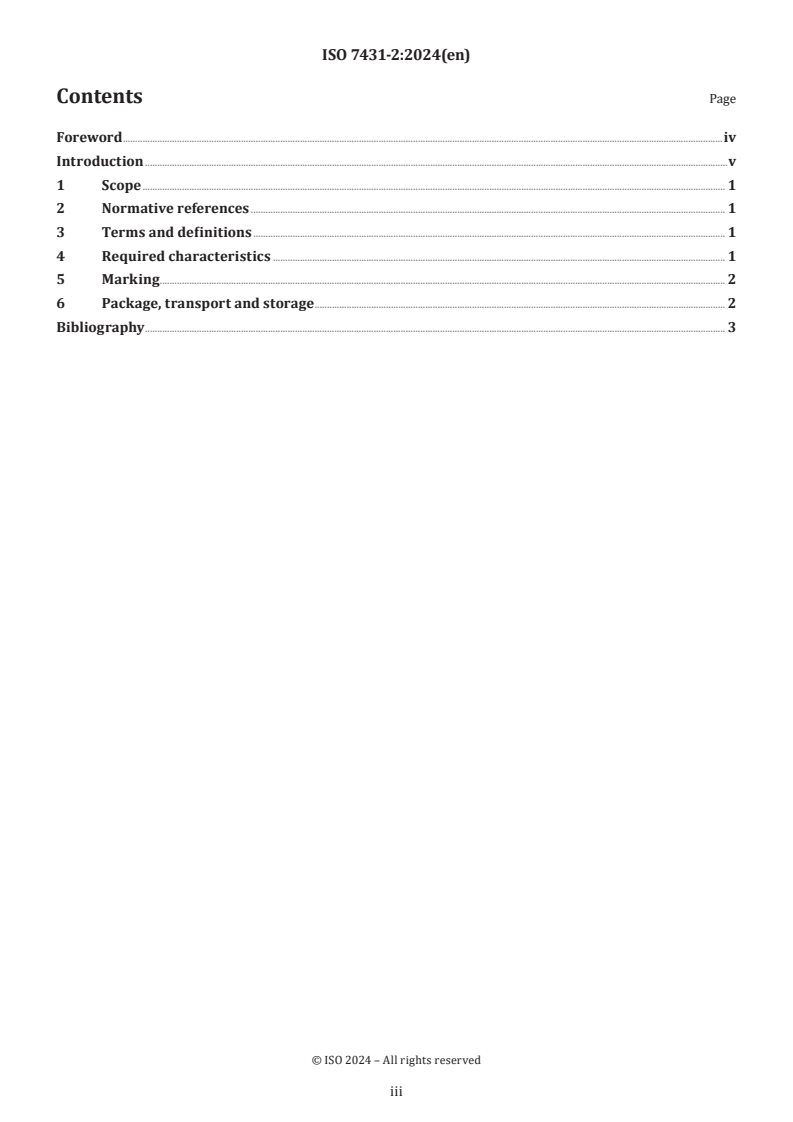
Contents Page
Foreword .iv
Introduction .v
1 Scope . 1
2 Normative references . 1
3 Terms and definitions . 1
4 Required characteristics . 1
5 Marking . . 2
6 Package, transport and storage . 2
Bibliography . 3
iii
Foreword
ISO (the International Organization for Standardization) is a worldwide federation of national standards
bodies (ISO member bodies). The work of preparing International Standards is normally carried out through
ISO technical committees. Each member body interested in a subject for which a technical committee
has been established has the right to be represented on that committee. International organizations,
governmental and non-governmental, in liaison with ISO, also take part in the work. ISO collaborates closely
with the International Electrotechnical Commission (IEC) on all matters of electrotechnical standardization.
The procedures used to develop this document and those intended for its further maintenance are described
in the ISO/IEC Directives, Part 1. In particular, the different approval criteria needed for the different types
of ISO documents should be noted. This document was drafted in accordance with the editorial rules of the
ISO/IEC Directives, Part 2 (see www.iso.org/directives).
ISO draws attention to the possibility that the implementation of this document may involve the use of (a)
patent(s). ISO takes no position concerning the evidence, validity or applicability of any claimed patent
rights in respect thereof. As of the date of publication of this document, ISO had not received notice of (a)
patent(s) which may be required to implement this document. However, implementers are cautioned that
this may not represent the latest information, which may be obtained from the patent database available at
www.iso.org/patents. ISO shall not be held responsible for identifying any or all such patent rights.
Any trade name used in this document is information given for the convenience of users and does not
constitute an endorsement.
For an explanation of the voluntary nature of standards, the meaning of ISO specific terms and expressions
related to conformity assessment, as well as information about ISO's adherence to the World Trade
Organization (WTO) principles in the Technical Barriers to Trade (TBT), see www.iso.org/iso/foreword.html.
This document was prepared by Technical Committee ISO/TC 47, Chemistry.
A list of all parts in the ISO 7431 series can be found on the ISO website.
Any feedback or questions on this document should be directed to the user’s nation
...