

ISO 22090-3:2014
(Main)Ships and marine technology — Transmitting heading devices (THDs) — Part 3: GNSS principles
General Information
- Abstract
ISO 22090-3:2014 specifies general requirements, construction, performance, and testing of transmitting heading device using GNSS principle as required by chapter V, SOLAS 1974 (as amended).
- Status
- Published
- Publication Date
- 23-Feb-2014
- Technical Committee
- ISO/TC 8/SC 6 - Navigation and ship operations
- Drafting Committee
- ISO/TC 8/SC 6 - Navigation and ship operations
- Current Stage
- 9092 - International Standard to be revised
- Start Date
- 09-Nov-2023
- Completion Date
- 29-Aug-2026
Buy Documents

ISO 22090-3:2014 - Ships and marine technology -- Transmitting heading devices (THDs)
ISO 22090-3:2014 - Ships and marine technology — Transmitting heading devices (THDs) — Part 3: GNSS principles/24/2014
Overview
ISO 22090-3:2014 - Ships and marine technology - Transmitting heading devices (THDs) - Part 3: GNSS principles specifies the requirements for transmitting heading devices that determine and provide a ship’s true heading using GNSS principles (measuring RF carrier phase of GNSS signals). The standard sets out general requirements for construction, performance, testing and interfaces as required by Chapter V of SOLAS 1974. It is intended for THDs that feed heading information into bridge systems and integrated navigation systems.
Key topics and requirements
- Scope and principle: THDs based on GNSS principles - heading derived from GNSS carrier-phase measurements of directional sources (GNSS antennas).
- Performance & functionality: Devices must output true heading, allow alignment to the ship’s fore-and-aft line, protect manual correction parameters, and support continuous operation under environmental stresses.
- Operational envelope: Minimum operating range from 70° S to 70° N latitude and capable of handling a maximum rate of turn of 20°/s.
- Availability & resilience:
- Settling time: less than 10 minutes in static conditions with a usable satellite almanac.
- Compensation for brief GNSS signal interruption: maintain heading accuracy for 60 s during signal loss.
- Alerting: required alerts for device malfunction/power failure and GNSS interruption exceeding 60 s; alert interfaces must follow Bridge Alert Management (IMO Res. MSC.302(87)).
- Accuracy and errors: Defines and requires testing for static error (settle point error), dynamic error, and follow-up error; specifics are addressed through type tests and accuracy tests in the standard.
- Type tests and conformity: Includes settling-time tests, static/dynamic/follow-up error tests, back-up, environmental (vibration, humidity, temperature), EMC, interface and malfunction tests (see clauses 6.x).
- Interfaces & presentation: Compatibility with maritime digital interfaces (e.g., IEC 61162 series) and presentation requirements per IMO/IEC guidance; displays and outputs shall indicate true heading.
Applications and who uses it
- Shipbuilders, OEMs and manufacturers of GNSS-based heading sensors and THDs
- Bridge system integrators and suppliers of Integrated Navigation Systems (INS)
- Naval architects, marine electronics engineers, classification societies and flag administrations for type approval and compliance checks
- Ship operators and operators of high-speed craft requiring certified heading information for navigation and safety systems
- Test laboratories performing type approvals and EMC/environmental testing
Related standards
- ISO 22090-1 (Gyro-compasses), ISO 22090-2 (Geomagnetic principles) - other THD technology parts
- IEC 60945, IEC 61162-1/2, IEC 61924-2, IEC 62288
- IMO Resolutions: MSC.116(73), A.694(17), MSC.302(87), A.813(19), A.821(19)
Keywords: ISO 22090-3:2014, transmitting heading devices, THD, GNSS principles, SOLAS, marine navigation, heading accuracy, settling time, GNSS interruption, bridge alert management.
Relations
- Effective Date
- 02-Jun-2012
Buy Documents
ISO 22090-3:2014 - Ships and marine technology -- Transmitting heading devices (THDs)
ISO 22090-3:2014 - Ships and marine technology — Transmitting heading devices (THDs) — Part 3: GNSS principles/24/2014
Get Certified
Connect with accredited certification bodies for this standard

DNV
DNV is an independent assurance and risk management provider.

Lloyd's Register
Lloyd's Register is a global professional services organisation specialising in engineering and technology.

FSC International
Forest Stewardship Council certification.
Sponsored listings
Frequently Asked Questions
ISO 22090-3:2014 is a standard published by the International Organization for Standardization (ISO). Its full title is "Ships and marine technology — Transmitting heading devices (THDs) — Part 3: GNSS principles". This standard covers: ISO 22090-3:2014 specifies general requirements, construction, performance, and testing of transmitting heading device using GNSS principle as required by chapter V, SOLAS 1974 (as amended).
ISO 22090-3:2014 specifies general requirements, construction, performance, and testing of transmitting heading device using GNSS principle as required by chapter V, SOLAS 1974 (as amended).
ISO 22090-3:2014 is classified under the following ICS (International Classification for Standards) categories: 47.020.70 - Navigation and control equipment. The ICS classification helps identify the subject area and facilitates finding related standards.
ISO 22090-3:2014 has the following relationships with other standards: It is inter standard links to ISO 22090-3:2004. Understanding these relationships helps ensure you are using the most current and applicable version of the standard.
ISO 22090-3:2014 is available in PDF format for immediate download after purchase. The document can be added to your cart and obtained through the secure checkout process. Digital delivery ensures instant access to the complete standard document.
Standards Content (Sample)
INTERNATIONAL ISO
STANDARD 22090-3
Second edition
2014-03-01
Ships and marine technology —
Transmitting heading devices
(THDs) —
Part 3:
GNSS principles
Navires et technologie maritime — Dispositifs de transmission de
données de pilotage —
Partie 3: Principes pour un système global de navigation par satellites
Reference number
©
ISO 2014
© ISO 2014
All rights reserved. Unless otherwise specified, no part of this publication may be reproduced or utilized otherwise in any form
or by any means, electronic or mechanical, including photocopying, or posting on the internet or an intranet, without prior
written permission. Permission can be requested from either ISO at the address below or ISO’s member body in the country of
the requester.
ISO copyright office
Case postale 56 • CH-1211 Geneva 20
Tel. + 41 22 749 01 11
Fax + 41 22 749 09 47
E-mail copyright@iso.org
Web www.iso.org
Published in Switzerland
ii © ISO 2014 – All rights reserved
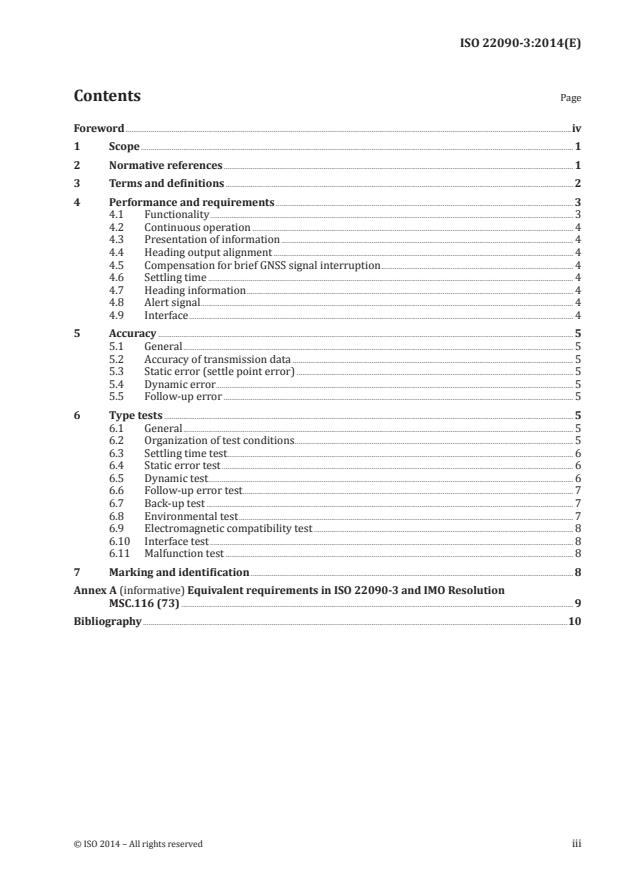
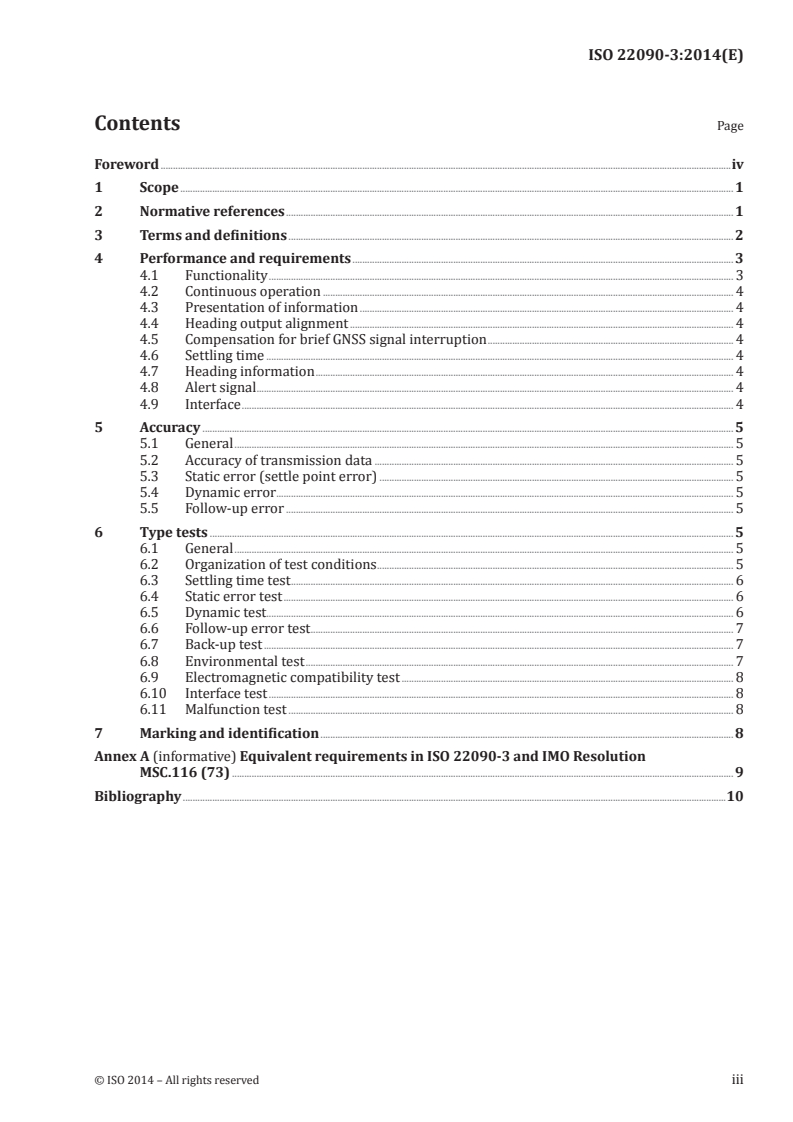
Contents Page
Foreword .iv
1 Scope . 1
2 Normative references . 1
3 Terms and definitions . 2
4 Performance and requirements . 3
4.1 Functionality . 3
4.2 Continuous operation . 4
4.3 Presentation of information . 4
4.4 Heading output alignment . 4
4.5 Compensation for brief GNSS signal interruption . 4
4.6 Settling time . 4
4.7 Heading information . 4
4.8 Alert signal . 4
4.9 Interface . 4
5 Accuracy . 5
5.1 General . 5
5.2 Accuracy of transmission data . 5
5.3 Static error (settle point error) . 5
5.4 Dynamic error . 5
5.5 Follow-up error . 5
6 Type tests . 5
6.1 General . 5
6.2 Organization of test conditions . 5
6.3 Settling time test . 6
6.4 Static error test . 6
6.5 Dynamic test. 6
6.6 Follow-up error test . 7
6.7 Back-up test . 7
6.8 Environmental test . 7
6.9 Electromagnetic compatibility test . 8
6.10 Interface test . 8
6.11 Malfunction test . 8
7 Marking and identification . 8
Annex A (informative) Equivalent requirements in ISO 22090-3 and IMO Resolution
MSC.116 (73) . 9
Bibliography .10
Foreword
ISO (the International Organization for Standardization) is a worldwide federation of national standards
bodies (ISO member bodies). The work of preparing International Standards is normally carried out
through ISO technical committees. Each member body interested in a subject for which a technical
committee has been established has the right to be represented on that committee. International
organizations, governmental and non-governmental, in liaison with ISO, also take part in the work.
ISO collaborates closely with the International Electrotechnical Commission (IEC) on all matters of
electrotechnical standardization.
The procedures used to develop this document and those intended for its further maintenance are
described in the ISO/IEC Directives, Part 1. In particular the different approval criteria needed for the
different types of ISO documents should be noted. This document was drafted in accordance with the
editorial rules of the ISO/IEC Directives, Part 2 (see www.iso.org/directives).
Attention is drawn to the possibility that some of the elements of this document may be the subject of
patent rights. ISO shall not be held responsible for identifying any or all such patent rights. Details of
any patent rights identified during the development of the document will be in the Introduction and/or
on the ISO list of patent declarations received (see www.iso.org/patents).
Any trade name used in this document is information given for the convenience of users and does not
constitute an endorsement.
For an explanation on the meaning of ISO specific terms and expressions related to conformity
assessment, as well as information about ISO’s adherence to the WTO principles in the Technical Barriers
to Trade (TBT) see the following URL: Foreword - Supplementary information
The committee responsible for this document is ISO/TC 8, Ships and marine technology, Subcommittee
SC 6, Navigation and ship operations.
This second edition cancels and replaces the first edition (ISO 22090-3:2004), of which has been
technically revised. It also replaces ISO 22090-3:2004/Cor1:2005.
ISO 22090 consists of the following parts, under the general title Ships and marine technology —
Transmitting heading devices (THDs):
— Part 1: Gyro-compasses
— Part 2: Geomagnetic principles
— Part 3: GNSS principles
iv © ISO 2014 – All rights reserved
INTERNATIONAL STANDARD ISO 22090-3:2014(E)
Ships and marine technology — Transmitting heading
devices (THDs) —
Part 3:
GNSS principles
1 Scope
This part of ISO 22090 specifies general requirements, construction, performance, and testing of
transmitting heading device using GNSS principle as required by chapter V, SOLAS 1974 (as amended).
A transmitting heading device (THD) is an electric device that provides information about the ship’s true
heading.
In addition to the general requirements contained in IMO Resolution A.694(17) to which IEC 60945 is
associated and the relevant standard for the sensing part used, the THD equipment shall comply with the
following minimum requirements.
Where the IMO performance standards that apply to the sensing part do not specify a geographical operating
area, the THD shall operate
a) at a maximum rate of turn 20°/s and
b) from 70° latitude south to 70° latitude north as minimum.
The THDs complying with the requirements contained in this part of ISO 22090 can be used for heading
information as contained in chapter V of the SOLAS Convention.
In addition, such THDs should meet the dynamic requirements contained in the HSC Code, chapter 13 for the
carriage of a suitable device providing heading information.
NOTE 1 Several technologies can be used to detect and transmit heading information. It is illogical to
standardize the detection of the heading separately from the transmission of the heading. Therefore, separate
parts of this part of ISO 22090 refer to different technologies. The requirements of this part of ISO 22090 only
apply to the principle of the GNSS. Other technologies are covered in other parts of ISO 22090.
NOTE 2 All requirements that are extracted from the recommendation of IMO Resolution MSC. 116(73) on
performance standards for transmitting heading devices are printed in italics.
2 Normative references
The following documents, in whole or in part, are normatively referenced in this document and are
indispensable for its application. For dated references, only the edition cited applies. For undated
references, the latest edition of the referenced document (including any amendments) applies.
ISO 25862, Ships and marine technology — Marine magnetic compasses, binnacles and azimuth reading
devices
IEC 60945, Marine navigation and radiocommunication equipment and systems — General requirements —
Methods of testing and required test results
IEC 61162-1, Maritime navigation and radiocommunication equipment and systems — Digital interfaces —
Part 1: Single talker and multiple listeners
IEC 61162-2, Maritime navigation and radiocommunication equipment and systems — Digital interfaces —
Part 2: Single talker and multiple listeners, high speed transmission
IEC 61924-2, Maritime navigation and radiocommunication equipment and systems — Integrated Navigation
Systems (INS) — Part 2: Modular structure for INS — Operational and performance requirements, methods
of testing and required test results
IEC 62288, Maritime navigation and radiocommunication equipment and systems — Presentation of
navigation-related information on shipborne navigational displays — General requirements — Methods of
testing and required test results
IMO Resolution A.424(XI), Performance standards for gyro-compasses
IMO Resolution A.694(17), General requirements for shipborne radio equipment forming part of the global
maritime distress and safety system (GMDSS) and for electronic navigational aids
IMO Resolution A.813(19), General requirements for electromagnetic compatibility (EMC) for all electrical
and electronic ship’s equipment
IMO Resolution A.821(19), Performance standards for gyro-compasses for high-speed craft
IMO Resolution MSC.116(73), Performance standards for marine transmitting heading devices (THDs)
IMO Resolution MSC.191(79), Performance standards for the presentation of navigation-related information
on shipborne navigational displays
IMO Resolution MSC.252(83), Adoption of the revised performance standards for integrated navigation
system (INS)
IMO Resolution MSC.302(87), Adoption of performance standards for bridge alert management
3 Terms and definitions
For the purposes of this document, the following terms and definitions apply.
3.1
heading
ship’s heading to be input to the THD function
Note 1 to entry: It is defined by the direction of the vertical projection of the fore-and-aft line of the ship onto the
horizontal plane. When measured relative to the true north, magnetic north, or compass north, it is respectively
defined as true heading, magnetic heading, or compass heading, and is usually expressed in degrees as a three-
figure group, star
...
INTERNATIONAL ISO
STANDARD 22090-3
Second edition
2014-03-01
Ships and marine technology —
Transmitting heading devices
(THDs) —
Part 3:
GNSS principles
Navires et technologie maritime — Dispositifs de transmission de
données de pilotage —
Partie 3: Principes pour un système global de navigation par satellites
Reference number
©
ISO 2014
© ISO 2014
All rights reserved. Unless otherwise specified, no part of this publication may be reproduced or utilized otherwise in any form
or by any means, electronic or mechanical, including photocopying, or posting on the internet or an intranet, without prior
written permission. Permission can be requested from either ISO at the address below or ISO’s member body in the country of
the requester.
ISO copyright office
Case postale 56 • CH-1211 Geneva 20
Tel. + 41 22 749 01 11
Fax + 41 22 749 09 47
E-mail copyright@iso.org
Web www.iso.org
Published in Switzerland
ii © ISO 2014 – All rights reserved
Contents Page
Foreword .iv
1 Scope . 1
2 Normative references . 1
3 Terms and definitions . 2
4 Performance and requirements . 3
4.1 Functionality . 3
4.2 Continuous operation . 4
4.3 Presentation of information . 4
4.4 Heading output alignment . 4
4.5 Compensation for brief GNSS signal interruption . 4
4.6 Settling time . 4
4.7 Heading information . 4
4.8 Alert signal . 4
4.9 Interface . 4
5 Accuracy . 5
5.1 General . 5
5.2 Accuracy of transmission data . 5
5.3 Static error (settle point error) . 5
5.4 Dynamic error . 5
5.5 Follow-up error . 5
6 Type tests . 5
6.1 General . 5
6.2 Organization of test conditions . 5
6.3 Settling time test . 6
6.4 Static error test . 6
6.5 Dynamic test. 6
6.6 Follow-up error test . 7
6.7 Back-up test . 7
6.8 Environmental test . 7
6.9 Electromagnetic compatibility test . 8
6.10 Interface test . 8
6.11 Malfunction test . 8
7 Marking and identification . 8
Annex A (informative) Equivalent requirements in ISO 22090-3 and IMO Resolution
MSC.116 (73) . 9
Bibliography .10
Foreword
ISO (the International Organization for Standardization) is a worldwide federation of national standards
bodies (ISO member bodies). The work of preparing International Standards is normally carried out
through ISO technical committees. Each member body interested in a subject for which a technical
committee has been established has the right to be represented on that committee. International
organizations, governmental and non-governmental, in liaison with ISO, also take part in the work.
ISO collaborates closely with the International Electrotechnical Commission (IEC) on all matters of
electrotechnical standardization.
The procedures used to develop this document and those intended for its further maintenance are
described in the ISO/IEC Directives, Part 1. In particular the different approval criteria needed for the
different types of ISO documents should be noted. This document was drafted in accordance with the
editorial rules of the ISO/IEC Directives, Part 2 (see www.iso.org/directives).
Attention is drawn to the possibility that some of the elements of this document may be the subject of
patent rights. ISO shall not be held responsible for identifying any or all such patent rights. Details of
any patent rights identified during the development of the document will be in the Introduction and/or
on the ISO list of patent declarations received (see www.iso.org/patents).
Any trade name used in this document is information given for the convenience of users and does not
constitute an endorsement.
For an explanation on the meaning of ISO specific terms and expressions related to conformity
assessment, as well as information about ISO’s adherence to the WTO principles in the Technical Barriers
to Trade (TBT) see the following URL: Foreword - Supplementary information
The committee responsible for this document is ISO/TC 8, Ships and marine technology, Subcommittee
SC 6, Navigation and ship operations.
This second edition cancels and replaces the first edition (ISO 22090-3:2004), of which has been
technically revised. It also replaces ISO 22090-3:2004/Cor1:2005.
ISO 22090 consists of the following parts, under the general title Ships and marine technology —
Transmitting heading devices (THDs):
— Part 1: Gyro-compasses
— Part 2: Geomagnetic principles
— Part 3: GNSS principles
iv © ISO 2014 – All rights reserved
INTERNATIONAL STANDARD ISO 22090-3:2014(E)
Ships and marine technology — Transmitting heading
devices (THDs) —
Part 3:
GNSS principles
1 Scope
This part of ISO 22090 specifies general requirements, construction, performance, and testing of
transmitting heading device using GNSS principle as required by chapter V, SOLAS 1974 (as amended).
A transmitting heading device (THD) is an electric device that provides information about the ship’s true
heading.
In addition to the general requirements contained in IMO Resolution A.694(17) to which IEC 60945 is
associated and the relevant standard for the sensing part used, the THD equipment shall comply with the
following minimum requirements.
Where the IMO performance standards that apply to the sensing part do not specify a geographical operating
area, the THD shall operate
a) at a maximum rate of turn 20°/s and
b) from 70° latitude south to 70° latitude north as minimum.
The THDs complying with the requirements contained in this part of ISO 22090 can be used for heading
information as contained in chapter V of the SOLAS Convention.
In addition, such THDs should meet the dynamic requirements contained in the HSC Code, chapter 13 for the
carriage of a suitable device providing heading information.
NOTE 1 Several technologies can be used to detect and transmit heading information. It is illogical to
standardize the detection of the heading separately from the transmission of the heading. Therefore, separate
parts of this part of ISO 22090 refer to different technologies. The requirements of this part of ISO 22090 only
apply to the principle of the GNSS. Other technologies are covered in other parts of ISO 22090.
NOTE 2 All requirements that are extracted from the recommendation of IMO Resolution MSC. 116(73) on
performance standards for transmitting heading devices are printed in italics.
2 Normative references
The following documents, in whole or in part, are normatively referenced in this document and are
indispensable for its application. For dated references, only the edition cited applies. For undated
references, the latest edition of the referenced document (including any amendments) applies.
ISO 25862, Ships and marine technology — Marine magnetic compasses, binnacles and azimuth reading
devices
IEC 60945, Marine navigation and radiocommunication equipment and systems — General requirements —
Methods of testing and required test results
IEC 61162-1, Maritime navigation and radiocommunication equipment and systems — Digital interfaces —
Part 1: Single talker and multiple listeners
IEC 61162-2, Maritime navigation and radiocommunication equipment and systems — Digital interfaces —
Part 2: Single talker and multiple listeners, high speed transmission
IEC 61924-2, Maritime navigation and radiocommunication equipment and systems — Integrated Navigation
Systems (INS) — Part 2: Modular structure for INS — Operational and performance requirements, methods
of testing and required test results
IEC 62288, Maritime navigation and radiocommunication equipment and systems — Presentation of
navigation-related information on shipborne navigational displays — General requirements — Methods of
testing and required test results
IMO Resolution A.424(XI), Performance standards for gyro-compasses
IMO Resolution A.694(17), General requirements for shipborne radio equipment forming part of the global
maritime distress and safety system (GMDSS) and for electronic navigational aids
IMO Resolution A.813(19), General requirements for electromagnetic compatibility (EMC) for all electrical
and electronic ship’s equipment
IMO Resolution A.821(19), Performance standards for gyro-compasses for high-speed craft
IMO Resolution MSC.116(73), Performance standards for marine transmitting heading devices (THDs)
IMO Resolution MSC.191(79), Performance standards for the presentation of navigation-related information
on shipborne navigational displays
IMO Resolution MSC.252(83), Adoption of the revised performance standards for integrated navigation
system (INS)
IMO Resolution MSC.302(87), Adoption of performance standards for bridge alert management
3 Terms and definitions
For the purposes of this document, the following terms and definitions apply.
3.1
heading
ship’s heading to be input to the THD function
Note 1 to entry: It is defined by the direction of the vertical projection of the fore-and-aft line of the ship onto the
horizontal plane. When measured relative to the true north, magnetic north, or compass north, it is respectively
defined as true heading, magnetic heading, or compass heading, and is usually expressed in degrees as a three-
figure group, star
...