


ISO/IEC 8802-11:1999/Amd 1:2000
(Amendment)Information technology — Telecommunications and information exchange between systems — Local and metropolitan area networks — Specific requirements — Part 11: Wireless LAN Medium Access Control (MAC) and Physical Layer (PHY) specifications — Amendment 1: High-speed Physical Layer in the 5 GHz band
Information technology — Telecommunications and information exchange between systems — Local and metropolitan area networks — Specific requirements — Part 11: Wireless LAN Medium Access Control (MAC) and Physical Layer (PHY) specifications — Amendment 1: High-speed Physical Layer in the 5 GHz band
Technologies de l'information — Télécommunications et échange d'information entre systèmes — Réseaux locaux et métropolitains — Exigences spécifiques — Partie 11: Spécifications pour le contrôle d'accès au support et la couche physique — Amendement 1: Couche physique à vitesse élevée dans la bande de 5 GHz
General Information
- Status
- Withdrawn
- Publication Date
- 20-Dec-2000
- Withdrawal Date
- 20-Dec-2000
- Current Stage
- 9599 - Withdrawal of International Standard
- Start Date
- 09-Aug-2005
- Completion Date
- 12-Feb-2026
Relations
- Effective Date
- 06-Jun-2022
- Effective Date
- 15-Apr-2008
- Effective Date
- 15-Apr-2008
Get Certified
Connect with accredited certification bodies for this standard

BSI Group
BSI (British Standards Institution) is the business standards company that helps organizations make excellence a habit.

NYCE
Mexican standards and certification body.
Sponsored listings
Frequently Asked Questions
ISO/IEC 8802-11:1999/Amd 1:2000 is a standard published by the International Organization for Standardization (ISO). Its full title is "Information technology — Telecommunications and information exchange between systems — Local and metropolitan area networks — Specific requirements — Part 11: Wireless LAN Medium Access Control (MAC) and Physical Layer (PHY) specifications — Amendment 1: High-speed Physical Layer in the 5 GHz band". This standard covers: Information technology — Telecommunications and information exchange between systems — Local and metropolitan area networks — Specific requirements — Part 11: Wireless LAN Medium Access Control (MAC) and Physical Layer (PHY) specifications — Amendment 1: High-speed Physical Layer in the 5 GHz band
Information technology — Telecommunications and information exchange between systems — Local and metropolitan area networks — Specific requirements — Part 11: Wireless LAN Medium Access Control (MAC) and Physical Layer (PHY) specifications — Amendment 1: High-speed Physical Layer in the 5 GHz band
ISO/IEC 8802-11:1999/Amd 1:2000 is classified under the following ICS (International Classification for Standards) categories: 35.110 - Networking. The ICS classification helps identify the subject area and facilitates finding related standards.
ISO/IEC 8802-11:1999/Amd 1:2000 has the following relationships with other standards: It is inter standard links to ISO/IEC 8802-11:1999, ISO/IEC 8802-11:2005; is excused to ISO/IEC 8802-11:1999. Understanding these relationships helps ensure you are using the most current and applicable version of the standard.
ISO/IEC 8802-11:1999/Amd 1:2000 is available in PDF format for immediate download after purchase. The document can be added to your cart and obtained through the secure checkout process. Digital delivery ensures instant access to the complete standard document.
Standards Content (Sample)
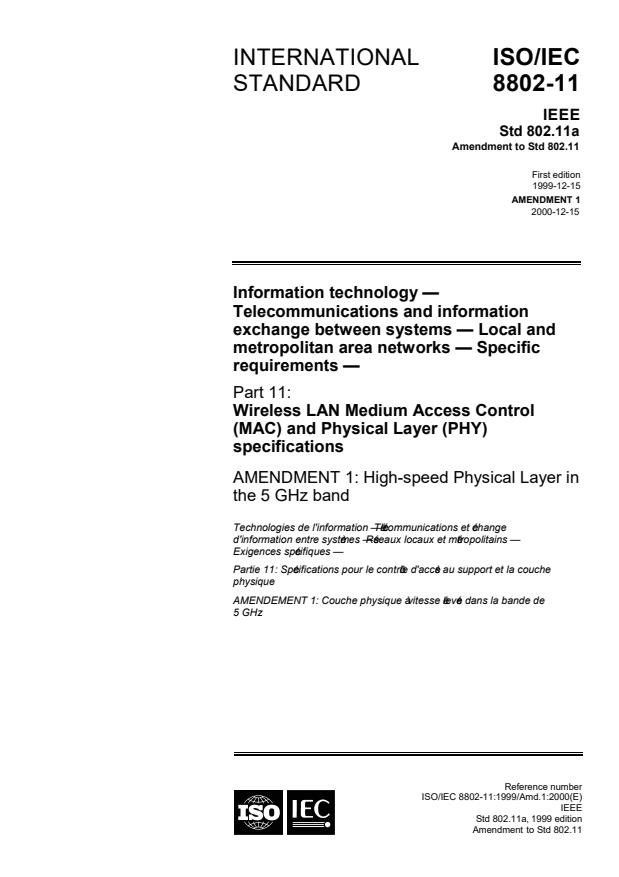
INTERNATIONAL ISO/IEC
STANDARD 8802-11
IEEE
P802.11a/D7.0
Supplement to Std.802.11
First edition
1999-12-15
AMENDMENT 1
2000-##-##
Information technology —
Telecommunications and information
exchange between systems — Local and
metropolitan area networks — Specific
requirements —
Part 11:
Wireless LAN Medium Access Control
(MAC) and Physical Layer (PHY)
specifications
AMENDMENT 1: High-speed Physical Layer in
the 5 GHz band
Technologies de l'information—Télécommunications etéchange
d'information entre systèmes—Réseaux locaux et métropolitains—
Exigences spécifiques—
Partie 11: Spécifications pour le contrôle d'accès au support et la couche
physique
AMENDEMENT 1: Couche physiqueàvitesse élevée dans la bande de
5GHz
Reference number
ISO/IEC 8802-11:1999/Amd.1:2000(E)
IEEE
P802.11a/D7.0, 1999 edition
Supplement to Std 802.11
ISO/IEC 8802-11:1999/Amd.1:2000(E)
PDF disclaimer
This PDF file may contain embedded typefaces. In accordance with Adobe's licensing policy, this file may be printed or viewed but shall not
be edited unless the typefaces which are embedded are licensed to and installed on the computer performing the editing. In downloading this
file, parties accept therein the responsibility of not infringing Adobe's licensing policy. The ISO Central Secretariat accepts no liability in this
area.
Adobe is a trademark of Adobe Systems Incorporated.
Details of the software products used to create this PDF file can be found in the General Info relative to the file; the PDF-creation parameters
were optimized for printing. Every care has been taken to ensure that the file is suitable for use by ISO member bodies. In the unlikely event
that a problem relating to it is found, please inform the Central Secretariat at the address given below.
ISO
Case postale 56 � CH-1211 Geneva 20
Tel. + 41 22 749 01 11
Fax + 41 22 749 09 47
E-mail copyright@iso.ch
Web www.iso.ch
ii
International Standard ISO/IEC 8802-11:1999/Amd 1:2000(E)
IEEE Std 802.11a-1999
Information technology—
Telecommunications and information
exchange between systems—
Local and metropolitan area networks—
Specific requirements
Part 11: Wireless LAN Medium Access
Control (MAC) and Physical Layer (PHY)
specifications
Amendment 1: High-speed Physical
Layer in the 5 GHz band
Sponsor
LAN MAN Standards Committee
of the
IEEE Computer Society
Abstract: Changes and additions to ISO/IEC 8802-11:1999(E) are provided to support the new
high-rate physical layer (PHY) for operation in the 5 GHz band.
Keywords: 5 GHz, high speed, local area network (LAN), orthogonal frequency division multiplex-
ing (OFDM), radio frequency, unlicensed national information infrastructure (U-NII), wireless
The Institute of Electrical and Electronics Engineers, Inc.
3 Park Avenue, New York, NY 10016-5997, USA
All rights reserved. Published November 2000. Printed in the United States of America.
Print: ISBN 0-7381-2695-0 SH94896
PDF: ISBN 0-7381-2696-9 SS94896
No part of this publication may be reproduced in any form, in an electronic retrieval system or otherwise, without the prior
written permission of the publisher.
ISO/IEC 8802-11:1999/Amd.1:2000(E)
International Standard ISO/IEC 8802-11:1999/Amd.1:2000(E)
ISO (the International Organization for Standardization) and IEC (the International Electrotechnical Commission)
form the specialized system for worldwide standardization. National bodies that are members of ISO or IEC
participate in the development of International Standards through technical committees established by the
respective organization to deal with particular fields of technical activity. ISO and IEC technical committees
collaborate in fields of mutual interest. Other international organizations, governmental and non-governmental, in
liaison with ISO and IEC, also take part in the work.
International Standards are drafted in accordance with the rules given in the ISO/IEC Directives, Part 3.
In the field of information technology, ISO and IEC have established a joint technical committee, ISO/IEC JTC 1.
Draft International Standards adopted by the joint technical committee are circulated to national bodies for voting.
Publication as an International Standard requires approval by at least 75 % of the national bodies casting a vote.
Attention is drawn to the possibility that some of the elements of this Amendment may be the subject of patent
rights. ISO and IEC shall not be held responsible for identifying any or all such patent rights.
Amendment 1 to International Standard ISO/IEC 8802-11 was prepared by Joint Technical Committee
ISO/IEC JTC 1, Information technology, Subcommittee SC 6, Telecommunications and information exchange
between systems.
International Organization for Standardization/International Electrotechnical Commission
Case postale 56 � CH-1211 Genève 20 � Switzerland
iii
IEEE Std 802.11a-1999
IEEE Standards documents are developed within the IEEE Societies and the Standards Coordinating Com-
mittees of the IEEE Standards Association (IEEE-SA) Standards Board. Members of the committees serve
voluntarily and without compensation. They are not necessarily members of the Institute. The standards
developed within IEEE represent a consensus of the broad expertise on the subject within the Institute as
well as those activities outside of IEEE that have expressed an interest in participating in the development of
the standard.
Use of an IEEE Standard is wholly voluntary. The existence of an IEEE Standard does not imply that there
are no other ways to produce, test, measure, purchase, market, or provide other goods and services related to
the scope of the IEEE Standard. Furthermore, the viewpoint expressed at the time a standard is approved and
issued is subject to change brought about through developments in the state of the art and comments
received from users of the standard. Every IEEE Standard is subjected to review at least every five years for
revision or reaffirmation. When a document is more than five years old and has not been reaffirmed, it is rea-
sonable to conclude that its contents, although still of some value, do not wholly reflect the present state of
the art. Users are cautioned to check to determine that they have the latest edition of any IEEE Standard.
Comments for revision of IEEE Standards are welcome from any interested party, regardless of membership
affiliation with IEEE. Suggestions for changes in documents should be in the form of a proposed change of
text, together with appropriate supporting comments.
Interpretations: Occasionally questions may arise regarding the meaning of portions of standards as they
relate to specific applications. When the need for interpretations is brought to the attention of IEEE, the
Institute will initiate action to prepare appropriate responses. Since IEEE Standards represent a consensus of
all concerned interests, it is important to ensure that any interpretation has also received the concurrence of a
balance of interests. For this reason, IEEE and the members of its societies and Standards Coordinating
Committees are not able to provide an instant response to interpretation requests except in those cases where
the matter has previously received formal consideration.
Comments on standards and requests for interpretations should be addressed to:
Secretary, IEEE-SA Standards Board
445 Hoes Lane
P.O. Box 1331
Piscataway, NJ 08855-1331
USA
Note: Attention is called to the possibility that implementation of this standard may
require use of subject matter covered by patent rights. By publication of this standard,
no position is taken with respect to the existence or validity of any patent rights in
connection therewith. The IEEE shall not be responsible for identifying patents for
which a license may be required by an IEEE standard or for conducting inquiries into
the legal validity or scope of those patents that are brought to its attention.
IEEE is the sole entity that may authorize the use of certification marks, trademarks, or other designations to
indicate compliance with the materials set forth herein.
Authorization to photocopy portions of any individual standard for internal or personal use is granted by the
Institute of Electrical and Electronics Engineers, Inc., provided that the appropriate fee is paid to Copyright
Clearance Center. To arrange for payment of licensing fee, please contact Copyright Clearance Center, Cus-
tomer Service, 222 Rosewood Drive, Danvers, MA 01923 USA; (978) 750-8400. Permission to photocopy
portions of any individual standard for educational classroom use can also be obtained through the Copy-
right Clearance Center.
Introduction
(This introduction is not part of IEEE Std 802.11a-1999, Supplement to IEEE Standard for Information technology—
Telecommunications and information exchange between systems—Local and metropolitan area networks—Specific
Requirements—Part 11: Wireless LAN Medium Access Control (MAC) and Physical Layer (PHY) specifications: High-
speed Physical Layer in the 5 GHz Band.)
This standard is part of a family of standards for local and metropolitan area networks. The relationship
between the standard and other members of the family is shown below. (The numbers in the figure refer to
IEEE standard numbers.)
802.2 LOGICAL LINK CONTROL
DATA
802.1 BRIDGING
LINK
LAYER
802.3 802.4 802.5 802.6 802.9 802.11 802.12
MEDIUM MEDIUM MEDIUM MEDIUM MEDIUM MEDIUM MEDIUM
ACCESS ACCESS ACCESS ACCESS ACCESS ACCESS ACCESS
802.3 802.4 802.5 802.6 802.9 802.11 802.12 PHYSICAL
PHYSICAL PHYSICAL PHYSICAL PHYSICAL PHYSICAL PHYSICAL PHYSICAL LAYER
* Formerly IEEE Std 802.1A.
This family of standards deals with the Physical and Data Link layers as defined by the International Organiza-
tion for Standardization (ISO) Open Systems Interconnection (OSI) Basic Reference Model (ISO/IEC
7498-1:1994). The access standards define seven types of medium access technologies and associated physi-
cal media, each appropriate for particular applications or system objectives. Other types are under
investigation.
The standards defining the access technologies are as follows:
IEEE Std 802 Overview and Architecture. This standard provides an overview to the family
of IEEE 802 Standards.
ANSI/IEEE Std 802.1B LAN/MAN Management. Defines an OSI management-compatible architec-
and 802.1k ture, and services and protocol elements for use in a LAN/MAN environment
[ISO/IEC 15802-2] for performing remote management.
ANSI/IEEE Std 802.1D Media Access Control (MAC) Bridges. Specifies an architecture and protocol
[ISO/IEC 15802-3] for the interconnection of IEEE 802 LANs below the MAC service boundary.
ANSI/IEEE Std 802.1E System Load Protocol. Specifies a set of services and protocol for those
[ISO/IEC 15802-4] aspects of management concerned with the loading of systems on IEEE 802
LANs.
IEEE Std 802.1F Common Definitions and Procedures for IEEE 802 Management Information
ANSI/IEEE Std 802.1G Remote Media Access Control Bridging . Specifies extensions for the intercon-
[ISO/IEC 15802-5] nection, using non-LAN communication technologies, of geographically sepa-
rated IEEE 802 LANs below the level of the logical link control protocol.
Copyright © 1999 IEEE. All rights reserved. iii
802.10 SECURITY
802 OVERVIEW & ARCHITECTURE*
802.1 MANAGEMENT
ANSI/IEEE Std 802.2 Logical Link Control
[ISO/IEC 8802-2]
ANSI/IEEE Std 802.3 CSMA/CD Access Method and Physical Layer Specifications
[ISO/IEC 8802-3]
ANSI/IEEE Std 802.4 Token Passing Bus Access Method and Physical Layer Specifications
[ISO/IEC 8802-4]
ANSI/IEEE Std 802.5 Token Ring Access Method and Physical Layer Specifications
[ISO/IEC 8802-5]
ANSI/IEEE Std 802.6 Distributed Queue Dual Bus Access Method and Physical Layer Specifica-
[ISO/IEC 8802-6] tions
ANSI/IEEE Std 802.9 Integrated Services (IS) LAN Interface at the Medium Access Control and
[ISO/IEC 8802-9] Physical Layers
ANSI/IEEE Std 802.10 Interoperable LAN/MAN Security
IEEE Std 802.11 Wireless LAN Medium Access Control and Physical Layer Specifications
[ISO/IEC DIS 8802-11]
ANSI/IEEE Std 802.12 Demand Priority Access Method, Physical Layer and Repeater Specifica-
[ISO/IEC DIS 8802-12] tions
In addition to the family of standards, the following is a recommended practice for a common Physical
Layer technology:
IEEE Std 802.7 IEEE Recommended Practice for Broadband Local Area Networks
The following additional working groups have authorized standards projects under development:
IEEE 802.14 Standard Protocol for Cable-TV Based Broadband Communication Network
IEEE 802.15 Wireless Personal Area Networks Access Method and Physical Layer
Specifications
IEEE 802.16 Broadband Wireless Access Method and Physical Layer Specifications
iv Copyright © 1999 IEEE. All rights reserved.
Editor’s Notes
Clause 4, subclause 9.1, and Clause 17 in this supplement will be inserted into the base standard as an addi-
tional PHY specification for the 5 GHz unlicensed national information infrastructure (U-NII) band.
There are three annexes included in this supplement. Following are instructions to merge the information in
these annexes into the base document.
Annex A: This annex shows a change to the table in A.4.3 of the base standard (IUT configuration) and the
addition of a new subclause. Item *CF6 should be added to the table in A.4.3 of the base standard. The entire
subclause A.4.8 (Orthogonal frequency division multiplex PHY functions) should be added to the end of
Annex A in the base standard (i.e., after A.4.7).
Annex D: This annex contains additions to be made to Annex D (ASN.1 encoding of the MAC and PHY
MIB) of the base standard. There are five sections that provide instructions to merge the information con-
tained herein into the appropriate locations in Annex D of the base standard.
Annex G: This annex is new to the base standard. The purpose of Annex G is to provide an example of
encoding a frame for the OFDM PHY, described in Clause 17, including all intermediate stages.
Copyright © 1999 IEEE. All rights reserved. v
Participants
At the time this standard was balloted, the 802.11 working group had the following membership:
Vic Hayes, Chair
Stuart J. Kerry, Vice Chair
Al Petrick, Co-Vice Chair
George Fishel, Secretary
Robert O'Hara, Chair and editor, 802.11-rev
Allen Heberling, State-diagram editor
Michael A. Fischer, State-diagram editor
Dean M. Kawaguchi, Chair PHY group
David Bagby, Chair MAC group
Naftali Chayat, Chair Task Group a
Hitoshi Takanashi, Editor 802.11a
John Fakatselis, Chair Task Group b
Carl F. Andren, Editor 802.11b
Chris D. Heegard
Jeffrey Abramowitz Frits Riep
Reza Ahy Robert Heile
William Roberts
Keith B. Amundsen Juha T. Heiskala
Kent G. Rollins
Maarten Hoeben
James R. Baker
Clemens C.W. Ruppel
Kevin M. Barry Masayuki Ikeda
Anil K. Sanwalka
Phil Belanger Donald C. Johnson
Roy Sebring
John Biddick Tal Kaitz
Tie-Jun Shan
Simon Black Ad Kamerman
Stephen J. Shellhammer
Timothy J. Blaney Mika Kasslin
Matthew B. Shoemake
Jan Boer Patrick Kinney
Thomas Siep
Ronald Brockmann Steven Knudsen
Donald I. Sloan
Wesley Brodsky Bruce P. Kraemer
Gary Spiess
John H. Cafarella David S. Landeta
Satoru Toguchi
James S. Li
Wen-Chiang Chen
Cherry Tom
Ken Clements Stanley Ling
Wim Diepstraten Michael D. McInnis
Mike Trompower
Peter Ecclesine Gene Miller
Tom Tsoulogiannis
Richard Eckard Akira Miura
Bruce Tuch
Darwin Engwer Henri Moelard
Sarosh N. Vesuna
Greg Ennis Masaharu Mori
Ikuo Wakayama
Jeffrey J. Fischer Masahiro Morikura
Robert M. Ward, Jr.
John Fisher Richard van Nee
Mark Webster
Ian Gifford Erwin R. Noble
Leo Wilz
Motohiro Gochi Tomoki Ohsawa
Harry R. Worstell
Tim Godfrey Kazuhiro Okanoue
Lawrence W. Yonge, III
Steven D. Gray Richard H. Paine
Chris Zegelin
Jan Haagh Roger Pandanda
Jonathan M. Zweig
Karl Hannestad Victoria M. Poncini
James Zyren
Kei Hara Gregory S. Rawlins
Stanley A. Reible
vi Copyright © 1999 IEEE. All rights reserved.
The following members of the balloting committee voted on this standard:
Raj Jain
Carl F. Andren Pete Rautenberg
A. Kamerman
Jack S. Andresen Stanley A. Reible
Dean M. Kawaguchi
Lek Ariyavisitakul Edouard Y. Rocher
Stuart J. Kerry
David Bagby Kent Rollins
Patrick Kinney
Kevin M. Barry James W. Romlein
Daniel R. Krent
John H. Cafarella Floyd E. Ross
Walter Levy
James T. Carlo Christoph Ruland
Stanley Ling
David E. Carlson Anil K. Sanwalka
Randolph S. Little
Linda T. Cheng Norman Schneidewind
Roger B. Marks
Thomas J. Dineen James E. Schuessler
Peter Martini
Christos Douligeris Rich Seifert
Richard McBride
Peter Ecclesine Matthew B. Shoemake
Bennett Meyer
Richard Eckard Leo Sintonen
David S. Millman
Philip H. Enslow Hitoshi Takanashi
Hiroshi Miyano
John Fakatselis Mike Trompower
Warren Monroe
Jeffrey J. Fischer Mark-Rene Uchida
Masahiro Morikura
Michael A. Fischer Scott A. Valcourt
Shimon Muller
Robert J. Gagliano Richard Van Nee
Peter A. Murphy
Gautam Garai Sarosh N. Vesuna
Paul Nikolich
Alireza Ghazizahedi John Viaplana
Erwin R. Noble
Tim Godfrey Hirohisa Wakai
Satoshi Obara
Patrick S. Gonia Robert M. Ward, Jr.
Robert O'Hara
Steven D. Gray Mark Webster
Charles Oestereicher
Chris G. Guy Harry R. Worstell
Kazuhiro Okanoue
Vic Hayes Stefan M. Wurster
Roger Pandanda
Allen Heberling Oren Yuen
Ronald C. Petersen
Chris D. Heegard Jonathan M. Zweig
Al Petrick
Juha T. Heiskala James Zyren
Vikram Punj
When the IEEE-SA Standards Board approved this standard on 16 September 1999, it had the following
membership:
Richard J. Holleman, Chair
Donald N. Heirman, Vice Chair
Judith Gorman, Secretary
Satish K. Aggarwal James H. Gurney Louis-François Pau
Dennis Bodson Lowell G. Johnson Ronald C. Petersen
Mark D. Bowman Robert J. Kennelly Gerald H. Peterson
James T. Carlo E. G. “Al” Kiener John B. Posey
Gary R. Engmann Joseph L. Koepfinger* Gary S. Robinson
Harold E. Epstein L. Bruce McClung Akio Tojo
Jay Forster* Daleep C. Mohla Hans E. Weinrich
Ruben D. Garzon Robert F. Munzner Donald W. Zipse
**Member Emeritus
Also included is the following nonvoting IEEE-SA Standards Board liaison:
Robert E. Hebner
Janet Rutigliano
IEEE Standards Project Editor
Copyright © 1999 IEEE. All rights reserved. vii
Contents
Editor’s Notes.v
4. Abbreviations and acronyms. 2
9.1 Multirate support. 2
10.4 PLME SAP interface. 2
17. OFDM PHY specification for the 5 GHz band.3
17.1 Introduction. 3
17.2 OFDM PHY specific service parameter list . 5
17.3 OFDM PLCP sublayer. 7
17.4 OFDM PLME . 34
17.5 OFDM PMD sublayer. 39
Annex A (normative), Protocol Implementation Conformance Statement (PICS) proforma . 46
Annex D (normative), ASN.1 encoding of the MAC and PHY MIB. 51
Annex G (informative), An example of encoding a frame for OFDM PHY. 54
viii Copyright © 1999 IEEE. All rights reserved.
Information technology—
Telecommunications and information
exchange between systems—
Local and metropolitan area networks—
Specific requirements
Part 11: Wireless LAN Medium Access
Control (MAC) and Physical Layer (PHY)
specifications
Amendment 1: High-speed Physical
Layer in the 5 GHz band
[These additions are based on ISO/IEC 8802-11:1999(E) (IEEE Std 802.11, 1999 Edition).]
EDITORIAL NOTE—The editing instructions contained in this supplement define how to merge the material contained
herein into ISO/IEC 8802-11:1999(E) (IEEE Std 802.11, 1999 Edition), to form the new comprehensive standard as cre-
ated by the addition of ISO/IEC 8802-11:1999/Amd 1:2000(E) (IEEE Std 802.11a-1999).
The editing instructions are shown in bold italic. Three editing instructions are used: change, delete, and insert. Change
is used to make small corrections to existing text or tables. The editing instruction specifies the location of the change
and describes what is being changed either by using strikethrough (to remove old material) or underscore (to add new
material). Delete removes existing material. Insert adds new material without disturbing the existing material. Insertions
may require renumbering. If so, renumbering instructions are given in the editing instructions. Editorial notes will not be
carried over into future editions.
IEEE
Std 802.11a-1999 SUPPLEMENT TO IEEE STANDARD FOR INFORMATION TECHNOLOGY—
4. Abbreviations and acronyms
Insert the following acronyms alphabetically in the list in Clause 4:
BPSK binary phase shift keying
C-MPDU coded MPDU
FFT Fast Fourier Transform
GI guard interval
IFFT inverse Fast Fourier Transform
OFDM orthogonal frequency division multiplexing
PER packet error rate
QAM quadrature amplitude modulation
QPSK quadrature phase shift keying
U-NII unlicensed national information infrastructure
9.1 Multirate support
Add the following text to the end of 9.6:
For the 5 GHz PHY, the time required to transmit a frame for use in the Duration/ID field is determined
using the PLME-TXTIME.request primitive and the PLME-TXTIME.confirm primitive. The calculation
method of TXTIME duration is defined in 17.4.3.
10.4 PLME SAP interface
Add the following text to the end of 10.4:
Remove the references to aMPDUDurationFactor from 10.4.3.1.
Add the following subclauses at the end of 10.4:
10.4.6 PLME-TXTIME.request
10.4.6.1 Function
This primitive is a request for the PHY to calculate the time that will be required to transmit onto the wire-
less medium a PPDU containing a specified length MPDU, and using a specified format, data rate, and
signalling.
10.4.6.2 Semantics of the service primitive
This primitive provides the following parameters:
PLME-TXTIME.request(TXVECTOR)
The TXVECTOR represents a list of parameters that the MAC sublayer provides to the local PHY entity in
order to transmit a MPDU, as further described in 12.3.4.4 and 17.4 (which defines the local PHY entity).
2 Copyright © 1999 IEEE. All rights reserved.
IEEE
HIGH-SPEED PHYSICAL LAYER IN THE 5 GHz BAND Std 802.11a-1999
10.4.6.3 When generated
This primitive is issued by the MAC sublayer to the PHY entity whenever the MAC sublayer needs to deter-
mine the time required to transmit a particular MPDU.
10.4.6.4 Effect of receipt
The effect of receipt of this primitive by the PHY entity shall be to generate a PHY-TXTIME.confirm primi-
tive that conveys the required transmission time.
10.4.7 PLME-TXTIME.confirm
10.4.7.1 Function
This primitive provides the time that will be required to transmit the PPDU described in the corresponding
PLME-TXTIME.request.
10.4.7.2 Semantics of the service primitive
This primitive provides the following parameters:
PLME-TXTIME.confirm(TXTIME)
The TXTIME represents the time in microseconds required to transmit the PPDU described in the corre-
sponding PLME-TXTIME.request. If the calculated time includes a fractional microsecond, the TXTIME
value is rounded up to the next higher integer.
10.4.7.3 When generated
This primitive is issued by the local PHY entity in response to a PLME-TXTIME.request.
10.4.7.4 Effect of receipt
The receipt of this primitive provides the MAC sublayer with the PPDU transmission time.
Add the entire Clause 17 to the base standard:
17. OFDM PHY specification for the 5 GHz band
17.1 Introduction
This clause specifies the PHY entity for an orthogonal frequency division multiplexing (OFDM) system and
the additions that have to be made to the base standard to accommodate the OFDM PHY. The radio fre-
quency LAN system is initially aimed for the 5.15–5.25, 5.25–5.35 and 5.725–5.825 GHz unlicensed
national information structure (U-NII) bands, as regulated in the United States by the Code of Federal Regu-
lations, Title 47, Section 15.407. The OFDM system provides a wireless LAN with data payload communi-
cation capabilities of 6, 9, 12, 18, 24, 36, 48, and 54 Mbit/s. The support of transmitting and receiving at data
rates of 6, 12, and 24 Mbit/s is mandatory. The system uses 52 subcarriers that are modulated using binary or
quadrature phase shift keying (BPSK/QPSK), 16-quadrature amplitude modulation (QAM), or 64-QAM.
Forward error correction coding (convolutional coding) is used with a coding rate of 1/2, 2/3, or 3/4.
Copyright © 1999 IEEE. All rights reserved. 3
IEEE
Std 802.11a-1999 SUPPLEMENT TO IEEE STANDARD FOR INFORMATION TECHNOLOGY—
17.1.1 Scope
This subclause describes the PHY services provided to the IEEE 802.11 wireless LAN MAC by the 5 GHz
(bands) OFDM system. The OFDM PHY layer consists of two protocol functions, as follows:
a) A PHY convergence function, which adapts the capabilities of the physical medium dependent
(PMD) system to the PHY service. This function is supported by the physical layer convergence pro-
cedure (PLCP), which defines a method of mapping the IEEE 802.11 PHY sublayer service data
units (PSDU) into a framing format suitable for sending and receiving user data and management
information between two or more stations using the associated PMD system.
b) A PMD system whose function defines the characteristics and method of transmitting and receiving
data through a wireless medium between two or more stations, each using the OFDM system.
17.1.2 OFDM PHY functions
The 5 GHz OFDM PHY architecture is depicted in the reference model shown in Figure 11 of IEEE Std
802.11, 1999 Edition (5.8). The OFDM PHY contains three functional entities: the PMD function, the PHY
convergence function, and the layer management function. Each of these functions is described in detail in
17.1.2.1 through 17.1.2.4.
The OFDM PHY service is provided to the MAC through the PHY service primitives described in Clause 12
of IEEE Std 802.11, 1999 Edition.
17.1.2.1 PLCP sublayer
In order to allow the IEEE 802.11 MAC to operate with minimum dependence on the PMD sublayer, a PHY
convergence sublayer is defined. This function simplifies the PHY service interface to the IEEE 802.11
MAC services.
17.1.2.2 PMD sublayer
The PMD sublayer provides a means to send and receive data between two or more stations. This clause is
concerned with the 5 GHz band using OFDM modulation.
17.1.2.3 PHY management entity (PLME)
The PLME performs management of the local PHY functions in conjunction with the MAC management
entity.
17.1.2.4 Service specification method
The models represented by figures and state diagrams are intended to be illustrations of the functions pro-
vided. It is important to distinguish between a model and a real implementation. The models are optimized
for simplicity and clarity of presentation; the actual method of implementation is left to the discretion of the
IEEE 802.11 OFDM PHY compliant developer.
The service of a layer or sublayer is the set of capabilities that it offers to a user in the next higher layer (or
sublayer). Abstract services are specified here by describing the service primitives and parameters that char-
acterize each service. This definition is independent of any particular implementation.
4 Copyright © 1999 IEEE. All rights reserved.
IEEE
HIGH-SPEED PHYSICAL LAYER IN THE 5 GHz BAND Std 802.11a-1999
17.2 OFDM PHY specific service parameter list
17.2.1 Introduction
The architecture of the IEEE 802.11 MAC is intended to be PHY independent. Some PHY implementations
require medium management state machines running in the MAC sublayer in order to meet certain PMD
requirements. These PHY-dependent MAC state machines reside in a sublayer defined as the MAC sublayer
management entity (MLME). In certain PMD implementations, the MLME may need to interact with the
PLME as part of the normal PHY SAP primitives. These interactions are defined by the PLME parameter list
currently defined in the PHY service primitives as TXVECTOR and RXVECTOR. The list of these parame-
ters, and the values they may represent, are defined in the specific PHY specifications for each PMD. This
subclause addresses the TXVECTOR and RXVECTOR for the OFDM PHY.
17.2.2 TXVECTOR parameters
The parameters in Table 76 are defined as part of the TXVECTOR parameter list in the PHY-
TXSTART.request service primitive.
Table 76—TXVECTOR parameters
Parameter Associate primitive Value
LENGTH PHY-TXSTART.request 1–4095
(TXVECTOR)
DATATRATE PHY-TXSTART.request 6, 9, 12, 18, 24, 36, 48,
(TXVECTOR) and 54
(Support of 6, 12, and
24 data rates is manda-
tory.)
SERVICE PHY-TXSTART.request Scrambler initializa-
(TXVECTOR) tion; 7 null bits + 9
reserved null bits
TXPWR_LEVEL PHY-TXSTART.request 1–8
(TXVECTOR)
17.2.2.1 TXVECTOR LENGTH
The allowed values for the LENGTH parameter are in the range of 1–4095. This parameter is used to indi-
cate the number of octets in the MPDU which the MAC is currently requesting the PHY to transmit. This
value is used by the PHY to determine the number of octet transfers that will occur between the MAC and
the PHY after receiving a request to start the transmission.
17.2.2.2 TXVECTOR DATARATE
The DATARATE parameter describes the bit rate at which the PLCP shall transmit the PSDU. Its value can
be any of the rates defined in Table 76. Data rates of 6, 12, and 24 shall be supported; other rates may also be
supported.
Copyright © 1999 IEEE. All rights reserved. 5
IEEE
Std 802.11a-1999 SUPPLEMENT TO IEEE STANDARD FOR INFORMATION TECHNOLOGY—
17.2.2.3 TXVECTOR SERVICE
The SERVICE parameter consists of 7 null bits used for the scrambler initialization and 9 null bits reserved
for future use.
17.2.2.4 TXVECTOR TXPWR_LEVEL
The allowed values for the TXPWR_LEVEL parameter are in the range from 1–8. This parameter is used to
indicate which of the available TxPowerLevel attributes defined in the MIB shall be used for the current
transmission.
17.2.3 RXVECTOR parameters
The parameters listed in Table 77 are defined as part of the RXVECTOR parameter list in the PHY-
RXSTART.indicate service primitive.
Table 77—RXVECTOR parameters
Parameter Associate primitive Value
LENGTH PHY-RXSTART.indicate 1–4095
RSSI PHY-RXSTART.indicate 0–RSSI maximum
(RXVECTOR)
DATARATE PHY-RXSTART.request 6, 9, 12, 18, 24, 36,
(RXVECTOR) 48, and 54
SERVICE PHY-RXSTART.request Null
(RXVECTOR)
17.2.3.1 RXVECTOR LENGTH
The allowed values for the LENGTH parameter are in the range from 1–4095. This parameter is used to
indicate the value contained in the LENGTH field which the PLCP has received in the PLCP header. The
MAC and PLCP will use this value to determine the number of octet transfers that will occur between the
two sublayers during the transfer of the received PSDU.
17.2.3.2 RXVECTOR RSSI
The allowed values for the receive signal strength indicator (RSSI) parameter are in the range from 0
through RSSI maximum. This parameter is a measure by the PHY sublayer of the energy observed at the
antenna used to receive the current PPDU. RSSI shall be measured during the reception of the PLCP pream-
ble. RSSI is intended to be used in a relative manner, and it shall be a monotonically increasing function of
the received power.
17.2.3.3 DATARATE
DATARATE shall represent the data rate at which the current PPDU was received. The allowed values of the
DATARATE are 6, 9, 12, 18, 24, 36, 48, or 54.
17.2.3.4 SERVICE
The SERVICE field shall be null.
6 Copyright © 1999 IEEE. All rights reserved.
IEEE
HIGH-SPEED PHYSICAL LAYER IN THE 5 GHz BAND Std 802.11a-1999
17.3 OFDM PLCP sublayer
17.3.1 Introduction
This subclause provides a convergence procedure in which PSDUs are converted to and from PPDUs. Dur-
ing transmission, the PSDU shall be provided with a PLCP preamble and header to create the PPDU. At the
receiver, the PLCP preamble and header are processed to aid in demodulation and delivery of the PSDU.
17.3.2 PLCP frame format
Figure 107 shows the format for the PPDU including the OFDM PLCP preamble, OFDM PLCP header,
PSDU, tail bits, and pad bits. The PLCP header contains the following fields: LENGTH, RATE, a reserved
bit, an even parity bit, and the SERVICE field. In terms of modulation, the LENGTH, RATE, reserved bit,
and parity bit (with 6 “zero” tail bits appended) constitute a separate single OFDM symbol, denoted SIG-
NAL, which is transmitted with the most robust combination of BPSK modulation and a coding rate of
R = 1/2. The SERVICE field of the PLCP header and the PSDU (with 6 “zero” tail bits and pad bits
appended), denoted as DATA, are transmitted at the data rate described in the RATE field and may constitute
multiple OFDM symbols. The tail bits in the SIGNAL symbol enable decoding of the RATE and LENGTH
fields immediately after the reception of the tail bits. The RATE and LENGTH are required for decoding the
DATA part of the packet. In addition, the CCA mechanism can be augmented by predicting the duration of
the packet from the contents of the RATE and LENGTH fields, even if the data rate is not supported by the
station. Each of these fields is described in detail in 17.3.3, 17.3.4, and 17.3.5.
PLCP Header
RATE Reserved Parity Tail SERVICE Tail
LENGTH
Pad Bits
PSDU
4 bits 1 bit 1 bit 6 bits 16 bits 6 bits
12 bits
Coded/OFDM
Coded/OFDM
(BPSK, r = 1/2)
(RATE is indicated in SIGNAL)
SIGNAL
PLCP Preamble DATA
12 Symbols
One OFDM Symbol Variable Number of OFDM Symbols
Figure 107—PPDU frame format
17.3.2.1 Overview of the PPDU encoding process
The encoding process is composed of many detailed steps, which are described fully in later subclauses, as
noted below. The following overview intends to facilitate understanding the details described in these
subclauses:
a) Produce the PLCP preamble field, composed of 10 repetitions of a “short training sequence” (used
for AGC convergence, diversity selection, timing acquisition, and coarse frequency acquisition in the
receiver) and two repetitions of a “long training sequence” (used for channel estimation and fine fre-
quency acquisition in the receiver), preceded by a guard interval (GI). Refer to 17.3.3 for details.
Copyright © 1999 IEEE. All rights reserved. 7
IEEE
Std 802.11a-1999 SUPPLEMENT TO IEEE STANDARD FOR INFORMATION TECHNOLOGY—
b) Produce the PLCP header field from the RATE, LENGTH, and SERVICE fields of the TXVECTOR
by filling the appropriate bit fields. The RATE and LENGTH fields of the PLCP header are encoded
by a convolutional code at a rate of R = 1/2, and are subsequently mapped onto a single BPSK
encoded OFDM symbol, denoted as the SIGNAL symbol. In order to facilitate a reliable and timely
detection of the RATE and LENGTH fields, 6 “zero” tail bits are inserted into the PLCP header. The
encoding of the SIGNAL field into an OFDM symbol follows the same steps for convolutional
encoding, interleaving, BPSK modulation, pilot insertion, Fourier transform, and prepending a GI as
described subsequently for data transmission at 6 Mbit/s. The contents of the SIGNAL field are not
scrambled. Refer to 17.3.4 for details.
c) Calculate from RATE field of the TXVECTOR the number of data bits per OFDM symbol (N ),
DBPS
the coding rate (R), the number of bits in each OFDM subcarrier (N ), and the number of coded
BPSC
bits per OFDM symbol (N ). Refer to 17.3.2.2 for details.
CBPS
d) Append the PSDU to the SERVICE field of the TXVECTOR. Extend the resulting bit string with
“zero” bits (at least 6 bits) so that the resulting length will be a multiple of N . The resulting bit
DBPS
string constitutes the DATA part of the packet. Refer to 17.3.5.4 for details.
e) Initiate the scrambler with a pseudorandom non-zero seed, generate a scrambling sequence, and
XOR it with the extended string of data bits. Refer to 17.3.5.4 for details.
f) Replace the six scrambled “zero” bits following the “data” with six nonscrambled “zero” bits.
(Those bits return the convolutional encoder to the “zero state” and are denoted as “tail bits.”) Refer
to 17.3.5.2 for details.
g) Encode the extended, scrambled data string with a convolutional encoder (R = 1/2). Omit (puncture)
some of the encoder output string (chosen according to “puncturing pattern”) to reach the desired
“coding rate.” Refer to 17.3.5.5 for details.
h) Divide the encoded bit string into groups of N bits. Within each group, perform an “interleav-
CBPS
ing” (reordering) of the bits according to a rule corresponding to the desired RATE. Refer to 17.3.5.6
for details.
i) Divide the resulting coded and interleaved data string into groups of N bits. For each of the bit
CBPS
groups, convert the bit group into a complex number according to the modulation encoding tables.
Refer to 17.3.5.7 for details.
j) Divide the complex number string into groups of 48 complex numbers. Each such group will be
associated with one OFDM symbol. In each group, the complex numbers will be numbered 0 to 47
and mapped hereafter into OFDM subcarriers numbered –26 to –22, –20 to –8, –6 to –1, 1 to 6,
8 to 20, and 22 to 26. The subcarriers –21, –7, 7, and 21 are skipped and, subsequently, used for
inserting pilot subcarriers. The “0” subcarrier, associated with center frequency, is omitted and filled
with zero value. Refer to 17.3.5.9 for details.
k) Four subcarriers are inserted as pilots into positions –21, –7, 7, and 21. The total number of the sub-
carriers is 52 (48 + 4). Refer to 17.3.5.8 for details.
l) For each group of subcarriers –26 to 26, convert the subcarriers to time domain using inverse Fourier
transform. Prepend to the Fourier-transformed waveform a circular extension of itself thus forming a
GI, and truncate the resulting periodic waveform to a single OFDM symbol length by applying time
domain windowing. Refer to 17.3.5.9 for details.
m) Append the OFDM symbols one after another, starting after the SIGNAL symbol describing the
RATE and LENGTH. Refer to 17.3.5.9 for details.
n) Up-convert the resulting “complex baseband” waveform to an RF frequency according to the center
frequency of the desired channel and transmit. Refer to 17.3.2.4 and 17.3.8.1 for details.
An illustration of the transmitted frame and its parts appears in Figure 110 of 17.3.3.
8 Copyright © 1999 IEEE. All rights reserved.
IEEE
HIGH-SPEED PHYSICAL LAYER IN THE 5 GHz BAND Std 802.11a-1999
17.3.2.2 RATE-dependent parameters
The modulation parameters dependent on the data rate used shall be set according to Table 78.
Table 78—Rate-dependent parameters
Coded bits
Coded bits Data bits
Data rate Coding rate per
per OFDM per OFDM
Modulation
(Mbits/s) (R) subcarrier
symbol symbol
(N ) (N ) (N )
BPSC CBPS DBPS
6 BPSK 1/2 1 48 24
9 BPSK 3/4 1 48 36
12 QPSK 1/2 2 96 48
18 QPSK 3/4 2 96 72
24 16-QAM 1/2 4 192 96
36 16-QAM 3/4 4 192 144
48 64-QAM 2/3 6 288 192
54 64-QAM 3/4 6 288 216
17.3.2.3 Timing related parameters
Table 79 is the list of timing parameters associated with the OFDM PLCP.
Table 79—Timing-related parameters
Parameter Value
N : Number of data subcarriers 48
SD
N : Number of pilot subcarriers 4
SP
N : Number of subcarriers, total 52 (N + N )
ST SD SP
∆ : Subcarrier frequency spacing 0.3125 MHz (=20 MHz/64)
F
T : IFFT/FFT period 3.2 µs (1/∆ )
FFT F
T : PLCP preamble duration 16 µs (T + T )
PREAMBLE SHORT LONG
T : Duration of the SIGNAL BPSK-OFDM symbol 4.0 µs (T + T )
SIGNAL GI FFT
T : GI duration 0.8 µs (T /4)
GI FFT
T : Training symbol GI duration 1.6 µs (T /2)
GI2 FFT
T : Symbol interval 4 µs (T + T )
SYM GI FFT
T : Short training sequence duration 8 µs (10 × T /4)
SHORT FFT
T : Long training sequence duration 8 µs (T + 2 × T )
LONG GI2 FFT
Copyright © 1999 IEEE. All rights reserved. 9
IEEE
Std 802.11a-1999 SUPPLEMENT TO IEEE STANDARD FOR INFORMATION TECHNOLOGY—
17.3.2.4 Mathematical conventions in the signal descriptions
The transmitted signals will be described in a complex baseband signal notation. The actual transmitted sig-
nal is related to the complex baseband signal by the following relation:
r = Re{rt〈〉exp〈〉j2π f t } (1)
〈〉t
()RF c
where
Re(.) represents the real part of a complex variable;
f denotes the carrier center frequency.
c
The transmitted baseband signal is composed of contributions from several OFDM symbols.
r ()t = r ()t + r ()tt– + r ()tt– (2)
PACKET PREAMBLE SIGNAL SIGNAL DATA DATA
The subframes of which Equation (2) are composed are described in 17.3.3, 17.3.4, and 17.3.5.9. The time
offsets t determine the starting time of the corresponding subframe; t is equal to 16 µs, and
SUBFRAME SIGNAL
t is equal to 20 µs.
DATA
All the subframes of the signal are constructed as an inverse Fourier transform of a set of coefficients, C ,
k
with C defined later as data, pilots, or training symbols in 17.3.3 through 17.3.5.
k
N ⁄ 2
ST
r ()t = w ()t C exp ()j2πk∆()tT– (3)
SUBFRAME TSUBFRAME ∑ k f GUARD
kN= – ⁄ 2
ST
The parameters ∆ and N are described in Table 79. The resulting waveform is periodic with a period of
F ST
T = 1/∆ . Shifting the time by T creates the “circular prefix” used in OFDM to avoid ISI from the
FFT F GUARD
previous frame. Three kinds of T are defined: for the short training sequence (= 0 µs), for the long
GUARD
training sequence (= T ), and for data OFDM symbols (= T ). (Refer to Table 79.) The boundaries of the
GI2 GI
subframe are set by a multiplication by a time-windowing function, w (t), which is defined as a
TSUBFRAME
rectangular pulse, w (t), of duration T, accepting the value T . The time-windowing function,
T SUBFRAME
w (t), depending on the value of the duration parameter, T, may extend over more than one period, T . In
T FFT
particular, window functions that extend over multiple periods of the Fast Fourier Transform (FFT) are uti-
lized in the definition of the preamble. Figure 108 illustrates the possibility of extending the windowing
function over more than one period, T , and additionally shows smoothed transitions by application of a
FFT
windowing function, as exemplified in Equation (4). In particular, window functions that extend over multi-
ple periods of the FFT are utilized in the definition of the preamble.
π
sin ---()0.5 +tT⁄ ()–T ⁄ 2<
TR TR TR
1 ()T ⁄ 2 ≤tT< –T ⁄ 2
w ()t = (4)
TR TR
T
π
sin ---()0.5 –()tT– ⁄ T()TT– ⁄ 2 ≤tT< +T ⁄ 2
TR TR TR
10 Copyright © 1999 IEEE. All rights reserved.
IEEE
HIGH-SPEED PHYSICAL LAYER IN THE 5 GHz BAND Std 802.11a-1999
In the case of vanishing T , the windowing function degenerates into a rectangular pulse of duration T. The
TR
normative specifications of generating the transmitted waveforms shall utilize the rectangular pulse shape. In
implementation, higher T is typically implemented in order to smooth the transitions between the consec-
TR
utive subsections. This creates a small overlap between them, of duration T , as shown in Figure 108. The
TR
transition time, T , is about 100 ns. Smoothing the transition is required in order to reduce the spectral side-
TR
lobes of the transmitted waveform. However, the binding requirements are the spectral mask and modulation
accuracy requirements, as detailed in 17.3.9.2 and 17.3.9.6. Time domain windowing, as
...
Questions, Comments and Discussion
Ask us and Technical Secretary will try to provide an answer. You can facilitate discussion about the standard in here.
Loading comments...