

ISO/IEC 10164-1:1993
(Main)Information technology — Open Systems Interconnection — Systems Management: Object Management Function
General Information
- Abstract
Defines a systems management function which may be used by an application process to interact for the purpose of systems management. Among others, establishes user requirements for the state management function, establishes a model that relates the services and generic definitions provided by this function to user requirements, defines the services provided by the function, specifies the protocol that is necessary in order to provide the services, defines the relationship between the service and management operations and notifications, defines relationships with other systems management functions.
- Status
- Published
- Publication Date
- 26-May-1993
- Technical Committee
- ISO/IEC JTC 1 - Information technology
- Drafting Committee
- ISO/IEC JTC 1 - Information technology
- Current Stage
- 9093 - International Standard confirmed
- Start Date
- 29-Jul-2008
- Completion Date
- 29-Aug-2026
Overview
ISO/IEC 10164-1:1993 - "Information technology - Open Systems Interconnection - Systems Management: Object Management Function" defines an OSI-layer systems management function used by application processes to perform object-level management. The standard establishes user requirements, provides a model linking services to requirements, defines services and generic notifications, and specifies the protocol mapping needed to deliver those services (notably as pass-throughs to CMIS/CMIP). It also specifies conformance and relationships with other systems management functions.
Key topics and requirements
- Object management function scope
- Services to create, delete, read, modify and act on managed objects across a managed object boundary.
- Reporting services for object creation, object deletion, and attribute value change.
- Model and mapping
- A model that relates user requirements to services and generic definitions.
- Use of pass-through services that map directly to CMIS (Common Management Information Service) primitives.
- Defined pass‑through services include PT-CREATE, PT-DELETE, PT-GET, PT-SET, PT-ACTION, and PT-EVENT-REPORT.
- Generic notifications
- Standardized event types and parameters: object creation, object deletion, attribute value change (add/remove/replace/default).
- Event information and event reply parameters suitable for logging and notification handling.
- Protocol and conformance
- Specifies the necessary protocol elements and abstract syntax (ASN.1 / MAPDUs mapping) required to implement services.
- Defines conformance classes and requirements for systems that implement or rely on the object management function.
- Limitations
- Does not define concrete implementations or the internal structure of managed objects - those are specified in related SMI and management information standards.
Applications and who uses it
ISO/IEC 10164-1 is applicable to:
- Network and systems management solution designers implementing OSI-based management (CMIS/CMIP).
- Vendors of management agents and managers who need standardized object-level operations and event notification semantics.
- Systems integrators and architects building cross-platform, centralized or decentralized management systems. Practical uses include standardized creation/deletion of managed objects, attribute manipulation, event logging/reporting, and ensuring interoperability and conformance in OSI management environments.
Related standards
- ISO/IEC 7498-4 (Management framework)
- ISO/IEC 9595 (CMIS)
- ISO/IEC 9596 (CMIP)
- ISO/IEC 10040 (Systems management overview)
- ISO/IEC 10165 series (Structure of management information) These related standards provide the management information model, protocol definitions, and overview context required to implement ISO/IEC 10164-1 compliant systems.
Relations
- Effective Date
- 25-Aug-2026
- Effective Date
- 20-Feb-2026
- Effective Date
- 20-Feb-2026
- Effective Date
- 20-Feb-2026
- Effective Date
- 06-Jun-2022
- Effective Date
- 15-Apr-2008
Get Certified
Connect with accredited certification bodies for this standard

BSI Group
BSI (British Standards Institution) is the business standards company that helps organizations make excellence a habit.

NYCE
Mexican standards and certification body.
Sponsored listings
Frequently Asked Questions
ISO/IEC 10164-1:1993 is a standard published by the International Organization for Standardization (ISO). Its full title is "Information technology — Open Systems Interconnection — Systems Management: Object Management Function". This standard covers: Defines a systems management function which may be used by an application process to interact for the purpose of systems management. Among others, establishes user requirements for the state management function, establishes a model that relates the services and generic definitions provided by this function to user requirements, defines the services provided by the function, specifies the protocol that is necessary in order to provide the services, defines the relationship between the service and management operations and notifications, defines relationships with other systems management functions.
Defines a systems management function which may be used by an application process to interact for the purpose of systems management. Among others, establishes user requirements for the state management function, establishes a model that relates the services and generic definitions provided by this function to user requirements, defines the services provided by the function, specifies the protocol that is necessary in order to provide the services, defines the relationship between the service and management operations and notifications, defines relationships with other systems management functions.
ISO/IEC 10164-1:1993 is classified under the following ICS (International Classification for Standards) categories: 35.100.70 - Application layer. The ICS classification helps identify the subject area and facilitates finding related standards.
ISO/IEC 10164-1:1993 has the following relationships with other standards: It is inter standard links to EN ISO 11073-10201:2005, EN 62439-2:2017, EN IEC 62439-2:2022, EN IEC 62439-5:2018, ISO/IEC 10164-1:1993/Amd 1:1996; is excused to ISO/IEC 10164-1:1993/Amd 1:1996. Understanding these relationships helps ensure you are using the most current and applicable version of the standard.
ISO/IEC 10164-1:1993 is available in PDF format for immediate download after purchase. The document can be added to your cart and obtained through the secure checkout process. Digital delivery ensures instant access to the complete standard document.
Standards Content (Sample)
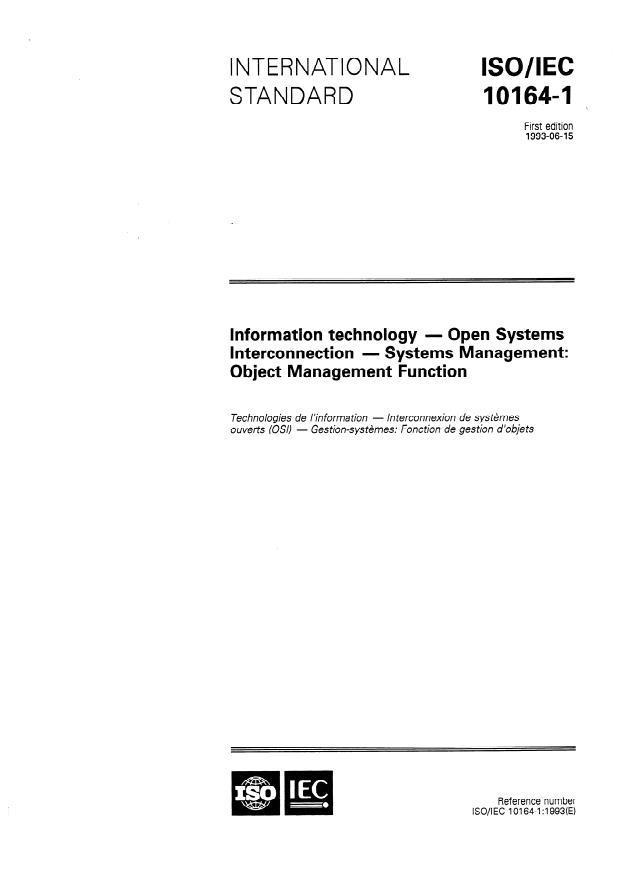
INTERNATIONAL ISO/IEC
STANDARD 10164-I
First edition
1993-06-15
Information technology - Open Systems
Interconnection - Systems Management:
Object Management Function
Technologies de I’informa tion - Interconnexion de syst&mes
ouverts (OS/) - Ges tion-sys tkmes: Fonction de ges tion d ‘obje ts
Reference number
lSO/IEC 10164-I :I 993(E)
,
Page
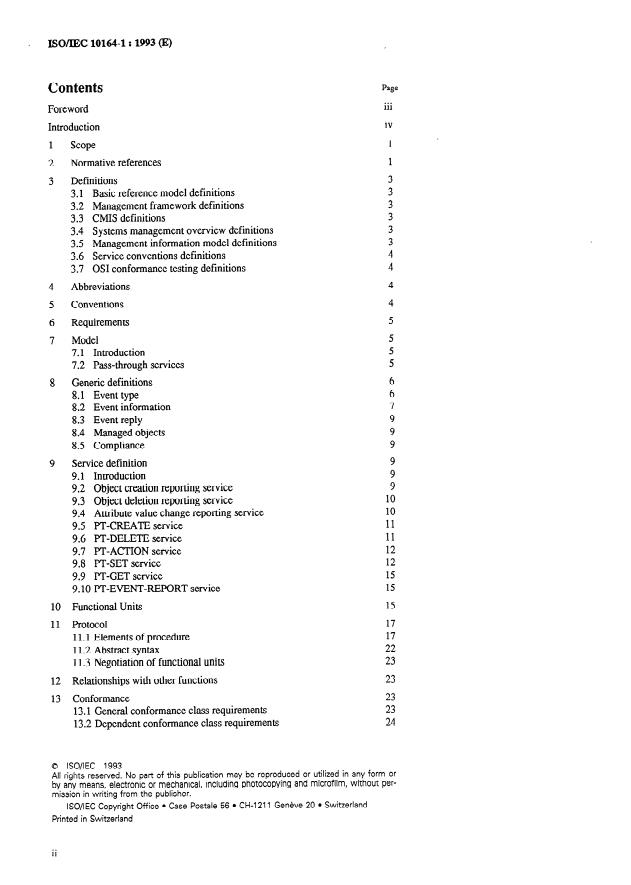
Contents
. . .
Foreword
iv
Introduction
Scope
Normative references
Definitions
3.1 Basic reference model definitions
3.2 Management framework definitions
3.3 CMIS definitions
3.4 Systems management overview definitions
3.5 Management information model definitions
3.6 Service conventions definitions
3.7 OS1 conformance testing definitions
Abbreviations
Conventions
Requirements
Model
7.1 Introduction
7.2 Pass-through services
8 Generic definitions
8.1 Event type
8.2 Event information
8.3 Event reply
8.4 Managed objects
8.5 Compliance
9 Service definition
91 . Introduction
Object creation reporting service
92 .
Object deletion reporting service
93 .
Attribute value change reporting service
94 .
PT-CREATE service
95 .
PT-DELETE service
96 .
PT-ACTION service
97 .
PT-SET service
98 .
99 . PT-GET service
9.10 PT-EVENT-REPORT service
10 Functional Units
11 Protocol
11.1 Elements of procedure
11.2 Abstract syntax
11.3 Negotiation of functional units
12 Relationships with other functions
Conformance
13.1 General conformance class requirements
13.2 Dependent conformance class requirements
0 ISO/IEC 1993
All rights resewed. No part of this publication may be reproduced or utilized in any form or
by any means, electronic or mechanical, including photocopying and microfilm, without per-
mission in writing from the publisher.
lSO/IEC Copyright Office l Case Postale 56 l CH-1211 Geneve 20 l Switzerland
Printed in Switzerland
ii
ISO/IEC10164=1:1993(E)
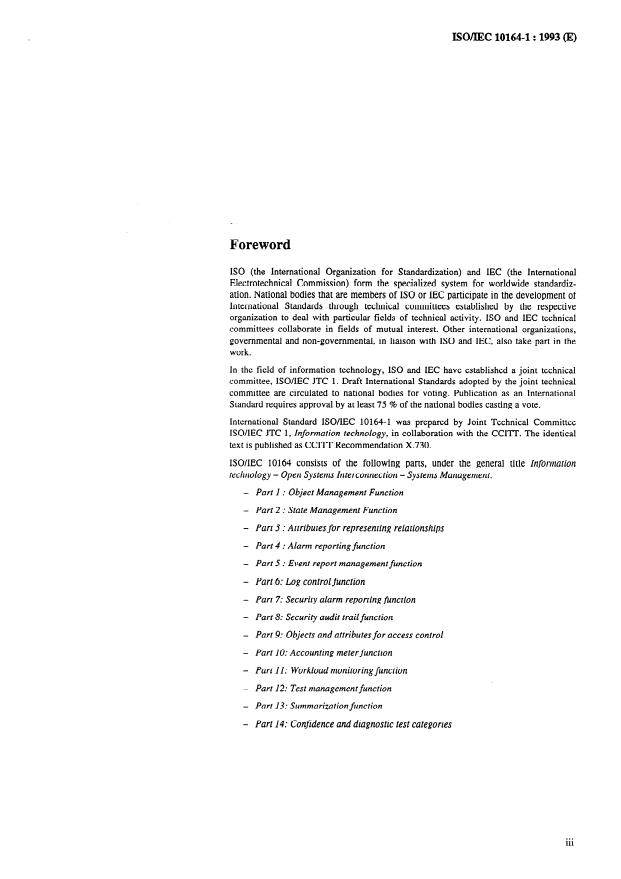
Foreword
IS0 (the International Organization for Standardization) and IEC (the International
Electrotechnical Commission) form the specialized system for worldwide standardiz-
ation. National bodies that are members of IS0 or IEC participate in the development of
International Standards through technical committees established by the respective
organization to deal with particular fields of technical activity. IS0 and IEC technical
committees collaborate in fields of mutual interest. Other international organizations,
governmental and non-governmental, in liaison with IS0 and IEC, also take part in the
work.
In the field of information technology, IS0 and IEC have established a joint technical
committee, ISO/IEC JTC 1. Draft International Standards adopted by the joint technical
committee are circulated to national bodies for voting. Publication as an International
Standard requires approval by at least 75 % of the national bodies casting a vote.
International Standard ISO/IEC 10164-l was prepared by Joint Technical Committee
ISO/IEC JTC 1, Information technology, in collaboration with the CCI’TT. The identical
text is published as CCI’TT Recommendation X.730.
ISO/IEC 10164 consists of the following parts, under the general title Information
technology - Open Systems Interconnection - Systems Management:
- Part I : Object Management Function
- Part 2 : State Management Function
- Part 3 : Attributes for representing relationships
Part 4 : Alarm reporting function
-
- Part 5 : Event report management function
- Part 6: Log control function
- Part 7: Security alarm reporting function
- Part 8: Security audit trail function
- Part 9: Objects and attributes for access control
- Part 10: Accounting meter function
- Part 1 I: Workload monitoring function
- Part 12: Test management function
- Part 13: Summarization function
Part 14: Confidence and diagnostic test categories
-
. . .
Ill
_ Is0nEc101644:1993(E)
Introduction
ISO/IEC 10164 is a multipart Standard developed according to IS0 7498 and
ISO/IEC 7498-4. ISO/IEC 10164 is related to the following International Standards:
Open Systems Interconnection -
ISO/IEC 9595: 1990, Information technology -
Common management information service definition;
Interconnection -
ISO/IEC 9596: 1990, Information technology - Open Systems
Common management information protocol;
- Open Systems Interconnection -
ISO/IEC 10040: 1992, Information technology
Systems management overview;
ISOAEC 10165: 1992, Information technology - Open Systems Interconnection -
Structure of management informution.
iv
ISWIEC 10164-l : 1993 (E)
INTERNATIONAL STANDARD
CCITI’ RECOMMENDATION
INFORMATION TECHNOLOGY - OPEN SYSTEMS INTERCONNECTION -
SYSTEMS IMANAGEMENT: OBJECT MANAGEMENT FUNCTION
1 Scope
This Recommendation I International Standard defines a systems management function which may be used by an
application process in a centralized or decentralized management environment to interact for the purposes of systems
management, as defined by CCI’IT Rec. X.700 I ISO/IEC 7498-4. This Recommendation I International Standard
defines the object management function that consists of services, functional units, and generic definitions. It is
positioned in the application layer of CCITI’ Rec. X.200 I IS0 7498 and is defined according to the model provided by
ISO/IEC 9545. The role of systems management functions are described by CCITI’ Rec. X.701 I ISO/IEC 10040.
This Recommendation I International Standard
establishes user requirements for the object management function;
- establishes a model that relates the services and generic definitions provided by this function to user
requirements;
- defines the services provided by the function;
- defines generic notification types and parameters documented in accordance with CCITT Rec. X.722 I
ISO/IEC 101654;
specifies the protocol that is necessary in order to provide the services;
defines the relationship between these services and management operations and notifications;
specifies compliance requirements placed on other Standards that make use of these generic definitions;
defines relationships with other systems management functions;
-
- specifies conformance requirements.
This Recommendation I International Standard does not
define the nature of any implementation intended to provide the object management function;
specify the manner in which management is accomplished by the user of the object management
-
function;
define the nature of any interactions which result in the use of the object management function;
- specify the services necessary for the establishment, normal and abnormal release of a management
association;
preclude the definition of further notification types;
define managed objects.
2 Normative references
The following CCITI’ Recommendations and International Standards contain provisions which, through reference in
this text, constitute provisions of this Recommendation I International Standard.
At the time of publication, the
editions indicated were valid. All Recommendations and Standards are subject to revision, and parties to agreements
based on this Recommendation I International Standard are encouraged to investigate the possibility of applying the
most recent editions of the Recommendations and Standards indicated below.
Members of IEC and IS0 maintain
registers of currently valid International Standards. The CCITT Secretariat maintains a list of the currently valid
CCITI’ Recommendations.
CCITI’ Rec. X.730 (1992 E) 1
ISOAEC10164-1:1993(E)
21 Identical Recommendations I International Standards
l
.
- CCITI’ Recommendation X.701 (1992) I ISO/IEC 10040: 1992, lnfomtation technology - Open Systems
Interconnection - Systems managemet overview.
- CCI’IT Recommendation X.720 (1992) I ISO/IEC 10165-1:1993, Infomration technology - Open
- Structure of management infomzation: Management infomuztion model.
Systems Interconnection
- CCITI’ Recommendation X.721 (1992) I ISO/IEC 101652:1992, Information technology - Open
Systems Interconnection - Structure of management information: Definition of management
information.
- CCITI’ Recommendation X.722 (1992) I ISO/lEC 10165-4:1992, Information technology - Open
Systems Interconnection - Structure of management information: Guidelines for the definition of
managed objects.
- CCm Recommendation X.733 (1992) I ISO/lEC 101644:1992, Information technology - Open
Systems Interconnection - Systems Management: Alarm reporting function.
- CCITT Recommendation X.734 (1992) I ISO/IEC 10164-5:1993, Information technology - Open
Systems Interconnection - Systems Management: Event report management function.
- CCITT Recommendation X.735 (1992) I ISO/IEC 10164-6:1993, Information technology - Open
Systems Interconnection - Systems Management: Log controlfirnction.
22 l Paired Recommendations I International Standards equivalent in technical content
- CCI’IT Recommendation X.200 (1988), Reference Model of Open Systems Interconnection for CCIT7’
Applications.
IS0 7498:1984, Information processing systems - Open Systems Interconnection - Basic Reference
Model.
- CCITT Recommendation X.209 (1988), Specification of basic encoding rules for Abstract Syntax
Notation One (ASN.1).
ISO/IEC 8825:1990, Information technology - Open Systems Interconnection - Specification of Basic
Encoding Rules for Abstract Syntax Notation One (ASN.l).
- CCITT Recommendation X.210 (1988), Open Systems Interconnection. Layer Service Definition
Conventions.
ISO/TR 8509:1987, Information processing systems - Open Systems Interconnection - Service
conventions.
- CCI’IT Recommendation X.290 (1992), OSI conformance testing methodology and framework for
protocol Recommendations for CCITT applications - General concepts.
ISOLEC 9646-1: 1991, Information technology - Open Systems Interconnection - Conformance testing
methodology and framework - Part 1: General concepts.
- CCI’IT Recommendation X.700 (1992), Management Framework Definition for Open Systems
Interconnection (OSI) for CCm Applications.
ISO/IEC 7498-4:1989, Information processing systems - Open Systems Interconnection - Basic
Reference Model - Part 4: Management framework.
- CCITT Recommendation X.710 (1991), Common Management Information Service Definition for
CCI?T applications.
ISO/IEC 9595: 1991, Information technology - Open Systems Interconnection - Common management
information service definition.
23 0 Additional references
- ISOIIEC 9545: 1989, Information technology - Open Systems Interconnection - Application layer
structure.
2 CCIl'TRec.X.730(1992E)
3 Definitions
For the pluposes of this Recommendation I International Standard, the following definitions apply.
31 l Basic reference model definitions
This Recommendation I International Standard makes use of the following term -defined in CCI’IT Rec. X.200 I
IS0 7498:
a) open system;
b) systems management;
c) layer management.
d) OS1 environment; -
32 0 Management framework definitions
This Recommendation I International Standard makes use of the following term defined in CCITT Rec. X.700 I
ISO/IEC 74984:
managed object
33 0 CMIS definitions
This Recommendation I International Standard makes use of the following tenon defined in CCITT Rec. X.710 I
ISO/IEC 9595:
attribute
34 l Systems management overview definitions
This Recommendation I International Standard makes use of the following terms defined in CCITT Rec. X.701 I
ISO/IEC 10040:
a) agent;
b) agent role;
c) dependent conformance;
d) general conformance;
e) generic definitions;
managed object class;
g) manager;
h) manager role;
notification;
i>
j) systems management functional unit;
k) systems management function;
1) systems management application protocol;
m) (systems management) operation.
35 0
Management information model definitions
This Recommendation I International Standard makes use of the following term defined in CCITT Rec. X.720 I
ISO/IEC 101654:
managed object boundary
CCWTRec.X.730(1992E) 3
ISO/lEC 10164-l : 1993 (E)
l Service conventions definitions
This Recommendation I International Standard makes use of the following terms defined in CCI’IT Rec. X.210 I
ISOKR 8509:
confhn (primitive);
a)
confirmed-service;
b)
indication (primitive);
Cl
non-confumed-service;
d)
request (primitive);
e)
response (primitive);
service-user;
9)
service-provider.
h)
37 0 OS1 conformance testing definitions
This Recommendation I International Standard makes use of the following term defined in CCI’IT Rec. X.290 I
ISO/IEC 9646-1:
system conformance statement
4 Abbreviations
ASN. 1 Abstract Syntax Notation One
CMIS Common Management Information service
conf Confmation
Ind Indication
MAPDU Management application protocol data unit
Open systems interconnection
OS1
Request
Req
Response
RsP
SMAPM Systems management application protocol machine
SMI Structure of management information
5 Conventions
This Recommendation I International Standard defines services for the object management function following the
descriptive conventions defined in CCITI’ Rec. X.210 I ISOKR 8509. In clause 9, the definition of each service
includes a table that lists the service parameters. For a given service primitive, the presence of each parameter is
described by one of the following values.
M the parameter is mandatory;
the value of the parameter is equal to the value of the parameter in the column to the left;
(=I
U the use of the parameter is a Service-user option;
the parameter is not present in the interaction described by the primitive concerned;
C
the parameter is conditional;
P the parameter is subject to the constraints imposed by CClTT Rec. X.710 I ISO/lEC 9595.
NOTE - The parameters that are marked “P” in service tables of this Recommendation I International Standard are
mapped directly onto the corresponding parameters of the CMIS service primitive, without changing the semantics or syntax of the
parameters. The remaining parameters are used to construct an MAPDU.
CCITI’ Rec. X.730 (1992 E)
ISO/IEC10164-1:1993(E)
6 Requirements
The MIS-User needs the ability to
- create and delete managed objects;
examine and modify the value of attributes of managed objects;
-
- be made aware of changes in the configuration of managed objects. ’
7 Model
71 l
Introduction
Each resource that is subject to systems management is represented by a managed object. These are described in
CCI’IT Rec. X.720 I ISO/IEC 101651.
Managed objects can be created and deleted, and values of attributes of managed objects can be changed, in one or
more of three distinct ways
through configuration processes in the local system environment that are outside the scope of OSI;
- through the o-layer operation and/or the layer management of an open system, as described in those
(N&layer standards;
- through the OS1 systems management services.
Object management describes services for
deletion
the reporting of creation and of managed objects;
the reporting of changes to attribute values of managed objects.
management
Object describes pass-through services for
the creation and deletion of managed objects;
performing actions upon managed objects;
- attribute changing;
attribute reading;
- event reporting.
72 l Pass-through services
Where different parts of systems management functions defme operations or notifications, then they do so
independently of their mapping onto an underlying communications service. This enables this Recommendation I
International Standard to be used across a range of underlying communications services by other systems management
functions or managed objects. When a systems management function defines specific systems management services,
then these services shall map directly onto the CMIS services.
In order to achieve this objective it is necessary for one of the systems management Recommendations I International
Standards to detail the mapping between the operations and notifications that apply across a managed object boundary
and the underlying communications services. This Recommendation I International Standard is used to document such
mapping.
Currently, only the mapping onto CMIS are defined by this Recommendation I International Standard through the use
of pass-through services.
I International Standard describes specific services, the management operations
Except where this Recommendation
and notifications that apply across a managed object boundary shall map onto the pass-through services of this
Recommendation I International Standard as shown in Table 1.
CCITI’Rec. X.730(1992E) 5
ISO/lEC 10164-l : 1993 (E)
The management operations are described in CCITI’ Rec. X.720 I ISO/IEC 10165-l.
Table I- Mapping of pass-through services
SMI Pass-through
Create PT-CREATE
I I I
Delete PT-DELETE
I I --1
I
,
I I I
Action
PIT-ACTION
I I
I
I
I I I
1 Replace 1 PT-SET
I
Add PT-SET
Remove PT-SET
Replace-with-Default
PT-SET
Get
PT-GET
Notification
PT-EVENT-REPORT
8 Generic definitions
The set of generic notifications, parameters and semantics defined by this Recommendation I International Standard
provide the detail for the following general parameters of the M-EVENT-REPORT service as defined by CCI’IT
Rec. X.710 I ISO/IEC 9595:
- event type;
- event information;
- event reply.
All notifications are potential entries in a systems management log and this Recommendation I International Standard
defines three managed object classes for this purpose.* CCI’IT Rec. X.721 I ISO/IEC 10165-2 defines a generic event
log record object class from which all entries are derived, the additional information being specified by the event
information and event reply parameters.
81 0 Event type
This parameter defines the type of the event. The following three event types are defined in this Recommendation I
International Standard:
- object creation: An indication that a managed object instance has been created. Where a managed object
class is required to report the creation of a managed object instance, then that managed object class shall
import the object creation notification type. The creation of a managed object within an open system
can be as a result of a PT-CREATE service, or a local operation within the open system;
- object deletion: An indication that a managed object instance has been deleted. Where a managed object
class is required to report the deletion of a managed object instance, then that managed object class shall
import the object deletion notification type. The deletion of a managed object within an open system
can be as a result of a PT.DELETE service, or a local operation within the open system;
- attribute value change: An indication that the attribute value(s) of a managed object has changed. This
notifkation type is used to report one or more of the following:
a) the addition of one or more new members to one or more set-valued attributes;
b) the removal of one or more members from one or more set-valued attributes;
6 CCITI’ Rec. X.730 (1992 E)
ISOLEC 101644 : 1993 (E)
c) the replacement of the value of one or more attributes;
d) the changing of the value of one or more attributes to their default value(s);
through either the internal operation of the resource or via management operation. This notification type
shall not be used for conveying attribute value changes which have specific notification types already
defined.
It is the role of the managed object class definer to fully detail the requirements that a managed object class has for
generating one or more of the above notification types. For the attribute value change notification, this includes
identifying which attributes, and which value changes to those attributes, are significant enough to warrant the
notification being emitted.
82 l Event information
The following parameters constitute the notification specific event information.
8.2.1 Object creation notification parameters
The following parameters are defined for the object creation notification.
8.2.1.1 Source Indicator
This parameter, when present, indicates the source of the operation that led to the generation of this notification type.
It can have one of the following values:
- resource operation: The notification was generated in response to a creation effected through the
internal operation of the resource;
- management operation: The notification was generated in response to a creation effected through an
SMI management operation applied across the managed object boundary external to the managed
object;
unknown: It is not possible to determine the source of the operation.
8.2.1.2 Attribute list
This parameter, when present, contains a list of attributes and their values at the time the managed object was created.
The managed object class definition may specify which attributes are to be included in the list. If the attribute list is
not specified by the managed object class definition and the parameter is present in the notification, then all the
attributes of the created managed object shall be included in the list.
8.2.1.3 Other information
The following parameters are also utilised. These parameters are defmed by CCITI Rec. X.733 I ISOLCEC 101644:
- Additional information;
- Additional text;
- Correlated notifications;
- Notification identifier.
8.2.2 Object deletion notification parameters
The following parameters are defmed for the object deletion notification.
8.2.2.1 Source Indicator
This parameter, when present, indicates the source of the operation that led to the generation of this notification type.
It can have one of the following values:
- resource operation: The notification was generated in response to a deletion effected through the
internal operation of the resource;
- management operation: The notification was generated in response to a deletion effected through an
SMI management operation applied across the managed object boundary external to the managed
object;
- u&own: It is not possible to determine the source of the operation.
CCITI’ Rec. X.730 (1992 E) 7
1somc 10164-l : 1993 (E)
8.2.2.2 Attribute list
This parameter, when present, contains a list of attributes and their values just before the managed object was deleted.
The managed object class definition may specify which attributes are to be included in the list. If this is not specified
by the managed object class definition and the parameter is present in the notification, then all the attributes of the
managed object shall be included in the list.
8.2.2.3 Other information
The following parameters are also utilised. These parameters are defined by CCI’IT Rec. X.733 I ISO/lEC 101644:
- Additional information;
-
Additional text;
Correlated notifications;
Notification identifier.
8.2.3 Attribute value change notification parameters
The following parameters are defined for attribute value change notification.
8.2.3.1 Source indicator
This parameter, when present, indicates the source of the operation that led to the generation of this notification type.
It can have one of the following values:
- resource operation: The notification was generated in response to an attribute value change effected
through the internal operation of the resource;
management operation: The notification was generated in response to a an attribute value change
-
effected through an SMI management operation applied across the managed object boundary external to
the managed object;
unknoWn: It is not possible to determine the source of the operation.
8.2.3.2 Attribute identifier list
This parameter, when present, identifies the set of attributes whose value changes are being reported.
8.2.3.3 Attribute value change defmition
This parameter set consists of a set of sequences of the three parameters: Attribute identifier, Old attribute value and
New attribute value described below. Each individual sequence describes a single attribute value change. At least one
new attribute value shall be present in this list.
8.2.3.3.1 Attribute identifier
This parameter identifies the attribute whose value change is being reported.
8.2.3.3.2 Old attribute value
This parameter, when present, identifies the old value of the attribute.
8.2.3.3.3 New attribute value
This parameter identifies the current value of the attribute.
8.2.3.4 Other information
The following parameters are also utilised. These parameters are defined by CCI’IT Rec. X.733 I ISO/IEC 10164-4:
- Additional information;
Additional text;
- Correlated notifications;
- Notification identifier.
CCIlTRec. X.730(1992 E)
ISO/IEC 10164-l : 1993 (E)
83 l Event reply
I International Standard does not specify information to be used in the event reply parameter.
This Recommendation
l Managed objects
8.4.1 Object creation record
An object creation record is a managed object class derived from the event log record object class defined in CCI’IT
Rec. X.735 I ISO/IEC 10164-6. The object creation record object class represents information stored in logs resulting
from object creation notification.
8.4.2 Object deletion record -
An object deletion record is a managed object class derived from the event log record object class defined in CCITI’
Rec. X.735 I ISO/IEC 10164-6. The object deletion record object class represents information stored in logs resulting
from object deletion notification.
8.4.3 Attribute value change record
An attribute value change record is a managed object class derived from the event log record object class defined in
CCITT Rec. X.735 I ISO/IEC 10164-6. The attribute value change record object class represents information stored in
logs resulting from attribute value change notification.
85 l Compliance
Managed object class definitions support the function defined in this Recommendation I International Standard by
incorporating the specification of the notification types defmed in this Recommendation I International Standard
through reference to the notification templates defmed in CCITT Rec. X.721 I ISO/IEC 10165-2. The reference
mechanism is defined in CCITT Rec. X.722 I ISO/IEC 101654
The definition of the managed object class shall, for each imported notification, specify in the behaviour clause which
of the optional and conditional parameters are to be utilized and any further restrictions on their use and their values. It
is permissible to state that the use of a parameter remains optional.
Service definition
91 l Introduction
This Recommendation I International Standard provides nine services, six of which are pass-through services. These
are identified below together with the parameters that these services convey.
92 l
Object creation reporting service
This service allows an MIS-User, in the agent role, to report the creation of managed objects. It is defined both as a
confnned and as a non-confirmed service.
The object creation reporting service uses the parameters defmed in clause 8 of this Recommendation I International
Standard in addition to the general M-EVENT-REPORT service parameters defined in CCI’IT Rec. X.710 I
ISO/lEC 9595.
Table 2 lists the parameters for the object creation reporting service.
The Event time, Correlated notifications and Notification identifier parameters may be assigned by the object emitting
the notification or by the managed system.
CCIYIT Rec. X.730 (1992 E)
ISOIIEC 10164-l : 1993 (E)
Table 2 - Object creation reporting parameters
Parameter name ReqAnd RsplConf
Invoke identifier P P
I
I I
P
Mode
I
I I
P
Managed object ciass P
I I I
Managed object instance P P
I I
I
Event type
Event time
Event information
Source indicator U
I I
Attribute list U
I I
I
Notification identifier U
I I
U
Correlated notifications
I I
U
Additional text
I I I
Additional infomation U
I I
P
Current time
I
I I
Event reply
I
I I
P
Errors
I
I
93 l Object deletion reporting service
This service allows an MIS-User, in the agent role, to report the deletion of managed objects. It is defined both as a
confurned and as a non-confirmed service.
The object deletion reporting service uses the parameters defined in clause 8 of this Recommendation I International
Standard in addition to the general M-EVENT-REPORT service parameters defined in CCITT Rec. X.710 I
ISOLEC 9595.
Table 3 lists the parameters for the object deletion reporting service.
The Event time, Correlated notifkations and Notification identifier parameters may be assigned by the object emitting
the notification or by the managed system.
94 l Attribute value change reporting service
This service allows an MIS-User, in the agent role, to report the changes in the values
...