


ISO 15000-3:2023
(Main)Electronic business eXtensible Markup Language (ebXML) — Part 3: Registry and repository
Electronic business eXtensible Markup Language (ebXML) — Part 3: Registry and repository
ISO 15000-3 specifies service interfaces, protocols and information model for an integrated registry and repository. The repository stores electronic content while the registry stores metadata that describes the content in the repository.
Commerce électronique en langage de balisage extensible (ebXML) — Partie 3: Titre manque
General Information
- Status
- Published
- Publication Date
- 15-Jan-2023
- Current Stage
- 6060 - International Standard published
- Start Date
- 16-Jan-2023
- Due Date
- 20-Jan-2023
- Completion Date
- 16-Jan-2023
Overview
ISO 15000-3:2023 - Electronic business eXtensible Markup Language (ebXML) - Part 3: Registry and repository defines the service interfaces, protocols and information model for an integrated ebXML registry and repository. The standard describes how a repository stores electronic content while the registry stores metadata that describes that content. It provides XML Schema-based data types and a comprehensive model for managing objects, metadata, services, queries, events, provenance and federation in an interoperable, standards-based way.
Key technical topics and requirements
- Registry information model: Core types and structures (e.g., identifiable and registry object types, slots, version info, extrinsic objects) and XML Schema definitions for metadata representation.
- Associations & classification: Models for linking objects, defining taxonomies, classification schemes and nodes to enable discoverability and structured metadata.
- Provenance & parties: Types for postal, telephone and party/person/organization information to support auditability and origin tracking.
- Service information model: Service, endpoint, binding and interface types to register and discover web-service style endpoints and service metadata.
- Query information model & services: QueryDefinitionType, QueryExpression types (string/XML) and canonical queries plus the QueryManager interface for parameterized and ad-hoc querying of registry content.
- Event and audit model: Auditable events, actions, subscriptions and notifications for change tracking and notification workflows.
- Federation: Registry federation configuration and registry-to-registry models to support distributed registries.
- Access control: Information model for defining access control policies, contextual roles and XACML function bindings - constraints and policy resolution rules are included.
- Protocols & interfaces: Abstract protocol definitions for RegistryRequest/Response and exception handling; server plugin patterns for extensibility.
Practical applications and users
- Enterprise architects and system integrators deploying B2B integration platforms who need a standardized registry/repository for service metadata, artifacts and documents.
- Software vendors building registry/repository products or extensions that must interoperate with ebXML ecosystems.
- Governance, compliance and audit teams that require provenance, versioning and auditable event models.
- Public sector and large federated organizations implementing distributed registry infrastructures for shared service discovery and metadata governance.
- Use cases: service discovery, document and schema repository management, metadata-driven routing, federated catalogs, and secure access-controlled publishing of electronic business artifacts.
Related standards
- Part of the ISO 15000 ebXML series (other parts address messaging, collaboration and core specifications).
- References XML Schema and uses XACML-style access control constructs for policy semantics.
ISO 15000-3:2023 is essential for anyone implementing an XML-based registry/repository architecture to ensure interoperable metadata management, standardized queries and secure, federated service discovery.

Get Certified
Connect with accredited certification bodies for this standard

BSI Group
BSI (British Standards Institution) is the business standards company that helps organizations make excellence a habit.

NYCE
Mexican standards and certification body.
Sponsored listings
Frequently Asked Questions
ISO 15000-3:2023 is a standard published by the International Organization for Standardization (ISO). Its full title is "Electronic business eXtensible Markup Language (ebXML) — Part 3: Registry and repository". This standard covers: ISO 15000-3 specifies service interfaces, protocols and information model for an integrated registry and repository. The repository stores electronic content while the registry stores metadata that describes the content in the repository.
ISO 15000-3 specifies service interfaces, protocols and information model for an integrated registry and repository. The repository stores electronic content while the registry stores metadata that describes the content in the repository.
ISO 15000-3:2023 is classified under the following ICS (International Classification for Standards) categories: 35.040.50 - Automatic identification and data capture techniques. The ICS classification helps identify the subject area and facilitates finding related standards.
ISO 15000-3:2023 is available in PDF format for immediate download after purchase. The document can be added to your cart and obtained through the secure checkout process. Digital delivery ensures instant access to the complete standard document.
Standards Content (Sample)
INTERNATIONAL ISO
STANDARD 15000-3
First edition
2023-01
Electronic business eXtensible
Markup Language (ebXML) —
Part 3:
Registry and repository
Reference number
© ISO 2023
All rights reserved. Unless otherwise specified, or required in the context of its implementation, no part of this publication may
be reproduced or utilized otherwise in any form or by any means, electronic or mechanical, including photocopying, or posting on
the internet or an intranet, without prior written permission. Permission can be requested from either ISO at the address below
or ISO’s member body in the country of the requester.
ISO copyright office
CP 401 • Ch. de Blandonnet 8
CH-1214 Vernier, Geneva
Phone: +41 22 749 01 11
Email: copyright@iso.org
Website: www.iso.org
Published in Switzerland
ii
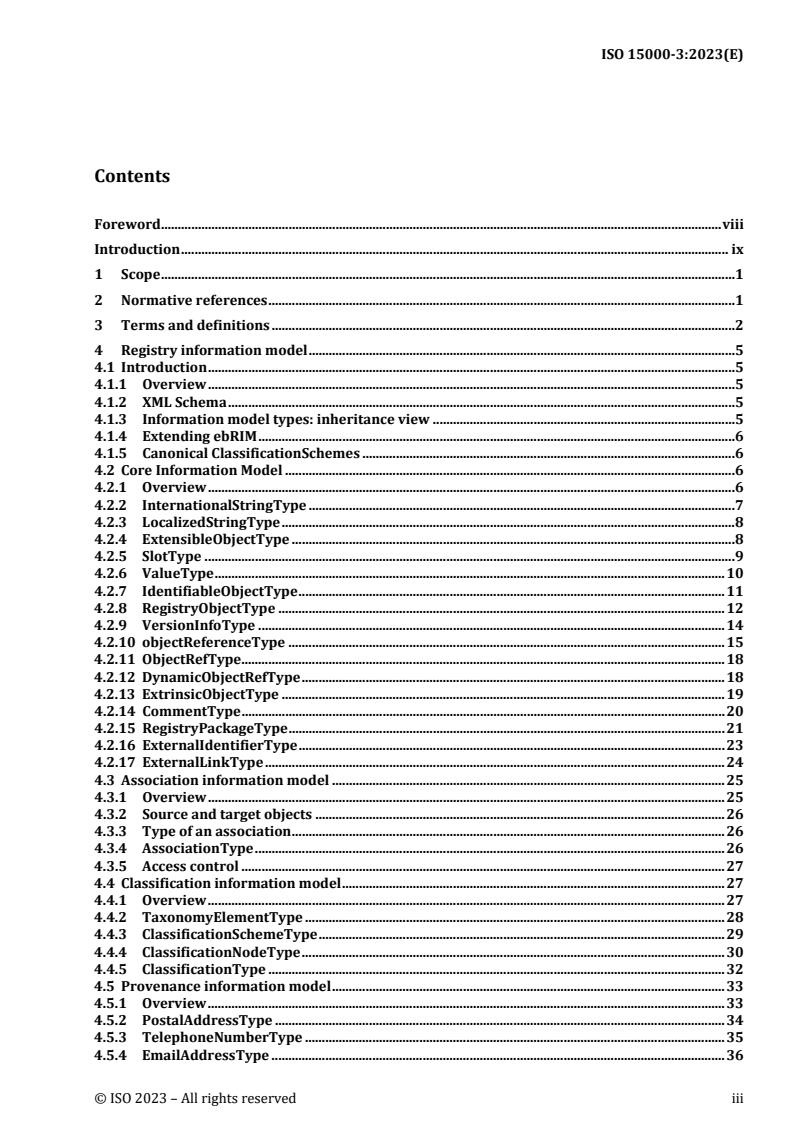
Contents
Foreword . viii
Introduction . ix
1 Scope . 1
2 Normative references . 1
3 Terms and definitions . 2
4 Registry information model . 5
4.1 Introduction . 5
4.1.1 Overview . 5
4.1.2 XML Schema . 5
4.1.3 Information model types: inheritance view . 5
4.1.4 Extending ebRIM . 6
4.1.5 Canonical ClassificationSchemes . 6
4.2 Core Information Model . 6
4.2.1 Overview . 6
4.2.2 InternationalStringType . 7
4.2.3 LocalizedStringType . 8
4.2.4 ExtensibleObjectType . 8
4.2.5 SlotType . 9
4.2.6 ValueType . 10
4.2.7 IdentifiableObjectType . 11
4.2.8 RegistryObjectType . 12
4.2.9 VersionInfoType . 14
4.2.10 objectReferenceType . 15
4.2.11 ObjectRefType . 18
4.2.12 DynamicObjectRefType . 18
4.2.13 ExtrinsicObjectType . 19
4.2.14 CommentType . 20
4.2.15 RegistryPackageType . 21
4.2.16 ExternalIdentifierType . 23
4.2.17 ExternalLinkType . 24
4.3 Association information model . 25
4.3.1 Overview . 25
4.3.2 Source and target objects . 26
4.3.3 Type of an association . 26
4.3.4 AssociationType . 26
4.3.5 Access control . 27
4.4 Classification information model . 27
4.4.1 Overview . 27
4.4.2 TaxonomyElementType . 28
4.4.3 ClassificationSchemeType . 29
4.4.4 ClassificationNodeType . 30
4.4.5 ClassificationType . 32
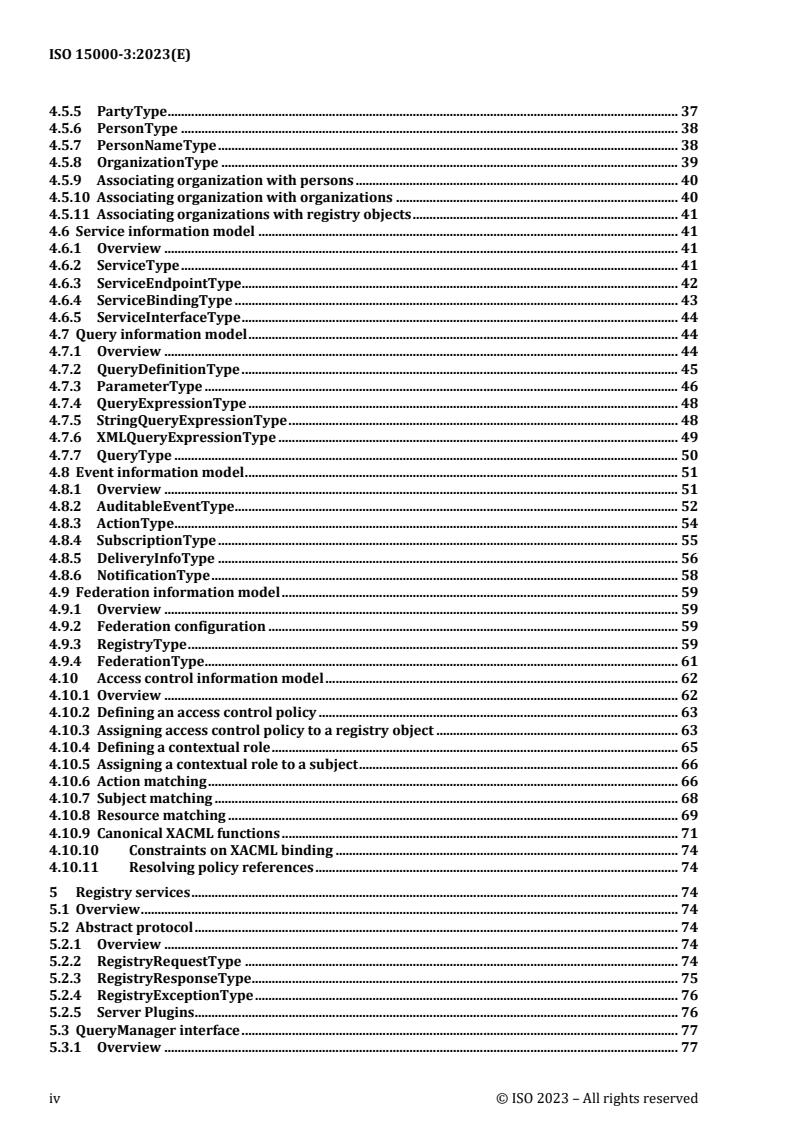
4.5 Provenance information model . 33
4.5.1 Overview . 33
4.5.2 PostalAddressType . 34
4.5.3 TelephoneNumberType . 35
4.5.4 EmailAddressType . 36
4.5.5 PartyType . 37
4.5.6 PersonType . 38
4.5.7 PersonNameType . 38
4.5.8 OrganizationType . 39
4.5.9 Associating organization with persons . 40
4.5.10 Associating organization with organizations . 40
4.5.11 Associating organizations with registry objects . 41
4.6 Service information model . 41
4.6.1 Overview . 41
4.6.2 ServiceType . 41
4.6.3 ServiceEndpointType. 42
4.6.4 ServiceBindingType . 43
4.6.5 ServiceInterfaceType . 44
4.7 Query information model . 44
4.7.1 Overview . 44
4.7.2 QueryDefinitionType . 45
4.7.3 ParameterType . 46
4.7.4 QueryExpressionType . 48
4.7.5 StringQueryExpressionType . 48
4.7.6 XMLQueryExpressionType . 49
4.7.7 QueryType . 50
4.8 Event information model . 51
4.8.1 Overview . 51
4.8.2 AuditableEventType . 52
4.8.3 ActionType . 54
4.8.4 SubscriptionType . 55
4.8.5 DeliveryInfoType . 56
4.8.6 NotificationType . 58
4.9 Federation information model . 59
4.9.1 Overview . 59
4.9.2 Federation configuration . 59
4.9.3 RegistryType . 59
4.9.4 FederationType. 61
4.10 Access control information model . 62
4.10.1 Overview . 62
4.10.2 Defining an access control policy . 63
4.10.3 Assigning access control policy to a registry object . 63
4.10.4 Defining a contextual role . 65
4.10.5 Assigning a contextual role to a subject . 66
4.10.6 Action matching . 66
4.10.7 Subject matching . 68
4.10.8 Resource matching . 69
4.10.9 Canonical XACML functions . 71
4.10.10 Constraints on XACML binding . 74
4.10.11 Resolving policy references . 74
5 Registry services . 74
5.1 Overview . 74
5.2 Abstract protocol . 74
5.2.1 Overview . 74
5.2.2 RegistryRequestType . 74
5.2.3 RegistryResponseType . 75
5.2.4 RegistryExceptionType . 76
5.2.5 Server Plugins . 76
5.3 QueryManager interface . 77
5.3.1 Overview . 77
iv © ISO 2023 – All rights reserved
5.3.2 Parameterized queries . 77
5.3.3 Query protocol . 77
5.3.4 Parameterized query definition . 82
5.3.5 Canonical Query: AdhocQuery . 82
5.3.6 Canonical query: BasicQuery. 83
5.3.7 Canonical query: ClassificationSchemeSelector . 84
5.3.8 Canonical query: FindAssociations . 85
5.3.9 Canonical query: FindAssociatedObjects . 86
5.3.10 Canonical query: GarbageCollector . 87
5.3.11 Canonical query: GetAuditTrailById. 87
5.3.12 Canonical query: GetAuditTrailByLid . 88
5.3.13 Canonical query: GetAuditTrailByTimeInterval . 89
5.3.14 Canonical query: GetChildrenByParentId . 89
5.3.15 Canonical query: GetClassificationSchemesById . 91
5.3.16 Canonical query: GetRegistryPackagesByMemberId . 91
5.3.17 Canonical query: GetNotification . 92
5.3.18 Canonical query: GetObjectById . 92
5.3.19 Canonical query: GetObjectsByLid . 93
5.3.20 Canonical query: GetReferencedObject . 93
5.3.21 Canonical query: KeywordSearch . 94
5.3.22 Canonical query: RegistryPackageSelector . 96
5.3.23 Query functions . 97
5.3.24 Common patterns in query functions . 100
5.3.25 Canonical functions . 100
5.3.26 Query plugins . 103
5.4 LifecycleManager interface . 103
5.4.1 Overview . 103
5.4.2 SubmitObjects protocol . 103
5.4.3 UpdateObjects protocol . 106
5.4.4 RemoveObjects Protocol . 110
5.5 Version control . 112
5.5.1 Overview . 112
5.5.2 Version controlled resources . 113
5.5.3 Versioning and id attribute . 114
5.5.4 Versioning and lid attribute . 114
5.5.5 Version identification for RegistryObjectType . 114
5.5.6 Version identification for RepositoryItem . 114
5.5.7 Versioning and references . 115
5.5.8 Versioning of RegistryPackages . 115
5.5.9 Versioning and RegistryPackage membership . 115
5.5.10 Inter-version association . 116
5.5.11 Version removal . 116
5.5.12 Locking and concurrent modifications . 116
5.5.13 Version creation . 116
5.6 Validator interface . 117
5.6.1 Overview . 117
5.6.2 ValidateObjects protocol . 117
5.6.3 Validator plugins . 118
5.7 Cataloger interface . 119
5.7.1 Overview . 119
5.7.2 CatalogObjects protocol . 119
5.7.3 Cataloger plugins . 122
5.8 Subscription and notification . 123
5.8.1 Overview . 123
5.8.2 Server events . 123
5.8.3 Notifications . 124
5.8.4 Creating a subscription . 124
5.8.5 Event delivery . 125
5.8.6 NotificationListener interface . 126
5.8.7 Notification protocol . 126
5.8.8 Pulling notification on demand . 127
5.8.9 Deleting a subscription . 127
5.9 Multi-server features . 127
5.9.1 Overview . 127
5.9.2 RemoteObjects reference . 127
5.9.3 Local replication of remote objects . 128
5.9.4 Registry federations . 130
5.10 Governance features . 133
5.10.1 Overview . 133
5.10.2 Representing a governance collaboration . 134
5.10.3 Scope of governance collaborations . 135
5.10.4 Assigning a governance collaboration . 135
5.10.5 Determining applicable governance collaboration . 136
5.10.6 Determining the registry process in a governance collaboration . 136
5.10.7 Starting the registry process for a governance collaboration . 136
5.10.8 Incoming messageFlows to registry process . 137
5.10.9 Outgoing messageFlows from registry process . 137
5.10.10 Canonical task patterns . 137
5.10.11 XPATH extension functions . 140
5.10.12 Default governance collaboration . 141
5.11 Security features . 142
5.11.1 Overview . 142
5.11.2 Message integrity . 142
5.11.3 Message confidentiality . 142
5.11.4 User registration and identity management . 142
5.11.5 Authentication . 143
5.11.6 Authorization and access control . 143
5.11.7 Audit trail . 143
5.12 Native language support (NLS) . 143
5.12.1 Overview . 143
5.12.2 Terminology . 143
5.12.3 NLS and registry protocol messages . 144
5.12.4 NLS support in RegistryObjects. 144
5.12.5 NLS and repository items . 145
5.13 REST binding . 146
5.13.1 Overview . 146
5.13.2 Canonical URL . 146
5.13.3 Query Protocol REST binding . 147
5.14 SOAP binding . 149
5.14.1 Overview . 149
5.14.2 WS-Addressing SOAP headers . 150
6 Conformance . 150
6.1 Conformance for ebXML RegRep . 150
6.2 QueryManager interface . 151
6.2.1 Overview . 151
6.2.2 Canonical queries . 151
6.2.3 Canonical query functions . 152
6.3 LifecycleManager interface . 152
6.4 Version control . 153
6.5 Validator interface . 153
6.6 Cataloger interface . 153
vi © ISO 2023 – All rights reserved
6.7 Subscription and notification . 153
6.8 Multi-server features . 154
6.9 Governance features . 154
6.10 Security features . 154
6.11 Native language support . 155
6.12 REST binding . 155
6.13 SOAP binding . 156
Annex A (Normative) Protocol exceptions . 157
Annex B (Normative) Namespace definitions . 159
Annex C (Informative) Namespace references . 161
Bibliography . 162
Foreword
ISO (the International Organization for Standardization) is a worldwide federation of national
standards bodies (ISO member bodies). The work of preparing International Standards is normally
carried out through ISO technical committees. Each member body interested in a subject for which a
technical committee has been established has the right to be represented on that committee.
International organizations, governmental and non-governmental, in liaison with ISO, also take part in
the work. ISO collaborates closely with the International Electrotechnical Commission (IEC) on all
matters of electrotechnical standardization.
The procedures used to develop this document and those intended for its further maintenance are
described in the ISO/IEC Directives, Part 1. In particular, the different approval criteria needed for the
different types of ISO documents should be noted. This document was drafted in accordance with the
editorial rules of the ISO/IEC Directives, Part 2 (see www.iso.org/directives).
Attention is drawn to the possibility that some of the elements of this document may be the subject of
patent rights. ISO shall not be held responsible for identifying any or all such patent rights. Details of
any patent rights identified during the development of the document will be in the Introduction and/or
on the ISO list of patent declarations received (see www.iso.org/patents).
Any trade name used in this document is information given for the convenience of users and does not
constitute an endorsement.
For an explanation of the voluntary nature of standards, the meaning of ISO specific terms and
expressions related to conformity assessment, as well as information about ISO's adherence to the
World Trade Organization (WTO) principles in the Technical Barriers to Trade (TBT), see
www.iso.org/iso/foreword.html.
This document was prepared by the OASIS ebXML (Electronic business eXtensible Markup Language)
Registry Technical Committee (as the “OASIS ebXML RegRep Version 4.0 specification”) and drafted in
accordance with its editorial rules. It was assigned to Technical Committee ISO/TC 154, Processes, data
elements and documents in commerce, industry and administration and adopted under the "fast-track
procedure".
A list of all parts in the ISO 15000 series can be found on the ISO website.
Any feedback or questions on this document should be directed to the user’s national standards body. A
complete listing of these bodies can be found at www.iso.org/members.html.
viii © ISO 2023 – All rights reserved
Introduction
ebXML RegRep (registry and repository) is a standard defining service interfaces, protocols and
information model for an integrated registry and repository. The repository stores electronic content
while the registry stores metadata that describes the content in the repository.
To explain what an ebXML RegRep is we use the following familiar analogy. The ebXML RegRep is to
electronic content, what your local library is to books and other published content. To make this
analogy clearer one could look at comparisons enumerated in Table 1:
Your Local Library ebXML RegRep
Manages books and all types of published material Manages all types of electronic content
Has book shelves containing books and other published Has a "repository" containing all types of electronic
material content
Has a card catalog that describes the published material Has a "registry" that describes the electronic content
that is available in the book shelves that is available in the repository
Multiple libraries can voluntarily participate in a Multiple ebXML RegRep instances can voluntarily
cooperative network and offer a unified service participate in a cooperative network and offer a unified
service
Table 1: ebXML RegRep comparison with your local library
An ebXML RegRep is capable of storing any type of electronic content such as XML documents, text
documents, images, sound and video. Instances of such content are classified as “RepositoryItem”
instances. Repository items are stored in a content repository provided by ebXML RegRep.
In addition to repository items ebXML RegRep also stores standardized metadata. Instances of such
metadata are classified as “RegistryObject” instances (or one of its sub-types, as described later in this
document). Registry objects are stored in a registry provided by ebXML RegRep. A registry object is like
a card in the card catalog. All registry objects conform to a standard just like the cards in the card
catalog conform to a standard. Every repository item shall have a registry object that describes it, just
like every book must have a card in the card catalog. At the same time there are registry objects that do
not describe any repository item and serve the purpose of defining capabilities of an ebXML RegRep
instance.
This document describes Electronic business eXtensible Markup Language (ebXML) Part 3: Registry
and Repository. The main clauses are:
a) The Registry Information Model (ebRIM) which defines the types of metadata that can be stored
in an ebXML RegRep server (Clause 4).
b) The Registry Services and Protocols (ebRS) which define the services provided by an ebXML
RegRep server and the protocols used by clients to interact with these services (Clause 5).
c) Conformance to ebXML Registry and Repositry (Clause 6).
This document also includes the following annexes:
a) Annex A lists the standard exceptions that may be returned by various protocols defined in this
document.
b) Annex B provides a listing of namespaces that are defined in this document.
c) Annex C provides a listing of namespaces that are referenced in this document.
Separately provided are:
a) A set of XML schema files at https://standards.iso.org/iso/15000/-3/ed-1/en/xsd/ define XML
schema types and elements referenced in the core specification clauses.
b) A set of WSDL files at https://standards.iso.org/iso/15000/-3/ed-1/en/wsdl/ define the WSDL
interfaces, bindings and services referenced in the core specification clauses.
c) A set of XML files at https://standards.iso.org/iso/15000/-3/ed-1/en/xml/ that contain the
canonical data that shall be supported within every ebXML RegRep server.
x © ISO 2023 – All rights reserved
Electronic business eXtensible Markup Language
(ebXML) —Part 3: Registry and Repository
1 Scope
This part of ISO 15000 specifies service interfaces, protocols and information model for an integrated
registry and repository. The repository stores electronic content while the registry stores metadata that
describes the content in the repository.
2 Normative references
The following documents are referred to in the text in such a way that some or all of their content
constitutes requirements of this document. For dated references, only the edition cited applies. For
undated references, the latest edition of the referenced document (including any amendments) applies.
INTERNET ENGINEERING TASK FORCE (IETF). RFC 2828, Internet Security Glossary, 2000. Edited by R.
Shirey. https://www.rfc-editor.org/info/rfc2828.
ISO. Information technology — Document Schema Definition Languages (DSDL) — Part 3: Rule-based
valid
...
Questions, Comments and Discussion
Ask us and Technical Secretary will try to provide an answer. You can facilitate discussion about the standard in here.
Loading comments...