

ISO 15000-1:2021
(Main)Electronic business eXtensible Markup Language (ebXML) — Part 1: Messaging service core specification
General Information
- Abstract
This document provides a communication-protocol neutral method for exchanging electronic business messages. It defines specific enveloping constructs supporting reliable, secure delivery of business information. Furthermore, this document defines a flexible enveloping technique, permitting messages to contain payloads of any format type. It specifies each of the following: ? Messaging model ? Message pulling and partitioning ? Processing modes ? Message packaging ? Error handling ? Security module ? Reliable messaging module This document is applicable to all types of organizations (e.g., commercial enterprises, government agencies, not-for-profit organizations) that exchange documents or data electronically using messaging.
- Status
- Published
- Publication Date
- 14-Feb-2021
- Current Stage
- 9093 - International Standard confirmed
- Start Date
- 03-Jul-2026
- Completion Date
- 29-Aug-2026
Buy Documents

ISO 15000-1:2021 - Electronic business eXtensible Markup Language (ebXML)

ISO 15000-1:2021 - Electronic business eXtensible Markup Language (ebXML) — Part 1: Messaging service core specification/15/2021
Overview
ISO 15000-1:2021 - Electronic business eXtensible Markup Language (ebXML), Part 1: Messaging service core specification defines a communication‑protocol neutral method for exchanging electronic business messages. The standard specifies enveloping constructs that support reliable, secure delivery of business information and a flexible packaging technique that lets messages carry payloads of any format. It is applicable to all organization types (commercial enterprises, government agencies, not‑for‑profit organizations) that exchange documents or data electronically.
Key topics and technical requirements
- Messaging model: Abstract components, messaging roles and operations, and Message Exchange Patterns (MEPs) including One‑Way/Push, One‑Way/Pull and Two‑Way/Sync.
- Message pulling and partitioning: Support for pull-based retrieval, partition channels and interaction with security and reliability features.
- Processing modes: Definitions of messaging service processing model and configurable processing mode features (defaults and extensibility).
- Message packaging: Envelope and parts handling, MIME structure, SOAP profile considerations, ebXML SOAP envelope extensions, ebMS header, payload containers and the eb:Messaging container with eb:UserMessage and eb:SignalMessage constructs.
- Error handling: Structured eb:Error element (origin, category, errorCode, severity, refToMessageInError, descriptions, detail), error generation and reporting, and a catalogue of standard ebMS errors.
- Security module: Message signing, encryption, SOAP with attachments handling, security tokens, authorization/authentication for PullRequest, replay prevention and secured message examples.
- Reliable messaging module: Mechanisms to ensure secure, ordered and guaranteed delivery (specified as a module in the standard).
Practical applications and who uses it
- Enables B2B integration, e‑procurement, supply‑chain document exchange and cross‑organization data flows where secure and reliable delivery is required.
- Useful for organizations modernizing legacy EDI systems or implementing Web Services-based messaging backbones.
- Implementers include system integrators, solution architects, software developers of messaging gateways, EDI/AS2/AS4 replacement projects, and public sector digital services teams.
Related standards and context
- Part of the ebXML / ISO 15000 series for electronic business interoperability. ISO 15000-1:2021 focuses on messaging core rules and interoperable packaging; implementers typically align it with transport, registry/repository and business process profiles from the broader ebXML family.
Keywords: ISO 15000-1:2021, ebXML, electronic business, messaging, ebMS, secure messaging, reliable messaging, MIME, SOAP, message packaging, B2B integration.
Relations
- Consolidated By
ISO 29481-1:2025 - Building information models — Information delivery manual — Part 1: Methodology and format - Effective Date
- 16-Dec-2023
Buy Documents
ISO 15000-1:2021 - Electronic business eXtensible Markup Language (ebXML)
ISO 15000-1:2021 - Electronic business eXtensible Markup Language (ebXML) — Part 1: Messaging service core specification/15/2021
Get Certified
Connect with accredited certification bodies for this standard

BSI Group
BSI (British Standards Institution) is the business standards company that helps organizations make excellence a habit.

NYCE
Mexican standards and certification body.
Sponsored listings
Frequently Asked Questions
ISO 15000-1:2021 is a standard published by the International Organization for Standardization (ISO). Its full title is "Electronic business eXtensible Markup Language (ebXML) — Part 1: Messaging service core specification". This standard covers: This document provides a communication-protocol neutral method for exchanging electronic business messages. It defines specific enveloping constructs supporting reliable, secure delivery of business information. Furthermore, this document defines a flexible enveloping technique, permitting messages to contain payloads of any format type. It specifies each of the following: ? Messaging model ? Message pulling and partitioning ? Processing modes ? Message packaging ? Error handling ? Security module ? Reliable messaging module This document is applicable to all types of organizations (e.g., commercial enterprises, government agencies, not-for-profit organizations) that exchange documents or data electronically using messaging.
This document provides a communication-protocol neutral method for exchanging electronic business messages. It defines specific enveloping constructs supporting reliable, secure delivery of business information. Furthermore, this document defines a flexible enveloping technique, permitting messages to contain payloads of any format type. It specifies each of the following: ? Messaging model ? Message pulling and partitioning ? Processing modes ? Message packaging ? Error handling ? Security module ? Reliable messaging module This document is applicable to all types of organizations (e.g., commercial enterprises, government agencies, not-for-profit organizations) that exchange documents or data electronically using messaging.
ISO 15000-1:2021 is classified under the following ICS (International Classification for Standards) categories: 35.040.50 - Automatic identification and data capture techniques. The ICS classification helps identify the subject area and facilitates finding related standards.
ISO 15000-1:2021 has the following relationships with other standards: It is inter standard links to ISO 29481-1:2025. Understanding these relationships helps ensure you are using the most current and applicable version of the standard.
ISO 15000-1:2021 is available in PDF format for immediate download after purchase. The document can be added to your cart and obtained through the secure checkout process. Digital delivery ensures instant access to the complete standard document.
Standards Content (Sample)
INTERNATIONAL ISO
STANDARD 15000-1
First edition
2021-02
Electronic business eXtensible
Markup Language (ebXML) —
Part 1:
Messaging service core specification
Reference number
©
ISO 2021
© ISO 2021
All rights reserved. Unless otherwise specified, or required in the context of its implementation, no part of this publication may
be reproduced or utilized otherwise in any form or by any means, electronic or mechanical, including photocopying, or posting
on the internet or an intranet, without prior written permission. Permission can be requested from either ISO at the address
below or ISO’s member body in the country of the requester.
ISO copyright office
CP 401 • Ch. de Blandonnet 8
CH-1214 Vernier, Geneva
Phone: +41 22 749 01 11
Email: copyright@iso.org
Website: www.iso.org
Published in Switzerland
ii © ISO 2021 – All rights reserved
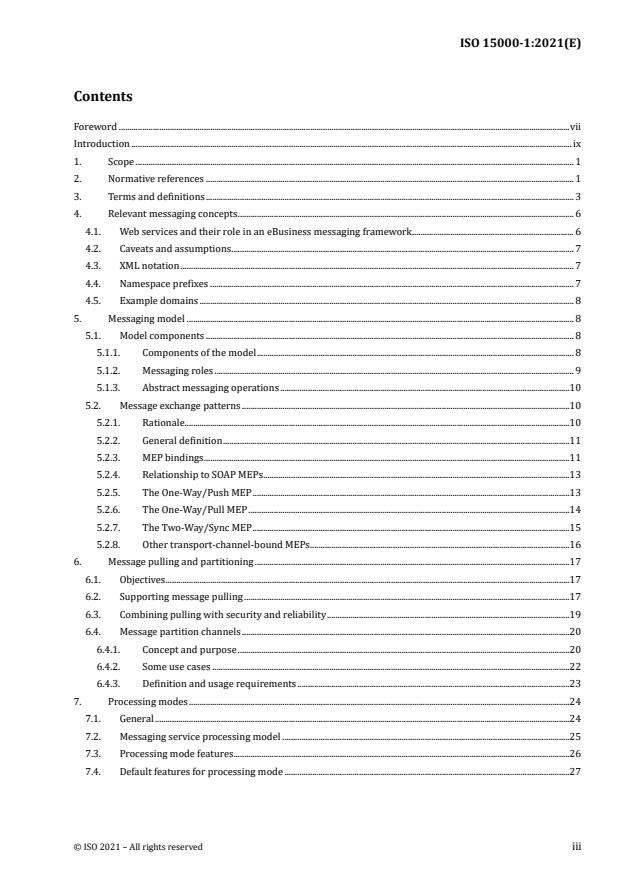
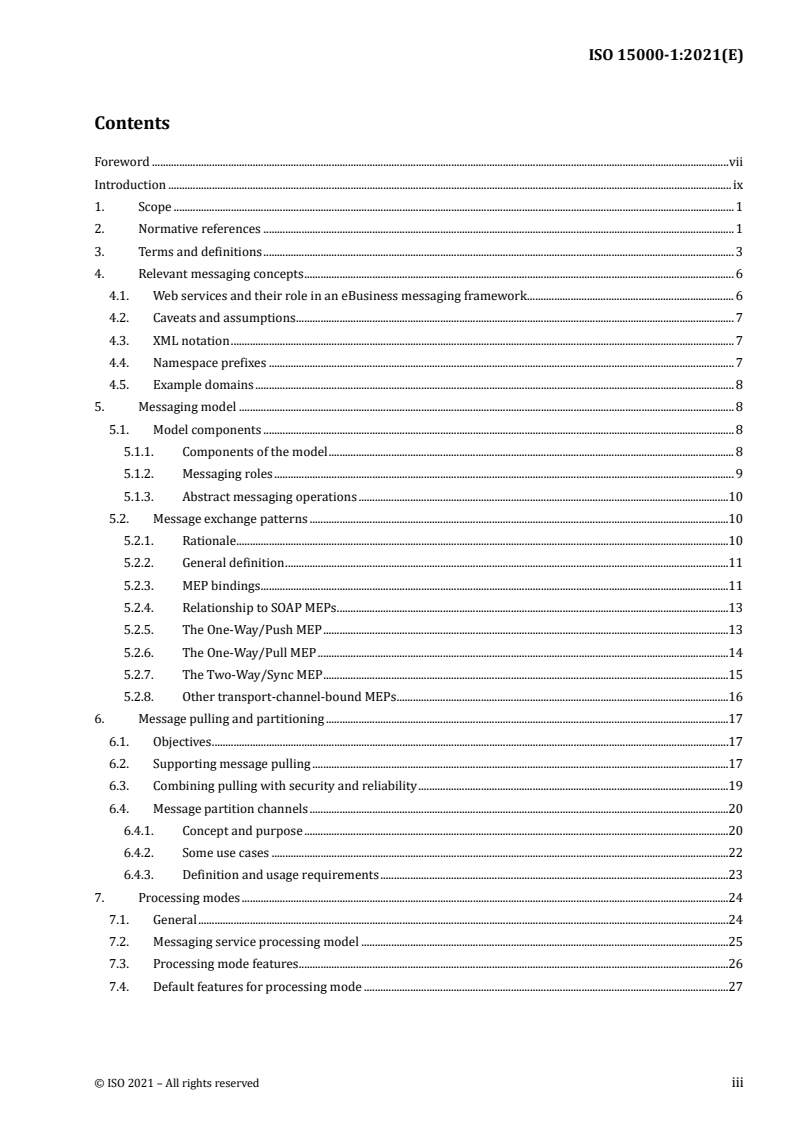
Contents
Foreword . vii
Introduction . ix
1. Scope . 1
2. Normative references . 1
3. Terms and definitions . 3
4. Relevant messaging concepts . 6
4.1. Web services and their role in an eBusiness messaging framework. 6
4.2. Caveats and assumptions . 7
4.3. XML notation . 7
4.4. Namespace prefixes . 7
4.5. Example domains . 8
5. Messaging model . 8
5.1. Model components . 8
5.1.1. Components of the model . 8
5.1.2. Messaging roles . 9
5.1.3. Abstract messaging operations . 10
5.2. Message exchange patterns .1 0
5.2.1. Rationale.1 0
5.2.2. General definition .1 1
5.2.3. MEP bindings .1 1
5.2.4. Relationship to SOAP MEPs .1 3
5.2.5. The One-Way/Push MEP .1 3
5.2.6. The One-Way/Pull MEP .1 4
5.2.7. The Two-Way/Sync MEP .1 5
5.2.8. Other transport-channel-bound MEPs. 16
6. Message pulling and partitioning .1 7
6.1. Objectives .1 7
6.2. Supporting message pulling .1 7
6.3. Combining pulling with security and reliability . 19
6.4. Message partition channels .2 0
6.4.1. Concept and purpose .2 0
6.4.2. Some use cases .2 2
6.4.3. Definition and usage requirements . 23
7. Processing modes .2 4
7.1. General .2 4
7.2. Messaging service processing model . 25
7.3. Processing mode features .2 6
7.4. Default features for processing mode . 27
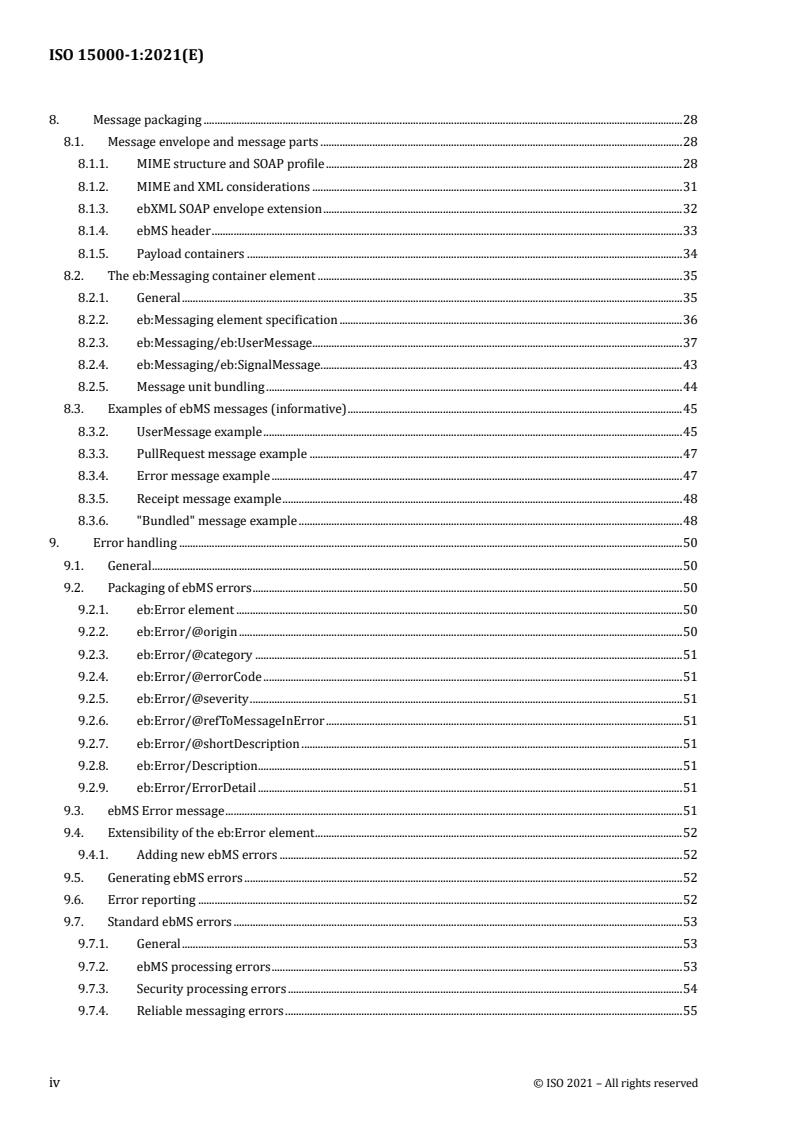
8. Message packaging . 28
8.1. Message envelope and message parts . 28
8.1.1. MIME structure and SOAP profile . 28
8.1.2. MIME and XML considerations . 31
8.1.3. ebXML SOAP envelope extension . 32
8.1.4. ebMS header . 33
8.1.5. Payload containers . 34
8.2. The eb:Messaging container element . 35
8.2.1. General . 35
8.2.2. eb:Messaging element specification . 36
8.2.3. eb:Messaging/eb:UserMessage. 37
8.2.4. eb:Messaging/eb:SignalMessage . 43
8.2.5. Message unit bundling . 44
8.3. Examples of ebMS messages (informative) . 45
8.3.2. UserMessage example . 45
8.3.3. PullRequest message example . 47
8.3.4. Error message example . 47
8.3.5. Receipt message example . 48
8.3.6. "Bundled" message example . 48
9. Error handling . 50
9.1. General . 50
9.2. Packaging of ebMS errors . 50
9.2.1. eb:Error element . 50
9.2.2. eb:Error/@origin . 50
9.2.3. eb:Error/@category . 51
9.2.4. eb:Error/@errorCode . 51
9.2.5. eb:Error/@severity . 51
9.2.6. eb:Error/@refToMessageInError . 51
9.2.7. eb:Error/@shortDescription . 51
9.2.8. eb:Error/Description. 51
9.2.9. eb:Error/ErrorDetail . 51
9.3. ebMS Error message . 51
9.4. Extensibility of the eb:Error element . 52
9.4.1. Adding new ebMS errors . 52
9.5. Generating ebMS errors . 52
9.6. Error reporting . 52
9.7. Standard ebMS errors . 53
9.7.1. General . 53
9.7.2. ebMS processing errors . 53
9.7.3. Security processing errors . 54
9.7.4. Reliable messaging errors . 55
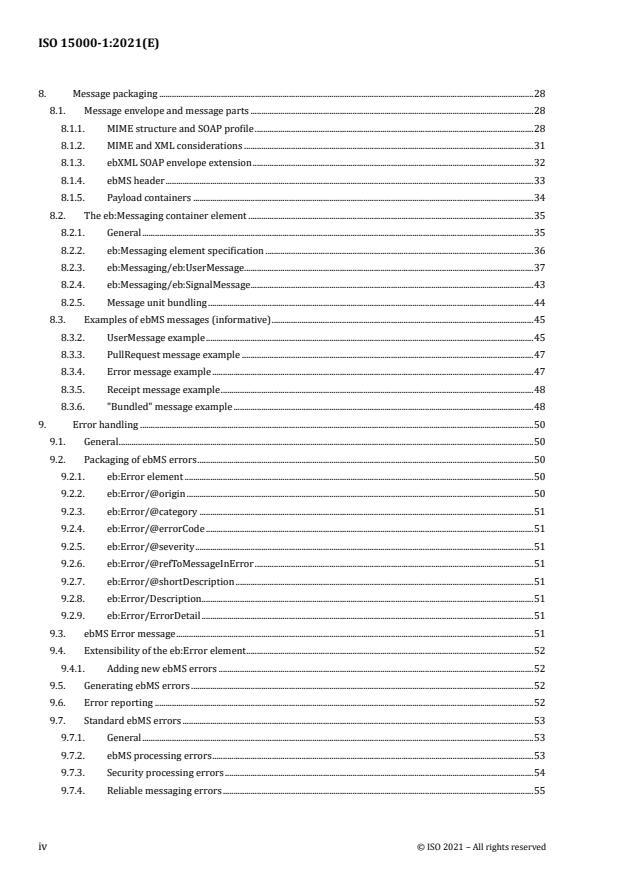
iv © ISO 2021 – All rights reserved
10. Security module .5 5
10.1. General .5 5
10.2. Security element .5 5
10.3. Signing messages .5 6
10.4. Signing SOAP with attachments messages . 56
10.5. Encrypting messages .5 7
10.6. Encrypting SOAP with attachments messages . 57
10.7. Signing and encrypting messages .5 7
10.8. Security token authentication .5 7
10.9. Security policy errors .5 7
10.10. Secured message examples .5 8
10.10.1. Digitally signed and encrypted ebXML message . 58
10.10.2. Digitally signed and encrypted ebXML SOAP with attachments message . 60
10.10.3. Digitally signed receipt signal message . 62
10.11. Message authorization .6 3
10.12. Securing the PullRequest signal .6 5
10.12.1. Authentication .6 5
10.12.2. Authorization .6 5
10.12.3. Preventing replay attacks .6 5
10.13. Countermeasure technologies .6 5
10.13.1. Persistent digital signature .6 5
10.13.2. Persistent signed receipt .6 6
10.13.3. Non-persistent authentication . 66
10.13.4. Non-persistent integrity .6 6
10.13.5. Persistent confidentiality .6 6
10.13.6. Non-persistent confidentiality . 66
10.13.7. Persistent authorization .6 6
10.13.8. Non-persistent authorization . 66
10.14. Security considerations .6 6
11. Reliable messaging module .6 8
11.1. The reliable messaging model .6 8
11.1.1. General .6 8
11.1.2. Message processing .6 8
11.1.3. The reliable messaging processor in the MSH . 68
11.2. Reliable delivery of ebMS messages .7 1
11.2.1. General .7 1
11.2.2. Reliability contracts for the RMP . 71
11.2.3. Reliability contracts for the MSH . 72
11.2.4. Reliability for signal messages .7 3
11.2.5. Handling of delivery failures .7 3
11.3. Reliability of ebMS MEPs . 74
11.3.1. General . 74
11.3.2. Reliability of the One-Way/Push MEP . 75
11.3.3. Reliability of the One-Way/Pull MEP . 76
11.3.4. Reliability of the Two-Way/Sync MEP . 77
11.3.5. Reliability of other transport-channel-bound MEPs . 78
Annex A (informative) The ebXML SOAP extension element schema . 79
Annex B (informative) Reliable messaging bindings . 83
Annex C (informative) SOAP format and bindings . 90
Annex D (informative) Processing modes . 94
Annex E (informative) P-Mode values and ebMS MEP bindings . 103
Annex F (informative) Compatibility mapping to ebMS 2.0 . 106
Annex G (informative) Conformance . 114
Bibliography . 115
vi © ISO 2021 – All rights reserved
Foreword
ISO (the International Organization for Standardization) is a worldwide federation of national standards
bodies (ISO member bodies). The work of preparing International Standards is normally carried out
through ISO technical committees. Each member body interested in a subject for which a technical
committee has been established has the right to be represented on that committee. International
organizations, governmental and non-governmental, in liaison with ISO, also take part in the work. ISO
collaborates closely with the International Electrotechnical Commission (IEC) on all matters of
electrotechnical standardization.
The procedures used to develop this document and those intended for its further maintenance are
described in the ISO/IEC Directives, Part 1. In particular, the different approval criteria needed for the
different types of ISO documents should be noted. This document was drafted in accordance with the
editorial rules of the ISO/IEC Directives, Part 2 (see www.iso.org/directives).
Attention is drawn to the possibility that some of the elements of this document may be the subject of
patent rights. ISO shall not be held responsible for identifying any or all such patent rights. Details of
any patent rights identified during the development of the document will be in the Introduction and/or
on the ISO list of patent declarations received (see www.iso.org/patents).
Any trade name used in this document is information given for the convenience of users and does not
constitute an endorsement.
For an explanation of the voluntary nature of standards, the meaning of ISO specific terms and
expressions related to conformity assessment, as well as information about ISO's adherence to the
World Trade Organization (WTO) principles in the Technical Barriers to Trade (TBT), see
www.iso.org/iso/foreword.html.
This document was prepared by the OASIS ebXML (Electronic business eXtensible Markup Language)
Messaging Services Committee (as “OASIS ebXML Messaging Services Version 3.0”) and drafted in
accordance with its editorial rules. It was assigned to Technical Committee ISO/TC 154, Processes, data
elements and documents in commerce, industry and administration and adopted under the "fast-track
procedure".
This first edition incorporates content from ISO/TS 15000-2:2004 and ISO/TS 15000-1:2004, which
have been withdrawn.
The main changes compared to ISO/TS 15000-2:2004 and ISO/TS 15000-1:2004 are as follows:
• The original ISO/TS 15000-2:2004 specification for the ebXML Messaging Service (ebMS) has
been updated and refactored into multiple parts, including this document, the “Core”
specification for ebMS, resubmitted to become this document.
• A separate “AS4 Profile of ebMS 3.0 Version 1.0” is submitted separately to ISO/TC 154. It
provides a select limited profile of the ebMS3 specification sufficient for Web Services business-
to-business messaging applications over the HTTP transport protocol, and is to become ISO
15000-2.
• This document defines the basic (and some optional) features necessary for reliable electronic
messaging and the transactional interactions that support such messaging.
• This document noted the availability of several newer methodologies, represented by normative
references and informative references included here, that were not available as of the 2004
version.
A list of all parts in the ISO 15000 series can be found on the ISO website.
Any feedback or questions on this document should be directed to the user’s national standards body. A
complete listing of these bodies can be found at www.iso.org/members.html.
viii © ISO 2021 – All rights reserved
Introduction
This document describes a communication-protocol neutral method for exchanging electronic business
messages. It defines specific enveloping constructs supporting reliable, secure delivery of business
information. Furthermore, the specification defines a flexible enveloping technique, permitting
messages to contain payloads of any format type. This versatility ensures that legacy electronic business
systems employing traditional syntaxes (i.e. UN/EDIFACT, ASC X12, or HL7) can leverage the advantages
of the ebXML infrastructure along with users of emerging technologies.
The prime objective of the ebXML messaging service (ebMS) is to facilitate the exchange of electronic
business messages within an XML framework that leverages common Internet standards, without
making any assumption on the integration and consumption model these messages will follow on the
back-end. These messages may be consumed in different ways that are out of scope of this document:
they may bind to a legacy application, to a service, be queued, enter a message workflow process, be
expected by an already-running business process, be batched for delayed processing, be routed over an
Enterprise Service Bus (ESB) before reaching their consumer application, or be dispatched based on
header data or payload data, etc.
It is becoming critical for broad adoption among all partners – large or small - of a supply-chain, to
handle differences in message flow capacity, intermittent connectivity, lack of static IP addresses or
firewall restrictions. Such new capabilities played an important role in the motivation that led to ebMS
3.0, along with the need to integrate and profile the emerging SOAP-based QoS-supporting standards.
The message header profiling that provided, in ebMS 2.0, a standard business-level header, has also
been extended to better address the diversity of back-end binding models, as well as the emerging trend
in business activity monitoring, the eBusiness side of which a message handler should be able to
support.
The ebXML messaging framework is not a restrictive one: business messages, identified as the
'payloads' of ebXML messages, are not limited to XML documents. Traditional EDI formats may also be
transported by ebMS. These payloads can take any digital form–XML, ASC X12, HL7, AIAG E5, database
tables, binary image files, etc. Multiple payloads, possibly of different MIME types, can be transported in
a single ebMS message. An objective of ebXML Messaging protocol is to be capable of being carried over
any available transfer protocol. This version of the specification provides bindings to HTTP and SMTP,
but other protocols to which SOAP may bind can also be used. The choice of an XML framework rather
reflects confidence in a growing XML-based Web infrastructure and development tools infrastructure,
the components of which can be leveraged and reused by developers.
INTERNATIONAL STANDARD ISO 15000-1:2021(E)
Electronic business eXtensible Markup Language
(ebXML) —
Part 1:
Messaging service core specification
1. Scope
This document provides a communication-protocol neutral method for exchanging electronic business
messages. It defines specific enveloping constructs supporting reliable, secure delivery of business
information. Furthermore, this document defines a flexible enveloping technique, permitting messages
to contain payloads of any format type.
It specifies each of the following:
• Messaging model
• Message pulling and partitioning
• Processing modes
• Message packaging
• Error handling
• Security module
• Reliable messaging module
This document is applicable to all types of organizations (e.g., commercial enterprises, government
agencies, not-for-profit organizations) that exchange documents or data electronically using messaging.
2. Normative references
The following documents are referred to in the text in such a way that some or all of their content
constitutes requirements of this document. For dated references, only the edition cited applies. For
undated references, the latest edition of the referenced document (including any amendments) applies.
INTERNET ASSIGNED NAMES AUTHORITY (IANA). MIME Media Types, Available from
http://www.iana.org/assignments/media-types/.
INTERNET ENGINEERING TASK FORCE (IETF). RFC 2045. Multipurpose Internet Mail Extensions (MIME)
Part One: Format of Internet Message Bodies, 1996. Edited by N Freed, et al. Available from
http://www.ietf.org/rfc/rfc2045.txt.
INTERNET ENGINEERING TASK FORCE (IETF). RFC 2279. UTF-8, a transformation format of ISO 10646,
1998. Edited by F. Yergeau. Available from http://www.ietf.org/rfc/rfc2279.txt.
INTERNET ENGINEERING TASK FORCE (IETF). RFC 2387. The MIME Multipart/Related Content-type,
1998. Edited by E. Levinson, Available from http://www.ietf.org/rfc/rfc2387.txt.
INTERNET ENGINEERING TASK FORCE (IETF). RFC 2392. Content-ID and Message-ID Uniform Resource
Locators, 1998. Edited by E. Levinson. Available from http://www.ietf.org/rfc/rfc2392.txt.
INTERNET ENGINEERING TASK FORCE (IETF). RFC 2396. Content-ID and Message-ID Uniform Resource
Locators, 1998. Edited by T. Berners-Lee, et al. Available from http://www.ietf.org/rfc/rfc2396.txt.
INTERNET ENGINEERING TASK FORCE (IETF). RFC 2616. Hypertext Transfer Protocol -- HTTP/1.1,
1999. Edited by R. Fielding, et al. Available from http://www.ietf.org/rfc/rfc2616.txt.
INTERNET ENGINEERING TASK FORCE (IETF). RFC 2822. Internet Message Format, 2001. Edited by
P. Resnick. Available from http://www.ietf.org/rfc/rfc2822.txt.
INTERNET ENGINEERING TASK FORCE (IETF). RFC 2821. Simple Mail Transfer Protocol, 2001. Edited by
J. Klensin. Available from http://www.ietf.org/rfc/rfc2821.txt.
OASIS. WS-Reliability 1.1, 2004. Edited by Kazunori Iwasa, et al. Available from http://docs.oasis-
open.org/wsrm/ws-reliability/v1.1/wsrm-ws_reliability-1.1-spec-os.pdf.
OASIS. Web Services Reliable Messaging (WS-ReliableMessaging) Version 1.1, 2007. Edited by D. Davis, et
al. Available from http://docs.oasis-open.org/ws-rx/wsrm/v1.1/wsrm.pdf.
OASIS. Web Services Reliable Messaging Policy (WS-RM Policy) Version 1.1, 2007. Edited by D. Davis, et al.
Available from http://docs.oasis-open.org/ws-rx/wsrmp/v1.1/wsrmp.pdf.
OASIS.Web Services Security: SOAP Message Security 1.0, 2004. Edited by Anthony Nadalin, et al Available
from http://docs.oasis-open.org/wss/2004/01/oasis-200401-wss-soap-message-security-1.0.pdf.
OASIS.Web Services Security UsernameToken Profile 1.0, 2004. Edited by P. Hallam-Baker, et al. Available
from http://docs.oasis-open.org/wss/2004/01/.
OASIS.Web Services Security X.509 Certificate Token Profile, 2004. Edited by P. Hallam-Baker, et al
Available from http://docs.oasis-open.org/wss/2004/01/.
ASIS.Web Services Security: SOAP Message Security 1.1, 2005. Edited by Anthony Nadalin, et al Available
from http://docs.oasis-open.org/wss/v1.1/.
OASIS.Web Services Security UsernameToken Profile 1.1, 2006. Edited by A. Nadalin, et al. Available from
http://docs.oasis-open.org/wss/v1.1/.
OASIS.Web Services Security X.509 Certificate Token Profile 1.1, 2006. Edited by A. Nadalin, et al. Available
from http://docs.oasis-open.org/wss/v1.1/.
WEB SERVICES INTEROPERABILITY ORGANIZATION. Attachments Profile Version 1.0, 2004. Edited by
Chris Ferris, et al. Available from http://www.ws-i.org/Profiles/AttachmentsProfile-1.0-2004-08-
24.html.
WEB SERVICES INTEROPERABILITY ORGANIZATION. Basic Security Profile Version 1.0, 2005. Edited by
Abbie Barbir, et al. Available from http://www.ws-i.org/Profiles/BasicSecurityProfile-1.0.html.
2 © ISO 2021 – All rights reserved
WORLD WIDE WEB CONSORTIUM. Simple Object Access Protocol (SOAP) 1.1, 2000. Edited by D. Box, et
al. Available from http://www.w3.org/TR/2000/NOTE-SOAP-20000508/.
WORLD WIDE WEB CONSORTIUM. SOAP Version 1.2 Part 1: Messaging Framework, 2003. Edited by
M. Gudgin, et al Available from http://www.w3.org/TR/soap12-part1/.
WORLD WIDE WEB CONSORTIUM. SOAP Messages with Attachments, 2000. Edited by J. Barton, et al.
Available from http://www.w3.org/TR/SOAP-attachments.
WORLD WIDE WEB CONSORTIUM.Extensible Markup Language (XML) 1.0 (Third Edition), 2004. Edited
by Tim Bray, et al. Available from http://www.w3.org/TR/2004/REC-xml-20040204/.
WORLD WIDE WEB CONSORTIUM. XML Schema Part 1: Structures Second Edition, 2004. Edited by Henry
S. Thompson, et al. Available from http://www.w3.org/TR/xmlschema-1/.
WORLD WIDE WEB CONSORTIUM. XML-Signature Syntax and Processing, 2002. Edited by Donald
Eastlake, et al. Available from http://www.w3.org/TR/xmldsig-core/.
WORLD WIDE WEB CONSORTIUM. XML Encryption Syntax and Processing, 2002. Edited by D. Eastlake,
et al. Available from http://www.w3.org/TR/xmlenc-core/.
WORLD WIDE WEB CONSORTIUM. Namespaces in XML, 1999. Edited by Tim Bray, et al. Available from
http://www.w3.org/TR/REC-xml-names/.
3. Terms and definitions
For the purposes of this document, the following terms and definitions apply.
ISO and IEC maintain terminological databases for use in standardization at the following addresses:
— ISO Online browsing platform: available at https://www.iso.org/obp
— IEC Electropedia: available at http://www.electropedia.org/
3.1
ebMS error generation
Operation of creating an ebMS error (3.14) based on some failure or warning condition
3.2
ebMS error reporting
Operation of communicating an ebMS error (3.14) to some other entity
3.3
ebMS message
SOAP message (3.29) that contains SOAP header(s) qualified with the ebMS namespace and that
conforms to this document
3.4
ebMS message exchange pattern
ebMS MEP
Choreography of ebMS user messages (3.11) which are all related through the use of the referencing
feature (eb:RefToMessageId)
3.5
ebMS MEP transport channel binding
Binding of an ebMS message exchange pattern (3.4) that defines how the ebMS MEP maps abstractly to
the channels allowed by an underlying transport protocol
3.6
ebMS MEP transport protocol binding
Binding of an ebMS message exchange pattern (3.4) that defines further how an ebMS MEP transport
channel binding (3.5) is implemented over a specific underlying transport protocol
3.7
ebMS message unit
Logical unit of data that is a subset of an ebMS Message (3.3)
3.8
ebMS messaging service handler
ebMS MSH
Entity that is able to generate or process ebMS messages (3.3) that conform to this document
3.9
ebMS user message unit
ebMS message unit (3.7) that is represented by the XML infoset eb:Messaging/eb:UserMessage,
together with any referenced payload items
Note 1 to entry: This is the part of the ebMS message that is submitted by a producer (via the “submit”
operation) and that is subject to delivery to a consumer.
3.10
ebMS signal message unit
ebMS message unit (3.7) that is represented by the XML infoset eb:Messaging/eb:SignalMessage
Note 1 to entry: Its role is to activate a specific function in the receiving MSH. It is not intended to be
delivered to a message consumer.
3.11
ebMS user message
ebMS message (3.3) that contains an ebMS user message unit (3.9)
3.12
ebMS signal message
ebMS message (3.3) that contains an ebMS signal message unit (3.10)
3.13
ebMS pull signal message
ebMS signal message (3.12) that contains an eb:PullRequest element
3.14
ebMS error
Particular case of Error (3.15) that is generated by the ebMS module in conformity with this document
3.15
Error
Object representing some failure or warning condition that originates in one of the defined modules
(ebMS module, reliability module, security module)
4 © ISO 2021 – All rights reserved
3.16
Escalated ebMS error
ebMS error (3.14) that originates in a module other than the ebMS Module (i.e. security module, or
reliability module)
3.17
Fault
Object representing some failure or warning condition that originates in SOAP processing
Note 1 to entry. It shall be generated and processed according to the W3C SOAP 1.1 or SOAP 1.2
specifications.
3.18
Message consumer
Entity that interacts with a receiving ebMS MSH (3.8) (i.e. an MSH in the receiving role) to consume data
from a received ebMS user message (3.11)
3.19
Message partition channel
Mechanism to partition the flow of messages from a sending MSH to a receiving MSH into several flows
that can be controlled separately and consumed differently
3.20
Message producer
Entity that interacts with a sending ebMS MSH (3.8) (i.e. an MSH in the sending role) to initiate the
sending of an ebMS user message (3.11)
3.21
Message-in-error
Flawed message causing an Error (3.15) of some kind
3.22
One-Way message exchange pattern
one-way MEP
Exchange of a single ebMS user message unit (3.9) unrelated to other user messages
3.23
Processing mode
P-Mode
Contextual information that governs the processing of a particular ebMS message (3.3)
Note 1 to entry: A P-Mode is not provided on a per-message basis, but is common to a set of messages
exchanged between or among parties. It may be interpreted as configuration data for a deployed MSH.
3.24
Processing mode operation set
Set of all P-Modes (3.23) that are supported by an ebMS MSH (3.8) during operation
3.25
Pull channel binding
ebMS MEP transport channel binding (3.5) in which the transfer of an ebMS message (3.3) is initiated by
the receiver
3.26
Push channel binding
ebMS MEP transport channel binding (3.5) in which the transfer of an ebMS message (3.3) is initiated by
the sender
3.27
Reliability error
Error (3.15) generated by the reliability module
3.28
Security error
Error (3.15) generated by the security module
3.29
SOAP message
Message that conforms to the SOAP 1.1 or SOAP 1.2 W3C specifications
3.30
Two-way message exchange pattern
two-way MEP
Exchange of two ebMS user message units (3.9) in opposite directions, in which the first one to occur is
labeled "request" and the second one "reply".
4. Relevant messaging concepts
4.1. Web services and the
...
INTERNATIONAL ISO
STANDARD 15000-1
First edition
2021-02
Electronic business eXtensible
Markup Language (ebXML) —
Part 1:
Messaging service core specification
Reference number
©
ISO 2021
© ISO 2021
All rights reserved. Unless otherwise specified, or required in the context of its implementation, no part of this publication may
be reproduced or utilized otherwise in any form or by any means, electronic or mechanical, including photocopying, or posting
on the internet or an intranet, without prior written permission. Permission can be requested from either ISO at the address
below or ISO’s member body in the country of the requester.
ISO copyright office
CP 401 • Ch. de Blandonnet 8
CH-1214 Vernier, Geneva
Phone: +41 22 749 01 11
Email: copyright@iso.org
Website: www.iso.org
Published in Switzerland
ii © ISO 2021 – All rights reserved
Contents
Foreword . vii
Introduction . ix
1. Scope . 1
2. Normative references . 1
3. Terms and definitions . 3
4. Relevant messaging concepts . 6
4.1. Web services and their role in an eBusiness messaging framework. 6
4.2. Caveats and assumptions . 7
4.3. XML notation . 7
4.4. Namespace prefixes . 7
4.5. Example domains . 8
5. Messaging model . 8
5.1. Model components . 8
5.1.1. Components of the model . 8
5.1.2. Messaging roles . 9
5.1.3. Abstract messaging operations . 10
5.2. Message exchange patterns .1 0
5.2.1. Rationale.1 0
5.2.2. General definition .1 1
5.2.3. MEP bindings .1 1
5.2.4. Relationship to SOAP MEPs .1 3
5.2.5. The One-Way/Push MEP .1 3
5.2.6. The One-Way/Pull MEP .1 4
5.2.7. The Two-Way/Sync MEP .1 5
5.2.8. Other transport-channel-bound MEPs. 16
6. Message pulling and partitioning .1 7
6.1. Objectives .1 7
6.2. Supporting message pulling .1 7
6.3. Combining pulling with security and reliability . 19
6.4. Message partition channels .2 0
6.4.1. Concept and purpose .2 0
6.4.2. Some use cases .2 2
6.4.3. Definition and usage requirements . 23
7. Processing modes .2 4
7.1. General .2 4
7.2. Messaging service processing model . 25
7.3. Processing mode features .2 6
7.4. Default features for processing mode . 27
8. Message packaging . 28
8.1. Message envelope and message parts . 28
8.1.1. MIME structure and SOAP profile . 28
8.1.2. MIME and XML considerations . 31
8.1.3. ebXML SOAP envelope extension . 32
8.1.4. ebMS header . 33
8.1.5. Payload containers . 34
8.2. The eb:Messaging container element . 35
8.2.1. General . 35
8.2.2. eb:Messaging element specification . 36
8.2.3. eb:Messaging/eb:UserMessage. 37
8.2.4. eb:Messaging/eb:SignalMessage . 43
8.2.5. Message unit bundling . 44
8.3. Examples of ebMS messages (informative) . 45
8.3.2. UserMessage example . 45
8.3.3. PullRequest message example . 47
8.3.4. Error message example . 47
8.3.5. Receipt message example . 48
8.3.6. "Bundled" message example . 48
9. Error handling . 50
9.1. General . 50
9.2. Packaging of ebMS errors . 50
9.2.1. eb:Error element . 50
9.2.2. eb:Error/@origin . 50
9.2.3. eb:Error/@category . 51
9.2.4. eb:Error/@errorCode . 51
9.2.5. eb:Error/@severity . 51
9.2.6. eb:Error/@refToMessageInError . 51
9.2.7. eb:Error/@shortDescription . 51
9.2.8. eb:Error/Description. 51
9.2.9. eb:Error/ErrorDetail . 51
9.3. ebMS Error message . 51
9.4. Extensibility of the eb:Error element . 52
9.4.1. Adding new ebMS errors . 52
9.5. Generating ebMS errors . 52
9.6. Error reporting . 52
9.7. Standard ebMS errors . 53
9.7.1. General . 53
9.7.2. ebMS processing errors . 53
9.7.3. Security processing errors . 54
9.7.4. Reliable messaging errors . 55
iv © ISO 2021 – All rights reserved
10. Security module .5 5
10.1. General .5 5
10.2. Security element .5 5
10.3. Signing messages .5 6
10.4. Signing SOAP with attachments messages . 56
10.5. Encrypting messages .5 7
10.6. Encrypting SOAP with attachments messages . 57
10.7. Signing and encrypting messages .5 7
10.8. Security token authentication .5 7
10.9. Security policy errors .5 7
10.10. Secured message examples .5 8
10.10.1. Digitally signed and encrypted ebXML message . 58
10.10.2. Digitally signed and encrypted ebXML SOAP with attachments message . 60
10.10.3. Digitally signed receipt signal message . 62
10.11. Message authorization .6 3
10.12. Securing the PullRequest signal .6 5
10.12.1. Authentication .6 5
10.12.2. Authorization .6 5
10.12.3. Preventing replay attacks .6 5
10.13. Countermeasure technologies .6 5
10.13.1. Persistent digital signature .6 5
10.13.2. Persistent signed receipt .6 6
10.13.3. Non-persistent authentication . 66
10.13.4. Non-persistent integrity .6 6
10.13.5. Persistent confidentiality .6 6
10.13.6. Non-persistent confidentiality . 66
10.13.7. Persistent authorization .6 6
10.13.8. Non-persistent authorization . 66
10.14. Security considerations .6 6
11. Reliable messaging module .6 8
11.1. The reliable messaging model .6 8
11.1.1. General .6 8
11.1.2. Message processing .6 8
11.1.3. The reliable messaging processor in the MSH . 68
11.2. Reliable delivery of ebMS messages .7 1
11.2.1. General .7 1
11.2.2. Reliability contracts for the RMP . 71
11.2.3. Reliability contracts for the MSH . 72
11.2.4. Reliability for signal messages .7 3
11.2.5. Handling of delivery failures .7 3
11.3. Reliability of ebMS MEPs . 74
11.3.1. General . 74
11.3.2. Reliability of the One-Way/Push MEP . 75
11.3.3. Reliability of the One-Way/Pull MEP . 76
11.3.4. Reliability of the Two-Way/Sync MEP . 77
11.3.5. Reliability of other transport-channel-bound MEPs . 78
Annex A (informative) The ebXML SOAP extension element schema . 79
Annex B (informative) Reliable messaging bindings . 83
Annex C (informative) SOAP format and bindings . 90
Annex D (informative) Processing modes . 94
Annex E (informative) P-Mode values and ebMS MEP bindings . 103
Annex F (informative) Compatibility mapping to ebMS 2.0 . 106
Annex G (informative) Conformance . 114
Bibliography . 115
vi © ISO 2021 – All rights reserved
Foreword
ISO (the International Organization for Standardization) is a worldwide federation of national standards
bodies (ISO member bodies). The work of preparing International Standards is normally carried out
through ISO technical committees. Each member body interested in a subject for which a technical
committee has been established has the right to be represented on that committee. International
organizations, governmental and non-governmental, in liaison with ISO, also take part in the work. ISO
collaborates closely with the International Electrotechnical Commission (IEC) on all matters of
electrotechnical standardization.
The procedures used to develop this document and those intended for its further maintenance are
described in the ISO/IEC Directives, Part 1. In particular, the different approval criteria needed for the
different types of ISO documents should be noted. This document was drafted in accordance with the
editorial rules of the ISO/IEC Directives, Part 2 (see www.iso.org/directives).
Attention is drawn to the possibility that some of the elements of this document may be the subject of
patent rights. ISO shall not be held responsible for identifying any or all such patent rights. Details of
any patent rights identified during the development of the document will be in the Introduction and/or
on the ISO list of patent declarations received (see www.iso.org/patents).
Any trade name used in this document is information given for the convenience of users and does not
constitute an endorsement.
For an explanation of the voluntary nature of standards, the meaning of ISO specific terms and
expressions related to conformity assessment, as well as information about ISO's adherence to the
World Trade Organization (WTO) principles in the Technical Barriers to Trade (TBT), see
www.iso.org/iso/foreword.html.
This document was prepared by the OASIS ebXML (Electronic business eXtensible Markup Language)
Messaging Services Committee (as “OASIS ebXML Messaging Services Version 3.0”) and drafted in
accordance with its editorial rules. It was assigned to Technical Committee ISO/TC 154, Processes, data
elements and documents in commerce, industry and administration and adopted under the "fast-track
procedure".
This first edition incorporates content from ISO/TS 15000-2:2004 and ISO/TS 15000-1:2004, which
have been withdrawn.
The main changes compared to ISO/TS 15000-2:2004 and ISO/TS 15000-1:2004 are as follows:
• The original ISO/TS 15000-2:2004 specification for the ebXML Messaging Service (ebMS) has
been updated and refactored into multiple parts, including this document, the “Core”
specification for ebMS, resubmitted to become this document.
• A separate “AS4 Profile of ebMS 3.0 Version 1.0” is submitted separately to ISO/TC 154. It
provides a select limited profile of the ebMS3 specification sufficient for Web Services business-
to-business messaging applications over the HTTP transport protocol, and is to become ISO
15000-2.
• This document defines the basic (and some optional) features necessary for reliable electronic
messaging and the transactional interactions that support such messaging.
• This document noted the availability of several newer methodologies, represented by normative
references and informative references included here, that were not available as of the 2004
version.
A list of all parts in the ISO 15000 series can be found on the ISO website.
Any feedback or questions on this document should be directed to the user’s national standards body. A
complete listing of these bodies can be found at www.iso.org/members.html.
viii © ISO 2021 – All rights reserved
Introduction
This document describes a communication-protocol neutral method for exchanging electronic business
messages. It defines specific enveloping constructs supporting reliable, secure delivery of business
information. Furthermore, the specification defines a flexible enveloping technique, permitting
messages to contain payloads of any format type. This versatility ensures that legacy electronic business
systems employing traditional syntaxes (i.e. UN/EDIFACT, ASC X12, or HL7) can leverage the advantages
of the ebXML infrastructure along with users of emerging technologies.
The prime objective of the ebXML messaging service (ebMS) is to facilitate the exchange of electronic
business messages within an XML framework that leverages common Internet standards, without
making any assumption on the integration and consumption model these messages will follow on the
back-end. These messages may be consumed in different ways that are out of scope of this document:
they may bind to a legacy application, to a service, be queued, enter a message workflow process, be
expected by an already-running business process, be batched for delayed processing, be routed over an
Enterprise Service Bus (ESB) before reaching their consumer application, or be dispatched based on
header data or payload data, etc.
It is becoming critical for broad adoption among all partners – large or small - of a supply-chain, to
handle differences in message flow capacity, intermittent connectivity, lack of static IP addresses or
firewall restrictions. Such new capabilities played an important role in the motivation that led to ebMS
3.0, along with the need to integrate and profile the emerging SOAP-based QoS-supporting standards.
The message header profiling that provided, in ebMS 2.0, a standard business-level header, has also
been extended to better address the diversity of back-end binding models, as well as the emerging trend
in business activity monitoring, the eBusiness side of which a message handler should be able to
support.
The ebXML messaging framework is not a restrictive one: business messages, identified as the
'payloads' of ebXML messages, are not limited to XML documents. Traditional EDI formats may also be
transported by ebMS. These payloads can take any digital form–XML, ASC X12, HL7, AIAG E5, database
tables, binary image files, etc. Multiple payloads, possibly of different MIME types, can be transported in
a single ebMS message. An objective of ebXML Messaging protocol is to be capable of being carried over
any available transfer protocol. This version of the specification provides bindings to HTTP and SMTP,
but other protocols to which SOAP may bind can also be used. The choice of an XML framework rather
reflects confidence in a growing XML-based Web infrastructure and development tools infrastructure,
the components of which can be leveraged and reused by developers.
INTERNATIONAL STANDARD ISO 15000-1:2021(E)
Electronic business eXtensible Markup Language
(ebXML) —
Part 1:
Messaging service core specification
1. Scope
This document provides a communication-protocol neutral method for exchanging electronic business
messages. It defines specific enveloping constructs supporting reliable, secure delivery of business
information. Furthermore, this document defines a flexible enveloping technique, permitting messages
to contain payloads of any format type.
It specifies each of the following:
• Messaging model
• Message pulling and partitioning
• Processing modes
• Message packaging
• Error handling
• Security module
• Reliable messaging module
This document is applicable to all types of organizations (e.g., commercial enterprises, government
agencies, not-for-profit organizations) that exchange documents or data electronically using messaging.
2. Normative references
The following documents are referred to in the text in such a way that some or all of their content
constitutes requirements of this document. For dated references, only the edition cited applies. For
undated references, the latest edition of the referenced document (including any amendments) applies.
INTERNET ASSIGNED NAMES AUTHORITY (IANA). MIME Media Types, Available from
http://www.iana.org/assignments/media-types/.
INTERNET ENGINEERING TASK FORCE (IETF). RFC 2045. Multipurpose Internet Mail Extensions (MIME)
Part One: Format of Internet Message Bodies, 1996. Edited by N Freed, et al. Available from
http://www.ietf.org/rfc/rfc2045.txt.
INTERNET ENGINEERING TASK FORCE (IETF). RFC 2279. UTF-8, a transformation format of ISO 10646,
1998. Edited by F. Yergeau. Available from http://www.ietf.org/rfc/rfc2279.txt.
INTERNET ENGINEERING TASK FORCE (IETF). RFC 2387. The MIME Multipart/Related Content-type,
1998. Edited by E. Levinson, Available from http://www.ietf.org/rfc/rfc2387.txt.
INTERNET ENGINEERING TASK FORCE (IETF). RFC 2392. Content-ID and Message-ID Uniform Resource
Locators, 1998. Edited by E. Levinson. Available from http://www.ietf.org/rfc/rfc2392.txt.
INTERNET ENGINEERING TASK FORCE (IETF). RFC 2396. Content-ID and Message-ID Uniform Resource
Locators, 1998. Edited by T. Berners-Lee, et al. Available from http://www.ietf.org/rfc/rfc2396.txt.
INTERNET ENGINEERING TASK FORCE (IETF). RFC 2616. Hypertext Transfer Protocol -- HTTP/1.1,
1999. Edited by R. Fielding, et al. Available from http://www.ietf.org/rfc/rfc2616.txt.
INTERNET ENGINEERING TASK FORCE (IETF). RFC 2822. Internet Message Format, 2001. Edited by
P. Resnick. Available from http://www.ietf.org/rfc/rfc2822.txt.
INTERNET ENGINEERING TASK FORCE (IETF). RFC 2821. Simple Mail Transfer Protocol, 2001. Edited by
J. Klensin. Available from http://www.ietf.org/rfc/rfc2821.txt.
OASIS. WS-Reliability 1.1, 2004. Edited by Kazunori Iwasa, et al. Available from http://docs.oasis-
open.org/wsrm/ws-reliability/v1.1/wsrm-ws_reliability-1.1-spec-os.pdf.
OASIS. Web Services Reliable Messaging (WS-ReliableMessaging) Version 1.1, 2007. Edited by D. Davis, et
al. Available from http://docs.oasis-open.org/ws-rx/wsrm/v1.1/wsrm.pdf.
OASIS. Web Services Reliable Messaging Policy (WS-RM Policy) Version 1.1, 2007. Edited by D. Davis, et al.
Available from http://docs.oasis-open.org/ws-rx/wsrmp/v1.1/wsrmp.pdf.
OASIS.Web Services Security: SOAP Message Security 1.0, 2004. Edited by Anthony Nadalin, et al Available
from http://docs.oasis-open.org/wss/2004/01/oasis-200401-wss-soap-message-security-1.0.pdf.
OASIS.Web Services Security UsernameToken Profile 1.0, 2004. Edited by P. Hallam-Baker, et al. Available
from http://docs.oasis-open.org/wss/2004/01/.
OASIS.Web Services Security X.509 Certificate Token Profile, 2004. Edited by P. Hallam-Baker, et al
Available from http://docs.oasis-open.org/wss/2004/01/.
ASIS.Web Services Security: SOAP Message Security 1.1, 2005. Edited by Anthony Nadalin, et al Available
from http://docs.oasis-open.org/wss/v1.1/.
OASIS.Web Services Security UsernameToken Profile 1.1, 2006. Edited by A. Nadalin, et al. Available from
http://docs.oasis-open.org/wss/v1.1/.
OASIS.Web Services Security X.509 Certificate Token Profile 1.1, 2006. Edited by A. Nadalin, et al. Available
from http://docs.oasis-open.org/wss/v1.1/.
WEB SERVICES INTEROPERABILITY ORGANIZATION. Attachments Profile Version 1.0, 2004. Edited by
Chris Ferris, et al. Available from http://www.ws-i.org/Profiles/AttachmentsProfile-1.0-2004-08-
24.html.
WEB SERVICES INTEROPERABILITY ORGANIZATION. Basic Security Profile Version 1.0, 2005. Edited by
Abbie Barbir, et al. Available from http://www.ws-i.org/Profiles/BasicSecurityProfile-1.0.html.
2 © ISO 2021 – All rights reserved
WORLD WIDE WEB CONSORTIUM. Simple Object Access Protocol (SOAP) 1.1, 2000. Edited by D. Box, et
al. Available from http://www.w3.org/TR/2000/NOTE-SOAP-20000508/.
WORLD WIDE WEB CONSORTIUM. SOAP Version 1.2 Part 1: Messaging Framework, 2003. Edited by
M. Gudgin, et al Available from http://www.w3.org/TR/soap12-part1/.
WORLD WIDE WEB CONSORTIUM. SOAP Messages with Attachments, 2000. Edited by J. Barton, et al.
Available from http://www.w3.org/TR/SOAP-attachments.
WORLD WIDE WEB CONSORTIUM.Extensible Markup Language (XML) 1.0 (Third Edition), 2004. Edited
by Tim Bray, et al. Available from http://www.w3.org/TR/2004/REC-xml-20040204/.
WORLD WIDE WEB CONSORTIUM. XML Schema Part 1: Structures Second Edition, 2004. Edited by Henry
S. Thompson, et al. Available from http://www.w3.org/TR/xmlschema-1/.
WORLD WIDE WEB CONSORTIUM. XML-Signature Syntax and Processing, 2002. Edited by Donald
Eastlake, et al. Available from http://www.w3.org/TR/xmldsig-core/.
WORLD WIDE WEB CONSORTIUM. XML Encryption Syntax and Processing, 2002. Edited by D. Eastlake,
et al. Available from http://www.w3.org/TR/xmlenc-core/.
WORLD WIDE WEB CONSORTIUM. Namespaces in XML, 1999. Edited by Tim Bray, et al. Available from
http://www.w3.org/TR/REC-xml-names/.
3. Terms and definitions
For the purposes of this document, the following terms and definitions apply.
ISO and IEC maintain terminological databases for use in standardization at the following addresses:
— ISO Online browsing platform: available at https://www.iso.org/obp
— IEC Electropedia: available at http://www.electropedia.org/
3.1
ebMS error generation
Operation of creating an ebMS error (3.14) based on some failure or warning condition
3.2
ebMS error reporting
Operation of communicating an ebMS error (3.14) to some other entity
3.3
ebMS message
SOAP message (3.29) that contains SOAP header(s) qualified with the ebMS namespace and that
conforms to this document
3.4
ebMS message exchange pattern
ebMS MEP
Choreography of ebMS user messages (3.11) which are all related through the use of the referencing
feature (eb:RefToMessageId)
3.5
ebMS MEP transport channel binding
Binding of an ebMS message exchange pattern (3.4) that defines how the ebMS MEP maps abstractly to
the channels allowed by an underlying transport protocol
3.6
ebMS MEP transport protocol binding
Binding of an ebMS message exchange pattern (3.4) that defines further how an ebMS MEP transport
channel binding (3.5) is implemented over a specific underlying transport protocol
3.7
ebMS message unit
Logical unit of data that is a subset of an ebMS Message (3.3)
3.8
ebMS messaging service handler
ebMS MSH
Entity that is able to generate or process ebMS messages (3.3) that conform to this document
3.9
ebMS user message unit
ebMS message unit (3.7) that is represented by the XML infoset eb:Messaging/eb:UserMessage,
together with any referenced payload items
Note 1 to entry: This is the part of the ebMS message that is submitted by a producer (via the “submit”
operation) and that is subject to delivery to a consumer.
3.10
ebMS signal message unit
ebMS message unit (3.7) that is represented by the XML infoset eb:Messaging/eb:SignalMessage
Note 1 to entry: Its role is to activate a specific function in the receiving MSH. It is not intended to be
delivered to a message consumer.
3.11
ebMS user message
ebMS message (3.3) that contains an ebMS user message unit (3.9)
3.12
ebMS signal message
ebMS message (3.3) that contains an ebMS signal message unit (3.10)
3.13
ebMS pull signal message
ebMS signal message (3.12) that contains an eb:PullRequest element
3.14
ebMS error
Particular case of Error (3.15) that is generated by the ebMS module in conformity with this document
3.15
Error
Object representing some failure or warning condition that originates in one of the defined modules
(ebMS module, reliability module, security module)
4 © ISO 2021 – All rights reserved
3.16
Escalated ebMS error
ebMS error (3.14) that originates in a module other than the ebMS Module (i.e. security module, or
reliability module)
3.17
Fault
Object representing some failure or warning condition that originates in SOAP processing
Note 1 to entry. It shall be generated and processed according to the W3C SOAP 1.1 or SOAP 1.2
specifications.
3.18
Message consumer
Entity that interacts with a receiving ebMS MSH (3.8) (i.e. an MSH in the receiving role) to consume data
from a received ebMS user message (3.11)
3.19
Message partition channel
Mechanism to partition the flow of messages from a sending MSH to a receiving MSH into several flows
that can be controlled separately and consumed differently
3.20
Message producer
Entity that interacts with a sending ebMS MSH (3.8) (i.e. an MSH in the sending role) to initiate the
sending of an ebMS user message (3.11)
3.21
Message-in-error
Flawed message causing an Error (3.15) of some kind
3.22
One-Way message exchange pattern
one-way MEP
Exchange of a single ebMS user message unit (3.9) unrelated to other user messages
3.23
Processing mode
P-Mode
Contextual information that governs the processing of a particular ebMS message (3.3)
Note 1 to entry: A P-Mode is not provided on a per-message basis, but is common to a set of messages
exchanged between or among parties. It may be interpreted as configuration data for a deployed MSH.
3.24
Processing mode operation set
Set of all P-Modes (3.23) that are supported by an ebMS MSH (3.8) during operation
3.25
Pull channel binding
ebMS MEP transport channel binding (3.5) in which the transfer of an ebMS message (3.3) is initiated by
the receiver
3.26
Push channel binding
ebMS MEP transport channel binding (3.5) in which the transfer of an ebMS message (3.3) is initiated by
the sender
3.27
Reliability error
Error (3.15) generated by the reliability module
3.28
Security error
Error (3.15) generated by the security module
3.29
SOAP message
Message that conforms to the SOAP 1.1 or SOAP 1.2 W3C specifications
3.30
Two-way message exchange pattern
two-way MEP
Exchange of two ebMS user message units (3.9) in opposite directions, in which the first one to occur is
labeled "request" and the second one "reply".
4. Relevant messaging concepts
4.1. Web services and the
...